×
Hero Background
English
Chinese
French
Japanese
Korean
German
Spanish

Osseointegration Implants Market Size

ID: MRFR/MED/5277-HCR
110 Pages
Kinjoll Dey
October 2025

Osseointegration Implants Market Research Report, by Product (Bone-anchored Prostheses, Dental Implants and Others), By Material Type (Metallic, Ceramic, Polymeric and Others), By End User (Hospitals, Ambulatory Surgical Clinics and Others), By Region (Americas, Europe, Asia Pacific and The Middle East and Africa) - Global Forecast Till 2035

Share:
Download PDF ×

We do not share your information with anyone. However, we may send you emails based on your report interest from time to time. You may contact us at any time to opt-out.

Osseointegration Implants Market Infographic
Purchase Options

Osseointegration Implants Size

Osseointegration Implants Market Growth Projections and Opportunities

Factors affecting the Osseointegration Implants Market are enormous in number and play a vital role in shaping its growth trajectory. Modern implantology has made osseointegration an important aspect, which is direct structural and functional connection between living bone and surface of load-bearing implant. One of the main reasons for the growth of Osseointegration Implants Market is increasing prevalence of dental disorders and orthopedic diseases. With global population aging, there has been a significant increase in incidents such as tooth loss, joint problems requiring implants surgeries. This demographic shift has created significant market demand for osseointegration implants that effectively address these conditions’ consequences on functions and quality life.

The market for Osseointegration Implants also benefits from technological advancements and innovations. Research and development done over time have led to introduction of advanced materials and new designs that make osseointegration procedures more effective cum successful. Technologies like 3D printing among others have improved precision resulting into customized Osseointegration Implants to meet patients’ specific needs. They have not only enhanced patient experience but also increased general acceptance as well as contributed towards the growth of osseointegration implants within medical community.

Another major element influencing the Osseointegration Implants Market is growing awareness and acceptance levels about oral implant surgeries among people suffering from dental or orthopedicrelated issues. Patients now understand durability, functionability and aesthetics benefits associated with osseointegrated implants better than before unlike in earlier years of my work experience when I had to explain them in details so that they could be convinced to go for this option instead of other types available then; moreover other health professionals including dentists or orthopedic surgeons who are now much interested this way because it is becoming more popular type on account all these positive factors make it important expanding adoption process taking place within industry continuously supports further development market overall favoring possibilities wide access new technologies.

Reimbursment policies and healthcare infrastructure on the economic front are critical to determining the market dynamics of Osseointegration Implants. Reimbursement policies that are favorable to implant procedures can significantly improve access to these treatments for a broader population. Additionally, presence of well-established medical facilities is critical in facilitating seamless integration of osseointegration implantation as main stream medical processes.

Global collaborations and partnerships between key industry players also contribute to the growth of the Osseointegration Implants Market. Joint research and development, marketing and distribution activities facilitate wider access to osseointegrated implants. This has created competitive situation that promotes innovation ensuring continual arrival new improved versions.

However, there are barriers against market growth such as expensive nature of osseointegrated implant procedures, hazards and complications related to it. To overcome these hindrances and sustain market growth rate, it is important for continuous research with cost effective manufacturing techniques coupled with stringent quality control procedures to be put in place."

Osseointegration Implants Market Size Graph
Author
Kinjoll Dey
Research Analyst Level I

He is an extremely curious individual currently working in Healthcare and Medical Devices Domain. Kinjoll is comfortably versed in data centric research backed by healthcare educational background. He leverages extensive data mining and analytics tools such as Primary and Secondary Research, Statistical Analysis, Machine Learning, Data Modelling. His key role also involves Technical Sales Support, Client Interaction and Project management within the Healthcare team. Lastly, he showcases extensive affinity towards learning new skills and remain fascinated in implementing them.

Leave a Comment

FAQs

At what CAGR is the osseointegration implants market projected to grow during the forecast period?

The osseointegration implants market is projected to grow at a 6.80% CAGR during the forecast period.

What will be the value of the osseointegration implants market during the forecast period?

The osseointegration implants market is predicted to touch USD 7.50 billion during the forecast period.

Which region is projected to command the largest share in the osseointegration implants market?

The Americas is projected to command the largest share in the osseointegration implants market.

Which end user segment will have the largest share in the osseointegration implants market?

The hospitals segment will have the largest share in the osseointegration implants market.

Which factors may limit the osseointegration implants market?

Risk of bone damage may limit market growth.

Market Summary

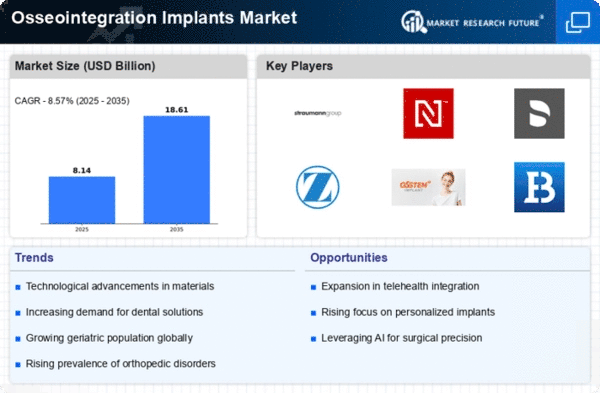
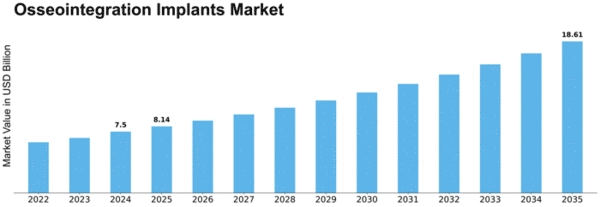
As per MRFR analysis, the Osseointegration Implants Market Size was estimated at 7.5 USD Billion in 2024. The Osseointegration Implants industry is projected to grow from 8.23 USD Billion in 2025 to 18.61 USD Billion by 2035, exhibiting a compound annual growth rate (CAGR) of 8.57 during the forecast period 2025 - 2035.

Key Market Trends & Highlights

The Osseointegration Implants Market is poised for robust growth driven by technological advancements and increasing patient awareness.

  • North America remains the largest market for osseointegration implants, driven by advanced healthcare infrastructure.
  • The Asia-Pacific region is emerging as the fastest-growing market, fueled by rising healthcare investments and population growth.
  • Dental implants represent the largest segment, while orthopedic implants are experiencing the fastest growth due to increasing surgical procedures.
  • Technological advancements and rising incidence of dental and orthopedic procedures are key drivers propelling market expansion.

Market Size & Forecast

2024 Market Size 7.5 (USD Billion)
2035 Market Size 18.61 (USD Billion)
CAGR (2025 - 2035) 8.57%
Largest Regional Market Share in 2024 North America

Major Players

<p>Straumann (CH), Nobel Biocare (CH), Dentsply Sirona (US), Zimmer Biomet (US), Osstem Implant (KR), Bicon (US), Implant Direct (US), Hiossen (KR), Alpha-Bio Tec (IL)</p>

Market Trends

The Osseointegration Implants Market is currently experiencing a notable transformation, driven by advancements in technology and increasing demand for dental and orthopedic solutions. Innovations in materials and techniques are enhancing the effectiveness and longevity of implants, which appears to be attracting a broader patient demographic. Furthermore, the growing awareness of the benefits associated with osseointegration, such as improved stability and reduced recovery times, is likely contributing to the market's expansion. As healthcare providers increasingly adopt these solutions, the market seems poised for sustained growth in the coming years. In addition to technological advancements, the Osseointegration Implants Market is influenced by changing consumer preferences and an aging population. Patients are becoming more informed about their treatment options, leading to a rise in demand for personalized and minimally invasive procedures. This shift in patient expectations is prompting manufacturers to focus on developing innovative products that cater to specific needs. Moreover, the integration of digital technologies in surgical procedures is enhancing precision and outcomes, which may further bolster market growth. Overall, the Osseointegration Implants Market appears to be on a promising trajectory, with various factors converging to support its development.

Technological Advancements

Recent innovations in materials and surgical techniques are significantly enhancing the performance and durability of osseointegration implants. These advancements are likely to improve patient outcomes and satisfaction, thereby driving market growth.

Increasing Patient Awareness

As patients become more knowledgeable about their treatment options, there is a growing demand for osseointegration implants. This trend suggests that healthcare providers must adapt to meet the evolving expectations of informed consumers.

Aging Population

The rising number of elderly individuals is contributing to an increased prevalence of conditions requiring osseointegration implants. This demographic shift indicates a sustained demand for effective orthopedic and dental solutions.

Osseointegration Implants Market Market Drivers

Market Growth Projections

The Global Osseointegration Implants Market Industry is projected to grow significantly over the next decade. With a market value of 12.5 USD Billion in 2024, it is expected to reach 25 USD Billion by 2035, indicating a substantial increase. The compound annual growth rate of 6.5% from 2025 to 2035 reflects the ongoing advancements in technology, increasing demand for dental implants, and the rising geriatric population. This growth trajectory suggests a dynamic market landscape, characterized by innovation and evolving consumer preferences. Stakeholders are likely to focus on research and development to meet the changing needs of patients.

Expansion of Dental Tourism

The Global Osseointegration Implants Market Industry is experiencing growth due to the expansion of dental tourism. Patients are increasingly traveling to countries with advanced dental care facilities and competitive pricing for osseointegration implants. This trend is particularly prominent in regions such as Southeast Asia and Eastern Europe, where high-quality dental services are available at lower costs. As a result, the market is likely to benefit from an influx of international patients seeking affordable yet effective dental solutions. This phenomenon not only boosts local economies but also encourages the development of specialized dental practices catering to global clientele.

Rising Geriatric Population

The Global Osseointegration Implants Market Industry is significantly influenced by the rising geriatric population, which is more susceptible to dental issues and tooth loss. By 2035, the market is anticipated to reach 25 USD Billion, reflecting the increasing need for dental implants among older adults. As the global population ages, healthcare systems are adapting to address the specific needs of this demographic, including the provision of osseointegration implants. This trend underscores the importance of targeted marketing strategies and product development aimed at older patients, who often require specialized care and support in dental health.

Increasing Demand for Dental Implants

The Global Osseointegration Implants Market Industry experiences a robust demand for dental implants, driven by an aging population and rising awareness of oral health. As individuals seek solutions for tooth loss, the market is projected to reach 12.5 USD Billion in 2024. This growth is fueled by advancements in implant technology and materials, which enhance the success rates of procedures. Moreover, the increasing prevalence of dental diseases necessitates effective treatment options, further propelling market expansion. The integration of digital technologies in dental practices also contributes to improved patient outcomes, thereby stimulating demand for osseointegration implants.

Growing Awareness of Aesthetic Dentistry

There is a notable increase in the awareness of aesthetic dentistry, which is a driving force in the Global Osseointegration Implants Market Industry. Patients are increasingly seeking dental solutions that not only restore functionality but also enhance appearance. This trend is particularly evident in urban areas, where cosmetic concerns are paramount. As a result, the demand for osseointegration implants is on the rise, as they provide a natural look and feel. Dental professionals are responding to this demand by offering more aesthetic options, thereby expanding the market. The intersection of aesthetics and functionality is likely to shape future product offerings.

Technological Advancements in Implant Design

Technological innovations are pivotal in shaping the Global Osseointegration Implants Market Industry. Recent developments in implant design, such as surface modifications and 3D printing, enhance osseointegration and reduce healing times. These advancements not only improve patient satisfaction but also increase the efficiency of dental procedures. As a result, the market is expected to witness a compound annual growth rate of 6.5% from 2025 to 2035. Enhanced implant designs allow for better customization and adaptability to individual patient needs, which is crucial in a diverse global market. This trend indicates a shift towards more personalized dental care solutions.

Market Segment Insights

By Application: Dental Implants (Largest) vs. Orthopedic Implants (Fastest-Growing)

<p>In the Osseointegration Implants Market, Dental Implants hold the largest share, driven by an increasing demand for cosmetic dentistry and advances in implant technology. Orthopedic Implants, while smaller in market share, show substantial growth potential as aging populations and active lifestyles increase the need for joint replacements and corrective orthopedic solutions. Maxillofacial Implants and Hearing Implants are also noteworthy segments, with growth fueled by innovations in materials and surgical techniques. Maxillofacial Implants benefit from a growing emphasis on facial reconstruction, while Hearing Implants leverage advancements in audiology, presenting unique growth trajectories within the overall market framework.</p>

<p>Dental Implants (Dominant) vs. Hearing Implants (Emerging)</p>

<p>Dental Implants, as the dominant segment, are poised for continued leadership in the Osseointegration Implants Market, characterized by technological innovations that enhance patient outcomes and convenience. With improvements in materials, such as biocompatible titanium, and techniques like computer-guided surgery, the segment attracts a broad consumer base seeking aesthetic and functional solutions. Meanwhile, Hearing Implants represent an emerging segment, increasingly recognized for their role in addressing hearing loss through advanced devices like cochlear implants. As awareness and acceptance grow, driven by rising incidences of hearing ailments, Hearing Implants are positioned for significant growth, focusing on better accessibility and integration with digital technologies.</p>

By Material Type: Titanium (Largest) vs. Zirconia (Fastest-Growing)

<p>In the Osseointegration Implants Market, Titanium holds the largest share, being the most widely used material due to its excellent biocompatibility and mechanical strength. This material has dominated the market for years, prompting significant investments in enhancing its properties to improve patient outcomes. Meanwhile, Zirconia is rapidly gaining traction and is recognized as the fastest-growing segment. Its aesthetic appeal and superior properties, such as reduced bioactivity, make it an attractive alternative for dental implants.</p>

<p>Titanium (Dominant) vs. Zirconia (Emerging)</p>

<p>Titanium has long been the dominant material in the Osseointegration Implants Market, known for its strength, lightweight nature, and ability to integrate seamlessly with bone tissue. It is highly favored in both dental and orthopedic implants, reflecting its reliability and clinical success rate. On the other hand, Zirconia, as an emerging material, is increasingly being recognized for its aesthetic advantages, particularly in dental applications. The white color of Zirconia implants closely resembles natural teeth, making them a popular choice among patients seeking cosmetic solutions. Its biocompatibility and resistance to corrosion further drive its adoption, highlighting a shift towards highly aesthetic and functional implants.</p>

By End User: Hospitals (Largest) vs. Dental Clinics (Fastest-Growing)

<p>The end user segment of the Osseointegration Implants Market primarily consists of hospitals, dental clinics, orthopedic clinics, and research institutions. Among these, hospitals hold the largest market share, driven by their comprehensive medical services and advanced surgical facilities. Dental clinics follow closely, capitalizing on the increasing demand for dental implants, particularly due to rising cosmetic and restorative dentistry practices. Orthopedic clinics and research institutions contribute to the market but hold comparatively smaller shares, focusing on specialized treatment and innovation in implant technologies.</p>

<p>Hospitals (Dominant) vs. Dental Clinics (Emerging)</p>

<p>Hospitals remain the dominant end user in the osseointegration implants market due to their extensive resources and the ability to perform complex surgeries. They are equipped with advanced surgical technologies and a wider patient base, facilitating varied applications of osseointegration implants, particularly in orthopedic and dental procedures. Conversely, dental clinics are an emerging segment in this market. With the rising consumer awareness about dental aesthetics and health, these clinics witness rapid growth, focusing on minimally invasive procedures and enhanced patient care. The combination of experienced dental professionals and innovative implant technologies positions dental clinics as a critical player, catching up with hospitals in market relevance.</p>

By Procedure Type: Two Stage Procedure (Largest) vs. Immediate Loading Procedure (Fastest-Growing)

<p>In the Osseointegration Implants Market, the distribution of market share among different procedure types indicates that the Two Stage Procedure holds the largest share. This segment has established itself as a standard due to its strong reliability and effectiveness in various clinical scenarios. Meanwhile, the Immediate Loading Procedure, while smaller in share size, is gaining traction among dental professionals and patients alike, thanks to its reduced treatment time and favorable outcomes. The growth trends in this segment are significantly influenced by technological advancements and evolving patient preferences. The Immediate Loading Procedure is increasingly favored for its ability to offer immediate functional patient benefits, contributing to its rapid growth. As awareness of innovative dental solutions expands, the industry anticipates a stronger shift towards procedures that promote convenience and speed, reshaping the market landscape over the coming years.</p>

<p>Procedure Type: Two Stage (Dominant) vs. Immediate Loading (Emerging)</p>

<p>The Two Stage Procedure has long been regarded as the dominant technique in the Osseointegration Implants Market, primarily due to its established efficacy and extensive research backing its success across various patient demographics. Characterized by a controlled healing phase, this method allows for optimal osseointegration, making it a preferred choice for complex cases. On the other hand, the Immediate Loading Procedure is seen as an emerging technique that caters to the modern demand for quicker dental solutions. This approach not only provides immediate aesthetic benefits but also significantly shortens the treatment time for patients. As research supports its growing success, the Immediate Loading Procedure is poised to reshape patient expectations, driving further innovation in implantology.</p>

Get more detailed insights about Osseointegration Implants Market Research Report - Global Forecast till 2035

Regional Insights

North America : Market Leader in Innovation

North America is poised to maintain its leadership in the osseointegration implants market, holding a significant share of 3.75 billion in 2024. The growth is driven by increasing dental procedures, advancements in implant technology, and a rising aging population. Regulatory support and favorable reimbursement policies further enhance market dynamics, fostering innovation and accessibility in dental care. The United States stands as the largest market, with key players like Dentsply Sirona and Zimmer Biomet leading the competitive landscape. The presence of advanced healthcare infrastructure and a high demand for cosmetic dental procedures contribute to the region's robust market. Additionally, ongoing research and development initiatives by companies such as Straumann and Nobel Biocare are expected to propel market growth further, ensuring North America's dominance in the global arena.

Europe : Emerging Market with Growth Potential

Europe's osseointegration implants market is valued at 2.25 billion, reflecting a growing demand for innovative dental solutions. Factors such as an increasing prevalence of dental disorders, rising disposable incomes, and a focus on aesthetic dentistry are driving market growth. Regulatory frameworks in countries like Germany and France are supportive, promoting advancements in dental technologies and ensuring patient safety. Leading countries in this region include Germany, France, and the UK, where major players like Nobel Biocare and Straumann are well-established. The competitive landscape is characterized by a mix of global and local companies, fostering innovation and collaboration. The European market is also witnessing a trend towards minimally invasive procedures, further enhancing the demand for osseointegration implants.

Asia-Pacific : Rapidly Growing Market Segment

The Asia-Pacific region, with a market size of 1.5 billion, is experiencing rapid growth in the osseointegration implants sector. This surge is attributed to rising disposable incomes, increasing awareness of dental aesthetics, and a growing elderly population. Countries like South Korea and Japan are leading the charge, supported by favorable government initiatives and investments in healthcare infrastructure. Key players such as Osstem Implant and Hiossen are capitalizing on the growing demand, enhancing their market presence through strategic partnerships and product innovations. The competitive landscape is evolving, with local manufacturers gaining traction alongside established global brands. As the region continues to embrace advanced dental technologies, the osseointegration implants market is set for substantial growth in the coming years.

Middle East and Africa : Emerging Market with Challenges

The Middle East and Africa region, valued at 0.75 billion, presents a nascent but promising market for osseointegration implants. The growth is driven by increasing healthcare investments, rising awareness of dental health, and a growing population. However, challenges such as economic disparities and varying regulatory environments can hinder market expansion. Nonetheless, the region is witnessing a gradual shift towards advanced dental solutions. Countries like South Africa and the UAE are at the forefront of this market, with a growing number of dental clinics adopting osseointegration implants. The competitive landscape is characterized by a mix of local and international players, with companies like Alpha-Bio Tec making significant inroads. As the region continues to develop its healthcare infrastructure, the potential for growth in the osseointegration implants market remains substantial.

Key Players and Competitive Insights

The Osseointegration Implants Market is characterized by a dynamic competitive landscape, driven by technological advancements, increasing demand for dental and orthopedic implants, and a growing aging population. Key players such as Straumann (CH), Nobel Biocare (CH), and Dentsply Sirona (US) are strategically positioned to leverage innovation and expand their market presence. Straumann (CH) focuses on enhancing its product portfolio through research and development, while Nobel Biocare (CH) emphasizes partnerships with dental professionals to improve patient outcomes. Dentsply Sirona (US) is actively pursuing digital transformation initiatives to streamline operations and enhance customer engagement, collectively shaping a competitive environment that prioritizes innovation and customer-centric solutions.

In terms of business tactics, companies are increasingly localizing manufacturing to reduce costs and improve supply chain efficiency. The market appears moderately fragmented, with several key players exerting influence over various segments. This fragmentation allows for niche players to thrive, while larger companies consolidate their positions through strategic acquisitions and partnerships, thereby enhancing their competitive edge.

In November 2025, Straumann (CH) announced a collaboration with a leading technology firm to develop AI-driven solutions for implant planning and patient management. This strategic move is likely to enhance Straumann's offerings, positioning the company at the forefront of digital innovation in the osseointegration space. The integration of AI could streamline workflows and improve clinical outcomes, thereby attracting a broader customer base.

In October 2025, Dentsply Sirona (US) launched a new line of biodegradable implants, reflecting a growing trend towards sustainability in the medical device industry. This initiative not only aligns with global environmental goals but also caters to an increasingly eco-conscious consumer base. The introduction of biodegradable options may provide Dentsply Sirona with a competitive advantage, as it differentiates its product offerings in a crowded market.

In September 2025, Nobel Biocare (CH) expanded its operations into emerging markets in Asia, particularly focusing on India and Vietnam. This expansion is indicative of a strategic effort to tap into the growing demand for dental implants in these regions, where rising disposable incomes and increasing awareness of dental health are driving market growth. By establishing a presence in these markets, Nobel Biocare is likely to enhance its global footprint and revenue potential.

As of December 2025, the competitive trends in the Osseointegration Implants Market are increasingly defined by digitalization, sustainability, and the integration of advanced technologies such as AI. Strategic alliances are becoming more prevalent, as companies seek to combine resources and expertise to innovate and meet evolving consumer demands. The competitive differentiation is shifting from price-based strategies to a focus on innovation, technology, and supply chain reliability, suggesting that companies that prioritize these areas will likely emerge as leaders in the market.

Key Companies in the Osseointegration Implants Market market include

Industry Developments

  • Q2 2024: Integrum receives FDA approval for OPRA™ Implant System for above-knee amputees Integrum AB announced that the U.S. FDA has granted premarket approval for its OPRA™ Implant System, designed for transfemoral (above-knee) amputees, marking a significant regulatory milestone for osseointegration implants in the U.S. market.
  • Q2 2024: Zimmer Biomet Announces Launch of ZBEdge™ Connected Intelligence Suite for Orthopedic Implants Zimmer Biomet launched its ZBEdge™ Connected Intelligence Suite, integrating data analytics and digital connectivity with orthopedic implant solutions, including osseointegration products, to enhance patient outcomes and surgeon decision-making.
  • Q1 2024: Dentsply Sirona launches new Astra Tech Implant System EV for improved osseointegration Dentsply Sirona introduced the Astra Tech Implant System EV, featuring enhanced surface technology aimed at accelerating and improving osseointegration for dental implant patients.
  • Q2 2024: Smith & Nephew opens new manufacturing facility in Malaysia to expand orthopedic implant production Smith & Nephew inaugurated a new manufacturing facility in Penang, Malaysia, to increase production capacity for orthopedic and osseointegration implants, supporting global demand and supply chain resilience.
  • Q1 2024: Envista Holdings acquires Osteogenics Biomedical to strengthen dental implant portfolio Envista Holdings completed the acquisition of Osteogenics Biomedical, expanding its dental implant and biomaterials offerings, including products that support osseointegration.
  • Q2 2024: Stryker announces partnership with 3D Systems for custom osseointegration implant solutions Stryker entered a partnership with 3D Systems to co-develop patient-specific osseointegration implants using advanced 3D printing technologies, aiming to improve clinical outcomes for orthopedic patients.
  • Q2 2024: Integrum AB secures SEK 100 million funding round to accelerate global expansion Integrum AB raised SEK 100 million in a funding round to support international commercialization and further development of its osseointegration implant systems.
  • Q1 2025: Zimmer Biomet receives CE Mark approval for Persona OsseoTi Knee System Zimmer Biomet announced CE Mark approval for its Persona OsseoTi Knee System, a next-generation knee implant designed to enhance osseointegration and long-term stability for patients in Europe.
  • Q2 2025: NuVasive launches new MODULUS® Osseointegrated Spinal Implant in Europe NuVasive introduced the MODULUS® Osseointegrated Spinal Implant to the European market, expanding its portfolio of spinal solutions with a focus on improved bone integration and patient outcomes.
  • Q1 2025: Dentsply Sirona appoints new Chief Technology Officer to lead implant innovation Dentsply Sirona named Dr. Maria Lopez as Chief Technology Officer, tasking her with driving innovation in dental and osseointegration implant technologies.
  • Q2 2025: Smith & Nephew receives FDA clearance for new osseointegration hip implant Smith & Nephew obtained FDA clearance for its latest osseointegration hip implant, enabling expanded use in U.S. orthopedic procedures.
  • Q2 2025: Stryker completes acquisition of OrthoX for $250 million to boost osseointegration R&D Stryker finalized the acquisition of OrthoX, a company specializing in osseointegration research and development, for $250 million, strengthening its innovation pipeline in orthopedic implants.

Future Outlook

Osseointegration Implants Market Future Outlook

<p>The Osseointegration Implants Market is projected to grow at an 8.57% CAGR from 2024 to 2035, driven by technological advancements, increasing demand for dental implants, and rising geriatric populations.</p>

New opportunities lie in:

  • <p>Expansion into emerging markets with tailored implant solutions.</p>
  • <p>Development of biodegradable implants to enhance patient outcomes.</p>
  • <p>Integration of AI-driven technologies for personalized implant design.</p>

<p>By 2035, the Osseointegration Implants Market is expected to achieve substantial growth and innovation.</p>

Market Segmentation

Osseointegration Implants Market End User Outlook

  • Hospitals
  • Dental Clinics
  • Orthopedic Clinics
  • Research Institutions

Osseointegration Implants Market Application Outlook

  • Dental Implants
  • Orthopedic Implants
  • Maxillofacial Implants
  • Hearing Implants

Osseointegration Implants Market Material Type Outlook

  • Titanium
  • Zirconia
  • Ceramics
  • Composite Materials

Osseointegration Implants Market Procedure Type Outlook

  • Single Stage Procedure
  • Two Stage Procedure
  • Immediate Loading Procedure

Report Scope

MARKET SIZE 20247.5(USD Billion)
MARKET SIZE 20258.23(USD Billion)
MARKET SIZE 203518.61(USD Billion)
COMPOUND ANNUAL GROWTH RATE (CAGR)8.57% (2024 - 2035)
REPORT COVERAGERevenue Forecast, Competitive Landscape, Growth Factors, and Trends
BASE YEAR2024
Market Forecast Period2025 - 2035
Historical Data2019 - 2024
Market Forecast UnitsUSD Billion
Key Companies ProfiledStraumann (CH), Nobel Biocare (CH), Dentsply Sirona (US), Zimmer Biomet (US), Osstem Implant (KR), Bicon (US), Implant Direct (US), Hiossen (KR), Alpha-Bio Tec (IL)
Segments CoveredApplication, Material Type, End User, Procedure Type
Key Market OpportunitiesAdvancements in biocompatible materials enhance patient outcomes in the Osseointegration Implants Market.
Key Market DynamicsTechnological advancements and regulatory changes drive innovation and competition in the osseointegration implants market.
Countries CoveredNorth America, Europe, APAC, South America, MEA

FAQs

At what CAGR is the osseointegration implants market projected to grow during the forecast period?

The osseointegration implants market is projected to grow at a 6.80% CAGR during the forecast period.

What will be the value of the osseointegration implants market during the forecast period?

The osseointegration implants market is predicted to touch USD 7.50 billion during the forecast period.

Which region is projected to command the largest share in the osseointegration implants market?

The Americas is projected to command the largest share in the osseointegration implants market.

Which end user segment will have the largest share in the osseointegration implants market?

The hospitals segment will have the largest share in the osseointegration implants market.

Which factors may limit the osseointegration implants market?

Risk of bone damage may limit market growth.

  1. Definition
    1. Scope of the Study
      1. Research Objective
      2. Assumptions
      3. Limitations
    2. Introduction
    3. Primary Research
    4. Secondary Research
    5. Market Size Estimation
    6. Drivers
    7. Restraints
    8. Opportunities
    9. Challenges
    10. Macroeconomic Indicators
    11. End User Trends & Assessment
    12. Porter’s Five Forces Analysis
      1. Bargaining Power of Suppliers
      2. Bargaining Power of Buyers
      3. Threat of New Entrants
      4. Threat of Substitutes
      5. Intensity of Rivalry
    13. Value Chain Analysis
    14. Investment Feasibility Analysis
    15. Pricing Analysis
  2. Chapter 6. Global Osseointegration Implants Market, by Product
    1. Introduction
    2. Dental implants
    3. Market Estimates & Forecast by region, 2023-2032
    4. Market Estimates & Forecast country, 2023-2032
    5. Bone-anchored prostheses
    6. Market Estimates & Forecast by region, 2023-2032
    7. Market Estimates & Forecast country, 2023-2032
    8. Others
    9. Market Estimates & Forecast by region, 2023-2032
    10. Market Estimates & Forecast country, 2023-2032
  3. Chapter 7. Global Osseointegration Implants Market, By Material Type
    1. Introduction
    2. Metallic
    3. Market Estimates & Forecast by region, 2023-2032
    4. Market Estimates & Forecast country, 2023-2032
    5. Ceramic
    6. Market Estimates & Forecast by region, 2023-2032
    7. Market Estimates & Forecast country, 2023-2032
    8. Polymeric
    9. Market Estimates & Forecast by region, 2023-2032
    10. Market Estimates & Forecast country, 2023-2032
    11. Others
    12. Market Estimates & Forecast by region, 2023-2032
    13. Market Estimates & Forecast country, 2023-2032
  4. Chapter 8. Global Osseointegration Implants Market, by End User
    1. Introduction
    2. Hospitals
    3. Market Estimates & Forecast by region, 2023-2032
    4. Market Estimates & Forecast country, 2023-2032
    5. Ambulatory Surgical Centers
    6. Market Estimates & Forecast by region, 2023-2032
    7. Market Estimates & Forecast country, 2023-2032
    8. Others
    9. Market Estimates & Forecast by region, 2023-2032
    10. Market Estimates & Forecast country, 2023-2032
  5. Chapter 9. Global Osseointegration Implants Market, by Region
    1. Introduction
    2. Americas
      1. North America
      2. South America
    3. Europe
      1. Western Europe
      2. Eastern Europe
    4. Asia Pacific
      1. Japan
      2. China
      3. India
      4. Australia
      5. Republic of Korea
      6. Rest of Asia Pacific
    5. The Middle East & Africa
      1. The Middle East
      2. Africa
    6. Chapter 10. Company Landscape
    7. Introduction
    8. Market Share Analysis
    9. Key Development & Strategies
    10. Chapter 11. Company Profiles
    11. Zimmer Biomet Holdings Inc.
      1. Company Overview
      2. Product Overview
      3. Financials Overview
      4. Key Developments
      5. SWOT Analysis
    12. Dentsply Sirona Inc.
      1. Company Overview
      2. Product Overview
      3. Financial Overview
      4. Key Developments
      5. SWOT Analysis
    13. Danaher Corporation
      1. Company Overview
      2. Product Overview
      3. Financial Overview
      4. Key Development
      5. SWOT Analysis
    14. The Straumann Group
      1. Company Overview
      2. Business Segment Overview
      3. Financial Overview
      4. Key Development
      5. SWOT Analysis
    15. Henry Schein Inc.
      1. Company Overview
      2. Product Overview
      3. Financial overview
      4. Key Developments
      5. SWOT Analysis
    16. NuVasive, Inc.
      1. Company Overview
      2. Product Overview
      3. Financial Overview
      4. Key Developments
      5. SWOT Analysis
    17. William Demant Holding A/S
      1. Company Overview
      2. Product Overview
      3. Financial Overview
      4. Key Developments
      5. SWOT Analysis
    18. Cochlear Ltd.
      1. Company Overview
      2. Product Overview
      3. Financial Overview
      4. Key Developments
      5. SWOT Analysis
    19. Stryker Corporation
      1. Company Overview
      2. Product Overview
      3. Financial Overview
      4. Key Developments
      5. SWOT Analysis
    20. Medtronic plc.
      1. Company Overview
      2. Product Overview
      3. Financial Overview
      4. Key Developments
      5. SWOT Analysis
    21. Chapter 12 MRFR Conclusion
    22. Key Findings
      1. From CEO’s View Point
      2. Unmet Needs of the Market
    23. Key Companies to Watch
    24. Prediction of the Osseointegration Implants Industry
    25. Chapter 13 Appendix
  6. LIST OF TABLES
  7. Global Osseointegration Implants Market Synopsis, 2023-2032
  8. Global Osseointegration Implants Market Estimates and Forecast, 2023-2032, (USD Million)
  9. Global Osseointegration Implants Market, by Region, 2023-2032, (USD Million)
  10. Global Osseointegration Implants Market, by Product, 2023-2032, (USD Million)
  11. Global Osseointegration Implants Market, By Material Type, 2023-2032, (USD Million)
  12. Global Osseointegration Implants Market, by End User, 2023-2032, (USD Million)
  13. North America Global Osseointegration Implants Market, by Product, 2023-2032, (USD Million)
  14. North America Global Osseointegration Implants Market, by Material Type, 2023-2032,
    1. (USD Million)
  15. North America Global Osseointegration Implants Market, By End User, 2023-2032,
    1. (USD Million)
  16. US Osseointegration Implants Market, by Product, 2023-2032, (USD Million)
  17. US Osseointegration Implants Market, by Material Type, 2023-2032, (USD Million)
  18. US Osseointegration Implants Market, By End User, 2023-2032, (USD Million)
  19. Canada Osseointegration Implants Market, by Product, 2023-2032, (USD Million)
  20. Canada Osseointegration Implants Market, by Material Type, 2023-2032, (USD Million)
  21. Canada Osseointegration Implants Market, By End User, 2023-2032, (USD Million)
  22. South America Osseointegration Implants Market, by Product, 2023-2032, (USD
    1. Million)
  23. South America Osseointegration Implants Market, by Material Type, 2023-2032, (USD
    1. Million)
  24. South America Osseointegration Implants Market, By End User, 2023-2032, (USD
    1. Million)
  25. Europe Osseointegration Implants Market, by Product, 2023-2032, (USD Million)
  26. Europe Osseointegration Implants Market, by Material Type, 2023-2032, (USD Million)
  27. Europe Osseointegration Implants Market, By End User, 2023-2032, (USD Million)
  28. Western Europe Osseointegration Implants Market, by Product, 2023-2032, (USD
    1. Million)
  29. Western Europe Osseointegration Implants Market, by Material Type, 2023-2032,
    1. (USD Million)
  30. Western Europe Osseointegration Implants Market, By End User, 2023-2032, (USD
    1. Million)
  31. Eastern Europe Osseointegration Implants Market, by Product, 2023-2032, (USD
    1. Million)
  32. Eastern Europe Osseointegration Implants Market, by Material Type, 2023-2032, (USD
    1. Million)
  33. Eastern Europe Osseointegration Implants Market, By End User, 2023-2032, (USD
    1. Million)
  34. Asia Pacific Osseointegration Implants Market, by Product, 2023-2032, (USD
    1. Million)
  35. Asia Pacific Osseointegration Implants Market, by Material Type, 2023-2032, (USD
    1. Million)
  36. Asia Pacific Osseointegration Implants Market, By End User, 2023-2032, (USD
    1. Million)
  37. Middle East & Africa Osseointegration Implants Market, by Product, 2023-2032, (USD
    1. Million)
  38. Middle East & Africa Osseointegration Implants Market, by Material Type, 2023-2032,
    1. (USD Million)
  39. Middle East & Africa Osseointegration Implants Market, By End User, 2023-2032,
    1. (USD Million)
  40. LIST OF FIGURES
  41. Research Process
  42. Global Osseointegration Implants Market
  43. Market Dynamics for Global Osseointegration Implants Market
  44. Global Osseointegration Implants Market Share, by Product 2023
  45. Global Osseointegration Implants Market Share, by Material Type 2023
  46. Global Osseointegration Implants Market Share, By End User, 2023
  47. Global Osseointegration Implants Market Share, by Region, 2023
  48. North America Osseointegration Implants Market Share, by Country, 2023
  49. Europe Osseointegration Implants Market Share, by Country, 2023
  50. Asia Pacific Osseointegration Implants Market Share, by Country, 2023
  51. Middle East & Africa Osseointegration Implants Market Share, by Country, 2023
  52. Global Osseointegration Implants Market: Company Share Analysis, 2023 (%)
  53. Zimmer Biomet Holdings Inc.: Key Financials
  54. Zimmer Biomet Holdings Inc.: Segmental Revenue
  55. Zimmer Biomet Holdings Inc.: Geographical Revenue
  56. Dentsply Sirona Inc..: Key Financials
  57. Dentsply Sirona Inc..: Segmental Revenue
  58. Dentsply Sirona Inc..: Geographical Revenue
  59. Danaher Corporation: Key Financials
  60. Danaher Corporation: Segmental Revenue
  61. Danaher Corporation: Geographical Revenue
  62. The Straumann Group: Key Financials
  63. The Straumann Group: Segmental Revenue
  64. The Straumann Group: Geographical Revenue
  65. Henry Schein Inc.: Key Financials
  66. Henry Schein Inc.: Segmental Revenue
  67. Henry Schein Inc. Geographical Revenue
  68. NuVasive, Inc.: Key Financials
  69. NuVasive, Inc.: Segmental Revenue
  70. NuVasive, Inc.: Geographical Revenue
  71. William Demant Holding A/S: Key Financials
  72. William Demant Holding A/S: Segmental Revenue
  73. William Demant Holding A/S: Geographical Revenue
  74. Cochlear Ltd..: Key Financials
  75. Cochlear Ltd.: Segmental Revenue
  76. Cochlear Ltd.: Geographical Revenue
  77. Stryker Corporation: Key Financials
  78. Stryker Corporation: Segmental Revenu

Osseointegration Implants Market Segmentation

Market Segmentation Overview

  • Detailed segmentation data will be available in the full report
  • Comprehensive analysis by multiple parameters
  • Regional and country-level breakdowns
  • Market size forecasts by segment
Infographic

Free Sample Request

Kindly complete the form below to receive a free sample of this Report

Get Free Sample

Customer Strories

Compare Licence

×
Features License Type
Single User Multiuser License Enterprise User
Price $4,950 $5,950 $7,250
Maximum User Access Limit 1 User Upto 10 Users Unrestricted Access Throughout the Organization
Free Customization
Direct Access to Analyst
Deliverable Format
Platform Access
Discount on Next Purchase 10% 15% 15%
Printable Versions