×
Request Free Sample ×

Kindly complete the form below to receive a free sample of this Report

* Please use a valid business email

Leading companies partner with us for data-driven Insights

clients tt-cursor
Hero Background
English
Chinese
French
Japanese
Korean
German
Spanish

Osseointegration Implants Market Share

ID: MRFR/MED/5277-HCR
110 Pages
Kinjoll Dey
February 2026

Osseointegration Implants Market Research Report, by Product (Bone-anchored Prostheses, Dental Implants and Others), By Material Type (Metallic, Ceramic, Polymeric and Others), By End User (Hospitals, Ambulatory Surgical Clinics and Others), By Region (Americas, Europe, Asia Pacific and The Middle East and Africa) - Global Forecast Till 2035

Share:
Download PDF ×

We do not share your information with anyone. However, we may send you emails based on your report interest from time to time. You may contact us at any time to opt-out.

Osseointegration Implants Market Infographic
Purchase Options

Market Share

Osseointegration Implants Market Share Analysis

The Osseointegration Implants Market, a fluid and swiftly advancing sector in medical implants industry is a highly competitive sector that perpetually keeps on innovating. How companies position themselves within the market plays an important part in determining their level of success. One such common strategy is differentiation where companies strive to make their products distinct from those of competitors either through different product features, technological advancements or superior quality. For instance, some Osseointegration implant manufacturers focus on developing cutting-edge materials that enhance bone integration or offer innovative designs that optimize patient comfort and functionality. By emphasizing these differentiating factors, they try to create room for their brands in the market place while attracting specific customers who value such qualities.

Another way of separating one’s product from others is by using cost leadership as a strategy for positioning market share. In this case, businesses concentrate on producing Osseointegration implants more efficiently and at a lower price than their rivals. This makes the firms’ products more affordable hence giving them edge over other competitors in terms of pricing. The strategy can be realized through scale economies, process optimization as well as strategic alliances with suppliers. Companies can therefore successfully tap into markets by offering low-cost alternatives without compromising quality especially where costs are main determinant factors among healthcare providers and patients.

Furthermore, besides differentiation and cost leadership strategies also embraced are those based on focus concept by organizations operating within the Osseointegration Implants Market.This entails concentrating only on one particular market segment or geographical area.For example,a firm may choose to concentrate solely in osseo-integrating implants for special medical specialty like orthopedic or pediatric involving pediatric population.Having been known as major players in a specialized market companies will be able to build strong relationships with customers by gaining insights about their target segment better than generalized competitors.

Additionally,the issue of collaborative undertakings as a method of increasing its own brand value forms another component which affects market share gains within Osseointegration Implants Market. It is common for companies to enter into partnerships with researchers, healthcare providers or other industry participants in order to tap on complementary skills and resources. These alliances can facilitate the process of product development and speed up regulatory approvals while also enhancing market expansion. Conversely, organizations that have good relationships with main interest groups are properly placed in the market to succeed.

Lastly, the most recent invention as far as market share positioning is concerned is by basing it sustainability and responsibility issues. As customers and all those in healthcare sector become more conscious of environmental impacts caused by medical products; Osseointegration Implants Market has brought in strategies supporting eco-friendliness. Among others, this may involve use of recyclable materials, minimal waste during production or indulgence in programs aimed at promoting sustainable healthcare services. By doing this companies do not only differentiate themselves but also expand into a bigger proportion of their target market which includes environmentally friendly customers as well.”

Author
Kinjoll Dey
Senior Research Analyst

He is an extremely curious individual currently working in Healthcare and Medical Devices Domain. Kinjoll is comfortably versed in data centric research backed by healthcare educational background. He leverages extensive data mining and analytics tools such as Primary and Secondary Research, Statistical Analysis, Machine Learning, Data Modelling. His key role also involves Technical Sales Support, Client Interaction and Project management within the Healthcare team. Lastly, he showcases extensive affinity towards learning new skills and remain fascinated in implementing them.

Leave a Comment

FAQs

At what CAGR is the osseointegration implants market projected to grow during the forecast period?

The osseointegration implants market is projected to grow at a 6.80% CAGR during the forecast period.

What will be the value of the osseointegration implants market during the forecast period?

The osseointegration implants market is predicted to touch USD 7.50 billion during the forecast period.

Which region is projected to command the largest share in the osseointegration implants market?

The Americas is projected to command the largest share in the osseointegration implants market.

Which end user segment will have the largest share in the osseointegration implants market?

The hospitals segment will have the largest share in the osseointegration implants market.

Which factors may limit the osseointegration implants market?

Risk of bone damage may limit market growth.

Market Summary

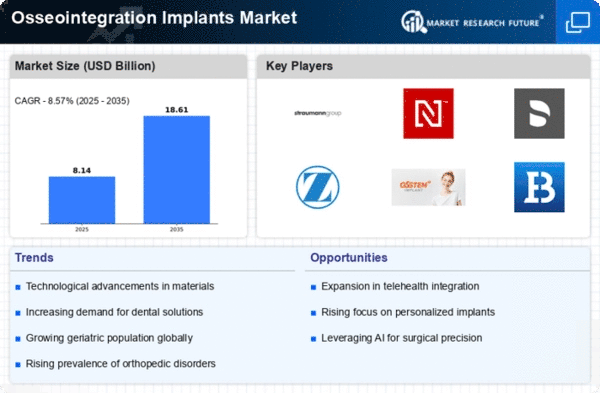
As per MRFR analysis, the Osseointegration Implants Market Size was estimated at 7.5 USD Billion in 2024. The Osseointegration Implants industry is projected to grow from 8.23 USD Billion in 2025 to 18.61 USD Billion by 2035, exhibiting a compound annual growth rate (CAGR) of 8.57% during the forecast period 2025 - 2035.

Key Market Trends & Highlights

The Osseointegration Implants Market is poised for substantial growth driven by technological advancements and increasing patient awareness.

  • North America remains the largest market for osseointegration implants, primarily due to advanced healthcare infrastructure and high patient demand. The Asia-Pacific region is emerging as the fastest-growing market, fueled by rising disposable incomes and expanding healthcare access. Dental implants represent the largest segment, while orthopedic implants are experiencing the fastest growth due to increasing surgical procedures. Technological advancements and the rising geriatric population are key drivers propelling market expansion.

Market Size & Forecast

2024 Market Size 7.5 (USD Billion)
2035 Market Size 18.61 (USD Billion)
CAGR (2025 - 2035) 8.57%
Largest Regional Market Share in 2024 North America

Major Players

Straumann (CH), Nobel Biocare (CH), Dentsply Sirona (US), Zimmer Biomet (US), Osstem Implant (KR), Bicon (US), Implant Direct (US), Hiossen (KR), Alpha-Bio Tec (IL) — these leading osseointegration implants market companies continue to strengthen their competitive positions through innovation, partnerships, and geographic expansion.

Market Trends

The osseointegration implants market trends indicate that the industry is currently experiencing a notable transformation, driven by advancements in technology and increasing demand for dental and orthopedic solutions. Innovations in materials and techniques are enhancing the effectiveness and longevity of implants, which appears to be attracting a broader patient demographic. Furthermore, the growing awareness of the benefits associated with osseointegration, such as improved stability and reduced recovery times, is likely contributing to the market's expansion. As healthcare providers increasingly adopt these solutions, the osseointegration implants market seems poised for sustained growth in the coming years.

In addition to technological advancements, the osseointegration implants market is influenced by changing consumer preferences and an aging population. Patients are becoming more informed about their treatment options, leading to a rise in demand for personalized and minimally invasive procedures. This shift in patient expectations is prompting manufacturers to focus on developing innovative products that cater to specific needs. Moreover, the integration of digital technologies in surgical procedures is enhancing precision and outcomes, which may further bolster market growth. Overall, the osseointegration implants market appears to be on a promising trajectory, with various factors converging to support its development.

Technological Advancements

Recent innovations in materials and surgical techniques are significantly enhancing the performance and durability of osseointegration implants. These advancements are likely to improve patient outcomes and satisfaction, thereby driving growth in the osseointegration implants market.

Increasing Patient Awareness

As patients become more knowledgeable about their treatment options, there is a growing demand for osseointegration implants. This trend suggests that healthcare providers must adapt to meet the evolving expectations of informed consumers within the osseointegration implants market.

Aging Population

The rising number of elderly individuals is contributing to an increased prevalence of conditions requiring osseointegration implants. This demographic shift indicates sustained demand growth across the global osseointegration implant implant market.

Osseointegration Implants Market Market Drivers

Market Growth Projections

The Global Osseointegration Implants Market Industry is projected to grow significantly over the next decade. With a market value of 12.5 USD Billion in 2024, it is expected to reach 25 USD Billion by 2035, indicating a substantial increase. The compound annual growth rate of 6.5% from 2025 to 2035 reflects the ongoing advancements in technology, increasing demand for dental implants, and the rising geriatric population. This growth trajectory suggests a dynamic market landscape, characterized by innovation and evolving consumer preferences. Stakeholders are likely to focus on research and development to meet the changing needs of patients.

Expansion of Dental Tourism

The Global Osseointegration Implants Market Industry is experiencing growth due to the expansion of dental tourism. Patients are increasingly traveling to countries with advanced dental care facilities and competitive pricing for osseointegration implants. This trend is particularly prominent in regions such as Southeast Asia and Eastern Europe, where high-quality dental services are available at lower costs. As a result, the market is likely to benefit from an influx of international patients seeking affordable yet effective dental solutions. This phenomenon not only boosts local economies but also encourages the development of specialized dental practices catering to global clientele.

Rising Geriatric Population

The Global Osseointegration Implants Market Industry is significantly influenced by the rising geriatric population, which is more susceptible to dental issues and tooth loss. By 2035, the market is anticipated to reach 25 USD Billion, reflecting the increasing need for dental implants among older adults. As the global population ages, healthcare systems are adapting to address the specific needs of this demographic, including the provision of osseointegration implants. This trend underscores the importance of targeted marketing strategies and product development aimed at older patients, who often require specialized care and support in dental health.

Increasing Demand for Dental Implants

The Global Osseointegration Implants Market Industry experiences a robust demand for dental implants, driven by an aging population and rising awareness of oral health. As individuals seek solutions for tooth loss, the market is projected to reach 12.5 USD Billion in 2024. This growth is fueled by advancements in implant technology and materials, which enhance the success rates of procedures. Moreover, the increasing prevalence of dental diseases necessitates effective treatment options, further propelling market expansion. The integration of digital technologies in dental practices also contributes to improved patient outcomes, thereby stimulating demand for osseointegration implants.

Growing Awareness of Aesthetic Dentistry

There is a notable increase in the awareness of aesthetic dentistry, which is a driving force in the Global Osseointegration Implants Market Industry. Patients are increasingly seeking dental solutions that not only restore functionality but also enhance appearance. This trend is particularly evident in urban areas, where cosmetic concerns are paramount. As a result, the demand for osseointegration implants is on the rise, as they provide a natural look and feel. Dental professionals are responding to this demand by offering more aesthetic options, thereby expanding the market. The intersection of aesthetics and functionality is likely to shape future product offerings.

Technological Advancements in Implant Design

Technological innovations are pivotal in shaping the Global Osseointegration Implants Market Industry. Recent developments in implant design, such as surface modifications and 3D printing, enhance osseointegration and reduce healing times. These advancements not only improve patient satisfaction but also increase the efficiency of dental procedures. As a result, the market is expected to witness a compound annual growth rate of 6.5% from 2025 to 2035. Enhanced implant designs allow for better customization and adaptability to individual patient needs, which is crucial in a diverse global market. This trend indicates a shift towards more personalized dental care solutions.

Market Segment Insights

By Application: Dental Implants (Largest) vs. Orthopedic Implants (Fastest-Growing)

The osseointegration implants market exhibits distinct distribution among its key application segments, notably dental implants, orthopedic implants, maxillofacial implants, and hearing implants. Dental implants command a significant portion of the market, being widely accepted and utilized across various demographics. Orthopedic implants also demonstrate a robust presence, reflecting the growing demand for surgical solutions in pain management and mobility restoration among aging populations and active individuals. Rapid advancements in technology and increasing adoption of minimally invasive surgical techniques are propelling growth within the orthopedic implants segment. Meanwhile, dental implants not only continue to represent the largest share but also benefit from heightened awareness of aesthetic and functional dental restoration solutions. Both segments are characterized by innovative product developments and a rising prevalence of dental and orthopedic diseases, driving sustained expansion in the osseointegration landscape.

Dental Implants (Dominant) vs. Orthopedic Implants (Emerging)

Dental implants are recognized as the dominant application in the osseointegration implants market due to their widespread use in restorative dentistry. They offer solutions for tooth loss, with advantages such as durability, functionality, and aesthetic appeal. Patients favor dental implants for their ability to restore both oral health and aesthetics, contributing to their strong market position. Conversely, orthopedic implants represent an emerging segment, driven by technological innovations and the increasing prevalence of bone-related conditions. This segment is gaining traction as healthcare providers adopt newer materials and designs that enhance patient outcomes. Both segments reflect a shift towards personalized healthcare solutions, emphasizing the importance of patient satisfaction and quality of life in treatment choices.

By Material Type: Titanium (Largest) vs. Zirconia (Fastest-Growing)

The osseointegration implants market is characterized by a competitive segmentation, with titanium leading in market share due to its long-standing use and established efficacy in dental and orthopedic applications. Titanium implants are favored for their strength and biocompatibility, commanding a substantial portion of the market. Zirconia, while currently a smaller segment, is rapidly gaining traction as an alternative due to its aesthetic appeal and favorable biological properties, poised for increased share over time.

Titanium: Leading vs. Zirconia: Emerging

Titanium implants are recognized for their superior mechanical strength and history of successful clinical outcomes, making them the preferred choice in many applications. Their established presence in the market has cemented them as the dominant material type for osseointegration implants. Conversely, zirconia implants are emerging as a viable competitor, particularly among patients seeking aesthetic solutions. These implants offer a tooth-like appearance and light transmission properties, attracting a growing customer base. While titanium remains the gold standard, zirconia's rapid adoption hints at a shifting landscape in implant preferences.

By End User: Hospitals (Largest) vs. Dental Clinics (Fastest-Growing)

In the Osseointegration Implants Market, hospitals hold the largest market share due to their comprehensive healthcare services and advanced infrastructure for implant surgeries. They provide a wide range of surgical options and specialized care, making them a preferred choice for patients requiring osseointegration implants. Meanwhile, dental clinics are experiencing rapid growth, rising in popularity as specialized centers for dental implants. This shift indicates a trend towards more efficient, dedicated facilities for dental care, contributing to the overall expansion of the market.

Hospitals (Dominant) vs. Dental Clinics (Emerging)

Hospitals are viewed as the dominant end user for osseointegration implants, primarily because they possess substantial resources, multidisciplinary healthcare teams, and advanced surgical capabilities. They cater to a wide array of cases, offering patients a holistic approach to their osseointegration needs. Conversely, dental clinics are emerging as vital players in the market. With an increasing focus on aesthetic outcomes and patient convenience, these clinics have adapted modern technologies, forging partnerships with manufacturers to provide tailored dental implant solutions that meet the growing consumer demand. This evolving landscape highlights the necessity for both end users to adapt their strategies in response to changing patient preferences and technological advancements.

By Procedure Type: Two Stage Procedure (Largest) vs. Immediate Loading Procedure (Fastest-Growing)

In the Osseointegration Implants Market, the distribution among procedure types reveals a significant preference for the Two Stage Procedure, which holds the largest share. This traditional method is widely recognized for its reliability and is preferred in complex cases, thereby cementing its position. On the other hand, the Immediate Loading Procedure is rapidly gaining traction, appealing to patients due to reduced treatment times and increased convenience, making it a strong contender in this market segment.

Procedure Type: Two Stage Procedure (Dominant) vs. Immediate Loading Procedure (Emerging)

The Two Stage Procedure is a well-established technique in osseointegration, characterized by its methodical approach involving two surgical phases. This procedure is preferred in many clinical settings due to its proven efficacy in promoting successful implant integration and minimizing complications. In contrast, the Immediate Loading Procedure is emerging as a popular alternative, notable for its ability to provide immediate prosthetic placement, enhancing patient satisfaction and reducing the overall treatment duration. As dental technology advances and patient preferences shift towards less invasive options, the Immediate Loading Procedure is anticipated to experience robust growth, further diversifying the options within the Osseointegration Implants Market.

Get more detailed insights about Osseointegration Implants Market Research Report - Global Forecast till 2035

Regional Insights

North America : Market Leader in Innovation

North America is poised to maintain its leadership in the osseointegration implants market, holding a significant share of 3.75 billion in 2024. The united states osseointegration implants market remains the largest contributor within the region, supported by advanced healthcare infrastructure and strong presence of key manufacturers. Regulatory support and favorable reimbursement policies further enhance market dynamics, strengthening overall osseointegration implants market share in the region. The United States stands as the largest market, with key players like Dentsply Sirona and Zimmer Biomet leading the competitive landscape. The presence of advanced healthcare infrastructure and a high demand for cosmetic dental procedures contribute to the region's robust market. Additionally, ongoing research and development initiatives by companies such as Straumann and Nobel Biocare are expected to propel market growth further, ensuring North America's dominance in the global arena.

Europe : Emerging Market with Growth Potential

Europe's osseointegration implants market is valued at 2.25 billion, reflecting growing demand for innovative dental solutions and expanding regional osseointegration implants market size. Factors such as an increasing prevalence of dental disorders, rising disposable incomes, and a focus on aesthetic dentistry are driving market growth. Regulatory frameworks in countries like Germany and France are supportive, promoting advancements in dental technologies and ensuring patient safety. Leading countries in this region include Germany, France, and the UK, where major players like Nobel Biocare and Straumann are well-established. The competitive landscape is characterized by a mix of global and local companies, fostering innovation and collaboration. The European market is also witnessing a trend towards minimally invasive procedures, further enhancing the demand for osseointegration implants.

Asia-Pacific : Rapidly Growing Market Segment

The Asia-Pacific region, with a market size of 1.5 billion, is experiencing rapid expansion in the osseointegration implants market, driven by rising disposable incomes and increasing awareness of dental aesthetics. This surge is attributed to rising disposable incomes, increasing awareness of dental aesthetics, and a growing elderly population. Countries like South Korea and Japan are leading the charge, supported by favorable government initiatives and investments in healthcare infrastructure. Key players such as Osstem Implant and Hiossen are capitalizing on the growing demand, enhancing their market presence through strategic partnerships and product innovations. The competitive landscape is evolving, with local manufacturers gaining traction alongside established global brands. As the region continues to embrace advanced dental technologies, the osseointegration implants market is set for substantial growth in the coming years.

Middle East and Africa : Untapped Market with Opportunities

The Middle East and Africa region, valued at 0.75 billion, presents significant opportunities for growth in the osseointegration implants market. Factors such as increasing urbanization, rising healthcare expenditure, and a growing awareness of dental aesthetics are driving demand. Regulatory bodies are beginning to establish frameworks that support the introduction of advanced dental technologies, paving the way for market expansion. Countries like South Africa and the UAE are leading the way, with a growing number of dental clinics and practitioners adopting osseointegration implants. The competitive landscape is evolving, with both local and international players entering the market. The presence of key players is gradually increasing, indicating a positive trend towards market maturity and consumer acceptance of dental implants.

Key Players and Competitive Insights

The osseointegration implants market is characterized by a dynamic competitive landscape driven by technological advancements, increasing demand, and a growing aging population. Leading osseointegration implants market companies such as Straumann (CH), Nobel Biocare (CH), and Dentsply Sirona (US) continue to invest in innovation and strategic collaborations. Straumann (CH) focuses on enhancing its product portfolio through research and development, while Nobel Biocare (CH) emphasizes partnerships with dental professionals to improve patient outcomes. Dentsply Sirona (US) is actively pursuing digital transformation initiatives to streamline operations and enhance customer engagement, collectively shaping a competitive environment that prioritizes innovation and customer-centric solutions. In terms of business tactics, companies are increasingly localizing manufacturing to reduce costs and improve supply chain efficiency. The market appears moderately fragmented, with several key players exerting influence over various segments. This fragmentation allows for niche players to thrive, while larger companies consolidate their positions through strategic acquisitions and partnerships, thereby enhancing their competitive edge.
In November 2025, Straumann (CH) announced a collaboration with a leading technology firm to develop AI-driven solutions for implant planning and patient management. This strategic move is likely to enhance Straumann's offerings, positioning the company at the forefront of digital innovation in the osseointegration space. The integration of AI could streamline workflows and improve clinical outcomes, thereby attracting a broader customer base. In October 2025, Dentsply Sirona (US) launched a new line of biodegradable implants, reflecting a growing trend towards sustainability in the medical device industry. This initiative not only aligns with global environmental goals but also caters to an increasingly eco-conscious consumer base. The introduction of biodegradable options may provide Dentsply Sirona with a competitive advantage, as it differentiates its product offerings in a crowded market.
In September 2025, Nobel Biocare (CH) expanded its operations into emerging markets in Asia, particularly focusing on India and Vietnam. This expansion is indicative of a strategic effort to tap into the growing demand for dental implants in these regions, where rising disposable incomes and increasing awareness of dental health are driving market growth. By establishing a presence in these markets, Nobel Biocare is likely to enhance its global footprint and revenue potential. As of December 2025, the competitive trends in the Osseointegration Implants Market are increasingly defined by digitalization, sustainability, and the integration of advanced technologies such as AI. Strategic alliances are becoming more prevalent, as companies seek to combine resources and expertise to innovate and meet evolving consumer demands. The competitive differentiation is shifting from price-based strategies to a focus on innovation, technology, and supply chain reliability, suggesting that companies that prioritize these areas will likely emerge as leaders in the market.

Key Companies in the Osseointegration Implants Market include

Industry Developments

  • Q2 2024: Integrum receives FDA approval for OPRA™ Implant System for above-knee amputees Integrum AB announced that the U.S. FDA has granted premarket approval for its OPRA™ Implant System, designed for transfemoral (above-knee) amputees, marking a significant regulatory milestone for osseointegration implants in the U.S. market.
  • Q2 2024: Zimmer Biomet Announces Launch of ZBEdge™ Connected Intelligence Suite for Orthopedic Implants Zimmer Biomet launched its ZBEdge™ Connected Intelligence Suite, integrating data analytics and digital connectivity with orthopedic implant solutions, including osseointegration products, to enhance patient outcomes and surgeon decision-making.
  • Q1 2024: Dentsply Sirona launches new Astra Tech Implant System EV for improved osseointegration Dentsply Sirona introduced the Astra Tech Implant System EV, featuring enhanced surface technology aimed at accelerating and improving osseointegration for dental implant patients.
  • Q2 2024: Smith & Nephew opens new manufacturing facility in Malaysia to expand orthopedic implant production Smith & Nephew inaugurated a new manufacturing facility in Penang, Malaysia, to increase production capacity for orthopedic and osseointegration implants, supporting global demand and supply chain resilience.
  • Q1 2024: Envista Holdings acquires Osteogenics Biomedical to strengthen dental implant portfolio Envista Holdings completed the acquisition of Osteogenics Biomedical, expanding its dental implant and biomaterials offerings, including products that support osseointegration.
  • Q2 2024: Stryker announces partnership with 3D Systems for custom osseointegration implant solutions Stryker entered a partnership with 3D Systems to co-develop patient-specific osseointegration implants using advanced 3D printing technologies, aiming to improve clinical outcomes for orthopedic patients.
  • Q2 2024: Integrum AB secures SEK 100 million funding round to accelerate global expansion Integrum AB raised SEK 100 million in a funding round to support international commercialization and further development of its osseointegration implant systems.
  • Q1 2025: Zimmer Biomet receives CE Mark approval for Persona OsseoTi Knee System Zimmer Biomet announced CE Mark approval for its Persona OsseoTi Knee System, a next-generation knee implant designed to enhance osseointegration and long-term stability for patients in Europe.
  • Q2 2025: NuVasive launches new MODULUS® Osseointegrated Spinal Implant in Europe NuVasive introduced the MODULUS® Osseointegrated Spinal Implant to the European market, expanding its portfolio of spinal solutions with a focus on improved bone integration and patient outcomes.
  • Q1 2025: Dentsply Sirona appoints new Chief Technology Officer to lead implant innovation Dentsply Sirona named Dr. Maria Lopez as Chief Technology Officer, tasking her with driving innovation in dental and osseointegration implant technologies.
  • Q2 2025: Smith & Nephew receives FDA clearance for new osseointegration hip implant Smith & Nephew obtained FDA clearance for its latest osseointegration hip implant, enabling expanded use in U.S. orthopedic procedures.
  • Q2 2025: Stryker completes acquisition of OrthoX for $250 million to boost osseointegration R&D Stryker finalized the acquisition of OrthoX, a company specializing in osseointegration research and development, for $250 million, strengthening its innovation pipeline in orthopedic implants.

Future Outlook

Osseointegration Implants Market Future Outlook

The Osseointegration Implants Market is projected to grow at an 8.57% CAGR from 2025 to 2035, driven by technological advancements, increasing demand for dental implants, and rising geriatric populations.

New opportunities lie in:

  • <p>Expansion into emerging markets with tailored implant solutions. Development of biodegradable implants to enhance patient outcomes. Integration of AI-driven technologies for personalized implant design.</p>

By 2035, the Osseointegration Implants Market is expected to achieve substantial growth and innovation.

Market Segmentation

Osseointegration Implants Market End User Outlook

  • Hospitals
  • Dental Clinics
  • Orthopedic Clinics
  • Research Institutions

Osseointegration Implants Market Application Outlook

  • Dental Implants
  • Orthopedic Implants
  • Maxillofacial Implants
  • Hearing Implants

Osseointegration Implants Market Material Type Outlook

  • Titanium
  • Zirconia
  • Composite Materials
  • Ceramics

Osseointegration Implants Market Procedure Type Outlook

  • Single Stage Procedure
  • Two Stage Procedure
  • Immediate Loading Procedure

Report Scope

MARKET SIZE 2024 7.5(USD Billion)
MARKET SIZE 2025 8.23(USD Billion)
MARKET SIZE 2035 18.61(USD Billion)
COMPOUND ANNUAL GROWTH RATE (CAGR) 8.57% (2025 - 2035)
REPORT COVERAGE Revenue Forecast, Competitive Landscape, Growth Factors, and Trends
BASE YEAR 2024
Market Forecast Period 2025 - 2035
Historical Data 2019 - 2024
Market Forecast Units USD Billion
Key Companies Profiled Straumann (CH), Nobel Biocare (CH), Dentsply Sirona (US), Zimmer Biomet (US), Osstem Implant (KR), Bicon (US), Implant Direct (US), Hiossen (KR), Alpha-Bio Tec (IL)
Segments Covered Application, Material Type, End User, Procedure Type
Key Market Opportunities Advancements in biocompatible materials enhance patient outcomes in the Osseointegration Implants Market.
Key Market Dynamics Technological advancements and regulatory changes drive innovation and competition in the osseointegration implants market.
Countries Covered North America, Europe, APAC, South America, MEA

FAQs

At what CAGR is the osseointegration implants market projected to grow during the forecast period?

The osseointegration implants market is projected to grow at a 6.80% CAGR during the forecast period.

What will be the value of the osseointegration implants market during the forecast period?

The osseointegration implants market is predicted to touch USD 7.50 billion during the forecast period.

Which region is projected to command the largest share in the osseointegration implants market?

The Americas is projected to command the largest share in the osseointegration implants market.

Which end user segment will have the largest share in the osseointegration implants market?

The hospitals segment will have the largest share in the osseointegration implants market.

Which factors may limit the osseointegration implants market?

Risk of bone damage may limit market growth.

  1. SECTION I: EXECUTIVE SUMMARY AND KEY HIGHLIGHTS
    1. EXECUTIVE SUMMARY
      1. Market Overview
      2. Key Findings
      3. Market Segmentation
      4. Competitive Landscape
      5. Challenges and Opportunities
      6. Future Outlook 2
  2. SECTION II: SCOPING, METHODOLOGY AND MARKET STRUCTURE
    1. MARKET INTRODUCTION
      1. Definition
      2. Scope of the study
    2. RESEARCH METHODOLOGY
      1. Overview
      2. Data Mining
      3. Secondary Research
      4. Primary Research
      5. Forecasting Model
      6. Market Size Estimation
      7. Data Triangulation
      8. Validation 3
  3. SECTION III: QUALITATIVE ANALYSIS
    1. MARKET DYNAMICS
      1. Overview
      2. Drivers
      3. Restraints
      4. Opportunities
    2. MARKET FACTOR ANALYSIS
      1. Value chain Analysis
      2. Porter's Five Forces Analysis
      3. COVID-19 Impact Analysis
  4. SECTION IV: QUANTITATIVE ANALYSIS
    1. Osseointegration Implants Market, BY Application (USD Billion)
      1. Dental Implants
      2. Orthopedic Implants
      3. Maxillofacial Implants
      4. Hearing Implants
    2. Osseointegration Implants Market, BY Material Type (USD Billion)
      1. Titanium
      2. Zirconia
      3. Composite Materials
      4. Ceramics
    3. Osseointegration Implants Market, BY End User (USD Billion)
      1. Hospitals
      2. Dental Clinics
      3. Orthopedic Clinics
      4. Research Institutions
    4. Osseointegration Implants Market, BY Procedure Type (USD Billion)
      1. Single Stage Procedure
      2. Two Stage Procedure
      3. Immediate Loading Procedure
    5. Osseointegration Implants Market, BY Region (USD Billion)
      1. North America
      2. Europe
      3. APAC
      4. South America
      5. MEA
  5. SECTION V: COMPETITIVE ANALYSIS
    1. Competitive Landscape
      1. Overview
      2. Competitive Analysis
      3. Market share Analysis
      4. Major Growth Strategy in the Healthcare
      5. Competitive Benchmarking
      6. Leading Players in Terms of Number of Developments in the Healthcare
      7. Key developments and growth strategies
      8. Major Players Financial Matrix
    2. Company Profiles
      1. Straumann (CH)
      2. Nobel Biocare (CH)
      3. Dentsply Sirona (US)
      4. Zimmer Biomet (US)
      5. Osstem Implant (KR)
      6. Bicon (US)
      7. Implant Direct (US)
      8. Hiossen (KR)
      9. Alpha-Bio Tec (IL)
    3. Appendix
      1. References
      2. Related Reports

Osseointegration Implants Market Segmentation

Osseointegration Implants Market By Application (USD Billion, 2025-2035)

  • Dental Implants
  • Orthopedic Implants
  • Maxillofacial Implants
  • Hearing Implants

Osseointegration Implants Market By Material Type (USD Billion, 2025-2035)

  • Titanium
  • Zirconia
  • Composite Materials
  • Ceramics

Osseointegration Implants Market By End User (USD Billion, 2025-2035)

  • Hospitals
  • Dental Clinics
  • Orthopedic Clinics
  • Research Institutions

Osseointegration Implants Market By Procedure Type (USD Billion, 2025-2035)

  • Single Stage Procedure
  • Two Stage Procedure
  • Immediate Loading Procedure
Infographic

Free Sample Request

Kindly complete the form below to receive a free sample of this Report

Get Free Sample

Customer Strories

Compare Licence

×
Features License Type
Single User Multiuser License Enterprise User
Price $4,950 $5,950 $7,250
Maximum User Access Limit 1 User Upto 10 Users Unrestricted Access Throughout the Organization
Free Customization
Direct Access to Analyst
Deliverable Format
Platform Access
Discount on Next Purchase 10% 15% 15%
Printable Versions