Request Free Sample ×

Kindly complete the form below to receive a free sample of this Report

* Please use a valid business email

Leading companies partner with us for data-driven Insights

clients tt-cursor
Hero Background
English
Chinese
French
Japanese
Korean
German
Spanish

Organic Food Beverages Market Size

ID: MRFR/FnB/1884-HCR
200 Pages
Snehal Singh
April 2026

Organic Food and Beverages Market Size, Share, Industry Trend & Analysis Research Report By Product Type (Organic Food, Organic Beverages, Organic Dairy Products, Organic Snacks, Organic Grains), By Distribution Channel (Supermarkets, Online Retail, Specialty Stores, Direct Sales), By End User (Households, Commercial, Food Service, Health and Wellness Centers), By Certification (USDA Organic, EU Organic, Non-GMO Project Verified, Other Organic Certifications) and By Regional (North America, Europe, South America, Asia Pacific, Middle East and Africa) - Forecast to 2035

Share:
Download PDF ×

We do not share your information with anyone. However, we may send you emails based on your report interest from time to time. You may contact us at any time to opt-out.

Organic Food Beverages Market Infographic
Purchase Options

Organic Food Beverages Size

Organic Food Beverages Market Growth Projections and Opportunities

The Organic Food and Beverage Market are deeply influenced by a confluence of factors that contribute to its growth and evolution. One of the primary drivers is the increasing consumer awareness and preference for healthier and sustainable dietary choices. As people become more health-conscious and environmentally aware, there is a growing demand for organic food and beverages that are perceived as free from synthetic pesticides, chemicals, and genetically modified organisms (GMOs). This heightened awareness has led to a significant shift in consumer behavior, with many opting for organic products to support both personal well-being and environmentally sustainable practices.

The market is also driven by the rising concern about the quality and safety of conventional food products. Consumers are increasingly scrutinizing food labels and seeking transparency in the production process. The Organic Food and Beverage Market, with its emphasis on natural farming methods, offers an alternative that resonates with those who prioritize food safety and purity. This trend is particularly pronounced in segments such as fruits, vegetables, dairy, and beverages.

Furthermore, the Organic Food and Beverage Market are influenced by factors related to taste and product innovation. Organic products are no longer perceived as niche or lacking in variety. Manufacturers are continually innovating to introduce a diverse range of organic products, including snacks, beverages, and ready-to-eat meals, that appeal to the evolving taste preferences of consumers. This variety helps dispel the notion that organic foods are limited in choice, contributing to the market's widespread acceptance.

Geographical factors play a vital role in shaping the Organic Food and Beverage Market, particularly in terms of regional variations in organic farming practices and consumer preferences. Different regions may have distinct preferences for specific organic products, and the availability of organic raw materials varies across regions. This diversity contributes to a rich and dynamic market landscape, with a wide range of organic options catering to local tastes.

Regulatory factors are significant in the organic market, with stringent standards governing the production, certification, and labeling of organic products. Compliance with these regulations is essential for companies to gain and maintain consumer trust. The Organic Food and Beverage Market are characterized by certifications such as USDA Organic, EU Organic, and various national organic standards, providing consumers with assurance about the authenticity of the organic claims.

Economic factors contribute to the dynamics of the Organic Food and Beverage Market, especially as consumers become more willing to pay a premium for organic products. The willingness to invest in organic options is often influenced by rising disposable incomes and a belief in the long-term health benefits associated with organic consumption. As economic conditions improve, consumers are more likely to allocate a larger portion of their budget to organic food and beverages.

Sustainability and environmental concerns are integral factors shaping the Organic Food and Beverage Market. Consumers are increasingly mindful of the ecological impact of food production, and brands that prioritize sustainable farming practices, eco-friendly packaging, and ethical sourcing gain favor among environmentally conscious consumers. Sustainability considerations are becoming key differentiators in the competitive landscape of the organic market.
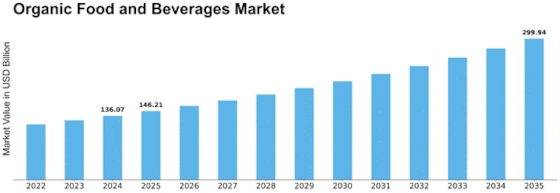

Organic Food Beverages Market Size Graph
Author
Author Profile
Snehal Singh
Manager - Research

High acumen in analyzing complex macro & micro markets with more than 6 years of work experience in the field of market research. By implementing her analytical skills in forecasting and estimation into market research reports, she has expertise in Packaging, Construction, and Equipment domains. She handles a team size of 20-25 resources and ensures smooth running of the projects, associated marketing activities, and client servicing.

Leave a Comment

FAQs

What is the current valuation of the Organic Food and Beverages Market?

<p>The Organic Food and Beverages Market was valued at 136.07 USD Billion in 2024.</p>

What is the projected market size for the Organic Food and Beverages Market by 2035?

<p>The market is projected to reach 299.94 USD Billion by 2035.</p>

What is the expected CAGR for the Organic Food and Beverages Market during the forecast period?

<p>The expected CAGR for the market from 2025 to 2035 is 7.45%.</p>

Which segment of the Organic Food and Beverages Market has the highest valuation?

<p>The Organic Food segment is projected to range from 40.0 to 90.0 USD Billion.</p>

How do supermarkets compare to online retail in terms of market share?

<p>Supermarkets are expected to dominate with a valuation between 50.0 and 110.0 USD Billion, compared to online retail's 30.0 to 70.0 USD Billion.</p>

What are the key end-user segments in the Organic Food and Beverages Market?

<p>Households represent the largest end-user segment, with a valuation projected between 68.04 and 150.0 USD Billion.</p>

Which companies are considered key players in the Organic Food and Beverages Market?

<p>Key players include Whole Foods Market, Danone, Nestle, Unilever, and General Mills.</p>

What is the valuation range for Organic Dairy Products within the market?

<p>Organic Dairy Products are projected to have a valuation between 25.0 and 60.0 USD Billion.</p>

What certifications are significant in the Organic Food and Beverages Market?

<p>USDA Organic and EU Organic certifications are notable, with projected valuations of 40.0 to 90.0 USD Billion and 30.0 to 70.0 USD Billion, respectively.</p>

What is the projected growth for the Organic Snacks segment?

<p>The Organic Snacks segment is expected to range from 20.0 to 50.0 USD Billion by 2035.</p>

Market Summary

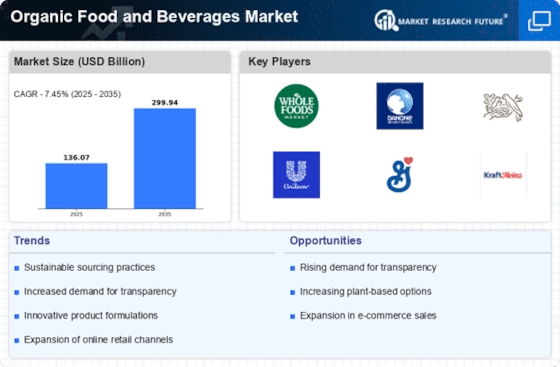
As per Market Research Future analysis, the Organic Food and Beverages Market Size was estimated at 136.07 USD Billion in 2024. The Organic Food and Beverages industry is projected to grow from 146.21 USD Billion in 2025 to 299.94 USD Billion by 2035, exhibiting a compound annual growth rate (CAGR) of 7.45% during the forecast period 2025 - 2035

Key Market Trends & Highlights

The Organic Food and Beverages Market is experiencing robust growth driven by sustainability and health trends.

  • The market is increasingly characterized by a strong focus on sustainability and environmentally friendly practices. Health consciousness among consumers is driving demand for organic food products, particularly in North America. Diverse product offerings in organic beverages are gaining traction, making this segment the fastest-growing within the market. Sustainability initiatives and health and wellness trends are key drivers propelling growth in both the organic food and beverages sectors.

Market Size & Forecast

2024 Market Size 136.07 (USD Billion)
2035 Market Size 299.94 (USD Billion)
CAGR (2025 - 2035) 7.45%
Largest Regional Market Share in 2024 North America

Major Players

<a href="https://www.wholefoodsmarket.co.uk/">Whole Foods Market</a> (US), Danone (FR), Nestle (CH), Unilever (GB), General Mills (US), Kraft Heinz (US), Hain Celestial Group (US), <a href="https://www.organicvalley.coop/">Organic Valley </a>(US), Amy's Kitchen (US), Nature's Path Foods (CA)

Market Trends

The Organic Food and Beverages Market is currently experiencing a notable transformation, driven by a growing consumer awareness regarding health and sustainability. This shift in consumer behavior appears to be influencing purchasing decisions, as individuals increasingly seek products that align with their values. The demand for organic options is not merely a trend; it seems to reflect a deeper societal change towards healthier lifestyles and environmental consciousness. Retailers are responding by expanding their organic offerings, thereby enhancing accessibility for consumers. Moreover, the market is witnessing innovations in product development, with brands exploring new flavors and formulations that cater to diverse dietary preferences. This evolution suggests that the Organic Food and Beverages Market is not static; rather, it is adapting to meet the needs of a more discerning consumer base. As awareness of the benefits of organic products continues to grow, it is likely that the market will expand further, potentially leading to new opportunities for both producers and retailers. The future landscape may be characterized by increased competition and a broader range of organic offerings, reflecting the dynamic nature of consumer preferences and market demands.

Sustainability Focus

There is a pronounced emphasis on sustainability within the Organic Food and Beverages Market. Consumers are increasingly prioritizing products that are not only organic but also produced through environmentally friendly practices. This trend indicates a shift towards a holistic approach to food sourcing, where the ecological impact of production methods is as crucial as the organic certification itself.

Health Consciousness

The rising awareness of health issues is significantly shaping the Organic Food and Beverages Market. Consumers are more inclined to choose organic products due to perceived health benefits, such as reduced exposure to pesticides and additives. This trend suggests that health consciousness is becoming a primary driver of purchasing behavior, influencing both product development and marketing strategies.

Diverse Product Offerings

The Organic Food and Beverages Market is witnessing an expansion in the variety of products available. Brands are diversifying their portfolios to include a wider range of organic options, catering to various dietary needs and preferences. This trend indicates a response to consumer demand for inclusivity and variety, potentially enhancing market growth and consumer engagement.

Organic Food Beverages Market Market Drivers

Regulatory Support

Regulatory frameworks supporting organic farming practices are emerging as a vital driver for the Organic Food and Beverages Market. Governments are increasingly recognizing the importance of organic agriculture in promoting sustainable food systems and are implementing policies that encourage organic farming. This includes financial incentives, certification programs, and educational initiatives aimed at both producers and consumers. Such regulatory support not only fosters growth within the organic sector but also enhances consumer confidence in organic products. As a result, the Organic Food and Beverages Market is likely to experience a boost in production and consumption, driven by favorable policies and increased awareness of organic standards.

Health and Wellness Trends

The rising health consciousness among consumers is significantly influencing the Organic Food and Beverages Market. With an increasing number of individuals prioritizing their health, there is a marked shift towards organic products perceived as healthier alternatives. Market data suggests that organic food sales have surged, with a notable increase in the consumption of organic fruits and vegetables, which are often associated with lower pesticide residues. This trend is further fueled by the growing awareness of the benefits of organic diets, including improved nutrition and reduced exposure to harmful chemicals. Consequently, the Organic Food and Beverages Market is poised for expansion as health-oriented consumers continue to seek out organic options.

Sustainability Initiatives

The increasing emphasis on sustainability appears to be a pivotal driver for the Organic Food and Beverages Market. Consumers are becoming more aware of the environmental impact of their food choices, leading to a surge in demand for organic products. This trend is reflected in the market data, which indicates that the organic food sector has experienced a compound annual growth rate of approximately 10% over the past few years. Companies are responding by adopting sustainable practices, such as eco-friendly packaging and responsible sourcing, which not only appeal to environmentally conscious consumers but also enhance brand loyalty. As a result, the Organic Food and Beverages Market is likely to witness continued growth as sustainability becomes a core value for both consumers and producers.

Technological Advancements

Technological innovations are playing a crucial role in shaping the Organic Food and Beverages Market. Advances in agricultural technology, such as precision farming and biotechnology, are enhancing the efficiency and yield of organic farming practices. These innovations not only help in meeting the rising demand for organic products but also address challenges related to sustainability and resource management. Furthermore, the integration of technology in supply chain management is improving traceability and transparency, which are increasingly important to consumers. As a result, the Organic Food and Beverages Market is likely to benefit from these advancements, leading to improved product quality and consumer trust.

Changing Consumer Preferences

The evolving preferences of consumers are a significant driver for the Organic Food and Beverages Market. There is a noticeable shift towards plant-based diets and organic options, as consumers seek to align their food choices with their values. This trend is reflected in market data, which shows a steady increase in the demand for organic beverages, including juices and plant-based drinks. Additionally, the rise of social media and health influencers has further propelled interest in organic products, as consumers are more exposed to information about the benefits of organic eating. Consequently, the Organic Food and Beverages Market is adapting to these changing preferences, leading to a broader range of offerings.

Market Segment Insights

By Type: Organic Food (Largest) vs. Organic Beverages (Fastest-Growing)

In the Organic Food and Beverages Market, Organic Food takes the lead as the largest segment, driven by a growing consumer preference for health-conscious eating. Organic <a href="https://www.marketresearchfuture.com/reports/dairy-market-11483" target="_blank">dairy</a> Products, Organic Snacks, and Organic Grains also contribute significantly to the market share, though with varying levels of penetration. Organic Beverages have emerged as a substantial player, with notable growth reflecting evolving consumer lifestyles focusing on wellness and transparency in sourcing products.

Organic Food: Organic <a href="https://www.marketresearchfuture.com/reports/dairy-market-11483" target="_blank">dairy</a> Products (Dominant) vs. Organic Snacks (Emerging)

Organic Dairy Products represent the dominant force within the Organic Food segment, capitalizing on the increased demand for natural and healthy alternatives to conventional dairy products. These items, including organic milk and <a href="https://www.marketresearchfuture.com/reports/cheese-market-2213" target="_blank">cheese</a>, appeal to health-conscious consumers and families. Meanwhile,<a href="https://www.marketresearchfuture.com/reports/organic-snacks-market-6613"> Organic Snacks </a>are gaining traction as an emerging category, reflecting changing consumer preferences for on-the-go, nutritious alternatives. As people become more aware of ingredients and sustainable practices, this segment is adapting to offer a variety of organic options that entice snackers who are seeking quality and health benefits.</p> <p>&nbsp;

By Distribution Channel: Supermarkets (Largest) vs. Online Retail (Fastest-Growing)

The distribution of organic food and beverages is significantly concentrated among supermarkets, which hold the largest market share in this segment. These retailers offer a wide variety of organic products, attracting consumers seeking convenience and quality under one roof. Online retail, on the other hand, is gaining momentum, supported by the increasing preference for home delivery and the growing familiarity of consumers with e-commerce platforms. This duality shapes the market dynamics, driving evolution in customer shopping behaviors. Growth trends indicate that online retail is quickly becoming a formidable player in the<a href="https://www.marketresearchfuture.com/reports/india-organic-food-market-20704"> organic food market</a>, particularly due to the rise of health-conscious consumers who prefer shopping from home. This is further accelerated by targeted marketing strategies and enhanced digital presence by brands. On the flip side, supermarkets continue to innovate their organic offerings, adapting to consumer preferences and maintaining their dominance in physical retail, leading to a competitive yet balanced distribution landscape.

Supermarkets (Dominant) vs. Online Retail (Emerging)

Supermarkets have long been the dominant force in the distribution channel for organic food and beverages, benefiting from their established networks, broad product ranges, and significant customer footfall. They cater to a diverse customer base, offering extensive organic selections alongside conventional goods, which enables cross-selling opportunities. This strategic positioning enhances customer retention as shoppers prefer the convenience of finding everything in one location. Conversely, online retail is an emerging channel that taps into the rising trend of digital shopping. With the flexibility to offer tailored selection and home delivery options, online retailers attract a younger, tech-savvy demographic. They often engage consumers with personalized marketing strategies and subscription models, further solidifying their position as a vital channel in the organic food market.

By End User: Households (Largest) vs. Commercial (Fastest-Growing)

In the Organic Food and Beverages Market, the distribution of market share among end-user segments reveals that households lead the market, driven by increasing consumer awareness about the health benefits of organic products. This segment significantly outpaces others, representing a large portion of the market as more consumers transition to organic foods for their families. In contrast, the commercial segment, which includes grocery retailers and natural food stores, is rapidly expanding as more businesses recognize the demand for organic options from consumers looking for healthier and sustainable choices.

Households: Dominant vs. Commercial: Emerging

Households represent the dominant force in the Organic Food and Beverages Market due to a growing preference for organic products that promote health and wellness. This segment is characterized by a strong commitment to quality and sustainability, leading to increased purchases of organic foods for family consumption. On the other hand, the commercial segment is emerging swiftly as retailers and food service establishments incorporate organic offerings into their product lines, aiming to meet the rising consumer demand. This shift is propelled by changes in consumer behavior, resulting in a more competitive landscape where businesses must adapt to provide organic options.

By Certification: USDA Organic (Largest) vs. Non-GMO Project Verified (Fastest-Growing)

The Organic Food and Beverages Market is predominantly driven by USDA Organic certifications, which hold the largest market share due to their longstanding recognition and consumer trust in the United States. This certification is crucial for organic producers to gain a competitive edge and establish credibility in the marketplace. In comparison, the Non-GMO Project Verified certification is rapidly gaining traction among consumers who prioritize transparency in food production processes, leading to its status as the fastest-growing segment in the market.

Certification: USDA Organic (Dominant) vs. Non-GMO Project Verified (Emerging)

USDA Organic certification is seen as the gold standard in organic labeling, appealing to a broad consumer base that values quality and sustainability. It signifies that products meet rigorous standards for organic farming and processing. On the other hand, the Non-GMO Project Verified certification targets health-conscious consumers looking for products free from genetically modified organisms. Both certifications reflect a growing trend towards sustainable and ethical consumption, with USDA Organic remaining dominant while Non-GMO Project Verified emerges as a vital player, appealing to a segment increasingly aware of food sourcing.

Get more detailed insights about Organic Food and Beverages Market Research Report-Forecast to 2035

Regional Insights

The Regional segment of the Organic Food and Beverages Market reflects a diverse landscape, with North America leading as a major player, holding a market valuation of 45.0 USD Billion in 2024, which is expected to double to 90.0 USD Billion by 2035.

Europe follows closely, valued at 40.0 USD Billion in 2024, progressively reaching 85.0 USD Billion by 2035, emphasizing the strong demand for organic products driven by consumer health consciousness.

The Asia Pacific region, valued at 30.0 USD Billion in 2024, will expand to 70.0 USD Billion, showcasing a growing middle-class population seeking healthier food options.

South America and the Middle East and Africa also contribute significantly, with valuations of 10.0 USD Billion and 11.07 USD Billion, respectively, in 2024, and expected increases to 20.0 USD Billion and 35.0 USD Billion by 2035.

The growth trends in these regions reveal a shift towards organic choices motivated by environmental concerns and a preference for sustainable agricultural practices, significantly impacting global market statistics. Organic food and beverages represent emerging opportunities as consumer awareness regarding health and wellness escalates in these regions, thereby driving the overall market growth trajectory.

Key Players and Competitive Insights

The Organic Food and Beverages Market has shown substantial growth over recent years, driven by increasing health consciousness among consumers and a growing preference for organic products as a sustainable alternative to conventional food and beverages.
This market is characterized by a diverse range of players, from large multinational corporations to small local producers, each vying for a share in the burgeoning demand for organic offerings.
As concerns regarding food safety, environmental sustainability, and health benefits come to the forefront, companies within this sector are innovating to meet consumer expectations and differentiate themselves through unique product offerings and branding strategies.
Competitive insights reveal not only the market leaders but also the dynamic landscape defined by strategic partnerships, acquisitions, and a robust supply chain aimed at maintaining quality and consistency in organic offerings.

Unilever has established a significant presence in the Organic Food and Beverages Market primarily through its commitment to sustainability and health-focused products.
The company's strengths lie in its diverse portfolio that includes organic variants of well-known food and beverage brands, as well as its extensive distribution network, which ensures that products reach consumers efficiently across the globe.
Unilever is recognized for its innovative approaches to product development, often incorporating consumer feedback to refine existing offerings and introduce new ones that align with the organic trend.
The company's ambitious sustainability goals, accompanied by substantial investments in organic agriculture and responsible sourcing, bolster its credibility and appeal among health-conscious consumers, thereby enhancing its competitive positioning in the market.

General Mills likewise plays a notable role in the Organic Food and Beverages Market, with a suite of organic offerings including cereals, snacks, and beverages designed to cater to the health-conscious consumer segment.
The company’s strengths are underscored by its established brand equity and the trust it has cultivated over decades. General Mills actively pursues strategic mergers and acquisitions to enhance its organic product line while expanding its market presence globally.
This approach allows the company to tap into new consumer trends and preferences, thus adapting to the increasing demand for organic options.
Additionally, General Mills invests significantly in research and development to ensure that its organic products not only meet but exceed market expectations in terms of quality and taste.
By maintaining a strong emphasis on sustainability and responsible sourcing, General Mills enhances its reputation and competitiveness in the global organic food and beverages landscape.

Key Companies in the Organic Food Beverages Market include

Industry Developments

Recent developments in the Organic Food and Beverages Market indicate a significant shift towards organic products driven by rising consumer awareness regarding health, sustainability, and environmental concerns.

Companies like Unilever and Danone have been expanding their product lines to include more organic offerings, reflecting changing consumer preferences. Notable acquisitions include General Mills' acquisition of Annie's Homegrown in January 2023, which enhances its organic portfolio, and Sprouts Farmers Market's strategic partnership with local farmers for better organic sourcing in May 2023.

The growth of Organic Valley and Whole Foods Market continues to reinforce the demand for organic produce, with sales expanding over 10% across multiple regions, as reported in recent industry studies. Additionally, Kraft Heinz has intensified its focus on organic condiments this year, indicating a shift in product innovation and marketing strategies.

Market projections suggest a continued increase in valuation as companies invest significantly in Research and Development and sustainable practices.

Over the past two to three years, the market has witnessed increased regulatory support for organic farming practices globally, with stricter guidelines implemented in various countries to ensure quality and authenticity in organic labeling, reflecting the broader trend towards stricter food safety standards.


Future Outlook

Organic Food Beverages Market Future Outlook

The Organic Food and Beverages Market is projected to grow at a 7.45% CAGR from 2025 to 2035, driven by increasing health consciousness, sustainability trends, and consumer demand for organic products.

New opportunities lie in:

  • Expansion of online organic grocery platforms
  • Development of organic meal kit subscription services
  • Investment in sustainable packaging solutions for organic products

By 2035, the market is expected to be robust, reflecting strong consumer preferences for organic offerings.

Market Segmentation

Organic Food Beverages Market Type Outlook

  • Organic Food
  • Organic Beverages
  • Organic Dairy Products
  • Organic Snacks
  • Organic Grains

Organic Food Beverages Market End User Outlook

  • Households
  • Commercial
  • Food Service
  • Health and Wellness Centers

Organic Food Beverages Market Certification Outlook

  • USDA Organic
  • EU Organic
  • Non-GMO Project Verified
  • Other Organic Certifications

Organic Food Beverages Market Distribution Channel Outlook

  • Supermarkets
  • Online Retail
  • Specialty Stores
  • Direct Sales

Report Scope

MARKET SIZE 2024 136.07(USD Billion)
MARKET SIZE 2025 146.21(USD Billion)
MARKET SIZE 2035 299.94(USD Billion)
COMPOUND ANNUAL GROWTH RATE (CAGR) 7.45% (2025 - 2035)
REPORT COVERAGE Revenue Forecast, Competitive Landscape, Growth Factors, and Trends
BASE YEAR 2024
Market Forecast Period 2025 - 2035
Historical Data 2019 - 2024
Market Forecast Units USD Billion
Key Companies Profiled Whole Foods Market (US), Danone (FR), Nestle (CH), Unilever (GB), General Mills (US), Kraft Heinz (US), Hain Celestial Group (US), Organic Valley (US), Amy's Kitchen (US), Nature's Path Foods (CA)
Segments Covered Product Type, Distribution Channel, End User, Certification, Regional
Key Market Opportunities Growing consumer demand for sustainable and health-conscious products in the Organic Food and Beverages Market.
Key Market Dynamics Rising consumer demand for sustainable products drives innovation and competition in the Organic Food and Beverages Market.
Countries Covered North America, Europe, APAC, South America, MEA

FAQs

What is the current valuation of the Organic Food and Beverages Market?

<p>The Organic Food and Beverages Market was valued at 136.07 USD Billion in 2024.</p>

What is the projected market size for the Organic Food and Beverages Market by 2035?

<p>The market is projected to reach 299.94 USD Billion by 2035.</p>

What is the expected CAGR for the Organic Food and Beverages Market during the forecast period?

<p>The expected CAGR for the market from 2025 to 2035 is 7.45%.</p>

Which segment of the Organic Food and Beverages Market has the highest valuation?

<p>The Organic Food segment is projected to range from 40.0 to 90.0 USD Billion.</p>

How do supermarkets compare to online retail in terms of market share?

<p>Supermarkets are expected to dominate with a valuation between 50.0 and 110.0 USD Billion, compared to online retail's 30.0 to 70.0 USD Billion.</p>

What are the key end-user segments in the Organic Food and Beverages Market?

<p>Households represent the largest end-user segment, with a valuation projected between 68.04 and 150.0 USD Billion.</p>

Which companies are considered key players in the Organic Food and Beverages Market?

<p>Key players include Whole Foods Market, Danone, Nestle, Unilever, and General Mills.</p>

What is the valuation range for Organic Dairy Products within the market?

<p>Organic Dairy Products are projected to have a valuation between 25.0 and 60.0 USD Billion.</p>

What certifications are significant in the Organic Food and Beverages Market?

<p>USDA Organic and EU Organic certifications are notable, with projected valuations of 40.0 to 90.0 USD Billion and 30.0 to 70.0 USD Billion, respectively.</p>

What is the projected growth for the Organic Snacks segment?

<p>The Organic Snacks segment is expected to range from 20.0 to 50.0 USD Billion by 2035.</p>

  1. SECTION I: EXECUTIVE SUMMARY AND KEY HIGHLIGHTS
    1. | 1.1 EXECUTIVE SUMMARY
    2. | | 1.1.1 Market Overview
    3. | | 1.1.2 Key Findings
    4. | | 1.1.3 Market Segmentation
    5. | | 1.1.4 Competitive Landscape
    6. | | 1.1.5 Challenges and Opportunities
    7. | | 1.1.6 Future Outlook
  2. SECTION II: SCOPING, METHODOLOGY AND MARKET STRUCTURE
    1. | 2.1 MARKET INTRODUCTION
    2. | | 2.1.1 Definition
    3. | | 2.1.2 Scope of the study
    4. | | | 2.1.2.1 Research Objective
    5. | | | 2.1.2.2 Assumption
    6. | | | 2.1.2.3 Limitations
    7. | 2.2 RESEARCH METHODOLOGY
    8. | | 2.2.1 Overview
    9. | | 2.2.2 Data Mining
    10. | | 2.2.3 Secondary Research
    11. | | 2.2.4 Primary Research
    12. | | | 2.2.4.1 Primary Interviews and Information Gathering Process
    13. | | | 2.2.4.2 Breakdown of Primary Respondents
    14. | | 2.2.5 Forecasting Model
    15. | | 2.2.6 Market Size Estimation
    16. | | | 2.2.6.1 Bottom-Up Approach
    17. | | | 2.2.6.2 Top-Down Approach
    18. | | 2.2.7 Data Triangulation
    19. | | 2.2.8 Validation
  3. SECTION III: QUALITATIVE ANALYSIS
    1. | 3.1 MARKET DYNAMICS
    2. | | 3.1.1 Overview
    3. | | 3.1.2 Drivers
    4. | | 3.1.3 Restraints
    5. | | 3.1.4 Opportunities
    6. | 3.2 MARKET FACTOR ANALYSIS
    7. | | 3.2.1 Value chain Analysis
    8. | | 3.2.2 Porter's Five Forces Analysis
    9. | | | 3.2.2.1 Bargaining Power of Suppliers
    10. | | | 3.2.2.2 Bargaining Power of Buyers
    11. | | | 3.2.2.3 Threat of New Entrants
    12. | | | 3.2.2.4 Threat of Substitutes
    13. | | | 3.2.2.5 Intensity of Rivalry
    14. | | 3.2.3 COVID-19 Impact Analysis
    15. | | | 3.2.3.1 Market Impact Analysis
    16. | | | 3.2.3.2 Regional Impact
    17. | | | 3.2.3.3 Opportunity and Threat Analysis
  4. SECTION IV: QUANTITATIVE ANALYSIS
    1. | 4.1 Food, Beverages & Nutrition, BY Type (USD Billion)
    2. | | 4.1.1 Organic Food
    3. | | 4.1.2 Organic Beverages
    4. | | 4.1.3 Organic Dairy Products
    5. | | 4.1.4 Organic Snacks
    6. | | 4.1.5 Organic Grains
    7. | 4.2 Food, Beverages & Nutrition, BY Distribution Channel (USD Billion)
    8. | | 4.2.1 Supermarkets
    9. | | 4.2.2 Online Retail
    10. | | 4.2.3 Specialty Stores
    11. | | 4.2.4 Direct Sales
    12. | 4.3 Food, Beverages & Nutrition, BY End User (USD Billion)
    13. | | 4.3.1 Households
    14. | | 4.3.2 Commercial
    15. | | 4.3.3 Food Service
    16. | | 4.3.4 Health and Wellness Centers
    17. | 4.4 Food, Beverages & Nutrition, BY Certification (USD Billion)
    18. | | 4.4.1 USDA Organic
    19. | | 4.4.2 EU Organic
    20. | | 4.4.3 Non-GMO Project Verified
    21. | | 4.4.4 Other Organic Certifications
    22. | 4.5 Food, Beverages & Nutrition, BY Region (USD Billion)
    23. | | 4.5.1 North America
    24. | | | 4.5.1.1 US
    25. | | | 4.5.1.2 Canada
    26. | | 4.5.2 Europe
    27. | | | 4.5.2.1 Germany
    28. | | | 4.5.2.2 UK
    29. | | | 4.5.2.3 France
    30. | | | 4.5.2.4 Russia
    31. | | | 4.5.2.5 Italy
    32. | | | 4.5.2.6 Spain
    33. | | | 4.5.2.7 Rest of Europe
    34. | | 4.5.3 APAC
    35. | | | 4.5.3.1 China
    36. | | | 4.5.3.2 India
    37. | | | 4.5.3.3 Japan
    38. | | | 4.5.3.4 South Korea
    39. | | | 4.5.3.5 Malaysia
    40. | | | 4.5.3.6 Thailand
    41. | | | 4.5.3.7 Indonesia
    42. | | | 4.5.3.8 Rest of APAC
    43. | | 4.5.4 South America
    44. | | | 4.5.4.1 Brazil
    45. | | | 4.5.4.2 Mexico
    46. | | | 4.5.4.3 Argentina
    47. | | | 4.5.4.4 Rest of South America
    48. | | 4.5.5 MEA
    49. | | | 4.5.5.1 GCC Countries
    50. | | | 4.5.5.2 South Africa
    51. | | | 4.5.5.3 Rest of MEA
  5. SECTION V: COMPETITIVE ANALYSIS
    1. | 5.1 Competitive Landscape
    2. | | 5.1.1 Overview
    3. | | 5.1.2 Competitive Analysis
    4. | | 5.1.3 Market share Analysis
    5. | | 5.1.4 Major Growth Strategy in the Food, Beverages & Nutrition
    6. | | 5.1.5 Competitive Benchmarking
    7. | | 5.1.6 Leading Players in Terms of Number of Developments in the Food, Beverages & Nutrition
    8. | | 5.1.7 Key developments and growth strategies
    9. | | | 5.1.7.1 New Product Launch/Service Deployment
    10. | | | 5.1.7.2 Merger & Acquisitions
    11. | | | 5.1.7.3 Joint Ventures
    12. | | 5.1.8 Major Players Financial Matrix
    13. | | | 5.1.8.1 Sales and Operating Income
    14. | | | 5.1.8.2 Major Players R&D Expenditure. 2023
    15. | 5.2 Company Profiles
    16. | | 5.2.1 Whole Foods Market (US)
    17. | | | 5.2.1.1 Financial Overview
    18. | | | 5.2.1.2 Products Offered
    19. | | | 5.2.1.3 Key Developments
    20. | | | 5.2.1.4 SWOT Analysis
    21. | | | 5.2.1.5 Key Strategies
    22. | | 5.2.2 Danone (FR)
    23. | | | 5.2.2.1 Financial Overview
    24. | | | 5.2.2.2 Products Offered
    25. | | | 5.2.2.3 Key Developments
    26. | | | 5.2.2.4 SWOT Analysis
    27. | | | 5.2.2.5 Key Strategies
    28. | | 5.2.3 Nestle (CH)
    29. | | | 5.2.3.1 Financial Overview
    30. | | | 5.2.3.2 Products Offered
    31. | | | 5.2.3.3 Key Developments
    32. | | | 5.2.3.4 SWOT Analysis
    33. | | | 5.2.3.5 Key Strategies
    34. | | 5.2.4 Unilever (GB)
    35. | | | 5.2.4.1 Financial Overview
    36. | | | 5.2.4.2 Products Offered
    37. | | | 5.2.4.3 Key Developments
    38. | | | 5.2.4.4 SWOT Analysis
    39. | | | 5.2.4.5 Key Strategies
    40. | | 5.2.5 General Mills (US)
    41. | | | 5.2.5.1 Financial Overview
    42. | | | 5.2.5.2 Products Offered
    43. | | | 5.2.5.3 Key Developments
    44. | | | 5.2.5.4 SWOT Analysis
    45. | | | 5.2.5.5 Key Strategies
    46. | | 5.2.6 Kraft Heinz (US)
    47. | | | 5.2.6.1 Financial Overview
    48. | | | 5.2.6.2 Products Offered
    49. | | | 5.2.6.3 Key Developments
    50. | | | 5.2.6.4 SWOT Analysis
    51. | | | 5.2.6.5 Key Strategies
    52. | | 5.2.7 Hain Celestial Group (US)
    53. | | | 5.2.7.1 Financial Overview
    54. | | | 5.2.7.2 Products Offered
    55. | | | 5.2.7.3 Key Developments
    56. | | | 5.2.7.4 SWOT Analysis
    57. | | | 5.2.7.5 Key Strategies
    58. | | 5.2.8 Organic Valley (US)
    59. | | | 5.2.8.1 Financial Overview
    60. | | | 5.2.8.2 Products Offered
    61. | | | 5.2.8.3 Key Developments
    62. | | | 5.2.8.4 SWOT Analysis
    63. | | | 5.2.8.5 Key Strategies
    64. | | 5.2.9 Amy's Kitchen (US)
    65. | | | 5.2.9.1 Financial Overview
    66. | | | 5.2.9.2 Products Offered
    67. | | | 5.2.9.3 Key Developments
    68. | | | 5.2.9.4 SWOT Analysis
    69. | | | 5.2.9.5 Key Strategies
    70. | | 5.2.10 Nature's Path Foods (CA)
    71. | | | 5.2.10.1 Financial Overview
    72. | | | 5.2.10.2 Products Offered
    73. | | | 5.2.10.3 Key Developments
    74. | | | 5.2.10.4 SWOT Analysis
    75. | | | 5.2.10.5 Key Strategies
    76. | 5.3 Appendix
    77. | | 5.3.1 References
    78. | | 5.3.2 Related Reports
  6. LIST OF FIGURES
    1. | 6.1 MARKET SYNOPSIS
    2. | 6.2 NORTH AMERICA MARKET ANALYSIS
    3. | 6.3 US MARKET ANALYSIS BY TYPE
    4. | 6.4 US MARKET ANALYSIS BY DISTRIBUTION CHANNEL
    5. | 6.5 US MARKET ANALYSIS BY END USER
    6. | 6.6 US MARKET ANALYSIS BY CERTIFICATION
    7. | 6.7 CANADA MARKET ANALYSIS BY TYPE
    8. | 6.8 CANADA MARKET ANALYSIS BY DISTRIBUTION CHANNEL
    9. | 6.9 CANADA MARKET ANALYSIS BY END USER
    10. | 6.10 CANADA MARKET ANALYSIS BY CERTIFICATION
    11. | 6.11 EUROPE MARKET ANALYSIS
    12. | 6.12 GERMANY MARKET ANALYSIS BY TYPE
    13. | 6.13 GERMANY MARKET ANALYSIS BY DISTRIBUTION CHANNEL
    14. | 6.14 GERMANY MARKET ANALYSIS BY END USER
    15. | 6.15 GERMANY MARKET ANALYSIS BY CERTIFICATION
    16. | 6.16 UK MARKET ANALYSIS BY TYPE
    17. | 6.17 UK MARKET ANALYSIS BY DISTRIBUTION CHANNEL
    18. | 6.18 UK MARKET ANALYSIS BY END USER
    19. | 6.19 UK MARKET ANALYSIS BY CERTIFICATION
    20. | 6.20 FRANCE MARKET ANALYSIS BY TYPE
    21. | 6.21 FRANCE MARKET ANALYSIS BY DISTRIBUTION CHANNEL
    22. | 6.22 FRANCE MARKET ANALYSIS BY END USER
    23. | 6.23 FRANCE MARKET ANALYSIS BY CERTIFICATION
    24. | 6.24 RUSSIA MARKET ANALYSIS BY TYPE
    25. | 6.25 RUSSIA MARKET ANALYSIS BY DISTRIBUTION CHANNEL
    26. | 6.26 RUSSIA MARKET ANALYSIS BY END USER
    27. | 6.27 RUSSIA MARKET ANALYSIS BY CERTIFICATION
    28. | 6.28 ITALY MARKET ANALYSIS BY TYPE
    29. | 6.29 ITALY MARKET ANALYSIS BY DISTRIBUTION CHANNEL
    30. | 6.30 ITALY MARKET ANALYSIS BY END USER
    31. | 6.31 ITALY MARKET ANALYSIS BY CERTIFICATION
    32. | 6.32 SPAIN MARKET ANALYSIS BY TYPE
    33. | 6.33 SPAIN MARKET ANALYSIS BY DISTRIBUTION CHANNEL
    34. | 6.34 SPAIN MARKET ANALYSIS BY END USER
    35. | 6.35 SPAIN MARKET ANALYSIS BY CERTIFICATION
    36. | 6.36 REST OF EUROPE MARKET ANALYSIS BY TYPE
    37. | 6.37 REST OF EUROPE MARKET ANALYSIS BY DISTRIBUTION CHANNEL
    38. | 6.38 REST OF EUROPE MARKET ANALYSIS BY END USER
    39. | 6.39 REST OF EUROPE MARKET ANALYSIS BY CERTIFICATION
    40. | 6.40 APAC MARKET ANALYSIS
    41. | 6.41 CHINA MARKET ANALYSIS BY TYPE
    42. | 6.42 CHINA MARKET ANALYSIS BY DISTRIBUTION CHANNEL
    43. | 6.43 CHINA MARKET ANALYSIS BY END USER
    44. | 6.44 CHINA MARKET ANALYSIS BY CERTIFICATION
    45. | 6.45 INDIA MARKET ANALYSIS BY TYPE
    46. | 6.46 INDIA MARKET ANALYSIS BY DISTRIBUTION CHANNEL
    47. | 6.47 INDIA MARKET ANALYSIS BY END USER
    48. | 6.48 INDIA MARKET ANALYSIS BY CERTIFICATION
    49. | 6.49 JAPAN MARKET ANALYSIS BY TYPE
    50. | 6.50 JAPAN MARKET ANALYSIS BY DISTRIBUTION CHANNEL
    51. | 6.51 JAPAN MARKET ANALYSIS BY END USER
    52. | 6.52 JAPAN MARKET ANALYSIS BY CERTIFICATION
    53. | 6.53 SOUTH KOREA MARKET ANALYSIS BY TYPE
    54. | 6.54 SOUTH KOREA MARKET ANALYSIS BY DISTRIBUTION CHANNEL
    55. | 6.55 SOUTH KOREA MARKET ANALYSIS BY END USER
    56. | 6.56 SOUTH KOREA MARKET ANALYSIS BY CERTIFICATION
    57. | 6.57 MALAYSIA MARKET ANALYSIS BY TYPE
    58. | 6.58 MALAYSIA MARKET ANALYSIS BY DISTRIBUTION CHANNEL
    59. | 6.59 MALAYSIA MARKET ANALYSIS BY END USER
    60. | 6.60 MALAYSIA MARKET ANALYSIS BY CERTIFICATION
    61. | 6.61 THAILAND MARKET ANALYSIS BY TYPE
    62. | 6.62 THAILAND MARKET ANALYSIS BY DISTRIBUTION CHANNEL
    63. | 6.63 THAILAND MARKET ANALYSIS BY END USER
    64. | 6.64 THAILAND MARKET ANALYSIS BY CERTIFICATION
    65. | 6.65 INDONESIA MARKET ANALYSIS BY TYPE
    66. | 6.66 INDONESIA MARKET ANALYSIS BY DISTRIBUTION CHANNEL
    67. | 6.67 INDONESIA MARKET ANALYSIS BY END USER
    68. | 6.68 INDONESIA MARKET ANALYSIS BY CERTIFICATION
    69. | 6.69 REST OF APAC MARKET ANALYSIS BY TYPE
    70. | 6.70 REST OF APAC MARKET ANALYSIS BY DISTRIBUTION CHANNEL
    71. | 6.71 REST OF APAC MARKET ANALYSIS BY END USER
    72. | 6.72 REST OF APAC MARKET ANALYSIS BY CERTIFICATION
    73. | 6.73 SOUTH AMERICA MARKET ANALYSIS
    74. | 6.74 BRAZIL MARKET ANALYSIS BY TYPE
    75. | 6.75 BRAZIL MARKET ANALYSIS BY DISTRIBUTION CHANNEL
    76. | 6.76 BRAZIL MARKET ANALYSIS BY END USER
    77. | 6.77 BRAZIL MARKET ANALYSIS BY CERTIFICATION
    78. | 6.78 MEXICO MARKET ANALYSIS BY TYPE
    79. | 6.79 MEXICO MARKET ANALYSIS BY DISTRIBUTION CHANNEL
    80. | 6.80 MEXICO MARKET ANALYSIS BY END USER
    81. | 6.81 MEXICO MARKET ANALYSIS BY CERTIFICATION
    82. | 6.82 ARGENTINA MARKET ANALYSIS BY TYPE
    83. | 6.83 ARGENTINA MARKET ANALYSIS BY DISTRIBUTION CHANNEL
    84. | 6.84 ARGENTINA MARKET ANALYSIS BY END USER
    85. | 6.85 ARGENTINA MARKET ANALYSIS BY CERTIFICATION
    86. | 6.86 REST OF SOUTH AMERICA MARKET ANALYSIS BY TYPE
    87. | 6.87 REST OF SOUTH AMERICA MARKET ANALYSIS BY DISTRIBUTION CHANNEL
    88. | 6.88 REST OF SOUTH AMERICA MARKET ANALYSIS BY END USER
    89. | 6.89 REST OF SOUTH AMERICA MARKET ANALYSIS BY CERTIFICATION
    90. | 6.90 MEA MARKET ANALYSIS
    91. | 6.91 GCC COUNTRIES MARKET ANALYSIS BY TYPE
    92. | 6.92 GCC COUNTRIES MARKET ANALYSIS BY DISTRIBUTION CHANNEL
    93. | 6.93 GCC COUNTRIES MARKET ANALYSIS BY END USER
    94. | 6.94 GCC COUNTRIES MARKET ANALYSIS BY CERTIFICATION
    95. | 6.95 SOUTH AFRICA MARKET ANALYSIS BY TYPE
    96. | 6.96 SOUTH AFRICA MARKET ANALYSIS BY DISTRIBUTION CHANNEL
    97. | 6.97 SOUTH AFRICA MARKET ANALYSIS BY END USER
    98. | 6.98 SOUTH AFRICA MARKET ANALYSIS BY CERTIFICATION
    99. | 6.99 REST OF MEA MARKET ANALYSIS BY TYPE
    100. | 6.100 REST OF MEA MARKET ANALYSIS BY DISTRIBUTION CHANNEL
    101. | 6.101 REST OF MEA MARKET ANALYSIS BY END USER
    102. | 6.102 REST OF MEA MARKET ANALYSIS BY CERTIFICATION
    103. | 6.103 KEY BUYING CRITERIA OF FOOD, BEVERAGES & NUTRITION
    104. | 6.104 RESEARCH PROCESS OF MRFR
    105. | 6.105 DRO ANALYSIS OF FOOD, BEVERAGES & NUTRITION
    106. | 6.106 DRIVERS IMPACT ANALYSIS: FOOD, BEVERAGES & NUTRITION
    107. | 6.107 RESTRAINTS IMPACT ANALYSIS: FOOD, BEVERAGES & NUTRITION
    108. | 6.108 SUPPLY / VALUE CHAIN: FOOD, BEVERAGES & NUTRITION
    109. | 6.109 FOOD, BEVERAGES & NUTRITION, BY TYPE, 2024 (% SHARE)
    110. | 6.110 FOOD, BEVERAGES & NUTRITION, BY TYPE, 2024 TO 2035 (USD Billion)
    111. | 6.111 FOOD, BEVERAGES & NUTRITION, BY DISTRIBUTION CHANNEL, 2024 (% SHARE)
    112. | 6.112 FOOD, BEVERAGES & NUTRITION, BY DISTRIBUTION CHANNEL, 2024 TO 2035 (USD Billion)
    113. | 6.113 FOOD, BEVERAGES & NUTRITION, BY END USER, 2024 (% SHARE)
    114. | 6.114 FOOD, BEVERAGES & NUTRITION, BY END USER, 2024 TO 2035 (USD Billion)
    115. | 6.115 FOOD, BEVERAGES & NUTRITION, BY CERTIFICATION, 2024 (% SHARE)
    116. | 6.116 FOOD, BEVERAGES & NUTRITION, BY CERTIFICATION, 2024 TO 2035 (USD Billion)
    117. | 6.117 BENCHMARKING OF MAJOR COMPETITORS
  7. LIST OF TABLES
    1. | 7.1 LIST OF ASSUMPTIONS
    2. | | 7.1.1
    3. | 7.2 North America MARKET SIZE ESTIMATES; FORECAST
    4. | | 7.2.1 BY TYPE, 2025-2035 (USD Billion)
    5. | | 7.2.2 BY DISTRIBUTION CHANNEL, 2025-2035 (USD Billion)
    6. | | 7.2.3 BY END USER, 2025-2035 (USD Billion)
    7. | | 7.2.4 BY CERTIFICATION, 2025-2035 (USD Billion)
    8. | 7.3 US MARKET SIZE ESTIMATES; FORECAST
    9. | | 7.3.1 BY TYPE, 2025-2035 (USD Billion)
    10. | | 7.3.2 BY DISTRIBUTION CHANNEL, 2025-2035 (USD Billion)
    11. | | 7.3.3 BY END USER, 2025-2035 (USD Billion)
    12. | | 7.3.4 BY CERTIFICATION, 2025-2035 (USD Billion)
    13. | 7.4 Canada MARKET SIZE ESTIMATES; FORECAST
    14. | | 7.4.1 BY TYPE, 2025-2035 (USD Billion)
    15. | | 7.4.2 BY DISTRIBUTION CHANNEL, 2025-2035 (USD Billion)
    16. | | 7.4.3 BY END USER, 2025-2035 (USD Billion)
    17. | | 7.4.4 BY CERTIFICATION, 2025-2035 (USD Billion)
    18. | 7.5 Europe MARKET SIZE ESTIMATES; FORECAST
    19. | | 7.5.1 BY TYPE, 2025-2035 (USD Billion)
    20. | | 7.5.2 BY DISTRIBUTION CHANNEL, 2025-2035 (USD Billion)
    21. | | 7.5.3 BY END USER, 2025-2035 (USD Billion)
    22. | | 7.5.4 BY CERTIFICATION, 2025-2035 (USD Billion)
    23. | 7.6 Germany MARKET SIZE ESTIMATES; FORECAST
    24. | | 7.6.1 BY TYPE, 2025-2035 (USD Billion)
    25. | | 7.6.2 BY DISTRIBUTION CHANNEL, 2025-2035 (USD Billion)
    26. | | 7.6.3 BY END USER, 2025-2035 (USD Billion)
    27. | | 7.6.4 BY CERTIFICATION, 2025-2035 (USD Billion)
    28. | 7.7 UK MARKET SIZE ESTIMATES; FORECAST
    29. | | 7.7.1 BY TYPE, 2025-2035 (USD Billion)
    30. | | 7.7.2 BY DISTRIBUTION CHANNEL, 2025-2035 (USD Billion)
    31. | | 7.7.3 BY END USER, 2025-2035 (USD Billion)
    32. | | 7.7.4 BY CERTIFICATION, 2025-2035 (USD Billion)
    33. | 7.8 France MARKET SIZE ESTIMATES; FORECAST
    34. | | 7.8.1 BY TYPE, 2025-2035 (USD Billion)
    35. | | 7.8.2 BY DISTRIBUTION CHANNEL, 2025-2035 (USD Billion)
    36. | | 7.8.3 BY END USER, 2025-2035 (USD Billion)
    37. | | 7.8.4 BY CERTIFICATION, 2025-2035 (USD Billion)
    38. | 7.9 Russia MARKET SIZE ESTIMATES; FORECAST
    39. | | 7.9.1 BY TYPE, 2025-2035 (USD Billion)
    40. | | 7.9.2 BY DISTRIBUTION CHANNEL, 2025-2035 (USD Billion)
    41. | | 7.9.3 BY END USER, 2025-2035 (USD Billion)
    42. | | 7.9.4 BY CERTIFICATION, 2025-2035 (USD Billion)
    43. | 7.10 Italy MARKET SIZE ESTIMATES; FORECAST
    44. | | 7.10.1 BY TYPE, 2025-2035 (USD Billion)
    45. | | 7.10.2 BY DISTRIBUTION CHANNEL, 2025-2035 (USD Billion)
    46. | | 7.10.3 BY END USER, 2025-2035 (USD Billion)
    47. | | 7.10.4 BY CERTIFICATION, 2025-2035 (USD Billion)
    48. | 7.11 Spain MARKET SIZE ESTIMATES; FORECAST
    49. | | 7.11.1 BY TYPE, 2025-2035 (USD Billion)
    50. | | 7.11.2 BY DISTRIBUTION CHANNEL, 2025-2035 (USD Billion)
    51. | | 7.11.3 BY END USER, 2025-2035 (USD Billion)
    52. | | 7.11.4 BY CERTIFICATION, 2025-2035 (USD Billion)
    53. | 7.12 Rest of Europe MARKET SIZE ESTIMATES; FORECAST
    54. | | 7.12.1 BY TYPE, 2025-2035 (USD Billion)
    55. | | 7.12.2 BY DISTRIBUTION CHANNEL, 2025-2035 (USD Billion)
    56. | | 7.12.3 BY END USER, 2025-2035 (USD Billion)
    57. | | 7.12.4 BY CERTIFICATION, 2025-2035 (USD Billion)
    58. | 7.13 APAC MARKET SIZE ESTIMATES; FORECAST
    59. | | 7.13.1 BY TYPE, 2025-2035 (USD Billion)
    60. | | 7.13.2 BY DISTRIBUTION CHANNEL, 2025-2035 (USD Billion)
    61. | | 7.13.3 BY END USER, 2025-2035 (USD Billion)
    62. | | 7.13.4 BY CERTIFICATION, 2025-2035 (USD Billion)
    63. | 7.14 China MARKET SIZE ESTIMATES; FORECAST
    64. | | 7.14.1 BY TYPE, 2025-2035 (USD Billion)
    65. | | 7.14.2 BY DISTRIBUTION CHANNEL, 2025-2035 (USD Billion)
    66. | | 7.14.3 BY END USER, 2025-2035 (USD Billion)
    67. | | 7.14.4 BY CERTIFICATION, 2025-2035 (USD Billion)
    68. | 7.15 India MARKET SIZE ESTIMATES; FORECAST
    69. | | 7.15.1 BY TYPE, 2025-2035 (USD Billion)
    70. | | 7.15.2 BY DISTRIBUTION CHANNEL, 2025-2035 (USD Billion)
    71. | | 7.15.3 BY END USER, 2025-2035 (USD Billion)
    72. | | 7.15.4 BY CERTIFICATION, 2025-2035 (USD Billion)
    73. | 7.16 Japan MARKET SIZE ESTIMATES; FORECAST
    74. | | 7.16.1 BY TYPE, 2025-2035 (USD Billion)
    75. | | 7.16.2 BY DISTRIBUTION CHANNEL, 2025-2035 (USD Billion)
    76. | | 7.16.3 BY END USER, 2025-2035 (USD Billion)
    77. | | 7.16.4 BY CERTIFICATION, 2025-2035 (USD Billion)
    78. | 7.17 South Korea MARKET SIZE ESTIMATES; FORECAST
    79. | | 7.17.1 BY TYPE, 2025-2035 (USD Billion)
    80. | | 7.17.2 BY DISTRIBUTION CHANNEL, 2025-2035 (USD Billion)
    81. | | 7.17.3 BY END USER, 2025-2035 (USD Billion)
    82. | | 7.17.4 BY CERTIFICATION, 2025-2035 (USD Billion)
    83. | 7.18 Malaysia MARKET SIZE ESTIMATES; FORECAST
    84. | | 7.18.1 BY TYPE, 2025-2035 (USD Billion)
    85. | | 7.18.2 BY DISTRIBUTION CHANNEL, 2025-2035 (USD Billion)
    86. | | 7.18.3 BY END USER, 2025-2035 (USD Billion)
    87. | | 7.18.4 BY CERTIFICATION, 2025-2035 (USD Billion)
    88. | 7.19 Thailand MARKET SIZE ESTIMATES; FORECAST
    89. | | 7.19.1 BY TYPE, 2025-2035 (USD Billion)
    90. | | 7.19.2 BY DISTRIBUTION CHANNEL, 2025-2035 (USD Billion)
    91. | | 7.19.3 BY END USER, 2025-2035 (USD Billion)
    92. | | 7.19.4 BY CERTIFICATION, 2025-2035 (USD Billion)
    93. | 7.20 Indonesia MARKET SIZE ESTIMATES; FORECAST
    94. | | 7.20.1 BY TYPE, 2025-2035 (USD Billion)
    95. | | 7.20.2 BY DISTRIBUTION CHANNEL, 2025-2035 (USD Billion)
    96. | | 7.20.3 BY END USER, 2025-2035 (USD Billion)
    97. | | 7.20.4 BY CERTIFICATION, 2025-2035 (USD Billion)
    98. | 7.21 Rest of APAC MARKET SIZE ESTIMATES; FORECAST
    99. | | 7.21.1 BY TYPE, 2025-2035 (USD Billion)
    100. | | 7.21.2 BY DISTRIBUTION CHANNEL, 2025-2035 (USD Billion)
    101. | | 7.21.3 BY END USER, 2025-2035 (USD Billion)
    102. | | 7.21.4 BY CERTIFICATION, 2025-2035 (USD Billion)
    103. | 7.22 South America MARKET SIZE ESTIMATES; FORECAST
    104. | | 7.22.1 BY TYPE, 2025-2035 (USD Billion)
    105. | | 7.22.2 BY DISTRIBUTION CHANNEL, 2025-2035 (USD Billion)
    106. | | 7.22.3 BY END USER, 2025-2035 (USD Billion)
    107. | | 7.22.4 BY CERTIFICATION, 2025-2035 (USD Billion)
    108. | 7.23 Brazil MARKET SIZE ESTIMATES; FORECAST
    109. | | 7.23.1 BY TYPE, 2025-2035 (USD Billion)
    110. | | 7.23.2 BY DISTRIBUTION CHANNEL, 2025-2035 (USD Billion)
    111. | | 7.23.3 BY END USER, 2025-2035 (USD Billion)
    112. | | 7.23.4 BY CERTIFICATION, 2025-2035 (USD Billion)
    113. | 7.24 Mexico MARKET SIZE ESTIMATES; FORECAST
    114. | | 7.24.1 BY TYPE, 2025-2035 (USD Billion)
    115. | | 7.24.2 BY DISTRIBUTION CHANNEL, 2025-2035 (USD Billion)
    116. | | 7.24.3 BY END USER, 2025-2035 (USD Billion)
    117. | | 7.24.4 BY CERTIFICATION, 2025-2035 (USD Billion)
    118. | 7.25 Argentina MARKET SIZE ESTIMATES; FORECAST
    119. | | 7.25.1 BY TYPE, 2025-2035 (USD Billion)
    120. | | 7.25.2 BY DISTRIBUTION CHANNEL, 2025-2035 (USD Billion)
    121. | | 7.25.3 BY END USER, 2025-2035 (USD Billion)
    122. | | 7.25.4 BY CERTIFICATION, 2025-2035 (USD Billion)
    123. | 7.26 Rest of South America MARKET SIZE ESTIMATES; FORECAST
    124. | | 7.26.1 BY TYPE, 2025-2035 (USD Billion)
    125. | | 7.26.2 BY DISTRIBUTION CHANNEL, 2025-2035 (USD Billion)
    126. | | 7.26.3 BY END USER, 2025-2035 (USD Billion)
    127. | | 7.26.4 BY CERTIFICATION, 2025-2035 (USD Billion)
    128. | 7.27 MEA MARKET SIZE ESTIMATES; FORECAST
    129. | | 7.27.1 BY TYPE, 2025-2035 (USD Billion)
    130. | | 7.27.2 BY DISTRIBUTION CHANNEL, 2025-2035 (USD Billion)
    131. | | 7.27.3 BY END USER, 2025-2035 (USD Billion)
    132. | | 7.27.4 BY CERTIFICATION, 2025-2035 (USD Billion)
    133. | 7.28 GCC Countries MARKET SIZE ESTIMATES; FORECAST
    134. | | 7.28.1 BY TYPE, 2025-2035 (USD Billion)
    135. | | 7.28.2 BY DISTRIBUTION CHANNEL, 2025-2035 (USD Billion)
    136. | | 7.28.3 BY END USER, 2025-2035 (USD Billion)
    137. | | 7.28.4 BY CERTIFICATION, 2025-2035 (USD Billion)
    138. | 7.29 South Africa MARKET SIZE ESTIMATES; FORECAST
    139. | | 7.29.1 BY TYPE, 2025-2035 (USD Billion)
    140. | | 7.29.2 BY DISTRIBUTION CHANNEL, 2025-2035 (USD Billion)
    141. | | 7.29.3 BY END USER, 2025-2035 (USD Billion)
    142. | | 7.29.4 BY CERTIFICATION, 2025-2035 (USD Billion)
    143. | 7.30 Rest of MEA MARKET SIZE ESTIMATES; FORECAST
    144. | | 7.30.1 BY TYPE, 2025-2035 (USD Billion)
    145. | | 7.30.2 BY DISTRIBUTION CHANNEL, 2025-2035 (USD Billion)
    146. | | 7.30.3 BY END USER, 2025-2035 (USD Billion)
    147. | | 7.30.4 BY CERTIFICATION, 2025-2035 (USD Billion)
    148. | 7.31 PRODUCT LAUNCH/PRODUCT DEVELOPMENT/APPROVAL
    149. | | 7.31.1
    150. | 7.32 ACQUISITION/PARTNERSHIP
    151. | | 7.32.1

Food, Beverages & Nutrition Market Segmentation

Food, Beverages & Nutrition By Type (USD Billion, 2025-2035)

  • Organic Food
  • Organic Beverages
  • Organic Dairy Products
  • Organic Snacks
  • Organic Grains

Food, Beverages & Nutrition By Distribution Channel (USD Billion, 2025-2035)

  • Supermarkets
  • Online Retail
  • Specialty Stores
  • Direct Sales

Food, Beverages & Nutrition By End User (USD Billion, 2025-2035)

  • Households
  • Commercial
  • Food Service
  • Health and Wellness Centers

Food, Beverages & Nutrition By Certification (USD Billion, 2025-2035)

  • USDA Organic
  • EU Organic
  • Non-GMO Project Verified
  • Other Organic Certifications
Infographic

Free Sample Request

Kindly complete the form below to receive a free sample of this Report

Get Free Sample

Customer Strories

Compare Licence

×
Features License Type
Single User Multiuser License Enterprise User
Price $4,950 $5,950 $7,250
Maximum User Access Limit 1 User Upto 10 Users Unrestricted Access Throughout the Organization
Free Customization
Direct Access to Analyst
Deliverable Format
Platform Access
Discount on Next Purchase 10% 15% 15%
Printable Versions
%>