Request Free Sample ×

Kindly complete the form below to receive a free sample of this Report

* Please use a valid business email

Leading companies partner with us for data-driven Insights

clients tt-cursor
Hero Background
English
Chinese
French
Japanese
Korean
German
Spanish

Oil and Gas Refining Industry Market Analysis

ID: MRFR/EnP/14664-HCR
128 Pages
Priya Nagrale
March 2026

Oil and Gas Refining Industry Market Research Report Information By Complexity Type (Topping, Hydro-Skimming, Conversion, and Deep Conversion), By Product Type (Light Distillates, Middle Distillates, Fuel Oil, and Others), By Fuel Type (Gasoline, Gasoil, Kerosene, LPG, and Others), By Application (Transportation, Aviation, Marine Bunker, Petrochemical, Residential & Commercial, Agriculture, Electricity, Rail & Domestic Waterways, and Others), By Region (North America, Europe, Asia-Pacific, And Rest Of The World) –Market Forecast Till 2035

Share:
Download PDF ×

We do not share your information with anyone. However, we may send you emails based on your report interest from time to time. You may contact us at any time to opt-out.

Oil Gas Refining Industry Market Infographic
Purchase Options

Market Analysis

In-depth Analysis of Oil Gas Refining Industry Market Industry Landscape

The oil and gas refining market is set to reach US$ 2366.202 BN by 2032, at a 5.58% CAGR between years 2023-2032. While operating in a competitive environment, the Oil and Gas Refining Industry is subject to several factors that determine its changing market comprising of different dynamics. One of the major drivers is global energy, which indirectly affects the refining industry. As economies continue to grow than it means that there is also an increase in demand for energy hence, increased consumption of refined oil and gas products. On the other hand, geopolitical incidents and oil prices also influence market dynamics. Political instabilities, supply interruptions or changes in areas of oil production can leave a mark on the refining sector with possible reactions affecting market trends and possibly even prevalent economics. Environmental regulations and sustainability drives help define the market dynamics of Oil Refinery Industry. As fears regarding climate change and environmental impact increase in intensity, governments across the globe are tightening regulations directed towards lowering emissions while focusing on clean energy sources. This framework is driving refineries to adopt advanced technologies like cleaner forms of the refining process and integration with renewable energy, meeting changes in environmental standards as well as changing market dynamics. The changes in the Oil and Gas Refining Industry continue to be catalysed by technological advancements. Introduction to new technologies, especially complex process control systems that use artificial intelligence and numericization simultaneously creates efficiency of cultural processes practically for free. All these technological shifts influence the market dynamics in this industry through achievement of efficient production processes, better usage efficiency and faster adaptation by refineries to shifting markets. Other forces of shifting markets are due to the worldwide trend for a more sustainable energy source and development in alternative fuel. With global shift into a low-carbon environment, there is more focus on renewable sources of energy and cleaner petroleum and natural gas products. The trend towards biofuel, hydrogen production and other sustainable initiatives adopted by refineries can be seen as a strategic positioning in the market of today that responds to consumer preferences levels influential regulatory level. Market dynamics in the Oil and Gas Refining Industry hinges on factors such as; supply chain resilience, geopolitics. The supply chain, if disrupted during natural calamities or geopolitical conflicts by unforeseen emergencies like COVID-19 can affect the available demand and hence impact prices trigger market conditions. Unsurprisingly, refineries have to anticipate the assessment and improvement of their supply chain resilience towards managing uncertainties amidst competition in market. Consumer behavior and preferences continue to change dynamically, which influences the market dynamics as well.


Author
Author Profile
Priya Nagrale
Senior Research Analyst

With an experience of over five years in market research industry (Chemicals & Materials domain), I gather and analyze market data from diverse sources to produce results, which are then presented back to a client. Also, provide recommendations based on the findings. As a Senior Research Analyst, I perform quality checks (QC) for market estimations, QC for reports, and handle queries and work extensively on client customizations. Also, handle the responsibilities of client proposals, report planning, report finalization, and execution

Leave a Comment

FAQs

What is the current market valuation of the Oil and Gas Refining Industry?

<p>The market valuation of the Oil and Gas Refining Industry was 1618.03 USD Billion in 2024.</p>

What is the projected market size for the Oil and Gas Refining Industry by 2035?

<p>The projected market size for the Oil and Gas Refining Industry is 2940.88 USD Billion by 2035.</p>

What is the expected CAGR for the Oil and Gas Refining Industry from 2025 to 2035?

<p>The expected CAGR for the Oil and Gas Refining Industry during the forecast period 2025 - 2035 is 5.58%.</p>

Which companies are considered key players in the Oil and Gas Refining Industry?

<p>Key players in the Oil and Gas Refining Industry include Saudi Aramco, ExxonMobil, Royal Dutch Shell, BP, Chevron, TotalEnergies, Petrobras, Reliance Industries, Valero Energy, and Phillips 66.</p>

What are the main segments of the Oil and Gas Refining Industry?

<p>The main segments of the Oil and Gas Refining Industry include Complexity Type, Product Type, Fuel Type, and Application.</p>

What is the valuation range for the Conversion segment in the Oil and Gas Refining Industry?

<p>The valuation range for the Conversion segment is between 600.0 and 1100.0 USD Billion.</p>

How do Light Distillates perform in terms of market valuation?

Light Distillates have a market valuation range of 400.0 to 700.0 USD Billion.

What is the market valuation for Gasoline in the Oil and Gas Refining Industry?

The market valuation for Gasoline is projected to be between 400.0 and 700.0 USD Billion.

What applications are driving demand in the Oil and Gas Refining Industry?

Key applications driving demand include Transportation, Petrochemical, and Residential &amp; Commercial, with valuations ranging from 100.0 to 900.0 USD Billion.

What is the valuation range for the Deep Conversion segment?

The valuation range for the Deep Conversion segment is between 318.03 and 590.88 USD Billion.

Market Summary

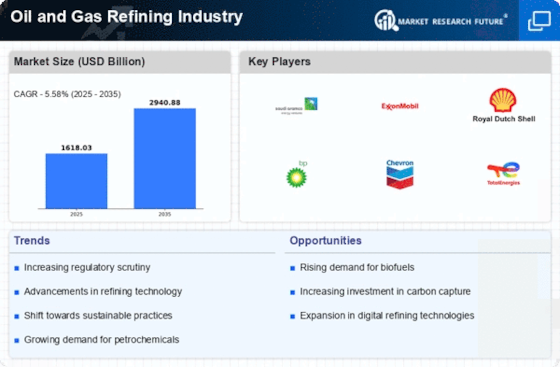
As per Market Research Future analysis, the Oil and Gas Refining Market Size was estimated at 1618.03 USD Billion in 2024. The Oil and Gas Refining industry is projected to grow from 1708.35 USD Billion in 2025 to 2940.88 USD Billion by 2035, exhibiting a compound annual growth rate (CAGR) of 5.58% during the forecast period 2025 - 2035

Key Market Trends & Highlights

The Oil and Gas Refining Sector is currently navigating a transformative phase characterized by sustainability and technological advancements.

  • North America remains the largest market for oil and gas refining, driven by robust infrastructure and established industry practices. Asia-Pacific is emerging as the fastest-growing region, propelled by increasing energy demand and rapid industrialization. Hydro-Skimming continues to dominate as the largest refining segment, while Conversion is gaining traction as the fastest-growing segment. Market drivers such as regulatory compliance and the demand for clean fuels are shaping the industry's evolution towards sustainability.

Market Size & Forecast

2024 Market Size 1618.03 (USD Billion)
2035 Market Size 2940.88 (USD Billion)
CAGR (2025 - 2035) 5.58%
Largest Regional Market Share in 2024 North America

Major Players

<a href="https://www.aramco.com/en/what-we-do/energy-products/refined-products">Saudi Aramco</a> (SA), ExxonMobil (US), Royal Dutch Shell (NL), BP (GB), Chevron (US), <a href="https://totalenergies.com/company/energy-expertise/explore-produce/oil-gas">TotalEnergies</a> (FR), Petrobras (BR), Reliance Industries (IN), Valero Energy (US), Phillips 66 (US)

Market Trends

The Oil and Gas Refining Industry is currently undergoing a transformative phase, driven by evolving consumer preferences and regulatory pressures. As the global demand for cleaner energy sources intensifies, refiners are increasingly investing in technologies that enhance efficiency and reduce emissions. This shift not only aligns with environmental goals but also addresses the growing scrutiny from governments and the public regarding sustainability practices. Furthermore, the integration of digital technologies is reshaping operational frameworks, enabling refiners to optimize processes and improve decision-making through data analytics. In addition to technological advancements, the Oil and Gas Refining Industry is witnessing a shift towards diversification of product offerings. Companies are exploring opportunities in biofuels and petrochemicals, which may provide alternative revenue streams amidst fluctuating oil prices. This diversification strategy appears to be a proactive response to market volatility and changing regulatory landscapes. Overall, the industry seems poised for a period of adaptation and innovation, as stakeholders navigate the complexities of a rapidly evolving energy landscape.

Sustainability Initiatives

The Oil and Gas Refining Industry is increasingly prioritizing sustainability initiatives. Companies are adopting practices aimed at reducing carbon footprints and enhancing energy efficiency. This trend reflects a broader commitment to environmental stewardship and aligns with global efforts to combat climate change.

Digital Transformation

Digital transformation is becoming a cornerstone of operational strategies within the Oil and Gas Refining Industry. The integration of advanced technologies, such as artificial intelligence and machine learning, is enabling refiners to streamline processes, enhance productivity, and make data-driven decisions.

Product Diversification

Product diversification is gaining traction as refiners seek to expand their portfolios beyond traditional fuels. The exploration of biofuels and petrochemicals represents a strategic move to adapt to changing market demands and regulatory pressures, potentially stabilizing revenue streams.

Oil Gas Refining Industry Market Market Drivers

Geopolitical Factors

Geopolitical dynamics significantly impact the Oil and Gas Refining Sector, influencing supply chains and pricing structures. Political instability in oil-producing regions can lead to supply disruptions, affecting global oil prices. Additionally, trade policies and tariffs can alter the competitive landscape for refiners. For instance, recent tensions in key oil-producing nations have resulted in fluctuations in crude oil prices, which directly affect refining margins. As geopolitical factors continue to evolve, they are likely to create both challenges and opportunities for the Oil and Gas Refining Industry, necessitating strategic adaptability among refiners.

Regulatory Compliance

The Oil and Gas Refining Sector is increasingly influenced by stringent regulatory frameworks aimed at reducing environmental impact. Governments are implementing regulations that mandate lower emissions and improved waste management practices. Compliance with these regulations often necessitates significant investment in technology and infrastructure. For instance, the introduction of stricter sulfur content regulations in fuels has compelled refiners to adopt advanced desulfurization technologies. This trend is expected to continue, as regulatory bodies worldwide are likely to enhance their focus on sustainability, thereby driving operational changes within the Oil and Gas Refining Industry.

Technological Advancements

Technological innovation plays a pivotal role in shaping the Oil and Gas Refining Sector. The adoption of advanced refining technologies, such as hydrocracking and catalytic reforming, enhances efficiency and product yield. Moreover, the integration of digital technologies, including artificial intelligence and machine learning, is transforming operational processes. These advancements not only optimize production but also reduce costs. According to recent data, refiners that have embraced these technologies report up to a 15% increase in operational efficiency. As technology continues to evolve, it is likely to further revolutionize the Oil and Gas Refining Industry.

Market Demand for Clean Fuels

The growing demand for cleaner fuels is a significant driver in the Oil and Gas Refining Sector. As consumers and industries increasingly prioritize sustainability, refiners are compelled to adapt their product offerings. The shift towards low-sulfur fuels and biofuels is evident, with many countries setting ambitious targets for reducing carbon emissions. For example, the International Energy Agency projects that the demand for clean fuels will rise by 30% by 2030. This trend necessitates refiners to invest in new technologies and processes to meet evolving market expectations, thereby reshaping the Oil and Gas Refining Industry.

Investment in Renewable Energy

The transition towards renewable energy sources is becoming increasingly relevant for the Oil and Gas Refining Sector. As governments and corporations commit to reducing carbon footprints, refiners are exploring opportunities to diversify their portfolios. Investments in renewable energy projects, such as biofuels and hydrogen production, are gaining traction. This shift not only aligns with sustainability goals but also positions refiners to remain competitive in a changing energy landscape. According to industry reports, investments in renewable energy by traditional refiners are expected to increase by 25% over the next five years, indicating a significant transformation within the Oil and Gas Refining Industry.

Market Segment Insights

By Complexity Type: Hydro-Skimming (Largest) vs. Conversion (Fastest-Growing)

In the Oil and Gas Refining Industry, the complexity type segment features a diverse range of refining methods, among which Hydro-Skimming has established itself as the largest due to its efficient process that minimizes production costs. This method allows refineries to extract valuable products from crude oil while maintaining a balance between quality and efficiency. Topping, on the other hand, holds a steady share but is increasingly overshadowed by the appeal of more advanced processes like Conversion and Deep Conversion. On the growth front, Conversion is fast becoming the fastest-growing segment as refiners seek to maximize output and adapt to changing fuel specifications. Factors driving this trend include technological advancements that enhance conversion efficiency and the evolving demand for lighter, more valuable products. Deep Conversion is also gaining traction as refineries upgrade existing infrastructures to better accommodate complex crude oil types and emerging market trends, cementing the importance of innovation in this sector.

Hydro-Skimming (Dominant) vs. Deep Conversion (Emerging)

Hydro-Skimming remains a dominant refining process in the Oil and Gas Refining Industry, known for its straightforward approach in converting crude oil into a range of light and middle distillates. While it is efficient and less capital-intensive, it also has limitations in producing higher-value, lighter products, which are increasingly in demand. In contrast, Deep Conversion represents an emerging trend focused on maximizing total yields from crude oil through advanced techniques such as hydrocracking and visbreaking. This complex method enables refiners to process heavier and more sour crude oils while creating a broader spectrum of products, catering to diverse market needs. As refiners adapt, the future landscape will likely favor methods combining both hydro-skimming efficiency with deep conversion benefits, leading to a more integrated approach to refining.

By Product Type: Light Distillates (Largest) vs. Middle Distillates (Fastest-Growing)

In the Oil and Gas Refining Industry, the market share distribution among product types is diverse with light distillates holding the largest segment. This includes gasoline and other high-value products that are essential for various applications including transportation and industrial uses. Following closely, middle distillates, which include diesel and kerosene, are gaining momentum, reflecting their significance in both emerging and established markets.

Light Distillates (Dominant) vs. Middle Distillates (Emerging)

Light distillates, encompassing gasoline and naphtha, remain dominant in the refining sector due to their critical role in transportation fuels and petrochemical feedstocks. Their steady demand underpins their leading market position. In contrast, middle distillates, particularly diesel, are experiencing rapid growth, driven by increasing transportation and logistics activities globally. As environmental regulations push for cleaner fuels, the demand for middle distillates&mdash;especially low-sulfur variants&mdash;continues to rise, signaling a shift towards these emerging products.

By Fuel Type: Gasoline (Largest) vs. Gasoil (Fastest-Growing)

The Fuel Type segment in the oil and gas refining industry reveals a diverse distribution of market share among its key players. Gasoline remains the largest segment, catering to a substantial portion of fuel consumption due to its widespread use in transportation and light-duty vehicles. Following closely is Gasoil, accounting for a significant share as well. Meanwhile, other segment values like Kerosene, LPG, and Others contribute to the overall landscape but with comparatively smaller fractions.

Gasoline (Dominant) vs. Gasoil (Emerging)

Gasoline is the dominant fuel type in the oil and gas refining sector, primarily due to its critical role in fueling vehicles and machinery. It is characterized by its high demand driven by urbanization and rising transportation needs. On the other hand, Gasoil is emerging rapidly, propelled by its versatility in various sectors including heating, marine, and industrial applications. The refinement process for Gasoil ensures enhanced quality and efficiency, offering it an edge in markets seeking cleaner and more efficient fuel sources. Both fuels play crucial roles, yet their market dynamics reveal contrasting trends that can influence future industry strategies.

By Application: Transportation (Largest) vs. Aviation (Fastest-Growing)

In the Oil and Gas Refining Industry, the application segment is diverse, with Transportation leading in market share due to its critical role in fuel distribution across roadways and logistics systems. Other notable segments include Aviation and Marine Bunker, which also contribute significantly to the overall sector. The Petrochemical segment utilizes refined products for various chemical applications, impacting the market share distribution with a varied focus on energy resources such as residential, commercial, and agricultural applications. The growth trends within this segment indicate a robust demand for cleaner fuels, particularly in the aviation sector which is rapidly pivoting toward sustainable and biofuels. This increase is driven by regulatory pressures and consumer preferences for environmentally friendly options. Furthermore, advancements in technology and infrastructure improvements are set to bolster the Transportation segment, while Agricultural and Marine applications are witnessing a renewed interest owing to shifts in international trade and supply chain logistics, consequential to geopolitical dynamics.

Transportation (Dominant) vs. Aviation (Emerging)

The Transportation segment stands as a dominant pillar in the Oil and Gas Refining Industry, characterized by its robust infrastructure supporting fuel distribution to vehicles and heavy machinery. This segment benefits from a well-established network of pipelines and storage facilities, ensuring seamless fuel supply to meet ever-increasing demand. In contrast, the Aviation sector is emerging as a significant player within the refining landscape, driven by innovation in fuel technology and sustainability practices. The need for high-performance aviation fuels is propelling this segment to invest in advancements focused on reducing emissions. As the aviation industry integrates alternatives and eco-friendly fuel sources, its growth trajectory reflects a response to global environmental challenges, thus marking its presence as a key growth driver in the oil and gas refining domain.

Get more detailed insights about Oil and Gas Refining Industry Research Report — Global Forecast till 2035

Regional Insights

By region, the study provides the market insights into North America, Europe, Asia-Pacific and Rest of the World. The North American oil and gas refining industry market area will dominate this market. The emphasis on sustainability, as demonstrated by companies' investments in greener technologies and the integration of renewable energy sources, is a significant trend in North America's oil and gas refining industry. In addition, the market can be significantly influenced by geopolitical factors such as trade ties and global energy supply dynamics.

Further, the major countries studied in the market report are The US, Canada, German, France, the UK, Italy, Spain, China, Japan, India, Australia, South Korea, and Brazil.

Figure 2: OIL AND GAS REFINING INDUSTRY MARKET SHARE BY REGION 2022 (USD Billion)

Europe oil and gas refining industry market accounts for the second-largest market share. Variables such as global energy consumption, environmental laws, and geopolitical changes can have a significant impact on the sector's future. The quantity of demand for the products produced by the EU refining industry will also undergo considerable changes until 2030, both in terms of the relative demand for gasoline and diesel and the absolute demand for each product.

Further, the German oil and gas refining industry market held the largest market share, and the UK oil and gas refining industry market was the fastest growing market in the European region

The Asia-Pacific Oil and Gas Refining Industry Market is expected to grow at the fastest CAGR from 2023 to 2032 owing to the rapid economic expansion, urbanization, and industrialization of the region. Asia Pacific has become one of the key hubs for oil refining, with several significant countries playing significant roles in the global petroleum sector. Moreover, China’s oil and gas refining industry market held the largest market share, and the Indian oil and gas refining industry market was the fastest growing market in the Asia-Pacific region.

Key Players and Competitive Insights

Leading market players are investing heavily in research and development in order to expand their product lines, which will help the oil and gas refining industry market, grow even more. Market participants are also undertaking a variety of strategic activities to expand their global footprint, with important market developments including new product launches, contractual agreements, mergers and acquisitions, higher investments, and collaboration with other organizations. To expand and survive in a more competitive and rising market climate, oil and gas refining industry industry must offer cost-effective items.
Manufacturing locally to minimize operational costs is one of the key business tactics used by manufacturers in the global oil and gas refining industry industry to benefit clients and increase the market sector. In recent years, the oil and gas refining industry industry has offered some of the most significant advantages to medicine.
Major players in the oil and gas refining industry market are attempting to increase market demand by investing in research and development operations includes CHINA NATIONAL PETROLEUM CORPORATION, INDIAN OIL CORPORATION LIMITED, EXXONMOBIL CORPORATION, CHEVRON CORPORATION, HINDUSTAN PETROLEUM CORPORATION LIMITED, PJSC LUKOIL OIL COMPANY, PETROLEOS DE VENEZUELA, S.A., RELIANCE INDUSTRIES LIMITED, MARATHON PETROLEUM CORPORATION, BP PLC, BHARAT PETROLEUM CORPORATION LIMITED, and ROYAL DUTCH SHELL PLC.
The integrated oil and gas business Exxon Mobil Corp. (ExxonMobil) finds, explores for, develops, and produces natural gas, crude oil, and natural gas liquids. It produces, transports, trades, and sells petroleum products; refines crude oil; and makes lube base stocks and finished lubricants. In addition, ExxonMobil produces and sells a broad range of specialist goods in addition to commodity petrochemicals such as aromatics, olefins, and polyethylene and polypropylene plastics. It is run by a network of distribution hubs, industrial facilities, and transit networks.
The integrated oil and gas firm is called Bharat Petroleum Corp Ltd (BPCL). In addition to producing natural gas and oil, it also refines crude oil and markets and distributes petroleum products. The business prioritizes green energy as well. Light distillates, middle distillates, and various oil products are produced by it. Via a network of retailers, dealers, and distributors, BPCL markets its goods. Additionally, the business supplies gasoline to both domestic and foreign airlines. In India, it has refineries in Madhya Pradesh, Kerala, Assam, and Maharashtra. Mumbai, Maharashtra, India is home to BPCL's headquarters.

Key Companies in the Oil Gas Refining Industry Market include

Industry Developments

May 2023: The Russian oil behemoth, Rosneft, declared that it would be working with state-owned refiners in India to build a new refinery. This choice was made in response to the Indian government-run refiners' modification of the proposed USD 44 billion refinery project on the country's western coast.

Future Outlook

Oil Gas Refining Industry Market Future Outlook

The Oil and Gas Refining Industry is projected to grow at a 5.58% CAGR from 2025 to 2035, driven by technological advancements, regulatory changes, and increasing global energy demand.

New opportunities lie in:

  • Investment in advanced refining technologies to enhance efficiency.
  • Development of biofuels and renewable energy integration in refineries.
  • Expansion into emerging markets with tailored refining solutions.

By 2035, the market is expected to be robust, driven by innovation and strategic investments.

Market Segmentation

Oil Gas Refining Industry Market Fuel Type Outlook

  • Gasoline
  • Gasoil
  • Kerosene
  • LPG
  • Others

Oil Gas Refining Industry Market Application Outlook

  • Transportation
  • Aviation
  • Marine Bunker
  • Petrochemical
  • Residential & Commercial
  • Agriculture
  • Electricity
  • Rail & Domestic Waterways
  • Others

Oil Gas Refining Industry Market Product Type Outlook

  • Light Distillates
  • Middle Distillates
  • Fuel Oil
  • Others

Oil Gas Refining Industry Market Complexity Type Outlook

  • Topping
  • Hydro-Skimming
  • Conversion
  • Deep Conversion

Report Scope

MARKET SIZE 2024 1618.03(USD Billion)
MARKET SIZE 2025 1708.35(USD Billion)
MARKET SIZE 2035 2940.88(USD Billion)
COMPOUND ANNUAL GROWTH RATE (CAGR) 5.58% (2025 - 2035)
REPORT COVERAGE Revenue Forecast, Competitive Landscape, Growth Factors, and Trends
BASE YEAR 2024
Market Forecast Period 2025 - 2035
Historical Data 2019 - 2024
Market Forecast Units USD Billion
Key Companies Profiled Saudi Aramco (SA), ExxonMobil (US), Royal Dutch Shell (NL), BP (GB), Chevron (US), TotalEnergies (FR), Petrobras (BR), Reliance Industries (IN), Valero Energy (US), Phillips 66 (US)
Segments Covered Complexity Type, Product Type, Fuel Type, Application, Region
Key Market Opportunities Adoption of advanced digital technologies for enhanced operational efficiency in the Oil and Gas Refining Industry.
Key Market Dynamics Technological advancements in refining processes drive efficiency and sustainability amid evolving regulatory frameworks and market demands.
Countries Covered North America, Europe, APAC, South America, MEA

FAQs

What is the current market valuation of the Oil and Gas Refining Industry?

<p>The market valuation of the Oil and Gas Refining Industry was 1618.03 USD Billion in 2024.</p>

What is the projected market size for the Oil and Gas Refining Industry by 2035?

<p>The projected market size for the Oil and Gas Refining Industry is 2940.88 USD Billion by 2035.</p>

What is the expected CAGR for the Oil and Gas Refining Industry from 2025 to 2035?

<p>The expected CAGR for the Oil and Gas Refining Industry during the forecast period 2025 - 2035 is 5.58%.</p>

Which companies are considered key players in the Oil and Gas Refining Industry?

<p>Key players in the Oil and Gas Refining Industry include Saudi Aramco, ExxonMobil, Royal Dutch Shell, BP, Chevron, TotalEnergies, Petrobras, Reliance Industries, Valero Energy, and Phillips 66.</p>

What are the main segments of the Oil and Gas Refining Industry?

<p>The main segments of the Oil and Gas Refining Industry include Complexity Type, Product Type, Fuel Type, and Application.</p>

What is the valuation range for the Conversion segment in the Oil and Gas Refining Industry?

<p>The valuation range for the Conversion segment is between 600.0 and 1100.0 USD Billion.</p>

How do Light Distillates perform in terms of market valuation?

Light Distillates have a market valuation range of 400.0 to 700.0 USD Billion.

What is the market valuation for Gasoline in the Oil and Gas Refining Industry?

The market valuation for Gasoline is projected to be between 400.0 and 700.0 USD Billion.

What applications are driving demand in the Oil and Gas Refining Industry?

Key applications driving demand include Transportation, Petrochemical, and Residential &amp; Commercial, with valuations ranging from 100.0 to 900.0 USD Billion.

What is the valuation range for the Deep Conversion segment?

The valuation range for the Deep Conversion segment is between 318.03 and 590.88 USD Billion.

  1. SECTION I: EXECUTIVE SUMMARY AND KEY HIGHLIGHTS
    1. | 1.1 EXECUTIVE SUMMARY
    2. | | 1.1.1 Market Overview
    3. | | 1.1.2 Key Findings
    4. | | 1.1.3 Market Segmentation
    5. | | 1.1.4 Competitive Landscape
    6. | | 1.1.5 Challenges and Opportunities
    7. | | 1.1.6 Future Outlook
  2. SECTION II: SCOPING, METHODOLOGY AND MARKET STRUCTURE
    1. | 2.1 MARKET INTRODUCTION
    2. | | 2.1.1 Definition
    3. | | 2.1.2 Scope of the study
    4. | | | 2.1.2.1 Research Objective
    5. | | | 2.1.2.2 Assumption
    6. | | | 2.1.2.3 Limitations
    7. | 2.2 RESEARCH METHODOLOGY
    8. | | 2.2.1 Overview
    9. | | 2.2.2 Data Mining
    10. | | 2.2.3 Secondary Research
    11. | | 2.2.4 Primary Research
    12. | | | 2.2.4.1 Primary Interviews and Information Gathering Process
    13. | | | 2.2.4.2 Breakdown of Primary Respondents
    14. | | 2.2.5 Forecasting Model
    15. | | 2.2.6 Market Size Estimation
    16. | | | 2.2.6.1 Bottom-Up Approach
    17. | | | 2.2.6.2 Top-Down Approach
    18. | | 2.2.7 Data Triangulation
    19. | | 2.2.8 Validation
  3. SECTION III: QUALITATIVE ANALYSIS
    1. | 3.1 MARKET DYNAMICS
    2. | | 3.1.1 Overview
    3. | | 3.1.2 Drivers
    4. | | 3.1.3 Restraints
    5. | | 3.1.4 Opportunities
    6. | 3.2 MARKET FACTOR ANALYSIS
    7. | | 3.2.1 Value chain Analysis
    8. | | 3.2.2 Porter's Five Forces Analysis
    9. | | | 3.2.2.1 Bargaining Power of Suppliers
    10. | | | 3.2.2.2 Bargaining Power of Buyers
    11. | | | 3.2.2.3 Threat of New Entrants
    12. | | | 3.2.2.4 Threat of Substitutes
    13. | | | 3.2.2.5 Intensity of Rivalry
    14. | | 3.2.3 COVID-19 Impact Analysis
    15. | | | 3.2.3.1 Market Impact Analysis
    16. | | | 3.2.3.2 Regional Impact
    17. | | | 3.2.3.3 Opportunity and Threat Analysis
  4. SECTION IV: QUANTITATIVE ANALYSIS
    1. | 4.1 Energy & Power, BY Complexity Type (USD Billion)
    2. | | 4.1.1 Topping
    3. | | 4.1.2 Hydro-Skimming
    4. | | 4.1.3 Conversion
    5. | | 4.1.4 Deep Conversion
    6. | 4.2 Energy & Power, BY Product Type (USD Billion)
    7. | | 4.2.1 Light Distillates
    8. | | 4.2.2 Middle Distillates
    9. | | 4.2.3 Fuel Oil
    10. | | 4.2.4 Others
    11. | 4.3 Energy & Power, BY Fuel Type (USD Billion)
    12. | | 4.3.1 Gasoline
    13. | | 4.3.2 Gasoil
    14. | | 4.3.3 Kerosene
    15. | | 4.3.4 LPG
    16. | | 4.3.5 Others
    17. | 4.4 Energy & Power, BY Application (USD Billion)
    18. | | 4.4.1 Transportation
    19. | | 4.4.2 Aviation
    20. | | 4.4.3 Marine Bunker
    21. | | 4.4.4 Petrochemical
    22. | | 4.4.5 Residential & Commercial
    23. | | 4.4.6 Agriculture
    24. | | 4.4.7 Electricity
    25. | | 4.4.8 Rail & Domestic Waterways
    26. | | 4.4.9 Others
    27. | 4.5 Energy & Power, BY Region (USD Billion)
    28. | | 4.5.1 North America
    29. | | | 4.5.1.1 US
    30. | | | 4.5.1.2 Canada
    31. | | 4.5.2 Europe
    32. | | | 4.5.2.1 Germany
    33. | | | 4.5.2.2 UK
    34. | | | 4.5.2.3 France
    35. | | | 4.5.2.4 Russia
    36. | | | 4.5.2.5 Italy
    37. | | | 4.5.2.6 Spain
    38. | | | 4.5.2.7 Rest of Europe
    39. | | 4.5.3 APAC
    40. | | | 4.5.3.1 China
    41. | | | 4.5.3.2 India
    42. | | | 4.5.3.3 Japan
    43. | | | 4.5.3.4 South Korea
    44. | | | 4.5.3.5 Malaysia
    45. | | | 4.5.3.6 Thailand
    46. | | | 4.5.3.7 Indonesia
    47. | | | 4.5.3.8 Rest of APAC
    48. | | 4.5.4 South America
    49. | | | 4.5.4.1 Brazil
    50. | | | 4.5.4.2 Mexico
    51. | | | 4.5.4.3 Argentina
    52. | | | 4.5.4.4 Rest of South America
    53. | | 4.5.5 MEA
    54. | | | 4.5.5.1 GCC Countries
    55. | | | 4.5.5.2 South Africa
    56. | | | 4.5.5.3 Rest of MEA
  5. SECTION V: COMPETITIVE ANALYSIS
    1. | 5.1 Competitive Landscape
    2. | | 5.1.1 Overview
    3. | | 5.1.2 Competitive Analysis
    4. | | 5.1.3 Market share Analysis
    5. | | 5.1.4 Major Growth Strategy in the Energy & Power
    6. | | 5.1.5 Competitive Benchmarking
    7. | | 5.1.6 Leading Players in Terms of Number of Developments in the Energy & Power
    8. | | 5.1.7 Key developments and growth strategies
    9. | | | 5.1.7.1 New Product Launch/Service Deployment
    10. | | | 5.1.7.2 Merger & Acquisitions
    11. | | | 5.1.7.3 Joint Ventures
    12. | | 5.1.8 Major Players Financial Matrix
    13. | | | 5.1.8.1 Sales and Operating Income
    14. | | | 5.1.8.2 Major Players R&D Expenditure. 2023
    15. | 5.2 Company Profiles
    16. | | 5.2.1 Saudi Aramco (SA)
    17. | | | 5.2.1.1 Financial Overview
    18. | | | 5.2.1.2 Products Offered
    19. | | | 5.2.1.3 Key Developments
    20. | | | 5.2.1.4 SWOT Analysis
    21. | | | 5.2.1.5 Key Strategies
    22. | | 5.2.2 ExxonMobil (US)
    23. | | | 5.2.2.1 Financial Overview
    24. | | | 5.2.2.2 Products Offered
    25. | | | 5.2.2.3 Key Developments
    26. | | | 5.2.2.4 SWOT Analysis
    27. | | | 5.2.2.5 Key Strategies
    28. | | 5.2.3 Royal Dutch Shell (NL)
    29. | | | 5.2.3.1 Financial Overview
    30. | | | 5.2.3.2 Products Offered
    31. | | | 5.2.3.3 Key Developments
    32. | | | 5.2.3.4 SWOT Analysis
    33. | | | 5.2.3.5 Key Strategies
    34. | | 5.2.4 BP (GB)
    35. | | | 5.2.4.1 Financial Overview
    36. | | | 5.2.4.2 Products Offered
    37. | | | 5.2.4.3 Key Developments
    38. | | | 5.2.4.4 SWOT Analysis
    39. | | | 5.2.4.5 Key Strategies
    40. | | 5.2.5 Chevron (US)
    41. | | | 5.2.5.1 Financial Overview
    42. | | | 5.2.5.2 Products Offered
    43. | | | 5.2.5.3 Key Developments
    44. | | | 5.2.5.4 SWOT Analysis
    45. | | | 5.2.5.5 Key Strategies
    46. | | 5.2.6 TotalEnergies (FR)
    47. | | | 5.2.6.1 Financial Overview
    48. | | | 5.2.6.2 Products Offered
    49. | | | 5.2.6.3 Key Developments
    50. | | | 5.2.6.4 SWOT Analysis
    51. | | | 5.2.6.5 Key Strategies
    52. | | 5.2.7 Petrobras (BR)
    53. | | | 5.2.7.1 Financial Overview
    54. | | | 5.2.7.2 Products Offered
    55. | | | 5.2.7.3 Key Developments
    56. | | | 5.2.7.4 SWOT Analysis
    57. | | | 5.2.7.5 Key Strategies
    58. | | 5.2.8 Reliance Industries (IN)
    59. | | | 5.2.8.1 Financial Overview
    60. | | | 5.2.8.2 Products Offered
    61. | | | 5.2.8.3 Key Developments
    62. | | | 5.2.8.4 SWOT Analysis
    63. | | | 5.2.8.5 Key Strategies
    64. | | 5.2.9 Valero Energy (US)
    65. | | | 5.2.9.1 Financial Overview
    66. | | | 5.2.9.2 Products Offered
    67. | | | 5.2.9.3 Key Developments
    68. | | | 5.2.9.4 SWOT Analysis
    69. | | | 5.2.9.5 Key Strategies
    70. | | 5.2.10 Phillips 66 (US)
    71. | | | 5.2.10.1 Financial Overview
    72. | | | 5.2.10.2 Products Offered
    73. | | | 5.2.10.3 Key Developments
    74. | | | 5.2.10.4 SWOT Analysis
    75. | | | 5.2.10.5 Key Strategies
    76. | 5.3 Appendix
    77. | | 5.3.1 References
    78. | | 5.3.2 Related Reports
  6. LIST OF FIGURES
    1. | 6.1 MARKET SYNOPSIS
    2. | 6.2 NORTH AMERICA MARKET ANALYSIS
    3. | 6.3 US MARKET ANALYSIS BY COMPLEXITY TYPE
    4. | 6.4 US MARKET ANALYSIS BY PRODUCT TYPE
    5. | 6.5 US MARKET ANALYSIS BY FUEL TYPE
    6. | 6.6 US MARKET ANALYSIS BY APPLICATION
    7. | 6.7 CANADA MARKET ANALYSIS BY COMPLEXITY TYPE
    8. | 6.8 CANADA MARKET ANALYSIS BY PRODUCT TYPE
    9. | 6.9 CANADA MARKET ANALYSIS BY FUEL TYPE
    10. | 6.10 CANADA MARKET ANALYSIS BY APPLICATION
    11. | 6.11 EUROPE MARKET ANALYSIS
    12. | 6.12 GERMANY MARKET ANALYSIS BY COMPLEXITY TYPE
    13. | 6.13 GERMANY MARKET ANALYSIS BY PRODUCT TYPE
    14. | 6.14 GERMANY MARKET ANALYSIS BY FUEL TYPE
    15. | 6.15 GERMANY MARKET ANALYSIS BY APPLICATION
    16. | 6.16 UK MARKET ANALYSIS BY COMPLEXITY TYPE
    17. | 6.17 UK MARKET ANALYSIS BY PRODUCT TYPE
    18. | 6.18 UK MARKET ANALYSIS BY FUEL TYPE
    19. | 6.19 UK MARKET ANALYSIS BY APPLICATION
    20. | 6.20 FRANCE MARKET ANALYSIS BY COMPLEXITY TYPE
    21. | 6.21 FRANCE MARKET ANALYSIS BY PRODUCT TYPE
    22. | 6.22 FRANCE MARKET ANALYSIS BY FUEL TYPE
    23. | 6.23 FRANCE MARKET ANALYSIS BY APPLICATION
    24. | 6.24 RUSSIA MARKET ANALYSIS BY COMPLEXITY TYPE
    25. | 6.25 RUSSIA MARKET ANALYSIS BY PRODUCT TYPE
    26. | 6.26 RUSSIA MARKET ANALYSIS BY FUEL TYPE
    27. | 6.27 RUSSIA MARKET ANALYSIS BY APPLICATION
    28. | 6.28 ITALY MARKET ANALYSIS BY COMPLEXITY TYPE
    29. | 6.29 ITALY MARKET ANALYSIS BY PRODUCT TYPE
    30. | 6.30 ITALY MARKET ANALYSIS BY FUEL TYPE
    31. | 6.31 ITALY MARKET ANALYSIS BY APPLICATION
    32. | 6.32 SPAIN MARKET ANALYSIS BY COMPLEXITY TYPE
    33. | 6.33 SPAIN MARKET ANALYSIS BY PRODUCT TYPE
    34. | 6.34 SPAIN MARKET ANALYSIS BY FUEL TYPE
    35. | 6.35 SPAIN MARKET ANALYSIS BY APPLICATION
    36. | 6.36 REST OF EUROPE MARKET ANALYSIS BY COMPLEXITY TYPE
    37. | 6.37 REST OF EUROPE MARKET ANALYSIS BY PRODUCT TYPE
    38. | 6.38 REST OF EUROPE MARKET ANALYSIS BY FUEL TYPE
    39. | 6.39 REST OF EUROPE MARKET ANALYSIS BY APPLICATION
    40. | 6.40 APAC MARKET ANALYSIS
    41. | 6.41 CHINA MARKET ANALYSIS BY COMPLEXITY TYPE
    42. | 6.42 CHINA MARKET ANALYSIS BY PRODUCT TYPE
    43. | 6.43 CHINA MARKET ANALYSIS BY FUEL TYPE
    44. | 6.44 CHINA MARKET ANALYSIS BY APPLICATION
    45. | 6.45 INDIA MARKET ANALYSIS BY COMPLEXITY TYPE
    46. | 6.46 INDIA MARKET ANALYSIS BY PRODUCT TYPE
    47. | 6.47 INDIA MARKET ANALYSIS BY FUEL TYPE
    48. | 6.48 INDIA MARKET ANALYSIS BY APPLICATION
    49. | 6.49 JAPAN MARKET ANALYSIS BY COMPLEXITY TYPE
    50. | 6.50 JAPAN MARKET ANALYSIS BY PRODUCT TYPE
    51. | 6.51 JAPAN MARKET ANALYSIS BY FUEL TYPE
    52. | 6.52 JAPAN MARKET ANALYSIS BY APPLICATION
    53. | 6.53 SOUTH KOREA MARKET ANALYSIS BY COMPLEXITY TYPE
    54. | 6.54 SOUTH KOREA MARKET ANALYSIS BY PRODUCT TYPE
    55. | 6.55 SOUTH KOREA MARKET ANALYSIS BY FUEL TYPE
    56. | 6.56 SOUTH KOREA MARKET ANALYSIS BY APPLICATION
    57. | 6.57 MALAYSIA MARKET ANALYSIS BY COMPLEXITY TYPE
    58. | 6.58 MALAYSIA MARKET ANALYSIS BY PRODUCT TYPE
    59. | 6.59 MALAYSIA MARKET ANALYSIS BY FUEL TYPE
    60. | 6.60 MALAYSIA MARKET ANALYSIS BY APPLICATION
    61. | 6.61 THAILAND MARKET ANALYSIS BY COMPLEXITY TYPE
    62. | 6.62 THAILAND MARKET ANALYSIS BY PRODUCT TYPE
    63. | 6.63 THAILAND MARKET ANALYSIS BY FUEL TYPE
    64. | 6.64 THAILAND MARKET ANALYSIS BY APPLICATION
    65. | 6.65 INDONESIA MARKET ANALYSIS BY COMPLEXITY TYPE
    66. | 6.66 INDONESIA MARKET ANALYSIS BY PRODUCT TYPE
    67. | 6.67 INDONESIA MARKET ANALYSIS BY FUEL TYPE
    68. | 6.68 INDONESIA MARKET ANALYSIS BY APPLICATION
    69. | 6.69 REST OF APAC MARKET ANALYSIS BY COMPLEXITY TYPE
    70. | 6.70 REST OF APAC MARKET ANALYSIS BY PRODUCT TYPE
    71. | 6.71 REST OF APAC MARKET ANALYSIS BY FUEL TYPE
    72. | 6.72 REST OF APAC MARKET ANALYSIS BY APPLICATION
    73. | 6.73 SOUTH AMERICA MARKET ANALYSIS
    74. | 6.74 BRAZIL MARKET ANALYSIS BY COMPLEXITY TYPE
    75. | 6.75 BRAZIL MARKET ANALYSIS BY PRODUCT TYPE
    76. | 6.76 BRAZIL MARKET ANALYSIS BY FUEL TYPE
    77. | 6.77 BRAZIL MARKET ANALYSIS BY APPLICATION
    78. | 6.78 MEXICO MARKET ANALYSIS BY COMPLEXITY TYPE
    79. | 6.79 MEXICO MARKET ANALYSIS BY PRODUCT TYPE
    80. | 6.80 MEXICO MARKET ANALYSIS BY FUEL TYPE
    81. | 6.81 MEXICO MARKET ANALYSIS BY APPLICATION
    82. | 6.82 ARGENTINA MARKET ANALYSIS BY COMPLEXITY TYPE
    83. | 6.83 ARGENTINA MARKET ANALYSIS BY PRODUCT TYPE
    84. | 6.84 ARGENTINA MARKET ANALYSIS BY FUEL TYPE
    85. | 6.85 ARGENTINA MARKET ANALYSIS BY APPLICATION
    86. | 6.86 REST OF SOUTH AMERICA MARKET ANALYSIS BY COMPLEXITY TYPE
    87. | 6.87 REST OF SOUTH AMERICA MARKET ANALYSIS BY PRODUCT TYPE
    88. | 6.88 REST OF SOUTH AMERICA MARKET ANALYSIS BY FUEL TYPE
    89. | 6.89 REST OF SOUTH AMERICA MARKET ANALYSIS BY APPLICATION
    90. | 6.90 MEA MARKET ANALYSIS
    91. | 6.91 GCC COUNTRIES MARKET ANALYSIS BY COMPLEXITY TYPE
    92. | 6.92 GCC COUNTRIES MARKET ANALYSIS BY PRODUCT TYPE
    93. | 6.93 GCC COUNTRIES MARKET ANALYSIS BY FUEL TYPE
    94. | 6.94 GCC COUNTRIES MARKET ANALYSIS BY APPLICATION
    95. | 6.95 SOUTH AFRICA MARKET ANALYSIS BY COMPLEXITY TYPE
    96. | 6.96 SOUTH AFRICA MARKET ANALYSIS BY PRODUCT TYPE
    97. | 6.97 SOUTH AFRICA MARKET ANALYSIS BY FUEL TYPE
    98. | 6.98 SOUTH AFRICA MARKET ANALYSIS BY APPLICATION
    99. | 6.99 REST OF MEA MARKET ANALYSIS BY COMPLEXITY TYPE
    100. | 6.100 REST OF MEA MARKET ANALYSIS BY PRODUCT TYPE
    101. | 6.101 REST OF MEA MARKET ANALYSIS BY FUEL TYPE
    102. | 6.102 REST OF MEA MARKET ANALYSIS BY APPLICATION
    103. | 6.103 KEY BUYING CRITERIA OF ENERGY & POWER
    104. | 6.104 RESEARCH PROCESS OF MRFR
    105. | 6.105 DRO ANALYSIS OF ENERGY & POWER
    106. | 6.106 DRIVERS IMPACT ANALYSIS: ENERGY & POWER
    107. | 6.107 RESTRAINTS IMPACT ANALYSIS: ENERGY & POWER
    108. | 6.108 SUPPLY / VALUE CHAIN: ENERGY & POWER
    109. | 6.109 ENERGY & POWER, BY COMPLEXITY TYPE, 2024 (% SHARE)
    110. | 6.110 ENERGY & POWER, BY COMPLEXITY TYPE, 2024 TO 2035 (USD Billion)
    111. | 6.111 ENERGY & POWER, BY PRODUCT TYPE, 2024 (% SHARE)
    112. | 6.112 ENERGY & POWER, BY PRODUCT TYPE, 2024 TO 2035 (USD Billion)
    113. | 6.113 ENERGY & POWER, BY FUEL TYPE, 2024 (% SHARE)
    114. | 6.114 ENERGY & POWER, BY FUEL TYPE, 2024 TO 2035 (USD Billion)
    115. | 6.115 ENERGY & POWER, BY APPLICATION, 2024 (% SHARE)
    116. | 6.116 ENERGY & POWER, BY APPLICATION, 2024 TO 2035 (USD Billion)
    117. | 6.117 BENCHMARKING OF MAJOR COMPETITORS
  7. LIST OF TABLES
    1. | 7.1 LIST OF ASSUMPTIONS
    2. | | 7.1.1
    3. | 7.2 North America MARKET SIZE ESTIMATES; FORECAST
    4. | | 7.2.1 BY COMPLEXITY TYPE, 2025-2035 (USD Billion)
    5. | | 7.2.2 BY PRODUCT TYPE, 2025-2035 (USD Billion)
    6. | | 7.2.3 BY FUEL TYPE, 2025-2035 (USD Billion)
    7. | | 7.2.4 BY APPLICATION, 2025-2035 (USD Billion)
    8. | 7.3 US MARKET SIZE ESTIMATES; FORECAST
    9. | | 7.3.1 BY COMPLEXITY TYPE, 2025-2035 (USD Billion)
    10. | | 7.3.2 BY PRODUCT TYPE, 2025-2035 (USD Billion)
    11. | | 7.3.3 BY FUEL TYPE, 2025-2035 (USD Billion)
    12. | | 7.3.4 BY APPLICATION, 2025-2035 (USD Billion)
    13. | 7.4 Canada MARKET SIZE ESTIMATES; FORECAST
    14. | | 7.4.1 BY COMPLEXITY TYPE, 2025-2035 (USD Billion)
    15. | | 7.4.2 BY PRODUCT TYPE, 2025-2035 (USD Billion)
    16. | | 7.4.3 BY FUEL TYPE, 2025-2035 (USD Billion)
    17. | | 7.4.4 BY APPLICATION, 2025-2035 (USD Billion)
    18. | 7.5 Europe MARKET SIZE ESTIMATES; FORECAST
    19. | | 7.5.1 BY COMPLEXITY TYPE, 2025-2035 (USD Billion)
    20. | | 7.5.2 BY PRODUCT TYPE, 2025-2035 (USD Billion)
    21. | | 7.5.3 BY FUEL TYPE, 2025-2035 (USD Billion)
    22. | | 7.5.4 BY APPLICATION, 2025-2035 (USD Billion)
    23. | 7.6 Germany MARKET SIZE ESTIMATES; FORECAST
    24. | | 7.6.1 BY COMPLEXITY TYPE, 2025-2035 (USD Billion)
    25. | | 7.6.2 BY PRODUCT TYPE, 2025-2035 (USD Billion)
    26. | | 7.6.3 BY FUEL TYPE, 2025-2035 (USD Billion)
    27. | | 7.6.4 BY APPLICATION, 2025-2035 (USD Billion)
    28. | 7.7 UK MARKET SIZE ESTIMATES; FORECAST
    29. | | 7.7.1 BY COMPLEXITY TYPE, 2025-2035 (USD Billion)
    30. | | 7.7.2 BY PRODUCT TYPE, 2025-2035 (USD Billion)
    31. | | 7.7.3 BY FUEL TYPE, 2025-2035 (USD Billion)
    32. | | 7.7.4 BY APPLICATION, 2025-2035 (USD Billion)
    33. | 7.8 France MARKET SIZE ESTIMATES; FORECAST
    34. | | 7.8.1 BY COMPLEXITY TYPE, 2025-2035 (USD Billion)
    35. | | 7.8.2 BY PRODUCT TYPE, 2025-2035 (USD Billion)
    36. | | 7.8.3 BY FUEL TYPE, 2025-2035 (USD Billion)
    37. | | 7.8.4 BY APPLICATION, 2025-2035 (USD Billion)
    38. | 7.9 Russia MARKET SIZE ESTIMATES; FORECAST
    39. | | 7.9.1 BY COMPLEXITY TYPE, 2025-2035 (USD Billion)
    40. | | 7.9.2 BY PRODUCT TYPE, 2025-2035 (USD Billion)
    41. | | 7.9.3 BY FUEL TYPE, 2025-2035 (USD Billion)
    42. | | 7.9.4 BY APPLICATION, 2025-2035 (USD Billion)
    43. | 7.10 Italy MARKET SIZE ESTIMATES; FORECAST
    44. | | 7.10.1 BY COMPLEXITY TYPE, 2025-2035 (USD Billion)
    45. | | 7.10.2 BY PRODUCT TYPE, 2025-2035 (USD Billion)
    46. | | 7.10.3 BY FUEL TYPE, 2025-2035 (USD Billion)
    47. | | 7.10.4 BY APPLICATION, 2025-2035 (USD Billion)
    48. | 7.11 Spain MARKET SIZE ESTIMATES; FORECAST
    49. | | 7.11.1 BY COMPLEXITY TYPE, 2025-2035 (USD Billion)
    50. | | 7.11.2 BY PRODUCT TYPE, 2025-2035 (USD Billion)
    51. | | 7.11.3 BY FUEL TYPE, 2025-2035 (USD Billion)
    52. | | 7.11.4 BY APPLICATION, 2025-2035 (USD Billion)
    53. | 7.12 Rest of Europe MARKET SIZE ESTIMATES; FORECAST
    54. | | 7.12.1 BY COMPLEXITY TYPE, 2025-2035 (USD Billion)
    55. | | 7.12.2 BY PRODUCT TYPE, 2025-2035 (USD Billion)
    56. | | 7.12.3 BY FUEL TYPE, 2025-2035 (USD Billion)
    57. | | 7.12.4 BY APPLICATION, 2025-2035 (USD Billion)
    58. | 7.13 APAC MARKET SIZE ESTIMATES; FORECAST
    59. | | 7.13.1 BY COMPLEXITY TYPE, 2025-2035 (USD Billion)
    60. | | 7.13.2 BY PRODUCT TYPE, 2025-2035 (USD Billion)
    61. | | 7.13.3 BY FUEL TYPE, 2025-2035 (USD Billion)
    62. | | 7.13.4 BY APPLICATION, 2025-2035 (USD Billion)
    63. | 7.14 China MARKET SIZE ESTIMATES; FORECAST
    64. | | 7.14.1 BY COMPLEXITY TYPE, 2025-2035 (USD Billion)
    65. | | 7.14.2 BY PRODUCT TYPE, 2025-2035 (USD Billion)
    66. | | 7.14.3 BY FUEL TYPE, 2025-2035 (USD Billion)
    67. | | 7.14.4 BY APPLICATION, 2025-2035 (USD Billion)
    68. | 7.15 India MARKET SIZE ESTIMATES; FORECAST
    69. | | 7.15.1 BY COMPLEXITY TYPE, 2025-2035 (USD Billion)
    70. | | 7.15.2 BY PRODUCT TYPE, 2025-2035 (USD Billion)
    71. | | 7.15.3 BY FUEL TYPE, 2025-2035 (USD Billion)
    72. | | 7.15.4 BY APPLICATION, 2025-2035 (USD Billion)
    73. | 7.16 Japan MARKET SIZE ESTIMATES; FORECAST
    74. | | 7.16.1 BY COMPLEXITY TYPE, 2025-2035 (USD Billion)
    75. | | 7.16.2 BY PRODUCT TYPE, 2025-2035 (USD Billion)
    76. | | 7.16.3 BY FUEL TYPE, 2025-2035 (USD Billion)
    77. | | 7.16.4 BY APPLICATION, 2025-2035 (USD Billion)
    78. | 7.17 South Korea MARKET SIZE ESTIMATES; FORECAST
    79. | | 7.17.1 BY COMPLEXITY TYPE, 2025-2035 (USD Billion)
    80. | | 7.17.2 BY PRODUCT TYPE, 2025-2035 (USD Billion)
    81. | | 7.17.3 BY FUEL TYPE, 2025-2035 (USD Billion)
    82. | | 7.17.4 BY APPLICATION, 2025-2035 (USD Billion)
    83. | 7.18 Malaysia MARKET SIZE ESTIMATES; FORECAST
    84. | | 7.18.1 BY COMPLEXITY TYPE, 2025-2035 (USD Billion)
    85. | | 7.18.2 BY PRODUCT TYPE, 2025-2035 (USD Billion)
    86. | | 7.18.3 BY FUEL TYPE, 2025-2035 (USD Billion)
    87. | | 7.18.4 BY APPLICATION, 2025-2035 (USD Billion)
    88. | 7.19 Thailand MARKET SIZE ESTIMATES; FORECAST
    89. | | 7.19.1 BY COMPLEXITY TYPE, 2025-2035 (USD Billion)
    90. | | 7.19.2 BY PRODUCT TYPE, 2025-2035 (USD Billion)
    91. | | 7.19.3 BY FUEL TYPE, 2025-2035 (USD Billion)
    92. | | 7.19.4 BY APPLICATION, 2025-2035 (USD Billion)
    93. | 7.20 Indonesia MARKET SIZE ESTIMATES; FORECAST
    94. | | 7.20.1 BY COMPLEXITY TYPE, 2025-2035 (USD Billion)
    95. | | 7.20.2 BY PRODUCT TYPE, 2025-2035 (USD Billion)
    96. | | 7.20.3 BY FUEL TYPE, 2025-2035 (USD Billion)
    97. | | 7.20.4 BY APPLICATION, 2025-2035 (USD Billion)
    98. | 7.21 Rest of APAC MARKET SIZE ESTIMATES; FORECAST
    99. | | 7.21.1 BY COMPLEXITY TYPE, 2025-2035 (USD Billion)
    100. | | 7.21.2 BY PRODUCT TYPE, 2025-2035 (USD Billion)
    101. | | 7.21.3 BY FUEL TYPE, 2025-2035 (USD Billion)
    102. | | 7.21.4 BY APPLICATION, 2025-2035 (USD Billion)
    103. | 7.22 South America MARKET SIZE ESTIMATES; FORECAST
    104. | | 7.22.1 BY COMPLEXITY TYPE, 2025-2035 (USD Billion)
    105. | | 7.22.2 BY PRODUCT TYPE, 2025-2035 (USD Billion)
    106. | | 7.22.3 BY FUEL TYPE, 2025-2035 (USD Billion)
    107. | | 7.22.4 BY APPLICATION, 2025-2035 (USD Billion)
    108. | 7.23 Brazil MARKET SIZE ESTIMATES; FORECAST
    109. | | 7.23.1 BY COMPLEXITY TYPE, 2025-2035 (USD Billion)
    110. | | 7.23.2 BY PRODUCT TYPE, 2025-2035 (USD Billion)
    111. | | 7.23.3 BY FUEL TYPE, 2025-2035 (USD Billion)
    112. | | 7.23.4 BY APPLICATION, 2025-2035 (USD Billion)
    113. | 7.24 Mexico MARKET SIZE ESTIMATES; FORECAST
    114. | | 7.24.1 BY COMPLEXITY TYPE, 2025-2035 (USD Billion)
    115. | | 7.24.2 BY PRODUCT TYPE, 2025-2035 (USD Billion)
    116. | | 7.24.3 BY FUEL TYPE, 2025-2035 (USD Billion)
    117. | | 7.24.4 BY APPLICATION, 2025-2035 (USD Billion)
    118. | 7.25 Argentina MARKET SIZE ESTIMATES; FORECAST
    119. | | 7.25.1 BY COMPLEXITY TYPE, 2025-2035 (USD Billion)
    120. | | 7.25.2 BY PRODUCT TYPE, 2025-2035 (USD Billion)
    121. | | 7.25.3 BY FUEL TYPE, 2025-2035 (USD Billion)
    122. | | 7.25.4 BY APPLICATION, 2025-2035 (USD Billion)
    123. | 7.26 Rest of South America MARKET SIZE ESTIMATES; FORECAST
    124. | | 7.26.1 BY COMPLEXITY TYPE, 2025-2035 (USD Billion)
    125. | | 7.26.2 BY PRODUCT TYPE, 2025-2035 (USD Billion)
    126. | | 7.26.3 BY FUEL TYPE, 2025-2035 (USD Billion)
    127. | | 7.26.4 BY APPLICATION, 2025-2035 (USD Billion)
    128. | 7.27 MEA MARKET SIZE ESTIMATES; FORECAST
    129. | | 7.27.1 BY COMPLEXITY TYPE, 2025-2035 (USD Billion)
    130. | | 7.27.2 BY PRODUCT TYPE, 2025-2035 (USD Billion)
    131. | | 7.27.3 BY FUEL TYPE, 2025-2035 (USD Billion)
    132. | | 7.27.4 BY APPLICATION, 2025-2035 (USD Billion)
    133. | 7.28 GCC Countries MARKET SIZE ESTIMATES; FORECAST
    134. | | 7.28.1 BY COMPLEXITY TYPE, 2025-2035 (USD Billion)
    135. | | 7.28.2 BY PRODUCT TYPE, 2025-2035 (USD Billion)
    136. | | 7.28.3 BY FUEL TYPE, 2025-2035 (USD Billion)
    137. | | 7.28.4 BY APPLICATION, 2025-2035 (USD Billion)
    138. | 7.29 South Africa MARKET SIZE ESTIMATES; FORECAST
    139. | | 7.29.1 BY COMPLEXITY TYPE, 2025-2035 (USD Billion)
    140. | | 7.29.2 BY PRODUCT TYPE, 2025-2035 (USD Billion)
    141. | | 7.29.3 BY FUEL TYPE, 2025-2035 (USD Billion)
    142. | | 7.29.4 BY APPLICATION, 2025-2035 (USD Billion)
    143. | 7.30 Rest of MEA MARKET SIZE ESTIMATES; FORECAST
    144. | | 7.30.1 BY COMPLEXITY TYPE, 2025-2035 (USD Billion)
    145. | | 7.30.2 BY PRODUCT TYPE, 2025-2035 (USD Billion)
    146. | | 7.30.3 BY FUEL TYPE, 2025-2035 (USD Billion)
    147. | | 7.30.4 BY APPLICATION, 2025-2035 (USD Billion)
    148. | 7.31 PRODUCT LAUNCH/PRODUCT DEVELOPMENT/APPROVAL
    149. | | 7.31.1
    150. | 7.32 ACQUISITION/PARTNERSHIP
    151. | | 7.32.1

Energy & Power Market Segmentation

Energy & Power By Complexity Type (USD Billion, 2025-2035)

  • Topping
  • Hydro-Skimming
  • Conversion
  • Deep Conversion

Energy & Power By Product Type (USD Billion, 2025-2035)

  • Light Distillates
  • Middle Distillates
  • Fuel Oil
  • Others

Energy & Power By Fuel Type (USD Billion, 2025-2035)

  • Gasoline
  • Gasoil
  • Kerosene
  • LPG
  • Others

Energy & Power By Application (USD Billion, 2025-2035)

  • Transportation
  • Aviation
  • Marine Bunker
  • Petrochemical
  • Residential & Commercial
  • Agriculture
  • Electricity
  • Rail & Domestic Waterways
  • Others
Infographic

Free Sample Request

Kindly complete the form below to receive a free sample of this Report

Get Free Sample

Customer Strories

Compare Licence

×
Features License Type
Single User Multiuser License Enterprise User
Price $4,950 $5,950 $7,250
Maximum User Access Limit 1 User Upto 10 Users Unrestricted Access Throughout the Organization
Free Customization
Direct Access to Analyst
Deliverable Format
Platform Access
Discount on Next Purchase 10% 15% 15%
Printable Versions