Request Free Sample ×

Kindly complete the form below to receive a free sample of this Report

* Please use a valid business email

Leading companies partner with us for data-driven Insights

clients tt-cursor
Hero Background
English
Chinese
French
Japanese
Korean
German
Spanish

Nuclear waste management Market Share

ID: MRFR/EnP/5759-CR
143 Pages
Anshula Mandaokar
Last Updated: January 21, 2026

Nuclear Waste Management Market Research Report Information By Waste Type (Low-Level Waste, Intermediate-Level Waste and High-Level Waste), By Reactor Type (Pressurized Water Reactor, Boiling Water Reactors, Gas-Cooled Reactors and Pressurized Heavy Water Reactor), By Application (Industrial and Utility), Disposal method (Incineration, Storage, Deep Geological Disposal, Others) and By Region (North America, Europe, Asia-Pacific, and Rest Of The World) - Forecast Till 2035

Share:
Download PDF ×

We do not share your information with anyone. However, we may send you emails based on your report interest from time to time. You may contact us at any time to opt-out.

Nuclear waste management Market Infographic
Purchase Options

Market Share

Nuclear waste management Market Share Analysis

In the dynamic landscape of nuclear waste control, market percentage positioning strategies play a pivotal function in figuring out the success and sustainability of companies inside this quarter. One number one approach followed by using companies entails leveraging superior technology for the secure and green disposal of nuclear waste. Companies that spend money on modern-day answers, along with modern storage facilities and superior recycling procedures, role themselves as industry leaders, attracting clients in search of ultra-modern solutions. This technological gain no longer complements their marketplace share but additionally solidifies their recognition as reliable partners in addressing the complex challenges of nuclear waste. Furthermore, proactive engagement with regulatory authorities is crucial for market proportion positioning inside the nuclear waste control sector. Given the stringent guidelines surrounding nuclear waste disposal, agencies that actively participate in the formula of enterprise standards and regulatory frameworks gain a competitive part. By demonstrating a commitment to compliance and environmental stewardship, these agencies construct consideration with both regulatory bodies and clients, establishing themselves as responsible and moral gamers within the marketplace. Effective verbal exchange and transparency also shape essential factors of market proportion positioning in the nuclear waste control enterprise. Companies that overtly speak their strategies, safety protocols, and environmental impact checks foster trust with the general public and capability clients. Transparency no longer most effectively builds credibility but additionally allows agencies to differentiate themselves from competitors by means of showcasing their commitment to moral practices and community well-being. Moreover, customization of offerings to meet the unique wishes of customers is a method that resonates properly inside the nuclear waste management market. Tailoring solutions based on the kind and extent of nuclear waste generated via a customer's operations demonstrates flexibility and adaptability. In conclusion, market percentage positioning within the nuclear waste control quarter entails a multifaceted method encompassing technological innovation, strategic partnerships, regulatory compliance, transparent conversation, patron customization, and a commitment to continuous development. Companies that efficaciously implement those techniques no longer most effectively navigate the complexities of the nuclear waste landscape but additionally steady an outstanding and sustainable role within the marketplace.

Author
Author Profile
Anshula Mandaokar
Team Lead - Research

Anshula Mandaokar holds an academic degree in Chemical Engineering and has been contributing to the field for more than 5 years. She has expertise in Market Research and Business Consulting and serves as a Team Lead for a reputed Market Research firm under the Chemicals and Materials domain spectrum. She has worked on multiple projects, generating explicit results in a quick turnaround time. Her understanding of data interpretation justifies her role as a leader.

Leave a Comment

FAQs

What is the current valuation of the Nuclear Waste Management Market as of 2024?

<p>The Nuclear Waste Management Market was valued at 4.89 USD Billion in 2024.</p>

What is the projected market valuation for the Nuclear Waste Management Market in 2035?

<p>The market is projected to reach 5.881 USD Billion by 2035.</p>

What is the expected CAGR for the Nuclear Waste Management Market during the forecast period 2025 - 2035?

<p>The expected CAGR for the market during the forecast period is 1.69%.</p>

Which companies are considered key players in the Nuclear Waste Management Market?

<p>Key players include Waste Management Inc, Veolia Environnement SA, Energoatom, Orano SA, and Holtec International.</p>

What are the market segments based on waste type in the Nuclear Waste Management Market?

<p>The market segments include Low-Level Waste, Intermediate-Level Waste, and High-Level Waste.</p>

What were the valuations for Low-Level Waste and High-Level Waste in 2024?

<p>In 2024, Low-Level Waste was valued at 1.5 USD Billion, while High-Level Waste was valued at 2.19 USD Billion.</p>

How does the valuation of Intermediate-Level Waste compare to other waste types?

Intermediate-Level Waste had a valuation of 1.2 USD Billion in 2024, which is lower than High-Level Waste but higher than Low-Level Waste.

What are the reactor types included in the Nuclear Waste Management Market segments?

Reactor types include Pressurized Water Reactor, Boiling Water Reactors, Gas-Cooled Reactors, and Pressurized Heavy Water Reactor.

What was the valuation for Industrial applications in the Nuclear Waste Management Market in 2024?

The valuation for Industrial applications was 2.44 USD Billion in 2024.

What is the projected growth trend for Utility applications in the Nuclear Waste Management Market?

Utility applications are projected to grow from 2.45 USD Billion in 2024 to higher valuations by 2035.

Market Summary

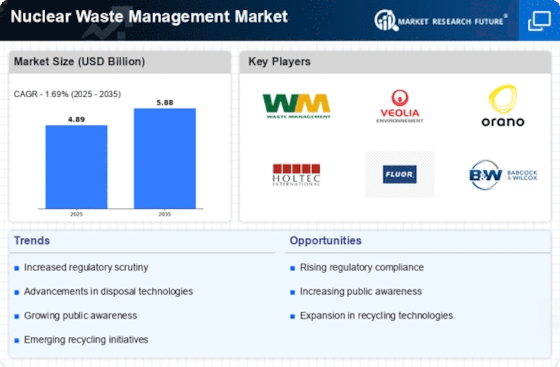
As per Market Research Future analysis, the Nuclear Waste Management Market Size was estimated at 4.89 USD Billion in 2024. The Nuclear Waste Management industry is projected to grow from 4.973 USD Billion in 2025 to 5.881 USD Billion by 2035, exhibiting a compound annual growth rate (CAGR) of 1.69% during the forecast period 2025 - 2035

Key Market Trends & Highlights

The Nuclear Waste Management Market is poised for growth driven by regulatory evolution and technological advancements.

  • North America remains the largest market for nuclear waste management, driven by stringent regulatory frameworks. Asia-Pacific is emerging as the fastest-growing region, reflecting increasing energy demands and environmental concerns. Intermediate-Level Waste continues to dominate the market, while High-Level Waste is experiencing rapid growth due to technological innovations. Key market drivers include increasing regulatory pressure and public awareness regarding environmental impacts.

Market Size & Forecast

2024 Market Size 4.89 (USD Billion)
2035 Market Size 5.881 (USD Billion)
CAGR (2025 - 2035) 1.69%
Largest Regional Market Share in 2024 North America

Major Players

Waste Management Inc (US), Veolia Environnement SA (FR), Energoatom (UA), <a href="https://www.orano.group/en/news/news-group/2025/march/enrichment-orano-and-energoatom-sign-an-agreement-to-supply-enrichment-services-to-ukraine-s-nuclear-power-plants">Orano</a> SA (FR), Holtec International (US), Fluor Corporation (US), Babcock &amp; Wilcox Enterprises Inc (US), Sierra Nuclear Corporation (US), Nuvia Limited (GB)

Market Trends

The Nuclear Waste Management Market is currently undergoing a transformative phase, driven by increasing regulatory pressures and heightened public awareness regarding environmental sustainability. Governments worldwide are implementing stricter regulations to ensure the safe disposal and management of nuclear waste, which appears to be fostering innovation in waste treatment technologies.

 Furthermore, the growing emphasis on sustainable practices suggests that stakeholders are increasingly prioritizing long-term environmental impacts over short-term economic gains. 

In addition, the Nuclear Waste Management Market is witnessing a trend towards collaboration among various stakeholders, including government agencies, private companies, and research institutions. This collaborative approach seems to facilitate knowledge sharing and the development of best practices, which could lead to more effective waste management strategies. 

As the Nuclear Waste Management Market evolves, it is essential for all parties involved to remain adaptable and responsive to emerging challenges and opportunities, ensuring that nuclear waste is managed in a manner that protects both public health and the environment.

Regulatory Evolution

The Nuclear Waste Management Market is experiencing a notable shift in regulatory frameworks, as governments are increasingly focused on enhancing safety standards and environmental protection. This evolution appears to be driving the adoption of more stringent guidelines for waste disposal and management, compelling industry players to innovate and comply with new requirements.

Technological Advancements

Technological innovation is playing a crucial role in the Nuclear Waste Management Market, with advancements in waste treatment and disposal methods emerging as a key trend. These innovations may include the development of more efficient recycling processes and improved containment solutions, which could significantly enhance the safety and sustainability of nuclear waste management. 

One of the most Notable Nuclear Waste Management Market trends is the integration of AI-driven characterization systems and robotics to enhance safety and efficiency during the decommissioning of aging reactors.

Stakeholder Collaboration

Collaboration among various stakeholders is becoming increasingly prevalent within the Nuclear Waste Management Market. This trend suggests that partnerships between government entities, private sector companies, and research organizations are essential for sharing knowledge and resources, ultimately leading to more effective and comprehensive waste management strategies.

Development of Deep Geological Repositories

Current nuclear waste management market trends also highlight a major shift toward the development of deep geological repositories as the preferred long-term solution for high-level radioactive waste.

Nuclear waste management Market Market Drivers

Growing Energy Demand

The increasing The Nuclear Waste Management Industry. As countries seek to diversify their energy sources and reduce carbon emissions, nuclear power is being recognized as a viable option. This shift towards nuclear energy production inevitably leads to an increase in nuclear waste generation, necessitating effective management solutions. The Nuclear Waste Management Market is thus poised for growth, as utilities and governments invest in infrastructure and technologies to handle the rising volumes of waste. Projections indicate that the market could expand by approximately 6% annually, driven by the need for sustainable energy solutions and the corresponding waste management requirements.

Technological Innovations

Technological advancements play a pivotal role in shaping the Nuclear Waste Management Market. Innovations in waste treatment and disposal technologies, such as advanced separation techniques and deep geological repositories, are enhancing the efficiency and safety of nuclear waste management processes. These technologies not only improve waste handling but also reduce the long-term environmental impact associated with nuclear waste. The market is witnessing an influx of investments aimed at research and development of new solutions, which could potentially lead to a more sustainable approach to nuclear waste management. As a result, the Nuclear Waste Management Market is expected to see a surge in demand for innovative solutions that address both safety and environmental concerns.

Increasing Regulatory Pressure

The Nuclear Waste Management Market is experiencing heightened regulatory pressure as governments worldwide implement stricter guidelines for waste disposal and management. This trend is driven by the need to ensure public safety and environmental protection. Regulatory bodies are establishing more comprehensive frameworks that mandate the safe handling, transportation, and storage of nuclear waste. As a result, companies operating within the Nuclear Waste Management Market are compelled to invest in compliance measures and advanced technologies to meet these evolving standards. The market is projected to grow significantly, with estimates suggesting a compound annual growth rate of around 5% over the next decade, largely influenced by these regulatory developments.

Public Awareness and Environmental Concerns

Public awareness regarding environmental issues is becoming increasingly pronounced, impacting the Nuclear Waste Management Market. As communities become more informed about the implications of nuclear waste, there is a growing demand for transparency and accountability from nuclear facilities. This shift in public perception is prompting companies within the Nuclear Waste Management Market to adopt more sustainable practices and engage in community outreach initiatives. Enhanced public scrutiny is likely to drive innovation and improvements in waste management strategies, as stakeholders seek to address environmental concerns effectively. Consequently, the market may experience a transformation as it adapts to these societal expectations.

International Collaboration and Knowledge Sharing

International collaboration is emerging as a crucial driver for the Nuclear Waste Management Market. Countries are increasingly recognizing the importance of sharing knowledge and best practices in managing nuclear waste. Collaborative efforts, such as joint research initiatives and technology transfer agreements, are fostering innovation and improving waste management strategies across borders. This trend not only enhances the capabilities of individual nations but also contributes to the development of a more cohesive global approach to nuclear waste management. As nations work together to address common challenges, the Nuclear Waste Management Market is likely to benefit from enhanced efficiency and effectiveness in waste management practices.

Market Segment Insights

By Waste Type: Intermediate-Level Waste (Largest) vs. High-Level Waste (Fastest-Growing)

<p>In the Nuclear Waste Management Market, the distribution of waste types showcases Intermediate-Level Waste as the largest segment, primarily due to its extensive generation from various nuclear applications, including medical and industrial sources. Low-Level Waste also holds a significant share but does not match the magnitude of Intermediate-Level Waste. High-Level Waste, while constituting a smaller percentage of the overall waste generated, is quickly gaining attention due to the growing concerns regarding its management and environmental implications, marking it as a critical focus for development in the sector.</p>

<p>Low-Level Waste (Dominant) vs. Intermediate-Level Waste (Emerging)</p>

<p>Low-Level Waste occupies a dominant position in the Nuclear Waste Management Market, attributed to its relatively lesser radioactivity and often simpler management processes. This type includes items like contaminated clothing and tools, making it easier and cost-effective to handle. On the other hand, Intermediate-Level Waste, while emerging, presents more challenges in terms of disposal and requires a more sophisticated approach to management owing to its higher levels of radioactivity. The transition toward sustainable management solutions in Intermediate-Level Waste is becoming increasingly important as stricter regulations and safety measures are implemented, driving innovation and investment within this segment.</p>

By Reactor Type: Pressurized Water Reactor (Largest) vs. Boiling Water Reactors (Fastest-Growing)

<p>In the Nuclear Waste Management Market, the reactor type segment reveals a diverse distribution of market share among its constituents. Pressurized Water Reactors (PWR) dominate the segment due to their widespread use and established technology, contributing significantly to the overall waste management challenges faced by the industry. Meanwhile, Boiling Water Reactors (BWR) are emerging rapidly, capturing the attention of stakeholders with their specific waste profiles and management requirements, which are distinctly different from those of PWRs. As uranium demand and energy production increase, the growth trends for these reactors are also magnified. Pressurized Water Reactors still lead but face competition from Boiling Water Reactors, which are gaining favor due to advancements in technologies that promise more efficient waste handling and management. The environmental pressures to improve waste disposal methods and regulations are further accelerating the development and deployment of newer reactor technologies in this sector.</p>

<p>PWR (Dominant) vs. BWR (Emerging)</p>

<p>Pressurized Water Reactors (PWR) are the backbone of nuclear energy production, characterized by their robust design and high reliability. Their operational efficiency and significant experience in waste management make them a dominant force in the market. PWRs generate high levels of thermal energy, which translates into greater quantities of nuclear waste requiring careful management. In juxtaposition, Boiling Water Reactors (BWR) present an emerging frontier. They operate at lower pressure and have different coolant management processes, which can lead to unique waste profiles. This distinct approach fosters innovative solutions for waste management, making BWRs an attractive option for future development and growth in the nuclear waste sector.</p>

By Application: Utility (Largest) vs. Industrial (Fastest-Growing)

<p>In the Nuclear Waste Management Market, the application segment is primarily divided into Utilities and Industries. Utilities command a substantial market share due to their reliance on nuclear power generation and the corresponding necessity for safe waste management. Industrial applications, while currently smaller in terms of market share, are rapidly gaining traction as the demand for nuclear-derived energy solutions in various sectors increases, resulting in an evolving landscape of nuclear waste handling.</p>

<p>Utility (Dominant) vs. Industrial (Emerging)</p>

<p>Utility applications dominate the nuclear waste management segment, primarily driven by the operation of nuclear power plants that generate large quantities of waste. These utilities typically have well-established protocols and robust infrastructure for managing and disposing of nuclear waste. In contrast, industrial applications are emerging rapidly, with increased adoption in sectors such as healthcare and research, which require diverse waste management solutions. As technologies evolve, and regulations tighten, industrial applications are positioned to grow significantly, reflecting a shift in how nuclear waste is perceived and managed across various industries.</p>

Get more detailed insights about Nuclear Waste Management Market Research Report—Global Forecast till 2035

Regional Insights

North America : Nuclear Leadership and Innovation

North America is the largest market for nuclear waste management, holding approximately 45% of the global share. The region's growth is driven by stringent regulatory frameworks, increasing nuclear energy production, and a rising focus on sustainable waste disposal solutions. The U.S. leads in nuclear energy generation, while Canada is also expanding its nuclear capabilities, contributing to the demand for effective waste management solutions. The competitive landscape in North America is robust, featuring key players such as Waste Management Inc, Holtec International, and Babcock & Wilcox Enterprises. These companies are at the forefront of developing innovative technologies for waste treatment and disposal. The presence of established regulatory bodies ensures compliance and safety, further enhancing market growth. The region's commitment to nuclear energy and waste management positions it as a leader in the global market.

Europe : Regulatory Framework and Sustainability

Europe is the second-largest market for nuclear waste management, accounting for approximately 30% of the global share. The region's growth is propelled by stringent EU regulations aimed at ensuring safe and sustainable waste management practices. Countries like France and the UK are leading in nuclear energy production, which drives the demand for advanced waste management solutions. The European Commission's initiatives to promote nuclear safety and waste disposal are key regulatory catalysts. Leading countries in Europe include France, Germany, and the UK, with significant investments in waste management technologies. Companies like Veolia Environnement and Orano are pivotal in providing innovative solutions. The competitive landscape is characterized by collaboration between public and private sectors, ensuring compliance with EU regulations. This collaborative approach enhances the region's capability to manage nuclear waste effectively and sustainably.

Asia-Pacific : Emerging Markets and Growth Potential

Asia-Pacific is witnessing rapid growth in the nuclear waste management market, holding approximately 20% of the global share. The region's expansion is driven by increasing energy demands, particularly in countries like China and India, which are investing heavily in nuclear energy. Regulatory frameworks are evolving to address safety and waste management, creating a conducive environment for market growth. The rising awareness of environmental sustainability further fuels demand for effective waste management solutions. Key players in the Asia-Pacific region include Energoatom and Nuvia Limited, which are focusing on innovative waste management technologies. Countries like Japan and South Korea are also enhancing their nuclear waste management capabilities. The competitive landscape is characterized by partnerships and collaborations aimed at improving waste disposal methods and ensuring compliance with emerging regulations. This dynamic environment positions Asia-Pacific as a significant player in The Nuclear Waste Management.

Middle East and Africa : Resource-Rich and Regulatory Challenges

The Middle East and Africa region is gradually developing its nuclear waste management market, currently holding about 5% of the global share. The growth is driven by emerging nuclear energy programs in countries like the UAE and South Africa, which are beginning to recognize the importance of effective waste management. However, regulatory frameworks are still in the nascent stages, posing challenges to market development. The region's focus on energy diversification is a key driver for nuclear energy adoption and subsequent waste management needs. Leading countries in this region include the UAE and South Africa, where investments in nuclear infrastructure are increasing. The competitive landscape is still forming, with local and international players exploring opportunities. Companies like Fluor Corporation are beginning to establish a presence, focusing on developing waste management solutions tailored to the region's unique challenges. As the nuclear sector grows, so will the demand for effective waste management strategies.

Key Players and Competitive Insights

Major market players are spending a lot on R&D to increase their product lines, which will help the nuclear waste management industry grow even more. Market participants are also taking various strategic initiatives to grow their worldwide footprint, including new product launches, contractual agreements, mergers and acquisitions, increased investments, market developments and collaboration with other organizations. Competitors in the industry must offer cost-effective items to expand and survive in an increasingly competitive and rising market industry.One of the primary business strategies manufacturers adopt in the global nuclear waste management industry to benefit clients and expand the sector is manufacturing locally to reduce operating costs. In recent years, nuclear waste management industry has provided medicine with some of the most significant benefits. The nuclear waste management market major player such as Enercon (US), Veolia (France), US Ecology Inc. (US), Posiva Oy (Finland), Stericycle Inc. (US), John Wood Group PLC (UK), Perma-Fix (US), Bechtel Corporation (US), Fluor Corporation (US), BHI Energy (US), Waste Control Specialists LLC (US), Augean PLC (UK), Chase Environmental Group Inc. (US), DMT (Germany), Holtec International (US) and Westinghouse Electric Company LLC (US).The corporate offices of the Finnish corporation Posiva Oy are located in the town of Eurajoki. It was established in 1995 by two Finnish nuclear plant operators, Teollisuuden Voima and Fortum, for the purpose of investigating and developing a strategy for disposing of spent nuclear fuel from their facilities.
In April a modelling effort on the groundwater chemistry in the bedrock has been started by Posiva Oy in Finland. It resulted in the eventual disposal of old nuclear fuel utilising the most effective computers decades in the future. The company is in charge of removing used nuclear energy.Also, the Irving, Texas-based Fluor Corporation is a worldwide American engineering and construction company. It is a holding company that offers services in the sectors of oil and gas, industrial and infrastructure, government, and power through its subsidiaries.

Key Companies in the Nuclear waste management Market include

Industry Developments

February 2019:Viridor has obtained a contract for the whole management of nuclear waste, and it will provide integrated waste management services for the waste generated at Hinkley Point C.

December 2018:Magnox Ltd has given Wood a significant contract for the removal, processing, and disposal of radioactive waste from a decommissioned nuclear power plant in the UK. 47m3 of radioactive wet waste that has been kept in tanks at Dungeness A in Kent will be removed as part of the project.

In November 2022, the Biden administration had planned for raising the funding in projects to recycle nuclear waste from power plants including through reprocessing, a technology that has not been practiced in the United States for decades because of concerns about costs and proliferation.

Future Outlook

Nuclear waste management Market Future Outlook

The Nuclear Waste Management Market size is projected to grow at 1.69% CAGR from 2024 to 2035, driven by regulatory pressures, technological advancements, and increasing public awareness.<br>The future of the Nuclear Waste Management Market is driven by the global transition toward low-carbon energy and the decommissioning of aging reactors. As nations invest in new power facilities, the Nuclear Waste Management Market is shifting toward advanced solutions like deep geological repositories and vitrification. Furthermore, innovations in recycling and robotics are expected to enhance safety and efficiency within the nuclear waste management market through 2030.

New opportunities lie in:

  • <p>Development of advanced containment materials for long-term storage solutions.</p>
  • <p> </p>
  • <p>Implementation of AI-driven monitoring systems for waste management efficiency.</p>
  • <p>Expansion of partnerships with local governments for community-based waste disposal initiatives.</p>

By 2035, the market is expected to achieve enhanced sustainability and operational efficiency.

Market Segmentation

Nuclear waste management Market Waste Type Outlook

  • Low-Level Waste
  • Intermediate-Level Waste
  • High-Level Waste

Nuclear waste management Market Application Outlook

  • Industrial
  • Utility

Nuclear waste management Market Reactor Type Outlook

  • Pressurized Water Reactor
  • Boiling Water Reactors
  • Gas-Cooled Reactors
  • Pressurized Heavy Water Reactor

Report Scope

MARKET SIZE 2024 4.89(USD Billion)
MARKET SIZE 2025 4.973(USD Billion)
MARKET SIZE 2035 5.881(USD Billion)
COMPOUND ANNUAL GROWTH RATE (CAGR) 1.69% (2025 - 2035)
REPORT COVERAGE Revenue Forecast, Competitive Landscape, Growth Factors, and Trends
BASE YEAR 2024
Market Forecast Period 2025 - 2035
Historical Data 2019 - 2024
Market Forecast Units USD Billion
Key Companies Profiled Waste Management Inc (US), Veolia Environnement SA (FR), Energoatom (UA), Orano SA (FR), Holtec International (US), Fluor Corporation (US), Babcock & Wilcox Enterprises Inc (US), Sierra Nuclear Corporation (US), Nuvia Limited (GB)
Segments Covered Waste Type, Reactor Type, Application, Region
Key Market Opportunities Advancements in deep geological repositories enhance safety and efficiency in the Nuclear Waste Management Market.
Key Market Dynamics Regulatory changes and technological advancements drive innovation and competition in the Nuclear Waste Management Market.
Countries Covered North America, Europe, APAC, South America, MEA

FAQs

What is the current valuation of the Nuclear Waste Management Market as of 2024?

<p>The Nuclear Waste Management Market was valued at 4.89 USD Billion in 2024.</p>

What is the projected market valuation for the Nuclear Waste Management Market in 2035?

<p>The market is projected to reach 5.881 USD Billion by 2035.</p>

What is the expected CAGR for the Nuclear Waste Management Market during the forecast period 2025 - 2035?

<p>The expected CAGR for the market during the forecast period is 1.69%.</p>

Which companies are considered key players in the Nuclear Waste Management Market?

<p>Key players include Waste Management Inc, Veolia Environnement SA, Energoatom, Orano SA, and Holtec International.</p>

What are the market segments based on waste type in the Nuclear Waste Management Market?

<p>The market segments include Low-Level Waste, Intermediate-Level Waste, and High-Level Waste.</p>

What were the valuations for Low-Level Waste and High-Level Waste in 2024?

<p>In 2024, Low-Level Waste was valued at 1.5 USD Billion, while High-Level Waste was valued at 2.19 USD Billion.</p>

How does the valuation of Intermediate-Level Waste compare to other waste types?

Intermediate-Level Waste had a valuation of 1.2 USD Billion in 2024, which is lower than High-Level Waste but higher than Low-Level Waste.

What are the reactor types included in the Nuclear Waste Management Market segments?

Reactor types include Pressurized Water Reactor, Boiling Water Reactors, Gas-Cooled Reactors, and Pressurized Heavy Water Reactor.

What was the valuation for Industrial applications in the Nuclear Waste Management Market in 2024?

The valuation for Industrial applications was 2.44 USD Billion in 2024.

What is the projected growth trend for Utility applications in the Nuclear Waste Management Market?

Utility applications are projected to grow from 2.45 USD Billion in 2024 to higher valuations by 2035.

  1. SECTION I: EXECUTIVE SUMMARY AND KEY HIGHLIGHTS
    1. | 1.1 EXECUTIVE SUMMARY
    2. | | 1.1.1 Market Overview
    3. | | 1.1.2 Key Findings
    4. | | 1.1.3 Market Segmentation
    5. | | 1.1.4 Competitive Landscape
    6. | | 1.1.5 Challenges and Opportunities
    7. | | 1.1.6 Future Outlook
  2. SECTION II: SCOPING, METHODOLOGY AND MARKET STRUCTURE
    1. | 2.1 MARKET INTRODUCTION
    2. | | 2.1.1 Definition
    3. | | 2.1.2 Scope of the study
    4. | | | 2.1.2.1 Research Objective
    5. | | | 2.1.2.2 Assumption
    6. | | | 2.1.2.3 Limitations
    7. | 2.2 RESEARCH METHODOLOGY
    8. | | 2.2.1 Overview
    9. | | 2.2.2 Data Mining
    10. | | 2.2.3 Secondary Research
    11. | | 2.2.4 Primary Research
    12. | | | 2.2.4.1 Primary Interviews and Information Gathering Process
    13. | | | 2.2.4.2 Breakdown of Primary Respondents
    14. | | 2.2.5 Forecasting Model
    15. | | 2.2.6 Market Size Estimation
    16. | | | 2.2.6.1 Bottom-Up Approach
    17. | | | 2.2.6.2 Top-Down Approach
    18. | | 2.2.7 Data Triangulation
    19. | | 2.2.8 Validation
  3. SECTION III: QUALITATIVE ANALYSIS
    1. | 3.1 MARKET DYNAMICS
    2. | | 3.1.1 Overview
    3. | | 3.1.2 Drivers
    4. | | 3.1.3 Restraints
    5. | | 3.1.4 Opportunities
    6. | 3.2 MARKET FACTOR ANALYSIS
    7. | | 3.2.1 Value chain Analysis
    8. | | 3.2.2 Porter's Five Forces Analysis
    9. | | | 3.2.2.1 Bargaining Power of Suppliers
    10. | | | 3.2.2.2 Bargaining Power of Buyers
    11. | | | 3.2.2.3 Threat of New Entrants
    12. | | | 3.2.2.4 Threat of Substitutes
    13. | | | 3.2.2.5 Intensity of Rivalry
    14. | | 3.2.3 COVID-19 Impact Analysis
    15. | | | 3.2.3.1 Market Impact Analysis
    16. | | | 3.2.3.2 Regional Impact
    17. | | | 3.2.3.3 Opportunity and Threat Analysis
  4. SECTION IV: QUANTITATIVE ANALYSIS
    1. | 4.1 Energy & Power, BY Waste Type (USD Billion)
    2. | | 4.1.1 Low-Level Waste
    3. | | 4.1.2 Intermediate-Level Waste
    4. | | 4.1.3 High-Level Waste
    5. | 4.2 Energy & Power, BY Reactor Type (USD Billion)
    6. | | 4.2.1 Pressurized Water Reactor
    7. | | 4.2.2 Boiling Water Reactors
    8. | | 4.2.3 Gas-Cooled Reactors
    9. | | 4.2.4 Pressurized Heavy Water Reactor
    10. | 4.3 Energy & Power, BY Application (USD Billion)
    11. | | 4.3.1 Industrial
    12. | | 4.3.2 Utility
    13. | 4.4 Energy & Power, BY Region (USD Billion)
    14. | | 4.4.1 North America
    15. | | | 4.4.1.1 US
    16. | | | 4.4.1.2 Canada
    17. | | 4.4.2 Europe
    18. | | | 4.4.2.1 Germany
    19. | | | 4.4.2.2 UK
    20. | | | 4.4.2.3 France
    21. | | | 4.4.2.4 Russia
    22. | | | 4.4.2.5 Italy
    23. | | | 4.4.2.6 Spain
    24. | | | 4.4.2.7 Rest of Europe
    25. | | 4.4.3 APAC
    26. | | | 4.4.3.1 China
    27. | | | 4.4.3.2 India
    28. | | | 4.4.3.3 Japan
    29. | | | 4.4.3.4 South Korea
    30. | | | 4.4.3.5 Malaysia
    31. | | | 4.4.3.6 Thailand
    32. | | | 4.4.3.7 Indonesia
    33. | | | 4.4.3.8 Rest of APAC
    34. | | 4.4.4 South America
    35. | | | 4.4.4.1 Brazil
    36. | | | 4.4.4.2 Mexico
    37. | | | 4.4.4.3 Argentina
    38. | | | 4.4.4.4 Rest of South America
    39. | | 4.4.5 MEA
    40. | | | 4.4.5.1 GCC Countries
    41. | | | 4.4.5.2 South Africa
    42. | | | 4.4.5.3 Rest of MEA
  5. SECTION V: COMPETITIVE ANALYSIS
    1. | 5.1 Competitive Landscape
    2. | | 5.1.1 Overview
    3. | | 5.1.2 Competitive Analysis
    4. | | 5.1.3 Market share Analysis
    5. | | 5.1.4 Major Growth Strategy in the Energy & Power
    6. | | 5.1.5 Competitive Benchmarking
    7. | | 5.1.6 Leading Players in Terms of Number of Developments in the Energy & Power
    8. | | 5.1.7 Key developments and growth strategies
    9. | | | 5.1.7.1 New Product Launch/Service Deployment
    10. | | | 5.1.7.2 Merger & Acquisitions
    11. | | | 5.1.7.3 Joint Ventures
    12. | | 5.1.8 Major Players Financial Matrix
    13. | | | 5.1.8.1 Sales and Operating Income
    14. | | | 5.1.8.2 Major Players R&D Expenditure. 2023
    15. | 5.2 Company Profiles
    16. | | 5.2.1 Waste Management Inc (US)
    17. | | | 5.2.1.1 Financial Overview
    18. | | | 5.2.1.2 Products Offered
    19. | | | 5.2.1.3 Key Developments
    20. | | | 5.2.1.4 SWOT Analysis
    21. | | | 5.2.1.5 Key Strategies
    22. | | 5.2.2 Veolia Environnement SA (FR)
    23. | | | 5.2.2.1 Financial Overview
    24. | | | 5.2.2.2 Products Offered
    25. | | | 5.2.2.3 Key Developments
    26. | | | 5.2.2.4 SWOT Analysis
    27. | | | 5.2.2.5 Key Strategies
    28. | | 5.2.3 Energoatom (UA)
    29. | | | 5.2.3.1 Financial Overview
    30. | | | 5.2.3.2 Products Offered
    31. | | | 5.2.3.3 Key Developments
    32. | | | 5.2.3.4 SWOT Analysis
    33. | | | 5.2.3.5 Key Strategies
    34. | | 5.2.4 Orano SA (FR)
    35. | | | 5.2.4.1 Financial Overview
    36. | | | 5.2.4.2 Products Offered
    37. | | | 5.2.4.3 Key Developments
    38. | | | 5.2.4.4 SWOT Analysis
    39. | | | 5.2.4.5 Key Strategies
    40. | | 5.2.5 Holtec International (US)
    41. | | | 5.2.5.1 Financial Overview
    42. | | | 5.2.5.2 Products Offered
    43. | | | 5.2.5.3 Key Developments
    44. | | | 5.2.5.4 SWOT Analysis
    45. | | | 5.2.5.5 Key Strategies
    46. | | 5.2.6 Fluor Corporation (US)
    47. | | | 5.2.6.1 Financial Overview
    48. | | | 5.2.6.2 Products Offered
    49. | | | 5.2.6.3 Key Developments
    50. | | | 5.2.6.4 SWOT Analysis
    51. | | | 5.2.6.5 Key Strategies
    52. | | 5.2.7 Babcock & Wilcox Enterprises Inc (US)
    53. | | | 5.2.7.1 Financial Overview
    54. | | | 5.2.7.2 Products Offered
    55. | | | 5.2.7.3 Key Developments
    56. | | | 5.2.7.4 SWOT Analysis
    57. | | | 5.2.7.5 Key Strategies
    58. | | 5.2.8 Sierra Nuclear Corporation (US)
    59. | | | 5.2.8.1 Financial Overview
    60. | | | 5.2.8.2 Products Offered
    61. | | | 5.2.8.3 Key Developments
    62. | | | 5.2.8.4 SWOT Analysis
    63. | | | 5.2.8.5 Key Strategies
    64. | | 5.2.9 Nuvia Limited (GB)
    65. | | | 5.2.9.1 Financial Overview
    66. | | | 5.2.9.2 Products Offered
    67. | | | 5.2.9.3 Key Developments
    68. | | | 5.2.9.4 SWOT Analysis
    69. | | | 5.2.9.5 Key Strategies
    70. | 5.3 Appendix
    71. | | 5.3.1 References
    72. | | 5.3.2 Related Reports
  6. LIST OF FIGURES
    1. | 6.1 MARKET SYNOPSIS
    2. | 6.2 NORTH AMERICA MARKET ANALYSIS
    3. | 6.3 US MARKET ANALYSIS BY WASTE TYPE
    4. | 6.4 US MARKET ANALYSIS BY REACTOR TYPE
    5. | 6.5 US MARKET ANALYSIS BY APPLICATION
    6. | 6.6 CANADA MARKET ANALYSIS BY WASTE TYPE
    7. | 6.7 CANADA MARKET ANALYSIS BY REACTOR TYPE
    8. | 6.8 CANADA MARKET ANALYSIS BY APPLICATION
    9. | 6.9 EUROPE MARKET ANALYSIS
    10. | 6.10 GERMANY MARKET ANALYSIS BY WASTE TYPE
    11. | 6.11 GERMANY MARKET ANALYSIS BY REACTOR TYPE
    12. | 6.12 GERMANY MARKET ANALYSIS BY APPLICATION
    13. | 6.13 UK MARKET ANALYSIS BY WASTE TYPE
    14. | 6.14 UK MARKET ANALYSIS BY REACTOR TYPE
    15. | 6.15 UK MARKET ANALYSIS BY APPLICATION
    16. | 6.16 FRANCE MARKET ANALYSIS BY WASTE TYPE
    17. | 6.17 FRANCE MARKET ANALYSIS BY REACTOR TYPE
    18. | 6.18 FRANCE MARKET ANALYSIS BY APPLICATION
    19. | 6.19 RUSSIA MARKET ANALYSIS BY WASTE TYPE
    20. | 6.20 RUSSIA MARKET ANALYSIS BY REACTOR TYPE
    21. | 6.21 RUSSIA MARKET ANALYSIS BY APPLICATION
    22. | 6.22 ITALY MARKET ANALYSIS BY WASTE TYPE
    23. | 6.23 ITALY MARKET ANALYSIS BY REACTOR TYPE
    24. | 6.24 ITALY MARKET ANALYSIS BY APPLICATION
    25. | 6.25 SPAIN MARKET ANALYSIS BY WASTE TYPE
    26. | 6.26 SPAIN MARKET ANALYSIS BY REACTOR TYPE
    27. | 6.27 SPAIN MARKET ANALYSIS BY APPLICATION
    28. | 6.28 REST OF EUROPE MARKET ANALYSIS BY WASTE TYPE
    29. | 6.29 REST OF EUROPE MARKET ANALYSIS BY REACTOR TYPE
    30. | 6.30 REST OF EUROPE MARKET ANALYSIS BY APPLICATION
    31. | 6.31 APAC MARKET ANALYSIS
    32. | 6.32 CHINA MARKET ANALYSIS BY WASTE TYPE
    33. | 6.33 CHINA MARKET ANALYSIS BY REACTOR TYPE
    34. | 6.34 CHINA MARKET ANALYSIS BY APPLICATION
    35. | 6.35 INDIA MARKET ANALYSIS BY WASTE TYPE
    36. | 6.36 INDIA MARKET ANALYSIS BY REACTOR TYPE
    37. | 6.37 INDIA MARKET ANALYSIS BY APPLICATION
    38. | 6.38 JAPAN MARKET ANALYSIS BY WASTE TYPE
    39. | 6.39 JAPAN MARKET ANALYSIS BY REACTOR TYPE
    40. | 6.40 JAPAN MARKET ANALYSIS BY APPLICATION
    41. | 6.41 SOUTH KOREA MARKET ANALYSIS BY WASTE TYPE
    42. | 6.42 SOUTH KOREA MARKET ANALYSIS BY REACTOR TYPE
    43. | 6.43 SOUTH KOREA MARKET ANALYSIS BY APPLICATION
    44. | 6.44 MALAYSIA MARKET ANALYSIS BY WASTE TYPE
    45. | 6.45 MALAYSIA MARKET ANALYSIS BY REACTOR TYPE
    46. | 6.46 MALAYSIA MARKET ANALYSIS BY APPLICATION
    47. | 6.47 THAILAND MARKET ANALYSIS BY WASTE TYPE
    48. | 6.48 THAILAND MARKET ANALYSIS BY REACTOR TYPE
    49. | 6.49 THAILAND MARKET ANALYSIS BY APPLICATION
    50. | 6.50 INDONESIA MARKET ANALYSIS BY WASTE TYPE
    51. | 6.51 INDONESIA MARKET ANALYSIS BY REACTOR TYPE
    52. | 6.52 INDONESIA MARKET ANALYSIS BY APPLICATION
    53. | 6.53 REST OF APAC MARKET ANALYSIS BY WASTE TYPE
    54. | 6.54 REST OF APAC MARKET ANALYSIS BY REACTOR TYPE
    55. | 6.55 REST OF APAC MARKET ANALYSIS BY APPLICATION
    56. | 6.56 SOUTH AMERICA MARKET ANALYSIS
    57. | 6.57 BRAZIL MARKET ANALYSIS BY WASTE TYPE
    58. | 6.58 BRAZIL MARKET ANALYSIS BY REACTOR TYPE
    59. | 6.59 BRAZIL MARKET ANALYSIS BY APPLICATION
    60. | 6.60 MEXICO MARKET ANALYSIS BY WASTE TYPE
    61. | 6.61 MEXICO MARKET ANALYSIS BY REACTOR TYPE
    62. | 6.62 MEXICO MARKET ANALYSIS BY APPLICATION
    63. | 6.63 ARGENTINA MARKET ANALYSIS BY WASTE TYPE
    64. | 6.64 ARGENTINA MARKET ANALYSIS BY REACTOR TYPE
    65. | 6.65 ARGENTINA MARKET ANALYSIS BY APPLICATION
    66. | 6.66 REST OF SOUTH AMERICA MARKET ANALYSIS BY WASTE TYPE
    67. | 6.67 REST OF SOUTH AMERICA MARKET ANALYSIS BY REACTOR TYPE
    68. | 6.68 REST OF SOUTH AMERICA MARKET ANALYSIS BY APPLICATION
    69. | 6.69 MEA MARKET ANALYSIS
    70. | 6.70 GCC COUNTRIES MARKET ANALYSIS BY WASTE TYPE
    71. | 6.71 GCC COUNTRIES MARKET ANALYSIS BY REACTOR TYPE
    72. | 6.72 GCC COUNTRIES MARKET ANALYSIS BY APPLICATION
    73. | 6.73 SOUTH AFRICA MARKET ANALYSIS BY WASTE TYPE
    74. | 6.74 SOUTH AFRICA MARKET ANALYSIS BY REACTOR TYPE
    75. | 6.75 SOUTH AFRICA MARKET ANALYSIS BY APPLICATION
    76. | 6.76 REST OF MEA MARKET ANALYSIS BY WASTE TYPE
    77. | 6.77 REST OF MEA MARKET ANALYSIS BY REACTOR TYPE
    78. | 6.78 REST OF MEA MARKET ANALYSIS BY APPLICATION
    79. | 6.79 KEY BUYING CRITERIA OF ENERGY & POWER
    80. | 6.80 RESEARCH PROCESS OF MRFR
    81. | 6.81 DRO ANALYSIS OF ENERGY & POWER
    82. | 6.82 DRIVERS IMPACT ANALYSIS: ENERGY & POWER
    83. | 6.83 RESTRAINTS IMPACT ANALYSIS: ENERGY & POWER
    84. | 6.84 SUPPLY / VALUE CHAIN: ENERGY & POWER
    85. | 6.85 ENERGY & POWER, BY WASTE TYPE, 2024 (% SHARE)
    86. | 6.86 ENERGY & POWER, BY WASTE TYPE, 2024 TO 2035 (USD Billion)
    87. | 6.87 ENERGY & POWER, BY REACTOR TYPE, 2024 (% SHARE)
    88. | 6.88 ENERGY & POWER, BY REACTOR TYPE, 2024 TO 2035 (USD Billion)
    89. | 6.89 ENERGY & POWER, BY APPLICATION, 2024 (% SHARE)
    90. | 6.90 ENERGY & POWER, BY APPLICATION, 2024 TO 2035 (USD Billion)
    91. | 6.91 BENCHMARKING OF MAJOR COMPETITORS
  7. LIST OF TABLES
    1. | 7.1 LIST OF ASSUMPTIONS
    2. | | 7.1.1
    3. | 7.2 North America MARKET SIZE ESTIMATES; FORECAST
    4. | | 7.2.1 BY WASTE TYPE, 2025-2035 (USD Billion)
    5. | | 7.2.2 BY REACTOR TYPE, 2025-2035 (USD Billion)
    6. | | 7.2.3 BY APPLICATION, 2025-2035 (USD Billion)
    7. | 7.3 US MARKET SIZE ESTIMATES; FORECAST
    8. | | 7.3.1 BY WASTE TYPE, 2025-2035 (USD Billion)
    9. | | 7.3.2 BY REACTOR TYPE, 2025-2035 (USD Billion)
    10. | | 7.3.3 BY APPLICATION, 2025-2035 (USD Billion)
    11. | 7.4 Canada MARKET SIZE ESTIMATES; FORECAST
    12. | | 7.4.1 BY WASTE TYPE, 2025-2035 (USD Billion)
    13. | | 7.4.2 BY REACTOR TYPE, 2025-2035 (USD Billion)
    14. | | 7.4.3 BY APPLICATION, 2025-2035 (USD Billion)
    15. | 7.5 Europe MARKET SIZE ESTIMATES; FORECAST
    16. | | 7.5.1 BY WASTE TYPE, 2025-2035 (USD Billion)
    17. | | 7.5.2 BY REACTOR TYPE, 2025-2035 (USD Billion)
    18. | | 7.5.3 BY APPLICATION, 2025-2035 (USD Billion)
    19. | 7.6 Germany MARKET SIZE ESTIMATES; FORECAST
    20. | | 7.6.1 BY WASTE TYPE, 2025-2035 (USD Billion)
    21. | | 7.6.2 BY REACTOR TYPE, 2025-2035 (USD Billion)
    22. | | 7.6.3 BY APPLICATION, 2025-2035 (USD Billion)
    23. | 7.7 UK MARKET SIZE ESTIMATES; FORECAST
    24. | | 7.7.1 BY WASTE TYPE, 2025-2035 (USD Billion)
    25. | | 7.7.2 BY REACTOR TYPE, 2025-2035 (USD Billion)
    26. | | 7.7.3 BY APPLICATION, 2025-2035 (USD Billion)
    27. | 7.8 France MARKET SIZE ESTIMATES; FORECAST
    28. | | 7.8.1 BY WASTE TYPE, 2025-2035 (USD Billion)
    29. | | 7.8.2 BY REACTOR TYPE, 2025-2035 (USD Billion)
    30. | | 7.8.3 BY APPLICATION, 2025-2035 (USD Billion)
    31. | 7.9 Russia MARKET SIZE ESTIMATES; FORECAST
    32. | | 7.9.1 BY WASTE TYPE, 2025-2035 (USD Billion)
    33. | | 7.9.2 BY REACTOR TYPE, 2025-2035 (USD Billion)
    34. | | 7.9.3 BY APPLICATION, 2025-2035 (USD Billion)
    35. | 7.10 Italy MARKET SIZE ESTIMATES; FORECAST
    36. | | 7.10.1 BY WASTE TYPE, 2025-2035 (USD Billion)
    37. | | 7.10.2 BY REACTOR TYPE, 2025-2035 (USD Billion)
    38. | | 7.10.3 BY APPLICATION, 2025-2035 (USD Billion)
    39. | 7.11 Spain MARKET SIZE ESTIMATES; FORECAST
    40. | | 7.11.1 BY WASTE TYPE, 2025-2035 (USD Billion)
    41. | | 7.11.2 BY REACTOR TYPE, 2025-2035 (USD Billion)
    42. | | 7.11.3 BY APPLICATION, 2025-2035 (USD Billion)
    43. | 7.12 Rest of Europe MARKET SIZE ESTIMATES; FORECAST
    44. | | 7.12.1 BY WASTE TYPE, 2025-2035 (USD Billion)
    45. | | 7.12.2 BY REACTOR TYPE, 2025-2035 (USD Billion)
    46. | | 7.12.3 BY APPLICATION, 2025-2035 (USD Billion)
    47. | 7.13 APAC MARKET SIZE ESTIMATES; FORECAST
    48. | | 7.13.1 BY WASTE TYPE, 2025-2035 (USD Billion)
    49. | | 7.13.2 BY REACTOR TYPE, 2025-2035 (USD Billion)
    50. | | 7.13.3 BY APPLICATION, 2025-2035 (USD Billion)
    51. | 7.14 China MARKET SIZE ESTIMATES; FORECAST
    52. | | 7.14.1 BY WASTE TYPE, 2025-2035 (USD Billion)
    53. | | 7.14.2 BY REACTOR TYPE, 2025-2035 (USD Billion)
    54. | | 7.14.3 BY APPLICATION, 2025-2035 (USD Billion)
    55. | 7.15 India MARKET SIZE ESTIMATES; FORECAST
    56. | | 7.15.1 BY WASTE TYPE, 2025-2035 (USD Billion)
    57. | | 7.15.2 BY REACTOR TYPE, 2025-2035 (USD Billion)
    58. | | 7.15.3 BY APPLICATION, 2025-2035 (USD Billion)
    59. | 7.16 Japan MARKET SIZE ESTIMATES; FORECAST
    60. | | 7.16.1 BY WASTE TYPE, 2025-2035 (USD Billion)
    61. | | 7.16.2 BY REACTOR TYPE, 2025-2035 (USD Billion)
    62. | | 7.16.3 BY APPLICATION, 2025-2035 (USD Billion)
    63. | 7.17 South Korea MARKET SIZE ESTIMATES; FORECAST
    64. | | 7.17.1 BY WASTE TYPE, 2025-2035 (USD Billion)
    65. | | 7.17.2 BY REACTOR TYPE, 2025-2035 (USD Billion)
    66. | | 7.17.3 BY APPLICATION, 2025-2035 (USD Billion)
    67. | 7.18 Malaysia MARKET SIZE ESTIMATES; FORECAST
    68. | | 7.18.1 BY WASTE TYPE, 2025-2035 (USD Billion)
    69. | | 7.18.2 BY REACTOR TYPE, 2025-2035 (USD Billion)
    70. | | 7.18.3 BY APPLICATION, 2025-2035 (USD Billion)
    71. | 7.19 Thailand MARKET SIZE ESTIMATES; FORECAST
    72. | | 7.19.1 BY WASTE TYPE, 2025-2035 (USD Billion)
    73. | | 7.19.2 BY REACTOR TYPE, 2025-2035 (USD Billion)
    74. | | 7.19.3 BY APPLICATION, 2025-2035 (USD Billion)
    75. | 7.20 Indonesia MARKET SIZE ESTIMATES; FORECAST
    76. | | 7.20.1 BY WASTE TYPE, 2025-2035 (USD Billion)
    77. | | 7.20.2 BY REACTOR TYPE, 2025-2035 (USD Billion)
    78. | | 7.20.3 BY APPLICATION, 2025-2035 (USD Billion)
    79. | 7.21 Rest of APAC MARKET SIZE ESTIMATES; FORECAST
    80. | | 7.21.1 BY WASTE TYPE, 2025-2035 (USD Billion)
    81. | | 7.21.2 BY REACTOR TYPE, 2025-2035 (USD Billion)
    82. | | 7.21.3 BY APPLICATION, 2025-2035 (USD Billion)
    83. | 7.22 South America MARKET SIZE ESTIMATES; FORECAST
    84. | | 7.22.1 BY WASTE TYPE, 2025-2035 (USD Billion)
    85. | | 7.22.2 BY REACTOR TYPE, 2025-2035 (USD Billion)
    86. | | 7.22.3 BY APPLICATION, 2025-2035 (USD Billion)
    87. | 7.23 Brazil MARKET SIZE ESTIMATES; FORECAST
    88. | | 7.23.1 BY WASTE TYPE, 2025-2035 (USD Billion)
    89. | | 7.23.2 BY REACTOR TYPE, 2025-2035 (USD Billion)
    90. | | 7.23.3 BY APPLICATION, 2025-2035 (USD Billion)
    91. | 7.24 Mexico MARKET SIZE ESTIMATES; FORECAST
    92. | | 7.24.1 BY WASTE TYPE, 2025-2035 (USD Billion)
    93. | | 7.24.2 BY REACTOR TYPE, 2025-2035 (USD Billion)
    94. | | 7.24.3 BY APPLICATION, 2025-2035 (USD Billion)
    95. | 7.25 Argentina MARKET SIZE ESTIMATES; FORECAST
    96. | | 7.25.1 BY WASTE TYPE, 2025-2035 (USD Billion)
    97. | | 7.25.2 BY REACTOR TYPE, 2025-2035 (USD Billion)
    98. | | 7.25.3 BY APPLICATION, 2025-2035 (USD Billion)
    99. | 7.26 Rest of South America MARKET SIZE ESTIMATES; FORECAST
    100. | | 7.26.1 BY WASTE TYPE, 2025-2035 (USD Billion)
    101. | | 7.26.2 BY REACTOR TYPE, 2025-2035 (USD Billion)
    102. | | 7.26.3 BY APPLICATION, 2025-2035 (USD Billion)
    103. | 7.27 MEA MARKET SIZE ESTIMATES; FORECAST
    104. | | 7.27.1 BY WASTE TYPE, 2025-2035 (USD Billion)
    105. | | 7.27.2 BY REACTOR TYPE, 2025-2035 (USD Billion)
    106. | | 7.27.3 BY APPLICATION, 2025-2035 (USD Billion)
    107. | 7.28 GCC Countries MARKET SIZE ESTIMATES; FORECAST
    108. | | 7.28.1 BY WASTE TYPE, 2025-2035 (USD Billion)
    109. | | 7.28.2 BY REACTOR TYPE, 2025-2035 (USD Billion)
    110. | | 7.28.3 BY APPLICATION, 2025-2035 (USD Billion)
    111. | 7.29 South Africa MARKET SIZE ESTIMATES; FORECAST
    112. | | 7.29.1 BY WASTE TYPE, 2025-2035 (USD Billion)
    113. | | 7.29.2 BY REACTOR TYPE, 2025-2035 (USD Billion)
    114. | | 7.29.3 BY APPLICATION, 2025-2035 (USD Billion)
    115. | 7.30 Rest of MEA MARKET SIZE ESTIMATES; FORECAST
    116. | | 7.30.1 BY WASTE TYPE, 2025-2035 (USD Billion)
    117. | | 7.30.2 BY REACTOR TYPE, 2025-2035 (USD Billion)
    118. | | 7.30.3 BY APPLICATION, 2025-2035 (USD Billion)
    119. | 7.31 PRODUCT LAUNCH/PRODUCT DEVELOPMENT/APPROVAL
    120. | | 7.31.1
    121. | 7.32 ACQUISITION/PARTNERSHIP
    122. | | 7.32.1

Energy & Power Market Segmentation

Energy & Power By Waste Type (USD Billion, 2025-2035)

  • Low-Level Waste
  • Intermediate-Level Waste
  • High-Level Waste

Energy & Power By Reactor Type (USD Billion, 2025-2035)

  • Pressurized Water Reactor
  • Boiling Water Reactors
  • Gas-Cooled Reactors
  • Pressurized Heavy Water Reactor

Energy & Power By Application (USD Billion, 2025-2035)

  • Industrial
  • Utility
Infographic

Free Sample Request

Kindly complete the form below to receive a free sample of this Report

Get Free Sample

Customer Strories

Compare Licence

×
Features License Type
Single User Multiuser License Enterprise User
Price $4,950 $5,950 $7,250
Maximum User Access Limit 1 User Upto 10 Users Unrestricted Access Throughout the Organization
Free Customization
Direct Access to Analyst
Deliverable Format
Platform Access
Discount on Next Purchase 10% 15% 15%
Printable Versions