
×
  • Cat-intel
  • MedIntelliX
  • Resources
  • About Us
  • Hero Background
    English
    Chinese
    French
    Japanese
    Korean
    German
    Spanish

    Neuromorphic Chip Market Trends

    ID: MRFR/SEM/9036-HCR
    200 Pages
    Shubham Munde
    October 2025

    Neuromorphic Chip Market Research Report By Technology (Spiking Neural Networks, Analog Neuromorphic Chips, Digital Neuromorphic Chips, Hybrid Neuromorphic Chips), By Application (Robotics, Computer Vision, Natural Language Processing, IoT Devices), By End Use (Consumer Electronics, Automotive, Healthcare, Data Centers, Telecommunications), By Architecture (Hardware-Based, Software-Based, Mixed...

    Share:
    Download PDF ×

    We do not share your information with anyone. However, we may send you emails based on your report interest from time to time. You may contact us at any time to opt-out.

    Neuromorphic Chip Market Infographic
    Purchase Options

    Market Trends

    Key Emerging Trends in the Neuromorphic Chip Market

    The Neuromorphic Chip market is witnessing splendid traits pushed by the quest for more efficient and mind-inspired computing answers. Neuromorphic Chips, designed to imitate the structure and functioning of the human brain, are gaining momentum due to their potential to revolutionize artificial intelligence (AI) and gadget-getting-to-know (ML) packages. One key trend in this market is the developing adoption of Neuromorphic Chips in area computing. As the demand for actual-time processing and occasional latency programs increases, Neuromorphic Chips offers a promising answer by permitting on-tool studying and inference, reducing the reliance on centralized cloud computing. Another enormous trend is the integration of Neuromorphic Chips into various devices, including smartphones, wearables, and Internet of Things (IoT) devices.

    The strong and cognitive computing talents of Neuromorphic Chips make them nicely perfect for embedded programs, allowing smarter and more independent gadgets. The market is also experiencing multiplied collaboration between Neuromorphic Chip producers and software program developers. The synergy among hardware and software programs is critical for unlocking the overall capability of neuromorphic computing. The collaboration's goal is to optimize algorithms and programming frameworks that leverage the unique structure of Neuromorphic Chips, permitting more green and powerful implementation of neuromorphic computing standards.

    Moreover, the demand for neuromorphic chips in AI programs is riding on innovation in chip architectures. Manufacturers specialize in designing chips that can successfully perform obligations together with sample reputation, herbal language processing, and decision-making, mirroring the talents of the human mind. This trend displays the industry's pursuit of accomplishing better levels of cognitive computing and AI sophistication, pushing the limits of what is viable with conventional computing architectures. The market is witnessing increased interest from research institutions and academia in exploring the potential of Neuromorphic Chips for medical and computational studies.

    Neuromorphic computing's ability to simulate complicated organic methods makes it treasured for applications in neuroscience, climate modeling, and drug discovery. Furthermore, the marketplace is responding to the demand for Neuromorphic Chips in neuromorphic engineering and robotics. The mind-inspired computing skills of these chips cause them to be appropriate for growing sensible robotic structures that can adapt, research, and engage with their environments. This trend is especially applicable in sectors like production, healthcare, and logistics, where robot systems are increasing in number and playing a critical position in automation and selection-making methods.


    Author
    Shubham Munde
    Research Analyst Level II

    With a technical background in information technology & semiconductors, Shubham has 4.5+ years of experience in market research and analytics with the tasks of data mining, analysis, and project execution. He is the POC for our clients, for their consulting projects running under the ICT/Semiconductor domain. Shubham holds a Bachelor’s in Information and Technology and a Master of Business Administration (MBA). Shubham has executed over 150 research projects for our clients under the brand name Market Research Future in the last 2 years. His core skill is building the research respondent relation for gathering the primary information from industry and market estimation for niche markets. He is having expertise in conducting secondary & primary research, market estimations, market projections, competitive analysis, analysing current market trends and market dynamics, deep-dive analysis on market scenarios, consumer behaviour, technological impact analysis, consulting, analytics, etc. He has worked on fortune 500 companies' syndicate and consulting projects along with several government projects. He has worked on the projects of top tech brands such as IBM, Google, Microsoft, AWS, Meta, Oracle, Cisco Systems, Samsung, Accenture, VMware, Schneider Electric, Dell, HP, Ericsson, and so many others. He has worked on Metaverse, Web 3.0, Zero-Trust security, cyber-security, blockchain, quantum computing, robotics, 5G technology, High-Performance computing, data centers, AI, automation, IT equipment, sensors, semiconductors, consumer electronics and so many tech domain projects.

    Leave a Comment

    FAQs

    What was the market size of the Neuromorphic Chip Market in 2024?

    The Neuromorphic Chip Market was valued at 1.68 USD billion in 2024.

    What will be the estimated market size by 2035?

    By 2035, the Neuromorphic Chip Market is anticipated to reach a value of 10.0 USD billion.

    What is the expected CAGR for the Neuromorphic Chip Market from 2025 to 2035?

    The expected CAGR for the Neuromorphic Chip Market from 2025 to 2035 is 17.61%.

    Which region held the largest market share in 2024?

    North America dominated the market with a valuation of 0.56 USD billion in 2024.

    What was the market size of Analog Neuromorphic Chips in 2024?

    Analog Neuromorphic Chips were valued at 0.42 USD billion in 2024.

    Who are the key players in the Neuromorphic Chip Market?

    Key players include Hewlett Packard Enterprise, NVIDIA, BrainChip, and IBM among others.

    What is the expected market value of Digital Neuromorphic Chips by 2035?

    By 2035, Digital Neuromorphic Chips are projected to be valued at 3.5 USD billion.

    What factors are driving the growth of the Neuromorphic Chip Market?

    Growth drivers include advancements in AI technology and increasing demand for computational efficiency.

    How much is the Asia Pacific region expected to contribute to the market in 2035?

    The Asia Pacific region is anticipated to contribute a market value of 2.24 USD billion by 2035.

    What is the projected market size for Hybrid Neuromorphic Chips in 2035?

    Hybrid Neuromorphic Chips are forecasted to reach a market size of 1.7 USD billion by 2035.

    Market Summary

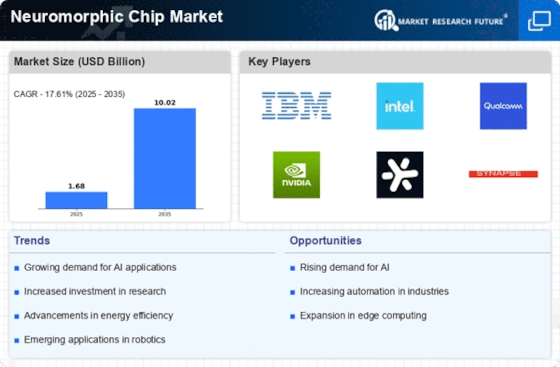
    As per MRFR analysis, the Neuromorphic Chip Market Size was estimated at 1.682 USD Billion in 2024. The Neuromorphic Chip industry is projected to grow from 1.978 USD Billion in 2025 to 10.02 USD Billion by 2035, exhibiting a compound annual growth rate (CAGR) of 17.61 during the forecast period 2025 - 2035.

    Key Market Trends & Highlights

    The Neuromorphic Chip Market is poised for substantial growth driven by technological advancements and diverse applications.

    • The market experiences increased adoption in AI applications, particularly in North America, which remains the largest market. Energy efficiency is becoming a focal point, influencing the design and implementation of neuromorphic chips across various sectors. Expansion into diverse industries is evident, with spiking neural networks leading the market while analog neuromorphic chips are rapidly gaining traction. Rising demand for advanced computing solutions and the integration of machine learning and AI are key drivers propelling market growth.

    Market Size & Forecast

    2024 Market Size 1.682 (USD Billion)
    2035 Market Size 10.02 (USD Billion)
    CAGR (2025 - 2035) 17.61%
    Largest Regional Market Share in 2024 North America

    Major Players

    <p>IBM (US), Intel (US), Qualcomm (US), NVIDIA (US), BrainChip (AU), Synapse (US), MemryX (CA), Horizon Robotics (CN), Cerebras Systems (US)</p>

    Market Trends

    The Neuromorphic Chip Market is currently experiencing a transformative phase, driven by advancements in artificial intelligence and machine learning technologies. These chips, designed to mimic the neural structure of the human brain, offer enhanced processing capabilities, enabling faster and more efficient data analysis. As industries increasingly seek to integrate intelligent systems, the demand for neuromorphic chips is likely to rise, reflecting a shift towards more adaptive and responsive computing solutions. Furthermore, the growing emphasis on energy efficiency in computing is propelling innovations in this sector, as neuromorphic chips typically consume less power compared to traditional architectures. In addition, the Neuromorphic Chip Market appears to be influenced by the expanding applications in various fields, including robotics, autonomous vehicles, and smart devices. Companies are investing in research and development to explore novel uses for these chips, which may lead to breakthroughs in cognitive computing. As the market evolves, collaboration between technology firms and academic institutions is expected to foster further advancements, potentially reshaping the landscape of computing. The future of the Neuromorphic Chip Market seems promising, with ongoing developments likely to enhance its relevance across multiple sectors.

    Increased Adoption in AI Applications

    The Neuromorphic Chip Market is witnessing a surge in adoption within artificial intelligence applications. As organizations strive to enhance machine learning capabilities, these chips provide a unique advantage by processing information in a manner akin to human cognition. This trend indicates a growing recognition of the potential benefits of neuromorphic computing in developing smarter AI systems.

    Focus on Energy Efficiency

    A notable trend in the Neuromorphic Chip Market is the heightened focus on energy efficiency. As the demand for sustainable technology rises, neuromorphic chips are becoming increasingly attractive due to their lower power consumption. This shift suggests that manufacturers are prioritizing the development of energy-efficient solutions to meet both performance and environmental standards.

    Expansion into Diverse Industries

    The Neuromorphic Chip Market is expanding into a variety of industries beyond traditional computing. Sectors such as healthcare, automotive, and telecommunications are exploring the integration of neuromorphic chips to enhance their operational capabilities. This diversification indicates a broader acceptance of neuromorphic technology, potentially leading to innovative applications and solutions.

    Neuromorphic Chip Market Market Drivers

    Growing Focus on Energy Efficiency

    The growing emphasis on energy efficiency is a significant driver for the Neuromorphic Chip Market. As global energy consumption continues to rise, there is an increasing need for computing solutions that minimize energy usage while maintaining high performance. Neuromorphic chips, which are designed to operate with lower power requirements compared to conventional chips, align well with this trend. Their ability to process information in a brain-like manner allows for more efficient data handling, which is particularly beneficial in applications such as edge computing and mobile devices. The market for energy-efficient computing solutions is projected to expand, with neuromorphic chips positioned as a key player in addressing the challenges of energy consumption in technology.

    Integration of Machine Learning and AI

    The integration of machine learning and artificial intelligence into various applications is a pivotal driver for the Neuromorphic Chip Market. As industries increasingly rely on AI for decision-making and automation, the need for chips that can efficiently process and learn from vast amounts of data becomes paramount. Neuromorphic chips, designed to operate in a manner akin to human cognition, are particularly well-suited for these tasks. They can potentially reduce the energy consumption associated with AI computations, making them an attractive option for companies aiming to optimize performance while minimizing costs. The market for AI applications is expected to grow significantly, with neuromorphic chips playing a critical role in this evolution, thereby enhancing their adoption across diverse sectors.

    Advancements in Neuromorphic Technologies

    Technological advancements in neuromorphic systems are propelling the Neuromorphic Chip Market forward. Innovations in materials science, circuit design, and fabrication techniques are enabling the development of more efficient and powerful neuromorphic chips. These advancements not only enhance the performance of neuromorphic chips but also expand their applicability in various fields, including robotics, IoT, and smart devices. The ability to process information in a manner similar to biological systems allows these chips to perform complex tasks with lower power consumption. As research institutions and tech companies continue to invest in neuromorphic technologies, the market is likely to witness a proliferation of new products and applications, further solidifying the role of neuromorphic chips in the future of computing.

    Rising Demand for Advanced Computing Solutions

    The Neuromorphic Chip Market is experiencing a surge in demand for advanced computing solutions, driven by the increasing complexity of data processing requirements across various sectors. As organizations seek to enhance their computational capabilities, neuromorphic chips, which mimic the human brain's neural architecture, offer a promising alternative to traditional computing systems. This shift is particularly evident in sectors such as healthcare, automotive, and robotics, where real-time data processing is crucial. According to recent estimates, the neuromorphic chip market is projected to reach a valuation of approximately 1.5 billion USD by 2026, reflecting a compound annual growth rate of around 30 percent. This growth indicates a robust interest in neuromorphic technology as a viable solution for tackling intricate computational challenges.

    Expansion of Research and Development Initiatives

    The expansion of research and development initiatives in neuromorphic computing is a crucial driver for the Neuromorphic Chip Market. Governments, academic institutions, and private enterprises are increasingly investing in R&D to explore the potential of neuromorphic technologies. This investment is fostering innovation and accelerating the development of new neuromorphic chip designs and applications. Collaborative efforts between academia and industry are likely to yield breakthroughs that enhance the capabilities of neuromorphic chips, making them more accessible and effective for various applications. As these initiatives continue to grow, they are expected to contribute significantly to the market's expansion, paving the way for novel applications in fields such as artificial intelligence, robotics, and beyond.

    Market Segment Insights

    By Technology: Spiking Neural Networks (Largest) vs. Analog Neuromorphic Chips (Fastest-Growing)

    <p>The Neuromorphic Chip Market exhibits a diverse range of technologies, with Spiking Neural Networks (SNNs) leading in market share. SNNs leverage the asynchronous nature of brain activity and have gained significant traction due to their ability to efficiently model complex neural behaviors. Following closely, Analog Neuromorphic Chips are capturing attention, which is attributed to their speed and energy efficiency, offering a compelling alternative for various applications. The integration of these technologies has marked a significant transformation in computational paradigms. As industries seek more efficient and powerful computing solutions, growth trends indicate a rapid trajectory for Analog Neuromorphic Chips, propelled by advancements in AI and machine learning. The surge in demand for real-time processing and low-power consumption applications is driving this segment forward. SNNs remain essential for their robustness in handling dynamic datasets and high-performance tasks, thereby establishing their dominance within the market. However, the rising adoption of Analog chips signifies a shift, fueling competitive dynamics and innovation.</p>

    <p>Technology: Spiking Neural Networks (Dominant) vs. Analog Neuromorphic Chips (Emerging)</p>

    <p>Spiking Neural Networks (SNNs) establish their position as a dominant technology in the Neuromorphic Chip Market due to their ability to process information similarly to biological neural networks, making them highly efficient for tasks such as pattern recognition and sensory processing. They excel in dynamic environments by mimicking the timing and structure of synaptic activities. On the other hand, Analog Neuromorphic Chips are emerging as a versatile solution, characterized by their high-speed performance and low power consumption, leveraging analog signals for computation. This allows for rapid processing capabilities, making them particularly suited for applications that require instant data handling. The synergy and competition between these technologies foster a dynamic market landscape, driving continuous innovations and enhancements.</p>

    By Application: Natural Language Processing (Largest) vs. Robotics (Fastest-Growing)

    <p>In the Neuromorphic Chip Market, the application segments are distinctly defined with Natural Language Processing (NLP) leading the charge. NLP has established itself as the dominant player, driven by its widespread adoption in various sectors, including customer service and virtual assistance. Conversely, Robotics is fast gaining traction due to advancements in automation and robotics technology, making it a key area of growth as industries increasingly adopt robots for various applications. The increasing demand for more efficient and adaptive systems is fueling growth trends across these applications. Natural Language Processing is benefiting from the rise of conversational AI and communication tools, leading to significant investments in this area. Meanwhile, Robotics is poised for rapid expansion, supported by innovations in machine learning and sensor technologies, which enhance robots' capabilities and applications across numerous industries.</p>

    <p>Robotics (Dominant) vs. IoT Devices (Emerging)</p>

    <p>Robotics represents a dominant application in the Neuromorphic Chip Market, characterized by its ability to leverage neuromorphic chips for improved processing efficiency and power consumption. Its market position is fortified by advancements in robotic applications, such as autonomous machines and smart manufacturing systems, leading to enhanced productivity. In contrast, IoT Devices are emerging as a significant segment, benefiting from the interconnectedness of the digital landscape. The integration of neuromorphic chips into IoT offers the potential for real-time data processing in edge devices, facilitating smarter urban planning and efficient resource management. The competition between Robotics and IoT Devices highlights the diverse applications of neuromorphic chips and their critical role in driving innovation and technology adoption.</p>

    By End Use: Consumer Electronics (Largest) vs. Automotive (Fastest-Growing)

    <p>The Neuromorphic Chip Market's end use segment reveals a significant distribution of shares among major sectors, with Consumer Electronics taking the lead. This segment benefits from the increasing integration of AI and machine learning into everyday devices, enhancing performance. Automotive, while currently smaller, is witnessing a rapid ascent driven by the rise of automated and connected vehicles, which demand advanced computing capabilities to process data in real time.</p>

    <p>Consumer Electronics: Dominant vs. Automotive: Emerging</p>

    <p>Consumer Electronics represents a robust foothold in the Neuromorphic Chip Market, fueled by the proliferation of smart devices that leverage neuromorphic chips for improved user experiences. This sector emphasizes efficiency and speed in processing inputs from various sensors. In contrast, the Automotive sector is emerging as a powerful player, propelled by the need for sophisticated functionalities in autonomous driving and intelligent systems. Automotive applications require chips that can emulate human brain functionalities, thus offering rapid decision-making without extensive computing resources, making it a critical area for growth.</p>

    By Architecture: Hardware-Based (Largest) vs. Software-Based (Fastest-Growing)

    <p>In the Neuromorphic Chip Market, the segment distribution illustrates that Hardware-Based architectures hold the largest share, attributed to their effectiveness in mimicking biological neural networks through dedicated hardware circuits. These systems are prevalent in various applications such as robotics and autonomous systems due to their reliable performance and efficiency. In contrast, Software-Based architecture is emerging rapidly as it offers flexibility and adaptability, allowing developers to create sophisticated algorithms that can run on standard hardware. This evolution is becoming increasingly essential as industries demand more versatile solutions. Growth trends in this segment reflect a significant shift towards mixed architecture solutions, which combine the best of both hardware and software approaches. The demand for real-time processing and machine learning capabilities is driving innovation in Software-Based architectures. Additionally, advancements in AI and the increasing complexity of tasks requiring neuromorphic computing are propelling the market growth, making Software-Based the fastest-growing segment. Companies are investing more in developing software solutions that can leverage existing hardware, further boosting this segment's growth potential.</p>

    <p>Architecture: Hardware-Based (Dominant) vs. Software-Based (Emerging)</p>

    <p>Hardware-Based architecture stands out as the dominant segment in the Neuromorphic Chip Market due to its robustness and efficiency in implementing neuromorphic computing. These systems typically feature specialized circuits that emulate neural processes, resulting in high performance for tasks that demand real-time processing. Conversely, Software-Based architecture is emerging as a nimble alternative, driven by the need for flexibility and continual improvements in algorithm design. While it may not yet match the raw performance of its hardware counterpart, the adaptability offered by Software-Based solutions allows for rapid iterations and the integration of cutting-edge AI methodologies. This ongoing evolution positions Software-Based solutions as critical players in addressing the future demands of neuromorphic applications.</p>

    Get more detailed insights about Neuromorphic Chip Market Research Report - Forecast till 2035

    Regional Insights

    The Neuromorphic Chip Market showcased a diverse landscape across various regions. North America held a significant position within this market, valued at 0.56 USD billion in 2024, and anticipated to expand to 3.38 USD billion by 2035, primarily due to its advanced technological infrastructure and active investment in artificial intelligence.

    Europe followed closely, with a value of 0.48 USD billion in 2024, expected to grow to 2.94 USD billion, driven by strong Research and Development investments in neuromorphic technologies. In contrast, South America held a smaller share, starting at 0.12 USD billion but projected to increase to 0.77 USD billion, indicating potential growth opportunities.

    The Asia Pacific region, valued at 0.36 USD billion in 2024, was positioned for substantial expansion, reaching 2.24 USD billion by 2035, due in part to increasing semiconductor manufacturing capabilities. Lastly, the Middle East and Africa, with a valuation of 0.16 USD billion in 2024, are forecasted to progress to 1.67 USD billion, reflecting growing interest in neuromorphic functionalities.

    Collectively, these variations in market size across regions highlighted the Neuromorphic Chip Market's segmentation, revealing unique opportunities and growth drivers for different geographical stakeholders.

    Neuromorphic Chip Market Regional Insights$IMAGE3_HERE$

    Source: Primary Research, Secondary Research, MRFR Database and Analyst Review

    Key Players and Competitive Insights

    The Neuromorphic Chip Market is currently undergoing a transformative phase driven by advancements in artificial intelligence and machine learning technologies. Neuromorphic chips are designed to mimic the neural structures of the human brain, leading to highly efficient processing capabilities for tasks that require deep learning and pattern recognition.

    In this competitive landscape, various players are striving to innovate and differentiate their offerings to capture a larger market share. Companies are focusing on developing specialized hardware that caters to specific applications, such as robotics, autonomous vehicles, and data centers.

    Additionally, the collaboration between academia and industry is fostering an environment rich in research and development, resulting in rapid technological advancements that are reshaping the market dynamics.

    As the demand for intelligent processing capabilities continues to increase, the competition within the Neuromorphic Chip Market is expected to intensify, with companies exploring new partnerships, mergers, and acquisitions to strengthen their market position.

    Hewlett Packard Enterprise has carved out its niche in the Neuromorphic Chip Market with a robust portfolio focused on high-performance computing and advanced computing systems. The company leverages its extensive experience in enterprise solutions to develop neuromorphic technologies that cater to various sectors, including healthcare and automotive.

    Hewlett Packard Enterprise is recognized for its ability to integrate neuromorphic chips into existing IT infrastructures, enhancing data processing capabilities and efficiency. The company's strengths lie in its strong brand recognition, strategic partnerships, and a focus on research and development, which have positioned it favorably to stay competitive.

    By utilizing cutting-edge research, the company is able to offer innovative solutions that meet the ever-evolving needs of the market, solidifying its presence in a highly competitive environment.

    NVIDIA stands out in the Neuromorphic Chip Market as a leading player known for its high-performance graphics processing units and artificial intelligence solutions. The company has expanded its offerings to include neuromorphic computing technologies that cater to complex data processing needs for various applications, including autonomous machines and robotics.

    NVIDIA’s strengths are prominently showcased in its advanced development platforms and software ecosystems, which facilitate easier integration for developers and researchers. The company is proactive in forging strategic partnerships and engaging in mergers and acquisitions to enhance its portfolio and capabilities in neuromorphic technologies.

    By leveraging its expertise in AI and deep learning, NVIDIA continues to drive innovation in this space while maintaining a strong market presence globally.

    Its commitment to cutting-edge technology and support for artificial intelligence research positions NVIDIA as a formidable competitor in the neuromorphic chip arena, catering to the increasing demand for intelligent computing solutions across numerous industries.

    Key Companies in the Neuromorphic Chip Market market include

    Industry Developments

    The Akida Pico, an ultra-low-power neuromorphic semiconductor made for edge AI devices like wearables and sensor modules, was introduced by BrainChip in October 2024. With the release of the AKD1000 in an M.2 form factor in early 2025, the business gave developers a means of creating AI prototypes that used less than 1W of power.

    With more than 1,000 Loihi 2 processors integrated, Intel unveiled Hala Point, the biggest neuromorphic computing system in the world, in April 2024. The platform is intended for energy-efficient research in robotics and continuous learning, and it can mimic 1.15 billion neurons.

    By expanding work from the SyNAPSE and TrueNorth programs, IBM has continued to be involved in neuromorphic R&D. Internal updates indicate continued development on low-power, event-based neural architectures, despite the fact that no significant product releases were published during this time.

    With an emphasis on applications where event-driven processing may outperform traditional GPUs in latency-sensitive conditions, NVIDIA continues to broaden its edge AI portfolio and conduct research into neuromorphic computing in 2023.

    In order to improve energy efficiency for real-time on-device learning, Qualcomm has also expanded its commitment in neuromorphic design by including spiking neural networks into its mobile AI roadmap.

    Future Outlook

    Neuromorphic Chip Market Future Outlook

    <p>The Neuromorphic Chip Market is projected to grow at a 17.61% CAGR from 2024 to 2035, driven by advancements in AI, machine learning, and energy efficiency.</p>

    New opportunities lie in:

    • <p>Development of neuromorphic computing platforms for autonomous vehicles.</p><p>Integration of neuromorphic chips in IoT devices for real-time data processing.</p><p>Partnerships with AI firms to enhance machine learning capabilities.</p>

    <p>By 2035, the Neuromorphic Chip Market is expected to be a pivotal component of advanced computing technologies.</p>

    Market Segmentation

    Neuromorphic Chip Market End Use Outlook

    • Consumer Electronics
    • Automotive
    • Healthcare
    • Data Centers
    • Telecommunications

    Neuromorphic Chip Market Technology Outlook

    • Spiking Neural Networks
    • Analog Neuromorphic Chips
    • Digital Neuromorphic Chips
    • Hybrid Neuromorphic Chips

    Neuromorphic Chip Market Application Outlook

    • Robotics
    • Computer Vision
    • Natural Language Processing
    • IoT Devices

    Neuromorphic Chip Market Architecture Outlook

    • Hardware-Based
    • Software-Based
    • Mixed Architecture

    Report Scope

    MARKET SIZE 20241.682(USD Billion)
    MARKET SIZE 20251.978(USD Billion)
    MARKET SIZE 203510.02(USD Billion)
    COMPOUND ANNUAL GROWTH RATE (CAGR)17.61% (2024 - 2035)
    REPORT COVERAGERevenue Forecast, Competitive Landscape, Growth Factors, and Trends
    BASE YEAR2024
    Market Forecast Period2025 - 2035
    Historical Data2019 - 2024
    Market Forecast UnitsUSD Billion
    Key Companies ProfiledMarket analysis in progress
    Segments CoveredMarket segmentation analysis in progress
    Key Market OpportunitiesAdvancements in artificial intelligence drive demand for Neuromorphic Chip Market innovations and applications.
    Key Market DynamicsRising demand for energy-efficient computing drives innovation and competition in the neuromorphic chip market.
    Countries CoveredNorth America, Europe, APAC, South America, MEA

    FAQs

    What was the market size of the Neuromorphic Chip Market in 2024?

    The Neuromorphic Chip Market was valued at 1.68 USD billion in 2024.

    What will be the estimated market size by 2035?

    By 2035, the Neuromorphic Chip Market is anticipated to reach a value of 10.0 USD billion.

    What is the expected CAGR for the Neuromorphic Chip Market from 2025 to 2035?

    The expected CAGR for the Neuromorphic Chip Market from 2025 to 2035 is 17.61%.

    Which region held the largest market share in 2024?

    North America dominated the market with a valuation of 0.56 USD billion in 2024.

    What was the market size of Analog Neuromorphic Chips in 2024?

    Analog Neuromorphic Chips were valued at 0.42 USD billion in 2024.

    Who are the key players in the Neuromorphic Chip Market?

    Key players include Hewlett Packard Enterprise, NVIDIA, BrainChip, and IBM among others.

    What is the expected market value of Digital Neuromorphic Chips by 2035?

    By 2035, Digital Neuromorphic Chips are projected to be valued at 3.5 USD billion.

    What factors are driving the growth of the Neuromorphic Chip Market?

    Growth drivers include advancements in AI technology and increasing demand for computational efficiency.

    How much is the Asia Pacific region expected to contribute to the market in 2035?

    The Asia Pacific region is anticipated to contribute a market value of 2.24 USD billion by 2035.

    What is the projected market size for Hybrid Neuromorphic Chips in 2035?

    Hybrid Neuromorphic Chips are forecasted to reach a market size of 1.7 USD billion by 2035.

    1. SECTION I: EXECUTIVE SUMMARY AND KEY HIGHLIGHTS
      1. | 1.1 EXECUTIVE SUMMARY
      2. | | 1.1.1 Market Overview
      3. | | 1.1.2 Key Findings
      4. | | 1.1.3 Market Segmentation
      5. | | 1.1.4 Competitive Landscape
      6. | | 1.1.5 Challenges and Opportunities
      7. | | 1.1.6 Future Outlook
    2. SECTION II: SCOPING, METHODOLOGY AND MARKET STRUCTURE
      1. | 2.1 MARKET INTRODUCTION
      2. | | 2.1.1 Definition
      3. | | 2.1.2 Scope of the study
      4. | | | 2.1.2.1 Research Objective
      5. | | | 2.1.2.2 Assumption
      6. | | | 2.1.2.3 Limitations
      7. | 2.2 RESEARCH METHODOLOGY
      8. | | 2.2.1 Overview
      9. | | 2.2.2 Data Mining
      10. | | 2.2.3 Secondary Research
      11. | | 2.2.4 Primary Research
      12. | | | 2.2.4.1 Primary Interviews and Information Gathering Process
      13. | | | 2.2.4.2 Breakdown of Primary Respondents
      14. | | 2.2.5 Forecasting Model
      15. | | 2.2.6 Market Size Estimation
      16. | | | 2.2.6.1 Bottom-Up Approach
      17. | | | 2.2.6.2 Top-Down Approach
      18. | | 2.2.7 Data Triangulation
      19. | | 2.2.8 Validation
    3. SECTION III: QUALITATIVE ANALYSIS
      1. | 3.1 MARKET DYNAMICS
      2. | | 3.1.1 Overview
      3. | | 3.1.2 Drivers
      4. | | 3.1.3 Restraints
      5. | | 3.1.4 Opportunities
      6. | 3.2 MARKET FACTOR ANALYSIS
      7. | | 3.2.1 Value chain Analysis
      8. | | 3.2.2 Porter's Five Forces Analysis
      9. | | | 3.2.2.1 Bargaining Power of Suppliers
      10. | | | 3.2.2.2 Bargaining Power of Buyers
      11. | | | 3.2.2.3 Threat of New Entrants
      12. | | | 3.2.2.4 Threat of Substitutes
      13. | | | 3.2.2.5 Intensity of Rivalry
      14. | | 3.2.3 COVID-19 Impact Analysis
      15. | | | 3.2.3.1 Market Impact Analysis
      16. | | | 3.2.3.2 Regional Impact
      17. | | | 3.2.3.3 Opportunity and Threat Analysis
    4. SECTION IV: QUANTITATIVE ANALYSIS
      1. | 4.1 Semiconductor & Electronics, BY Technology (USD Billion)
      2. | | 4.1.1 Spiking Neural Networks
      3. | | 4.1.2 Analog Neuromorphic Chips
      4. | | 4.1.3 Digital Neuromorphic Chips
      5. | | 4.1.4 Hybrid Neuromorphic Chips
      6. | 4.2 Semiconductor & Electronics, BY Application (USD Billion)
      7. | | 4.2.1 Robotics
      8. | | 4.2.2 Computer Vision
      9. | | 4.2.3 Natural Language Processing
      10. | | 4.2.4 IoT Devices
      11. | 4.3 Semiconductor & Electronics, BY End Use (USD Billion)
      12. | | 4.3.1 Consumer Electronics
      13. | | 4.3.2 Automotive
      14. | | 4.3.3 Healthcare
      15. | | 4.3.4 Data Centers
      16. | | 4.3.5 Telecommunications
      17. | 4.4 Semiconductor & Electronics, BY Architecture (USD Billion)
      18. | | 4.4.1 Hardware-Based
      19. | | 4.4.2 Software-Based
      20. | | 4.4.3 Mixed Architecture
      21. | 4.5 Semiconductor & Electronics, BY Region (USD Billion)
      22. | | 4.5.1 North America
      23. | | | 4.5.1.1 US
      24. | | | 4.5.1.2 Canada
      25. | | 4.5.2 Europe
      26. | | | 4.5.2.1 Germany
      27. | | | 4.5.2.2 UK
      28. | | | 4.5.2.3 France
      29. | | | 4.5.2.4 Russia
      30. | | | 4.5.2.5 Italy
      31. | | | 4.5.2.6 Spain
      32. | | | 4.5.2.7 Rest of Europe
      33. | | 4.5.3 APAC
      34. | | | 4.5.3.1 China
      35. | | | 4.5.3.2 India
      36. | | | 4.5.3.3 Japan
      37. | | | 4.5.3.4 South Korea
      38. | | | 4.5.3.5 Malaysia
      39. | | | 4.5.3.6 Thailand
      40. | | | 4.5.3.7 Indonesia
      41. | | | 4.5.3.8 Rest of APAC
      42. | | 4.5.4 South America
      43. | | | 4.5.4.1 Brazil
      44. | | | 4.5.4.2 Mexico
      45. | | | 4.5.4.3 Argentina
      46. | | | 4.5.4.4 Rest of South America
      47. | | 4.5.5 MEA
      48. | | | 4.5.5.1 GCC Countries
      49. | | | 4.5.5.2 South Africa
      50. | | | 4.5.5.3 Rest of MEA
    5. SECTION V: COMPETITIVE ANALYSIS
      1. | 5.1 Competitive Landscape
      2. | | 5.1.1 Overview
      3. | | 5.1.2 Competitive Analysis
      4. | | 5.1.3 Market share Analysis
      5. | | 5.1.4 Major Growth Strategy in the Semiconductor & Electronics
      6. | | 5.1.5 Competitive Benchmarking
      7. | | 5.1.6 Leading Players in Terms of Number of Developments in the Semiconductor & Electronics
      8. | | 5.1.7 Key developments and growth strategies
      9. | | | 5.1.7.1 New Product Launch/Service Deployment
      10. | | | 5.1.7.2 Merger & Acquisitions
      11. | | | 5.1.7.3 Joint Ventures
      12. | | 5.1.8 Major Players Financial Matrix
      13. | | | 5.1.8.1 Sales and Operating Income
      14. | | | 5.1.8.2 Major Players R&D Expenditure. 2023
      15. | 5.2 Company Profiles
      16. | | 5.2.1 IBM (US)
      17. | | | 5.2.1.1 Financial Overview
      18. | | | 5.2.1.2 Products Offered
      19. | | | 5.2.1.3 Key Developments
      20. | | | 5.2.1.4 SWOT Analysis
      21. | | | 5.2.1.5 Key Strategies
      22. | | 5.2.2 Intel (US)
      23. | | | 5.2.2.1 Financial Overview
      24. | | | 5.2.2.2 Products Offered
      25. | | | 5.2.2.3 Key Developments
      26. | | | 5.2.2.4 SWOT Analysis
      27. | | | 5.2.2.5 Key Strategies
      28. | | 5.2.3 Qualcomm (US)
      29. | | | 5.2.3.1 Financial Overview
      30. | | | 5.2.3.2 Products Offered
      31. | | | 5.2.3.3 Key Developments
      32. | | | 5.2.3.4 SWOT Analysis
      33. | | | 5.2.3.5 Key Strategies
      34. | | 5.2.4 NVIDIA (US)
      35. | | | 5.2.4.1 Financial Overview
      36. | | | 5.2.4.2 Products Offered
      37. | | | 5.2.4.3 Key Developments
      38. | | | 5.2.4.4 SWOT Analysis
      39. | | | 5.2.4.5 Key Strategies
      40. | | 5.2.5 BrainChip (AU)
      41. | | | 5.2.5.1 Financial Overview
      42. | | | 5.2.5.2 Products Offered
      43. | | | 5.2.5.3 Key Developments
      44. | | | 5.2.5.4 SWOT Analysis
      45. | | | 5.2.5.5 Key Strategies
      46. | | 5.2.6 Synapse (US)
      47. | | | 5.2.6.1 Financial Overview
      48. | | | 5.2.6.2 Products Offered
      49. | | | 5.2.6.3 Key Developments
      50. | | | 5.2.6.4 SWOT Analysis
      51. | | | 5.2.6.5 Key Strategies
      52. | | 5.2.7 MemryX (CA)
      53. | | | 5.2.7.1 Financial Overview
      54. | | | 5.2.7.2 Products Offered
      55. | | | 5.2.7.3 Key Developments
      56. | | | 5.2.7.4 SWOT Analysis
      57. | | | 5.2.7.5 Key Strategies
      58. | | 5.2.8 Horizon Robotics (CN)
      59. | | | 5.2.8.1 Financial Overview
      60. | | | 5.2.8.2 Products Offered
      61. | | | 5.2.8.3 Key Developments
      62. | | | 5.2.8.4 SWOT Analysis
      63. | | | 5.2.8.5 Key Strategies
      64. | | 5.2.9 Cerebras Systems (US)
      65. | | | 5.2.9.1 Financial Overview
      66. | | | 5.2.9.2 Products Offered
      67. | | | 5.2.9.3 Key Developments
      68. | | | 5.2.9.4 SWOT Analysis
      69. | | | 5.2.9.5 Key Strategies
      70. | 5.3 Appendix
      71. | | 5.3.1 References
      72. | | 5.3.2 Related Reports
    6. LIST OF FIGURES
      1. | 6.1 MARKET SYNOPSIS
      2. | 6.2 NORTH AMERICA MARKET ANALYSIS
      3. | 6.3 US MARKET ANALYSIS BY TECHNOLOGY
      4. | 6.4 US MARKET ANALYSIS BY APPLICATION
      5. | 6.5 US MARKET ANALYSIS BY END USE
      6. | 6.6 US MARKET ANALYSIS BY ARCHITECTURE
      7. | 6.7 CANADA MARKET ANALYSIS BY TECHNOLOGY
      8. | 6.8 CANADA MARKET ANALYSIS BY APPLICATION
      9. | 6.9 CANADA MARKET ANALYSIS BY END USE
      10. | 6.10 CANADA MARKET ANALYSIS BY ARCHITECTURE
      11. | 6.11 EUROPE MARKET ANALYSIS
      12. | 6.12 GERMANY MARKET ANALYSIS BY TECHNOLOGY
      13. | 6.13 GERMANY MARKET ANALYSIS BY APPLICATION
      14. | 6.14 GERMANY MARKET ANALYSIS BY END USE
      15. | 6.15 GERMANY MARKET ANALYSIS BY ARCHITECTURE
      16. | 6.16 UK MARKET ANALYSIS BY TECHNOLOGY
      17. | 6.17 UK MARKET ANALYSIS BY APPLICATION
      18. | 6.18 UK MARKET ANALYSIS BY END USE
      19. | 6.19 UK MARKET ANALYSIS BY ARCHITECTURE
      20. | 6.20 FRANCE MARKET ANALYSIS BY TECHNOLOGY
      21. | 6.21 FRANCE MARKET ANALYSIS BY APPLICATION
      22. | 6.22 FRANCE MARKET ANALYSIS BY END USE
      23. | 6.23 FRANCE MARKET ANALYSIS BY ARCHITECTURE
      24. | 6.24 RUSSIA MARKET ANALYSIS BY TECHNOLOGY
      25. | 6.25 RUSSIA MARKET ANALYSIS BY APPLICATION
      26. | 6.26 RUSSIA MARKET ANALYSIS BY END USE
      27. | 6.27 RUSSIA MARKET ANALYSIS BY ARCHITECTURE
      28. | 6.28 ITALY MARKET ANALYSIS BY TECHNOLOGY
      29. | 6.29 ITALY MARKET ANALYSIS BY APPLICATION
      30. | 6.30 ITALY MARKET ANALYSIS BY END USE
      31. | 6.31 ITALY MARKET ANALYSIS BY ARCHITECTURE
      32. | 6.32 SPAIN MARKET ANALYSIS BY TECHNOLOGY
      33. | 6.33 SPAIN MARKET ANALYSIS BY APPLICATION
      34. | 6.34 SPAIN MARKET ANALYSIS BY END USE
      35. | 6.35 SPAIN MARKET ANALYSIS BY ARCHITECTURE
      36. | 6.36 REST OF EUROPE MARKET ANALYSIS BY TECHNOLOGY
      37. | 6.37 REST OF EUROPE MARKET ANALYSIS BY APPLICATION
      38. | 6.38 REST OF EUROPE MARKET ANALYSIS BY END USE
      39. | 6.39 REST OF EUROPE MARKET ANALYSIS BY ARCHITECTURE
      40. | 6.40 APAC MARKET ANALYSIS
      41. | 6.41 CHINA MARKET ANALYSIS BY TECHNOLOGY
      42. | 6.42 CHINA MARKET ANALYSIS BY APPLICATION
      43. | 6.43 CHINA MARKET ANALYSIS BY END USE
      44. | 6.44 CHINA MARKET ANALYSIS BY ARCHITECTURE
      45. | 6.45 INDIA MARKET ANALYSIS BY TECHNOLOGY
      46. | 6.46 INDIA MARKET ANALYSIS BY APPLICATION
      47. | 6.47 INDIA MARKET ANALYSIS BY END USE
      48. | 6.48 INDIA MARKET ANALYSIS BY ARCHITECTURE
      49. | 6.49 JAPAN MARKET ANALYSIS BY TECHNOLOGY
      50. | 6.50 JAPAN MARKET ANALYSIS BY APPLICATION
      51. | 6.51 JAPAN MARKET ANALYSIS BY END USE
      52. | 6.52 JAPAN MARKET ANALYSIS BY ARCHITECTURE
      53. | 6.53 SOUTH KOREA MARKET ANALYSIS BY TECHNOLOGY
      54. | 6.54 SOUTH KOREA MARKET ANALYSIS BY APPLICATION
      55. | 6.55 SOUTH KOREA MARKET ANALYSIS BY END USE
      56. | 6.56 SOUTH KOREA MARKET ANALYSIS BY ARCHITECTURE
      57. | 6.57 MALAYSIA MARKET ANALYSIS BY TECHNOLOGY
      58. | 6.58 MALAYSIA MARKET ANALYSIS BY APPLICATION
      59. | 6.59 MALAYSIA MARKET ANALYSIS BY END USE
      60. | 6.60 MALAYSIA MARKET ANALYSIS BY ARCHITECTURE
      61. | 6.61 THAILAND MARKET ANALYSIS BY TECHNOLOGY
      62. | 6.62 THAILAND MARKET ANALYSIS BY APPLICATION
      63. | 6.63 THAILAND MARKET ANALYSIS BY END USE
      64. | 6.64 THAILAND MARKET ANALYSIS BY ARCHITECTURE
      65. | 6.65 INDONESIA MARKET ANALYSIS BY TECHNOLOGY
      66. | 6.66 INDONESIA MARKET ANALYSIS BY APPLICATION
      67. | 6.67 INDONESIA MARKET ANALYSIS BY END USE
      68. | 6.68 INDONESIA MARKET ANALYSIS BY ARCHITECTURE
      69. | 6.69 REST OF APAC MARKET ANALYSIS BY TECHNOLOGY
      70. | 6.70 REST OF APAC MARKET ANALYSIS BY APPLICATION
      71. | 6.71 REST OF APAC MARKET ANALYSIS BY END USE
      72. | 6.72 REST OF APAC MARKET ANALYSIS BY ARCHITECTURE
      73. | 6.73 SOUTH AMERICA MARKET ANALYSIS
      74. | 6.74 BRAZIL MARKET ANALYSIS BY TECHNOLOGY
      75. | 6.75 BRAZIL MARKET ANALYSIS BY APPLICATION
      76. | 6.76 BRAZIL MARKET ANALYSIS BY END USE
      77. | 6.77 BRAZIL MARKET ANALYSIS BY ARCHITECTURE
      78. | 6.78 MEXICO MARKET ANALYSIS BY TECHNOLOGY
      79. | 6.79 MEXICO MARKET ANALYSIS BY APPLICATION
      80. | 6.80 MEXICO MARKET ANALYSIS BY END USE
      81. | 6.81 MEXICO MARKET ANALYSIS BY ARCHITECTURE
      82. | 6.82 ARGENTINA MARKET ANALYSIS BY TECHNOLOGY
      83. | 6.83 ARGENTINA MARKET ANALYSIS BY APPLICATION
      84. | 6.84 ARGENTINA MARKET ANALYSIS BY END USE
      85. | 6.85 ARGENTINA MARKET ANALYSIS BY ARCHITECTURE
      86. | 6.86 REST OF SOUTH AMERICA MARKET ANALYSIS BY TECHNOLOGY
      87. | 6.87 REST OF SOUTH AMERICA MARKET ANALYSIS BY APPLICATION
      88. | 6.88 REST OF SOUTH AMERICA MARKET ANALYSIS BY END USE
      89. | 6.89 REST OF SOUTH AMERICA MARKET ANALYSIS BY ARCHITECTURE
      90. | 6.90 MEA MARKET ANALYSIS
      91. | 6.91 GCC COUNTRIES MARKET ANALYSIS BY TECHNOLOGY
      92. | 6.92 GCC COUNTRIES MARKET ANALYSIS BY APPLICATION
      93. | 6.93 GCC COUNTRIES MARKET ANALYSIS BY END USE
      94. | 6.94 GCC COUNTRIES MARKET ANALYSIS BY ARCHITECTURE
      95. | 6.95 SOUTH AFRICA MARKET ANALYSIS BY TECHNOLOGY
      96. | 6.96 SOUTH AFRICA MARKET ANALYSIS BY APPLICATION
      97. | 6.97 SOUTH AFRICA MARKET ANALYSIS BY END USE
      98. | 6.98 SOUTH AFRICA MARKET ANALYSIS BY ARCHITECTURE
      99. | 6.99 REST OF MEA MARKET ANALYSIS BY TECHNOLOGY
      100. | 6.100 REST OF MEA MARKET ANALYSIS BY APPLICATION
      101. | 6.101 REST OF MEA MARKET ANALYSIS BY END USE
      102. | 6.102 REST OF MEA MARKET ANALYSIS BY ARCHITECTURE
      103. | 6.103 KEY BUYING CRITERIA OF SEMICONDUCTOR & ELECTRONICS
      104. | 6.104 RESEARCH PROCESS OF MRFR
      105. | 6.105 DRO ANALYSIS OF SEMICONDUCTOR & ELECTRONICS
      106. | 6.106 DRIVERS IMPACT ANALYSIS: SEMICONDUCTOR & ELECTRONICS
      107. | 6.107 RESTRAINTS IMPACT ANALYSIS: SEMICONDUCTOR & ELECTRONICS
      108. | 6.108 SUPPLY / VALUE CHAIN: SEMICONDUCTOR & ELECTRONICS
      109. | 6.109 SEMICONDUCTOR & ELECTRONICS, BY TECHNOLOGY, 2024 (% SHARE)
      110. | 6.110 SEMICONDUCTOR & ELECTRONICS, BY TECHNOLOGY, 2024 TO 2035 (USD Billion)
      111. | 6.111 SEMICONDUCTOR & ELECTRONICS, BY APPLICATION, 2024 (% SHARE)
      112. | 6.112 SEMICONDUCTOR & ELECTRONICS, BY APPLICATION, 2024 TO 2035 (USD Billion)
      113. | 6.113 SEMICONDUCTOR & ELECTRONICS, BY END USE, 2024 (% SHARE)
      114. | 6.114 SEMICONDUCTOR & ELECTRONICS, BY END USE, 2024 TO 2035 (USD Billion)
      115. | 6.115 SEMICONDUCTOR & ELECTRONICS, BY ARCHITECTURE, 2024 (% SHARE)
      116. | 6.116 SEMICONDUCTOR & ELECTRONICS, BY ARCHITECTURE, 2024 TO 2035 (USD Billion)
      117. | 6.117 BENCHMARKING OF MAJOR COMPETITORS
    7. LIST OF TABLES
      1. | 7.1 LIST OF ASSUMPTIONS
      2. | | 7.1.1
      3. | 7.2 North America MARKET SIZE ESTIMATES; FORECAST
      4. | | 7.2.1 BY TECHNOLOGY, 2025-2035 (USD Billion)
      5. | | 7.2.2 BY APPLICATION, 2025-2035 (USD Billion)
      6. | | 7.2.3 BY END USE, 2025-2035 (USD Billion)
      7. | | 7.2.4 BY ARCHITECTURE, 2025-2035 (USD Billion)
      8. | 7.3 US MARKET SIZE ESTIMATES; FORECAST
      9. | | 7.3.1 BY TECHNOLOGY, 2025-2035 (USD Billion)
      10. | | 7.3.2 BY APPLICATION, 2025-2035 (USD Billion)
      11. | | 7.3.3 BY END USE, 2025-2035 (USD Billion)
      12. | | 7.3.4 BY ARCHITECTURE, 2025-2035 (USD Billion)
      13. | 7.4 Canada MARKET SIZE ESTIMATES; FORECAST
      14. | | 7.4.1 BY TECHNOLOGY, 2025-2035 (USD Billion)
      15. | | 7.4.2 BY APPLICATION, 2025-2035 (USD Billion)
      16. | | 7.4.3 BY END USE, 2025-2035 (USD Billion)
      17. | | 7.4.4 BY ARCHITECTURE, 2025-2035 (USD Billion)
      18. | 7.5 Europe MARKET SIZE ESTIMATES; FORECAST
      19. | | 7.5.1 BY TECHNOLOGY, 2025-2035 (USD Billion)
      20. | | 7.5.2 BY APPLICATION, 2025-2035 (USD Billion)
      21. | | 7.5.3 BY END USE, 2025-2035 (USD Billion)
      22. | | 7.5.4 BY ARCHITECTURE, 2025-2035 (USD Billion)
      23. | 7.6 Germany MARKET SIZE ESTIMATES; FORECAST
      24. | | 7.6.1 BY TECHNOLOGY, 2025-2035 (USD Billion)
      25. | | 7.6.2 BY APPLICATION, 2025-2035 (USD Billion)
      26. | | 7.6.3 BY END USE, 2025-2035 (USD Billion)
      27. | | 7.6.4 BY ARCHITECTURE, 2025-2035 (USD Billion)
      28. | 7.7 UK MARKET SIZE ESTIMATES; FORECAST
      29. | | 7.7.1 BY TECHNOLOGY, 2025-2035 (USD Billion)
      30. | | 7.7.2 BY APPLICATION, 2025-2035 (USD Billion)
      31. | | 7.7.3 BY END USE, 2025-2035 (USD Billion)
      32. | | 7.7.4 BY ARCHITECTURE, 2025-2035 (USD Billion)
      33. | 7.8 France MARKET SIZE ESTIMATES; FORECAST
      34. | | 7.8.1 BY TECHNOLOGY, 2025-2035 (USD Billion)
      35. | | 7.8.2 BY APPLICATION, 2025-2035 (USD Billion)
      36. | | 7.8.3 BY END USE, 2025-2035 (USD Billion)
      37. | | 7.8.4 BY ARCHITECTURE, 2025-2035 (USD Billion)
      38. | 7.9 Russia MARKET SIZE ESTIMATES; FORECAST
      39. | | 7.9.1 BY TECHNOLOGY, 2025-2035 (USD Billion)
      40. | | 7.9.2 BY APPLICATION, 2025-2035 (USD Billion)
      41. | | 7.9.3 BY END USE, 2025-2035 (USD Billion)
      42. | | 7.9.4 BY ARCHITECTURE, 2025-2035 (USD Billion)
      43. | 7.10 Italy MARKET SIZE ESTIMATES; FORECAST
      44. | | 7.10.1 BY TECHNOLOGY, 2025-2035 (USD Billion)
      45. | | 7.10.2 BY APPLICATION, 2025-2035 (USD Billion)
      46. | | 7.10.3 BY END USE, 2025-2035 (USD Billion)
      47. | | 7.10.4 BY ARCHITECTURE, 2025-2035 (USD Billion)
      48. | 7.11 Spain MARKET SIZE ESTIMATES; FORECAST
      49. | | 7.11.1 BY TECHNOLOGY, 2025-2035 (USD Billion)
      50. | | 7.11.2 BY APPLICATION, 2025-2035 (USD Billion)
      51. | | 7.11.3 BY END USE, 2025-2035 (USD Billion)
      52. | | 7.11.4 BY ARCHITECTURE, 2025-2035 (USD Billion)
      53. | 7.12 Rest of Europe MARKET SIZE ESTIMATES; FORECAST
      54. | | 7.12.1 BY TECHNOLOGY, 2025-2035 (USD Billion)
      55. | | 7.12.2 BY APPLICATION, 2025-2035 (USD Billion)
      56. | | 7.12.3 BY END USE, 2025-2035 (USD Billion)
      57. | | 7.12.4 BY ARCHITECTURE, 2025-2035 (USD Billion)
      58. | 7.13 APAC MARKET SIZE ESTIMATES; FORECAST
      59. | | 7.13.1 BY TECHNOLOGY, 2025-2035 (USD Billion)
      60. | | 7.13.2 BY APPLICATION, 2025-2035 (USD Billion)
      61. | | 7.13.3 BY END USE, 2025-2035 (USD Billion)
      62. | | 7.13.4 BY ARCHITECTURE, 2025-2035 (USD Billion)
      63. | 7.14 China MARKET SIZE ESTIMATES; FORECAST
      64. | | 7.14.1 BY TECHNOLOGY, 2025-2035 (USD Billion)
      65. | | 7.14.2 BY APPLICATION, 2025-2035 (USD Billion)
      66. | | 7.14.3 BY END USE, 2025-2035 (USD Billion)
      67. | | 7.14.4 BY ARCHITECTURE, 2025-2035 (USD Billion)
      68. | 7.15 India MARKET SIZE ESTIMATES; FORECAST
      69. | | 7.15.1 BY TECHNOLOGY, 2025-2035 (USD Billion)
      70. | | 7.15.2 BY APPLICATION, 2025-2035 (USD Billion)
      71. | | 7.15.3 BY END USE, 2025-2035 (USD Billion)
      72. | | 7.15.4 BY ARCHITECTURE, 2025-2035 (USD Billion)
      73. | 7.16 Japan MARKET SIZE ESTIMATES; FORECAST
      74. | | 7.16.1 BY TECHNOLOGY, 2025-2035 (USD Billion)
      75. | | 7.16.2 BY APPLICATION, 2025-2035 (USD Billion)
      76. | | 7.16.3 BY END USE, 2025-2035 (USD Billion)
      77. | | 7.16.4 BY ARCHITECTURE, 2025-2035 (USD Billion)
      78. | 7.17 South Korea MARKET SIZE ESTIMATES; FORECAST
      79. | | 7.17.1 BY TECHNOLOGY, 2025-2035 (USD Billion)
      80. | | 7.17.2 BY APPLICATION, 2025-2035 (USD Billion)
      81. | | 7.17.3 BY END USE, 2025-2035 (USD Billion)
      82. | | 7.17.4 BY ARCHITECTURE, 2025-2035 (USD Billion)
      83. | 7.18 Malaysia MARKET SIZE ESTIMATES; FORECAST
      84. | | 7.18.1 BY TECHNOLOGY, 2025-2035 (USD Billion)
      85. | | 7.18.2 BY APPLICATION, 2025-2035 (USD Billion)
      86. | | 7.18.3 BY END USE, 2025-2035 (USD Billion)
      87. | | 7.18.4 BY ARCHITECTURE, 2025-2035 (USD Billion)
      88. | 7.19 Thailand MARKET SIZE ESTIMATES; FORECAST
      89. | | 7.19.1 BY TECHNOLOGY, 2025-2035 (USD Billion)
      90. | | 7.19.2 BY APPLICATION, 2025-2035 (USD Billion)
      91. | | 7.19.3 BY END USE, 2025-2035 (USD Billion)
      92. | | 7.19.4 BY ARCHITECTURE, 2025-2035 (USD Billion)
      93. | 7.20 Indonesia MARKET SIZE ESTIMATES; FORECAST
      94. | | 7.20.1 BY TECHNOLOGY, 2025-2035 (USD Billion)
      95. | | 7.20.2 BY APPLICATION, 2025-2035 (USD Billion)
      96. | | 7.20.3 BY END USE, 2025-2035 (USD Billion)
      97. | | 7.20.4 BY ARCHITECTURE, 2025-2035 (USD Billion)
      98. | 7.21 Rest of APAC MARKET SIZE ESTIMATES; FORECAST
      99. | | 7.21.1 BY TECHNOLOGY, 2025-2035 (USD Billion)
      100. | | 7.21.2 BY APPLICATION, 2025-2035 (USD Billion)
      101. | | 7.21.3 BY END USE, 2025-2035 (USD Billion)
      102. | | 7.21.4 BY ARCHITECTURE, 2025-2035 (USD Billion)
      103. | 7.22 South America MARKET SIZE ESTIMATES; FORECAST
      104. | | 7.22.1 BY TECHNOLOGY, 2025-2035 (USD Billion)
      105. | | 7.22.2 BY APPLICATION, 2025-2035 (USD Billion)
      106. | | 7.22.3 BY END USE, 2025-2035 (USD Billion)
      107. | | 7.22.4 BY ARCHITECTURE, 2025-2035 (USD Billion)
      108. | 7.23 Brazil MARKET SIZE ESTIMATES; FORECAST
      109. | | 7.23.1 BY TECHNOLOGY, 2025-2035 (USD Billion)
      110. | | 7.23.2 BY APPLICATION, 2025-2035 (USD Billion)
      111. | | 7.23.3 BY END USE, 2025-2035 (USD Billion)
      112. | | 7.23.4 BY ARCHITECTURE, 2025-2035 (USD Billion)
      113. | 7.24 Mexico MARKET SIZE ESTIMATES; FORECAST
      114. | | 7.24.1 BY TECHNOLOGY, 2025-2035 (USD Billion)
      115. | | 7.24.2 BY APPLICATION, 2025-2035 (USD Billion)
      116. | | 7.24.3 BY END USE, 2025-2035 (USD Billion)
      117. | | 7.24.4 BY ARCHITECTURE, 2025-2035 (USD Billion)
      118. | 7.25 Argentina MARKET SIZE ESTIMATES; FORECAST
      119. | | 7.25.1 BY TECHNOLOGY, 2025-2035 (USD Billion)
      120. | | 7.25.2 BY APPLICATION, 2025-2035 (USD Billion)
      121. | | 7.25.3 BY END USE, 2025-2035 (USD Billion)
      122. | | 7.25.4 BY ARCHITECTURE, 2025-2035 (USD Billion)
      123. | 7.26 Rest of South America MARKET SIZE ESTIMATES; FORECAST
      124. | | 7.26.1 BY TECHNOLOGY, 2025-2035 (USD Billion)
      125. | | 7.26.2 BY APPLICATION, 2025-2035 (USD Billion)
      126. | | 7.26.3 BY END USE, 2025-2035 (USD Billion)
      127. | | 7.26.4 BY ARCHITECTURE, 2025-2035 (USD Billion)
      128. | 7.27 MEA MARKET SIZE ESTIMATES; FORECAST
      129. | | 7.27.1 BY TECHNOLOGY, 2025-2035 (USD Billion)
      130. | | 7.27.2 BY APPLICATION, 2025-2035 (USD Billion)
      131. | | 7.27.3 BY END USE, 2025-2035 (USD Billion)
      132. | | 7.27.4 BY ARCHITECTURE, 2025-2035 (USD Billion)
      133. | 7.28 GCC Countries MARKET SIZE ESTIMATES; FORECAST
      134. | | 7.28.1 BY TECHNOLOGY, 2025-2035 (USD Billion)
      135. | | 7.28.2 BY APPLICATION, 2025-2035 (USD Billion)
      136. | | 7.28.3 BY END USE, 2025-2035 (USD Billion)
      137. | | 7.28.4 BY ARCHITECTURE, 2025-2035 (USD Billion)
      138. | 7.29 South Africa MARKET SIZE ESTIMATES; FORECAST
      139. | | 7.29.1 BY TECHNOLOGY, 2025-2035 (USD Billion)
      140. | | 7.29.2 BY APPLICATION, 2025-2035 (USD Billion)
      141. | | 7.29.3 BY END USE, 2025-2035 (USD Billion)
      142. | | 7.29.4 BY ARCHITECTURE, 2025-2035 (USD Billion)
      143. | 7.30 Rest of MEA MARKET SIZE ESTIMATES; FORECAST
      144. | | 7.30.1 BY TECHNOLOGY, 2025-2035 (USD Billion)
      145. | | 7.30.2 BY APPLICATION, 2025-2035 (USD Billion)
      146. | | 7.30.3 BY END USE, 2025-2035 (USD Billion)
      147. | | 7.30.4 BY ARCHITECTURE, 2025-2035 (USD Billion)
      148. | 7.31 PRODUCT LAUNCH/PRODUCT DEVELOPMENT/APPROVAL
      149. | | 7.31.1
      150. | 7.32 ACQUISITION/PARTNERSHIP
      151. | | 7.32.1

    Neuromorphic Chip Market Segmentation

    • Neuromorphic Chip Market By Technology (USD Billion, 2019-2035) 
      • Spiking Neural Networks
      • Analog Neuromorphic Chips
      • Digital Neuromorphic Chips
      • Hybrid Neuromorphic Chips


    • Neuromorphic Chip Market By Application (USD Billion, 2019-2035) 
      • Robotics
      • Computer Vision
      • Natural Language Processing
      • IoT Devices


    • Neuromorphic Chip Market By End Use (USD Billion, 2019-2035) 
      • Consumer Electronics
      • Automotive
      • Healthcare
      • Data Centers
      • Telecommunications


    • Neuromorphic Chip Market By Architecture (USD Billion, 2019-2035) 
      • Hardware-Based
      • Software-Based
      • Mixed Architecture


    • Neuromorphic Chip Market By Regional (USD Billion, 2019-2035) 
      • North America
      • Europe
      • South America
      • Asia Pacific
      • Middle East and Africa


    Neuromorphic Chip Market Regional Outlook (USD Billion, 2019-2035)

    • North America Outlook (USD Billion, 2019-2035)
      • North America Neuromorphic Chip Market by Technology Type
        • Spiking Neural Networks
        • Analog Neuromorphic Chips
        • Digital Neuromorphic Chips
        • Hybrid Neuromorphic Chips
      • North America Neuromorphic Chip Market by Application Type
        • Robotics
        • Computer Vision
        • Natural Language Processing
        • IoT Devices
      • North America Neuromorphic Chip Market by End Use Type
        • Consumer Electronics
        • Automotive
        • Healthcare
        • Data Centers
        • Telecommunications
      • North America Neuromorphic Chip Market by Architecture Type
        • Hardware-Based
        • Software-Based
        • Mixed Architecture
      • North America Neuromorphic Chip Market by Regional Type
        • US
        • Canada
      • US Outlook (USD Billion, 2019-2035)
      • US Neuromorphic Chip Market by Technology Type
        • Spiking Neural Networks
        • Analog Neuromorphic Chips
        • Digital Neuromorphic Chips
        • Hybrid Neuromorphic Chips
      • US Neuromorphic Chip Market by Application Type
        • Robotics
        • Computer Vision
        • Natural Language Processing
        • IoT Devices
      • US Neuromorphic Chip Market by End Use Type
        • Consumer Electronics  
        • Automotive
        • Healthcare
        • Data Centers
        • Telecommunications
      • US Neuromorphic Chip Market by Architecture Type
        • Hardware-Based
        • Software-Based
        • Mixed Architecture
      • CANADA Outlook (USD Billion, 2019-2035)
      • CANADA Neuromorphic Chip Market by Technology Type
        • Spiking Neural Networks
        • Analog Neuromorphic Chips
        • Digital Neuromorphic Chips
        • Hybrid Neuromorphic Chips
      • CANADA Neuromorphic Chip Market by Application Type
        • Robotics
        • Computer Vision
        • Natural Language Processing
        • IoT Devices
      • CANADA Neuromorphic Chip Market by End Use Type
        • Consumer Electronics
        • Automotive
        • Healthcare
        • Data Centers
        • Telecommunications
      • CANADA Neuromorphic Chip Market by Architecture Type
        • Hardware-Based
        • Software-Based
        • Mixed Architecture
      • Europe Outlook (USD Billion, 2019-2035)
        • Europe Neuromorphic Chip Market by Technology Type
          • Spiking Neural Networks
          • Analog Neuromorphic Chips
          • Digital Neuromorphic Chips
          • Hybrid Neuromorphic Chips  
        • Europe Neuromorphic Chip Market by Application Type
          • Robotics
          • Computer Vision
          • Natural Language Processing
          • IoT Devices
        • Europe Neuromorphic Chip Market by End Use Type
          • Consumer Electronics
          • Automotive
          • Healthcare
          • Data Centers
          • Telecommunications
        • Europe Neuromorphic Chip Market by Architecture Type
          • Hardware-Based
          • Software-Based
          • Mixed Architecture
        • Europe Neuromorphic Chip Market by Regional Type
          • Germany
          • UK
          • France
          • Russia
          • Italy
          • Spain
          • Rest of Europe
        • GERMANY Outlook (USD Billion, 2019-2035)
        • GERMANY Neuromorphic Chip Market by Technology Type
          • Spiking Neural Networks
          • Analog Neuromorphic Chips
          • Digital Neuromorphic Chips
          • Hybrid Neuromorphic Chips
        • GERMANY Neuromorphic Chip Market by Application Type
          • Robotics
          • Computer Vision
          • Natural Language Processing
          • IoT Devices
        • GERMANY Neuromorphic Chip Market by End Use Type
          • Consumer Electronics
          • Automotive
          • Healthcare
          • Data Centers
          • Telecommunications
        • GERMANY Neuromorphic Chip Market by Architecture Type
          • Hardware-Based
          • Software-Based
          • Mixed Architecture
        • UK Outlook (USD Billion, 2019-2035)
        • UK Neuromorphic Chip Market by Technology Type
          • Spiking Neural Networks
          • Analog Neuromorphic Chips
          • Digital Neuromorphic Chips
          • Hybrid Neuromorphic Chips
        • UK Neuromorphic Chip Market by Application Type
          • Robotics
          • Computer Vision
          • Natural Language Processing
          • IoT Devices
        • UK Neuromorphic Chip Market by End Use Type
          • Consumer Electronics
          • Automotive
          • Healthcare
          • Data Centers
          • Telecommunications
        • UK Neuromorphic Chip Market by Architecture Type
          • Hardware-Based
          • Software-Based
          • Mixed Architecture
        • FRANCE Outlook (USD Billion, 2019-2035)
        • FRANCE Neuromorphic Chip Market by Technology Type
          • Spiking Neural Networks
          • Analog Neuromorphic Chips
          • Digital Neuromorphic Chips
          • Hybrid Neuromorphic Chips
        • FRANCE Neuromorphic Chip Market by Application Type
          • Robotics
          • Computer Vision
          • Natural Language Processing
          • IoT Devices
        • FRANCE Neuromorphic Chip Market by End Use Type
          • Consumer Electronics
          • Automotive
          • Healthcare
          • Data Centers
          • Telecommunications
        • FRANCE Neuromorphic Chip Market by Architecture Type
          • Hardware-Based
          • Software-Based
          • Mixed Architecture
        • RUSSIA Outlook (USD Billion, 2019-2035)
        • RUSSIA Neuromorphic Chip Market by Technology Type
          • Spiking Neural Networks
          • Analog Neuromorphic Chips
          • Digital Neuromorphic Chips
          • Hybrid Neuromorphic Chips
        • RUSSIA Neuromorphic Chip Market by Application Type
          • Robotics
          • Computer Vision
          • Natural Language Processing
          • IoT Devices
        • RUSSIA Neuromorphic Chip Market by End Use Type
          • Consumer Electronics
          • Automotive
          • Healthcare
          • Data Centers
          • Telecommunications
        • RUSSIA Neuromorphic Chip Market by Architecture Type
          • Hardware-Based
          • Software-Based
          • Mixed Architecture
        • ITALY Outlook (USD Billion, 2019-2035)
        • ITALY Neuromorphic Chip Market by Technology Type
          • Spiking Neural Networks
          • Analog Neuromorphic Chips
          • Digital Neuromorphic Chips
          • Hybrid Neuromorphic Chips
        • ITALY Neuromorphic Chip Market by Application Type
          • Robotics
          • Computer Vision
          • Natural Language Processing
          • IoT Devices
        • ITALY Neuromorphic Chip Market by End Use Type
          • Consumer Electronics
          • Automotive
          • Healthcare
          • Data Centers
          • Telecommunications
        • ITALY Neuromorphic Chip Market by Architecture Type
          • Hardware-Based
          • Software-Based
          • Mixed Architecture
        • SPAIN Outlook (USD Billion, 2019-2035)
        • SPAIN Neuromorphic Chip Market by Technology Type
          • Spiking Neural Networks
          • Analog Neuromorphic Chips
          • Digital Neuromorphic Chips
          • Hybrid Neuromorphic Chips
        • SPAIN Neuromorphic Chip Market by Application Type
          • Robotics
          • Computer Vision
          • Natural Language Processing
          • IoT Devices
        • SPAIN Neuromorphic Chip Market by End Use Type
          • Consumer Electronics
          • Automotive
          • Healthcare
          • Data Centers
          • Telecommunications
        • SPAIN Neuromorphic Chip Market by Architecture Type
          • Hardware-Based
          • Software-Based
          • Mixed Architecture
        • REST OF EUROPE Outlook (USD Billion, 2019-2035)
        • REST OF EUROPE Neuromorphic Chip Market by Technology Type
          • Spiking Neural Networks
          • Analog Neuromorphic Chips
          • Digital Neuromorphic Chips
          • Hybrid Neuromorphic Chips
        • REST OF EUROPE Neuromorphic Chip Market by Application Type
          • Robotics
          • Computer Vision
          • Natural Language Processing
          • IoT Devices
        • REST OF EUROPE Neuromorphic Chip Market by End Use Type
          • Consumer Electronics
          • Automotive
          • Healthcare
          • Data Centers
          • Telecommunications
        • REST OF EUROPE Neuromorphic Chip Market by Architecture Type
          • Hardware-Based
          • Software-Based
          • Mixed Architecture
        • APAC Outlook (USD Billion, 2019-2035)
          • APAC Neuromorphic Chip Market by Technology Type
            • Spiking Neural Networks
            • Analog Neuromorphic Chips
            • Digital Neuromorphic Chips
            • Hybrid Neuromorphic Chips
          • APAC Neuromorphic Chip Market by Application Type
            • Robotics
            • Computer Vision
            • Natural Language Processing
            • IoT Devices
          • APAC Neuromorphic Chip Market by End Use Type
            • Consumer Electronics
            • Automotive
            • Healthcare
            • Data Centers
            • Telecommunications
          • APAC Neuromorphic Chip Market by Architecture Type
            • Hardware-Based
            • Software-Based
            • Mixed Architecture
          • APAC Neuromorphic Chip Market by Regional Type
            • China
            • India
            • Japan
            • South Korea
            • Malaysia
            • Thailand
            • Indonesia
            • Rest of APAC
          • CHINA Outlook (USD Billion, 2019-2035)
          • CHINA Neuromorphic Chip Market by Technology Type
            • Spiking Neural Networks
            • Analog Neuromorphic Chips
            • Digital Neuromorphic Chips
            • Hybrid Neuromorphic Chips
          • CHINA Neuromorphic Chip Market by Application Type
            • Robotics
            • Computer Vision
            • Natural Language Processing
            • IoT Devices
          • CHINA Neuromorphic Chip Market by End Use Type
            • Consumer Electronics
            • Automotive
            • Healthcare
            • Data Centers
            • Telecommunications
          • CHINA Neuromorphic Chip Market by Architecture Type
            • Hardware-Based
            • Software-Based
            • Mixed Architecture
          • INDIA Outlook (USD Billion, 2019-2035)
          • INDIA Neuromorphic Chip Market by Technology Type
            • Spiking Neural Networks
            • Analog Neuromorphic Chips
            • Digital Neuromorphic Chips
            • Hybrid Neuromorphic Chips
          • INDIA Neuromorphic Chip Market by Application Type
            • Robotics
            • Computer Vision
            • Natural Language Processing
            • IoT Devices
          • INDIA Neuromorphic Chip Market by End Use Type
            • Consumer Electronics
            • Automotive
            • Healthcare
            • Data Centers
            • Telecommunications
          • INDIA Neuromorphic Chip Market by Architecture Type
            • Hardware-Based
            • Software-Based
            • Mixed Architecture
          • JAPAN Outlook (USD Billion, 2019-2035)
          • JAPAN Neuromorphic Chip Market by Technology Type
            • Spiking Neural Networks
            • Analog Neuromorphic Chips
            • Digital Neuromorphic Chips
            • Hybrid Neuromorphic Chips
          • JAPAN Neuromorphic Chip Market by Application Type
            • Robotics
            • Computer Vision
            • Natural Language Processing
            • IoT Devices
          • JAPAN Neuromorphic Chip Market by End Use Type
            • Consumer Electronics
            • Automotive
            • Healthcare
            • Data Centers
            • Telecommunications
          • JAPAN Neuromorphic Chip Market by Architecture Type
            • Hardware-Based
            • Software-Based
            • Mixed Architecture
          • SOUTH KOREA Outlook (USD Billion, 2019-2035)
          • SOUTH KOREA Neuromorphic Chip Market by Technology Type
            • Spiking Neural Networks
            • Analog Neuromorphic Chips
            • Digital Neuromorphic Chips
            • Hybrid Neuromorphic Chips
          • SOUTH KOREA Neuromorphic Chip Market by Application Type
            • Robotics
            • Computer Vision
            • Natural Language Processing
            • IoT Devices
          • SOUTH KOREA Neuromorphic Chip Market by End Use Type
            • Consumer Electronics
            • Automotive
            • Healthcare
            • Data Centers
            • Telecommunications
          • SOUTH KOREA Neuromorphic Chip Market by Architecture Type
            • Hardware-Based
            • Software-Based
            • Mixed Architecture
          • MALAYSIA Outlook (USD Billion, 2019-2035)
          • MALAYSIA Neuromorphic Chip Market by Technology Type
            • Spiking Neural Networks
            • Analog Neuromorphic Chips
            • Digital Neuromorphic Chips
            • Hybrid Neuromorphic Chips
          • MALAYSIA Neuromorphic Chip Market by Application Type
            • Robotics
            • Computer Vision
            • Natural Language Processing
            • IoT Devices
          • MALAYSIA Neuromorphic Chip Market by End Use Type
            • Consumer Electronics
            • Automotive
            • Healthcare
            • Data Centers
            • Telecommunications
          • MALAYSIA Neuromorphic Chip Market by Architecture Type
            • Hardware-Based
            • Software-Based
            • Mixed Architecture
          • THAILAND Outlook (USD Billion, 2019-2035)
          • THAILAND Neuromorphic Chip Market by Technology Type
            • Spiking Neural Networks
            • Analog Neuromorphic Chips
            • Digital Neuromorphic Chips
            • Hybrid Neuromorphic Chips
          • THAILAND Neuromorphic Chip Market by Application Type
            • Robotics
            • Computer Vision
            • Natural Language Processing
            • IoT Devices
          • THAILAND Neuromorphic Chip Market by End Use Type
            • Consumer Electronics
            • Automotive
            • Healthcare
            • Data Centers
            • Telecommunications
          • THAILAND Neuromorphic Chip Market by Architecture Type
            • Hardware-Based
            • Software-Based
            • Mixed Architecture   
          • INDONESIA Outlook (USD Billion, 2019-2035)
          • INDONESIA Neuromorphic Chip Market by Technology Type
            • Spiking Neural Networks
            • Analog Neuromorphic Chips
            • Digital Neuromorphic Chips
            • Hybrid Neuromorphic Chips
          • INDONESIA Neuromorphic Chip Market by Application Type
            • Robotics
            • Computer Vision
            • Natural Language Processing
            • IoT Devices
          • INDONESIA Neuromorphic Chip Market by End Use Type
            • Consumer Electronics
            • Automotive
            • Healthcare
            • Data Centers
            • Telecommunications
          • INDONESIA Neuromorphic Chip Market by Architecture Type
            • Hardware-Based
            • Software-Based
            • Mixed Architecture
          • REST OF APAC Outlook (USD Billion, 2019-2035)
          • REST OF APAC Neuromorphic Chip Market by Technology Type
            • Spiking Neural Networks
            • Analog Neuromorphic Chips
            • Digital Neuromorphic Chips
            • Hybrid Neuromorphic Chips
          • REST OF APAC Neuromorphic Chip Market by Application Type
            • Robotics
            • Computer Vision
            • Natural Language Processing
            • IoT Devices
          • REST OF APAC Neuromorphic Chip Market by End Use Type
            • Consumer Electronics
            • Automotive
            • Healthcare
            • Data Centers
            • Telecommunications
          • REST OF APAC Neuromorphic Chip Market by Architecture Type
            • Hardware-Based
            • Software-Based
            • Mixed Architecture  
          • South America Outlook (USD Billion, 2019-2035)
            • South America Neuromorphic Chip Market by Technology Type
              • Spiking Neural Networks
              • Analog Neuromorphic Chips
              • Digital Neuromorphic Chips
              • Hybrid Neuromorphic Chips
            • South America Neuromorphic Chip Market by Application Type
              • Robotics
              • Computer Vision
              • Natural Language Processing
              • IoT Devices
            • South America Neuromorphic Chip Market by End Use Type
              • Consumer Electronics
              • Automotive
              • Healthcare
              • Data Centers
              • Telecommunications
            • South America Neuromorphic Chip Market by Architecture Type
              • Hardware-Based
              • Software-Based
              • Mixed Architecture
            • South America Neuromorphic Chip Market by Regional Type
              • Brazil
              • Mexico
              • Argentina
              • Rest of South America
            • BRAZIL Outlook (USD Billion, 2019-2035)
            • BRAZIL Neuromorphic Chip Market by Technology Type
              • Spiking Neural Networks
              • Analog Neuromorphic Chips
              • Digital Neuromorphic Chips
              • Hybrid Neuromorphic Chips
            • BRAZIL Neuromorphic Chip Market by Application Type
              • Robotics
              • Computer Vision
              • Natural Language Processing
              • IoT Devices
            • BRAZIL Neuromorphic Chip Market by End Use Type
              • Consumer Electronics
              • Automotive
              • Healthcare
              • Data Centers
              • Telecommunications
            • BRAZIL Neuromorphic Chip Market by Architecture Type
              • Hardware-Based
              • Software-Based
              • Mixed Architecture
            • MEXICO Outlook (USD Billion, 2019-2035)
            • MEXICO Neuromorphic Chip Market by Technology Type
              • Spiking Neural Networks
              • Analog Neuromorphic Chips
              • Digital Neuromorphic Chips
              • Hybrid Neuromorphic Chips
            • MEXICO Neuromorphic Chip Market by Application Type
              • Robotics
              • Computer Vision
              • Natural Language Processing
              • IoT Devices
            • MEXICO Neuromorphic Chip Market by End Use Type
              • Consumer Electronics
              • Automotive
              • Healthcare
              • Data Centers
              • Telecommunications
            • MEXICO Neuromorphic Chip Market by Architecture Type
              • Hardware-Based
              • Software-Based
              • Mixed Architecture
            • ARGENTINA Outlook (USD Billion, 2019-2035)
            • ARGENTINA Neuromorphic Chip Market by Technology Type
              • Spiking Neural Networks
              • Analog Neuromorphic Chips
              • Digital Neuromorphic Chips
              • Hybrid Neuromorphic Chips
            • ARGENTINA Neuromorphic Chip Market by Application Type
              • Robotics
              • Computer Vision
              • Natural Language Processing
              • IoT Devices
            • ARGENTINA Neuromorphic Chip Market by End Use Type
              • Consumer Electronics
              • Automotive
              • Healthcare
              • Data Centers
              • Telecommunications
            • ARGENTINA Neuromorphic Chip Market by Architecture Type
              • Hardware-Based
              • Software-Based
              • Mixed Architecture
            • REST OF SOUTH AMERICA Outlook (USD Billion, 2019-2035)
            • REST OF SOUTH AMERICA Neuromorphic Chip Market by Technology Type
              • Spiking Neural Networks
              • Analog Neuromorphic Chips
              • Digital Neuromorphic Chips
              • Hybrid Neuromorphic Chips
            • REST OF SOUTH AMERICA Neuromorphic Chip Market by Application Type
              • Robotics
              • Computer Vision
              • Natural Language Processing
              • IoT Devices
            • REST OF SOUTH AMERICA Neuromorphic Chip Market by End Use Type
              • Consumer Electronics
              • Automotive
              • Healthcare
              • Data Centers
              • Telecommunications
            • REST OF SOUTH AMERICA Neuromorphic Chip Market by Architecture Type
              • Hardware-Based
              • Software-Based
              • Mixed Architecture
            • MEA Outlook (USD Billion, 2019-2035)
              • MEA Neuromorphic Chip Market by Technology Type
                • Spiking Neural Networks
                • Analog Neuromorphic Chips
                • Digital Neuromorphic Chips
                • Hybrid Neuromorphic Chips
              • MEA Neuromorphic Chip Market by Application Type
                • Robotics
                • Computer Vision
                • Natural Language Processing
                • IoT Devices
              • MEA Neuromorphic Chip Market by End Use Type
                • Consumer Electronics
                • Automotive
                • Healthcare
                • Data Centers
                • Telecommunications
              • MEA Neuromorphic Chip Market by Architecture Type
                • Hardware-Based
                • Software-Based
                • Mixed Architecture
              • MEA Neuromorphic Chip Market by Regional Type
                • GCC Countries
                • South Africa
                • Rest of MEA
              • GCC COUNTRIES Outlook (USD Billion, 2019-2035)  
              • GCC COUNTRIES Neuromorphic Chip Market by Technology Type
                • Spiking Neural Networks
                • Analog Neuromorphic Chips
                • Digital Neuromorphic Chips
                • Hybrid Neuromorphic Chips
              • GCC COUNTRIES Neuromorphic Chip Market by Application Type
                • Robotics
                • Computer Vision
                • Natural Language Processing
                • IoT Devices
              • GCC COUNTRIES Neuromorphic Chip Market by End Use Type
                • Consumer Electronics
                • Automotive
                • Healthcare
                • Data Centers
                • Telecommunications
              • GCC COUNTRIES Neuromorphic Chip Market by Architecture Type
                • Hardware-Based
                • Software-Based
                • Mixed Architecture
              • SOUTH AFRICA Outlook (USD Billion, 2019-2035)
              • SOUTH AFRICA Neuromorphic Chip Market by Technology Type
                • Spiking Neural Networks
                • Analog Neuromorphic Chips
                • Digital Neuromorphic Chips
                • Hybrid Neuromorphic Chips
              • SOUTH AFRICA Neuromorphic Chip Market by Application Type
                • Robotics
                • Computer Vision
                • Natural Language Processing
                • IoT Devices
              • SOUTH AFRICA Neuromorphic Chip Market by End Use Type
                • Consumer Electronics
                • Automotive
                • Healthcare
                • Data Centers
                • Telecommunications
              • SOUTH AFRICA Neuromorphic Chip Market by Architecture Type
                • Hardware-Based
                • Software-Based
                • Mixed Architecture
              • REST OF MEA Outlook (USD Billion, 2019-2035)
              • REST OF MEA Neuromorphic Chip Market by Technology Type
                • Spiking Neural Networks
                • Analog Neuromorphic Chips
                • Digital Neuromorphic Chips
                • Hybrid Neuromorphic Chips
              • REST OF MEA Neuromorphic Chip Market by Application Type
                • Robotics
                • Computer Vision
                • Natural Language Processing
                • IoT Devices
              • REST OF MEA Neuromorphic Chip Market by End Use Type
                • Consumer Electronics
                • Automotive
                • Healthcare
                • Data Centers
                • Telecommunications
              • REST OF MEA Neuromorphic Chip Market by Architecture Type
                • Hardware-Based
                • Software-Based
                • Mixed Architecture
    Infographic

    Free Sample Request

    Kindly complete the form below to receive a free sample of this Report

    Get Free Sample

    Customer Strories

    “I am very pleased with how market segments have been defined in a relevant way for my purposes (such as "Portable Freezers & refrigerators" and "last-mile"). In general the report is well structured. Thanks very much for your efforts.”

    Victoria Milne

    Founder
    Case Study
    Chemicals and Materials

    Compare Licence

    ×
    Features License Type
    Single User Multiuser License Enterprise User
    Price $4,950 $5,950 $7,250
    Maximum User Access Limit 1 User Upto 10 Users Unrestricted Access Throughout the Organization
    Free Customization
    Direct Access to Analyst
    Deliverable Format
    Platform Access
    Discount on Next Purchase 10% 15% 15%
    Printable Versions