×
Request Free Sample ×

Kindly complete the form below to receive a free sample of this Report

* Please use a valid business email

Leading companies partner with us for data-driven Insights

clients tt-cursor
Hero Background
English
Chinese
French
Japanese
Korean
German
Spanish

Natural Organic Cosmetics Market Size

ID: MRFR/CG/5790-CR
128 Pages
Pradeep Nandi
March 2023

Natural and Organic Cosmetics Market Size, Share, Industry Trend & Analysis Research Report Information By Product Type (Skin Care, Hair Care, Oral Care, Make-Up Cosmetic, and Others), By End-User (Male, Female, and Unisex), By Distribution Channel (Store-Based And Non-Store-Based) And By Region (North America, Europe, Asia-Pacific, And Rest Of The World) – Forecast Till 2035

Share:
Download PDF ×

We do not share your information with anyone. However, we may send you emails based on your report interest from time to time. You may contact us at any time to opt-out.

Natural Organic Cosmetics Market Infographic
Purchase Options

Natural Organic Cosmetics Size

Natural Organic Cosmetics Market Growth Projections and Opportunities

The global Natural and Organic Cosmetics market is on a trajectory to witness substantial growth, projected at a robust Compound Annual Growth Rate (CAGR) of 9.7% throughout the forecast period from 2022 to 2030. This expansion is fundamentally propelled by a surge in customer demand for cosmetics infused with natural ingredients and the influential impact of social media. An evolving trend in favor of natural & organic cosmetics is predominantly driven by heightened consumer awareness regarding the potential harm posed by certain chemicals found in conventional cosmetics. Consumers are increasingly favoring all-natural products devoid of artificial additives, considering them safer and more appealing. Moreover, the willingness of consumers to pay premium prices for these natural and organic alternatives stems from their perceived benefits and safety, coupled with factors like increased urbanization and a rise in per capita disposable income.

The growth potential of the natural & organic cosmetics market is further augmented by significant investments in Research and Development (R&D) by key market players. This strategic focus on R&D aims to expand the product range, thus fueling market expansion. Market participants are leveraging substantial investments and global partnerships, releasing innovative products, acquiring businesses, and collaborating with various organizations to fortify their foothold in the industry. However, amidst this burgeoning landscape, companies operating in the natural and organic cosmetics sector are compelled to offer competitively priced products to thrive in a fiercely competitive market and sustain growth.

Despite this optimistic growth trajectory, certain challenges loom over the horizon, acting as potential inhibitors for the natural & organic cosmetics market during the projected period. The inherent short shelf life of natural and organic products poses a significant challenge for manufacturers, impacting their shelf presence and shelf-life stability compared to synthetic cosmetics. Moreover, the availability and growing popularity of cutting-edge cosmetic procedures present a counterforce to the market growth. These advancements in cosmetic procedures offer consumers alternative means to achieve desired results, potentially diverting attention away from natural & organic cosmetics.

In essence, while the natural and organic cosmetics market is poised for substantial growth driven by consumer preferences, evolving market dynamics, and strategic industry initiatives, overcoming challenges related to product shelf life and competing cosmetic procedures remains pivotal for sustained market expansion and continued success in this competitive landscape.

Natural Organic Cosmetics Market Size Graph
Author
Pradeep Nandi
Senior Research Analyst

I have a bachelor's degree in mechanical engineering and an MBA. I have more than two years of expertise in the retail, food, and beverage, chemical, and material industries, and hence have developed a sound cross-domain expertise. A firm believer in lifelong learning and sharing of knowledge. Having a proclivity for hatching ideas and trying to absorb as much information as possible in a short amount of time. Introducing corporates to the data and insight, which enables them to move from probability to possibility, has been my key areas of interest. 

Leave a Comment

FAQs

How much is the natural and organic cosmetics market?

The natural and organic cosmetics market size was valued at USD 45.32 Billion in 2023.

What is the growth rate of the natural and organic cosmetics market?

The market is projected to grow at a CAGR of 9.5% during the forecast period, 2025-2034.

Which region held the largest market share in the natural and organic cosmetics market?

North America had the largest share of the market

Who are the key players in the natural and organic cosmetics market?

The key players in the market are L'Occitane International SA (France), FANCL Corp. (Japan), The Clorox Co. (US), Jurlique International Pty. Limited (Australia), LaboratoireNuxe (France), Bare Escentuals, Inc. (US), Aubrey Organics, Inc. (US), and Nature's Gate (US).

Which product type led the natural and organic cosmetics market?

The skin care category dominated the market in 2023.

Which end-user had the largest market share in the natural and organic cosmetics market?

The female had the largest share of the market.

Which distribution channel had the largest market share in the natural and organic cosmetics market?

The non-store-based had the largest share in the market.

Market Summary

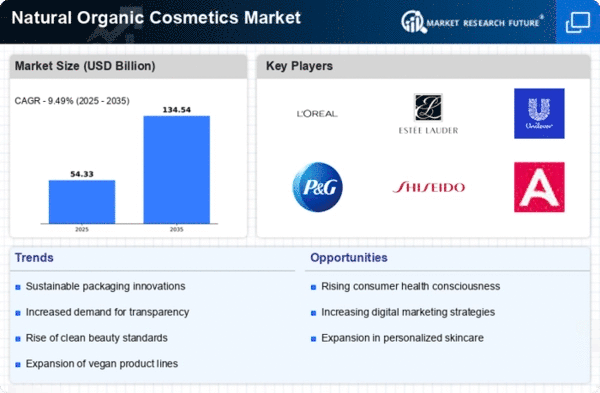
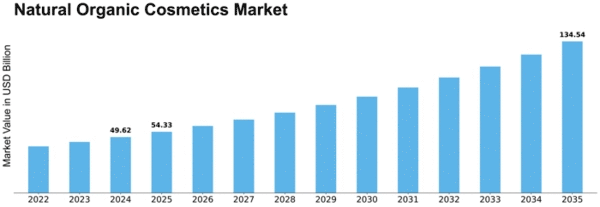
As per MRFR analysis, the Natural Organic Cosmetics Market was estimated at 49.62 USD Billion in 2024. The Natural Organic Cosmetics industry is projected to grow from 54.33 USD Billion in 2025 to 134.54 USD Billion by 2035, exhibiting a compound annual growth rate (CAGR) of 9.49 during the forecast period 2025 - 2035.

Key Market Trends & Highlights

The Natural Organic Cosmetics Market is experiencing robust growth driven by sustainability and consumer demand for transparency.

  • The market is witnessing a pronounced shift towards sustainability, with brands prioritizing eco-friendly practices.
  • Ingredient transparency is becoming increasingly vital, as consumers demand to know the origins and benefits of their products.
  • In North America, skin care remains the largest segment, while the Asia-Pacific region is emerging as the fastest-growing market for hair care.
  • Rising consumer awareness and the influence of social media are key drivers propelling the demand for diverse product offerings, particularly in moisturizers and serums.

Market Size & Forecast

2024 Market Size 49.62 (USD Billion)
2035 Market Size 134.54 (USD Billion)
CAGR (2025 - 2035) 9.49%
Largest Regional Market Share in 2024 North America

Major Players

L'Oreal (FR), Estée Lauder (US), Unilever (GB), Procter & Gamble (US), Shiseido (JP), Avon (GB), Weleda (DE), Dr. Hauschka (DE), Burt's Bees (US), Aveda (US)

Market Trends

The Natural Organic Cosmetics Market is currently experiencing a notable transformation, driven by a growing consumer preference for products that are perceived as safe, environmentally friendly, and ethically sourced. This shift is largely influenced by increased awareness regarding the potential harmful effects of synthetic ingredients and a rising demand for transparency in product formulations. As consumers become more discerning, brands are compelled to adapt their offerings to align with these evolving expectations, leading to a proliferation of innovative products that emphasize natural and organic components. Furthermore, the market is witnessing a surge in the popularity of clean beauty, which prioritizes not only the ingredients used but also the overall sustainability of packaging and production processes. In addition to changing consumer preferences, the Natural Organic Cosmetics Market is also benefiting from advancements in technology and e-commerce. The rise of online shopping platforms has enabled brands to reach a broader audience, facilitating access to a diverse range of natural and organic products. Social media plays a pivotal role in shaping consumer perceptions and driving engagement, as influencers and beauty enthusiasts share their experiences with various products. This digital landscape fosters a community of informed consumers who actively seek out brands that resonate with their values. As the market continues to evolve, it appears poised for sustained growth, with an emphasis on authenticity, sustainability, and innovation.

Sustainability Focus

There is an increasing emphasis on sustainability within the Natural Organic Cosmetics Market. Brands are prioritizing eco-friendly packaging and sourcing practices, reflecting a commitment to environmental stewardship. This trend resonates with consumers who are increasingly concerned about their ecological footprint.

Ingredient Transparency

Consumers are demanding greater transparency regarding product ingredients. The Natural Organic Cosmetics Market is responding by providing detailed information about sourcing, formulation, and potential allergens. This trend fosters trust and encourages informed purchasing decisions.

Personalization and Customization

The market is witnessing a shift towards personalized beauty solutions. Brands are leveraging technology to offer customized products tailored to individual skin types and preferences. This trend enhances consumer engagement and satisfaction, as customers seek products that cater specifically to their unique needs.

Natural Organic Cosmetics Market Market Drivers

Regulatory Support

Government regulations promoting the use of natural and organic ingredients bolster the Global Natural and Organic Cosmetics Industry. Regulatory bodies are increasingly establishing guidelines that encourage the formulation of cosmetics with safer, non-toxic ingredients. This regulatory support not only enhances consumer trust but also incentivizes manufacturers to innovate and develop products that align with these standards. As a result, the market is likely to experience a compound annual growth rate of 9.49% from 2025 to 2035, as companies adapt to these evolving regulations and consumer expectations.

Sustainability Trends

The growing emphasis on sustainability and eco-friendly practices significantly influences the Global Natural and Organic Cosmetics Industry. Consumers increasingly prefer brands that adopt sustainable sourcing, packaging, and production methods. This shift is not merely a trend but appears to be a fundamental change in consumer behavior, as evidenced by the rise of brands that prioritize biodegradable packaging and ethically sourced ingredients. As a result, the market is expected to witness substantial growth, with projections indicating a rise to 134.6 USD Billion by 2035. This reflects a broader societal movement towards sustainability that is reshaping the cosmetics landscape.

Diverse Product Offerings

The expansion of diverse product offerings within the Global Natural and Organic Cosmetics Industry caters to a wide range of consumer needs and preferences. Brands are increasingly developing specialized products, including vegan, cruelty-free, and gender-neutral cosmetics, which appeal to various demographics. This diversification not only attracts a broader consumer base but also enhances market competitiveness. As the industry evolves, the availability of innovative formulations and unique product lines is likely to contribute to sustained market growth, further solidifying the position of natural and organic cosmetics in the global beauty landscape.

Influence of Social Media

The impact of social media on consumer purchasing behavior is a notable driver of the Global Natural and Organic Cosmetics Industry. Platforms such as Instagram and TikTok have become vital channels for beauty brands to engage with consumers, showcasing natural and organic products through influencer partnerships and user-generated content. This digital engagement fosters a sense of community and trust among consumers, leading to increased brand loyalty and sales. As social media continues to shape consumer preferences, the market is poised for growth, with an increasing number of brands leveraging these platforms to promote their natural offerings.

Rising Consumer Awareness

Increasing consumer awareness regarding the harmful effects of synthetic chemicals in personal care products drives the Global Natural and Organic Cosmetics Industry. As consumers become more educated about ingredients and their potential health impacts, there is a notable shift towards products that are perceived as safer and more environmentally friendly. This trend is reflected in the growing demand for natural and organic alternatives, which are often marketed as free from harmful additives. Consequently, the Global Natural and Organic Cosmetics Market is projected to reach 49.6 USD Billion in 2024, indicating a robust consumer preference for transparency and sustainability in cosmetic formulations.

Market Segment Insights

By Application: Skin Care (Largest) vs. Hair Care (Fastest-Growing)

In the Natural Organic Cosmetics Market, the application segmentation reveals significant diversity. Skin Care holds the largest share, driven by increasing consumer awareness about the benefits of natural ingredients for skin health. This segment encompasses moisturizers, sunscreens, and other topical products, which are preferred for their gentle and effective formulations. Meanwhile, Hair Care is also gaining traction, showing the fastest growth as more consumers shift towards organic alternatives for styling and treatment, seeking to avoid harsh chemicals present in conventional products. The growth trends in these segments are influenced by a rising inclination towards sustainable and eco-friendly products. Skin Care remains robust due to continuous innovations in formulations that cater to various skin types and conditions. Conversely, the Hair Care segment is expanding rapidly, propelled by growing consumer demand for cruelty-free, vegan, and environmentally conscious products that promise not only aesthetic benefits but also contribute positively to overall hair health.

Skin Care: Dominant vs. Hair Care: Emerging

The Skin Care segment is characterized by its extensive range of products that address specific skin issues while emphasizing the use of organic, non-toxic ingredients. It caters to a diverse audience, including those with sensitive skin and environmentally conscious consumers seeking ethical beauty solutions. Brands have recognized the opportunity for growth in this segment by offering innovative formulations that combine natural extracts with skincare technology. On the other hand, Hair Care is emerging as a vital segment, fueled by trends toward natural hair products that promote health and shine without harmful additives. This segment attracts a younger demographic interested in personal care routines that align with their values of sustainability and health. As a result, both segments are not only growing but also evolving to meet changing consumer demands.

By Product Type: Moisturizers (Largest) vs. Serums (Fastest-Growing)

In the Natural Organic Cosmetics Market, the product type segment showcases a diverse distribution of market shares. Moisturizers emerge as the largest segment, appealing to a wide range of consumers seeking hydration and nourishment from natural ingredients. Cleansers and sunscreens follow, catering to the essential needs of skincare routines, while serums are gaining traction due to their targeted benefits and efficacy. Makeup removers, though essential, occupy a smaller share as consumers prioritize multifunctional products. The growth trends within this segment are driven by increasing consumer awareness regarding natural ingredients and the advantages they offer over synthetic alternatives. Serums, in particular, are witnessing rapid growth, fueled by the demand for products that address specific skin concerns such as anti-aging and hydration. Additionally, the rise of e-commerce platforms facilitates easy access to these organic products, further propelling their popularity among health-conscious consumers.

Moisturizers (Dominant) vs. Serums (Emerging)

Moisturizers remain the dominant product type within the Natural Organic Cosmetics Market due to their integral role in daily skincare routines. Formulated with natural ingredients, they provide hydration without harmful chemicals, appealing to eco-conscious consumers. On the other hand, serums are emerging rapidly as a sought-after category, emphasizing targeted treatments that address various skin issues. Their concentrated formulations offer enhanced efficacy, which resonates with consumers looking for results-oriented products. This shift reflects a growing trend towards personalized skincare solutions, where consumers are eager to invest in products that deliver specific benefits. Both segments highlight the industry's shift towards natural, effective, and ethical beauty solutions.

By Distribution Channel: Online Retail (Largest) vs. Specialty Stores (Fastest-Growing)

The distribution of market share within the Natural Organic Cosmetics Market reveals that the Online Retail segment holds the most substantial proportion, driven by consumer preference for convenience and accessibility. Specialty Stores, while not commanding as large a share, are rapidly gaining traction among consumers seeking niche products and personalized experiences. The increasing number of boutique organic retailers is contributing to a diverse range of product offerings that cater to the growing demand for natural cosmetics. As consumers continue to shift towards online shopping, the Online Retail channel benefits significantly from technological advancements and enhanced delivery systems. Specialty Stores, on the other hand, are experiencing growth due to a rising trend towards wellness and sustainability, as consumers prioritize quality and unique product experiences. Innovations within these stores, such as eco-friendly packaging and locally sourced products, are also driving their appeal in the market.

Online Retail: Dominant vs. Specialty Stores: Emerging

Online Retail dominates the distribution landscape of natural organic cosmetics, providing consumers with a vast array of choices and the convenience of shopping from home. This channel is particularly appealing to younger demographics who prioritize efficiency and are more inclined to explore various brands online. Conversely, Specialty Stores are emerging as key players, fostering closer connections with eco-conscious consumers through curated selections and expert staff. These stores emphasize personalized customer experiences, which resonate well with those who value organic and sustainable practices. Both segments play crucial roles in shaping consumer preferences, with Online Retail focusing on volume and convenience, while Specialty Stores strive to cultivate community engagement and distinctive brand identities.

By Consumer Demographics: Age Group (Largest) vs. Lifestyle (Fastest-Growing)

In the Natural Organic Cosmetics Market, age demographics play a crucial role in shaping consumer behavior. The largest segment, comprising millennials aged 25 to 40, dominates the market due to their preference for sustainable and ethically sourced products. Following closely, the Gen Z group is quickly increasing its market share, reflecting a shift towards organic beauty solutions. On the other hand, older generations, while not the largest segment, are beginning to adopt natural organic cosmetics, attracted by anti-aging benefits and skin health improvements. Examining growth trends, lifestyle plays a pivotal role, especially among consumers who prioritize wellness and sustainability. The fastest-growing segment within this demographic is consumers adopting a holistic lifestyle, influencing their choices in cosmetics. This growth is driven by increased awareness of health issues, the rise of social media influencers advocating for organic products, and brand transparency. Consumers of all ages are now opting for products that align with their growing health-conscious values, thereby expanding the market exponentially.

Age Group: Millennials (Dominant) vs. Lifestyle: Wellness Advocates (Emerging)

Millennials have established themselves as the dominant age group in the Natural Organic Cosmetics Market, driven by their commitment to sustainability and ethical consumption. This cohort, heavily influences trends with their purchasing power and preference for brands that reflect their values. They gravitate towards natural ingredients and cruelty-free certifications, demonstrating a keen interest in personal health and environmental impact. In contrast, wellness advocates represent an emerging segment, growing rapidly as they seek products that not only enhance beauty but also contribute to overall health and well-being. This demographic is informed and engaged, often researching ingredients and seeking out brands that offer transparency. Their demands for holistic <a href="https://www.marketresearchfuture.com/reports/beauty-products-market-55355" target="_blank">beauty products</a> that align with a healthier lifestyle are reshaping the market landscape.

By Formulation Type: Creams (Largest) vs. Oils (Fastest-Growing)

In the Natural Organic Cosmetics Market, the segmentation by formulation type reveals that creams lead the market, accounting for the largest share, primarily due to their versatility and effectiveness in improving skin health. Oils, on the other hand, are emerging as rapidly gaining popularity, catering to the growing demand for natural and <a href="https://www.marketresearchfuture.com/reports/clean-beauty-market-11976" target="_blank">clean beauty</a> products. Their nourishing properties, coupled with an increased consumer interest in holistic beauty solutions, augment their market presence. The growth trends within this segment indicate a robust shift toward more natural ingredients, with consumers increasingly prioritizing the purity and source of ingredients used in their cosmetic products. Additionally, the rising awareness around sustainability and organic formulations is amplifying the demand for gels and balms, which offer refreshing and soothing benefits. Overall, this segment reflects a dynamic interplay of consumer preferences towards effective yet natural cosmetic solutions.

Creams: Dominant vs. Oils: Emerging

In the Natural Organic Cosmetics Market, creams stand out as the dominant formulation type due to their rich texture and multi-functional benefits that provide hydration, nourishment, and skin barrier protection. They are widely embraced for their ability to cater to diverse skin types and conditions, making them a staple in many consumers' beauty routines. In contrast, oils are recognized as an emerging favorite, primarily among eco-conscious consumers seeking lightweight, highly absorbent products. The growth of oils can be attributed to the trend towards natural beauty regimes, where the emphasis is on using fewer, more effective, and sustainable ingredients. Both creams and oils offer unique benefits that appeal to modern consumers, positioning them as key players within this evolving market.

Get more detailed insights about Natural and Organic Cosmetics Market Research Report - Forecast to 2035

Regional Insights

North America : Market Leader in Innovation

North America continues to lead the Natural Organic Cosmetics Market, holding a significant market share of 24.81% as of 2024. The growth is driven by increasing consumer awareness regarding the benefits of organic ingredients, coupled with a shift towards sustainable and eco-friendly products. Regulatory support for organic labeling and safety standards further catalyzes this trend, encouraging brands to innovate and expand their offerings. The competitive landscape is robust, with key players like Estée Lauder, L'Oreal, and Burt's Bees dominating the market. The U.S. remains the largest contributor, supported by a strong retail infrastructure and a growing demand for clean beauty products. Companies are increasingly focusing on transparency in sourcing and production, which resonates well with the environmentally conscious consumer base.

Europe : Sustainable Beauty Hub

Europe's Natural Organic Cosmetics Market is valued at €15.0 million, reflecting a strong consumer preference for sustainable and ethically sourced products. The region benefits from stringent regulations that promote organic certification, enhancing consumer trust. The rise in health consciousness and environmental awareness among consumers drives demand for natural ingredients, making Europe a key player in the global market. Leading countries such as Germany, France, and the UK are at the forefront, with brands like Weleda and Dr. Hauschka setting industry standards. The competitive landscape is characterized by a mix of established players and emerging brands focusing on niche markets. The European market is also witnessing an increase in online sales channels, further expanding the reach of organic cosmetics.

Asia-Pacific : Emerging Market Potential

The Asia-Pacific region, with a market size of $7.5 million, is witnessing rapid growth in the Natural Organic Cosmetics sector. Factors such as rising disposable incomes, urbanization, and increasing awareness of the benefits of organic products are driving this trend. Regulatory frameworks are gradually evolving to support organic certification, which is crucial for consumer confidence and market expansion. Countries like Japan, Australia, and South Korea are leading the charge, with brands such as Shiseido and Aveda gaining traction. The competitive landscape is becoming increasingly dynamic, with both local and international players vying for market share. The region's unique cultural preferences also influence product formulations, creating opportunities for innovation in organic cosmetics.

Middle East and Africa : Untapped Market Opportunities

The Middle East and Africa region, with a market size of $2.31 million, presents untapped opportunities in the Natural Organic Cosmetics Market. The growth is driven by a rising middle class, increasing awareness of health and wellness, and a shift towards natural products. Regulatory bodies are beginning to implement guidelines for organic labeling, which is essential for market credibility and consumer trust. Countries like South Africa and the UAE are emerging as key players, with local brands focusing on natural ingredients that resonate with regional preferences. The competitive landscape is still developing, with opportunities for both local and international brands to establish a foothold. As consumer demand for organic products grows, the region is poised for significant expansion in the coming years.

Key Players and Competitive Insights

The Natural Organic Cosmetics Market is currently characterized by a dynamic competitive landscape, driven by increasing consumer demand for sustainable and ethically sourced products. Major players such as L'Oreal (FR), Estée Lauder (US), and Unilever (GB) are strategically positioning themselves through innovation and digital transformation. L'Oreal (FR) has focused on enhancing its product lines with natural ingredients, while Estée Lauder (US) emphasizes sustainability in its packaging and sourcing. Unilever (GB) is actively pursuing partnerships with local suppliers to ensure authenticity and traceability in its organic offerings. Collectively, these strategies not only enhance brand loyalty but also shape a competitive environment that prioritizes sustainability and consumer engagement.Key business tactics within the market include localizing manufacturing and optimizing supply chains to meet the growing demand for organic products. The competitive structure appears moderately fragmented, with a mix of established brands and emerging players vying for market share. The influence of key players is substantial, as they leverage their extensive distribution networks and marketing capabilities to capture consumer interest in natural cosmetics.

In November L'Oreal (FR) announced a partnership with a leading organic farming cooperative to source ingredients directly from local farmers. This strategic move is likely to enhance L'Oreal's supply chain transparency and strengthen its commitment to sustainability, aligning with consumer preferences for locally sourced products. Such initiatives may also bolster the company's reputation as a leader in the organic cosmetics sector.

In October Estée Lauder (US) launched a new line of eco-friendly skincare products, utilizing biodegradable packaging and organic ingredients. This initiative reflects the company's commitment to reducing its environmental footprint and catering to the growing segment of eco-conscious consumers. The launch is expected to not only attract new customers but also reinforce brand loyalty among existing consumers who prioritize sustainability.

In September Unilever (GB) expanded its organic product range by acquiring a niche brand known for its innovative use of plant-based ingredients. This acquisition is indicative of Unilever's strategy to diversify its portfolio and respond to the increasing consumer demand for natural cosmetics. By integrating this brand, Unilever may enhance its market position and appeal to a broader audience seeking organic alternatives.

As of December current trends in the Natural Organic Cosmetics Market are heavily influenced by digitalization, sustainability, and the integration of AI technologies. Strategic alliances among companies are increasingly shaping the competitive landscape, fostering innovation and collaboration. The shift from price-based competition to a focus on technological advancements and supply chain reliability is evident. Moving forward, competitive differentiation is likely to hinge on the ability to innovate and adapt to evolving consumer preferences, with an emphasis on sustainability and ethical practices.

Key Companies in the Natural Organic Cosmetics Market include

Industry Developments

November 2022: Avon partnered with Perfect Corp., a leading Al-based beauty tech solutions provider, to improve the virtual makeup technology system and help consumers choose suitable product types.

September 2022: Naturals Skincare Products launched its new beauty care product, ' Pearl.' The Pearl company launched 18 new chemical-free organic beauty products for skin and hair care.

Future Outlook

Natural Organic Cosmetics Market Future Outlook

The Natural Organic Cosmetics Market is projected to grow at a 9.49% CAGR from 2025 to 2035, driven by increasing consumer demand for sustainable and eco-friendly products.

New opportunities lie in:

  • Expansion of e-commerce platforms for organic cosmetics
  • Development of subscription-based delivery services
  • Investment in biodegradable packaging solutions for products

By 2035, the market is expected to solidify its position as a leader in sustainable beauty.

Market Segmentation

Natural Organic Cosmetics Market Application Outlook

  • Skin Care
  • Hair Care
  • Makeup
  • Fragrance
  • Personal Care

Natural Organic Cosmetics Market Product Type Outlook

  • Moisturizers
  • Cleansers
  • Sunscreens
  • Serums
  • Makeup Removers

Natural Organic Cosmetics Market Formulation Type Outlook

  • Creams
  • Gels
  • Oils
  • Lotions
  • Balms

Natural Organic Cosmetics Market Distribution Channel Outlook

  • Online Retail
  • Specialty Stores
  • Supermarkets
  • Pharmacies
  • Direct Sales

Natural Organic Cosmetics Market Consumer Demographics Outlook

  • Age Group
  • Gender
  • Income Level
  • Lifestyle
  • Ethnicity

Report Scope

MARKET SIZE 202449.62(USD Billion)
MARKET SIZE 202554.33(USD Billion)
MARKET SIZE 2035134.54(USD Billion)
COMPOUND ANNUAL GROWTH RATE (CAGR)9.49% (2025 - 2035)
REPORT COVERAGERevenue Forecast, Competitive Landscape, Growth Factors, and Trends
BASE YEAR2024
Market Forecast Period2025 - 2035
Historical Data2019 - 2024
Market Forecast UnitsUSD Billion
Key Companies ProfiledL'Oreal (FR), Estée Lauder (US), Unilever (GB), Procter & Gamble (US), Shiseido (JP), Avon (GB), Weleda (DE), Dr. Hauschka (DE), Burt's Bees (US), Aveda (US)
Segments CoveredApplication, Product Type, Distribution Channel, Consumer Demographics, Formulation Type
Key Market OpportunitiesGrowing consumer demand for sustainable and ethically sourced ingredients in the Natural Organic Cosmetics Market.
Key Market DynamicsRising consumer demand for sustainable ingredients drives innovation and competition in the Natural Organic Cosmetics Market.
Countries CoveredNorth America, Europe, APAC, South America, MEA

FAQs

How much is the natural and organic cosmetics market?

The natural and organic cosmetics market size was valued at USD 45.32 Billion in 2023.

What is the growth rate of the natural and organic cosmetics market?

The market is projected to grow at a CAGR of 9.5% during the forecast period, 2025-2034.

Which region held the largest market share in the natural and organic cosmetics market?

North America had the largest share of the market

Who are the key players in the natural and organic cosmetics market?

The key players in the market are L'Occitane International SA (France), FANCL Corp. (Japan), The Clorox Co. (US), Jurlique International Pty. Limited (Australia), LaboratoireNuxe (France), Bare Escentuals, Inc. (US), Aubrey Organics, Inc. (US), and Nature's Gate (US).

Which product type led the natural and organic cosmetics market?

The skin care category dominated the market in 2023.

Which end-user had the largest market share in the natural and organic cosmetics market?

The female had the largest share of the market.

Which distribution channel had the largest market share in the natural and organic cosmetics market?

The non-store-based had the largest share in the market.

  1. SECTION I: EXECUTIVE SUMMARY AND KEY HIGHLIGHTS
    1. | 1.1 EXECUTIVE SUMMARY
    2. | 1.1.1 Market Overview
    3. | 1.1.2 Key Findings
    4. | 1.1.3 Market Segmentation
    5. | 1.1.4 Competitive Landscape
    6. | 1.1.5 Challenges and Opportunities
    7. | 1.1.6 Future Outlook
  2. SECTION II: SCOPING, METHODOLOGY AND MARKET STRUCTURE
    1. | 2.1 MARKET INTRODUCTION
    2. | 2.1.1 Definition
    3. | 2.1.2 Scope of the study
    4. |-- 2.1.2.1 Research Objective
    5. |-- 2.1.2.2 Assumption
    6. |-- 2.1.2.3 Limitations
    7. | 2.2 RESEARCH METHODOLOGY
    8. | 2.2.1 Overview
    9. | 2.2.2 Data Mining
    10. | 2.2.3 Secondary Research
    11. | 2.2.4 Primary Research
    12. |-- 2.2.4.1 Primary Interviews and Information Gathering Process
    13. |-- 2.2.4.2 Breakdown of Primary Respondents
    14. | 2.2.5 Forecasting Model
    15. | 2.2.6 Market Size Estimation
    16. |-- 2.2.6.1 Bottom-Up Approach
    17. |-- 2.2.6.2 Top-Down Approach
    18. | 2.2.7 Data Triangulation
    19. | 2.2.8 Validation
  3. SECTION III: QUALITATIVE ANALYSIS
    1. | 3.1 MARKET DYNAMICS
    2. | 3.1.1 Overview
    3. | 3.1.2 Drivers
    4. | 3.1.3 Restraints
    5. | 3.1.4 Opportunities
    6. | 3.2 MARKET FACTOR ANALYSIS
    7. | 3.2.1 Value chain Analysis
    8. | 3.2.2 Porter's Five Forces Analysis
    9. |-- 3.2.2.1 Bargaining Power of Suppliers
    10. |-- 3.2.2.2 Bargaining Power of Buyers
    11. |-- 3.2.2.3 Threat of New Entrants
    12. |-- 3.2.2.4 Threat of Substitutes
    13. |-- 3.2.2.5 Intensity of Rivalry
    14. | 3.2.3 COVID-19 Impact Analysis
    15. |-- 3.2.3.1 Market Impact Analysis
    16. |-- 3.2.3.2 Regional Impact
    17. |-- 3.2.3.3 Opportunity and Threat Analysis
  4. SECTION IV: QUANTITATIVE ANALYSIS
    1. | 4.1 Consumer and Retail, BY Application (USD Billion)
    2. | 4.1.1 Skin Care
    3. | 4.1.2 Hair Care
    4. | 4.1.3 Makeup
    5. | 4.1.4 Fragrance
    6. | 4.1.5 Personal Care
    7. | 4.2 Consumer and Retail, BY Product Type (USD Billion)
    8. | 4.2.1 Moisturizers
    9. | 4.2.2 Cleansers
    10. | 4.2.3 Sunscreens
    11. | 4.2.4 Serums
    12. | 4.2.5 Makeup Removers
    13. | 4.3 Consumer and Retail, BY Distribution Channel (USD Billion)
    14. | 4.3.1 Online Retail
    15. | 4.3.2 Specialty Stores
    16. | 4.3.3 Supermarkets
    17. | 4.3.4 Pharmacies
    18. | 4.3.5 Direct Sales
    19. | 4.4 Consumer and Retail, BY Consumer Demographics (USD Billion)
    20. | 4.4.1 Age Group
    21. | 4.4.2 Gender
    22. | 4.4.3 Income Level
    23. | 4.4.4 Lifestyle
    24. | 4.4.5 Ethnicity
    25. | 4.5 Consumer and Retail, BY Formulation Type (USD Billion)
    26. | 4.5.1 Creams
    27. | 4.5.2 Gels
    28. | 4.5.3 Oils
    29. | 4.5.4 Lotions
    30. | 4.5.5 Balms
    31. | 4.6 Consumer and Retail, BY Region (USD Billion)
    32. | 4.6.1 North America
    33. |-- 4.6.1.1 US
    34. |-- 4.6.1.2 Canada
    35. | 4.6.2 Europe
    36. |-- 4.6.2.1 Germany
    37. |-- 4.6.2.2 UK
    38. |-- 4.6.2.3 France
    39. |-- 4.6.2.4 Russia
    40. |-- 4.6.2.5 Italy
    41. |-- 4.6.2.6 Spain
    42. |-- 4.6.2.7 Rest of Europe
    43. | 4.6.3 APAC
    44. |-- 4.6.3.1 China
    45. |-- 4.6.3.2 India
    46. |-- 4.6.3.3 Japan
    47. |-- 4.6.3.4 South Korea
    48. |-- 4.6.3.5 Malaysia
    49. |-- 4.6.3.6 Thailand
    50. |-- 4.6.3.7 Indonesia
    51. |-- 4.6.3.8 Rest of APAC
    52. | 4.6.4 South America
    53. |-- 4.6.4.1 Brazil
    54. |-- 4.6.4.2 Mexico
    55. |-- 4.6.4.3 Argentina
    56. |-- 4.6.4.4 Rest of South America
    57. | 4.6.5 MEA
    58. |-- 4.6.5.1 GCC Countries
    59. |-- 4.6.5.2 South Africa
    60. |-- 4.6.5.3 Rest of MEA
  5. SECTION V: COMPETITIVE ANALYSIS
    1. | 5.1 Competitive Landscape
    2. | 5.1.1 Overview
    3. | 5.1.2 Competitive Analysis
    4. | 5.1.3 Market share Analysis
    5. | 5.1.4 Major Growth Strategy in the Consumer and Retail
    6. | 5.1.5 Competitive Benchmarking
    7. | 5.1.6 Leading Players in Terms of Number of Developments in the Consumer and Retail
    8. | 5.1.7 Key developments and growth strategies
    9. |-- 5.1.7.1 New Product Launch/Service Deployment
    10. |-- 5.1.7.2 Merger & Acquisitions
    11. |-- 5.1.7.3 Joint Ventures
    12. | 5.1.8 Major Players Financial Matrix
    13. |-- 5.1.8.1 Sales and Operating Income
    14. |-- 5.1.8.2 Major Players R&D Expenditure. 2023
    15. | 5.2 Company Profiles
    16. | 5.2.1 L'Oreal (FR)
    17. |-- 5.2.1.1 Financial Overview
    18. |-- 5.2.1.2 Products Offered
    19. |-- 5.2.1.3 Key Developments
    20. |-- 5.2.1.4 SWOT Analysis
    21. |-- 5.2.1.5 Key Strategies
    22. | 5.2.2 Estée Lauder (US)
    23. |-- 5.2.2.1 Financial Overview
    24. |-- 5.2.2.2 Products Offered
    25. |-- 5.2.2.3 Key Developments
    26. |-- 5.2.2.4 SWOT Analysis
    27. |-- 5.2.2.5 Key Strategies
    28. | 5.2.3 Unilever (GB)
    29. |-- 5.2.3.1 Financial Overview
    30. |-- 5.2.3.2 Products Offered
    31. |-- 5.2.3.3 Key Developments
    32. |-- 5.2.3.4 SWOT Analysis
    33. |-- 5.2.3.5 Key Strategies
    34. | 5.2.4 Procter & Gamble (US)
    35. |-- 5.2.4.1 Financial Overview
    36. |-- 5.2.4.2 Products Offered
    37. |-- 5.2.4.3 Key Developments
    38. |-- 5.2.4.4 SWOT Analysis
    39. |-- 5.2.4.5 Key Strategies
    40. | 5.2.5 Shiseido (JP)
    41. |-- 5.2.5.1 Financial Overview
    42. |-- 5.2.5.2 Products Offered
    43. |-- 5.2.5.3 Key Developments
    44. |-- 5.2.5.4 SWOT Analysis
    45. |-- 5.2.5.5 Key Strategies
    46. | 5.2.6 Avon (GB)
    47. |-- 5.2.6.1 Financial Overview
    48. |-- 5.2.6.2 Products Offered
    49. |-- 5.2.6.3 Key Developments
    50. |-- 5.2.6.4 SWOT Analysis
    51. |-- 5.2.6.5 Key Strategies
    52. | 5.2.7 Weleda (DE)
    53. |-- 5.2.7.1 Financial Overview
    54. |-- 5.2.7.2 Products Offered
    55. |-- 5.2.7.3 Key Developments
    56. |-- 5.2.7.4 SWOT Analysis
    57. |-- 5.2.7.5 Key Strategies
    58. | 5.2.8 Dr. Hauschka (DE)
    59. |-- 5.2.8.1 Financial Overview
    60. |-- 5.2.8.2 Products Offered
    61. |-- 5.2.8.3 Key Developments
    62. |-- 5.2.8.4 SWOT Analysis
    63. |-- 5.2.8.5 Key Strategies
    64. | 5.2.9 Burt's Bees (US)
    65. |-- 5.2.9.1 Financial Overview
    66. |-- 5.2.9.2 Products Offered
    67. |-- 5.2.9.3 Key Developments
    68. |-- 5.2.9.4 SWOT Analysis
    69. |-- 5.2.9.5 Key Strategies
    70. | 5.2.10 Aveda (US)
    71. |-- 5.2.10.1 Financial Overview
    72. |-- 5.2.10.2 Products Offered
    73. |-- 5.2.10.3 Key Developments
    74. |-- 5.2.10.4 SWOT Analysis
    75. |-- 5.2.10.5 Key Strategies
    76. | 5.3 Appendix
    77. | 5.3.1 References
    78. | 5.3.2 Related Reports

Consumer and Retail Market Segmentation

Consumer and Retail By Application (USD Billion, 2025-2035)

  • Skin Care
  • Hair Care
  • Makeup
  • Fragrance
  • Personal Care

Consumer and Retail By Product Type (USD Billion, 2025-2035)

  • Moisturizers
  • Cleansers
  • Sunscreens
  • Serums
  • Makeup Removers

Consumer and Retail By Distribution Channel (USD Billion, 2025-2035)

  • Online Retail
  • Specialty Stores
  • Supermarkets
  • Pharmacies
  • Direct Sales

Consumer and Retail By Consumer Demographics (USD Billion, 2025-2035)

  • Age Group
  • Gender
  • Income Level
  • Lifestyle
  • Ethnicity

Consumer and Retail By Formulation Type (USD Billion, 2025-2035)

  • Creams
  • Gels
  • Oils
  • Lotions
  • Balms
Infographic

Free Sample Request

Kindly complete the form below to receive a free sample of this Report

Get Free Sample

Customer Strories

Compare Licence

×
Features License Type
Single User Multiuser License Enterprise User
Price $4,950 $5,950 $7,250
Maximum User Access Limit 1 User Upto 10 Users Unrestricted Access Throughout the Organization
Free Customization
Direct Access to Analyst
Deliverable Format
Platform Access
Discount on Next Purchase 10% 15% 15%
Printable Versions