×
Request Free Sample ×

Kindly complete the form below to receive a free sample of this Report

* Please use a valid business email

Leading companies partner with us for data-driven Insights

clients tt-cursor
Hero Background

3D NAND Memory Market

ID: MRFR/SEM/0534-HCR
200 Pages
Ankit Gupta
October 2025

3D NAND Memory Market Research Report Information By Types (Single-Level Cell (SLC), Multi-Level Cell (MLC), Triple-Level Cell (TLC), By Applications (Cameras, Laptops & PCs, Smartphone & Tablets, Others), By End-Users (Automotive, Consumer Electronics, Enterprise, Healthcare, Others), And By Region (North America, Europe, Asia-Pacific, And Rest Of The World) – Industry Forecast Till 2035

Share:
Download PDF ×

We do not share your information with anyone. However, we may send you emails based on your report interest from time to time. You may contact us at any time to opt-out.

3D NAND Memory Market Infographic
Purchase Options

3D NAND Memory Market Summary

As per MRFR analysis, the 3D NAND Memory Market Size was estimated at 38.95 USD Billion in 2024. The 3D NAND Memory industry is projected to grow from 44.81 USD Billion in 2025 to 181.77 USD Billion by 2035, exhibiting a compound annual growth rate (CAGR) of 15.03 during the forecast period 2025 - 2035.

Key Market Trends & Highlights

The 3D NAND Memory Market is poised for robust growth driven by technological advancements and increasing demand across various sectors.

  • North America remains the largest market for 3D NAND memory, driven by high consumer electronics demand.
  • Asia-Pacific is the fastest-growing region, fueled by rapid advancements in data center technologies.
  • The consumer electronics segment leads in market share, while the data center segment exhibits the highest growth potential.
  • Technological innovations in 3D NAND memory and the rising adoption of cloud computing are key drivers of market expansion.

Market Size & Forecast

2024 Market Size 38.95 (USD Billion)
2035 Market Size 181.77 (USD Billion)
CAGR (2025 - 2035) 15.03%

Major Players

Samsung Electronics (KR), Western Digital (US), SK Hynix (KR), Micron Technology (US), Intel Corporation (US), Toshiba Memory Corporation (JP), Kioxia Holdings Corporation (JP), Nanya Technology Corporation (TW)

3D NAND Memory Market Trends

The 3D NAND Memory Market is currently experiencing a transformative phase characterized by rapid advancements in technology and increasing demand for high-capacity storage solutions. This market segment is witnessing a shift towards more efficient manufacturing processes, which are essential for meeting the growing needs of various applications, including mobile devices, data centers, and consumer electronics. As the demand for faster and more reliable memory solutions escalates, manufacturers are investing heavily in research and development to enhance performance and reduce costs. This trend indicates a competitive landscape where innovation plays a crucial role in shaping the future of memory technology. Moreover, the 3D NAND Memory Market is also influenced by the rising adoption of cloud computing and big data analytics. These trends are driving the need for robust storage solutions that can handle vast amounts of data while ensuring quick access and retrieval. As organizations increasingly rely on data-driven decision-making, the importance of high-performance memory solutions becomes more pronounced. Consequently, the market is likely to see a surge in collaborations and partnerships among key players, aimed at leveraging complementary strengths to deliver cutting-edge products that cater to evolving consumer demands.

Technological Advancements in Manufacturing

The 3D NAND Memory Market is witnessing significant technological advancements in manufacturing processes. Innovations such as multi-layer stacking and improved lithography techniques are enhancing production efficiency and yield rates. These developments not only reduce costs but also enable the creation of higher-capacity memory chips, which are essential for meeting the demands of modern applications.

Growing Demand for High-Capacity Storage

There is a notable increase in the demand for high-capacity storage solutions across various sectors, including consumer electronics and enterprise applications. This trend is driven by the proliferation of data-intensive applications, such as artificial intelligence and machine learning, which require substantial memory resources. As a result, manufacturers are focusing on developing larger and more efficient 3D NAND memory products.

Shift Towards Sustainable Practices

The 3D NAND Memory Market is gradually shifting towards more sustainable manufacturing practices. Companies are increasingly adopting eco-friendly materials and processes to minimize environmental impact. This trend reflects a broader commitment to sustainability within the technology sector, as stakeholders recognize the importance of responsible production methods in the face of growing environmental concerns.

3D NAND Memory Market Drivers

Market Growth Projections

The Global 3D NAND Memory Market Industry is characterized by promising growth projections, with the market expected to reach 39.0 USD Billion in 2024 and 181.7 USD Billion by 2035. This growth trajectory indicates a compound annual growth rate of 15.03% from 2025 to 2035. Such projections suggest a robust demand for 3D NAND memory solutions across various sectors, including consumer electronics, data centers, and enterprise storage. The anticipated expansion of the market reflects the increasing reliance on advanced memory technologies to support the growing data needs of businesses and consumers alike.

Growth of Consumer Electronics Sector

The Global 3D NAND Memory Market Industry is significantly influenced by the growth of the consumer electronics sector. With the proliferation of smartphones, tablets, and wearable devices, the demand for high-capacity and high-speed memory solutions is on the rise. This sector's expansion is expected to drive the market forward, as manufacturers seek to integrate advanced memory technologies into their products. The increasing consumer preference for devices with enhanced storage capabilities suggests a favorable outlook for the industry. As a result, the Global 3D NAND Memory Market is poised for substantial growth, potentially achieving a compound annual growth rate of 15.03% from 2025 to 2035.

Increased Adoption of Cloud Computing

The increased adoption of cloud computing services is a pivotal driver of the Global 3D NAND Memory Market Industry. As businesses migrate to cloud-based solutions for enhanced flexibility and scalability, the demand for robust storage solutions intensifies. Cloud service providers are increasingly investing in high-capacity memory technologies to meet the storage needs of their clients. This trend is expected to propel the market forward, with projections indicating a significant increase in market size by 2035. The reliance on 3D NAND memory in cloud infrastructures suggests a long-term growth trajectory for the industry, as organizations seek to optimize their data storage and retrieval processes.

Rising Demand for Data Storage Solutions

The Global 3D NAND Memory Market Industry experiences a surge in demand for data storage solutions, driven by the exponential growth of data generation across various sectors. As organizations increasingly rely on cloud computing, big data analytics, and artificial intelligence, the need for efficient and high-capacity storage solutions becomes paramount. The Global 3D NAND Memory Market is projected to reach 39.0 USD Billion in 2024, reflecting the industry's response to this growing demand. This trend indicates a shift towards advanced storage technologies that can accommodate the vast amounts of data being generated, thereby enhancing operational efficiency and data management capabilities.

Technological Advancements in Memory Technology

Technological advancements play a crucial role in shaping the Global 3D NAND Memory Market Industry. Innovations in memory architecture, such as the development of multi-layer stacking techniques, have significantly improved storage density and performance. These advancements enable manufacturers to produce memory chips that are not only faster but also more energy-efficient. As a result, the market is likely to witness a robust growth trajectory, with projections indicating a market size of 181.7 USD Billion by 2035. The continuous evolution of memory technology suggests that the industry will remain competitive, catering to the increasing demands for high-performance computing and mobile applications.

Emergence of Artificial Intelligence and Machine Learning

The emergence of artificial intelligence and machine learning technologies is reshaping the Global 3D NAND Memory Market Industry. These technologies require substantial data processing capabilities, necessitating high-performance memory solutions. As AI applications proliferate across various industries, the demand for 3D NAND memory is likely to increase, driven by the need for faster data access and processing speeds. This trend indicates a growing reliance on advanced memory technologies to support complex algorithms and large datasets. Consequently, the Global 3D NAND Memory Market is expected to benefit from this shift, positioning itself as a key player in the evolving landscape of technology.

Market Segment Insights

By Application: Consumer Electronics (Largest) vs. Data Centers (Fastest-Growing)

The 3D NAND Memory Market is significantly influenced by various applications, with Consumer Electronics holding the largest market share. This segment includes a vast array of devices such as smartphones, tablets, and laptops, which are essential for modern digital life. Following closely is the Data Centers segment, which is experiencing rapid expansion due to the increasing demand for cloud services, big data analytics, and AI applications. This growing reliance on data storage solutions is reshaping the market landscape.

Consumer Electronics (Dominant) vs. Data Centers (Emerging)

Consumer Electronics is the dominant application in the 3D NAND Memory Market. This segment benefits from the rapid adoption of portable devices and consumer demand for higher storage capacities and speeds. In contrast, the Data Centers segment is emerging as a critical player, driven by the escalating need for efficient data management solutions. With the rise of cloud computing and the Internet of Things (IoT), this segment is seeing exponential growth. As companies invest in infrastructure to support these technologies, the demand for high-performance 3D NAND memory is expected to surge, making it a pivotal focus for manufacturers.

By End Use: Smartphones (Largest) vs. Servers (Fastest-Growing)

In the 3D NAND memory market, smartphones hold the largest share as they require high-performance memory solutions for increasing storage needs. This segment benefits from the growing sales of flagship smartphones featuring advanced camera systems and high-resolution displays, driving the demand for extensive memory capabilities. In contrast, the servers segment is experiencing rapid growth, fueled by the surge in data centers and cloud services. The shift towards remote work and the increasing reliance on digital services contribute to this expansion.

Smartphones (Dominant) vs. Servers (Emerging)

Smartphones represent a dominant force in the 3D NAND memory market, leveraging their critical role in consumer electronics. These devices come equipped with extensive storage options to support multimedia applications, gaming, and everyday tasks. The integration of 3D NAND technology enhances performance and reliability, making them indispensable for modern smartphones. On the other hand, servers are emerging as a significant market for 3D NAND memory, driven by the need for faster data access and large storage solutions. As businesses transition to cloud infrastructures and increase IT demands, servers will require high-capacity and efficient memory solutions, ensuring rapid market growth.

By Technology: Vertical NAND (Largest) vs. Charge Trap NAND (Fastest-Growing)

In the 3D NAND Memory Market, Vertical NAND has emerged as the largest segment, leading the charge with its advanced architecture and scalability. Charge Trap NAND follows closely behind, demonstrating the fastest growth rate due to its increasing adoption in consumer electronics and data centers. Floating Gate NAND and Multi-Level Cell also contribute significantly, albeit at a slower pace, reflecting varying preferences in application needs and cost efficiency.

Technology: Vertical NAND (Dominant) vs. Charge Trap NAND (Emerging)

Vertical NAND stands out as the dominant technology within the 3D NAND Memory Market, characterized by its ability to efficiently stack memory cells vertically, resulting in higher storage density and performance. This positions it favorably in high-performance computing and mobile applications. On the other hand, Charge Trap NAND is emerging as a strong competitor, leveraging innovative structures that enhance data retention and durability. As demand for more efficient memory solutions rises, both technologies play critical roles in meeting the market's evolving needs, with Vertical NAND solidifying its leadership and Charge Trap NAND rapidly gaining traction among manufacturers.

By Form Factor: M.2 (Largest) vs. PCIe (Fastest-Growing)

The 3D NAND Memory Market has witnessed distinct preferences in its form factors, with M.2 leading the space significantly due to its compact design, suitability for various applications, and growing demand in consumer electronics and laptops. Following M.2, the U.2 format has also captured a notable market share, appealing primarily to enterprise SSD buyers seeking high-speed data performance and reliability. Meanwhile, 2.5 Inch drives continue to serve traditional storage needs, though their share is declining as newer form factors gain favor.

Form Factor: M.2 (Dominant) vs. PCIe (Emerging)

M.2 drives stand out as the dominant form factor in the 3D NAND Memory Market, offering a versatile and space-efficient solution ideal for ultra-thin laptops and high-performance desktops. They support a variety of interfaces, enhancing their adaptability in diverse applications, thus driving their substantial market presence. On the other hand, PCIe, while considered an emerging form factor, is gaining traction due to its higher data transfer rates and performance efficiency. This form factor enables breakthrough speeds for data-intensive applications, benefiting data centers and gaming systems. As industries transition towards faster storage solutions, the demand for PCIe continues to rise, establishing it as a formidable contender in future market dynamics.

By Storage Capacity: 512 GB (Largest) vs. 1 TB (Fastest-Growing)

In the 3D NAND Memory Market, the storage capacity segment displays a diverse distribution. The 512 GB segment has emerged as the largest in overall market share, favored for its balance between performance and affordability. Following closely, the 1 TB segment is rapidly gaining traction, capturing significant attention among users demanding higher storage while maintaining efficiency. The demand for larger storage capacities is notably rising, influenced by applications in high-performance computing and gaming, where the need for reliable, high-speed memory solutions is paramount. Growth trends indicate a dynamic shift towards higher capacity drives within the 3D NAND Memory Market. The increasing adoption of cloud services and data-intensive applications is propelling the demand for 1 TB modules, marking them as the fastest-growing segment. Moreover, advancements in 3D NAND technology enable the manufacturing of larger capacities with improved efficiency, further fueling this shift. As storage needs evolve with innovations in technology, both the 512 GB and 1 TB segments are set to play essential roles in shaping a storage-centric future.

512 GB (Dominant) vs. 2 TB (Emerging)

The 512 GB segment stands as the dominant force within the 3D NAND Memory Market, appealing to a broad range of consumers, including regular users and professionals who require a balance of capacity and performance. Its reliable storage capacity caters to a myriad of applications, from everyday computing to more demanding tasks requiring substantial data handling. The affordability and efficiency of 512 GB drives have solidified their position as a go-to option for enhancing device performance. In contrast, the 2 TB segment is the emerging choice for high-end applications, boasting larger capacity to accommodate extensive data storage needs. As 4K and 8K video content becomes mainstream, coupled with the rise of high-performance gaming, the 2 TB units provide a robust solution for users seeking high-speed data access and large storage. With expanding use cases and ongoing improvements in NAND technology, the 2 TB segment is poised for substantial growth, offering compelling prospects for both manufacturers and consumers.

Get more detailed insights about 3D NAND Memory Market

Regional Insights

North America : Innovation and Growth Hub

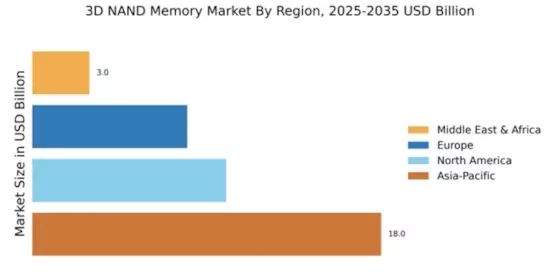
North America is witnessing robust growth in the 3D NAND memory market, driven by increasing demand for high-performance storage solutions across various sectors, including consumer electronics and data centers. The region's market size is projected at $12.0 billion, reflecting a significant share of the global market. Regulatory support for technology innovation and investment in semiconductor manufacturing further catalyze this growth, positioning North America as a leader in the industry. The competitive landscape is dominated by key players such as Micron Technology, Intel Corporation, and Western Digital, which are investing heavily in R&D to enhance product offerings. The U.S. remains a pivotal market, with a strong focus on advanced memory technologies. As companies strive to meet the growing demand for faster and more efficient storage solutions, North America is set to maintain its leadership in the 3D NAND sector.

Europe : Emerging Technology Landscape

Europe is experiencing a notable increase in the adoption of 3D NAND memory, with a market size of $8.0 billion. The region's growth is fueled by the rising demand for data storage in sectors such as automotive, healthcare, and cloud computing. Regulatory initiatives aimed at promoting digital transformation and sustainability are also driving investments in advanced memory technologies, enhancing the region's competitive edge in the global market. Leading countries like Germany, France, and the UK are at the forefront of this growth, with significant contributions from local manufacturers and collaborations with global players. The presence of companies such as STMicroelectronics and Infineon Technologies highlights Europe's commitment to innovation in memory solutions. As the market evolves, Europe is poised to become a key player in the global 3D NAND landscape.

Asia-Pacific : Dominant Market Leader

Asia-Pacific holds the largest market share in the 3D NAND memory sector, with a projected size of $16.0 billion. The region's growth is primarily driven by the rapid expansion of consumer electronics, cloud services, and data centers. Countries like South Korea, Japan, and China are leading this growth, supported by favorable government policies and substantial investments in semiconductor manufacturing, which are crucial for meeting the increasing demand for high-capacity storage solutions. The competitive landscape is characterized by major players such as Samsung Electronics, SK Hynix, and Kioxia Holdings, which dominate the market with their advanced technologies and extensive product portfolios. The region's focus on innovation and efficiency in production processes further strengthens its position as a global leader in the 3D NAND memory market. As demand continues to rise, Asia-Pacific is expected to maintain its dominance in the coming years.

Middle East and Africa : Emerging Market Potential

The Middle East and Africa region is gradually emerging in the 3D NAND memory market, with a market size of $2.95 billion. Growth is driven by increasing digitalization and the demand for advanced storage solutions in sectors such as telecommunications and finance. Governments in the region are implementing initiatives to boost technology adoption, which is expected to further enhance market growth and attract foreign investments in the semiconductor industry. Countries like South Africa and the UAE are leading the way in adopting new technologies, with local firms beginning to explore partnerships with global players. The presence of international companies is also growing, as they seek to tap into the region's potential. As the market matures, the Middle East and Africa are poised for significant growth in the 3D NAND sector, driven by innovation and investment.

Key Players and Competitive Insights

The 3D NAND Memory Market is characterized by intense competition and rapid technological advancements, driven by the increasing demand for high-capacity storage solutions across various sectors, including consumer electronics, data centers, and automotive applications. Major players such as Samsung Electronics (KR), Western Digital (US), and Micron Technology (US) are at the forefront, each adopting distinct strategies to enhance their market positioning. Samsung Electronics (KR) continues to lead in innovation, focusing on the development of advanced 3D NAND technologies that promise higher density and efficiency. Meanwhile, Western Digital (US) emphasizes strategic partnerships and acquisitions to bolster its product offerings and expand its market reach, while Micron Technology (US) is heavily investing in R&D to enhance its manufacturing capabilities and product performance, collectively shaping a competitive landscape that is both dynamic and multifaceted.

Key business tactics within the market include localizing manufacturing to reduce costs and optimize supply chains, which appears crucial in maintaining competitive pricing and ensuring timely delivery. The competitive structure of the 3D NAND Memory Market is moderately fragmented, with several key players exerting significant influence. This fragmentation allows for a variety of innovations and product offerings, although the presence of dominant firms like Samsung and Micron suggests a trend towards consolidation as companies seek to leverage economies of scale and technological synergies.

In November 2025, Micron Technology (US) announced the opening of a new fabrication facility in Virginia, aimed at increasing its production capacity for 3D NAND memory chips. This strategic move is likely to enhance Micron's ability to meet the growing demand for high-performance storage solutions, particularly in the data center segment, where capacity and speed are paramount. The facility is expected to create thousands of jobs and contribute to the local economy, while also positioning Micron as a key player in the U.S. semiconductor landscape.

In October 2025, Western Digital (US) unveiled a new line of 3D NAND products designed specifically for enterprise applications, highlighting its commitment to innovation and customer-centric solutions. This launch not only reinforces Western Digital's position in the enterprise storage market but also reflects a broader trend towards tailored solutions that meet the specific needs of businesses. The introduction of these products is anticipated to drive revenue growth and strengthen customer loyalty in a competitive environment.

In September 2025, Kioxia Holdings Corporation (JP) entered into a strategic partnership with a leading cloud service provider to develop next-generation storage solutions utilizing its advanced 3D NAND technology. This collaboration is indicative of the growing trend towards strategic alliances in the industry, as companies seek to combine their strengths to address the evolving demands of cloud computing and data storage. Such partnerships are likely to enhance Kioxia's market presence and accelerate the development of innovative solutions.

As of December 2025, the competitive trends in the 3D NAND Memory Market are increasingly defined by digitalization, sustainability, and the integration of AI technologies. Companies are focusing on sustainable practices, such as reducing energy consumption in manufacturing processes, while also leveraging AI to optimize production and enhance product performance. Strategic alliances are becoming more prevalent, allowing firms to pool resources and expertise to drive innovation. Looking ahead, competitive differentiation is expected to evolve from traditional price-based competition towards a focus on technological innovation, supply chain reliability, and the ability to deliver customized solutions that meet the diverse needs of customers.

Key Companies in the 3D NAND Memory Market market include

Industry Developments

  • Q2 2024: Samsung Electronics Begins Mass Production of Industry’s First 9th-Generation V-NAND Samsung Electronics announced the start of mass production for its 9th-generation V-NAND, featuring the industry's highest bit density and advanced 3D NAND architecture, aimed at next-generation data centers and enterprise storage solutions.
  • Q2 2024: Micron Unveils World’s First 232-Layer QLC NAND for Data Center and Consumer Storage Micron Technology launched its 232-layer QLC NAND, the first of its kind, designed to deliver higher storage density and performance for both data center and consumer SSD applications.
  • Q2 2024: SK hynix Develops 321-Layer 4D NAND Flash, the World’s Highest Layer Count SK hynix announced the development of a 321-layer 4D NAND flash memory, setting a new industry record for layer count and targeting high-capacity storage markets.
  • Q1 2024: Kioxia and Western Digital Celebrate Opening of New Fab7 3D Flash Memory Manufacturing Facility in Yokkaichi Kioxia and Western Digital jointly opened the Fab7 facility in Yokkaichi, Japan, dedicated to the mass production of advanced 3D NAND flash memory to meet growing global demand.
  • Q2 2024: China’s YMTC launches 232-layer 3D NAND chip, challenging global rivals Yangtze Memory Technologies Co. (YMTC) announced the commercial launch of its 232-layer 3D NAND chip, marking a significant technological milestone and intensifying competition with established global memory manufacturers.
  • Q1 2024: SK hynix to Invest $3.87 Billion in New 3D NAND Flash Plant in South Korea SK hynix revealed plans to invest $3.87 billion in constructing a new 3D NAND flash memory manufacturing plant in South Korea, aiming to expand production capacity and support next-generation memory technologies.
  • Q2 2024: Western Digital Introduces 3D NAND-Based Ultrastar DC SN655 NVMe SSD for Data Centers Western Digital launched the Ultrastar DC SN655 NVMe SSD, leveraging advanced 3D NAND technology to deliver higher performance and capacity for enterprise data center applications.
  • Q1 2024: Kioxia and Western Digital secure $1.6bn in government subsidies for 3D NAND expansion Kioxia and Western Digital received $1.6 billion in subsidies from the Japanese government to support the expansion of their 3D NAND flash memory production facilities.
  • Q2 2024: Micron to Build $2.75 Billion 3D NAND Plant in India Micron Technology announced plans to invest $2.75 billion in a new 3D NAND flash memory manufacturing facility in India, aiming to strengthen its global supply chain and meet rising demand.
  • Q1 2024: Chinese 3D NAND startup Starblaze raises $100M Series C to scale production Starblaze, a Chinese 3D NAND memory startup, closed a $100 million Series C funding round to expand its manufacturing capabilities and accelerate product development.
  • Q2 2024: Samsung and AMD Extend Strategic Partnership to Advance 3D NAND-Powered Storage Solutions Samsung and AMD announced an extension of their strategic partnership to co-develop advanced storage solutions utilizing Samsung’s latest 3D NAND technology for high-performance computing applications.
  • Q1 2024: Kioxia appoints Nobuo Hayasaka as new CEO to steer 3D NAND growth Kioxia named Nobuo Hayasaka as its new CEO, tasking him with leading the company’s expansion in the global 3D NAND flash memory market.

Future Outlook

3D NAND Memory Market Future Outlook

The 3D NAND Memory Market is projected to grow at a 15.03% CAGR from 2024 to 2035, driven by increasing demand for high-capacity storage and advancements in semiconductor technology.

New opportunities lie in:

  • Development of specialized 3D NAND solutions for AI and machine learning applications.
  • Expansion into emerging markets with tailored storage solutions for mobile devices.
  • Partnerships with cloud service providers to enhance data center storage capabilities.

By 2035, the 3D NAND Memory Market is expected to be robust, driven by innovation and diverse applications.

Market Segmentation

3D NAND Memory Market End Use Outlook

  • Smartphones
  • Laptops
  • Tablets
  • Servers
  • Gaming Consoles

3D NAND Memory Market Technology Outlook

  • Vertical NAND
  • Charge Trap NAND
  • Floating Gate NAND
  • 3D NAND Flash
  • Multi-Level Cell

3D NAND Memory Market Application Outlook

  • Consumer Electronics
  • Data Centers
  • Enterprise Storage
  • Automotive
  • Industrial

3D NAND Memory Market Form Factor Outlook

  • 2.5 Inch
  • M.2
  • U.2
  • PCIe
  • BGA

3D NAND Memory Market Storage Capacity Outlook

  • 128 GB
  • 256 GB
  • 512 GB
  • 1 TB
  • 2 TB

Report Scope

MARKET SIZE 202438.95(USD Billion)
MARKET SIZE 202544.81(USD Billion)
MARKET SIZE 2035181.77(USD Billion)
COMPOUND ANNUAL GROWTH RATE (CAGR)15.03% (2024 - 2035)
REPORT COVERAGERevenue Forecast, Competitive Landscape, Growth Factors, and Trends
BASE YEAR2024
Market Forecast Period2025 - 2035
Historical Data2019 - 2024
Market Forecast UnitsUSD Billion
Key Companies ProfiledSamsung Electronics (KR), Western Digital (US), SK Hynix (KR), Micron Technology (US), Intel Corporation (US), Toshiba Memory Corporation (JP), Kioxia Holdings Corporation (JP), Nanya Technology Corporation (TW)
Segments CoveredApplication, End Use, Technology, Form Factor, Storage Capacity
Key Market OpportunitiesGrowing demand for high-capacity storage solutions drives innovation in the 3D NAND Memory Market.
Key Market DynamicsRising demand for high-capacity storage drives innovation and competition in the 3D NAND Memory Market.
Countries CoveredNorth America, Europe, APAC, South America, MEA

Market Highlights

Author
Ankit Gupta
Senior Research Analyst

Ankit Gupta is an analyst in market research industry in ICT and SEMI industry. With post-graduation in "Telecom and Marketing Management" and graduation in "Electronics and Telecommunication" vertical he is well versed with recent development in ICT industry as a whole. Having worked on more than 150+ reports including consultation for fortune 500 companies such as Microsoft and Rio Tinto in identifying solutions with respect to business problems his opinions are inclined towards mixture of technical and managerial aspects.

Leave a Comment

FAQs

How much is the 3D NAND Memory market?

The 3D NAND Memory market size was valued at USD 38.95 billion in 2024.

What is the growth rate of the 3D NAND Memory market?

The market is projected to grow at a CAGR of 15.03% during the forecast period, 2025 to 2035.

Which region held the largest market share in the 3D NAND Memory market?

Asia Pacific had the largest share of the 3D NAND Memory market.

Who are the key players in the 3D NAND Memory market?

The key players in the market are VIA Technologies Inc, Infineon Technologies, Microchip Technology Inc, ON Semiconductor, SK Hynix, Western Digital Corporation, Micron Technology Inc, Integrated Silicon Solution Inc, Transcend Information Inc, and Phison Electronics Corporation.

Which Types led the market of 3D NAND Memory?

The Single-Level Cell (SLC) category dominated the market in 2022.

Which Application had the largest market share in the market of 3D NAND Memory?

The Laptops & PCs segment had the largest share in the market for 3D NAND Memory.

Download Free Sample

Kindly complete the form below to receive a free sample of this Report

Compare Licence

×
Features License Type
Single User Multiuser License Enterprise User
Price $4,950 $5,950 $7,250
Maximum User Access Limit 1 User Upto 10 Users Unrestricted Access Throughout the Organization
Free Customization
Direct Access to Analyst
Deliverable Format
Platform Access
Discount on Next Purchase 10% 15% 15%
Printable Versions