×
Request Free Sample ×

Kindly complete the form below to receive a free sample of this Report

* Please use a valid business email

Leading companies partner with us for data-driven Insights

clients tt-cursor
Hero Background
English
Chinese
French
Japanese
Korean
German
Spanish

Mobile Gambling Market Trends

ID: MRFR/ICT/3706-CR
87 Pages
Ankit Gupta
February 2020

Mobile Gambling Market Research Report: Information By Type (Casino, Betting, Poker, Lottery, Online Bingo), By End-User (Gambling Enthusiasts, Social Exuberant), And By Region (North America, Europe, Asia-Pacific, And Rest Of The World) –Market Forecast Till 2035.

Share:
Download PDF ×

We do not share your information with anyone. However, we may send you emails based on your report interest from time to time. You may contact us at any time to opt-out.

Mobile Gambling Market Infographic
×
Mobile Gambling Market Infographic Full View
Purchase Options

Market Trends

Key Emerging Trends in the Mobile Gambling Market

Increased Attraction of Mobile Gaming Among Youth

Globally, mobile gaming has significantly captivated the younger age brackets. This surge owes much to the widespread accessibility of affordable internet connectivity and the growing prevalence of smartphones. Moreover, the emergence of highly advanced smartphones compatible with various online gaming platforms has accelerated the mobile gaming trend worldwide. The proliferation of mobile phones has simplified the process of downloading games, allowing individuals the flexibility to engage in gameplay at their convenience, regardless of time or place. Consequently, this shift has spurred the rise of "casual gamers," individuals who primarily utilize smartphones for gaming purposes.

A recent whitepaper, titled "The State of Online Gaming – 2018," released by Limelight Network, conducted a survey encompassing 3,000 consumers aged 18 and above across France, Germany, Japan, South Korea, the United Kingdom, and the United States. These individuals were engaged in video gaming activities at least once a week. The survey outcomes revealed that gamers dedicate more time to playing games on their mobile phones compared to computers, tablets, or gaming consoles. On average, these gamers devote no less than an hour and 20 minutes to gaming sessions. Additionally, younger gamers aged between 18 and 25 spend a considerable number of hours weekly watching online games via smartphones, surpassing the time spent watching traditional sports on television sets.

Moreover, apart from active gameplay and viewing, gamers actively participate in betting activities associated with games such as poker, casino games, or sports like football and cricket. These statistics unequivocally highlight the immense popularity of mobile gaming among the younger demographic. As a direct consequence, a growing number of young gamers are engaging in betting practices across various mobile games, which is anticipated to propel the expansion of the mobile gambling market.

Across the globe, mobile gaming has become increasingly popular among the younger generation. This surge is primarily due to the widespread availability of affordable internet connections and the growing ownership of smartphones. Furthermore, the rise of highly sophisticated smartphones compatible with online gaming platforms has contributed significantly to this trend. The prevalence of mobile devices has simplified the process of downloading games, enabling individuals to play at their convenience, leading to the emergence of a category known as "casual gamers" who predominantly use smartphones for gaming purposes.

A recent study, "The State of Online Gaming – 2018," conducted by Limelight Network, surveyed 3,000 consumers aged 18 and above across several countries. The findings revealed that gamers spend more time playing games on their mobile phones than on computers, tablets, or gaming consoles, with an average playtime exceeding one hour and 20 minutes. Interestingly, younger gamers aged 18 to 25 dedicate more hours per week to watching online games via smartphones than to viewing traditional sports on television sets.

Additionally, gamers actively engage in betting practices related to games like poker, casino games, or sports such as football and cricket. These statistics clearly demonstrate the widespread popularity of mobile gaming among the younger populace. Consequently, an increasing number of young gamers participating in betting on various mobile games is expected to drive the growth of the mobile gambling market.


Author
Ankit Gupta
Senior Research Analyst

Ankit Gupta is an analyst in market research industry in ICT and SEMI industry. With post-graduation in "Telecom and Marketing Management" and graduation in "Electronics and Telecommunication" vertical he is well versed with recent development in ICT industry as a whole. Having worked on more than 150+ reports including consultation for fortune 500 companies such as Microsoft and Rio Tinto in identifying solutions with respect to business problems his opinions are inclined towards mixture of technical and managerial aspects.

Leave a Comment

FAQs

How much is the Mobile Gambling market?

The global Mobile Gambling market size was valued at USD 74.5 Million in 2024.

What is the growth rate of the Mobile Gambling market?

The global market is estimated to grow at a CAGR of 11.2% during the forecast period, 2025 - 2034.

Which Region witnessed the largest market share in the Mobile Gambling market?

North America had the largest share of the global market

Who are the key players in the Mobile Gambling market?

The key players in the market are Kindred Group Plc., William Hill Plc., StarsGroup.com, Flutter Entertainment Plc., Betsson AB, Buffalo Partners, GVC Holdings Plc., and DraftKings Inc.

Which type led the Mobile Gambling market?

The Casino Mobile Gambling category dominated the market in 2024.

Which End-User witnessed the largest market share in the Mobile Gambling market?

Gambling Enthusiasts had the largest share of the global market.

Market Summary

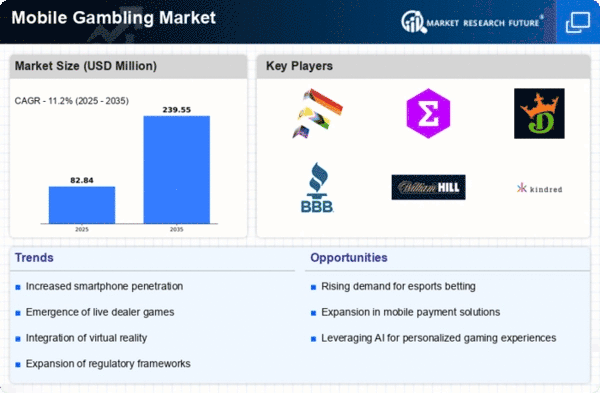
As per MRFR analysis, the Mobile Gambling Market Size was estimated at 74.5 USD Million in 2024. The Mobile Gambling industry is projected to grow from 82.85 in 2025 to 239.55 by 2035, exhibiting a compound annual growth rate (CAGR) of 11.2 during the forecast period 2025 - 2035.

Key Market Trends & Highlights

The Mobile Gambling Market is experiencing robust growth driven by technological advancements and evolving consumer preferences.

  • North America remains the largest market for mobile gambling, showcasing a strong demand for smartphone-based gaming. Asia-Pacific is emerging as the fastest-growing region, with increasing adoption of mobile gambling platforms. Casino games continue to dominate the market, while sports betting is rapidly gaining traction among users. Technological advancements and changing consumer preferences are key drivers propelling the growth of mobile gambling.

Market Size & Forecast

2024 Market Size 74.5 (USD Million)
2035 Market Size 239.55 (USD Million)
CAGR (2025 - 2035) 11.2%
Largest Regional Market Share in 2024 North America

Major Players

Flutter Entertainment (GB), Entain (GB), DraftKings (US), Bet365 (GB), William Hill (GB), Kindred Group (SE), 888 Holdings (GB), MGM Resorts International (US), Caesars Entertainment (US)

Market Trends

The Mobile Gambling Market is currently experiencing a transformative phase, characterized by rapid technological advancements and evolving consumer preferences. The proliferation of smartphones and high-speed internet access has facilitated a significant shift towards mobile platforms, enabling users to engage in gambling activities with unprecedented convenience. This trend appears to be driven by a younger demographic that favors mobile applications over traditional gambling venues. Furthermore, the integration of advanced features such as live betting and virtual reality is enhancing user experiences, making mobile gambling more immersive and appealing. In addition to technological innovations, regulatory changes across various jurisdictions are shaping the landscape of the Mobile Gambling Market. Governments are increasingly recognizing the potential tax revenue from legalized online gambling, leading to more favorable regulations. This shift not only legitimizes the industry but also encourages responsible gambling practices. As the market continues to evolve, it seems poised for further growth, with operators likely to invest in user-friendly interfaces and personalized experiences to attract and retain customers. Overall, the Mobile Gambling Market is on a trajectory of expansion, driven by both technological and regulatory factors that are reshaping how consumers engage with gambling activities.

Technological Integration

The Mobile Gambling Market is witnessing a surge in the integration of cutting-edge technologies. Innovations such as augmented reality and artificial intelligence are enhancing user engagement and personalizing experiences. This trend suggests that operators are increasingly focused on creating immersive environments that captivate users, potentially leading to higher retention rates.

Regulatory Evolution

Changes in regulations are significantly influencing the Mobile Gambling Market. As more jurisdictions move towards legalization, the framework governing online gambling is becoming more structured. This evolution may foster a safer gambling environment, encouraging responsible practices while simultaneously expanding market access.

Social Gaming Influence

The rise of social gaming is impacting the Mobile Gambling Market in notable ways. Many users are drawn to gambling experiences that incorporate social elements, such as multiplayer games and community features. This trend indicates a shift towards more interactive and engaging platforms, which could redefine user expectations in the gambling space.

Mobile Gambling Market Market Drivers

Diverse Gaming Options

The Global Mobile Gambling Market Industry is characterized by a diverse array of gaming options, which significantly contributes to its appeal. From traditional casino games to innovative betting formats, the variety available caters to a wide range of preferences. This diversity not only attracts new users but also retains existing ones, as players are continually seeking fresh experiences. The introduction of live dealer games and skill-based betting options further enhances this appeal. As the market evolves, the availability of diverse gaming options is likely to play a pivotal role in sustaining growth and engagement within the Global Mobile Gambling Market Industry.

Regulatory Developments

Regulatory frameworks are evolving to accommodate the Global Mobile Gambling Market Industry, which is crucial for its growth. Governments worldwide are increasingly recognizing the potential tax revenues and economic benefits associated with legalized mobile gambling. For example, jurisdictions that have embraced regulation have seen a surge in revenue, which could lead to more states and countries considering similar measures. This regulatory acceptance may contribute to the market's projected growth, with estimates suggesting it could reach 239.5 USD Million by 2035. Such developments indicate that a more structured regulatory environment could foster a safer and more reliable gambling experience for users.

Enhanced User Experience

User experience is a critical factor driving the Global Mobile Gambling Market Industry. Operators are increasingly focusing on creating seamless, user-friendly interfaces that enhance player satisfaction. Features such as personalized recommendations, intuitive navigation, and responsive design contribute to a more enjoyable gambling experience. Additionally, the integration of secure payment methods and customer support services further bolsters user confidence. As operators prioritize user experience, the market is expected to witness sustained growth, with projections indicating a potential market size of 239.5 USD Million by 2035. This emphasis on user experience is likely to be a defining characteristic of the Global Mobile Gambling Market Industry.

Market Growth Projections

The Global Mobile Gambling Market Industry is poised for substantial growth, with projections indicating a market size of 74.5 USD Million in 2024 and an anticipated increase to 239.5 USD Million by 2035. This trajectory suggests a compound annual growth rate of 11.2% from 2025 to 2035, reflecting the increasing adoption of mobile gambling platforms. The growth is driven by various factors, including technological advancements, regulatory developments, and enhanced user experiences. As the market evolves, it is likely to attract significant investment and innovation, further solidifying its position within the global gambling landscape.

Technological Advancements

The Global Mobile Gambling Market Industry is experiencing rapid growth due to continuous technological advancements. Innovations in mobile devices, such as enhanced processing power and improved graphics, facilitate a more immersive gambling experience. For instance, the integration of augmented reality and virtual reality technologies is becoming increasingly prevalent, allowing users to engage in more interactive gaming environments. As a result, the market is projected to reach 74.5 USD Million in 2024, with expectations of further expansion as these technologies evolve. This trend indicates that the Global Mobile Gambling Market Industry is likely to attract a broader audience, enhancing user engagement and retention.

Increased Smartphone Penetration

The proliferation of smartphones is a significant driver of the Global Mobile Gambling Market Industry. As mobile technology becomes more accessible, a larger segment of the population gains the ability to participate in mobile gambling activities. Current statistics suggest that smartphone penetration rates are expected to continue rising, particularly in emerging markets. This increased accessibility is likely to enhance user engagement and participation rates, thereby driving market growth. The Global Mobile Gambling Market Industry is poised to benefit from this trend, as more users turn to mobile platforms for their gambling needs, potentially leading to a compound annual growth rate of 11.2% from 2025 to 2035.

Market Segment Insights

By Device Type: Smartphone (Largest) vs. Tablet (Fastest-Growing)

In the Mobile Gambling Market, the device type segment is prominently dominated by smartphones, which account for a significant portion of the user base. These devices offer on-the-go accessibility and enhanced user experiences, making them the preferred choice for mobile gambling enthusiasts. Tablets, while trailing behind, show an impressive growth trend, indicating that more players are seeking larger screens for an immersive gambling experience. As the mobile gambling landscape evolves, the growth of tablets is fueled by advancements in technology and the increasing demand for mobile accessibility. Wearable devices and laptops, although present in this market, are experiencing slower adoption rates for mobile gambling functionalities. The rise in mobile internet penetration and improved gaming applications are the key drivers behind these growth trends, leading to a shift in consumer preference towards tablets as an engaging gambling device.

Smartphone: Dominant vs. Tablet: Emerging

Smartphones remain the dominant device in the Mobile Gambling Market due to their convenience and ubiquity. Their capability to support sophisticated gaming applications and seamless payment methods enhances the overall gambling experience, making them a staple device for users. Conversely, tablets are emerging as a compelling alternative, largely due to their larger screen size, which offers an enriched gaming interface. This segment is increasingly appealing to those who prefer a more visual and interactive experience while gambling. The tablet’s ergonomic design also allows for extended gaming sessions and social play, helping it carve out a niche in the market. As both devices continue to evolve with improved features, their distinction in user preference is likely to shape the future dynamics of mobile gambling.

By Game Type: Casino Games (Largest) vs. Sports Betting (Fastest-Growing)

In the Mobile Gambling Market, Casino Games hold the largest market share, capturing a significant portion of the total revenue. This segment includes classic games like slots and table games, appealing to a broad audience due to their variety and accessibility. <a href="https://www.marketresearchfuture.com/reports/online-sports-betting-market-10480">Sports Betting</a>, while smaller in comparison, is rapidly gaining traction as more users engage in betting on various sports events through mobile platforms. This shift has led to a more diverse market landscape, highlighting the changing preferences among mobile gamblers.

Casino Games (Dominant) vs. Sports Betting (Emerging)

Casino Games represent the dominant force in the Mobile Gambling Market, characterized by a wide array of options that cater to players' varying tastes. The segment benefits from established trust and familiarity, as players often lean towards traditional games. Conversely, Sports Betting is the emerging trend, driven by technological advancements and the increasing popularity of live betting features. With enhanced user experiences and engaging interfaces, sports betting apps attract a younger demographic eager for more interactive and exciting wagering opportunities. Both segments coexist yet cater to distinct player preferences, shaping the future of mobile gambling.

By Payment Method: E-Wallet (Largest) vs. Cryptocurrency (Fastest-Growing)

In the Mobile Gambling Market, the payment method segment showcases a varied landscape, with E-Wallets dominating the market share. These digital wallets offer convenience and speed, significantly enhancing user experience during transactions. Credit Cards follow closely, appreciated for their widespread acceptance, while Bank Transfers hold a smaller niche due to longer processing times. Cryptocurrency is beginning to carve out its presence, gaining traction among tech-savvy users looking for privacy and security in their gambling activities. It encapsulates a growing interest driven by the overall acceptance of digital currencies across various industries and the appeal of decentralized transactions. Growth trends indicate a substantial shift towards digital solutions, with E-Wallets leading as the preferred payment method due to their user-friendly interfaces and instant processing capabilities. <a href="https://www.marketresearchfuture.com/reports/cryptocurrency-market-31627">Cryptocurrency</a>, however, represents an exciting prospect, projected as the fastest-growing segment. Factors such as increased regulation of traditional payment methods, a rise in online gambling enthusiasts, and the desire for enhanced transaction security are all contributing to the growing adoption of E-Wallets and Cryptocurrencies in mobile gambling.

E-Wallet (Dominant) vs. Cryptocurrency (Emerging)

E-Wallets have established themselves as the dominant payment method in the Mobile Gambling Market due to their convenience and quick transaction processing times. This method allows users to deposit and withdraw funds seamlessly, contributing to a smooth gambling experience. Major providers, like PayPal and Skrill, are highly integrated with gambling platforms, which further boosts their adoption. Conversely, Cryptocurrency is emerging as a significant player, appealing especially to users who value privacy and seek alternatives to traditional payment methods. Its decentralized nature and increasing acceptance by online casinos offer distinct advantages, particularly as blockchain technology continues to evolve. The flexibility, security, and anonymity provided by cryptocurrencies are becoming key factors in attracting a new demographic of tech-savvy gamblers.

By User Demographics: Age Group (Largest) vs. Income Level (Fastest-Growing)

The user demographics in the mobile gambling market reveal a conspicuous distribution across various age groups and income levels. The largest share comes from the 25-34 age group, which has made a significant impact on overall market engagement. Meanwhile, the income levels indicate a diverse range of participants, with a notable presence from individuals with disposable income, enhancing their gambling activities via mobile platforms. These demographics play a critical role in shaping marketing strategies and product offerings for mobile gambling providers.

Age Group: 25-34 (Dominant) vs. Income Level: High-Income (Emerging)

The 25-34 age group constitutes a dominant segment in the mobile gambling market, characterized by tech-savvy individuals who prefer the convenience of mobile platforms. This group actively engages in various gambling activities, leveraging mobile technology for enhanced experiences. Conversely, the high-income segment has emerged as a fast-growing demographic as more affluent users adopt mobile gambling for entertainment and leisure. These high-income users are inclined towards premium features and experiences, which drive developers to innovate and tailor their offerings to meet this growing demand.

By Regulatory Environment: Licensing Requirements (Largest) vs. Taxation Policies (Fastest-Growing)

In the Mobile Gambling Market, the distribution of the regulatory environment segment primarily hinges on licensing requirements, taxation policies, and advertising regulations. Licensing requirements have established themselves as the largest segment, providing a framework that governs operators and ensures compliance with regional laws. Taxation policies, though smaller in market share, are rapidly evolving and are becoming increasingly significant as mobile gambling expands globally. Advertising regulations, while crucial for maintaining market ethics, remain somewhat restrictive across various jurisdictions but are essential for market success.

Licensing Requirements: Dominant vs. Taxation Policies: Emerging

Licensing Requirements dominate the regulatory environment in the mobile gambling industry by providing operational legitimacy and fostering consumer trust. This segment ensures that operators comply with stringent standards, promoting a fair gaming atmosphere. In contrast, Taxation Policies represent an emerging segment that is gaining traction as jurisdictions seek innovative ways to harness revenue from mobile gambling. The dynamic nature of taxation policies reflects changes in legal frameworks and public attitudes toward gambling, influencing how operators strategize their market approaches. Both segments play pivotal roles, with licensing solidifying industry foundations and taxation paving the path for future growth.

Get more detailed insights about Mobile Gambling Market Research Report - Global Forecast till 2035

Regional Insights

North America : Market Leader in Mobile Gambling

North America is poised to maintain its leadership in the mobile gambling market, holding a significant market share of 37.45% as of 2024. The growth is driven by increasing smartphone penetration, favorable regulatory changes, and a surge in online gaming popularity. States like New Jersey and Pennsylvania have implemented progressive regulations that encourage mobile gambling, contributing to a robust market environment. The competitive landscape is dominated by key players such as DraftKings, MGM Resorts International, and Caesars Entertainment, which are leveraging technology to enhance user experience. The U.S. market is characterized by a diverse range of offerings, from sports betting to casino games, appealing to a broad audience. As more states legalize mobile gambling, the market is expected to expand further, attracting both new entrants and established companies.

Europe : Regulatory Framework Driving Growth

Europe's mobile gambling market is experiencing significant growth, with a market size of €20.0 billion. The region benefits from a well-established regulatory framework that fosters innovation and consumer protection. Countries like the UK and Sweden are leading the charge, implementing regulations that not only ensure fair play but also promote responsible gambling practices. This regulatory environment is a key driver of market expansion, attracting both operators and consumers. Leading countries in Europe, such as the UK, Germany, and Sweden, host major players like Flutter Entertainment and Bet365. The competitive landscape is vibrant, with numerous operators vying for market share. The presence of established brands and innovative startups creates a dynamic ecosystem, ensuring a wide variety of mobile gambling options for consumers. As regulations continue to evolve, the market is expected to grow, driven by technological advancements and changing consumer preferences.

Asia-Pacific : Emerging Market with Potential

The Asia-Pacific region is emerging as a significant player in the mobile gambling market, with a market size of $12.0 billion. The growth is fueled by increasing smartphone adoption, rising disposable incomes, and a growing interest in online gaming. Countries like Australia and Japan are leading the way, with favorable regulations that support mobile gambling initiatives. The region's diverse cultural landscape also contributes to a wide range of gaming preferences, enhancing market demand. In the competitive landscape, key players such as Kindred Group and 888 Holdings are making strides in the region. The presence of local operators alongside international brands creates a competitive environment that fosters innovation. As more countries in the region consider legalizing mobile gambling, the market is expected to expand rapidly, driven by both consumer demand and regulatory support.

Middle East and Africa : Untapped Market Opportunities

The Middle East and Africa region presents untapped opportunities in the mobile gambling market, with a market size of $5.0 billion. The growth is primarily driven by increasing internet penetration and smartphone usage, alongside a gradual shift in regulatory attitudes towards gambling. Countries like South Africa are leading the way, with regulations that are becoming more favorable for mobile gambling operators, paving the way for market expansion. The competitive landscape is still developing, with a mix of local and international players entering the market. Companies are focusing on tailored offerings to meet the unique preferences of consumers in this diverse region. As regulations continue to evolve and consumer interest grows, the mobile gambling market in the Middle East and Africa is poised for significant growth in the coming years.

Key Players and Competitive Insights

The Mobile Gambling Market is currently characterized by a dynamic competitive landscape, driven by rapid technological advancements and evolving consumer preferences. Key players such as Flutter Entertainment (GB), Entain (GB), and DraftKings (US) are at the forefront, each adopting distinct strategies to enhance their market positioning. Flutter Entertainment (GB) has focused on innovation through the integration of advanced analytics and AI to personalize user experiences, while Entain (GB) has pursued aggressive regional expansion, particularly in emerging markets. DraftKings (US), on the other hand, emphasizes partnerships with sports leagues to bolster its brand visibility and customer engagement. Collectively, these strategies contribute to a competitive environment that is increasingly defined by technological prowess and strategic collaborations.
In terms of business tactics, companies are increasingly localizing their offerings to cater to diverse consumer bases, optimizing their supply chains to enhance efficiency. The competitive structure of the market appears moderately fragmented, with several key players exerting substantial influence. This fragmentation allows for a variety of consumer choices, while also fostering innovation as companies strive to differentiate themselves in a crowded marketplace.
In November 2025, Flutter Entertainment (GB) announced a strategic partnership with a leading fintech company to enhance its payment processing capabilities. This move is significant as it not only streamlines transactions for users but also positions Flutter to capture a larger share of the growing digital payment market, which is crucial for mobile gambling operations. The partnership is expected to improve user retention and attract new customers by offering seamless payment experiences.
In October 2025, Entain (GB) launched a new mobile application that incorporates augmented reality (AR) features, allowing users to engage with games in a more immersive manner. This initiative reflects Entain's commitment to innovation and enhancing user engagement, potentially setting a new standard in the mobile gambling experience. The introduction of AR could attract a younger demographic, thereby expanding Entain's customer base and increasing market share.
In September 2025, DraftKings (US) expanded its operations into the European market by acquiring a local gaming company. This acquisition is pivotal as it not only diversifies DraftKings' portfolio but also provides a foothold in a region with a rapidly growing mobile gambling sector. The strategic move is likely to enhance DraftKings' competitive edge and facilitate its growth trajectory in international markets.
As of December 2025, the Mobile Gambling Market is witnessing trends such as increased digitalization, sustainability initiatives, and the integration of AI technologies. Strategic alliances are becoming increasingly vital, as companies recognize the need to collaborate to enhance their technological capabilities and market reach. Looking ahead, competitive differentiation is expected to evolve, with a shift from price-based competition to a focus on innovation, technology, and supply chain reliability. This transition underscores the importance of adaptability and forward-thinking strategies in maintaining a competitive advantage.

Key Companies in the Mobile Gambling Market include

Industry Developments

July 2020 Kindred Group Plc. has revealed its plans for expansion in Indiana. The company is committed to broadening its reach not only within the United States but also on a global scale. To achieve this, Kindred Group intends to collaborate with local industry experts, leveraging their knowledge and expertise to establish a strong presence in new markets.

In November 2019 William Hill Plc. announced the launch of its online casino app and sportsbook launch in Michigan in partnership with the Grand Traverse Band of Ottawa and Chippewa Indians. The platform offers sports bettors a new experience using a deep and exhaustive array of bets.

Future Outlook

Mobile Gambling Market Future Outlook

The Mobile Gambling Market is projected to grow at an 11.2% CAGR from 2025 to 2035, driven by technological advancements, increased smartphone penetration, and evolving consumer preferences.

New opportunities lie in:

  • Integration of AI-driven personalized gaming experiences
  • Expansion of blockchain technology for secure transactions
  • Development of augmented reality gaming platforms for immersive experiences

By 2035, the Mobile Gambling Market is expected to be robust, reflecting substantial growth and innovation.

Market Segmentation

Mobile Gambling Market Game Type Outlook

  • Casino Games
  • Sports Betting
  • Poker
  • Lottery

Mobile Gambling Market Device Type Outlook

  • Smartphone
  • Tablet
  • Wearable Device
  • Laptop

Mobile Gambling Market Payment Method Outlook

  • Credit Card
  • E-Wallet
  • Bank Transfer
  • Cryptocurrency

Mobile Gambling Market User Demographics Outlook

  • Age Group
  • Gender
  • Income Level
  • Geographic Location

Mobile Gambling Market Regulatory Environment Outlook

  • Licensing Requirements
  • Taxation Policies
  • Advertising Regulations

Report Scope

MARKET SIZE 2024 74.5(USD Million)
MARKET SIZE 2025 82.85(USD Million)
MARKET SIZE 2035 239.55(USD Million)
COMPOUND ANNUAL GROWTH RATE (CAGR) 11.2% (2025 - 2035)
REPORT COVERAGE Revenue Forecast, Competitive Landscape, Growth Factors, and Trends
BASE YEAR 2024
Market Forecast Period 2025 - 2035
Historical Data 2019 - 2024
Market Forecast Units USD Million
Key Companies Profiled Flutter Entertainment (GB), Entain (GB), DraftKings (US), Bet365 (GB), William Hill (GB), Kindred Group (SE), 888 Holdings (GB), MGM Resorts International (US), Caesars Entertainment (US)
Segments Covered Device Type, Game Type, Payment Method, User Demographics, Regulatory Environment
Key Market Opportunities Integration of blockchain technology enhances security and transparency in the Mobile Gambling Market.
Key Market Dynamics Rising consumer demand for mobile gaming experiences drives innovation and competition among gambling operators and technology providers.
Countries Covered North America, Europe, APAC, South America, MEA

FAQs

How much is the Mobile Gambling market?

The global Mobile Gambling market size was valued at USD 74.5 Million in 2024.

What is the growth rate of the Mobile Gambling market?

The global market is estimated to grow at a CAGR of 11.2% during the forecast period, 2025 - 2034.

Which Region witnessed the largest market share in the Mobile Gambling market?

North America had the largest share of the global market

Who are the key players in the Mobile Gambling market?

The key players in the market are Kindred Group Plc., William Hill Plc., StarsGroup.com, Flutter Entertainment Plc., Betsson AB, Buffalo Partners, GVC Holdings Plc., and DraftKings Inc.

Which type led the Mobile Gambling market?

The Casino Mobile Gambling category dominated the market in 2024.

Which End-User witnessed the largest market share in the Mobile Gambling market?

Gambling Enthusiasts had the largest share of the global market.

  1. SECTION I: EXECUTIVE SUMMARY AND KEY HIGHLIGHTS
    1. | 1.1 EXECUTIVE SUMMARY
    2. | 1.1.1 Market Overview
    3. | 1.1.2 Key Findings
    4. | 1.1.3 Market Segmentation
    5. | 1.1.4 Competitive Landscape
    6. | 1.1.5 Challenges and Opportunities
    7. | 1.1.6 Future Outlook
  2. SECTION II: SCOPING, METHODOLOGY AND MARKET STRUCTURE
    1. | 2.1 MARKET INTRODUCTION
    2. | 2.1.1 Definition
    3. | 2.1.2 Scope of the study
    4. |-- 2.1.2.1 Research Objective
    5. |-- 2.1.2.2 Assumption
    6. |-- 2.1.2.3 Limitations
    7. | 2.2 RESEARCH METHODOLOGY
    8. | 2.2.1 Overview
    9. | 2.2.2 Data Mining
    10. | 2.2.3 Secondary Research
    11. | 2.2.4 Primary Research
    12. |-- 2.2.4.1 Primary Interviews and Information Gathering Process
    13. |-- 2.2.4.2 Breakdown of Primary Respondents
    14. | 2.2.5 Forecasting Model
    15. | 2.2.6 Market Size Estimation
    16. |-- 2.2.6.1 Bottom-Up Approach
    17. |-- 2.2.6.2 Top-Down Approach
    18. | 2.2.7 Data Triangulation
    19. | 2.2.8 Validation
  3. SECTION III: QUALITATIVE ANALYSIS
    1. | 3.1 MARKET DYNAMICS
    2. | 3.1.1 Overview
    3. | 3.1.2 Drivers
    4. | 3.1.3 Restraints
    5. | 3.1.4 Opportunities
    6. | 3.2 MARKET FACTOR ANALYSIS
    7. | 3.2.1 Value chain Analysis
    8. | 3.2.2 Porter's Five Forces Analysis
    9. |-- 3.2.2.1 Bargaining Power of Suppliers
    10. |-- 3.2.2.2 Bargaining Power of Buyers
    11. |-- 3.2.2.3 Threat of New Entrants
    12. |-- 3.2.2.4 Threat of Substitutes
    13. |-- 3.2.2.5 Intensity of Rivalry
    14. | 3.2.3 COVID-19 Impact Analysis
    15. |-- 3.2.3.1 Market Impact Analysis
    16. |-- 3.2.3.2 Regional Impact
    17. |-- 3.2.3.3 Opportunity and Threat Analysis
  4. SECTION IV: QUANTITATIVE ANALYSIS
    1. | 4.1 Information and Communications Technology, BY Device Type (USD Million)
    2. | 4.1.1 Smartphone
    3. | 4.1.2 Tablet
    4. | 4.1.3 Wearable Device
    5. | 4.1.4 Laptop
    6. | 4.2 Information and Communications Technology, BY Game Type (USD Million)
    7. | 4.2.1 Casino Games
    8. | 4.2.2 Sports Betting
    9. | 4.2.3 Poker
    10. | 4.2.4 Lottery
    11. | 4.3 Information and Communications Technology, BY Payment Method (USD Million)
    12. | 4.3.1 Credit Card
    13. | 4.3.2 E-Wallet
    14. | 4.3.3 Bank Transfer
    15. | 4.3.4 Cryptocurrency
    16. | 4.4 Information and Communications Technology, BY User Demographics (USD Million)
    17. | 4.4.1 Age Group
    18. | 4.4.2 Gender
    19. | 4.4.3 Income Level
    20. | 4.4.4 Geographic Location
    21. | 4.5 Information and Communications Technology, BY Regulatory Environment (USD Million)
    22. | 4.5.1 Licensing Requirements
    23. | 4.5.2 Taxation Policies
    24. | 4.5.3 Advertising Regulations
    25. | 4.6 Information and Communications Technology, BY Region (USD Million)
    26. | 4.6.1 North America
    27. |-- 4.6.1.1 US
    28. |-- 4.6.1.2 Canada
    29. | 4.6.2 Europe
    30. |-- 4.6.2.1 Germany
    31. |-- 4.6.2.2 UK
    32. |-- 4.6.2.3 France
    33. |-- 4.6.2.4 Russia
    34. |-- 4.6.2.5 Italy
    35. |-- 4.6.2.6 Spain
    36. |-- 4.6.2.7 Rest of Europe
    37. | 4.6.3 APAC
    38. |-- 4.6.3.1 China
    39. |-- 4.6.3.2 India
    40. |-- 4.6.3.3 Japan
    41. |-- 4.6.3.4 South Korea
    42. |-- 4.6.3.5 Malaysia
    43. |-- 4.6.3.6 Thailand
    44. |-- 4.6.3.7 Indonesia
    45. |-- 4.6.3.8 Rest of APAC
    46. | 4.6.4 South America
    47. |-- 4.6.4.1 Brazil
    48. |-- 4.6.4.2 Mexico
    49. |-- 4.6.4.3 Argentina
    50. |-- 4.6.4.4 Rest of South America
    51. | 4.6.5 MEA
    52. |-- 4.6.5.1 GCC Countries
    53. |-- 4.6.5.2 South Africa
    54. |-- 4.6.5.3 Rest of MEA
  5. SECTION V: COMPETITIVE ANALYSIS
    1. | 5.1 Competitive Landscape
    2. | 5.1.1 Overview
    3. | 5.1.2 Competitive Analysis
    4. | 5.1.3 Market share Analysis
    5. | 5.1.4 Major Growth Strategy in the Information and Communications Technology
    6. | 5.1.5 Competitive Benchmarking
    7. | 5.1.6 Leading Players in Terms of Number of Developments in the Information and Communications Technology
    8. | 5.1.7 Key developments and growth strategies
    9. |-- 5.1.7.1 New Product Launch/Service Deployment
    10. |-- 5.1.7.2 Merger & Acquisitions
    11. |-- 5.1.7.3 Joint Ventures
    12. | 5.1.8 Major Players Financial Matrix
    13. |-- 5.1.8.1 Sales and Operating Income
    14. |-- 5.1.8.2 Major Players R&D Expenditure. 2023
    15. | 5.2 Company Profiles
    16. | 5.2.1 Flutter Entertainment (GB)
    17. |-- 5.2.1.1 Financial Overview
    18. |-- 5.2.1.2 Products Offered
    19. |-- 5.2.1.3 Key Developments
    20. |-- 5.2.1.4 SWOT Analysis
    21. |-- 5.2.1.5 Key Strategies
    22. | 5.2.2 Entain (GB)
    23. |-- 5.2.2.1 Financial Overview
    24. |-- 5.2.2.2 Products Offered
    25. |-- 5.2.2.3 Key Developments
    26. |-- 5.2.2.4 SWOT Analysis
    27. |-- 5.2.2.5 Key Strategies
    28. | 5.2.3 DraftKings (US)
    29. |-- 5.2.3.1 Financial Overview
    30. |-- 5.2.3.2 Products Offered
    31. |-- 5.2.3.3 Key Developments
    32. |-- 5.2.3.4 SWOT Analysis
    33. |-- 5.2.3.5 Key Strategies
    34. | 5.2.4 Bet365 (GB)
    35. |-- 5.2.4.1 Financial Overview
    36. |-- 5.2.4.2 Products Offered
    37. |-- 5.2.4.3 Key Developments
    38. |-- 5.2.4.4 SWOT Analysis
    39. |-- 5.2.4.5 Key Strategies
    40. | 5.2.5 William Hill (GB)
    41. |-- 5.2.5.1 Financial Overview
    42. |-- 5.2.5.2 Products Offered
    43. |-- 5.2.5.3 Key Developments
    44. |-- 5.2.5.4 SWOT Analysis
    45. |-- 5.2.5.5 Key Strategies
    46. | 5.2.6 Kindred Group (SE)
    47. |-- 5.2.6.1 Financial Overview
    48. |-- 5.2.6.2 Products Offered
    49. |-- 5.2.6.3 Key Developments
    50. |-- 5.2.6.4 SWOT Analysis
    51. |-- 5.2.6.5 Key Strategies
    52. | 5.2.7 888 Holdings (GB)
    53. |-- 5.2.7.1 Financial Overview
    54. |-- 5.2.7.2 Products Offered
    55. |-- 5.2.7.3 Key Developments
    56. |-- 5.2.7.4 SWOT Analysis
    57. |-- 5.2.7.5 Key Strategies
    58. | 5.2.8 MGM Resorts International (US)
    59. |-- 5.2.8.1 Financial Overview
    60. |-- 5.2.8.2 Products Offered
    61. |-- 5.2.8.3 Key Developments
    62. |-- 5.2.8.4 SWOT Analysis
    63. |-- 5.2.8.5 Key Strategies
    64. | 5.2.9 Caesars Entertainment (US)
    65. |-- 5.2.9.1 Financial Overview
    66. |-- 5.2.9.2 Products Offered
    67. |-- 5.2.9.3 Key Developments
    68. |-- 5.2.9.4 SWOT Analysis
    69. |-- 5.2.9.5 Key Strategies
    70. | 5.3 Appendix
    71. | 5.3.1 References
    72. | 5.3.2 Related Reports

Information and Communications Technology Market Segmentation

Information and Communications Technology By Device Type (USD Million, 2025-2035)

  • Smartphone
  • Tablet
  • Wearable Device
  • Laptop

Information and Communications Technology By Game Type (USD Million, 2025-2035)

  • Casino Games
  • Sports Betting
  • Poker
  • Lottery

Information and Communications Technology By Payment Method (USD Million, 2025-2035)

  • Credit Card
  • E-Wallet
  • Bank Transfer
  • Cryptocurrency

Information and Communications Technology By User Demographics (USD Million, 2025-2035)

  • Age Group
  • Gender
  • Income Level
  • Geographic Location

Information and Communications Technology By Regulatory Environment (USD Million, 2025-2035)

  • Licensing Requirements
  • Taxation Policies
  • Advertising Regulations
Infographic

Free Sample Request

Kindly complete the form below to receive a free sample of this Report

Get Free Sample

Customer Strories

Compare Licence

×
Features License Type
Single User Multiuser License Enterprise User
Price $4,950 $5,950 $7,250
Maximum User Access Limit 1 User Upto 10 Users Unrestricted Access Throughout the Organization
Free Customization
Direct Access to Analyst
Deliverable Format
Platform Access
Discount on Next Purchase 10% 15% 15%
Printable Versions