
×
Hero Background
English
Chinese
French
Japanese
Korean
German
Spanish

Military UAV Sensor Market Size

ID: MRFR/AD/4637-HCR
100 Pages
Sejal Akre
October 2025

Military UAV Sensor Market Research Report Information by UAV Type (HALE, MALE, Tactical, and Small), Sensor Type (Radar Sensor, Image Sensor, Motion Position Sensor ),Technology Type (CMOS, MEMS, NEMS), Application (Collision Avoidance, Navigation, 3D Scanner, Data Acquisition, LIDAR ) Region (North America, Asia Pacific, Europe, Middle East Africa, and Latin America) Forecast till 2032

Share:
Download PDF ×

We do not share your information with anyone. However, we may send you emails based on your report interest from time to time. You may contact us at any time to opt-out.

Military UAV Sensor Market Infographic
Purchase Options

Military Uav Sensor Size

Military UAV Sensor Market Growth Projections and Opportunities

The development, advancement, and cutthroat climate of the military UAV sensor market are essentially influenced by various basic factors that work inside the safeguard area. Mechanical progressions are the transcendent impetuses in this market. The development of UAV sensors is pushed by continuous headways in sensor innovation, including the formation of hyperspectral imaging frameworks, EO/IR cameras with higher goals, radar frameworks, and refined signal handling capacities. These improvements assume a urgent part in tending to the changing prerequisites of protection applications, impelling the advancement and execution of further developed and effective sensor frameworks for UAVs in the military. Besides, the rising spotlight on further developing observation and reconnaissance functionalities is a significant impetus for the requirement for military UAV sensors. The sensors being referred to are critical as they outfit military powers with situational mindfulness, target securing abilities, and continuous insight. Market factors are affected by the necessity for automated UAVs to gather crucial information, supervise activities, and distinguish potential dangers across different scenes and conditions. Accordingly, ventures and improvements in sensor advances are coordinated towards fulfilling the developing needs of safeguard applications. Besides, the military UAV sensor area is significantly impacted by market factors that are impelled by advancing security dangers and the unique idea of contentions. Modern observation and recognition capacities are important to counter offside dangers, hilter kilter fighting, and counterinsurgency tries. The use of military UAV sensors is urgent to upgrade knowledge, recognize, and identify expected dangers. Subsequently, market factors are affected by the expanded interest for sensors that can work effectively in troublesome and complex conditions. Further, market elements in the military UAV sensor industry are considerably affected by administrative guidelines and consistency commitments. Sensors intended for UAVs planned for military utilize should adjust to thorough quality, wellbeing, and functional standards to ensure reliability, accuracy, and adherence to safeguard guidelines. To guarantee that their sensors fit the bill for safeguard contracts, producers distribute assets towards fulfilling these thorough guidelines, accordingly, applying an effect on acquisition choices and market elements through the requirement of such principles. Cost contemplations fundamentally impact market elements in the military UAV sensor industry. While seeking after practical arrangements, protection organizations attempt to keep up with execution and quality principles. Upper hand is obtained by producers who offer seriously estimated superior execution sensors; this benefit is appeared as market impact, as it draws in guard organizations that are looking for esteem situated arrangements. Further, tries committed to innovative work (Research and development) cultivate seriousness and advancement on the lookout for military UAV sensors. Organizations keep an upper hand by putting resources into Research and development drives that upgrade sensor innovations, capacities, capacities coordination, and cost decrease, as well as the combination of refined highlights. Market factors are significantly impacted by ceaseless improvements in sensor scaling down, upgraded usefulness, information handling, and reconciliation, which move the development of UAV sensor frameworks that are more adaptable and proficient. Mechanical progressions, the interest for further developed observation abilities, changing guard prerequisites, administrative consistence, cost-viability, and ceaseless advancement all impact market factors in the military UAV sensor area. In a time where safeguard prerequisites proceed to change and focus on precision, adaptability, and upgraded observation functionalities, the progression and execution of UAV sensor innovation will endure as urgent determinants of market elements and project workers' future military UAV sensor arrangements.

Military UAV Sensor Market Size Graph
Author
Sejal Akre
Senior Research Analyst

She has over 5 years of rich experience, in market research and consulting providing valuable market insights to client. Hands on expertise in management consulting, and extensive knowledge in domain including ICT, Automotive & Transportation and Aerospace & Defense. She is skilled in Go-to market strategy, industry analysis, market sizing, in depth company profiling, competitive intelligence & benchmarking and value chain amongst others.

Leave a Comment

FAQs

How Military UAV Sensor Market is Growing ?

at a CAGR of approximately 5.80% from 2024 to 2032

Top Key players in Military UAV Sensor Market ?

TE Connectivity (Switzerland), Raytheon Company (US), Thales Group (France), Lockheed Martin (US), AeroVironment (US), General Atomics (US), FLIR Systems (US), Elbit Systems (Israel), Kratos Defense & Security Solutions (US), Northrop Grumman Corporation (US), Honeywell International Inc. (US), and Safran Electronics & Defense (France).

In which Military UAV Sensor Market is Dominated ?

North America is expected to dominate the market in the future, due to its high deployment of UAVs for military applications

Market Summary

As per Market Research Future Analysis, the Global Military UAV Sensor Market was valued at USD 2.03 billion in 2024 and is projected to reach USD 3.37 billion by 2032, growing at a CAGR of 5.80% from 2024 to 2032. The market is driven by increasing investments in military UAVs and the growing demand for advanced sensor technologies, particularly in navigation and battlefield monitoring. Key applications include image sensor systems and laser scanning, which enhance operational capabilities. However, stringent regulations from aviation authorities pose challenges to market growth. North America is expected to dominate the market due to high UAV deployment, followed by the Asia Pacific region, which is witnessing significant R&D investments. Major players include TE Connectivity, Raytheon Company, and Lockheed Martin, among others.

Key Market Trends & Highlights

The military UAV sensor market is characterized by several key trends and highlights.

  • Market Size in 2024: USD 2.03 billion; projected to grow to USD 3.37 billion by 2032. CAGR of 5.80% during the forecast period (2024 - 2032). High-Altitude Long Endurance (HALE) UAVs hold the largest market share due to their enhanced capabilities. Radar sensors are expected to witness the largest demand due to their diverse applications.

Market Size & Forecast

2024 Market Size USD 2.03 billion
2032 Market Size USD 3.37 billion
CAGR 5.80%
Dominant Region North America

Major Players

<p>TE Connectivity (Switzerland), Raytheon Company (US), Thales Group (France), Lockheed Martin (US), AeroVironment (US), General Atomics (US), FLIR Systems (US), Elbit Systems (Israel), Kratos Defense &amp; Security Solutions (US), Northrop Grumman Corporation (US), Honeywell International Inc. (US), Safran Electronics &amp; Defense (France)</p>

Market Trends

Military UAV Sensor Market Market Drivers

Market Growth Projections

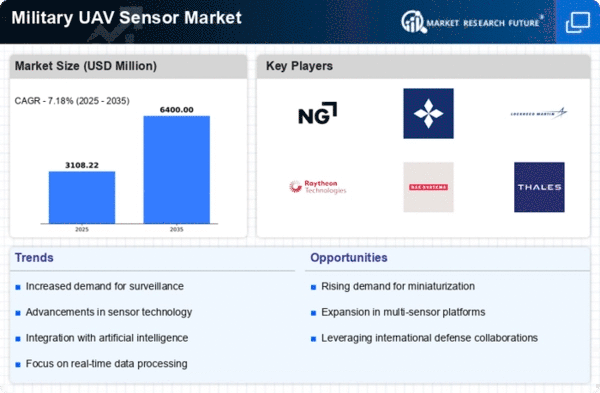
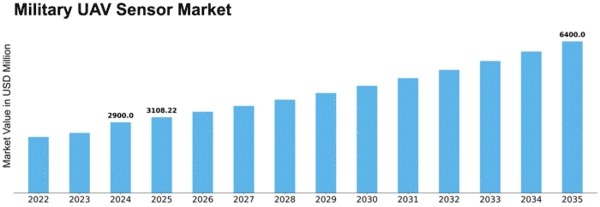
The Global Military UAV Sensor Industry is projected to experience substantial growth over the next decade. With a market value expected to reach 2.03 USD Billion in 2024 and an anticipated increase to 3.99 USD Billion by 2035, the industry is poised for significant expansion. The compound annual growth rate (CAGR) of 6.34% from 2025 to 2035 indicates a robust demand for UAV sensors driven by technological advancements and increasing military expenditures. This growth reflects the ongoing evolution of military strategies and the critical role that UAV sensors play in modern warfare.

Increasing Military Expenditure

The Global Military UAV Sensor Industry is experiencing growth driven by rising military budgets across various nations. Countries are investing heavily in advanced technologies to enhance their defense capabilities. For instance, in 2024, military spending is projected to reach approximately 2.03 USD Billion, reflecting a commitment to modernizing military assets. This trend is likely to continue, as nations recognize the strategic advantages offered by UAV sensors in surveillance and reconnaissance missions. As military expenditure increases, the demand for sophisticated UAV sensors is expected to rise, further propelling the market forward.

Technological Advancements in UAV Sensors

The Global Military UAV Sensor Industry benefits significantly from rapid technological advancements. Innovations in sensor technology, such as improved imaging capabilities and enhanced data processing, are transforming the operational effectiveness of UAVs. For example, the integration of artificial intelligence and machine learning into UAV sensors allows for real-time data analysis and decision-making. This evolution not only enhances situational awareness but also increases the efficiency of military operations. As these technologies continue to develop, they are likely to drive the demand for advanced UAV sensors, contributing to the market's projected growth.

Geopolitical Tensions and Security Threats

The Global Military UAV Sensor Industry is significantly impacted by rising geopolitical tensions and security threats. Nations are compelled to enhance their defense capabilities in response to evolving threats, leading to increased investments in military technologies, including UAV sensors. For instance, ongoing conflicts and territorial disputes have prompted countries to prioritize the development and deployment of UAVs for intelligence gathering and surveillance. This heightened focus on national security is likely to sustain the demand for advanced UAV sensors, thereby driving market growth in the coming years.

Integration of UAVs in Military Operations

The Global Military UAV Sensor Industry is witnessing a trend towards the integration of UAVs into various military operations. As armed forces recognize the strategic advantages of UAVs, there is a growing emphasis on incorporating these platforms into conventional military strategies. This integration enhances operational capabilities, allowing for more effective mission planning and execution. The increasing reliance on UAVs for diverse applications, from reconnaissance to combat support, is expected to fuel the demand for advanced UAV sensors. Consequently, this trend is likely to contribute to the market's growth trajectory, with projections indicating a rise to 3.99 USD Billion by 2035.

Rising Demand for Surveillance and Reconnaissance

The Global Military UAV Sensor Industry is largely influenced by the increasing demand for surveillance and reconnaissance capabilities. Military organizations are increasingly utilizing UAVs equipped with advanced sensors to gather intelligence and monitor activities in real-time. This trend is particularly evident in conflict zones where traditional surveillance methods may be limited. The ability of UAV sensors to provide high-resolution imagery and data analytics enhances operational effectiveness. As global security concerns escalate, the demand for UAV sensors is expected to grow, supporting the market's expansion and contributing to the anticipated CAGR of 6.34% from 2025 to 2035.

Market Segment Insights

Key Insights

<p>Market sizing, forecast, and analysis: detailed coverage of the market segment and sub-segments</p>

<p>Regional/country trends and forecast: detailed analysis of the market in North America, Asia-Pacific, Europe, the Middle East &amp; Africa, and Latin America, along with key countries in each region</p>

Get more detailed insights about Military UAV Sensor Market Research Report - Global Forecast till 2035

Regional Insights

Key Companies in the Military UAV Sensor Market market include

Industry Developments

Future Outlook

Military UAV Sensor Market Future Outlook

<p>The Military UAV Sensor Market is projected to grow at a 6.34% CAGR from 2024 to 2035, driven by advancements in technology, increasing defense budgets, and rising demand for surveillance capabilities.</p>

New opportunities lie in:

  • <p>Develop AI-driven sensor technologies to enhance data analysis and operational efficiency. Expand partnerships with defense contractors for integrated UAV sensor solutions. Invest in R&amp;D for miniaturized sensors to improve UAV payload capabilities.</p>

<p>By 2035, the Military UAV Sensor Market is expected to be robust, reflecting substantial advancements and increased investment.</p>

Market Segmentation

Report Scope

{}

FAQs

How Military UAV Sensor Market is Growing ?

at a CAGR of approximately 5.80% from 2024 to 2032

Top Key players in Military UAV Sensor Market ?

TE Connectivity (Switzerland), Raytheon Company (US), Thales Group (France), Lockheed Martin (US), AeroVironment (US), General Atomics (US), FLIR Systems (US), Elbit Systems (Israel), Kratos Defense &amp; Security Solutions (US), Northrop Grumman Corporation (US), Honeywell International Inc. (US), and Safran Electronics &amp; Defense (France).

In which Military UAV Sensor Market is Dominated ?

North America is expected to dominate the market in the future, due to its high deployment of UAVs for military applications

  1. Executive Summary
    1. Market Attractiveness Analysis
      1. Global Military UAV Sensor Market, by Application
      2. Global Military UAV Sensor Market, by Technology Type
      3. Global Military UAV Sensor Market, by UAV Type
      4. Global Military UAV Sensor Market, by Platform
      5. Global Military UAV Sensor Market, by Region
  2. Scope of the Report
    1. Market Definition
    2. Scope of the Study
      1. Definition
      2. Research Objective
      3. Assumptions
      4. Limitations
    3. Research Process
      1. Primary Research
      2. Secondary Research
    4. Market Size Estimation
    5. Forecast Model
  3. Market Landscape
    1. Porter’s Five Forces Analysis
      1. Threat of New Entrants
      2. Bargaining Power of Buyers
      3. Threat of Substitutes
      4. Segment Rivalry
      5. Bargaining Power of Buyers
    2. Value Chain/Supply Chain Analysis
  4. Market Dynamics
    1. Introduction
    2. Market Drivers
    3. Market Restraints
    4. Market Opportunities
    5. Market Trends
  5. Military UAV Sensors Market, by UAV Type
    1. Introduction
    2. High-Altitude Long Endurance (HALE)
      1. Market Estimates & Forecast, 2020–2027
      2. Market Estimates & Forecast, by Region, 2020–2027
    3. Medium-Altitude Long Endurance (MALE)
      1. Market Estimates & Forecast, 2020–2027
      2. Market Estimates & Forecast, by Region, 2020–2027
    4. Tactical
      1. Market Estimates & Forecast, 2020–2027
      2. Market Estimates & Forecast, by Region, 2020–2027
    5. Small
      1. Market Estimates & Forecast, 2020–2027
      2. Market Estimates & Forecast, by Region, 2020–2027
  6. Military UAV Sensors Market, by Platform
    1. Introduction
    2. Radar Sensor
      1. Market Estimates & Forecast, 2020–2027
      2. Market Estimates & Forecast, by Region, 2020–2027
    3. Image Sensor
      1. Market Estimates & Forecast, 2020–2027
      2. Market Estimates & Forecast, by Region, 2020–2027
    4. Motion & Position Sensor
      1. Market Estimates & Forecast, 2020–2027
      2. Market Estimates & Forecast, by Region, 2020–2027
    5. Others
      1. Market Estimates & Forecast, 2020–2027
      2. Market Estimates & Forecast, by Region, 2020–2027
  7. Military UAV Sensors Market, by Technology Type
    1. Introduction
    2. Complementary Metal Oxide Semiconductor (CMOS)
      1. Market Estimates & Forecast, 2020–2027
      2. Market Estimates & Forecast, by Region, 2020–2027
    3. Micro-Electro-Mechanical Semiconductor (MEMS)
      1. Market Estimates & Forecast, 2020–2027
      2. Market Estimates & Forecast, by Region, 2020–2027
    4. Nano-Electro-Mechanical Semiconductor (NEMS)
      1. Market Estimates & Forecast, 2020–2027
      2. Market Estimates & Forecast, by Region, 2020–2027
    5. Others
      1. Market Estimates & Forecast, 2020–2027
      2. Market Estimates & Forecast, by Region, 2020–2027
  8. Military UAV Sensors Market, by Application
    1. Introduction
    2. Collision Avoidance
      1. Market Estimates & Forecast, 2020–2027
      2. Market Estimates & Forecast, by Region, 2020–2027
    3. Navigation
      1. Market Estimates & Forecast, 2020–2027
      2. Market Estimates & Forecast, by Region, 2020–2027
    4. 3D Scanner
      1. Market Estimates & Forecast, 2020–2027
      2. Market Estimates & Forecast, by Region, 2020–2027
    5. Data Acquisition
      1. Market Estimates & Forecast, 2020–2027
      2. Market Estimates & Forecast, by Region, 2020–2027
    6. LIDAR
      1. Market Estimates & Forecast, 2020–2027
      2. Market Estimates & Forecast, by Region, 2020–2027
    7. Others
      1. Market Estimates & Forecast, 2020–2027
      2. Market Estimates & Forecast, by Region, 2020–2027
  9. Military UAV Sensors Market, by Region
    1. Introduction
    2. North America
      1. Market Estimates & Forecast, 2020–2027
      2. Market Estimates & Forecast, by UAV Type, 2020–2027
      3. Market Estimates & Forecast, by Platform, 2020–2027
      4. Market Estimates & Forecast, by Technology Type, 2020–2027
      5. Market Estimates & Forecast, by Application, 2020–2027
      6. U.S.
      7. Canada
    3. Europe
      1. Market Estimates & Forecast, 2020–2027
      2. Market Estimates & Forecast, by UAV Type, 2020–2027
      3. Market Estimates & Forecast, by Platform, 2020–2027
      4. Market Estimates & Forecast, by Technology Type, 2020–2027
      5. Market Estimates & Forecast, by Application, 2020–2027
      6. UK
      7. Germany
      8. France
      9. Russia
      10. Rest of Europe
    4. Asia-Pacific
      1. Market Estimates & Forecast, 2020–2027
      2. Market Estimates & Forecast, by UAV Type, 2020–2027
      3. Market Estimates & Forecast, by Platform, 2020–2027
      4. Market Estimates & Forecast, by Technology Type, 2020–2027
      5. Market Estimates & Forecast, by Application, 2020–2027
      6. China
      7. Japan
      8. India
      9. Rest of Asia-Pacific
    5. Middle East & Africa
      1. Market Estimates & Forecast, 2020–2027
      2. Market Estimates & Forecast, by UAV Type, 2020–2027
      3. Market Estimates & Forecast, by Platform, 2020–2027
      4. Market Estimates & Forecast, by Technology Type, 2020–2027
      5. Market Estimates & Forecast, by Application, 2020–2027
    6. Latin America
      1. Market Estimates & Forecast, 2020–2027
      2. Market Estimates & Forecast, by UAV Type, 2020–2027
      3. Market Estimates & Forecast, by Platform, 2020–2027
      4. Market Estimates & Forecast, by Technology Type, 2020–2027
      5. Market Estimates & Forecast, by Application, 2020–2027
  10. Competitive Landscape
  11. Company Profile
    1. TE Connectivity
      1. Company Overview
      2. Products/Services Offered
      3. Financial Overview
      4. Key Developments
      5. Key Strategies
      6. SWOT Analysis
    2. Raytheon Company
      1. Company Overview
      2. Products/Services Offered
      3. Financial Overview
      4. Key Developments
      5. Key Strategies
      6. SWOT Analysis
    3. Thales Group
      1. Company Overview
      2. Products/Services Offered
      3. Financial Overview
      4. Key Developments
      5. Key Strategies
      6. SWOT Analysis
    4. Lockheed Martin
      1. Company Overview
      2. Products/Services Offered
      3. Financial Overview
      4. Key Developments
      5. Key Strategies
      6. SWOT Analysis
    5. AeroVironment
      1. Company Overview
      2. Products/Services Offered
      3. Financial Overview
      4. Key Developments
      5. Key Strategies
      6. SWOT Analysis
    6. General Atomics
      1. Company Overview
      2. Products/Services Offered
      3. Financial Overview
      4. Key Developments
      5. Key Strategies
      6. SWOT Analysis
    7. FLIR Systems
      1. Company Overview
      2. Products/Services Offered
      3. Financial Overview
      4. Key Developments
      5. Key Strategies
      6. SWOT Analysis
    8. Elbit Systems
      1. Company Overview
      2. Products/Services Offered
      3. Financial Overview
      4. Key Developments
      5. Key Strategies
      6. SWOT Analysis
    9. Kratos Defense & Security Solutions
      1. Company Overview
      2. Products/Services Offered
      3. Financial Overview
      4. Key Developments
      5. Key Strategies
      6. SWOT Analysis
    10. Safran Electronics & Defense
      1. Company Overview
      2. Products/Services Offered
      3. Financial Overview
      4. Key Developments
      5. Key Strategies
      6. SWOT Analysis
    11. Northrop Grumman Corporation
      1. Company Overview
      2. Products/Services Offered
      3. Financial Overview
      4. Key Developments
      5. Key Strategies
      6. SWOT Analysis
    12. Honeywell International Inc.
      1. Company Overview
      2. Products/Services Offered
      3. Financial Overview
      4. Key Developments
      5. Key Strategies
      6. SWOT Analysis
  12. Appendix
    1. References
    2. Related Reports
    3. List of Abbreviations
  13. Industry Insights
    1. Note: This table of contents is tentative and subject to change as the research progresses.
    2. List of Tables
  14. Global Military UAV Sensor Market, by Region, 2020–2027
  15. North America Military UAV Sensor Market, by Country, 2020–2027
  16. Europe Military UAV Sensor Market, by Country, 2020–2027
  17. Asia-Pacific Military UAV Sensor Market, by Country, 2020–2027
  18. Middle East & Africa Military UAV Sensor Market, by Country, 2020–2027
  19. Latin America Military UAV Sensor Market, by Country, 2020–2027
  20. Global Military UAV Sensor Market, by Region, 2020–2027
  21. Global Military UAV Sensor Market, by Technology Type, 2020–2027
  22. Global Military UAV Sensor Market, by UAV Type, 2020–2027
  23. Global Military UAV Sensor Market, by Platform, 2020–2027
  24. Global Military UAV Sensor Market, by Application, 2020–2027
  25. North America: Military UAV Sensor Market, by Country, 2020–2027
  26. North America: Military UAV Sensor Market, by Technology Type, 2020–2027
  27. North America: Military UAV Sensor Market, by UAV Type, 2020–2027
  28. North America: Military UAV Sensor Market, by Platform, 2020–2027
  29. North America: Military UAV Sensor Market, by Application, 2020–2027
  30. Europe: Military UAV Sensor Market, by Country, 2020–2027
  31. Europe: Military UAV Sensor Market, by Technology Type, 2020–2027
  32. Europe: Military UAV Sensor Market, by UAV Type, 2020–2027
  33. Europe: Military UAV Sensor Market, by Platform, 2020–2027
  34. Europe: Military UAV Sensor Market, by Application, 2020–2027
  35. Asia-Pacific: Military UAV Sensor Market, by Country, 2020–2027
  36. Asia-Pacific: Military UAV Sensor Market, by Technology Type, 2020–2027
  37. Asia-Pacific: Military UAV Sensor Market, by UAV Type, 2020–2027
  38. Asia-Pacific: Military UAV Sensor Market, by Platform, 2020–2027
  39. Asia-Pacific: Military UAV Sensor Market, by Application, 2020–2027
  40. Middle East & Africa: Military UAV Sensor Market, by Region, 2020–2027
  41. Middle East & Africa: Military UAV Sensor Market, by Technology Type, 2020–2027
  42. Middle East & Africa: Military UAV Sensor Market, by UAV Type, 2020–2027
  43. Middle East & Africa: Military UAV Sensor Market, by Platform, 2020–2027
  44. Middle East & Africa: Military UAV Sensor Market, by Application, 2020–2027
  45. Latin America: Military UAV Sensor Market, by Region, 2020–2027
  46. Latin America: Military UAV Sensor Market, by Technology Type, 2020–2027
  47. Latin America: Military UAV Sensor Market, by UAV Type, 2020–2027
  48. Latin America: Military UAV Sensor Market, by Platform, 2020–2027
  49. Latin America: Military UAV Sensor Market, by Application, 2020–2027
    1. List of Figures
  50. Research Process of MRFR
  51. Top-Down and Bottom-Up Approaches
  52. Market Dynamics
  53. Impact Analysis: Market Drivers
  54. Impact Analysis: Market Restraints
  55. Porter's Five Forces Analysis
  56. Value Chain Analysis
  57. Global Military UAV Sensor Market Share, by Technology Type, 2020 (%)
  58. Global Military UAV Sensor Market, by Technology Type, 2020–2027 (USD Million)
  59. Global Military UAV Sensor Market Share, by UAV Type, 2020 (%)
  60. Global Military UAV Sensor Market, by UAV Type, 2020–2027 (USD Million)
  61. Global Military UAV Sensor Market Share, by Platform, 2020 (%)
  62. Global Military UAV Sensor Market, by Platform, 2020–2027 (USD Million)
  63. Global Military UAV Sensor Market Share, by Application, 2020 (%)
  64. Global Military UAV Sensor Market, by Application, 2020–2027 (USD Million)
  65. Global Military UAV Sensor Market Share (%), by Region, 2020
  66. Global Military UAV Sensor Market, by Region, 2020–2027 (USD Million)
  67. North America: Military UAV Sensor Market Share (%), 2020
  68. North America: Military UAV Sensor Market by Country, 2020–2027 (USD Million)
  69. Europe: Military UAV Sensor Market Share (%), 2020
  70. Europe: Military UAV Sensor Market by Country, 2020–2027 (USD Million)
  71. Asia-Pacific: Military UAV Sensor Market Share (%), 2020
  72. Asia-Pacific: Military UAV Sensor Market by Country, 2020–2027 (USD Million)
  73. Middle East & Africa Military UAV Sensor Market Share (%), 2020
  74. Middle East & Africa Military UAV Sensor Market by Region, 2020–2027 (USD Million)
  75. Latin America Military UAV Sensor Market Share (%), 2020
  76. Latin America Military UAV Sensor Market by Region, 2020–2027 (USD Million)

Military UAV Sensor Market Segmentation

Market Segmentation Overview

  • Detailed segmentation data will be available in the full report
  • Comprehensive analysis by multiple parameters
  • Regional and country-level breakdowns
  • Market size forecasts by segment
Infographic

Free Sample Request

Kindly complete the form below to receive a free sample of this Report

Get Free Sample

Customer Strories

Compare Licence

×
Features License Type
Single User Multiuser License Enterprise User
Price $4,950 $5,950 $7,250
Maximum User Access Limit 1 User Upto 10 Users Unrestricted Access Throughout the Organization
Free Customization
Direct Access to Analyst
Deliverable Format
Platform Access
Discount on Next Purchase 10% 15% 15%
Printable Versions