×
Request Free Sample ×

Kindly complete the form below to receive a free sample of this Report

* Please use a valid business email

Leading companies partner with us for data-driven Insights

clients tt-cursor
Hero Background
English
Chinese
French
Japanese
Korean
German
Spanish

Military UAV Sensor Market Share

ID: MRFR/AD/4637-HCR
100 Pages
Sejal Akre
October 2025

Military UAV Sensor Market Size, Share, Industry Trend & Analysis Research Report Information by UAV Type (HALE, MALE, Tactical, and Small), Sensor Type (Radar Sensor, Image Sensor, Motion Position Sensor ),Technology Type (CMOS, MEMS, NEMS), Application (Collision Avoidance, Navigation, 3D Scanner, Data Acquisition, LIDAR ) Region (North America, Asia Pacific, Europe, Middle East Africa, and Latin America) Forecast till 2032

Share:
Download PDF ×

We do not share your information with anyone. However, we may send you emails based on your report interest from time to time. You may contact us at any time to opt-out.

Military UAV Sensor Market Infographic
Purchase Options

Market Share

Military UAV Sensor Market Share Analysis

Inside the exceptionally serious military UAV sensor market, associations utilize a huge number of strategies with an end goal to lay out a strong traction and secure a part of the market. Mechanical development fills in as an essential way to deal with market situations. Critical speculations are made by makers in innovative work to lead the movement of UAV sensor advances. These headways habitually include upgrades in sensor qualities like goal, reach, exactness, and mix capacity, with the target of conveying sensor frameworks that are further developed and compelling in contrast with their adversaries. Moreover, essential coordinated efforts and organizations significantly affect a piece of the pie situating in the military UAV sensor industry. The foundation of organizations among sensor producers, UAV designers, protection project workers, and examination establishments works with the assembly of information, resources, and limits to foster widely inclusive and durable sensor arrangements. Through essential coalitions, organizations can give altered sensor frameworks that address specific guard applications or military necessities, along these lines supporting their market allure and situating. Besides, item contributions that are adjustable and flexible comprise a basic situating procedure for piece of the pie. Sensor producers offer versatile and particular sensor frameworks to fulfill a large number of military prerequisites. The market situation is improved by giving versatile sensors that can be modified for specific UAV stages or incorporated into an assortment of safeguard frameworks. This system empowers associations to support different safeguard applications, mission essentials, and functional settings, accordingly, laying out their image as purveyors of adaptable and specific arrangements. Executing market entrance systems is significant for expanding piece of the pie in the area of military UAV sensors. Associations focus on improving their piece of the pie in different protection areas, locales, or parts of the military by carrying out proficient appropriation organizations, designated publicizing efforts, and vital unions. By distinguishing basic areas or protection applications that display significant interest for sensor frameworks, associations can improve asset distribution and achieve an upper hand inside those spaces. Estimating methodologies are of impressive importance with regards to situating a piece of the pie. Associations execute serious valuing techniques that plan to work out some kind of harmony between the specialized ability and reasonableness of their sensor frameworks. This methodology empowers them to get a part of the market by focusing on protection organizations that are looking for arrangements that are both practical and of predominant quality. Moreover, by consolidating esteem added administrations or adaptable valuing bundles, organizations can expand the allure of their items and apply a more prominent effect on their market situating. Notoriety the board and brand situating are fundamental parts of methodologies that mean to accomplish piece of the pie predominance. Laying out a powerful brand personality upheld by constancy, inventiveness, and viability shapes the inclinations of guard organizations and develops certainty. Associations make vital speculations to maintain a good brand notoriety by guaranteeing predictable quality, reliability, client care, and adherence to thorough military principles, in this manner strengthening their market standing. Continuous innovative work (Research and development) tries to keep on being basic for the military UAV sensor area to maintain and upgrade its market position. Associations that dispense huge assets towards innovative work keep an upper hand through the predictable presentation of upgrades, novel functionalities, and mechanical headways in their sensor frameworks. By executing this methodology, they ensure their proceeded with relevance to the market, brace their remaining as leaders in the business, and appeal to guard organizations looking for bleeding edge and effective automated ethereal vehicle sensor arrangements. In synopsis, the situating methodologies for piece of the pie in the military UAV sensor area contain the accompanying: advancement, vital coalitions, customization, market entrance, evaluating, brand the board, and progressing innovative work. Capable associations use a mix of these strategies to acquire an upper hand, satisfy different protective commitments, and widen their market impression. Supporting mechanical strength, acclimating to changing guard prerequisites, and meeting thorough military rules keep on being basic variables in saving and extending market presence inside the savagely serious military UAV sensor area.

Author
Sejal Akre
Senior Research Analyst

She has over 5 years of rich experience, in market research and consulting providing valuable market insights to client. Hands on expertise in management consulting, and extensive knowledge in domain including ICT, Automotive & Transportation and Aerospace & Defense. She is skilled in Go-to market strategy, industry analysis, market sizing, in depth company profiling, competitive intelligence & benchmarking and value chain amongst others.

Leave a Comment

FAQs

How Military UAV Sensor Market is Growing ?

at a CAGR of approximately 5.80% from 2024 to 2032

Top Key players in Military UAV Sensor Market ?

TE Connectivity (Switzerland), Raytheon Company (US), Thales Group (France), Lockheed Martin (US), AeroVironment (US), General Atomics (US), FLIR Systems (US), Elbit Systems (Israel), Kratos Defense & Security Solutions (US), Northrop Grumman Corporation (US), Honeywell International Inc. (US), and Safran Electronics & Defense (France).

In which Military UAV Sensor Market is Dominated ?

North America is expected to dominate the market in the future, due to its high deployment of UAVs for military applications

Market Summary

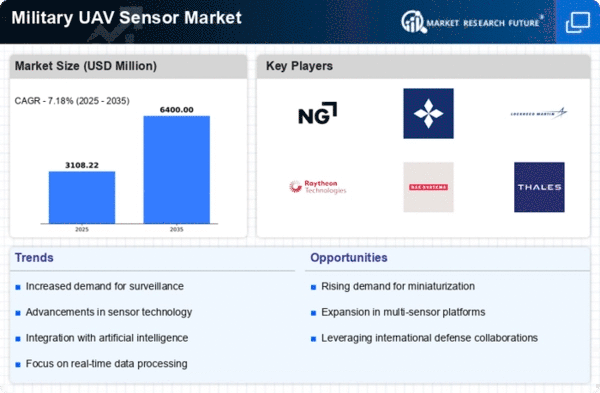
As per Market Research Future analysis, the Military UAV Sensor Market was estimated at 2900.0 USD Million in 2024. The Military UAV Sensor industry is projected to grow from USD 3200.0 Million in 2025 to USD 6400.0 Million by 2035, exhibiting a compound annual growth rate (CAGR) of 7.18% during the forecast period 2025 - 2035

Key Market Trends & Highlights

The Military UAV Sensor Market is poised for substantial growth driven by technological advancements and increasing demand for ISR capabilities.

  • North America remains the largest market for military UAV sensors, driven by robust defense budgets and technological innovation.
  • The Asia-Pacific region is emerging as the fastest-growing market, reflecting heightened military investments and regional security concerns.
  • Surveillance sensors dominate the market, while reconnaissance sensors are experiencing the fastest growth due to evolving military strategies.
  • Technological advancements in sensor technology and rising geopolitical tensions are key drivers propelling market expansion.

Market Size & Forecast

2024 Market Size 2900.0 (USD Million)
2035 Market Size 6400.0 (USD Million)
CAGR (2025 - 2035) 7.18%
Largest Regional Market Share in 2024 North America

Major Players

Northrop Grumman (US), General Atomics (US), Lockheed Martin (US), Raytheon Technologies (US), BAE Systems (GB), Thales Group (FR), Leonardo (IT), Elbit Systems (IL), Textron (US)

Market Trends

defense

Military UAV Sensor Market Market Drivers

Market Growth Projections

The Global Military UAV Sensor Industry is projected to experience substantial growth over the next decade. With a market value expected to reach 2.03 USD Billion in 2024 and an anticipated increase to 3.99 USD Billion by 2035, the industry is poised for significant expansion. The compound annual growth rate (CAGR) of 6.34% from 2025 to 2035 indicates a robust demand for UAV sensors driven by technological advancements and increasing military expenditures. This growth reflects the ongoing evolution of military strategies and the critical role that UAV sensors play in modern warfare.

Increasing Military Expenditure

The Global Military UAV Sensor Industry is experiencing growth driven by rising military budgets across various nations. Countries are investing heavily in advanced technologies to enhance their defense capabilities. For instance, in 2024, military spending is projected to reach approximately 2.03 USD Billion, reflecting a commitment to modernizing military assets. This trend is likely to continue, as nations recognize the strategic advantages offered by UAV sensors in surveillance and reconnaissance missions. As military expenditure increases, the demand for sophisticated UAV sensors is expected to rise, further propelling the market forward.

Technological Advancements in UAV Sensors

The Global Military UAV Sensor Industry benefits significantly from rapid technological advancements. Innovations in sensor technology, such as improved imaging capabilities and enhanced data processing, are transforming the operational effectiveness of UAVs. For example, the integration of artificial intelligence and machine learning into UAV sensors allows for real-time data analysis and decision-making. This evolution not only enhances situational awareness but also increases the efficiency of military operations. As these technologies continue to develop, they are likely to drive the demand for advanced UAV sensors, contributing to the market's projected growth.

Geopolitical Tensions and Security Threats

The Global Military UAV Sensor Industry is significantly impacted by rising geopolitical tensions and security threats. Nations are compelled to enhance their defense capabilities in response to evolving threats, leading to increased investments in military technologies, including UAV sensors. For instance, ongoing conflicts and territorial disputes have prompted countries to prioritize the development and deployment of UAVs for intelligence gathering and surveillance. This heightened focus on national security is likely to sustain the demand for advanced UAV sensors, thereby driving market growth in the coming years.

Integration of UAVs in Military Operations

The Global Military UAV Sensor Industry is witnessing a trend towards the integration of UAVs into various military operations. As armed forces recognize the strategic advantages of UAVs, there is a growing emphasis on incorporating these platforms into conventional military strategies. This integration enhances operational capabilities, allowing for more effective mission planning and execution. The increasing reliance on UAVs for diverse applications, from reconnaissance to combat support, is expected to fuel the demand for advanced UAV sensors. Consequently, this trend is likely to contribute to the market's growth trajectory, with projections indicating a rise to 3.99 USD Billion by 2035.

Rising Demand for Surveillance and Reconnaissance

The Global Military UAV Sensor Industry is largely influenced by the increasing demand for surveillance and reconnaissance capabilities. Military organizations are increasingly utilizing UAVs equipped with advanced sensors to gather intelligence and monitor activities in real-time. This trend is particularly evident in conflict zones where traditional surveillance methods may be limited. The ability of UAV sensors to provide high-resolution imagery and data analytics enhances operational effectiveness. As global security concerns escalate, the demand for UAV sensors is expected to grow, supporting the market's expansion and contributing to the anticipated CAGR of 6.34% from 2025 to 2035.

Market Segment Insights

By Application: Surveillance (Largest) vs. Reconnaissance (Fastest-Growing)

In the Military UAV Sensor Market, the application segment is characterized by a diverse range of functionalities that cater to various military needs. Surveillance holds the largest share within this segment, driven by its critical role in intelligence gathering and threat assessment. Meanwhile, reconnaissance is emerging as the fastest-growing application, reflecting the increasing demand for detailed situational awareness on the battlefield. The growth of these applications is attributed to advancements in sensor technology that enhance data collection and analysis capabilities. Moreover, the evolving nature of warfare, which increasingly emphasizes the importance of information superiority, is propelling the demand for UAVs equipped with sophisticated surveillance and reconnaissance systems. This shift is encouraging investments in UAV programs that can deliver faster and more accurate reconnaissance outputs, making them vital in modern military operations.

Surveillance (Dominant) vs. Target Acquisition (Emerging)

Surveillance as the dominant application within the Military UAV Sensor Market exemplifies the increasing reliance on aerial monitoring to enhance tactical awareness and operational readiness. It involves the deployment of advanced sensors, which provide real-time data, aiding commanders in making informed decisions. The extensive use of surveillance UAVs across various terrains demonstrates their strategic significance. On the other hand, target acquisition is emerging, fueled by technological advancements that facilitate precision and speed in identifying and engaging targets. As military operations evolve, the need for <a href="https://www.marketresearchfuture.com/reports/drones-market-1124" target="_blank">drones</a> equipped with cutting-edge sensors capable of precise target acquisition is rising, providing a crucial tactical edge. The synergy between these applications not only enhances mission outcomes but also fosters ongoing innovation in military UAV technology.

By Sensor Type: Electro-Optical Sensor (Largest) vs. Infrared Sensor (Fastest-Growing)

In the Military UAV Sensor Market, the Electro-Optical Sensor segment holds a significant portion of the market share, owing to its capability to capture high-resolution imagery during surveillance and reconnaissance missions. This segment benefits from increasing defense budgets and the growing use of UAVs in various military operations. Conversely, the Infrared Sensor segment has emerged as the fastest-growing category, driven by advancements in sensor technology and the rising demand for thermal imaging solutions in low-visibility conditions.

Electro-Optical Sensor (Dominant) vs. Infrared Sensor (Emerging)

The Electro-Optical Sensor is often regarded as the dominant technology in military UAVs due to its versatility and effectiveness in providing real-time video imagery. This sensor type is extensively used for target acquisition, reconnaissance, and situational awareness in combat zones. On the other hand, the Infrared Sensor is an emerging player, gaining ground rapidly due to its ability to detect heat signatures, making it vital for night operations and reconnaissance missions in challenging environments. Both sensor types complement each other in military applications, with electro-optical systems providing detailed visual data and infrared sensors enhancing operational capabilities under varied conditions.

By End Use: Military (Largest) vs. Defense (Fastest-Growing)

The Military UAV Sensor Market is predominantly characterized by its military applications, which hold the largest share in end-use segments. Military organizations worldwide are increasingly integrating UAV sensors into their operational frameworks, enhancing surveillance, reconnaissance, and targeting capabilities. Following closely, the defense sector has shown significant growth, supported by increased defense budgets and an urgent need for advanced technologies to counter emerging threats.

Military (Dominant) vs. Defense (Emerging)

Military applications represent the dominant force in the Military UAV Sensor Market, focusing on enhancing tactical advantage through surveillance and reconnaissance capabilities. This segment benefits from extensive governmental investments and the push for modernization in military fleets. In contrast, the defense applications are emerging swiftly due to rising geopolitical tensions and the necessity for advanced situational awareness. Defense organizations are rapidly adopting UAV sensors for intelligence, surveillance, and reconnaissance (ISR) purposes, which is propelling growth in this area. Both segments play crucial roles, but the dynamic nature of global defense needs indicates a promising outlook for defense applications as they become increasingly critical in security strategies.

Get more detailed insights about Military UAV Sensor Market Research Report - Global Forecast till 2035

Regional Insights

North America : Market Leader in UAV Sensors

North America is poised to maintain its leadership in the Military UAV Sensor Market, holding a significant market share of 1450.0 million. The region's growth is driven by increasing defense budgets, technological advancements, and a rising demand for surveillance and reconnaissance capabilities. Regulatory support from government agencies further catalyzes market expansion, ensuring compliance with safety and operational standards. The competitive landscape is characterized by major players such as Northrop Grumman, General Atomics, and Lockheed Martin, which are at the forefront of innovation. The U.S. remains a key player, leveraging its advanced technological infrastructure and strong defense policies. The presence of these industry giants fosters a robust ecosystem for UAV sensor development, ensuring North America's dominance in the global market.

Europe : Emerging Market for UAV Technology

Europe is rapidly evolving as a significant player in the Military UAV Sensor Market, with a market size of 800.0 million. The region's growth is fueled by increasing defense expenditures and a focus on enhancing national security. Collaborative efforts among EU nations to develop advanced UAV technologies are also driving demand, supported by regulatory frameworks that promote innovation and interoperability among member states. Leading countries such as the UK, France, and Germany are at the forefront of this market, with companies like BAE Systems and Thales Group leading the charge. The competitive landscape is marked by strategic partnerships and investments in R&D, positioning Europe as a key contributor to The Military UAV Sensor. As stated by the European Defence Agency, "The development of UAV technologies is crucial for enhancing the operational capabilities of European armed forces."

Asia-Pacific : Growing Demand for UAV Solutions

Asia-Pacific is witnessing a burgeoning Military UAV Sensor Market, valued at 500.0 million. The region's growth is driven by increasing military modernization efforts and the rising need for surveillance capabilities among nations. Countries are investing heavily in UAV technologies to enhance their defense strategies, supported by favorable government policies and initiatives aimed at boosting indigenous manufacturing. Key players in this region include countries like China, India, and Japan, which are rapidly advancing their UAV capabilities. The competitive landscape is characterized by a mix of domestic and international companies striving to capture market share. As nations prioritize defense spending, the demand for advanced UAV sensors is expected to rise significantly, positioning Asia-Pacific as a critical market in the global landscape.

Middle East and Africa : Emerging Defense Market

The Middle East and Africa region is emerging as a notable market for Military UAV Sensors, with a market size of 150.0 million. The growth is primarily driven by escalating security concerns and geopolitical tensions, prompting countries to enhance their defense capabilities. Investments in UAV technologies are being prioritized, supported by government initiatives aimed at modernizing military assets and improving surveillance operations. Countries like the UAE and Saudi Arabia are leading the charge in UAV adoption, with significant investments in defense technology. The competitive landscape features both local and international players, striving to meet the growing demand for advanced UAV sensors. As stated by the Gulf Cooperation Council, "Investments in UAV technology are essential for ensuring regional security and stability."

Key Players and Competitive Insights

The Military UAV Sensor Market is currently characterized by a dynamic competitive landscape, driven by technological advancements and increasing defense budgets across various nations. Key players such as Northrop Grumman (US), General Atomics (US), and Raytheon Technologies (US) are at the forefront, focusing on innovation and strategic partnerships to enhance their market positions. Northrop Grumman (US) emphasizes the integration of advanced sensor technologies into its UAV platforms, while General Atomics (US) is known for its robust R&D efforts aimed at developing next-generation sensors. Raytheon Technologies (US) is actively pursuing collaborations with defense agencies to tailor its sensor solutions to meet specific operational requirements, thereby shaping a competitive environment that prioritizes technological superiority and operational effectiveness.In terms of business tactics, companies are increasingly localizing manufacturing and optimizing supply chains to enhance responsiveness to market demands. The Military UAV Sensor Market appears moderately fragmented, with several key players exerting influence through strategic initiatives. This fragmentation allows for a diverse range of sensor technologies and applications, fostering innovation while also creating competitive pressures among established and emerging firms.

In November Northrop Grumman (US) announced the successful deployment of its latest sensor suite aboard a UAV for a major defense exercise, showcasing enhanced surveillance capabilities. This strategic move not only demonstrates the company's commitment to innovation but also reinforces its position as a leader in the UAV sensor domain. The deployment is expected to attract interest from various defense agencies looking to upgrade their surveillance capabilities, potentially leading to increased contracts and partnerships.

In October General Atomics (US) unveiled a new line of multi-spectral sensors designed for integration with its UAV platforms. This introduction is significant as it reflects the company's focus on expanding its product offerings to meet the evolving needs of military customers. By enhancing its sensor capabilities, General Atomics (US) positions itself to capture a larger share of the market, particularly in areas requiring advanced reconnaissance and intelligence-gathering capabilities.

In September Raytheon Technologies (US) entered into a strategic partnership with a leading technology firm to develop AI-driven sensor systems for UAVs. This collaboration is indicative of the growing trend towards digitalization within the military sector. By leveraging AI, Raytheon Technologies (US) aims to enhance the operational efficiency and effectiveness of its UAV sensors, thereby addressing the increasing demand for intelligent systems in modern warfare.

As of December the Military UAV Sensor Market is witnessing trends such as digitalization, sustainability, and AI integration, which are reshaping competitive dynamics. Strategic alliances are becoming increasingly important, as companies seek to combine expertise and resources to drive innovation. The competitive differentiation is likely to evolve from traditional price-based competition towards a focus on technological advancements, reliability in supply chains, and the ability to deliver cutting-edge solutions that meet the complex demands of modern military operations.

Key Companies in the Military UAV Sensor Market include

Industry Developments

Future Outlook

Military UAV Sensor Market Future Outlook

The Military UAV Sensor Market is projected to grow at a 7.18% CAGR from 2025 to 2035, driven by advancements in technology, increasing defense budgets, and rising demand for surveillance capabilities.

New opportunities lie in:

  • Development of AI-driven sensor fusion technologies for enhanced data analysis.
  • Expansion into emerging markets with tailored UAV sensor solutions.
  • Partnerships with defense contractors for integrated sensor systems in military platforms.

By 2035, the Military UAV Sensor Market is expected to be robust, reflecting substantial growth and innovation.

Market Segmentation

Military UAV Sensor Market End Use Outlook

  • Military
  • Defense
  • Homeland Security
  • Civilian Applications
  • Research and Development

Military UAV Sensor Market Application Outlook

  • Surveillance
  • Reconnaissance
  • Target Acquisition
  • Combat Operations
  • Search and Rescue

Military UAV Sensor Market Sensor Type Outlook

  • Electro-Optical Sensor
  • Infrared Sensor
  • Radar Sensor
  • Lidar Sensor
  • Multispectral Sensor

Report Scope

MARKET SIZE 20242900.0(USD Million)
MARKET SIZE 20253200.0(USD Million)
MARKET SIZE 20356400.0(USD Million)
COMPOUND ANNUAL GROWTH RATE (CAGR)7.18% (2025 - 2035)
REPORT COVERAGERevenue Forecast, Competitive Landscape, Growth Factors, and Trends
BASE YEAR2024
Market Forecast Period2025 - 2035
Historical Data2019 - 2024
Market Forecast UnitsUSD Million
Key Companies ProfiledNorthrop Grumman (US), General Atomics (US), Lockheed Martin (US), Raytheon Technologies (US), BAE Systems (GB), Thales Group (FR), Leonardo (IT), Elbit Systems (IL), Textron (US)
Segments CoveredApplication, Sensor Type, End Use
Key Market OpportunitiesIntegration of advanced artificial intelligence in Military UAV Sensor systems enhances operational efficiency and decision-making.
Key Market DynamicsTechnological advancements in sensor capabilities drive competitive dynamics in the Military UAV Sensor Market.
Countries CoveredNorth America, Europe, APAC, South America, MEA

FAQs

How Military UAV Sensor Market is Growing ?

at a CAGR of approximately 5.80% from 2024 to 2032

Top Key players in Military UAV Sensor Market ?

TE Connectivity (Switzerland), Raytheon Company (US), Thales Group (France), Lockheed Martin (US), AeroVironment (US), General Atomics (US), FLIR Systems (US), Elbit Systems (Israel), Kratos Defense &amp; Security Solutions (US), Northrop Grumman Corporation (US), Honeywell International Inc. (US), and Safran Electronics &amp; Defense (France).

In which Military UAV Sensor Market is Dominated ?

North America is expected to dominate the market in the future, due to its high deployment of UAVs for military applications

  1. SECTION I: EXECUTIVE SUMMARY AND KEY HIGHLIGHTS
    1. | 1.1 EXECUTIVE SUMMARY
    2. | 1.1.1 Market Overview
    3. | 1.1.2 Key Findings
    4. | 1.1.3 Market Segmentation
    5. | 1.1.4 Competitive Landscape
    6. | 1.1.5 Challenges and Opportunities
    7. | 1.1.6 Future Outlook
  2. SECTION II: SCOPING, METHODOLOGY AND MARKET STRUCTURE
    1. | 2.1 MARKET INTRODUCTION
    2. | 2.1.1 Definition
    3. | 2.1.2 Scope of the study
    4. |-- 2.1.2.1 Research Objective
    5. |-- 2.1.2.2 Assumption
    6. |-- 2.1.2.3 Limitations
    7. | 2.2 RESEARCH METHODOLOGY
    8. | 2.2.1 Overview
    9. | 2.2.2 Data Mining
    10. | 2.2.3 Secondary Research
    11. | 2.2.4 Primary Research
    12. |-- 2.2.4.1 Primary Interviews and Information Gathering Process
    13. |-- 2.2.4.2 Breakdown of Primary Respondents
    14. | 2.2.5 Forecasting Model
    15. | 2.2.6 Market Size Estimation
    16. |-- 2.2.6.1 Bottom-Up Approach
    17. |-- 2.2.6.2 Top-Down Approach
    18. | 2.2.7 Data Triangulation
    19. | 2.2.8 Validation
  3. SECTION III: QUALITATIVE ANALYSIS
    1. | 3.1 MARKET DYNAMICS
    2. | 3.1.1 Overview
    3. | 3.1.2 Drivers
    4. | 3.1.3 Restraints
    5. | 3.1.4 Opportunities
    6. | 3.2 MARKET FACTOR ANALYSIS
    7. | 3.2.1 Value chain Analysis
    8. | 3.2.2 Porter's Five Forces Analysis
    9. |-- 3.2.2.1 Bargaining Power of Suppliers
    10. |-- 3.2.2.2 Bargaining Power of Buyers
    11. |-- 3.2.2.3 Threat of New Entrants
    12. |-- 3.2.2.4 Threat of Substitutes
    13. |-- 3.2.2.5 Intensity of Rivalry
    14. | 3.2.3 COVID-19 Impact Analysis
    15. |-- 3.2.3.1 Market Impact Analysis
    16. |-- 3.2.3.2 Regional Impact
    17. |-- 3.2.3.3 Opportunity and Threat Analysis
  4. SECTION IV: QUANTITATIVE ANALYSIS
    1. | 4.1 Aerospace & Defense, BY Application (USD Million)
    2. | 4.1.1 Surveillance
    3. | 4.1.2 Reconnaissance
    4. | 4.1.3 Target Acquisition
    5. | 4.1.4 Combat Operations
    6. | 4.1.5 Search and Rescue
    7. | 4.2 Aerospace & Defense, BY Sensor Type (USD Million)
    8. | 4.2.1 Electro-Optical Sensor
    9. | 4.2.2 Infrared Sensor
    10. | 4.2.3 Radar Sensor
    11. | 4.2.4 Lidar Sensor
    12. | 4.2.5 Multispectral Sensor
    13. | 4.3 Aerospace & Defense, BY End Use (USD Million)
    14. | 4.3.1 Military
    15. | 4.3.2 Defense
    16. | 4.3.3 Homeland Security
    17. | 4.3.4 Civilian Applications
    18. | 4.3.5 Research and Development
    19. | 4.4 Aerospace & Defense, BY Region (USD Million)
    20. | 4.4.1 North America
    21. |-- 4.4.1.1 US
    22. |-- 4.4.1.2 Canada
    23. | 4.4.2 Europe
    24. |-- 4.4.2.1 Germany
    25. |-- 4.4.2.2 UK
    26. |-- 4.4.2.3 France
    27. |-- 4.4.2.4 Russia
    28. |-- 4.4.2.5 Italy
    29. |-- 4.4.2.6 Spain
    30. |-- 4.4.2.7 Rest of Europe
    31. | 4.4.3 APAC
    32. |-- 4.4.3.1 China
    33. |-- 4.4.3.2 India
    34. |-- 4.4.3.3 Japan
    35. |-- 4.4.3.4 South Korea
    36. |-- 4.4.3.5 Malaysia
    37. |-- 4.4.3.6 Thailand
    38. |-- 4.4.3.7 Indonesia
    39. |-- 4.4.3.8 Rest of APAC
    40. | 4.4.4 South America
    41. |-- 4.4.4.1 Brazil
    42. |-- 4.4.4.2 Mexico
    43. |-- 4.4.4.3 Argentina
    44. |-- 4.4.4.4 Rest of South America
    45. | 4.4.5 MEA
    46. |-- 4.4.5.1 GCC Countries
    47. |-- 4.4.5.2 South Africa
    48. |-- 4.4.5.3 Rest of MEA
  5. SECTION V: COMPETITIVE ANALYSIS
    1. | 5.1 Competitive Landscape
    2. | 5.1.1 Overview
    3. | 5.1.2 Competitive Analysis
    4. | 5.1.3 Market share Analysis
    5. | 5.1.4 Major Growth Strategy in the Aerospace & Defense
    6. | 5.1.5 Competitive Benchmarking
    7. | 5.1.6 Leading Players in Terms of Number of Developments in the Aerospace & Defense
    8. | 5.1.7 Key developments and growth strategies
    9. |-- 5.1.7.1 New Product Launch/Service Deployment
    10. |-- 5.1.7.2 Merger & Acquisitions
    11. |-- 5.1.7.3 Joint Ventures
    12. | 5.1.8 Major Players Financial Matrix
    13. |-- 5.1.8.1 Sales and Operating Income
    14. |-- 5.1.8.2 Major Players R&D Expenditure. 2023
    15. | 5.2 Company Profiles
    16. | 5.2.1 Northrop Grumman (US)
    17. |-- 5.2.1.1 Financial Overview
    18. |-- 5.2.1.2 Products Offered
    19. |-- 5.2.1.3 Key Developments
    20. |-- 5.2.1.4 SWOT Analysis
    21. |-- 5.2.1.5 Key Strategies
    22. | 5.2.2 General Atomics (US)
    23. |-- 5.2.2.1 Financial Overview
    24. |-- 5.2.2.2 Products Offered
    25. |-- 5.2.2.3 Key Developments
    26. |-- 5.2.2.4 SWOT Analysis
    27. |-- 5.2.2.5 Key Strategies
    28. | 5.2.3 Lockheed Martin (US)
    29. |-- 5.2.3.1 Financial Overview
    30. |-- 5.2.3.2 Products Offered
    31. |-- 5.2.3.3 Key Developments
    32. |-- 5.2.3.4 SWOT Analysis
    33. |-- 5.2.3.5 Key Strategies
    34. | 5.2.4 Raytheon Technologies (US)
    35. |-- 5.2.4.1 Financial Overview
    36. |-- 5.2.4.2 Products Offered
    37. |-- 5.2.4.3 Key Developments
    38. |-- 5.2.4.4 SWOT Analysis
    39. |-- 5.2.4.5 Key Strategies
    40. | 5.2.5 BAE Systems (GB)
    41. |-- 5.2.5.1 Financial Overview
    42. |-- 5.2.5.2 Products Offered
    43. |-- 5.2.5.3 Key Developments
    44. |-- 5.2.5.4 SWOT Analysis
    45. |-- 5.2.5.5 Key Strategies
    46. | 5.2.6 Thales Group (FR)
    47. |-- 5.2.6.1 Financial Overview
    48. |-- 5.2.6.2 Products Offered
    49. |-- 5.2.6.3 Key Developments
    50. |-- 5.2.6.4 SWOT Analysis
    51. |-- 5.2.6.5 Key Strategies
    52. | 5.2.7 Leonardo (IT)
    53. |-- 5.2.7.1 Financial Overview
    54. |-- 5.2.7.2 Products Offered
    55. |-- 5.2.7.3 Key Developments
    56. |-- 5.2.7.4 SWOT Analysis
    57. |-- 5.2.7.5 Key Strategies
    58. | 5.2.8 Elbit Systems (IL)
    59. |-- 5.2.8.1 Financial Overview
    60. |-- 5.2.8.2 Products Offered
    61. |-- 5.2.8.3 Key Developments
    62. |-- 5.2.8.4 SWOT Analysis
    63. |-- 5.2.8.5 Key Strategies
    64. | 5.2.9 Textron (US)
    65. |-- 5.2.9.1 Financial Overview
    66. |-- 5.2.9.2 Products Offered
    67. |-- 5.2.9.3 Key Developments
    68. |-- 5.2.9.4 SWOT Analysis
    69. |-- 5.2.9.5 Key Strategies
    70. | 5.3 Appendix
    71. | 5.3.1 References
    72. | 5.3.2 Related Reports

Aerospace & Defense Market Segmentation

Aerospace & Defense By Application (USD Million, 2025-2035)

  • Surveillance
  • Reconnaissance
  • Target Acquisition
  • Combat Operations
  • Search and Rescue

Aerospace & Defense By Sensor Type (USD Million, 2025-2035)

  • Electro-Optical Sensor
  • Infrared Sensor
  • Radar Sensor
  • Lidar Sensor
  • Multispectral Sensor

Aerospace & Defense By End Use (USD Million, 2025-2035)

  • Military
  • Defense
  • Homeland Security
  • Civilian Applications
  • Research and Development
Infographic

Free Sample Request

Kindly complete the form below to receive a free sample of this Report

Get Free Sample

Customer Strories

Compare Licence

×
Features License Type
Single User Multiuser License Enterprise User
Price $4,950 $5,950 $7,250
Maximum User Access Limit 1 User Upto 10 Users Unrestricted Access Throughout the Organization
Free Customization
Direct Access to Analyst
Deliverable Format
Platform Access
Discount on Next Purchase 10% 15% 15%
Printable Versions