×
  • Cat-intel
  • MedIntelliX
  • Resources
  • About Us
  • Hero Background
    English
    Chinese
    French
    Japanese
    Korean
    German
    Spanish

    Military Night Vision Device Market Trends

    ID: MRFR/AD/4522-CR
    140 Pages
    Swapnil Palwe
    October 2019

    Military Night Vision Device Market Research Report Information By Device Type (Goggle, Camera, and Scope), By Technology (Image Intensifier, Thermal Imaging, and Infrared Illumination), By Application (Surveillance, Navigation, Targeting, and Others), And By Region (North America, Europe, Asia-Pacific, And Rest Of The World) –Market Forecast Till 2030

    Share:
    Download PDF ×

    We do not share your information with anyone. However, we may send you emails based on your report interest from time to time. You may contact us at any time to opt-out.

    Military Night Vision Device Market Infographic
    Purchase Options

    Market Trends

    Military Night Vision Device Market Trends

    The military night vision device market is experiencing significant trends driven by advancements in technology, evolving warfare tactics, and increasing global security threats. Night vision devices (NVDs) play a critical role in enhancing soldiers' situational awareness and operational capabilities in low-light or nighttime conditions, providing them with a distinct advantage on the battlefield. One prominent trend in the market is the ongoing development of advanced night vision technologies. Manufacturers are continually innovating to improve the performance, reliability, and usability of NVDs, incorporating features such as high-resolution image sensors, digital image processing, and enhanced thermal imaging capabilities. These advancements allow soldiers to detect, identify, and engage targets with greater precision and effectiveness, enhancing mission success and reducing the risk to personnel. Moreover, the evolving nature of modern warfare is driving market trends in the military night vision device sector. As military operations increasingly occur in urban environments, dense vegetation, or rugged terrain, there is a growing need for NVDs that can adapt to a variety of operational scenarios. Manufacturers are developing versatile and multi-functional NVDs that are lightweight, ruggedized, and compatible with various weapon systems and equipment. Additionally, there is a growing demand for NVDs that offer connectivity and interoperability with other battlefield technologies, allowing for seamless integration into command and control systems and enhancing the coordination and effectiveness of military units. Furthermore, the proliferation of asymmetric threats and non-traditional warfare tactics is shaping market trends in the military night vision device sector. Militaries around the world are facing threats from insurgent groups, terrorists, and other non-state actors who operate covertly and exploit the cover of darkness to conduct attacks or evade detection. As a result, there is an increased emphasis on enhancing the night vision capabilities of military forces to counter these threats effectively. Manufacturers are developing NVDs with improved detection ranges, target recognition algorithms, and low-light performance to enable soldiers to detect and engage adversaries in challenging and unpredictable environments. Additionally, the integration of digital technologies is influencing market trends in the military night vision device sector. Digital NVDs, which utilize digital image sensors and display screens instead of traditional image intensifier tubes, offer several advantages such as higher resolution, extended battery life, and compatibility with digital communication and data transmission systems. These devices also allow for the overlay of augmented reality information, such as maps, waypoints, and target indicators, directly onto the soldier's field of view, enhancing situational awareness and decision-making capabilities. As militaries seek to leverage digitalization to gain a tactical edge on the battlefield, the adoption of digital NVDs is expected to increase, driving market growth and innovation. Moreover, the increasing focus on soldier lethality and survivability is driving market trends in the military night vision device sector. Military organizations are investing in NVDs that not only enhance soldiers' ability to detect and engage targets but also improve their overall safety and effectiveness in combat. For example, there is a growing demand for NVDs with built-in sensors for detecting chemical, biological, radiological, and nuclear threats, as well as integrated health monitoring systems to monitor soldiers' vital signs and physiological status in real-time. Additionally, there is a continued emphasis on reducing the size, weight, and power consumption of NVDs to enhance soldier mobility and reduce fatigue during prolonged missions.


    Author
    Swapnil Palwe
    Team Lead - Research

    With a technical background as Bachelor's in Mechanical Engineering, with MBA in Operations Management , Swapnil has 6+ years of experience in market research, consulting and analytics with the tasks of data mining, analysis, and project execution. He is the POC for our clients, for their consulting projects running under the Automotive/A&D domain. Swapnil has worked on major projects in verticals such as Aerospace & Defense, Automotive and many other domain projects. He has worked on projects for fortune 500 companies' syndicate and consulting projects along with several government projects.

    Leave a Comment

    FAQs

    How much is the military night vision device market?

    The Military Night Vision Device Market size was valued at USD 4.3 Billion in 2022.

    What is the growth rate of the military night vision device market?

    The global market is projected to grow at a CAGR of 10.80% during the forecast period, 2023-2030.

    Which region held the largest military night vision device market share?

    North America had the largest share of the global market

    Who are the key players in the military night vision device market?

    The key players in the market are American Technologies Network Corp. (US), Collins Aerospace (US), Meopta Optica S.R.O (Czech Republic), L3 Technologies Inc. (US), Harris Corporation (US), FLIR Systems Inc. (US), BAE Systems plc (UK), Bharat Electronics Limited (India), Thales Group (France), Elbit Systems Ltd. (Israel).

    Which application led the military night vision device market?

    The Surveillance category dominated the market in 2022.

    Which transportation had the largest military night vision device market share?

    The Image Intensifier channel had the largest share of the global market.

    Market Summary

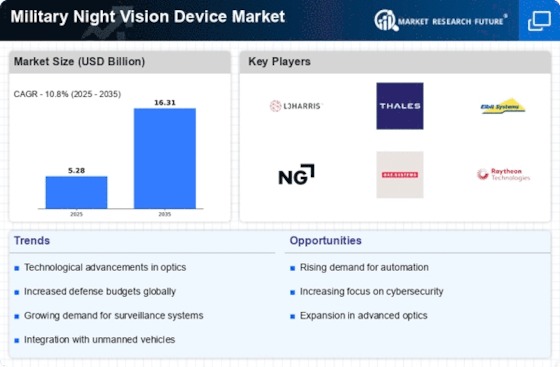
    As per MRFR analysis, the Military Night Vision Device Market was estimated at 5.279 USD Billion in 2024. The Military Night Vision Device industry is projected to grow from 5.849 USD Billion in 2025 to 16.31 USD Billion by 2035, exhibiting a compound annual growth rate (CAGR) of 10.8 during the forecast period 2025 - 2035.

    Key Market Trends & Highlights

    The Military Night Vision Device Market is poised for growth driven by technological advancements and increasing defense budgets.

    • Technological advancements are enhancing the capabilities of military night vision devices, leading to improved performance and functionality.
    • The market is witnessing a shift towards lightweight solutions, which are becoming increasingly preferred by military personnel for ease of use.
    • Integration and interoperability of night vision devices with other military systems are gaining traction, particularly in North America.
    • Rising geopolitical tensions and increasing defense budgets are major drivers propelling the demand for enhanced soldier capabilities, particularly in the goggles and thermal imaging segments.

    Market Size & Forecast

    2024 Market Size 5.279 (USD Billion)
    2035 Market Size 16.31 (USD Billion)
    CAGR (2025 - 2035) 10.8%
    Largest Regional Market Share in 2024 North America

    Major Players

    <p>L3Harris Technologies (US), Thales Group (FR), Elbit Systems (IL), Northrop Grumman (US), BAE Systems (GB), Raytheon Technologies (US), Leonardo S.p.A. (IT), Hensoldt (DE), Safran Electronics & Defense (FR)</p>

    Market Trends

    The Military Night Vision Device Market is currently experiencing a notable evolution, driven by advancements in technology and increasing defense budgets across various nations. The integration of cutting-edge features such as thermal imaging and augmented reality is enhancing the operational capabilities of military personnel. As global security concerns rise, the demand for sophisticated night vision systems is likely to escalate, prompting manufacturers to innovate and improve their offerings. Furthermore, the growing emphasis on modernization within armed forces is pushing for the adoption of more efficient and effective night vision solutions. In addition, the Military Night Vision Device Market is witnessing a shift towards lightweight and compact designs, which facilitate ease of use and mobility for soldiers in the field. This trend aligns with the broader movement towards enhancing soldier survivability and effectiveness in diverse combat scenarios. As nations invest in next-generation technologies, the market appears poised for substantial growth, with potential opportunities for collaboration between defense contractors and technology firms. The future landscape of this market may be characterized by increased competition and a focus on sustainability, as environmental considerations become more prominent in defense procurement strategies.

    Technological Advancements

    The Military Night Vision Device Market is increasingly influenced by rapid technological advancements. Innovations in sensor technology, image processing, and display systems are enhancing the performance and reliability of night vision devices. These improvements enable clearer images in low-light conditions, thereby increasing operational effectiveness for military personnel.

    Shift Towards Lightweight Solutions

    There is a discernible trend towards the development of lightweight and compact night vision devices. This shift is driven by the need for enhanced mobility and ease of use in various operational environments. Lighter equipment allows soldiers to carry essential gear without compromising their agility and effectiveness.

    Focus on Integration and Interoperability

    The Military Night Vision Device Market is seeing a growing emphasis on the integration of night vision systems with other military technologies. Enhanced interoperability between devices allows for improved situational awareness and coordination among troops. This trend suggests a move towards more comprehensive systems that can function seamlessly within a broader military framework.

    Military Night Vision Device Market Market Drivers

    Technological Innovations

    The Military Night Vision Device Market is witnessing rapid technological innovations that are reshaping the landscape of night vision capabilities. Advancements in sensor technology, image processing, and materials science are enabling the development of more efficient and effective night vision devices. For example, the integration of digital night vision technology with thermal imaging is enhancing the performance of these devices in various operational scenarios. The market is projected to grow as manufacturers invest in research and development to create next-generation night vision systems that offer improved resolution, range, and durability. This trend is likely to attract military organizations seeking to leverage cutting-edge technologies to enhance their operational effectiveness during nighttime missions.

    Increasing Defense Budgets

    The Military Night Vision Device Market is experiencing a notable surge due to increasing defense budgets across various nations. Governments are prioritizing modernization of their armed forces, which includes investing in advanced night vision technologies. For instance, countries such as the United States and India have allocated substantial portions of their defense budgets to enhance surveillance and reconnaissance capabilities. This trend is expected to continue, as nations recognize the strategic advantage provided by superior night vision systems. The global military expenditure is projected to reach unprecedented levels, further driving demand for innovative night vision devices. As a result, manufacturers are likely to focus on developing cutting-edge technologies that meet the evolving needs of military operations.

    Rising Geopolitical Tensions

    The Military Night Vision Device Market is significantly influenced by rising geopolitical tensions worldwide. As conflicts and territorial disputes escalate, military forces are compelled to enhance their operational readiness. Night vision devices play a crucial role in ensuring situational awareness during nighttime operations, which is increasingly vital in modern warfare. Countries facing security threats are likely to invest heavily in night vision technologies to maintain a tactical edge. This heightened focus on defense capabilities is expected to propel the market forward, as nations seek to equip their forces with advanced night vision systems that can operate effectively in diverse environments. The urgency to address security challenges may lead to accelerated procurement processes, further stimulating market growth.

    Focus on Counter-Terrorism Operations

    The Military Night Vision Device Market is significantly impacted by the focus on counter-terrorism operations. As nations confront the persistent threat of terrorism, military forces are increasingly deploying specialized units equipped with advanced night vision technologies. These devices are essential for conducting covert operations and surveillance in urban environments, where visibility is often compromised. The emphasis on counter-terrorism is likely to drive demand for night vision devices that offer superior performance in challenging conditions. As military strategies evolve to address asymmetric threats, the market for night vision technologies is expected to expand, with manufacturers responding to the specific needs of counter-terrorism units.

    Growing Demand for Enhanced Soldier Capabilities

    The Military Night Vision Device Market is driven by the growing demand for enhanced soldier capabilities on the battlefield. Modern military operations require soldiers to operate effectively in low-light conditions, necessitating the use of advanced night vision devices. As militaries around the world focus on improving the performance and survivability of their personnel, the demand for high-quality night vision systems is expected to rise. This trend is further supported by the increasing emphasis on soldier modernization programs, which aim to equip troops with state-of-the-art technologies. The market is likely to benefit from initiatives aimed at integrating night vision devices with other soldier systems, thereby enhancing overall operational effectiveness and situational awareness.

    Market Segment Insights

    Military Night Vision Device Device Type Insights

    <p>Military Night Vision Device Device Type Insights</p>

    <p>Based on Device Type, the Military Night Vision Device Market segmentation includes Goggles, Cameras, and Scope. The Scope segment dominated the market, and the expansion can be due to the military and defense industry's rising demand for night vision goggles. Additionally, it is anticipated that increased investment and R&amp;D efforts to improve night vision devices will fuel the market that has enhanced Military Night Vision Device market CAGR across the globe in recent years.</p>

    Military Night Vision Device Technology Insights

    <p>Military Night Vision Device Technology Insights</p>

    <p>The Military Night Vision Device Market segmentation based on technology includes image intensifiers, thermal imaging , and infrared illumination. The image intensifiers segment held the majority share in 2022 concerning the Military Night Vision Device Market revenue. The main benefit of image intensifiers in medical imaging is the synergy of the high detector and conversion efficiency to efficiently use fluoroscopy while adhering to the radiation protection principle of dose optimization.</p>

    <p>Figure 1: Military Night Vision Device Market by Technology, 2022 &amp; 2030 (USD billion)</p>

    Military Night Vision Device Application Insights

    <p>Military Night Vision Device Application Insights</p>

    <p>Based on the application, the Military Night Vision Device Market data includes surveillance, navigation, targeting, and others. The surveillance category generated the most income. The growth is attributable to the rise in demand for equipment for night vision security, IR illumination, and wide-angle surveillance radar implants for Military Night Vision Devices, positively impacting the market growth.</p>

    Get more detailed insights about Military Night Vision Device Market Research Report - Global Forecast to 2035

    Regional Insights

    North America : Defense Innovation Leader

    North America is the largest market for military night vision devices, holding approximately 45% of the global share. The region's growth is driven by increasing defense budgets, technological advancements, and a focus on modernization of military equipment. Regulatory support from government initiatives and partnerships with defense contractors further catalyze market expansion. The U.S. Department of Defense's emphasis on enhancing situational awareness is a key demand driver. The United States is the leading country in this sector, with major players like L3Harris Technologies, Northrop Grumman, and Raytheon Technologies dominating the landscape. Canada also contributes to the market, albeit to a lesser extent. The competitive environment is characterized by continuous innovation and collaboration among key players, ensuring that North America remains at the forefront of military night vision technology.

    Europe : Emerging Defense Market

    Europe is witnessing significant growth in the military night vision device market, accounting for approximately 30% of the global share. The demand is fueled by rising geopolitical tensions and the need for enhanced surveillance capabilities. Regulatory frameworks, such as the European Defense Fund, are encouraging investment in advanced technologies, thereby driving market expansion. Countries are increasingly prioritizing defense spending to modernize their military capabilities. Leading countries in this region include the United Kingdom, France, and Germany, with key players like Thales Group and BAE Systems making substantial contributions. The competitive landscape is marked by collaborations and partnerships aimed at developing cutting-edge technologies. The presence of established defense contractors ensures a robust supply chain and innovation pipeline, positioning Europe as a vital player in the military night vision market.

    Asia-Pacific : Rapidly Growing Defense Sector

    Asia-Pacific is emerging as a significant player in the military night vision device market, holding around 20% of the global share. The region's growth is driven by increasing defense budgets, modernization efforts, and rising security concerns. Countries like India and China are investing heavily in advanced military technologies, supported by government initiatives aimed at enhancing national security. The demand for night vision devices is expected to rise as military forces seek to improve operational effectiveness. Key players in this region include Elbit Systems and Hensoldt, which are actively involved in developing innovative solutions tailored to regional needs. The competitive landscape is evolving, with local manufacturers also entering the market, thereby increasing competition. The presence of established defense contractors and a growing focus on indigenous production are shaping the future of the night vision device market in Asia-Pacific.

    Middle East and Africa : Strategic Defense Investments

    The Middle East and Africa region is gradually expanding its military night vision device market, accounting for approximately 5% of the global share. The growth is driven by increasing defense expenditures and the need for enhanced surveillance and reconnaissance capabilities. Countries in this region are investing in modernizing their military forces, influenced by geopolitical tensions and security challenges. Regulatory support from governments is also fostering market growth. Leading countries include the United Arab Emirates and South Africa, with key players like Safran Electronics & Defense contributing to the market. The competitive landscape is characterized by partnerships and collaborations aimed at enhancing technological capabilities. As regional defense forces seek to improve their operational readiness, the demand for advanced night vision devices is expected to rise significantly.

    Key Players and Competitive Insights

    Leading market players are investing heavily in research and development to expand their product lines, which will help the Military Night Vision Device market grow even more. Market participants are also undertaking various strategic activities to expand their Global footprint, with important market developments including new product launches, contractual agreements, mergers and acquisitions, higher investments, and collaboration with other organizations. To expand and survive in a more competitive and rising market climate, the Military Night Vision Device industry must offer cost-effective items.

    Manufacturing locally to minimize operational costs is one of the key business tactics manufacturers use in the Global Military Night Vision Device industry to benefit clients and increase the market sector. The Military Night Vision Device industry has recently offered some of the most significant medical advantages.

    Major players in the Military Night Vision Device market, including American Technologies Network Corp. (US), Collins Aerospace (US), Meopta Optica S.R.O (Czech Republic), L3 Technologies Inc. (US), Harris Corporation (US), FLIR Systems Inc. (US), BAE Systems plc (UK), Bharat Electronics Limited (India), Thales Group (France), Elbit Systems Ltd. (Israel) and others, are attempting to increase market demand by investing in research and development operations.

    Recent Development News for Military Night Vision Device Market

    November 2024: ICARUS Devices, or the Institute of Combat Aviation and Research in the United States, is proud to announce that the U.S. Army has issued a release about the Airworthiness of its Night Vision Goggle Visor. The Instrument Conditions Awareness Recognition and Understanding System (ICARUS), constituting smart view-restricting devices incorporated by instructor pilots, enables the compilation of degraded visual environment (DVE) simulation images in aircraft. ICARUS NVG visor is conveniently small and lightweight (2.0 ounces), which is very crucial in aviation or when engaged in some quick fastening of something oriented towards the brain.

    The visor, on the other hand, uses 3D-printed rubber caps that do not want to be rigidly mounted but fit snuggly on the NVG tubes. The NVG visor has the same Polymer Dispersed Liquid Crystal film as used by the regular visor to switch from the transparent to the opaque states. There is also the same Power Control Unit and the App used on the visor.

    September 2024: What is brighter than sunshine is that the Bulgarian army will receive American portable anti-tank systems with Javelin-guided missiles. In accordance with a DSCA notice, this deal, which amounts to close to USD 114 million, involves the supply of 107 Javelin Lightweight Command Launch Units [LWCLU] and 218 Javelin FGM-148F missiles. In addition, the order includes a number of other training devices, coolants, integration, launching and maintenance services like Javelin LWCLU Basic Skills Trainers [BST], Javelin Outdoor Trainers [JOT], Battery Coolant Units [BCUs], System Integration and Checkout [SICO] and other lifecycle services.

    With this huge order, Bulgaria becomes the next in line to avail its access to the sophisticated American Javelin systems. These will mark the first purchase of such technology by Bulgaria, making it newer to the circles of countries operating these systems. It is always wise to train the Bulgarian army to ensure a timely and seamless transition towards using such advanced technologies.

    Collins Aerospace (US), To reduce maintenance, we are developing structures that are lighter in weight and more efficient. With more autonomous operations, we're reducing the workload on our pilots. For a best-in-class cabin experience, we're fusing cutting-edge technology with contemporary design. We're transforming how data is used to uncover insightful knowledge that enhances passenger experiences and airline and airport operations. We supply more digital systems for the interconnected airspace and battlespace to support quicker decision-making and increase mission effectiveness. While accelerating technological progress and embracing digital transformation, we are advancing more environmentally friendly practices and products.

    In a world that is changing quickly and becoming more complex, L3Harris is using agile technology to anticipate problems and respond quickly, making the world safer and the future more secure. With quick, cutting-edge fixes that a disruptive prime can only provide, we're strengthening our trusted position as the defense sector's leading merchant supplier and our customers' positions.

    Key Companies in the Military Night Vision Device Market market include

    Industry Developments

    November 2024: ICARUS Devices, or the Institute of Combat Aviation and Research in the United States, is proud to announce that the U.S. Army has issued a release about the Airworthiness of its Night Vision Goggle Visor. The Instrument Conditions Awareness Recognition and Understanding System (ICARUS), constituting smart view-restricting devices incorporated by instructor pilots, enables the compilation of degraded visual environment (DVE) simulation images in aircraft. ICARUS NVG visor is conveniently small and lightweight (2.0 ounces), which is very crucial in aviation or when engaged in some quick fastening of something oriented towards the brain.

    The visor, on the other hand, uses 3D-printed rubber caps that do not want to be rigidly mounted but fit snuggly on the NVG tubes. The NVG visor has the same Polymer Dispersed Liquid Crystal film as used by the regular visor to switch from the transparent to the opaque states. There is also the same Power Control Unit and the App used on the visor.

    September 2024: What is brighter than sunshine is that the Bulgarian army will receive American portable anti-tank systems with Javelin-guided missiles. In accordance with a DSCA notice, this deal, which amounts to close to USD 114 million, involves the supply of 107 Javelin Lightweight Command Launch Units [LWCLU] and 218 Javelin FGM-148F missiles. In addition, the order includes a number of other training devices, coolants, integration, launching and maintenance services like Javelin LWCLU Basic Skills Trainers [BST], Javelin Outdoor Trainers [JOT], Battery Coolant Units [BCUs], System Integration and Checkout [SICO] and other lifecycle services.

    With this huge order, Bulgaria becomes the next in line to avail its access to the sophisticated American Javelin systems. These will mark the first purchase of such technology by Bulgaria, making it newer to the circles of countries operating these systems. It is always wise to train the Bulgarian army to ensure a timely and seamless transition towards using such advanced technologies.

    Collins Aerospace (US), To reduce maintenance, we are developing structures that are lighter in weight and more efficient. With more autonomous operations, we're reducing the workload on our pilots. For a best-in-class cabin experience, we're fusing cutting-edge technology with contemporary design. We're transforming how data is used to uncover insightful knowledge that enhances passenger experiences and airline and airport operations. We supply more digital systems for the interconnected airspace and battlespace to support quicker decision-making and increase mission effectiveness. While accelerating technological progress and embracing digital transformation, we are advancing more environmentally friendly practices and products.

    In a world that is changing quickly and becoming more complex, L3Harris is using agile technology to anticipate problems and respond quickly, making the world safer and the future more secure. With quick, cutting-edge fixes that a disruptive prime can only provide, we're strengthening our trusted position as the defense sector's leading merchant supplier and our customers' positions.

    Key Companies in the Military Night Vision Device market include

    • American Technologies Network Corp. (US)
    • Collins Aerospace (US)
    • Meopta Optica S.R.O (Czech Republic)
    • L3 Technologies Inc. (US)
    • Harris Corporation (US)
    • FLIR Systems Inc. (US)
    • BAE Systems plc (UK)
    • Bharat Electronics Limited (India)
    • Thales Group (France)
    • Elbit Systems Ltd. (Israel)

    Military Night Vision Device Industry Developments

    For instance,August 2021 the 27-inch ShadowSense touchscreen technology was unveiled by Canadian technology company Baanto International for the armed forces. This touchscreen complies with Night Vision Imaging Systems (NVIS) requirements, enabling mission deployment regardless of the amount of incoming light.

    For instance,September 2022 Thales unveiled XTRAIM, a new weapon sight, in December 2021. It offers day/night de-camouflage capabilities that were previously only possible by using a variety of other pieces of equipment. Its compatibility with all shoulder-fired assault rifles (HK416) and light machine guns (Minimi) enables its users to fire accurately at night.

    For instance,January 2021 A new night vision camera from Ulefone will be released in May 2021. It can be worn as a body camera that can be quickly attached to your jacket, belt, back pocket, etc., with the aid of the incredibly portable gadget that serves as a smartphone add-on. The night vision camera's Sony STARVIS IMX307 incredibly light-sensitive CMOS image sensor is ideal for low-light, night, and videography photography.

    For instance,July 2022 The US Army and L3Harris Technologies, Inc. will collaborate in September 2021. a $100 million agreement was reached to deliver ENVG-B (enhanced night vision goggle-binocular) systems. With the aid of these integrated devices, the soldiers can more effectively target, engage, and neutralize threats without running the risk of being seen.

    Future Outlook

    Military Night Vision Device Market Future Outlook

    <p>The Military Night Vision Device Market is projected to grow at a 10.8% CAGR from 2024 to 2035, driven by technological advancements, increased defense budgets, and rising demand for enhanced situational awareness.</p>

    New opportunities lie in:

    • <p>Development of advanced thermal imaging systems for improved night operations.</p>
    • <p>Integration of AI-driven analytics for real-time battlefield insights.</p>
    • <p>Expansion into emerging markets with tailored night vision solutions.</p>

    <p>By 2035, the Military Night Vision Device Market is expected to be robust, reflecting substantial growth and innovation.</p>

    Market Segmentation

    Military Night Vision Device Device Type Outlook

    • Goggle
    • Camera
    • Scope
    • Image Intensifier
    • Thermal Imaging
    • Infrared Illumination
    • Surveillance
    • Navigation
    • Targeting
    • Others
    • North America
    • US
    • Canada
    • Europe
    • Germany
    • France
    • UK
    • Italy
    • Spain
    • Rest of Europe
    • Asia-Pacific
    • China
    • Japan
    • India
    • Australia
    • South Korea
    • Rest of Asia-Pacific
    • Rest of the World
    • Middle East
    • Africa
    • Latin America

    Report Scope

    MARKET SIZE 20245.279(USD Billion)
    MARKET SIZE 20255.849(USD Billion)
    MARKET SIZE 203516.31(USD Billion)
    COMPOUND ANNUAL GROWTH RATE (CAGR)10.8% (2024 - 2035)
    REPORT COVERAGERevenue Forecast, Competitive Landscape, Growth Factors, and Trends
    BASE YEAR2024
    Market Forecast Period2025 - 2035
    Historical Data2019 - 2024
    Market Forecast UnitsUSD Billion
    Key Companies ProfiledMarket analysis in progress
    Segments CoveredMarket segmentation analysis in progress
    Key Market OpportunitiesIntegration of advanced sensor technologies enhances operational capabilities in the Military Night Vision Device Market.
    Key Market DynamicsTechnological advancements drive competition in the Military Night Vision Device Market, enhancing operational capabilities and performance.
    Countries CoveredNorth America, Europe, APAC, South America, MEA

    FAQs

    How much is the military night vision device market?

    The Military Night Vision Device Market size was valued at USD 4.3 Billion in 2022.

    What is the growth rate of the military night vision device market?

    The global market is projected to grow at a CAGR of 10.80% during the forecast period, 2023-2030.

    Which region held the largest military night vision device market share?

    North America had the largest share of the global market

    Who are the key players in the military night vision device market?

    The key players in the market are American Technologies Network Corp. (US), Collins Aerospace (US), Meopta Optica S.R.O (Czech Republic), L3 Technologies Inc. (US), Harris Corporation (US), FLIR Systems Inc. (US), BAE Systems plc (UK), Bharat Electronics Limited (India), Thales Group (France), Elbit Systems Ltd. (Israel).

    Which application led the military night vision device market?

    The Surveillance category dominated the market in 2022.

    Which transportation had the largest military night vision device market share?

    The Image Intensifier channel had the largest share of the global market.

    1. SECTION I: EXECUTIVE SUMMARY AND KEY HIGHLIGHTS
      1. | 1.1 EXECUTIVE SUMMARY
      2. | | 1.1.1 Market Overview
      3. | | 1.1.2 Key Findings
      4. | | 1.1.3 Market Segmentation
      5. | | 1.1.4 Competitive Landscape
      6. | | 1.1.5 Challenges and Opportunities
      7. | | 1.1.6 Future Outlook
    2. SECTION II: SCOPING, METHODOLOGY AND MARKET STRUCTURE
      1. | 2.1 MARKET INTRODUCTION
      2. | | 2.1.1 Definition
      3. | | 2.1.2 Scope of the study
      4. | | | 2.1.2.1 Research Objective
      5. | | | 2.1.2.2 Assumption
      6. | | | 2.1.2.3 Limitations
      7. | 2.2 RESEARCH METHODOLOGY
      8. | | 2.2.1 Overview
      9. | | 2.2.2 Data Mining
      10. | | 2.2.3 Secondary Research
      11. | | 2.2.4 Primary Research
      12. | | | 2.2.4.1 Primary Interviews and Information Gathering Process
      13. | | | 2.2.4.2 Breakdown of Primary Respondents
      14. | | 2.2.5 Forecasting Model
      15. | | 2.2.6 Market Size Estimation
      16. | | | 2.2.6.1 Bottom-Up Approach
      17. | | | 2.2.6.2 Top-Down Approach
      18. | | 2.2.7 Data Triangulation
      19. | | 2.2.8 Validation
    3. SECTION III: QUALITATIVE ANALYSIS
      1. | 3.1 MARKET DYNAMICS
      2. | | 3.1.1 Overview
      3. | | 3.1.2 Drivers
      4. | | 3.1.3 Restraints
      5. | | 3.1.4 Opportunities
      6. | 3.2 MARKET FACTOR ANALYSIS
      7. | | 3.2.1 Value chain Analysis
      8. | | 3.2.2 Porter's Five Forces Analysis
      9. | | | 3.2.2.1 Bargaining Power of Suppliers
      10. | | | 3.2.2.2 Bargaining Power of Buyers
      11. | | | 3.2.2.3 Threat of New Entrants
      12. | | | 3.2.2.4 Threat of Substitutes
      13. | | | 3.2.2.5 Intensity of Rivalry
      14. | | 3.2.3 COVID-19 Impact Analysis
      15. | | | 3.2.3.1 Market Impact Analysis
      16. | | | 3.2.3.2 Regional Impact
      17. | | | 3.2.3.3 Opportunity and Threat Analysis
    4. SECTION IV: QUANTITATIVE ANALYSIS
      1. | 4.1 Aerospace & Defense, BY Device Type (USD Billion)
      2. | | 4.1.1 Goggles
      3. | | 4.1.2 Cameras
      4. | | 4.1.3 Scope
      5. | 4.2 Aerospace & Defense, BY Technology (USD Billion)
      6. | | 4.2.1 Image Intensifiers
      7. | | 4.2.2 Thermal Imaging
      8. | | 4.2.3 Infrared Illumination
      9. | 4.3 Aerospace & Defense, BY Application (USD Billion)
      10. | | 4.3.1 Surveillance
      11. | | 4.3.2 Navigation
      12. | | 4.3.3 Targeting
      13. | | 4.3.4 Others
      14. | 4.4 Aerospace & Defense, BY Region (USD Billion)
      15. | | 4.4.1 North America
      16. | | | 4.4.1.1 US
      17. | | | 4.4.1.2 Canada
      18. | | 4.4.2 Europe
      19. | | | 4.4.2.1 Germany
      20. | | | 4.4.2.2 UK
      21. | | | 4.4.2.3 France
      22. | | | 4.4.2.4 Russia
      23. | | | 4.4.2.5 Italy
      24. | | | 4.4.2.6 Spain
      25. | | | 4.4.2.7 Rest of Europe
      26. | | 4.4.3 APAC
      27. | | | 4.4.3.1 China
      28. | | | 4.4.3.2 India
      29. | | | 4.4.3.3 Japan
      30. | | | 4.4.3.4 South Korea
      31. | | | 4.4.3.5 Malaysia
      32. | | | 4.4.3.6 Thailand
      33. | | | 4.4.3.7 Indonesia
      34. | | | 4.4.3.8 Rest of APAC
      35. | | 4.4.4 South America
      36. | | | 4.4.4.1 Brazil
      37. | | | 4.4.4.2 Mexico
      38. | | | 4.4.4.3 Argentina
      39. | | | 4.4.4.4 Rest of South America
      40. | | 4.4.5 MEA
      41. | | | 4.4.5.1 GCC Countries
      42. | | | 4.4.5.2 South Africa
      43. | | | 4.4.5.3 Rest of MEA
    5. SECTION V: COMPETITIVE ANALYSIS
      1. | 5.1 Competitive Landscape
      2. | | 5.1.1 Overview
      3. | | 5.1.2 Competitive Analysis
      4. | | 5.1.3 Market share Analysis
      5. | | 5.1.4 Major Growth Strategy in the Aerospace & Defense
      6. | | 5.1.5 Competitive Benchmarking
      7. | | 5.1.6 Leading Players in Terms of Number of Developments in the Aerospace & Defense
      8. | | 5.1.7 Key developments and growth strategies
      9. | | | 5.1.7.1 New Product Launch/Service Deployment
      10. | | | 5.1.7.2 Merger & Acquisitions
      11. | | | 5.1.7.3 Joint Ventures
      12. | | 5.1.8 Major Players Financial Matrix
      13. | | | 5.1.8.1 Sales and Operating Income
      14. | | | 5.1.8.2 Major Players R&D Expenditure. 2023
      15. | 5.2 Company Profiles
      16. | | 5.2.1 L3Harris Technologies (US)
      17. | | | 5.2.1.1 Financial Overview
      18. | | | 5.2.1.2 Products Offered
      19. | | | 5.2.1.3 Key Developments
      20. | | | 5.2.1.4 SWOT Analysis
      21. | | | 5.2.1.5 Key Strategies
      22. | | 5.2.2 Thales Group (FR)
      23. | | | 5.2.2.1 Financial Overview
      24. | | | 5.2.2.2 Products Offered
      25. | | | 5.2.2.3 Key Developments
      26. | | | 5.2.2.4 SWOT Analysis
      27. | | | 5.2.2.5 Key Strategies
      28. | | 5.2.3 Elbit Systems (IL)
      29. | | | 5.2.3.1 Financial Overview
      30. | | | 5.2.3.2 Products Offered
      31. | | | 5.2.3.3 Key Developments
      32. | | | 5.2.3.4 SWOT Analysis
      33. | | | 5.2.3.5 Key Strategies
      34. | | 5.2.4 Northrop Grumman (US)
      35. | | | 5.2.4.1 Financial Overview
      36. | | | 5.2.4.2 Products Offered
      37. | | | 5.2.4.3 Key Developments
      38. | | | 5.2.4.4 SWOT Analysis
      39. | | | 5.2.4.5 Key Strategies
      40. | | 5.2.5 BAE Systems (GB)
      41. | | | 5.2.5.1 Financial Overview
      42. | | | 5.2.5.2 Products Offered
      43. | | | 5.2.5.3 Key Developments
      44. | | | 5.2.5.4 SWOT Analysis
      45. | | | 5.2.5.5 Key Strategies
      46. | | 5.2.6 Raytheon Technologies (US)
      47. | | | 5.2.6.1 Financial Overview
      48. | | | 5.2.6.2 Products Offered
      49. | | | 5.2.6.3 Key Developments
      50. | | | 5.2.6.4 SWOT Analysis
      51. | | | 5.2.6.5 Key Strategies
      52. | | 5.2.7 Leonardo S.p.A. (IT)
      53. | | | 5.2.7.1 Financial Overview
      54. | | | 5.2.7.2 Products Offered
      55. | | | 5.2.7.3 Key Developments
      56. | | | 5.2.7.4 SWOT Analysis
      57. | | | 5.2.7.5 Key Strategies
      58. | | 5.2.8 Hensoldt (DE)
      59. | | | 5.2.8.1 Financial Overview
      60. | | | 5.2.8.2 Products Offered
      61. | | | 5.2.8.3 Key Developments
      62. | | | 5.2.8.4 SWOT Analysis
      63. | | | 5.2.8.5 Key Strategies
      64. | | 5.2.9 Safran Electronics & Defense (FR)
      65. | | | 5.2.9.1 Financial Overview
      66. | | | 5.2.9.2 Products Offered
      67. | | | 5.2.9.3 Key Developments
      68. | | | 5.2.9.4 SWOT Analysis
      69. | | | 5.2.9.5 Key Strategies
      70. | 5.3 Appendix
      71. | | 5.3.1 References
      72. | | 5.3.2 Related Reports
    6. LIST OF FIGURES
      1. | 6.1 MARKET SYNOPSIS
      2. | 6.2 NORTH AMERICA MARKET ANALYSIS
      3. | 6.3 US MARKET ANALYSIS BY DEVICE TYPE
      4. | 6.4 US MARKET ANALYSIS BY TECHNOLOGY
      5. | 6.5 US MARKET ANALYSIS BY APPLICATION
      6. | 6.6 CANADA MARKET ANALYSIS BY DEVICE TYPE
      7. | 6.7 CANADA MARKET ANALYSIS BY TECHNOLOGY
      8. | 6.8 CANADA MARKET ANALYSIS BY APPLICATION
      9. | 6.9 EUROPE MARKET ANALYSIS
      10. | 6.10 GERMANY MARKET ANALYSIS BY DEVICE TYPE
      11. | 6.11 GERMANY MARKET ANALYSIS BY TECHNOLOGY
      12. | 6.12 GERMANY MARKET ANALYSIS BY APPLICATION
      13. | 6.13 UK MARKET ANALYSIS BY DEVICE TYPE
      14. | 6.14 UK MARKET ANALYSIS BY TECHNOLOGY
      15. | 6.15 UK MARKET ANALYSIS BY APPLICATION
      16. | 6.16 FRANCE MARKET ANALYSIS BY DEVICE TYPE
      17. | 6.17 FRANCE MARKET ANALYSIS BY TECHNOLOGY
      18. | 6.18 FRANCE MARKET ANALYSIS BY APPLICATION
      19. | 6.19 RUSSIA MARKET ANALYSIS BY DEVICE TYPE
      20. | 6.20 RUSSIA MARKET ANALYSIS BY TECHNOLOGY
      21. | 6.21 RUSSIA MARKET ANALYSIS BY APPLICATION
      22. | 6.22 ITALY MARKET ANALYSIS BY DEVICE TYPE
      23. | 6.23 ITALY MARKET ANALYSIS BY TECHNOLOGY
      24. | 6.24 ITALY MARKET ANALYSIS BY APPLICATION
      25. | 6.25 SPAIN MARKET ANALYSIS BY DEVICE TYPE
      26. | 6.26 SPAIN MARKET ANALYSIS BY TECHNOLOGY
      27. | 6.27 SPAIN MARKET ANALYSIS BY APPLICATION
      28. | 6.28 REST OF EUROPE MARKET ANALYSIS BY DEVICE TYPE
      29. | 6.29 REST OF EUROPE MARKET ANALYSIS BY TECHNOLOGY
      30. | 6.30 REST OF EUROPE MARKET ANALYSIS BY APPLICATION
      31. | 6.31 APAC MARKET ANALYSIS
      32. | 6.32 CHINA MARKET ANALYSIS BY DEVICE TYPE
      33. | 6.33 CHINA MARKET ANALYSIS BY TECHNOLOGY
      34. | 6.34 CHINA MARKET ANALYSIS BY APPLICATION
      35. | 6.35 INDIA MARKET ANALYSIS BY DEVICE TYPE
      36. | 6.36 INDIA MARKET ANALYSIS BY TECHNOLOGY
      37. | 6.37 INDIA MARKET ANALYSIS BY APPLICATION
      38. | 6.38 JAPAN MARKET ANALYSIS BY DEVICE TYPE
      39. | 6.39 JAPAN MARKET ANALYSIS BY TECHNOLOGY
      40. | 6.40 JAPAN MARKET ANALYSIS BY APPLICATION
      41. | 6.41 SOUTH KOREA MARKET ANALYSIS BY DEVICE TYPE
      42. | 6.42 SOUTH KOREA MARKET ANALYSIS BY TECHNOLOGY
      43. | 6.43 SOUTH KOREA MARKET ANALYSIS BY APPLICATION
      44. | 6.44 MALAYSIA MARKET ANALYSIS BY DEVICE TYPE
      45. | 6.45 MALAYSIA MARKET ANALYSIS BY TECHNOLOGY
      46. | 6.46 MALAYSIA MARKET ANALYSIS BY APPLICATION
      47. | 6.47 THAILAND MARKET ANALYSIS BY DEVICE TYPE
      48. | 6.48 THAILAND MARKET ANALYSIS BY TECHNOLOGY
      49. | 6.49 THAILAND MARKET ANALYSIS BY APPLICATION
      50. | 6.50 INDONESIA MARKET ANALYSIS BY DEVICE TYPE
      51. | 6.51 INDONESIA MARKET ANALYSIS BY TECHNOLOGY
      52. | 6.52 INDONESIA MARKET ANALYSIS BY APPLICATION
      53. | 6.53 REST OF APAC MARKET ANALYSIS BY DEVICE TYPE
      54. | 6.54 REST OF APAC MARKET ANALYSIS BY TECHNOLOGY
      55. | 6.55 REST OF APAC MARKET ANALYSIS BY APPLICATION
      56. | 6.56 SOUTH AMERICA MARKET ANALYSIS
      57. | 6.57 BRAZIL MARKET ANALYSIS BY DEVICE TYPE
      58. | 6.58 BRAZIL MARKET ANALYSIS BY TECHNOLOGY
      59. | 6.59 BRAZIL MARKET ANALYSIS BY APPLICATION
      60. | 6.60 MEXICO MARKET ANALYSIS BY DEVICE TYPE
      61. | 6.61 MEXICO MARKET ANALYSIS BY TECHNOLOGY
      62. | 6.62 MEXICO MARKET ANALYSIS BY APPLICATION
      63. | 6.63 ARGENTINA MARKET ANALYSIS BY DEVICE TYPE
      64. | 6.64 ARGENTINA MARKET ANALYSIS BY TECHNOLOGY
      65. | 6.65 ARGENTINA MARKET ANALYSIS BY APPLICATION
      66. | 6.66 REST OF SOUTH AMERICA MARKET ANALYSIS BY DEVICE TYPE
      67. | 6.67 REST OF SOUTH AMERICA MARKET ANALYSIS BY TECHNOLOGY
      68. | 6.68 REST OF SOUTH AMERICA MARKET ANALYSIS BY APPLICATION
      69. | 6.69 MEA MARKET ANALYSIS
      70. | 6.70 GCC COUNTRIES MARKET ANALYSIS BY DEVICE TYPE
      71. | 6.71 GCC COUNTRIES MARKET ANALYSIS BY TECHNOLOGY
      72. | 6.72 GCC COUNTRIES MARKET ANALYSIS BY APPLICATION
      73. | 6.73 SOUTH AFRICA MARKET ANALYSIS BY DEVICE TYPE
      74. | 6.74 SOUTH AFRICA MARKET ANALYSIS BY TECHNOLOGY
      75. | 6.75 SOUTH AFRICA MARKET ANALYSIS BY APPLICATION
      76. | 6.76 REST OF MEA MARKET ANALYSIS BY DEVICE TYPE
      77. | 6.77 REST OF MEA MARKET ANALYSIS BY TECHNOLOGY
      78. | 6.78 REST OF MEA MARKET ANALYSIS BY APPLICATION
      79. | 6.79 KEY BUYING CRITERIA OF AEROSPACE & DEFENSE
      80. | 6.80 RESEARCH PROCESS OF MRFR
      81. | 6.81 DRO ANALYSIS OF AEROSPACE & DEFENSE
      82. | 6.82 DRIVERS IMPACT ANALYSIS: AEROSPACE & DEFENSE
      83. | 6.83 RESTRAINTS IMPACT ANALYSIS: AEROSPACE & DEFENSE
      84. | 6.84 SUPPLY / VALUE CHAIN: AEROSPACE & DEFENSE
      85. | 6.85 AEROSPACE & DEFENSE, BY DEVICE TYPE, 2024 (% SHARE)
      86. | 6.86 AEROSPACE & DEFENSE, BY DEVICE TYPE, 2024 TO 2035 (USD Billion)
      87. | 6.87 AEROSPACE & DEFENSE, BY TECHNOLOGY, 2024 (% SHARE)
      88. | 6.88 AEROSPACE & DEFENSE, BY TECHNOLOGY, 2024 TO 2035 (USD Billion)
      89. | 6.89 AEROSPACE & DEFENSE, BY APPLICATION, 2024 (% SHARE)
      90. | 6.90 AEROSPACE & DEFENSE, BY APPLICATION, 2024 TO 2035 (USD Billion)
      91. | 6.91 BENCHMARKING OF MAJOR COMPETITORS
    7. LIST OF TABLES
      1. | 7.1 LIST OF ASSUMPTIONS
      2. | | 7.1.1
      3. | 7.2 North America MARKET SIZE ESTIMATES; FORECAST
      4. | | 7.2.1 BY DEVICE TYPE, 2025-2035 (USD Billion)
      5. | | 7.2.2 BY TECHNOLOGY, 2025-2035 (USD Billion)
      6. | | 7.2.3 BY APPLICATION, 2025-2035 (USD Billion)
      7. | 7.3 US MARKET SIZE ESTIMATES; FORECAST
      8. | | 7.3.1 BY DEVICE TYPE, 2025-2035 (USD Billion)
      9. | | 7.3.2 BY TECHNOLOGY, 2025-2035 (USD Billion)
      10. | | 7.3.3 BY APPLICATION, 2025-2035 (USD Billion)
      11. | 7.4 Canada MARKET SIZE ESTIMATES; FORECAST
      12. | | 7.4.1 BY DEVICE TYPE, 2025-2035 (USD Billion)
      13. | | 7.4.2 BY TECHNOLOGY, 2025-2035 (USD Billion)
      14. | | 7.4.3 BY APPLICATION, 2025-2035 (USD Billion)
      15. | 7.5 Europe MARKET SIZE ESTIMATES; FORECAST
      16. | | 7.5.1 BY DEVICE TYPE, 2025-2035 (USD Billion)
      17. | | 7.5.2 BY TECHNOLOGY, 2025-2035 (USD Billion)
      18. | | 7.5.3 BY APPLICATION, 2025-2035 (USD Billion)
      19. | 7.6 Germany MARKET SIZE ESTIMATES; FORECAST
      20. | | 7.6.1 BY DEVICE TYPE, 2025-2035 (USD Billion)
      21. | | 7.6.2 BY TECHNOLOGY, 2025-2035 (USD Billion)
      22. | | 7.6.3 BY APPLICATION, 2025-2035 (USD Billion)
      23. | 7.7 UK MARKET SIZE ESTIMATES; FORECAST
      24. | | 7.7.1 BY DEVICE TYPE, 2025-2035 (USD Billion)
      25. | | 7.7.2 BY TECHNOLOGY, 2025-2035 (USD Billion)
      26. | | 7.7.3 BY APPLICATION, 2025-2035 (USD Billion)
      27. | 7.8 France MARKET SIZE ESTIMATES; FORECAST
      28. | | 7.8.1 BY DEVICE TYPE, 2025-2035 (USD Billion)
      29. | | 7.8.2 BY TECHNOLOGY, 2025-2035 (USD Billion)
      30. | | 7.8.3 BY APPLICATION, 2025-2035 (USD Billion)
      31. | 7.9 Russia MARKET SIZE ESTIMATES; FORECAST
      32. | | 7.9.1 BY DEVICE TYPE, 2025-2035 (USD Billion)
      33. | | 7.9.2 BY TECHNOLOGY, 2025-2035 (USD Billion)
      34. | | 7.9.3 BY APPLICATION, 2025-2035 (USD Billion)
      35. | 7.10 Italy MARKET SIZE ESTIMATES; FORECAST
      36. | | 7.10.1 BY DEVICE TYPE, 2025-2035 (USD Billion)
      37. | | 7.10.2 BY TECHNOLOGY, 2025-2035 (USD Billion)
      38. | | 7.10.3 BY APPLICATION, 2025-2035 (USD Billion)
      39. | 7.11 Spain MARKET SIZE ESTIMATES; FORECAST
      40. | | 7.11.1 BY DEVICE TYPE, 2025-2035 (USD Billion)
      41. | | 7.11.2 BY TECHNOLOGY, 2025-2035 (USD Billion)
      42. | | 7.11.3 BY APPLICATION, 2025-2035 (USD Billion)
      43. | 7.12 Rest of Europe MARKET SIZE ESTIMATES; FORECAST
      44. | | 7.12.1 BY DEVICE TYPE, 2025-2035 (USD Billion)
      45. | | 7.12.2 BY TECHNOLOGY, 2025-2035 (USD Billion)
      46. | | 7.12.3 BY APPLICATION, 2025-2035 (USD Billion)
      47. | 7.13 APAC MARKET SIZE ESTIMATES; FORECAST
      48. | | 7.13.1 BY DEVICE TYPE, 2025-2035 (USD Billion)
      49. | | 7.13.2 BY TECHNOLOGY, 2025-2035 (USD Billion)
      50. | | 7.13.3 BY APPLICATION, 2025-2035 (USD Billion)
      51. | 7.14 China MARKET SIZE ESTIMATES; FORECAST
      52. | | 7.14.1 BY DEVICE TYPE, 2025-2035 (USD Billion)
      53. | | 7.14.2 BY TECHNOLOGY, 2025-2035 (USD Billion)
      54. | | 7.14.3 BY APPLICATION, 2025-2035 (USD Billion)
      55. | 7.15 India MARKET SIZE ESTIMATES; FORECAST
      56. | | 7.15.1 BY DEVICE TYPE, 2025-2035 (USD Billion)
      57. | | 7.15.2 BY TECHNOLOGY, 2025-2035 (USD Billion)
      58. | | 7.15.3 BY APPLICATION, 2025-2035 (USD Billion)
      59. | 7.16 Japan MARKET SIZE ESTIMATES; FORECAST
      60. | | 7.16.1 BY DEVICE TYPE, 2025-2035 (USD Billion)
      61. | | 7.16.2 BY TECHNOLOGY, 2025-2035 (USD Billion)
      62. | | 7.16.3 BY APPLICATION, 2025-2035 (USD Billion)
      63. | 7.17 South Korea MARKET SIZE ESTIMATES; FORECAST
      64. | | 7.17.1 BY DEVICE TYPE, 2025-2035 (USD Billion)
      65. | | 7.17.2 BY TECHNOLOGY, 2025-2035 (USD Billion)
      66. | | 7.17.3 BY APPLICATION, 2025-2035 (USD Billion)
      67. | 7.18 Malaysia MARKET SIZE ESTIMATES; FORECAST
      68. | | 7.18.1 BY DEVICE TYPE, 2025-2035 (USD Billion)
      69. | | 7.18.2 BY TECHNOLOGY, 2025-2035 (USD Billion)
      70. | | 7.18.3 BY APPLICATION, 2025-2035 (USD Billion)
      71. | 7.19 Thailand MARKET SIZE ESTIMATES; FORECAST
      72. | | 7.19.1 BY DEVICE TYPE, 2025-2035 (USD Billion)
      73. | | 7.19.2 BY TECHNOLOGY, 2025-2035 (USD Billion)
      74. | | 7.19.3 BY APPLICATION, 2025-2035 (USD Billion)
      75. | 7.20 Indonesia MARKET SIZE ESTIMATES; FORECAST
      76. | | 7.20.1 BY DEVICE TYPE, 2025-2035 (USD Billion)
      77. | | 7.20.2 BY TECHNOLOGY, 2025-2035 (USD Billion)
      78. | | 7.20.3 BY APPLICATION, 2025-2035 (USD Billion)
      79. | 7.21 Rest of APAC MARKET SIZE ESTIMATES; FORECAST
      80. | | 7.21.1 BY DEVICE TYPE, 2025-2035 (USD Billion)
      81. | | 7.21.2 BY TECHNOLOGY, 2025-2035 (USD Billion)
      82. | | 7.21.3 BY APPLICATION, 2025-2035 (USD Billion)
      83. | 7.22 South America MARKET SIZE ESTIMATES; FORECAST
      84. | | 7.22.1 BY DEVICE TYPE, 2025-2035 (USD Billion)
      85. | | 7.22.2 BY TECHNOLOGY, 2025-2035 (USD Billion)
      86. | | 7.22.3 BY APPLICATION, 2025-2035 (USD Billion)
      87. | 7.23 Brazil MARKET SIZE ESTIMATES; FORECAST
      88. | | 7.23.1 BY DEVICE TYPE, 2025-2035 (USD Billion)
      89. | | 7.23.2 BY TECHNOLOGY, 2025-2035 (USD Billion)
      90. | | 7.23.3 BY APPLICATION, 2025-2035 (USD Billion)
      91. | 7.24 Mexico MARKET SIZE ESTIMATES; FORECAST
      92. | | 7.24.1 BY DEVICE TYPE, 2025-2035 (USD Billion)
      93. | | 7.24.2 BY TECHNOLOGY, 2025-2035 (USD Billion)
      94. | | 7.24.3 BY APPLICATION, 2025-2035 (USD Billion)
      95. | 7.25 Argentina MARKET SIZE ESTIMATES; FORECAST
      96. | | 7.25.1 BY DEVICE TYPE, 2025-2035 (USD Billion)
      97. | | 7.25.2 BY TECHNOLOGY, 2025-2035 (USD Billion)
      98. | | 7.25.3 BY APPLICATION, 2025-2035 (USD Billion)
      99. | 7.26 Rest of South America MARKET SIZE ESTIMATES; FORECAST
      100. | | 7.26.1 BY DEVICE TYPE, 2025-2035 (USD Billion)
      101. | | 7.26.2 BY TECHNOLOGY, 2025-2035 (USD Billion)
      102. | | 7.26.3 BY APPLICATION, 2025-2035 (USD Billion)
      103. | 7.27 MEA MARKET SIZE ESTIMATES; FORECAST
      104. | | 7.27.1 BY DEVICE TYPE, 2025-2035 (USD Billion)
      105. | | 7.27.2 BY TECHNOLOGY, 2025-2035 (USD Billion)
      106. | | 7.27.3 BY APPLICATION, 2025-2035 (USD Billion)
      107. | 7.28 GCC Countries MARKET SIZE ESTIMATES; FORECAST
      108. | | 7.28.1 BY DEVICE TYPE, 2025-2035 (USD Billion)
      109. | | 7.28.2 BY TECHNOLOGY, 2025-2035 (USD Billion)
      110. | | 7.28.3 BY APPLICATION, 2025-2035 (USD Billion)
      111. | 7.29 South Africa MARKET SIZE ESTIMATES; FORECAST
      112. | | 7.29.1 BY DEVICE TYPE, 2025-2035 (USD Billion)
      113. | | 7.29.2 BY TECHNOLOGY, 2025-2035 (USD Billion)
      114. | | 7.29.3 BY APPLICATION, 2025-2035 (USD Billion)
      115. | 7.30 Rest of MEA MARKET SIZE ESTIMATES; FORECAST
      116. | | 7.30.1 BY DEVICE TYPE, 2025-2035 (USD Billion)
      117. | | 7.30.2 BY TECHNOLOGY, 2025-2035 (USD Billion)
      118. | | 7.30.3 BY APPLICATION, 2025-2035 (USD Billion)
      119. | 7.31 PRODUCT LAUNCH/PRODUCT DEVELOPMENT/APPROVAL
      120. | | 7.31.1
      121. | 7.32 ACQUISITION/PARTNERSHIP
      122. | | 7.32.1

    Military Night Vision Device Market Segmentation

    Market Segmentation Overview

    • Detailed segmentation data will be available in the full report
    • Comprehensive analysis by multiple parameters
    • Regional and country-level breakdowns
    • Market size forecasts by segment
    Infographic

    Free Sample Request

    Kindly complete the form below to receive a free sample of this Report

    Get Free Sample

    Customer Strories

    “I am very pleased with how market segments have been defined in a relevant way for my purposes (such as "Portable Freezers & refrigerators" and "last-mile"). In general the report is well structured. Thanks very much for your efforts.”

    Victoria Milne

    Founder
    Case Study
    Chemicals and Materials

    Compare Licence

    ×
    Features License Type
    Single User Multiuser License Enterprise User
    Price $4,950 $5,950 $7,250
    Maximum User Access Limit 1 User Upto 10 Users Unrestricted Access Throughout the Organization
    Free Customization
    Direct Access to Analyst
    Deliverable Format
    Platform Access
    Discount on Next Purchase 10% 15% 15%
    Printable Versions