
×
Request Free Sample ×

Kindly complete the form below to receive a free sample of this Report

* Please use a valid business email

Leading companies partner with us for data-driven Insights

clients tt-cursor
Hero Background
English
Chinese
French
Japanese
Korean
German
Spanish

Military IoT Market Trends

ID: MRFR/AD/6077-CR
136 Pages
Swapnil Palwe
October 2019

Military IoT Market Size, Share, Industry Trend & Analysis Research Report Information by Component (Hardware, Software and Services), Technology (Wi-Fi, Cellular, RFID and others), Application (Training and Simulation, Health Monitoring, Real-Time Fleet Management, Inventory Management, Equipment Maintenance and others) and Region (North America, Europe, Asia-Pacific, Middle East & Africa and Latin America) - Forecast till 2032

Share:
Download PDF ×

We do not share your information with anyone. However, we may send you emails based on your report interest from time to time. You may contact us at any time to opt-out.

Military IoT Market Infographic
Purchase Options

Market Trends

Key Emerging Trends in the Military IoT Market

The future of defense technology will be shaped by some significant trends currently seen within the military Internet of Things (IoT). The adoption of IOT technologies by various countries' military agencies is one such trend as they modernize their forces for effectiveness. One important thing driving this trend is a need for real-time data demand and connectivity during military operations." Another notable trend evident within the Military IoT sector is interoperability. As different types of devices and systems are being used together within defense forces, it becomes essential to ensure smooth communication between them." This problem can be resolved by allowing different IOT devices to use common communication protocols and platforms, hence facilitating their interoperability and making them work together seamlessly. Not only does this straightforward trend enhance general effectiveness in military operations; it also simplifies managing and maintaining integrated plants." Given that the sensitive nature of defense operations makes Cybersecurity a paramount concern in the Military IoT market?" Inevitably, however, with more connected devices, there are higher risks likely to arise from cyber threats vulnerability?" Artificial Intelligence (AI) helps shape what is called "future" military Internet-of-things." AI algorithms embedded into IOT devices allow for autonomous decision-making and enhance military systems' capabilities. The volume of data generated by IoT sensors can be processed using AI-driven analytics to generate insights and provide predictive analytics for mission planning and threat assessment. In this regard, it is possible to say that AI supplements and IoT improve efficiency in the areas of mission execution." One of the market trends worth mentioning here is the demand for miniaturized, lightweight IoT devices, which is driven by increased mobility and flexibility in military operations." Easy integration into different military platforms, including infantry equipment, vehicles, or UAVs, makes compact IoT sensors and devices useful?" Another emerging trend in the Military IoT market is sustainability and energy efficiency. However, as the deployment of IoT devices has increased on the ground, there has been a rising demand for sustainable power sources to support long-term operation without frequent battery changes. To conclude, today's Military IoT market has encountered significant rapid transformation due to important tendencies such as real-time connectivity, interoperability, Cybersecurity as well as AI integration, among others like miniaturization and sustainability.

Author
Swapnil Palwe
Team Lead - Research

With a technical background as Bachelor's in Mechanical Engineering, with MBA in Operations Management , Swapnil has 6+ years of experience in market research, consulting and analytics with the tasks of data mining, analysis, and project execution. He is the POC for our clients, for their consulting projects running under the Automotive/A&D domain. Swapnil has worked on major projects in verticals such as Aerospace & Defense, Automotive and many other domain projects. He has worked on projects for fortune 500 companies' syndicate and consulting projects along with several government projects.

Leave a Comment

FAQs

What is the projected market valuation of The Global Military IoT by 2035?

<p>The projected market valuation for The Global Military IoT by 2035 is 21,900.2 USD Billion.</p>

What was the market valuation of The Global Military IoT in 2024?

<p>The overall market valuation of The Global Military IoT in 2024 was 11,300.0 USD Billion.</p>

What is the expected CAGR for The Global Military IoT during the forecast period 2025 - 2035?

<p>The expected CAGR for The Global Military IoT during the forecast period 2025 - 2035 is 6.2%.</p>

Which companies are considered key players in The Global Military IoT?

<p>Key players in The Global Military IoT include Lockheed Martin, Northrop Grumman, Raytheon Technologies, Thales Group, BAE Systems, General Dynamics, Leonardo, Hewlett Packard Enterprise, and Cisco Systems.</p>

What are the main technology segments within The Global Military IoT?

<p>The main technology segments within The Global Military IoT include Wi-Fi, Cell, RFID, and Others, with valuations ranging from 2,260.0 to 13,900.2 USD Billion.</p>

What components are included in The Global Military IoT?

<p>The components of The Global Military IoT consist of Hardware, Software, and Services, with valuations between 3,300.0 and 10,000.0 USD Billion.</p>

What applications are driving growth in The Global Military IoT?

<p>Applications driving growth in The Global Military IoT include Training and Simulation, Health Monitoring, Real-time Fleet Management, Inventory Management, and Equipment Maintenance, with valuations from 1,200.0 to 14,500.2 USD Billion.</p>

How does The Global Military IoT's growth compare to other sectors?

<p>The Global Military IoT's growth appears robust, with a projected increase from 11,300.0 USD Billion in 2024 to 21,900.2 USD Billion by 2035.</p>

What role do companies like Raytheon Technologies play in The Global Military IoT?

<p>Companies like Raytheon Technologies play a pivotal role in The Global Military IoT by providing advanced technological solutions and innovations.</p>

What is the significance of the projected growth from 2025 to 2035 for The Global Military IoT?

<p>The projected growth from 2025 to 2035 indicates a strong demand for military IoT solutions, reflecting an increasing investment in defense technologies.</p>

Market Summary

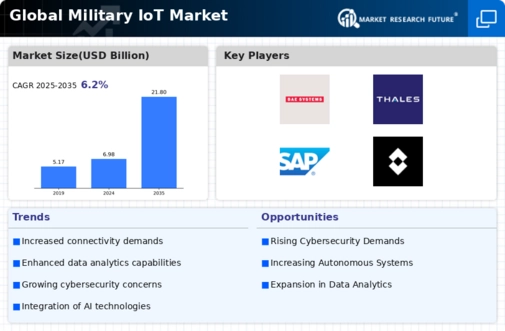
As per Market Research Future analysis, The Global Military IoT Market Size was estimated at 11300.0 USD Billion in 2024. The Military IoT industry is projected to grow from 12000.6 USD Billion in 2025 to 21900.2 USD Billion by 2035, exhibiting a compound annual growth rate (CAGR) of 6.2% during the forecast period 2025 - 2035

Key Market Trends & Highlights

The Global Military IoT Market is poised for substantial growth driven by technological advancements and increasing demand for enhanced operational capabilities.

  • North America remains the largest market for Military IoT Market, driven by significant defense budgets and technological investments.
  • The Asia-Pacific region is emerging as the fastest-growing market, fueled by rising military modernization efforts and regional security concerns.
  • The Wi-Fi segment continues to dominate the market, while the cellular segment is experiencing rapid growth due to advancements in mobile connectivity.
  • Enhanced operational efficiency and improved situational awareness are key drivers propelling the adoption of Military IoT Market solutions.

Market Size & Forecast

2024 Market Size 11300.0 (USD Billion)
2035 Market Size 21900.2 (USD Billion)
CAGR (2025 - 2035) 6.2%
Largest Regional Market Share in 2024 North America

Major Players

Lockheed Martin (US), Northrop Grumman (US), Raytheon Technologies (US), Thales Group (FR), BAE Systems (GB), General Dynamics (US), Leonardo (IT), Hewlett Packard Enterprise (US), Cisco Systems (US)

Market Trends

The Global Military IoT is currently experiencing a transformative phase, driven by advancements in technology and the increasing need for enhanced operational efficiency. Military organizations worldwide are integrating Internet of Things (IoT) solutions to improve communication, data collection, and real-time decision-making. This integration appears to facilitate better situational awareness and resource management, which are crucial for modern defense strategies. As nations invest in smart technologies, the demand for interconnected devices and systems is likely to rise, leading to a more cohesive and responsive military infrastructure. Moreover, the emphasis on cybersecurity within The Global Military IoT cannot be overstated. As military operations become increasingly reliant on digital networks, the potential vulnerabilities associated with IoT devices pose significant risks. Consequently, defense agencies are prioritizing the development of robust security measures to protect sensitive information and maintain operational integrity. This focus on security may drive innovation in the sector, as companies strive to create solutions that not only enhance functionality but also safeguard against cyber threats. Overall, The Global Military IoT is poised for substantial growth, characterized by a blend of technological advancement and heightened security awareness.

Increased Interconnectivity

The trend towards greater interconnectivity among military assets is becoming more pronounced. This interconnectedness allows for seamless communication between various platforms, enhancing operational efficiency and coordination during missions.

Focus on Cybersecurity

As military operations increasingly depend on IoT technologies, the emphasis on cybersecurity is intensifying. Defense organizations are prioritizing the development of advanced security protocols to protect sensitive data and ensure the integrity of their systems.

Adoption of Artificial Intelligence

The integration of artificial intelligence within The Global Military IoT is gaining traction. AI technologies are being utilized to analyze vast amounts of data collected from IoT devices, enabling more informed decision-making and predictive analytics.

Military IoT Market Market Drivers

Real-Time Data Analytics

Real-time data analytics represents a transformative driver in The Global Military IoT Industry. The ability to collect and analyze vast amounts of data instantaneously allows military personnel to make informed decisions on the battlefield. IoT devices equipped with advanced sensors can gather data on troop movements, equipment status, and environmental conditions, which can be analyzed to provide actionable insights. This capability is particularly vital in combat scenarios where timely information can be the difference between success and failure. The market for military analytics is projected to reach USD 10 billion by 2026, underscoring the growing importance of data-driven strategies in military operations. As the demand for real-time analytics continues to rise, it is expected to significantly influence the adoption of IoT technologies in military applications.

Improved Situational Awareness

Improved situational awareness is a critical driver in The Global Military IoT Industry. The deployment of IoT devices enables military forces to gain a comprehensive understanding of their operational environment. Sensors and connected devices provide real-time information about troop locations, equipment status, and potential threats, allowing for more effective strategic planning and execution. Enhanced situational awareness can lead to a reduction in response times and improved mission outcomes. According to recent studies, military operations that leverage IoT for situational awareness report a 25% increase in operational effectiveness. As the complexity of modern warfare increases, the demand for technologies that enhance situational awareness is expected to rise, driving further investment in the IoT sector.

Enhanced Operational Efficiency

The drive towards enhanced operational efficiency is a pivotal factor in The Global Military IoT Industry. Military organizations are increasingly adopting IoT technologies to streamline operations, reduce costs, and improve decision-making processes. By integrating IoT devices, military forces can monitor equipment in real-time, leading to predictive maintenance and reduced downtime. Reports indicate that the implementation of IoT solutions can lead to operational cost reductions of up to 30%. This efficiency not only enhances mission readiness but also allows for better resource allocation, which is crucial in a landscape where budgets are often constrained. As military forces seek to maximize their capabilities, the emphasis on operational efficiency through IoT adoption is likely to grow, driving the market forward.

Focus on Cybersecurity Measures

The focus on cybersecurity measures is becoming increasingly prominent in The Global Military IoT Industry. As military organizations adopt IoT technologies, the potential vulnerabilities associated with interconnected devices raise significant concerns regarding data security and operational integrity. Cyber threats can compromise sensitive information and disrupt critical operations, making robust cybersecurity protocols essential. The Global Military IoT is projected to reach USD 30 billion by 2027, indicating a strong emphasis on securing IoT infrastructures. Military forces are investing in advanced cybersecurity solutions to protect their IoT networks from potential attacks. This focus on cybersecurity not only safeguards military assets but also fosters confidence in the adoption of IoT technologies, thereby driving growth in the market.

Integration of Autonomous Systems

The integration of autonomous systems is emerging as a key driver in The Global Military IoT Industry. Military forces are increasingly exploring the use of drones, unmanned ground vehicles, and autonomous maritime systems, all of which rely heavily on IoT technologies for communication and data exchange. These systems enhance operational capabilities by providing surveillance, reconnaissance, and logistical support without putting personnel at risk. The global market for military drones alone is anticipated to exceed USD 20 billion by 2025, reflecting the growing reliance on autonomous systems. As military organizations continue to invest in these technologies, the integration of IoT with autonomous systems is likely to accelerate, further propelling the market's growth.

Market Segment Insights

By Technology: Wi-Fi (Largest) vs. Cell (Fastest-Growing)

<p>In The Global Military IoT, the technology segment is primarily dominated by Wi-Fi technology, which accounts for a significant portion of market share due to its extensive implementation in various military applications. Wi-Fi's reliability, ease of integration, and cost-effectiveness make it the preferred choice for many military personnel. On the other hand, the Cell technology is gradually gaining momentum, attributed to its broad coverage and superior connectivity in remote areas, positioning it as the fastest-growing segment in this market.</p>

<p>Technology: Wi-Fi (Dominant) vs. Cell (Emerging)</p>

<p>Wi-Fi technology stands out as the dominant force in the military IoT segment, favored for its ability to support a high density of devices and provide robust communication solutions within military bases and operations. Its versatility allows for rapid deployment and adaptability to different military needs. Conversely, Cell technology, while currently emerging, is rapidly gaining traction due to advancements in cellular networks such as 5G, enhancing data speeds and latency improvements. This positioning enables cellular solutions to support critical military operations and enable real-time data exchange across vast terrains, thus making it an attractive alternative for future military IoT applications.</p>

By Component: Hardware (Largest) vs. Software (Fastest-Growing)

<p>The Global Military IoT is a complex ecosystem, segmented primarily into Hardware, Software, and Services. Among these, Hardware holds the largest share, driven by a significant demand for advanced IoT devices such as sensors and equipment used in military applications. Software follows, with considerable growth potential as middleware and cybersecurity solutions gain traction to ensure secure communication systems. Services, while essential, trail behind in market size yet remain integral to providing ongoing support and maintenance for military IoT systems.</p>

<p>Technology: Hardware (Dominant) vs. Software (Emerging)</p>

<p>In The Global Military IoT, Hardware has established itself as the dominant component, primarily composed of ruggedized IoT devices and sophisticated sensors that adhere to stringent military standards. This dominance is propelled by the increasing focus on battlefield automation and real-time data acquisition. On the other hand, Software represents an emerging segment, characterized by a growing emphasis on cybersecurity solutions and data analytics platforms designed specifically for military scenarios. The rise of software applications is fueled by the ongoing digital transformation within defense sectors, enhancing operational efficiency and enabling advanced tactical decision-making.</p>

By Application: Training and Simulation (Largest) vs. Real-time Fleet Management (Fastest-Growing)

<p>In The Global Military IoT, the application segment showcases a diverse distribution of functionalities. Training and Simulation takes the lead as the largest segment, reflecting the military's increasing emphasis on innovative training methodologies. In contrast, Real-time Fleet Management is emerging as the fastest-growing application, providing critical data and insights for optimal fleet operations. Other notable segments include Health Monitoring, Inventory Management, and Equipment Maintenance, which each play essential roles in enhancing operational efficiency and readiness.</p>

<p>Training and Simulation (Dominant) vs. Real-time Fleet Management (Emerging)</p>

<p>The Training and Simulation segment is characterized by its ability to create immersive environments for military personnel, facilitating skill development and strategic decision-making. This segment leads the market due to the military's focus on reducing training costs while enhancing combat readiness. In comparison, Real-time Fleet Management is gaining traction as it leverages IoT technologies for improved logistics and operational oversight. As militaries around the world recognize the importance of real-time data in managing their fleet, this segment's growth is propelled by advancements in connectivity and data analytics, making it essential for modern military operations.</p>

Get more detailed insights about Military IoT Market Research Report - Global Forecast till 2035

Regional Insights

North America : Defense Innovation Leader

North America is the largest market for Military IoT, holding approximately 45% of the global share. The region's growth is driven by significant defense budgets, technological advancements, and a focus on enhancing military capabilities through IoT integration. Regulatory support from government initiatives further catalyzes this growth, ensuring compliance and fostering innovation in defense technologies. The United States is the leading country in this sector, with major players like Lockheed Martin, Northrop Grumman, and Raytheon Technologies dominating the landscape. The competitive environment is characterized by continuous investment in R&D and strategic partnerships, ensuring that North America remains at the forefront of Military IoT advancements. The presence of key players solidifies the region's position as a hub for military technology innovation.

Europe : Emerging Defense Technology Hub

Europe is witnessing a significant rise in Military IoT adoption, accounting for approximately 30% of the global market share. The region's growth is propelled by increasing defense expenditures, collaborative defense initiatives among EU nations, and a strong emphasis on cybersecurity and data protection regulations. The European Union's regulatory frameworks are also fostering innovation and ensuring interoperability among member states' defense systems. Leading countries in this region include France, Germany, and the United Kingdom, where companies like Thales Group and BAE Systems are key players. The competitive landscape is marked by partnerships between governments and private sectors, focusing on developing advanced IoT solutions for military applications. This collaboration enhances the region's capabilities in defense technology and positions Europe as a formidable player in The Global Military IoT.

Asia-Pacific : Rapidly Growing Defense Sector

Asia-Pacific is emerging as a significant player in the Military IoT market, holding around 20% of the global share. The region's growth is driven by increasing military modernization efforts, geopolitical tensions, and a focus on enhancing operational efficiency through IoT technologies. Countries are investing heavily in defense infrastructure, supported by government initiatives aimed at boosting local manufacturing and technological capabilities. Key players in this region include countries like China, India, and Japan, where companies are rapidly adopting IoT solutions for military applications. The competitive landscape is evolving, with both state-owned and private enterprises vying for market share. The presence of major global players, alongside local firms, is fostering innovation and driving advancements in Military IoT technologies across Asia-Pacific.

Middle East and Africa : Strategic Defense Investments

The Middle East and Africa region is gradually expanding its Military IoT market, accounting for approximately 5% of the global share. Growth is driven by increasing defense budgets, regional conflicts, and a focus on modernizing military capabilities. Governments are investing in advanced technologies to enhance security and operational efficiency, supported by international partnerships and collaborations in defense technology. Leading countries in this region include the United Arab Emirates and South Africa, where investments in military IoT are gaining momentum. The competitive landscape features a mix of local and international players, with a focus on developing tailored solutions for regional security challenges. The presence of key global firms is also contributing to the growth of the Military IoT sector in the Middle East and Africa, fostering innovation and technological advancements.

Key Players and Competitive Insights

The Global Military IoT is characterized by a rapidly evolving competitive landscape, driven by technological advancements and increasing defense budgets across various nations. Key players such as Lockheed Martin (US), Northrop Grumman (US), and Raytheon Technologies (US) are at the forefront, focusing on innovation and strategic partnerships to enhance their operational capabilities. These companies are not only investing in cutting-edge technologies but are also actively pursuing mergers and acquisitions to consolidate their market positions. The collective strategies of these firms contribute to a dynamic environment where agility and technological prowess are paramount.

In terms of business tactics, companies are increasingly localizing manufacturing and optimizing supply chains to enhance efficiency and responsiveness to market demands. The competitive structure of The Global Military IoT appears moderately fragmented, with several key players exerting substantial influence. This fragmentation allows for a diverse range of solutions and innovations, fostering a competitive atmosphere that encourages continuous improvement and adaptation.

In August 2025, Lockheed Martin (US) announced a strategic partnership with a leading cybersecurity firm to enhance the security of its IoT devices used in military applications. This move underscores the growing importance of cybersecurity in military operations, as the integration of IoT technologies increases the potential for cyber threats. By bolstering its cybersecurity measures, Lockheed Martin aims to provide more robust solutions to its clients, thereby reinforcing its competitive edge in the market.

In July 2025, Northrop Grumman (US) unveiled a new IoT-based surveillance system designed to improve situational awareness for military operations. This innovative system leverages advanced data analytics and machine learning to provide real-time insights, which could significantly enhance decision-making processes on the battlefield. The introduction of such technology not only positions Northrop Grumman as a leader in military IoT solutions but also reflects the broader trend of integrating AI and data analytics into defense operations.

In September 2025, Raytheon Technologies (US) expanded its IoT capabilities by acquiring a small tech firm specializing in edge computing solutions. This acquisition is likely to enhance Raytheon's existing product offerings by enabling faster data processing at the source, which is crucial for military applications that require immediate responses. Such strategic moves indicate a clear trend towards enhancing operational efficiency and responsiveness in military contexts, aligning with the increasing demand for real-time data processing.

As of October 2025, the competitive trends in The Global Military IoT are heavily influenced by digitalization, sustainability, and the integration of artificial intelligence. Strategic alliances are becoming increasingly vital, as companies seek to leverage complementary strengths to innovate and enhance their offerings. Looking ahead, it appears that competitive differentiation will evolve from traditional price-based competition to a focus on innovation, technological advancement, and supply chain reliability, reflecting the changing dynamics of the defense sector.

Key Companies in the Military IoT Market include

Industry Developments

On Jun.22, 2023,

BT Group plc, a British multinational telecommunication company, announced securing a networks contract with the British Army to equipe its smart bases across the United Kingdom. It is a five-year contract to provide a managed Wi-Fi service known as MOD Wi-Fi. This agreement is also expandable to other defence customers, including the Royal Air Force and the Royal Navy.

On Jun.09, 2023,

QuSecure, a post-quantum cybersecurity company, announced receiving a $2M contract from the US army to develop quantum-resilient software solutions to secure tactical edge and IoT devices from quantum cyberattacks.

The funds will be used to conduct further research on quantum-resilient technologies and encryption solutions needed in battle-ready tactical edge and IoT devices. This five-year budget for research into emerging technologies like quantum computing and post-quantum cryptography (PQC) is awarded under the US Innovation and Competition Act of 2021

On Apr.13, 2023,

Smarter Technologies (the UK), a leading provider of IoT solutions, announced the successful completion of capability assessment trial of their asset tracking systems with the MoD at HMNB Devonport. Follow-on demonstrations are also planned for HMNB Portsmouth and other military establishments. The company highlighted the unique capabilities of their Orion IoT data network to defence in helping to defeat organised crime.

On Mar.15, 2023,

SpaceBridge, a leading broadband satellite communications systems provider, announced a partnership with nexTenna, a provider of advanced Ultra-thin ESA to offer satellite broadband solutions to enterprise and military. Electronically Steerable Antennas feature the industry leading lowest power consumption, to develop a new line of wireless communication systems targeting IoT, mobility IoT, and broadband & fixed broadband solutions.

On Aug.16, 2022,

American Armaments Research Company (ARC) announced that it will introduce its IoT full-stack technology in the Next Generation Squad Weapon (NGSW) program, in partnership with Sig Sauer. ARC’s embedded IoT sensors will provide unprecedented mission-critical data to ground leadership. US Army will integrate ARC’s IoT tech into next-gen squad weapons.

Future Outlook

Military IoT Market Future Outlook

The Global Military IoT is projected to grow at a 6.2% CAGR from 2024 to 2035, driven by advancements in connectivity, data analytics, and enhanced security protocols.

New opportunities lie in:

  • Development of integrated battlefield management systems
  • Expansion of predictive maintenance solutions for military assets
  • Implementation of secure communication networks for real-time data sharing

By 2035, the market is expected to be robust, driven by innovative technologies and strategic partnerships.

Market Segmentation

Military IoT Market Component Outlook

  • Hardware
  • Software
  • Services

Military IoT Market Technology Outlook

  • Wi-Fi
  • Cell
  • RFID
  • Others

Military IoT Market Application Outlook

  • Training and Simulation
  • Health Monitoring
  • Real-time Fleet Management
  • Inventory Management
  • Equipment Maintenance
  • Others

Report Scope

MARKET SIZE 202411300.0(USD Billion)
MARKET SIZE 202512000.6(USD Billion)
MARKET SIZE 203521900.2(USD Billion)
COMPOUND ANNUAL GROWTH RATE (CAGR)6.2% (2024 - 2035)
REPORT COVERAGERevenue Forecast, Competitive Landscape, Growth Factors, and Trends
BASE YEAR2024
Market Forecast Period2025 - 2035
Historical Data2019 - 2024
Market Forecast UnitsUSD Billion
Key Companies ProfiledMarket analysis in progress
Segments CoveredMarket segmentation analysis in progress
Key Market OpportunitiesIntegration of advanced analytics and artificial intelligence in military IoT systems enhances operational efficiency and decision-making.
Key Market DynamicsRising demand for advanced surveillance systems drives innovation in military Internet of Things technologies and applications.
Countries CoveredNorth America, Europe, APAC, South America, MEA

FAQs

What is the projected market valuation of The Global Military IoT by 2035?

<p>The projected market valuation for The Global Military IoT by 2035 is 21,900.2 USD Billion.</p>

What was the market valuation of The Global Military IoT in 2024?

<p>The overall market valuation of The Global Military IoT in 2024 was 11,300.0 USD Billion.</p>

What is the expected CAGR for The Global Military IoT during the forecast period 2025 - 2035?

<p>The expected CAGR for The Global Military IoT during the forecast period 2025 - 2035 is 6.2%.</p>

Which companies are considered key players in The Global Military IoT?

<p>Key players in The Global Military IoT include Lockheed Martin, Northrop Grumman, Raytheon Technologies, Thales Group, BAE Systems, General Dynamics, Leonardo, Hewlett Packard Enterprise, and Cisco Systems.</p>

What are the main technology segments within The Global Military IoT?

<p>The main technology segments within The Global Military IoT include Wi-Fi, Cell, RFID, and Others, with valuations ranging from 2,260.0 to 13,900.2 USD Billion.</p>

What components are included in The Global Military IoT?

<p>The components of The Global Military IoT consist of Hardware, Software, and Services, with valuations between 3,300.0 and 10,000.0 USD Billion.</p>

What applications are driving growth in The Global Military IoT?

<p>Applications driving growth in The Global Military IoT include Training and Simulation, Health Monitoring, Real-time Fleet Management, Inventory Management, and Equipment Maintenance, with valuations from 1,200.0 to 14,500.2 USD Billion.</p>

How does The Global Military IoT's growth compare to other sectors?

<p>The Global Military IoT's growth appears robust, with a projected increase from 11,300.0 USD Billion in 2024 to 21,900.2 USD Billion by 2035.</p>

What role do companies like Raytheon Technologies play in The Global Military IoT?

<p>Companies like Raytheon Technologies play a pivotal role in The Global Military IoT by providing advanced technological solutions and innovations.</p>

What is the significance of the projected growth from 2025 to 2035 for The Global Military IoT?

<p>The projected growth from 2025 to 2035 indicates a strong demand for military IoT solutions, reflecting an increasing investment in defense technologies.</p>

  1. SECTION I: EXECUTIVE SUMMARY AND KEY HIGHLIGHTS
    1. | 1.1 EXECUTIVE SUMMARY
    2. | | 1.1.1 Market Overview
    3. | | 1.1.2 Key Findings
    4. | | 1.1.3 Market Segmentation
    5. | | 1.1.4 Competitive Landscape
    6. | | 1.1.5 Challenges and Opportunities
    7. | | 1.1.6 Future Outlook
  2. SECTION II: SCOPING, METHODOLOGY AND MARKET STRUCTURE
    1. | 2.1 MARKET INTRODUCTION
    2. | | 2.1.1 Definition
    3. | | 2.1.2 Scope of the study
    4. | | | 2.1.2.1 Research Objective
    5. | | | 2.1.2.2 Assumption
    6. | | | 2.1.2.3 Limitations
    7. | 2.2 RESEARCH METHODOLOGY
    8. | | 2.2.1 Overview
    9. | | 2.2.2 Data Mining
    10. | | 2.2.3 Secondary Research
    11. | | 2.2.4 Primary Research
    12. | | | 2.2.4.1 Primary Interviews and Information Gathering Process
    13. | | | 2.2.4.2 Breakdown of Primary Respondents
    14. | | 2.2.5 Forecasting Model
    15. | | 2.2.6 Market Size Estimation
    16. | | | 2.2.6.1 Bottom-Up Approach
    17. | | | 2.2.6.2 Top-Down Approach
    18. | | 2.2.7 Data Triangulation
    19. | | 2.2.8 Validation
  3. SECTION III: QUALITATIVE ANALYSIS
    1. | 3.1 MARKET DYNAMICS
    2. | | 3.1.1 Overview
    3. | | 3.1.2 Drivers
    4. | | 3.1.3 Restraints
    5. | | 3.1.4 Opportunities
    6. | 3.2 MARKET FACTOR ANALYSIS
    7. | | 3.2.1 Value chain Analysis
    8. | | 3.2.2 Porter's Five Forces Analysis
    9. | | | 3.2.2.1 Bargaining Power of Suppliers
    10. | | | 3.2.2.2 Bargaining Power of Buyers
    11. | | | 3.2.2.3 Threat of New Entrants
    12. | | | 3.2.2.4 Threat of Substitutes
    13. | | | 3.2.2.5 Intensity of Rivalry
    14. | | 3.2.3 COVID-19 Impact Analysis
    15. | | | 3.2.3.1 Market Impact Analysis
    16. | | | 3.2.3.2 Regional Impact
    17. | | | 3.2.3.3 Opportunity and Threat Analysis
  4. SECTION IV: QUANTITATIVE ANALYSIS
    1. | 4.1 Aerospace & Defense, BY Technology (USD Billion)
    2. | | 4.1.1 Wi-Fi
    3. | | 4.1.2 Cell
    4. | | 4.1.3 RFID
    5. | | 4.1.4 Others
    6. | 4.2 Aerospace & Defense, BY Component (USD Billion)
    7. | | 4.2.1 Hardware
    8. | | 4.2.2 Software
    9. | | 4.2.3 Services
    10. | 4.3 Aerospace & Defense, BY Application (USD Billion)
    11. | | 4.3.1 Training and Simulation
    12. | | 4.3.2 Health Monitoring
    13. | | 4.3.3 Real-time Fleet Management
    14. | | 4.3.4 Inventory Management
    15. | | 4.3.5 Equipment Maintenance
    16. | | 4.3.6 Others
    17. | 4.4 Aerospace & Defense, BY Region (USD Billion)
    18. | | 4.4.1 North America
    19. | | | 4.4.1.1 US
    20. | | | 4.4.1.2 Canada
    21. | | 4.4.2 Europe
    22. | | | 4.4.2.1 Germany
    23. | | | 4.4.2.2 UK
    24. | | | 4.4.2.3 France
    25. | | | 4.4.2.4 Russia
    26. | | | 4.4.2.5 Italy
    27. | | | 4.4.2.6 Spain
    28. | | | 4.4.2.7 Rest of Europe
    29. | | 4.4.3 APAC
    30. | | | 4.4.3.1 China
    31. | | | 4.4.3.2 India
    32. | | | 4.4.3.3 Japan
    33. | | | 4.4.3.4 South Korea
    34. | | | 4.4.3.5 Malaysia
    35. | | | 4.4.3.6 Thailand
    36. | | | 4.4.3.7 Indonesia
    37. | | | 4.4.3.8 Rest of APAC
    38. | | 4.4.4 South America
    39. | | | 4.4.4.1 Brazil
    40. | | | 4.4.4.2 Mexico
    41. | | | 4.4.4.3 Argentina
    42. | | | 4.4.4.4 Rest of South America
    43. | | 4.4.5 MEA
    44. | | | 4.4.5.1 GCC Countries
    45. | | | 4.4.5.2 South Africa
    46. | | | 4.4.5.3 Rest of MEA
  5. SECTION V: COMPETITIVE ANALYSIS
    1. | 5.1 Competitive Landscape
    2. | | 5.1.1 Overview
    3. | | 5.1.2 Competitive Analysis
    4. | | 5.1.3 Market share Analysis
    5. | | 5.1.4 Major Growth Strategy in the Aerospace & Defense
    6. | | 5.1.5 Competitive Benchmarking
    7. | | 5.1.6 Leading Players in Terms of Number of Developments in the Aerospace & Defense
    8. | | 5.1.7 Key developments and growth strategies
    9. | | | 5.1.7.1 New Product Launch/Service Deployment
    10. | | | 5.1.7.2 Merger & Acquisitions
    11. | | | 5.1.7.3 Joint Ventures
    12. | | 5.1.8 Major Players Financial Matrix
    13. | | | 5.1.8.1 Sales and Operating Income
    14. | | | 5.1.8.2 Major Players R&D Expenditure. 2023
    15. | 5.2 Company Profiles
    16. | | 5.2.1 Lockheed Martin (US)
    17. | | | 5.2.1.1 Financial Overview
    18. | | | 5.2.1.2 Products Offered
    19. | | | 5.2.1.3 Key Developments
    20. | | | 5.2.1.4 SWOT Analysis
    21. | | | 5.2.1.5 Key Strategies
    22. | | 5.2.2 Northrop Grumman (US)
    23. | | | 5.2.2.1 Financial Overview
    24. | | | 5.2.2.2 Products Offered
    25. | | | 5.2.2.3 Key Developments
    26. | | | 5.2.2.4 SWOT Analysis
    27. | | | 5.2.2.5 Key Strategies
    28. | | 5.2.3 Raytheon Technologies (US)
    29. | | | 5.2.3.1 Financial Overview
    30. | | | 5.2.3.2 Products Offered
    31. | | | 5.2.3.3 Key Developments
    32. | | | 5.2.3.4 SWOT Analysis
    33. | | | 5.2.3.5 Key Strategies
    34. | | 5.2.4 Thales Group (FR)
    35. | | | 5.2.4.1 Financial Overview
    36. | | | 5.2.4.2 Products Offered
    37. | | | 5.2.4.3 Key Developments
    38. | | | 5.2.4.4 SWOT Analysis
    39. | | | 5.2.4.5 Key Strategies
    40. | | 5.2.5 BAE Systems (GB)
    41. | | | 5.2.5.1 Financial Overview
    42. | | | 5.2.5.2 Products Offered
    43. | | | 5.2.5.3 Key Developments
    44. | | | 5.2.5.4 SWOT Analysis
    45. | | | 5.2.5.5 Key Strategies
    46. | | 5.2.6 General Dynamics (US)
    47. | | | 5.2.6.1 Financial Overview
    48. | | | 5.2.6.2 Products Offered
    49. | | | 5.2.6.3 Key Developments
    50. | | | 5.2.6.4 SWOT Analysis
    51. | | | 5.2.6.5 Key Strategies
    52. | | 5.2.7 Leonardo (IT)
    53. | | | 5.2.7.1 Financial Overview
    54. | | | 5.2.7.2 Products Offered
    55. | | | 5.2.7.3 Key Developments
    56. | | | 5.2.7.4 SWOT Analysis
    57. | | | 5.2.7.5 Key Strategies
    58. | | 5.2.8 Hewlett Packard Enterprise (US)
    59. | | | 5.2.8.1 Financial Overview
    60. | | | 5.2.8.2 Products Offered
    61. | | | 5.2.8.3 Key Developments
    62. | | | 5.2.8.4 SWOT Analysis
    63. | | | 5.2.8.5 Key Strategies
    64. | | 5.2.9 Cisco Systems (US)
    65. | | | 5.2.9.1 Financial Overview
    66. | | | 5.2.9.2 Products Offered
    67. | | | 5.2.9.3 Key Developments
    68. | | | 5.2.9.4 SWOT Analysis
    69. | | | 5.2.9.5 Key Strategies
    70. | 5.3 Appendix
    71. | | 5.3.1 References
    72. | | 5.3.2 Related Reports
  6. LIST OF FIGURES
    1. | 6.1 MARKET SYNOPSIS
    2. | 6.2 NORTH AMERICA MARKET ANALYSIS
    3. | 6.3 US MARKET ANALYSIS BY TECHNOLOGY
    4. | 6.4 US MARKET ANALYSIS BY COMPONENT
    5. | 6.5 US MARKET ANALYSIS BY APPLICATION
    6. | 6.6 CANADA MARKET ANALYSIS BY TECHNOLOGY
    7. | 6.7 CANADA MARKET ANALYSIS BY COMPONENT
    8. | 6.8 CANADA MARKET ANALYSIS BY APPLICATION
    9. | 6.9 EUROPE MARKET ANALYSIS
    10. | 6.10 GERMANY MARKET ANALYSIS BY TECHNOLOGY
    11. | 6.11 GERMANY MARKET ANALYSIS BY COMPONENT
    12. | 6.12 GERMANY MARKET ANALYSIS BY APPLICATION
    13. | 6.13 UK MARKET ANALYSIS BY TECHNOLOGY
    14. | 6.14 UK MARKET ANALYSIS BY COMPONENT
    15. | 6.15 UK MARKET ANALYSIS BY APPLICATION
    16. | 6.16 FRANCE MARKET ANALYSIS BY TECHNOLOGY
    17. | 6.17 FRANCE MARKET ANALYSIS BY COMPONENT
    18. | 6.18 FRANCE MARKET ANALYSIS BY APPLICATION
    19. | 6.19 RUSSIA MARKET ANALYSIS BY TECHNOLOGY
    20. | 6.20 RUSSIA MARKET ANALYSIS BY COMPONENT
    21. | 6.21 RUSSIA MARKET ANALYSIS BY APPLICATION
    22. | 6.22 ITALY MARKET ANALYSIS BY TECHNOLOGY
    23. | 6.23 ITALY MARKET ANALYSIS BY COMPONENT
    24. | 6.24 ITALY MARKET ANALYSIS BY APPLICATION
    25. | 6.25 SPAIN MARKET ANALYSIS BY TECHNOLOGY
    26. | 6.26 SPAIN MARKET ANALYSIS BY COMPONENT
    27. | 6.27 SPAIN MARKET ANALYSIS BY APPLICATION
    28. | 6.28 REST OF EUROPE MARKET ANALYSIS BY TECHNOLOGY
    29. | 6.29 REST OF EUROPE MARKET ANALYSIS BY COMPONENT
    30. | 6.30 REST OF EUROPE MARKET ANALYSIS BY APPLICATION
    31. | 6.31 APAC MARKET ANALYSIS
    32. | 6.32 CHINA MARKET ANALYSIS BY TECHNOLOGY
    33. | 6.33 CHINA MARKET ANALYSIS BY COMPONENT
    34. | 6.34 CHINA MARKET ANALYSIS BY APPLICATION
    35. | 6.35 INDIA MARKET ANALYSIS BY TECHNOLOGY
    36. | 6.36 INDIA MARKET ANALYSIS BY COMPONENT
    37. | 6.37 INDIA MARKET ANALYSIS BY APPLICATION
    38. | 6.38 JAPAN MARKET ANALYSIS BY TECHNOLOGY
    39. | 6.39 JAPAN MARKET ANALYSIS BY COMPONENT
    40. | 6.40 JAPAN MARKET ANALYSIS BY APPLICATION
    41. | 6.41 SOUTH KOREA MARKET ANALYSIS BY TECHNOLOGY
    42. | 6.42 SOUTH KOREA MARKET ANALYSIS BY COMPONENT
    43. | 6.43 SOUTH KOREA MARKET ANALYSIS BY APPLICATION
    44. | 6.44 MALAYSIA MARKET ANALYSIS BY TECHNOLOGY
    45. | 6.45 MALAYSIA MARKET ANALYSIS BY COMPONENT
    46. | 6.46 MALAYSIA MARKET ANALYSIS BY APPLICATION
    47. | 6.47 THAILAND MARKET ANALYSIS BY TECHNOLOGY
    48. | 6.48 THAILAND MARKET ANALYSIS BY COMPONENT
    49. | 6.49 THAILAND MARKET ANALYSIS BY APPLICATION
    50. | 6.50 INDONESIA MARKET ANALYSIS BY TECHNOLOGY
    51. | 6.51 INDONESIA MARKET ANALYSIS BY COMPONENT
    52. | 6.52 INDONESIA MARKET ANALYSIS BY APPLICATION
    53. | 6.53 REST OF APAC MARKET ANALYSIS BY TECHNOLOGY
    54. | 6.54 REST OF APAC MARKET ANALYSIS BY COMPONENT
    55. | 6.55 REST OF APAC MARKET ANALYSIS BY APPLICATION
    56. | 6.56 SOUTH AMERICA MARKET ANALYSIS
    57. | 6.57 BRAZIL MARKET ANALYSIS BY TECHNOLOGY
    58. | 6.58 BRAZIL MARKET ANALYSIS BY COMPONENT
    59. | 6.59 BRAZIL MARKET ANALYSIS BY APPLICATION
    60. | 6.60 MEXICO MARKET ANALYSIS BY TECHNOLOGY
    61. | 6.61 MEXICO MARKET ANALYSIS BY COMPONENT
    62. | 6.62 MEXICO MARKET ANALYSIS BY APPLICATION
    63. | 6.63 ARGENTINA MARKET ANALYSIS BY TECHNOLOGY
    64. | 6.64 ARGENTINA MARKET ANALYSIS BY COMPONENT
    65. | 6.65 ARGENTINA MARKET ANALYSIS BY APPLICATION
    66. | 6.66 REST OF SOUTH AMERICA MARKET ANALYSIS BY TECHNOLOGY
    67. | 6.67 REST OF SOUTH AMERICA MARKET ANALYSIS BY COMPONENT
    68. | 6.68 REST OF SOUTH AMERICA MARKET ANALYSIS BY APPLICATION
    69. | 6.69 MEA MARKET ANALYSIS
    70. | 6.70 GCC COUNTRIES MARKET ANALYSIS BY TECHNOLOGY
    71. | 6.71 GCC COUNTRIES MARKET ANALYSIS BY COMPONENT
    72. | 6.72 GCC COUNTRIES MARKET ANALYSIS BY APPLICATION
    73. | 6.73 SOUTH AFRICA MARKET ANALYSIS BY TECHNOLOGY
    74. | 6.74 SOUTH AFRICA MARKET ANALYSIS BY COMPONENT
    75. | 6.75 SOUTH AFRICA MARKET ANALYSIS BY APPLICATION
    76. | 6.76 REST OF MEA MARKET ANALYSIS BY TECHNOLOGY
    77. | 6.77 REST OF MEA MARKET ANALYSIS BY COMPONENT
    78. | 6.78 REST OF MEA MARKET ANALYSIS BY APPLICATION
    79. | 6.79 KEY BUYING CRITERIA OF AEROSPACE & DEFENSE
    80. | 6.80 RESEARCH PROCESS OF MRFR
    81. | 6.81 DRO ANALYSIS OF AEROSPACE & DEFENSE
    82. | 6.82 DRIVERS IMPACT ANALYSIS: AEROSPACE & DEFENSE
    83. | 6.83 RESTRAINTS IMPACT ANALYSIS: AEROSPACE & DEFENSE
    84. | 6.84 SUPPLY / VALUE CHAIN: AEROSPACE & DEFENSE
    85. | 6.85 AEROSPACE & DEFENSE, BY TECHNOLOGY, 2024 (% SHARE)
    86. | 6.86 AEROSPACE & DEFENSE, BY TECHNOLOGY, 2024 TO 2035 (USD Billion)
    87. | 6.87 AEROSPACE & DEFENSE, BY COMPONENT, 2024 (% SHARE)
    88. | 6.88 AEROSPACE & DEFENSE, BY COMPONENT, 2024 TO 2035 (USD Billion)
    89. | 6.89 AEROSPACE & DEFENSE, BY APPLICATION, 2024 (% SHARE)
    90. | 6.90 AEROSPACE & DEFENSE, BY APPLICATION, 2024 TO 2035 (USD Billion)
    91. | 6.91 BENCHMARKING OF MAJOR COMPETITORS
  7. LIST OF TABLES
    1. | 7.1 LIST OF ASSUMPTIONS
    2. | | 7.1.1
    3. | 7.2 North America MARKET SIZE ESTIMATES; FORECAST
    4. | | 7.2.1 BY TECHNOLOGY, 2025-2035 (USD Billion)
    5. | | 7.2.2 BY COMPONENT, 2025-2035 (USD Billion)
    6. | | 7.2.3 BY APPLICATION, 2025-2035 (USD Billion)
    7. | 7.3 US MARKET SIZE ESTIMATES; FORECAST
    8. | | 7.3.1 BY TECHNOLOGY, 2025-2035 (USD Billion)
    9. | | 7.3.2 BY COMPONENT, 2025-2035 (USD Billion)
    10. | | 7.3.3 BY APPLICATION, 2025-2035 (USD Billion)
    11. | 7.4 Canada MARKET SIZE ESTIMATES; FORECAST
    12. | | 7.4.1 BY TECHNOLOGY, 2025-2035 (USD Billion)
    13. | | 7.4.2 BY COMPONENT, 2025-2035 (USD Billion)
    14. | | 7.4.3 BY APPLICATION, 2025-2035 (USD Billion)
    15. | 7.5 Europe MARKET SIZE ESTIMATES; FORECAST
    16. | | 7.5.1 BY TECHNOLOGY, 2025-2035 (USD Billion)
    17. | | 7.5.2 BY COMPONENT, 2025-2035 (USD Billion)
    18. | | 7.5.3 BY APPLICATION, 2025-2035 (USD Billion)
    19. | 7.6 Germany MARKET SIZE ESTIMATES; FORECAST
    20. | | 7.6.1 BY TECHNOLOGY, 2025-2035 (USD Billion)
    21. | | 7.6.2 BY COMPONENT, 2025-2035 (USD Billion)
    22. | | 7.6.3 BY APPLICATION, 2025-2035 (USD Billion)
    23. | 7.7 UK MARKET SIZE ESTIMATES; FORECAST
    24. | | 7.7.1 BY TECHNOLOGY, 2025-2035 (USD Billion)
    25. | | 7.7.2 BY COMPONENT, 2025-2035 (USD Billion)
    26. | | 7.7.3 BY APPLICATION, 2025-2035 (USD Billion)
    27. | 7.8 France MARKET SIZE ESTIMATES; FORECAST
    28. | | 7.8.1 BY TECHNOLOGY, 2025-2035 (USD Billion)
    29. | | 7.8.2 BY COMPONENT, 2025-2035 (USD Billion)
    30. | | 7.8.3 BY APPLICATION, 2025-2035 (USD Billion)
    31. | 7.9 Russia MARKET SIZE ESTIMATES; FORECAST
    32. | | 7.9.1 BY TECHNOLOGY, 2025-2035 (USD Billion)
    33. | | 7.9.2 BY COMPONENT, 2025-2035 (USD Billion)
    34. | | 7.9.3 BY APPLICATION, 2025-2035 (USD Billion)
    35. | 7.10 Italy MARKET SIZE ESTIMATES; FORECAST
    36. | | 7.10.1 BY TECHNOLOGY, 2025-2035 (USD Billion)
    37. | | 7.10.2 BY COMPONENT, 2025-2035 (USD Billion)
    38. | | 7.10.3 BY APPLICATION, 2025-2035 (USD Billion)
    39. | 7.11 Spain MARKET SIZE ESTIMATES; FORECAST
    40. | | 7.11.1 BY TECHNOLOGY, 2025-2035 (USD Billion)
    41. | | 7.11.2 BY COMPONENT, 2025-2035 (USD Billion)
    42. | | 7.11.3 BY APPLICATION, 2025-2035 (USD Billion)
    43. | 7.12 Rest of Europe MARKET SIZE ESTIMATES; FORECAST
    44. | | 7.12.1 BY TECHNOLOGY, 2025-2035 (USD Billion)
    45. | | 7.12.2 BY COMPONENT, 2025-2035 (USD Billion)
    46. | | 7.12.3 BY APPLICATION, 2025-2035 (USD Billion)
    47. | 7.13 APAC MARKET SIZE ESTIMATES; FORECAST
    48. | | 7.13.1 BY TECHNOLOGY, 2025-2035 (USD Billion)
    49. | | 7.13.2 BY COMPONENT, 2025-2035 (USD Billion)
    50. | | 7.13.3 BY APPLICATION, 2025-2035 (USD Billion)
    51. | 7.14 China MARKET SIZE ESTIMATES; FORECAST
    52. | | 7.14.1 BY TECHNOLOGY, 2025-2035 (USD Billion)
    53. | | 7.14.2 BY COMPONENT, 2025-2035 (USD Billion)
    54. | | 7.14.3 BY APPLICATION, 2025-2035 (USD Billion)
    55. | 7.15 India MARKET SIZE ESTIMATES; FORECAST
    56. | | 7.15.1 BY TECHNOLOGY, 2025-2035 (USD Billion)
    57. | | 7.15.2 BY COMPONENT, 2025-2035 (USD Billion)
    58. | | 7.15.3 BY APPLICATION, 2025-2035 (USD Billion)
    59. | 7.16 Japan MARKET SIZE ESTIMATES; FORECAST
    60. | | 7.16.1 BY TECHNOLOGY, 2025-2035 (USD Billion)
    61. | | 7.16.2 BY COMPONENT, 2025-2035 (USD Billion)
    62. | | 7.16.3 BY APPLICATION, 2025-2035 (USD Billion)
    63. | 7.17 South Korea MARKET SIZE ESTIMATES; FORECAST
    64. | | 7.17.1 BY TECHNOLOGY, 2025-2035 (USD Billion)
    65. | | 7.17.2 BY COMPONENT, 2025-2035 (USD Billion)
    66. | | 7.17.3 BY APPLICATION, 2025-2035 (USD Billion)
    67. | 7.18 Malaysia MARKET SIZE ESTIMATES; FORECAST
    68. | | 7.18.1 BY TECHNOLOGY, 2025-2035 (USD Billion)
    69. | | 7.18.2 BY COMPONENT, 2025-2035 (USD Billion)
    70. | | 7.18.3 BY APPLICATION, 2025-2035 (USD Billion)
    71. | 7.19 Thailand MARKET SIZE ESTIMATES; FORECAST
    72. | | 7.19.1 BY TECHNOLOGY, 2025-2035 (USD Billion)
    73. | | 7.19.2 BY COMPONENT, 2025-2035 (USD Billion)
    74. | | 7.19.3 BY APPLICATION, 2025-2035 (USD Billion)
    75. | 7.20 Indonesia MARKET SIZE ESTIMATES; FORECAST
    76. | | 7.20.1 BY TECHNOLOGY, 2025-2035 (USD Billion)
    77. | | 7.20.2 BY COMPONENT, 2025-2035 (USD Billion)
    78. | | 7.20.3 BY APPLICATION, 2025-2035 (USD Billion)
    79. | 7.21 Rest of APAC MARKET SIZE ESTIMATES; FORECAST
    80. | | 7.21.1 BY TECHNOLOGY, 2025-2035 (USD Billion)
    81. | | 7.21.2 BY COMPONENT, 2025-2035 (USD Billion)
    82. | | 7.21.3 BY APPLICATION, 2025-2035 (USD Billion)
    83. | 7.22 South America MARKET SIZE ESTIMATES; FORECAST
    84. | | 7.22.1 BY TECHNOLOGY, 2025-2035 (USD Billion)
    85. | | 7.22.2 BY COMPONENT, 2025-2035 (USD Billion)
    86. | | 7.22.3 BY APPLICATION, 2025-2035 (USD Billion)
    87. | 7.23 Brazil MARKET SIZE ESTIMATES; FORECAST
    88. | | 7.23.1 BY TECHNOLOGY, 2025-2035 (USD Billion)
    89. | | 7.23.2 BY COMPONENT, 2025-2035 (USD Billion)
    90. | | 7.23.3 BY APPLICATION, 2025-2035 (USD Billion)
    91. | 7.24 Mexico MARKET SIZE ESTIMATES; FORECAST
    92. | | 7.24.1 BY TECHNOLOGY, 2025-2035 (USD Billion)
    93. | | 7.24.2 BY COMPONENT, 2025-2035 (USD Billion)
    94. | | 7.24.3 BY APPLICATION, 2025-2035 (USD Billion)
    95. | 7.25 Argentina MARKET SIZE ESTIMATES; FORECAST
    96. | | 7.25.1 BY TECHNOLOGY, 2025-2035 (USD Billion)
    97. | | 7.25.2 BY COMPONENT, 2025-2035 (USD Billion)
    98. | | 7.25.3 BY APPLICATION, 2025-2035 (USD Billion)
    99. | 7.26 Rest of South America MARKET SIZE ESTIMATES; FORECAST
    100. | | 7.26.1 BY TECHNOLOGY, 2025-2035 (USD Billion)
    101. | | 7.26.2 BY COMPONENT, 2025-2035 (USD Billion)
    102. | | 7.26.3 BY APPLICATION, 2025-2035 (USD Billion)
    103. | 7.27 MEA MARKET SIZE ESTIMATES; FORECAST
    104. | | 7.27.1 BY TECHNOLOGY, 2025-2035 (USD Billion)
    105. | | 7.27.2 BY COMPONENT, 2025-2035 (USD Billion)
    106. | | 7.27.3 BY APPLICATION, 2025-2035 (USD Billion)
    107. | 7.28 GCC Countries MARKET SIZE ESTIMATES; FORECAST
    108. | | 7.28.1 BY TECHNOLOGY, 2025-2035 (USD Billion)
    109. | | 7.28.2 BY COMPONENT, 2025-2035 (USD Billion)
    110. | | 7.28.3 BY APPLICATION, 2025-2035 (USD Billion)
    111. | 7.29 South Africa MARKET SIZE ESTIMATES; FORECAST
    112. | | 7.29.1 BY TECHNOLOGY, 2025-2035 (USD Billion)
    113. | | 7.29.2 BY COMPONENT, 2025-2035 (USD Billion)
    114. | | 7.29.3 BY APPLICATION, 2025-2035 (USD Billion)
    115. | 7.30 Rest of MEA MARKET SIZE ESTIMATES; FORECAST
    116. | | 7.30.1 BY TECHNOLOGY, 2025-2035 (USD Billion)
    117. | | 7.30.2 BY COMPONENT, 2025-2035 (USD Billion)
    118. | | 7.30.3 BY APPLICATION, 2025-2035 (USD Billion)
    119. | 7.31 PRODUCT LAUNCH/PRODUCT DEVELOPMENT/APPROVAL
    120. | | 7.31.1
    121. | 7.32 ACQUISITION/PARTNERSHIP
    122. | | 7.32.1

Aerospace & Defense Market Segmentation

Aerospace & Defense By Technology (USD Billion, 2025-2035)

  • Wi-Fi
  • Cell
  • RFID
  • Others

Aerospace & Defense By Component (USD Billion, 2025-2035)

  • Hardware
  • Software
  • Services

Aerospace & Defense By Application (USD Billion, 2025-2035)

  • Training and Simulation
  • Health Monitoring
  • Real-time Fleet Management
  • Inventory Management
  • Equipment Maintenance
  • Others
Infographic

Free Sample Request

Kindly complete the form below to receive a free sample of this Report

Get Free Sample

Customer Strories

Compare Licence

×
Features License Type
Single User Multiuser License Enterprise User
Price $4,950 $5,950 $7,250
Maximum User Access Limit 1 User Upto 10 Users Unrestricted Access Throughout the Organization
Free Customization
Direct Access to Analyst
Deliverable Format
Platform Access
Discount on Next Purchase 10% 15% 15%
Printable Versions