
×
Request Free Sample ×

Kindly complete the form below to receive a free sample of this Report

* Please use a valid business email

Leading companies partner with us for data-driven Insights

clients tt-cursor
Hero Background
English
Chinese
French
Japanese
Korean
German
Spanish

Microcrystalline Cellulose MCC Market Trends

ID: MRFR/CnM/4165-CR
111 Pages
Chitranshi Jaiswal
March 2021

Microcrystalline Cellulose Market Research Report Information By Source (Wood Based, and Non-wood Based), By End Users Industry Pharmaceuticals, Food & Beverages, and Cosmetic & Personal Care), And By Region (North America, Europe, Asia-Pacific, And Rest Of The World) – Market Forecast Till 2035

Share:
Download PDF ×

We do not share your information with anyone. However, we may send you emails based on your report interest from time to time. You may contact us at any time to opt-out.

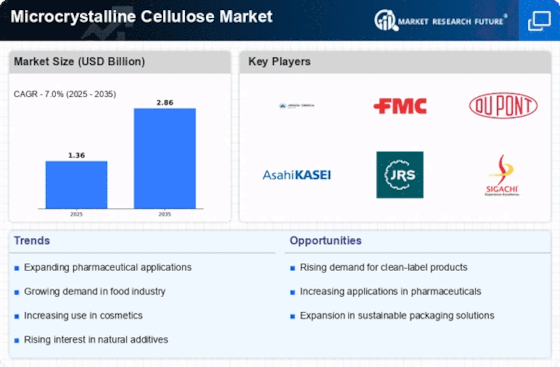
Microcrystalline Cellulose MCC Market Infographic
Purchase Options

Market Trends

Key Emerging Trends in the Microcrystalline Cellulose MCC Market

Medicinal formulations such as tablets, ointments, and other topical treatment bases rely on microcrystalline cellulose for a number of functions, including stabilization, binding, film formation, suspension, and disintegration. Pharmaceutical formulations such tablets, capsules, and sachets rely on it as a binding agent and diluent, solidifying its position as one of the most important excipients in the industry. The demand for pharmaceutical product production is rising and this is precipitating the growth of microcrystalline cellulose market. The demand for microcrystalline cellulose has recently seen an uptick, and the emerging economies like India, Brazil and China are the major contributors to the same.

Along with the elevating trend of global application of processed foods, microcrystalline cellulose market is one other driver. Processed food plays a key role in the market growth, the latest trend of using microcrystalline cellulose as a filler having a positive influence. Given the increasing demand for pharmaceutical products, notably tablets and capsules, microcrystalline cellulose can expect to be seen in frequent demand. The market has not risen as much as it could have due to aspects such as the price fluctuations and the alternative goods being available although such a development in this field is encouraging.

The major players in the microcrystal cellulose arena see the increasing disposable incomes in the developing nations in the Asia-Pacific region as a positive development. Microcrystalline cellulose businesses are highly favored by the current economic trends characterized by increased incomes and appearance of new growth options.

Microcrystalline cellulose has a lot of uses in pharmaceutical sphere, specifically related to product stability and formulation. Development of tablets, ointments, and other therapeutic applications depends on the activity of binder, stabilizer and disintegrants, a very significant role played by each one of them. There are a lot of drugs used in the form of pills capsules and sachets but microcrystalline cellulose which is an excipient is highly used for being good a diluent and for binding. One of the major reasons behind the rapidly increasing number of microcrystalline cellulose being produced is the continuous expansion of pharmaceutical product manufacturing, especially in the developing countries like India, Brazil, and China.

Processed foods that are used in countries around the world create a substantial impact on the microcrystalline cellulose market as well. The market for microcrystalline cellulose keeps growing since, consumption of processed foods raises which, in result, the industry uses the component. The expected increasing demand for pharmaceutical products; namely, tablets and capsules, is also forecasted to escalate the need for microcrystalline cellulose. The market is still in the infancy stage due to the price fluctuations and abundant substitute products although these encouraging trends exist.

On the other hand, the market of microcrystalline cellulose in Asia Pacific looks good owing to the region’s growing GDP and development of middle class. Opportunities for major players in the sector to expand and thrive in this region are being created by the rise in disposable income. Despite hurdles, microcrystalline cellulose is poised to become a major participant in the global market thanks to its numerous applications in medicines and the food industry, as well as rising market potential.


Author
Chitranshi Jaiswal
Team Lead - Research

Chitranshi is a Team Leader in the Chemicals & Materials (CnM) and Energy & Power (EnP) domains, with 6+ years of experience in market research. She leads and mentors teams to deliver cross-domain projects that equip clients with actionable insights and growth strategies. She is skilled in market estimation, forecasting, competitive benchmarking, and both primary & secondary research, enabling her to turn complex data into decision-ready insights. An engineer and MBA professional, she combines technical expertise with strategic acumen to solve dynamic market challenges. Chitranshi has successfully managed projects that support market entry, investment planning, and competitive positioning, while building strong client relationships. Certified in Advanced Excel & Power BI she leverages data-driven approaches to ensure accuracy, clarity, and impactful outcomes.

Leave a Comment

FAQs

What is the projected market valuation of the Microcrystalline Cellulose Market by 2035?

<p>The Microcrystalline Cellulose Market is projected to reach a valuation of 2.863 USD Billion by 2035.</p>

What was the market valuation of Microcrystalline Cellulose in 2024?

<p>In 2024, the overall market valuation of Microcrystalline Cellulose was 1.36 USD Billion.</p>

What is the expected CAGR for the Microcrystalline Cellulose Market during the forecast period 2025 - 2035?

<p>The expected CAGR for the Microcrystalline Cellulose Market during the forecast period 2025 - 2035 is 7.0%.</p>

Which companies are considered key players in the Microcrystalline Cellulose Market?

<p>Key players in the Microcrystalline Cellulose Market include Mingtai Chemical, FMC Corporation, DuPont, Asahi Kasei Corporation, JRS Pharma, Sigachi Industries, Shin-Etsu Chemical, and HPMC.</p>

What are the two main sources of Microcrystalline Cellulose and their market valuations?

<p>The two main sources are Wood Based, valued at 1.75 USD Billion, and Non-Wood Based, valued at 1.113 USD Billion.</p>

How does the Microcrystalline Cellulose market perform in the pharmaceutical sector?

<p>In the pharmaceutical sector, the Microcrystalline Cellulose market was valued at 1.15 USD Billion in 2024.</p>

What is the market valuation of Microcrystalline Cellulose in the food and beverages industry?

The market valuation of Microcrystalline Cellulose in the food and beverages industry was 1.15 USD Billion in 2024.

What is the projected market size for Microcrystalline Cellulose in the cosmetic and personal care industry by 2035?

The market size for Microcrystalline Cellulose in the cosmetic and personal care industry is expected to reach 0.6 USD Billion by 2035.

What are the expected growth trends for the Microcrystalline Cellulose Market in the coming years?

The Microcrystalline Cellulose Market is likely to experience robust growth, driven by a projected CAGR of 7.0% from 2025 to 2035.

How does the market valuation of Microcrystalline Cellulose in 2024 compare to its projected valuation in 2035?

The market valuation of Microcrystalline Cellulose increased from 1.36 USD Billion in 2024 to a projected 2.863 USD Billion in 2035.

Market Summary

As per Market Research Future analysis, the Microcrystalline Cellulose Market Size was estimated at 1.36 USD Billion in 2024. The Microcrystalline Cellulose industry is projected to grow from 1.455 USD Billion in 2025 to 2.863 USD Billion by 2035, exhibiting a compound annual growth rate (CAGR) of 7.0% during the forecast period 2025 - 2035

Key Market Trends & Highlights

The Microcrystalline Cellulose Market is poised for robust growth driven by diverse applications and evolving consumer preferences.

  • North America remains the largest market for microcrystalline cellulose, primarily due to its extensive use in pharmaceuticals. Asia-Pacific is emerging as the fastest-growing region, fueled by increasing demand in food and beverage applications. The wood-based segment continues to dominate the market, while non-wood-based sources are gaining traction due to sustainability concerns. Key market drivers include the rising application of microcrystalline cellulose in the food industry and the expansion of its use in personal care products.

Market Size & Forecast

2024 Market Size 1.36 (USD Billion)
2035 Market Size 2.863 (USD Billion)
CAGR (2025 - 2035) 7.0%
Largest Regional Market Share in 2024 Asia Pacific

Major Players

Mingtai Chemical (CN), FMC Corporation (US), DuPont (US), Asahi Kasei Corporation (JP), JRS Pharma (DE), Sigachi Industries (IN), Shin-Etsu Chemical (JP), HPMC (IN)

Market Trends

The Microcrystalline Cellulose Market is currently experiencing a notable evolution, driven by diverse applications across various industries. This versatile ingredient, derived from cellulose, is widely utilized in pharmaceuticals, food, and cosmetics, among others. Its unique properties, such as excellent binding, stabilizing, and thickening capabilities, render it indispensable in product formulations. As consumer preferences shift towards natural and clean-label products, the demand for microcrystalline cellulose is likely to increase, reflecting a broader trend towards sustainability and health consciousness. Furthermore, innovations in production techniques and the development of novel applications may further enhance its market presence.

In addition to the rising demand, the microcrystalline cellulose market is influenced by regulatory frameworks and industry standards that govern ingredient quality and safety. Companies operating within the microcrystalline cellulose MCC market are prioritizing compliance with international quality standards to ensure product reliability and consumer trust. This commitment to safety and regulatory adherence is encouraging the adoption of microcrystalline cellulose across additional industries. As global markets expand and emerging economies increase industrial production, the microcrystalline cellulose market size is likely to benefit from new growth opportunities.

Rising Demand in Pharmaceuticals

The Microcrystalline Cellulose Market is witnessing an upsurge in demand from the pharmaceutical sector. This ingredient is essential for tablet formulation, acting as a binder and disintegrant. As the pharmaceutical industry evolves, the need for high-quality excipients is becoming increasingly critical, driving the adoption of microcrystalline cellulose in drug manufacturing.

Shift Towards Natural Ingredients

There is a discernible trend towards the use of natural ingredients in various consumer products. The Microcrystalline Cellulose Market is benefiting from this shift, as consumers increasingly prefer products that are perceived as safe and environmentally friendly. This inclination towards clean-label products is likely to bolster the market's growth.

Technological Advancements in Production

Innovations in production technologies are shaping the Microcrystalline Cellulose Market. Enhanced manufacturing processes are improving the efficiency and quality of microcrystalline cellulose, making it more accessible to various industries. These advancements may lead to the development of new applications, further expanding the market's reach.

Microcrystalline Cellulose MCC Market Market Drivers

Rising Demand in Nutraceuticals

The Microcrystalline Cellulose Market is benefiting from the rising demand for nutraceuticals, which are products derived from food sources with health benefits. As consumers become more health-conscious, the need for effective delivery systems for vitamins, minerals, and herbal supplements has increased. Microcrystalline cellulose serves as an ideal excipient in tablet formulations, providing necessary binding and disintegration properties. Market data indicates that the nutraceutical segment is projected to witness robust growth, driven by the increasing prevalence of lifestyle-related diseases and the growing trend of preventive healthcare. This trend is likely to propel the demand for microcrystalline cellulose as a key ingredient in the formulation of dietary supplements.

Growth in Personal Care Products

The Microcrystalline Cellulose Market is witnessing growth fueled by its incorporation in personal care products. This ingredient is valued for its ability to enhance the texture and stability of formulations, making it a preferred choice among manufacturers. The increasing consumer awareness regarding product ingredients has led to a shift towards formulations that are perceived as safer and more effective. Market data suggests that the personal care segment is expected to grow significantly, as brands increasingly adopt microcrystalline cellulose to meet consumer demands for transparency and quality. Additionally, the multifunctional properties of microcrystalline cellulose, such as its ability to act as a bulking agent and emulsifier, further bolster its appeal in this sector.

Sustainability Trends in Manufacturing

The Microcrystalline Cellulose Market is influenced by the growing emphasis on sustainability in manufacturing processes. As industries strive to reduce their environmental footprint, the demand for biodegradable and renewable materials is on the rise. Microcrystalline cellulose, derived from plant sources, aligns with these sustainability goals, making it an attractive option for manufacturers. Market data indicates that companies are increasingly investing in sustainable practices, which is likely to enhance the demand for microcrystalline cellulose across various sectors. This trend not only supports environmental initiatives but also appeals to consumers who are increasingly prioritizing eco-friendly products in their purchasing decisions.

Increasing Application in Food Industry

The Microcrystalline Cellulose Market is experiencing a notable surge in demand due to its extensive application in the food sector. This compound serves as a stabilizer, thickener, and anti-caking agent, enhancing the texture and quality of various food products. As consumers increasingly seek healthier and more natural food options, the incorporation of microcrystalline cellulose aligns with these preferences. The market data indicates that the food segment is projected to account for a substantial share of the overall market, driven by the rising trend of clean label products. Furthermore, the versatility of microcrystalline cellulose allows it to be utilized in a wide range of food items, from dairy to baked goods, thereby expanding its market reach.

Expansion in Pharmaceutical Applications

The Microcrystalline Cellulose Market is poised for expansion, particularly within the pharmaceutical sector. This compound is widely utilized as a binder and filler in tablet formulations, ensuring optimal drug delivery and stability. The increasing prevalence of chronic diseases and the subsequent rise in pharmaceutical production are contributing to the heightened demand for microcrystalline cellulose. Market data suggests that the pharmaceutical segment is expected to grow steadily, driven by innovations in drug formulation and the need for more efficient manufacturing processes. Furthermore, the regulatory landscape is becoming increasingly favorable, encouraging the adoption of microcrystalline cellulose in various pharmaceutical applications.

Market Segment Insights

By Source: Wood Based (Largest) vs. Non-Wood Based (Fastest-Growing)

In the Microcrystalline Cellulose Market, wood-based sources currently dominate the segment, capturing the majority of market share due to their widespread availability and established supply chains. The preference for wood-based microcrystalline cellulose has stemmed from its high purity and cost-effectiveness, making it a preferred choice among manufacturers in various industries, including pharmaceuticals and <a href="https://www.marketresearchfuture.com/reports/food-processing-market-8588">food processing</a>. Non-wood based sources, while holding a smaller market share, are gaining traction as the demand for alternative and sustainable materials grows, particularly in response to environmental concerns.

Wood Based: Dominant vs. Non-Wood Based: Emerging

Wood based microcrystalline cellulose is recognized for its superior performance characteristics, including high gel-forming capacity and stability in various formulations, thus maintaining its dominant position in the market. This segment benefits from well-established harvesting, processing, and distribution networks, which enhances its reliability and reduces costs. Conversely, non-wood based sources like plant fibers are emerging as alternatives that appeal to environmentally conscious consumers. They cater to the growing demand for sustainability in product sourcing, driven by shifting preferences towards natural ingredients and the reduction of ecological footprints. As innovations in processing techniques improve the quality of non-wood cellulose, its market presence is expected to grow significantly.

By End-Use Industry: Pharmaceuticals (Largest) vs. Food & Beverages (Fastest-Growing)

The microcrystalline cellulose market sees a significant distribution of market share among its key end-use industries. Pharmaceuticals hold the largest share, driven by the increasing demand for high-quality excipients in drug formulations. This is complemented by the essential role that microcrystalline cellulose plays in enhancing the stability and effectiveness of pharmaceutical products. In contrast, the food and beverages sector, while currently smaller, demonstrates a robust growth trajectory, motivated by the rising inclination towards clean-label products and natural ingredients, which microcrystalline cellulose provides at an acceptable cost.

Pharmaceuticals: Dominant vs. Food &amp; Beverages: Emerging

Pharmaceuticals represent the dominant segment in the microcrystalline cellulose market, benefiting from its extensive application as a binder and filler in tablet formulations. The stringent regulatory standards governing pharmaceutical excipients further serve to solidify this sector's leading position. Conversely, the food and beverages segment is seen as emerging, as it rapidly adopts microcrystalline cellulose for stabilizing and texturizing food products. This trend is propelled by consumer demand for healthier options and the need for clean-label formulations, enhancing the appeal of both processed and natural food products. This growing sector reflects the adaptability of microcrystalline cellulose to evolving consumer preferences, solidifying its market relevance.

Get more detailed insights about Microcrystalline Cellulose Market Research Report - Forecast till 2035

Regional Insights

By Region, the study provides the market insights into North America, Europe, Asia-Pacific and Rest of the World. Asia-Pacific microcrystalline cellulose market accounted for USD 0.47 billion in 2021 and is expected to exhibit a significant CAGR growth during the study period. This is attributed to steadily growing food and pharmaceutical industries as microcrystalline cellulose has high demand in pharmaceuticals and is extensively used as functional ingredient in food and beverages across the region. Moreover, China microcrystalline cellulose market held the largest market share, and the India microcrystalline cellulose market was the fastest growing market in the Asia-Pacific region.

Further, the major countries studied in the market report are: The U.S, Canada, Germany, France, UK, Italy, Spain, China, Japan, India, Australia, South Korea, and Brazil.

Europe microcrystalline cellulose market accounts for the second-largest market share due to the increasing government-backed investments in drug development and improvements in the quality of pharmaceutical products are anticipated to bode well for the market in this region. Further, the Germany microcrystalline cellulose market held the largest market share, and the UK microcrystalline cellulose market was the fastest growing market in the European region.

The Asia-Pacific microcrystalline cellulose Market is expected to grow at the fastest CAGR from 2022 to 2030. This is due to the economic recovery and the increase in employment rate are the growth factors in the region, which, in turn, supports the growth of the market Moreover, China microcrystalline cellulose market held the largest market share, and the India microcrystalline cellulose market was the fastest growing market in the Asia-Pacific region.

Key Players and Competitive Insights

Major market players are spending a lot of money on R&D to increase their product lines, which will help the microcrystalline cellulose market grow even more. Market participants are also taking a range of strategic initiatives to grow their worldwide footprint, with key market developments such as new product launches, contractual agreements, mergers and acquisitions, increased investments, and collaboration with other organizations. Competitors in the microcrystalline cellulose industry must offer cost-effective items to expand and survive in an increasingly competitive and rising market environment.
One of the primary business strategies adopted by manufacturers in the microcrystalline cellulose industry to benefit clients and expand the market sector is to manufacture locally to reduce operating costs. In recent years, microcrystalline cellulose industry has provided medicine with some of the most significant benefits. The microcrystalline cellulose market major player such as DuPont, Asahi Kasei Corporation, JRS Pharma, Roquette Frères, and others are working to expand the market demand by investing in research and development activities.
Asahi Kasei Medical Co., Ltd. manufactures and distributes medical devices. The Company produces dialyzers, therapeutic apheresis products, leukocyte reduction filters, virus removal filters, and other products. Asahi Kasei Medical markets its products throughout Japan.
In June Asahi Kasei Medical has completed its acquisition of Bionova Scientific, LLC, a provider of contract process development services and GMP-compliant contract manufacturing services to biopharmaceutical companies. Bionova Scientific will operate as a business unit within Asahi Kasei Medical’s bioprocess division.
Bionova Scientific will continue to expand its business by building on its strengths as a CDMO specialized in the process design and manufacture of various types of biologics such as microcrystalline cellulose, cytokines, vaccines, hormones etc.
Also, DFE Pharma is a leader in pharma- and nutraceutical excipient solutions. The company develop, produce and supply high-quality functional excipients for use in the pharmaceutical, biopharmaceutical, and nutraceutical industries for respiratory, oral solid dose (OSD), ophthalmic and parenteral formulations.
In July DFE Pharma, a provider of pharmaceutical Excipient solutions, launched Pharmacel sMCC 90, a silicified variant of microcrystalline cellulose. The new product is developed as a synergistic solution for challenging oral solid dosage formulations. It offers increases surface area, enhanced powder flow, and superior tablatibility, thereby improving formulation robustness.

Key Companies in the Microcrystalline Cellulose MCC Market include

Industry Developments

May 2022: Asahi Kasei had established a group-wide data management platform called “DEEP” (Data Exploration and Exchange Pipeline) to accelerate digital transformation (DX) throughout the Asahi Kasei Group, and started its operation in April 2022. DEEP has already been utilized in the analysis of several businesses, and is expected to make further contribution to the enhancement of management and businesses.

September 2023:

 JRS Pharma GmbH & Co. KG announced that it has launched a new grade of MCC called Avicel® HFE Pro. Avicel® HFE Pro is a high-performance MCC that is designed to meet the demanding requirements of the pharmaceutical industry. It is suitable for use in a wide range of pharmaceutical applications, including tablet and capsule formulations, oral suspensions, and topical creams and gels.

January 2021: Asahi Kasei's specialty solutions SBU had announced that they will build a second plant for microcrystalline cellulose at its Mizushima Works in Kurashiki, Okayama, Japan. The expansion is expected to be completed by 2023’s spring season. Asahi Kasei currently manufactures Ceolus, a microcrystalline cellulose used primarily in pharmaceuticals as tablet binder, in Nobeoka, Miyazaki, Japan. Through this expansion Asahi Kasei will enhance its market presence in Japan and adjoining countries

Future Outlook

Microcrystalline Cellulose MCC Market Future Outlook

The Microcrystalline Cellulose Market is projected to grow at a 7.0% CAGR from 2025 to 2035, driven by increasing demand in pharmaceuticals, food, and cosmetics.

New opportunities lie in:

  • <p>Expansion into emerging markets with tailored product offerings. Development of innovative formulations for enhanced functionality. Strategic partnerships with food and beverage manufacturers for ingredient supply.</p>

By 2035, the Microcrystalline Cellulose Market is expected to solidify its position as a key ingredient across multiple industries.

Market Segmentation

Microcrystalline Cellulose MCC Market Source Outlook

  • Wood Based
  • Non-Wood Based

Microcrystalline Cellulose MCC Market End-Use Industry Outlook

  • Pharmaceuticals
  • Food & Beverages
  • Cosmetic & Personal Care

Report Scope

MARKET SIZE 2024 1.36(USD Billion)
MARKET SIZE 2025 1.455(USD Billion)
MARKET SIZE 2035 2.863(USD Billion)
COMPOUND ANNUAL GROWTH RATE (CAGR) 7.0% (2025 - 2035)
REPORT COVERAGE Revenue Forecast, Competitive Landscape, Growth Factors, and Trends
BASE YEAR 2024
Market Forecast Period 2025 - 2035
Historical Data 2019 - 2024
Market Forecast Units USD Billion
Key Companies Profiled Mingtai Chemical (CN), FMC Corporation (US), DuPont (US), Asahi Kasei Corporation (JP), JRS Pharma (DE), Sigachi Industries (IN), Shin-Etsu Chemical (JP), HPMC (IN)
Segments Covered Source, End Users Industry Pharmaceuticals, Food & Beverages, and Cosmetic & Personal Care, Region
Key Market Opportunities Growing demand for clean label products drives innovation in the Microcrystalline Cellulose Market.
Key Market Dynamics Rising demand for clean-label products drives innovation and competition in the Microcrystalline Cellulose Market.
Countries Covered North America, Europe, APAC, South America, MEA

FAQs

What is the projected market valuation of the Microcrystalline Cellulose Market by 2035?

<p>The Microcrystalline Cellulose Market is projected to reach a valuation of 2.863 USD Billion by 2035.</p>

What was the market valuation of Microcrystalline Cellulose in 2024?

<p>In 2024, the overall market valuation of Microcrystalline Cellulose was 1.36 USD Billion.</p>

What is the expected CAGR for the Microcrystalline Cellulose Market during the forecast period 2025 - 2035?

<p>The expected CAGR for the Microcrystalline Cellulose Market during the forecast period 2025 - 2035 is 7.0%.</p>

Which companies are considered key players in the Microcrystalline Cellulose Market?

<p>Key players in the Microcrystalline Cellulose Market include Mingtai Chemical, FMC Corporation, DuPont, Asahi Kasei Corporation, JRS Pharma, Sigachi Industries, Shin-Etsu Chemical, and HPMC.</p>

What are the two main sources of Microcrystalline Cellulose and their market valuations?

<p>The two main sources are Wood Based, valued at 1.75 USD Billion, and Non-Wood Based, valued at 1.113 USD Billion.</p>

How does the Microcrystalline Cellulose market perform in the pharmaceutical sector?

<p>In the pharmaceutical sector, the Microcrystalline Cellulose market was valued at 1.15 USD Billion in 2024.</p>

What is the market valuation of Microcrystalline Cellulose in the food and beverages industry?

The market valuation of Microcrystalline Cellulose in the food and beverages industry was 1.15 USD Billion in 2024.

What is the projected market size for Microcrystalline Cellulose in the cosmetic and personal care industry by 2035?

The market size for Microcrystalline Cellulose in the cosmetic and personal care industry is expected to reach 0.6 USD Billion by 2035.

What are the expected growth trends for the Microcrystalline Cellulose Market in the coming years?

The Microcrystalline Cellulose Market is likely to experience robust growth, driven by a projected CAGR of 7.0% from 2025 to 2035.

How does the market valuation of Microcrystalline Cellulose in 2024 compare to its projected valuation in 2035?

The market valuation of Microcrystalline Cellulose increased from 1.36 USD Billion in 2024 to a projected 2.863 USD Billion in 2035.

  1. SECTION I: EXECUTIVE SUMMARY AND KEY HIGHLIGHTS |
    1. EXECUTIVE SUMMARY | |
      1. Market Overview | |
      2. Key Findings | |
      3. Market Segmentation | |
      4. Competitive Landscape | |
      5. Challenges and Opportunities | |
      6. Future Outlook 2
  2. SECTION II: SCOPING, METHODOLOGY AND MARKET STRUCTURE |
    1. MARKET INTRODUCTION | |
      1. Definition | |
      2. Scope of the study | | |
    2. RESEARCH METHODOLOGY | |
      1. Overview | |
      2. Data Mining | |
      3. Secondary Research | |
      4. Primary Research | | |
      5. Forecasting Model | |
      6. Market Size Estimation | | |
      7. Data Triangulation | |
      8. Validation 3
  3. SECTION III: QUALITATIVE ANALYSIS |
    1. MARKET DYNAMICS | |
      1. Overview | |
      2. Drivers | |
      3. Restraints | |
      4. Opportunities |
    2. MARKET FACTOR ANALYSIS | |
      1. Value chain Analysis | |
      2. Porter's Five Forces Analysis | | |
      3. COVID-19 Impact Analysis | | |
  4. SECTION IV: QUANTITATIVE ANALYSIS |
    1. Chemicals and Materials, BY Source (USD Billion) | |
      1. Wood Based | |
      2. Non-Wood Based |
    2. Chemicals and Materials, BY End-Use Industry (USD Billion) | |
      1. Pharmaceuticals | |
      2. Food & Beverages | |
      3. Cosmetic & Personal Care |
    3. Chemicals and Materials, BY Region (USD Billion) | |
      1. North America | | |
      2. Europe | | |
      3. APAC | | |
      4. South America | | |
      5. MEA | | |
  5. SECTION V: COMPETITIVE ANALYSIS |
    1. Competitive Landscape | |
      1. Overview | |
      2. Competitive Analysis | |
      3. Market share Analysis | |
      4. Major Growth Strategy in the Chemicals and Materials | |
      5. Competitive Benchmarking | |
      6. Leading Players in Terms of Number of Developments in the Chemicals and Materials | |
      7. Key developments and growth strategies | | |
      8. Major Players Financial Matrix | | |
    2. Company Profiles | |
      1. Mingtai Chemical (CN) | | |
      2. FMC Corporation (US) | | |
      3. DuPont (US) | | |
      4. Asahi Kasei Corporation (JP) | | |
      5. JRS Pharma (DE) | | |
      6. Sigachi Industries (IN) | | |
      7. Shin-Etsu Chemical (JP) | | |
      8. HPMC (IN) | | |
    3. Appendix | |
      1. References | |
      2. Related Reports 6 LIST OF FIGURES |
    4. MARKET SYNOPSIS |
    5. NORTH AMERICA MARKET ANALYSIS |
    6. US MARKET ANALYSIS BY SOURCE |
    7. US MARKET ANALYSIS BY END-USE INDUSTRY |
    8. CANADA MARKET ANALYSIS BY SOURCE |
    9. CANADA MARKET ANALYSIS BY END-USE INDUSTRY |
    10. EUROPE MARKET ANALYSIS |
    11. GERMANY MARKET ANALYSIS BY SOURCE |
    12. GERMANY MARKET ANALYSIS BY END-USE INDUSTRY |
    13. UK MARKET ANALYSIS BY SOURCE |
    14. UK MARKET ANALYSIS BY END-USE INDUSTRY |
    15. FRANCE MARKET ANALYSIS BY SOURCE |
    16. FRANCE MARKET ANALYSIS BY END-USE INDUSTRY |
    17. RUSSIA MARKET ANALYSIS BY SOURCE |
    18. RUSSIA MARKET ANALYSIS BY END-USE INDUSTRY |
    19. ITALY MARKET ANALYSIS BY SOURCE |
    20. ITALY MARKET ANALYSIS BY END-USE INDUSTRY |
    21. SPAIN MARKET ANALYSIS BY SOURCE |
    22. SPAIN MARKET ANALYSIS BY END-USE INDUSTRY |
    23. REST OF EUROPE MARKET ANALYSIS BY SOURCE |
    24. REST OF EUROPE MARKET ANALYSIS BY END-USE INDUSTRY |
    25. APAC MARKET ANALYSIS |
    26. CHINA MARKET ANALYSIS BY SOURCE |
    27. CHINA MARKET ANALYSIS BY END-USE INDUSTRY |
    28. INDIA MARKET ANALYSIS BY SOURCE |
    29. INDIA MARKET ANALYSIS BY END-USE INDUSTRY |
    30. JAPAN MARKET ANALYSIS BY SOURCE |
    31. JAPAN MARKET ANALYSIS BY END-USE INDUSTRY |
    32. SOUTH KOREA MARKET ANALYSIS BY SOURCE |
    33. SOUTH KOREA MARKET ANALYSIS BY END-USE INDUSTRY |
    34. MALAYSIA MARKET ANALYSIS BY SOURCE |
    35. MALAYSIA MARKET ANALYSIS BY END-USE INDUSTRY |
    36. THAILAND MARKET ANALYSIS BY SOURCE |
    37. THAILAND MARKET ANALYSIS BY END-USE INDUSTRY |
    38. INDONESIA MARKET ANALYSIS BY SOURCE |
    39. INDONESIA MARKET ANALYSIS BY END-USE INDUSTRY |
    40. REST OF APAC MARKET ANALYSIS BY SOURCE |
    41. REST OF APAC MARKET ANALYSIS BY END-USE INDUSTRY |
    42. SOUTH AMERICA MARKET ANALYSIS |
    43. BRAZIL MARKET ANALYSIS BY SOURCE |
    44. BRAZIL MARKET ANALYSIS BY END-USE INDUSTRY |
    45. MEXICO MARKET ANALYSIS BY SOURCE |
    46. MEXICO MARKET ANALYSIS BY END-USE INDUSTRY |
    47. ARGENTINA MARKET ANALYSIS BY SOURCE |
    48. ARGENTINA MARKET ANALYSIS BY END-USE INDUSTRY |
    49. REST OF SOUTH AMERICA MARKET ANALYSIS BY SOURCE |
    50. REST OF SOUTH AMERICA MARKET ANALYSIS BY END-USE INDUSTRY |
    51. MEA MARKET ANALYSIS |
    52. GCC COUNTRIES MARKET ANALYSIS BY SOURCE |
    53. GCC COUNTRIES MARKET ANALYSIS BY END-USE INDUSTRY |
    54. SOUTH AFRICA MARKET ANALYSIS BY SOURCE |
    55. SOUTH AFRICA MARKET ANALYSIS BY END-USE INDUSTRY |
    56. REST OF MEA MARKET ANALYSIS BY SOURCE |
    57. REST OF MEA MARKET ANALYSIS BY END-USE INDUSTRY |
    58. KEY BUYING CRITERIA OF CHEMICALS AND MATERIALS |
    59. RESEARCH PROCESS OF MRFR |
    60. DRO ANALYSIS OF CHEMICALS AND MATERIALS |
    61. DRIVERS IMPACT ANALYSIS: CHEMICALS AND MATERIALS |
    62. RESTRAINTS IMPACT ANALYSIS: CHEMICALS AND MATERIALS |
    63. SUPPLY / VALUE CHAIN: CHEMICALS AND MATERIALS |
    64. CHEMICALS AND MATERIALS, BY SOURCE, 2024 (% SHARE) |
    65. CHEMICALS AND MATERIALS, BY SOURCE, 2024 TO 2035 (USD Billion) |
    66. CHEMICALS AND MATERIALS, BY END-USE INDUSTRY, 2024 (% SHARE) |
    67. CHEMICALS AND MATERIALS, BY END-USE INDUSTRY, 2024 TO 2035 (USD Billion) |
    68. BENCHMARKING OF MAJOR COMPETITORS 7 LIST OF TABLES |
    69. LIST OF ASSUMPTIONS | |
      1. |
    70. North America MARKET SIZE ESTIMATES; FORECAST | |
      1. BY SOURCE, 2025-2035 (USD Billion) | |
      2. BY END-USE INDUSTRY, 2025-2035 (USD Billion) |
    71. US MARKET SIZE ESTIMATES; FORECAST | |
      1. BY SOURCE, 2025-2035 (USD Billion) | |
      2. BY END-USE INDUSTRY, 2025-2035 (USD Billion) |
    72. Canada MARKET SIZE ESTIMATES; FORECAST | |
      1. BY SOURCE, 2025-2035 (USD Billion) | |
      2. BY END-USE INDUSTRY, 2025-2035 (USD Billion) |
    73. Europe MARKET SIZE ESTIMATES; FORECAST | |
      1. BY SOURCE, 2025-2035 (USD Billion) | |
      2. BY END-USE INDUSTRY, 2025-2035 (USD Billion) |
    74. Germany MARKET SIZE ESTIMATES; FORECAST | |
      1. BY SOURCE, 2025-2035 (USD Billion) | |
      2. BY END-USE INDUSTRY, 2025-2035 (USD Billion) |
    75. UK MARKET SIZE ESTIMATES; FORECAST | |
      1. BY SOURCE, 2025-2035 (USD Billion) | |
      2. BY END-USE INDUSTRY, 2025-2035 (USD Billion) |
    76. France MARKET SIZE ESTIMATES; FORECAST | |
      1. BY SOURCE, 2025-2035 (USD Billion) | |
      2. BY END-USE INDUSTRY, 2025-2035 (USD Billion) |
    77. Russia MARKET SIZE ESTIMATES; FORECAST | |
      1. BY SOURCE, 2025-2035 (USD Billion) | |
      2. BY END-USE INDUSTRY, 2025-2035 (USD Billion) |
    78. Italy MARKET SIZE ESTIMATES; FORECAST | |
      1. BY SOURCE, 2025-2035 (USD Billion) | |
      2. BY END-USE INDUSTRY, 2025-2035 (USD Billion) |
    79. Spain MARKET SIZE ESTIMATES; FORECAST | |
      1. BY SOURCE, 2025-2035 (USD Billion) | |
      2. BY END-USE INDUSTRY, 2025-2035 (USD Billion) |
    80. Rest of Europe MARKET SIZE ESTIMATES; FORECAST | |
      1. BY SOURCE, 2025-2035 (USD Billion) | |
      2. BY END-USE INDUSTRY, 2025-2035 (USD Billion) |
    81. APAC MARKET SIZE ESTIMATES; FORECAST | |
      1. BY SOURCE, 2025-2035 (USD Billion) | |
      2. BY END-USE INDUSTRY, 2025-2035 (USD Billion) |
    82. China MARKET SIZE ESTIMATES; FORECAST | |
      1. BY SOURCE, 2025-2035 (USD Billion) | |
      2. BY END-USE INDUSTRY, 2025-2035 (USD Billion) |
    83. India MARKET SIZE ESTIMATES; FORECAST | |
      1. BY SOURCE, 2025-2035 (USD Billion) | |
      2. BY END-USE INDUSTRY, 2025-2035 (USD Billion) |
    84. Japan MARKET SIZE ESTIMATES; FORECAST | |
      1. BY SOURCE, 2025-2035 (USD Billion) | |
      2. BY END-USE INDUSTRY, 2025-2035 (USD Billion) |
    85. South Korea MARKET SIZE ESTIMATES; FORECAST | |
      1. BY SOURCE, 2025-2035 (USD Billion) | |
      2. BY END-USE INDUSTRY, 2025-2035 (USD Billion) |
    86. Malaysia MARKET SIZE ESTIMATES; FORECAST | |
      1. BY SOURCE, 2025-2035 (USD Billion) | |
      2. BY END-USE INDUSTRY, 2025-2035 (USD Billion) |
    87. Thailand MARKET SIZE ESTIMATES; FORECAST | |
      1. BY SOURCE, 2025-2035 (USD Billion) | |
      2. BY END-USE INDUSTRY, 2025-2035 (USD Billion) |
    88. Indonesia MARKET SIZE ESTIMATES; FORECAST | |
      1. BY SOURCE, 2025-2035 (USD Billion) | |
      2. BY END-USE INDUSTRY, 2025-2035 (USD Billion) |
    89. Rest of APAC MARKET SIZE ESTIMATES; FORECAST | |
      1. BY SOURCE, 2025-2035 (USD Billion) | |
      2. BY END-USE INDUSTRY, 2025-2035 (USD Billion) |
    90. South America MARKET SIZE ESTIMATES; FORECAST | |
      1. BY SOURCE, 2025-2035 (USD Billion) | |
      2. BY END-USE INDUSTRY, 2025-2035 (USD Billion) |
    91. Brazil MARKET SIZE ESTIMATES; FORECAST | |
      1. BY SOURCE, 2025-2035 (USD Billion) | |
      2. BY END-USE INDUSTRY, 2025-2035 (USD Billion) |
    92. Mexico MARKET SIZE ESTIMATES; FORECAST | |
      1. BY SOURCE, 2025-2035 (USD Billion) | |
      2. BY END-USE INDUSTRY, 2025-2035 (USD Billion) |
    93. Argentina MARKET SIZE ESTIMATES; FORECAST | |
      1. BY SOURCE, 2025-2035 (USD Billion) | |
      2. BY END-USE INDUSTRY, 2025-2035 (USD Billion) |
    94. Rest of South America MARKET SIZE ESTIMATES; FORECAST | |
      1. BY SOURCE, 2025-2035 (USD Billion) | |
      2. BY END-USE INDUSTRY, 2025-2035 (USD Billion) |
    95. MEA MARKET SIZE ESTIMATES; FORECAST | |
      1. BY SOURCE, 2025-2035 (USD Billion) | |
      2. BY END-USE INDUSTRY, 2025-2035 (USD Billion) |
    96. GCC Countries MARKET SIZE ESTIMATES; FORECAST | |
      1. BY SOURCE, 2025-2035 (USD Billion) | |
      2. BY END-USE INDUSTRY, 2025-2035 (USD Billion) |
    97. South Africa MARKET SIZE ESTIMATES; FORECAST | |
      1. BY SOURCE, 2025-2035 (USD Billion) | |
      2. BY END-USE INDUSTRY, 2025-2035 (USD Billion) |
    98. Rest of MEA MARKET SIZE ESTIMATES; FORECAST | |
      1. BY SOURCE, 2025-2035 (USD Billion) | |
      2. BY END-USE INDUSTRY, 2025-2035 (USD Billion) |
    99. PRODUCT LAUNCH/PRODUCT DEVELOPMENT/APPROVAL | |
      1. |
    100. ACQUISITION/PARTNERSHIP | |

Chemicals and Materials Market Segmentation

Chemicals and Materials By Source (USD Billion, 2025-2035)

  • Wood Based
  • Non-Wood Based

Chemicals and Materials By End-Use Industry (USD Billion, 2025-2035)

  • Pharmaceuticals
  • Food & Beverages
  • Cosmetic & Personal Care
Infographic

Free Sample Request

Kindly complete the form below to receive a free sample of this Report

Get Free Sample

Customer Strories

Compare Licence

×
Features License Type
Single User Multiuser License Enterprise User
Price $4,950 $5,950 $7,250
Maximum User Access Limit 1 User Upto 10 Users Unrestricted Access Throughout the Organization
Free Customization
Direct Access to Analyst
Deliverable Format
Platform Access
Discount on Next Purchase 10% 15% 15%
Printable Versions