×
Hero Background
English
Chinese
French
Japanese
Korean
German
Spanish

Micro Robots Market Trends

ID: MRFR/HC/9985-HCR
100 Pages
Garvit Vyas
October 2025

Micro Robots Market Research Report Information By Mode of Operation (Autonomous, Semi-Autonomous, and Tele Operated), Material Type (Bio-hybrid and Synthetic), End-User (Hospitals and Clinics, Ambulatory surgical centers (ASCs), and Others), and Region (North America, Europe, Asia-Pacific, and Rest of the World)—Forecast till 2035

Share:
Download PDF ×

We do not share your information with anyone. However, we may send you emails based on your report interest from time to time. You may contact us at any time to opt-out.

Micro Robots Market Infographic
Purchase Options

Market Trends

Key Emerging Trends in the Micro Robots Market

The market dynamics of medical microbots are on the frontier in health care technology, driven by the merging of robotics and pharmaceuticals for drug delivery, diagnostics, and surgical interventions at the micro-scale. Such tiny robots as these measuring in micrometers promise precision medicine, targeted drug delivery and improved diagnostic capabilities. Some technological advancements, need for minimal invasive procedures and patient-centered treatments are factors that influence its markets.

Technological advances in micro robot development have a significant impact on the pharmaceutical sector. The progress made to come up with complex tiny robots that can maneuver within human bodies has brought about a revolution concerning precise drug delivery and target interferences. These miniature robots may be programmed to perform various tasks such as; bringing drugs to exact locations inside an individual’s body, carrying out minimally invasive surgeries or assisting during diagnosis. In response to these breakthroughs, the market encourages research aimed at improving the functionalities of this tool.

Minimally invasive procedures that put patients at ease drive the market dynamics of pharma microbots. Traditional methods of drug administration often led to systemic injection causing possible side effects and limited targeting. Microscopic machines can help by way of specific drug administration reducing damage towards healthy tissues which lessens side effects too. On top, microscopic machines used during diagnoses will bring accuracy into play while offering less harmful alternatives compared with well-known methods among others too many to mention for now. To meet this end, marketers look into applications that favor comfort to patients over anything else regarding healthcare outcomes.

Regulation is pivotal in shaping how markets behave when it comes to pharmaceutical micro-robots’ dynamism. As these innovative technologies move from research and development into clinical use regulatory agencies develop guidelines that ensure their safety efficacy compliance with established standards etcetera etcetera . Concomitantly, it is noteworthy that there are unique challenges surrounding MRs which require their assessment against biological systems including potential long-term effects thereof hence regulatory landscape continues evolving accordingly. Complying with this regulatory environment by pharmaceutical companies makes the market dependable and encourages the widespread use of micro-robots in medical applications.

Pharmaceutical micro robot markets are also shaped by constant research to expand their applications. For example, scientists and engineers are exploring functionalities for microbots such as targeted drug delivery in cancer therapy or microsurgery within delicate structures. Besides, research and development activities in this area are highly dynamic leading to the ever-changing nature of pharmaceutical MRs while presenting other avenues for novel applications toward wider acceptance by the medical fraternity.

Economics is another factor that factors in when it comes to the market for pharma micro robots especially on whether they provide value-for-money. Although significant investments may be required during early stages of developing and implementing such micro robots, economic aspects drive their market towards scalability and cost efficiency. As technology matures and gains more acceptance efforts are put into optimizing production processes, cutting down manufacturing costs making these drugs economically viable across a wider range of medical uses.


Author
Garvit Vyas
Analyst

Explore the profile of Garvit Vyas, one of our esteemed authors at Market Research Future, and access their expert research contributions in the field of market research and industry analysis

Leave a Comment

FAQs

What is the current valuation of the Micro Robots Market?

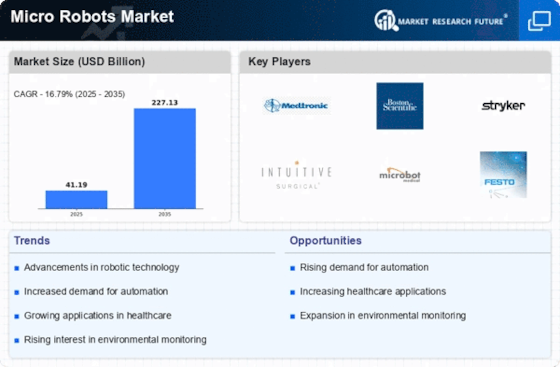
As of 2024, the Micro Robots Market was valued at 41.19 USD Billion.

What is the projected market size for the Micro Robots Market by 2035?

The Micro Robots Market is projected to reach 227.13 USD Billion by 2035.

What is the expected CAGR for the Micro Robots Market during the forecast period?

The expected CAGR for the Micro Robots Market from 2025 to 2035 is 16.79%.

Which companies are considered key players in the Micro Robots Market?

Key players in the Micro Robots Market include Medtronic, Boston Scientific, Stryker, and Intuitive Surgical.

What are the main segments of the Micro Robots Market based on mode of operation?

The main segments based on mode of operation are Autonomous, Semi-Autonomous, and Tele Operated.

How did the Autonomous segment perform in terms of valuation?

The Autonomous segment was valued at 10.0 USD Billion in 2024 and is projected to reach 56.0 USD Billion by 2035.

What is the valuation of the Synthetic material type segment?

The Synthetic material type segment was valued at 31.19 USD Billion in 2024 and is expected to grow to 177.13 USD Billion by 2035.

Market Summary

As per MRFR analysis, the Micro Robots Market Size was estimated at 41.19 USD Billion in 2024. The Micro Robots industry is projected to grow from 48.11 USD Billion in 2025 to 227.13 USD Billion by 2035, exhibiting a compound annual growth rate (CAGR) of 16.79 during the forecast period 2025 - 2035.

Key Market Trends & Highlights

The Micro Robots Market is experiencing robust growth driven by technological advancements and increasing applications across various sectors.

  • The Micro Robots Market is witnessing increased adoption in healthcare, particularly in surgical procedures and diagnostics. Advancements in materials and technology are enhancing the capabilities and efficiency of micro robots, particularly in North America. The Asia-Pacific region is emerging as the fastest-growing market, fueled by rising investments in automation and robotics. Key market drivers include the rising demand for automation and expanding applications in healthcare, which are propelling growth in both autonomous and bio-hybrid segments.

Market Size & Forecast

2024 Market Size 41.19 (USD Billion)
2035 Market Size 227.13 (USD Billion)
CAGR (2025 - 2035) 16.79%
Largest Regional Market Share in 2024 North America

Major Players

<p>Medtronic (US), Boston Scientific (US), Stryker (US), Intuitive Surgical (US), Microbot Medical (IL), Festo (DE), KUKA (DE), ABB (CH), Sony (JP)</p>

Market Trends

The Micro Robots Market is currently experiencing a transformative phase, characterized by rapid advancements in technology and increasing applications across various sectors. These miniature robots, often measuring just a few millimeters, are being integrated into fields such as healthcare, manufacturing, and environmental monitoring. The growing demand for precision and efficiency in tasks has led to innovative designs and functionalities, enabling micro robots to perform complex operations that were previously unattainable. As industries seek to enhance productivity and reduce operational costs, the adoption of micro robots appears to be gaining momentum, suggesting a promising future for this niche market. Moreover, the ongoing research and development efforts in robotics and materials science are likely to further propel the Micro Robots Market. Emerging technologies, such as artificial intelligence and machine learning, are being incorporated into micro robotic systems, enhancing their capabilities and adaptability. This integration not only improves performance but also opens new avenues for applications, particularly in minimally invasive surgeries and targeted drug delivery. As the market evolves, it seems poised to attract significant investment and interest from various stakeholders, indicating a robust growth trajectory in the coming years.

Increased Adoption in Healthcare

The Micro Robots Market is witnessing a surge in the utilization of micro robots within the healthcare sector. These devices are being employed for tasks such as targeted drug delivery, minimally invasive surgeries, and precise diagnostics. The ability to navigate through the human body with high accuracy is revolutionizing treatment methodologies, thereby enhancing patient outcomes.

Advancements in Materials and Technology

Innovations in materials science and robotics technology are driving the evolution of micro robots. The development of biocompatible materials and advanced sensors is enabling the creation of more efficient and versatile micro robotic systems. This trend is likely to enhance their functionality and expand their applications across various industries.

Growing Environmental Applications

The Micro Robots Market is also expanding into environmental monitoring and remediation. Micro robots are being designed to detect pollutants and assess environmental conditions with precision. This trend reflects a growing awareness of sustainability and the need for innovative solutions to address environmental challenges.

Micro Robots Market Market Drivers

Rising Demand for Automation

The Micro Robots Market experiences a notable surge in demand for automation across various sectors. Industries such as manufacturing, logistics, and healthcare are increasingly adopting micro robots to enhance efficiency and reduce operational costs. The integration of micro robots into automated systems allows for precision tasks that were previously labor-intensive. According to recent estimates, the automation market is projected to grow significantly, with micro robots playing a pivotal role in this transformation. As companies seek to streamline processes and improve productivity, the Micro Robots Market is likely to benefit from this trend, leading to increased investments and innovations in micro robotic technologies.

Expanding Applications in Healthcare

The Micro Robots Market is witnessing an expansion of applications in the healthcare sector, driven by the need for minimally invasive procedures and precise medical interventions. Micro robots are being utilized for tasks such as targeted drug delivery, surgical assistance, and diagnostics. The ability of these robots to operate at a microscale allows for reduced patient recovery times and improved outcomes. As the healthcare industry continues to embrace technological advancements, the Micro Robots Market is likely to see increased adoption of micro robotic solutions. This trend may lead to significant growth opportunities as healthcare providers seek innovative ways to enhance patient care.

Technological Advancements in Robotics

Technological advancements are propelling the Micro Robots Market forward, as innovations in robotics and artificial intelligence enhance the capabilities of micro robots. Developments in miniaturization, sensor technology, and machine learning are enabling micro robots to perform complex tasks with greater accuracy and efficiency. For instance, the introduction of advanced sensors allows micro robots to navigate intricate environments and execute precise operations. The market for robotics is expected to expand, with micro robots at the forefront of this evolution. As these technologies continue to evolve, the Micro Robots Market is poised for substantial growth, driven by the demand for smarter and more capable robotic solutions.

Growing Interest in Environmental Monitoring

The Micro Robots Market is increasingly influenced by the growing interest in environmental monitoring and sustainability. Micro robots are being developed for applications such as pollution detection, wildlife tracking, and ecosystem monitoring. These small-scale robots can access hard-to-reach areas and gather data with minimal disruption to the environment. As concerns about climate change and environmental degradation rise, the demand for innovative monitoring solutions is likely to increase. The Micro Robots Market is well-positioned to capitalize on this trend, as organizations seek efficient and effective ways to monitor and protect natural resources.

Increased Investment in Research and Development

Investment in research and development is a critical driver for the Micro Robots Market, as companies and institutions seek to explore new applications and improve existing technologies. Funding for R&D initiatives is on the rise, with a focus on enhancing the functionality and versatility of micro robots. This investment is likely to lead to breakthroughs in various fields, including healthcare, environmental monitoring, and industrial automation. The Micro Robots Market stands to gain from these advancements, as innovative solutions emerge from ongoing research efforts. As a result, the market may witness an influx of new products and applications, further stimulating growth.

Market Segment Insights

By Mode of Operation: Autonomous (Largest) vs. Semi-Autonomous (Fastest-Growing)

<p>In the Micro Robots Market, the Autonomous segment commands the largest market share, significantly outpacing other modes of operation. Its preference stems from efficiency and capability in executing complex tasks without human intervention. Conversely, the Semi-Autonomous mode, while smaller in proportion, shows promising growth as it combines human oversight with robotic assistance, enhancing operational flexibility. Tele Operated micro robots hold a niche position, primarily in applications that require direct human control and real-time decision-making.</p>

<p>Autonomous (Dominant) vs. Semi-Autonomous (Emerging)</p>

<p>The Autonomous segment stands as the dominant force in the Micro Robots Market, recognized for its advanced capabilities and independent functionalities that cater to various industries, including healthcare and manufacturing. These micro robots excel in performing intricate tasks, allowing for higher precision and efficiency. On the other hand, the Semi-Autonomous segment is emerging as a significant player, blending human intelligence with automation. This segment benefits from the growing demand for flexible solutions that require both human insight and robotic performance, making it a preferred choice for many applications such as search and rescue operations.</p>

By Material Type: Bio-hybrid (Largest) vs. Synthetic (Fastest-Growing)

<p>In the Micro Robots Market, the material type segment exhibits a diverse distribution between bio-hybrid and synthetic materials. Bio-hybrid materials hold the largest share, primarily due to their integration of biological components, which enhances functionality and adaptability in various applications. On the other hand, synthetic materials are gaining momentum, showcasing innovative developments that cater to specific needs, from precision tasks in surgery to environmental monitoring.</p>

<p>Material Type: Bio-hybrid (Dominant) vs. Synthetic (Emerging)</p>

<p>Bio-hybrid micro robots incorporate biological components, making them versatile and efficient for tasks that require interaction with living tissue or complex biological systems. These robots benefit from their ability to navigate complex environments and perform delicate operations, which positions them strongly in healthcare and research sectors. In contrast, synthetic micro robots are emerging as key players, with advantages such as enhanced durability, cost-effectiveness, and customization potential. This segment is characterized by rapid technological advancements, enabling synthetic micro robots to address an expanding array of applications, including industrial automation and environmental monitoring.</p>

By End User: Hospitals and Clinics (Largest) vs. Ambulatory Surgical Centers (Fastest-Growing)

<p>In the Micro Robots Market, the distribution of market share reveals that Hospitals and Clinics are the dominant end users, utilizing micro robots for a range of surgical and diagnostic procedures. Their established infrastructure and advanced medical technologies have contributed significantly to their leading position. In contrast, Ambulatory Surgical Centers (ASCs) are emerging rapidly, driven by the need for minimally invasive procedures that enhance patient recovery and reduce hospital stays. As healthcare providers strive for efficiency and effectiveness, ASCs are becoming a preferred choice for various types of surgeries. Market trends indicate that the adoption of micro robots is expanding in both Hospitals and Clinics and ASCs. The latter is witnessing the fastest growth due to a shift toward outpatient services and the increasing demand for cost-effective surgical options. Innovative micro robot technologies, such as enhanced precision and automation, are enabling ASCs to deliver high-quality care. As a result, competition in the market is intensifying, pushing both segments to further invest in advanced robotic solutions.</p>

<p>Hospitals and Clinics (Dominant) vs. Ambulatory Surgical Centers (Emerging)</p>

<p>Hospitals and Clinics continue to dominate the Micro Robots Market due to their extensive resources and commitment to adopting cutting-edge technologies for surgical applications. These facilities leverage micro robots to enhance precision, reduce recovery times, and improve patient outcomes, making them integral to modern healthcare. On the other hand, Ambulatory Surgical Centers are emerging as a vital player, focusing on outpatient procedures that require minimal invasiveness. The flexibility and reduced overhead costs associated with ASCs make them attractive to both patients and healthcare providers. As surgical techniques evolve, the growing preference for outpatient solutions signifies a pivotal shift, positioning ASCs favorably against traditional hospital settings.</p>

Get more detailed insights about Micro Robots Market Research Report—Global Forecast till 2035

Regional Insights

North America : Innovation and Market Leadership

North America is the largest market for micro robots, holding approximately 45% of the global share. The region benefits from advanced healthcare infrastructure, significant R&D investments, and a growing demand for minimally invasive surgical procedures. Regulatory support from agencies like the FDA further accelerates market growth, fostering innovation and ensuring safety standards. The United States leads the market, driven by key players such as Medtronic, Boston Scientific, and Intuitive Surgical. These companies are at the forefront of technological advancements, focusing on robotic-assisted surgeries and micro-manipulation techniques. The competitive landscape is characterized by strategic partnerships and collaborations aimed at enhancing product offerings and expanding market reach.

Europe : Emerging Market with Growth Potential

Europe is the second-largest market for micro robots, accounting for around 30% of the global market share. The region is witnessing a surge in demand for innovative medical technologies, driven by an aging population and increasing prevalence of chronic diseases. Regulatory frameworks, such as the EU Medical Device Regulation, are facilitating market entry for new technologies, ensuring safety and efficacy. Leading countries in Europe include Germany, France, and the UK, where companies like Festo and KUKA are making significant strides in micro robotics. The competitive landscape is marked by a mix of established firms and startups, focusing on research and development to create cutting-edge solutions. Collaborations between academia and industry are also fostering innovation in this sector.

Asia-Pacific : Rapid Growth and Adoption

Asia-Pacific is rapidly emerging as a significant player in the micro robots market, holding approximately 20% of the global share. The region's growth is driven by increasing healthcare expenditures, technological advancements, and a rising demand for minimally invasive surgeries. Countries like China and Japan are at the forefront, supported by government initiatives to boost healthcare technology and innovation. China is leading the charge, with substantial investments in healthcare infrastructure and robotics. Key players such as Sony and Microbot Medical are expanding their presence in the region, focusing on developing advanced micro robotic systems. The competitive landscape is evolving, with both local and international companies vying for market share, fostering a dynamic environment for innovation and growth.

Middle East and Africa : Untapped Market Potential

The Middle East and Africa represent an emerging market for micro robots, holding about 5% of the global share. The region is characterized by increasing healthcare investments and a growing focus on advanced medical technologies. Governments are actively promoting healthcare reforms and technological adoption, which are expected to drive market growth in the coming years. Countries like South Africa and the UAE are leading the way, with initiatives aimed at enhancing healthcare delivery through technology. The competitive landscape is still developing, with opportunities for both local and international players to enter the market. As awareness of micro robotic applications increases, the region is poised for significant growth in this sector.

Key Players and Competitive Insights

The Micro Robots Market is characterized by the presence of many global, regional, and local vendors catering to the demand created by research scientists and pharmaceutical and biotechnology companies operating in the industry. The market comprises tier-1, tier-2, and local players. The tier-1 and tier-2 players have reach across the globe with diverse product portfolios. Companies such as Thermo Fisher Scientific (US), Seiko Epson Corporation (Japan), QinetiQ (UK), and Medtronic (Ireland) dominate the market of micro robots due to product differentiation, financial stability, strategic developments, and diversified regional presence. The players are focused on investing in research and development.

Furthermore, they adopt strategic growth initiatives, such as expansion, product launches, joint ventures, and partnerships, to strengthen their market position and capture a large customer base.

One of the key players Thermo Fisher Scientific (US) is engaged in analytical instruments, laboratory supply chain programs and e-commerce, laboratory equipment, lab services, specialty diagnostics, and others. The company helps its customers accelerate life sciences research, solve complex analytical challenges, improve patient diagnostics, deliver medicines to the market, and increase the productivity of the laboratory. It has five premier brands, namely, Thermo Scientific, Applied Biosystems, Invitrogen, Fisher Scientific, and Unity Lab Services, through which it offers an unmatched combination of innovative technologies, purchasing convenience, and comprehensive services. 

The company has a global presence across more than 50 countries. For instance, in In March 2018, Thermo Fisher Scientific (US) launched inSPIRE vertical modular robotic platform designed to integrate multiple instruments in an easy-to-use, space-saving solution. It aims to provide intuitive control of all integrated systems, both online and offlins, and uses the Thermo Scientific Spinnaker XT robot. As a microplate mover with built-in vision capability, Spinnaker XT can identify potential positional issues and take corrective actions to improve sample safety without interrupting the system’s operation.

Key Companies in the Micro Robots Market market include

Industry Developments

November 2022: Rockwell Automation (US) collaborated with Comau (Italy). It helps organizations of all sizes to accelerate the adoption of robotic applications by overcoming the skills gap related to robot programming.

May 2018:  ReconRobotics (US) has launched Throwbot 2 robot.The Throwbot 2 (TB2) robot is a throwable micro-robot platform that enables operators to obtain instantaneous video and audio reconnaissance within indoor or outdoor environments.

September 2018: Medtronic (Ireland) acquired Mazor Robotics (Israel), to become a leader in spinal surgery using guided robotics, which is the largest amount ever paid for an Israeli company in the medical sector.

March 2021: Memic Innovative Surgery (Israel) received regulatory approval from the US FDA for their robotically assisted surgical device, Hominis. It is the first FDA-approved device for transvaginal hysterectomy. It is designed to replicate the motions and capabilities of a surgeon's arms, with shoulder, elbow, and wrist joints, allowing the surgical robot device to access and reach through areas not possible with other robots.

Future Outlook

Micro Robots Market Future Outlook

<p>The Micro Robots Market is projected to grow at a 16.79% CAGR from 2024 to 2035, driven by advancements in automation, healthcare applications, and miniaturization technologies.</p>

New opportunities lie in:

  • <p>Development of micro-robotic surgical tools for minimally invasive procedures.</p><p>Integration of AI for autonomous micro-robot navigation systems.</p><p>Creation of micro-robotic delivery systems for pharmaceuticals in targeted therapies.</p>

<p>By 2035, the Micro Robots Market is expected to achieve substantial growth and innovation.</p>

Market Segmentation

Micro Robots Market End User Outlook

  • Hospitals and Clinics
  • Ambulatory Surgical Centers (ASCs)
  • Others

Micro Robots Market Material Type Outlook

  • Bio-hybrid
  • Synthetic

Micro Robots Market Mode of Operation Outlook

  • Autonomous
  • Semi-Autonomous
  • Tele Operated

Report Scope

MARKET SIZE 202441.19(USD Billion)
MARKET SIZE 202548.11(USD Billion)
MARKET SIZE 2035227.13(USD Billion)
COMPOUND ANNUAL GROWTH RATE (CAGR)16.79% (2024 - 2035)
REPORT COVERAGERevenue Forecast, Competitive Landscape, Growth Factors, and Trends
BASE YEAR2024
Market Forecast Period2025 - 2035
Historical Data2019 - 2024
Market Forecast UnitsUSD Billion
Key Companies ProfiledMarket analysis in progress
Segments CoveredMarket segmentation analysis in progress
Key Market OpportunitiesAdvancements in miniaturization and automation drive growth in the Micro Robots Market.
Key Market DynamicsTechnological advancements drive innovation in micro robots, enhancing applications across healthcare, manufacturing, and environmental sectors.
Countries CoveredNorth America, Europe, APAC, South America, MEA

FAQs

What is the current valuation of the Micro Robots Market?

As of 2024, the Micro Robots Market was valued at 41.19 USD Billion.

What is the projected market size for the Micro Robots Market by 2035?

The Micro Robots Market is projected to reach 227.13 USD Billion by 2035.

What is the expected CAGR for the Micro Robots Market during the forecast period?

The expected CAGR for the Micro Robots Market from 2025 to 2035 is 16.79%.

Which companies are considered key players in the Micro Robots Market?

Key players in the Micro Robots Market include Medtronic, Boston Scientific, Stryker, and Intuitive Surgical.

What are the main segments of the Micro Robots Market based on mode of operation?

The main segments based on mode of operation are Autonomous, Semi-Autonomous, and Tele Operated.

How did the Autonomous segment perform in terms of valuation?

The Autonomous segment was valued at 10.0 USD Billion in 2024 and is projected to reach 56.0 USD Billion by 2035.

What is the valuation of the Synthetic material type segment?

The Synthetic material type segment was valued at 31.19 USD Billion in 2024 and is expected to grow to 177.13 USD Billion by 2035.

  1. SECTION I: EXECUTIVE SUMMARY AND KEY HIGHLIGHTS
    1. EXECUTIVE SUMMARY
      1. Market Overview
      2. Key Findings
      3. Market Segmentation
      4. Competitive Landscape
      5. Challenges and Opportunities
      6. Future Outlook 2
  2. SECTION II: SCOPING, METHODOLOGY AND MARKET STRUCTURE
    1. MARKET INTRODUCTION
      1. Definition
      2. Scope of the study
    2. RESEARCH METHODOLOGY
      1. Overview
      2. Data Mining
      3. Secondary Research
      4. Primary Research
      5. Forecasting Model
      6. Market Size Estimation
      7. Data Triangulation
      8. Validation 3
  3. SECTION III: QUALITATIVE ANALYSIS
    1. MARKET DYNAMICS
      1. Overview
      2. Drivers
      3. Restraints
      4. Opportunities
    2. MARKET FACTOR ANALYSIS
      1. Value chain Analysis
      2. Porter's Five Forces Analysis
      3. COVID-19 Impact Analysis
  4. SECTION IV: QUANTITATIVE ANALYSIS
    1. Healthcare, BY Mode of Operation (USD Billion)
      1. Autonomous
      2. Semi-Autonomous
      3. Tele Operated
    2. Healthcare, BY Material Type (USD Billion)
      1. Bio-hybrid
      2. Synthetic
    3. Healthcare, BY End User (USD Billion)
      1. Hospitals and Clinics
      2. Ambulatory Surgical Centers (ASCs)
      3. Others
    4. Healthcare, BY Region (USD Billion)
      1. North America
      2. Europe
      3. APAC
      4. South America
      5. MEA
  5. SECTION V: COMPETITIVE ANALYSIS
    1. Competitive Landscape
      1. Overview
      2. Competitive Analysis
      3. Market share Analysis
      4. Major Growth Strategy in the Healthcare
      5. Competitive Benchmarking
      6. Leading Players in Terms of Number of Developments in the Healthcare
      7. Key developments and growth strategies
      8. Major Players Financial Matrix
    2. Company Profiles
      1. Medtronic (US)
      2. Boston Scientific (US)
      3. Stryker (US)
      4. Intuitive Surgical (US)
      5. Microbot Medical (IL)
      6. Festo (DE)
      7. KUKA (DE)
      8. ABB (CH)
      9. Sony (JP)
    3. Appendix
      1. References
      2. Related Reports 6 LIST OF FIGURES
    4. MARKET SYNOPSIS
    5. NORTH AMERICA MARKET ANALYSIS
    6. US MARKET ANALYSIS BY MODE OF OPERATION
    7. US MARKET ANALYSIS BY MATERIAL TYPE
    8. US MARKET ANALYSIS BY END USER
    9. CANADA MARKET ANALYSIS BY MODE OF OPERATION
    10. CANADA MARKET ANALYSIS BY MATERIAL TYPE
    11. CANADA MARKET ANALYSIS BY END USER
    12. EUROPE MARKET ANALYSIS
    13. GERMANY MARKET ANALYSIS BY MODE OF OPERATION
    14. GERMANY MARKET ANALYSIS BY MATERIAL TYPE
    15. GERMANY MARKET ANALYSIS BY END USER
    16. UK MARKET ANALYSIS BY MODE OF OPERATION
    17. UK MARKET ANALYSIS BY MATERIAL TYPE
    18. UK MARKET ANALYSIS BY END USER
    19. FRANCE MARKET ANALYSIS BY MODE OF OPERATION
    20. FRANCE MARKET ANALYSIS BY MATERIAL TYPE
    21. FRANCE MARKET ANALYSIS BY END USER
    22. RUSSIA MARKET ANALYSIS BY MODE OF OPERATION
    23. RUSSIA MARKET ANALYSIS BY MATERIAL TYPE
    24. RUSSIA MARKET ANALYSIS BY END USER
    25. ITALY MARKET ANALYSIS BY MODE OF OPERATION
    26. ITALY MARKET ANALYSIS BY MATERIAL TYPE
    27. ITALY MARKET ANALYSIS BY END USER
    28. SPAIN MARKET ANALYSIS BY MODE OF OPERATION
    29. SPAIN MARKET ANALYSIS BY MATERIAL TYPE
    30. SPAIN MARKET ANALYSIS BY END USER
    31. REST OF EUROPE MARKET ANALYSIS BY MODE OF OPERATION
    32. REST OF EUROPE MARKET ANALYSIS BY MATERIAL TYPE
    33. REST OF EUROPE MARKET ANALYSIS BY END USER
    34. APAC MARKET ANALYSIS
    35. CHINA MARKET ANALYSIS BY MODE OF OPERATION
    36. CHINA MARKET ANALYSIS BY MATERIAL TYPE
    37. CHINA MARKET ANALYSIS BY END USER
    38. INDIA MARKET ANALYSIS BY MODE OF OPERATION
    39. INDIA MARKET ANALYSIS BY MATERIAL TYPE
    40. INDIA MARKET ANALYSIS BY END USER
    41. JAPAN MARKET ANALYSIS BY MODE OF OPERATION
    42. JAPAN MARKET ANALYSIS BY MATERIAL TYPE
    43. JAPAN MARKET ANALYSIS BY END USER
    44. SOUTH KOREA MARKET ANALYSIS BY MODE OF OPERATION
    45. SOUTH KOREA MARKET ANALYSIS BY MATERIAL TYPE
    46. SOUTH KOREA MARKET ANALYSIS BY END USER
    47. MALAYSIA MARKET ANALYSIS BY MODE OF OPERATION
    48. MALAYSIA MARKET ANALYSIS BY MATERIAL TYPE
    49. MALAYSIA MARKET ANALYSIS BY END USER
    50. THAILAND MARKET ANALYSIS BY MODE OF OPERATION
    51. THAILAND MARKET ANALYSIS BY MATERIAL TYPE
    52. THAILAND MARKET ANALYSIS BY END USER
    53. INDONESIA MARKET ANALYSIS BY MODE OF OPERATION
    54. INDONESIA MARKET ANALYSIS BY MATERIAL TYPE
    55. INDONESIA MARKET ANALYSIS BY END USER
    56. REST OF APAC MARKET ANALYSIS BY MODE OF OPERATION
    57. REST OF APAC MARKET ANALYSIS BY MATERIAL TYPE
    58. REST OF APAC MARKET ANALYSIS BY END USER
    59. SOUTH AMERICA MARKET ANALYSIS
    60. BRAZIL MARKET ANALYSIS BY MODE OF OPERATION
    61. BRAZIL MARKET ANALYSIS BY MATERIAL TYPE
    62. BRAZIL MARKET ANALYSIS BY END USER
    63. MEXICO MARKET ANALYSIS BY MODE OF OPERATION
    64. MEXICO MARKET ANALYSIS BY MATERIAL TYPE
    65. MEXICO MARKET ANALYSIS BY END USER
    66. ARGENTINA MARKET ANALYSIS BY MODE OF OPERATION
    67. ARGENTINA MARKET ANALYSIS BY MATERIAL TYPE
    68. ARGENTINA MARKET ANALYSIS BY END USER
    69. REST OF SOUTH AMERICA MARKET ANALYSIS BY MODE OF OPERATION
    70. REST OF SOUTH AMERICA MARKET ANALYSIS BY MATERIAL TYPE
    71. REST OF SOUTH AMERICA MARKET ANALYSIS BY END USER
    72. MEA MARKET ANALYSIS
    73. GCC COUNTRIES MARKET ANALYSIS BY MODE OF OPERATION
    74. GCC COUNTRIES MARKET ANALYSIS BY MATERIAL TYPE
    75. GCC COUNTRIES MARKET ANALYSIS BY END USER
    76. SOUTH AFRICA MARKET ANALYSIS BY MODE OF OPERATION
    77. SOUTH AFRICA MARKET ANALYSIS BY MATERIAL TYPE
    78. SOUTH AFRICA MARKET ANALYSIS BY END USER
    79. REST OF MEA MARKET ANALYSIS BY MODE OF OPERATION
    80. REST OF MEA MARKET ANALYSIS BY MATERIAL TYPE
    81. REST OF MEA MARKET ANALYSIS BY END USER
    82. KEY BUYING CRITERIA OF HEALTHCARE
    83. RESEARCH PROCESS OF MRFR
    84. DRO ANALYSIS OF HEALTHCARE
    85. DRIVERS IMPACT ANALYSIS: HEALTHCARE
    86. RESTRAINTS IMPACT ANALYSIS: HEALTHCARE
    87. SUPPLY / VALUE CHAIN: HEALTHCARE
    88. HEALTHCARE, BY MODE OF OPERATION, 2024 (% SHARE)
    89. HEALTHCARE, BY MODE OF OPERATION, 2024 TO 2035 (USD Billion)
    90. HEALTHCARE, BY MATERIAL TYPE, 2024 (% SHARE)
    91. HEALTHCARE, BY MATERIAL TYPE, 2024 TO 2035 (USD Billion)
    92. HEALTHCARE, BY END USER, 2024 (% SHARE)
    93. HEALTHCARE, BY END USER, 2024 TO 2035 (USD Billion)
    94. BENCHMARKING OF MAJOR COMPETITORS 7 LIST OF TABLES
    95. LIST OF ASSUMPTIONS
    96. North America MARKET SIZE ESTIMATES; FORECAST
      1. BY MODE OF OPERATION, 2025-2035 (USD Billion)
      2. BY MATERIAL TYPE, 2025-2035 (USD Billion)
      3. BY END USER, 2025-2035 (USD Billion)
    97. US MARKET SIZE ESTIMATES; FORECAST
      1. BY MODE OF OPERATION, 2025-2035 (USD Billion)
      2. BY MATERIAL TYPE, 2025-2035 (USD Billion)
      3. BY END USER, 2025-2035 (USD Billion)
    98. Canada MARKET SIZE ESTIMATES; FORECAST
      1. BY MODE OF OPERATION, 2025-2035 (USD Billion)
      2. BY MATERIAL TYPE, 2025-2035 (USD Billion)
      3. BY END USER, 2025-2035 (USD Billion)
    99. Europe MARKET SIZE ESTIMATES; FORECAST
      1. BY MODE OF OPERATION, 2025-2035 (USD Billion)
      2. BY MATERIAL TYPE, 2025-2035 (USD Billion)
      3. BY END USER, 2025-2035 (USD Billion)
    100. Germany MARKET SIZE ESTIMATES; FORECAST
      1. BY MODE OF OPERATION, 2025-2035 (USD Billion)
      2. BY MATERIAL TYPE, 2025-2035 (USD Billion)
      3. BY END USER, 2025-2035 (USD Billion)
    101. UK MARKET SIZE ESTIMATES; FORECAST
      1. BY MODE OF OPERATION, 2025-2035 (USD Billion)
      2. BY MATERIAL TYPE, 2025-2035 (USD Billion)
      3. BY END USER, 2025-2035 (USD Billion)
    102. France MARKET SIZE ESTIMATES; FORECAST
      1. BY MODE OF OPERATION, 2025-2035 (USD Billion)
      2. BY MATERIAL TYPE, 2025-2035 (USD Billion)
      3. BY END USER, 2025-2035 (USD Billion)
    103. Russia MARKET SIZE ESTIMATES; FORECAST
      1. BY MODE OF OPERATION, 2025-2035 (USD Billion)
      2. BY MATERIAL TYPE, 2025-2035 (USD Billion)
      3. BY END USER, 2025-2035 (USD Billion)
    104. Italy MARKET SIZE ESTIMATES; FORECAST
      1. BY MODE OF OPERATION, 2025-2035 (USD Billion)
      2. BY MATERIAL TYPE, 2025-2035 (USD Billion)
      3. BY END USER, 2025-2035 (USD Billion)
    105. Spain MARKET SIZE ESTIMATES; FORECAST
      1. BY MODE OF OPERATION, 2025-2035 (USD Billion)
      2. BY MATERIAL TYPE, 2025-2035 (USD Billion)
      3. BY END USER, 2025-2035 (USD Billion)
    106. Rest of Europe MARKET SIZE ESTIMATES; FORECAST
      1. BY MODE OF OPERATION, 2025-2035 (USD Billion)
      2. BY MATERIAL TYPE, 2025-2035 (USD Billion)
      3. BY END USER, 2025-2035 (USD Billion)
    107. APAC MARKET SIZE ESTIMATES; FORECAST
      1. BY MODE OF OPERATION, 2025-2035 (USD Billion)
      2. BY MATERIAL TYPE, 2025-2035 (USD Billion)
      3. BY END USER, 2025-2035 (USD Billion)
    108. China MARKET SIZE ESTIMATES; FORECAST
      1. BY MODE OF OPERATION, 2025-2035 (USD Billion)
      2. BY MATERIAL TYPE, 2025-2035 (USD Billion)
      3. BY END USER, 2025-2035 (USD Billion)
    109. India MARKET SIZE ESTIMATES; FORECAST
      1. BY MODE OF OPERATION, 2025-2035 (USD Billion)
      2. BY MATERIAL TYPE, 2025-2035 (USD Billion)
      3. BY END USER, 2025-2035 (USD Billion)
    110. Japan MARKET SIZE ESTIMATES; FORECAST
      1. BY MODE OF OPERATION, 2025-2035 (USD Billion)
      2. BY MATERIAL TYPE, 2025-2035 (USD Billion)
      3. BY END USER, 2025-2035 (USD Billion)
    111. South Korea MARKET SIZE ESTIMATES; FORECAST
      1. BY MODE OF OPERATION, 2025-2035 (USD Billion)
      2. BY MATERIAL TYPE, 2025-2035 (USD Billion)
      3. BY END USER, 2025-2035 (USD Billion)
    112. Malaysia MARKET SIZE ESTIMATES; FORECAST
      1. BY MODE OF OPERATION, 2025-2035 (USD Billion)
      2. BY MATERIAL TYPE, 2025-2035 (USD Billion)
      3. BY END USER, 2025-2035 (USD Billion)
    113. Thailand MARKET SIZE ESTIMATES; FORECAST
      1. BY MODE OF OPERATION, 2025-2035 (USD Billion)
      2. BY MATERIAL TYPE, 2025-2035 (USD Billion)
      3. BY END USER, 2025-2035 (USD Billion)
    114. Indonesia MARKET SIZE ESTIMATES; FORECAST
      1. BY MODE OF OPERATION, 2025-2035 (USD Billion)
      2. BY MATERIAL TYPE, 2025-2035 (USD Billion)
      3. BY END USER, 2025-2035 (USD Billion)
    115. Rest of APAC MARKET SIZE ESTIMATES; FORECAST
      1. BY MODE OF OPERATION, 2025-2035 (USD Billion)
      2. BY MATERIAL TYPE, 2025-2035 (USD Billion)
      3. BY END USER, 2025-2035 (USD Billion)
    116. South America MARKET SIZE ESTIMATES; FORECAST
      1. BY MODE OF OPERATION, 2025-2035 (USD Billion)
      2. BY MATERIAL TYPE, 2025-2035 (USD Billion)
      3. BY END USER, 2025-2035 (USD Billion)
    117. Brazil MARKET SIZE ESTIMATES; FORECAST
      1. BY MODE OF OPERATION, 2025-2035 (USD Billion)
      2. BY MATERIAL TYPE, 2025-2035 (USD Billion)
      3. BY END USER, 2025-2035 (USD Billion)
    118. Mexico MARKET SIZE ESTIMATES; FORECAST
      1. BY MODE OF OPERATION, 2025-2035 (USD Billion)
      2. BY MATERIAL TYPE, 2025-2035 (USD Billion)
      3. BY END USER, 2025-2035 (USD Billion)
    119. Argentina MARKET SIZE ESTIMATES; FORECAST
      1. BY MODE OF OPERATION, 2025-2035 (USD Billion)
      2. BY MATERIAL TYPE, 2025-2035 (USD Billion)
      3. BY END USER, 2025-2035 (USD Billion)
    120. Rest of South America MARKET SIZE ESTIMATES; FORECAST
      1. BY MODE OF OPERATION, 2025-2035 (USD Billion)
      2. BY MATERIAL TYPE, 2025-2035 (USD Billion)
      3. BY END USER, 2025-2035 (USD Billion)
    121. MEA MARKET SIZE ESTIMATES; FORECAST
      1. BY MODE OF OPERATION, 2025-2035 (USD Billion)
      2. BY MATERIAL TYPE, 2025-2035 (USD Billion)
      3. BY END USER, 2025-2035 (USD Billion)
    122. GCC Countries MARKET SIZE ESTIMATES; FORECAST
      1. BY MODE OF OPERATION, 2025-2035 (USD Billion)
      2. BY MATERIAL TYPE, 2025-2035 (USD Billion)
      3. BY END USER, 2025-2035 (USD Billion)
    123. South Africa MARKET SIZE ESTIMATES; FORECAST
      1. BY MODE OF OPERATION, 2025-2035 (USD Billion)
      2. BY MATERIAL TYPE, 2025-2035 (USD Billion)
      3. BY END USER, 2025-2035 (USD Billion)
    124. Rest of MEA MARKET SIZE ESTIMATES; FORECAST
      1. BY MODE OF OPERATION, 2025-2035 (USD Billion)
      2. BY MATERIAL TYPE, 2025-2035 (USD Billion)
      3. BY END USER, 2025-2035 (USD Billion)
    125. PRODUCT LAUNCH/PRODUCT DEVELOPMENT/APPROVAL
    126. ACQUISITION/PARTNERSHIP

Micro Robots Market Segmentation

Micro Robots Mode of Operation Outlook (USD Billion, 2019-2030)

Autonomous

Semi-Autonomous

Tele Operated

Micro Robots Material Type Outlook (USD Billion, 2019-2030)

Bio-hybrid

Synthetic

Micro Robots End User Outlook (USD Billion, 2019-2030)

Hospitals and Clinics

Ambulatory surgical centers (ASCs)

Others

Micro Robots Regional Outlook (USD Billion, 2019-2030)

North America Outlook (USD Billion, 2019-2030)

North America Micro Robots by Mode of Operation

Autonomous

Semi-Autonomous

Tele Operated

North America Micro Robots by Material Type

Bio-hybrid

Synthetic

North America Micro Robots by End User

Hospitals and Clinics

Ambulatory surgical centers (ASCs)

Others

US Outlook (USD Billion, 2019-2030)

US Micro Robots by Mode of Operation

Autonomous

Semi-Autonomous

Tele Operated

US Micro Robots by Material Type

Bio-hybrid

Synthetic

US Micro Robots by End User

Hospitals and Clinics

Ambulatory surgical centers (ASCs)

Others

Canada Outlook (USD Billion, 2019-2030)

Canada Micro Robots by Mode of Operation

Autonomous

Semi-Autonomous

Tele Operated

Canada Micro Robots by Material Type

Bio-hybrid

Synthetic

Canada Micro Robots by End User

Hospitals and Clinics

Ambulatory surgical centers (ASCs)

Others

Europe Outlook (USD Billion, 2019-2030)

Europe Micro Robots by Mode of Operation

Autonomous

Semi-Autonomous

Tele Operated

Europe Micro Robots by Material Type

Bio-hybrid

Synthetic

Europe Micro Robots by End User

Hospitals and Clinics

Ambulatory surgical centers (ASCs)

Others

Germany Outlook (USD Billion, 2019-2030)

Germany Micro Robots by Mode of Operation

Autonomous

Semi-Autonomous

Tele Operated

Germany Micro Robots by Material Type

Bio-hybrid

Synthetic

Germany Micro Robots by End User

Hospitals and Clinics

Ambulatory surgical centers (ASCs)

Others

France Outlook (USD Billion, 2019-2030)

France Micro Robots by Mode of Operation

Autonomous

Semi-Autonomous

Tele Operated

France Micro Robots by Material Type

Bio-hybrid

Synthetic

France Micro Robots by End User

Hospitals and Clinics

Ambulatory surgical centers (ASCs)

Others

UK Outlook (USD Billion, 2019-2030)

UK Micro Robots by Mode of Operation

Autonomous

Semi-Autonomous

Tele Operated

UK Micro Robots by Material Type

Bio-hybrid

Synthetic

UK Micro Robots by End User

Hospitals and Clinics

Ambulatory surgical centers (ASCs)

Others

Italy Outlook (USD Billion, 2019-2030)

Italy Micro Robots by Mode of Operation

Autonomous

Semi-Autonomous

Tele Operated

Italy Micro Robots by Material Type

Bio-hybrid

Synthetic

Italy Micro Robots by End User

Hospitals and Clinics

Ambulatory surgical centers (ASCs)

Others

Spain Outlook (USD Billion, 2019-2030)

Spain Micro Robots by Mode of Operation

Autonomous

Semi-Autonomous

Tele Operated

Spain Micro Robots by Material Type

Bio-hybrid

Synthetic

Spain Micro Robots by End User

Hospitals and Clinics

Ambulatory surgical centers (ASCs)

Others

Rest Of Europe Outlook (USD Billion, 2019-2030)

Rest Of Europe Micro Robots by Mode of Operation

Autonomous

Semi-Autonomous

Tele Operated

Rest Of Europe Micro Robots by Material Type

Bio-hybrid

Synthetic

Rest Of Europe Micro Robots by End User

Hospitals and Clinics

Ambulatory surgical centers (ASCs)

Others

Asia-Pacific Outlook (USD Billion, 2019-2030)

Asia-Pacific Micro Robots by Mode of Operation

Autonomous

Semi-Autonomous

Tele Operated

Asia-Pacific Micro Robots by Material Type

Bio-hybrid

Synthetic

Asia-Pacific Micro Robots by End User

Hospitals and Clinics

Ambulatory surgical centers (ASCs)

Others

China Outlook (USD Billion, 2019-2030)

China Micro Robots by Mode of Operation

Autonomous

Semi-Autonomous

Tele Operated

China Micro Robots by Material Type

Bio-hybrid

Synthetic

China Micro Robots by End User

Hospitals and Clinics

Ambulatory surgical centers (ASCs)

Others

Japan Outlook (USD Billion, 2019-2030)

Japan Micro Robots by Mode of Operation

Autonomous

Semi-Autonomous

Tele Operated

Japan Micro Robots by Material Type

Bio-hybrid

Synthetic

Japan Micro Robots by End User

Hospitals and Clinics

Ambulatory surgical centers (ASCs)

Others

India Outlook (USD Billion, 2019-2030)

India Micro Robots by Mode of Operation

Autonomous

Semi-Autonomous

Tele Operated

India Micro Robots by Material Type

Bio-hybrid

Synthetic

India Micro Robots by End User

Hospitals and Clinics

Ambulatory surgical centers (ASCs)

Others

Australia Outlook (USD Billion, 2019-2030)

Australia Micro Robots by Mode of Operation

Autonomous

Semi-Autonomous

Tele Operated

Australia Micro Robots by Material Type

Bio-hybrid

Synthetic

Australia Micro Robots by End User

Hospitals and Clinics

Ambulatory surgical centers (ASCs)

Others

South Korea Outlook (USD Billion, 2019-2030)

South Korea Micro Robots by Mode of Operation

Autonomous

Semi-Autonomous

Tele Operated

South Korea Micro Robots by Material Type

Bio-hybrid

Synthetic

South Korea Micro Robots by End User

Hospitals and Clinics

Ambulatory surgical centers (ASCs)

Others

Rest of Asia-Pacific Outlook (USD Billion, 2019-2030)

Rest of Asia-Pacific Micro Robots by Mode of Operation

Autonomous

Semi-Autonomous

Tele Operated

Rest of Asia-Pacific Micro Robots by Material Type

Bio-hybrid

Synthetic

Rest of Asia-Pacific Micro Robots by End User

Hospitals and Clinics

Ambulatory surgical centers (ASCs)

Others

Rest of the World Outlook (USD Billion, 2019-2030)

Rest of the World Micro Robots by Mode of Operation

Autonomous

Semi-Autonomous

Tele Operated

Rest of the World Micro Robots by Material Type

Bio-hybrid

Synthetic

Rest of the World Micro Robots by End User

Hospitals and Clinics

Ambulatory surgical centers (ASCs)

Others

Middle East Outlook (USD Billion, 2019-2030)

Middle East Micro Robots by Mode of Operation

Autonomous

Semi-Autonomous

Tele Operated

Middle East Micro Robots by Material Type

Bio-hybrid

Synthetic

Middle East Micro Robots by End User

Hospitals and Clinics

Ambulatory surgical centers (ASCs)

Others

Africa Outlook (USD Billion, 2019-2030)

Africa Micro Robots by Mode of Operation

Autonomous

Semi-Autonomous

Tele Operated

Africa Micro Robots by Material Type

Bio-hybrid

Synthetic

Africa Micro Robots by End User

Hospitals and Clinics

Ambulatory surgical centers (ASCs)

Others

Latin America Outlook (USD Billion, 2019-2030)

Latin America Micro Robots by Mode of Operation

Autonomous

Semi-Autonomous

Tele Operated

Latin America Micro Robots by Material Type

Bio-hybrid

Synthetic

Latin America Micro Robots by End User

Hospitals and Clinics

Ambulatory surgical centers (ASCs)

Others

Infographic

Free Sample Request

Kindly complete the form below to receive a free sample of this Report

Get Free Sample

Customer Strories

Compare Licence

×
Features License Type
Single User Multiuser License Enterprise User
Price $4,950 $5,950 $7,250
Maximum User Access Limit 1 User Upto 10 Users Unrestricted Access Throughout the Organization
Free Customization
Direct Access to Analyst
Deliverable Format
Platform Access
Discount on Next Purchase 10% 15% 15%
Printable Versions