×
Request Free Sample ×

Kindly complete the form below to receive a free sample of this Report

* Please use a valid business email

Leading companies partner with us for data-driven Insights

clients tt-cursor
Hero Background
English
Chinese
French
Japanese
Korean
German
Spanish

Methyl Cellulose Market Trends

ID: MRFR/CnM/3123-HCR
135 Pages
Chitranshi Jaiswal
October 2025

Methyl Cellulose Market Research Report Information- by Derivative (Hydroxyethyl Methyl Cellulose, Hydroxybutyl Methyl Cellulose, and Hydroxypropyl Methyl Cellulose), by Application (Construction Material, Cosmetic & Personal Care, Paints & Coatings, Pharmaceutical, and Others), and Region- Forecast till 2035

Share:
Download PDF ×

We do not share your information with anyone. However, we may send you emails based on your report interest from time to time. You may contact us at any time to opt-out.

Methyl Cellulose Market Infographic
×
Methyl Cellulose Market Infographic Full View
Purchase Options

Market Trends

Key Emerging Trends in the Methyl Cellulose Market

Methyl Cellulose market well-known trends are shaped by its extensive product use spreed in construction, pharmaceutical, food, and personal care industries. One of the most noticeable tendencies in the Methyl Cellulose market is the increasing number of using it in the construction segment. Methyl Cellulose, a hydrophilic polymer, is one of the most widely incorporate emulsifier in sometimes foundation, to stop the water from evaporating in mortars, plasters, and tile adhesives. The cement benefitting the build market through a better workability, adhesion, and mixture consistency is the significant factor in developing dynamics in construction and infrastructure building.

To make our points clear, the pharmaceutical industry is another major consumer of the Methyl Cellulose. This product is picked-up by the pharma industries as binder, disintegrant, and viscosity modifier in tablet and capsule production. The completely inert and non-toxic nature of Methyl Cellulose puts it as the go-to substance for pharmaceutical applications, thereby affecting the market trend in the healthcare and pharmaceutical spheres.

Non-food industry is another big factor for market share for Methyl Cellulose. Methylcellulose is used in the food industry as a thickener, stabilizer and emulsifier in many different products, ranging from tomato sauces to bakery items. Aligned with the consumers' preference of clean label and plant-based components, Methyl Cellulose presents itself as a compelling and suitable ingredient which may consequently result in increased adoption rate of the food industry positively affecting the market dynamics

The Personal Care and Cosmetics Sectors that also generate great demand in Methyl Cellulose. It is a very popular ingredient incorporated into the product like creams, lotions, and hair products for more thickening, stability etc. The capacity of Methyl Cellulose to upgrading ccosmetic products texture as well as stability drives the rapid growth of industry due to its emphasis on product performance and consumer experience; subsequent market trends of personal care industry are also inspired.

The significance of technological innovations cannot be refuted when it comes to determining the trends in the market of methyl cellulose ingredients. Continuing efforts are spent on the work of investigating, designing and modifying the functionality and properties for multiple uses of methyl cellulose. Rationalizations in production processes, along with restructuring in molecular configurations, becomes the root of the development of adjustable Methyl Cellulose that could conform to industry expectary requirements and in effect, affect market trends.

Regarding geographical distribution, the production of Methyl Cellulose market has considerable variation among regions. Developed or emerging nations, whose basic industries, such as construction, pharmaceuticals, and food industries, have expanded in recent times, especially Asia and America display higher adoption of Methyl Cellulose. Stakeholders often seek to exploit these regions more purposefully, in order to tap into the emerging markets, while at the same time enabling industries to meet local requirements.
Author
Chitranshi Jaiswal
Research Analyst Level I

In her 3 years of experience in the market research field, she has handled critical cross-domain projects. She has an in-depth knowledge of market estimation & analysis, problem-solving, primary as well as secondary research, and team management.She holds an engineering degree and is an MBA professional from a well-known university, capable of evaluating the market and competitive conditions. An exceptional strategist with excellent communication skills and a passion for delivering cutting-edge & practical insights for the market. Proficient in multi-tasking, and can successfully deal with competing demands, while maintaining complete confidentiality. Generated business through active client and project development, networking, and high-quality responses. Her knowledge and skills have helped in making solid business decisions, securing funding from investors, and avoiding business failures.

Leave a Comment

FAQs

At what CAGR is the Methyl Cellulose Market predicted to grow during the forecast period?

Methyl Cellulose Market is predicted to grow at 4.5% through forecast period of 2025-2035.

What is the forecast period of Methyl Cellulose Market research report?

The forecast period for Methyl Cellulose Market research report is 2025-2035.

Which region will lead the global Methyl Cellulose Market?

Global Methyl Cellulose Market is dominated by APAC region.

Market Summary

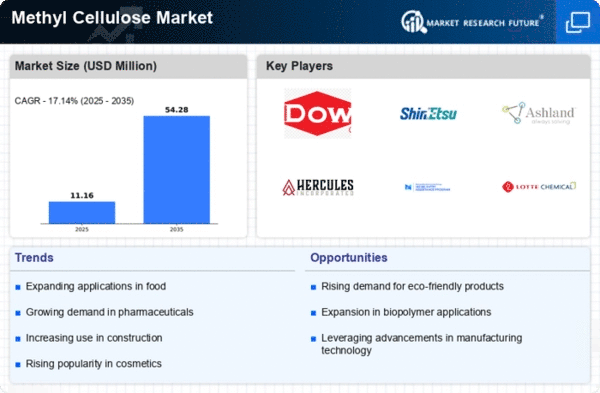
As per MRFR analysis, the Methyl Cellulose Market Size was estimated at 9.53 USD Million in 2024. The Methyl Cellulose industry is projected to grow from 11.16 USD Million in 2025 to 54.28 USD Million by 2035, exhibiting a compound annual growth rate (CAGR) of 17.14 during the forecast period 2025 - 2035.

Key Market Trends & Highlights

The Methyl Cellulose Market is poised for substantial growth driven by diverse applications and increasing sustainability efforts.

  • The market is experiencing a notable shift towards sustainability, influencing product development and consumer preferences.
  • North America remains the largest market for methyl cellulose, while Asia-Pacific is emerging as the fastest-growing region.
  • The construction segment leads in market share, whereas the pharmaceutical segment is witnessing rapid growth due to innovative applications.
  • Key drivers include rising demand in the construction sector and technological advancements in manufacturing processes.

Market Size & Forecast

2024 Market Size 9.53 (USD Million)
2035 Market Size 54.28 (USD Million)
CAGR (2025 - 2035) 17.14%
Largest Regional Market Share in 2024 North America

Major Players

Dow Chemical Company (US), Shin-Etsu Chemical Co., Ltd. (JP), Ashland Global Holdings Inc. (US), Hercules Chemical Company (US), MCC (Methyl Cellulose Company) (DE), Lotte Chemical Corporation (KR), Nippon Synthetic Chemical Industry Co., Ltd. (JP), Celanese Corporation (US)

Market Trends

The Methyl Cellulose Market is currently experiencing a notable transformation, driven by various factors that influence its demand and application across multiple industries. This versatile compound, known for its thickening, binding, and emulsifying properties, finds extensive use in construction, food, pharmaceuticals, and personal care products. As sustainability becomes a focal point for many sectors, the market appears to be shifting towards more eco-friendly formulations, which may enhance the appeal of methyl cellulose as a natural alternative to synthetic additives. Furthermore, the increasing trend of plant-based and gluten-free products in the food industry suggests a growing preference for methyl cellulose as a stabilizer and texture enhancer, potentially expanding its market reach. In addition to the food sector, the construction industry is likely to witness a surge in the utilization of methyl cellulose in various applications, such as tile adhesives and mortar. This trend may be attributed to the compound's ability to improve workability and water retention, which are essential for high-performance building materials. Moreover, the pharmaceutical sector's ongoing innovation in drug delivery systems indicates a promising future for methyl cellulose, as it serves as an effective excipient in controlled-release formulations. Overall, the Methyl Cellulose Market appears poised for growth, driven by evolving consumer preferences and advancements in technology.

Sustainability Focus

The Methyl Cellulose Market is increasingly aligning with sustainability initiatives, as manufacturers seek to develop eco-friendly products. This trend reflects a broader industry movement towards natural ingredients, which may enhance the market's appeal among environmentally conscious consumers.

Expansion in Food Applications

There is a noticeable increase in the use of methyl cellulose within the food sector, particularly in plant-based and gluten-free products. This trend suggests that methyl cellulose is becoming a preferred ingredient for enhancing texture and stability, thereby broadening its market presence.

Growth in Pharmaceutical Innovations

The pharmaceutical industry is likely to drive demand for methyl cellulose due to its role in advanced drug delivery systems. As research progresses, the compound's effectiveness as an excipient in controlled-release formulations may lead to further market expansion.

Methyl Cellulose Market Market Drivers

Growth in Food Industry

The Global Methyl Cellulose Market Industry benefits from the expanding food sector, where methyl cellulose is utilized as a food additive and thickening agent. It is particularly valued in the production of gluten-free products, which are gaining popularity among health-conscious consumers. As dietary preferences shift, the demand for gluten-free and low-calorie food products is expected to rise, potentially contributing to the market's growth. The food industry’s increasing focus on texture and stability in processed foods suggests that methyl cellulose will play a crucial role in meeting these evolving consumer demands.

Pharmaceutical Applications

The Global Methyl Cellulose Market Industry is significantly influenced by its applications in the pharmaceutical sector. Methyl cellulose is employed as a binder and thickening agent in various formulations, including tablets and topical creams. The ongoing advancements in drug delivery systems and the increasing prevalence of chronic diseases are likely to drive the demand for methyl cellulose in pharmaceuticals. As the industry evolves, the need for effective and safe excipients will likely enhance the market's growth, indicating a promising trajectory for methyl cellulose in this vital sector.

Rising Demand in Construction

The Global Methyl Cellulose Market Industry experiences a notable surge in demand due to its applications in construction materials, particularly in tile adhesives and cement-based products. Methyl cellulose serves as a thickener and water-retaining agent, enhancing the performance of these materials. As urbanization accelerates globally, the construction sector is projected to grow, driving the market value to approximately 1.83 USD Billion in 2024. This growth is indicative of the increasing reliance on advanced materials that improve durability and workability, suggesting a robust future for methyl cellulose in construction applications.

Environmental Sustainability Trends

The Global Methyl Cellulose Market Industry is positively impacted by the growing emphasis on environmental sustainability. Methyl cellulose, being a plant-derived product, aligns with the increasing demand for eco-friendly materials across various industries. As consumers and manufacturers alike prioritize sustainable practices, the adoption of methyl cellulose in applications such as biodegradable packaging and eco-friendly construction materials is expected to rise. This trend not only supports environmental goals but also positions methyl cellulose as a key player in the transition towards more sustainable industrial practices.

Technological Advancements in Production

The Global Methyl Cellulose Market Industry is poised for growth due to ongoing technological advancements in its production processes. Innovations that enhance the efficiency and quality of methyl cellulose manufacturing are likely to reduce costs and improve product availability. As production techniques evolve, the market is expected to witness a compound annual growth rate of 4.75% from 2025 to 2035. This growth reflects the industry's adaptability to changing market demands and the potential for methyl cellulose to penetrate new applications and markets, further solidifying its position in various sectors.

Market Segment Insights

By Application: Construction (Largest) vs. Pharmaceuticals (Fastest-Growing)

Within the Methyl Cellulose Market, the application distribution shows that construction holds the largest share due to its extensive use as a thickener and binder in cement and drywall applications. Following closely are pharmaceuticals, food and beverage, personal care, and paints and coatings, each contributing to the market with diverse functionalities that include stabilizers and emulsifying agents.

Construction: Dominant vs. Pharmaceuticals: Emerging

The construction segment of the Methyl Cellulose Market is characterized by its vast consumption in various building materials, making it the dominant sector. Its role as a binder adds critical value in enhancing the durability and workability of construction products. In contrast, the pharmaceuticals segment is emerging rapidly, driven by increasing demand for drug formulations and personalized medicines. Methyl cellulose's unique properties as an excipient support its application in creating controlled-release formulations, gaining traction in innovative healthcare solutions.

By End Use: Building Materials (Largest) vs. Pharmaceuticals (Fastest-Growing)

The Methyl Cellulose Market exhibits a diverse range of applications, with Building Materials holding the largest share due to its critical role as a binder and thickener in construction products. The strong demand for sustainable building solutions and innovations in construction technology further bolster this segment’s prominence. Conversely, Pharmaceuticals is emerging as the fastest-growing segment, driven by the increased utilization of methyl cellulose in drug formulations and as a stabilizing agent in vaccines, underscoring the compound's versatility and importance in healthcare.

Building Materials (Dominant) vs. Pharmaceuticals (Emerging)

The Building Materials segment dominates the Methyl Cellulose Market due to its essential characteristics such as enhancing workability, providing excellent water retention, and improving the adhesion properties of mortars and tiles. This segment benefits from increased construction activities and the trend towards green building materials, ensuring steady demand. On the other hand, the Pharmaceuticals segment is rapidly emerging as a key player within the market, propelled by innovations in drug delivery systems and the need for better efficacy and solubility in medicinal formulations. The versatility of methyl cellulose in this domain allows for a variety of applications, including as a thickening agent in ointments and a suspending agent in oral solutions.

By Type: Hydroxypropyl Methylcellulose (Largest) vs. Methylcellulose (Fastest-Growing)

The Methyl Cellulose Market is significantly influenced by various types, with Hydroxypropyl Methylcellulose (HPMC) holding the largest share. This segment is favored for its versatility in pharmaceuticals, food, and cosmetics, making it a key player in market dynamics. Methylcellulose, while smaller in share, is rapidly gaining traction due to its unique properties and applications, particularly in construction, where it serves as a stabilizer and thickening agent. Growth trends in the Methyl Cellulose Market indicate a rising demand for eco-friendly and multifunctional additives. The increasing application scope of these compounds in various industries is a significant driver, particularly in the food, pharmaceutical, and personal care sectors. Innovations in product formulations and increased awareness of the benefits of methyl cellulose derivatives continue to accelerate growth, with Methylcellulose emerging as a fast-growing segment in this vibrant market.

Hydroxypropyl Methylcellulose (Dominant) vs. Methylcellulose (Emerging)

Hydroxypropyl Methylcellulose (HPMC) stands out as the dominant force in the Methyl Cellulose Market, primarily due to its extensive applications across various sectors. Its highly soluble nature and ability to form gels make it an essential ingredient in the food industry for texture and stabilization. In contrast, Methylcellulose, while traditionally regarded as a base polymer, is emerging rapidly due to its unique properties such as non-toxicity and biodegradable nature, appealing to the environmentally conscious market. The versatility of both HPMC and Methylcellulose underlines their importance; HPMC is primarily used in specialized pharmaceutical formulations and food products, while Methylcellulose is gaining traction in construction and personal care products.

By Formulation: Powder (Largest) vs. Granules (Fastest-Growing)

In the Methyl Cellulose Market, the formulation segment is characterized by a diverse product range, including powder, granules, liquid, gel, and paste. Among these, powdered methyl cellulose holds the largest market share, primarily due to its wide range of applications in construction, food, and pharmaceutical industries. Granules have emerged as the fastest-growing form, driven by their convenience and efficacy in various formulations, including food additives and personal care products.

Powder (Dominant) vs. Granules (Emerging)

Powdered methyl cellulose dominates the formulation segment due to its versatility, ease of use, and strong customer preference. It is heavily utilized across multiple sectors such as construction for its binding properties, in food as a thickener, and in pharmaceuticals for drug formulation. On the other hand, granules are recognized as an emerging format, gaining traction for their superior solubility and reduced dusting compared to powders. This makes them particularly attractive for applications where clean handling is crucial, thus catering to a growing demand in specific end-user industries.

By Functionality: Thickening Agent (Largest) vs. Emulsifier (Fastest-Growing)

In the Methyl Cellulose Market, the functionality segment showcases a notable distribution among various applications, with thickening agents holding the largest share. These agents are crucial in multiple industries, including food, cosmetics, and pharmaceuticals, contributing significantly to their market presence. The emulsifier segment, while smaller in market share, displays a fast-growing trend, driven by the rising demand for stable formulations in food products and personal care items that require enhanced texture and consistency.

Thickening Agent (Dominant) vs. Emulsifier (Emerging)

Thickening agents are a dominant component of the methyl cellulose market, known for their ability to increase viscosity and stabilize formulations across food, cosmetic, and pharmaceutical applications. They play a pivotal role in improving texture and overall product quality. On the other hand, emulsifiers, although classified as an emerging segment, have been gaining traction due to the increasing consumer demand for clean-label products and the growth of the food and beverages sector. Their ability to blend oil and water phases effectively is increasingly sought after, positioning them for rapid growth as more manufacturers seek to innovate and improve the shelf-life and stability of their products.

Get more detailed insights about Methyl Cellulose Market Research Report - Forecast to 2035

Regional Insights

North America : Market Leader in Methyl Cellulose

North America is poised to maintain its leadership in the methyl cellulose market, holding a significant market share of 4.76 in 2024. The region's growth is driven by increasing demand in construction, food, and pharmaceuticals, alongside stringent regulations promoting the use of eco-friendly materials. The rising trend towards sustainable products is further catalyzing market expansion, as manufacturers adapt to consumer preferences for natural ingredients. The competitive landscape in North America is robust, featuring key players such as Dow Chemical Company, Ashland Global Holdings, and Celanese Corporation. These companies are investing in R&D to innovate and enhance product offerings. The U.S. remains the largest market, supported by a strong manufacturing base and advanced technology. The presence of established firms ensures a dynamic market environment, fostering competition and growth.

Europe : Emerging Market with Growth Potential

Europe's methyl cellulose market is on an upward trajectory, with a market size of 2.85 in 2024. The growth is fueled by increasing applications in the construction and food industries, alongside regulatory support for sustainable materials. The European Union's commitment to environmental sustainability is driving demand for bio-based products, which is expected to further enhance market growth in the coming years. Leading countries in this region include Germany, France, and the UK, where major players like MCC and Shin-Etsu Chemical are actively expanding their operations. The competitive landscape is characterized by innovation and strategic partnerships, as companies seek to leverage technological advancements. The presence of stringent regulations ensures that only high-quality products are available in the market, fostering consumer trust and driving sales.

Asia-Pacific : Rapidly Growing Market Segment

The Asia-Pacific region is witnessing significant growth in the methyl cellulose market, with a market size of 1.92 in 2024. This growth is primarily driven by the booming construction and food sectors, alongside rising consumer awareness regarding health and wellness. Regulatory frameworks in countries like China and India are increasingly supporting the use of methyl cellulose in various applications, enhancing its market appeal. Key players in this region include Lotte Chemical and Nippon Synthetic Chemical, which are focusing on expanding their production capacities to meet rising demand. Countries such as China and India are leading the market, supported by rapid industrialization and urbanization. The competitive landscape is evolving, with companies investing in innovation to capture a larger market share and cater to diverse consumer needs.

Middle East and Africa : Untapped Market Potential

The Middle East and Africa region currently represents an untapped market for methyl cellulose, with a market size of 0.0 in 2024. Despite this, there is potential for growth driven by increasing construction activities and a rising demand for food additives. The region's regulatory environment is gradually evolving, which may support the introduction of methyl cellulose in various applications, particularly in the food and pharmaceutical sectors. Countries like South Africa and the UAE are expected to lead the market as they invest in infrastructure development and modernization. The competitive landscape is still developing, with few key players currently operating. However, as awareness of the benefits of methyl cellulose grows, new entrants may emerge, creating opportunities for market expansion and innovation.

Key Players and Competitive Insights

The Methyl Cellulose Market is currently characterized by a dynamic competitive landscape, driven by increasing demand across various sectors such as construction, food, and pharmaceuticals. Key players are actively engaging in strategies that emphasize innovation, regional expansion, and sustainability. For instance, Dow Chemical Company (US) has been focusing on enhancing its product portfolio through research and development initiatives aimed at creating more sustainable and efficient methyl cellulose products. Similarly, Ashland Global Holdings Inc. (US) has positioned itself as a leader in specialty chemicals, leveraging its extensive distribution network to penetrate emerging markets, thereby shaping the competitive environment through strategic market positioning.In terms of business tactics, companies are increasingly localizing manufacturing to reduce lead times and optimize supply chains. The Methyl Cellulose Market appears moderately fragmented, with several key players exerting considerable influence. This structure allows for a diverse range of products and innovations, as companies strive to differentiate themselves in a competitive landscape. The collective influence of these major players fosters a competitive atmosphere where agility and responsiveness to market demands are paramount.

In November Shin-Etsu Chemical Co., Ltd. (Japan) announced a strategic partnership with a leading construction firm to develop advanced building materials incorporating methyl cellulose. This collaboration is expected to enhance the performance of construction materials, aligning with the growing trend towards sustainable building practices. The strategic importance of this partnership lies in its potential to position Shin-Etsu as a frontrunner in the construction sector, capitalizing on the increasing demand for eco-friendly solutions.

In October Celanese Corporation (US) unveiled a new line of methyl cellulose products designed specifically for the food industry, focusing on clean label applications. This move is indicative of the company's commitment to innovation and responsiveness to consumer trends favoring natural ingredients. The introduction of these products not only strengthens Celanese's market position but also reflects a broader industry shift towards health-conscious formulations.

In September Lotte Chemical Corporation (South Korea) expanded its production capacity for methyl cellulose in response to rising global demand. This expansion is strategically significant as it enables Lotte to enhance its supply chain reliability and meet the needs of various industries more effectively. Such capacity increases are crucial in a market where demand fluctuations can significantly impact operational efficiency.

As of December the Methyl Cellulose Market is witnessing trends that emphasize digitalization, sustainability, and the integration of AI technologies. Strategic alliances are increasingly shaping the competitive landscape, allowing companies to pool resources and expertise to drive innovation. The shift from price-based competition to a focus on technological advancements and supply chain reliability is becoming evident. Moving forward, competitive differentiation will likely hinge on the ability to innovate and adapt to evolving market demands, with a strong emphasis on sustainability and efficiency.

Key Companies in the Methyl Cellulose Market include

Industry Developments

Future Outlook

Methyl Cellulose Market Future Outlook

The Methyl Cellulose Market is projected to grow at a 17.14% CAGR from 2025 to 2035, driven by increasing demand in construction, food, and pharmaceuticals.

New opportunities lie in:

  • Development of eco-friendly methyl cellulose products for sustainable construction applications.
  • Expansion into emerging markets with tailored formulations for local industries.
  • Investment in advanced manufacturing technologies to enhance production efficiency and reduce costs.

By 2035, the Methyl Cellulose Market is expected to achieve substantial growth, solidifying its global presence.

Market Segmentation

Methyl Cellulose Market Type Outlook

  • Hydroxypropyl Methylcellulose
  • Methylcellulose
  • Carboxymethylcellulose
  • Ethyl Methylcellulose
  • Hydroxyethyl Methylcellulose

Methyl Cellulose Market End Use Outlook

  • Building Materials
  • Cosmetics
  • Food Products
  • Pharmaceutical Products
  • Industrial Applications

Methyl Cellulose Market Application Outlook

  • Construction
  • Pharmaceuticals
  • Food and Beverage
  • Personal Care
  • Paints and Coatings

Methyl Cellulose Market Formulation Outlook

  • Powder
  • Granules
  • Liquid
  • Gel
  • Paste

Methyl Cellulose Market Functionality Outlook

  • Thickening Agent
  • Emulsifier
  • Stabilizer
  • Film Former
  • Binder

Report Scope

MARKET SIZE 20249.53(USD Million)
MARKET SIZE 202511.16(USD Million)
MARKET SIZE 203554.28(USD Million)
COMPOUND ANNUAL GROWTH RATE (CAGR)17.14% (2025 - 2035)
REPORT COVERAGERevenue Forecast, Competitive Landscape, Growth Factors, and Trends
BASE YEAR2024
Market Forecast Period2025 - 2035
Historical Data2019 - 2024
Market Forecast UnitsUSD Million
Key Companies ProfiledDow Chemical Company (US), Shin-Etsu Chemical Co., Ltd. (JP), Ashland Global Holdings Inc. (US), Hercules Chemical Company (US), MCC (Methyl Cellulose Company) (DE), Lotte Chemical Corporation (KR), Nippon Synthetic Chemical Industry Co., Ltd. (JP), Celanese Corporation (US)
Segments CoveredApplication, End Use, Type, Formulation, Functionality
Key Market OpportunitiesGrowing demand for sustainable and eco-friendly additives in the Methyl Cellulose Market presents significant opportunities.
Key Market DynamicsRising demand for sustainable building materials drives innovation in the Methyl Cellulose Market.
Countries CoveredNorth America, Europe, APAC, South America, MEA

FAQs

At what CAGR is the Methyl Cellulose Market predicted to grow during the forecast period?

Methyl Cellulose Market is predicted to grow at 4.5% through forecast period of 2025-2035.

What is the forecast period of Methyl Cellulose Market research report?

The forecast period for Methyl Cellulose Market research report is 2025-2035.

Which region will lead the global Methyl Cellulose Market?

Global Methyl Cellulose Market is dominated by APAC region.

  1. SECTION I: EXECUTIVE SUMMARY AND KEY HIGHLIGHTS
    1. | 1.1 EXECUTIVE SUMMARY
    2. | 1.1.1 Market Overview
    3. | 1.1.2 Key Findings
    4. | 1.1.3 Market Segmentation
    5. | 1.1.4 Competitive Landscape
    6. | 1.1.5 Challenges and Opportunities
    7. | 1.1.6 Future Outlook
  2. SECTION II: SCOPING, METHODOLOGY AND MARKET STRUCTURE
    1. | 2.1 MARKET INTRODUCTION
    2. | 2.1.1 Definition
    3. | 2.1.2 Scope of the study
    4. |-- 2.1.2.1 Research Objective
    5. |-- 2.1.2.2 Assumption
    6. |-- 2.1.2.3 Limitations
    7. | 2.2 RESEARCH METHODOLOGY
    8. | 2.2.1 Overview
    9. | 2.2.2 Data Mining
    10. | 2.2.3 Secondary Research
    11. | 2.2.4 Primary Research
    12. |-- 2.2.4.1 Primary Interviews and Information Gathering Process
    13. |-- 2.2.4.2 Breakdown of Primary Respondents
    14. | 2.2.5 Forecasting Model
    15. | 2.2.6 Market Size Estimation
    16. |-- 2.2.6.1 Bottom-Up Approach
    17. |-- 2.2.6.2 Top-Down Approach
    18. | 2.2.7 Data Triangulation
    19. | 2.2.8 Validation
  3. SECTION III: QUALITATIVE ANALYSIS
    1. | 3.1 MARKET DYNAMICS
    2. | 3.1.1 Overview
    3. | 3.1.2 Drivers
    4. | 3.1.3 Restraints
    5. | 3.1.4 Opportunities
    6. | 3.2 MARKET FACTOR ANALYSIS
    7. | 3.2.1 Value chain Analysis
    8. | 3.2.2 Porter's Five Forces Analysis
    9. |-- 3.2.2.1 Bargaining Power of Suppliers
    10. |-- 3.2.2.2 Bargaining Power of Buyers
    11. |-- 3.2.2.3 Threat of New Entrants
    12. |-- 3.2.2.4 Threat of Substitutes
    13. |-- 3.2.2.5 Intensity of Rivalry
    14. | 3.2.3 COVID-19 Impact Analysis
    15. |-- 3.2.3.1 Market Impact Analysis
    16. |-- 3.2.3.2 Regional Impact
    17. |-- 3.2.3.3 Opportunity and Threat Analysis
  4. SECTION IV: QUANTITATIVE ANALYSIS
    1. | 4.1 Chemicals and Materials, BY Application (USD Million)
    2. | 4.1.1 Construction
    3. | 4.1.2 Pharmaceuticals
    4. | 4.1.3 Food and Beverage
    5. | 4.1.4 Personal Care
    6. | 4.1.5 Paints and Coatings
    7. | 4.2 Chemicals and Materials, BY End Use (USD Million)
    8. | 4.2.1 Building Materials
    9. | 4.2.2 Cosmetics
    10. | 4.2.3 Food Products
    11. | 4.2.4 Pharmaceutical Products
    12. | 4.2.5 Industrial Applications
    13. | 4.3 Chemicals and Materials, BY Type (USD Million)
    14. | 4.3.1 Hydroxypropyl Methylcellulose
    15. | 4.3.2 Methylcellulose
    16. | 4.3.3 Carboxymethylcellulose
    17. | 4.3.4 Ethyl Methylcellulose
    18. | 4.3.5 Hydroxyethyl Methylcellulose
    19. | 4.4 Chemicals and Materials, BY Formulation (USD Million)
    20. | 4.4.1 Powder
    21. | 4.4.2 Granules
    22. | 4.4.3 Liquid
    23. | 4.4.4 Gel
    24. | 4.4.5 Paste
    25. | 4.5 Chemicals and Materials, BY Functionality (USD Million)
    26. | 4.5.1 Thickening Agent
    27. | 4.5.2 Emulsifier
    28. | 4.5.3 Stabilizer
    29. | 4.5.4 Film Former
    30. | 4.5.5 Binder
    31. | 4.6 Chemicals and Materials, BY Region (USD Million)
    32. | 4.6.1 North America
    33. |-- 4.6.1.1 US
    34. |-- 4.6.1.2 Canada
    35. | 4.6.2 Europe
    36. |-- 4.6.2.1 Germany
    37. |-- 4.6.2.2 UK
    38. |-- 4.6.2.3 France
    39. |-- 4.6.2.4 Russia
    40. |-- 4.6.2.5 Italy
    41. |-- 4.6.2.6 Spain
    42. |-- 4.6.2.7 Rest of Europe
    43. | 4.6.3 APAC
    44. |-- 4.6.3.1 China
    45. |-- 4.6.3.2 India
    46. |-- 4.6.3.3 Japan
    47. |-- 4.6.3.4 South Korea
    48. |-- 4.6.3.5 Malaysia
    49. |-- 4.6.3.6 Thailand
    50. |-- 4.6.3.7 Indonesia
    51. |-- 4.6.3.8 Rest of APAC
    52. | 4.6.4 South America
    53. |-- 4.6.4.1 Brazil
    54. |-- 4.6.4.2 Mexico
    55. |-- 4.6.4.3 Argentina
    56. |-- 4.6.4.4 Rest of South America
    57. | 4.6.5 MEA
    58. |-- 4.6.5.1 GCC Countries
    59. |-- 4.6.5.2 South Africa
    60. |-- 4.6.5.3 Rest of MEA
  5. SECTION V: COMPETITIVE ANALYSIS
    1. | 5.1 Competitive Landscape
    2. | 5.1.1 Overview
    3. | 5.1.2 Competitive Analysis
    4. | 5.1.3 Market share Analysis
    5. | 5.1.4 Major Growth Strategy in the Chemicals and Materials
    6. | 5.1.5 Competitive Benchmarking
    7. | 5.1.6 Leading Players in Terms of Number of Developments in the Chemicals and Materials
    8. | 5.1.7 Key developments and growth strategies
    9. |-- 5.1.7.1 New Product Launch/Service Deployment
    10. |-- 5.1.7.2 Merger & Acquisitions
    11. |-- 5.1.7.3 Joint Ventures
    12. | 5.1.8 Major Players Financial Matrix
    13. |-- 5.1.8.1 Sales and Operating Income
    14. |-- 5.1.8.2 Major Players R&D Expenditure. 2023
    15. | 5.2 Company Profiles
    16. | 5.2.1 Dow Chemical Company (US)
    17. |-- 5.2.1.1 Financial Overview
    18. |-- 5.2.1.2 Products Offered
    19. |-- 5.2.1.3 Key Developments
    20. |-- 5.2.1.4 SWOT Analysis
    21. |-- 5.2.1.5 Key Strategies
    22. | 5.2.2 Shin-Etsu Chemical Co., Ltd. (JP)
    23. |-- 5.2.2.1 Financial Overview
    24. |-- 5.2.2.2 Products Offered
    25. |-- 5.2.2.3 Key Developments
    26. |-- 5.2.2.4 SWOT Analysis
    27. |-- 5.2.2.5 Key Strategies
    28. | 5.2.3 Ashland Global Holdings Inc. (US)
    29. |-- 5.2.3.1 Financial Overview
    30. |-- 5.2.3.2 Products Offered
    31. |-- 5.2.3.3 Key Developments
    32. |-- 5.2.3.4 SWOT Analysis
    33. |-- 5.2.3.5 Key Strategies
    34. | 5.2.4 Hercules Chemical Company (US)
    35. |-- 5.2.4.1 Financial Overview
    36. |-- 5.2.4.2 Products Offered
    37. |-- 5.2.4.3 Key Developments
    38. |-- 5.2.4.4 SWOT Analysis
    39. |-- 5.2.4.5 Key Strategies
    40. | 5.2.5 MCC (Methyl Cellulose Company) (DE)
    41. |-- 5.2.5.1 Financial Overview
    42. |-- 5.2.5.2 Products Offered
    43. |-- 5.2.5.3 Key Developments
    44. |-- 5.2.5.4 SWOT Analysis
    45. |-- 5.2.5.5 Key Strategies
    46. | 5.2.6 Lotte Chemical Corporation (KR)
    47. |-- 5.2.6.1 Financial Overview
    48. |-- 5.2.6.2 Products Offered
    49. |-- 5.2.6.3 Key Developments
    50. |-- 5.2.6.4 SWOT Analysis
    51. |-- 5.2.6.5 Key Strategies
    52. | 5.2.7 Nippon Synthetic Chemical Industry Co., Ltd. (JP)
    53. |-- 5.2.7.1 Financial Overview
    54. |-- 5.2.7.2 Products Offered
    55. |-- 5.2.7.3 Key Developments
    56. |-- 5.2.7.4 SWOT Analysis
    57. |-- 5.2.7.5 Key Strategies
    58. | 5.2.8 Celanese Corporation (US)
    59. |-- 5.2.8.1 Financial Overview
    60. |-- 5.2.8.2 Products Offered
    61. |-- 5.2.8.3 Key Developments
    62. |-- 5.2.8.4 SWOT Analysis
    63. |-- 5.2.8.5 Key Strategies
    64. | 5.3 Appendix
    65. | 5.3.1 References
    66. | 5.3.2 Related Reports

Chemicals and Materials Market Segmentation

Chemicals and Materials By Application (USD Million, 2025-2035)

  • Construction
  • Pharmaceuticals
  • Food and Beverage
  • Personal Care
  • Paints and Coatings

Chemicals and Materials By End Use (USD Million, 2025-2035)

  • Building Materials
  • Cosmetics
  • Food Products
  • Pharmaceutical Products
  • Industrial Applications

Chemicals and Materials By Type (USD Million, 2025-2035)

  • Hydroxypropyl Methylcellulose
  • Methylcellulose
  • Carboxymethylcellulose
  • Ethyl Methylcellulose
  • Hydroxyethyl Methylcellulose

Chemicals and Materials By Formulation (USD Million, 2025-2035)

  • Powder
  • Granules
  • Liquid
  • Gel
  • Paste

Chemicals and Materials By Functionality (USD Million, 2025-2035)

  • Thickening Agent
  • Emulsifier
  • Stabilizer
  • Film Former
  • Binder
Infographic

Free Sample Request

Kindly complete the form below to receive a free sample of this Report

Get Free Sample

Customer Strories

Compare Licence

×
Features License Type
Single User Multiuser License Enterprise User
Price $4,950 $5,950 $7,250
Maximum User Access Limit 1 User Upto 10 Users Unrestricted Access Throughout the Organization
Free Customization
Direct Access to Analyst
Deliverable Format
Platform Access
Discount on Next Purchase 10% 15% 15%
Printable Versions