Request Free Sample ×

Kindly complete the form below to receive a free sample of this Report

* Please use a valid business email

Leading companies partner with us for data-driven Insights

clients tt-cursor
Hero Background
English
Chinese
French
Japanese
Korean
German
Spanish

Men Hair Color Market Trends

ID: MRFR/CG/7959-CR
128 Pages
Snehal Singh
February 2021

Men’s Hair Color Market Size, Share, Industry Trend & Analysis Research Report Information By Product Type (Permanent, Semi-Permanent Hair Color, Temporary Hair Color and Root Touch-Up), Category (Conventional, Natural & Organic), By Distribution Channel (Store-Based And Non-Store-Based) And By Region (North America, Europe, Asia-Pacific, And Rest Of The World) – Forecast Till 2035

Share:
Download PDF ×

We do not share your information with anyone. However, we may send you emails based on your report interest from time to time. You may contact us at any time to opt-out.

Men Hair Color Market Infographic
Purchase Options

Market Trends

Key Emerging Trends in the Men Hair Color Market

The men's hair color market has gone through a striking transformation lately, reflecting changing attitudes towards grooming and self-expression among men. One significant pattern that has picked up speed is the increasing acknowledgment and reception of variable hair colors by men. Customarily, men would in general stick to natural shades, however there has been a perceptible shift towards striking and lively colors. This shift can be credited to a more extensive social shift towards embracing singularity and departing from customary gender norms. One more essential pattern in the men's hair color market is the developing prevalence of impermanent and semi-extremely durable color products. Men are increasingly seeking ways to experiment with their hair without focusing on a super durable change. Impermanent colors offer a speedy and easy method for transforming one's appearance without the drawn-out commitment. This pattern aligns with the contemporary lifestyle, where individuals seek adaptability and versatility in their personal grooming choices. Besides, the impact of social media and superstar culture has assumed a critical part in shaping men's hair color trends. Men are presently more inspired by the diverse hairstyles and colors showcased by influencers, actors, and musicians. The visibility of these trends on social platforms has added to an elevated awareness and acknowledgment of various hair color options among men. Interestingly, the men's hair color market has witnessed a surge in demand for products that cater specifically to the needs of men, including formulations designed to address the one-of-a-kind surface and texture of men's hair. This specialization in item development demonstrates a developing acknowledgment inside the industry of the distinct requirements of male consumers. Men are presently seeking personalized solutions that give energetic color as well as take care of the specific characteristics of their hair.


Author
Author Profile
Snehal Singh
Manager - Research

High acumen in analyzing complex macro & micro markets with more than 6 years of work experience in the field of market research. By implementing her analytical skills in forecasting and estimation into market research reports, she has expertise in Packaging, Construction, and Equipment domains. She handles a team size of 20-25 resources and ensures smooth running of the projects, associated marketing activities, and client servicing.

Leave a Comment

FAQs

What is the current valuation of the Men's Hair Color Market as of 2024?

<p>The Men's Hair Color Market was valued at 0.5679 USD Billion in 2024.</p>

What is the projected market size for the Men's Hair Color Market in 2035?

<p>The market is projected to reach 1.119 USD Billion by 2035.</p>

What is the expected CAGR for the Men's Hair Color Market during the forecast period 2025 - 2035?

<p>The expected CAGR for the Men's Hair Color Market during 2025 - 2035 is 6.36%.</p>

Which product type segment had the highest valuation in 2024?

<p>In 2024, the Permanent Hair Color segment had the highest valuation at 0.2279 USD Billion.</p>

How does the valuation of Semi-Permanent Hair Color compare to Temporary Hair Color in 2024?

<p>In 2024, Semi-Permanent Hair Color was valued at 0.1359 USD Billion, while Temporary Hair Color was valued at 0.0679 USD Billion.</p>

What are the projected valuations for the Conventional and Natural categories by 2035?

<p>By 2035, the Conventional category is projected to reach 0.65 USD Billion, while the Natural category is expected to reach 0.35 USD Billion.</p>

What distribution channel is anticipated to grow more rapidly from 2025 to 2035?

<p>The Non-Store-Based distribution channel, valued at 0.2279 USD Billion in 2024, is anticipated to grow more rapidly than Store-Based.</p>

Which key players are leading the Men's Hair Color Market?

<p>Key players in the Men's Hair Color Market include L'Oreal, Procter & Gamble, Revlon, and Henkel.</p>

What is the valuation of the Root Touch-Up segment in 2024?

<p>The Root Touch-Up segment was valued at 0.1362 USD Billion in 2024.</p>

How does the Organic category's valuation in 2024 compare to the projected valuation in 2035?

<p>The Organic category was valued at 0.0779 USD Billion in 2024 and is projected to grow to 0.119 USD Billion by 2035.</p>

Market Summary

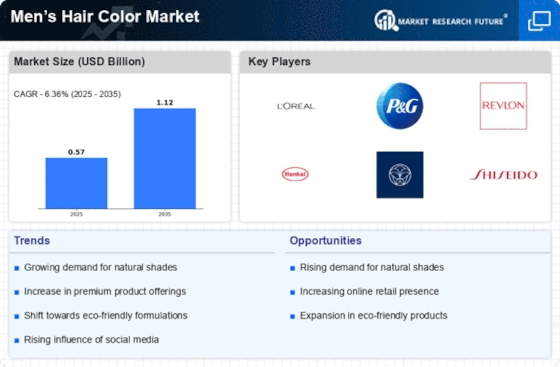
As per Market Research Future analysis, the Men’s Hair Color Market Size was estimated at 0.5679 USD Billion in 2024. The Men’s Hair Color industry is projected to grow from 0.604 USD Billion in 2025 to 1.119 USD Billion by 2035, exhibiting a compound annual growth rate (CAGR) of 6.36% during the forecast period 2025 - 2035

Key Market Trends & Highlights

The Men’s Hair Color Market is experiencing a dynamic shift towards natural and sustainable products, driven by changing consumer preferences.

  • The demand for natural shades in men's hair color is on the rise, reflecting a broader trend towards authenticity and personal expression. Sustainability in hair color products is becoming increasingly important, with consumers favoring eco-friendly and organic options. Social media continues to play a pivotal role in shaping men's grooming habits, influencing trends and product choices. The growing acceptance of hair color among men, coupled with diverse product offerings, is driving market expansion, particularly in the North American and Asia-Pacific regions.

Market Size & Forecast

2024 Market Size 0.5679 (USD Billion)
2035 Market Size 1.119 (USD Billion)
CAGR (2025 - 2035) 6.36%
Largest Regional Market Share in 2024 North America

Major Players

<a href="https://www.loreal-paris.fr/">L'Oreal (FR),</a> Procter &amp; Gamble (US), Revlon (US), <a href="https://www.henkel.com/">Henkel (DE)</a>, Coty (US), Shiseido (JP), Unilever (GB), American Crew (US), Just For Men (US)

Market Trends

The Men’s Hair Color Market is currently experiencing a notable transformation, driven by evolving consumer preferences and increasing awareness regarding personal grooming. As societal norms shift, more men are embracing hair color as a means of self-expression and style enhancement. This trend appears to be fueled by a growing acceptance of diverse aesthetics, where men are no longer confined to traditional notions of masculinity. Consequently, brands are responding by diversifying their product offerings, catering to a wider range of shades and formulations that appeal to this expanding demographic. Moreover, the rise of social media and influencer culture seems to play a pivotal role in shaping consumer behavior within the Men’s Hair Color Market. Men are increasingly exposed to various styles and color options through platforms that promote individuality and creativity. This exposure may lead to a greater willingness to experiment with hair color, thereby driving demand for innovative products. As the market continues to evolve, it is likely that brands will focus on sustainability and natural ingredients, aligning with the broader trend of conscious consumerism. This shift could further enhance the appeal of hair color products among environmentally aware consumers, indicating a promising future for the Men’s Hair Color Market.

Rise of Natural Shades

There is a noticeable trend towards natural-looking hair colors among men. Consumers appear to prefer shades that mimic their original hair color, allowing for a subtle enhancement rather than a dramatic change. This inclination suggests a desire for authenticity and a more understated approach to grooming.

Sustainability in Products

Sustainability is becoming increasingly relevant in the Men’s Hair Color Market. Brands are likely to prioritize eco-friendly ingredients and packaging, appealing to environmentally conscious consumers. This trend indicates a shift towards responsible consumption, where men seek products that align with their values.

Influence of Social Media

The impact of social media on grooming choices is profound. Men are exposed to a plethora of styles and color options through influencers and online platforms. This exposure may encourage experimentation with hair color, leading to a broader acceptance of diverse looks in the Men’s Hair Color Market.

Men Hair Color Market Market Drivers

Diverse Product Offerings

The Men’s Hair Color Market is characterized by a diverse range of product offerings, catering to various preferences and needs. From permanent to semi-permanent and temporary hair colors, brands are innovating to provide options that appeal to different consumer segments. The introduction of products that blend seamlessly with natural hair colors has gained traction, particularly among older men looking to cover gray hair. Market data shows that the semi-permanent segment is expected to witness a growth rate of 5% annually, indicating a shift towards less commitment in hair coloring. This diversity in offerings is likely to enhance consumer engagement and drive sales in the Men’s Hair Color Market.

Influence of Celebrity Endorsements

Celebrity endorsements play a pivotal role in shaping consumer behavior within the Men’s Hair Color Market. High-profile figures, including actors and musicians, are increasingly seen promoting hair color products, which significantly influences public perception and purchasing decisions. The visibility of these endorsements can lead to a surge in product demand, particularly among younger demographics who idolize these celebrities. Recent surveys indicate that nearly 40% of men are more likely to purchase a product endorsed by a celebrity they admire. This trend suggests that leveraging celebrity influence could be a strategic approach for brands aiming to capture a larger share of the Men’s Hair Color Market.

Growing Awareness of Personal Grooming

The Men’s Hair Color Market is benefiting from a growing awareness of personal grooming and self-care among men. As societal expectations evolve, more men are investing in their appearance, viewing grooming as an essential aspect of their lifestyle. This shift is reflected in the increasing sales of hair color products, with the market projected to reach USD 1.5 billion by 2026. The rise of grooming salons and specialized services further indicates a burgeoning interest in hair color among men. This heightened awareness is likely to sustain growth in the Men’s Hair Color Market, as more men seek to enhance their personal image through hair coloring.

Increasing Acceptance of Hair Color Among Men

The Men’s Hair Color Market is experiencing a notable shift in societal norms, with an increasing acceptance of hair coloring among men. This trend is driven by changing perceptions of masculinity and self-expression. As more men embrace hair color as a means of enhancing their appearance, the market is projected to grow. Recent data indicates that approximately 30% of men aged 18-34 have used hair color products, reflecting a significant rise in this demographic. This acceptance is likely to continue, suggesting a robust future for the Men’s Hair Color Market as it caters to a broader audience seeking to express individuality.

Technological Advancements in Hair Color Products

Technological advancements are significantly impacting the Men’s Hair Color Market, leading to the development of innovative products that cater to consumer needs. Formulations that minimize damage to hair while providing vibrant color options are becoming increasingly popular. Additionally, advancements in application techniques, such as easy-to-use kits for at-home coloring, are enhancing accessibility for consumers. Market Research Future suggests that the demand for ammonia-free and organic hair color products is on the rise, with a projected growth rate of 6% over the next five years. These technological innovations are likely to drive the Men’s Hair Color Market forward, appealing to health-conscious consumers seeking effective yet gentle hair color solutions.

Market Segment Insights

By Product Type: Permanent (Largest) vs. Semi-Permanent Hair Color (Fastest-Growing)

<p>In the Men’s Hair Color Market, the distribution of market share among product types is diverse. Permanent hair color dominates the market, driven by its long-lasting effects and the need for comprehensive gray coverage. Following closely is semi-permanent hair color, which has gained traction among consumers seeking less commitment, offering a balance between performance and convenience. Temporary hair color and root touch-up products occupy smaller yet significant portions of the market, catering to specific consumer needs and preferences.</p>

<p>Permanent (Dominant) vs. Semi-Permanent Hair Color (Emerging)</p>

<p>Permanent hair color products remain the dominant choice in the Men’s Hair Color Market. They are preferred for their extensive color range and enduring results, making them suitable for consumers looking for longevity. On the other hand, semi-permanent hair color is emerging rapidly, offering a viable solution for those who desire a temporary change or wish to experiment without permanent commitment. This segment appeals particularly to younger consumers and those who frequently change their hairstyles. Both segments showcase distinct characteristics, with permanent hair color focusing on coverage and durability, while semi-permanent options attract those seeking versatility and ease of use.</p>

By Category: Conventional (Largest) vs. Organic (Fastest-Growing)

<p>In the Men’s Hair Color Market, the category segment is dominated by Conventional hair color products, which account for a significant portion of the overall market. Conventional options are preferred due to their wide availability and range of color choices, catering to diverse consumer preferences. On the other hand, Natural and Organic hair color products are progressively gaining traction, especially among health-conscious consumers seeking safer and more environmentally friendly alternatives. Their growing market share reflects a shift towards more sustainable personal care choices. Recent trends indicate an increasing demand for Organic hair color products, which are recognized as the fastest-growing segment in the market. This growth is driven by rising awareness surrounding harmful chemicals in traditional hair dyes and a growing inclination towards clean beauty products. As consumers become more informed, the market is witnessing an acceleration in the adoption of Organic options, indicating a shift in consumer behavior and preferences that prioritize health and sustainability in personal grooming products.</p>

<p>Conventional (Dominant) vs. Organic (Emerging)</p>

<p>Conventional hair color products continue to reign supreme in the Men’s Hair Color Market, characterized by their affordability and variety, making them the go-to choice for many consumers. They are often formulated with synthetic chemicals that enhance color richness and longevity. This segment benefits from extensive marketing and established brand loyalty, which solidifies its dominance. However, the rise of Organic hair colors, which are often made from plant-based ingredients and free from harsh chemicals, represents a significant transformation in consumer preferences. As individuals become more aware of the benefits associated with using Organic products, this segment is witnessing rapid growth, attracting a younger demographic that prioritizes organic and clean ingredients. The competition is intensifying as brands strive to innovate and capture the changing market landscape.</p>

By Distribution Channel: Store-Based (Largest) vs. Non-Store-Based (Fastest-Growing)

<p>In the Men’s Hair Color Market, the distribution landscape is notably defined by store-based channels, which account for a substantial share of sales. These typically include supermarkets, drugstores, and salons where consumers can physically choose from a range of products. Conversely, non-store-based channels, including e-commerce platforms, are rapidly gaining traction among consumers seeking convenience and variety, though they currently account for a smaller portion of the market.</p>

<p>Distribution Channel: Store-Based (Dominant) vs. Non-Store-Based (Emerging)</p>

<p>The store-based distribution channel emerges as the dominant force in the Men’s Hair Color Market, largely due to customer preferences for tactile shopping experiences where the product can be seen and compared. This includes popular outlets such as pharmacies and supermarkets, which ensure accessibility and instant gratification for customers. Meanwhile, non-store-based channels are carving out their niche as the emerging segment, driven by the rise of online shopping and the increasing popularity of direct-to-consumer brands. As consumer habits shift toward digital platforms, the non-store-based segment is adapting by offering better online experiences and targeted marketing strategies to attract an audience eager for ease of purchase.</p>

Get more detailed insights about Men's Hair Color market Research Report - Global Forecast till 2035

Regional Insights

North America : Market Leader in Innovation

North America is the largest market for men’s hair color, holding approximately 40% of the global share. The growth is driven by increasing grooming awareness among men, coupled with a rise in the number of product offerings tailored for diverse hair types. Regulatory support for cosmetic safety and innovation further fuels market expansion. The U.S. is the primary contributor, followed by Canada, which accounts for about 10% of the market share. The competitive landscape in North America is robust, featuring key players like L'Oreal, Procter & Gamble, and Revlon. These companies leverage advanced marketing strategies and product innovations to capture consumer interest. The presence of established brands and a growing trend towards premium products are shaping the market dynamics, making it a hotbed for new entrants and innovations.

Europe : Emerging Trends and Regulations

Europe is witnessing significant growth in the men’s hair color market, accounting for approximately 30% of the global share. The demand is driven by changing societal norms regarding male grooming and increasing disposable incomes. Regulatory frameworks in the EU emphasize product safety and environmental sustainability, which are crucial for market players. Germany and the UK are the largest markets, together holding about 15% of the total market share. Leading countries in Europe include Germany, the UK, and France, with a competitive landscape featuring major players like Henkel and Coty. The market is characterized by a mix of established brands and niche players focusing on organic and natural products. The presence of innovative marketing strategies and collaborations with salons further enhances market penetration, catering to the evolving preferences of male consumers.

Asia-Pacific : Rapid Growth and Adoption

Asia-Pacific is rapidly emerging as a significant player in the men’s hair color market, holding around 25% of the global share. The growth is fueled by increasing urbanization, rising disposable incomes, and a growing acceptance of grooming products among men. Countries like China and India are leading this trend, with China alone accounting for nearly 15% of the market share, driven by a younger demographic eager to experiment with personal grooming. The competitive landscape in Asia-Pacific is diverse, with both international brands like Shiseido and local players gaining traction. The market is characterized by a surge in demand for innovative products, including temporary and semi-permanent hair colors. The presence of e-commerce platforms is also enhancing accessibility, allowing consumers to explore a wide range of options tailored to their preferences, thus driving market growth.

Middle East and Africa : Untapped Market Opportunities

The Middle East and Africa region is witnessing a gradual increase in the men’s hair color market, currently holding about 5% of the global share. The growth is primarily driven by changing perceptions of male grooming and increasing disposable incomes in urban areas. Countries like South Africa and the UAE are leading this trend, with a growing number of salons offering specialized services for men. Regulatory frameworks are evolving to support product safety and quality, which is essential for market growth. In this region, the competitive landscape is still developing, with local brands and international players like Unilever and American Crew making their mark. The market is characterized by a rising trend towards premium products and organic formulations, catering to the increasing demand for quality and safety. As awareness of grooming products continues to rise, the market is expected to expand significantly in the coming years.

Key Players and Competitive Insights

The Men’s Hair Color Market is currently characterized by a dynamic competitive landscape, driven by evolving consumer preferences and an increasing emphasis on personal grooming. Key players such as L'Oreal (FR), Procter & Gamble (US), and Just For Men (US) are strategically positioned to leverage innovation and brand loyalty. L'Oreal (FR) focuses on product diversification and sustainability, aiming to cater to a broader demographic, while Procter & Gamble (US) emphasizes digital marketing and e-commerce to enhance consumer engagement. Just For Men (US) has carved a niche by targeting specific age groups, particularly older men, with tailored products that address greying hair. Collectively, these strategies contribute to a competitive environment that is both fragmented and concentrated, with established brands vying for market share against emerging players.

In terms of business tactics, companies are increasingly localizing manufacturing to reduce costs and optimize supply chains. This approach not only enhances operational efficiency but also allows for quicker response times to market demands. The market structure appears moderately fragmented, with several key players dominating while numerous smaller brands cater to niche segments. The collective influence of these major companies shapes pricing strategies and product offerings, creating a competitive yet collaborative atmosphere.

In August 2025, L'Oreal (FR) announced a partnership with a leading tech firm to develop AI-driven hair color customization tools. This strategic move is likely to enhance consumer experience by providing personalized recommendations, thereby increasing customer satisfaction and loyalty. Such innovations may position L'Oreal (FR) as a frontrunner in the market, as personalization becomes a critical factor in consumer decision-making.

In September 2025, Procter & Gamble (US) launched a new line of eco-friendly hair color products, aligning with the growing consumer demand for sustainable options. This initiative not only reflects a commitment to environmental responsibility but also taps into a lucrative market segment that prioritizes sustainability. By integrating eco-friendly practices, Procter & Gamble (US) may strengthen its brand image and appeal to environmentally conscious consumers.

In July 2025, Just For Men (US) expanded its product line to include a range of temporary hair color solutions aimed at younger consumers. This strategic expansion is indicative of a shift towards catering to a broader audience, potentially attracting a demographic that seeks flexibility in hair color choices. By diversifying its offerings, Just For Men (US) could enhance its market presence and appeal to a younger, trend-focused consumer base.

As of October 2025, the Men’s Hair Color Market is witnessing significant trends such as digitalization, sustainability, and the integration of AI technologies. Strategic alliances among key players are shaping the competitive landscape, fostering innovation and collaboration. The shift from price-based competition to a focus on technological advancements and supply chain reliability is becoming increasingly evident. Moving forward, competitive differentiation will likely hinge on the ability to innovate and adapt to changing consumer preferences, with brands that prioritize sustainability and personalization poised to lead the market.

Key Companies in the Men Hair Color Market include

Industry Developments

For Instance, March 2023 Godrej Consumer Products Ltd. (GCPL), one of India's major hair color companies, has democratized the hair color sector in South India with a new shampoo hair color brand priced at INR 15.

In 2023, Beardo, a male grooming business, will debut a line of AMMONIA FREE Permanent Hair Colors, designed specifically for professional use in salon settings. Hair color is one of the most popular services in salons, hence it is believed that no company can be considered a legitimate salon brand unless it offers professional hair colors. The hair color category is now dominated by huge overseas competitors and only includes female brands.

For Instance, February 2022 BBlunt, based in Mumbai, was purchased by Mamaearth, a direct-to-consumer (D2C) business, from Godrej Consumer Products Limited (GCPL).

Future Outlook

Men Hair Color Market Future Outlook

The Men’s Hair Color Market is projected to grow at a 6.36% CAGR from 2024 to 2035, driven by increasing grooming trends, product innovation, and rising disposable incomes.

New opportunities lie in:

  • Expansion of subscription-based delivery services for hair color products.
  • Development of eco-friendly and organic hair color formulations.
  • Partnerships with barbershops for exclusive product lines and promotions.

By 2035, the Men’s Hair Color Market is expected to achieve substantial growth and diversification.

Market Segmentation

Men Hair Color Market Category Outlook

  • Conventional
  • Natural
  • Organic

Men Hair Color Market Product Type Outlook

  • Permanent
  • Semi-Permanent Hair Color
  • Temporary Hair Color
  • Root Touch-Up

Men Hair Color Market Distribution Channel Outlook

  • Store-Based
  • Non-Store-Based

Report Scope

MARKET SIZE 20240.5679(USD Billion)
MARKET SIZE 20250.604(USD Billion)
MARKET SIZE 20351.119(USD Billion)
COMPOUND ANNUAL GROWTH RATE (CAGR)6.36% (2024 - 2035)
REPORT COVERAGERevenue Forecast, Competitive Landscape, Growth Factors, and Trends
BASE YEAR2024
Market Forecast Period2025 - 2035
Historical Data2019 - 2024
Market Forecast UnitsUSD Billion
Key Companies ProfiledMarket analysis in progress
Segments CoveredMarket segmentation analysis in progress
Key Market OpportunitiesGrowing demand for natural and organic formulations in the Men’s Hair Color Market presents significant opportunities.
Key Market DynamicsRising consumer preference for natural ingredients drives innovation and competition in the Men’s Hair Color Market.
Countries CoveredNorth America, Europe, APAC, South America, MEA

FAQs

What is the current valuation of the Men's Hair Color Market as of 2024?

<p>The Men's Hair Color Market was valued at 0.5679 USD Billion in 2024.</p>

What is the projected market size for the Men's Hair Color Market in 2035?

<p>The market is projected to reach 1.119 USD Billion by 2035.</p>

What is the expected CAGR for the Men's Hair Color Market during the forecast period 2025 - 2035?

<p>The expected CAGR for the Men's Hair Color Market during 2025 - 2035 is 6.36%.</p>

Which product type segment had the highest valuation in 2024?

<p>In 2024, the Permanent Hair Color segment had the highest valuation at 0.2279 USD Billion.</p>

How does the valuation of Semi-Permanent Hair Color compare to Temporary Hair Color in 2024?

<p>In 2024, Semi-Permanent Hair Color was valued at 0.1359 USD Billion, while Temporary Hair Color was valued at 0.0679 USD Billion.</p>

What are the projected valuations for the Conventional and Natural categories by 2035?

<p>By 2035, the Conventional category is projected to reach 0.65 USD Billion, while the Natural category is expected to reach 0.35 USD Billion.</p>

What distribution channel is anticipated to grow more rapidly from 2025 to 2035?

<p>The Non-Store-Based distribution channel, valued at 0.2279 USD Billion in 2024, is anticipated to grow more rapidly than Store-Based.</p>

Which key players are leading the Men's Hair Color Market?

<p>Key players in the Men's Hair Color Market include L'Oreal, Procter & Gamble, Revlon, and Henkel.</p>

What is the valuation of the Root Touch-Up segment in 2024?

<p>The Root Touch-Up segment was valued at 0.1362 USD Billion in 2024.</p>

How does the Organic category's valuation in 2024 compare to the projected valuation in 2035?

<p>The Organic category was valued at 0.0779 USD Billion in 2024 and is projected to grow to 0.119 USD Billion by 2035.</p>

  1. SECTION I: EXECUTIVE SUMMARY AND KEY HIGHLIGHTS
    1. | 1.1 EXECUTIVE SUMMARY
    2. | | 1.1.1 Market Overview
    3. | | 1.1.2 Key Findings
    4. | | 1.1.3 Market Segmentation
    5. | | 1.1.4 Competitive Landscape
    6. | | 1.1.5 Challenges and Opportunities
    7. | | 1.1.6 Future Outlook
  2. SECTION II: SCOPING, METHODOLOGY AND MARKET STRUCTURE
    1. | 2.1 MARKET INTRODUCTION
    2. | | 2.1.1 Definition
    3. | | 2.1.2 Scope of the study
    4. | | | 2.1.2.1 Research Objective
    5. | | | 2.1.2.2 Assumption
    6. | | | 2.1.2.3 Limitations
    7. | 2.2 RESEARCH METHODOLOGY
    8. | | 2.2.1 Overview
    9. | | 2.2.2 Data Mining
    10. | | 2.2.3 Secondary Research
    11. | | 2.2.4 Primary Research
    12. | | | 2.2.4.1 Primary Interviews and Information Gathering Process
    13. | | | 2.2.4.2 Breakdown of Primary Respondents
    14. | | 2.2.5 Forecasting Model
    15. | | 2.2.6 Market Size Estimation
    16. | | | 2.2.6.1 Bottom-Up Approach
    17. | | | 2.2.6.2 Top-Down Approach
    18. | | 2.2.7 Data Triangulation
    19. | | 2.2.8 Validation
  3. SECTION III: QUALITATIVE ANALYSIS
    1. | 3.1 MARKET DYNAMICS
    2. | | 3.1.1 Overview
    3. | | 3.1.2 Drivers
    4. | | 3.1.3 Restraints
    5. | | 3.1.4 Opportunities
    6. | 3.2 MARKET FACTOR ANALYSIS
    7. | | 3.2.1 Value chain Analysis
    8. | | 3.2.2 Porter's Five Forces Analysis
    9. | | | 3.2.2.1 Bargaining Power of Suppliers
    10. | | | 3.2.2.2 Bargaining Power of Buyers
    11. | | | 3.2.2.3 Threat of New Entrants
    12. | | | 3.2.2.4 Threat of Substitutes
    13. | | | 3.2.2.5 Intensity of Rivalry
    14. | | 3.2.3 COVID-19 Impact Analysis
    15. | | | 3.2.3.1 Market Impact Analysis
    16. | | | 3.2.3.2 Regional Impact
    17. | | | 3.2.3.3 Opportunity and Threat Analysis
  4. SECTION IV: QUANTITATIVE ANALYSIS
    1. | 4.1 Consumer and Retail, BY Product Type (USD Billion)
    2. | | 4.1.1 Permanent
    3. | | 4.1.2 Semi-Permanent Hair Color
    4. | | 4.1.3 Temporary Hair Color
    5. | | 4.1.4 Root Touch-Up
    6. | 4.2 Consumer and Retail, BY Category (USD Billion)
    7. | | 4.2.1 Conventional
    8. | | 4.2.2 Natural
    9. | | 4.2.3 Organic
    10. | 4.3 Consumer and Retail, BY Distribution Channel (USD Billion)
    11. | | 4.3.1 Store-Based
    12. | | 4.3.2 Non-Store-Based
    13. | 4.4 Consumer and Retail, BY Region (USD Billion)
    14. | | 4.4.1 North America
    15. | | | 4.4.1.1 US
    16. | | | 4.4.1.2 Canada
    17. | | 4.4.2 Europe
    18. | | | 4.4.2.1 Germany
    19. | | | 4.4.2.2 UK
    20. | | | 4.4.2.3 France
    21. | | | 4.4.2.4 Russia
    22. | | | 4.4.2.5 Italy
    23. | | | 4.4.2.6 Spain
    24. | | | 4.4.2.7 Rest of Europe
    25. | | 4.4.3 APAC
    26. | | | 4.4.3.1 China
    27. | | | 4.4.3.2 India
    28. | | | 4.4.3.3 Japan
    29. | | | 4.4.3.4 South Korea
    30. | | | 4.4.3.5 Malaysia
    31. | | | 4.4.3.6 Thailand
    32. | | | 4.4.3.7 Indonesia
    33. | | | 4.4.3.8 Rest of APAC
    34. | | 4.4.4 South America
    35. | | | 4.4.4.1 Brazil
    36. | | | 4.4.4.2 Mexico
    37. | | | 4.4.4.3 Argentina
    38. | | | 4.4.4.4 Rest of South America
    39. | | 4.4.5 MEA
    40. | | | 4.4.5.1 GCC Countries
    41. | | | 4.4.5.2 South Africa
    42. | | | 4.4.5.3 Rest of MEA
  5. SECTION V: COMPETITIVE ANALYSIS
    1. | 5.1 Competitive Landscape
    2. | | 5.1.1 Overview
    3. | | 5.1.2 Competitive Analysis
    4. | | 5.1.3 Market share Analysis
    5. | | 5.1.4 Major Growth Strategy in the Consumer and Retail
    6. | | 5.1.5 Competitive Benchmarking
    7. | | 5.1.6 Leading Players in Terms of Number of Developments in the Consumer and Retail
    8. | | 5.1.7 Key developments and growth strategies
    9. | | | 5.1.7.1 New Product Launch/Service Deployment
    10. | | | 5.1.7.2 Merger & Acquisitions
    11. | | | 5.1.7.3 Joint Ventures
    12. | | 5.1.8 Major Players Financial Matrix
    13. | | | 5.1.8.1 Sales and Operating Income
    14. | | | 5.1.8.2 Major Players R&D Expenditure. 2023
    15. | 5.2 Company Profiles
    16. | | 5.2.1 L'Oreal (FR)
    17. | | | 5.2.1.1 Financial Overview
    18. | | | 5.2.1.2 Products Offered
    19. | | | 5.2.1.3 Key Developments
    20. | | | 5.2.1.4 SWOT Analysis
    21. | | | 5.2.1.5 Key Strategies
    22. | | 5.2.2 Procter & Gamble (US)
    23. | | | 5.2.2.1 Financial Overview
    24. | | | 5.2.2.2 Products Offered
    25. | | | 5.2.2.3 Key Developments
    26. | | | 5.2.2.4 SWOT Analysis
    27. | | | 5.2.2.5 Key Strategies
    28. | | 5.2.3 Revlon (US)
    29. | | | 5.2.3.1 Financial Overview
    30. | | | 5.2.3.2 Products Offered
    31. | | | 5.2.3.3 Key Developments
    32. | | | 5.2.3.4 SWOT Analysis
    33. | | | 5.2.3.5 Key Strategies
    34. | | 5.2.4 Henkel (DE)
    35. | | | 5.2.4.1 Financial Overview
    36. | | | 5.2.4.2 Products Offered
    37. | | | 5.2.4.3 Key Developments
    38. | | | 5.2.4.4 SWOT Analysis
    39. | | | 5.2.4.5 Key Strategies
    40. | | 5.2.5 Coty (US)
    41. | | | 5.2.5.1 Financial Overview
    42. | | | 5.2.5.2 Products Offered
    43. | | | 5.2.5.3 Key Developments
    44. | | | 5.2.5.4 SWOT Analysis
    45. | | | 5.2.5.5 Key Strategies
    46. | | 5.2.6 Shiseido (JP)
    47. | | | 5.2.6.1 Financial Overview
    48. | | | 5.2.6.2 Products Offered
    49. | | | 5.2.6.3 Key Developments
    50. | | | 5.2.6.4 SWOT Analysis
    51. | | | 5.2.6.5 Key Strategies
    52. | | 5.2.7 Unilever (GB)
    53. | | | 5.2.7.1 Financial Overview
    54. | | | 5.2.7.2 Products Offered
    55. | | | 5.2.7.3 Key Developments
    56. | | | 5.2.7.4 SWOT Analysis
    57. | | | 5.2.7.5 Key Strategies
    58. | | 5.2.8 American Crew (US)
    59. | | | 5.2.8.1 Financial Overview
    60. | | | 5.2.8.2 Products Offered
    61. | | | 5.2.8.3 Key Developments
    62. | | | 5.2.8.4 SWOT Analysis
    63. | | | 5.2.8.5 Key Strategies
    64. | | 5.2.9 Just For Men (US)
    65. | | | 5.2.9.1 Financial Overview
    66. | | | 5.2.9.2 Products Offered
    67. | | | 5.2.9.3 Key Developments
    68. | | | 5.2.9.4 SWOT Analysis
    69. | | | 5.2.9.5 Key Strategies
    70. | 5.3 Appendix
    71. | | 5.3.1 References
    72. | | 5.3.2 Related Reports
  6. LIST OF FIGURES
    1. | 6.1 MARKET SYNOPSIS
    2. | 6.2 NORTH AMERICA MARKET ANALYSIS
    3. | 6.3 US MARKET ANALYSIS BY PRODUCT TYPE
    4. | 6.4 US MARKET ANALYSIS BY CATEGORY
    5. | 6.5 US MARKET ANALYSIS BY DISTRIBUTION CHANNEL
    6. | 6.6 CANADA MARKET ANALYSIS BY PRODUCT TYPE
    7. | 6.7 CANADA MARKET ANALYSIS BY CATEGORY
    8. | 6.8 CANADA MARKET ANALYSIS BY DISTRIBUTION CHANNEL
    9. | 6.9 EUROPE MARKET ANALYSIS
    10. | 6.10 GERMANY MARKET ANALYSIS BY PRODUCT TYPE
    11. | 6.11 GERMANY MARKET ANALYSIS BY CATEGORY
    12. | 6.12 GERMANY MARKET ANALYSIS BY DISTRIBUTION CHANNEL
    13. | 6.13 UK MARKET ANALYSIS BY PRODUCT TYPE
    14. | 6.14 UK MARKET ANALYSIS BY CATEGORY
    15. | 6.15 UK MARKET ANALYSIS BY DISTRIBUTION CHANNEL
    16. | 6.16 FRANCE MARKET ANALYSIS BY PRODUCT TYPE
    17. | 6.17 FRANCE MARKET ANALYSIS BY CATEGORY
    18. | 6.18 FRANCE MARKET ANALYSIS BY DISTRIBUTION CHANNEL
    19. | 6.19 RUSSIA MARKET ANALYSIS BY PRODUCT TYPE
    20. | 6.20 RUSSIA MARKET ANALYSIS BY CATEGORY
    21. | 6.21 RUSSIA MARKET ANALYSIS BY DISTRIBUTION CHANNEL
    22. | 6.22 ITALY MARKET ANALYSIS BY PRODUCT TYPE
    23. | 6.23 ITALY MARKET ANALYSIS BY CATEGORY
    24. | 6.24 ITALY MARKET ANALYSIS BY DISTRIBUTION CHANNEL
    25. | 6.25 SPAIN MARKET ANALYSIS BY PRODUCT TYPE
    26. | 6.26 SPAIN MARKET ANALYSIS BY CATEGORY
    27. | 6.27 SPAIN MARKET ANALYSIS BY DISTRIBUTION CHANNEL
    28. | 6.28 REST OF EUROPE MARKET ANALYSIS BY PRODUCT TYPE
    29. | 6.29 REST OF EUROPE MARKET ANALYSIS BY CATEGORY
    30. | 6.30 REST OF EUROPE MARKET ANALYSIS BY DISTRIBUTION CHANNEL
    31. | 6.31 APAC MARKET ANALYSIS
    32. | 6.32 CHINA MARKET ANALYSIS BY PRODUCT TYPE
    33. | 6.33 CHINA MARKET ANALYSIS BY CATEGORY
    34. | 6.34 CHINA MARKET ANALYSIS BY DISTRIBUTION CHANNEL
    35. | 6.35 INDIA MARKET ANALYSIS BY PRODUCT TYPE
    36. | 6.36 INDIA MARKET ANALYSIS BY CATEGORY
    37. | 6.37 INDIA MARKET ANALYSIS BY DISTRIBUTION CHANNEL
    38. | 6.38 JAPAN MARKET ANALYSIS BY PRODUCT TYPE
    39. | 6.39 JAPAN MARKET ANALYSIS BY CATEGORY
    40. | 6.40 JAPAN MARKET ANALYSIS BY DISTRIBUTION CHANNEL
    41. | 6.41 SOUTH KOREA MARKET ANALYSIS BY PRODUCT TYPE
    42. | 6.42 SOUTH KOREA MARKET ANALYSIS BY CATEGORY
    43. | 6.43 SOUTH KOREA MARKET ANALYSIS BY DISTRIBUTION CHANNEL
    44. | 6.44 MALAYSIA MARKET ANALYSIS BY PRODUCT TYPE
    45. | 6.45 MALAYSIA MARKET ANALYSIS BY CATEGORY
    46. | 6.46 MALAYSIA MARKET ANALYSIS BY DISTRIBUTION CHANNEL
    47. | 6.47 THAILAND MARKET ANALYSIS BY PRODUCT TYPE
    48. | 6.48 THAILAND MARKET ANALYSIS BY CATEGORY
    49. | 6.49 THAILAND MARKET ANALYSIS BY DISTRIBUTION CHANNEL
    50. | 6.50 INDONESIA MARKET ANALYSIS BY PRODUCT TYPE
    51. | 6.51 INDONESIA MARKET ANALYSIS BY CATEGORY
    52. | 6.52 INDONESIA MARKET ANALYSIS BY DISTRIBUTION CHANNEL
    53. | 6.53 REST OF APAC MARKET ANALYSIS BY PRODUCT TYPE
    54. | 6.54 REST OF APAC MARKET ANALYSIS BY CATEGORY
    55. | 6.55 REST OF APAC MARKET ANALYSIS BY DISTRIBUTION CHANNEL
    56. | 6.56 SOUTH AMERICA MARKET ANALYSIS
    57. | 6.57 BRAZIL MARKET ANALYSIS BY PRODUCT TYPE
    58. | 6.58 BRAZIL MARKET ANALYSIS BY CATEGORY
    59. | 6.59 BRAZIL MARKET ANALYSIS BY DISTRIBUTION CHANNEL
    60. | 6.60 MEXICO MARKET ANALYSIS BY PRODUCT TYPE
    61. | 6.61 MEXICO MARKET ANALYSIS BY CATEGORY
    62. | 6.62 MEXICO MARKET ANALYSIS BY DISTRIBUTION CHANNEL
    63. | 6.63 ARGENTINA MARKET ANALYSIS BY PRODUCT TYPE
    64. | 6.64 ARGENTINA MARKET ANALYSIS BY CATEGORY
    65. | 6.65 ARGENTINA MARKET ANALYSIS BY DISTRIBUTION CHANNEL
    66. | 6.66 REST OF SOUTH AMERICA MARKET ANALYSIS BY PRODUCT TYPE
    67. | 6.67 REST OF SOUTH AMERICA MARKET ANALYSIS BY CATEGORY
    68. | 6.68 REST OF SOUTH AMERICA MARKET ANALYSIS BY DISTRIBUTION CHANNEL
    69. | 6.69 MEA MARKET ANALYSIS
    70. | 6.70 GCC COUNTRIES MARKET ANALYSIS BY PRODUCT TYPE
    71. | 6.71 GCC COUNTRIES MARKET ANALYSIS BY CATEGORY
    72. | 6.72 GCC COUNTRIES MARKET ANALYSIS BY DISTRIBUTION CHANNEL
    73. | 6.73 SOUTH AFRICA MARKET ANALYSIS BY PRODUCT TYPE
    74. | 6.74 SOUTH AFRICA MARKET ANALYSIS BY CATEGORY
    75. | 6.75 SOUTH AFRICA MARKET ANALYSIS BY DISTRIBUTION CHANNEL
    76. | 6.76 REST OF MEA MARKET ANALYSIS BY PRODUCT TYPE
    77. | 6.77 REST OF MEA MARKET ANALYSIS BY CATEGORY
    78. | 6.78 REST OF MEA MARKET ANALYSIS BY DISTRIBUTION CHANNEL
    79. | 6.79 KEY BUYING CRITERIA OF CONSUMER AND RETAIL
    80. | 6.80 RESEARCH PROCESS OF MRFR
    81. | 6.81 DRO ANALYSIS OF CONSUMER AND RETAIL
    82. | 6.82 DRIVERS IMPACT ANALYSIS: CONSUMER AND RETAIL
    83. | 6.83 RESTRAINTS IMPACT ANALYSIS: CONSUMER AND RETAIL
    84. | 6.84 SUPPLY / VALUE CHAIN: CONSUMER AND RETAIL
    85. | 6.85 CONSUMER AND RETAIL, BY PRODUCT TYPE, 2024 (% SHARE)
    86. | 6.86 CONSUMER AND RETAIL, BY PRODUCT TYPE, 2024 TO 2035 (USD Billion)
    87. | 6.87 CONSUMER AND RETAIL, BY CATEGORY, 2024 (% SHARE)
    88. | 6.88 CONSUMER AND RETAIL, BY CATEGORY, 2024 TO 2035 (USD Billion)
    89. | 6.89 CONSUMER AND RETAIL, BY DISTRIBUTION CHANNEL, 2024 (% SHARE)
    90. | 6.90 CONSUMER AND RETAIL, BY DISTRIBUTION CHANNEL, 2024 TO 2035 (USD Billion)
    91. | 6.91 BENCHMARKING OF MAJOR COMPETITORS
  7. LIST OF TABLES
    1. | 7.1 LIST OF ASSUMPTIONS
    2. | | 7.1.1
    3. | 7.2 North America MARKET SIZE ESTIMATES; FORECAST
    4. | | 7.2.1 BY PRODUCT TYPE, 2025-2035 (USD Billion)
    5. | | 7.2.2 BY CATEGORY, 2025-2035 (USD Billion)
    6. | | 7.2.3 BY DISTRIBUTION CHANNEL, 2025-2035 (USD Billion)
    7. | 7.3 US MARKET SIZE ESTIMATES; FORECAST
    8. | | 7.3.1 BY PRODUCT TYPE, 2025-2035 (USD Billion)
    9. | | 7.3.2 BY CATEGORY, 2025-2035 (USD Billion)
    10. | | 7.3.3 BY DISTRIBUTION CHANNEL, 2025-2035 (USD Billion)
    11. | 7.4 Canada MARKET SIZE ESTIMATES; FORECAST
    12. | | 7.4.1 BY PRODUCT TYPE, 2025-2035 (USD Billion)
    13. | | 7.4.2 BY CATEGORY, 2025-2035 (USD Billion)
    14. | | 7.4.3 BY DISTRIBUTION CHANNEL, 2025-2035 (USD Billion)
    15. | 7.5 Europe MARKET SIZE ESTIMATES; FORECAST
    16. | | 7.5.1 BY PRODUCT TYPE, 2025-2035 (USD Billion)
    17. | | 7.5.2 BY CATEGORY, 2025-2035 (USD Billion)
    18. | | 7.5.3 BY DISTRIBUTION CHANNEL, 2025-2035 (USD Billion)
    19. | 7.6 Germany MARKET SIZE ESTIMATES; FORECAST
    20. | | 7.6.1 BY PRODUCT TYPE, 2025-2035 (USD Billion)
    21. | | 7.6.2 BY CATEGORY, 2025-2035 (USD Billion)
    22. | | 7.6.3 BY DISTRIBUTION CHANNEL, 2025-2035 (USD Billion)
    23. | 7.7 UK MARKET SIZE ESTIMATES; FORECAST
    24. | | 7.7.1 BY PRODUCT TYPE, 2025-2035 (USD Billion)
    25. | | 7.7.2 BY CATEGORY, 2025-2035 (USD Billion)
    26. | | 7.7.3 BY DISTRIBUTION CHANNEL, 2025-2035 (USD Billion)
    27. | 7.8 France MARKET SIZE ESTIMATES; FORECAST
    28. | | 7.8.1 BY PRODUCT TYPE, 2025-2035 (USD Billion)
    29. | | 7.8.2 BY CATEGORY, 2025-2035 (USD Billion)
    30. | | 7.8.3 BY DISTRIBUTION CHANNEL, 2025-2035 (USD Billion)
    31. | 7.9 Russia MARKET SIZE ESTIMATES; FORECAST
    32. | | 7.9.1 BY PRODUCT TYPE, 2025-2035 (USD Billion)
    33. | | 7.9.2 BY CATEGORY, 2025-2035 (USD Billion)
    34. | | 7.9.3 BY DISTRIBUTION CHANNEL, 2025-2035 (USD Billion)
    35. | 7.10 Italy MARKET SIZE ESTIMATES; FORECAST
    36. | | 7.10.1 BY PRODUCT TYPE, 2025-2035 (USD Billion)
    37. | | 7.10.2 BY CATEGORY, 2025-2035 (USD Billion)
    38. | | 7.10.3 BY DISTRIBUTION CHANNEL, 2025-2035 (USD Billion)
    39. | 7.11 Spain MARKET SIZE ESTIMATES; FORECAST
    40. | | 7.11.1 BY PRODUCT TYPE, 2025-2035 (USD Billion)
    41. | | 7.11.2 BY CATEGORY, 2025-2035 (USD Billion)
    42. | | 7.11.3 BY DISTRIBUTION CHANNEL, 2025-2035 (USD Billion)
    43. | 7.12 Rest of Europe MARKET SIZE ESTIMATES; FORECAST
    44. | | 7.12.1 BY PRODUCT TYPE, 2025-2035 (USD Billion)
    45. | | 7.12.2 BY CATEGORY, 2025-2035 (USD Billion)
    46. | | 7.12.3 BY DISTRIBUTION CHANNEL, 2025-2035 (USD Billion)
    47. | 7.13 APAC MARKET SIZE ESTIMATES; FORECAST
    48. | | 7.13.1 BY PRODUCT TYPE, 2025-2035 (USD Billion)
    49. | | 7.13.2 BY CATEGORY, 2025-2035 (USD Billion)
    50. | | 7.13.3 BY DISTRIBUTION CHANNEL, 2025-2035 (USD Billion)
    51. | 7.14 China MARKET SIZE ESTIMATES; FORECAST
    52. | | 7.14.1 BY PRODUCT TYPE, 2025-2035 (USD Billion)
    53. | | 7.14.2 BY CATEGORY, 2025-2035 (USD Billion)
    54. | | 7.14.3 BY DISTRIBUTION CHANNEL, 2025-2035 (USD Billion)
    55. | 7.15 India MARKET SIZE ESTIMATES; FORECAST
    56. | | 7.15.1 BY PRODUCT TYPE, 2025-2035 (USD Billion)
    57. | | 7.15.2 BY CATEGORY, 2025-2035 (USD Billion)
    58. | | 7.15.3 BY DISTRIBUTION CHANNEL, 2025-2035 (USD Billion)
    59. | 7.16 Japan MARKET SIZE ESTIMATES; FORECAST
    60. | | 7.16.1 BY PRODUCT TYPE, 2025-2035 (USD Billion)
    61. | | 7.16.2 BY CATEGORY, 2025-2035 (USD Billion)
    62. | | 7.16.3 BY DISTRIBUTION CHANNEL, 2025-2035 (USD Billion)
    63. | 7.17 South Korea MARKET SIZE ESTIMATES; FORECAST
    64. | | 7.17.1 BY PRODUCT TYPE, 2025-2035 (USD Billion)
    65. | | 7.17.2 BY CATEGORY, 2025-2035 (USD Billion)
    66. | | 7.17.3 BY DISTRIBUTION CHANNEL, 2025-2035 (USD Billion)
    67. | 7.18 Malaysia MARKET SIZE ESTIMATES; FORECAST
    68. | | 7.18.1 BY PRODUCT TYPE, 2025-2035 (USD Billion)
    69. | | 7.18.2 BY CATEGORY, 2025-2035 (USD Billion)
    70. | | 7.18.3 BY DISTRIBUTION CHANNEL, 2025-2035 (USD Billion)
    71. | 7.19 Thailand MARKET SIZE ESTIMATES; FORECAST
    72. | | 7.19.1 BY PRODUCT TYPE, 2025-2035 (USD Billion)
    73. | | 7.19.2 BY CATEGORY, 2025-2035 (USD Billion)
    74. | | 7.19.3 BY DISTRIBUTION CHANNEL, 2025-2035 (USD Billion)
    75. | 7.20 Indonesia MARKET SIZE ESTIMATES; FORECAST
    76. | | 7.20.1 BY PRODUCT TYPE, 2025-2035 (USD Billion)
    77. | | 7.20.2 BY CATEGORY, 2025-2035 (USD Billion)
    78. | | 7.20.3 BY DISTRIBUTION CHANNEL, 2025-2035 (USD Billion)
    79. | 7.21 Rest of APAC MARKET SIZE ESTIMATES; FORECAST
    80. | | 7.21.1 BY PRODUCT TYPE, 2025-2035 (USD Billion)
    81. | | 7.21.2 BY CATEGORY, 2025-2035 (USD Billion)
    82. | | 7.21.3 BY DISTRIBUTION CHANNEL, 2025-2035 (USD Billion)
    83. | 7.22 South America MARKET SIZE ESTIMATES; FORECAST
    84. | | 7.22.1 BY PRODUCT TYPE, 2025-2035 (USD Billion)
    85. | | 7.22.2 BY CATEGORY, 2025-2035 (USD Billion)
    86. | | 7.22.3 BY DISTRIBUTION CHANNEL, 2025-2035 (USD Billion)
    87. | 7.23 Brazil MARKET SIZE ESTIMATES; FORECAST
    88. | | 7.23.1 BY PRODUCT TYPE, 2025-2035 (USD Billion)
    89. | | 7.23.2 BY CATEGORY, 2025-2035 (USD Billion)
    90. | | 7.23.3 BY DISTRIBUTION CHANNEL, 2025-2035 (USD Billion)
    91. | 7.24 Mexico MARKET SIZE ESTIMATES; FORECAST
    92. | | 7.24.1 BY PRODUCT TYPE, 2025-2035 (USD Billion)
    93. | | 7.24.2 BY CATEGORY, 2025-2035 (USD Billion)
    94. | | 7.24.3 BY DISTRIBUTION CHANNEL, 2025-2035 (USD Billion)
    95. | 7.25 Argentina MARKET SIZE ESTIMATES; FORECAST
    96. | | 7.25.1 BY PRODUCT TYPE, 2025-2035 (USD Billion)
    97. | | 7.25.2 BY CATEGORY, 2025-2035 (USD Billion)
    98. | | 7.25.3 BY DISTRIBUTION CHANNEL, 2025-2035 (USD Billion)
    99. | 7.26 Rest of South America MARKET SIZE ESTIMATES; FORECAST
    100. | | 7.26.1 BY PRODUCT TYPE, 2025-2035 (USD Billion)
    101. | | 7.26.2 BY CATEGORY, 2025-2035 (USD Billion)
    102. | | 7.26.3 BY DISTRIBUTION CHANNEL, 2025-2035 (USD Billion)
    103. | 7.27 MEA MARKET SIZE ESTIMATES; FORECAST
    104. | | 7.27.1 BY PRODUCT TYPE, 2025-2035 (USD Billion)
    105. | | 7.27.2 BY CATEGORY, 2025-2035 (USD Billion)
    106. | | 7.27.3 BY DISTRIBUTION CHANNEL, 2025-2035 (USD Billion)
    107. | 7.28 GCC Countries MARKET SIZE ESTIMATES; FORECAST
    108. | | 7.28.1 BY PRODUCT TYPE, 2025-2035 (USD Billion)
    109. | | 7.28.2 BY CATEGORY, 2025-2035 (USD Billion)
    110. | | 7.28.3 BY DISTRIBUTION CHANNEL, 2025-2035 (USD Billion)
    111. | 7.29 South Africa MARKET SIZE ESTIMATES; FORECAST
    112. | | 7.29.1 BY PRODUCT TYPE, 2025-2035 (USD Billion)
    113. | | 7.29.2 BY CATEGORY, 2025-2035 (USD Billion)
    114. | | 7.29.3 BY DISTRIBUTION CHANNEL, 2025-2035 (USD Billion)
    115. | 7.30 Rest of MEA MARKET SIZE ESTIMATES; FORECAST
    116. | | 7.30.1 BY PRODUCT TYPE, 2025-2035 (USD Billion)
    117. | | 7.30.2 BY CATEGORY, 2025-2035 (USD Billion)
    118. | | 7.30.3 BY DISTRIBUTION CHANNEL, 2025-2035 (USD Billion)
    119. | 7.31 PRODUCT LAUNCH/PRODUCT DEVELOPMENT/APPROVAL
    120. | | 7.31.1
    121. | 7.32 ACQUISITION/PARTNERSHIP
    122. | | 7.32.1

Consumer and Retail Market Segmentation

Consumer and Retail By Product Type (USD Billion, 2025-2035)

  • Permanent
  • Semi-Permanent Hair Color
  • Temporary Hair Color
  • Root Touch-Up

Consumer and Retail By Category (USD Billion, 2025-2035)

  • Conventional
  • Natural
  • Organic

Consumer and Retail By Distribution Channel (USD Billion, 2025-2035)

  • Store-Based
  • Non-Store-Based
Infographic

Free Sample Request

Kindly complete the form below to receive a free sample of this Report

Get Free Sample

Customer Strories

Compare Licence

×
Features License Type
Single User Multiuser License Enterprise User
Price $4,950 $5,950 $7,250
Maximum User Access Limit 1 User Upto 10 Users Unrestricted Access Throughout the Organization
Free Customization
Direct Access to Analyst
Deliverable Format
Platform Access
Discount on Next Purchase 10% 15% 15%
Printable Versions