
Request Free Sample ×

Kindly complete the form below to receive a free sample of this Report

* Please use a valid business email

Leading companies partner with us for data-driven Insights

clients tt-cursor
Hero Background
English
Chinese
French
Japanese
Korean
German
Spanish

Micro Combined Heat and Power Market Trends

ID: MRFR/EnP/0603-CR
132 Pages
Anshula Mandaokar
April 2022

Micro Combined Heat and Power (MCHP) Market Size, Share & Growth Analysis Report By Technology (Internal Combustion Engine, Stirling Engine, Fuel Cell), By Fuel Type (Natural Gas, Biogas, Propane, Renewable Energy), By Application (Residential, Commercial, Industrial), By End Use (Heating, Electricity Generation, Combined Heating and Power) and By Regional (North America, Europe, South America, Asia Pacific, Middle East and Africa) - Trends & Industry Forecast to 2035

Share:
Download PDF ×

We do not share your information with anyone. However, we may send you emails based on your report interest from time to time. You may contact us at any time to opt-out.

MCHP Market Infographic
Purchase Options

Market Trends

Key Emerging Trends in the MCHP Market

The increasing emphasis on cost-efficient and competitive energy systems has led to a growing focus on energy efficiency, aiming to minimize energy consumption while optimizing performance at the lowest possible cost. This approach not only reduces energy waste but also contributes to economic growth and mitigates greenhouse gas emissions. In the global market, consumers are actively seeking efficient energy generation sources to lower costs and minimize environmental impact.

The surge in energy demand, particularly in residential and commercial sectors, has led to a rise in electricity generation from conventional sources such as coal, natural gas, and oil. For instance, according to the BP Statistical Review of World Energy Report 2020, global electricity generated from natural gas increased to 27,004.7 Terawatt-hours (TWh) in 2019 compared to 26,652.7 TWh in 2018. In the U.S., as reported by the Energy Information Administration (EIA) in 2018, energy consumption in end-use sectors like residential and commercial accounted for approximately 15.68% and 12.38%, respectively.

Despite the dominance of traditional energy sources, alternative systems like Micro Combined Heat and Power (MCHP) are gaining attention due to their superior efficiency. For example, the efficiency of thermal power plants is around 35%, while solar and wind energy systems exhibit efficiencies of approximately 20% and 40%, respectively. In contrast, reciprocating engines, a component of MCHP systems, boast an impressive overall energy efficiency of nearly 80%, and fuel cell MCHP systems achieve over 50% efficiency, as per data from the U.S. Department of Energy (DOE).

As the efficiency of energy systems increases, the thermal energy required to generate useful heat decreases per unit of power output. This trend is prompting consumers to adopt MCHP systems globally to enhance overall energy efficiency. The demand for Micro Combined Heat and Power (MCHP) products is expected to rise in response to the growing imperative for energy efficiency in the global market. Consequently, there is an increasing need to establish MCHP plants, driven by the pursuit of enhanced energy efficiency, contributing to the anticipated growth of the global MCHP market in the forecast period.


Author
Author Profile
Anshula Mandaokar
Team Lead - Research

Anshula Mandaokar holds an academic degree in Chemical Engineering and has been contributing to the field for more than 5 years. She has expertise in Market Research and Business Consulting and serves as a Team Lead for a reputed Market Research firm under the Chemicals and Materials domain spectrum. She has worked on multiple projects, generating explicit results in a quick turnaround time. Her understanding of data interpretation justifies her role as a leader.

Leave a Comment

FAQs

What is the projected market valuation of the Micro Combined Heat and Power (MCHP) Market by 2035?

<p>The projected market valuation for the MCHP Market is expected to reach 8.271 USD Billion by 2035.</p>

What was the market valuation of the MCHP Market in 2024?

<p>The overall market valuation of the MCHP Market was 3.434 USD Billion in 2024.</p>

What is the expected CAGR for the MCHP Market during the forecast period 2025 - 2035?

<p>The expected CAGR for the MCHP Market during the forecast period 2025 - 2035 is 8.32%.</p>

Which technology segments are included in the MCHP Market, and what are their valuations?

<p>The technology segments include Internal Combustion Engine valued at 1.5 to 3.5 USD Billion, Stirling Engine at 1.0 to 2.5 USD Billion, and Fuel Cell at 0.934 to 2.271 USD Billion.</p>

What fuel types are utilized in the MCHP Market, and what are their respective market values?

<p>The fuel types include Natural Gas valued at 1.5 to 3.5 USD Billion, Biogas at 0.5 to 1.2 USD Billion, Propane at 0.3 to 0.8 USD Billion, and Renewable Energy at 1.134 to 2.771 USD Billion.</p>

What applications are driving the MCHP Market, and what are their valuations?

<p>The applications driving the MCHP Market include Residential valued at 1.5 to 3.5 USD Billion, Commercial at 1.0 to 2.5 USD Billion, and Industrial at 0.934 to 2.271 USD Billion.</p>

What end-use segments are present in the MCHP Market, and what are their market values?

<p>The end-use segments include Heating valued at 1.5 to 3.5 USD Billion, Electricity Generation at 1.0 to 2.5 USD Billion, and Combined Heating and Power at 0.934 to 2.271 USD Billion.</p>

Who are the key players in the Micro Combined Heat and Power (MCHP) Market?

<p>Key players in the MCHP Market include Vaillant Group, Baxi, Microgen, SenerTec, Ceres Media, E.ON, Aalborg Energie Technik, Engie, Froling, and Viessmann.</p>

How does the MCHP Market contribute to energy efficiency?

<p>The MCHP Market contributes to energy efficiency by providing simultaneous heating and electricity generation, thereby optimizing energy use.</p>

What trends are influencing the growth of the MCHP Market?

<p>Trends influencing the MCHP Market growth include increasing demand for energy-efficient solutions and a shift towards renewable energy sources.</p>

Market Summary

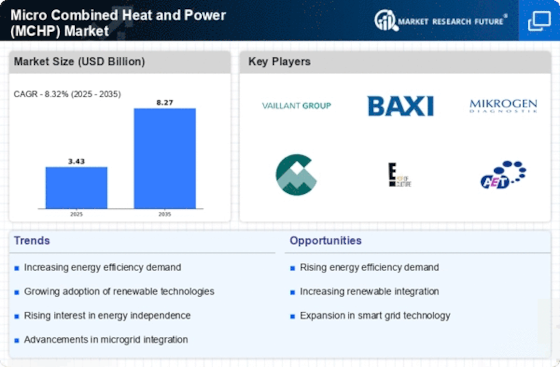
As per Market Research Future analysis, the Micro Combined Heat and Power (MCHP Market) Market Size was estimated at 3.434 USD Billion in 2024. The MCHP industry is projected to grow from 3.719 USD Billion in 2025 to 8.271 USD Billion by 2035, exhibiting a compound annual growth rate (CAGR) of 8.32% during the forecast period 2025 - 2035

Key Market Trends & Highlights

The Micro Combined Heat and Power (MCHP Market) market is poised for substantial growth driven by technological advancements and increasing consumer awareness.

  • North America remains the largest market for MCHP Market systems, reflecting a strong demand for energy-efficient solutions. The Asia-Pacific region is emerging as the fastest-growing market, propelled by rapid urbanization and energy needs. Internal combustion engines dominate the MCHP Market segment, while Stirling engines are gaining traction due to their efficiency and low emissions. Rising energy costs and government incentives are key drivers fueling the adoption of MCHP Market technologies, particularly in natural gas and biogas segments.

Market Size & Forecast

2024 Market Size 3.434 (USD Billion)
2035 Market Size 8.271 (USD Billion)
CAGR (2025 - 2035) 8.32%
Largest Regional Market Share in 2024 Europe

Major Players

<a href="https://www.vaillant-group.com/news-stories/vaillant-group-takes-over-combined-heat-and-power-systems-manufacturer-cogenon.html">Vaillant Group</a> (DE), Baxi (GB), Microgen (GB), SenerTec (DE), Ceres Media (GB), <a href="https://www.eonenergy.com/business/renewable-energy/combined-heat-power.html">E.ON</a> (DE), Aalborg Energie Technik (DK), Engie (FR), Froling (AT), Viessmann (DE)

Market Trends

The Micro Combined Heat and Power (MCHP Market) Market is currently experiencing a notable transformation, driven by the increasing demand for energy efficiency and sustainability. This market encompasses systems that simultaneously generate heat and electricity from a single energy source, offering a dual benefit that appeals to both residential and commercial sectors.

As energy costs continue to rise, consumers are seeking innovative solutions that not only reduce their utility bills but also minimize their carbon footprint. The integration of advanced technologies, such as smart grids and IoT, further enhances the appeal of MCHP Market systems, allowing for optimized energy management and improved operational efficiency. The Micro Combined Heat and Power Market is experiencing steady growth as residential and small-scale commercial users seek decentralized energy solutions that reduce reliance on centralized utility grids.

Moreover, government initiatives aimed at promoting renewable energy sources and reducing greenhouse gas emissions are likely to bolster the growth of the Micro Combined Heat and Power (MCHP Market) Market. Incentives and subsidies for adopting clean energy technologies may encourage more consumers to invest in MCHP Market systems. Additionally, the growing awareness of climate change and the need for sustainable practices are influencing consumer preferences, leading to a shift towards more environmentally friendly energy solutions. As the market evolves, it appears that the Micro Combined Heat and Power (MCHP Market) Market will play a crucial role in the transition towards a more sustainable energy landscape.

Technological Advancements

Recent innovations in micro combined heat and power systems are enhancing their efficiency and reliability. The integration of smart technologies allows for real-time monitoring and control, which optimizes energy usage and reduces waste. This trend indicates a shift towards more intelligent energy solutions that cater to the needs of modern consumers.

Current micro combined heat and power market trends highlight a shift toward "smart" cogeneration units, which utilize AI-driven energy management to optimize performance.

Regulatory Support

Government policies are increasingly favoring the adoption of micro combined heat and power systems. Various incentives, such as tax credits and grants, are being introduced to encourage investment in these technologies. This regulatory support suggests a growing recognition of the importance of sustainable energy solutions.

Consumer Awareness

There is a rising awareness among consumers regarding the benefits of micro combined heat and power systems. As individuals become more informed about energy efficiency and environmental impact, they are more likely to consider MCHP Market solutions for their energy needs. This trend reflects a broader societal shift towards sustainability.

MCHP Market Market Drivers

Rising Energy Costs

The escalating costs of energy are a primary driver for the Micro Combined Heat and Power (MCHP Market) Market. As traditional energy prices continue to rise, consumers and businesses are increasingly seeking alternative solutions to mitigate their energy expenses. MCHP Market systems, which generate both heat and electricity from a single energy source, offer a compelling solution by enhancing energy efficiency and reducing reliance on grid electricity. According to recent data, the average residential electricity price has seen a steady increase, prompting a shift towards self-generation technologies. This trend is likely to bolster the adoption of MCHP Market systems, as they provide a cost-effective means of energy production, thereby appealing to both residential and commercial sectors.

Technological Innovations

Technological innovations play a crucial role in shaping the Micro Combined Heat and Power (MCHP Market) Market. Advances in microgeneration technologies, such as improved fuel cells and more efficient heat recovery systems, are enhancing the performance and reliability of MCHP Market systems. These innovations not only increase energy efficiency but also reduce operational costs, making MCHP Market systems more appealing to potential users. For instance, recent developments in control systems and smart grid integration have enabled better management of energy production and consumption. As these technologies continue to evolve, they are likely to drive further adoption of MCHP Market systems across various sectors, including residential, commercial, and industrial applications.

Environmental Sustainability

The growing emphasis on environmental sustainability is significantly influencing the Micro Combined Heat and Power (MCHP Market) Market. With increasing awareness of climate change and the need for reduced carbon emissions, MCHP Market systems present an attractive option for environmentally conscious consumers. These systems utilize renewable energy sources, such as biomass or biogas, which can substantially lower greenhouse gas emissions compared to conventional energy sources. Furthermore, the integration of MCHP Market systems into energy strategies aligns with international commitments to reduce carbon footprints. As governments and organizations strive to meet sustainability targets, the demand for MCHP Market solutions is expected to rise, reflecting a broader commitment to environmental stewardship.

Government Incentives and Policies

Government incentives and policies are pivotal in propelling the Micro Combined Heat and Power (MCHP Market) Market. Many governments are implementing supportive measures, such as tax credits, rebates, and grants, to encourage the adoption of energy-efficient technologies. These initiatives aim to reduce energy consumption and promote the use of renewable energy sources. For example, certain regions have established feed-in tariffs for MCHP Market systems, ensuring a stable return on investment for users. Such policies not only enhance the economic viability of MCHP Market systems but also align with broader energy transition goals. As these supportive frameworks expand, they are expected to stimulate market growth and increase the penetration of MCHP Market technologies.

Increasing Demand for Energy Independence

The increasing demand for energy independence is a significant driver for the Micro Combined Heat and Power (MCHP Market) Market. As geopolitical tensions and energy supply disruptions become more prevalent, consumers and businesses are seeking ways to secure their energy sources. MCHP Market systems provide a viable solution by enabling users to generate their own electricity and heat on-site, thereby reducing dependence on external energy suppliers. This trend is particularly evident in regions with unstable energy markets, where self-sufficiency is becoming a priority. The potential for MCHP Market systems to enhance energy security is likely to drive their adoption, as users recognize the benefits of localized energy production.

Market Segment Insights

By Technology: Internal Combustion Engine (Largest) vs. Stirling Engine (Fastest-Growing)

In the Micro Combined Heat and Power (MCHP Market) Market, the distribution of market share among the technology segment values reveals a clear hierarchy. The Internal Combustion Engine (ICE) holds the largest share, significantly leading the market due to its established technology and widespread applications. It provides a reliable and efficient solution for residential and commercial energy needs, making it a preferred choice among users. On the other hand, the Stirling Engine, while smaller in market share, is positioned as the fastest-growing segment. This growth can be attributed to its low emissions and high efficiency in converting heat into power, appealing increasingly to environmentally conscious consumers. The growth trends in the MCHP Market technology segment are driven by the rising demand for energy-efficient solutions and renewable energy sources. ICE technology is witnessing sustained demand due to its robustness and versatility, particularly in regions where traditional power supply is inconsistent. Meanwhile, the Stirling Engine, being environmentally friendly and efficient, is gaining traction as consumers and businesses look for sustainable energy options. The growing focus on reducing carbon footprints and transitioning to cleaner energy sources is propelling the expansion of both technologies, although ICE remains dominant in terms of current market share while Stirling shows the potential for rapid growth in the coming years.

Technology: Internal Combustion Engine (Dominant) vs. Stirling Engine (Emerging)

The Internal Combustion Engine (ICE) is the dominant technology in the Micro Combined Heat and Power (MCHP Market) Market, favored for its reliability and efficiency in producing heat and electricity from a single fuel source. With various designs and applications, ICEs are widely utilized in both residential and commercial setups, making them a go-to choice for many consumers. Conversely, the Stirling Engine represents an emerging technology that is rapidly gaining attention in the MCHP Market sector. Known for its ability to operate on different heat sources, including solar and biomass, the Stirling Engine is celebrated for its high efficiency and low emissions. As communities and industries increasingly seek sustainable energy solutions, the Stirling Engine's flexibility in harnessing renewable energy positions it as a promising competitor to traditional technologies.

By Fuel Type: Natural Gas (Largest) vs. Biogas (Fastest-Growing)

In the Micro Combined Heat and Power (MCHP Market) Market, Natural Gas remains the largest fuel type, commanding a significant share due to its availability and established infrastructure. More than half of MCHP Market systems operate on natural gas, making it a preferred choice for residential and commercial applications. Biogas, while currently smaller in market share, is rapidly gaining traction as a renewable alternative, leveraging organic waste as a source that aligns with environmental sustainability trends. The growth trends in the MCHP Market fuel type segment are predominantly driven by the shift towards renewable energy sources. Biogas is perceived as a sustainable option, appealing to consumers and businesses seeking to reduce carbon footprints. Furthermore, advancements in technology and government incentives are bolstering the adoption of renewable energy, positioning biogas as the fastest-growing segment in the market alongside the steady dominance of natural gas, which benefits from lower costs and reliable performance.

Natural Gas (Dominant) vs. Biogas (Emerging)

Natural Gas stands out as the dominant fuel type in the Micro Combined Heat and Power (MCHP Market) market, capitalizing on its widespread availability and cost-effectiveness. Its established infrastructure and reliability make it a go-to option for consumers in both residential and commercial settings. On the other hand, Biogas is emerging as a compelling alternative fueled by a growing emphasis on sustainable practices. Biogas systems utilize organic materials, transforming waste into energy and minimizing environmental impact. This segment is characterized by innovations that enhance efficiency and reduce emissions, appealing to environmentally conscious users. As regulations tighten around carbon emissions, biogas is poised for market expansion, strategically positioning itself alongside the traditional dominance of natural gas.

By Application: Residential (Largest) vs. Commercial (Fastest-Growing)

In the Micro Combined Heat and Power (MCHP Market) Market, the residential segment accounts for the largest share, fueled by the increasing demand for energy efficiency and sustainability in homes. Consumers are more inclined towards solutions that provide heating and electricity simultaneously while reducing their carbon footprint. The commercial segment, while smaller, is witnessing rapid growth as businesses aim to decrease operational costs and promote green initiatives, making it a critical area in the MCHP Market landscape.

Residential (Dominant) vs. Industrial (Emerging)

The residential segment is currently the dominant force in the Micro Combined Heat and Power market, characterized by its widespread adoption in single-family homes and multi-unit apartments. This segment's success is driven by consumer awareness of energy efficiency and the desire for energy independence. On the other hand, the industrial segment presents an emerging opportunity, primarily targeting manufacturing facilities and large-scale operations. With industries facing stringent regulations on emissions and rising energy costs, MCHP Market solutions offer an advantageous method for companies to meet energy demands while minimizing environmental impact, thus making it a segment to watch for significant future growth.

By End Use: Heating (Largest) vs. Combined Heating and Power (Fastest-Growing)

In the Micro Combined Heat and Power (MCHP Market) market, the end-use segment is primarily divided into three categories: Heating, Electricity Generation, and Combined Heating and Power (CHP). Heating holds the largest share, as it fulfills a critical demand for residential and small commercial applications that require efficient heating solutions. Meanwhile, CHP is recognized as the fastest-growing segment, driven by its ability to enhance energy efficiency and sustainability, making it an attractive option for consumers seeking to reduce their energy bills and carbon footprint. The growth trends in the MCHP Market end-use segment reflect a shift towards more sustainable energy solutions. Factors such as rising energy costs, increasing environmental concerns, and government incentives promoting energy efficiency are propelling the adoption of CHP systems. As technology advances, the integration of smart technology into MCHP Market systems is also expected to drive growth, allowing for better energy management and increasing consumer interest in combined solutions that offer both heating and power generation capabilities.

Heating (Dominant) vs. Combined Heating and Power (Emerging)

In the Micro Combined Heat and Power (MCHP Market) market, Heating is recognized as the dominant end-use segment, primarily due to its established presence and ongoing necessity in residential heating applications. This segment benefits from a well-developed infrastructure and consumer preference for reliable heating solutions. Conversely, Combined Heating and Power (CHP) is emerging as a pivotal player in the market, capitalizing on the growing emphasis on energy efficiency and sustainability. CHP technologies generate electricity alongside heat, appealing to consumers who prioritize both energy savings and environmental responsibility. As policies and market dynamics evolve, CHP presents a significant opportunity for growth, particularly in urban areas where demand for efficient energy solutions is increasing.

Get more detailed insights about Micro Combined Heat and Power (MCHP) Market Research Report - Global Forecast till 2035

Regional Insights

The Micro Combined Heat and Power (MCHP Market) Market is projected to achieve substantial growth, reflecting a diverse Regional segmentation comprising North America, Europe, APAC, South America, and MEA. In 2023, North America holds a valuation of 0.912 USD Billion, while Europe, being the largest market, is valued at 1.064 USD Billion, indicating significant adoption driven by regulatory support for energy efficiency. APAC is emerging with a valuation of 0.646 USD Billion, showcasing a strong potential for growth due to increasing energy demands.

South America and MEA, at valuations of 0.304 USD Billion and 0.243 USD Billion respectively, highlight their nascent yet impactful roles in the MCHP Market, capitalizing on localized energy solutions. Europe dominates the market due to stringent environmental norms and advancements in technology, whereas North America shows a majority holding attributed to its established infrastructure for micro-CHP systems.

As the Micro Combined Heat and Power (MCHP Market) Market data reveals, these regions offer unique opportunities and challenges, with market growth driven by the push for sustainable energy solutions and the need for efficient heating and power systems across residential and commercial sectors.

Key Players and Competitive Insights

The competitive landscape of the Micro Combined Heat and Power Market is characterized by significant innovation and a growing focus on sustainability and energy efficiency. As end-users increasingly seek solutions that not only provide energy but also reduce carbon footprints, companies in this market are leveraging advanced technologies and fostering strategic partnerships to enhance their offerings. Leading technology providers are expanding their micro combined heat and power market share by developing fuel-flexible systems capable of operating on hydrogen blends and renewable biogas.
The emphasis on decentralized energy production is driving market growth, leading to increased competition among key players who aim to prove their technological capabilities and reliability in delivering combined heat and power solutions.
This trend is particularly critical as more countries implement policies favoring renewable energy sources and energy-efficient solutions, creating ample opportunities for those well-positioned to capitalize on these developments while facing the inherent challenges of the evolving energy landscape.
Aalborg Energie Technik is known for its strong presence in the Micro Combined Heat and Power Market, showcasing notable strengths that set it apart from its competitors. The company excels in providing high-quality products that are designed for efficiency and reliability, allowing customers to achieve both energy savings and reduced emissions. Aalborg Energie Technik has carved a niche by focusing on tailored solutions that meet the specific needs of various industrial and residential sectors.
Its commitment to research and development has resulted in advanced technologies that prioritize performance and sustainability, solidifying their reputation as a trusted provider within the market. Furthermore, Aalborg Energie Technik's robust customer service and support operations underline its dedication to client satisfaction, fostering strong relationships and ensuring successful project implementations.
Panasonic has established a significant foothold in the Micro Combined Heat and Power (MCHP Market) Market, recognized for its innovative product offerings and commitment to sustainability. The company stands out due to its expertise in integrating cutting-edge technology with energy-efficient designs, contributing to its competitive edge. Panasonic's focus on developing environmentally friendly solutions aligns with the growing demand for sustainable energy options, allowing it to capture a diverse customer base across various segments.
With a strong emphasis on research and development, Panasonic continues to enhance its MCHP Market systems, ensuring that they deliver high performance while meeting the rigorous standards required by the market. The company's strategic initiatives, including collaborations and partnerships, further strengthen its position, ensuring the ongoing growth and advancement of its offerings in the competitive MCHP Market landscape.

Key Companies in the MCHP Market include

Industry Developments

The Micro Combined Heat and Power (MCHP Market) Market has seen significant activity recently, with various companies unveiling new technologies and expanding their market presence. Notably, Aalborg Energie Technik has announced advancements in biomass-powered MCHP Market systems, enhancing efficiency. Panasonic has introduced a novel micro-CHP solution aimed at residential applications, reflecting a growing trend towards energy self-sufficiency. Meanwhile, Bosch and Siemens have collaborated on integrating IoT technology into their MCHP Market products, aiming to boost operational efficiencies. Also, Ceres Media has expanded its focus on commercial applications of MCHP Market, diversifying its portfolio.

In terms of mergers and acquisitions, E.ON acquired a strategic stake in a startup specializing in next-gen micro-CHP production, while Viessmann has expanded its footprint through strategic partnerships in Europe. The growth in valuation for companies such as Wärtsilä and Vaillant indicates increasing investor confidence, driven by rising demand for sustainable energy solutions. This surge in market activity is shaping a landscape where innovative technologies are expected to lead the MCHP Market into new stages of growth, fostering competitive advancements among key players like ENGIE, Catalyst Energy, MGT Power, and Qnergy.

Future Outlook

MCHP Market Future Outlook

The Micro Combined Heat and Power (MCHP Market) Market is projected to grow at an 8.32% CAGR from 2025 to 2035, driven by increasing energy efficiency demands and renewable energy integration.<br>The overall Micro Combined Heat and Power Market size continues to be influenced by the rising demand for energy-efficient heating and electricity in urban residential complexes and the hospitality sector. A comprehensive Micro Combined Heat And Power Market analysis indicates that government-backed incentive programs for low-carbon home heating remain a critical catalyst for long-term technology adoption.

New opportunities lie in:

  • <p>Development of residential MCHP Market systems for energy independence Partnerships with utility companies for demand response programs Expansion into emerging markets with tailored financing solutions</p>

By 2035, the MCHP Market is expected to achieve substantial growth, driven by innovation and strategic partnerships.

Market Segmentation

MCHP Market End Use Outlook

  • Heating
  • Electricity Generation
  • Combined Heating and Power

MCHP Market Fuel Type Outlook

  • Natural Gas
  • Biogas
  • Propane
  • Renewable Energy

MCHP Market Technology Outlook

  • Internal Combustion Engine
  • Stirling Engine
  • Fuel Cell

MCHP Market Application Outlook

  • Residential
  • Commercial
  • Industrial

Report Scope

MARKET SIZE 2024 3.434(USD Billion)
MARKET SIZE 2025 3.719(USD Billion)
MARKET SIZE 2035 8.271(USD Billion)
COMPOUND ANNUAL GROWTH RATE (CAGR) 8.32% (2025 - 2035)
REPORT COVERAGE Revenue Forecast, Competitive Landscape, Growth Factors, and Trends
BASE YEAR 2024
Market Forecast Period 2025 - 2035
Historical Data 2019 - 2024
Market Forecast Units USD Billion
Key Companies Profiled Vaillant Group (DE), Baxi (GB), Microgen (GB), SenerTec (DE), Ceres Media (GB), E.ON (DE), Aalborg Energie Technik (DK), Engie (FR), Froling (AT), Viessmann (DE)
Segments Covered Technology, Fuel Type, Application, End Use, Regional
Key Market Opportunities Growing demand for energy efficiency drives innovation in the Micro Combined Heat and Power (MCHP) Market.
Key Market Dynamics Rising demand for energy efficiency drives innovation and competition in the Micro Combined Heat and Power market.
Countries Covered North America, Europe, APAC, South America, MEA

FAQs

What is the projected market valuation of the Micro Combined Heat and Power (MCHP) Market by 2035?

<p>The projected market valuation for the MCHP Market is expected to reach 8.271 USD Billion by 2035.</p>

What was the market valuation of the MCHP Market in 2024?

<p>The overall market valuation of the MCHP Market was 3.434 USD Billion in 2024.</p>

What is the expected CAGR for the MCHP Market during the forecast period 2025 - 2035?

<p>The expected CAGR for the MCHP Market during the forecast period 2025 - 2035 is 8.32%.</p>

Which technology segments are included in the MCHP Market, and what are their valuations?

<p>The technology segments include Internal Combustion Engine valued at 1.5 to 3.5 USD Billion, Stirling Engine at 1.0 to 2.5 USD Billion, and Fuel Cell at 0.934 to 2.271 USD Billion.</p>

What fuel types are utilized in the MCHP Market, and what are their respective market values?

<p>The fuel types include Natural Gas valued at 1.5 to 3.5 USD Billion, Biogas at 0.5 to 1.2 USD Billion, Propane at 0.3 to 0.8 USD Billion, and Renewable Energy at 1.134 to 2.771 USD Billion.</p>

What applications are driving the MCHP Market, and what are their valuations?

<p>The applications driving the MCHP Market include Residential valued at 1.5 to 3.5 USD Billion, Commercial at 1.0 to 2.5 USD Billion, and Industrial at 0.934 to 2.271 USD Billion.</p>

What end-use segments are present in the MCHP Market, and what are their market values?

<p>The end-use segments include Heating valued at 1.5 to 3.5 USD Billion, Electricity Generation at 1.0 to 2.5 USD Billion, and Combined Heating and Power at 0.934 to 2.271 USD Billion.</p>

Who are the key players in the Micro Combined Heat and Power (MCHP) Market?

<p>Key players in the MCHP Market include Vaillant Group, Baxi, Microgen, SenerTec, Ceres Media, E.ON, Aalborg Energie Technik, Engie, Froling, and Viessmann.</p>

How does the MCHP Market contribute to energy efficiency?

<p>The MCHP Market contributes to energy efficiency by providing simultaneous heating and electricity generation, thereby optimizing energy use.</p>

What trends are influencing the growth of the MCHP Market?

<p>Trends influencing the MCHP Market growth include increasing demand for energy-efficient solutions and a shift towards renewable energy sources.</p>

  1. SECTION I: EXECUTIVE SUMMARY AND KEY HIGHLIGHTS
    1. | 1.1 EXECUTIVE SUMMARY
    2. | | 1.1.1 Market Overview
    3. | | 1.1.2 Key Findings
    4. | | 1.1.3 Market Segmentation
    5. | | 1.1.4 Competitive Landscape
    6. | | 1.1.5 Challenges and Opportunities
    7. | | 1.1.6 Future Outlook
  2. SECTION II: SCOPING, METHODOLOGY AND MARKET STRUCTURE
    1. | 2.1 MARKET INTRODUCTION
    2. | | 2.1.1 Definition
    3. | | 2.1.2 Scope of the study
    4. | | | 2.1.2.1 Research Objective
    5. | | | 2.1.2.2 Assumption
    6. | | | 2.1.2.3 Limitations
    7. | 2.2 RESEARCH METHODOLOGY
    8. | | 2.2.1 Overview
    9. | | 2.2.2 Data Mining
    10. | | 2.2.3 Secondary Research
    11. | | 2.2.4 Primary Research
    12. | | | 2.2.4.1 Primary Interviews and Information Gathering Process
    13. | | | 2.2.4.2 Breakdown of Primary Respondents
    14. | | 2.2.5 Forecasting Model
    15. | | 2.2.6 Market Size Estimation
    16. | | | 2.2.6.1 Bottom-Up Approach
    17. | | | 2.2.6.2 Top-Down Approach
    18. | | 2.2.7 Data Triangulation
    19. | | 2.2.8 Validation
  3. SECTION III: QUALITATIVE ANALYSIS
    1. | 3.1 MARKET DYNAMICS
    2. | | 3.1.1 Overview
    3. | | 3.1.2 Drivers
    4. | | 3.1.3 Restraints
    5. | | 3.1.4 Opportunities
    6. | 3.2 MARKET FACTOR ANALYSIS
    7. | | 3.2.1 Value chain Analysis
    8. | | 3.2.2 Porter's Five Forces Analysis
    9. | | | 3.2.2.1 Bargaining Power of Suppliers
    10. | | | 3.2.2.2 Bargaining Power of Buyers
    11. | | | 3.2.2.3 Threat of New Entrants
    12. | | | 3.2.2.4 Threat of Substitutes
    13. | | | 3.2.2.5 Intensity of Rivalry
    14. | | 3.2.3 COVID-19 Impact Analysis
    15. | | | 3.2.3.1 Market Impact Analysis
    16. | | | 3.2.3.2 Regional Impact
    17. | | | 3.2.3.3 Opportunity and Threat Analysis
  4. SECTION IV: QUANTITATIVE ANALYSIS
    1. | 4.1 Energy & Power, BY Technology (USD Billion)
    2. | | 4.1.1 Internal Combustion Engine
    3. | | 4.1.2 Stirling Engine
    4. | | 4.1.3 Fuel Cell
    5. | 4.2 Energy & Power, BY Fuel Type (USD Billion)
    6. | | 4.2.1 Natural Gas
    7. | | 4.2.2 Biogas
    8. | | 4.2.3 Propane
    9. | | 4.2.4 Renewable Energy
    10. | 4.3 Energy & Power, BY Application (USD Billion)
    11. | | 4.3.1 Residential
    12. | | 4.3.2 Commercial
    13. | | 4.3.3 Industrial
    14. | 4.4 Energy & Power, BY End Use (USD Billion)
    15. | | 4.4.1 Heating
    16. | | 4.4.2 Electricity Generation
    17. | | 4.4.3 Combined Heating and Power
    18. | 4.5 Energy & Power, BY Region (USD Billion)
    19. | | 4.5.1 North America
    20. | | | 4.5.1.1 US
    21. | | | 4.5.1.2 Canada
    22. | | 4.5.2 Europe
    23. | | | 4.5.2.1 Germany
    24. | | | 4.5.2.2 UK
    25. | | | 4.5.2.3 France
    26. | | | 4.5.2.4 Russia
    27. | | | 4.5.2.5 Italy
    28. | | | 4.5.2.6 Spain
    29. | | | 4.5.2.7 Rest of Europe
    30. | | 4.5.3 APAC
    31. | | | 4.5.3.1 China
    32. | | | 4.5.3.2 India
    33. | | | 4.5.3.3 Japan
    34. | | | 4.5.3.4 South Korea
    35. | | | 4.5.3.5 Malaysia
    36. | | | 4.5.3.6 Thailand
    37. | | | 4.5.3.7 Indonesia
    38. | | | 4.5.3.8 Rest of APAC
    39. | | 4.5.4 South America
    40. | | | 4.5.4.1 Brazil
    41. | | | 4.5.4.2 Mexico
    42. | | | 4.5.4.3 Argentina
    43. | | | 4.5.4.4 Rest of South America
    44. | | 4.5.5 MEA
    45. | | | 4.5.5.1 GCC Countries
    46. | | | 4.5.5.2 South Africa
    47. | | | 4.5.5.3 Rest of MEA
  5. SECTION V: COMPETITIVE ANALYSIS
    1. | 5.1 Competitive Landscape
    2. | | 5.1.1 Overview
    3. | | 5.1.2 Competitive Analysis
    4. | | 5.1.3 Market share Analysis
    5. | | 5.1.4 Major Growth Strategy in the Energy & Power
    6. | | 5.1.5 Competitive Benchmarking
    7. | | 5.1.6 Leading Players in Terms of Number of Developments in the Energy & Power
    8. | | 5.1.7 Key developments and growth strategies
    9. | | | 5.1.7.1 New Product Launch/Service Deployment
    10. | | | 5.1.7.2 Merger & Acquisitions
    11. | | | 5.1.7.3 Joint Ventures
    12. | | 5.1.8 Major Players Financial Matrix
    13. | | | 5.1.8.1 Sales and Operating Income
    14. | | | 5.1.8.2 Major Players R&D Expenditure. 2023
    15. | 5.2 Company Profiles
    16. | | 5.2.1 Vaillant Group (DE)
    17. | | | 5.2.1.1 Financial Overview
    18. | | | 5.2.1.2 Products Offered
    19. | | | 5.2.1.3 Key Developments
    20. | | | 5.2.1.4 SWOT Analysis
    21. | | | 5.2.1.5 Key Strategies
    22. | | 5.2.2 Baxi (GB)
    23. | | | 5.2.2.1 Financial Overview
    24. | | | 5.2.2.2 Products Offered
    25. | | | 5.2.2.3 Key Developments
    26. | | | 5.2.2.4 SWOT Analysis
    27. | | | 5.2.2.5 Key Strategies
    28. | | 5.2.3 Microgen (GB)
    29. | | | 5.2.3.1 Financial Overview
    30. | | | 5.2.3.2 Products Offered
    31. | | | 5.2.3.3 Key Developments
    32. | | | 5.2.3.4 SWOT Analysis
    33. | | | 5.2.3.5 Key Strategies
    34. | | 5.2.4 SenerTec (DE)
    35. | | | 5.2.4.1 Financial Overview
    36. | | | 5.2.4.2 Products Offered
    37. | | | 5.2.4.3 Key Developments
    38. | | | 5.2.4.4 SWOT Analysis
    39. | | | 5.2.4.5 Key Strategies
    40. | | 5.2.5 Ceres Media (GB)
    41. | | | 5.2.5.1 Financial Overview
    42. | | | 5.2.5.2 Products Offered
    43. | | | 5.2.5.3 Key Developments
    44. | | | 5.2.5.4 SWOT Analysis
    45. | | | 5.2.5.5 Key Strategies
    46. | | 5.2.6 E.ON (DE)
    47. | | | 5.2.6.1 Financial Overview
    48. | | | 5.2.6.2 Products Offered
    49. | | | 5.2.6.3 Key Developments
    50. | | | 5.2.6.4 SWOT Analysis
    51. | | | 5.2.6.5 Key Strategies
    52. | | 5.2.7 Aalborg Energie Technik (DK)
    53. | | | 5.2.7.1 Financial Overview
    54. | | | 5.2.7.2 Products Offered
    55. | | | 5.2.7.3 Key Developments
    56. | | | 5.2.7.4 SWOT Analysis
    57. | | | 5.2.7.5 Key Strategies
    58. | | 5.2.8 Engie (FR)
    59. | | | 5.2.8.1 Financial Overview
    60. | | | 5.2.8.2 Products Offered
    61. | | | 5.2.8.3 Key Developments
    62. | | | 5.2.8.4 SWOT Analysis
    63. | | | 5.2.8.5 Key Strategies
    64. | | 5.2.9 Froling (AT)
    65. | | | 5.2.9.1 Financial Overview
    66. | | | 5.2.9.2 Products Offered
    67. | | | 5.2.9.3 Key Developments
    68. | | | 5.2.9.4 SWOT Analysis
    69. | | | 5.2.9.5 Key Strategies
    70. | | 5.2.10 Viessmann (DE)
    71. | | | 5.2.10.1 Financial Overview
    72. | | | 5.2.10.2 Products Offered
    73. | | | 5.2.10.3 Key Developments
    74. | | | 5.2.10.4 SWOT Analysis
    75. | | | 5.2.10.5 Key Strategies
    76. | 5.3 Appendix
    77. | | 5.3.1 References
    78. | | 5.3.2 Related Reports
  6. LIST OF FIGURES
    1. | 6.1 MARKET SYNOPSIS
    2. | 6.2 NORTH AMERICA MARKET ANALYSIS
    3. | 6.3 US MARKET ANALYSIS BY TECHNOLOGY
    4. | 6.4 US MARKET ANALYSIS BY FUEL TYPE
    5. | 6.5 US MARKET ANALYSIS BY APPLICATION
    6. | 6.6 US MARKET ANALYSIS BY END USE
    7. | 6.7 CANADA MARKET ANALYSIS BY TECHNOLOGY
    8. | 6.8 CANADA MARKET ANALYSIS BY FUEL TYPE
    9. | 6.9 CANADA MARKET ANALYSIS BY APPLICATION
    10. | 6.10 CANADA MARKET ANALYSIS BY END USE
    11. | 6.11 EUROPE MARKET ANALYSIS
    12. | 6.12 GERMANY MARKET ANALYSIS BY TECHNOLOGY
    13. | 6.13 GERMANY MARKET ANALYSIS BY FUEL TYPE
    14. | 6.14 GERMANY MARKET ANALYSIS BY APPLICATION
    15. | 6.15 GERMANY MARKET ANALYSIS BY END USE
    16. | 6.16 UK MARKET ANALYSIS BY TECHNOLOGY
    17. | 6.17 UK MARKET ANALYSIS BY FUEL TYPE
    18. | 6.18 UK MARKET ANALYSIS BY APPLICATION
    19. | 6.19 UK MARKET ANALYSIS BY END USE
    20. | 6.20 FRANCE MARKET ANALYSIS BY TECHNOLOGY
    21. | 6.21 FRANCE MARKET ANALYSIS BY FUEL TYPE
    22. | 6.22 FRANCE MARKET ANALYSIS BY APPLICATION
    23. | 6.23 FRANCE MARKET ANALYSIS BY END USE
    24. | 6.24 RUSSIA MARKET ANALYSIS BY TECHNOLOGY
    25. | 6.25 RUSSIA MARKET ANALYSIS BY FUEL TYPE
    26. | 6.26 RUSSIA MARKET ANALYSIS BY APPLICATION
    27. | 6.27 RUSSIA MARKET ANALYSIS BY END USE
    28. | 6.28 ITALY MARKET ANALYSIS BY TECHNOLOGY
    29. | 6.29 ITALY MARKET ANALYSIS BY FUEL TYPE
    30. | 6.30 ITALY MARKET ANALYSIS BY APPLICATION
    31. | 6.31 ITALY MARKET ANALYSIS BY END USE
    32. | 6.32 SPAIN MARKET ANALYSIS BY TECHNOLOGY
    33. | 6.33 SPAIN MARKET ANALYSIS BY FUEL TYPE
    34. | 6.34 SPAIN MARKET ANALYSIS BY APPLICATION
    35. | 6.35 SPAIN MARKET ANALYSIS BY END USE
    36. | 6.36 REST OF EUROPE MARKET ANALYSIS BY TECHNOLOGY
    37. | 6.37 REST OF EUROPE MARKET ANALYSIS BY FUEL TYPE
    38. | 6.38 REST OF EUROPE MARKET ANALYSIS BY APPLICATION
    39. | 6.39 REST OF EUROPE MARKET ANALYSIS BY END USE
    40. | 6.40 APAC MARKET ANALYSIS
    41. | 6.41 CHINA MARKET ANALYSIS BY TECHNOLOGY
    42. | 6.42 CHINA MARKET ANALYSIS BY FUEL TYPE
    43. | 6.43 CHINA MARKET ANALYSIS BY APPLICATION
    44. | 6.44 CHINA MARKET ANALYSIS BY END USE
    45. | 6.45 INDIA MARKET ANALYSIS BY TECHNOLOGY
    46. | 6.46 INDIA MARKET ANALYSIS BY FUEL TYPE
    47. | 6.47 INDIA MARKET ANALYSIS BY APPLICATION
    48. | 6.48 INDIA MARKET ANALYSIS BY END USE
    49. | 6.49 JAPAN MARKET ANALYSIS BY TECHNOLOGY
    50. | 6.50 JAPAN MARKET ANALYSIS BY FUEL TYPE
    51. | 6.51 JAPAN MARKET ANALYSIS BY APPLICATION
    52. | 6.52 JAPAN MARKET ANALYSIS BY END USE
    53. | 6.53 SOUTH KOREA MARKET ANALYSIS BY TECHNOLOGY
    54. | 6.54 SOUTH KOREA MARKET ANALYSIS BY FUEL TYPE
    55. | 6.55 SOUTH KOREA MARKET ANALYSIS BY APPLICATION
    56. | 6.56 SOUTH KOREA MARKET ANALYSIS BY END USE
    57. | 6.57 MALAYSIA MARKET ANALYSIS BY TECHNOLOGY
    58. | 6.58 MALAYSIA MARKET ANALYSIS BY FUEL TYPE
    59. | 6.59 MALAYSIA MARKET ANALYSIS BY APPLICATION
    60. | 6.60 MALAYSIA MARKET ANALYSIS BY END USE
    61. | 6.61 THAILAND MARKET ANALYSIS BY TECHNOLOGY
    62. | 6.62 THAILAND MARKET ANALYSIS BY FUEL TYPE
    63. | 6.63 THAILAND MARKET ANALYSIS BY APPLICATION
    64. | 6.64 THAILAND MARKET ANALYSIS BY END USE
    65. | 6.65 INDONESIA MARKET ANALYSIS BY TECHNOLOGY
    66. | 6.66 INDONESIA MARKET ANALYSIS BY FUEL TYPE
    67. | 6.67 INDONESIA MARKET ANALYSIS BY APPLICATION
    68. | 6.68 INDONESIA MARKET ANALYSIS BY END USE
    69. | 6.69 REST OF APAC MARKET ANALYSIS BY TECHNOLOGY
    70. | 6.70 REST OF APAC MARKET ANALYSIS BY FUEL TYPE
    71. | 6.71 REST OF APAC MARKET ANALYSIS BY APPLICATION
    72. | 6.72 REST OF APAC MARKET ANALYSIS BY END USE
    73. | 6.73 SOUTH AMERICA MARKET ANALYSIS
    74. | 6.74 BRAZIL MARKET ANALYSIS BY TECHNOLOGY
    75. | 6.75 BRAZIL MARKET ANALYSIS BY FUEL TYPE
    76. | 6.76 BRAZIL MARKET ANALYSIS BY APPLICATION
    77. | 6.77 BRAZIL MARKET ANALYSIS BY END USE
    78. | 6.78 MEXICO MARKET ANALYSIS BY TECHNOLOGY
    79. | 6.79 MEXICO MARKET ANALYSIS BY FUEL TYPE
    80. | 6.80 MEXICO MARKET ANALYSIS BY APPLICATION
    81. | 6.81 MEXICO MARKET ANALYSIS BY END USE
    82. | 6.82 ARGENTINA MARKET ANALYSIS BY TECHNOLOGY
    83. | 6.83 ARGENTINA MARKET ANALYSIS BY FUEL TYPE
    84. | 6.84 ARGENTINA MARKET ANALYSIS BY APPLICATION
    85. | 6.85 ARGENTINA MARKET ANALYSIS BY END USE
    86. | 6.86 REST OF SOUTH AMERICA MARKET ANALYSIS BY TECHNOLOGY
    87. | 6.87 REST OF SOUTH AMERICA MARKET ANALYSIS BY FUEL TYPE
    88. | 6.88 REST OF SOUTH AMERICA MARKET ANALYSIS BY APPLICATION
    89. | 6.89 REST OF SOUTH AMERICA MARKET ANALYSIS BY END USE
    90. | 6.90 MEA MARKET ANALYSIS
    91. | 6.91 GCC COUNTRIES MARKET ANALYSIS BY TECHNOLOGY
    92. | 6.92 GCC COUNTRIES MARKET ANALYSIS BY FUEL TYPE
    93. | 6.93 GCC COUNTRIES MARKET ANALYSIS BY APPLICATION
    94. | 6.94 GCC COUNTRIES MARKET ANALYSIS BY END USE
    95. | 6.95 SOUTH AFRICA MARKET ANALYSIS BY TECHNOLOGY
    96. | 6.96 SOUTH AFRICA MARKET ANALYSIS BY FUEL TYPE
    97. | 6.97 SOUTH AFRICA MARKET ANALYSIS BY APPLICATION
    98. | 6.98 SOUTH AFRICA MARKET ANALYSIS BY END USE
    99. | 6.99 REST OF MEA MARKET ANALYSIS BY TECHNOLOGY
    100. | 6.100 REST OF MEA MARKET ANALYSIS BY FUEL TYPE
    101. | 6.101 REST OF MEA MARKET ANALYSIS BY APPLICATION
    102. | 6.102 REST OF MEA MARKET ANALYSIS BY END USE
    103. | 6.103 KEY BUYING CRITERIA OF ENERGY & POWER
    104. | 6.104 RESEARCH PROCESS OF MRFR
    105. | 6.105 DRO ANALYSIS OF ENERGY & POWER
    106. | 6.106 DRIVERS IMPACT ANALYSIS: ENERGY & POWER
    107. | 6.107 RESTRAINTS IMPACT ANALYSIS: ENERGY & POWER
    108. | 6.108 SUPPLY / VALUE CHAIN: ENERGY & POWER
    109. | 6.109 ENERGY & POWER, BY TECHNOLOGY, 2024 (% SHARE)
    110. | 6.110 ENERGY & POWER, BY TECHNOLOGY, 2024 TO 2035 (USD Billion)
    111. | 6.111 ENERGY & POWER, BY FUEL TYPE, 2024 (% SHARE)
    112. | 6.112 ENERGY & POWER, BY FUEL TYPE, 2024 TO 2035 (USD Billion)
    113. | 6.113 ENERGY & POWER, BY APPLICATION, 2024 (% SHARE)
    114. | 6.114 ENERGY & POWER, BY APPLICATION, 2024 TO 2035 (USD Billion)
    115. | 6.115 ENERGY & POWER, BY END USE, 2024 (% SHARE)
    116. | 6.116 ENERGY & POWER, BY END USE, 2024 TO 2035 (USD Billion)
    117. | 6.117 BENCHMARKING OF MAJOR COMPETITORS
  7. LIST OF TABLES
    1. | 7.1 LIST OF ASSUMPTIONS
    2. | | 7.1.1
    3. | 7.2 North America MARKET SIZE ESTIMATES; FORECAST
    4. | | 7.2.1 BY TECHNOLOGY, 2025-2035 (USD Billion)
    5. | | 7.2.2 BY FUEL TYPE, 2025-2035 (USD Billion)
    6. | | 7.2.3 BY APPLICATION, 2025-2035 (USD Billion)
    7. | | 7.2.4 BY END USE, 2025-2035 (USD Billion)
    8. | 7.3 US MARKET SIZE ESTIMATES; FORECAST
    9. | | 7.3.1 BY TECHNOLOGY, 2025-2035 (USD Billion)
    10. | | 7.3.2 BY FUEL TYPE, 2025-2035 (USD Billion)
    11. | | 7.3.3 BY APPLICATION, 2025-2035 (USD Billion)
    12. | | 7.3.4 BY END USE, 2025-2035 (USD Billion)
    13. | 7.4 Canada MARKET SIZE ESTIMATES; FORECAST
    14. | | 7.4.1 BY TECHNOLOGY, 2025-2035 (USD Billion)
    15. | | 7.4.2 BY FUEL TYPE, 2025-2035 (USD Billion)
    16. | | 7.4.3 BY APPLICATION, 2025-2035 (USD Billion)
    17. | | 7.4.4 BY END USE, 2025-2035 (USD Billion)
    18. | 7.5 Europe MARKET SIZE ESTIMATES; FORECAST
    19. | | 7.5.1 BY TECHNOLOGY, 2025-2035 (USD Billion)
    20. | | 7.5.2 BY FUEL TYPE, 2025-2035 (USD Billion)
    21. | | 7.5.3 BY APPLICATION, 2025-2035 (USD Billion)
    22. | | 7.5.4 BY END USE, 2025-2035 (USD Billion)
    23. | 7.6 Germany MARKET SIZE ESTIMATES; FORECAST
    24. | | 7.6.1 BY TECHNOLOGY, 2025-2035 (USD Billion)
    25. | | 7.6.2 BY FUEL TYPE, 2025-2035 (USD Billion)
    26. | | 7.6.3 BY APPLICATION, 2025-2035 (USD Billion)
    27. | | 7.6.4 BY END USE, 2025-2035 (USD Billion)
    28. | 7.7 UK MARKET SIZE ESTIMATES; FORECAST
    29. | | 7.7.1 BY TECHNOLOGY, 2025-2035 (USD Billion)
    30. | | 7.7.2 BY FUEL TYPE, 2025-2035 (USD Billion)
    31. | | 7.7.3 BY APPLICATION, 2025-2035 (USD Billion)
    32. | | 7.7.4 BY END USE, 2025-2035 (USD Billion)
    33. | 7.8 France MARKET SIZE ESTIMATES; FORECAST
    34. | | 7.8.1 BY TECHNOLOGY, 2025-2035 (USD Billion)
    35. | | 7.8.2 BY FUEL TYPE, 2025-2035 (USD Billion)
    36. | | 7.8.3 BY APPLICATION, 2025-2035 (USD Billion)
    37. | | 7.8.4 BY END USE, 2025-2035 (USD Billion)
    38. | 7.9 Russia MARKET SIZE ESTIMATES; FORECAST
    39. | | 7.9.1 BY TECHNOLOGY, 2025-2035 (USD Billion)
    40. | | 7.9.2 BY FUEL TYPE, 2025-2035 (USD Billion)
    41. | | 7.9.3 BY APPLICATION, 2025-2035 (USD Billion)
    42. | | 7.9.4 BY END USE, 2025-2035 (USD Billion)
    43. | 7.10 Italy MARKET SIZE ESTIMATES; FORECAST
    44. | | 7.10.1 BY TECHNOLOGY, 2025-2035 (USD Billion)
    45. | | 7.10.2 BY FUEL TYPE, 2025-2035 (USD Billion)
    46. | | 7.10.3 BY APPLICATION, 2025-2035 (USD Billion)
    47. | | 7.10.4 BY END USE, 2025-2035 (USD Billion)
    48. | 7.11 Spain MARKET SIZE ESTIMATES; FORECAST
    49. | | 7.11.1 BY TECHNOLOGY, 2025-2035 (USD Billion)
    50. | | 7.11.2 BY FUEL TYPE, 2025-2035 (USD Billion)
    51. | | 7.11.3 BY APPLICATION, 2025-2035 (USD Billion)
    52. | | 7.11.4 BY END USE, 2025-2035 (USD Billion)
    53. | 7.12 Rest of Europe MARKET SIZE ESTIMATES; FORECAST
    54. | | 7.12.1 BY TECHNOLOGY, 2025-2035 (USD Billion)
    55. | | 7.12.2 BY FUEL TYPE, 2025-2035 (USD Billion)
    56. | | 7.12.3 BY APPLICATION, 2025-2035 (USD Billion)
    57. | | 7.12.4 BY END USE, 2025-2035 (USD Billion)
    58. | 7.13 APAC MARKET SIZE ESTIMATES; FORECAST
    59. | | 7.13.1 BY TECHNOLOGY, 2025-2035 (USD Billion)
    60. | | 7.13.2 BY FUEL TYPE, 2025-2035 (USD Billion)
    61. | | 7.13.3 BY APPLICATION, 2025-2035 (USD Billion)
    62. | | 7.13.4 BY END USE, 2025-2035 (USD Billion)
    63. | 7.14 China MARKET SIZE ESTIMATES; FORECAST
    64. | | 7.14.1 BY TECHNOLOGY, 2025-2035 (USD Billion)
    65. | | 7.14.2 BY FUEL TYPE, 2025-2035 (USD Billion)
    66. | | 7.14.3 BY APPLICATION, 2025-2035 (USD Billion)
    67. | | 7.14.4 BY END USE, 2025-2035 (USD Billion)
    68. | 7.15 India MARKET SIZE ESTIMATES; FORECAST
    69. | | 7.15.1 BY TECHNOLOGY, 2025-2035 (USD Billion)
    70. | | 7.15.2 BY FUEL TYPE, 2025-2035 (USD Billion)
    71. | | 7.15.3 BY APPLICATION, 2025-2035 (USD Billion)
    72. | | 7.15.4 BY END USE, 2025-2035 (USD Billion)
    73. | 7.16 Japan MARKET SIZE ESTIMATES; FORECAST
    74. | | 7.16.1 BY TECHNOLOGY, 2025-2035 (USD Billion)
    75. | | 7.16.2 BY FUEL TYPE, 2025-2035 (USD Billion)
    76. | | 7.16.3 BY APPLICATION, 2025-2035 (USD Billion)
    77. | | 7.16.4 BY END USE, 2025-2035 (USD Billion)
    78. | 7.17 South Korea MARKET SIZE ESTIMATES; FORECAST
    79. | | 7.17.1 BY TECHNOLOGY, 2025-2035 (USD Billion)
    80. | | 7.17.2 BY FUEL TYPE, 2025-2035 (USD Billion)
    81. | | 7.17.3 BY APPLICATION, 2025-2035 (USD Billion)
    82. | | 7.17.4 BY END USE, 2025-2035 (USD Billion)
    83. | 7.18 Malaysia MARKET SIZE ESTIMATES; FORECAST
    84. | | 7.18.1 BY TECHNOLOGY, 2025-2035 (USD Billion)
    85. | | 7.18.2 BY FUEL TYPE, 2025-2035 (USD Billion)
    86. | | 7.18.3 BY APPLICATION, 2025-2035 (USD Billion)
    87. | | 7.18.4 BY END USE, 2025-2035 (USD Billion)
    88. | 7.19 Thailand MARKET SIZE ESTIMATES; FORECAST
    89. | | 7.19.1 BY TECHNOLOGY, 2025-2035 (USD Billion)
    90. | | 7.19.2 BY FUEL TYPE, 2025-2035 (USD Billion)
    91. | | 7.19.3 BY APPLICATION, 2025-2035 (USD Billion)
    92. | | 7.19.4 BY END USE, 2025-2035 (USD Billion)
    93. | 7.20 Indonesia MARKET SIZE ESTIMATES; FORECAST
    94. | | 7.20.1 BY TECHNOLOGY, 2025-2035 (USD Billion)
    95. | | 7.20.2 BY FUEL TYPE, 2025-2035 (USD Billion)
    96. | | 7.20.3 BY APPLICATION, 2025-2035 (USD Billion)
    97. | | 7.20.4 BY END USE, 2025-2035 (USD Billion)
    98. | 7.21 Rest of APAC MARKET SIZE ESTIMATES; FORECAST
    99. | | 7.21.1 BY TECHNOLOGY, 2025-2035 (USD Billion)
    100. | | 7.21.2 BY FUEL TYPE, 2025-2035 (USD Billion)
    101. | | 7.21.3 BY APPLICATION, 2025-2035 (USD Billion)
    102. | | 7.21.4 BY END USE, 2025-2035 (USD Billion)
    103. | 7.22 South America MARKET SIZE ESTIMATES; FORECAST
    104. | | 7.22.1 BY TECHNOLOGY, 2025-2035 (USD Billion)
    105. | | 7.22.2 BY FUEL TYPE, 2025-2035 (USD Billion)
    106. | | 7.22.3 BY APPLICATION, 2025-2035 (USD Billion)
    107. | | 7.22.4 BY END USE, 2025-2035 (USD Billion)
    108. | 7.23 Brazil MARKET SIZE ESTIMATES; FORECAST
    109. | | 7.23.1 BY TECHNOLOGY, 2025-2035 (USD Billion)
    110. | | 7.23.2 BY FUEL TYPE, 2025-2035 (USD Billion)
    111. | | 7.23.3 BY APPLICATION, 2025-2035 (USD Billion)
    112. | | 7.23.4 BY END USE, 2025-2035 (USD Billion)
    113. | 7.24 Mexico MARKET SIZE ESTIMATES; FORECAST
    114. | | 7.24.1 BY TECHNOLOGY, 2025-2035 (USD Billion)
    115. | | 7.24.2 BY FUEL TYPE, 2025-2035 (USD Billion)
    116. | | 7.24.3 BY APPLICATION, 2025-2035 (USD Billion)
    117. | | 7.24.4 BY END USE, 2025-2035 (USD Billion)
    118. | 7.25 Argentina MARKET SIZE ESTIMATES; FORECAST
    119. | | 7.25.1 BY TECHNOLOGY, 2025-2035 (USD Billion)
    120. | | 7.25.2 BY FUEL TYPE, 2025-2035 (USD Billion)
    121. | | 7.25.3 BY APPLICATION, 2025-2035 (USD Billion)
    122. | | 7.25.4 BY END USE, 2025-2035 (USD Billion)
    123. | 7.26 Rest of South America MARKET SIZE ESTIMATES; FORECAST
    124. | | 7.26.1 BY TECHNOLOGY, 2025-2035 (USD Billion)
    125. | | 7.26.2 BY FUEL TYPE, 2025-2035 (USD Billion)
    126. | | 7.26.3 BY APPLICATION, 2025-2035 (USD Billion)
    127. | | 7.26.4 BY END USE, 2025-2035 (USD Billion)
    128. | 7.27 MEA MARKET SIZE ESTIMATES; FORECAST
    129. | | 7.27.1 BY TECHNOLOGY, 2025-2035 (USD Billion)
    130. | | 7.27.2 BY FUEL TYPE, 2025-2035 (USD Billion)
    131. | | 7.27.3 BY APPLICATION, 2025-2035 (USD Billion)
    132. | | 7.27.4 BY END USE, 2025-2035 (USD Billion)
    133. | 7.28 GCC Countries MARKET SIZE ESTIMATES; FORECAST
    134. | | 7.28.1 BY TECHNOLOGY, 2025-2035 (USD Billion)
    135. | | 7.28.2 BY FUEL TYPE, 2025-2035 (USD Billion)
    136. | | 7.28.3 BY APPLICATION, 2025-2035 (USD Billion)
    137. | | 7.28.4 BY END USE, 2025-2035 (USD Billion)
    138. | 7.29 South Africa MARKET SIZE ESTIMATES; FORECAST
    139. | | 7.29.1 BY TECHNOLOGY, 2025-2035 (USD Billion)
    140. | | 7.29.2 BY FUEL TYPE, 2025-2035 (USD Billion)
    141. | | 7.29.3 BY APPLICATION, 2025-2035 (USD Billion)
    142. | | 7.29.4 BY END USE, 2025-2035 (USD Billion)
    143. | 7.30 Rest of MEA MARKET SIZE ESTIMATES; FORECAST
    144. | | 7.30.1 BY TECHNOLOGY, 2025-2035 (USD Billion)
    145. | | 7.30.2 BY FUEL TYPE, 2025-2035 (USD Billion)
    146. | | 7.30.3 BY APPLICATION, 2025-2035 (USD Billion)
    147. | | 7.30.4 BY END USE, 2025-2035 (USD Billion)
    148. | 7.31 PRODUCT LAUNCH/PRODUCT DEVELOPMENT/APPROVAL
    149. | | 7.31.1
    150. | 7.32 ACQUISITION/PARTNERSHIP
    151. | | 7.32.1

Energy & Power Market Segmentation

Energy & Power By Technology (USD Billion, 2025-2035)

  • Internal Combustion Engine
  • Stirling Engine
  • Fuel Cell

Energy & Power By Fuel Type (USD Billion, 2025-2035)

  • Natural Gas
  • Biogas
  • Propane
  • Renewable Energy

Energy & Power By Application (USD Billion, 2025-2035)

  • Residential
  • Commercial
  • Industrial

Energy & Power By End Use (USD Billion, 2025-2035)

  • Heating
  • Electricity Generation
  • Combined Heating and Power
Infographic

Free Sample Request

Kindly complete the form below to receive a free sample of this Report

Get Free Sample

Customer Strories

Compare Licence

×
Features License Type
Single User Multiuser License Enterprise User
Price $4,950 $5,950 $7,250
Maximum User Access Limit 1 User Upto 10 Users Unrestricted Access Throughout the Organization
Free Customization âś“ âś“ âś“
Direct Access to Analyst âś“ âś“ âś“
Deliverable Format âś“ âś“ âś“
Platform Access âś— âś— âś“
Discount on Next Purchase 10% 15% 15%
Printable Versions âś— âś— âś“