Request Free Sample ×

Kindly complete the form below to receive a free sample of this Report

* Please use a valid business email

Leading companies partner with us for data-driven Insights

clients tt-cursor
Hero Background
English
Chinese
French
Japanese
Korean
German
Spanish

Matcha Tea Market Analysis

ID: MRFR/FnB/1757-CR
129 Pages
Pradeep Nandi
February 2021

Matcha Tea Market Size, Share, Industry Trend & Analysis Research Report Information By Application (Regular Tea, Food, Cosmetics, Matcha Beverages, Personal Market), By Form (Ready-To-Drink, Instant Premixes, Powder Form), By Type (Traditional, Sweetened, Unsweetened), By Formulation (Plain, Flavored), By Distribution Channel (Store-Based Distribution Channels And Non-Store-Based Distribution Channels.) And By Region (North America, Europe, Asia-Pacific, And Rest Of The World) – Forecast Till 2035

Share:
Download PDF ×

We do not share your information with anyone. However, we may send you emails based on your report interest from time to time. You may contact us at any time to opt-out.

Matcha Tea Market Infographic
Purchase Options

Market Analysis

In-depth Analysis of Matcha Tea Market Industry Landscape

The Matcha Tea Market falls under the wider tea and beverages industry, which is going through dynamic changes influenced by consumer trends and cultural diversity, apart from health consciousness. Essentially, matcha consists of finely powdered green tea known for its bright coloration, distinctive flavor taste, and potential health benefits. Consequently, customer preferences are the key drivers of matcha tea market dynamics. Also, cultural appeal and authenticity are important for the Matcha Tea Market. This powdered tea originated in Japanese tea ceremonies but has gained worldwide popularity as consumers perceive its cultural richness and authenticity. It is now a ritual known to many to whisk matcha with hot water due to its long-standing traditional method of preparation, which enhances the market's appeal. As a result, such cultural links give matcha an extra dimension that distinguishes it from other types of teas, thus driving its increasing use in various domestic culinary applications other than tea. Moreover, the versatility of matcha beyond being consumed as a beverage further impacts its market dynamics. Matcha is used as an ingredient in various products, including desserts, snacks, and even cosmetics, rather than just as a drink like most teas do. This presents an opportunity for chefs, bakers, and food manufacturers who would want to use this highly regarded substance either in making sweets or savory edible things, thereby widening its market scope even more so than ever before. The global nature of the Matcha Tea Market introduces complexities related to supply chain dynamics. Green tea leaves form the basis for matcha production, which involves delicate shade growing and processing that preserves their bright color and specific taste characteristics intact throughout the entire process until they become powder. Climate variations, among other geographical factors, also affect both quality and supply through agricultural practices involved in growing green tea leaves from which it comes. At the same time, geopolitical issues can sometimes limit availability. With regard to these circumstances, participants in this business sector must come up with ways capable of ensuring that there are continuous, high-quality deliveries regardless of external challenges. The Matcha Tea Market Competition is characterized by the traditional tea producers and newcomers riding on this wave. To meet consumer demand, established tea companies, as well as niche brands, are incorporating matcha into their product portfolios. Marketing efforts often focus on product authenticity, quality, and the unique benefits associated with matcha. Environmental and sustainability considerations are rising in the dynamics of the matcha tea market. As consumers become more environmentally conscious, there is a growing demand for sustainably sourced and ethically produced matcha. Companies that prioritize transparent and eco-friendly practices in farming, production, and packaging can gain a competitive edge in a market where sustainability is increasingly influencing consumer choices.

Author
Author Profile
Pradeep Nandi
Senior Research Analyst

I have a bachelor's degree in mechanical engineering and an MBA. I have more than two years of expertise in the retail, food, and beverage, chemical, and material industries, and hence have developed a sound cross-domain expertise. A firm believer in lifelong learning and sharing of knowledge. Having a proclivity for hatching ideas and trying to absorb as much information as possible in a short amount of time. Introducing corporates to the data and insight, which enables them to move from probability to possibility, has been my key areas of interest. 

Leave a Comment

FAQs

What is the current valuation of the Matcha Tea Market as of 2024?

<p>The Matcha Tea Market was valued at 3.66 USD Billion in 2024.</p>

What is the projected market size for the Matcha Tea Market by 2035?

<p>The market is projected to reach 7.705 USD Billion by 2035.</p>

What is the expected CAGR for the Matcha Tea Market during the forecast period 2025 - 2035?

<p>The expected CAGR for the Matcha Tea Market during 2025 - 2035 is 7.0%.</p>

Which segments are included in the Matcha Tea Market analysis?

<p>The segments include Application, Form, Type, Formulation, and Distribution Channel.</p>

What are the projected values for Matcha Beverages in 2025?

<p>Matcha Beverages are projected to grow from 1.1 USD Billion in 2024 to 2.3 USD Billion by 2035.</p>

How does the market for flavored Matcha compare to plain Matcha?

<p>Flavored Matcha is expected to grow from 1.46 USD Billion in 2024 to 3.205 USD Billion by 2035, while plain Matcha is projected to increase from 2.2 USD Billion to 4.5 USD Billion.</p>

What are the key players in the Matcha Tea Market?

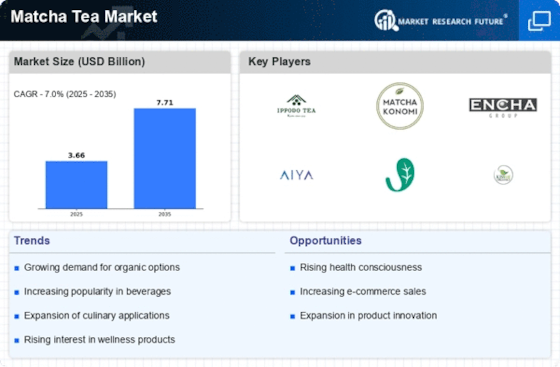
Key players include Ippodo Tea Co, Matcha Konomi, Encha, Aiya, Jade Leaf Matcha, Kiss Me Organics, The Matcha Maiden, Matchaful, and DoMatcha.

What is the expected growth for the ready-to-drink Matcha segment?

The ready-to-drink Matcha segment is anticipated to grow from 1.1 USD Billion in 2024 to 2.3 USD Billion by 2035.

What distribution channels are utilized in the Matcha Tea Market?

The market utilizes both store-based and non-store-based distribution channels, with store-based expected to grow from 2.2 USD Billion to 4.5 USD Billion.

What types of Matcha are projected to see the most growth?

Sweetened Matcha is projected to grow from 1.2 USD Billion in 2024 to 2.5 USD Billion by 2035, indicating a strong consumer preference.

Market Summary

As per Market Research Future analysis, the Matcha Tea Market Size was estimated at 3.66 USD Billion in 2024. The Matcha Tea industry is projected to grow from 3.916 USD Billion in 2025 to 7.705 USD Billion by 2035, exhibiting a compound annual growth rate (CAGR) of 7.0% during the forecast period 2025 - 2035

Key Market Trends & Highlights

The Matcha Tea Market is experiencing robust growth driven by health trends and product innovation.

  • The health and wellness focus continues to propel the demand for matcha tea, particularly in North America, the largest market. Product innovation is evident as brands introduce diverse matcha beverages, catering to evolving consumer preferences. In the Asia-Pacific region, the market is rapidly expanding, with instant premixes emerging as the fastest-growing segment. Rising demand for functional beverages and the culinary versatility of matcha are key drivers influencing market dynamics.

Market Size & Forecast

2024 Market Size 3.66 (USD Billion)
2035 Market Size 7.705 (USD Billion)
CAGR (2025 - 2035) 7.0%
Largest Regional Market Share in 2024 Asia Pacific

Major Players

<p>Ippodo Tea Co (JP), Matcha Konomi (JP), Encha (US), Aiya (JP), Jade Leaf Matcha (US), Kiss Me Organics (US), The Matcha Maiden (US), Matchaful (US), DoMatcha (US)</p>

Market Trends

The global matcha tea market size growth is currently experiencing a notable transformation, driven by a growing consumer awareness of health benefits associated with matcha. This green tea variant, known for its vibrant color and unique flavor, is increasingly favored for its potential antioxidant properties and calming effects. As individuals become more health-conscious, the demand for organic and premium matcha products appears to rise, suggesting a shift towards higher quality offerings. Additionally, the versatility of matcha in various culinary applications, from beverages to desserts, enhances its appeal, potentially attracting a broader audience. 

Health and Wellness Focus

The matcha tea market size is increasingly influenced by a heightened emphasis on health and wellness. Consumers are gravitating towards products that offer perceived health benefits, such as antioxidants and stress relief, which matcha is believed to provide.

Product Innovation

The matcha tea market trends suggest that innovation within the global matcha tea market is evident as brands introduce new formats and applications. From matcha-infused snacks to ready-to-drink options, companies are diversifying their offerings to meet the demands of modern consumers.

Sustainability Initiatives

Sustainability is becoming a pivotal concern in the Matcha Tea Market. Brands are likely to adopt eco-friendly practices, focusing on sustainable sourcing and packaging, which may resonate with environmentally conscious consumers.

Matcha Tea Market Market Drivers

Culinary Versatility of Matcha

The culinary versatility of matcha tea is emerging as a key driver in the Matcha Tea Market. Beyond traditional consumption as a beverage, matcha is increasingly being incorporated into various culinary applications, including desserts, smoothies, and savory dishes. This trend is supported by data showing that the food service sector is increasingly adopting matcha as a trendy ingredient, with a reported increase in menu items featuring matcha. The versatility of matcha not only appeals to health-conscious consumers but also attracts food enthusiasts looking for innovative flavors. As restaurants and cafes continue to experiment with matcha-infused dishes, the Matcha Tea Market is likely to see a boost in demand, as consumers seek new and exciting ways to enjoy this unique ingredient.

Expansion of E-commerce Platforms

The Matcha Tea Market is witnessing a significant transformation due to the expansion of e-commerce platforms. As online shopping becomes increasingly prevalent, consumers are more inclined to purchase matcha tea products through digital channels. This shift is supported by data indicating that e-commerce sales in the food and beverage sector have seen a substantial increase, with projections suggesting a growth rate of over 10% annually. The convenience of online shopping, coupled with the ability to access a wider variety of matcha products, enhances consumer engagement and drives sales. Furthermore, e-commerce platforms often provide detailed product information and customer reviews, which can influence purchasing decisions. This trend indicates that the Matcha Tea Market is likely to benefit from the ongoing digitalization of retail, as more consumers turn to online platforms for their matcha tea needs.

Growing Interest in Organic Products

The Matcha Tea Market is significantly influenced by the growing interest in organic products among consumers. As awareness of the benefits of organic farming practices increases, more consumers are seeking out organic matcha tea options. Data indicates that the organic food market has been expanding at a rate of approximately 9% annually, reflecting a broader trend towards sustainable and health-conscious consumption. This shift is likely to enhance the appeal of matcha tea, particularly among environmentally aware consumers who prioritize organic certifications. The demand for organic matcha not only supports the health benefits associated with the product but also aligns with consumers' values regarding sustainability and ethical sourcing. As a result, the Matcha Tea Market is poised to benefit from this growing preference for organic offerings.

Rising Demand for Functional Beverages

The Matcha Tea Market experiences a notable surge in demand for functional beverages, driven by consumers' increasing preference for health-oriented products. This trend is reflected in the growing awareness of the health benefits associated with matcha tea, such as its high antioxidant content and potential metabolism-boosting properties. According to recent data, the functional beverage market is projected to grow at a compound annual growth rate of approximately 8% over the next five years. This growth is likely to bolster the Matcha Tea Market, as consumers seek alternatives to sugary drinks and opt for beverages that offer both taste and health benefits. The alignment of matcha tea with the wellness trend positions it favorably in a competitive market, suggesting that its popularity will continue to rise as more consumers prioritize health in their beverage choices.

Influence of Social Media and Health Trends

The Matcha Tea Market is increasingly shaped by the influence of social media and emerging health trends. Platforms such as Instagram and TikTok have played a pivotal role in popularizing matcha tea, showcasing its vibrant color and versatility in various recipes. This social media exposure has led to a surge in interest, particularly among younger demographics who are more likely to engage with health trends online. Data suggests that products featured in social media campaigns can experience a sales increase of up to 30%. As influencers and health advocates promote matcha tea as a superfood, the Matcha Tea Market is likely to see continued growth, driven by the viral nature of social media and the desire for aesthetically pleasing, health-oriented products.

Market Segment Insights

By Application: Matcha Beverages (Largest) vs. Regular Tea (Fastest-Growing)

<p>In the Matcha Tea Market, the application segments reveal interesting dynamics with 'Matcha Beverages' holding the largest market share. This segment has gained immense popularity due to emerging consumer preferences for health-focused drinks. In contrast, 'Regular Tea' has shown rapid growth, quickly becoming a strong competitor in the market landscape as consumers increasingly seek out traditional tea offerings infused with matcha for their unique health benefits. The growth trends in these segments are driven by shifting consumer behaviors towards healthier lifestyle choices and the rising demand for premium, organic products. 'Matcha Beverages' benefits from the trend of functional drinks, while 'Regular Tea' is capitalizing on its heritage and broad acceptance, particularly among health-conscious consumers. The potential for growth in these areas suggests a vibrant and competitive landscape for matcha products moving forward.</p>

<p>Matcha Beverages: Dominant vs. Regular Tea: Emerging</p>

<p>'Matcha Beverages' clearly establishes itself as the dominant player in the application segment of the Matcha Tea Market. This category includes ready-to-drink matcha lattes and smoothies, appealing to consumers looking for convenience and health benefits. The adoption of matcha in various beverage formats is on the rise, fueled by its perceived health benefits and versatility. Meanwhile, 'Regular Tea', marked as an emerging segment, incorporates matcha into traditional tea blends, thereby attracting consumers seeking a fusion of modern health trends with classic preferences. This segment's growth indicates a strong resurgence of interest in traditional tea forms, suggesting that consumers are increasingly open to trying innovative combinations.</p>

By Form: Ready-To-Drink (Largest) vs. Instant Premixes (Fastest-Growing)

<p>In the Matcha Tea market, the distribution of the 'Form' segment reveals that Ready-To-Drink offerings hold a significant share, appealing to consumers looking for convenience and instant preparation. This segment benefits from the growing trend of health-conscious consumers seeking quick and easy access to matcha's health benefits, leading to its dominance in overall market share. On the other hand, Instant Premixes have emerged as a strong contender, leveraging the trend of at-home preparation and customization, attracting both casual drinkers and enthusiasts alike. Growth trends for the Matcha Tea 'Form' segment indicate a shift towards ready-to-drink solutions as consumers prioritize convenience in their busy lifestyles. Instant Premixes are rapidly gaining traction among younger demographics who prefer quick and hassle-free options, showcasing the market’s adaptation to changing consumer preferences. This growth is driven by increasing awareness about matcha's health benefits, as well as innovative product offerings that cater specifically to the evolving tastes and habits of modern consumers.</p>

<p>Ready-To-Drink (Dominant) vs. Instant Premixes (Emerging)</p>

<p>The Ready-To-Drink (RTD) segment in the Matcha Tea market stands out as the dominant choice among consumers seeking convenient wellness options. RTD products are often packaged in single-serve formats, making them highly accessible for on-the-go consumption. Their popularity is bolstered by effective marketing strategies that highlight the health benefits of matcha, combined with the appeal of unique flavors and branding. In contrast, Instant Premixes represent an emerging trend, appealing particularly to younger consumers who enjoy the ritual of preparing matcha at home. These premixes often come with customizable options and are designed to blend seamlessly with other ingredients, catering to diverse taste preferences. While RTD leads in share, Instant Premixes are rapidly innovating to capture an increasing segment of health-conscious consumers.</p>

By Type: Traditional (Largest) vs. Sweetened (Fastest-Growing)

<p>In the Matcha Tea Market, the 'Type' segment comprises Traditional, Sweetened, and Unsweetened varieties, with Traditional matcha leading the market share due to its deep-rooted cultural significance and preference among purists. Sweetened matcha, while a smaller segment, is rapidly gaining popularity, especially among younger consumers who seek a more palatable introduction to this traditional beverage. Unsweetened matcha maintains a niche but stable audience focused on the health benefits and authentic taste of matcha.</p>

<p>Traditional (Dominant) vs. Sweetened (Emerging)</p>

<p>Traditional matcha is characterized by its ceremonial origins, pure ingredient usage, and rich flavor profile, positioning it as the dominant choice among loyal consumers and traditionalists. This segment often appeals to those who appreciate the authenticity of matcha, thereby capturing significant market interest. Conversely, Sweetened matcha serves as an emerging product appealing to a broader audience, particularly health-conscious millennials and Gen Z consumers who favor flavored beverages. This segment's adaptability and innovative approach to blending matcha with various sweeteners and flavorings are driving its rapid growth, thus reshaping consumer perceptions and expanding the matcha market.</p>

By Formulation: Plain (Largest) vs. Flavored (Fastest-Growing)

<p>In the Matcha Tea Market, the formulation segment showcases a clear distinction in market shares between plain and flavored offerings. Plain matcha continues to dominate the segment, appealing to traditional consumers who appreciate its authentic flavors and health benefits. On the other hand, flavored matcha is rapidly increasing its presence, catering to younger demographics and consumers looking for novel taste experiences. This distribution reflects a growing trend where both segments co-exist, each serving distinct consumer preferences.</p>

<p>Matcha Formulation: Plain (Dominant) vs. Flavored (Emerging)</p>

<p>Plain matcha remains the dominant formulation in the market, valued for its cultural significance and traditional uses in ceremonies and tea drinking. Its richness in antioxidants and health benefits attracts health-conscious consumers who prioritize authenticity. In contrast, flavored matcha is an emerging trend that has captured the attention of a younger, more adventurous audience. It offers a variety of taste profiles, including vanilla, chocolate, and berry, making it a versatile choice for beverages such as lattes and smoothies. This expansion is driven by changing consumer preferences and a desire for innovation in the beverage sector.</p>

By Distribution Channel: Store-Based Distribution Channels (Largest) vs. Non-Store-Based Distribution Channels (Fastest-Growing)

<p>In the Matcha Tea market, Store-Based Distribution Channels dominate, serving as the primary method for consumers to access their favorite products. Traditional retailers and specialty tea shops provide a tangible experience for customers, allowing them to sample and select quality matcha. This method capitalizes on consumer trust and brand loyalty, making it a significant player in the overall market share distribution.</p>

<p>Distribution Channels: Store-Based (Dominant) vs. Non-Store-Based (Emerging)</p>

<p>Store-Based Distribution Channels characterize conventional shopping environments, where consumers can physically interact with products and receive personalized guidance from staff. This segment benefits from established brand visibility and customer loyalty, attracting health-conscious consumers looking for premium matcha options. Conversely, Non-Store-Based Distribution Channels, including e-commerce platforms and subscription services, are rapidly gaining traction. The convenience, variety, and competitive pricing offered by online retailers appeal to a younger demographic that values flexibility and accessibility, further driving the growth of non-store sales in the market.</p>

Matcha Tea Market Distribution Channel Insights

<p>The matcha tea market segmentation, based on distribution channel, includes store-based distribution channels, non-store-based distribution channels. The market was dominated by store-based distribution channels. Store-based distribution channels are further classified as specialized stores and hypermarkets/supermarkets. Supermarkets/Hypermarkets are expected to create a greater proportion of USD 1,735 million, with a GAGR of 6.4%. Hypermarkets and supermarkets are becoming more popular as a result of their large assortment of consumer goods under one roof, ample parking space, and convenient business hours.</p>

Get more detailed insights about Matcha Tea Market Research Report - Forecast to 2035

Regional Insights

North America : Health-Conscious Consumer Base

The North American matcha tea market is experiencing significant growth, driven by increasing health consciousness among consumers and the rising popularity of matcha as a superfood. The region holds approximately 35% of the global market share, making it the largest market for matcha tea. Regulatory support for organic products and health claims further fuels this demand, as consumers seek natural and beneficial alternatives to traditional beverages.

The matcha tea market trends suggest that United States is the leading country in this market, with a growing number of specialty tea shops and online retailers offering a variety of matcha products. The Canada matcha tea market is another important contributor. Key players such as Encha and Jade Leaf Matcha are capitalizing on this trend, providing high-quality matcha sourced from Japan. The competitive landscape is characterized by a mix of established brands and emerging startups, all vying for a share of the expanding market.

Europe : Emerging Market for Wellness

The Europe matcha tea market is rapidly becoming a significant player in the matcha tea market, driven by a surge in health and wellness trends. The region accounts for approximately 25% of the global market share, making it the second-largest market. Factors such as increasing awareness of the health benefits of matcha and the rise of vegan and organic lifestyles are key drivers of this growth. Regulatory frameworks supporting organic certification are also enhancing consumer trust in matcha products.

Leading countries in this region include the UK matcha tea market, Germany, and France, where matcha is increasingly featured in cafes and health food stores. The competitive landscape is marked by both local and international brands, with companies like Matcha Konomi and Aiya establishing a strong presence. The market is expected to continue expanding as more consumers seek out premium, health-oriented beverages.

Asia-Pacific : Cultural Heritage and Growth

The Asia-Pacific region, particularly Japan, is the birthplace of matcha tea and continues to dominate the global market, holding approximately 30% of the share. The growth is fueled by a blend of traditional consumption and modern trends, as younger consumers embrace matcha for its health benefits and versatility in various culinary applications. Regulatory support for organic farming practices is also a catalyst for market expansion in this region.

The Japan matcha tea market remains the leading country, with a rich cultural heritage surrounding matcha. Key players like Ippodo Tea Co and Aiya are well-established, offering premium products that cater to both domestic and international markets. The competitive landscape is robust, with numerous local brands and an increasing number of international entrants looking to capitalize on the growing global interest in matcha tea.

Middle East and Africa : Emerging Health Trends

The Middle East and Africa region is witnessing a gradual rise in the popularity of matcha tea, driven by increasing health awareness and a growing interest in wellness products. This region currently holds about 10% of the global market share, with potential for significant growth as consumers become more health-conscious. Regulatory initiatives promoting healthy lifestyles are also contributing to the market's expansion, encouraging the adoption of matcha as a preferred beverage choice. Countries like South Africa and the UAE are leading the way in matcha consumption, with a growing number of cafes and health food stores introducing matcha products. The competitive landscape is still developing, with both local and international brands entering the market. Key players are beginning to establish their presence, aiming to meet the rising demand for health-oriented beverages in this region.

Key Players and Competitive Insights

The matcha tea market trends suggest that the industry is currently characterized by a dynamic competitive landscape, driven by increasing consumer awareness of health benefits and a growing preference for premium products. Key players such as Ippodo Tea Co (Japan), Encha (US), and Jade Leaf Matcha (US) are strategically positioning themselves through innovation and regional expansion. Ippodo Tea Co (Japan), renowned for its traditional matcha production methods, emphasizes quality and authenticity, which resonates with health-conscious consumers. Meanwhile, Encha (US) focuses on organic offerings, appealing to the rising demand for clean-label products. Jade Leaf Matcha (US) leverages digital marketing strategies to enhance brand visibility and consumer engagement, indicating a shift towards e-commerce as a primary sales channel.


The business tactics employed by these companies reflect a moderately fragmented market structure, where localizing manufacturing and optimizing supply chains are pivotal. For instance, many companies are increasingly sourcing matcha directly from Japanese farms to ensure quality and sustainability, which not only enhances product authenticity but also strengthens supply chain reliability. This collective approach among key players fosters a competitive environment that encourages innovation and responsiveness to consumer trends.


In August 2025, Ippodo Tea Co (Japan) announced a partnership with a leading health and wellness influencer to promote its premium matcha products. This strategic move aims to tap into the influencer's extensive follower base, thereby enhancing brand awareness and driving sales through targeted marketing efforts. Such collaborations are likely to bolster Ippodo's market presence, particularly among younger consumers who are increasingly influenced by social media.


In September 2025, Encha (US) launched a new line of matcha-infused snacks, diversifying its product portfolio to cater to the growing demand for convenient health foods. This expansion not only aligns with consumer trends towards snacking but also positions Encha as a versatile brand in the matcha segment. By innovating beyond traditional beverage offerings, Encha appears to be capitalizing on the trend of functional foods, potentially increasing its market share.


In October 2025, Jade Leaf Matcha (US) unveiled a new sustainability initiative aimed at reducing its carbon footprint through eco-friendly packaging solutions. This initiative reflects a broader industry trend towards sustainability, as consumers increasingly favor brands that demonstrate environmental responsibility. By prioritizing sustainable practices, Jade Leaf Matcha is likely to enhance its brand loyalty and attract environmentally conscious consumers.


As of October 2025, the Matcha Tea Market is witnessing significant trends such as digitalization, sustainability, and the integration of technology in operations. Strategic alliances among companies are shaping the competitive landscape, fostering innovation and collaboration. Looking ahead, it is anticipated that competitive differentiation will increasingly hinge on innovation and technology rather than price alone. Companies that successfully leverage these trends will likely emerge as leaders in the evolving market.

Key Companies in the Matcha Tea Market include

Industry Developments

March 2024- India's most trusted FMCG brand, Pansari Group, is now ready to blaze the audience with its launch of TVOY GREEN TEA at AAHAR 2024. Lately, the company introduced its new tea range, Pansari Chai, which comes in four distinct flavors, each of which provides an intense tea-drinking experience. After getting a massive response from their customers for Pansari Chai, the team thought of bringing their green tea range to the market as well. 

The company is now ready to enter the world of excellent green tea sourced from the prestigious Nilgiris in Tamil Nadu, South India. The TVOY GREEN TEA is expanded in one of the top-tier tea estates, situated at an altitude of 1900 meters above MSL. Set by crystal-clear streams and natural forests, this eco-friendly sanctuary offers the ideal setting for responsible tea farming. The director of Pansari Group, Shammi Agarwal, shows his pursuit of the launch by mentioning that the launch of TVOY GREEN TEA is not just about introducing a product but about supporting a lifestyle.

In a time when health awareness is on the ascent, TVOY provides a mix of wellness and culture. 

The distinct flavors of these products include Classic green tea, Kahwa green tea, and chamomile. At present, no leading players are in the green tea market. Hence, the brand thinks it is high time it entered the market. Everyone is quite excited about the journey ahead and believes that TVOY GREEN TEA will become an indication of health and indulgence for our consumers. In addition, Pansari's products are ISO 9001 2008 certified, HACCP 2006 certified, and Fair Trade Certified by the Fair Trade Labeling Organization.

In March 2023, Tenzo Tea, a luxury line of matcha tea, will be partnering with boutique tequila brand Lo Siento to create three exclusive match-infused cocktails. In this alliance, both brands are committed to providing exceptional quality and pioneering taste experiences.

 In November 2023, Hojicha Co., responding to client requests for reliable brands of matcha online, partnered with Marukyu Koyamaen to provide genuine Uji matcha on their website. The partnership will make available different customer preferences ranging from ceremonial occasion cocktails like ‘Match Yugen’ or ‘Match Isuzu Latte’ lattes, etc.

February 2022, Nestlé Health Science acquired a stake in Orgain. Nestlé Health Science's nutrition products would complement the company's existing product line as a result of this agreement.

January 2022, Aiya America's newest product line is the Matcha Infused Tea Line. Three superb Japanese matcha teas in the collection are Organic Matcha Infused Sencha, Organic Matcha Infused Gyokuro, and Organic Matcha Infused Genmaicha.

Future Outlook

Matcha Tea Market Future Outlook

<p>The Matcha Tea Market is projected to grow at a 7.0% CAGR from 2025 to 2035, driven by increasing health awareness, product innovation, and expanding distribution channels.</p>

New opportunities lie in:

  • <p>Development of premium organic matcha product lines Expansion into ready-to-drink matcha beverages Implementation of subscription-based matcha delivery services</p>

<p>By 2035, the Matcha Tea Market is expected to achieve robust growth and diversification.</p>

Market Segmentation

Matcha Tea Market Form Outlook

  • Ready-To-Drink
  • Instant Premixes
  • Powder Form

Matcha Tea Market Type Outlook

  • Traditional
  • Sweetened
  • Unsweetened

Matcha Tea Market Application Outlook

  • Regular Tea
  • Food
  • Cosmetics
  • Matcha Beverages
  • Personal Market

Matcha Tea Market Formulation Outlook

  • Plain
  • Flavored

Matcha Tea Market Distribution Channel Outlook

  • Store-Based Distribution Channels
  • Non-Store-Based Distribution Channels

Report Scope

MARKET SIZE 2024 3.66(USD Billion)
MARKET SIZE 2025 3.916(USD Billion)
MARKET SIZE 2035 7.705(USD Billion)
COMPOUND ANNUAL GROWTH RATE (CAGR) 7.0% (2025 - 2035)
REPORT COVERAGE Revenue Forecast, Competitive Landscape, Growth Factors, and Trends
BASE YEAR 2024
Market Forecast Period 2025 - 2035
Historical Data 2019 - 2024
Market Forecast Units USD Billion
Key Companies Profiled Ippodo Tea Co (JP), Matcha Konomi (JP), Encha (US), Aiya (JP), Jade Leaf Matcha (US), Kiss Me Organics (US), The Matcha Maiden (US), Matchaful (US), DoMatcha (US)
Segments Covered Application, Form, Type, Formulation, Distribution Channel, Region
Key Market Opportunities Growing consumer preference for health-oriented beverages enhances opportunities in the Matcha Tea Market.
Key Market Dynamics Rising consumer preference for health-oriented beverages drives demand for premium matcha tea products and innovative blends.
Countries Covered North America, Europe, APAC, South America, MEA

FAQs

What is the current valuation of the Matcha Tea Market as of 2024?

<p>The Matcha Tea Market was valued at 3.66 USD Billion in 2024.</p>

What is the projected market size for the Matcha Tea Market by 2035?

<p>The market is projected to reach 7.705 USD Billion by 2035.</p>

What is the expected CAGR for the Matcha Tea Market during the forecast period 2025 - 2035?

<p>The expected CAGR for the Matcha Tea Market during 2025 - 2035 is 7.0%.</p>

Which segments are included in the Matcha Tea Market analysis?

<p>The segments include Application, Form, Type, Formulation, and Distribution Channel.</p>

What are the projected values for Matcha Beverages in 2025?

<p>Matcha Beverages are projected to grow from 1.1 USD Billion in 2024 to 2.3 USD Billion by 2035.</p>

How does the market for flavored Matcha compare to plain Matcha?

<p>Flavored Matcha is expected to grow from 1.46 USD Billion in 2024 to 3.205 USD Billion by 2035, while plain Matcha is projected to increase from 2.2 USD Billion to 4.5 USD Billion.</p>

What are the key players in the Matcha Tea Market?

Key players include Ippodo Tea Co, Matcha Konomi, Encha, Aiya, Jade Leaf Matcha, Kiss Me Organics, The Matcha Maiden, Matchaful, and DoMatcha.

What is the expected growth for the ready-to-drink Matcha segment?

The ready-to-drink Matcha segment is anticipated to grow from 1.1 USD Billion in 2024 to 2.3 USD Billion by 2035.

What distribution channels are utilized in the Matcha Tea Market?

The market utilizes both store-based and non-store-based distribution channels, with store-based expected to grow from 2.2 USD Billion to 4.5 USD Billion.

What types of Matcha are projected to see the most growth?

Sweetened Matcha is projected to grow from 1.2 USD Billion in 2024 to 2.5 USD Billion by 2035, indicating a strong consumer preference.

  1. SECTION I: EXECUTIVE SUMMARY AND KEY HIGHLIGHTS
    1. | 1.1 EXECUTIVE SUMMARY
    2. | | 1.1.1 Market Overview
    3. | | 1.1.2 Key Findings
    4. | | 1.1.3 Market Segmentation
    5. | | 1.1.4 Competitive Landscape
    6. | | 1.1.5 Challenges and Opportunities
    7. | | 1.1.6 Future Outlook
  2. SECTION II: SCOPING, METHODOLOGY AND MARKET STRUCTURE
    1. | 2.1 MARKET INTRODUCTION
    2. | | 2.1.1 Definition
    3. | | 2.1.2 Scope of the study
    4. | | | 2.1.2.1 Research Objective
    5. | | | 2.1.2.2 Assumption
    6. | | | 2.1.2.3 Limitations
    7. | 2.2 RESEARCH METHODOLOGY
    8. | | 2.2.1 Overview
    9. | | 2.2.2 Data Mining
    10. | | 2.2.3 Secondary Research
    11. | | 2.2.4 Primary Research
    12. | | | 2.2.4.1 Primary Interviews and Information Gathering Process
    13. | | | 2.2.4.2 Breakdown of Primary Respondents
    14. | | 2.2.5 Forecasting Model
    15. | | 2.2.6 Market Size Estimation
    16. | | | 2.2.6.1 Bottom-Up Approach
    17. | | | 2.2.6.2 Top-Down Approach
    18. | | 2.2.7 Data Triangulation
    19. | | 2.2.8 Validation
  3. SECTION III: QUALITATIVE ANALYSIS
    1. | 3.1 MARKET DYNAMICS
    2. | | 3.1.1 Overview
    3. | | 3.1.2 Drivers
    4. | | 3.1.3 Restraints
    5. | | 3.1.4 Opportunities
    6. | 3.2 MARKET FACTOR ANALYSIS
    7. | | 3.2.1 Value chain Analysis
    8. | | 3.2.2 Porter's Five Forces Analysis
    9. | | | 3.2.2.1 Bargaining Power of Suppliers
    10. | | | 3.2.2.2 Bargaining Power of Buyers
    11. | | | 3.2.2.3 Threat of New Entrants
    12. | | | 3.2.2.4 Threat of Substitutes
    13. | | | 3.2.2.5 Intensity of Rivalry
    14. | | 3.2.3 COVID-19 Impact Analysis
    15. | | | 3.2.3.1 Market Impact Analysis
    16. | | | 3.2.3.2 Regional Impact
    17. | | | 3.2.3.3 Opportunity and Threat Analysis
  4. SECTION IV: QUANTITATIVE ANALYSIS
    1. | 4.1 Food, Beverages & Nutrition, BY Application (USD Billion)
    2. | | 4.1.1 Regular Tea
    3. | | 4.1.2 Food
    4. | | 4.1.3 Cosmetics
    5. | | 4.1.4 Matcha Beverages
    6. | | 4.1.5 Personal Market
    7. | 4.2 Food, Beverages & Nutrition, BY Form (USD Billion)
    8. | | 4.2.1 Ready-To-Drink
    9. | | 4.2.2 Instant Premixes
    10. | | 4.2.3 Powder Form
    11. | 4.3 Food, Beverages & Nutrition, BY Type (USD Billion)
    12. | | 4.3.1 Traditional
    13. | | 4.3.2 Sweetened
    14. | | 4.3.3 Unsweetened
    15. | 4.4 Food, Beverages & Nutrition, BY Formulation (USD Billion)
    16. | | 4.4.1 Plain
    17. | | 4.4.2 Flavored
    18. | 4.5 Food, Beverages & Nutrition, BY Distribution Channel (USD Billion)
    19. | | 4.5.1 Store-Based Distribution Channels
    20. | | 4.5.2 Non-Store-Based Distribution Channels
    21. | 4.6 Food, Beverages & Nutrition, BY Region (USD Billion)
    22. | | 4.6.1 North America
    23. | | | 4.6.1.1 US
    24. | | | 4.6.1.2 Canada
    25. | | 4.6.2 Europe
    26. | | | 4.6.2.1 Germany
    27. | | | 4.6.2.2 UK
    28. | | | 4.6.2.3 France
    29. | | | 4.6.2.4 Russia
    30. | | | 4.6.2.5 Italy
    31. | | | 4.6.2.6 Spain
    32. | | | 4.6.2.7 Rest of Europe
    33. | | 4.6.3 APAC
    34. | | | 4.6.3.1 China
    35. | | | 4.6.3.2 India
    36. | | | 4.6.3.3 Japan
    37. | | | 4.6.3.4 South Korea
    38. | | | 4.6.3.5 Malaysia
    39. | | | 4.6.3.6 Thailand
    40. | | | 4.6.3.7 Indonesia
    41. | | | 4.6.3.8 Rest of APAC
    42. | | 4.6.4 South America
    43. | | | 4.6.4.1 Brazil
    44. | | | 4.6.4.2 Mexico
    45. | | | 4.6.4.3 Argentina
    46. | | | 4.6.4.4 Rest of South America
    47. | | 4.6.5 MEA
    48. | | | 4.6.5.1 GCC Countries
    49. | | | 4.6.5.2 South Africa
    50. | | | 4.6.5.3 Rest of MEA
  5. SECTION V: COMPETITIVE ANALYSIS
    1. | 5.1 Competitive Landscape
    2. | | 5.1.1 Overview
    3. | | 5.1.2 Competitive Analysis
    4. | | 5.1.3 Market share Analysis
    5. | | 5.1.4 Major Growth Strategy in the Food, Beverages & Nutrition
    6. | | 5.1.5 Competitive Benchmarking
    7. | | 5.1.6 Leading Players in Terms of Number of Developments in the Food, Beverages & Nutrition
    8. | | 5.1.7 Key developments and growth strategies
    9. | | | 5.1.7.1 New Product Launch/Service Deployment
    10. | | | 5.1.7.2 Merger & Acquisitions
    11. | | | 5.1.7.3 Joint Ventures
    12. | | 5.1.8 Major Players Financial Matrix
    13. | | | 5.1.8.1 Sales and Operating Income
    14. | | | 5.1.8.2 Major Players R&D Expenditure. 2023
    15. | 5.2 Company Profiles
    16. | | 5.2.1 Ippodo Tea Co (JP)
    17. | | | 5.2.1.1 Financial Overview
    18. | | | 5.2.1.2 Products Offered
    19. | | | 5.2.1.3 Key Developments
    20. | | | 5.2.1.4 SWOT Analysis
    21. | | | 5.2.1.5 Key Strategies
    22. | | 5.2.2 Matcha Konomi (JP)
    23. | | | 5.2.2.1 Financial Overview
    24. | | | 5.2.2.2 Products Offered
    25. | | | 5.2.2.3 Key Developments
    26. | | | 5.2.2.4 SWOT Analysis
    27. | | | 5.2.2.5 Key Strategies
    28. | | 5.2.3 Encha (US)
    29. | | | 5.2.3.1 Financial Overview
    30. | | | 5.2.3.2 Products Offered
    31. | | | 5.2.3.3 Key Developments
    32. | | | 5.2.3.4 SWOT Analysis
    33. | | | 5.2.3.5 Key Strategies
    34. | | 5.2.4 Aiya (JP)
    35. | | | 5.2.4.1 Financial Overview
    36. | | | 5.2.4.2 Products Offered
    37. | | | 5.2.4.3 Key Developments
    38. | | | 5.2.4.4 SWOT Analysis
    39. | | | 5.2.4.5 Key Strategies
    40. | | 5.2.5 Jade Leaf Matcha (US)
    41. | | | 5.2.5.1 Financial Overview
    42. | | | 5.2.5.2 Products Offered
    43. | | | 5.2.5.3 Key Developments
    44. | | | 5.2.5.4 SWOT Analysis
    45. | | | 5.2.5.5 Key Strategies
    46. | | 5.2.6 Kiss Me Organics (US)
    47. | | | 5.2.6.1 Financial Overview
    48. | | | 5.2.6.2 Products Offered
    49. | | | 5.2.6.3 Key Developments
    50. | | | 5.2.6.4 SWOT Analysis
    51. | | | 5.2.6.5 Key Strategies
    52. | | 5.2.7 The Matcha Maiden (US)
    53. | | | 5.2.7.1 Financial Overview
    54. | | | 5.2.7.2 Products Offered
    55. | | | 5.2.7.3 Key Developments
    56. | | | 5.2.7.4 SWOT Analysis
    57. | | | 5.2.7.5 Key Strategies
    58. | | 5.2.8 Matchaful (US)
    59. | | | 5.2.8.1 Financial Overview
    60. | | | 5.2.8.2 Products Offered
    61. | | | 5.2.8.3 Key Developments
    62. | | | 5.2.8.4 SWOT Analysis
    63. | | | 5.2.8.5 Key Strategies
    64. | | 5.2.9 DoMatcha (US)
    65. | | | 5.2.9.1 Financial Overview
    66. | | | 5.2.9.2 Products Offered
    67. | | | 5.2.9.3 Key Developments
    68. | | | 5.2.9.4 SWOT Analysis
    69. | | | 5.2.9.5 Key Strategies
    70. | 5.3 Appendix
    71. | | 5.3.1 References
    72. | | 5.3.2 Related Reports
  6. LIST OF FIGURES
    1. | 6.1 MARKET SYNOPSIS
    2. | 6.2 NORTH AMERICA MARKET ANALYSIS
    3. | 6.3 US MARKET ANALYSIS BY APPLICATION
    4. | 6.4 US MARKET ANALYSIS BY FORM
    5. | 6.5 US MARKET ANALYSIS BY TYPE
    6. | 6.6 US MARKET ANALYSIS BY FORMULATION
    7. | 6.7 US MARKET ANALYSIS BY DISTRIBUTION CHANNEL
    8. | 6.8 CANADA MARKET ANALYSIS BY APPLICATION
    9. | 6.9 CANADA MARKET ANALYSIS BY FORM
    10. | 6.10 CANADA MARKET ANALYSIS BY TYPE
    11. | 6.11 CANADA MARKET ANALYSIS BY FORMULATION
    12. | 6.12 CANADA MARKET ANALYSIS BY DISTRIBUTION CHANNEL
    13. | 6.13 EUROPE MARKET ANALYSIS
    14. | 6.14 GERMANY MARKET ANALYSIS BY APPLICATION
    15. | 6.15 GERMANY MARKET ANALYSIS BY FORM
    16. | 6.16 GERMANY MARKET ANALYSIS BY TYPE
    17. | 6.17 GERMANY MARKET ANALYSIS BY FORMULATION
    18. | 6.18 GERMANY MARKET ANALYSIS BY DISTRIBUTION CHANNEL
    19. | 6.19 UK MARKET ANALYSIS BY APPLICATION
    20. | 6.20 UK MARKET ANALYSIS BY FORM
    21. | 6.21 UK MARKET ANALYSIS BY TYPE
    22. | 6.22 UK MARKET ANALYSIS BY FORMULATION
    23. | 6.23 UK MARKET ANALYSIS BY DISTRIBUTION CHANNEL
    24. | 6.24 FRANCE MARKET ANALYSIS BY APPLICATION
    25. | 6.25 FRANCE MARKET ANALYSIS BY FORM
    26. | 6.26 FRANCE MARKET ANALYSIS BY TYPE
    27. | 6.27 FRANCE MARKET ANALYSIS BY FORMULATION
    28. | 6.28 FRANCE MARKET ANALYSIS BY DISTRIBUTION CHANNEL
    29. | 6.29 RUSSIA MARKET ANALYSIS BY APPLICATION
    30. | 6.30 RUSSIA MARKET ANALYSIS BY FORM
    31. | 6.31 RUSSIA MARKET ANALYSIS BY TYPE
    32. | 6.32 RUSSIA MARKET ANALYSIS BY FORMULATION
    33. | 6.33 RUSSIA MARKET ANALYSIS BY DISTRIBUTION CHANNEL
    34. | 6.34 ITALY MARKET ANALYSIS BY APPLICATION
    35. | 6.35 ITALY MARKET ANALYSIS BY FORM
    36. | 6.36 ITALY MARKET ANALYSIS BY TYPE
    37. | 6.37 ITALY MARKET ANALYSIS BY FORMULATION
    38. | 6.38 ITALY MARKET ANALYSIS BY DISTRIBUTION CHANNEL
    39. | 6.39 SPAIN MARKET ANALYSIS BY APPLICATION
    40. | 6.40 SPAIN MARKET ANALYSIS BY FORM
    41. | 6.41 SPAIN MARKET ANALYSIS BY TYPE
    42. | 6.42 SPAIN MARKET ANALYSIS BY FORMULATION
    43. | 6.43 SPAIN MARKET ANALYSIS BY DISTRIBUTION CHANNEL
    44. | 6.44 REST OF EUROPE MARKET ANALYSIS BY APPLICATION
    45. | 6.45 REST OF EUROPE MARKET ANALYSIS BY FORM
    46. | 6.46 REST OF EUROPE MARKET ANALYSIS BY TYPE
    47. | 6.47 REST OF EUROPE MARKET ANALYSIS BY FORMULATION
    48. | 6.48 REST OF EUROPE MARKET ANALYSIS BY DISTRIBUTION CHANNEL
    49. | 6.49 APAC MARKET ANALYSIS
    50. | 6.50 CHINA MARKET ANALYSIS BY APPLICATION
    51. | 6.51 CHINA MARKET ANALYSIS BY FORM
    52. | 6.52 CHINA MARKET ANALYSIS BY TYPE
    53. | 6.53 CHINA MARKET ANALYSIS BY FORMULATION
    54. | 6.54 CHINA MARKET ANALYSIS BY DISTRIBUTION CHANNEL
    55. | 6.55 INDIA MARKET ANALYSIS BY APPLICATION
    56. | 6.56 INDIA MARKET ANALYSIS BY FORM
    57. | 6.57 INDIA MARKET ANALYSIS BY TYPE
    58. | 6.58 INDIA MARKET ANALYSIS BY FORMULATION
    59. | 6.59 INDIA MARKET ANALYSIS BY DISTRIBUTION CHANNEL
    60. | 6.60 JAPAN MARKET ANALYSIS BY APPLICATION
    61. | 6.61 JAPAN MARKET ANALYSIS BY FORM
    62. | 6.62 JAPAN MARKET ANALYSIS BY TYPE
    63. | 6.63 JAPAN MARKET ANALYSIS BY FORMULATION
    64. | 6.64 JAPAN MARKET ANALYSIS BY DISTRIBUTION CHANNEL
    65. | 6.65 SOUTH KOREA MARKET ANALYSIS BY APPLICATION
    66. | 6.66 SOUTH KOREA MARKET ANALYSIS BY FORM
    67. | 6.67 SOUTH KOREA MARKET ANALYSIS BY TYPE
    68. | 6.68 SOUTH KOREA MARKET ANALYSIS BY FORMULATION
    69. | 6.69 SOUTH KOREA MARKET ANALYSIS BY DISTRIBUTION CHANNEL
    70. | 6.70 MALAYSIA MARKET ANALYSIS BY APPLICATION
    71. | 6.71 MALAYSIA MARKET ANALYSIS BY FORM
    72. | 6.72 MALAYSIA MARKET ANALYSIS BY TYPE
    73. | 6.73 MALAYSIA MARKET ANALYSIS BY FORMULATION
    74. | 6.74 MALAYSIA MARKET ANALYSIS BY DISTRIBUTION CHANNEL
    75. | 6.75 THAILAND MARKET ANALYSIS BY APPLICATION
    76. | 6.76 THAILAND MARKET ANALYSIS BY FORM
    77. | 6.77 THAILAND MARKET ANALYSIS BY TYPE
    78. | 6.78 THAILAND MARKET ANALYSIS BY FORMULATION
    79. | 6.79 THAILAND MARKET ANALYSIS BY DISTRIBUTION CHANNEL
    80. | 6.80 INDONESIA MARKET ANALYSIS BY APPLICATION
    81. | 6.81 INDONESIA MARKET ANALYSIS BY FORM
    82. | 6.82 INDONESIA MARKET ANALYSIS BY TYPE
    83. | 6.83 INDONESIA MARKET ANALYSIS BY FORMULATION
    84. | 6.84 INDONESIA MARKET ANALYSIS BY DISTRIBUTION CHANNEL
    85. | 6.85 REST OF APAC MARKET ANALYSIS BY APPLICATION
    86. | 6.86 REST OF APAC MARKET ANALYSIS BY FORM
    87. | 6.87 REST OF APAC MARKET ANALYSIS BY TYPE
    88. | 6.88 REST OF APAC MARKET ANALYSIS BY FORMULATION
    89. | 6.89 REST OF APAC MARKET ANALYSIS BY DISTRIBUTION CHANNEL
    90. | 6.90 SOUTH AMERICA MARKET ANALYSIS
    91. | 6.91 BRAZIL MARKET ANALYSIS BY APPLICATION
    92. | 6.92 BRAZIL MARKET ANALYSIS BY FORM
    93. | 6.93 BRAZIL MARKET ANALYSIS BY TYPE
    94. | 6.94 BRAZIL MARKET ANALYSIS BY FORMULATION
    95. | 6.95 BRAZIL MARKET ANALYSIS BY DISTRIBUTION CHANNEL
    96. | 6.96 MEXICO MARKET ANALYSIS BY APPLICATION
    97. | 6.97 MEXICO MARKET ANALYSIS BY FORM
    98. | 6.98 MEXICO MARKET ANALYSIS BY TYPE
    99. | 6.99 MEXICO MARKET ANALYSIS BY FORMULATION
    100. | 6.100 MEXICO MARKET ANALYSIS BY DISTRIBUTION CHANNEL
    101. | 6.101 ARGENTINA MARKET ANALYSIS BY APPLICATION
    102. | 6.102 ARGENTINA MARKET ANALYSIS BY FORM
    103. | 6.103 ARGENTINA MARKET ANALYSIS BY TYPE
    104. | 6.104 ARGENTINA MARKET ANALYSIS BY FORMULATION
    105. | 6.105 ARGENTINA MARKET ANALYSIS BY DISTRIBUTION CHANNEL
    106. | 6.106 REST OF SOUTH AMERICA MARKET ANALYSIS BY APPLICATION
    107. | 6.107 REST OF SOUTH AMERICA MARKET ANALYSIS BY FORM
    108. | 6.108 REST OF SOUTH AMERICA MARKET ANALYSIS BY TYPE
    109. | 6.109 REST OF SOUTH AMERICA MARKET ANALYSIS BY FORMULATION
    110. | 6.110 REST OF SOUTH AMERICA MARKET ANALYSIS BY DISTRIBUTION CHANNEL
    111. | 6.111 MEA MARKET ANALYSIS
    112. | 6.112 GCC COUNTRIES MARKET ANALYSIS BY APPLICATION
    113. | 6.113 GCC COUNTRIES MARKET ANALYSIS BY FORM
    114. | 6.114 GCC COUNTRIES MARKET ANALYSIS BY TYPE
    115. | 6.115 GCC COUNTRIES MARKET ANALYSIS BY FORMULATION
    116. | 6.116 GCC COUNTRIES MARKET ANALYSIS BY DISTRIBUTION CHANNEL
    117. | 6.117 SOUTH AFRICA MARKET ANALYSIS BY APPLICATION
    118. | 6.118 SOUTH AFRICA MARKET ANALYSIS BY FORM
    119. | 6.119 SOUTH AFRICA MARKET ANALYSIS BY TYPE
    120. | 6.120 SOUTH AFRICA MARKET ANALYSIS BY FORMULATION
    121. | 6.121 SOUTH AFRICA MARKET ANALYSIS BY DISTRIBUTION CHANNEL
    122. | 6.122 REST OF MEA MARKET ANALYSIS BY APPLICATION
    123. | 6.123 REST OF MEA MARKET ANALYSIS BY FORM
    124. | 6.124 REST OF MEA MARKET ANALYSIS BY TYPE
    125. | 6.125 REST OF MEA MARKET ANALYSIS BY FORMULATION
    126. | 6.126 REST OF MEA MARKET ANALYSIS BY DISTRIBUTION CHANNEL
    127. | 6.127 KEY BUYING CRITERIA OF FOOD, BEVERAGES & NUTRITION
    128. | 6.128 RESEARCH PROCESS OF MRFR
    129. | 6.129 DRO ANALYSIS OF FOOD, BEVERAGES & NUTRITION
    130. | 6.130 DRIVERS IMPACT ANALYSIS: FOOD, BEVERAGES & NUTRITION
    131. | 6.131 RESTRAINTS IMPACT ANALYSIS: FOOD, BEVERAGES & NUTRITION
    132. | 6.132 SUPPLY / VALUE CHAIN: FOOD, BEVERAGES & NUTRITION
    133. | 6.133 FOOD, BEVERAGES & NUTRITION, BY APPLICATION, 2024 (% SHARE)
    134. | 6.134 FOOD, BEVERAGES & NUTRITION, BY APPLICATION, 2024 TO 2035 (USD Billion)
    135. | 6.135 FOOD, BEVERAGES & NUTRITION, BY FORM, 2024 (% SHARE)
    136. | 6.136 FOOD, BEVERAGES & NUTRITION, BY FORM, 2024 TO 2035 (USD Billion)
    137. | 6.137 FOOD, BEVERAGES & NUTRITION, BY TYPE, 2024 (% SHARE)
    138. | 6.138 FOOD, BEVERAGES & NUTRITION, BY TYPE, 2024 TO 2035 (USD Billion)
    139. | 6.139 FOOD, BEVERAGES & NUTRITION, BY FORMULATION, 2024 (% SHARE)
    140. | 6.140 FOOD, BEVERAGES & NUTRITION, BY FORMULATION, 2024 TO 2035 (USD Billion)
    141. | 6.141 FOOD, BEVERAGES & NUTRITION, BY DISTRIBUTION CHANNEL, 2024 (% SHARE)
    142. | 6.142 FOOD, BEVERAGES & NUTRITION, BY DISTRIBUTION CHANNEL, 2024 TO 2035 (USD Billion)
    143. | 6.143 BENCHMARKING OF MAJOR COMPETITORS
  7. LIST OF TABLES
    1. | 7.1 LIST OF ASSUMPTIONS
    2. | | 7.1.1
    3. | 7.2 North America MARKET SIZE ESTIMATES; FORECAST
    4. | | 7.2.1 BY APPLICATION, 2025-2035 (USD Billion)
    5. | | 7.2.2 BY FORM, 2025-2035 (USD Billion)
    6. | | 7.2.3 BY TYPE, 2025-2035 (USD Billion)
    7. | | 7.2.4 BY FORMULATION, 2025-2035 (USD Billion)
    8. | | 7.2.5 BY DISTRIBUTION CHANNEL, 2025-2035 (USD Billion)
    9. | 7.3 US MARKET SIZE ESTIMATES; FORECAST
    10. | | 7.3.1 BY APPLICATION, 2025-2035 (USD Billion)
    11. | | 7.3.2 BY FORM, 2025-2035 (USD Billion)
    12. | | 7.3.3 BY TYPE, 2025-2035 (USD Billion)
    13. | | 7.3.4 BY FORMULATION, 2025-2035 (USD Billion)
    14. | | 7.3.5 BY DISTRIBUTION CHANNEL, 2025-2035 (USD Billion)
    15. | 7.4 Canada MARKET SIZE ESTIMATES; FORECAST
    16. | | 7.4.1 BY APPLICATION, 2025-2035 (USD Billion)
    17. | | 7.4.2 BY FORM, 2025-2035 (USD Billion)
    18. | | 7.4.3 BY TYPE, 2025-2035 (USD Billion)
    19. | | 7.4.4 BY FORMULATION, 2025-2035 (USD Billion)
    20. | | 7.4.5 BY DISTRIBUTION CHANNEL, 2025-2035 (USD Billion)
    21. | 7.5 Europe MARKET SIZE ESTIMATES; FORECAST
    22. | | 7.5.1 BY APPLICATION, 2025-2035 (USD Billion)
    23. | | 7.5.2 BY FORM, 2025-2035 (USD Billion)
    24. | | 7.5.3 BY TYPE, 2025-2035 (USD Billion)
    25. | | 7.5.4 BY FORMULATION, 2025-2035 (USD Billion)
    26. | | 7.5.5 BY DISTRIBUTION CHANNEL, 2025-2035 (USD Billion)
    27. | 7.6 Germany MARKET SIZE ESTIMATES; FORECAST
    28. | | 7.6.1 BY APPLICATION, 2025-2035 (USD Billion)
    29. | | 7.6.2 BY FORM, 2025-2035 (USD Billion)
    30. | | 7.6.3 BY TYPE, 2025-2035 (USD Billion)
    31. | | 7.6.4 BY FORMULATION, 2025-2035 (USD Billion)
    32. | | 7.6.5 BY DISTRIBUTION CHANNEL, 2025-2035 (USD Billion)
    33. | 7.7 UK MARKET SIZE ESTIMATES; FORECAST
    34. | | 7.7.1 BY APPLICATION, 2025-2035 (USD Billion)
    35. | | 7.7.2 BY FORM, 2025-2035 (USD Billion)
    36. | | 7.7.3 BY TYPE, 2025-2035 (USD Billion)
    37. | | 7.7.4 BY FORMULATION, 2025-2035 (USD Billion)
    38. | | 7.7.5 BY DISTRIBUTION CHANNEL, 2025-2035 (USD Billion)
    39. | 7.8 France MARKET SIZE ESTIMATES; FORECAST
    40. | | 7.8.1 BY APPLICATION, 2025-2035 (USD Billion)
    41. | | 7.8.2 BY FORM, 2025-2035 (USD Billion)
    42. | | 7.8.3 BY TYPE, 2025-2035 (USD Billion)
    43. | | 7.8.4 BY FORMULATION, 2025-2035 (USD Billion)
    44. | | 7.8.5 BY DISTRIBUTION CHANNEL, 2025-2035 (USD Billion)
    45. | 7.9 Russia MARKET SIZE ESTIMATES; FORECAST
    46. | | 7.9.1 BY APPLICATION, 2025-2035 (USD Billion)
    47. | | 7.9.2 BY FORM, 2025-2035 (USD Billion)
    48. | | 7.9.3 BY TYPE, 2025-2035 (USD Billion)
    49. | | 7.9.4 BY FORMULATION, 2025-2035 (USD Billion)
    50. | | 7.9.5 BY DISTRIBUTION CHANNEL, 2025-2035 (USD Billion)
    51. | 7.10 Italy MARKET SIZE ESTIMATES; FORECAST
    52. | | 7.10.1 BY APPLICATION, 2025-2035 (USD Billion)
    53. | | 7.10.2 BY FORM, 2025-2035 (USD Billion)
    54. | | 7.10.3 BY TYPE, 2025-2035 (USD Billion)
    55. | | 7.10.4 BY FORMULATION, 2025-2035 (USD Billion)
    56. | | 7.10.5 BY DISTRIBUTION CHANNEL, 2025-2035 (USD Billion)
    57. | 7.11 Spain MARKET SIZE ESTIMATES; FORECAST
    58. | | 7.11.1 BY APPLICATION, 2025-2035 (USD Billion)
    59. | | 7.11.2 BY FORM, 2025-2035 (USD Billion)
    60. | | 7.11.3 BY TYPE, 2025-2035 (USD Billion)
    61. | | 7.11.4 BY FORMULATION, 2025-2035 (USD Billion)
    62. | | 7.11.5 BY DISTRIBUTION CHANNEL, 2025-2035 (USD Billion)
    63. | 7.12 Rest of Europe MARKET SIZE ESTIMATES; FORECAST
    64. | | 7.12.1 BY APPLICATION, 2025-2035 (USD Billion)
    65. | | 7.12.2 BY FORM, 2025-2035 (USD Billion)
    66. | | 7.12.3 BY TYPE, 2025-2035 (USD Billion)
    67. | | 7.12.4 BY FORMULATION, 2025-2035 (USD Billion)
    68. | | 7.12.5 BY DISTRIBUTION CHANNEL, 2025-2035 (USD Billion)
    69. | 7.13 APAC MARKET SIZE ESTIMATES; FORECAST
    70. | | 7.13.1 BY APPLICATION, 2025-2035 (USD Billion)
    71. | | 7.13.2 BY FORM, 2025-2035 (USD Billion)
    72. | | 7.13.3 BY TYPE, 2025-2035 (USD Billion)
    73. | | 7.13.4 BY FORMULATION, 2025-2035 (USD Billion)
    74. | | 7.13.5 BY DISTRIBUTION CHANNEL, 2025-2035 (USD Billion)
    75. | 7.14 China MARKET SIZE ESTIMATES; FORECAST
    76. | | 7.14.1 BY APPLICATION, 2025-2035 (USD Billion)
    77. | | 7.14.2 BY FORM, 2025-2035 (USD Billion)
    78. | | 7.14.3 BY TYPE, 2025-2035 (USD Billion)
    79. | | 7.14.4 BY FORMULATION, 2025-2035 (USD Billion)
    80. | | 7.14.5 BY DISTRIBUTION CHANNEL, 2025-2035 (USD Billion)
    81. | 7.15 India MARKET SIZE ESTIMATES; FORECAST
    82. | | 7.15.1 BY APPLICATION, 2025-2035 (USD Billion)
    83. | | 7.15.2 BY FORM, 2025-2035 (USD Billion)
    84. | | 7.15.3 BY TYPE, 2025-2035 (USD Billion)
    85. | | 7.15.4 BY FORMULATION, 2025-2035 (USD Billion)
    86. | | 7.15.5 BY DISTRIBUTION CHANNEL, 2025-2035 (USD Billion)
    87. | 7.16 Japan MARKET SIZE ESTIMATES; FORECAST
    88. | | 7.16.1 BY APPLICATION, 2025-2035 (USD Billion)
    89. | | 7.16.2 BY FORM, 2025-2035 (USD Billion)
    90. | | 7.16.3 BY TYPE, 2025-2035 (USD Billion)
    91. | | 7.16.4 BY FORMULATION, 2025-2035 (USD Billion)
    92. | | 7.16.5 BY DISTRIBUTION CHANNEL, 2025-2035 (USD Billion)
    93. | 7.17 South Korea MARKET SIZE ESTIMATES; FORECAST
    94. | | 7.17.1 BY APPLICATION, 2025-2035 (USD Billion)
    95. | | 7.17.2 BY FORM, 2025-2035 (USD Billion)
    96. | | 7.17.3 BY TYPE, 2025-2035 (USD Billion)
    97. | | 7.17.4 BY FORMULATION, 2025-2035 (USD Billion)
    98. | | 7.17.5 BY DISTRIBUTION CHANNEL, 2025-2035 (USD Billion)
    99. | 7.18 Malaysia MARKET SIZE ESTIMATES; FORECAST
    100. | | 7.18.1 BY APPLICATION, 2025-2035 (USD Billion)
    101. | | 7.18.2 BY FORM, 2025-2035 (USD Billion)
    102. | | 7.18.3 BY TYPE, 2025-2035 (USD Billion)
    103. | | 7.18.4 BY FORMULATION, 2025-2035 (USD Billion)
    104. | | 7.18.5 BY DISTRIBUTION CHANNEL, 2025-2035 (USD Billion)
    105. | 7.19 Thailand MARKET SIZE ESTIMATES; FORECAST
    106. | | 7.19.1 BY APPLICATION, 2025-2035 (USD Billion)
    107. | | 7.19.2 BY FORM, 2025-2035 (USD Billion)
    108. | | 7.19.3 BY TYPE, 2025-2035 (USD Billion)
    109. | | 7.19.4 BY FORMULATION, 2025-2035 (USD Billion)
    110. | | 7.19.5 BY DISTRIBUTION CHANNEL, 2025-2035 (USD Billion)
    111. | 7.20 Indonesia MARKET SIZE ESTIMATES; FORECAST
    112. | | 7.20.1 BY APPLICATION, 2025-2035 (USD Billion)
    113. | | 7.20.2 BY FORM, 2025-2035 (USD Billion)
    114. | | 7.20.3 BY TYPE, 2025-2035 (USD Billion)
    115. | | 7.20.4 BY FORMULATION, 2025-2035 (USD Billion)
    116. | | 7.20.5 BY DISTRIBUTION CHANNEL, 2025-2035 (USD Billion)
    117. | 7.21 Rest of APAC MARKET SIZE ESTIMATES; FORECAST
    118. | | 7.21.1 BY APPLICATION, 2025-2035 (USD Billion)
    119. | | 7.21.2 BY FORM, 2025-2035 (USD Billion)
    120. | | 7.21.3 BY TYPE, 2025-2035 (USD Billion)
    121. | | 7.21.4 BY FORMULATION, 2025-2035 (USD Billion)
    122. | | 7.21.5 BY DISTRIBUTION CHANNEL, 2025-2035 (USD Billion)
    123. | 7.22 South America MARKET SIZE ESTIMATES; FORECAST
    124. | | 7.22.1 BY APPLICATION, 2025-2035 (USD Billion)
    125. | | 7.22.2 BY FORM, 2025-2035 (USD Billion)
    126. | | 7.22.3 BY TYPE, 2025-2035 (USD Billion)
    127. | | 7.22.4 BY FORMULATION, 2025-2035 (USD Billion)
    128. | | 7.22.5 BY DISTRIBUTION CHANNEL, 2025-2035 (USD Billion)
    129. | 7.23 Brazil MARKET SIZE ESTIMATES; FORECAST
    130. | | 7.23.1 BY APPLICATION, 2025-2035 (USD Billion)
    131. | | 7.23.2 BY FORM, 2025-2035 (USD Billion)
    132. | | 7.23.3 BY TYPE, 2025-2035 (USD Billion)
    133. | | 7.23.4 BY FORMULATION, 2025-2035 (USD Billion)
    134. | | 7.23.5 BY DISTRIBUTION CHANNEL, 2025-2035 (USD Billion)
    135. | 7.24 Mexico MARKET SIZE ESTIMATES; FORECAST
    136. | | 7.24.1 BY APPLICATION, 2025-2035 (USD Billion)
    137. | | 7.24.2 BY FORM, 2025-2035 (USD Billion)
    138. | | 7.24.3 BY TYPE, 2025-2035 (USD Billion)
    139. | | 7.24.4 BY FORMULATION, 2025-2035 (USD Billion)
    140. | | 7.24.5 BY DISTRIBUTION CHANNEL, 2025-2035 (USD Billion)
    141. | 7.25 Argentina MARKET SIZE ESTIMATES; FORECAST
    142. | | 7.25.1 BY APPLICATION, 2025-2035 (USD Billion)
    143. | | 7.25.2 BY FORM, 2025-2035 (USD Billion)
    144. | | 7.25.3 BY TYPE, 2025-2035 (USD Billion)
    145. | | 7.25.4 BY FORMULATION, 2025-2035 (USD Billion)
    146. | | 7.25.5 BY DISTRIBUTION CHANNEL, 2025-2035 (USD Billion)
    147. | 7.26 Rest of South America MARKET SIZE ESTIMATES; FORECAST
    148. | | 7.26.1 BY APPLICATION, 2025-2035 (USD Billion)
    149. | | 7.26.2 BY FORM, 2025-2035 (USD Billion)
    150. | | 7.26.3 BY TYPE, 2025-2035 (USD Billion)
    151. | | 7.26.4 BY FORMULATION, 2025-2035 (USD Billion)
    152. | | 7.26.5 BY DISTRIBUTION CHANNEL, 2025-2035 (USD Billion)
    153. | 7.27 MEA MARKET SIZE ESTIMATES; FORECAST
    154. | | 7.27.1 BY APPLICATION, 2025-2035 (USD Billion)
    155. | | 7.27.2 BY FORM, 2025-2035 (USD Billion)
    156. | | 7.27.3 BY TYPE, 2025-2035 (USD Billion)
    157. | | 7.27.4 BY FORMULATION, 2025-2035 (USD Billion)
    158. | | 7.27.5 BY DISTRIBUTION CHANNEL, 2025-2035 (USD Billion)
    159. | 7.28 GCC Countries MARKET SIZE ESTIMATES; FORECAST
    160. | | 7.28.1 BY APPLICATION, 2025-2035 (USD Billion)
    161. | | 7.28.2 BY FORM, 2025-2035 (USD Billion)
    162. | | 7.28.3 BY TYPE, 2025-2035 (USD Billion)
    163. | | 7.28.4 BY FORMULATION, 2025-2035 (USD Billion)
    164. | | 7.28.5 BY DISTRIBUTION CHANNEL, 2025-2035 (USD Billion)
    165. | 7.29 South Africa MARKET SIZE ESTIMATES; FORECAST
    166. | | 7.29.1 BY APPLICATION, 2025-2035 (USD Billion)
    167. | | 7.29.2 BY FORM, 2025-2035 (USD Billion)
    168. | | 7.29.3 BY TYPE, 2025-2035 (USD Billion)
    169. | | 7.29.4 BY FORMULATION, 2025-2035 (USD Billion)
    170. | | 7.29.5 BY DISTRIBUTION CHANNEL, 2025-2035 (USD Billion)
    171. | 7.30 Rest of MEA MARKET SIZE ESTIMATES; FORECAST
    172. | | 7.30.1 BY APPLICATION, 2025-2035 (USD Billion)
    173. | | 7.30.2 BY FORM, 2025-2035 (USD Billion)
    174. | | 7.30.3 BY TYPE, 2025-2035 (USD Billion)
    175. | | 7.30.4 BY FORMULATION, 2025-2035 (USD Billion)
    176. | | 7.30.5 BY DISTRIBUTION CHANNEL, 2025-2035 (USD Billion)
    177. | 7.31 PRODUCT LAUNCH/PRODUCT DEVELOPMENT/APPROVAL
    178. | | 7.31.1
    179. | 7.32 ACQUISITION/PARTNERSHIP
    180. | | 7.32.1

Food, Beverages & Nutrition Market Segmentation

Food, Beverages & Nutrition By Application (USD Billion, 2025-2035)

  • Regular Tea
  • Food
  • Cosmetics
  • Matcha Beverages
  • Personal Market

Food, Beverages & Nutrition By Form (USD Billion, 2025-2035)

  • Ready-To-Drink
  • Instant Premixes
  • Powder Form

Food, Beverages & Nutrition By Type (USD Billion, 2025-2035)

  • Traditional
  • Sweetened
  • Unsweetened

Food, Beverages & Nutrition By Formulation (USD Billion, 2025-2035)

  • Plain
  • Flavored

Food, Beverages & Nutrition By Distribution Channel (USD Billion, 2025-2035)

  • Store-Based Distribution Channels
  • Non-Store-Based Distribution Channels
Infographic

Free Sample Request

Kindly complete the form below to receive a free sample of this Report

Get Free Sample

Customer Strories

Compare Licence

×
Features License Type
Single User Multiuser License Enterprise User
Price $4,950 $5,950 $7,250
Maximum User Access Limit 1 User Upto 10 Users Unrestricted Access Throughout the Organization
Free Customization
Direct Access to Analyst
Deliverable Format
Platform Access
Discount on Next Purchase 10% 15% 15%
Printable Versions