Request Free Sample ×

Kindly complete the form below to receive a free sample of this Report

* Please use a valid business email

Leading companies partner with us for data-driven Insights

clients tt-cursor
Hero Background
English
Chinese
French
Japanese
Korean
German
Spanish

Mastitis Market Size

ID: MRFR/Pharma/3936-CR
142 Pages
Vikita Thakur
Last Updated: March 31, 2026

Mastitis Market Research Report Information by Type (Bovine {Contagious Mastitis, Environmental Mastitis and Opportunist Mastitis} and Human {Non-Infectious Mastitis and Infectious Mastitis}), Treatment (Bovine {Antibiotics and Vaccines} and Human {Pain Relievers and Antibiotics}), End User (Veterinary Centers and Hospital & Clinics) - Forecast till 2035

Share:
Download PDF ×

We do not share your information with anyone. However, we may send you emails based on your report interest from time to time. You may contact us at any time to opt-out.

Mastitis Market Infographic
Purchase Options

Mastitis Size

Mastitis Market Size and Growth Highlights

The mastitis market size refers to the extent or scale of the market related to mastitis, a condition that involves the inflammation of the breast tissue. This market size helps us understand how widespread or common mastitis is and how it impacts various healthcare aspects. In simple terms, the mastitis market size provides insights into the number of people affected by mastitis, the demand for related healthcare products and services, and the economic implications associated with managing and treating this condition. Mastitis is a common issue, especially among breastfeeding women, where the breast tissue becomes inflamed. The market size for mastitis reflects the number of individuals seeking medical attention or using products to address this condition. This information is valuable for healthcare professionals, researchers, and companies involved in developing solutions for mastitis. A larger market size indicates a higher demand for resources to manage and treat mastitis effectively. The mastitis market size can influence healthcare policies and strategies for addressing this condition. If the market size is significant, it may prompt increased investments in research, development of new treatments, and awareness campaigns. Understanding the market size is crucial for healthcare providers to allocate resources efficiently, ensuring that there are adequate facilities, healthcare professionals, and support systems to meet the needs of individuals dealing with mastitis. Moreover, the mastitis market size can have economic implications, as it involves factors such as healthcare expenditures, costs associated with treatments, and potential economic losses due to missed work or reduced productivity. By comprehending the market size, policymakers, healthcare professionals, and stakeholders can make informed decisions to enhance healthcare services, improve outcomes for those affected by mastitis, and contribute to overall public health.
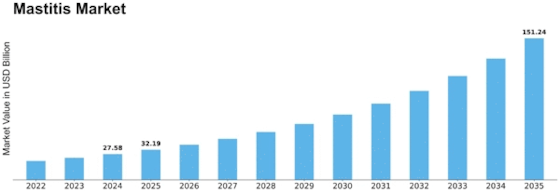
Mastitis Market Size Graph
Author
Author Profile
Vikita Thakur
Senior Research Analyst

She holds an experience of about 5+ years in market research and business consulting projects for sectors such as life sciences, medical devices, and healthcare IT. She possesses a robust background in data analysis, market estimation, competitive intelligence, pipeline analysis market trend identification, and consumer behavior insights. Her expertise lies in technical Sales support, client interaction and project management, designing and implementing market research studies, conducting competitive analysis, and synthesizing complex data into actionable recommendations that drive business growth.

Leave a Comment

FAQs

What is the current valuation of the Mastitis Market as of 2024?

<p>The Mastitis Market was valued at 27.58 USD Billion in 2024.</p>

What is the projected market size for the Mastitis Market in 2035?

<p>The Mastitis Market is projected to reach 151.24 USD Billion by 2035.</p>

What is the expected CAGR for the Mastitis Market during the forecast period 2025 - 2035?

<p>The expected CAGR for the Mastitis Market during the forecast period 2025 - 2035 is 16.73%.</p>

Which segments are included in the Mastitis Market analysis?

<p>The Mastitis Market analysis includes segments such as Type, Treatment, and End User.</p>

What are the key players in the Mastitis Market?

<p>Key players in the Mastitis Market include Zoetis, Merck Animal Health, and Boehringer Ingelheim.</p>

How does the Bovine Mastitis segment perform in terms of valuation?

The Bovine Mastitis segment is valued between 15.0 and 80.0 USD Billion.

What is the valuation range for Human Mastitis in the market?

The Human Mastitis segment is valued between 12.58 and 71.24 USD Billion.

What treatments are available for Bovine Mastitis?

Available treatments for Bovine Mastitis include Bovine Antibiotics, valued between 8.0 and 43.0 USD Billion.

What is the market size for veterinary centers as an end user?

Veterinary Centers as an end user are valued between 10.0 and 55.0 USD Billion.

How do hospitals and clinics contribute to the Mastitis Market?

Hospitals and Clinics contribute significantly, with a valuation range of 17.58 to 96.24 USD Billion.

Market Summary

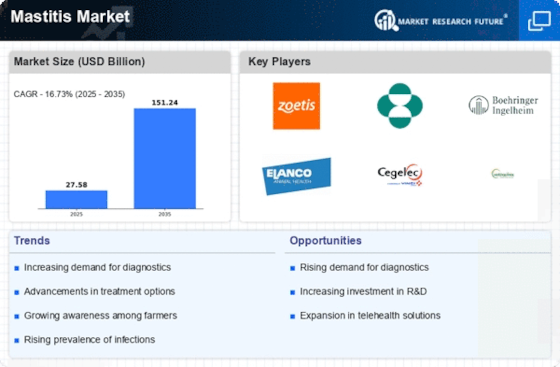
According to MRFR analysis, the Mastitis Market size was valued at USD 27.58 Billion in 2024. The market is projected to grow from USD 32.20 Billion in 2025 to USD 151.24 Billion by 2035, exhibiting a CAGR of 16.73% during the forecast period 2025-2035.North America led the market with over 44.96% share, generating around USD 12.4 Billion in revenue.
 
The Mastitis Market is growing due to increasing prevalence of breast infections among lactating women and rising awareness of early diagnosis and treatment. Key trends include advancements in antibiotic therapies, improved diagnostic methods, and growing focus on maternal healthcare, supporting better disease management and reducing complications globally.
 
According to the World Health Organization, mastitis affects up to 10% of breastfeeding women, emphasizing the need for effective diagnosis and treatment strategies.

Key Market Trends & Highlights

The Mastitis Market is experiencing a dynamic shift driven by technological advancements and changing consumer demands.

  • Technological advancements in diagnostics are enhancing the detection and management of mastitis in both bovine and human populations. North America remains the largest market for mastitis treatments, while the Asia-Pacific region is emerging as the fastest-growing market. Bovine mastitis treatment, particularly through antibiotics, continues to dominate the market, whereas human mastitis solutions are witnessing rapid growth. The rising incidence of mastitis in dairy cattle and growing awareness of animal health are key drivers propelling market expansion.

Market Size & Forecast

2024 Market Size 27.58 (USD Billion)
2035 Market Size 151.24 (USD Billion)
CAGR (2025 - 2035) 16.73%
Largest Regional Market Share in 2024 Europe

Major Players

Companies such as <a href="https://www.zoetisus.com/products/dairy/spectramast-lc/">Zoetis</a> (US), Merck Animal Health (US), Boehringer Ingelheim (DE), <a href="https://farmanimal.elanco.com/au/insights-centre/mastitis-in-dairy-cows">Elanco Animal Health</a> (US), Cegelec (FR), Vetoquinol (FR), Huvepharma (BG), Phibro Animal Health (US), Dechra Pharmaceuticals (GB) are some of the major participants in the global market.

Market Trends

The Mastitis Market is currently experiencing notable transformations driven by various factors. The increasing awareness regarding animal health and welfare is prompting dairy farmers to adopt better management practices. This shift is likely to enhance the overall quality of milk production, thereby influencing the demand for effective mastitis treatment solutions.

Furthermore, advancements in veterinary medicine and technology are facilitating the development of innovative therapies and diagnostic tools, which may improve the detection and management of mastitis in livestock. As a result, stakeholders in the Mastitis Market are focusing on research and development to create more efficient products that cater to the evolving needs of the industry.

In addition, the rising prevalence of mastitis in dairy herds is compelling producers to seek preventive measures and treatments. This trend suggests a growing market for both pharmaceuticals and alternative therapies aimed at reducing the incidence of this condition. Moreover, regulatory changes and increased scrutiny on antibiotic use in livestock are likely to drive the demand for non-antibiotic treatment options. Overall, the Mastitis Market appears poised for growth as it adapts to these emerging challenges and opportunities, fostering a more sustainable approach to dairy farming.

Technological Advancements in Diagnostics

The Mastitis Market is witnessing a surge in the adoption of advanced diagnostic tools. Innovations such as rapid testing kits and digital monitoring systems are enhancing the ability to detect mastitis early. This trend is likely to lead to timely interventions, reducing the overall impact of the disease on dairy production.

According to the Food and Agriculture Organization (FAO), livestock diseases such as Mastitis significantly impact dairy productivity, contributing to substantial economic losses globally, which has accelerated the adoption of advanced diagnostic tools for early detection.

Shift Towards Preventive Care

There is a noticeable shift in focus towards preventive care within the Mastitis Market. Dairy producers are increasingly investing in management practices that aim to prevent mastitis outbreaks. This proactive approach may result in a decline in treatment costs and improved herd health.

Food and Agriculture Organization highlights that preventive livestock health management practices can reduce disease incidence and improve productivity, with better herd management contributing to higher milk yield and quality.

Regulatory Changes Impacting Treatment Options

Regulatory frameworks surrounding antibiotic use in livestock are evolving, influencing the Mastitis Market. Stricter guidelines are prompting the development of alternative treatment options. This trend indicates a potential shift towards more sustainable practices in managing mastitis.

According to the World Health Organization, antimicrobial resistance is a major global concern linked to antibiotic use in livestock, leading to stronger regulations promoting responsible usage and alternative therapies.

Mastitis Market Market Drivers

Growing Awareness of Animal Health

There is a notable increase in awareness regarding animal health, particularly among dairy farmers and consumers. This heightened awareness is driving the Mastitis Market as stakeholders recognize the importance of maintaining herd health for sustainable production.
 
Educational initiatives and outreach programs have been implemented to inform farmers about the implications of mastitis on animal welfare and economic viability. Consequently, this awareness is fostering a demand for advanced diagnostic tools and treatment options, thereby stimulating growth within the Mastitis Market. The emphasis on animal welfare is expected to continue influencing purchasing decisions in the coming years.

Increasing Demand for Dairy Products

The rising demand for dairy products is a crucial factor propelling the Mastitis Market. As consumer preferences shift towards dairy consumption, the pressure on dairy producers to maintain high-quality milk production intensifies.
 
This demand compels farmers to adopt effective mastitis management strategies to ensure optimal milk yield and quality. Reports suggest that the dairy market is projected to grow at a compound annual growth rate of 3.5% over the next five years. Consequently, the Mastitis Market is poised to benefit from this trend, as producers seek solutions to combat mastitis and enhance overall herd productivity.

Advancements in Treatment Technologies

Technological advancements in treatment options are significantly influencing the Mastitis Market. Innovations such as targeted therapies and improved antibiotic formulations are emerging, providing more effective solutions for managing mastitis. The introduction of non-antibiotic alternatives, including immunomodulators and herbal treatments, is also gaining traction.
 
These advancements not only enhance treatment efficacy but also align with the growing demand for sustainable practices in livestock management. As a result, the Mastitis Market is likely to experience growth driven by the adoption of these novel technologies, which aim to improve animal health outcomes and reduce reliance on traditional antibiotics.

Rising Incidence of Mastitis in Dairy Cattle

The increasing incidence of mastitis in dairy cattle is a primary driver of the Mastitis Market. Reports indicate that mastitis affects approximately 30% of dairy herds, leading to significant economic losses. The condition not only reduces milk production but also increases veterinary costs and impacts milk quality.
 
As dairy farmers seek to mitigate these losses, there is a growing demand for effective treatment and prevention solutions. This trend is likely to propel the Mastitis Market forward, as stakeholders invest in innovative therapies and management practices to address the rising prevalence of this disease.

Regulatory Pressure for Sustainable Practices

Regulatory frameworks are increasingly emphasizing sustainable practices in livestock management, which is impacting the Mastitis Market. Governments and organizations are implementing stricter guidelines regarding antibiotic use and animal welfare standards. This regulatory pressure is prompting dairy farmers to seek alternative solutions for mastitis management that align with sustainability goals.
 
As a result, there is a growing market for innovative treatments and preventive measures that comply with these regulations. The Mastitis Market is likely to evolve in response to these changes, as stakeholders adapt to meet both regulatory requirements and consumer expectations for responsible dairy production.

Market Segment Insights

By Type: Bovine Mastitis (Largest) vs. Human Mastitis (Fastest-Growing)

The Mastitis Market shows a distinct segmentation in terms of type, with Bovine Mastitis holding a significant share owing to the large-scale cattle farming and dairy industry demands. This segment is prevalent due to the higher incidence of mastitis in cows, leading to increased treatment expenditures. On the other hand, Human Mastitis, while smaller in proportion, is witnessing rapid growth, driven by rising awareness of breast health issues and the increasing prevalence of mastitis in breastfeeding women.

Bovine Mastitis (Dominant) vs. Human Mastitis (Emerging)

Bovine Mastitis remains the dominant force in the market share, primarily attributed to extensive dairy farming practices and the consequential need for effective treatment options. The focus on dairy production makes managing bovine mastitis critical for farmers, elevating the demand for veterinary solutions. Conversely, Human Mastitis is emerging rapidly, fueled by heightened awareness of breast health among postpartum women and an increase in healthcare access. This growth is characterized by the introduction of innovative therapies tailored for human patients, alongside educational initiatives aimed at reducing the stigma surrounding this condition, thus positioning it as a significant developing segment in the mastitis landscape.

By Treatment: Bovine Antibiotics (Largest) vs. Bovine Vaccines (Fastest-Growing)

In the Mastitis Market, the treatment segment showcases a diverse range of products designed to combat this prevalent dairy cattle disease. Bovine Antibiotics dominate the market due to their established efficacy and widespread use among dairy farmers, capturing a significant market share. In contrast, Bovine Vaccines, while currently smaller, are rapidly gaining traction as awareness of preventive health measures grows, thus representing a compelling shift in industry preferences.

Bovine Antibiotics (Dominant) vs. Bovine Vaccines (Emerging)

Bovine Antibiotics remain the cornerstone of mastitis treatment offerings, valued for their effectiveness in managing infections and promoting bovine health. They have a strong presence due to familiarity among veterinarians and farmers, contributing to their dominant status in the market. However, Bovine Vaccines are emerging as a vital alternative, providing a proactive approach to mastitis management. Their rise is fueled by increasing demand for preventive health solutions, with advancements in vaccine technology enhancing their efficacy and appeal. Farmers are progressively inclined to invest in vaccines to minimize antibiotic use, thus promoting a shift toward holistic herd health management.

By End User: Veterinary Centers (Largest) vs. Hospitals & Clinics (Fastest-Growing)

In the Mastitis Market, the distribution of market share among end users reveals a dominant presence of veterinary centers, which are the largest segment owing to their specialized focus on animal health care, particularly in the management of mastitis in livestock. Veterinary centers provide dedicated services and expertise, leading to significant consumer preference in the market. Conversely, hospitals and clinics, while smaller in share, are gaining traction as they increasingly incorporate veterinary services and health management solutions that address mastitis treatments.

End Users: Veterinary Centers (Dominant) vs. Hospitals &amp; Clinics (Emerging)

Veterinary centers play a crucial role in the market share, characterized by their specialized approach to the treatment and prevention of mastitis in dairy cattle and other livestock. This segment is recognized for its focused expertise, offering tailored solutions and veterinary services that ensure enhanced animal health and productivity. In contrast, hospitals and clinics represent an emerging segment, expanding their services to include mastitis treatment. They benefit from integrating advanced medical technology and collaborative healthcare approaches, catering to a growing demand for comprehensive animal health services, thus indicating potential for rapid growth.

Get more detailed insights about Mastitis Market Research Report - Forecast till 2035

Regional Insights

North America : Leading Market for Mastitis Solutions

North America leads in the Mastitis Market Size, accounting for over 44.96% of the global revenue in 2024.The region benefits from advanced veterinary healthcare systems, increasing dairy production, and stringent regulations promoting animal welfare. The demand for effective mastitis treatments is driven by rising awareness among farmers and the need for improved milk quality.

The United States and Canada are the leading countries in this market, with significant investments in research and development. Key players like Zoetis and Merck Animal Health are prominent, offering innovative solutions. The competitive landscape is characterized by a focus on product differentiation and strategic partnerships to enhance market presence.

Europe : Regulatory Focus on Animal Health

Europe Mastitis Market was valued at USD 8.27 billion in 2024, making it the second-largest regional market with a 30% share.The region's growth is fueled by increasing dairy farming practices and a strong emphasis on animal health regulations.

The European Union's stringent policies on antibiotic use in livestock are driving demand for alternative treatments and preventive measures against mastitis. Leading countries include Germany, France, and the UK, where the presence of major players like Boehringer Ingelheim and Cegelec enhances market dynamics.

The competitive landscape is marked by innovation in treatment options and a focus on sustainable practices. The European Medicines Agency continues to support advancements in veterinary medicine, ensuring compliance with health standards.

Asia-Pacific : Emerging Market with Growth Potential

Asia-Pacific is an emerging powerhouse in the mastitis market, contributing approximately 20% to the global share. The region's growth is driven by increasing dairy consumption, rising awareness of animal health, and government initiatives to enhance livestock productivity. Countries like India and China are witnessing a surge in dairy farming, leading to higher demand for effective mastitis treatments. 

India and China are the leading countries in this region, with a growing number of local and international players entering the market. The competitive landscape is evolving, with companies focusing on affordable and effective solutions. The presence of key players like Elanco and Vetoquinol is strengthening the market, as they adapt to local needs and preferences.

Middle East and Africa : Untapped Market with Challenges

The Middle East and Africa represent a smaller segment of the mastitis market, holding about 5% of the global share. The region faces challenges such as limited access to veterinary services and varying levels of awareness regarding mastitis management. However, increasing dairy production and government initiatives to improve livestock health are driving growth potential.

Countries like South Africa and Kenya are at the forefront, with a growing focus on improving dairy farming practices. The competitive landscape is characterized by a mix of local and international players, including Huvepharma and Phibro Animal Health. As awareness of mastitis management increases, the market is expected to expand, attracting more investments and innovations.

Key Players and Competitive Insights

The Mastitis Market is characterized by a competitive landscape that is increasingly shaped by innovation, strategic partnerships, and a focus on sustainability. Key players such as Zoetis (US), Merck Animal Health (US), and Boehringer Ingelheim (DE) are actively pursuing strategies that enhance their market positioning. Zoetis (US) emphasizes research and development, particularly in the realm of advanced diagnostics and treatment options, which appears to be a critical driver of their growth. Meanwhile, Merck Animal Health (US) focuses on expanding its product portfolio through strategic acquisitions, thereby enhancing its competitive edge. Boehringer Ingelheim (DE) is also notable for its commitment to sustainability, integrating eco-friendly practices into its operations, which resonates well with the evolving market demands.
 
The business tactics employed by these companies reflect a concerted effort to optimize supply chains and localize manufacturing processes. The Mastitis Market is moderately fragmented, with a mix of established players and emerging companies vying for market share. This competitive structure allows for a dynamic interplay among key players, where the collective influence of their strategies shapes market trends and consumer preferences.
 
In August 2025, Zoetis (US) announced the launch of a new line of mastitis treatment products that utilize cutting-edge biotechnology. This strategic move is significant as it not only reinforces Zoetis's commitment to innovation but also positions the company to meet the growing demand for effective and sustainable animal health solutions. The introduction of these products is likely to enhance their market share and strengthen customer loyalty.
 
In September 2025, Merck Animal Health (US) completed the acquisition of a regional competitor specializing in mastitis management solutions. This acquisition is pivotal as it expands Merck's reach into new markets and enhances its product offerings, thereby solidifying its position as a leader in the mastitis treatment segment. The integration of this new entity is expected to streamline operations and improve supply chain efficiencies.
 
In July 2025, Boehringer Ingelheim (DE) launched a collaborative initiative with several dairy farms to implement sustainable practices in mastitis management. This initiative not only underscores the company's commitment to sustainability but also positions it as a thought leader in the industry. By fostering partnerships with dairy producers, Boehringer Ingelheim (DE) is likely to gain valuable insights that can inform future product development and marketing strategies.
 
As of October 2025, the Mastitis Market is witnessing trends that emphasize digitalization, sustainability, and the integration of artificial intelligence in product development and customer engagement. Strategic alliances among key players are increasingly shaping the competitive landscape, allowing for shared resources and knowledge. Looking ahead, it appears that competitive differentiation will evolve from traditional price-based competition to a focus on innovation, technological advancements, and the reliability of supply chains. This shift may redefine how companies approach market entry and customer retention in the coming years.

Key Companies in the Mastitis Market include

Industry Developments

  • A new Biological Development Centre (BDC) at Boehringer Ingelheim's research development locations in Biberach, Germany, was revealed in June 2018 with a 230-million-euro investment. The BDC will be the company's first BDC.
  • Tavocept, an experimental novel medication developed by BioNumerik Pharmaceuticals, was approved by the Food and Drug Administration in June 2017 for use in both cancer and non-oncology purposes.
  • Keytruda, developed by Merck & Co., was authorized by the FDA in May 2017 to treat adult and pediatric individuals with recently treated advanced or metastatic or metastatic solid tumors with high microsatellite instability (MSI-H) mismatch repair deficiency.

Future Outlook

Mastitis Market Future Outlook

The Mastitis Market size is projected to reach USD 151.24 Billion by 2035, growing at a CAGR of 16.73%

New opportunities lie in:

  • <p>Development of <a href="https://www.marketresearchfuture.com/reports/telemedicine-market-2216">telemedicine</a> platforms for remote diagnosis and treatment monitoring.</p>
  • <p> </p>
  • <p>Investment in AI-driven analytics for early detection of mastitis.</p>
  • <p>Expansion of organic and natural treatment product lines to meet consumer demand.</p>

By 2035, the Mastitis Market is expected to achieve substantial growth, reflecting evolving industry dynamics.

Market Segmentation

Mastitis Market Type Outlook

  • Bovine Mastitis
  • Human Mastitis

Mastitis Market End User Outlook

  • Veterinary Centers
  • Hospitals & Clinics

Mastitis Market Treatment Outlook

  • Bovine Antibiotics
  • Bovine Vaccines
  • Human Pain Relievers
  • Human Antibiotics

Report Scope

MARKET SIZE 2024 27.58(USD Billion)
MARKET SIZE 2025 32.2(USD Billion)
MARKET SIZE 2035 151.24(USD Billion)
COMPOUND ANNUAL GROWTH RATE (CAGR) 16.73% (2025 - 2035)
REPORT COVERAGE Revenue Forecast, Competitive Landscape, Growth Factors, and Trends
BASE YEAR 2024
Market Forecast Period 2025 - 2035
Historical Data 2019 - 2024
Market Forecast Units USD Billion
Key Companies Profiled Zoetis (US), Merck Animal Health (US), Boehringer Ingelheim (DE), Elanco Animal Health (US), Cegelec (FR), Vetoquinol (FR), Huvepharma (BG), Phibro Animal Health (US), Dechra Pharmaceuticals (GB)
Segments Covered Type
Key Market Opportunities Advancements in diagnostic technologies enhance early detection and treatment options in the Mastitis Market.
Key Market Dynamics Rising demand for effective mastitis treatments drives innovation and competition among pharmaceutical and biotechnology companies.
Countries Covered North America, Europe, APAC, South America, MEA

FAQs

What is the current valuation of the Mastitis Market as of 2024?

<p>The Mastitis Market was valued at 27.58 USD Billion in 2024.</p>

What is the projected market size for the Mastitis Market in 2035?

<p>The Mastitis Market is projected to reach 151.24 USD Billion by 2035.</p>

What is the expected CAGR for the Mastitis Market during the forecast period 2025 - 2035?

<p>The expected CAGR for the Mastitis Market during the forecast period 2025 - 2035 is 16.73%.</p>

Which segments are included in the Mastitis Market analysis?

<p>The Mastitis Market analysis includes segments such as Type, Treatment, and End User.</p>

What are the key players in the Mastitis Market?

<p>Key players in the Mastitis Market include Zoetis, Merck Animal Health, and Boehringer Ingelheim.</p>

How does the Bovine Mastitis segment perform in terms of valuation?

The Bovine Mastitis segment is valued between 15.0 and 80.0 USD Billion.

What is the valuation range for Human Mastitis in the market?

The Human Mastitis segment is valued between 12.58 and 71.24 USD Billion.

What treatments are available for Bovine Mastitis?

Available treatments for Bovine Mastitis include Bovine Antibiotics, valued between 8.0 and 43.0 USD Billion.

What is the market size for veterinary centers as an end user?

Veterinary Centers as an end user are valued between 10.0 and 55.0 USD Billion.

How do hospitals and clinics contribute to the Mastitis Market?

Hospitals and Clinics contribute significantly, with a valuation range of 17.58 to 96.24 USD Billion.

  1. SECTION I: EXECUTIVE SUMMARY AND KEY HIGHLIGHTS |
    1. EXECUTIVE SUMMARY | |
      1. Market Overview | |
      2. Key Findings | |
      3. Market Segmentation | |
      4. Competitive Landscape | |
      5. Challenges and Opportunities | |
      6. Future Outlook 2
  2. SECTION II: SCOPING, METHODOLOGY AND MARKET STRUCTURE |
    1. MARKET INTRODUCTION | |
      1. Definition | |
      2. Scope of the study | | |
    2. RESEARCH METHODOLOGY | |
      1. Overview | |
      2. Data Mining | |
      3. Secondary Research | |
      4. Primary Research | | |
      5. Forecasting Model | |
      6. Market Size Estimation | | |
      7. Data Triangulation | |
      8. Validation 3
  3. SECTION III: QUALITATIVE ANALYSIS |
    1. MARKET DYNAMICS | |
      1. Overview | |
      2. Drivers | |
      3. Restraints | |
      4. Opportunities |
    2. MARKET FACTOR ANALYSIS | |
      1. Value chain Analysis | |
      2. Porter's Five Forces Analysis | | |
      3. COVID-19 Impact Analysis | | |
  4. SECTION IV: QUANTITATIVE ANALYSIS |
    1. Healthcare, BY Type (USD Billion) | |
      1. Bovine Mastitis | |
      2. Human Mastitis |
    2. Healthcare, BY Treatment (USD Billion) | |
      1. Bovine Antibiotics | |
      2. Bovine Vaccines | |
      3. Human Pain Relievers | |
      4. Human Antibiotics |
    3. Healthcare, BY End User (USD Billion) | |
      1. Veterinary Centers | |
      2. Hospitals & Clinics |
    4. Healthcare, BY Region (USD Billion) | |
      1. North America | | |
      2. Europe | | |
      3. APAC | | |
      4. South America | | |
      5. MEA | | |
  5. SECTION V: COMPETITIVE ANALYSIS |
    1. Competitive Landscape | |
      1. Overview | |
      2. Competitive Analysis | |
      3. Market share Analysis | |
      4. Major Growth Strategy in the Healthcare | |
      5. Competitive Benchmarking | |
      6. Leading Players in Terms of Number of Developments in the Healthcare | |
      7. Key developments and growth strategies | | |
      8. Major Players Financial Matrix | | |
    2. Company Profiles | |
      1. Zoetis (US) | | |
      2. Merck Animal Health (US) | | |
      3. Boehringer Ingelheim (DE) | | |
      4. Elanco Animal Health (US) | | |
      5. Cegelec (FR) | | |
      6. Vetoquinol (FR) | | |
      7. Huvepharma (BG) | | |
      8. Phibro Animal Health (US) | | |
      9. Dechra Pharmaceuticals (GB) | | |
    3. Appendix | |
      1. References | |
      2. Related Reports 6 LIST OF FIGURES |
    4. MARKET SYNOPSIS |
    5. NORTH AMERICA MARKET ANALYSIS |
    6. US MARKET ANALYSIS BY TYPE |
    7. US MARKET ANALYSIS BY TREATMENT |
    8. US MARKET ANALYSIS BY END USER |
    9. CANADA MARKET ANALYSIS BY TYPE |
    10. CANADA MARKET ANALYSIS BY TREATMENT |
    11. CANADA MARKET ANALYSIS BY END USER |
    12. EUROPE MARKET ANALYSIS |
    13. GERMANY MARKET ANALYSIS BY TYPE |
    14. GERMANY MARKET ANALYSIS BY TREATMENT |
    15. GERMANY MARKET ANALYSIS BY END USER |
    16. UK MARKET ANALYSIS BY TYPE |
    17. UK MARKET ANALYSIS BY TREATMENT |
    18. UK MARKET ANALYSIS BY END USER |
    19. FRANCE MARKET ANALYSIS BY TYPE |
    20. FRANCE MARKET ANALYSIS BY TREATMENT |
    21. FRANCE MARKET ANALYSIS BY END USER |
    22. RUSSIA MARKET ANALYSIS BY TYPE |
    23. RUSSIA MARKET ANALYSIS BY TREATMENT |
    24. RUSSIA MARKET ANALYSIS BY END USER |
    25. ITALY MARKET ANALYSIS BY TYPE |
    26. ITALY MARKET ANALYSIS BY TREATMENT |
    27. ITALY MARKET ANALYSIS BY END USER |
    28. SPAIN MARKET ANALYSIS BY TYPE |
    29. SPAIN MARKET ANALYSIS BY TREATMENT |
    30. SPAIN MARKET ANALYSIS BY END USER |
    31. REST OF EUROPE MARKET ANALYSIS BY TYPE |
    32. REST OF EUROPE MARKET ANALYSIS BY TREATMENT |
    33. REST OF EUROPE MARKET ANALYSIS BY END USER |
    34. APAC MARKET ANALYSIS |
    35. CHINA MARKET ANALYSIS BY TYPE |
    36. CHINA MARKET ANALYSIS BY TREATMENT |
    37. CHINA MARKET ANALYSIS BY END USER |
    38. INDIA MARKET ANALYSIS BY TYPE |
    39. INDIA MARKET ANALYSIS BY TREATMENT |
    40. INDIA MARKET ANALYSIS BY END USER |
    41. JAPAN MARKET ANALYSIS BY TYPE |
    42. JAPAN MARKET ANALYSIS BY TREATMENT |
    43. JAPAN MARKET ANALYSIS BY END USER |
    44. SOUTH KOREA MARKET ANALYSIS BY TYPE |
    45. SOUTH KOREA MARKET ANALYSIS BY TREATMENT |
    46. SOUTH KOREA MARKET ANALYSIS BY END USER |
    47. MALAYSIA MARKET ANALYSIS BY TYPE |
    48. MALAYSIA MARKET ANALYSIS BY TREATMENT |
    49. MALAYSIA MARKET ANALYSIS BY END USER |
    50. THAILAND MARKET ANALYSIS BY TYPE |
    51. THAILAND MARKET ANALYSIS BY TREATMENT |
    52. THAILAND MARKET ANALYSIS BY END USER |
    53. INDONESIA MARKET ANALYSIS BY TYPE |
    54. INDONESIA MARKET ANALYSIS BY TREATMENT |
    55. INDONESIA MARKET ANALYSIS BY END USER |
    56. REST OF APAC MARKET ANALYSIS BY TYPE |
    57. REST OF APAC MARKET ANALYSIS BY TREATMENT |
    58. REST OF APAC MARKET ANALYSIS BY END USER |
    59. SOUTH AMERICA MARKET ANALYSIS |
    60. BRAZIL MARKET ANALYSIS BY TYPE |
    61. BRAZIL MARKET ANALYSIS BY TREATMENT |
    62. BRAZIL MARKET ANALYSIS BY END USER |
    63. MEXICO MARKET ANALYSIS BY TYPE |
    64. MEXICO MARKET ANALYSIS BY TREATMENT |
    65. MEXICO MARKET ANALYSIS BY END USER |
    66. ARGENTINA MARKET ANALYSIS BY TYPE |
    67. ARGENTINA MARKET ANALYSIS BY TREATMENT |
    68. ARGENTINA MARKET ANALYSIS BY END USER |
    69. REST OF SOUTH AMERICA MARKET ANALYSIS BY TYPE |
    70. REST OF SOUTH AMERICA MARKET ANALYSIS BY TREATMENT |
    71. REST OF SOUTH AMERICA MARKET ANALYSIS BY END USER |
    72. MEA MARKET ANALYSIS |
    73. GCC COUNTRIES MARKET ANALYSIS BY TYPE |
    74. GCC COUNTRIES MARKET ANALYSIS BY TREATMENT |
    75. GCC COUNTRIES MARKET ANALYSIS BY END USER |
    76. SOUTH AFRICA MARKET ANALYSIS BY TYPE |
    77. SOUTH AFRICA MARKET ANALYSIS BY TREATMENT |
    78. SOUTH AFRICA MARKET ANALYSIS BY END USER |
    79. REST OF MEA MARKET ANALYSIS BY TYPE |
    80. REST OF MEA MARKET ANALYSIS BY TREATMENT |
    81. REST OF MEA MARKET ANALYSIS BY END USER |
    82. KEY BUYING CRITERIA OF HEALTHCARE |
    83. RESEARCH PROCESS OF MRFR |
    84. DRO ANALYSIS OF HEALTHCARE |
    85. DRIVERS IMPACT ANALYSIS: HEALTHCARE |
    86. RESTRAINTS IMPACT ANALYSIS: HEALTHCARE |
    87. SUPPLY / VALUE CHAIN: HEALTHCARE |
    88. HEALTHCARE, BY TYPE, 2024 (% SHARE) |
    89. HEALTHCARE, BY TYPE, 2024 TO 2035 (USD Billion) |
    90. HEALTHCARE, BY TREATMENT, 2024 (% SHARE) |
    91. HEALTHCARE, BY TREATMENT, 2024 TO 2035 (USD Billion) |
    92. HEALTHCARE, BY END USER, 2024 (% SHARE) |
    93. HEALTHCARE, BY END USER, 2024 TO 2035 (USD Billion) |
    94. BENCHMARKING OF MAJOR COMPETITORS 7 LIST OF TABLES |
    95. LIST OF ASSUMPTIONS | |
      1. |
    96. North America MARKET SIZE ESTIMATES; FORECAST | |
      1. BY TYPE, 2025-2035 (USD Billion) | |
      2. BY TREATMENT, 2025-2035 (USD Billion) | |
      3. BY END USER, 2025-2035 (USD Billion) |
    97. US MARKET SIZE ESTIMATES; FORECAST | |
      1. BY TYPE, 2025-2035 (USD Billion) | |
      2. BY TREATMENT, 2025-2035 (USD Billion) | |
      3. BY END USER, 2025-2035 (USD Billion) |
    98. Canada MARKET SIZE ESTIMATES; FORECAST | |
      1. BY TYPE, 2025-2035 (USD Billion) | |
      2. BY TREATMENT, 2025-2035 (USD Billion) | |
      3. BY END USER, 2025-2035 (USD Billion) |
    99. Europe MARKET SIZE ESTIMATES; FORECAST | |
      1. BY TYPE, 2025-2035 (USD Billion) | |
      2. BY TREATMENT, 2025-2035 (USD Billion) | |
      3. BY END USER, 2025-2035 (USD Billion) |
    100. Germany MARKET SIZE ESTIMATES; FORECAST | |
      1. BY TYPE, 2025-2035 (USD Billion) | |
      2. BY TREATMENT, 2025-2035 (USD Billion) | |
      3. BY END USER, 2025-2035 (USD Billion) |
    101. UK MARKET SIZE ESTIMATES; FORECAST | |
      1. BY TYPE, 2025-2035 (USD Billion) | |
      2. BY TREATMENT, 2025-2035 (USD Billion) | |
      3. BY END USER, 2025-2035 (USD Billion) |
    102. France MARKET SIZE ESTIMATES; FORECAST | |
      1. BY TYPE, 2025-2035 (USD Billion) | |
      2. BY TREATMENT, 2025-2035 (USD Billion) | |
      3. BY END USER, 2025-2035 (USD Billion) |
    103. Russia MARKET SIZE ESTIMATES; FORECAST | |
      1. BY TYPE, 2025-2035 (USD Billion) | |
      2. BY TREATMENT, 2025-2035 (USD Billion) | |
      3. BY END USER, 2025-2035 (USD Billion) |
    104. Italy MARKET SIZE ESTIMATES; FORECAST | |
      1. BY TYPE, 2025-2035 (USD Billion) | |
      2. BY TREATMENT, 2025-2035 (USD Billion) | |
      3. BY END USER, 2025-2035 (USD Billion) |
    105. Spain MARKET SIZE ESTIMATES; FORECAST | |
      1. BY TYPE, 2025-2035 (USD Billion) | |
      2. BY TREATMENT, 2025-2035 (USD Billion) | |
      3. BY END USER, 2025-2035 (USD Billion) |
    106. Rest of Europe MARKET SIZE ESTIMATES; FORECAST | |
      1. BY TYPE, 2025-2035 (USD Billion) | |
      2. BY TREATMENT, 2025-2035 (USD Billion) | |
      3. BY END USER, 2025-2035 (USD Billion) |
    107. APAC MARKET SIZE ESTIMATES; FORECAST | |
      1. BY TYPE, 2025-2035 (USD Billion) | |
      2. BY TREATMENT, 2025-2035 (USD Billion) | |
      3. BY END USER, 2025-2035 (USD Billion) |
    108. China MARKET SIZE ESTIMATES; FORECAST | |
      1. BY TYPE, 2025-2035 (USD Billion) | |
      2. BY TREATMENT, 2025-2035 (USD Billion) | |
      3. BY END USER, 2025-2035 (USD Billion) |
    109. India MARKET SIZE ESTIMATES; FORECAST | |
      1. BY TYPE, 2025-2035 (USD Billion) | |
      2. BY TREATMENT, 2025-2035 (USD Billion) | |
      3. BY END USER, 2025-2035 (USD Billion) |
    110. Japan MARKET SIZE ESTIMATES; FORECAST | |
      1. BY TYPE, 2025-2035 (USD Billion) | |
      2. BY TREATMENT, 2025-2035 (USD Billion) | |
      3. BY END USER, 2025-2035 (USD Billion) |
    111. South Korea MARKET SIZE ESTIMATES; FORECAST | |
      1. BY TYPE, 2025-2035 (USD Billion) | |
      2. BY TREATMENT, 2025-2035 (USD Billion) | |
      3. BY END USER, 2025-2035 (USD Billion) |
    112. Malaysia MARKET SIZE ESTIMATES; FORECAST | |
      1. BY TYPE, 2025-2035 (USD Billion) | |
      2. BY TREATMENT, 2025-2035 (USD Billion) | |
      3. BY END USER, 2025-2035 (USD Billion) |
    113. Thailand MARKET SIZE ESTIMATES; FORECAST | |
      1. BY TYPE, 2025-2035 (USD Billion) | |
      2. BY TREATMENT, 2025-2035 (USD Billion) | |
      3. BY END USER, 2025-2035 (USD Billion) |
    114. Indonesia MARKET SIZE ESTIMATES; FORECAST | |
      1. BY TYPE, 2025-2035 (USD Billion) | |
      2. BY TREATMENT, 2025-2035 (USD Billion) | |
      3. BY END USER, 2025-2035 (USD Billion) |
    115. Rest of APAC MARKET SIZE ESTIMATES; FORECAST | |
      1. BY TYPE, 2025-2035 (USD Billion) | |
      2. BY TREATMENT, 2025-2035 (USD Billion) | |
      3. BY END USER, 2025-2035 (USD Billion) |
    116. South America MARKET SIZE ESTIMATES; FORECAST | |
      1. BY TYPE, 2025-2035 (USD Billion) | |
      2. BY TREATMENT, 2025-2035 (USD Billion) | |
      3. BY END USER, 2025-2035 (USD Billion) |
    117. Brazil MARKET SIZE ESTIMATES; FORECAST | |
      1. BY TYPE, 2025-2035 (USD Billion) | |
      2. BY TREATMENT, 2025-2035 (USD Billion) | |
      3. BY END USER, 2025-2035 (USD Billion) |
    118. Mexico MARKET SIZE ESTIMATES; FORECAST | |
      1. BY TYPE, 2025-2035 (USD Billion) | |
      2. BY TREATMENT, 2025-2035 (USD Billion) | |
      3. BY END USER, 2025-2035 (USD Billion) |
    119. Argentina MARKET SIZE ESTIMATES; FORECAST | |
      1. BY TYPE, 2025-2035 (USD Billion) | |
      2. BY TREATMENT, 2025-2035 (USD Billion) | |
      3. BY END USER, 2025-2035 (USD Billion) |
    120. Rest of South America MARKET SIZE ESTIMATES; FORECAST | |
      1. BY TYPE, 2025-2035 (USD Billion) | |
      2. BY TREATMENT, 2025-2035 (USD Billion) | |
      3. BY END USER, 2025-2035 (USD Billion) |
    121. MEA MARKET SIZE ESTIMATES; FORECAST | |
      1. BY TYPE, 2025-2035 (USD Billion) | |
      2. BY TREATMENT, 2025-2035 (USD Billion) | |
      3. BY END USER, 2025-2035 (USD Billion) |
    122. GCC Countries MARKET SIZE ESTIMATES; FORECAST | |
      1. BY TYPE, 2025-2035 (USD Billion) | |
      2. BY TREATMENT, 2025-2035 (USD Billion) | |
      3. BY END USER, 2025-2035 (USD Billion) |
    123. South Africa MARKET SIZE ESTIMATES; FORECAST | |
      1. BY TYPE, 2025-2035 (USD Billion) | |
      2. BY TREATMENT, 2025-2035 (USD Billion) | |
      3. BY END USER, 2025-2035 (USD Billion) |
    124. Rest of MEA MARKET SIZE ESTIMATES; FORECAST | |
      1. BY TYPE, 2025-2035 (USD Billion) | |
      2. BY TREATMENT, 2025-2035 (USD Billion) | |
      3. BY END USER, 2025-2035 (USD Billion) |
    125. PRODUCT LAUNCH/PRODUCT DEVELOPMENT/APPROVAL | |
      1. |
    126. ACQUISITION/PARTNERSHIP | |

Healthcare Market Segmentation

Healthcare By Type (USD Billion, 2025-2035)

  • Bovine Mastitis
  • Human Mastitis

Healthcare By Treatment (USD Billion, 2025-2035)

  • Bovine Antibiotics
  • Bovine Vaccines
  • Human Pain Relievers
  • Human Antibiotics

Healthcare By End User (USD Billion, 2025-2035)

  • Veterinary Centers
  • Hospitals & Clinics
Infographic

Free Sample Request

Kindly complete the form below to receive a free sample of this Report

Get Free Sample

Customer Strories

Compare Licence

×
Features License Type
Single User Multiuser License Enterprise User
Price $4,950 $5,950 $7,250
Maximum User Access Limit 1 User Upto 10 Users Unrestricted Access Throughout the Organization
Free Customization
Direct Access to Analyst
Deliverable Format
Platform Access
Discount on Next Purchase 10% 15% 15%
Printable Versions