Request Free Sample ×

Kindly complete the form below to receive a free sample of this Report

* Please use a valid business email

Leading companies partner with us for data-driven Insights

clients tt-cursor
Hero Background
English
Chinese
French
Japanese
Korean
German
Spanish

Mandelic Acid Market Trends

ID: MRFR/CnM/18752-HCR
128 Pages
Anshula Mandaokar
Last Updated: April 14, 2026

Mandelic Acid Market Research Report Information By Type (DL Type, L Type and D Type), By Application (Pharmaceutical, Cosmetics & Personal Care, Textiles & Dye Intermediates and Others) And By Region (North America, Europe, Asia-Pacific, And Rest Of The World) –Market Forecast Till 2035

Share:
Download PDF ×

We do not share your information with anyone. However, we may send you emails based on your report interest from time to time. You may contact us at any time to opt-out.

Mandelic Acid Market Infographic
Purchase Options

Market Trends

Key Emerging Trends in the Mandelic Acid Market

The mandelic acid market is witnessing several notable trends that are reshaping its landscape and driving growth across various industries. One significant trend is the rising popularity of skincare products containing mandelic acid. Mandelic acid, derived from bitter almonds, is well-known for its exfoliating, antibacterial, and anti-inflammatory properties, making it a sought-after ingredient in skincare formulations. As consumers become more conscious of their skincare routines and seek out products targeting specific skin concerns such as acne, hyperpigmentation, and aging, the demand for mandelic acid-based skincare products is increasing steadily.

Moreover, the pharmaceutical industry's interest in mandelic acid is growing, particularly for its potential therapeutic applications. Mandelic acid serves as a precursor in the synthesis of various pharmaceutical compounds, including antibiotics, antiviral drugs, and antiseptics. With the increasing prevalence of infectious diseases and the need for effective treatment options, the demand for pharmaceuticals containing mandelic acid as an active ingredient is expected to rise, driving market growth in the pharmaceutical sector.

Additionally, the cosmetic industry is embracing the use of mandelic acid in skincare and personal care products. Mandelic acid's natural origin, gentle exfoliating properties, and suitability for sensitive skin make it a favored choice for formulators seeking effective yet mild skincare solutions. As consumers gravitate towards clean beauty products and prioritize natural ingredients in their skincare routines, the demand for mandelic acid-based cosmetics and personal care products is expected to grow, fostering innovation and product development in the cosmetic industry.

Furthermore, technological advancements and innovations in mandelic acid production and formulation are driving market trends by improving product quality, efficiency, and cost-effectiveness. Manufacturers are investing in research and development to enhance extraction methods, purification techniques, and formulation technologies to meet the evolving needs of consumers and industry regulations. Advanced extraction techniques, such as solvent extraction and supercritical fluid extraction, have enabled higher yields and purity levels of mandelic acid from natural sources, making it more commercially viable for manufacturers.

Moreover, changing consumer preferences and lifestyles are influencing market trends in the mandelic acid industry. As consumers increasingly prioritize self-care and invest in skincare routines, the demand for specialty skincare products containing mandelic acid is expected to grow. Manufacturers are responding to these trends by introducing a wide range of mandelic acid-based products targeting specific skin concerns and demographic segments, including anti-acne treatments, anti-aging serums, and brightening creams.

Furthermore, regulatory factors, including safety regulations and labeling requirements, are shaping market trends in the mandelic acid industry. Manufacturers must ensure compliance with regulatory guidelines and obtain necessary approvals and certifications to market mandelic acid products effectively. Moreover, adherence to good manufacturing practices (GMP) and quality standards is essential for ensuring product safety, efficacy, and consumer satisfaction.

Additionally, market competition and pricing pressures are influencing market trends in the mandelic acid industry. As the market becomes more saturated with competing products and brands, manufacturers are under pressure to differentiate their offerings through product innovation, branding, and marketing strategies. Moreover, pricing strategies, including discounts, promotional offers, and bundle deals, are used to attract consumers and gain market share in a highly competitive market environment.

Author
Author Profile
Anshula Mandaokar
Team Lead - Research

Anshula Mandaokar holds an academic degree in Chemical Engineering and has been contributing to the field for more than 5 years. She has expertise in Market Research and Business Consulting and serves as a Team Lead for a reputed Market Research firm under the Chemicals and Materials domain spectrum. She has worked on multiple projects, generating explicit results in a quick turnaround time. Her understanding of data interpretation justifies her role as a leader.

Leave a Comment

FAQs

What is the current valuation of the Mandelic Acid Market as of 2024?

<p>The Mandelic Acid Market was valued at 0.3186 USD Billion in 2024.</p>

What is the projected market valuation for Mandelic Acid by 2035?

<p>The market is projected to reach 1.321 USD Billion by 2035.</p>

What is the expected CAGR for the Mandelic Acid Market during the forecast period 2025 - 2035?

<p>The expected CAGR for the Mandelic Acid Market during 2025 - 2035 is 13.8%.</p>

Which companies are considered key players in the Mandelic Acid Market?

<p>Key players in the market include BASF SE, Merck KGaA, Evonik Industries AG, and others.</p>

What are the main application segments for Mandelic Acid?

The main application segments for Mandelic Acid include Pharmaceuticals, Cosmetics &amp; Personal Care, and Textiles &amp; Dye Intermediates.

How did the Pharmaceuticals segment perform in terms of valuation in 2024?

<p>The Pharmaceuticals segment was valued at 0.1276 USD Billion in 2024.</p>

What is the projected valuation for the Cosmetics & Personal Care segment by 2035?

The Cosmetics &amp; Personal Care segment is projected to reach 0.4105 USD Billion by 2035.

What are the valuation ranges for different types of Mandelic Acid?

<p>The valuation ranges for different types include DL Type at 0.095 to 0.415 USD Billion, L Type at 0.115 to 0.485 USD Billion, and D Type at 0.1086 to 0.421 USD Billion.</p>

What is the expected growth trend for the Textiles & Dye Intermediates segment?

The Textiles &amp; Dye Intermediates segment is expected to grow from 0.0652 USD Billion in 2024 to 0.2805 USD Billion by 2035.

How does the market outlook for Mandelic Acid appear in comparison to other chemical markets?

<p>The Mandelic Acid Market appears to have a robust growth trajectory, potentially outpacing many other chemical markets due to its diverse applications.</p>

Market Summary

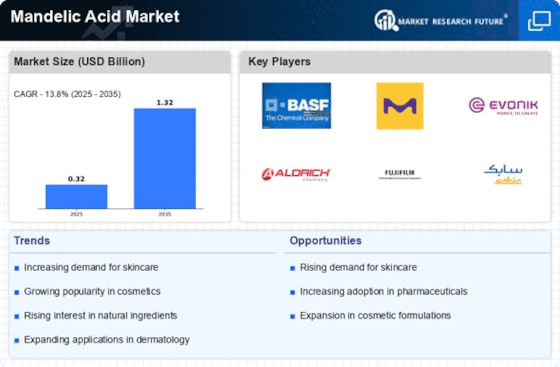
As per Market Research Future analysis, the Mandelic Acid Market Size was estimated at 0.3186 USD Billion in 2024. The Mandelic Acid industry is projected to grow from USD 0.3626 Billion in 2025 to USD 1.321 Billion by 2035, exhibiting a compound annual growth rate (CAGR) of 13.8% during the forecast period 2025 - 2035
Key Market Facts 2024-2035  

Metric 2024 Value 2035 Projection CAGR
Global Market Size USD 0.319B USD 1.321B 13.8%
Asia-Pacific USD 0.131B (41.2%) USD 0.578B 14.4% ← DOMINANT
North America USD 0.089B (28.0%) USD 0.415B 14.6% ← FASTEST
Europe USD 0.076B (23.8%) USD 0.281B 12.7%
Fastest Growing Segments  
Segment 2024 Share CAGR Key Driver
Cosmetics & Personal Care 48.3% 15.1% Anti-aging skincare boom
Pharmaceutical 32.7% 13.2% Antibiotic & antiviral uses
Textiles & Dye Intermediates 12.4% 11.8% Specialty chemical demand
By Type Segmentation  
Type 2024 Share CAGR Key Driver
L Type 42.6% 14.5% Pharmaceutical applications
DL Type 35.8% 13.4% Cosmetics formulations
D Type 21.6% 13.9% Chiral synthesis

 
  Regional Leadership
  • Asia-Pacific (41.2%): India/China lead with skincare exports & generic pharma
  • North America (14.6% CAGR): USA fastest - premium cosmetics, clinical treatments
  • Europe: Luxury beauty brands & research applications
Primary Growth Drivers
  • Skincare & anti-aging product demand (+4.8% CAGR impact)
  • Pharmaceutical chiral synthesis (+3.5% CAGR impact)
  • Clean beauty & natural exfoliant trend (+3.2% CAGR impact)

Key Market Trends & Highlights

The Mandelic Acid Market is experiencing robust growth driven by evolving consumer preferences and innovative product developments.

  • The demand for natural ingredients in skincare formulations is rising, particularly in North America, which remains the largest market for mandelic acid. The Asia-Pacific region is emerging as the fastest-growing market, fueled by increasing consumer awareness and interest in skincare products. The DL type segment continues to dominate the market, while the L type segment is witnessing rapid growth due to its unique properties. Key market drivers include the growing awareness of skin health and the rising popularity of chemical peels, which are significantly influencing consumer choices.

Market Size & Forecast

2024 Market Size 0.3186 (USD Billion)
2035 Market Size 1.321 (USD Billion)
CAGR (2025 - 2035) 13.8%
Largest Regional Market Share in 2024 North America

Major Players

BASF SE (DE), Merck KGaA (DE), Evonik Industries AG (DE), Aldrich Chemical Company (US), Fujifilm Wako Pure Chemical Corporation (JP), SABIC (SA), Hubei Greenhome Fine Chemical Co., Ltd. (CN), Zhejiang Jianye Chemical Co., Ltd. (CN)

Market Trends

The Mandelic Acid Market is currently experiencing a notable evolution, driven by increasing consumer awareness regarding skincare and the rising demand for natural and organic products within the mandelic acid market . This compound, derived from almonds, is recognized for its gentle exfoliating properties and effectiveness in treating various skin conditions. As consumers become more discerning about ingredient transparency, the appeal of mandelic acid, with its milder profile compared to other alpha hydroxy acids, appears to be gaining traction. Furthermore, the market is witnessing a surge in product innovation, with brands incorporating mandelic acid into a diverse range of formulations, including serums, cleansers, and peels, thereby broadening its application scope. These developments are frequently highlighted in mandelic acid market analysis, reflecting the growing interest in the sector.

In addition to the growing interest in skincare, the mandelic acid market is also influenced by the increasing prevalence of dermatological conditions such as acne and hyperpigmentation. This trend suggests a potential for sustained growth as consumers seek effective solutions for their skin concerns. Moreover, the rise of e-commerce platforms has facilitated greater accessibility to mandelic acid products, allowing consumers to explore various options conveniently and contributing to changes in overall mandelic acid market share among brands. . As the market continues to evolve, it is likely that the focus on sustainability and ethical sourcing will further shape consumer preferences, leading to a more conscientious approach to product development and marketing in the Mandelic Acid Market.

Rising Demand for Natural Ingredients

There is a growing trend towards the use of natural and organic ingredients in skincare products. Consumers are increasingly seeking formulations that are free from synthetic additives, which has led to a heightened interest in mandelic acid due to its natural origins and gentle properties.

Expansion of Product Offerings

Brands are diversifying their product lines to include mandelic acid in various forms, such as serums, masks, and cleansers. This expansion allows consumers to choose products that best fit their skincare routines, enhancing the overall market appeal.

Increased Online Retail Presence

The shift towards online shopping has significantly impacted the Mandelic Acid Market. E-commerce platforms provide consumers with easy access to a wide range of mandelic acid products, facilitating informed purchasing decisions and fostering brand loyalty.

Mandelic Acid Market Market Drivers

Growing Awareness of Skin Health

The increasing awareness of skin health among consumers appears to be a pivotal driver for the Mandelic Acid Market. As individuals become more informed about skincare ingredients, the demand for effective and gentle exfoliants like mandelic acid is likely to rise. This compound is known for its ability to treat various skin concerns, including acne and hyperpigmentation, without causing irritation. Market data suggests that the skincare segment is projected to grow at a compound annual growth rate of approximately 5.5% over the next few years, indicating a robust interest in products containing mandelic acid. Consequently, brands are increasingly incorporating this ingredient into their formulations to cater to the evolving preferences of consumers, thereby enhancing their market presence.

Expansion of E-commerce Platforms

The expansion of e-commerce platforms is significantly influencing the Mandelic Acid Market. With the increasing prevalence of online shopping, consumers are more inclined to explore and purchase skincare products, including those containing mandelic acid, through digital channels. This shift in purchasing behavior is likely to enhance market accessibility and visibility for brands. Data suggests that e-commerce sales in the beauty and personal care sector are expected to grow by approximately 10% annually, indicating a robust trend towards online retail. As brands invest in their online presence and marketing strategies, the availability of mandelic acid products is anticipated to increase, further driving market growth.

Rising Popularity of Chemical Peels

The rising popularity of chemical peels is another significant driver for the Mandelic Acid Market. Chemical peels, which utilize mandelic acid for their exfoliating properties, are gaining traction among both consumers and dermatologists. This trend is likely fueled by the growing desire for non-invasive skincare treatments that deliver visible results. According to recent market analysis, the chemical peel segment is expected to witness substantial growth, with an estimated increase of 7% annually. As more individuals seek professional treatments and at-home solutions, the demand for mandelic acid-based products is anticipated to surge. This shift in consumer behavior underscores the potential for brands to innovate and expand their offerings within the Mandelic Acid Market.

Advancements in Cosmetic Formulations

Advancements in cosmetic formulations are playing a crucial role in shaping the Mandelic Acid Market. The continuous evolution of formulation technologies allows for the development of more effective and stable products that incorporate mandelic acid. These innovations not only enhance the efficacy of the ingredient but also improve its compatibility with various skin types. Market data indicates that the cosmetic industry is experiencing a shift towards multifunctional products, which often include mandelic acid for its exfoliating and brightening properties. As brands strive to meet consumer demands for high-performance skincare solutions, the integration of mandelic acid into new formulations is likely to become increasingly prevalent, driving growth in the market.

Increased Focus on Anti-Aging Solutions

The increased focus on anti-aging solutions is emerging as a significant driver for the Mandelic Acid Market. As the global population ages, there is a growing demand for products that address signs of aging, such as fine lines and uneven skin tone. Mandelic acid, known for its gentle exfoliating properties, is often included in formulations targeting these concerns. Market Research Future indicates that the anti-aging skincare segment is projected to grow at a rate of 6% annually, reflecting the rising consumer interest in effective anti-aging solutions. This trend presents an opportunity for brands to leverage mandelic acid in their product lines, catering to the needs of an aging demographic seeking safe and effective skincare options.

Market Segment Insights

By Type: DL Type (Largest) vs. L Type (Fastest-Growing)

In the Mandelic Acid Market, the DL Type currently holds the largest market share among the various types. This segment is favored for its broad applications in skincare and cosmetics, largely due to its dual action of exfoliating and improving skin texture. Conversely, the L Type, known for its specific use in various dermatological applications, is emerging rapidly, gaining traction for its perceived efficacy in treating acne and hyperpigmentation.

DL Type (Dominant) vs. L Type (Emerging)

The DL Type is characterized by its versatile application, widely utilized in both skincare formulations and clinical treatments. Its popularity stems from its ability to provide gentle exfoliation without causing irritation, making it a staple in many beauty products. On the other hand, the L Type is recognized as an emerging player within the Mandelic Acid Market sphere, attracting attention due to its targeted effectiveness in treating specific skin concerns. This type is gaining favor among consumers seeking specialized solutions, thereby fostering growth and innovation in product development.

By Application: Pharmaceuticals (Largest) vs. Cosmetics & Personal Care (Fastest-Growing)

In the Mandelic Acid Market, the application segment exhibits a diverse distribution with Pharmaceuticals commanding the largest share. This dominance is attributed to the efficacy of mandelic acid in medical applications, particularly in treating skin conditions and its incorporation in dermatological formulations. Conversely, Cosmetics &amp; Personal Care is rapidly emerging as a significant player, showcasing a growing preference among consumers for products with mandelic acid due to its exfoliating properties and ability to improve skin texture and tone. The growth trends within the Mandelic Acid Market's application segment indicate a robust expansion trajectory, primarily driven by the increasing adoption of chemical peel treatments and anti-aging products in the cosmetic industry. Additionally, the rising awareness among consumers about the benefits of mandelic acid for acne and hyperpigmentation is propelling its use in healthcare products. This trend is further supported by innovation in product formulations that enhance the efficacy and appeal of mandelic acid in various applications.

Pharmaceuticals (Dominant) vs. Cosmetics &amp; Personal Care (Emerging)

In the Mandelic Acid Market, the Pharmaceuticals segment is characterized by its established dominance, leveraging mandelic acid's therapeutic properties to address various dermatological issues. This includes its effectiveness as an antibacterial agent and its role in skin rejuvenation. The increasing prevalence of skin disorders necessitates advanced treatment options, making pharmaceuticals a critical area of application. On the other hand, the Cosmetics &amp; Personal Care segment represents an emerging sector, driven by consumer demand for innovative skincare solutions. Manufacturers are integrating mandelic acid into products like serums and creams, capitalizing on its ability to enhance skin appearance. This segment's growth is reinforced by marketing strategies focusing on natural ingredients and effective skin care, positioning mandelic acid as a sought-after ingredient in beautifying formulations.

Get more detailed insights about Mandelic Acid Market Research Report — Global Forecast till 2035

Regional Insights

By region, the study provides the market insights into North America, Europe, Asia-Pacific and Rest of the World. The North American mandelic acid market area will dominate this market, owing to skincare awareness and demand and presence of cosmetic and pharmaceutical industries will boost market growth in this region.

Further, the major countries studied in the market report are The US, Canada, German, France, the UK, Italy, Spain, China, Japan, India, Australia, South Korea, and Brazil.

Figure2: MANDELIC ACID MARKET SHARE BY REGION 2022 (USD Billion)

Europe mandelic acid market accounts for the second-largest market share due to the consumer awareness and education and innovation in beauty and personal care. Further, the German mandelic acid market held the largest market share, and the UK mandelic acid market was the fastest growing market in the European region

The Asia-Pacific Mandelic acid Market is expected to grow at the fastest CAGR from 2023 to 2032. This is due to increasing demand for cosmetic ingredients and product innovation and formulation. Moreover, China’s mandelic acid market held the largest market share, and the Indian mandelic acid market was the fastest growing market in the Asia-Pacific region.

Key Players and Competitive Insights

Leading market players are investing heavily in research and development in order to expand their product lines, which will help the mandelic acid market, grow even more. Market participants are also undertaking a variety of strategic activities to expand their global footprint, with important market developments including new product launches, contractual agreements, mergers and acquisitions, higher investments, and collaboration with other organizations. To expand and survive in a more competitive and rising market climate, mandelic acidindustry must offer cost-effective items.
Manufacturing locally to minimize operational costs is one of the key business tactics used by manufacturers in the mandelic acid industry to benefit clients and increase the market sector. In recent years, the mandelic acid industry has offered some of the most significant advantages to medicine. Major players in the mandelic acid market, including BASF, Keyuan Biopharm, Wuhan Runder Pharmda Technologoy, Hanhong Chemical, Xiang Rong Chemical, Shengyu Chemical., and others, are attempting to increase market demand by investing in research and development operations.
The Chemours Company is known for its diverse portfolio of chemical products, including fluoroproducts, titanium technologies, chemical solutions, and more. The company operates globally, serving various industries such as automotive, electronics, energy, and consumer products.
In November The Chemours Company launched a new glycolic acid product under the brand name Glyclean D. The new product is used as a disinfectant for various household and institutional cleaning applications.
The CABB Group was established in 2003 through Bridgepoint Capital's acquisition of Clariant's fine chemicals business. CABB is a prominent manufacturer of fine and specialty chemicals, creating a diverse array of chemical intermediates and active ingredients for industries such as agrochemicals, pharmaceuticals, and performance chemicals. The company has a global presence, with production facilities in Europe and Asia. October 2018, CABB Group GmbH invested millions of Euros to increase the storage and production volume of monochloroacetic (MCA) acid & its derivatives at the Knapsack and Gersthofen facility.
The expansion will be boosting the company's production of glycolic acid at Gersthofen facility.

Key Companies in the Mandelic Acid Market include

Industry Developments

January 2019: Skinceuticals launched a new glycolic acid cream, Glycolic 10 Renew Overnight that improves skin glow by 36% while also maintaining tolerability. The cream effectively targets dullness, fine lines, and uneven texture of the skin. It stimulates cell regeneration for enriched tone, texture, and brighter complexion.

July 2019: Hefei TNJ Chemical Industry Co., Ltd expanded its market in Cosmetics materials in Seoul, South Korea.

Future Outlook

Mandelic Acid Market Future Outlook

The Mandelic Acid Market is projected to grow at a 13.8% CAGR from 2025 to 2035, driven by increasing demand in cosmetics, <a title="pharmaceutical" href="https://www.marketresearchfuture.com/reports/pharmaceutical-market-67551" target="_blank" rel="noopener">pharmaceuticals</a>, and personal care sectors.

New opportunities lie in:

  • <p>Expansion into emerging markets with tailored formulations Development of eco-friendly production processes Strategic partnerships with skincare brands for exclusive product lines</p>

By 2035, the Mandelic Acid Market is poised for robust growth and increased market share.

Market Segmentation

Mandelic Acid Market Type Outlook

  • DL Type
  • L Type
  • D Type

Mandelic Acid Market Application Outlook

  • Pharmaceutical
  • Cosmetics & Personal Care
  • Textiles & Dye Intermediates
  • Others

Report Scope

MARKET SIZE 2024 0.3186(USD Billion)
MARKET SIZE 2025 0.3626(USD Billion)
MARKET SIZE 2035 1.321(USD Billion)
COMPOUND ANNUAL GROWTH RATE (CAGR) 13.8% (2025 - 2035)
REPORT COVERAGE Revenue Forecast, Competitive Landscape, Growth Factors, and Trends
BASE YEAR 2024
Market Forecast Period 2025 - 2035
Historical Data 2019 - 2024
Market Forecast Units USD Billion
Key Companies Profiled BASF SE (DE), Merck KGaA (DE), Evonik Industries AG (DE), Aldrich Chemical Company (US), Fujifilm Wako Pure Chemical Corporation (JP), SABIC (SA), Hubei Greenhome Fine Chemical Co., Ltd. (CN), Zhejiang Jianye Chemical Co., Ltd. (CN)
Segments Covered Type, Application, Region
Key Market Opportunities Growing demand for natural skincare products drives innovation in the Mandelic Acid Market.
Key Market Dynamics Rising demand for natural skincare products drives growth in the Mandelic Acid Market, influencing competitive dynamics.
Countries Covered North America, Europe, APAC, South America, MEA

FAQs

What is the current valuation of the Mandelic Acid Market as of 2024?

<p>The Mandelic Acid Market was valued at 0.3186 USD Billion in 2024.</p>

What is the projected market valuation for Mandelic Acid by 2035?

<p>The market is projected to reach 1.321 USD Billion by 2035.</p>

What is the expected CAGR for the Mandelic Acid Market during the forecast period 2025 - 2035?

<p>The expected CAGR for the Mandelic Acid Market during 2025 - 2035 is 13.8%.</p>

Which companies are considered key players in the Mandelic Acid Market?

<p>Key players in the market include BASF SE, Merck KGaA, Evonik Industries AG, and others.</p>

What are the main application segments for Mandelic Acid?

The main application segments for Mandelic Acid include Pharmaceuticals, Cosmetics &amp; Personal Care, and Textiles &amp; Dye Intermediates.

How did the Pharmaceuticals segment perform in terms of valuation in 2024?

<p>The Pharmaceuticals segment was valued at 0.1276 USD Billion in 2024.</p>

What is the projected valuation for the Cosmetics & Personal Care segment by 2035?

The Cosmetics &amp; Personal Care segment is projected to reach 0.4105 USD Billion by 2035.

What are the valuation ranges for different types of Mandelic Acid?

<p>The valuation ranges for different types include DL Type at 0.095 to 0.415 USD Billion, L Type at 0.115 to 0.485 USD Billion, and D Type at 0.1086 to 0.421 USD Billion.</p>

What is the expected growth trend for the Textiles & Dye Intermediates segment?

The Textiles &amp; Dye Intermediates segment is expected to grow from 0.0652 USD Billion in 2024 to 0.2805 USD Billion by 2035.

How does the market outlook for Mandelic Acid appear in comparison to other chemical markets?

<p>The Mandelic Acid Market appears to have a robust growth trajectory, potentially outpacing many other chemical markets due to its diverse applications.</p>

  1. SECTION I: EXECUTIVE SUMMARY AND KEY HIGHLIGHTS |
    1. EXECUTIVE SUMMARY | |
      1. Market Overview | |
      2. Key Findings | |
      3. Market Segmentation | |
      4. Competitive Landscape | |
      5. Challenges and Opportunities | |
      6. Future Outlook 2
  2. SECTION II: SCOPING, METHODOLOGY AND MARKET STRUCTURE |
    1. MARKET INTRODUCTION | |
      1. Definition | |
      2. Scope of the study | | |
    2. RESEARCH METHODOLOGY | |
      1. Overview | |
      2. Data Mining | |
      3. Secondary Research | |
      4. Primary Research | | |
      5. Forecasting Model | |
      6. Market Size Estimation | | |
      7. Data Triangulation | |
      8. Validation 3
  3. SECTION III: QUALITATIVE ANALYSIS |
    1. MARKET DYNAMICS | |
      1. Overview | |
      2. Drivers | |
      3. Restraints | |
      4. Opportunities |
    2. MARKET FACTOR ANALYSIS | |
      1. Value chain Analysis | |
      2. Porter's Five Forces Analysis | | |
      3. COVID-19 Impact Analysis | | |
  4. SECTION IV: QUANTITATIVE ANALYSIS |
    1. Chemicals and Materials, BY Type (USD Billion) | |
      1. DL Type | |
      2. L Type | |
      3. D Type |
    2. Chemicals and Materials, BY Application (USD Billion) | |
      1. Pharmaceutical | |
      2. Cosmetics & Personal Care | |
      3. Textiles & Dye Intermediates | |
      4. Others |
    3. Chemicals and Materials, BY Region (USD Billion) | |
      1. North America | | |
      2. Europe | | |
      3. APAC | | |
      4. South America | | |
      5. MEA | | |
  5. SECTION V: COMPETITIVE ANALYSIS |
    1. Competitive Landscape | |
      1. Overview | |
      2. Competitive Analysis | |
      3. Market share Analysis | |
      4. Major Growth Strategy in the Chemicals and Materials | |
      5. Competitive Benchmarking | |
      6. Leading Players in Terms of Number of Developments in the Chemicals and Materials | |
      7. Key developments and growth strategies | | |
      8. Major Players Financial Matrix | | |
    2. Company Profiles | |
      1. BASF SE (DE) | | |
      2. Merck KGaA (DE) | | |
      3. Evonik Industries AG (DE) | | |
      4. Aldrich Chemical Company (US) | | |
      5. Fujifilm Wako Pure Chemical Corporation (JP) | | |
      6. SABIC (SA) | | |
      7. Hubei Greenhome Fine Chemical Co., Ltd. (CN) | | |
      8. Zhejiang Jianye Chemical Co., Ltd. (CN) | | |
    3. Appendix | |
      1. References | |
      2. Related Reports 6 LIST OF FIGURES |
    4. MARKET SYNOPSIS |
    5. NORTH AMERICA MARKET ANALYSIS |
    6. US MARKET ANALYSIS BY TYPE |
    7. US MARKET ANALYSIS BY APPLICATION |
    8. CANADA MARKET ANALYSIS BY TYPE |
    9. CANADA MARKET ANALYSIS BY APPLICATION |
    10. EUROPE MARKET ANALYSIS |
    11. GERMANY MARKET ANALYSIS BY TYPE |
    12. GERMANY MARKET ANALYSIS BY APPLICATION |
    13. UK MARKET ANALYSIS BY TYPE |
    14. UK MARKET ANALYSIS BY APPLICATION |
    15. FRANCE MARKET ANALYSIS BY TYPE |
    16. FRANCE MARKET ANALYSIS BY APPLICATION |
    17. RUSSIA MARKET ANALYSIS BY TYPE |
    18. RUSSIA MARKET ANALYSIS BY APPLICATION |
    19. ITALY MARKET ANALYSIS BY TYPE |
    20. ITALY MARKET ANALYSIS BY APPLICATION |
    21. SPAIN MARKET ANALYSIS BY TYPE |
    22. SPAIN MARKET ANALYSIS BY APPLICATION |
    23. REST OF EUROPE MARKET ANALYSIS BY TYPE |
    24. REST OF EUROPE MARKET ANALYSIS BY APPLICATION |
    25. APAC MARKET ANALYSIS |
    26. CHINA MARKET ANALYSIS BY TYPE |
    27. CHINA MARKET ANALYSIS BY APPLICATION |
    28. INDIA MARKET ANALYSIS BY TYPE |
    29. INDIA MARKET ANALYSIS BY APPLICATION |
    30. JAPAN MARKET ANALYSIS BY TYPE |
    31. JAPAN MARKET ANALYSIS BY APPLICATION |
    32. SOUTH KOREA MARKET ANALYSIS BY TYPE |
    33. SOUTH KOREA MARKET ANALYSIS BY APPLICATION |
    34. MALAYSIA MARKET ANALYSIS BY TYPE |
    35. MALAYSIA MARKET ANALYSIS BY APPLICATION |
    36. THAILAND MARKET ANALYSIS BY TYPE |
    37. THAILAND MARKET ANALYSIS BY APPLICATION |
    38. INDONESIA MARKET ANALYSIS BY TYPE |
    39. INDONESIA MARKET ANALYSIS BY APPLICATION |
    40. REST OF APAC MARKET ANALYSIS BY TYPE |
    41. REST OF APAC MARKET ANALYSIS BY APPLICATION |
    42. SOUTH AMERICA MARKET ANALYSIS |
    43. BRAZIL MARKET ANALYSIS BY TYPE |
    44. BRAZIL MARKET ANALYSIS BY APPLICATION |
    45. MEXICO MARKET ANALYSIS BY TYPE |
    46. MEXICO MARKET ANALYSIS BY APPLICATION |
    47. ARGENTINA MARKET ANALYSIS BY TYPE |
    48. ARGENTINA MARKET ANALYSIS BY APPLICATION |
    49. REST OF SOUTH AMERICA MARKET ANALYSIS BY TYPE |
    50. REST OF SOUTH AMERICA MARKET ANALYSIS BY APPLICATION |
    51. MEA MARKET ANALYSIS |
    52. GCC COUNTRIES MARKET ANALYSIS BY TYPE |
    53. GCC COUNTRIES MARKET ANALYSIS BY APPLICATION |
    54. SOUTH AFRICA MARKET ANALYSIS BY TYPE |
    55. SOUTH AFRICA MARKET ANALYSIS BY APPLICATION |
    56. REST OF MEA MARKET ANALYSIS BY TYPE |
    57. REST OF MEA MARKET ANALYSIS BY APPLICATION |
    58. KEY BUYING CRITERIA OF CHEMICALS AND MATERIALS |
    59. RESEARCH PROCESS OF MRFR |
    60. DRO ANALYSIS OF CHEMICALS AND MATERIALS |
    61. DRIVERS IMPACT ANALYSIS: CHEMICALS AND MATERIALS |
    62. RESTRAINTS IMPACT ANALYSIS: CHEMICALS AND MATERIALS |
    63. SUPPLY / VALUE CHAIN: CHEMICALS AND MATERIALS |
    64. CHEMICALS AND MATERIALS, BY TYPE, 2024 (% SHARE) |
    65. CHEMICALS AND MATERIALS, BY TYPE, 2024 TO 2035 (USD Billion) |
    66. CHEMICALS AND MATERIALS, BY APPLICATION, 2024 (% SHARE) |
    67. CHEMICALS AND MATERIALS, BY APPLICATION, 2024 TO 2035 (USD Billion) |
    68. BENCHMARKING OF MAJOR COMPETITORS 7 LIST OF TABLES |
    69. LIST OF ASSUMPTIONS | |
      1. |
    70. North America MARKET SIZE ESTIMATES; FORECAST | |
      1. BY TYPE, 2025-2035 (USD Billion) | |
      2. BY APPLICATION, 2025-2035 (USD Billion) |
    71. US MARKET SIZE ESTIMATES; FORECAST | |
      1. BY TYPE, 2025-2035 (USD Billion) | |
      2. BY APPLICATION, 2025-2035 (USD Billion) |
    72. Canada MARKET SIZE ESTIMATES; FORECAST | |
      1. BY TYPE, 2025-2035 (USD Billion) | |
      2. BY APPLICATION, 2025-2035 (USD Billion) |
    73. Europe MARKET SIZE ESTIMATES; FORECAST | |
      1. BY TYPE, 2025-2035 (USD Billion) | |
      2. BY APPLICATION, 2025-2035 (USD Billion) |
    74. Germany MARKET SIZE ESTIMATES; FORECAST | |
      1. BY TYPE, 2025-2035 (USD Billion) | |
      2. BY APPLICATION, 2025-2035 (USD Billion) |
    75. UK MARKET SIZE ESTIMATES; FORECAST | |
      1. BY TYPE, 2025-2035 (USD Billion) | |
      2. BY APPLICATION, 2025-2035 (USD Billion) |
    76. France MARKET SIZE ESTIMATES; FORECAST | |
      1. BY TYPE, 2025-2035 (USD Billion) | |
      2. BY APPLICATION, 2025-2035 (USD Billion) |
    77. Russia MARKET SIZE ESTIMATES; FORECAST | |
      1. BY TYPE, 2025-2035 (USD Billion) | |
      2. BY APPLICATION, 2025-2035 (USD Billion) |
    78. Italy MARKET SIZE ESTIMATES; FORECAST | |
      1. BY TYPE, 2025-2035 (USD Billion) | |
      2. BY APPLICATION, 2025-2035 (USD Billion) |
    79. Spain MARKET SIZE ESTIMATES; FORECAST | |
      1. BY TYPE, 2025-2035 (USD Billion) | |
      2. BY APPLICATION, 2025-2035 (USD Billion) |
    80. Rest of Europe MARKET SIZE ESTIMATES; FORECAST | |
      1. BY TYPE, 2025-2035 (USD Billion) | |
      2. BY APPLICATION, 2025-2035 (USD Billion) |
    81. APAC MARKET SIZE ESTIMATES; FORECAST | |
      1. BY TYPE, 2025-2035 (USD Billion) | |
      2. BY APPLICATION, 2025-2035 (USD Billion) |
    82. China MARKET SIZE ESTIMATES; FORECAST | |
      1. BY TYPE, 2025-2035 (USD Billion) | |
      2. BY APPLICATION, 2025-2035 (USD Billion) |
    83. India MARKET SIZE ESTIMATES; FORECAST | |
      1. BY TYPE, 2025-2035 (USD Billion) | |
      2. BY APPLICATION, 2025-2035 (USD Billion) |
    84. Japan MARKET SIZE ESTIMATES; FORECAST | |
      1. BY TYPE, 2025-2035 (USD Billion) | |
      2. BY APPLICATION, 2025-2035 (USD Billion) |
    85. South Korea MARKET SIZE ESTIMATES; FORECAST | |
      1. BY TYPE, 2025-2035 (USD Billion) | |
      2. BY APPLICATION, 2025-2035 (USD Billion) |
    86. Malaysia MARKET SIZE ESTIMATES; FORECAST | |
      1. BY TYPE, 2025-2035 (USD Billion) | |
      2. BY APPLICATION, 2025-2035 (USD Billion) |
    87. Thailand MARKET SIZE ESTIMATES; FORECAST | |
      1. BY TYPE, 2025-2035 (USD Billion) | |
      2. BY APPLICATION, 2025-2035 (USD Billion) |
    88. Indonesia MARKET SIZE ESTIMATES; FORECAST | |
      1. BY TYPE, 2025-2035 (USD Billion) | |
      2. BY APPLICATION, 2025-2035 (USD Billion) |
    89. Rest of APAC MARKET SIZE ESTIMATES; FORECAST | |
      1. BY TYPE, 2025-2035 (USD Billion) | |
      2. BY APPLICATION, 2025-2035 (USD Billion) |
    90. South America MARKET SIZE ESTIMATES; FORECAST | |
      1. BY TYPE, 2025-2035 (USD Billion) | |
      2. BY APPLICATION, 2025-2035 (USD Billion) |
    91. Brazil MARKET SIZE ESTIMATES; FORECAST | |
      1. BY TYPE, 2025-2035 (USD Billion) | |
      2. BY APPLICATION, 2025-2035 (USD Billion) |
    92. Mexico MARKET SIZE ESTIMATES; FORECAST | |
      1. BY TYPE, 2025-2035 (USD Billion) | |
      2. BY APPLICATION, 2025-2035 (USD Billion) |
    93. Argentina MARKET SIZE ESTIMATES; FORECAST | |
      1. BY TYPE, 2025-2035 (USD Billion) | |
      2. BY APPLICATION, 2025-2035 (USD Billion) |
    94. Rest of South America MARKET SIZE ESTIMATES; FORECAST | |
      1. BY TYPE, 2025-2035 (USD Billion) | |
      2. BY APPLICATION, 2025-2035 (USD Billion) |
    95. MEA MARKET SIZE ESTIMATES; FORECAST | |
      1. BY TYPE, 2025-2035 (USD Billion) | |
      2. BY APPLICATION, 2025-2035 (USD Billion) |
    96. GCC Countries MARKET SIZE ESTIMATES; FORECAST | |
      1. BY TYPE, 2025-2035 (USD Billion) | |
      2. BY APPLICATION, 2025-2035 (USD Billion) |
    97. South Africa MARKET SIZE ESTIMATES; FORECAST | |
      1. BY TYPE, 2025-2035 (USD Billion) | |
      2. BY APPLICATION, 2025-2035 (USD Billion) |
    98. Rest of MEA MARKET SIZE ESTIMATES; FORECAST | |
      1. BY TYPE, 2025-2035 (USD Billion) | |
      2. BY APPLICATION, 2025-2035 (USD Billion) |
    99. PRODUCT LAUNCH/PRODUCT DEVELOPMENT/APPROVAL | |
      1. |
    100. ACQUISITION/PARTNERSHIP | |

Chemicals and Materials Market Segmentation

Chemicals and Materials By Type (USD Billion, 2025-2035)

  • DL Type
  • L Type
  • D Type

Chemicals and Materials By Application (USD Billion, 2025-2035)

  • Pharmaceutical
  • Cosmetics & Personal Care
  • Textiles & Dye Intermediates
  • Others
Infographic

Free Sample Request

Kindly complete the form below to receive a free sample of this Report

Get Free Sample

Customer Strories

Compare Licence

×
Features License Type
Single User Multiuser License Enterprise User
Price $4,950 $5,950 $7,250
Maximum User Access Limit 1 User Upto 10 Users Unrestricted Access Throughout the Organization
Free Customization
Direct Access to Analyst
Deliverable Format
Platform Access
Discount on Next Purchase 10% 15% 15%
Printable Versions