×
Request Free Sample ×

Kindly complete the form below to receive a free sample of this Report

* Please use a valid business email

Leading companies partner with us for data-driven Insights

clients tt-cursor
Hero Background
English
Chinese
French
Japanese
Korean
German
Spanish

2026 Managed Pressure Drilling (MPD) Market Analysis

ID: MRFR/EnP/1057-CR
116 Pages
Chitranshi Jaiswal
March 2024

Managed Pressure Drilling Market Research Report Information By Technology (Constant Bottom Hole Pressure (CBHP), Mud Cap Drilling (MCD), Dual Gradient Drilling (DGD), Return Flow Control Drilling (RFCD)), By Tool (Rotating Control Device, Non-Return Valves, Choke Manifold Systems), By Application (Onshore, Offshore) and By Region - Global Forecast to 2035

Share:
Download PDF ×

We do not share your information with anyone. However, we may send you emails based on your report interest from time to time. You may contact us at any time to opt-out.

Managed Pressure drilling Market Infographic
Purchase Options

Market Analysis

In-depth Analysis of Managed Pressure drilling Market Industry Landscape

The managed pressure drilling market is set to reach US$ 4,523.7 MN by 2030, at a 3.90% CAGR between years 2022-2030. The market is undergoing profound changes in its dynamics with respect to the elements that influence the oil and gas industry. Overemphasis on effective pressure control has helped managed pressure drilling (MPD) to gain popularity since it can minimize the risks of drilling complications. Some of the notable market trends are technological innovations, rising offshore exploration activities and high demand for inexpensive as well as safer drilling solutions. Developments in technology have a significant implication on the market landscape of managed pressure drilling. The oil and gas industry is moving ahead in the use of novel drilling technologies as required all over. The emergence of superior sensors, quick data analysis and automation systems has made it possible for drillers to operate wellbore pressure properly thereby optimizing the rate parameters with a minimal risk of such incidents. This technological advance not only increases drilling productivity but also creates a conducive setting for the universal adoption of managed pressure systems. Another factor that contributes to building the market dynamics is offshore exploration activities. In offshore locations, drilling techniques have to be capable of accommodating different downhole conditions. In offshore drilling, managed pressure can be particularly valuable owing to the fact that it offers better control of wellbore pressure while minimising kick occurrence and improving safety measures. With the growth in offshore exploration activities, demand for managed pressure drilling services is projected to increase. This scenario will propel market dynamics towards more expansionary moves. The need for cost-efficient and safer methods of drilling is a primary market driving force in managed pressure drilling. The main disadvantages of traditional drilling include the greater expenses, longer time needed for operations and safety issues. These challenges are also dealt with through managed pressure drilling which is more effective and controlled means of drilling. MPD stands out as an appealing option for operators who wish to boost their drilling’s economics due to its capability of decreasing formation damage, optimizing fast-drill rates and the time nonproductive. With cost-efficiency and safety as primary concerns in the oil and gas industry, this development will naturally lead to market dynamics of managed pressure drilling driving further growth.

Author
Chitranshi Jaiswal
Team Lead - Research

Chitranshi is a Team Leader in the Chemicals & Materials (CnM) and Energy & Power (EnP) domains, with 6+ years of experience in market research. She leads and mentors teams to deliver cross-domain projects that equip clients with actionable insights and growth strategies. She is skilled in market estimation, forecasting, competitive benchmarking, and both primary & secondary research, enabling her to turn complex data into decision-ready insights. An engineer and MBA professional, she combines technical expertise with strategic acumen to solve dynamic market challenges. Chitranshi has successfully managed projects that support market entry, investment planning, and competitive positioning, while building strong client relationships. Certified in Advanced Excel & Power BI she leverages data-driven approaches to ensure accuracy, clarity, and impactful outcomes.

Leave a Comment

FAQs

What is Managed Pressure Drilling (MPD) and how does it work?

Managed Pressure Drilling (MPD) is an adaptive closed-loop drilling process that precisely controls the annular pressure profile throughout a wellbore to prevent instability, kicks, and lost circulation. Unlike conventional drilling, MPD continuously monitors and adjusts bottomhole pressure in real time using a Rotating Control Device (RCD), choke manifold system, and automated flow measurement tools.MPD is widely used in High Pressure High Temperature (HPHT) wells, deepwater and ultra-deepwater environments, and narrow-margin formations where conventional drilling poses unacceptable safety and cost risks. It reduces non-productive time (NPT), lowers blowout risk, and improves overall well construction efficiency — making it a critical technology for modern oil and gas operators globally.  

What is the current size of the Managed Pressure Drilling Market and what is it projected to reach by 2035?

The global Managed Pressure Drilling Market was valued at USD 5.89 Billion in 2024 and is projected to grow from USD 6.15 Billion in 2025 to USD 9.46 Billion by 2035, registering a compound annual growth rate (CAGR) of 4.39% during the 2025–2035 forecast period.This steady growth is driven by rising global oil and gas demand, deepwater exploration expansion, and the increasing adoption of advanced wellbore pressure management technologies across North America, Asia-Pacific, and the Middle East & Africa.  

What is the growth rate (CAGR) of the Managed Pressure Drilling Market from 2025 to 2035?

The Managed Pressure Drilling Market is expected to grow at a CAGR of 4.39% from 2025 to 2035. This growth trajectory is supported by four primary drivers: increasing exploration in deepwater and unconventional reservoirs, rising adoption of AI-integrated real-time pressure management systems, a global regulatory push toward safer and more sustainable drilling practices, and growing energy demand in Asia-Pacific and Middle Eastern markets.The market is projected to add approximately USD 3.3 Billion in absolute value between 2025 and 2035, making it a stable long-term investment opportunity within the broader oil and gas services sector.  

Which region dominates the Managed Pressure Drilling Market and which is the fastest growing?

North America dominates the Managed Pressure Drilling Market with approximately 45% of global market share in 2024, driven by extensive unconventional oil and gas operations in the U.S. and Canada, mature regulatory support, and the headquarters presence of global leaders SLB, Halliburton, and Baker Hughes.Asia-Pacific is the fastest-growing region, fuelled by rising energy demand in China and India, rapid industrialisation, and increasing offshore exploration investments. Europe holds approximately 25% of market share, led by Norway and the UK, while the Middle East & Africa holds around 10%, supported by deepwater investments in Saudi Arabia and the UAE.  

What are the key technology segments in the Managed Pressure Drilling Market?

The Managed Pressure Drilling Market is segmented into four primary technologies:1. Constant Bottom Hole Pressure (CBHP) — The dominant segment, preferred for its real-time pressure balancing capability that reduces wellbore collapse risk and non-productive time (NPT) in both onshore and offshore operations.2. Dual Gradient Drilling (DGD) — The fastest-growing segment, gaining traction for deepwater and ultra-deepwater applications where varying mud densities improve pressure management and operational safety.3. Mud Cap Drilling (MCD) — Applied in severe lost-circulation environments where conventional returns to surface are not feasible.4. Return Flow Control Drilling (RFCD) — Used in low-pressure, naturally fractured formations to manage influx and maintain wellbore integrity.  

Who are the leading companies in the Managed Pressure Drilling Market?

The leading companies in the global Managed Pressure Drilling Market include SLB (Schlumberger), Halliburton, Baker Hughes, Weatherford International, National Oilwell Varco (NOV), Nabors Industries, KCA Deutag, Precision Drilling, and Cameron International.SLB leads in AI-driven MPD innovation, having announced a strategic partnership in August 2025 to develop advanced predictive drilling control systems. Halliburton has expanded its North American MPD capabilities through a September 2025 acquisition, while Baker Hughes launched a new suite of environmentally optimised drilling fluids in July 2025 to support sustainable MPD operations.  

What are the key trends shaping the Managed Pressure Drilling Market in 2025 and beyond?

Four key trends are shaping the Managed Pressure Drilling Market through 2025 and into the 2035 forecast horizon:1. AI and automation integration — Operators are deploying real-time AI-driven pressure control systems that reduce non-productive time (NPT) by up to 20% and improve decision-making speed during critical drilling phases.2. Deepwater and ultra-deepwater expansion — Growing offshore investments in the Gulf of Mexico, North Sea, and Asia-Pacific are accelerating Dual Gradient Drilling (DGD) adoption for complex subsea wells.3. Sustainability and emissions reduction — MPD techniques can reduce carbon emissions by up to 30% versus conventional drilling, aligning operators with ESG commitments and tightening environmental regulations.4. HPHT well development — Rising exploration in high-pressure, high-temperature reservoirs in the Middle East, North Sea, and Asia-Pacific is expanding CBHP technology demand globally.  

What is the difference between onshore and offshore Managed Pressure Drilling applications?

Onshore MPD currently holds the largest application share in the Managed Pressure Drilling Market, driven by lower operational costs, established land-based infrastructure, and abundant unconventional reserves particularly in North America and the Middle East. Onshore MPD is most widely adopted in shale plays and tight formations where narrow pressure windows make conventional drilling impractical.Offshore MPD is the fastest-growing application, driven by increasing deepwater and ultra-deepwater exploration in the Gulf of Mexico, North Sea, and Asia-Pacific. Offshore MPD adoption is accelerating due to its ability to manage complex pressure regimes in subsea wells, prevent costly blowouts, and reduce overall well construction time — critical factors given the significantly higher daily operational costs of offshore rigs.  

What does the Managed Pressure Drilling Market research report include?

The Managed Pressure Drilling Market report by Market Research Future provides a comprehensive analysis covering:— Market sizing and forecasting from 2019 to 2035 in USD Million, including historical data and forward projections— Technology segmentation: CBHP, MCD, DGD, and RFCD segments with individual valuations and growth rates— Tool segmentation: Rotating Control Devices, Non-Return Valves, and Choke Manifold Systems— Application analysis: Onshore vs. offshore adoption trends and revenue breakdown— Regional intelligence: North America, Europe, Asia-Pacific, and Middle East & Africa with country-level insights— Competitive landscape: Profiles of 9 key players including SLB, Halliburton, Baker Hughes, and NOV— Recent industry developments through 2025 including mergers, product launches, and strategic partnerships  

What are the major challenges and opportunities in the Managed Pressure Drilling Market?

<strong>Key challenges</strong> in the Managed Pressure Drilling Market include the high upfront capital cost of MPD equipment and systems, a global shortage of skilled MPD engineers and operators, and technical complexity in integrating MPD with legacy drilling infrastructure — particularly in developing markets.<strong>Key opportunities</strong> include the rapid development of automated MPD control systems that reduce human error and operational costs, expansion into emerging markets in Asia-Pacific, Latin America, and Africa where energy demand is accelerating, growing integration of MPD with real-time digital twin and AI platforms, and rising partnerships between MPD service providers and electric vehicle infrastructure developers for dual-application energy storage solutions.  

Market Summary

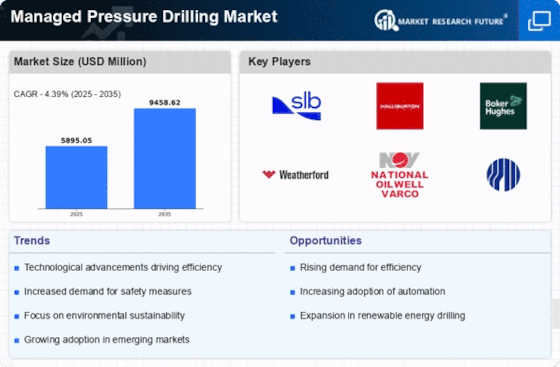
As per Market Research Future analysis, the Managed Pressure Drilling Market Size was estimated at USD 5895.05 Million in 2024. The Managed fis projected to grow from USD 6153.96 Million in 2025 to USD 9458.62 Million by 2035, exhibiting a compound annual growth rate (CAGR) of 4.3% during the forecast period 2025 - 2035. North America is the largest regional market for Managed Pressure Drilling (MPD), representing nearly 45% of the global market share, driven by strong offshore drilling activities and advanced oilfield technologies.

Key Market Trends & Highlights

The Managed Pressure Drilling Market is poised for substantial growth driven by technological advancements and sustainability efforts.

  • North America remains the largest market for managed pressure drilling, reflecting a robust demand for innovative drilling solutions. Asia-Pacific is emerging as the fastest-growing region, indicating a shift towards advanced drilling technologies in developing economies. The Constant Bottom Hole Pressure segment dominates the market, while Dual Gradient Drilling is rapidly gaining traction due to its efficiency. Technological advancements and a focus on sustainability are key drivers, as the industry seeks to enhance operational efficiency and reduce environmental impact.

Market Size & Forecast

2024 Market Size 5895.05 (USD Million)
2035 Market Size 9458.62 (USD Million)
CAGR (2025 - 2035) 4.39%
Largest Regional Market Share in 2024 North America

Major Players

Top major listed companies in the MPD market are, <a href="https://www.slb.com/products-and-services/innovating-in-oil-and-gas/well-construction/rigs-and-equipment/managed-pressure-drilling-services">Schlumberger</a> (US), Halliburton (US), <a href="https://www.bakerhughes.com/case-study/xact-service-provided-downhole-data-during-mpd-drilling-cementing">Baker Hughes</a> (US), Weatherford International (US), National Oilwell Varco (US), Nabors Industries (BM), KCA Deutag (GB), Precision Drilling (CA), Cameron International (US)

Market Trends

The Managed Pressure Drilling Market is currently experiencing a notable evolution, driven by advancements in technology and the increasing demand for efficient drilling solutions. This market appears to be characterized by a shift towards more sophisticated drilling techniques that enhance operational efficiency and reduce costs. Companies are increasingly adopting managed pressure drilling methods to optimize wellbore stability and improve overall drilling performance.

Furthermore, the integration of real-time data analytics and automation technologies seems to be transforming traditional drilling practices, allowing for more precise control over drilling parameters. In addition to technological advancements, the Managed Pressure Drilling Market is influenced by the growing emphasis on safety and environmental sustainability. Managed Pressure Drilling Services are seeing increased adoption in deepwater and unconventional reservoirs as they provide precise, real-time control over wellbore pressure to prevent hazardous kicks and reduce non-productive time. Operators are likely to prioritize methods that minimize the ecological footprint of drilling activities while ensuring the safety of personnel and equipment. 

This trend indicates a broader industry movement towards sustainable practices, which may reshape the competitive landscape. As the market continues to evolve, stakeholders must remain vigilant to emerging trends and adapt their strategies accordingly to maintain a competitive edge in this dynamic environment.

Technological Advancements

The Managed Pressure Drilling Market is witnessing a surge in technological innovations that enhance drilling efficiency. New tools and techniques are being developed to provide better control over pressure management, which can lead to improved safety and reduced operational costs.

Focus on Sustainability

There is a growing trend within the Managed Pressure Drilling Market towards environmentally friendly practices. Companies are increasingly adopting methods that reduce their ecological impact, aligning with global sustainability goals and regulatory requirements.

Integration of Data Analytics

The incorporation of data analytics into managed pressure drilling operations is becoming more prevalent. This trend allows for real-time monitoring and adjustments, which can optimize drilling performance and enhance decision-making processes.

Managed Pressure drilling Market Market Drivers

Regulatory Support and Industry Standards

Regulatory support plays a crucial role in shaping the Managed Pressure Drilling Market. Governments and regulatory bodies are increasingly recognizing the benefits of managed pressure drilling techniques in enhancing safety and reducing environmental impact. As a result, there is a growing emphasis on establishing industry standards that promote the adoption of these practices. Recent initiatives have led to the development of guidelines that encourage the use of advanced drilling technologies. This regulatory backing is expected to facilitate market growth, as companies seek to comply with new standards while improving operational efficiency in the Managed Pressure Drilling Market.
 

Increasing Demand for Oil and Gas Resources

The rising demand for oil and gas resources is a significant driver of the Managed Pressure Drilling Market. As economies expand and energy consumption increases, the need for efficient extraction methods becomes paramount. Managed pressure drilling offers a solution by enabling access to challenging reservoirs that were previously deemed uneconomical. Market data suggests that the demand for oil is projected to grow by 1.5% annually over the next decade, necessitating innovative drilling techniques. This trend is likely to stimulate investments in managed pressure drilling technologies, thereby bolstering the market.
 

Technological Advancements in Drilling Techniques

The Managed Pressure Drilling Market is experiencing a surge in technological advancements that enhance drilling efficiency and safety. Innovations such as real-time monitoring systems and automated drilling processes are becoming increasingly prevalent. These technologies allow for better control of downhole conditions, reducing the risk of blowouts and improving overall operational performance. According to recent data, the adoption of advanced drilling technologies has led to a 20% increase in drilling efficiency in certain regions. This trend is likely to continue as companies invest in research and development to further refine these technologies, thereby driving growth in the Managed Pressure Drilling Market.
 

Focus on Sustainability and Environmental Concerns

Sustainability has emerged as a critical driver in the Managed Pressure Drilling Market. Companies are increasingly prioritizing environmentally friendly practices to minimize their ecological footprint. The implementation of managed pressure drilling techniques reduces waste and enhances resource utilization, aligning with global sustainability goals. Recent studies indicate that the adoption of these practices can lead to a 30% reduction in carbon emissions compared to traditional drilling methods. As regulatory frameworks become more stringent, the demand for sustainable drilling solutions is expected to rise, further propelling the Managed Pressure Drilling Market forward.
 

Integration of Data Analytics for Enhanced Decision Making

The integration of data analytics into the Managed Pressure Drilling Market is transforming how drilling operations are conducted. By leveraging big data and predictive analytics, companies can make informed decisions that optimize drilling performance and reduce costs. This trend is evidenced by a reported 15% decrease in operational costs for firms utilizing data-driven strategies. The ability to analyze real-time data allows for proactive adjustments during drilling operations, enhancing safety and efficiency. As the industry continues to embrace digital transformation, the reliance on data analytics is likely to grow, further influencing the Managed Pressure Drilling Market.
 

Market Segment Insights

By Technology: Constant Bottom Hole Pressure (Largest) vs. Dual Gradient Drilling (Fastest-Growing)

In the Managed Pressure Drilling Market, the Constant Bottom Hole Pressure (CBHP) method has established itself as the dominant technology, thanks to its effectiveness in maintaining pressure control during drilling operations. This approach significantly reduces the risk of wellbore collapse and enhances overall operational efficiency. Conversely, the Dual Gradient Drilling (DGD) method is carving out a niche with a rapid growth trajectory, attributed to its innovative approach to pressure management, allowing for deeper water drilling with increased safety and reliability.<br> 

Technology: CBHP (Dominant) vs. DGD (Emerging)<br> 

Constant Bottom Hole Pressure (CBHP) is recognized for its crucial role in drilling operations, where maintaining optimal pressure is essential to prevent wellbore instability. It effectively balances the hydrostatic pressure with the formation pressure in real-time, providing operators with enhanced control. In contrast, Dual Gradient Drilling (DGD) leverages varying mud densities to manage pressure differently, enabling operations in challenging offshore environments. With growing investments in deepwater exploration and advancements in drilling technology, DGD is rapidly gaining traction as an innovative solution for resource extraction, marking its position as an emerging player in the market.<br> 

By Tool: Rotating Control Device (Largest) vs. Choke Manifold Systems (Fastest-Growing)

The Managed Pressure Drilling Market showcases a diverse range of tools, with the Rotating Control Device holding the largest share among the segment values. This tool is pivotal in maintaining the stability of the wellbore during drilling operations, contributing significantly to operational efficiency. The Choke Manifold Systems, while smaller in overall market share, are rapidly gaining traction as they enhance well control capabilities, particularly in high-pressure environments. Their growing adoption reflects the increasing emphasis on safety and operational optimization in drilling projects.<br> 

Choke Manifold Systems (Dominant) vs. Non-Return Valves (Emerging)<br> 

Choke Manifold Systems are regarded as a dominant force in the Managed Pressure Drilling Market due to their advanced ability to manage pressure variations and enhance workflow during drilling operations. As projects become more complex, the functionality and reliability of Choke Manifold Systems stand out, driving their demand. On the other hand, Non-Return Valves are emerging as significant components, providing vital support in fluid control and preventing backflow, thereby ensuring the integrity of operations. As technology evolves, the shift towards more innovative and reliable tools will likely elevate the status of these valves within the market.<br> 

By Application Industry: Onshore (Largest) vs. Offshore (Fastest-Growing)

The managed pressure drilling market exhibits a clear division between onshore and offshore applications. <a href="https://www.marketresearchfuture.com/reports/onshore-drilling-fluid-market-30382">Onshore drilling</a> remains the largest segment, driven by the abundance of <a href="https://www.marketresearchfuture.com/reports/oil-gas-projects-market-16161">oil and gas</a> reserves and the relatively lower costs associated with land-based drilling operations. This segment's stability stems from a long history of established infrastructure and technological advancements, ensuring a significant market share. In contrast, the offshore segment, while smaller, is gaining attention due to increasing investments and technological advancements that improve its efficiency and feasibility. As oil and gas companies seek new opportunities, the offshore segment is poised to capture a growing share of interest and resources.<br> 

Application Industry: Onshore (Dominant) vs. Offshore (Emerging)<br> 

The onshore application industry for managed pressure drilling is characterized by its dominance in the market. This segment benefits from established infrastructure, its cost-effectiveness, and the availability of vast land reserves. Companies in this area leverage advancements in drilling technologies to enhance efficiency and reduce operational risks. Meanwhile, the offshore application industry is rapidly emerging, driven by increasing demand for deepwater and ultra-deepwater exploration activities. Innovations in drilling techniques and equipment have made offshore drilling more viable, attracting investment and interest from major oil and gas players. While onshore remains the dominant force, offshore is quickly becoming a key player in the market as technological advancements continue to support its growth.<br> 

Get more detailed insights about Managed Pressure Drilling Market Research Report – Forecast to 2035

Regional Insights

North America : Innovation and Technology Leader

North America is the largest market for Managed Pressure Drilling (MPD), holding approximately 45% of the global market share. The region's growth is driven by the increasing demand for efficient drilling techniques, regulatory support for advanced technologies, and a focus on reducing operational costs. The U.S. and Canada are the primary contributors, with significant investments in R&D and infrastructure supporting MPD adoption. The competitive landscape in North America is robust, featuring key players such as Schlumberger, Halliburton, and Baker Hughes. These companies leverage advanced technologies and strategic partnerships to enhance their service offerings. The presence of established oil and gas companies further fuels market growth, as they seek innovative solutions to optimize drilling operations and improve safety standards.

Europe : Emerging Market with Potential

Europe is witnessing a growing interest in Managed Pressure Drilling, accounting for approximately 25% of the global market share. The region's growth is propelled by stringent environmental regulations and a shift towards sustainable drilling practices. Countries like Norway and the UK are leading the charge, supported by government initiatives aimed at enhancing energy efficiency and reducing carbon footprints. The competitive landscape in Europe includes key players such as KCA Deutag and Weatherford International. These companies are focusing on technological advancements and strategic collaborations to capture market share. The presence of regulatory bodies promoting innovation and sustainability further enhances the region's attractiveness for MPD investments, positioning Europe as a significant player in the global market.

Asia-Pacific : Rapid Growth and Adoption

Asia-Pacific is emerging as a significant player in the Managed Pressure Drilling market, holding around 20% of the global market share. The region's growth is driven by increasing energy demands, particularly in countries like China and India, where rapid industrialization and urbanization are pushing for more efficient drilling solutions. Regulatory frameworks are evolving to support advanced drilling technologies, further catalyzing market growth. Leading countries in this region include China, India, and Australia, with a competitive landscape featuring both local and international players. Companies like Nabors Industries and Precision Drilling are expanding their operations to meet the rising demand. The focus on technological innovation and partnerships with local firms is crucial for capturing market opportunities in this dynamic region, making it a focal point for future investments in MPD.

Middle East and Africa : Resource-Rich and Strategic Hub

The Middle East and Africa region holds approximately 10% of The Managed Pressure Drilling share, characterized by its rich oil and gas resources. The growth in this region is driven by the need for efficient drilling techniques to maximize resource extraction and minimize environmental impact. Countries like Saudi Arabia and the UAE are at the forefront, supported by government initiatives aimed at enhancing operational efficiency and sustainability in drilling practices. The competitive landscape features key players such as National Oilwell Varco and Cameron International, who are actively investing in the region. The presence of established oil companies and a growing focus on technological advancements are shaping the market dynamics. As the region continues to develop its energy sector, Managed Pressure Drilling is expected to play a crucial role in optimizing resource extraction and ensuring compliance with environmental regulations.


Key Players and Competitive Insights

The Managed Pressure Drilling Market is currently characterized by a dynamic competitive landscape, driven by technological advancements and the increasing demand for efficient drilling solutions. Key players such as Schlumberger (US), Halliburton (US), and Baker Hughes (US) are at the forefront, each adopting distinct strategies to enhance their market positioning. Schlumberger (US) emphasizes innovation through its investment in digital technologies, aiming to optimize drilling operations and reduce costs. Halliburton (US), on the other hand, focuses on strategic partnerships and acquisitions to expand its service offerings and geographical reach, while Baker Hughes (US) is leveraging its expertise in data analytics to improve operational efficiency and sustainability in drilling practices.


Collectively, these strategies contribute to a competitive environment that is increasingly focused on technological differentiation and operational excellence. In terms of business tactics, companies are localizing manufacturing and optimizing supply chains to enhance responsiveness to market demands. The Managed Pressure Drilling Market appears moderately fragmented, with several key players exerting influence over various segments. This fragmentation allows for a diverse range of services and innovations in mpd market, although it also intensifies competition among established firms and new entrants alike. In August 2025, Schlumberger (US) announced a strategic partnership with a leading technology firm to develop advanced AI-driven drilling solutions. This collaboration is poised to enhance predictive maintenance capabilities, thereby reducing downtime and operational costs for clients. The strategic importance of this move lies in Schlumberger's commitment to integrating cutting-edge technology into its service offerings, which may provide a competitive edge in an increasingly tech-driven market.


In September 2025, Halliburton (US) completed the acquisition of a regional drilling services company, significantly expanding its footprint in the North American market. This acquisition is strategically vital as it not only broadens Halliburton's service capabilities but also enhances its market share in a region that is witnessing a resurgence in drilling activities. Such moves indicate Halliburton's proactive approach to consolidating its position amidst growing competition.


In July 2025, Baker Hughes (US) launched a new suite of environmentally friendly drilling fluids aimed at reducing the ecological impact of drilling operations. This initiative reflects a broader industry trend towards sustainability, as companies increasingly prioritize environmentally responsible practices. The launch is significant as it positions Baker Hughes as a leader in sustainable drilling solutions, potentially attracting clients who are increasingly concerned about environmental compliance.

As of October 2025, the Managed Pressure Drilling Market is witnessing trends that emphasize digitalization, sustainability, and the integration of artificial intelligence. Strategic alliances are becoming increasingly pivotal, as companies seek to pool resources and expertise to navigate the complexities of modern drilling challenges. Looking ahead, competitive differentiation is likely to evolve from traditional price-based competition to a focus on innovation, technological advancements, and supply chain reliability, underscoring the importance of adaptability in a rapidly changing drilling market.

Key Companies in the Managed Pressure drilling Market include

Industry Developments

Company: Weatherford International

In February 2026, Weatherford was awarded a three-year contract by Turnwell Industries to provide Managed Pressure Drilling (MPD) services for an unconventional gas project in the United Arab Emirates. The contract supports turnkey well-construction operations and strengthens Weatherford’s presence in the Middle East drilling market.

Impact on Industry

  • Expands MPD deployment in unconventional gas projects
  • Strengthens Weatherford’s drilling services portfolio in the Middle East

Company: SLB

In January–February 2026, SLB was awarded multiple drilling and well-construction contracts, including five-year agreements in Oman’s Block-6 oil concession to support drilling operations with advanced well technologies.

These projects typically involve advanced drilling technologies such as MPD systems and real-time well control solutions to optimize production efficiency in complex reservoirs.

Impact on Industry

  • Expands deepwater and offshore drilling operations
  • Accelerates adoption of digital drilling technologies

Companies: Weatherford International & Maersk Training

Weatherford partnered with Maersk Training to develop IADC-accredited training programs for Managed Pressure Drilling operations, focusing on simulation-based workforce training.

Impact on Industry

  • Addresses shortage of skilled MPD operators
  • Supports safe and efficient drilling operations


Future Outlook

Managed Pressure drilling Market Future Outlook

The Managed Pressure Drilling Market is projected to grow at a 4.39% CAGR from 2025 to 2035, driven by technological advancements, increasing demand for efficient drilling, and environmental regulations.<br> 

New opportunities lie in:

  • <p>Development of automated drilling control systems to enhance precision and reduce costs. Expansion into emerging markets with tailored managed pressure solutions. Integration of real-time data analytics for improved decision-making and operational efficiency.</p>
  • <p> </p>

By 2035, the Managed Pressure Drilling Market is expected to be robust, driven by innovation and strategic expansion.<br> 

Market Segmentation

Managed Pressure drilling Market Tool Outlook

  • Rotating Control Device
  • Non-Return Valves
  • Choke Manifold Systems

Managed Pressure drilling Market Technology Outlook

  • Constant Bottom Hole Pressure (CBHP)
  • Mud Cap Drilling (MCD)
  • Dual Gradient Drilling (DGD)
  • Return Flow Control Drilling (RFCD)

Managed Pressure drilling Market Application Industry Outlook

  • Onshore
  • Offshore

Report Scope

MARKET SIZE 2024 5895.05(USD Million)
MARKET SIZE 2025 6153.96(USD Million)
MARKET SIZE 2035 9458.62(USD Million)
COMPOUND ANNUAL GROWTH RATE (CAGR) 4.39% (2025 - 2035)
REPORT COVERAGE Revenue Forecast, Competitive Landscape, Growth Factors, and Trends
BASE YEAR 2024
Market Forecast Period 2025 - 2035
Historical Data 2019 - 2024
Market Forecast Units USD Million
Key Companies Profiled Schlumberger (US), Halliburton (US), Baker Hughes (US), Weatherford International (US), National Oilwell Varco (US), Nabors Industries (BM), KCA Deutag (GB), Precision Drilling (CA), Cameron International (US)
Segments Covered Technology, Tool, Application, Region - Global Forecast to 2035
Key Market Opportunities Integration of advanced automation technologies enhances efficiency in the Managed Pressure Drilling Market.
Key Market Dynamics Technological advancements and regulatory changes drive innovation and competition in the Managed Pressure Drilling Market.
Countries Covered North America, Europe, APAC, South America, MEA

FAQs

What is Managed Pressure Drilling (MPD) and how does it work?

Managed Pressure Drilling (MPD) is an adaptive closed-loop drilling process that precisely controls the annular pressure profile throughout a wellbore to prevent instability, kicks, and lost circulation. Unlike conventional drilling, MPD continuously monitors and adjusts bottomhole pressure in real time using a Rotating Control Device (RCD), choke manifold system, and automated flow measurement tools.MPD is widely used in High Pressure High Temperature (HPHT) wells, deepwater and ultra-deepwater environments, and narrow-margin formations where conventional drilling poses unacceptable safety and cost risks. It reduces non-productive time (NPT), lowers blowout risk, and improves overall well construction efficiency — making it a critical technology for modern oil and gas operators globally.  

What is the current size of the Managed Pressure Drilling Market and what is it projected to reach by 2035?

The global Managed Pressure Drilling Market was valued at USD 5.89 Billion in 2024 and is projected to grow from USD 6.15 Billion in 2025 to USD 9.46 Billion by 2035, registering a compound annual growth rate (CAGR) of 4.39% during the 2025–2035 forecast period.This steady growth is driven by rising global oil and gas demand, deepwater exploration expansion, and the increasing adoption of advanced wellbore pressure management technologies across North America, Asia-Pacific, and the Middle East &amp; Africa.  

What is the growth rate (CAGR) of the Managed Pressure Drilling Market from 2025 to 2035?

The Managed Pressure Drilling Market is expected to grow at a CAGR of 4.39% from 2025 to 2035. This growth trajectory is supported by four primary drivers: increasing exploration in deepwater and unconventional reservoirs, rising adoption of AI-integrated real-time pressure management systems, a global regulatory push toward safer and more sustainable drilling practices, and growing energy demand in Asia-Pacific and Middle Eastern markets.The market is projected to add approximately USD 3.3 Billion in absolute value between 2025 and 2035, making it a stable long-term investment opportunity within the broader oil and gas services sector.  

Which region dominates the Managed Pressure Drilling Market and which is the fastest growing?

North America dominates the Managed Pressure Drilling Market with approximately 45% of global market share in 2024, driven by extensive unconventional oil and gas operations in the U.S. and Canada, mature regulatory support, and the headquarters presence of global leaders SLB, Halliburton, and Baker Hughes.Asia-Pacific is the fastest-growing region, fuelled by rising energy demand in China and India, rapid industrialisation, and increasing offshore exploration investments. Europe holds approximately 25% of market share, led by Norway and the UK, while the Middle East &amp; Africa holds around 10%, supported by deepwater investments in Saudi Arabia and the UAE.  

What are the key technology segments in the Managed Pressure Drilling Market?

The Managed Pressure Drilling Market is segmented into four primary technologies:1. Constant Bottom Hole Pressure (CBHP) — The dominant segment, preferred for its real-time pressure balancing capability that reduces wellbore collapse risk and non-productive time (NPT) in both onshore and offshore operations.2. Dual Gradient Drilling (DGD) — The fastest-growing segment, gaining traction for deepwater and ultra-deepwater applications where varying mud densities improve pressure management and operational safety.3. Mud Cap Drilling (MCD) — Applied in severe lost-circulation environments where conventional returns to surface are not feasible.4. Return Flow Control Drilling (RFCD) — Used in low-pressure, naturally fractured formations to manage influx and maintain wellbore integrity.  

Who are the leading companies in the Managed Pressure Drilling Market?

The leading companies in the global Managed Pressure Drilling Market include SLB (Schlumberger), Halliburton, Baker Hughes, Weatherford International, National Oilwell Varco (NOV), Nabors Industries, KCA Deutag, Precision Drilling, and Cameron International.SLB leads in AI-driven MPD innovation, having announced a strategic partnership in August 2025 to develop advanced predictive drilling control systems. Halliburton has expanded its North American MPD capabilities through a September 2025 acquisition, while Baker Hughes launched a new suite of environmentally optimised drilling fluids in July 2025 to support sustainable MPD operations.  

What are the key trends shaping the Managed Pressure Drilling Market in 2025 and beyond?

Four key trends are shaping the Managed Pressure Drilling Market through 2025 and into the 2035 forecast horizon:1. AI and automation integration — Operators are deploying real-time AI-driven pressure control systems that reduce non-productive time (NPT) by up to 20% and improve decision-making speed during critical drilling phases.2. Deepwater and ultra-deepwater expansion — Growing offshore investments in the Gulf of Mexico, North Sea, and Asia-Pacific are accelerating Dual Gradient Drilling (DGD) adoption for complex subsea wells.3. Sustainability and emissions reduction — MPD techniques can reduce carbon emissions by up to 30% versus conventional drilling, aligning operators with ESG commitments and tightening environmental regulations.4. HPHT well development — Rising exploration in high-pressure, high-temperature reservoirs in the Middle East, North Sea, and Asia-Pacific is expanding CBHP technology demand globally.  

What is the difference between onshore and offshore Managed Pressure Drilling applications?

Onshore MPD currently holds the largest application share in the Managed Pressure Drilling Market, driven by lower operational costs, established land-based infrastructure, and abundant unconventional reserves particularly in North America and the Middle East. Onshore MPD is most widely adopted in shale plays and tight formations where narrow pressure windows make conventional drilling impractical.Offshore MPD is the fastest-growing application, driven by increasing deepwater and ultra-deepwater exploration in the Gulf of Mexico, North Sea, and Asia-Pacific. Offshore MPD adoption is accelerating due to its ability to manage complex pressure regimes in subsea wells, prevent costly blowouts, and reduce overall well construction time — critical factors given the significantly higher daily operational costs of offshore rigs.  

What does the Managed Pressure Drilling Market research report include?

The Managed Pressure Drilling Market report by Market Research Future provides a comprehensive analysis covering:— Market sizing and forecasting from 2019 to 2035 in USD Million, including historical data and forward projections— Technology segmentation: CBHP, MCD, DGD, and RFCD segments with individual valuations and growth rates— Tool segmentation: Rotating Control Devices, Non-Return Valves, and Choke Manifold Systems— Application analysis: Onshore vs. offshore adoption trends and revenue breakdown— Regional intelligence: North America, Europe, Asia-Pacific, and Middle East &amp; Africa with country-level insights— Competitive landscape: Profiles of 9 key players including SLB, Halliburton, Baker Hughes, and NOV— Recent industry developments through 2025 including mergers, product launches, and strategic partnerships  

What are the major challenges and opportunities in the Managed Pressure Drilling Market?

<strong>Key challenges</strong> in the Managed Pressure Drilling Market include the high upfront capital cost of MPD equipment and systems, a global shortage of skilled MPD engineers and operators, and technical complexity in integrating MPD with legacy drilling infrastructure — particularly in developing markets.<strong>Key opportunities</strong> include the rapid development of automated MPD control systems that reduce human error and operational costs, expansion into emerging markets in Asia-Pacific, Latin America, and Africa where energy demand is accelerating, growing integration of MPD with real-time digital twin and AI platforms, and rising partnerships between MPD service providers and electric vehicle infrastructure developers for dual-application energy storage solutions.  

  1. SECTION I: EXECUTIVE SUMMARY AND KEY HIGHLIGHTS
    1. | 1.1 EXECUTIVE SUMMARY
    2. | | 1.1.1 Market Overview
    3. | | 1.1.2 Key Findings
    4. | | 1.1.3 Market Segmentation
    5. | | 1.1.4 Competitive Landscape
    6. | | 1.1.5 Challenges and Opportunities
    7. | | 1.1.6 Future Outlook
  2. SECTION II: SCOPING, METHODOLOGY AND MARKET STRUCTURE
    1. | 2.1 MARKET INTRODUCTION
    2. | | 2.1.1 Definition
    3. | | 2.1.2 Scope of the study
    4. | | | 2.1.2.1 Research Objective
    5. | | | 2.1.2.2 Assumption
    6. | | | 2.1.2.3 Limitations
    7. | 2.2 RESEARCH METHODOLOGY
    8. | | 2.2.1 Overview
    9. | | 2.2.2 Data Mining
    10. | | 2.2.3 Secondary Research
    11. | | 2.2.4 Primary Research
    12. | | | 2.2.4.1 Primary Interviews and Information Gathering Process
    13. | | | 2.2.4.2 Breakdown of Primary Respondents
    14. | | 2.2.5 Forecasting Model
    15. | | 2.2.6 Market Size Estimation
    16. | | | 2.2.6.1 Bottom-Up Approach
    17. | | | 2.2.6.2 Top-Down Approach
    18. | | 2.2.7 Data Triangulation
    19. | | 2.2.8 Validation
  3. SECTION III: QUALITATIVE ANALYSIS
    1. | 3.1 MARKET DYNAMICS
    2. | | 3.1.1 Overview
    3. | | 3.1.2 Drivers
    4. | | 3.1.3 Restraints
    5. | | 3.1.4 Opportunities
    6. | 3.2 MARKET FACTOR ANALYSIS
    7. | | 3.2.1 Value chain Analysis
    8. | | 3.2.2 Porter's Five Forces Analysis
    9. | | | 3.2.2.1 Bargaining Power of Suppliers
    10. | | | 3.2.2.2 Bargaining Power of Buyers
    11. | | | 3.2.2.3 Threat of New Entrants
    12. | | | 3.2.2.4 Threat of Substitutes
    13. | | | 3.2.2.5 Intensity of Rivalry
    14. | | 3.2.3 COVID-19 Impact Analysis
    15. | | | 3.2.3.1 Market Impact Analysis
    16. | | | 3.2.3.2 Regional Impact
    17. | | | 3.2.3.3 Opportunity and Threat Analysis
  4. SECTION IV: QUANTITATIVE ANALYSIS
    1. | 4.1 Energy & Power, BY Technology (USD Million)
    2. | | 4.1.1 Constant Bottom Hole Pressure (CBHP)
    3. | | 4.1.2 Mud Cap Drilling (MCD)
    4. | | 4.1.3 Dual Gradient Drilling (DGD)
    5. | | 4.1.4 Return Flow Control Drilling (RFCD)
    6. | 4.2 Energy & Power, BY Tool (USD Million)
    7. | | 4.2.1 Rotating Control Device
    8. | | 4.2.2 Non-Return Valves
    9. | | 4.2.3 Choke Manifold Systems
    10. | 4.3 Energy & Power, BY Application Industry (USD Million)
    11. | | 4.3.1 Onshore
    12. | | 4.3.2 Offshore
    13. | 4.4 Energy & Power, BY Region (USD Million)
    14. | | 4.4.1 North America
    15. | | | 4.4.1.1 US
    16. | | | 4.4.1.2 Canada
    17. | | 4.4.2 Europe
    18. | | | 4.4.2.1 Germany
    19. | | | 4.4.2.2 UK
    20. | | | 4.4.2.3 France
    21. | | | 4.4.2.4 Russia
    22. | | | 4.4.2.5 Italy
    23. | | | 4.4.2.6 Spain
    24. | | | 4.4.2.7 Rest of Europe
    25. | | 4.4.3 APAC
    26. | | | 4.4.3.1 China
    27. | | | 4.4.3.2 India
    28. | | | 4.4.3.3 Japan
    29. | | | 4.4.3.4 South Korea
    30. | | | 4.4.3.5 Malaysia
    31. | | | 4.4.3.6 Thailand
    32. | | | 4.4.3.7 Indonesia
    33. | | | 4.4.3.8 Rest of APAC
    34. | | 4.4.4 South America
    35. | | | 4.4.4.1 Brazil
    36. | | | 4.4.4.2 Mexico
    37. | | | 4.4.4.3 Argentina
    38. | | | 4.4.4.4 Rest of South America
    39. | | 4.4.5 MEA
    40. | | | 4.4.5.1 GCC Countries
    41. | | | 4.4.5.2 South Africa
    42. | | | 4.4.5.3 Rest of MEA
  5. SECTION V: COMPETITIVE ANALYSIS
    1. | 5.1 Competitive Landscape
    2. | | 5.1.1 Overview
    3. | | 5.1.2 Competitive Analysis
    4. | | 5.1.3 Market share Analysis
    5. | | 5.1.4 Major Growth Strategy in the Energy & Power
    6. | | 5.1.5 Competitive Benchmarking
    7. | | 5.1.6 Leading Players in Terms of Number of Developments in the Energy & Power
    8. | | 5.1.7 Key developments and growth strategies
    9. | | | 5.1.7.1 New Product Launch/Service Deployment
    10. | | | 5.1.7.2 Merger & Acquisitions
    11. | | | 5.1.7.3 Joint Ventures
    12. | | 5.1.8 Major Players Financial Matrix
    13. | | | 5.1.8.1 Sales and Operating Income
    14. | | | 5.1.8.2 Major Players R&D Expenditure. 2023
    15. | 5.2 Company Profiles
    16. | | 5.2.1 Schlumberger (US)
    17. | | | 5.2.1.1 Financial Overview
    18. | | | 5.2.1.2 Products Offered
    19. | | | 5.2.1.3 Key Developments
    20. | | | 5.2.1.4 SWOT Analysis
    21. | | | 5.2.1.5 Key Strategies
    22. | | 5.2.2 Halliburton (US)
    23. | | | 5.2.2.1 Financial Overview
    24. | | | 5.2.2.2 Products Offered
    25. | | | 5.2.2.3 Key Developments
    26. | | | 5.2.2.4 SWOT Analysis
    27. | | | 5.2.2.5 Key Strategies
    28. | | 5.2.3 Baker Hughes (US)
    29. | | | 5.2.3.1 Financial Overview
    30. | | | 5.2.3.2 Products Offered
    31. | | | 5.2.3.3 Key Developments
    32. | | | 5.2.3.4 SWOT Analysis
    33. | | | 5.2.3.5 Key Strategies
    34. | | 5.2.4 Weatherford International (US)
    35. | | | 5.2.4.1 Financial Overview
    36. | | | 5.2.4.2 Products Offered
    37. | | | 5.2.4.3 Key Developments
    38. | | | 5.2.4.4 SWOT Analysis
    39. | | | 5.2.4.5 Key Strategies
    40. | | 5.2.5 National Oilwell Varco (US)
    41. | | | 5.2.5.1 Financial Overview
    42. | | | 5.2.5.2 Products Offered
    43. | | | 5.2.5.3 Key Developments
    44. | | | 5.2.5.4 SWOT Analysis
    45. | | | 5.2.5.5 Key Strategies
    46. | | 5.2.6 Nabors Industries (BM)
    47. | | | 5.2.6.1 Financial Overview
    48. | | | 5.2.6.2 Products Offered
    49. | | | 5.2.6.3 Key Developments
    50. | | | 5.2.6.4 SWOT Analysis
    51. | | | 5.2.6.5 Key Strategies
    52. | | 5.2.7 KCA Deutag (GB)
    53. | | | 5.2.7.1 Financial Overview
    54. | | | 5.2.7.2 Products Offered
    55. | | | 5.2.7.3 Key Developments
    56. | | | 5.2.7.4 SWOT Analysis
    57. | | | 5.2.7.5 Key Strategies
    58. | | 5.2.8 Precision Drilling (CA)
    59. | | | 5.2.8.1 Financial Overview
    60. | | | 5.2.8.2 Products Offered
    61. | | | 5.2.8.3 Key Developments
    62. | | | 5.2.8.4 SWOT Analysis
    63. | | | 5.2.8.5 Key Strategies
    64. | | 5.2.9 Cameron International (US)
    65. | | | 5.2.9.1 Financial Overview
    66. | | | 5.2.9.2 Products Offered
    67. | | | 5.2.9.3 Key Developments
    68. | | | 5.2.9.4 SWOT Analysis
    69. | | | 5.2.9.5 Key Strategies
    70. | 5.3 Appendix
    71. | | 5.3.1 References
    72. | | 5.3.2 Related Reports
  6. LIST OF FIGURES
    1. | 6.1 MARKET SYNOPSIS
    2. | 6.2 NORTH AMERICA MARKET ANALYSIS
    3. | 6.3 US MARKET ANALYSIS BY TECHNOLOGY
    4. | 6.4 US MARKET ANALYSIS BY TOOL
    5. | 6.5 US MARKET ANALYSIS BY APPLICATION INDUSTRY
    6. | 6.6 CANADA MARKET ANALYSIS BY TECHNOLOGY
    7. | 6.7 CANADA MARKET ANALYSIS BY TOOL
    8. | 6.8 CANADA MARKET ANALYSIS BY APPLICATION INDUSTRY
    9. | 6.9 EUROPE MARKET ANALYSIS
    10. | 6.10 GERMANY MARKET ANALYSIS BY TECHNOLOGY
    11. | 6.11 GERMANY MARKET ANALYSIS BY TOOL
    12. | 6.12 GERMANY MARKET ANALYSIS BY APPLICATION INDUSTRY
    13. | 6.13 UK MARKET ANALYSIS BY TECHNOLOGY
    14. | 6.14 UK MARKET ANALYSIS BY TOOL
    15. | 6.15 UK MARKET ANALYSIS BY APPLICATION INDUSTRY
    16. | 6.16 FRANCE MARKET ANALYSIS BY TECHNOLOGY
    17. | 6.17 FRANCE MARKET ANALYSIS BY TOOL
    18. | 6.18 FRANCE MARKET ANALYSIS BY APPLICATION INDUSTRY
    19. | 6.19 RUSSIA MARKET ANALYSIS BY TECHNOLOGY
    20. | 6.20 RUSSIA MARKET ANALYSIS BY TOOL
    21. | 6.21 RUSSIA MARKET ANALYSIS BY APPLICATION INDUSTRY
    22. | 6.22 ITALY MARKET ANALYSIS BY TECHNOLOGY
    23. | 6.23 ITALY MARKET ANALYSIS BY TOOL
    24. | 6.24 ITALY MARKET ANALYSIS BY APPLICATION INDUSTRY
    25. | 6.25 SPAIN MARKET ANALYSIS BY TECHNOLOGY
    26. | 6.26 SPAIN MARKET ANALYSIS BY TOOL
    27. | 6.27 SPAIN MARKET ANALYSIS BY APPLICATION INDUSTRY
    28. | 6.28 REST OF EUROPE MARKET ANALYSIS BY TECHNOLOGY
    29. | 6.29 REST OF EUROPE MARKET ANALYSIS BY TOOL
    30. | 6.30 REST OF EUROPE MARKET ANALYSIS BY APPLICATION INDUSTRY
    31. | 6.31 APAC MARKET ANALYSIS
    32. | 6.32 CHINA MARKET ANALYSIS BY TECHNOLOGY
    33. | 6.33 CHINA MARKET ANALYSIS BY TOOL
    34. | 6.34 CHINA MARKET ANALYSIS BY APPLICATION INDUSTRY
    35. | 6.35 INDIA MARKET ANALYSIS BY TECHNOLOGY
    36. | 6.36 INDIA MARKET ANALYSIS BY TOOL
    37. | 6.37 INDIA MARKET ANALYSIS BY APPLICATION INDUSTRY
    38. | 6.38 JAPAN MARKET ANALYSIS BY TECHNOLOGY
    39. | 6.39 JAPAN MARKET ANALYSIS BY TOOL
    40. | 6.40 JAPAN MARKET ANALYSIS BY APPLICATION INDUSTRY
    41. | 6.41 SOUTH KOREA MARKET ANALYSIS BY TECHNOLOGY
    42. | 6.42 SOUTH KOREA MARKET ANALYSIS BY TOOL
    43. | 6.43 SOUTH KOREA MARKET ANALYSIS BY APPLICATION INDUSTRY
    44. | 6.44 MALAYSIA MARKET ANALYSIS BY TECHNOLOGY
    45. | 6.45 MALAYSIA MARKET ANALYSIS BY TOOL
    46. | 6.46 MALAYSIA MARKET ANALYSIS BY APPLICATION INDUSTRY
    47. | 6.47 THAILAND MARKET ANALYSIS BY TECHNOLOGY
    48. | 6.48 THAILAND MARKET ANALYSIS BY TOOL
    49. | 6.49 THAILAND MARKET ANALYSIS BY APPLICATION INDUSTRY
    50. | 6.50 INDONESIA MARKET ANALYSIS BY TECHNOLOGY
    51. | 6.51 INDONESIA MARKET ANALYSIS BY TOOL
    52. | 6.52 INDONESIA MARKET ANALYSIS BY APPLICATION INDUSTRY
    53. | 6.53 REST OF APAC MARKET ANALYSIS BY TECHNOLOGY
    54. | 6.54 REST OF APAC MARKET ANALYSIS BY TOOL
    55. | 6.55 REST OF APAC MARKET ANALYSIS BY APPLICATION INDUSTRY
    56. | 6.56 SOUTH AMERICA MARKET ANALYSIS
    57. | 6.57 BRAZIL MARKET ANALYSIS BY TECHNOLOGY
    58. | 6.58 BRAZIL MARKET ANALYSIS BY TOOL
    59. | 6.59 BRAZIL MARKET ANALYSIS BY APPLICATION INDUSTRY
    60. | 6.60 MEXICO MARKET ANALYSIS BY TECHNOLOGY
    61. | 6.61 MEXICO MARKET ANALYSIS BY TOOL
    62. | 6.62 MEXICO MARKET ANALYSIS BY APPLICATION INDUSTRY
    63. | 6.63 ARGENTINA MARKET ANALYSIS BY TECHNOLOGY
    64. | 6.64 ARGENTINA MARKET ANALYSIS BY TOOL
    65. | 6.65 ARGENTINA MARKET ANALYSIS BY APPLICATION INDUSTRY
    66. | 6.66 REST OF SOUTH AMERICA MARKET ANALYSIS BY TECHNOLOGY
    67. | 6.67 REST OF SOUTH AMERICA MARKET ANALYSIS BY TOOL
    68. | 6.68 REST OF SOUTH AMERICA MARKET ANALYSIS BY APPLICATION INDUSTRY
    69. | 6.69 MEA MARKET ANALYSIS
    70. | 6.70 GCC COUNTRIES MARKET ANALYSIS BY TECHNOLOGY
    71. | 6.71 GCC COUNTRIES MARKET ANALYSIS BY TOOL
    72. | 6.72 GCC COUNTRIES MARKET ANALYSIS BY APPLICATION INDUSTRY
    73. | 6.73 SOUTH AFRICA MARKET ANALYSIS BY TECHNOLOGY
    74. | 6.74 SOUTH AFRICA MARKET ANALYSIS BY TOOL
    75. | 6.75 SOUTH AFRICA MARKET ANALYSIS BY APPLICATION INDUSTRY
    76. | 6.76 REST OF MEA MARKET ANALYSIS BY TECHNOLOGY
    77. | 6.77 REST OF MEA MARKET ANALYSIS BY TOOL
    78. | 6.78 REST OF MEA MARKET ANALYSIS BY APPLICATION INDUSTRY
    79. | 6.79 KEY BUYING CRITERIA OF ENERGY & POWER
    80. | 6.80 RESEARCH PROCESS OF MRFR
    81. | 6.81 DRO ANALYSIS OF ENERGY & POWER
    82. | 6.82 DRIVERS IMPACT ANALYSIS: ENERGY & POWER
    83. | 6.83 RESTRAINTS IMPACT ANALYSIS: ENERGY & POWER
    84. | 6.84 SUPPLY / VALUE CHAIN: ENERGY & POWER
    85. | 6.85 ENERGY & POWER, BY TECHNOLOGY, 2024 (% SHARE)
    86. | 6.86 ENERGY & POWER, BY TECHNOLOGY, 2024 TO 2035 (USD Million)
    87. | 6.87 ENERGY & POWER, BY TOOL, 2024 (% SHARE)
    88. | 6.88 ENERGY & POWER, BY TOOL, 2024 TO 2035 (USD Million)
    89. | 6.89 ENERGY & POWER, BY APPLICATION INDUSTRY, 2024 (% SHARE)
    90. | 6.90 ENERGY & POWER, BY APPLICATION INDUSTRY, 2024 TO 2035 (USD Million)
    91. | 6.91 BENCHMARKING OF MAJOR COMPETITORS
  7. LIST OF TABLES
    1. | 7.1 LIST OF ASSUMPTIONS
    2. | | 7.1.1
    3. | 7.2 North America MARKET SIZE ESTIMATES; FORECAST
    4. | | 7.2.1 BY TECHNOLOGY, 2025-2035 (USD Million)
    5. | | 7.2.2 BY TOOL, 2025-2035 (USD Million)
    6. | | 7.2.3 BY APPLICATION INDUSTRY, 2025-2035 (USD Million)
    7. | 7.3 US MARKET SIZE ESTIMATES; FORECAST
    8. | | 7.3.1 BY TECHNOLOGY, 2025-2035 (USD Million)
    9. | | 7.3.2 BY TOOL, 2025-2035 (USD Million)
    10. | | 7.3.3 BY APPLICATION INDUSTRY, 2025-2035 (USD Million)
    11. | 7.4 Canada MARKET SIZE ESTIMATES; FORECAST
    12. | | 7.4.1 BY TECHNOLOGY, 2025-2035 (USD Million)
    13. | | 7.4.2 BY TOOL, 2025-2035 (USD Million)
    14. | | 7.4.3 BY APPLICATION INDUSTRY, 2025-2035 (USD Million)
    15. | 7.5 Europe MARKET SIZE ESTIMATES; FORECAST
    16. | | 7.5.1 BY TECHNOLOGY, 2025-2035 (USD Million)
    17. | | 7.5.2 BY TOOL, 2025-2035 (USD Million)
    18. | | 7.5.3 BY APPLICATION INDUSTRY, 2025-2035 (USD Million)
    19. | 7.6 Germany MARKET SIZE ESTIMATES; FORECAST
    20. | | 7.6.1 BY TECHNOLOGY, 2025-2035 (USD Million)
    21. | | 7.6.2 BY TOOL, 2025-2035 (USD Million)
    22. | | 7.6.3 BY APPLICATION INDUSTRY, 2025-2035 (USD Million)
    23. | 7.7 UK MARKET SIZE ESTIMATES; FORECAST
    24. | | 7.7.1 BY TECHNOLOGY, 2025-2035 (USD Million)
    25. | | 7.7.2 BY TOOL, 2025-2035 (USD Million)
    26. | | 7.7.3 BY APPLICATION INDUSTRY, 2025-2035 (USD Million)
    27. | 7.8 France MARKET SIZE ESTIMATES; FORECAST
    28. | | 7.8.1 BY TECHNOLOGY, 2025-2035 (USD Million)
    29. | | 7.8.2 BY TOOL, 2025-2035 (USD Million)
    30. | | 7.8.3 BY APPLICATION INDUSTRY, 2025-2035 (USD Million)
    31. | 7.9 Russia MARKET SIZE ESTIMATES; FORECAST
    32. | | 7.9.1 BY TECHNOLOGY, 2025-2035 (USD Million)
    33. | | 7.9.2 BY TOOL, 2025-2035 (USD Million)
    34. | | 7.9.3 BY APPLICATION INDUSTRY, 2025-2035 (USD Million)
    35. | 7.10 Italy MARKET SIZE ESTIMATES; FORECAST
    36. | | 7.10.1 BY TECHNOLOGY, 2025-2035 (USD Million)
    37. | | 7.10.2 BY TOOL, 2025-2035 (USD Million)
    38. | | 7.10.3 BY APPLICATION INDUSTRY, 2025-2035 (USD Million)
    39. | 7.11 Spain MARKET SIZE ESTIMATES; FORECAST
    40. | | 7.11.1 BY TECHNOLOGY, 2025-2035 (USD Million)
    41. | | 7.11.2 BY TOOL, 2025-2035 (USD Million)
    42. | | 7.11.3 BY APPLICATION INDUSTRY, 2025-2035 (USD Million)
    43. | 7.12 Rest of Europe MARKET SIZE ESTIMATES; FORECAST
    44. | | 7.12.1 BY TECHNOLOGY, 2025-2035 (USD Million)
    45. | | 7.12.2 BY TOOL, 2025-2035 (USD Million)
    46. | | 7.12.3 BY APPLICATION INDUSTRY, 2025-2035 (USD Million)
    47. | 7.13 APAC MARKET SIZE ESTIMATES; FORECAST
    48. | | 7.13.1 BY TECHNOLOGY, 2025-2035 (USD Million)
    49. | | 7.13.2 BY TOOL, 2025-2035 (USD Million)
    50. | | 7.13.3 BY APPLICATION INDUSTRY, 2025-2035 (USD Million)
    51. | 7.14 China MARKET SIZE ESTIMATES; FORECAST
    52. | | 7.14.1 BY TECHNOLOGY, 2025-2035 (USD Million)
    53. | | 7.14.2 BY TOOL, 2025-2035 (USD Million)
    54. | | 7.14.3 BY APPLICATION INDUSTRY, 2025-2035 (USD Million)
    55. | 7.15 India MARKET SIZE ESTIMATES; FORECAST
    56. | | 7.15.1 BY TECHNOLOGY, 2025-2035 (USD Million)
    57. | | 7.15.2 BY TOOL, 2025-2035 (USD Million)
    58. | | 7.15.3 BY APPLICATION INDUSTRY, 2025-2035 (USD Million)
    59. | 7.16 Japan MARKET SIZE ESTIMATES; FORECAST
    60. | | 7.16.1 BY TECHNOLOGY, 2025-2035 (USD Million)
    61. | | 7.16.2 BY TOOL, 2025-2035 (USD Million)
    62. | | 7.16.3 BY APPLICATION INDUSTRY, 2025-2035 (USD Million)
    63. | 7.17 South Korea MARKET SIZE ESTIMATES; FORECAST
    64. | | 7.17.1 BY TECHNOLOGY, 2025-2035 (USD Million)
    65. | | 7.17.2 BY TOOL, 2025-2035 (USD Million)
    66. | | 7.17.3 BY APPLICATION INDUSTRY, 2025-2035 (USD Million)
    67. | 7.18 Malaysia MARKET SIZE ESTIMATES; FORECAST
    68. | | 7.18.1 BY TECHNOLOGY, 2025-2035 (USD Million)
    69. | | 7.18.2 BY TOOL, 2025-2035 (USD Million)
    70. | | 7.18.3 BY APPLICATION INDUSTRY, 2025-2035 (USD Million)
    71. | 7.19 Thailand MARKET SIZE ESTIMATES; FORECAST
    72. | | 7.19.1 BY TECHNOLOGY, 2025-2035 (USD Million)
    73. | | 7.19.2 BY TOOL, 2025-2035 (USD Million)
    74. | | 7.19.3 BY APPLICATION INDUSTRY, 2025-2035 (USD Million)
    75. | 7.20 Indonesia MARKET SIZE ESTIMATES; FORECAST
    76. | | 7.20.1 BY TECHNOLOGY, 2025-2035 (USD Million)
    77. | | 7.20.2 BY TOOL, 2025-2035 (USD Million)
    78. | | 7.20.3 BY APPLICATION INDUSTRY, 2025-2035 (USD Million)
    79. | 7.21 Rest of APAC MARKET SIZE ESTIMATES; FORECAST
    80. | | 7.21.1 BY TECHNOLOGY, 2025-2035 (USD Million)
    81. | | 7.21.2 BY TOOL, 2025-2035 (USD Million)
    82. | | 7.21.3 BY APPLICATION INDUSTRY, 2025-2035 (USD Million)
    83. | 7.22 South America MARKET SIZE ESTIMATES; FORECAST
    84. | | 7.22.1 BY TECHNOLOGY, 2025-2035 (USD Million)
    85. | | 7.22.2 BY TOOL, 2025-2035 (USD Million)
    86. | | 7.22.3 BY APPLICATION INDUSTRY, 2025-2035 (USD Million)
    87. | 7.23 Brazil MARKET SIZE ESTIMATES; FORECAST
    88. | | 7.23.1 BY TECHNOLOGY, 2025-2035 (USD Million)
    89. | | 7.23.2 BY TOOL, 2025-2035 (USD Million)
    90. | | 7.23.3 BY APPLICATION INDUSTRY, 2025-2035 (USD Million)
    91. | 7.24 Mexico MARKET SIZE ESTIMATES; FORECAST
    92. | | 7.24.1 BY TECHNOLOGY, 2025-2035 (USD Million)
    93. | | 7.24.2 BY TOOL, 2025-2035 (USD Million)
    94. | | 7.24.3 BY APPLICATION INDUSTRY, 2025-2035 (USD Million)
    95. | 7.25 Argentina MARKET SIZE ESTIMATES; FORECAST
    96. | | 7.25.1 BY TECHNOLOGY, 2025-2035 (USD Million)
    97. | | 7.25.2 BY TOOL, 2025-2035 (USD Million)
    98. | | 7.25.3 BY APPLICATION INDUSTRY, 2025-2035 (USD Million)
    99. | 7.26 Rest of South America MARKET SIZE ESTIMATES; FORECAST
    100. | | 7.26.1 BY TECHNOLOGY, 2025-2035 (USD Million)
    101. | | 7.26.2 BY TOOL, 2025-2035 (USD Million)
    102. | | 7.26.3 BY APPLICATION INDUSTRY, 2025-2035 (USD Million)
    103. | 7.27 MEA MARKET SIZE ESTIMATES; FORECAST
    104. | | 7.27.1 BY TECHNOLOGY, 2025-2035 (USD Million)
    105. | | 7.27.2 BY TOOL, 2025-2035 (USD Million)
    106. | | 7.27.3 BY APPLICATION INDUSTRY, 2025-2035 (USD Million)
    107. | 7.28 GCC Countries MARKET SIZE ESTIMATES; FORECAST
    108. | | 7.28.1 BY TECHNOLOGY, 2025-2035 (USD Million)
    109. | | 7.28.2 BY TOOL, 2025-2035 (USD Million)
    110. | | 7.28.3 BY APPLICATION INDUSTRY, 2025-2035 (USD Million)
    111. | 7.29 South Africa MARKET SIZE ESTIMATES; FORECAST
    112. | | 7.29.1 BY TECHNOLOGY, 2025-2035 (USD Million)
    113. | | 7.29.2 BY TOOL, 2025-2035 (USD Million)
    114. | | 7.29.3 BY APPLICATION INDUSTRY, 2025-2035 (USD Million)
    115. | 7.30 Rest of MEA MARKET SIZE ESTIMATES; FORECAST
    116. | | 7.30.1 BY TECHNOLOGY, 2025-2035 (USD Million)
    117. | | 7.30.2 BY TOOL, 2025-2035 (USD Million)
    118. | | 7.30.3 BY APPLICATION INDUSTRY, 2025-2035 (USD Million)
    119. | 7.31 PRODUCT LAUNCH/PRODUCT DEVELOPMENT/APPROVAL
    120. | | 7.31.1
    121. | 7.32 ACQUISITION/PARTNERSHIP
    122. | | 7.32.1

Energy & Power Market Segmentation

Energy & Power By Technology (USD Million, 2025-2035)

  • Constant Bottom Hole Pressure (CBHP)
  • Mud Cap Drilling (MCD)
  • Dual Gradient Drilling (DGD)
  • Return Flow Control Drilling (RFCD)

Energy & Power By Tool (USD Million, 2025-2035)

  • Rotating Control Device
  • Non-Return Valves
  • Choke Manifold Systems

Energy & Power By Application Industry (USD Million, 2025-2035)

  • Onshore
  • Offshore
Infographic

Free Sample Request

Kindly complete the form below to receive a free sample of this Report

Get Free Sample

Customer Strories

Compare Licence

×
Features License Type
Single User Multiuser License Enterprise User
Price $4,950 $5,950 $7,250
Maximum User Access Limit 1 User Upto 10 Users Unrestricted Access Throughout the Organization
Free Customization
Direct Access to Analyst
Deliverable Format
Platform Access
Discount on Next Purchase 10% 15% 15%
Printable Versions