
Request Free Sample ×

Kindly complete the form below to receive a free sample of this Report

* Please use a valid business email

Leading companies partner with us for data-driven Insights

clients tt-cursor
Hero Background
English
Chinese
French
Japanese
Korean
German
Spanish

Managed Network Services Market Share

ID: MRFR/ICT/9356-HCR
141 Pages
Ankit Gupta
March 2026

Managed Network Services Market Size, Share and Trends Analysis Report By Service Type (Managed LAN/ WPN Networks, Managed Wi-Fi, Managed IP/ VPN, Managed Network Monitoring, Managed WAN, Managed Network Security, Other Services), Organization Size (Small and Medium Enterprises and Large Enterprises), By Deployment Mode (On-Cloud, On-Premises), Vertical (BFSI, IT & Telecommunications, Retail & E-Commerce, Manufacturing, Government, Healthcare), Region (North America, Europe, Asia Pacific, Middle East and Africa, and South America) - Forecast till 2035

Share:
Download PDF ×

We do not share your information with anyone. However, we may send you emails based on your report interest from time to time. You may contact us at any time to opt-out.

Managed Network Services Market Infographic
Purchase Options

Market Share

Managed Network Services Market Share Analysis

Inside the powerful domain of data innovation, the MNS area has arisen as a critical member in empowering smoothed out and successful business exercises. The serious rivalry in this industry has constrained organizations to execute an assortment of piece of the pie situating procedures. A broadly embraced technique is separation, in which associations endeavour to separate their administrations from those of their opponents. This might involve giving unmistakable properties, specific information, or tweaked goals to address specific client necessities. Thusly, organizations can draw in clients looking for a novel assortment of administrations and cut out a specialty for themselves. An extra basic methodology relates to cost initiative. A few MNS suppliers focus on the improvement of functional efficiencies and cost structures as a way to achieve a significant piece of the pie. This essential methodology enables these suppliers to offer their administrations at a more cutthroat cost range. Clients looking to streamline their venture while keeping up with the best expectations of organization the executives’ administrations might find this monetary arranged system particularly alluring. Besides, certain organizations use economies of scale to decrease costs, empowering them to keep up with productivity while offering cutthroat valuing structures. With regards to determining the position of a company in the MNS market, strategic alliances & partnerships are decisive. Strategic alliances with the providers of complementary service or collaborations with eminent industry players can be utilized for investigating new development opportunities. These cooperative alliances have the potential to penetrate new markets, improve technical capabilities, or broaden the scope of services offered. By exploiting the capacities and assets of their colleagues, MNS suppliers can set up a good foundation for themselves as suppliers of complete arrangements fit for meeting the fluctuated necessities of their clients by using their aggregate mastery. Besides, in the MNS industry, growing and getting piece of the pie are worked with by client driven procedures. With regards to guaranteeing consumer loyalty, MNS suppliers often focus on the accompanying: proactive upkeep, customized arrangements, and powerful help administrations. An overjoyed customers is leaned to execute contract recharges as well as expect the job of a promoter, in this way creating great verbal exchange suggestions. This technique develops client dedication as well as works with the procurement of new clients, given the developing accentuation that associations put on client connections and administration quality while picking an MNS specialist co-op. In the unique MNS industry, piece of the pie situating is vigorously dependent on dexterity and development. An upper hand builds to organizations that can quickly conform to new advancements and industry patterns. MNS suppliers should exhibit their ability to keep an upper hand by carrying out mechanical technology, mechanization, man-made brainpower, or modern examination. Through a pledge to continuous development and the arrangement of cutting-edge arrangements, associations can lay down a good foundation for themselves as moderate leaders in their separate areas, subsequently interesting to customer base looking for partners who have the capacity to explore the complicated difficulties of the computerized age.


Author
Author Profile
Ankit Gupta
Team Lead - Research

Ankit Gupta is a seasoned market intelligence and strategic research professional with over six plus years of experience in the ICT and Semiconductor industries. With academic roots in Telecom, Marketing, and Electronics, he blends technical insight with business strategy. Ankit has led 200+ projects, including work for Fortune 500 clients like Microsoft and Rio Tinto, covering market sizing, tech forecasting, and go-to-market strategies. Known for bridging engineering and enterprise decision-making, his insights support growth, innovation, and investment planning across diverse technology markets.

Leave a Comment

FAQs

What is the current valuation of the Managed Network Services Market?

<p>The Managed Network Services Market was valued at 235.9 USD Billion in 2024.</p>

What is the projected market size for the Managed Network Services Market by 2035?

<p>The market is expected to reach 536.78 USD Billion by 2035.</p>

What is the expected CAGR for the Managed Network Services Market during the forecast period?

<p>The expected CAGR for the Managed Network Services Market from 2025 to 2035 is 7.84%.</p>

Which service type segment is projected to have the highest growth?

<p>The Cloud Services segment is anticipated to grow from 85.9 USD Billion to 186.78 USD Billion by 2035.</p>

How does the On-Premises deployment type compare to Cloud-Based in terms of market size?

The On-Premises deployment type was valued at 70.0 USD Billion in 2024, while Cloud-Based was at 90.0 USD Billion.

What are the key players in the Managed Network Services Market?

Key players include AT&amp;T, Cisco Systems, IBM, Verizon Communications, and NTT Communications.

Which end-user segment is expected to see the most significant growth?

The Large Enterprises segment is projected to grow from 85.0 USD Billion to 200.0 USD Billion by 2035.

What is the market size for Network Security services in 2024?

The Network Security services segment was valued at 60.0 USD Billion in 2024.

How does the Telecommunications end-user segment perform in terms of market valuation?

The Telecommunications segment was valued at 63.9 USD Billion in 2024 and is expected to grow significantly.

What is the projected market size for Hybrid deployment types by 2035?

The Hybrid deployment type is expected to grow from 75.9 USD Billion to 136.78 USD Billion by 2035.

Market Summary

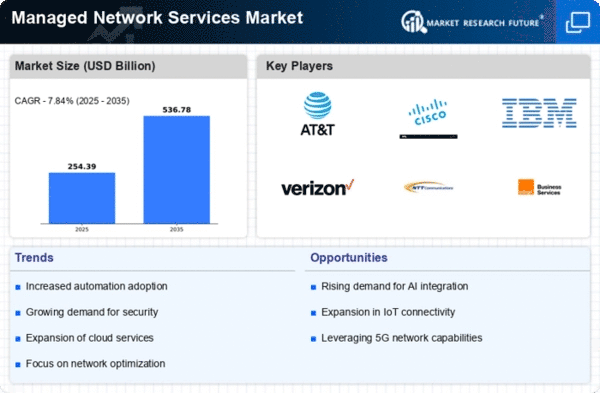
As per MRFR analysis, the Managed Network Services Market Size was estimated at 235.9 USD Billion in 2024. The Managed Network Services industry is projected to grow from 252.34 USD Billion in 2025 to 536.78 USD Billion by 2035, exhibiting a compound annual growth rate (CAGR) of 7.84% during the forecast period 2025 - 2035.

Key Market Trends & Highlights

The Managed Network Services Market is experiencing robust growth driven by technological advancements and evolving customer needs.

  • North America remains the largest market for managed network services, driven by increasing demand for advanced network solutions. The Asia-Pacific region is emerging as the fastest-growing market, fueled by rapid digital transformation and cloud adoption. Network security continues to dominate as the largest segment, while cloud services are recognized as the fastest-growing segment in the market. Key drivers include the growing demand for network scalability and the emphasis on cost efficiency, which are shaping service offerings.

Market Size & Forecast

2024 Market Size 235.9 (USD Billion)
2035 Market Size 536.78 (USD Billion)
CAGR (2025 - 2035) 7.84%
Largest Regional Market Share in 2024 North America

Major Players

AT&amp;T (US), Cisco Systems (US), IBM (US), Verizon Communications (US), NTT Communications (JP), Orange Business Services (FR), BT Group (GB), Tata Communications (IN), Lumen Technologies (US)

Market Trends

The Managed Network Services Market is currently experiencing a transformative phase, driven by the increasing demand for efficient network management solutions. Organizations are recognizing the necessity of outsourcing their network operations to specialized service providers, which allows them to focus on core business activities. This shift is largely influenced by the growing complexity of network infrastructures and the need for enhanced security measures. As businesses continue to adopt cloud-based services and IoT technologies, the reliance on managed services is likely to intensify, suggesting a robust growth trajectory for the market. The managed network services market is driven by increasing demand for scalable, secure, and outsourced network management solutions. A managed network service enables organizations to outsource monitoring, management, and optimization of their network infrastructure. Managed network service providers play a crucial role in delivering end-to-end connectivity, monitoring, and security solutions. Managed network infrastructure services support enterprise connectivity by ensuring network performance, availability, and security.

Moreover, the Managed Network Services Market appears to be evolving in response to emerging technologies such as artificial intelligence and machine learning. These advancements enable service providers to offer more proactive and predictive network management solutions, thereby enhancing operational efficiency. The integration of automation tools is also becoming prevalent, as they facilitate quicker response times and reduce human error. Consequently, the market is poised for further expansion, with organizations increasingly seeking innovative solutions to meet their networking needs. Managed network services companies such as AT&T, Cisco Systems, and IBM continue to expand their service portfolios through partnerships and innovation. Networking managed services are evolving through the integration of AI, automation, and predictive analytics.

Managed network as a service is gaining traction as organizations seek subscription-based and scalable networking solutions. Managed data network services enable enterprises to securely transmit and manage large volumes of data across distributed networks. The MNS managed network services segment benefits from rising demand for outsourced network management across industries. To define network services, they refer to solutions that enable connectivity, communication, and data exchange across IT infrastructures.

Increased Adoption of Cloud Services

The Managed Network Services Market is witnessing a notable trend towards the adoption of cloud-based solutions. Organizations are increasingly migrating their operations to the cloud, which necessitates robust network management to ensure seamless connectivity and performance. This shift is prompting service providers to enhance their offerings, integrating cloud services with traditional network management to deliver comprehensive solutions.

Focus on Cybersecurity Solutions

As cyber threats become more sophisticated, the Managed Network Services Market is placing a heightened emphasis on cybersecurity. Organizations are prioritizing the protection of their networks, leading to an increased demand for managed services that incorporate advanced security measures. Service providers are responding by developing solutions that not only manage networks but also safeguard them against potential vulnerabilities.

Integration of AI and Automation

The integration of artificial intelligence and automation within the Managed Network Services Market is emerging as a significant trend. These technologies enable service providers to optimize network performance, enhance troubleshooting processes, and improve overall efficiency. By leveraging AI and automation, organizations can achieve greater operational agility and responsiveness, which is becoming increasingly essential in today's fast-paced digital landscape.

Managed Network Services Market Market Drivers

Expansion of IoT Devices

The proliferation of Internet of Things (IoT) devices is reshaping the landscape of the Global Managed Network Services Market Industry. As more devices connect to networks, the complexity of managing these connections increases, necessitating specialized managed services. Organizations are turning to managed network solutions to ensure reliable connectivity, data management, and security for their IoT ecosystems. This trend is likely to drive market growth as businesses seek to harness the potential of IoT while mitigating associated risks. The integration of IoT with managed services is expected to enhance operational capabilities and foster innovation across various sectors.

Market Growth Projections

The Global Managed Network Services Market Industry is poised for substantial growth, with projections indicating a market size of 235.94 USD Billion in 2024 and an expected increase to 541.32 USD Billion by 2035. This growth trajectory, characterized by a compound annual growth rate of 7.84% from 2025 to 2035, underscores the increasing reliance on managed services across various sectors. Factors such as the rise of cloud computing, cybersecurity concerns, and the expansion of IoT devices contribute to this upward trend. The market's evolution reflects the dynamic nature of technology and the growing need for efficient network management solutions.

Emergence of 5G Technology

The rollout of 5G technology is a transformative factor in the Global Managed Network Services Market Industry. With its promise of faster speeds and lower latency, 5G is set to revolutionize network management and connectivity. Businesses are increasingly adopting managed services to leverage the capabilities of 5G, enabling them to enhance their operational efficiency and customer experiences. The anticipated growth in the market, projected to reach 541.32 USD Billion by 2035, reflects the potential impact of 5G on network services. As organizations adapt to this new technology, the demand for managed network solutions is likely to surge.

Rising Cybersecurity Concerns

Cybersecurity threats pose a substantial challenge for businesses globally, driving the demand for managed network services. The Global Managed Network Services Market Industry is increasingly influenced by the need for enhanced security measures to protect sensitive data and maintain compliance with regulations. Organizations are investing in managed services that offer advanced security protocols, including threat detection and response capabilities. This trend indicates a proactive approach to cybersecurity, as companies recognize the potential financial and reputational risks associated with data breaches. The emphasis on security is likely to sustain market growth as businesses prioritize safeguarding their networks.

Growing Demand for Cloud Services

The increasing adoption of cloud services is a pivotal driver in the Global Managed Network Services Market Industry. As organizations migrate to cloud-based solutions, they require robust network management to ensure seamless connectivity and performance. This trend is evidenced by the projected market size of 235.94 USD Billion in 2024, reflecting a significant shift towards cloud infrastructure. Companies are seeking managed services to optimize their networks, enhance security, and reduce operational costs. The integration of cloud services with managed network solutions is likely to enhance service delivery and customer satisfaction, thereby propelling market growth.

Increased Focus on Operational Efficiency

Organizations are continuously striving for operational efficiency, which significantly influences the Global Managed Network Services Market Industry. By outsourcing network management, companies can focus on their core competencies while leveraging the expertise of managed service providers. This shift not only reduces operational costs but also enhances service quality and reliability. As businesses seek to streamline their operations, the demand for managed network services is expected to rise. The anticipated compound annual growth rate of 7.84% from 2025 to 2035 underscores the growing recognition of the benefits associated with outsourcing network management.

Market Segment Insights

By Service Type: Network Monitoring (Largest) vs. Cloud Services (Fastest-Growing)

<p>In the Managed Network Services Market, the service types exhibit varying levels of market penetration. Network Monitoring currently holds the largest share, as enterprises increasingly prioritize oversight to ensure optimal performance and security of their networks. Conversely, Cloud Services are becoming a significant contender, appealing to organizations looking for flexibility, scalability, and remote accessibility. This emerging demand is reshaping how businesses view network management.</p>

<p>Network Monitoring: Dominant vs. Cloud Services: Emerging</p>

<p>Network Monitoring is the cornerstone of the Managed Network Services Market, providing critical insights into network performance and security threats. It caters to organizations that require real-time data analytics to preemptively address issues and maintain a robust IT infrastructure. On the other hand, Cloud Services are rapidly gaining traction, driven by the ongoing digital transformation of enterprises. Businesses are increasingly opting for cloud-based solutions to enhance collaboration, reduce costs, and ensure continuous availability. The collaborative nature of cloud services encourages innovation and adaptability, positioning it as an emerging force in the market.</p>

By Deployment Type: Cloud-Based (Largest) vs. On-Premises (Fastest-Growing)

<p>In the Managed Network Services Market, the distribution of deployment types reveals that Cloud-Based services hold the largest market share. This segment is favored due to its scalability and flexibility, enabling businesses to adapt their network services as their demands evolve. On the other hand, On-Premises solutions, while traditionally popular for their control and security, are experiencing a rapid increase in adoption rates as more enterprises recognize the benefits of hybrid infrastructures that combine physical and cloud-based resources. The growth trends in this segment are primarily driven by the increasing need for reliable connectivity and cost-effectiveness. Organizations are embracing hybrid models that allow them to capitalize on the advantages of both Cloud-Based and On-Premises solutions. This trend is fueled by technological advancements and the increasing adoption of IoT applications, which necessitate more adaptable and powerful network configurations.</p>

<p>Cloud-Based (Dominant) vs. On-Premises (Emerging)</p>

<p>In the Managed Network Services Market, Cloud-Based deployment stands as the dominant segment, renowned for its agility and reduced operational costs. Businesses are increasingly shifting towards cloud solutions to enhance their operational efficiency and support remote access. In contrast, On-Premises services are emerging as an essential component for organizations requiring pronounced security and compliance protocols. The latter is becoming particularly pertinent for sectors like finance and healthcare, where data integrity is critical. While Cloud-Based services continue to thrive due to their operational flexibility, On-Premises options are gaining traction as organizations recognize the necessity of a fortified network backbone that aligns with their regulatory frameworks.</p>

By End User: Small and Medium Enterprises (Largest) vs. Large Enterprises (Fastest-Growing)

The Managed Network Services Market is witnessing a diverse distribution of end users, with Small and Medium Enterprises (SMEs) holding a significant share. These enterprises rely heavily on managed services to optimize their bandwidth and enhance operational efficiency. Meanwhile, Large Enterprises are not far behind, as they continue to innovate and integrate advanced technologies into their networks, driving a healthy competition in the market.

Small and Medium Enterprises (Dominant) vs. Large Enterprises (Emerging)

Small and Medium Enterprises constitute the dominant segment in the Managed Network Services Market, primarily due to their increasing demand for cost-effective and scalable solutions. These businesses often seek managed services to improve their IT capabilities without the burden of extensive infrastructure investments. On the other hand, Large Enterprises are emerging as a significant user group, leveraging managed network services to streamline complex operations, boost productivity, and ensure seamless connectivity. Their investment in technologies like cloud computing and AI-powered management tools signifies their growing influence, as they seek to enhance efficiency and remain competitive in a rapidly evolving market.

Get more detailed insights about Managed Network Services Market Research Report—Global Forecast till 2035

Regional Insights

North America : Market Leader in Innovation

North America continues to lead the Managed Network Services market, holding a significant share of 117.95 million in 2024. The region's growth is driven by increasing demand for cloud-based solutions, enhanced cybersecurity measures, and the adoption of IoT technologies. Regulatory support for digital transformation initiatives further catalyzes market expansion, making it a hub for innovation and investment in managed services. The competitive landscape is characterized by major players such as AT&T, Cisco Systems, and Verizon Communications, which dominate the market with their advanced service offerings. The U.S. remains the largest contributor, while Canada and Mexico are also witnessing growth in managed services adoption. The presence of these key players ensures a robust ecosystem, fostering innovation and driving service enhancements across various sectors.

Europe : Emerging Market with Growth Potential

Europe's Managed Network Services market is valued at 62.37 million, reflecting a growing demand for integrated network solutions. The region is witnessing a shift towards digitalization, driven by regulatory frameworks that promote data protection and cybersecurity. The European Union's initiatives to enhance digital infrastructure are pivotal in shaping market dynamics, encouraging investments in managed services across member states. Leading countries such as Germany, France, and the UK are at the forefront of this growth, with key players like Orange Business Services and BT Group enhancing their service portfolios. The competitive landscape is evolving, with a focus on partnerships and collaborations to deliver comprehensive solutions. As businesses increasingly seek to optimize their network operations, the demand for managed services is expected to rise significantly in the coming years.

Asia-Pacific : Rapid Growth in Emerging Markets

The Asia-Pacific region, with a market size of 43.77 million, is experiencing rapid growth in Managed Network Services. Factors such as increasing internet penetration, the rise of SMEs, and government initiatives to boost digital economies are driving demand. Countries like India and China are leading this growth, supported by favorable regulations that encourage technology adoption and investment in network infrastructure. The competitive landscape is marked by the presence of key players like NTT Communications and Tata Communications, which are expanding their service offerings to cater to diverse customer needs. The region's unique challenges, including varying regulatory environments and infrastructure disparities, are being addressed through innovative solutions. As businesses prioritize digital transformation, the demand for managed services is set to escalate, positioning Asia-Pacific as a key player in the global market.

Middle East and Africa : Emerging Market with Untapped Potential

The Managed Network Services market in the Middle East and Africa is valued at 11.0 million, showcasing significant growth potential. The region is witnessing an increase in demand for managed services driven by digital transformation initiatives and investments in telecommunications infrastructure. Governments are actively promoting technology adoption to enhance economic diversification, which is crucial for market expansion. Countries like South Africa and the UAE are leading the charge, with key players such as Lumen Technologies establishing a strong presence. The competitive landscape is evolving, with local and international firms vying for market share. As businesses increasingly recognize the value of managed services in optimizing operations, the region is poised for substantial growth in the coming years.

Key Players and Competitive Insights

The Managed Network Services Market is currently characterized by a dynamic competitive landscape, driven by the increasing demand for efficient network management solutions and the rapid evolution of digital technologies. Key players such as AT&T (US), Cisco Systems (US), and IBM (US) are strategically positioning themselves through innovation and partnerships, which collectively shape the competitive environment. For instance, AT&T (US) has focused on enhancing its 5G capabilities, while Cisco Systems (US) emphasizes its software-defined networking solutions to cater to the growing need for flexibility and scalability in network management.In terms of business tactics, companies are increasingly localizing their operations and optimizing supply chains to enhance service delivery and responsiveness. The market appears moderately fragmented, with several players vying for market share, yet the influence of major companies remains substantial. This competitive structure allows for a diverse range of services, catering to various customer needs while fostering innovation across the sector.
In November Verizon Communications (US) announced a strategic partnership with a leading cloud service provider to enhance its managed network services portfolio. This collaboration is expected to integrate advanced cloud solutions with Verizon's existing network infrastructure, thereby improving service offerings and customer experience. Such strategic moves indicate a trend towards hybrid solutions that combine traditional networking with cloud capabilities, reflecting the industry's shift towards more integrated service models.
In October NTT Communications (JP) launched a new AI-driven network management platform aimed at automating network operations and enhancing security measures. This initiative underscores the growing importance of artificial intelligence in network management, as companies seek to leverage technology to improve efficiency and reduce operational costs. The introduction of such platforms may significantly alter competitive dynamics, as firms that adopt AI solutions could gain a substantial edge in service delivery.
In September Tata Communications (IN) expanded its global reach by acquiring a regional managed services provider in Europe. This acquisition is likely to bolster Tata's presence in the European market, allowing it to offer localized services while enhancing its overall service portfolio. Such strategic expansions are indicative of a broader trend where companies are seeking to strengthen their market positions through acquisitions, thereby increasing their competitive advantage.
As of December the Managed Network Services Market is witnessing trends such as digitalization, sustainability, and AI integration, which are redefining competitive strategies. Strategic alliances are becoming increasingly prevalent, enabling companies to pool resources and expertise to enhance service offerings. Looking ahead, competitive differentiation is expected to evolve, with a notable shift from price-based competition towards innovation, technology integration, and supply chain reliability. This transition may ultimately reshape the market landscape, as companies that prioritize these aspects are likely to emerge as leaders in the Managed Network Services Market.

Key Companies in the Managed Network Services Market include

Industry Developments

  • Q2 2024: AT&T and Cisco Expand Partnership to Deliver Managed Network Services Market for Enterprise Customers AT&T and Cisco announced an expanded partnership to offer new managed network services, including SD-WAN and security solutions, targeting large enterprise clients seeking enhanced connectivity and network management.
  • Q2 2024: IBM Launches New AI-Powered Managed Network Services Market Platform IBM unveiled a new platform for managed network services that leverages artificial intelligence to automate network monitoring, predictive maintenance, and security management for global enterprise customers.
  • Q3 2024: Aryaka Secures $60 Million Funding to Expand Global Managed SD-WAN Services Aryaka, a provider of managed SD-WAN and network services, raised $60 million in a funding round led by Goldman Sachs to accelerate its global expansion and enhance its managed network offerings.
  • Q2 2024: NTT Opens New Managed Network Services Market Operations Center in Frankfurt NTT announced the opening of a new operations center in Frankfurt, Germany, dedicated to supporting its managed network services clients across Europe with advanced monitoring and support capabilities.
  • Q1 2024: Orange Business Services Wins Major Managed Network Services Market Contract with European Retail Giant Orange Business Services secured a multi-year contract to provide managed network services, including SD-WAN and cloud connectivity, for a leading European retail group, supporting its digital transformation initiatives.
  • Q2 2024: Verizon Appoints New Head of Global Managed Network Services Market Division Verizon announced the appointment of Maria Chen as the new head of its Global Managed Network Services Market division, overseeing strategy and growth for enterprise network solutions.
  • Q3 2024: HCLTech Acquires UK-Based Managed Network Services Market Provider, Networkers Ltd. HCLTech completed the acquisition of Networkers Ltd., a UK-based managed network services provider, to strengthen its presence in the European market and expand its portfolio of network management solutions.
  • Q1 2024: Vodafone Business Launches 5G-Enabled Managed Network Services Market for SMEs Vodafone Business introduced a new suite of managed network services leveraging 5G technology, aimed at small and medium-sized enterprises seeking scalable and secure connectivity solutions.
  • Q2 2025: BT Group Announces Strategic Partnership with Palo Alto Networks for Managed Security Services BT Group entered a strategic partnership with Palo Alto Networks to integrate advanced cybersecurity solutions into its managed network services portfolio for enterprise customers.
  • Q1 2025: Cloudflare Launches Managed Network Services Market for Multi-Cloud Environments Cloudflare announced the launch of managed network services designed for multi-cloud environments, providing unified network management, security, and performance optimization for global enterprises.
  • Q2 2025: Tata Communications Wins $100 Million Managed Network Services Market Contract with Global Automotive Manufacturer Tata Communications secured a $100 million contract to deliver managed network services, including SD-WAN and cloud connectivity, for a major global automotive manufacturer.
  • Q3 2025: Lumen Technologies Opens New Managed Network Services Market Innovation Hub in Singapore Lumen Technologies inaugurated a new innovation hub in Singapore focused on developing and delivering advanced managed network services for clients across the Asia-Pacific region.


Future Outlook

Managed Network Services Market Future Outlook

The Managed Network Services Market is projected to grow at a 7.84% CAGR from 2025 to 2035, driven by increasing demand for cloud services, cybersecurity needs, and IoT integration.

New opportunities lie in:

  • <p>Expansion of AI-driven network management solutions Development of tailored cybersecurity packages for SMEs Integration of 5G technology into managed services offerings</p>

By 2035, the Managed Network Services Market is expected to be robust, reflecting substantial growth and innovation.

Market Segmentation

Managed Network Services Market End User Outlook

  • Small and Medium Enterprises
  • Large Enterprises
  • Government Organizations
  • Educational Institutions

Managed Network Services Market Service Type Outlook

  • Network Monitoring
  • Network Security
  • Network Optimization
  • Cloud Services
  • Managed Wi-Fi

Managed Network Services Market Deployment Type Outlook

  • On-Premises
  • Cloud-Based
  • Hybrid

Report Scope

MARKET SIZE 2024 235.9(USD Billion)
MARKET SIZE 2025 252.34(USD Billion)
MARKET SIZE 2035 536.78(USD Billion)
COMPOUND ANNUAL GROWTH RATE (CAGR) 7.84% (2025 - 2035)
REPORT COVERAGE Revenue Forecast, Competitive Landscape, Growth Factors, and Trends
BASE YEAR 2024
Market Forecast Period 2025 - 2035
Historical Data 2019 - 2024
Market Forecast Units USD Billion
Key Companies Profiled AT&T (US), Cisco Systems (US), IBM (US), Verizon Communications (US), NTT Communications (JP), Orange Business Services (FR), BT Group (GB), Tata Communications (IN), Lumen Technologies (US)
Segments Covered Service Type, Deployment Type, End User
Key Market Opportunities Integration of artificial intelligence and automation in the Managed Network Services Market enhances operational efficiency and service delivery.
Key Market Dynamics Rising demand for cybersecurity solutions drives innovation and competition in the Managed Network Services Market.
Countries Covered North America, Europe, APAC, South America, MEA

FAQs

What is the current valuation of the Managed Network Services Market?

<p>The Managed Network Services Market was valued at 235.9 USD Billion in 2024.</p>

What is the projected market size for the Managed Network Services Market by 2035?

<p>The market is expected to reach 536.78 USD Billion by 2035.</p>

What is the expected CAGR for the Managed Network Services Market during the forecast period?

<p>The expected CAGR for the Managed Network Services Market from 2025 to 2035 is 7.84%.</p>

Which service type segment is projected to have the highest growth?

<p>The Cloud Services segment is anticipated to grow from 85.9 USD Billion to 186.78 USD Billion by 2035.</p>

How does the On-Premises deployment type compare to Cloud-Based in terms of market size?

The On-Premises deployment type was valued at 70.0 USD Billion in 2024, while Cloud-Based was at 90.0 USD Billion.

What are the key players in the Managed Network Services Market?

Key players include AT&amp;T, Cisco Systems, IBM, Verizon Communications, and NTT Communications.

Which end-user segment is expected to see the most significant growth?

The Large Enterprises segment is projected to grow from 85.0 USD Billion to 200.0 USD Billion by 2035.

What is the market size for Network Security services in 2024?

The Network Security services segment was valued at 60.0 USD Billion in 2024.

How does the Telecommunications end-user segment perform in terms of market valuation?

The Telecommunications segment was valued at 63.9 USD Billion in 2024 and is expected to grow significantly.

What is the projected market size for Hybrid deployment types by 2035?

The Hybrid deployment type is expected to grow from 75.9 USD Billion to 136.78 USD Billion by 2035.

  1. SECTION I: EXECUTIVE SUMMARY AND KEY HIGHLIGHTS
    1. | 1.1 EXECUTIVE SUMMARY
    2. | | 1.1.1 Market Overview
    3. | | 1.1.2 Key Findings
    4. | | 1.1.3 Market Segmentation
    5. | | 1.1.4 Competitive Landscape
    6. | | 1.1.5 Challenges and Opportunities
    7. | | 1.1.6 Future Outlook
  2. SECTION II: SCOPING, METHODOLOGY AND MARKET STRUCTURE
    1. | 2.1 MARKET INTRODUCTION
    2. | | 2.1.1 Definition
    3. | | 2.1.2 Scope of the study
    4. | | | 2.1.2.1 Research Objective
    5. | | | 2.1.2.2 Assumption
    6. | | | 2.1.2.3 Limitations
    7. | 2.2 RESEARCH METHODOLOGY
    8. | | 2.2.1 Overview
    9. | | 2.2.2 Data Mining
    10. | | 2.2.3 Secondary Research
    11. | | 2.2.4 Primary Research
    12. | | | 2.2.4.1 Primary Interviews and Information Gathering Process
    13. | | | 2.2.4.2 Breakdown of Primary Respondents
    14. | | 2.2.5 Forecasting Model
    15. | | 2.2.6 Market Size Estimation
    16. | | | 2.2.6.1 Bottom-Up Approach
    17. | | | 2.2.6.2 Top-Down Approach
    18. | | 2.2.7 Data Triangulation
    19. | | 2.2.8 Validation
  3. SECTION III: QUALITATIVE ANALYSIS
    1. | 3.1 MARKET DYNAMICS
    2. | | 3.1.1 Overview
    3. | | 3.1.2 Drivers
    4. | | 3.1.3 Restraints
    5. | | 3.1.4 Opportunities
    6. | 3.2 MARKET FACTOR ANALYSIS
    7. | | 3.2.1 Value chain Analysis
    8. | | 3.2.2 Porter's Five Forces Analysis
    9. | | | 3.2.2.1 Bargaining Power of Suppliers
    10. | | | 3.2.2.2 Bargaining Power of Buyers
    11. | | | 3.2.2.3 Threat of New Entrants
    12. | | | 3.2.2.4 Threat of Substitutes
    13. | | | 3.2.2.5 Intensity of Rivalry
    14. | | 3.2.3 COVID-19 Impact Analysis
    15. | | | 3.2.3.1 Market Impact Analysis
    16. | | | 3.2.3.2 Regional Impact
    17. | | | 3.2.3.3 Opportunity and Threat Analysis
  4. SECTION IV: QUANTITATIVE ANALYSIS
    1. | 4.1 Information and Communications Technology, BY Service Type (USD Billion)
    2. | | 4.1.1 Network Monitoring
    3. | | 4.1.2 Network Security
    4. | | 4.1.3 Network Optimization
    5. | | 4.1.4 Cloud Services
    6. | 4.2 Information and Communications Technology, BY Deployment Type (USD Billion)
    7. | | 4.2.1 On-Premises
    8. | | 4.2.2 Cloud-Based
    9. | | 4.2.3 Hybrid
    10. | 4.3 Information and Communications Technology, BY End User (USD Billion)
    11. | | 4.3.1 Small and Medium Enterprises
    12. | | 4.3.2 Large Enterprises
    13. | | 4.3.3 Government Organizations
    14. | | 4.3.4 Telecommunications
    15. | 4.4 Information and Communications Technology, BY Region (USD Billion)
    16. | | 4.4.1 North America
    17. | | | 4.4.1.1 US
    18. | | | 4.4.1.2 Canada
    19. | | 4.4.2 Europe
    20. | | | 4.4.2.1 Germany
    21. | | | 4.4.2.2 UK
    22. | | | 4.4.2.3 France
    23. | | | 4.4.2.4 Russia
    24. | | | 4.4.2.5 Italy
    25. | | | 4.4.2.6 Spain
    26. | | | 4.4.2.7 Rest of Europe
    27. | | 4.4.3 APAC
    28. | | | 4.4.3.1 China
    29. | | | 4.4.3.2 India
    30. | | | 4.4.3.3 Japan
    31. | | | 4.4.3.4 South Korea
    32. | | | 4.4.3.5 Malaysia
    33. | | | 4.4.3.6 Thailand
    34. | | | 4.4.3.7 Indonesia
    35. | | | 4.4.3.8 Rest of APAC
    36. | | 4.4.4 South America
    37. | | | 4.4.4.1 Brazil
    38. | | | 4.4.4.2 Mexico
    39. | | | 4.4.4.3 Argentina
    40. | | | 4.4.4.4 Rest of South America
    41. | | 4.4.5 MEA
    42. | | | 4.4.5.1 GCC Countries
    43. | | | 4.4.5.2 South Africa
    44. | | | 4.4.5.3 Rest of MEA
  5. SECTION V: COMPETITIVE ANALYSIS
    1. | 5.1 Competitive Landscape
    2. | | 5.1.1 Overview
    3. | | 5.1.2 Competitive Analysis
    4. | | 5.1.3 Market share Analysis
    5. | | 5.1.4 Major Growth Strategy in the Information and Communications Technology
    6. | | 5.1.5 Competitive Benchmarking
    7. | | 5.1.6 Leading Players in Terms of Number of Developments in the Information and Communications Technology
    8. | | 5.1.7 Key developments and growth strategies
    9. | | | 5.1.7.1 New Product Launch/Service Deployment
    10. | | | 5.1.7.2 Merger & Acquisitions
    11. | | | 5.1.7.3 Joint Ventures
    12. | | 5.1.8 Major Players Financial Matrix
    13. | | | 5.1.8.1 Sales and Operating Income
    14. | | | 5.1.8.2 Major Players R&D Expenditure. 2023
    15. | 5.2 Company Profiles
    16. | | 5.2.1 AT&T (US)
    17. | | | 5.2.1.1 Financial Overview
    18. | | | 5.2.1.2 Products Offered
    19. | | | 5.2.1.3 Key Developments
    20. | | | 5.2.1.4 SWOT Analysis
    21. | | | 5.2.1.5 Key Strategies
    22. | | 5.2.2 Cisco Systems (US)
    23. | | | 5.2.2.1 Financial Overview
    24. | | | 5.2.2.2 Products Offered
    25. | | | 5.2.2.3 Key Developments
    26. | | | 5.2.2.4 SWOT Analysis
    27. | | | 5.2.2.5 Key Strategies
    28. | | 5.2.3 IBM (US)
    29. | | | 5.2.3.1 Financial Overview
    30. | | | 5.2.3.2 Products Offered
    31. | | | 5.2.3.3 Key Developments
    32. | | | 5.2.3.4 SWOT Analysis
    33. | | | 5.2.3.5 Key Strategies
    34. | | 5.2.4 Verizon Communications (US)
    35. | | | 5.2.4.1 Financial Overview
    36. | | | 5.2.4.2 Products Offered
    37. | | | 5.2.4.3 Key Developments
    38. | | | 5.2.4.4 SWOT Analysis
    39. | | | 5.2.4.5 Key Strategies
    40. | | 5.2.5 NTT Communications (JP)
    41. | | | 5.2.5.1 Financial Overview
    42. | | | 5.2.5.2 Products Offered
    43. | | | 5.2.5.3 Key Developments
    44. | | | 5.2.5.4 SWOT Analysis
    45. | | | 5.2.5.5 Key Strategies
    46. | | 5.2.6 Orange Business Services (FR)
    47. | | | 5.2.6.1 Financial Overview
    48. | | | 5.2.6.2 Products Offered
    49. | | | 5.2.6.3 Key Developments
    50. | | | 5.2.6.4 SWOT Analysis
    51. | | | 5.2.6.5 Key Strategies
    52. | | 5.2.7 BT Group (GB)
    53. | | | 5.2.7.1 Financial Overview
    54. | | | 5.2.7.2 Products Offered
    55. | | | 5.2.7.3 Key Developments
    56. | | | 5.2.7.4 SWOT Analysis
    57. | | | 5.2.7.5 Key Strategies
    58. | | 5.2.8 Tata Communications (IN)
    59. | | | 5.2.8.1 Financial Overview
    60. | | | 5.2.8.2 Products Offered
    61. | | | 5.2.8.3 Key Developments
    62. | | | 5.2.8.4 SWOT Analysis
    63. | | | 5.2.8.5 Key Strategies
    64. | | 5.2.9 Lumen Technologies (US)
    65. | | | 5.2.9.1 Financial Overview
    66. | | | 5.2.9.2 Products Offered
    67. | | | 5.2.9.3 Key Developments
    68. | | | 5.2.9.4 SWOT Analysis
    69. | | | 5.2.9.5 Key Strategies
    70. | 5.3 Appendix
    71. | | 5.3.1 References
    72. | | 5.3.2 Related Reports
  6. LIST OF FIGURES
    1. | 6.1 MARKET SYNOPSIS
    2. | 6.2 NORTH AMERICA MARKET ANALYSIS
    3. | 6.3 US MARKET ANALYSIS BY SERVICE TYPE
    4. | 6.4 US MARKET ANALYSIS BY DEPLOYMENT TYPE
    5. | 6.5 US MARKET ANALYSIS BY END USER
    6. | 6.6 CANADA MARKET ANALYSIS BY SERVICE TYPE
    7. | 6.7 CANADA MARKET ANALYSIS BY DEPLOYMENT TYPE
    8. | 6.8 CANADA MARKET ANALYSIS BY END USER
    9. | 6.9 EUROPE MARKET ANALYSIS
    10. | 6.10 GERMANY MARKET ANALYSIS BY SERVICE TYPE
    11. | 6.11 GERMANY MARKET ANALYSIS BY DEPLOYMENT TYPE
    12. | 6.12 GERMANY MARKET ANALYSIS BY END USER
    13. | 6.13 UK MARKET ANALYSIS BY SERVICE TYPE
    14. | 6.14 UK MARKET ANALYSIS BY DEPLOYMENT TYPE
    15. | 6.15 UK MARKET ANALYSIS BY END USER
    16. | 6.16 FRANCE MARKET ANALYSIS BY SERVICE TYPE
    17. | 6.17 FRANCE MARKET ANALYSIS BY DEPLOYMENT TYPE
    18. | 6.18 FRANCE MARKET ANALYSIS BY END USER
    19. | 6.19 RUSSIA MARKET ANALYSIS BY SERVICE TYPE
    20. | 6.20 RUSSIA MARKET ANALYSIS BY DEPLOYMENT TYPE
    21. | 6.21 RUSSIA MARKET ANALYSIS BY END USER
    22. | 6.22 ITALY MARKET ANALYSIS BY SERVICE TYPE
    23. | 6.23 ITALY MARKET ANALYSIS BY DEPLOYMENT TYPE
    24. | 6.24 ITALY MARKET ANALYSIS BY END USER
    25. | 6.25 SPAIN MARKET ANALYSIS BY SERVICE TYPE
    26. | 6.26 SPAIN MARKET ANALYSIS BY DEPLOYMENT TYPE
    27. | 6.27 SPAIN MARKET ANALYSIS BY END USER
    28. | 6.28 REST OF EUROPE MARKET ANALYSIS BY SERVICE TYPE
    29. | 6.29 REST OF EUROPE MARKET ANALYSIS BY DEPLOYMENT TYPE
    30. | 6.30 REST OF EUROPE MARKET ANALYSIS BY END USER
    31. | 6.31 APAC MARKET ANALYSIS
    32. | 6.32 CHINA MARKET ANALYSIS BY SERVICE TYPE
    33. | 6.33 CHINA MARKET ANALYSIS BY DEPLOYMENT TYPE
    34. | 6.34 CHINA MARKET ANALYSIS BY END USER
    35. | 6.35 INDIA MARKET ANALYSIS BY SERVICE TYPE
    36. | 6.36 INDIA MARKET ANALYSIS BY DEPLOYMENT TYPE
    37. | 6.37 INDIA MARKET ANALYSIS BY END USER
    38. | 6.38 JAPAN MARKET ANALYSIS BY SERVICE TYPE
    39. | 6.39 JAPAN MARKET ANALYSIS BY DEPLOYMENT TYPE
    40. | 6.40 JAPAN MARKET ANALYSIS BY END USER
    41. | 6.41 SOUTH KOREA MARKET ANALYSIS BY SERVICE TYPE
    42. | 6.42 SOUTH KOREA MARKET ANALYSIS BY DEPLOYMENT TYPE
    43. | 6.43 SOUTH KOREA MARKET ANALYSIS BY END USER
    44. | 6.44 MALAYSIA MARKET ANALYSIS BY SERVICE TYPE
    45. | 6.45 MALAYSIA MARKET ANALYSIS BY DEPLOYMENT TYPE
    46. | 6.46 MALAYSIA MARKET ANALYSIS BY END USER
    47. | 6.47 THAILAND MARKET ANALYSIS BY SERVICE TYPE
    48. | 6.48 THAILAND MARKET ANALYSIS BY DEPLOYMENT TYPE
    49. | 6.49 THAILAND MARKET ANALYSIS BY END USER
    50. | 6.50 INDONESIA MARKET ANALYSIS BY SERVICE TYPE
    51. | 6.51 INDONESIA MARKET ANALYSIS BY DEPLOYMENT TYPE
    52. | 6.52 INDONESIA MARKET ANALYSIS BY END USER
    53. | 6.53 REST OF APAC MARKET ANALYSIS BY SERVICE TYPE
    54. | 6.54 REST OF APAC MARKET ANALYSIS BY DEPLOYMENT TYPE
    55. | 6.55 REST OF APAC MARKET ANALYSIS BY END USER
    56. | 6.56 SOUTH AMERICA MARKET ANALYSIS
    57. | 6.57 BRAZIL MARKET ANALYSIS BY SERVICE TYPE
    58. | 6.58 BRAZIL MARKET ANALYSIS BY DEPLOYMENT TYPE
    59. | 6.59 BRAZIL MARKET ANALYSIS BY END USER
    60. | 6.60 MEXICO MARKET ANALYSIS BY SERVICE TYPE
    61. | 6.61 MEXICO MARKET ANALYSIS BY DEPLOYMENT TYPE
    62. | 6.62 MEXICO MARKET ANALYSIS BY END USER
    63. | 6.63 ARGENTINA MARKET ANALYSIS BY SERVICE TYPE
    64. | 6.64 ARGENTINA MARKET ANALYSIS BY DEPLOYMENT TYPE
    65. | 6.65 ARGENTINA MARKET ANALYSIS BY END USER
    66. | 6.66 REST OF SOUTH AMERICA MARKET ANALYSIS BY SERVICE TYPE
    67. | 6.67 REST OF SOUTH AMERICA MARKET ANALYSIS BY DEPLOYMENT TYPE
    68. | 6.68 REST OF SOUTH AMERICA MARKET ANALYSIS BY END USER
    69. | 6.69 MEA MARKET ANALYSIS
    70. | 6.70 GCC COUNTRIES MARKET ANALYSIS BY SERVICE TYPE
    71. | 6.71 GCC COUNTRIES MARKET ANALYSIS BY DEPLOYMENT TYPE
    72. | 6.72 GCC COUNTRIES MARKET ANALYSIS BY END USER
    73. | 6.73 SOUTH AFRICA MARKET ANALYSIS BY SERVICE TYPE
    74. | 6.74 SOUTH AFRICA MARKET ANALYSIS BY DEPLOYMENT TYPE
    75. | 6.75 SOUTH AFRICA MARKET ANALYSIS BY END USER
    76. | 6.76 REST OF MEA MARKET ANALYSIS BY SERVICE TYPE
    77. | 6.77 REST OF MEA MARKET ANALYSIS BY DEPLOYMENT TYPE
    78. | 6.78 REST OF MEA MARKET ANALYSIS BY END USER
    79. | 6.79 KEY BUYING CRITERIA OF INFORMATION AND COMMUNICATIONS TECHNOLOGY
    80. | 6.80 RESEARCH PROCESS OF MRFR
    81. | 6.81 DRO ANALYSIS OF INFORMATION AND COMMUNICATIONS TECHNOLOGY
    82. | 6.82 DRIVERS IMPACT ANALYSIS: INFORMATION AND COMMUNICATIONS TECHNOLOGY
    83. | 6.83 RESTRAINTS IMPACT ANALYSIS: INFORMATION AND COMMUNICATIONS TECHNOLOGY
    84. | 6.84 SUPPLY / VALUE CHAIN: INFORMATION AND COMMUNICATIONS TECHNOLOGY
    85. | 6.85 INFORMATION AND COMMUNICATIONS TECHNOLOGY, BY SERVICE TYPE, 2024 (% SHARE)
    86. | 6.86 INFORMATION AND COMMUNICATIONS TECHNOLOGY, BY SERVICE TYPE, 2024 TO 2035 (USD Billion)
    87. | 6.87 INFORMATION AND COMMUNICATIONS TECHNOLOGY, BY DEPLOYMENT TYPE, 2024 (% SHARE)
    88. | 6.88 INFORMATION AND COMMUNICATIONS TECHNOLOGY, BY DEPLOYMENT TYPE, 2024 TO 2035 (USD Billion)
    89. | 6.89 INFORMATION AND COMMUNICATIONS TECHNOLOGY, BY END USER, 2024 (% SHARE)
    90. | 6.90 INFORMATION AND COMMUNICATIONS TECHNOLOGY, BY END USER, 2024 TO 2035 (USD Billion)
    91. | 6.91 BENCHMARKING OF MAJOR COMPETITORS
  7. LIST OF TABLES
    1. | 7.1 LIST OF ASSUMPTIONS
    2. | | 7.1.1
    3. | 7.2 North America MARKET SIZE ESTIMATES; FORECAST
    4. | | 7.2.1 BY SERVICE TYPE, 2025-2035 (USD Billion)
    5. | | 7.2.2 BY DEPLOYMENT TYPE, 2025-2035 (USD Billion)
    6. | | 7.2.3 BY END USER, 2025-2035 (USD Billion)
    7. | 7.3 US MARKET SIZE ESTIMATES; FORECAST
    8. | | 7.3.1 BY SERVICE TYPE, 2025-2035 (USD Billion)
    9. | | 7.3.2 BY DEPLOYMENT TYPE, 2025-2035 (USD Billion)
    10. | | 7.3.3 BY END USER, 2025-2035 (USD Billion)
    11. | 7.4 Canada MARKET SIZE ESTIMATES; FORECAST
    12. | | 7.4.1 BY SERVICE TYPE, 2025-2035 (USD Billion)
    13. | | 7.4.2 BY DEPLOYMENT TYPE, 2025-2035 (USD Billion)
    14. | | 7.4.3 BY END USER, 2025-2035 (USD Billion)
    15. | 7.5 Europe MARKET SIZE ESTIMATES; FORECAST
    16. | | 7.5.1 BY SERVICE TYPE, 2025-2035 (USD Billion)
    17. | | 7.5.2 BY DEPLOYMENT TYPE, 2025-2035 (USD Billion)
    18. | | 7.5.3 BY END USER, 2025-2035 (USD Billion)
    19. | 7.6 Germany MARKET SIZE ESTIMATES; FORECAST
    20. | | 7.6.1 BY SERVICE TYPE, 2025-2035 (USD Billion)
    21. | | 7.6.2 BY DEPLOYMENT TYPE, 2025-2035 (USD Billion)
    22. | | 7.6.3 BY END USER, 2025-2035 (USD Billion)
    23. | 7.7 UK MARKET SIZE ESTIMATES; FORECAST
    24. | | 7.7.1 BY SERVICE TYPE, 2025-2035 (USD Billion)
    25. | | 7.7.2 BY DEPLOYMENT TYPE, 2025-2035 (USD Billion)
    26. | | 7.7.3 BY END USER, 2025-2035 (USD Billion)
    27. | 7.8 France MARKET SIZE ESTIMATES; FORECAST
    28. | | 7.8.1 BY SERVICE TYPE, 2025-2035 (USD Billion)
    29. | | 7.8.2 BY DEPLOYMENT TYPE, 2025-2035 (USD Billion)
    30. | | 7.8.3 BY END USER, 2025-2035 (USD Billion)
    31. | 7.9 Russia MARKET SIZE ESTIMATES; FORECAST
    32. | | 7.9.1 BY SERVICE TYPE, 2025-2035 (USD Billion)
    33. | | 7.9.2 BY DEPLOYMENT TYPE, 2025-2035 (USD Billion)
    34. | | 7.9.3 BY END USER, 2025-2035 (USD Billion)
    35. | 7.10 Italy MARKET SIZE ESTIMATES; FORECAST
    36. | | 7.10.1 BY SERVICE TYPE, 2025-2035 (USD Billion)
    37. | | 7.10.2 BY DEPLOYMENT TYPE, 2025-2035 (USD Billion)
    38. | | 7.10.3 BY END USER, 2025-2035 (USD Billion)
    39. | 7.11 Spain MARKET SIZE ESTIMATES; FORECAST
    40. | | 7.11.1 BY SERVICE TYPE, 2025-2035 (USD Billion)
    41. | | 7.11.2 BY DEPLOYMENT TYPE, 2025-2035 (USD Billion)
    42. | | 7.11.3 BY END USER, 2025-2035 (USD Billion)
    43. | 7.12 Rest of Europe MARKET SIZE ESTIMATES; FORECAST
    44. | | 7.12.1 BY SERVICE TYPE, 2025-2035 (USD Billion)
    45. | | 7.12.2 BY DEPLOYMENT TYPE, 2025-2035 (USD Billion)
    46. | | 7.12.3 BY END USER, 2025-2035 (USD Billion)
    47. | 7.13 APAC MARKET SIZE ESTIMATES; FORECAST
    48. | | 7.13.1 BY SERVICE TYPE, 2025-2035 (USD Billion)
    49. | | 7.13.2 BY DEPLOYMENT TYPE, 2025-2035 (USD Billion)
    50. | | 7.13.3 BY END USER, 2025-2035 (USD Billion)
    51. | 7.14 China MARKET SIZE ESTIMATES; FORECAST
    52. | | 7.14.1 BY SERVICE TYPE, 2025-2035 (USD Billion)
    53. | | 7.14.2 BY DEPLOYMENT TYPE, 2025-2035 (USD Billion)
    54. | | 7.14.3 BY END USER, 2025-2035 (USD Billion)
    55. | 7.15 India MARKET SIZE ESTIMATES; FORECAST
    56. | | 7.15.1 BY SERVICE TYPE, 2025-2035 (USD Billion)
    57. | | 7.15.2 BY DEPLOYMENT TYPE, 2025-2035 (USD Billion)
    58. | | 7.15.3 BY END USER, 2025-2035 (USD Billion)
    59. | 7.16 Japan MARKET SIZE ESTIMATES; FORECAST
    60. | | 7.16.1 BY SERVICE TYPE, 2025-2035 (USD Billion)
    61. | | 7.16.2 BY DEPLOYMENT TYPE, 2025-2035 (USD Billion)
    62. | | 7.16.3 BY END USER, 2025-2035 (USD Billion)
    63. | 7.17 South Korea MARKET SIZE ESTIMATES; FORECAST
    64. | | 7.17.1 BY SERVICE TYPE, 2025-2035 (USD Billion)
    65. | | 7.17.2 BY DEPLOYMENT TYPE, 2025-2035 (USD Billion)
    66. | | 7.17.3 BY END USER, 2025-2035 (USD Billion)
    67. | 7.18 Malaysia MARKET SIZE ESTIMATES; FORECAST
    68. | | 7.18.1 BY SERVICE TYPE, 2025-2035 (USD Billion)
    69. | | 7.18.2 BY DEPLOYMENT TYPE, 2025-2035 (USD Billion)
    70. | | 7.18.3 BY END USER, 2025-2035 (USD Billion)
    71. | 7.19 Thailand MARKET SIZE ESTIMATES; FORECAST
    72. | | 7.19.1 BY SERVICE TYPE, 2025-2035 (USD Billion)
    73. | | 7.19.2 BY DEPLOYMENT TYPE, 2025-2035 (USD Billion)
    74. | | 7.19.3 BY END USER, 2025-2035 (USD Billion)
    75. | 7.20 Indonesia MARKET SIZE ESTIMATES; FORECAST
    76. | | 7.20.1 BY SERVICE TYPE, 2025-2035 (USD Billion)
    77. | | 7.20.2 BY DEPLOYMENT TYPE, 2025-2035 (USD Billion)
    78. | | 7.20.3 BY END USER, 2025-2035 (USD Billion)
    79. | 7.21 Rest of APAC MARKET SIZE ESTIMATES; FORECAST
    80. | | 7.21.1 BY SERVICE TYPE, 2025-2035 (USD Billion)
    81. | | 7.21.2 BY DEPLOYMENT TYPE, 2025-2035 (USD Billion)
    82. | | 7.21.3 BY END USER, 2025-2035 (USD Billion)
    83. | 7.22 South America MARKET SIZE ESTIMATES; FORECAST
    84. | | 7.22.1 BY SERVICE TYPE, 2025-2035 (USD Billion)
    85. | | 7.22.2 BY DEPLOYMENT TYPE, 2025-2035 (USD Billion)
    86. | | 7.22.3 BY END USER, 2025-2035 (USD Billion)
    87. | 7.23 Brazil MARKET SIZE ESTIMATES; FORECAST
    88. | | 7.23.1 BY SERVICE TYPE, 2025-2035 (USD Billion)
    89. | | 7.23.2 BY DEPLOYMENT TYPE, 2025-2035 (USD Billion)
    90. | | 7.23.3 BY END USER, 2025-2035 (USD Billion)
    91. | 7.24 Mexico MARKET SIZE ESTIMATES; FORECAST
    92. | | 7.24.1 BY SERVICE TYPE, 2025-2035 (USD Billion)
    93. | | 7.24.2 BY DEPLOYMENT TYPE, 2025-2035 (USD Billion)
    94. | | 7.24.3 BY END USER, 2025-2035 (USD Billion)
    95. | 7.25 Argentina MARKET SIZE ESTIMATES; FORECAST
    96. | | 7.25.1 BY SERVICE TYPE, 2025-2035 (USD Billion)
    97. | | 7.25.2 BY DEPLOYMENT TYPE, 2025-2035 (USD Billion)
    98. | | 7.25.3 BY END USER, 2025-2035 (USD Billion)
    99. | 7.26 Rest of South America MARKET SIZE ESTIMATES; FORECAST
    100. | | 7.26.1 BY SERVICE TYPE, 2025-2035 (USD Billion)
    101. | | 7.26.2 BY DEPLOYMENT TYPE, 2025-2035 (USD Billion)
    102. | | 7.26.3 BY END USER, 2025-2035 (USD Billion)
    103. | 7.27 MEA MARKET SIZE ESTIMATES; FORECAST
    104. | | 7.27.1 BY SERVICE TYPE, 2025-2035 (USD Billion)
    105. | | 7.27.2 BY DEPLOYMENT TYPE, 2025-2035 (USD Billion)
    106. | | 7.27.3 BY END USER, 2025-2035 (USD Billion)
    107. | 7.28 GCC Countries MARKET SIZE ESTIMATES; FORECAST
    108. | | 7.28.1 BY SERVICE TYPE, 2025-2035 (USD Billion)
    109. | | 7.28.2 BY DEPLOYMENT TYPE, 2025-2035 (USD Billion)
    110. | | 7.28.3 BY END USER, 2025-2035 (USD Billion)
    111. | 7.29 South Africa MARKET SIZE ESTIMATES; FORECAST
    112. | | 7.29.1 BY SERVICE TYPE, 2025-2035 (USD Billion)
    113. | | 7.29.2 BY DEPLOYMENT TYPE, 2025-2035 (USD Billion)
    114. | | 7.29.3 BY END USER, 2025-2035 (USD Billion)
    115. | 7.30 Rest of MEA MARKET SIZE ESTIMATES; FORECAST
    116. | | 7.30.1 BY SERVICE TYPE, 2025-2035 (USD Billion)
    117. | | 7.30.2 BY DEPLOYMENT TYPE, 2025-2035 (USD Billion)
    118. | | 7.30.3 BY END USER, 2025-2035 (USD Billion)
    119. | 7.31 PRODUCT LAUNCH/PRODUCT DEVELOPMENT/APPROVAL
    120. | | 7.31.1
    121. | 7.32 ACQUISITION/PARTNERSHIP
    122. | | 7.32.1

Information and Communications Technology Market Segmentation

Information and Communications Technology By Service Type (USD Billion, 2025-2035)

  • Network Monitoring
  • Network Security
  • Network Optimization
  • Cloud Services

Information and Communications Technology By Deployment Type (USD Billion, 2025-2035)

  • On-Premises
  • Cloud-Based
  • Hybrid

Information and Communications Technology By End User (USD Billion, 2025-2035)

  • Small and Medium Enterprises
  • Large Enterprises
  • Government Organizations
  • Telecommunications
Infographic

Free Sample Request

Kindly complete the form below to receive a free sample of this Report

Get Free Sample

Customer Strories

Compare Licence

×
Features License Type
Single User Multiuser License Enterprise User
Price $4,950 $5,950 $7,250
Maximum User Access Limit 1 User Upto 10 Users Unrestricted Access Throughout the Organization
Free Customization
Direct Access to Analyst
Deliverable Format
Platform Access
Discount on Next Purchase 10% 15% 15%
Printable Versions