×
Hero Background
English
Chinese
French
Japanese
Korean
German
Spanish

Low GWP Refrigerants Market Trends

ID: MRFR/CnM/6002-HCR
140 Pages
Anshula Mandaokar
October 2025

Low GWP Refrigerants Market Research Report Information by Type (Inorganics, Hydrocarbons, Fluorocarbons), Application (Industrial Refrigeration, Commercial Refrigeration, Domestic Refrigeration, Mobile Air-Conditioning), Region — Global Forecast till 2035

Share:
Download PDF ×

We do not share your information with anyone. However, we may send you emails based on your report interest from time to time. You may contact us at any time to opt-out.

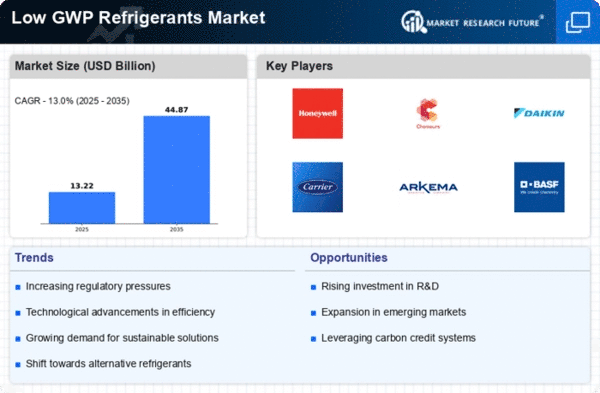
Low GWP Refrigerants Market Infographic
Purchase Options

Market Trends

Key Emerging Trends in the Low GWP Refrigerants Market

The market for low GWP refrigerants has changed significantly in recent years, reflecting a greater awareness and responsibility to the environment. As environmental concerns grow, companies are seeking alternatives to high GWP refrigerants, which support ozone-depleting chemical releases. This transition is driven by administrative measures like the Kigali Correction to the Montreal Convention, which aims to reduce the production and use of high-GWP hydrofluorocarbons.

The low GWP refrigerants market has seen increased use of standard refrigerants. Normal refrigerants including alkali, CO2, and hydrocarbons have gained popularity due to their low climate impact. Due of its excellent thermodynamic qualities, smelling salts are used in modern refrigeration systems. CO2 is utilized in corporate refrigeration as an eco friendly, low GWP solution. These selections aim to balance execution, energy efficiency, and natural duty. Companies are investing in innovative work to provide details that meet administrative norms and cooling system requirements.

Low GWP refrigerant markets prioritize energy productivity. As companies reduce their carbon footprint and comply with strict energy productivity criteria, demand for low-GWP refrigerants that improve energy efficiency is rising. Retrofit and new establishments are favoring low-GWP refrigerants that improve framework efficiency and performance.

Unofficial rules and peaceful accords shape the low GWP refrigerant business. Countries are adapting to global environmental change efforts, creating an optimal setting for low-GWP solutions. The market is moving forward due to regulations promoting the use of eco-friendly refrigerants, with companies adapting to retain their sustainability.

Despite administrative drivers, customer preferences and business manageability goals affect market variables. Buyers are increasingly aware of products' environmental impact and favor eco-friendly companies. This change in buyer sentiment is prompting companies to use low-GWP refrigerants in their products and services, growing the market.The market for low GWP refrigerants has changed significantly in recent years, reflecting a greater awareness and responsibility to the environment. As environmental concerns grow, companies are seeking alternatives to high GWP refrigerants, which support ozone-depleting chemical releases. This transition is driven by administrative measures like the Kigali Correction to the Montreal Convention, which aims to reduce the production and use of high-GWP hydrofluorocarbons.

The low GWP refrigerants market has seen increased use of standard refrigerants. Normal refrigerants including alkali, CO2, and hydrocarbons have gained popularity due to their low climate impact. Due of its excellent thermodynamic qualities, smelling salts are used in modern refrigeration systems. CO2 is utilized in corporate refrigeration as an eco friendly, low GWP solution. These selections aim to balance execution, energy efficiency, and natural duty. Companies are investing in innovative work to provide details that meet administrative norms and cooling system requirements.

Low GWP refrigerant markets prioritize energy productivity. As companies reduce their carbon footprint and comply with strict energy productivity criteria, demand for low-GWP refrigerants that improve energy efficiency is rising. Retrofit and new establishments are favoring low-GWP refrigerants that improve framework efficiency and performance.

Unofficial rules and peaceful accords shape the low GWP refrigerant business. Countries are adapting to global environmental change efforts, creating an optimal setting for low-GWP solutions. The market is moving forward due to regulations promoting the use of eco-friendly refrigerants, with companies adapting to retain their sustainability.

Despite administrative drivers, customer preferences and business manageability goals affect market variables. Buyers are increasingly aware of products' environmental impact and favor eco-friendly companies. This change in buyer sentiment is prompting companies to use low-GWP refrigerants in their products and services, growing the market.

Author
Anshula Mandaokar
Team Lead - Research

Anshula Mandaokar holds an academic degree in Chemical Engineering and has been contributing to the field for more than 5 years. She has expertise in Market Research and Business Consulting and serves as a Team Lead for a reputed Market Research firm under the Chemicals and Materials domain spectrum. She has worked on multiple projects, generating explicit results in a quick turnaround time. Her understanding of data interpretation justifies her role as a leader.

Leave a Comment

FAQs

At what CAGR is the low GWP refrigerants market projected to grow during the forecast period?

The low GWP refrigerants market is projected to grow at a 11.12% CAGR between 2025 to 2035

Who are the leading players in the low GWP refrigerants market?

E.F. International (U.S.), Sinochem Lantian co., Ltd (China), engas Australasia (Australia), Brothers Gas (UAE), The natural refrigerants company Pty ltd (Australia), A-Gas International (UK), Airgas, Inc (U.S.), Puyang Zhongwei Fine Chemical Co. Ltd (China), Tazzetti S.p.A (Italy), HyChill (Australia), Harp International Ltd (UK), Mexichem S.A.B de C.V. (Mexico), SOL Spa (Italy), GTS SPA (Italy), Arkema (France), The Chemours Company (U.S.), The Linde Group (Ireland), Honeywell International Inc (U.S.), and Daikin industries, Ltd. (Japan).

Which region will command the largest share in the low GWP refrigerants market?

Europe is predicted to command the largest share in the low GWP refrigerants market.

What are the key factors driving the low GWP refrigerants market growth?

Growing demand for air conditioners and limited environmental impact is boosting market growth.

What are the major applications of low GWP refrigerants?

Some of the major applications of low GWP refrigerants include stationary air-conditioning, mobile air-conditioning, commercial refrigeration, domestic refrigeration, and industrial refrigeration.

Market Summary

As per Market Research Future Analysis, the Low GWP Refrigerants Market is projected to reach USD 73.7 Billion by 2030, with a CAGR of 11.12% from 2022 to 2030. The market growth is driven by the low environmental impact of these refrigerants, the phase-out of CFC, HCFC, and HFC refrigerants, and the increasing demand for air conditioning globally. Hydrocarbon refrigerants, known for their energy efficiency and thermodynamic properties, are gaining traction despite safety concerns due to their flammability. Regulatory frameworks like the Montreal and Kyoto Protocols are further propelling the market by limiting harmful refrigerants. Europe is expected to lead the market, supported by regulations such as the F-Gas Regulation 517/2014, while Latin America shows promising growth due to rising air conditioning usage. The Middle East & Africa are also emerging markets, particularly in countries like UAE and Saudi Arabia, where cooling demand is high.

Key Market Trends & Highlights

The Low GWP Refrigerants Market is witnessing significant regulatory and technological advancements.

  • Europe is projected to lead the market due to F-Gas Regulation 517/2014, controlling fluorinated gases.
  • Latin America is expected to experience healthy CAGR driven by increased air conditioning usage in Brazil and Chile.
  • The EU announced a ban on HFC refrigerants in new air conditioners from 2023, enhancing market growth.
  • The U.S. EPA requires low GWP refrigerants in new commercial refrigerators from 2024, aiming to reduce emissions by 1.3 billion metric tons.

Market Size & Forecast

Market Size in 2022 USD 30.0 Billion
Projected Market Size by 2030 USD 73.7 Billion
CAGR from 2022 to 2030 11.12%
Largest Regional Market Share in 2023 Europe.

Major Players

Key players include Honeywell International Inc (U.S.), Daikin Industries, Ltd. (Japan), The Linde Group (Ireland), Arkema (France), and The Chemours Company (U.S.).

Market Trends

Low GWP Refrigerants Market Market Drivers

Rising Awareness of Environmental Impact

Awareness of the environmental impact of refrigerants is driving the Global Low GWP Refrigerants Market Industry. As climate change becomes a pressing global issue, stakeholders are increasingly recognizing the importance of sustainable practices in refrigeration. This heightened awareness is prompting manufacturers, consumers, and policymakers to prioritize low GWP alternatives. Educational campaigns and industry initiatives are further amplifying this awareness, leading to a shift in consumer preferences towards eco-friendly refrigerants. Consequently, the market is expected to experience substantial growth as more entities commit to reducing their carbon footprint and embracing low GWP solutions.

Market Dynamics and Competitive Landscape

The competitive landscape of the Global Low GWP Refrigerants Market Industry is characterized by dynamic market forces that influence pricing, innovation, and product offerings. Key players are actively investing in research and development to create advanced low GWP refrigerants that meet evolving regulatory standards and consumer demands. This competitive environment fosters innovation and drives down costs, making low GWP options more accessible. As companies strive to differentiate themselves, the market is likely to witness an influx of new products and technologies, further propelling growth in the sector.

Regulatory Support for Low GWP Refrigerants

The Global Low GWP Refrigerants Market Industry benefits from increasing regulatory support aimed at reducing greenhouse gas emissions. Governments worldwide are implementing stringent regulations to phase out high global warming potential refrigerants, such as hydrofluorocarbons (HFCs). For instance, the Kigali Amendment to the Montreal Protocol mandates a gradual reduction in HFC consumption, which is expected to drive the adoption of low GWP alternatives. This regulatory landscape is anticipated to propel the market, with projections indicating a market value of 43.2 USD Billion in 2024, reflecting the urgency for environmentally friendly refrigerants.

Technological Advancements in Refrigeration

Technological innovation plays a pivotal role in the Global Low GWP Refrigerants Market Industry. Advances in refrigeration technology, such as the development of new low GWP refrigerants and improved system efficiencies, are facilitating the transition from traditional refrigerants. For example, the introduction of hydrocarbon-based refrigerants has shown promising results in energy efficiency and environmental impact. These advancements not only enhance performance but also align with regulatory requirements, thereby fostering market growth. As the industry evolves, the market is projected to reach 124.9 USD Billion by 2035, indicating a robust demand for innovative solutions.

Growing Demand for Energy-Efficient Solutions

The increasing emphasis on energy efficiency is a significant driver for the Global Low GWP Refrigerants Market Industry. As energy costs rise and environmental concerns mount, consumers and businesses are seeking refrigeration solutions that minimize energy consumption. Low GWP refrigerants often exhibit superior energy efficiency compared to their high GWP counterparts, making them an attractive option. This trend is reflected in the market's projected compound annual growth rate of 10.13% from 2025 to 2035. The shift towards energy-efficient systems is likely to accelerate the adoption of low GWP refrigerants across various sectors, including commercial refrigeration and air conditioning.

Market Segment Insights

Regional Insights

Key Companies in the Low GWP Refrigerants Market market include

Industry Developments

March 2023:

 The European Union (EU) announced a ban on the use of HFC refrigerants in new air conditioners and heat pumps from 2023. This is a major step towards phasing out HFCs, which are potent greenhouse gases.

April 2023:

 The United States Environmental Protection Agency (EPA) issued a rule requiring the use of low GWP refrigerants in new commercial refrigerators and freezers from 2024. This rule is expected to reduce greenhouse gas emissions by an estimated 1.3 billion metric tons over the next 30 years.

June 2023:

 The Chinese government announced a plan to phase out HFCs by 2030. This is a major commitment from China, which is the world's largest consumer of HFCs.

July 2023:

 The Kigali Amendment to the Montreal Protocol, which aims to phase down HFCs, came into force in India. This is a major milestone for the global effort to reduce greenhouse gas emissions.

Intended Audience

    • Low GWP refrigerant manufacturers
    • Traders and distributors of low GWP refrigerant
    • Research and development institutes
    • Potential investors
    • Raw material suppliers
    • Nationalized laboratories

Future Outlook

Low GWP Refrigerants Market Future Outlook

The Low GWP Refrigerants Market is projected to grow at a 10.13% CAGR from 2024 to 2035, driven by regulatory changes, technological advancements, and increasing environmental awareness.

New opportunities lie in:

  • Develop innovative low GWP refrigerant blends for diverse applications.
  • Invest in R&D for energy-efficient cooling technologies.
  • Expand distribution networks in emerging markets to capture new customer segments.

By 2035, the Low GWP Refrigerants Market is expected to achieve substantial growth, reflecting a robust commitment to sustainability.

Market Segmentation

Market Segmentation

Intended Audience
  • Low GWP refrigerant manufacturers
  • Traders and distributors of low GWP refrigerant
  • Research and development institutes
  • Potential investors
  • Raw material suppliers
  • Nationalized laboratories

Report Scope

Report Attribute/Metric Details
  Market Size   2030 : USD 73.7 Billion
  CAGR   2030: 11.12% CAGR
  Base Year   2021
  Forecast Period   2022 to 2030
  Historical Data   2019 & 2020
  Forecast Units   Value (USD Million)
  Report Coverage   Revenue Forecast, Competitive Landscape, Growth Factors, and Trends
  Segments Covered   Basis of types, application and region.
  Geographies Covered   North America, Europe, Asia-Pacific, and Rest of the World (RoW)
  Key Vendors   Honeywell International Inc (U.S.), Daikin industries, Ltd. (Japan), The Linde Group (Ireland), Arkema (France), The Chemours Company (U.S.), SOL Spa (Italy), GTS SPA (Italy), Harp International Ltd (UK), Mexichem S.A.B de C.V. (Mexico), HyChill (Australia), Puyang Zhongwei Fine Chemical Co. Ltd (China), Tazzetti S.p.A (Italy), Airgas, Inc (U.S.), The natural refrigerants company Pty ltd (Australia), A-Gas International (UK), Brothers Gas (UAE), E.F. International (U.S.), engas Australasia (Australia) and Sinochem Lantian co., Ltd (China).
  Key Market Opportunities   Rising air conditioner demand across the globe is expected to boost low GWP refrigerant market
  Key Market Drivers   Growing demand for air conditioners and limited environmental impact is boosting market growth.

FAQs

At what CAGR is the low GWP refrigerants market projected to grow during the forecast period?

The low GWP refrigerants market is projected to grow at a 11.12% CAGR between 2025 to 2035

Who are the leading players in the low GWP refrigerants market?

E.F. International (U.S.), Sinochem Lantian co., Ltd (China), engas Australasia (Australia), Brothers Gas (UAE), The natural refrigerants company Pty ltd (Australia), A-Gas International (UK), Airgas, Inc (U.S.), Puyang Zhongwei Fine Chemical Co. Ltd (China), Tazzetti S.p.A (Italy), HyChill (Australia), Harp International Ltd (UK), Mexichem S.A.B de C.V. (Mexico), SOL Spa (Italy), GTS SPA (Italy), Arkema (France), The Chemours Company (U.S.), The Linde Group (Ireland), Honeywell International Inc (U.S.), and Daikin industries, Ltd. (Japan).

Which region will command the largest share in the low GWP refrigerants market?

Europe is predicted to command the largest share in the low GWP refrigerants market.

What are the key factors driving the low GWP refrigerants market growth?

Growing demand for air conditioners and limited environmental impact is boosting market growth.

What are the major applications of low GWP refrigerants?

Some of the major applications of low GWP refrigerants include stationary air-conditioning, mobile air-conditioning, commercial refrigeration, domestic refrigeration, and industrial refrigeration.

  1. EXECUTIVE SUMMARY
    1. Market Attractiveness Analysis
      1. Global Low GWP Refrigerants Market, by Type
      2. Global Low GWP
  2. Refrigerants Market, by Application
    1. by Region
  3. Global Low GWP Refrigerants Market,
  4. MARKET INTRODUCTION
    1. Definition
    2. Scope of the
    3. Study
    4. Assumptions & Limitations
    5. Market Structure
  5. RESEARCH METHODOLOGY
    1. Research Process
    2. Primary Research
    3. Secondary Research
    4. Market Size Estimation
    5. Forecast Model
    6. List of Assumptions
  6. MARKET DYNAMICS
    1. Introduction
      1. Increasing demand for refrigeration and air-conditioning application
      2. Long-term viability of low GWP refrigerants
      3. Drivers Impact
    2. Drivers
    3. Analysis
    4. Restraints
      1. Higher initial capital cost requirement
      2. Restraints Impact Analysis
    5. Opportunities
      1. Effects
    6. of global warming
    7. Challenges
      1. Lack of education and awareness
    8. in HVAC contractors and technicians
  7. MARKET FACTOR ANALYSIS
    1. Value
      1. Raw Material Suppliers
      2. Distribution & Sales Channel
      3. Applications
    2. Chain Analysis/Supply Chain Analysis
    3. Manufacturers
    4. Porter’s Five Forces Model
      1. Bargaining Power of Suppliers
      2. Bargaining Power of Buyers
      3. Threat of New Entrants
      4. Intensity of Rivalry
    5. Threat of Substitutes
    6. Pricing Analysis,
    7. By Region, (USD/TON)
    8. Impact of Coronavirus Outbreak on Low GWP Refrigerants
      1. Impact of COVID-19 on Supply Chain of Low GWP Refrigerants Market*
      2. Major Government Policies to Counter the Pandemic*
      3. Qualitative
    9. Market
    10. Analysis on Change in Demand from End users*
  8. GLOBAL LOW GWP REFRIGERANTS
  9. MARKET, BY TYPE
    1. Introduction
    2. Inorganics
      1. Market
    3. Estimates & Forecast, By Region/Country, 2019–2028
    4. Hydrocarbons
      1. Market Estimates & Forecast, By Region/Country, 2019–2028
    5. Fluorocarbons
      1. Market Estimates & Forecast, By Region/Country,
  10. GLOBAL LOW GWP REFRIGERANTS MARKET, BY APPLICATION
    1. Introduction
    2. Industrial Refrigeration
      1. Market Estimates &
    3. Forecast, By Region/Country, 2019–2028
    4. Commercial Refrigeration
      1. Market Estimates & Forecast, By Region/Country, 2019–2028
    5. Domestic Refrigeration
      1. Market Estimates & Forecast, By Region/Country,
    6. Mobile Air-Conditioning
      1. Market Estimates
    7. & Forecast, By Region/Country, 2019–2028
    8. Stationary Air-Conditioning
      1. Market Estimates & Forecast, By Region/Country, 2019–2028
    9. Others
      1. Market Estimates & Forecast, By Region/Country, 2019–2028
  11. GLOBAL LOW GWP REFRIGERANTS MARKET, BY REGION
    1. Overview
      1. US
      2. Canada
    2. North America
    3. Europe
      1. Germany
      2. UK
      3. France
      4. Spain
      5. Italy
      6. Russia
      7. Rest of Europe
    4. Asia Pacific
      1. China
      2. Japan
      3. India
      4. South Korea
      5. Rest of Asia Pacific
      6. Brazil
      7. Mexico
      8. Argentina
    5. Latin America
    6. Rest of Latin America
    7. Middle East & Africa
      1. GCC
      2. South Africa
      3. Rest of Middle East & Africa
    8. Turkey
  12. COMPETITIVE LANDSCAPE
    1. Competitive Overview
    2. Recent Developments,
    3. Mergers/Acquisitions
    4. Global Market Strategy Analysis
    5. Competitive
    6. Benchmarking
  13. COMPANY PROFILES
    1. Honeywell International Inc.
      1. Company Overview
      2. Financial Overview
      3. Products
      4. Key Developments
      5. SWOT Analysis
    2. Offerings
    3. Key Strategies
    4. Daikin industries, Ltd.
    5. The Linde Group
    6. Arkema
    7. The Chemours Company
    8. SOL Spa
    9. GTS
    10. SPA
    11. Harp International Ltd
    12. Mexichem S.A.B de C.V.
    13. HyChill
    14. Puyang Zhongwei Fine Chemical Co. Ltd
    15. Tazzetti S.p.A
    16. Airgas, Inc
    17. The natural refrigerants company Pty ltd
    18. A-Gas International
    19. Brothers Gas
    20. E.F. International
    21. engas Australasia
    22. Sinochem Lantian co., Ltd.

Low GWP Refrigerants Market Segmentation

Market Segmentation Overview

  • Detailed segmentation data will be available in the full report
  • Comprehensive analysis by multiple parameters
  • Regional and country-level breakdowns
  • Market size forecasts by segment
Infographic

Free Sample Request

Kindly complete the form below to receive a free sample of this Report

Get Free Sample

Customer Strories

Compare Licence

×
Features License Type
Single User Multiuser License Enterprise User
Price $4,950 $5,950 $7,250
Maximum User Access Limit 1 User Upto 10 Users Unrestricted Access Throughout the Organization
Free Customization
Direct Access to Analyst
Deliverable Format
Platform Access
Discount on Next Purchase 10% 15% 15%
Printable Versions