×
Request Free Sample ×

Kindly complete the form below to receive a free sample of this Report

* Please use a valid business email

Leading companies partner with us for data-driven Insights

clients tt-cursor
Hero Background
English
Chinese
French
Japanese
Korean
German
Spanish

Low GWP Refrigerants Market Analysis

ID: MRFR/CnM/6002-HCR
140 Pages
Anshula Mandaokar
October 2025

Low GWP Refrigerants Market Research Report Information by Type (Inorganics, Hydrocarbons, Fluorocarbons), Application (Industrial Refrigeration, Commercial Refrigeration, Domestic Refrigeration, Mobile Air-Conditioning), Region — Global Forecast till 2035

Share:
Download PDF ×

We do not share your information with anyone. However, we may send you emails based on your report interest from time to time. You may contact us at any time to opt-out.

Low GWP Refrigerants Market Infographic
Purchase Options

Market Analysis

In-depth Analysis of Low GWP Refrigerants Market Industry Landscape

The market elements of low Global Warming Potential (GWP) refrigerants have gone through an extraordinary change lately, determined by a growing global familiarity with ecological worries and the need to relieve environmental change. Low GWP refrigerants, which reducedly affect the nursery impact contrasted with their high GWP partners, have turned into a point of convergence in the refrigeration and cooling industry. The interest for these harmless to the ecosystem choices has flooded as states overall sanction severe guidelines to deliberately get rid of high GWP refrigerants, lining up with global drives like the Kigali Alteration to the Montreal Convention.

One key driver affecting the low GWP refrigerants market is the rising accentuation on supportability and ecological obligation. Businesses and shoppers the same are perceiving the significance of embracing eco-accommodating refrigerants to limit the carbon impression related with cooling frameworks. This change in attitude has provoked makers to put vigorously in innovative work, expecting to figure out low GWP choices that consent to administrative norms as well as convey ideal execution.

Unofficial laws and strategies have arisen as powerful impetuses forming the low GWP refrigerants market scene. Nations and locales are carrying out severe rules to check the utilization of high GWP refrigerants, empowering the reception of low GWP choices. The European Association, for example, has been at the cutting edge of administrative drives with the F-Gas Guideline, which sets phasedown focuses for hydrofluorocarbon (HFC) refrigerants, pushing the business towards the reception of low GWP choices. Such administrative structures have constrained organizations to rethink their refrigerant options, cultivating a progress towards maintainable other options.

The monetary part of the low GWP refrigerants market can't be neglected. As the interest for these refrigerants keeps on rising, the economies of scale become possibly the most important factor, prompting cost decreases underway and dissemination. This cost-viability upgrades the engaging quality of low GWP refrigerants in the market, pursuing them a feasible and cutthroat decision for organizations hoping to line up with both natural and financial manageability objectives. The advancing market elements likewise animate advancement, empowering organizations to investigate new advancements and plans to remain ahead in the serious scene.

Mechanical progressions assume a vital part in forming the market elements of low GWP refrigerants. Scientists and specialists are continually endeavoring to foster refrigerants with unrivaled productivity, lower poisonousness, and negligible natural effect. Developments like regular refrigerants, hydrofluoroolefins (HFOs), and other low GWP choices are building up some momentum, offering a different scope of choices for different applications. The continuous quest for greener arrangements has prompted a powerful market climate, portrayed by a nonstop deluge of novel refrigerants intended to meet the developing requirements of various businesses.

Author
Anshula Mandaokar
Team Lead - Research

Anshula Mandaokar holds an academic degree in Chemical Engineering and has been contributing to the field for more than 5 years. She has expertise in Market Research and Business Consulting and serves as a Team Lead for a reputed Market Research firm under the Chemicals and Materials domain spectrum. She has worked on multiple projects, generating explicit results in a quick turnaround time. Her understanding of data interpretation justifies her role as a leader.

Leave a Comment

FAQs

At what CAGR is the low GWP refrigerants market projected to grow during the forecast period?

The low GWP refrigerants market is projected to grow at a 11.12% CAGR between 2025 to 2035

Who are the leading players in the low GWP refrigerants market?

E.F. International (U.S.), Sinochem Lantian co., Ltd (China), engas Australasia (Australia), Brothers Gas (UAE), The natural refrigerants company Pty ltd (Australia), A-Gas International (UK), Airgas, Inc (U.S.), Puyang Zhongwei Fine Chemical Co. Ltd (China), Tazzetti S.p.A (Italy), HyChill (Australia), Harp International Ltd (UK), Mexichem S.A.B de C.V. (Mexico), SOL Spa (Italy), GTS SPA (Italy), Arkema (France), The Chemours Company (U.S.), The Linde Group (Ireland), Honeywell International Inc (U.S.), and Daikin industries, Ltd. (Japan).

Which region will command the largest share in the low GWP refrigerants market?

Europe is predicted to command the largest share in the low GWP refrigerants market.

What are the key factors driving the low GWP refrigerants market growth?

Growing demand for air conditioners and limited environmental impact is boosting market growth.

What are the major applications of low GWP refrigerants?

Some of the major applications of low GWP refrigerants include stationary air-conditioning, mobile air-conditioning, commercial refrigeration, domestic refrigeration, and industrial refrigeration.

Market Summary

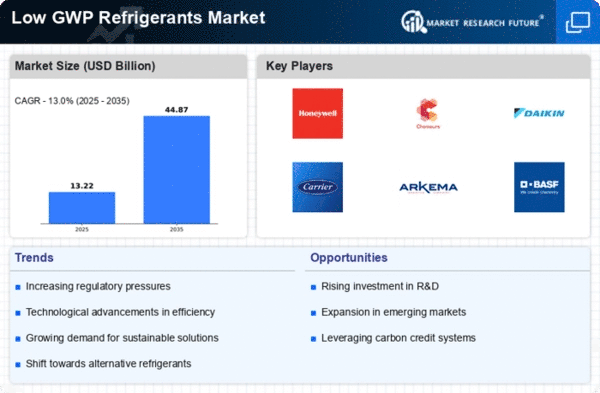
As per MRFR analysis, the Low GWP Refrigerants Market was estimated at 11.7 USD Billion in 2024. The Low GWP Refrigerants industry is projected to grow from 13.22 USD Billion in 2025 to 44.87 USD Billion by 2035, exhibiting a compound annual growth rate (CAGR) of 13.0 during the forecast period 2025 - 2035.

Key Market Trends & Highlights

The Low GWP Refrigerants Market is poised for substantial growth driven by regulatory pressures and technological advancements.

  • North America remains the largest market for low GWP refrigerants, reflecting strong regulatory compliance and consumer demand.
  • The Asia-Pacific region is emerging as the fastest-growing market, propelled by increasing industrialization and environmental awareness.
  • In the refrigeration segment, which is the largest, there is a notable shift towards low GWP options due to stringent regulations.
  • Market drivers such as regulatory compliance pressure and rising environmental concerns are significantly influencing the adoption of low GWP refrigerants.

Market Size & Forecast

2024 Market Size 11.7 (USD Billion)
2035 Market Size 44.87 (USD Billion)
CAGR (2025 - 2035) 13.0%
Largest Regional Market Share in 2024 North America

Major Players

Honeywell (US), Chemours (US), Daikin (JP), Carrier (US), Arkema (FR), BASF (DE), Linde (DE), Mitsubishi Electric (JP), Gree Electric Appliances (CN)

Market Trends

The Low GWP Refrigerants Market is currently experiencing a transformative phase, driven by increasing regulatory pressures and a global shift towards sustainability. Governments worldwide are implementing stringent regulations to phase out high global warming potential refrigerants, which has led to a growing demand for alternatives that possess lower environmental impact. This transition is not merely a response to policy changes; it reflects a broader societal commitment to combating climate change and reducing greenhouse gas emissions. As industries adapt, the market is witnessing a surge in innovation, with manufacturers investing in research and development to create efficient and eco-friendly refrigerants. Moreover, the Low GWP Refrigerants Market is characterized by a diverse range of applications, spanning sectors such as commercial refrigeration, air conditioning, and industrial processes. The increasing awareness of environmental issues among consumers and businesses alike is propelling the adoption of low GWP solutions. This trend is further supported by advancements in technology that enhance the performance and efficiency of these refrigerants. As the market evolves, it appears poised for substantial growth, with stakeholders keenly focused on aligning their operations with sustainable practices and meeting the demands of an environmentally conscious consumer base.

Regulatory Influence

The Low GWP Refrigerants Market is significantly shaped by regulatory frameworks aimed at reducing greenhouse gas emissions. Governments are enacting policies that encourage the adoption of refrigerants with lower global warming potential, thereby driving manufacturers to innovate and comply with these standards.

Technological Advancements

Ongoing technological advancements are playing a crucial role in the evolution of the Low GWP Refrigerants Market. Innovations in formulation and application techniques are enhancing the efficiency and performance of low GWP refrigerants, making them more appealing to various industries.

Consumer Awareness

There is a noticeable increase in consumer awareness regarding environmental sustainability, which is influencing purchasing decisions in the Low GWP Refrigerants Market. As businesses strive to meet the expectations of eco-conscious consumers, the demand for low GWP solutions is likely to rise.

Low GWP Refrigerants Market Market Drivers

Rising Awareness of Environmental Impact

Awareness of the environmental impact of refrigerants is driving the Global Low GWP Refrigerants Market Industry. As climate change becomes a pressing global issue, stakeholders are increasingly recognizing the importance of sustainable practices in refrigeration. This heightened awareness is prompting manufacturers, consumers, and policymakers to prioritize low GWP alternatives. Educational campaigns and industry initiatives are further amplifying this awareness, leading to a shift in consumer preferences towards eco-friendly refrigerants. Consequently, the market is expected to experience substantial growth as more entities commit to reducing their carbon footprint and embracing low GWP solutions.

Market Dynamics and Competitive Landscape

The competitive landscape of the Global Low GWP Refrigerants Market Industry is characterized by dynamic market forces that influence pricing, innovation, and product offerings. Key players are actively investing in research and development to create advanced low GWP refrigerants that meet evolving regulatory standards and consumer demands. This competitive environment fosters innovation and drives down costs, making low GWP options more accessible. As companies strive to differentiate themselves, the market is likely to witness an influx of new products and technologies, further propelling growth in the sector.

Regulatory Support for Low GWP Refrigerants

The Global Low GWP Refrigerants Market Industry benefits from increasing regulatory support aimed at reducing greenhouse gas emissions. Governments worldwide are implementing stringent regulations to phase out high global warming potential refrigerants, such as hydrofluorocarbons (HFCs). For instance, the Kigali Amendment to the Montreal Protocol mandates a gradual reduction in HFC consumption, which is expected to drive the adoption of low GWP alternatives. This regulatory landscape is anticipated to propel the market, with projections indicating a market value of 43.2 USD Billion in 2024, reflecting the urgency for environmentally friendly refrigerants.

Technological Advancements in Refrigeration

Technological innovation plays a pivotal role in the Global Low GWP Refrigerants Market Industry. Advances in refrigeration technology, such as the development of new low GWP refrigerants and improved system efficiencies, are facilitating the transition from traditional refrigerants. For example, the introduction of hydrocarbon-based refrigerants has shown promising results in energy efficiency and environmental impact. These advancements not only enhance performance but also align with regulatory requirements, thereby fostering market growth. As the industry evolves, the market is projected to reach 124.9 USD Billion by 2035, indicating a robust demand for innovative solutions.

Growing Demand for Energy-Efficient Solutions

The increasing emphasis on energy efficiency is a significant driver for the Global Low GWP Refrigerants Market Industry. As energy costs rise and environmental concerns mount, consumers and businesses are seeking refrigeration solutions that minimize energy consumption. Low GWP refrigerants often exhibit superior energy efficiency compared to their high GWP counterparts, making them an attractive option. This trend is reflected in the market's projected compound annual growth rate of 10.13% from 2025 to 2035. The shift towards energy-efficient systems is likely to accelerate the adoption of low GWP refrigerants across various sectors, including commercial refrigeration and air conditioning.

Market Segment Insights

By Application: Refrigeration (Largest) vs. Air Conditioning (Fastest-Growing)

In the Low GWP Refrigerants Market, the application segment is broadly categorized into Refrigeration, Air Conditioning, Heat Pumps, and Chillers. Among these, Refrigeration holds a significant share, largely due to its extensive use across various sectors, including food preservation and industrial refrigeration. Air Conditioning is not far behind, experiencing notable traction as climates change and consumer demand surges for energy-efficient cooling solutions.

Refrigeration (Dominant) vs. Air Conditioning (Emerging)

The Refrigeration segment is a dominant force in the Low GWP Refrigerants Market due to its longstanding applications in grocery stores, refrigerated transportation, and large-scale industrial operations. It has adapted to include low Global Warming Potential refrigerants, meeting regulatory requirements while continuing to support diverse temperature management needs. On the other hand, the Air Conditioning segment is emerging rapidly, facilitated by the growing need for energy efficiency and sustainability in residential and commercial cooling systems. As consumers become more environmentally conscious and regulations become stricter, air conditioning manufacturers are increasingly adopting low GWP options, demonstrating a shift towards more sustainable practices.

By End Use: Commercial (Largest) vs. Industrial (Fastest-Growing)

In the Low GWP Refrigerants Market, the market share distribution reveals that the Commercial segment holds the largest share, driven primarily by the increasing demand for energy-efficient cooling solutions across retail and food service establishments. This segment's strong performance is attributed to the growing implementation of regulations aimed at reducing greenhouse gas emissions, leading businesses to adopt eco-friendly refrigerants in order to comply with sustainability standards. In contrast, the Industrial segment is recognized as the fastest-growing area within the market. The rise in industrial applications is bolstered by improvements in manufacturing processes and the need for effective refrigeration solutions in sectors such as food processing and pharmaceuticals. Further, the increasing awareness about environmental impact is encouraging industries to transition to low GWP refrigerants, thus facilitating growth in this sector.

Commercial (Dominant) vs. Transportation (Emerging)

The Commercial segment stands as the dominant player in the Low GWP Refrigerants Market, primarily characterized by its extensive use in supermarkets, restaurants, and other retail spaces. This segment's preference for low GWP options is largely fueled by regulatory pressures and the need for sustainable operations, pushing businesses to adopt technologies that align with environmental standards. Conversely, the Transportation segment is emerging as a key area in the market, driven by the demand for eco-friendly refrigerants in vehicles and shipping containers. As the transportation industry undergoes a paradigm shift towards reducing its carbon footprint, the adoption of low GWP refrigerants is gaining momentum, supported by innovations in vehicle design and logistics.

By Type: Hydrofluoroolefins (Largest) vs. Natural Refrigerants (Fastest-Growing)

In the Low GWP Refrigerants Market, Hydrofluoroolefins (HFOs) have the largest market share due to their efficiency and relatively low environmental impact. These compounds are extensively utilized in various applications, leading to their dominance in the market. In contrast, Natural Refrigerants, which include carbon dioxide, ammonia, and hydrocarbons, are rapidly gaining traction, attributed to their sustainability and minimal atmospheric effect, making them increasingly popular among environmentally conscious consumers and industries. The growth trends in the Low GWP Refrigerants Market are strongly influenced by the global push for greener alternatives to traditional refrigerants. Factors driving the adoption of Natural Refrigerants include regulatory support, advancements in technology, and the rising awareness of climate change. As stakeholders seek viable solutions, the demand for HFOs and Natural Refrigerants is expected to escalate, reshaping the market dynamics.

Hydrofluoroolefins (Dominant) vs. Natural Refrigerants (Emerging)

Hydrofluoroolefins (HFOs) are positioned as the dominant segment in the Low GWP Refrigerants Market due to their favorable performance characteristics, including energy efficiency and low global warming potential. They find extensive applications in sectors like refrigeration, air conditioning, and foam production, making HFOs a preferred choice for many manufacturers. Conversely, Natural Refrigerants, such as ammonia and hydrocarbons, are classified as an emerging segment. These refrigerants are celebrated for their eco-friendliness and safety, appealing to industries focused on sustainability. As environmental regulations tighten and carbon footprints gain attention, Natural Refrigerants are on an upward trajectory, gaining acceptance in diverse applications, even challenging traditional refrigerants despite their handling complexities.

By System Type: Split Systems (Largest) vs. Packaged Systems (Fastest-Growing)

The low GWP refrigerants market is characterized by a significant share distribution among various system types. Split systems currently command the largest market share due to their versatility and efficiency, offering optimal cooling solutions for residential and commercial applications. Packaged systems are gaining ground rapidly, owing to their compact design and ease of installation, which make them highly attractive for small to medium-sized enterprises looking to adopt low GWP solutions. The growth trends in the low GWP refrigerants segment are driven primarily by stringent environmental regulations and a global shift towards sustainable practices. As consumers and businesses become more eco-conscious, the adoption of split systems remains robust, while packaged systems are perceived as the quickest solution for retrofitting and replacing outdated systems. Centralized and modular systems, while essential in large-scale applications, are experiencing slower growth comparatively, focusing more on energy efficiency improvements rather than market share expansion.

Split Systems (Dominant) vs. Packaged Systems (Emerging)

Split systems are the dominant players in the low GWP refrigerants market due to their effective performance and flexibility in various settings. They cater to a wide range of applications, from residential to commercial, ensuring a consistent demand across sectors. The rising consumer preference for energy-efficient cooling solutions has solidified their market position. In contrast, packaged systems are emerging rapidly as an efficient alternative, particularly among smaller businesses. Their ease of installation and lower upfront costs make them appealing to a growing customer base, especially as awareness of eco-friendly options increases. As technology progresses, both systems will likely innovate further, enhancing energy efficiency and overall performance.

By Regulatory Compliance: F-Gas Regulation (Largest) vs. Montreal Protocol (Fastest-Growing)

The regulatory compliance segment within the Low GWP Refrigerants Market is primarily driven by F-Gas Regulation, which holds a significant market share as companies rush to comply with stringent standards aimed at reducing greenhouse gas emissions. This regulation emphasizes the reduction of high-GWP refrigerants, compelling manufacturers to shift towards low-GWP alternatives. Following closely is the Montreal Protocol, which has become increasingly influential, particularly with its amendments pushing for the phase-down of hydrofluorocarbons (HFCs) globally, further incentivizing the adoption of eco-friendly refrigerants. The growth trends in this segment are largely facilitated by evolving energy efficiency standards and localized environmental regulations that prioritize sustainability. As governments worldwide enhance their commitments to combat climate change, compliance requirements are becoming more rigorous. Innovations in low GWP technologies and increased awareness regarding environmental impact drive demand and positively influence market dynamics. The interplay of these regulations not only propels adoption but also creates a competitive landscape among manufacturers to achieve compliance through innovative solutions.

F-Gas Regulation (Dominant) vs. Local Environmental Regulations (Emerging)

F-Gas Regulation stands as the dominant force in the Low GWP Refrigerants Market, reflecting a robust framework that guides manufacturers toward eco-friendly solutions. It mandates a systematic phase-out of high-GWP substances, creating a sharper focus on developing low-GWP alternatives that are not only compliant but also energy-efficient. This regulation drives innovation, encouraging investment in next-generation refrigerants while imposing penalties on non-compliance. In contrast, local environmental regulations are emerging as crucial influences, shaped by regional policies and environmental commitments. These regulations vary across jurisdictions but generally promote the adoption of sustainable practices, often incorporating specific provisions for low GWP refrigerants. While still in a growth phase, these regulations are becoming increasingly pivotal as they align with global objectives, pushing industries towards greater environmental responsibility.

Get more detailed insights about Low GWP Refrigerants Market Research Report – Global Forecast till 2035

Regional Insights

North America : Leading Market Innovators

North America is poised to maintain its leadership in the Low GWP Refrigerants Market, holding a significant market share of 5.85 in 2024. The region's growth is driven by stringent environmental regulations aimed at reducing greenhouse gas emissions, alongside increasing demand for energy-efficient cooling solutions. The transition to low GWP refrigerants is further supported by government incentives and initiatives promoting sustainable practices. The competitive landscape in North America is robust, featuring key players such as Honeywell, Chemours, and Carrier. These companies are at the forefront of innovation, developing advanced refrigerant technologies that comply with regulatory standards. The U.S. and Canada are leading countries in this market, with substantial investments in research and development to enhance product offerings and meet the growing demand for eco-friendly refrigerants.

Europe : Regulatory-Driven Market Growth

Europe is experiencing significant growth in the Low GWP Refrigerants Market, with a market size of 3.5. The region's expansion is largely driven by stringent EU regulations aimed at phasing out high GWP refrigerants, such as the F-Gas Regulation. This regulatory framework encourages the adoption of low GWP alternatives, fostering innovation and investment in sustainable technologies across the continent. Leading countries in Europe include Germany, France, and the UK, where major players like Arkema and BASF are actively developing low GWP solutions. The competitive landscape is characterized by a strong emphasis on sustainability, with companies investing in R&D to create efficient and environmentally friendly refrigerants. The European market is expected to continue its upward trajectory as regulations tighten and demand for sustainable solutions increases.

Asia-Pacific : Emerging Market Potential

The Asia-Pacific region is witnessing a growing demand for low GWP refrigerants, with a market size of 2.8. This growth is fueled by rapid urbanization, increasing air conditioning usage, and a rising awareness of environmental issues. Governments in countries like China and India are implementing policies to phase out high GWP refrigerants, creating a favorable environment for low GWP alternatives to thrive. China is the leading country in this region, with significant contributions from companies like Gree Electric Appliances and Daikin. The competitive landscape is evolving, with both local and international players striving to capture market share. As the region continues to develop economically, the demand for energy-efficient and environmentally friendly refrigerants is expected to rise, driving further growth in the market.

Middle East and Africa : Untapped Market Opportunities

The Middle East and Africa region represents an emerging market for low GWP refrigerants, with a market size of 0.65. The growth in this region is primarily driven by increasing temperatures and the rising demand for cooling solutions. However, the market is still in its infancy, with significant opportunities for expansion as awareness of environmental issues grows and regulations begin to take shape. Countries like South Africa and the UAE are leading the way in adopting low GWP refrigerants, with local companies starting to explore sustainable options. The competitive landscape is gradually evolving, with international players looking to enter the market. As the region develops its infrastructure and regulatory frameworks, the demand for low GWP solutions is expected to increase, paving the way for future growth.

Key Players and Competitive Insights

The Low GWP Refrigerants Market is currently characterized by a dynamic competitive landscape, driven by increasing regulatory pressures and a global shift towards sustainable practices. Key players such as Honeywell (US), Chemours (US), and Daikin (JP) are strategically positioning themselves through innovation and partnerships to capture market share. Honeywell (US) has focused on developing advanced refrigerant solutions that comply with stringent environmental regulations, while Chemours (US) emphasizes its commitment to sustainability through the introduction of low GWP alternatives. Daikin (JP), on the other hand, is leveraging its technological expertise to enhance product efficiency, thereby shaping the competitive environment through a blend of innovation and regulatory compliance.In terms of business tactics, companies are increasingly localizing manufacturing and optimizing supply chains to enhance responsiveness to market demands. The market structure appears moderately fragmented, with several key players exerting influence over their respective segments. This fragmentation allows for a diverse range of products and solutions, fostering competition that drives innovation and efficiency across the board.

In November Honeywell (US) announced a strategic partnership with a leading HVAC manufacturer to co-develop next-generation refrigerants aimed at reducing environmental impact. This collaboration is significant as it not only enhances Honeywell's product portfolio but also aligns with global sustainability goals, potentially positioning the company as a leader in eco-friendly refrigerant solutions.

In October Chemours (US) launched a new line of low GWP refrigerants designed specifically for commercial refrigeration applications. This move is indicative of Chemours' strategy to expand its market presence while addressing the growing demand for sustainable refrigerants. The introduction of these products could enhance Chemours' competitive edge, particularly in regions with stringent environmental regulations.

In September Daikin (JP) unveiled a breakthrough technology that significantly improves the energy efficiency of its refrigerants. This innovation not only meets current regulatory standards but also sets a new benchmark for energy performance in the industry. Daikin's focus on technological advancement is likely to attract environmentally conscious consumers and businesses, further solidifying its market position.

As of December the competitive trends in the Low GWP Refrigerants Market are increasingly defined by digitalization, sustainability, and the integration of AI technologies. Strategic alliances among key players are shaping the landscape, fostering innovation and enhancing product offerings. The shift from price-based competition to a focus on technological differentiation and supply chain reliability is evident, suggesting that future competitive dynamics will hinge on the ability to innovate and adapt to evolving market demands.

Key Companies in the Low GWP Refrigerants Market include

Industry Developments

March 2023:

 The European Union (EU) announced a ban on the use of HFC refrigerants in new air conditioners and heat pumps from 2023. This is a major step towards phasing out HFCs, which are potent greenhouse gases.

April 2023:

 The United States Environmental Protection Agency (EPA) issued a rule requiring the use of low GWP refrigerants in new commercial refrigerators and freezers from 2024. This rule is expected to reduce greenhouse gas emissions by an estimated 1.3 billion metric tons over the next 30 years.

June 2023:

 The Chinese government announced a plan to phase out HFCs by 2030. This is a major commitment from China, which is the world's largest consumer of HFCs.

July 2023:

 The Kigali Amendment to the Montreal Protocol, which aims to phase down HFCs, came into force in India. This is a major milestone for the global effort to reduce greenhouse gas emissions.

Intended Audience

    • Low GWP refrigerant manufacturers
    • Traders and distributors of low GWP refrigerant
    • Research and development institutes
    • Potential investors
    • Raw material suppliers
    • Nationalized laboratories

Future Outlook

Low GWP Refrigerants Market Future Outlook

The Low GWP Refrigerants Market is projected to grow at a 13.0% CAGR from 2025 to 2035, driven by regulatory changes, technological advancements, and increasing environmental awareness.

New opportunities lie in:

  • Development of advanced low GWP refrigerant blends for commercial applications.
  • Investment in R&D for innovative refrigerant recovery technologies.
  • Expansion of training programs for technicians on low GWP systems.

By 2035, the market is expected to be robust, driven by sustainable practices and technological innovations.

Market Segmentation

Low GWP Refrigerants Market Type Outlook

  • Hydrofluoroolefins
  • Natural Refrigerants
  • Hydrocarbons
  • Inorganics

Low GWP Refrigerants Market End Use Outlook

  • Commercial
  • Industrial
  • Residential
  • Transportation

Low GWP Refrigerants Market Application Outlook

  • Refrigeration
  • Air Conditioning
  • Heat Pumps
  • Chillers

Low GWP Refrigerants Market System Type Outlook

  • Split Systems
  • Packaged Systems
  • Centralized Systems
  • Modular Systems

Low GWP Refrigerants Market Regulatory Compliance Outlook

  • F-Gas Regulation
  • Montreal Protocol
  • Energy Efficiency Standards
  • Local Environmental Regulations

Report Scope

MARKET SIZE 202411.7(USD Billion)
MARKET SIZE 202513.22(USD Billion)
MARKET SIZE 203544.87(USD Billion)
COMPOUND ANNUAL GROWTH RATE (CAGR)13.0% (2025 - 2035)
REPORT COVERAGERevenue Forecast, Competitive Landscape, Growth Factors, and Trends
BASE YEAR2024
Market Forecast Period2025 - 2035
Historical Data2019 - 2024
Market Forecast UnitsUSD Billion
Key Companies ProfiledHoneywell (US), Chemours (US), Daikin (JP), Carrier (US), Arkema (FR), BASF (DE), Linde (DE), Mitsubishi Electric (JP), Gree Electric Appliances (CN)
Segments CoveredApplication, End Use, Type, System Type, Regulatory Compliance
Key Market OpportunitiesGrowing demand for sustainable cooling solutions drives innovation in the Low GWP Refrigerants Market.
Key Market DynamicsRising regulatory pressures drive innovation and adoption of low GWP refrigerants across various industries.
Countries CoveredNorth America, Europe, APAC, South America, MEA

FAQs

At what CAGR is the low GWP refrigerants market projected to grow during the forecast period?

The low GWP refrigerants market is projected to grow at a 11.12% CAGR between 2025 to 2035

Who are the leading players in the low GWP refrigerants market?

E.F. International (U.S.), Sinochem Lantian co., Ltd (China), engas Australasia (Australia), Brothers Gas (UAE), The natural refrigerants company Pty ltd (Australia), A-Gas International (UK), Airgas, Inc (U.S.), Puyang Zhongwei Fine Chemical Co. Ltd (China), Tazzetti S.p.A (Italy), HyChill (Australia), Harp International Ltd (UK), Mexichem S.A.B de C.V. (Mexico), SOL Spa (Italy), GTS SPA (Italy), Arkema (France), The Chemours Company (U.S.), The Linde Group (Ireland), Honeywell International Inc (U.S.), and Daikin industries, Ltd. (Japan).

Which region will command the largest share in the low GWP refrigerants market?

Europe is predicted to command the largest share in the low GWP refrigerants market.

What are the key factors driving the low GWP refrigerants market growth?

Growing demand for air conditioners and limited environmental impact is boosting market growth.

What are the major applications of low GWP refrigerants?

Some of the major applications of low GWP refrigerants include stationary air-conditioning, mobile air-conditioning, commercial refrigeration, domestic refrigeration, and industrial refrigeration.

  1. SECTION I: EXECUTIVE SUMMARY AND KEY HIGHLIGHTS
    1. | 1.1 EXECUTIVE SUMMARY
    2. | 1.1.1 Market Overview
    3. | 1.1.2 Key Findings
    4. | 1.1.3 Market Segmentation
    5. | 1.1.4 Competitive Landscape
    6. | 1.1.5 Challenges and Opportunities
    7. | 1.1.6 Future Outlook
  2. SECTION II: SCOPING, METHODOLOGY AND MARKET STRUCTURE
    1. | 2.1 MARKET INTRODUCTION
    2. | 2.1.1 Definition
    3. | 2.1.2 Scope of the study
    4. |-- 2.1.2.1 Research Objective
    5. |-- 2.1.2.2 Assumption
    6. |-- 2.1.2.3 Limitations
    7. | 2.2 RESEARCH METHODOLOGY
    8. | 2.2.1 Overview
    9. | 2.2.2 Data Mining
    10. | 2.2.3 Secondary Research
    11. | 2.2.4 Primary Research
    12. |-- 2.2.4.1 Primary Interviews and Information Gathering Process
    13. |-- 2.2.4.2 Breakdown of Primary Respondents
    14. | 2.2.5 Forecasting Model
    15. | 2.2.6 Market Size Estimation
    16. |-- 2.2.6.1 Bottom-Up Approach
    17. |-- 2.2.6.2 Top-Down Approach
    18. | 2.2.7 Data Triangulation
    19. | 2.2.8 Validation
  3. SECTION III: QUALITATIVE ANALYSIS
    1. | 3.1 MARKET DYNAMICS
    2. | 3.1.1 Overview
    3. | 3.1.2 Drivers
    4. | 3.1.3 Restraints
    5. | 3.1.4 Opportunities
    6. | 3.2 MARKET FACTOR ANALYSIS
    7. | 3.2.1 Value chain Analysis
    8. | 3.2.2 Porter's Five Forces Analysis
    9. |-- 3.2.2.1 Bargaining Power of Suppliers
    10. |-- 3.2.2.2 Bargaining Power of Buyers
    11. |-- 3.2.2.3 Threat of New Entrants
    12. |-- 3.2.2.4 Threat of Substitutes
    13. |-- 3.2.2.5 Intensity of Rivalry
    14. | 3.2.3 COVID-19 Impact Analysis
    15. |-- 3.2.3.1 Market Impact Analysis
    16. |-- 3.2.3.2 Regional Impact
    17. |-- 3.2.3.3 Opportunity and Threat Analysis
  4. SECTION IV: QUANTITATIVE ANALYSIS
    1. | 4.1 Chemicals and Materials, BY Application (USD Billion)
    2. | 4.1.1 Refrigeration
    3. | 4.1.2 Air Conditioning
    4. | 4.1.3 Heat Pumps
    5. | 4.1.4 Chillers
    6. | 4.2 Chemicals and Materials, BY End Use (USD Billion)
    7. | 4.2.1 Commercial
    8. | 4.2.2 Industrial
    9. | 4.2.3 Residential
    10. | 4.2.4 Transportation
    11. | 4.3 Chemicals and Materials, BY Type (USD Billion)
    12. | 4.3.1 Hydrofluoroolefins
    13. | 4.3.2 Natural Refrigerants
    14. | 4.3.3 Hydrocarbons
    15. | 4.3.4 Inorganics
    16. | 4.4 Chemicals and Materials, BY System Type (USD Billion)
    17. | 4.4.1 Split Systems
    18. | 4.4.2 Packaged Systems
    19. | 4.4.3 Centralized Systems
    20. | 4.4.4 Modular Systems
    21. | 4.5 Chemicals and Materials, BY Regulatory Compliance (USD Billion)
    22. | 4.5.1 F-Gas Regulation
    23. | 4.5.2 Montreal Protocol
    24. | 4.5.3 Energy Efficiency Standards
    25. | 4.5.4 Local Environmental Regulations
    26. | 4.6 Chemicals and Materials, BY Region (USD Billion)
    27. | 4.6.1 North America
    28. |-- 4.6.1.1 US
    29. |-- 4.6.1.2 Canada
    30. | 4.6.2 Europe
    31. |-- 4.6.2.1 Germany
    32. |-- 4.6.2.2 UK
    33. |-- 4.6.2.3 France
    34. |-- 4.6.2.4 Russia
    35. |-- 4.6.2.5 Italy
    36. |-- 4.6.2.6 Spain
    37. |-- 4.6.2.7 Rest of Europe
    38. | 4.6.3 APAC
    39. |-- 4.6.3.1 China
    40. |-- 4.6.3.2 India
    41. |-- 4.6.3.3 Japan
    42. |-- 4.6.3.4 South Korea
    43. |-- 4.6.3.5 Malaysia
    44. |-- 4.6.3.6 Thailand
    45. |-- 4.6.3.7 Indonesia
    46. |-- 4.6.3.8 Rest of APAC
    47. | 4.6.4 South America
    48. |-- 4.6.4.1 Brazil
    49. |-- 4.6.4.2 Mexico
    50. |-- 4.6.4.3 Argentina
    51. |-- 4.6.4.4 Rest of South America
    52. | 4.6.5 MEA
    53. |-- 4.6.5.1 GCC Countries
    54. |-- 4.6.5.2 South Africa
    55. |-- 4.6.5.3 Rest of MEA
  5. SECTION V: COMPETITIVE ANALYSIS
    1. | 5.1 Competitive Landscape
    2. | 5.1.1 Overview
    3. | 5.1.2 Competitive Analysis
    4. | 5.1.3 Market share Analysis
    5. | 5.1.4 Major Growth Strategy in the Chemicals and Materials
    6. | 5.1.5 Competitive Benchmarking
    7. | 5.1.6 Leading Players in Terms of Number of Developments in the Chemicals and Materials
    8. | 5.1.7 Key developments and growth strategies
    9. |-- 5.1.7.1 New Product Launch/Service Deployment
    10. |-- 5.1.7.2 Merger & Acquisitions
    11. |-- 5.1.7.3 Joint Ventures
    12. | 5.1.8 Major Players Financial Matrix
    13. |-- 5.1.8.1 Sales and Operating Income
    14. |-- 5.1.8.2 Major Players R&D Expenditure. 2023
    15. | 5.2 Company Profiles
    16. | 5.2.1 Honeywell (US)
    17. |-- 5.2.1.1 Financial Overview
    18. |-- 5.2.1.2 Products Offered
    19. |-- 5.2.1.3 Key Developments
    20. |-- 5.2.1.4 SWOT Analysis
    21. |-- 5.2.1.5 Key Strategies
    22. | 5.2.2 Chemours (US)
    23. |-- 5.2.2.1 Financial Overview
    24. |-- 5.2.2.2 Products Offered
    25. |-- 5.2.2.3 Key Developments
    26. |-- 5.2.2.4 SWOT Analysis
    27. |-- 5.2.2.5 Key Strategies
    28. | 5.2.3 Daikin (JP)
    29. |-- 5.2.3.1 Financial Overview
    30. |-- 5.2.3.2 Products Offered
    31. |-- 5.2.3.3 Key Developments
    32. |-- 5.2.3.4 SWOT Analysis
    33. |-- 5.2.3.5 Key Strategies
    34. | 5.2.4 Carrier (US)
    35. |-- 5.2.4.1 Financial Overview
    36. |-- 5.2.4.2 Products Offered
    37. |-- 5.2.4.3 Key Developments
    38. |-- 5.2.4.4 SWOT Analysis
    39. |-- 5.2.4.5 Key Strategies
    40. | 5.2.5 Arkema (FR)
    41. |-- 5.2.5.1 Financial Overview
    42. |-- 5.2.5.2 Products Offered
    43. |-- 5.2.5.3 Key Developments
    44. |-- 5.2.5.4 SWOT Analysis
    45. |-- 5.2.5.5 Key Strategies
    46. | 5.2.6 BASF (DE)
    47. |-- 5.2.6.1 Financial Overview
    48. |-- 5.2.6.2 Products Offered
    49. |-- 5.2.6.3 Key Developments
    50. |-- 5.2.6.4 SWOT Analysis
    51. |-- 5.2.6.5 Key Strategies
    52. | 5.2.7 Linde (DE)
    53. |-- 5.2.7.1 Financial Overview
    54. |-- 5.2.7.2 Products Offered
    55. |-- 5.2.7.3 Key Developments
    56. |-- 5.2.7.4 SWOT Analysis
    57. |-- 5.2.7.5 Key Strategies
    58. | 5.2.8 Mitsubishi Electric (JP)
    59. |-- 5.2.8.1 Financial Overview
    60. |-- 5.2.8.2 Products Offered
    61. |-- 5.2.8.3 Key Developments
    62. |-- 5.2.8.4 SWOT Analysis
    63. |-- 5.2.8.5 Key Strategies
    64. | 5.2.9 Gree Electric Appliances (CN)
    65. |-- 5.2.9.1 Financial Overview
    66. |-- 5.2.9.2 Products Offered
    67. |-- 5.2.9.3 Key Developments
    68. |-- 5.2.9.4 SWOT Analysis
    69. |-- 5.2.9.5 Key Strategies
    70. | 5.3 Appendix
    71. | 5.3.1 References
    72. | 5.3.2 Related Reports

Chemicals and Materials Market Segmentation

Chemicals and Materials By Application (USD Billion, 2025-2035)

  • Refrigeration
  • Air Conditioning
  • Heat Pumps
  • Chillers

Chemicals and Materials By End Use (USD Billion, 2025-2035)

  • Commercial
  • Industrial
  • Residential
  • Transportation

Chemicals and Materials By Type (USD Billion, 2025-2035)

  • Hydrofluoroolefins
  • Natural Refrigerants
  • Hydrocarbons
  • Inorganics

Chemicals and Materials By System Type (USD Billion, 2025-2035)

  • Split Systems
  • Packaged Systems
  • Centralized Systems
  • Modular Systems

Chemicals and Materials By Regulatory Compliance (USD Billion, 2025-2035)

  • F-Gas Regulation
  • Montreal Protocol
  • Energy Efficiency Standards
  • Local Environmental Regulations
Infographic

Free Sample Request

Kindly complete the form below to receive a free sample of this Report

Get Free Sample

Customer Strories

Compare Licence

×
Features License Type
Single User Multiuser License Enterprise User
Price $4,950 $5,950 $7,250
Maximum User Access Limit 1 User Upto 10 Users Unrestricted Access Throughout the Organization
Free Customization
Direct Access to Analyst
Deliverable Format
Platform Access
Discount on Next Purchase 10% 15% 15%
Printable Versions