×
Request Free Sample ×

Kindly complete the form below to receive a free sample of this Report

* Please use a valid business email

Leading companies partner with us for data-driven Insights

clients tt-cursor
Hero Background
English
Chinese
French
Japanese
Korean
German
Spanish

Logistics & Supply Chain Market Trends

ID: MRFR/PCM/9488-HCR
128 Pages
Garvit Vyas
October 2025

Logistics & Supply Chain Market Research Report Information By Transportation Mode (Railways, Roadways, Airways, And Waterways), By Application (Transportation, Warehousing, Sourcing & Procurement, And Others), By End User (Industry & Manufacturing, Retail, Healthcare, Aerospace, BFSI, Government & Public Utilities, Media & Entertainment, Food & Beverages, And Others) And By Region (North America, Europe, Asia-Pacific, And Rest Of The World) –Market Forecast Till 2035

Share:
Download PDF ×

We do not share your information with anyone. However, we may send you emails based on your report interest from time to time. You may contact us at any time to opt-out.

Logistics & Supply Chain Market Infographic
×
Logistics & Supply Chain Market Infographic Full View
Purchase Options

Market Trends

Key Emerging Trends in the Logistics & Supply Chain Market

The logistics and supply chain business is experiencing key market drifts that are changing how organizations develop labor and products. Innovation to improve supply chain efficiency and visibility is a recent trend. Mechanization, artificial thinking, and data analysis are helping companies streamline processes, cut costs, and make data-driven decisions.

Another driver of logistics and supply chain market patterns is web-based business development. Internet purchasing has increased demand for fast, reliable delivery services. This has led to innovative last-mile transportation methods like robotics and autonomous vehicles. Companies are simplifying their supply chains to suit the growing demands of customers for fast and convenient delivery.

Administration is becoming a key logistics market factor. As environmental issues gain attention, companies are focusing on eco-friendly supply chain methods. This includes green technology, transportation routes that reduce fossil fuel emissions, and eco-friendly packaging. Supportability is becoming an ethical requirement and a key distinction in serious logistics.

The Coronavirus pandemic has accelerated logistics and supply chain market patterns, emphasizing adaptability and deftness. Traditional supply chain models were weakened by the global health crisis. Thus, companies are rethinking their supply chain strategies, emphasizing risk management, supplier expansion, and other approaches to mitigate future disruptions.

Organisations and coordinated effort are shaping the logistics and supply chain business. Organizations are seeing the benefits of crucial relationships to improve their supply chains. This includes working with technology vendors, transportation companies, and other partners to create efficient start-to-finish plans. By sharing assets and expertise, companies can adapt to the changing market.

Globalization affects logistics and supply chain patterns when companies expand internationally. Global commerce is becoming more complex, requiring logistics arrangements that can navigate customs, rules, and transportation organizations. Companies are investing in global supply chain technologies to ensure coordination and visibility across regions.

Leaders in logistics and supply chain are seeing client assumptions change market patterns. Current buyers want order transparency, flexible delivery options, and manageable processes. To improve customer experience, companies are investing in advanced stages and client-driven innovations. Meeting and exceeding these assumptions is essential for brands to stay competitive.


Author
Garvit Vyas
Analyst

Explore the profile of Garvit Vyas, one of our esteemed authors at Market Research Future, and access their expert research contributions in the field of market research and industry analysis

Leave a Comment

FAQs

How much is the Logistics & Supply Chain Market?

The Logistics & Supply Chain Market size was valued at USD 9.66 Billion in 2024.

What is the growth rate of the Logistics & Supply Chain Market?

Logistics & Supply Chain Market is projected to grow at a CAGR of 6.2% during the forecast period, 2025-2035

Which region held the largest market share in the Logistics & Supply Chain Market?

North America had the largest share of the market

Who are the key players in the Logistics & Supply Chain Market?

The key players in the market are DB Schenker, FedEx Corporation, Nippon Express Co. Ltd., AP Moller Maersk, Deutsche Post AG, Geodis, United Parcel Service of America Inc., CH Robinson Worldwide Inc., JB Hunt Transport Services Inc., BDP International.

Which transportation mode led the Logistics & Supply Chain Market?

The roadways category dominated the market in 2022.

Which end-user had the largest market share in the Logistics & Supply Chain Market?

The industry & manufacturing had the largest share of the market.

Market Summary

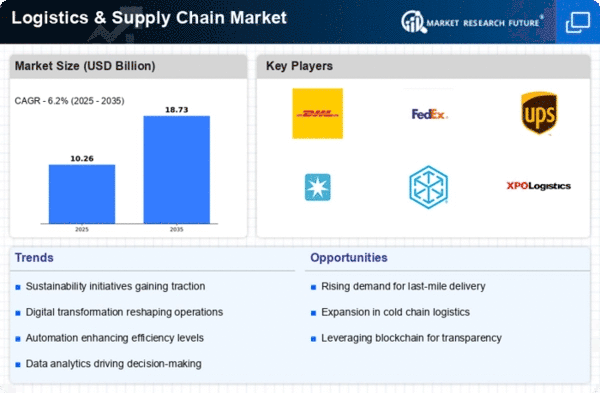
As per MRFR analysis, the Logistics & Supply Chain Market Size was estimated at 9.66 USD Billion in 2024. The Logistics & Supply Chain industry is projected to grow from 10.26 USD Billion in 2025 to 18.73 USD Billion by 2035, exhibiting a compound annual growth rate (CAGR) of 6.2 during the forecast period 2025 - 2035.

Key Market Trends & Highlights

The Logistics and Supply Chain Market is experiencing a transformative shift driven by technological advancements and sustainability initiatives.

  • Technological integration is reshaping logistics operations, enhancing efficiency and visibility across supply chains.
  • Sustainability initiatives are becoming increasingly critical, as companies strive to reduce their carbon footprints and meet regulatory standards.
  • North America remains the largest market, while the Asia-Pacific region is emerging as the fastest-growing area in logistics and supply chain.
  • E-commerce continues to drive market growth, with consumer demand for speed and technological advancements acting as key market drivers.

Market Size & Forecast

2024 Market Size 9.66 (USD Billion)
2035 Market Size 18.73 (USD Billion)
CAGR (2025 - 2035) 6.2%
Largest Regional Market Share in 2024 North America

Major Players

<p>DHL (DE), FedEx (US), UPS (US), Maersk (DK), C.H. Robinson (US), XPO Logistics (US), Kuehne + Nagel (CH), DB Schenker (DE), Nippon Express (JP)</p>

Market Trends

The Logistics & Supply Chain Market is currently experiencing a transformative phase characterized by the integration of advanced technologies and evolving consumer expectations. Companies are increasingly adopting automation and artificial intelligence to enhance operational efficiency and reduce costs. This shift not only streamlines processes but also improves accuracy in inventory management and order fulfillment. Furthermore, sustainability has emerged as a critical focus, with organizations striving to minimize their environmental impact through greener practices and supply chain transparency. As a result, businesses are re-evaluating their logistics strategies to align with these new priorities, which may lead to a more resilient and adaptive market landscape. In addition, the ongoing globalization of trade continues to shape the Logistics & Supply Chain Market. Firms are expanding their reach into emerging markets, necessitating the development of robust logistics networks that can support diverse geographical demands. This trend indicates a growing need for collaboration among stakeholders, including suppliers, manufacturers, and logistics providers, to ensure seamless operations across borders. As the market evolves, it appears that agility and responsiveness will be paramount for organizations aiming to thrive in this dynamic environment. The interplay of technology, sustainability, and globalization is likely to redefine the future of logistics and supply chain management.

Technological Integration

The Logistics & Supply Chain Market is witnessing a surge in the adoption of technologies such as artificial intelligence, machine learning, and the Internet of Things. These innovations facilitate real-time tracking, predictive analytics, and enhanced decision-making capabilities, thereby optimizing supply chain operations.

Sustainability Initiatives

There is a growing emphasis on sustainable practices within the Logistics & Supply Chain Market. Companies are increasingly focusing on reducing carbon footprints, utilizing eco-friendly materials, and implementing circular economy principles to meet consumer demand for environmentally responsible solutions.

Global Trade Expansion

The ongoing globalization of trade is reshaping the Logistics & Supply Chain Market. Businesses are exploring new markets and diversifying their supply chains, which necessitates the establishment of efficient logistics networks capable of handling complex international operations.

Logistics & Supply Chain Market Market Drivers

Technological Advancements

The Global Logistics and Supply Chain Market Industry is experiencing a transformative phase driven by rapid technological advancements. Innovations such as artificial intelligence, blockchain, and the Internet of Things are enhancing operational efficiency and transparency. For instance, AI-powered analytics are optimizing inventory management, while blockchain technology is improving traceability in supply chains. These technologies are expected to contribute to the market's growth, with projections indicating a market value of 9.66 USD Billion in 2024. As companies increasingly adopt these technologies, the Global Logistics and Supply Chain Market Industry is likely to witness a robust expansion.

Market Segment Insights

By Application: Transportation (Largest) vs. Warehousing (Fastest-Growing)

<p>The application segment of the Logistics & Supply Chain Market is predominantly represented by Transportation, which holds the largest market share due to its crucial role in product movement and distribution. Following closely is Warehousing, which, while smaller in share, is rapidly gaining traction as businesses acknowledge the importance of strategic storage solutions. Other significant applications include Inventory Management, Order Fulfillment, and Supply Chain Planning, each contributing to the overall market dynamics and value addition.</p>

<p>Transportation (Dominant) vs. Order Fulfillment (Emerging)</p>

<p>Transportation continues to be the dominant application in the Logistics & Supply Chain Market, facilitating the transfer of goods across various modes, including road, rail, air, and sea. This segment is characterized by advanced technologies that optimize route planning, reduce delivery times, and enhance customer satisfaction. In contrast, Order Fulfillment is emerging as a critical component, driven by the growth of e-commerce and consumer demand for faster shipping. This segment focuses on efficiently processing and delivering orders, utilizing automated systems and integrated logistics solutions to improve service levels and operational performance. The synergy between these applications not only enhances efficiency but also positions companies to meet evolving market demands.</p>

By End Use: E-commerce (Largest) vs. Healthcare (Fastest-Growing)

<p>In the Logistics & Supply Chain Market, E-commerce has emerged as the largest segment, capturing significant market share due to the rapid digitalization of retail and increased online shopping trends. Retail and Manufacturing also contribute substantially, but E-commerce's growth is outpacing them as consumer preferences shift towards online platforms. The Healthcare sector, while smaller currently, is gaining traction with greater demand for medical supplies and pharmaceuticals, especially highlighted by recent global health challenges. The growth in the E-commerce segment is driven by increased consumer reliance on online shopping, extensive use of advanced logistics solutions, and a shift toward faster delivery options. Conversely, the Healthcare segment is propelled by a rising demand for efficient supply chain management of critical medical supplies and a growing focus on patient-centric services. The dual impact of evolving consumer behaviors and regulatory changes are shaping the dynamics of these markets.</p>

<p>Retail (Dominant) vs. Food and Beverage (Emerging)</p>

<p>The Retail segment remains a dominant force in the Logistics & Supply Chain Market, characterized by its extensive distribution networks and strong demand for efficient inventory management. Retail encompasses a wide range of products, making it a critical area for logistics operations. In contrast, the Food and Beverage segment is an emerging player, marked by a growing focus on perishable goods and the need for specialized logistics solutions. This sector experiences unique challenges such as temperature control and timely deliveries, leading to increased investment in cold chain logistics. As health-conscious consumers drive changes in purchasing behavior, the Food and Beverage market is rapidly expanding, necessitating innovative supply chain strategies to meet evolving demands.</p>

By Service Type: Freight Transportation (Largest) vs. Third Party Logistics (Fastest-Growing)

<p>In the Logistics & Supply Chain Market, the service type segment is primarily dominated by Freight Transportation, which holds the largest market share. This segment includes various modes of transportation, such as road, rail, air, and sea, facilitating the movement of goods worldwide. Following closely is Third Party Logistics (3PL), which has been gaining traction as businesses increasingly outsource their logistics functions to specialized providers, enhancing operational efficiency and cost savings. As businesses seek to optimize their supply chains, the growth of Third Party Logistics is particularly noteworthy, driven by the demand for integrated solutions and technology advancements. Moreover, with the rise of e-commerce and consumer expectations for faster delivery, services such as Last Mile Delivery are also experiencing significant growth. Overall, this segment showcases diverse opportunities and trends that reflect the evolving logistics landscape.</p>

<p>Freight Transportation (Dominant) vs. Third Party Logistics (Emerging)</p>

<p>Freight Transportation remains the cornerstone of the Logistics & Supply Chain Market, providing essential services that facilitate global trade. This segment encompasses various transport modes, enabling the efficient movement of goods across countries and continents. As global trade volumes increase, the importance of Freight Transportation is underscored, offering businesses flexibility and speed in their logistics operations. Conversely, Third Party Logistics is emerging as a critical player, capitalizing on businesses' need to streamline operations through outsourcing. 3PL providers manage complex logistics tasks and integrate advanced technology, enhancing visibility and efficiency. The collaboration between these segments highlights a synergistic approach to logistics, where traditional freight solutions complement innovative third-party services, catering to a broad spectrum of customer needs.</p>

By Technology: Artificial Intelligence (Largest) vs. Internet of Things (Fastest-Growing)

<p>In the Logistics & Supply Chain Market, the technology segment showcases a dynamic distribution of market share among various innovative solutions. Artificial Intelligence has emerged as the largest segment, largely due to its capabilities in enhancing decision-making processes and streamlining operations. In contrast, the Internet of Things is demonstrating rapid growth, attracting attention for its ability to revolutionize real-time data collection and asset tracking, which are critical for efficiency and responsiveness in logistics operations.</p>

<p>Technology: AI (Dominant) vs. IoT (Emerging)</p>

<p>Artificial Intelligence is recognized as the dominant technology in the logistics and supply chain sector, directly contributing to the optimization of supply chain management and inventory control. Its capabilities in predictive analysis and machine learning allow businesses to anticipate demand fluctuations and efficiently allocate resources. On the other hand, the Internet of Things, characterized as an emerging trend, is becoming increasingly relevant due to its potential to provide interconnected systems that offer enhanced visibility and control over logistics processes. By integrating IoT solutions, companies can achieve greater operational efficiency, enabling real-time monitoring and management of assets.</p>

By Mode of Transportation: Road (Largest) vs. Air (Fastest-Growing)

<p>In the Logistics & Supply Chain Market, the distribution of market share among the various modes of transportation reveals significant dynamics. Road transportation holds the largest market share, primarily due to its extensive infrastructure and ability to provide last-mile delivery services efficiently. Sea and rail come next, offering bulk transport options that are indispensable for international trade, while air transportation, though smaller in share, plays a critical role in premium services and time-sensitive deliveries. Analyzing growth trends, air transportation stands out as the fastest-growing segment, driven by the increasing demand for expedited shipping and the rise of e-commerce. Innovations in logistics technologies and the leveraging of digital platforms are also propelling the efficiency of road transport, while sustainability concerns drive rail and sea transport developments, each adapting to market needs and regulatory pressures.</p>

<p>Road (Dominant) vs. Air (Emerging)</p>

<p>Road transportation is currently the dominant mode within the Logistics & Supply Chain Market, characterized by its flexibility and extensive reach. It allows for door-to-door service, making it ideal for varied goods and perishable items. The infrastructure supporting road transport continues to improve, facilitating smooth transit and faster deliveries. In contrast, air transportation is emerging rapidly, catering to sectors such as pharmaceuticals and electronics where speed is crucial. Advanced logistics techniques enhance air transport efficiency, alongside an increase in cargo aircraft options. As e-commerce continues to expand, the role of air transport becomes more prominent, leading to innovations that streamline operations and meet consumer demands for quicker delivery.</p>

Get more detailed insights about Logistics & Supply Chain Market Research Report - Global Forecast by 2035

Regional Insights

North America : Logistics Powerhouse

North America continues to dominate the Logistics & Supply Chain Market, holding a significant market share of 4.83 in 2024. Key growth drivers include advancements in technology, increased e-commerce demand, and a robust regulatory framework that supports infrastructure development. The region's strategic location and extensive transportation networks further enhance its logistics capabilities, making it a critical hub for global trade. The competitive landscape is characterized by major players such as FedEx, UPS, and DHL, which are investing heavily in technology and sustainability initiatives. The U.S. leads the market, followed by Canada and Mexico, with a focus on improving supply chain efficiency. The presence of these key players ensures a dynamic market environment, fostering innovation and responsiveness to consumer needs.

Europe : Diverse and Competitive Market

Europe's Logistics & Supply Chain Market is valued at 2.9, driven by increasing cross-border trade and regulatory support for digitalization. The European Union's initiatives to enhance transport infrastructure and sustainability are pivotal in shaping market dynamics. The region is witnessing a shift towards green logistics, with regulations promoting eco-friendly practices, which are expected to further boost market growth. Leading countries include Germany, France, and the UK, where major players like DHL and DB Schenker are expanding their operations. The competitive landscape is marked by a mix of established firms and emerging startups, all vying for market share. The focus on innovation and customer-centric solutions is reshaping the logistics landscape, making Europe a key player in the global supply chain.

Asia-Pacific : Emerging Market Potential

The Asia-Pacific region, with a market size of 1.8, is experiencing rapid growth in the Logistics & Supply Chain sector, driven by urbanization, rising consumer demand, and advancements in technology. Countries like China and India are at the forefront, with significant investments in infrastructure and logistics capabilities. Regulatory support for trade facilitation is also enhancing market dynamics, making the region a focal point for global supply chains. China leads the market, followed by Japan and India, with key players such as Nippon Express and Kuehne + Nagel expanding their presence. The competitive landscape is evolving, with a mix of local and international firms striving to capture market share. The emphasis on digital transformation and efficiency is reshaping logistics operations, positioning Asia-Pacific as a vital player in the global market.

Middle East and Africa : Emerging Logistics Hub

The Middle East and Africa region, with a market size of 0.13, presents emerging opportunities in the Logistics & Supply Chain sector. Key growth drivers include increasing trade activities, investments in infrastructure, and a growing focus on e-commerce. Regulatory frameworks are evolving to support logistics development, enhancing the region's attractiveness for global players. The strategic location of the Middle East as a trade corridor further boosts its logistics potential. Leading countries include the UAE and South Africa, where companies are investing in logistics capabilities to meet rising demand. The competitive landscape is characterized by both local and international players, with a focus on innovation and service quality. As the region continues to develop, it is poised to become a significant player in The Logistics & Supply Chain.

Key Players and Competitive Insights

The Logistics & Supply Chain Market is currently characterized by intense competition and rapid evolution, driven by technological advancements and shifting consumer demands. Major players such as DHL (DE), FedEx (US), and Maersk (DK) are strategically positioning themselves through innovation and digital transformation. DHL (DE) has focused on enhancing its e-commerce capabilities, while FedEx (US) emphasizes automation and AI integration to streamline operations. Maersk (DK), on the other hand, is concentrating on sustainability initiatives, aiming to reduce carbon emissions across its fleet. Collectively, these strategies not only enhance operational efficiency but also reshape the competitive landscape, pushing other players to adapt or risk obsolescence.

Key business tactics within the market include localizing manufacturing and optimizing supply chains to meet regional demands. The competitive structure appears moderately fragmented, with a mix of large multinational corporations and smaller regional players. The influence of key players is substantial, as their strategic decisions often set industry standards and drive innovation across the sector.

In November 2025, FedEx (US) announced a partnership with a leading AI firm to develop predictive analytics tools aimed at improving delivery efficiency. This strategic move is likely to enhance FedEx's operational capabilities, allowing for better resource allocation and reduced delivery times, which could significantly improve customer satisfaction and loyalty.

In October 2025, Maersk (DK) launched a new carbon-neutral shipping service, which is expected to attract environmentally conscious clients and strengthen its market position. This initiative not only aligns with global sustainability goals but also positions Maersk as a leader in eco-friendly logistics solutions, potentially increasing its market share in a growing segment of green logistics.

In September 2025, DHL (DE) expanded its last-mile delivery network by acquiring a regional logistics provider in Southeast Asia. This acquisition is strategically important as it enhances DHL's footprint in a rapidly growing market, allowing for improved service levels and faster delivery times, which are critical in the competitive e-commerce landscape.

As of December 2025, current trends in the Logistics & Supply Chain Market are heavily influenced by digitalization, sustainability, and AI integration. Strategic alliances are increasingly shaping the landscape, as companies recognize the need for collaboration to enhance service offerings and operational efficiency. Looking ahead, competitive differentiation is likely to evolve from traditional price-based competition to a focus on innovation, technology, and supply chain reliability, as companies strive to meet the demands of a more discerning consumer base.

Key Companies in the Logistics & Supply Chain Market include

Industry Developments

March 2022: The largest express shipping firm in the world, FedEx Express, a division of FedEx Corp., is collaborating with Elory Air, based in the San Francisco Bay Area, on the development of the first end-to-end autonomous vertical take-off and landing (VTOL) aerial cargo system.

October 2022: DHL has compiled 40 trends that will influence how companies, society, and technologies develop for the logistics community over the next ten years in the sixth edition of the DHL Logistics Trend Radar. Decarburization, robotics, big data, supply chain diversity, and alternate energy sources will have the most significant effects on logistics transformation. September 2023: Walmart invests $250 million in DroneUp for drone delivery. This partnership aims to leverage drones for faster and more accessible last-mile deliveries. October 2023: Microsoft and Maersk launch a cloud-based logistics platform.

This platform aims to streamline data exchange and visibility across the supply chain. November 2023: FedEx launches SenseAware, a connected sensor platform for real-time cargo tracking. This provides improved visibility and control over shipments

Future Outlook

Logistics & Supply Chain Market Future Outlook

<p>The Logistics & Supply Chain Market is projected to grow at a 6.2% CAGR from 2024 to 2035, driven by technological advancements, e-commerce expansion, and sustainability initiatives.</p>

New opportunities lie in:

  • <p>Integration of AI-driven supply chain analytics tools</p>
  • <p>Development of autonomous delivery vehicle networks</p>
  • <p>Expansion of last-mile logistics solutions for urban areas</p>

<p>By 2035, the market is expected to be robust, characterized by innovation and efficiency.</p>

Market Segmentation

Logistics & Supply Chain Market End Use Outlook

  • Retail
  • Manufacturing
  • E-commerce
  • Healthcare
  • Food and Beverage

Logistics & Supply Chain Market Technology Outlook

  • Internet of Things
  • Artificial Intelligence
  • Blockchain
  • Automation
  • Cloud Computing

Logistics & Supply Chain Market Application Outlook

  • Transportation
  • Warehousing
  • Inventory Management
  • Order Fulfillment
  • Supply Chain Planning

Logistics & Supply Chain Market Service Type Outlook

  • Freight Transportation
  • Third Party Logistics
  • Supply Chain Consulting
  • Warehouse Management
  • Last Mile Delivery

Logistics & Supply Chain Market Mode of Transportation Outlook

  • Road
  • Rail
  • Air
  • Sea
  • Pipeline

Report Scope

MARKET SIZE 20249.66(USD Billion)
MARKET SIZE 202510.26(USD Billion)
MARKET SIZE 203518.73(USD Billion)
COMPOUND ANNUAL GROWTH RATE (CAGR)6.2% (2024 - 2035)
REPORT COVERAGERevenue Forecast, Competitive Landscape, Growth Factors, and Trends
BASE YEAR2024
Market Forecast Period2025 - 2035
Historical Data2019 - 2024
Market Forecast UnitsUSD Billion
Key Companies ProfiledDHL (DE), FedEx (US), UPS (US), Maersk (DK), C.H. Robinson (US), XPO Logistics (US), Kuehne + Nagel (CH), DB Schenker (DE), Nippon Express (JP)
Segments CoveredApplication, End Use, Service Type, Technology, Mode of Transportation
Key Market OpportunitiesIntegration of artificial intelligence and automation enhances efficiency in the Logistics and Supply Chain Market.
Key Market DynamicsTechnological advancements drive efficiency and transparency in logistics, reshaping supply chain dynamics and competitive landscapes.
Countries CoveredNorth America, Europe, APAC, South America, MEA

FAQs

How much is the Logistics & Supply Chain Market?

The Logistics &amp; Supply Chain Market size was valued at USD 9.66 Billion in 2024.

What is the growth rate of the Logistics & Supply Chain Market?

Logistics & Supply Chain Market is projected to grow at a CAGR of 6.2% during the forecast period, 2025-2035

Which region held the largest market share in the Logistics & Supply Chain Market?

North America had the largest share of the market

Who are the key players in the Logistics & Supply Chain Market?

The key players in the market are DB Schenker, FedEx Corporation, Nippon Express Co. Ltd., AP Moller Maersk, Deutsche Post AG, Geodis, United Parcel Service of America Inc., CH Robinson Worldwide Inc., JB Hunt Transport Services Inc., BDP International.

Which transportation mode led the Logistics & Supply Chain Market?

The roadways category dominated the market in 2022.

Which end-user had the largest market share in the Logistics & Supply Chain Market?

The industry &amp; manufacturing had the largest share of the market.

  1. SECTION I: EXECUTIVE SUMMARY AND KEY HIGHLIGHTS
    1. | 1.1 EXECUTIVE SUMMARY
  2. SECTION II: SCOPING, METHODOLOGY AND MARKET STRUCTURE
    1. | 2.1 MARKET INTRODUCTION
    2. | 2.2 RESEARCH METHODOLOGY
  3. SECTION III: QUALITATIVE ANALYSIS
    1. | 3.1 MARKET DYNAMICS
    2. | 3.2 MARKET FACTOR ANALYSIS
  4. SECTION IV: QUANTITATIVE ANALYSIS
    1. | 4.1 Packaging & Transport, BY Application (USD Billion)
    2. | 4.2 Packaging & Transport, BY End Use (USD Billion)
    3. | 4.3 Packaging & Transport, BY Service Type (USD Billion)
    4. | 4.4 Packaging & Transport, BY Technology (USD Billion)
    5. | 4.5 Packaging & Transport, BY Mode of Transportation (USD Billion)
    6. | 4.6 Packaging & Transport, BY Region (USD Billion)
  5. SECTION V: COMPETITIVE ANALYSIS
    1. | 5.1 Competitive Landscape
    2. | 5.2 Company Profiles
    3. | 5.3 Appendix

Logistics & Supply Chain Market Segmentation

Market Segmentation Overview

  • Detailed segmentation data will be available in the full report
  • Comprehensive analysis by multiple parameters
  • Regional and country-level breakdowns
  • Market size forecasts by segment
Infographic

Free Sample Request

Kindly complete the form below to receive a free sample of this Report

Get Free Sample

Customer Strories

Compare Licence

×
Features License Type
Single User Multiuser License Enterprise User
Price $4,950 $5,950 $7,250
Maximum User Access Limit 1 User Upto 10 Users Unrestricted Access Throughout the Organization
Free Customization
Direct Access to Analyst
Deliverable Format
Platform Access
Discount on Next Purchase 10% 15% 15%
Printable Versions