Request Free Sample ×

Kindly complete the form below to receive a free sample of this Report

* Please use a valid business email

Leading companies partner with us for data-driven Insights

clients tt-cursor
Hero Background
English
Chinese
French
Japanese
Korean
German
Spanish

Lithium Minerals Market for Non-Battery Application Size

ID: MRFR/CnM/10424-CR
128 Pages
Anshula Mandaokar
July 2023

Lithium and Lithium Minerals Market for Non-Battery Application Research Report: Information By Type (Lithium Carbonate, Lithium Hydroxide and Others), By Application (Ceramic and Glass, Lubricants, Polymer and Rubber and Others) and By Region -Global Forecast to 2035

Share:
Download PDF ×

We do not share your information with anyone. However, we may send you emails based on your report interest from time to time. You may contact us at any time to opt-out.

Lithium Minerals Market for Non-Battery Application Infographic
Purchase Options

Lithium Minerals For Non Battery Application Size

Lithium Minerals Market for Non-Battery Application Growth Projections and Opportunities

The lithium and lithium minerals market for non-battery applications is poised to exhibit a Compound Annual Growth Rate (CAGR) of 7.22% during the forecast period spanning from 2023 to 2030. In 2022, this market segment held a valuation of USD 2,709.7 million, and it is anticipated to surge to USD 4,570.0 million by 2030. Lithium, a reactive and flammable chemical element, recognized for its soft, silvery-white metal properties, boasts attributes such as low density, corrosion resistance, and thermal stability. These characteristics render it indispensable across various sectors, including lubricants, polymer and rubber, ceramic & glass, and more.

The non-battery application sector of the lithium and lithium minerals market is poised for growth, primarily fueled by escalating demand in ceramic and glass products within the construction industry. Lithium's role in ceramic production enhances workability, while its inclusion in glass formulation curtails thermal expansion coefficients, making it a preferred choice for specialty glass production.

However, environmental concerns linked to lithium extraction and processing are anticipated to impede market growth. Despite these concerns, the robust industrial growth worldwide is expected to provide support to the lithium and lithium minerals market for non-battery applications in the years to come.

Segmented by type, the global market encompasses lithium carbonate, lithium hydroxide, and others. In 2022, the lithium carbonate segment took the lead, holding a substantial market share valued at USD 1,613.3 million. It is expected to register a CAGR of 7.72% during the projected timeframe. The increased use of lithium carbonate in lubricating greases is a significant driver for market growth, particularly as demand for lubricants rises in manufacturing and automotive sectors. Lithium-based lubricants offer excellent water resistance and compatibility with a broad array of metals, making them ideal for various applications.

In terms of application, the ceramic and glass segment dominated the market in 2022, holding a substantial market share with a value of USD 1,280.8 million. Projected to register a CAGR of 7.82%, this segment's growth is attributed to the vital role lithium and lithium minerals play in enhancing the strength of ceramic and glass products. The increasing demand for these products across industrial sectors such as construction, automotive, and electronics is expected to drive market expansion.

Geographically, the Asia-Pacific region is anticipated to be the driving force behind the global lithium and lithium minerals market for non-battery applications throughout the forecast period. With emerging nations like India, China, and Japan, this region is expected to contribute significantly, offering a total incremental opportunity of USD 2,286.4 million by the end of 2030. The dynamic market growth in this region is fueled by robust industrial activities and increasing demand for lithium and lithium minerals across various applications.
Lithium Minerals Market for Non-Battery Application Size Graph
Author
Author Profile
Anshula Mandaokar
Team Lead - Research

Anshula Mandaokar holds an academic degree in Chemical Engineering and has been contributing to the field for more than 5 years. She has expertise in Market Research and Business Consulting and serves as a Team Lead for a reputed Market Research firm under the Chemicals and Materials domain spectrum. She has worked on multiple projects, generating explicit results in a quick turnaround time. Her understanding of data interpretation justifies her role as a leader.

Leave a Comment

FAQs

What is the projected market valuation for the Lithium and Lithium Minerals Market for Non-Battery Application in 2035?

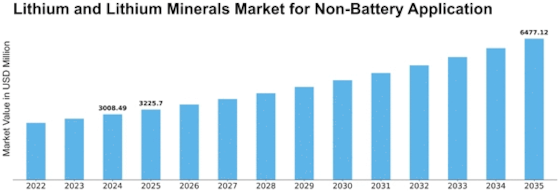
<p>The projected market valuation for 2035 is 6477.12 USD Million.</p>

What was the overall market valuation in 2024?

<p>The overall market valuation in 2024 was 3008.49 USD Million.</p>

What is the expected CAGR for the market during the forecast period 2025 - 2035?

<p>The expected CAGR for the market during the forecast period 2025 - 2035 is 7.22%.</p>

Which companies are considered key players in the Lithium and Lithium Minerals Market for Non-Battery Application?

<p>Key players include Albemarle Corporation, SQM, Livent Corporation, Ganfeng Lithium Co., Ltd., Orocobre Limited, Tianqi Lithium Industries, Inc., Mineral Resources Limited, and Galaxy Resources Limited.</p>

What are the main segments of the Lithium and Lithium Minerals Market for Non-Battery Application?

<p>The main segments include Lithium Carbonate, Lithium Hydroxide, and others under the type category, and Ceramic and Glass, Lubricants, Polymer and Rubber, and others under the application category.</p>

What was the valuation of Lithium Carbonate in 2024?

<p>The valuation of Lithium Carbonate in 2024 was 1200.0 USD Million.</p>

What is the projected valuation for Lubricants in 2035?

<p>The projected valuation for Lubricants in 2035 is 1500.0 USD Million.</p>

How does the valuation of Lithium Hydroxide compare to that of Lithium Carbonate in 2024?

<p>In 2024, the valuation of Lithium Hydroxide was 1500.0 USD Million, which is higher than that of Lithium Carbonate at 1200.0 USD Million.</p>

What is the expected growth trend for the Ceramic and Glass segment from 2024 to 2035?

<p>The Ceramic and Glass segment is expected to grow from 1000.0 USD Million in 2024 to 2200.0 USD Million by 2035.</p>

What are the projected valuations for the 'Others' category in both type and application segments by 2035?

<p>The projected valuation for the 'Others' category in the type segment is 977.12 USD Million, while in the application segment, it is 1477.12 USD Million by 2035.</p>

Market Summary

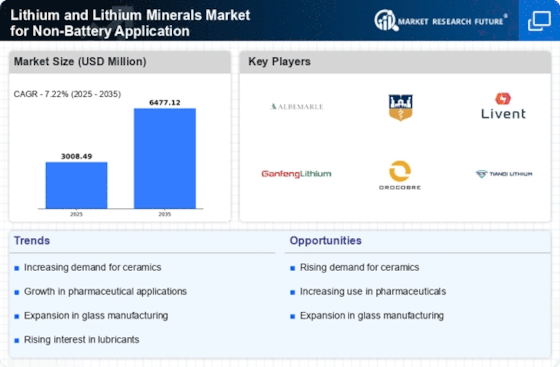
As per Market Research Future analysis, the Lithium and Lithium Minerals Market for Non-Battery Application Market was estimated at 3008.49 USD Million in 2024. The Lithium and Lithium Minerals industry is projected to grow from 3225.7 USD Million in 2025 to 6477.12 USD Million by 2035, exhibiting a compound annual growth rate (CAGR) of 7.22% during the forecast period 2025 - 2035

Key Market Trends & Highlights

The Lithium and Lithium Minerals Market for Non-Battery Applications is experiencing robust growth driven by diverse industrial demands.

  • The market is witnessing rising demand in the ceramics and glass industries, particularly in North America, which remains the largest market.
  • Asia-Pacific is emerging as the fastest-growing region, fueled by advancements in extraction methods and sustainability practices.
  • Lithium carbonate continues to dominate the market, while lithium hydroxide is rapidly gaining traction as a preferred choice in various applications.

  • Key market drivers include the increasing use of lithium in pharmaceuticals and the expansion of the grease and lubricants sector, highlighting the versatility of lithium minerals.

Market Size & Forecast

2024 Market Size 3008.49 (USD Million)
2035 Market Size 6477.12 (USD Million)
CAGR (2025 - 2035) 7.22%
Largest Regional Market Share in 2024 Asia Pacific

Major Players

Albemarle Corporation (US), SQM (Sociedad Quimica y Minera de Chile) (CL), Livent Corporation (US), Ganfeng Lithium Co., Ltd. (CN), Orocobre Limited (AU), Tianqi Lithium Industries, Inc. (CN), Mineral Resources Limited (AU), Galaxy Resources Limited (AU)

Market Trends

The Lithium and Lithium Minerals Market for Non-Battery Application Market is currently experiencing notable developments, driven by increasing demand across various sectors. Industries such as ceramics, glass, and lubricants are recognizing the unique properties of lithium compounds, which enhance product performance and durability. This growing interest suggests a shift in focus from traditional battery applications to alternative uses, potentially expanding the market's scope. Furthermore, advancements in extraction technologies and processing methods may facilitate the efficient utilization of lithium resources, thereby supporting market growth. In addition, the environmental considerations surrounding lithium extraction and processing are becoming more pronounced. Stakeholders are increasingly prioritizing sustainable practices, which could influence sourcing strategies and product development. As companies strive to meet regulatory requirements and consumer expectations, the emphasis on eco-friendly solutions may reshape the competitive landscape. Overall, the Lithium and Lithium Minerals Market for Non-Battery Application Market appears poised for growth, with evolving trends indicating a diversification of applications and a commitment to sustainability.

Rising Demand in Ceramics and Glass Industries

The ceramics and glass sectors are increasingly incorporating lithium compounds due to their beneficial properties. Lithium enhances thermal stability and reduces melting temperatures, making it a valuable additive in these industries. This trend indicates a broader acceptance of lithium in non-battery applications.

Sustainability and Eco-Friendly Practices

There is a growing emphasis on sustainable practices within the Lithium and Lithium Minerals Market for Non-Battery Application Market. Companies are exploring eco-friendly extraction methods and processing techniques to minimize environmental impact, reflecting a shift towards responsible sourcing.

Technological Advancements in Extraction Methods

Innovations in extraction technologies are likely to improve the efficiency of lithium recovery from various sources. These advancements may lead to increased availability of lithium minerals for non-battery applications, potentially expanding market opportunities.

Lithium Minerals Market for Non-Battery Application Market Drivers

Increasing Use in Pharmaceuticals

The Lithium and Lithium Minerals Market for Non-Battery Applications is experiencing a notable surge in demand from the pharmaceutical sector. Lithium compounds, particularly lithium carbonate, are utilized in the treatment of bipolar disorder and depression. The market for lithium in pharmaceuticals is projected to grow as mental health awareness increases, with a potential market size reaching approximately 1.5 billion USD by 2026. This growth is driven by the rising prevalence of mental health disorders and the expanding range of lithium-based medications. As a result, the demand for high-purity lithium compounds is likely to intensify, thereby bolstering the overall market for lithium and lithium minerals.

Advancements in Water Treatment Technologies

The Lithium and Lithium Minerals Market for Non-Battery Applications is benefiting from advancements in water treatment technologies. Lithium compounds are increasingly being utilized in the treatment of wastewater and in the production of high-purity water. The market for lithium in water treatment is expected to grow, driven by the rising need for clean water and effective wastewater management solutions. With an estimated market size of over 500 million USD by 2028, this sector presents a significant opportunity for lithium and lithium minerals. As environmental regulations become more stringent, the demand for lithium-based solutions in water treatment applications is likely to increase, further propelling the market.

Expansion in the Grease and Lubricants Sector

The Lithium and Lithium Minerals Market for Non-Battery Applications is witnessing a significant expansion in the grease and lubricants sector. Lithium-based greases are favored for their excellent thermal stability and water resistance, making them suitable for various industrial applications. The global market for lithium greases is anticipated to grow at a compound annual growth rate of around 4% over the next few years, driven by increasing industrial activities and the need for high-performance lubricants. This trend indicates a robust demand for lithium hydroxide and lithium stearate, which are essential components in the formulation of these greases, thereby enhancing the market dynamics for lithium and lithium minerals.

Growth in the Aerospace and Defense Industries

The Lithium and Lithium Minerals Market for Non-Battery Applications is poised for growth due to the increasing utilization of lithium in aerospace and defense applications. Lithium is employed in the production of lightweight materials and advanced alloys, which are crucial for enhancing fuel efficiency and performance in aircraft. The aerospace sector is projected to expand significantly, with an estimated market value of over 800 billion USD by 2030. This growth is likely to drive demand for lithium-based materials, as manufacturers seek to improve the performance and sustainability of their products. Consequently, the lithium and lithium minerals market is expected to benefit from this upward trend.

Rising Demand in the Glass and Ceramics Industry

The Lithium and Lithium Minerals Market for Non-Battery Applications is experiencing a rising demand from the glass and ceramics industry. Lithium compounds are essential in the production of high-quality glass and ceramics, enhancing their thermal and mechanical properties. The market for lithium in this sector is projected to grow, with estimates suggesting a value of approximately 2 billion USD by 2027. This growth is attributed to the increasing use of lithium in specialty glass applications, such as in electronics and solar panels. As manufacturers continue to seek innovative materials to improve product performance, the demand for lithium and lithium minerals is likely to rise correspondingly.

Market Segment Insights

By Type: Lithium Carbonate (Largest) vs. Lithium Hydroxide (Fastest-Growing)

In the Lithium and Lithium Minerals Market for Non-Battery Application Market, Lithium Carbonate holds a substantial market share, being the most prominent segment due to its extensive use in applications such as glass, ceramics, and pharmaceuticals. Its established presence in various industrial applications allows it to retain a competitive edge. Lithium Hydroxide, while smaller in market share, is rapidly gaining traction owing to its unique properties that make it preferable for certain industrial applications, including the production of lubricating greases and the development of other chemical derivatives.

Lithium Carbonate (Dominant) vs. Lithium Hydroxide (Emerging)

Lithium Carbonate is recognized as the dominant segment within the non-battery application market, primarily due to its versatility and significant application in diverse industries such as glass manufacturing, ceramics, and pharmaceuticals. Its ability to improve product performance and enhance quality ensures its continued demand. On the other hand, Lithium Hydroxide is identified as an emerging segment that is swiftly increasing in importance, particularly in sectors that require high-purity lithium compounds. Known for its excellent thermal stability and efficacy in applications such as lubricants and chemical precursors, Lithium Hydroxide's unique attributes position it favorably for robust growth as industries pivot towards advanced material solutions.

By Application: Ceramic and Glass (Largest) vs. Lubricants (Fastest-Growing)

In the Lithium and Lithium Minerals Market for Non-Battery Application Market, Ceramic and Glass account for the largest share, driven by their widespread use in high-performance glass and ceramic products. This segment has established itself as a key player, catering to the demand for lithium in advanced materials that require thermal stability and durability. Meanwhile, Lubricants are emerging rapidly, leveraging the need for high-performance lubricants across various industries, including automotive and machinery.

Ceramic and Glass (Dominant) vs. Lubricants (Emerging)

The Ceramic and Glass segment has solidified its dominance in the Lithium and Lithium Minerals Market by providing essential materials used in constructing high-durability glass coatings and specialty ceramics that stand up to extreme conditions. This segment benefits from advancements in manufacturing processes and increased demand for dielectric materials in electronics. In contrast, the Lubricants segment is gaining traction as manufacturers seek lithium-based formulations for their superior properties in reducing friction and wear. This emerging segment is characterized by innovation, as new combinations are being developed to enhance performance and sustainability, making it a notable trendsetter in the marketplace.

Get more detailed insights about Lithium and Lithium Minerals Market for Non-Battery Application Research Report—Global Forecast till 2035

Regional Insights

By Region, the study segments the Lithium and Lithium Minerals Market for Non-Battery Application Market into North America, Europe, Asia-Pacific, Middle East & Africa, and Latin America. The Asia Pacific Lithium and Lithium Minerals Market for Non-Battery Application Market holds the largest market share and is also anticipated to account for the largest revenue share during the forecast period. The Asia-Pacific region is home to many advanced manufacturing facilities and technological advancements. This facilitates the development and use of lithium compounds in innovative non-battery applications, including high-performance ceramics, specialty polymers and advanced lubricants.

Overall, a combination of robust industrial sectors, economic growth, supportive government policies, technological advancements, and access to lithium resources contribute to the Asia Pacific region's leading market share in non-battery lithium applications.

The industrial sector is growing very rapidly in the Asia Pacific region owing to rising urbanization.  Also, the presence of a large population and their changing preferences is making industry players to expand their businesses in the region, further creating demand for lithium and lithium minerals from sectors such as ceramic and glass. Lithium can significantly help in saving energy during the production of glass by decreasing their melting temperature. Moreover, lithium can enhance the attributes of glass products by improving its, chemical resistance, durability, and refractive index.

Thus, the advantages offered by lithium makes lithium-based glass ideal for numerous applications in optical lenses, display panels, and specialty glass. The growing automotive, electronics, and construction industry in Asia Pacific region will augment the demand for lithium in the estimated timeframe.

Key Players and Competitive Insights

Market players are investing and focusing on R&D in order to increase their product lines, that will help the Lithium and Lithium Minerals Market for Non-Battery Application Market to grow significantly. Market participants are also adopting strategic initiatives to grow their business worldwide and to acquire a larger customer base. Competitors in the Lithium and Lithium Minerals Market for Non-Battery Application industry must provide cost-effective products to survive in the competitive and rising market environment.
The market for Lithium and Lithium Minerals Market for Non-Battery Application Market is as extremely competitive market. This competitive environment is likely to increase further due to growing technological advancements. Some of the key players operating in the Lithium and Lithium Minerals Market for Non-Battery Application Market are SQM SA, Albemarle Corporation, Livent, Nemaska Lithium, Allkem Limited, Lithium Americas Corp, Ganfeng Lithium Co., Ltd, Mineral Resources, and Tianqi Lithium Corporation. To increase their global reach and client base, key firms are concentrating on acquisitions and product innovation.
SQM SA SQM is a Chilean company that plays a major role in the global lithium and lithium minerals market. SQM is one of the world's largest lithium producers and has significant operations in Chile. SQM is a leading producer of lithium globally. The company extracts lithium from brine resources in the Salar de Atacama, which is one of the world's largest and highest-grade lithium reserves. SQM's lithium production includes lithium carbonate and lithium hydroxide, which are essential components in lithium-ion batteries. SQM has a strong global presence and serves customers in numerous countries.
Its products are utilized in industries such as electric vehicles, energy storage, agriculture, pharmaceuticals, and more. SQM has a robust supply chain network and distribution channels to meet the demand for its products worldwide.
Albemarle Corporation is a global specialty chemicals company headquartered in Charlotte, North Carolina, United States. The company is known for manufacturing and marketing a wide range of chemicals and chemical products. Albemarle operates in a variety of industries, including lithium, bromine, refining catalysts and performance chemicals. One of Albemarle's core businesses is lithium, a key ingredient in the production of batteries for electric vehicles and energy storage systems. The company is one of the world's leading lithium producers and plays a significant role in supporting the growing demand for clean energy solutions.

Key Companies in the Lithium Minerals Market for Non-Battery Application include

Industry Developments

May 2023 SQM on track with Chile lithium output expansion. Chile’s main lithium producer, SQM, contributed over US$1bn to the treasury during the first quarter under the public-private alliance it has with development agency Corfo, according to its Q1 earnings release. SQM continues with plans to expand its lithium production to meet global demand, which it said is expected to grow at least 20% this year.

May 2023 Albemarle Corporation one of the global leader in providing essential elements for mobility, energy, connectivity and health, announced its decision to build two additional processing trains at the leading-edge Kemerton lithium hydroxide plant in Western Australia.

March 2023 Albemarle Corporation Announces New U.S. Lithium Mega-Flex Processing Facility in South Carolina. Albemarle Corporation announced plans to locate its previously announced lithium hydroxide Mega-Flex facility in Chester County, South Carolina. Plans for the facility include an initial investment of at least $1.3 billion to help meet the surging demand for domestic and international electric vehicles and lithium-ion batteries.

Future Outlook

Lithium Minerals Market for Non-Battery Application Future Outlook

The Lithium and Lithium Minerals Market for Non-Battery Applications is projected to grow at a 7.22% CAGR from 2025 to 2035, driven by increasing demand in industrial applications, pharmaceuticals, and advanced materials.

New opportunities lie in:

  • Development of lithium-based catalysts for industrial processes.
  • Expansion into lithium compounds for pharmaceutical applications.
  • Investment in lithium extraction technologies for sustainable mining.

By 2035, the market is expected to solidify its position as a key player in various non-battery sectors.

Market Segmentation

Lithium Minerals Market for Non-Battery Application Type Outlook

  • Lithium Carbonate
  • Lithium Hydroxide
  • Others

Lithium Minerals Market for Non-Battery Application Application Outlook

  • Ceramic and Glass
  • Lubricants
  • Polymer and Rubber
  • Others

Report Scope

MARKET SIZE 2024 3008.49(USD Million)
MARKET SIZE 2025 3225.7(USD Million)
MARKET SIZE 2035 6477.12(USD Million)
COMPOUND ANNUAL GROWTH RATE (CAGR) 7.22% (2025 - 2035)
REPORT COVERAGE Revenue Forecast, Competitive Landscape, Growth Factors, and Trends
BASE YEAR 2024
Market Forecast Period 2025 - 2035
Historical Data 2019 - 2024
Market Forecast Units USD Million
Key Companies Profiled Albemarle Corporation (US), SQM (Sociedad Quimica y Minera de Chile) (CL), Livent Corporation (US), Ganfeng Lithium Co., Ltd. (CN), Orocobre Limited (AU), Tianqi Lithium Industries, Inc. (CN), Mineral Resources Limited (AU), Galaxy Resources Limited (AU)
Segments Covered Type, Application, Region -Global Forecast to 2035
Key Market Opportunities Growing demand for lithium in ceramics, glass, and lubricants presents new opportunities in the market.
Key Market Dynamics Rising demand for lithium in ceramics and glass applications drives innovation and competition among suppliers.
Countries Covered North America, Europe, APAC, South America, MEA

FAQs

What is the projected market valuation for the Lithium and Lithium Minerals Market for Non-Battery Application in 2035?

<p>The projected market valuation for 2035 is 6477.12 USD Million.</p>

What was the overall market valuation in 2024?

<p>The overall market valuation in 2024 was 3008.49 USD Million.</p>

What is the expected CAGR for the market during the forecast period 2025 - 2035?

<p>The expected CAGR for the market during the forecast period 2025 - 2035 is 7.22%.</p>

Which companies are considered key players in the Lithium and Lithium Minerals Market for Non-Battery Application?

<p>Key players include Albemarle Corporation, SQM, Livent Corporation, Ganfeng Lithium Co., Ltd., Orocobre Limited, Tianqi Lithium Industries, Inc., Mineral Resources Limited, and Galaxy Resources Limited.</p>

What are the main segments of the Lithium and Lithium Minerals Market for Non-Battery Application?

<p>The main segments include Lithium Carbonate, Lithium Hydroxide, and others under the type category, and Ceramic and Glass, Lubricants, Polymer and Rubber, and others under the application category.</p>

What was the valuation of Lithium Carbonate in 2024?

<p>The valuation of Lithium Carbonate in 2024 was 1200.0 USD Million.</p>

What is the projected valuation for Lubricants in 2035?

<p>The projected valuation for Lubricants in 2035 is 1500.0 USD Million.</p>

How does the valuation of Lithium Hydroxide compare to that of Lithium Carbonate in 2024?

<p>In 2024, the valuation of Lithium Hydroxide was 1500.0 USD Million, which is higher than that of Lithium Carbonate at 1200.0 USD Million.</p>

What is the expected growth trend for the Ceramic and Glass segment from 2024 to 2035?

<p>The Ceramic and Glass segment is expected to grow from 1000.0 USD Million in 2024 to 2200.0 USD Million by 2035.</p>

What are the projected valuations for the 'Others' category in both type and application segments by 2035?

<p>The projected valuation for the 'Others' category in the type segment is 977.12 USD Million, while in the application segment, it is 1477.12 USD Million by 2035.</p>

  1. SECTION I: EXECUTIVE SUMMARY AND KEY HIGHLIGHTS
    1. | 1.1 EXECUTIVE SUMMARY
    2. | | 1.1.1 Market Overview
    3. | | 1.1.2 Key Findings
    4. | | 1.1.3 Market Segmentation
    5. | | 1.1.4 Competitive Landscape
    6. | | 1.1.5 Challenges and Opportunities
    7. | | 1.1.6 Future Outlook
  2. SECTION II: SCOPING, METHODOLOGY AND MARKET STRUCTURE
    1. | 2.1 MARKET INTRODUCTION
    2. | | 2.1.1 Definition
    3. | | 2.1.2 Scope of the study
    4. | | | 2.1.2.1 Research Objective
    5. | | | 2.1.2.2 Assumption
    6. | | | 2.1.2.3 Limitations
    7. | 2.2 RESEARCH METHODOLOGY
    8. | | 2.2.1 Overview
    9. | | 2.2.2 Data Mining
    10. | | 2.2.3 Secondary Research
    11. | | 2.2.4 Primary Research
    12. | | | 2.2.4.1 Primary Interviews and Information Gathering Process
    13. | | | 2.2.4.2 Breakdown of Primary Respondents
    14. | | 2.2.5 Forecasting Model
    15. | | 2.2.6 Market Size Estimation
    16. | | | 2.2.6.1 Bottom-Up Approach
    17. | | | 2.2.6.2 Top-Down Approach
    18. | | 2.2.7 Data Triangulation
    19. | | 2.2.8 Validation
  3. SECTION III: QUALITATIVE ANALYSIS
    1. | 3.1 MARKET DYNAMICS
    2. | | 3.1.1 Overview
    3. | | 3.1.2 Drivers
    4. | | 3.1.3 Restraints
    5. | | 3.1.4 Opportunities
    6. | 3.2 MARKET FACTOR ANALYSIS
    7. | | 3.2.1 Value chain Analysis
    8. | | 3.2.2 Porter's Five Forces Analysis
    9. | | | 3.2.2.1 Bargaining Power of Suppliers
    10. | | | 3.2.2.2 Bargaining Power of Buyers
    11. | | | 3.2.2.3 Threat of New Entrants
    12. | | | 3.2.2.4 Threat of Substitutes
    13. | | | 3.2.2.5 Intensity of Rivalry
    14. | | 3.2.3 COVID-19 Impact Analysis
    15. | | | 3.2.3.1 Market Impact Analysis
    16. | | | 3.2.3.2 Regional Impact
    17. | | | 3.2.3.3 Opportunity and Threat Analysis
  4. SECTION IV: QUANTITATIVE ANALYSIS
    1. | 4.1 Chemicals and Materials, BY Type (USD Million)
    2. | | 4.1.1 Lithium Carbonate
    3. | | 4.1.2 Lithium Hydroxide
    4. | | 4.1.3 Others
    5. | 4.2 Chemicals and Materials, BY Application (USD Million)
    6. | | 4.2.1 Ceramic and Glass
    7. | | 4.2.2 Lubricants
    8. | | 4.2.3 Polymer and Rubber
    9. | | 4.2.4 Others
    10. | 4.3 Chemicals and Materials, BY Region (USD Million)
    11. | | 4.3.1 North America
    12. | | | 4.3.1.1 US
    13. | | | 4.3.1.2 Canada
    14. | | 4.3.2 Europe
    15. | | | 4.3.2.1 Germany
    16. | | | 4.3.2.2 UK
    17. | | | 4.3.2.3 France
    18. | | | 4.3.2.4 Russia
    19. | | | 4.3.2.5 Italy
    20. | | | 4.3.2.6 Spain
    21. | | | 4.3.2.7 Rest of Europe
    22. | | 4.3.3 APAC
    23. | | | 4.3.3.1 China
    24. | | | 4.3.3.2 India
    25. | | | 4.3.3.3 Japan
    26. | | | 4.3.3.4 South Korea
    27. | | | 4.3.3.5 Malaysia
    28. | | | 4.3.3.6 Thailand
    29. | | | 4.3.3.7 Indonesia
    30. | | | 4.3.3.8 Rest of APAC
    31. | | 4.3.4 South America
    32. | | | 4.3.4.1 Brazil
    33. | | | 4.3.4.2 Mexico
    34. | | | 4.3.4.3 Argentina
    35. | | | 4.3.4.4 Rest of South America
    36. | | 4.3.5 MEA
    37. | | | 4.3.5.1 GCC Countries
    38. | | | 4.3.5.2 South Africa
    39. | | | 4.3.5.3 Rest of MEA
  5. SECTION V: COMPETITIVE ANALYSIS
    1. | 5.1 Competitive Landscape
    2. | | 5.1.1 Overview
    3. | | 5.1.2 Competitive Analysis
    4. | | 5.1.3 Market share Analysis
    5. | | 5.1.4 Major Growth Strategy in the Chemicals and Materials
    6. | | 5.1.5 Competitive Benchmarking
    7. | | 5.1.6 Leading Players in Terms of Number of Developments in the Chemicals and Materials
    8. | | 5.1.7 Key developments and growth strategies
    9. | | | 5.1.7.1 New Product Launch/Service Deployment
    10. | | | 5.1.7.2 Merger & Acquisitions
    11. | | | 5.1.7.3 Joint Ventures
    12. | | 5.1.8 Major Players Financial Matrix
    13. | | | 5.1.8.1 Sales and Operating Income
    14. | | | 5.1.8.2 Major Players R&D Expenditure. 2023
    15. | 5.2 Company Profiles
    16. | | 5.2.1 Albemarle Corporation (US)
    17. | | | 5.2.1.1 Financial Overview
    18. | | | 5.2.1.2 Products Offered
    19. | | | 5.2.1.3 Key Developments
    20. | | | 5.2.1.4 SWOT Analysis
    21. | | | 5.2.1.5 Key Strategies
    22. | | 5.2.2 SQM (Sociedad Quimica y Minera de Chile) (CL)
    23. | | | 5.2.2.1 Financial Overview
    24. | | | 5.2.2.2 Products Offered
    25. | | | 5.2.2.3 Key Developments
    26. | | | 5.2.2.4 SWOT Analysis
    27. | | | 5.2.2.5 Key Strategies
    28. | | 5.2.3 Livent Corporation (US)
    29. | | | 5.2.3.1 Financial Overview
    30. | | | 5.2.3.2 Products Offered
    31. | | | 5.2.3.3 Key Developments
    32. | | | 5.2.3.4 SWOT Analysis
    33. | | | 5.2.3.5 Key Strategies
    34. | | 5.2.4 Ganfeng Lithium Co., Ltd. (CN)
    35. | | | 5.2.4.1 Financial Overview
    36. | | | 5.2.4.2 Products Offered
    37. | | | 5.2.4.3 Key Developments
    38. | | | 5.2.4.4 SWOT Analysis
    39. | | | 5.2.4.5 Key Strategies
    40. | | 5.2.5 Orocobre Limited (AU)
    41. | | | 5.2.5.1 Financial Overview
    42. | | | 5.2.5.2 Products Offered
    43. | | | 5.2.5.3 Key Developments
    44. | | | 5.2.5.4 SWOT Analysis
    45. | | | 5.2.5.5 Key Strategies
    46. | | 5.2.6 Tianqi Lithium Industries, Inc. (CN)
    47. | | | 5.2.6.1 Financial Overview
    48. | | | 5.2.6.2 Products Offered
    49. | | | 5.2.6.3 Key Developments
    50. | | | 5.2.6.4 SWOT Analysis
    51. | | | 5.2.6.5 Key Strategies
    52. | | 5.2.7 Mineral Resources Limited (AU)
    53. | | | 5.2.7.1 Financial Overview
    54. | | | 5.2.7.2 Products Offered
    55. | | | 5.2.7.3 Key Developments
    56. | | | 5.2.7.4 SWOT Analysis
    57. | | | 5.2.7.5 Key Strategies
    58. | | 5.2.8 Galaxy Resources Limited (AU)
    59. | | | 5.2.8.1 Financial Overview
    60. | | | 5.2.8.2 Products Offered
    61. | | | 5.2.8.3 Key Developments
    62. | | | 5.2.8.4 SWOT Analysis
    63. | | | 5.2.8.5 Key Strategies
    64. | 5.3 Appendix
    65. | | 5.3.1 References
    66. | | 5.3.2 Related Reports
  6. LIST OF FIGURES
    1. | 6.1 MARKET SYNOPSIS
    2. | 6.2 NORTH AMERICA MARKET ANALYSIS
    3. | 6.3 US MARKET ANALYSIS BY TYPE
    4. | 6.4 US MARKET ANALYSIS BY APPLICATION
    5. | 6.5 CANADA MARKET ANALYSIS BY TYPE
    6. | 6.6 CANADA MARKET ANALYSIS BY APPLICATION
    7. | 6.7 EUROPE MARKET ANALYSIS
    8. | 6.8 GERMANY MARKET ANALYSIS BY TYPE
    9. | 6.9 GERMANY MARKET ANALYSIS BY APPLICATION
    10. | 6.10 UK MARKET ANALYSIS BY TYPE
    11. | 6.11 UK MARKET ANALYSIS BY APPLICATION
    12. | 6.12 FRANCE MARKET ANALYSIS BY TYPE
    13. | 6.13 FRANCE MARKET ANALYSIS BY APPLICATION
    14. | 6.14 RUSSIA MARKET ANALYSIS BY TYPE
    15. | 6.15 RUSSIA MARKET ANALYSIS BY APPLICATION
    16. | 6.16 ITALY MARKET ANALYSIS BY TYPE
    17. | 6.17 ITALY MARKET ANALYSIS BY APPLICATION
    18. | 6.18 SPAIN MARKET ANALYSIS BY TYPE
    19. | 6.19 SPAIN MARKET ANALYSIS BY APPLICATION
    20. | 6.20 REST OF EUROPE MARKET ANALYSIS BY TYPE
    21. | 6.21 REST OF EUROPE MARKET ANALYSIS BY APPLICATION
    22. | 6.22 APAC MARKET ANALYSIS
    23. | 6.23 CHINA MARKET ANALYSIS BY TYPE
    24. | 6.24 CHINA MARKET ANALYSIS BY APPLICATION
    25. | 6.25 INDIA MARKET ANALYSIS BY TYPE
    26. | 6.26 INDIA MARKET ANALYSIS BY APPLICATION
    27. | 6.27 JAPAN MARKET ANALYSIS BY TYPE
    28. | 6.28 JAPAN MARKET ANALYSIS BY APPLICATION
    29. | 6.29 SOUTH KOREA MARKET ANALYSIS BY TYPE
    30. | 6.30 SOUTH KOREA MARKET ANALYSIS BY APPLICATION
    31. | 6.31 MALAYSIA MARKET ANALYSIS BY TYPE
    32. | 6.32 MALAYSIA MARKET ANALYSIS BY APPLICATION
    33. | 6.33 THAILAND MARKET ANALYSIS BY TYPE
    34. | 6.34 THAILAND MARKET ANALYSIS BY APPLICATION
    35. | 6.35 INDONESIA MARKET ANALYSIS BY TYPE
    36. | 6.36 INDONESIA MARKET ANALYSIS BY APPLICATION
    37. | 6.37 REST OF APAC MARKET ANALYSIS BY TYPE
    38. | 6.38 REST OF APAC MARKET ANALYSIS BY APPLICATION
    39. | 6.39 SOUTH AMERICA MARKET ANALYSIS
    40. | 6.40 BRAZIL MARKET ANALYSIS BY TYPE
    41. | 6.41 BRAZIL MARKET ANALYSIS BY APPLICATION
    42. | 6.42 MEXICO MARKET ANALYSIS BY TYPE
    43. | 6.43 MEXICO MARKET ANALYSIS BY APPLICATION
    44. | 6.44 ARGENTINA MARKET ANALYSIS BY TYPE
    45. | 6.45 ARGENTINA MARKET ANALYSIS BY APPLICATION
    46. | 6.46 REST OF SOUTH AMERICA MARKET ANALYSIS BY TYPE
    47. | 6.47 REST OF SOUTH AMERICA MARKET ANALYSIS BY APPLICATION
    48. | 6.48 MEA MARKET ANALYSIS
    49. | 6.49 GCC COUNTRIES MARKET ANALYSIS BY TYPE
    50. | 6.50 GCC COUNTRIES MARKET ANALYSIS BY APPLICATION
    51. | 6.51 SOUTH AFRICA MARKET ANALYSIS BY TYPE
    52. | 6.52 SOUTH AFRICA MARKET ANALYSIS BY APPLICATION
    53. | 6.53 REST OF MEA MARKET ANALYSIS BY TYPE
    54. | 6.54 REST OF MEA MARKET ANALYSIS BY APPLICATION
    55. | 6.55 KEY BUYING CRITERIA OF CHEMICALS AND MATERIALS
    56. | 6.56 RESEARCH PROCESS OF MRFR
    57. | 6.57 DRO ANALYSIS OF CHEMICALS AND MATERIALS
    58. | 6.58 DRIVERS IMPACT ANALYSIS: CHEMICALS AND MATERIALS
    59. | 6.59 RESTRAINTS IMPACT ANALYSIS: CHEMICALS AND MATERIALS
    60. | 6.60 SUPPLY / VALUE CHAIN: CHEMICALS AND MATERIALS
    61. | 6.61 CHEMICALS AND MATERIALS, BY TYPE, 2024 (% SHARE)
    62. | 6.62 CHEMICALS AND MATERIALS, BY TYPE, 2024 TO 2035 (USD Million)
    63. | 6.63 CHEMICALS AND MATERIALS, BY APPLICATION, 2024 (% SHARE)
    64. | 6.64 CHEMICALS AND MATERIALS, BY APPLICATION, 2024 TO 2035 (USD Million)
    65. | 6.65 BENCHMARKING OF MAJOR COMPETITORS
  7. LIST OF TABLES
    1. | 7.1 LIST OF ASSUMPTIONS
    2. | | 7.1.1
    3. | 7.2 North America MARKET SIZE ESTIMATES; FORECAST
    4. | | 7.2.1 BY TYPE, 2025-2035 (USD Million)
    5. | | 7.2.2 BY APPLICATION, 2025-2035 (USD Million)
    6. | 7.3 US MARKET SIZE ESTIMATES; FORECAST
    7. | | 7.3.1 BY TYPE, 2025-2035 (USD Million)
    8. | | 7.3.2 BY APPLICATION, 2025-2035 (USD Million)
    9. | 7.4 Canada MARKET SIZE ESTIMATES; FORECAST
    10. | | 7.4.1 BY TYPE, 2025-2035 (USD Million)
    11. | | 7.4.2 BY APPLICATION, 2025-2035 (USD Million)
    12. | 7.5 Europe MARKET SIZE ESTIMATES; FORECAST
    13. | | 7.5.1 BY TYPE, 2025-2035 (USD Million)
    14. | | 7.5.2 BY APPLICATION, 2025-2035 (USD Million)
    15. | 7.6 Germany MARKET SIZE ESTIMATES; FORECAST
    16. | | 7.6.1 BY TYPE, 2025-2035 (USD Million)
    17. | | 7.6.2 BY APPLICATION, 2025-2035 (USD Million)
    18. | 7.7 UK MARKET SIZE ESTIMATES; FORECAST
    19. | | 7.7.1 BY TYPE, 2025-2035 (USD Million)
    20. | | 7.7.2 BY APPLICATION, 2025-2035 (USD Million)
    21. | 7.8 France MARKET SIZE ESTIMATES; FORECAST
    22. | | 7.8.1 BY TYPE, 2025-2035 (USD Million)
    23. | | 7.8.2 BY APPLICATION, 2025-2035 (USD Million)
    24. | 7.9 Russia MARKET SIZE ESTIMATES; FORECAST
    25. | | 7.9.1 BY TYPE, 2025-2035 (USD Million)
    26. | | 7.9.2 BY APPLICATION, 2025-2035 (USD Million)
    27. | 7.10 Italy MARKET SIZE ESTIMATES; FORECAST
    28. | | 7.10.1 BY TYPE, 2025-2035 (USD Million)
    29. | | 7.10.2 BY APPLICATION, 2025-2035 (USD Million)
    30. | 7.11 Spain MARKET SIZE ESTIMATES; FORECAST
    31. | | 7.11.1 BY TYPE, 2025-2035 (USD Million)
    32. | | 7.11.2 BY APPLICATION, 2025-2035 (USD Million)
    33. | 7.12 Rest of Europe MARKET SIZE ESTIMATES; FORECAST
    34. | | 7.12.1 BY TYPE, 2025-2035 (USD Million)
    35. | | 7.12.2 BY APPLICATION, 2025-2035 (USD Million)
    36. | 7.13 APAC MARKET SIZE ESTIMATES; FORECAST
    37. | | 7.13.1 BY TYPE, 2025-2035 (USD Million)
    38. | | 7.13.2 BY APPLICATION, 2025-2035 (USD Million)
    39. | 7.14 China MARKET SIZE ESTIMATES; FORECAST
    40. | | 7.14.1 BY TYPE, 2025-2035 (USD Million)
    41. | | 7.14.2 BY APPLICATION, 2025-2035 (USD Million)
    42. | 7.15 India MARKET SIZE ESTIMATES; FORECAST
    43. | | 7.15.1 BY TYPE, 2025-2035 (USD Million)
    44. | | 7.15.2 BY APPLICATION, 2025-2035 (USD Million)
    45. | 7.16 Japan MARKET SIZE ESTIMATES; FORECAST
    46. | | 7.16.1 BY TYPE, 2025-2035 (USD Million)
    47. | | 7.16.2 BY APPLICATION, 2025-2035 (USD Million)
    48. | 7.17 South Korea MARKET SIZE ESTIMATES; FORECAST
    49. | | 7.17.1 BY TYPE, 2025-2035 (USD Million)
    50. | | 7.17.2 BY APPLICATION, 2025-2035 (USD Million)
    51. | 7.18 Malaysia MARKET SIZE ESTIMATES; FORECAST
    52. | | 7.18.1 BY TYPE, 2025-2035 (USD Million)
    53. | | 7.18.2 BY APPLICATION, 2025-2035 (USD Million)
    54. | 7.19 Thailand MARKET SIZE ESTIMATES; FORECAST
    55. | | 7.19.1 BY TYPE, 2025-2035 (USD Million)
    56. | | 7.19.2 BY APPLICATION, 2025-2035 (USD Million)
    57. | 7.20 Indonesia MARKET SIZE ESTIMATES; FORECAST
    58. | | 7.20.1 BY TYPE, 2025-2035 (USD Million)
    59. | | 7.20.2 BY APPLICATION, 2025-2035 (USD Million)
    60. | 7.21 Rest of APAC MARKET SIZE ESTIMATES; FORECAST
    61. | | 7.21.1 BY TYPE, 2025-2035 (USD Million)
    62. | | 7.21.2 BY APPLICATION, 2025-2035 (USD Million)
    63. | 7.22 South America MARKET SIZE ESTIMATES; FORECAST
    64. | | 7.22.1 BY TYPE, 2025-2035 (USD Million)
    65. | | 7.22.2 BY APPLICATION, 2025-2035 (USD Million)
    66. | 7.23 Brazil MARKET SIZE ESTIMATES; FORECAST
    67. | | 7.23.1 BY TYPE, 2025-2035 (USD Million)
    68. | | 7.23.2 BY APPLICATION, 2025-2035 (USD Million)
    69. | 7.24 Mexico MARKET SIZE ESTIMATES; FORECAST
    70. | | 7.24.1 BY TYPE, 2025-2035 (USD Million)
    71. | | 7.24.2 BY APPLICATION, 2025-2035 (USD Million)
    72. | 7.25 Argentina MARKET SIZE ESTIMATES; FORECAST
    73. | | 7.25.1 BY TYPE, 2025-2035 (USD Million)
    74. | | 7.25.2 BY APPLICATION, 2025-2035 (USD Million)
    75. | 7.26 Rest of South America MARKET SIZE ESTIMATES; FORECAST
    76. | | 7.26.1 BY TYPE, 2025-2035 (USD Million)
    77. | | 7.26.2 BY APPLICATION, 2025-2035 (USD Million)
    78. | 7.27 MEA MARKET SIZE ESTIMATES; FORECAST
    79. | | 7.27.1 BY TYPE, 2025-2035 (USD Million)
    80. | | 7.27.2 BY APPLICATION, 2025-2035 (USD Million)
    81. | 7.28 GCC Countries MARKET SIZE ESTIMATES; FORECAST
    82. | | 7.28.1 BY TYPE, 2025-2035 (USD Million)
    83. | | 7.28.2 BY APPLICATION, 2025-2035 (USD Million)
    84. | 7.29 South Africa MARKET SIZE ESTIMATES; FORECAST
    85. | | 7.29.1 BY TYPE, 2025-2035 (USD Million)
    86. | | 7.29.2 BY APPLICATION, 2025-2035 (USD Million)
    87. | 7.30 Rest of MEA MARKET SIZE ESTIMATES; FORECAST
    88. | | 7.30.1 BY TYPE, 2025-2035 (USD Million)
    89. | | 7.30.2 BY APPLICATION, 2025-2035 (USD Million)
    90. | 7.31 PRODUCT LAUNCH/PRODUCT DEVELOPMENT/APPROVAL
    91. | | 7.31.1
    92. | 7.32 ACQUISITION/PARTNERSHIP
    93. | | 7.32.1

Chemicals and Materials Market Segmentation

Chemicals and Materials By Type (USD Million, 2025-2035)

  • Lithium Carbonate
  • Lithium Hydroxide
  • Others

Chemicals and Materials By Application (USD Million, 2025-2035)

  • Ceramic and Glass
  • Lubricants
  • Polymer and Rubber
  • Others
Infographic

Free Sample Request

Kindly complete the form below to receive a free sample of this Report

Get Free Sample

Customer Strories

Compare Licence

×
Features License Type
Single User Multiuser License Enterprise User
Price $4,950 $5,950 $7,250
Maximum User Access Limit 1 User Upto 10 Users Unrestricted Access Throughout the Organization
Free Customization
Direct Access to Analyst
Deliverable Format
Platform Access
Discount on Next Purchase 10% 15% 15%
Printable Versions