×
  • Cat-intel
  • MedIntelliX
  • Resources
  • About Us
  • Hero Background
    English
    Chinese
    French
    Japanese
    Korean
    German
    Spanish

    Lithium Hydroxide Market Analysis

    ID: MRFR/CnM/0482-HCR
    111 Pages
    Chitranshi Jaiswal
    October 2025

    Lithium Hydroxide Market Research Report: By Application (Batteries, Ceramic Glass, Lubricant Grease, Air conditioning), By End Use (Automotive, Electrical & Electronics, Marine, Aerospace) and By Regional (North America, Europe, South America, Asia Pacific, Middle East and Africa) - Forecast to 2035.

    Share:
    Download PDF ×

    We do not share your information with anyone. However, we may send you emails based on your report interest from time to time. You may contact us at any time to opt-out.

    Lithium Hydroxide Market Infographic
    Purchase Options

    Market Analysis

    In-depth Analysis of Lithium Hydroxide Market Industry Landscape

    The market dynamics of lithium hydroxide are influenced by various factors that drive supply, demand, and pricing in the industry. One key factor is the increasing demand for lithium-ion batteries, particularly in the electric vehicle (EV) sector. As governments worldwide push for the adoption of cleaner transportation alternatives to reduce carbon emissions, the demand for EVs has surged, consequently boosting the demand for lithium hydroxide, a crucial component in the production of high-performance batteries.

    All the market players are competing with each other globally in the international markets by implementing various types of strategies such as product launches and upgradations, mergers and acquisitions, partnerships, etc.

    Additionally, the growing popularity of consumer electronics such as smartphones, laptops, and tablets further contributes to the demand for lithium hydroxide. These devices rely heavily on lithium-ion batteries due to their lightweight, high energy density, and long-lasting properties. As consumer preferences continue to shift towards more portable and efficient electronic gadgets, the demand for lithium hydroxide is expected to remain robust.

    On the supply side, lithium hydroxide production is primarily derived from lithium-bearing minerals such as spodumene and lithium-containing brine deposits. The mining and extraction processes involved in obtaining lithium can be complex and capital-intensive, leading to supply constraints and fluctuations in availability. Additionally, geopolitical factors, environmental regulations, and infrastructure limitations in key producing regions such as Australia, Chile, and China can also impact supply dynamics.

    Moreover, technological advancements and innovations in lithium extraction and processing techniques play a significant role in shaping the market dynamics of lithium hydroxide. Companies are continually investing in research and development to improve efficiency, reduce costs, and minimize environmental impacts associated with lithium production. For example, advancements in direct lithium extraction (DLE) technologies offer the potential to enhance lithium recovery rates from brine deposits, thereby increasing supply and potentially lowering prices.

    Furthermore, the competitive landscape of the lithium hydroxide market is characterized by the presence of several key players, including mining companies, chemical manufacturers, and battery producers. These companies often engage in strategic partnerships, acquisitions, and collaborations to secure access to lithium resources, optimize production processes, and expand market reach. Additionally, vertical integration along the supply chain, from lithium mining to battery manufacturing, is becoming increasingly common as companies seek to capture value and ensure a reliable supply of lithium hydroxide.

    Price volatility is another factor that influences market dynamics in the lithium hydroxide industry. The price of lithium and its derivatives, including lithium hydroxide, can be subject to fluctuations due to changes in supply and demand dynamics, currency exchange rates, trade policies, and investor sentiment. As a result, stakeholders in the lithium market, including producers, consumers, and investors, closely monitor price trends and market developments to make informed decisions and mitigate risks.

    Moreover, regulatory policies and government initiatives aimed at promoting renewable energy, energy storage, and electrification can have a significant impact on the lithium hydroxide market. Subsidies, tax incentives, and regulatory mandates to accelerate the adoption of electric vehicles and renewable energy sources can drive demand for lithium-ion batteries, thereby stimulating demand for lithium hydroxide. Conversely, changes in regulations related to environmental standards, mining permits, and trade tariffs can disrupt supply chains and affect market dynamics.

    Author
    Chitranshi Jaiswal
    Research Analyst Level I

    In her 3 years of experience in the market research field, she has handled critical cross-domain projects. She has an in-depth knowledge of market estimation & analysis, problem-solving, primary as well as secondary research, and team management.She holds an engineering degree and is an MBA professional from a well-known university, capable of evaluating the market and competitive conditions. An exceptional strategist with excellent communication skills and a passion for delivering cutting-edge & practical insights for the market. Proficient in multi-tasking, and can successfully deal with competing demands, while maintaining complete confidentiality. Generated business through active client and project development, networking, and high-quality responses. Her knowledge and skills have helped in making solid business decisions, securing funding from investors, and avoiding business failures.

    Leave a Comment

    FAQs

    What is the projected market valuation of the Lithium Hydroxide Market by 2035?

    The Lithium Hydroxide Market is projected to reach a valuation of 1.61 USD Billion by 2035.

    What was the market valuation of Lithium Hydroxide in 2024?

    In 2024, the Lithium Hydroxide Market was valued at 0.61 USD Billion.

    What is the expected CAGR for the Lithium Hydroxide Market during the forecast period 2025 - 2035?

    The expected CAGR for the Lithium Hydroxide Market during the forecast period 2025 - 2035 is 9.22%.

    Which applications are driving growth in the Lithium Hydroxide Market?

    Key applications driving growth include Batteries, Ceramic Glass, Lubricant Grease, and Air Conditioning.

    What are the projected valuations for the Batteries segment by 2035?

    The Batteries segment is projected to grow from 0.3 USD Billion in 2024 to 0.8 USD Billion by 2035.

    How does the Automotive end-use segment contribute to the market?

    The Automotive end-use segment is expected to increase from 0.25 USD Billion in 2024 to 0.65 USD Billion by 2035.

    Who are the leading players in the Lithium Hydroxide Market?

    Leading players in the Lithium Hydroxide Market include Albemarle Corporation, Livent Corporation, and Ganfeng Lithium Co Ltd.

    What is the projected growth for the Aerospace end-use segment by 2035?

    The Aerospace end-use segment is projected to grow from 0.16 USD Billion in 2024 to 0.41 USD Billion by 2035.

    What is the expected growth trajectory for the Ceramic Glass application?

    The Ceramic Glass application is anticipated to grow from 0.15 USD Billion in 2024 to 0.4 USD Billion by 2035.

    Market Summary

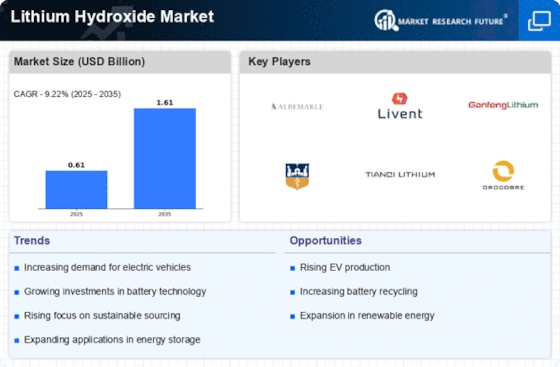
    As per MRFR analysis, the Lithium Hydroxide Market Size was estimated at 0.61 USD Billion in 2024. The Lithium Hydroxide industry is projected to grow from 0.6663 in 2025 to 1.61 by 2035, exhibiting a compound annual growth rate (CAGR) of 9.22 during the forecast period 2025 - 2035.

    Key Market Trends & Highlights

    The Lithium Hydroxide Market is poised for substantial growth driven by increasing demand across various sectors.

    • North America remains the largest market for lithium hydroxide, primarily fueled by the booming electric vehicle industry. The Asia-Pacific region is emerging as the fastest-growing market, reflecting a surge in electric mobility solutions and battery production. Batteries constitute the largest segment, while lubricant grease is witnessing rapid growth due to technological advancements in extraction. Key market drivers include a surge in battery production and strategic investments in lithium mining, which are essential for meeting rising demand.

    Market Size & Forecast

    2024 Market Size 0.61 (USD Billion)
    2035 Market Size 1.61 (USD Billion)
    CAGR (2025 - 2035) 9.22%
    Largest Regional Market Share in 2024 Europe

    Major Players

    <p>Albemarle Corporation (US), Livent Corporation (US), Ganfeng Lithium Co Ltd (CN), SQM (Sociedad Química y Minera de Chile) (CL), Tianqi Lithium Industries Inc (CN), Orocobre Limited (AU), Galaxy Resources Limited (AU), Nemaska Lithium Inc (CA)</p>

    Market Trends

    The Lithium Hydroxide Market is currently experiencing a notable transformation, driven by the increasing demand for electric vehicles and energy storage solutions. This shift is largely attributed to the global emphasis on sustainable energy and the transition away from fossil fuels. As industries seek to enhance battery performance, lithium hydroxide has emerged as a critical component in the production of lithium-ion batteries. The growing awareness of environmental issues appears to be propelling investments in lithium extraction and processing technologies, which may further stimulate market growth. Moreover, the Lithium Hydroxide Market is witnessing a surge in research and development activities aimed at improving the efficiency of lithium extraction methods. Companies are exploring innovative techniques to reduce costs and environmental impact, which could potentially reshape the competitive landscape. Additionally, partnerships between manufacturers and technology firms are likely to foster advancements in battery technology, thereby enhancing the overall value chain. As the market evolves, it seems poised to play a pivotal role in the broader context of renewable energy and electric mobility.

    Rising Demand for Electric Vehicles

    The Lithium Hydroxide Market is significantly influenced by the escalating demand for electric vehicles. As consumers increasingly prioritize sustainable transportation options, manufacturers are compelled to enhance battery performance, leading to a greater reliance on lithium hydroxide.

    Technological Advancements in Extraction

    Innovations in lithium extraction technologies are emerging as a key trend within the Lithium Hydroxide Market. Companies are investing in research to develop more efficient and environmentally friendly methods, which may enhance production capabilities and reduce costs.

    Strategic Partnerships and Collaborations

    The formation of strategic partnerships between lithium producers and technology firms is becoming more prevalent. These collaborations aim to drive advancements in battery technology, potentially leading to improved performance and efficiency in lithium-ion batteries.

    Lithium Hydroxide Market Market Drivers

    Surge in Battery Production

    The Lithium Hydroxide Market is experiencing a notable surge in battery production, primarily driven by the increasing demand for electric vehicles and renewable energy storage solutions. As manufacturers ramp up production to meet the growing needs of electric vehicle batteries, the demand for lithium hydroxide, a critical component in lithium-ion batteries, is expected to rise significantly. Reports indicate that the battery production capacity is projected to reach over 2,000 GWh by 2030, which could lead to a corresponding increase in lithium hydroxide consumption. This trend suggests that the Lithium Hydroxide Market is poised for substantial growth as it aligns with the broader shift towards sustainable energy solutions.

    Strategic Investments in Lithium Mining

    Strategic investments in lithium mining are crucial for the Lithium Hydroxide Market, as they ensure a stable supply of raw materials. With the increasing demand for lithium hydroxide, mining companies are expanding their operations and exploring new deposits. Recent investments in lithium extraction technologies, such as direct lithium extraction, are expected to enhance production efficiency and reduce environmental impact. Analysts estimate that the lithium supply chain will need to double by 2030 to meet the anticipated demand from battery manufacturers. This scenario highlights the importance of strategic investments in the Lithium Hydroxide Market to secure a sustainable supply of lithium resources.

    Expansion of Renewable Energy Initiatives

    The Lithium Hydroxide Market is likely to benefit from the expansion of renewable energy initiatives worldwide. Governments and organizations are increasingly investing in renewable energy sources, such as solar and wind, which require efficient energy storage systems. Lithium-ion batteries, utilizing lithium hydroxide, are favored for their high energy density and efficiency. As the renewable energy sector continues to grow, the demand for lithium hydroxide is expected to increase, potentially leading to a market growth rate of over 15% annually. This expansion indicates a promising future for the Lithium Hydroxide Market as it supports the transition to cleaner energy alternatives.

    Technological Innovations in Battery Chemistry

    Technological innovations in battery chemistry are playing a pivotal role in shaping the Lithium Hydroxide Market. Advances in lithium-ion battery technology, including the development of high-nickel cathodes, are enhancing the performance and longevity of batteries. These innovations are likely to increase the demand for lithium hydroxide, as it is essential for producing high-performance batteries. The market for lithium-ion batteries is projected to grow at a compound annual growth rate of approximately 20% through 2027, which could significantly impact the lithium hydroxide demand. This trend underscores the importance of ongoing research and development within the Lithium Hydroxide Market.

    Growing Adoption of Electric Mobility Solutions

    The growing adoption of electric mobility solutions is a key driver for the Lithium Hydroxide Market. As urban areas seek to reduce carbon emissions and improve air quality, electric vehicles are becoming increasingly popular. This shift is expected to drive the demand for lithium-ion batteries, which rely heavily on lithium hydroxide. Market analysts predict that the electric vehicle market will reach over 30 million units sold annually by 2030, further amplifying the need for lithium hydroxide. This trend indicates a robust growth trajectory for the Lithium Hydroxide Market as it aligns with the global push towards sustainable transportation.

    Market Segment Insights

    By Application: Batteries (Largest) vs. Lubricant Grease (Fastest-Growing)

    <p>In the Lithium Hydroxide Market, the application segments showcase a diverse market share distribution. Batteries predominantly take the lead as the largest segment, driven by their crucial role in electric vehicles and renewable energy storage solutions. Following batteries, the ceramic glass segment presents a noteworthy presence, utilized in high-performance applications. Lubricant grease and air conditioning segments also contribute significantly, yet they occupy smaller portions of the overall market when compared to the dominant battery segment. Therefore, the distribution highlights the concentrated preference for lithium hydroxide in battery production over other applications. The growth trends within the Lithium Hydroxide Market indicate a robust trajectory for batteries, particularly due to the rise in EV adoption and the global shift toward electrification. The <a href="https://www.marketresearchfuture.com/reports/us-lubricants-market-14596">lubricant</a> grease segment, on the other hand, is emerging as the fastest-growing due to the increasing demand for high-performance lubricants in various industrial applications. Moreover, advancements in lithium hydroxide production technology and its capability to enhance battery efficiency and performance contribute to its expanding applications. Market drivers include the global push for energy sustainability, leading to innovations across different sectors, including ceramic glass where lithium hydroxide enhances thermal stability and strength.</p>

    <p>Batteries: Dominant vs. Lubricant Grease: Emerging</p>

    <p>The batteries segment holds a dominant position within the Lithium Hydroxide Market, primarily due to its extensive use in rechargeable batteries for electric vehicles and energy storage systems. As the demand for electric vehicles surges, the need for lithium hydroxide continues to grow, positioning this segment as critical for future energy solutions. In contrast, the lubricant grease segment is emerging rapidly, fueled by evolving industrial needs for high-performance lubricants that offer enhanced reliability and efficiency. This growth is supported by innovations in formulation that leverage lithium hydroxide, improving the operational lifespan and effectiveness of lubricants in various mechanical applications. Together, these segments illustrate the dynamic landscape of the lithium hydroxide market driven by technological advancements and market demands.</p>

    By End Use: Automotive (Largest) vs. Electrical & Electronics (Fastest-Growing)

    <p>In the Lithium Hydroxide Market, the end-use sectors are primarily distributed among automotive, electrical &amp; electronics, marine, and aerospace applications. The automotive sector commands the largest share, primarily driven by the increasing adoption of electric vehicles (EVs) that utilize lithium-ion batteries requiring high-purity lithium hydroxide. In contrast, the electrical &amp; electronics segment is witnessing rapid growth due to the escalating demand for consumer electronics, which also leverages lithium-ion technology for battery production.</p>

    <p>Automotive: Dominant vs. Electrical &amp; Electronics: Emerging</p>

    <p>The automotive segment stands as the dominant force in the Lithium Hydroxide Market, underpinned by the rapid transition towards electric mobility. This sector is characterized by substantial investments from automotive manufacturers in EV technology, necessitating high-performance lithium-ion batteries, which demand quality lithium hydroxide. Conversely, the electrical &amp; electronics sector emerges with significant growth potential, fueled by rising consumer demand for portable devices and renewable energy storage solutions. This segment is increasingly recognized for its innovative applications, driving competition and technological advancements, ensuring its role as a pivotal player in the lithium hydroxide landscape.</p>

    Get more detailed insights about Lithium Hydroxide Market Research Report- Forecast to 2035

    Regional Insights

    North America : Innovation and Demand Surge

    North America is witnessing a significant surge in the lithium hydroxide market, driven by the booming electric vehicle (EV) sector and stringent environmental regulations. The United States holds the largest market share at approximately 60%, followed by Canada at around 25%. Regulatory support, such as tax incentives for EV production, is further propelling demand for lithium hydroxide, essential for battery manufacturing. The competitive landscape is dominated by key players like Albemarle Corporation and Livent Corporation, both based in the U.S. These companies are investing heavily in production capacity to meet the growing demand. Canada is also emerging as a significant player, with companies like Nemaska Lithium Inc. focusing on sustainable extraction methods. The region's focus on innovation and sustainability is shaping the future of the lithium hydroxide market.

    Europe : Sustainable Growth and Innovation

    Europe is rapidly evolving into a critical hub for lithium hydroxide production, driven by the increasing demand for electric vehicles and renewable energy storage solutions. Germany and France are the largest markets, collectively holding about 50% of the European market share. The European Union's Green Deal and various national policies are catalyzing investments in lithium extraction and processing, aiming for a sustainable supply chain. Leading countries like Germany and France are home to major players such as SQM and Ganfeng Lithium, which are expanding their operations to meet local demand. The competitive landscape is characterized by partnerships between automotive manufacturers and lithium producers, ensuring a steady supply of lithium hydroxide for battery production. This collaboration is crucial for achieving the EU's ambitious climate goals.

    Asia-Pacific : Emerging Market Dynamics

    Asia-Pacific is emerging as a powerhouse in the lithium hydroxide market, primarily driven by the rapid growth of the electric vehicle industry in China. China holds the largest market share in the region at approximately 70%, followed by Australia at around 20%. Government initiatives promoting electric mobility and renewable energy are key growth drivers, alongside increasing investments in lithium extraction technologies. China's dominance is complemented by significant players like Tianqi Lithium Industries and Ganfeng Lithium, which are expanding their production capabilities. Australia is also becoming a vital player, with companies like Orocobre Limited and Galaxy Resources focusing on sustainable mining practices. The competitive landscape is marked by strategic partnerships and joint ventures aimed at enhancing production efficiency and meeting the surging demand for lithium hydroxide.

    Middle East and Africa : Resource-Rich Opportunities

    The Middle East and Africa region is beginning to tap into its lithium hydroxide potential, driven by increasing global demand for electric vehicles and energy storage solutions. Countries like Zimbabwe and Namibia are emerging as key players, with Zimbabwe holding approximately 30% of the regional market share. The region's rich mineral resources and favorable mining regulations are attracting foreign investments, fostering growth in lithium production. Zimbabwe is home to significant lithium deposits, with companies like Prospect Resources leading the charge in extraction efforts. Namibia is also gaining attention with its favorable investment climate. The competitive landscape is evolving, with new entrants looking to capitalize on the region's untapped resources. As global demand for lithium hydroxide continues to rise, the Middle East and Africa are poised to become important players in the market.

    Key Players and Competitive Insights

    The Lithium Hydroxide Market is currently characterized by a dynamic competitive landscape, driven by the increasing demand for electric vehicle (EV) batteries and energy storage solutions. Key players such as Albemarle Corporation (US), Livent Corporation (US), and Ganfeng Lithium Co Ltd (CN) are strategically positioning themselves to capitalize on this growth. Albemarle Corporation (US) focuses on innovation and expanding its production capabilities, while Livent Corporation (US) emphasizes sustainable practices and partnerships to enhance its market presence. Ganfeng Lithium Co Ltd (CN) is actively pursuing regional expansion and vertical integration, which collectively shapes a competitive environment that is increasingly focused on sustainability and technological advancement.

    In terms of business tactics, companies are localizing manufacturing and optimizing supply chains to enhance efficiency and reduce costs. The market structure appears moderately fragmented, with several key players exerting influence over pricing and supply dynamics. This fragmentation allows for a variety of strategies to coexist, fostering competition that drives innovation and operational excellence among the leading firms.

    In August 2025, Albemarle Corporation (US) announced the opening of a new lithium hydroxide processing facility in North Carolina, aimed at increasing its production capacity to meet the surging demand from the EV sector. This strategic move not only enhances Albemarle's operational capabilities but also positions the company as a key supplier in the North American market, potentially reducing reliance on imports and bolstering local supply chains.

    In September 2025, Livent Corporation (US) entered into a strategic partnership with a major automotive manufacturer to supply lithium hydroxide for their upcoming line of electric vehicles. This collaboration underscores Livent's commitment to sustainability and innovation, as it aligns with the automotive industry's shift towards greener technologies. Such partnerships are likely to enhance Livent's market share and reinforce its reputation as a leader in sustainable lithium production.

    In July 2025, Ganfeng Lithium Co Ltd (CN) completed the acquisition of a lithium hydroxide production facility in Australia, significantly expanding its operational footprint. This acquisition is strategically important as it not only increases Ganfeng's production capacity but also enhances its ability to serve the growing demand in the Asia-Pacific region. The move reflects Ganfeng's aggressive growth strategy and its focus on securing a stable supply of lithium hydroxide for its customers.

    As of October 2025, current competitive trends in the Lithium Hydroxide Market are increasingly defined by digitalization, sustainability, and the integration of advanced technologies such as AI. Strategic alliances are becoming more prevalent, as companies recognize the importance of collaboration in navigating the complexities of the supply chain and meeting evolving customer demands. Looking ahead, competitive differentiation is likely to evolve from traditional price-based competition to a focus on innovation, technological advancements, and supply chain reliability, as companies strive to establish themselves as leaders in a rapidly changing market.

    Key Companies in the Lithium Hydroxide Market market include

    Industry Developments

    • Q3 2025: CME Lithium Hydroxide Futures Volume Hits Record Highs In July 2025, the Chicago Mercantile Exchange (CME) lithium hydroxide futures contract set an all-time high for monthly trading volume, with 17,013 tonnes traded, reflecting increased market participation and confidence in standardized financial instruments for lithium trading.

    Future Outlook

    Lithium Hydroxide Market Future Outlook

    <p>The Lithium Hydroxide Market is projected to grow at a 9.22% CAGR from 2024 to 2035, driven by increasing demand in electric vehicle batteries and renewable energy storage.</p>

    New opportunities lie in:

    • <p>Expansion of lithium hydroxide production facilities in emerging markets.</p><p>Development of advanced recycling technologies for lithium-ion batteries.</p><p>Strategic partnerships with electric vehicle manufacturers for supply chain integration.</p>

    <p>By 2035, the Lithium Hydroxide Market is expected to be robust, driven by sustainable energy initiatives.</p>

    Market Segmentation

    Lithium Hydroxide Market End Use Outlook

    • Automotive
    • Electrical & Electronics
    • Marine
    • Aerospace

    Lithium Hydroxide Market Application Outlook

    • Batteries
    • Ceramic Glass
    • Lubricant Grease
    • Air Conditioning

    Report Scope

    MARKET SIZE 20240.61(USD Billion)
    MARKET SIZE 20250.6663(USD Billion)
    MARKET SIZE 20351.61(USD Billion)
    COMPOUND ANNUAL GROWTH RATE (CAGR)9.22% (2024 - 2035)
    REPORT COVERAGERevenue Forecast, Competitive Landscape, Growth Factors, and Trends
    BASE YEAR2024
    Market Forecast Period2025 - 2035
    Historical Data2019 - 2024
    Market Forecast UnitsUSD Billion
    Key Companies ProfiledMarket analysis in progress
    Segments CoveredMarket segmentation analysis in progress
    Key Market OpportunitiesGrowing demand for electric vehicle batteries drives expansion in the Lithium Hydroxide Market.
    Key Market DynamicsRising demand for electric vehicles drives competition and innovation in the lithium hydroxide market.
    Countries CoveredNorth America, Europe, APAC, South America, MEA

    FAQs

    What is the projected market valuation of the Lithium Hydroxide Market by 2035?

    The Lithium Hydroxide Market is projected to reach a valuation of 1.61 USD Billion by 2035.

    What was the market valuation of Lithium Hydroxide in 2024?

    In 2024, the Lithium Hydroxide Market was valued at 0.61 USD Billion.

    What is the expected CAGR for the Lithium Hydroxide Market during the forecast period 2025 - 2035?

    The expected CAGR for the Lithium Hydroxide Market during the forecast period 2025 - 2035 is 9.22%.

    Which applications are driving growth in the Lithium Hydroxide Market?

    Key applications driving growth include Batteries, Ceramic Glass, Lubricant Grease, and Air Conditioning.

    What are the projected valuations for the Batteries segment by 2035?

    The Batteries segment is projected to grow from 0.3 USD Billion in 2024 to 0.8 USD Billion by 2035.

    How does the Automotive end-use segment contribute to the market?

    The Automotive end-use segment is expected to increase from 0.25 USD Billion in 2024 to 0.65 USD Billion by 2035.

    Who are the leading players in the Lithium Hydroxide Market?

    Leading players in the Lithium Hydroxide Market include Albemarle Corporation, Livent Corporation, and Ganfeng Lithium Co Ltd.

    What is the projected growth for the Aerospace end-use segment by 2035?

    The Aerospace end-use segment is projected to grow from 0.16 USD Billion in 2024 to 0.41 USD Billion by 2035.

    What is the expected growth trajectory for the Ceramic Glass application?

    The Ceramic Glass application is anticipated to grow from 0.15 USD Billion in 2024 to 0.4 USD Billion by 2035.

    1. SECTION I: EXECUTIVE SUMMARY AND KEY HIGHLIGHTS
      1. | 1.1 EXECUTIVE SUMMARY
      2. | | 1.1.1 Market Overview
      3. | | 1.1.2 Key Findings
      4. | | 1.1.3 Market Segmentation
      5. | | 1.1.4 Competitive Landscape
      6. | | 1.1.5 Challenges and Opportunities
      7. | | 1.1.6 Future Outlook
    2. SECTION II: SCOPING, METHODOLOGY AND MARKET STRUCTURE
      1. | 2.1 MARKET INTRODUCTION
      2. | | 2.1.1 Definition
      3. | | 2.1.2 Scope of the study
      4. | | | 2.1.2.1 Research Objective
      5. | | | 2.1.2.2 Assumption
      6. | | | 2.1.2.3 Limitations
      7. | 2.2 RESEARCH METHODOLOGY
      8. | | 2.2.1 Overview
      9. | | 2.2.2 Data Mining
      10. | | 2.2.3 Secondary Research
      11. | | 2.2.4 Primary Research
      12. | | | 2.2.4.1 Primary Interviews and Information Gathering Process
      13. | | | 2.2.4.2 Breakdown of Primary Respondents
      14. | | 2.2.5 Forecasting Model
      15. | | 2.2.6 Market Size Estimation
      16. | | | 2.2.6.1 Bottom-Up Approach
      17. | | | 2.2.6.2 Top-Down Approach
      18. | | 2.2.7 Data Triangulation
      19. | | 2.2.8 Validation
    3. SECTION III: QUALITATIVE ANALYSIS
      1. | 3.1 MARKET DYNAMICS
      2. | | 3.1.1 Overview
      3. | | 3.1.2 Drivers
      4. | | 3.1.3 Restraints
      5. | | 3.1.4 Opportunities
      6. | 3.2 MARKET FACTOR ANALYSIS
      7. | | 3.2.1 Value chain Analysis
      8. | | 3.2.2 Porter's Five Forces Analysis
      9. | | | 3.2.2.1 Bargaining Power of Suppliers
      10. | | | 3.2.2.2 Bargaining Power of Buyers
      11. | | | 3.2.2.3 Threat of New Entrants
      12. | | | 3.2.2.4 Threat of Substitutes
      13. | | | 3.2.2.5 Intensity of Rivalry
      14. | | 3.2.3 COVID-19 Impact Analysis
      15. | | | 3.2.3.1 Market Impact Analysis
      16. | | | 3.2.3.2 Regional Impact
      17. | | | 3.2.3.3 Opportunity and Threat Analysis
    4. SECTION IV: QUANTITATIVE ANALYSIS
      1. | 4.1 Chemicals and Materials, BY Application (USD Billion)
      2. | | 4.1.1 Batteries
      3. | | 4.1.2 Ceramic Glass
      4. | | 4.1.3 Lubricant Grease
      5. | | 4.1.4 Air Conditioning
      6. | 4.2 Chemicals and Materials, BY End Use (USD Billion)
      7. | | 4.2.1 Automotive
      8. | | 4.2.2 Electrical & Electronics
      9. | | 4.2.3 Marine
      10. | | 4.2.4 Aerospace
      11. | 4.3 Chemicals and Materials, BY Region (USD Billion)
      12. | | 4.3.1 North America
      13. | | | 4.3.1.1 US
      14. | | | 4.3.1.2 Canada
      15. | | 4.3.2 Europe
      16. | | | 4.3.2.1 Germany
      17. | | | 4.3.2.2 UK
      18. | | | 4.3.2.3 France
      19. | | | 4.3.2.4 Russia
      20. | | | 4.3.2.5 Italy
      21. | | | 4.3.2.6 Spain
      22. | | | 4.3.2.7 Rest of Europe
      23. | | 4.3.3 APAC
      24. | | | 4.3.3.1 China
      25. | | | 4.3.3.2 India
      26. | | | 4.3.3.3 Japan
      27. | | | 4.3.3.4 South Korea
      28. | | | 4.3.3.5 Malaysia
      29. | | | 4.3.3.6 Thailand
      30. | | | 4.3.3.7 Indonesia
      31. | | | 4.3.3.8 Rest of APAC
      32. | | 4.3.4 South America
      33. | | | 4.3.4.1 Brazil
      34. | | | 4.3.4.2 Mexico
      35. | | | 4.3.4.3 Argentina
      36. | | | 4.3.4.4 Rest of South America
      37. | | 4.3.5 MEA
      38. | | | 4.3.5.1 GCC Countries
      39. | | | 4.3.5.2 South Africa
      40. | | | 4.3.5.3 Rest of MEA
    5. SECTION V: COMPETITIVE ANALYSIS
      1. | 5.1 Competitive Landscape
      2. | | 5.1.1 Overview
      3. | | 5.1.2 Competitive Analysis
      4. | | 5.1.3 Market share Analysis
      5. | | 5.1.4 Major Growth Strategy in the Chemicals and Materials
      6. | | 5.1.5 Competitive Benchmarking
      7. | | 5.1.6 Leading Players in Terms of Number of Developments in the Chemicals and Materials
      8. | | 5.1.7 Key developments and growth strategies
      9. | | | 5.1.7.1 New Product Launch/Service Deployment
      10. | | | 5.1.7.2 Merger & Acquisitions
      11. | | | 5.1.7.3 Joint Ventures
      12. | | 5.1.8 Major Players Financial Matrix
      13. | | | 5.1.8.1 Sales and Operating Income
      14. | | | 5.1.8.2 Major Players R&D Expenditure. 2023
      15. | 5.2 Company Profiles
      16. | | 5.2.1 Albemarle Corporation (US)
      17. | | | 5.2.1.1 Financial Overview
      18. | | | 5.2.1.2 Products Offered
      19. | | | 5.2.1.3 Key Developments
      20. | | | 5.2.1.4 SWOT Analysis
      21. | | | 5.2.1.5 Key Strategies
      22. | | 5.2.2 Livent Corporation (US)
      23. | | | 5.2.2.1 Financial Overview
      24. | | | 5.2.2.2 Products Offered
      25. | | | 5.2.2.3 Key Developments
      26. | | | 5.2.2.4 SWOT Analysis
      27. | | | 5.2.2.5 Key Strategies
      28. | | 5.2.3 Ganfeng Lithium Co Ltd (CN)
      29. | | | 5.2.3.1 Financial Overview
      30. | | | 5.2.3.2 Products Offered
      31. | | | 5.2.3.3 Key Developments
      32. | | | 5.2.3.4 SWOT Analysis
      33. | | | 5.2.3.5 Key Strategies
      34. | | 5.2.4 SQM (Sociedad Química y Minera de Chile) (CL)
      35. | | | 5.2.4.1 Financial Overview
      36. | | | 5.2.4.2 Products Offered
      37. | | | 5.2.4.3 Key Developments
      38. | | | 5.2.4.4 SWOT Analysis
      39. | | | 5.2.4.5 Key Strategies
      40. | | 5.2.5 Tianqi Lithium Industries Inc (CN)
      41. | | | 5.2.5.1 Financial Overview
      42. | | | 5.2.5.2 Products Offered
      43. | | | 5.2.5.3 Key Developments
      44. | | | 5.2.5.4 SWOT Analysis
      45. | | | 5.2.5.5 Key Strategies
      46. | | 5.2.6 Orocobre Limited (AU)
      47. | | | 5.2.6.1 Financial Overview
      48. | | | 5.2.6.2 Products Offered
      49. | | | 5.2.6.3 Key Developments
      50. | | | 5.2.6.4 SWOT Analysis
      51. | | | 5.2.6.5 Key Strategies
      52. | | 5.2.7 Galaxy Resources Limited (AU)
      53. | | | 5.2.7.1 Financial Overview
      54. | | | 5.2.7.2 Products Offered
      55. | | | 5.2.7.3 Key Developments
      56. | | | 5.2.7.4 SWOT Analysis
      57. | | | 5.2.7.5 Key Strategies
      58. | | 5.2.8 Nemaska Lithium Inc (CA)
      59. | | | 5.2.8.1 Financial Overview
      60. | | | 5.2.8.2 Products Offered
      61. | | | 5.2.8.3 Key Developments
      62. | | | 5.2.8.4 SWOT Analysis
      63. | | | 5.2.8.5 Key Strategies
      64. | 5.3 Appendix
      65. | | 5.3.1 References
      66. | | 5.3.2 Related Reports
    6. LIST OF FIGURES
      1. | 6.1 MARKET SYNOPSIS
      2. | 6.2 NORTH AMERICA MARKET ANALYSIS
      3. | 6.3 US MARKET ANALYSIS BY APPLICATION
      4. | 6.4 US MARKET ANALYSIS BY END USE
      5. | 6.5 CANADA MARKET ANALYSIS BY APPLICATION
      6. | 6.6 CANADA MARKET ANALYSIS BY END USE
      7. | 6.7 EUROPE MARKET ANALYSIS
      8. | 6.8 GERMANY MARKET ANALYSIS BY APPLICATION
      9. | 6.9 GERMANY MARKET ANALYSIS BY END USE
      10. | 6.10 UK MARKET ANALYSIS BY APPLICATION
      11. | 6.11 UK MARKET ANALYSIS BY END USE
      12. | 6.12 FRANCE MARKET ANALYSIS BY APPLICATION
      13. | 6.13 FRANCE MARKET ANALYSIS BY END USE
      14. | 6.14 RUSSIA MARKET ANALYSIS BY APPLICATION
      15. | 6.15 RUSSIA MARKET ANALYSIS BY END USE
      16. | 6.16 ITALY MARKET ANALYSIS BY APPLICATION
      17. | 6.17 ITALY MARKET ANALYSIS BY END USE
      18. | 6.18 SPAIN MARKET ANALYSIS BY APPLICATION
      19. | 6.19 SPAIN MARKET ANALYSIS BY END USE
      20. | 6.20 REST OF EUROPE MARKET ANALYSIS BY APPLICATION
      21. | 6.21 REST OF EUROPE MARKET ANALYSIS BY END USE
      22. | 6.22 APAC MARKET ANALYSIS
      23. | 6.23 CHINA MARKET ANALYSIS BY APPLICATION
      24. | 6.24 CHINA MARKET ANALYSIS BY END USE
      25. | 6.25 INDIA MARKET ANALYSIS BY APPLICATION
      26. | 6.26 INDIA MARKET ANALYSIS BY END USE
      27. | 6.27 JAPAN MARKET ANALYSIS BY APPLICATION
      28. | 6.28 JAPAN MARKET ANALYSIS BY END USE
      29. | 6.29 SOUTH KOREA MARKET ANALYSIS BY APPLICATION
      30. | 6.30 SOUTH KOREA MARKET ANALYSIS BY END USE
      31. | 6.31 MALAYSIA MARKET ANALYSIS BY APPLICATION
      32. | 6.32 MALAYSIA MARKET ANALYSIS BY END USE
      33. | 6.33 THAILAND MARKET ANALYSIS BY APPLICATION
      34. | 6.34 THAILAND MARKET ANALYSIS BY END USE
      35. | 6.35 INDONESIA MARKET ANALYSIS BY APPLICATION
      36. | 6.36 INDONESIA MARKET ANALYSIS BY END USE
      37. | 6.37 REST OF APAC MARKET ANALYSIS BY APPLICATION
      38. | 6.38 REST OF APAC MARKET ANALYSIS BY END USE
      39. | 6.39 SOUTH AMERICA MARKET ANALYSIS
      40. | 6.40 BRAZIL MARKET ANALYSIS BY APPLICATION
      41. | 6.41 BRAZIL MARKET ANALYSIS BY END USE
      42. | 6.42 MEXICO MARKET ANALYSIS BY APPLICATION
      43. | 6.43 MEXICO MARKET ANALYSIS BY END USE
      44. | 6.44 ARGENTINA MARKET ANALYSIS BY APPLICATION
      45. | 6.45 ARGENTINA MARKET ANALYSIS BY END USE
      46. | 6.46 REST OF SOUTH AMERICA MARKET ANALYSIS BY APPLICATION
      47. | 6.47 REST OF SOUTH AMERICA MARKET ANALYSIS BY END USE
      48. | 6.48 MEA MARKET ANALYSIS
      49. | 6.49 GCC COUNTRIES MARKET ANALYSIS BY APPLICATION
      50. | 6.50 GCC COUNTRIES MARKET ANALYSIS BY END USE
      51. | 6.51 SOUTH AFRICA MARKET ANALYSIS BY APPLICATION
      52. | 6.52 SOUTH AFRICA MARKET ANALYSIS BY END USE
      53. | 6.53 REST OF MEA MARKET ANALYSIS BY APPLICATION
      54. | 6.54 REST OF MEA MARKET ANALYSIS BY END USE
      55. | 6.55 KEY BUYING CRITERIA OF CHEMICALS AND MATERIALS
      56. | 6.56 RESEARCH PROCESS OF MRFR
      57. | 6.57 DRO ANALYSIS OF CHEMICALS AND MATERIALS
      58. | 6.58 DRIVERS IMPACT ANALYSIS: CHEMICALS AND MATERIALS
      59. | 6.59 RESTRAINTS IMPACT ANALYSIS: CHEMICALS AND MATERIALS
      60. | 6.60 SUPPLY / VALUE CHAIN: CHEMICALS AND MATERIALS
      61. | 6.61 CHEMICALS AND MATERIALS, BY APPLICATION, 2024 (% SHARE)
      62. | 6.62 CHEMICALS AND MATERIALS, BY APPLICATION, 2024 TO 2035 (USD Billion)
      63. | 6.63 CHEMICALS AND MATERIALS, BY END USE, 2024 (% SHARE)
      64. | 6.64 CHEMICALS AND MATERIALS, BY END USE, 2024 TO 2035 (USD Billion)
      65. | 6.65 BENCHMARKING OF MAJOR COMPETITORS
    7. LIST OF TABLES
      1. | 7.1 LIST OF ASSUMPTIONS
      2. | | 7.1.1
      3. | 7.2 North America MARKET SIZE ESTIMATES; FORECAST
      4. | | 7.2.1 BY APPLICATION, 2025-2035 (USD Billion)
      5. | | 7.2.2 BY END USE, 2025-2035 (USD Billion)
      6. | 7.3 US MARKET SIZE ESTIMATES; FORECAST
      7. | | 7.3.1 BY APPLICATION, 2025-2035 (USD Billion)
      8. | | 7.3.2 BY END USE, 2025-2035 (USD Billion)
      9. | 7.4 Canada MARKET SIZE ESTIMATES; FORECAST
      10. | | 7.4.1 BY APPLICATION, 2025-2035 (USD Billion)
      11. | | 7.4.2 BY END USE, 2025-2035 (USD Billion)
      12. | 7.5 Europe MARKET SIZE ESTIMATES; FORECAST
      13. | | 7.5.1 BY APPLICATION, 2025-2035 (USD Billion)
      14. | | 7.5.2 BY END USE, 2025-2035 (USD Billion)
      15. | 7.6 Germany MARKET SIZE ESTIMATES; FORECAST
      16. | | 7.6.1 BY APPLICATION, 2025-2035 (USD Billion)
      17. | | 7.6.2 BY END USE, 2025-2035 (USD Billion)
      18. | 7.7 UK MARKET SIZE ESTIMATES; FORECAST
      19. | | 7.7.1 BY APPLICATION, 2025-2035 (USD Billion)
      20. | | 7.7.2 BY END USE, 2025-2035 (USD Billion)
      21. | 7.8 France MARKET SIZE ESTIMATES; FORECAST
      22. | | 7.8.1 BY APPLICATION, 2025-2035 (USD Billion)
      23. | | 7.8.2 BY END USE, 2025-2035 (USD Billion)
      24. | 7.9 Russia MARKET SIZE ESTIMATES; FORECAST
      25. | | 7.9.1 BY APPLICATION, 2025-2035 (USD Billion)
      26. | | 7.9.2 BY END USE, 2025-2035 (USD Billion)
      27. | 7.10 Italy MARKET SIZE ESTIMATES; FORECAST
      28. | | 7.10.1 BY APPLICATION, 2025-2035 (USD Billion)
      29. | | 7.10.2 BY END USE, 2025-2035 (USD Billion)
      30. | 7.11 Spain MARKET SIZE ESTIMATES; FORECAST
      31. | | 7.11.1 BY APPLICATION, 2025-2035 (USD Billion)
      32. | | 7.11.2 BY END USE, 2025-2035 (USD Billion)
      33. | 7.12 Rest of Europe MARKET SIZE ESTIMATES; FORECAST
      34. | | 7.12.1 BY APPLICATION, 2025-2035 (USD Billion)
      35. | | 7.12.2 BY END USE, 2025-2035 (USD Billion)
      36. | 7.13 APAC MARKET SIZE ESTIMATES; FORECAST
      37. | | 7.13.1 BY APPLICATION, 2025-2035 (USD Billion)
      38. | | 7.13.2 BY END USE, 2025-2035 (USD Billion)
      39. | 7.14 China MARKET SIZE ESTIMATES; FORECAST
      40. | | 7.14.1 BY APPLICATION, 2025-2035 (USD Billion)
      41. | | 7.14.2 BY END USE, 2025-2035 (USD Billion)
      42. | 7.15 India MARKET SIZE ESTIMATES; FORECAST
      43. | | 7.15.1 BY APPLICATION, 2025-2035 (USD Billion)
      44. | | 7.15.2 BY END USE, 2025-2035 (USD Billion)
      45. | 7.16 Japan MARKET SIZE ESTIMATES; FORECAST
      46. | | 7.16.1 BY APPLICATION, 2025-2035 (USD Billion)
      47. | | 7.16.2 BY END USE, 2025-2035 (USD Billion)
      48. | 7.17 South Korea MARKET SIZE ESTIMATES; FORECAST
      49. | | 7.17.1 BY APPLICATION, 2025-2035 (USD Billion)
      50. | | 7.17.2 BY END USE, 2025-2035 (USD Billion)
      51. | 7.18 Malaysia MARKET SIZE ESTIMATES; FORECAST
      52. | | 7.18.1 BY APPLICATION, 2025-2035 (USD Billion)
      53. | | 7.18.2 BY END USE, 2025-2035 (USD Billion)
      54. | 7.19 Thailand MARKET SIZE ESTIMATES; FORECAST
      55. | | 7.19.1 BY APPLICATION, 2025-2035 (USD Billion)
      56. | | 7.19.2 BY END USE, 2025-2035 (USD Billion)
      57. | 7.20 Indonesia MARKET SIZE ESTIMATES; FORECAST
      58. | | 7.20.1 BY APPLICATION, 2025-2035 (USD Billion)
      59. | | 7.20.2 BY END USE, 2025-2035 (USD Billion)
      60. | 7.21 Rest of APAC MARKET SIZE ESTIMATES; FORECAST
      61. | | 7.21.1 BY APPLICATION, 2025-2035 (USD Billion)
      62. | | 7.21.2 BY END USE, 2025-2035 (USD Billion)
      63. | 7.22 South America MARKET SIZE ESTIMATES; FORECAST
      64. | | 7.22.1 BY APPLICATION, 2025-2035 (USD Billion)
      65. | | 7.22.2 BY END USE, 2025-2035 (USD Billion)
      66. | 7.23 Brazil MARKET SIZE ESTIMATES; FORECAST
      67. | | 7.23.1 BY APPLICATION, 2025-2035 (USD Billion)
      68. | | 7.23.2 BY END USE, 2025-2035 (USD Billion)
      69. | 7.24 Mexico MARKET SIZE ESTIMATES; FORECAST
      70. | | 7.24.1 BY APPLICATION, 2025-2035 (USD Billion)
      71. | | 7.24.2 BY END USE, 2025-2035 (USD Billion)
      72. | 7.25 Argentina MARKET SIZE ESTIMATES; FORECAST
      73. | | 7.25.1 BY APPLICATION, 2025-2035 (USD Billion)
      74. | | 7.25.2 BY END USE, 2025-2035 (USD Billion)
      75. | 7.26 Rest of South America MARKET SIZE ESTIMATES; FORECAST
      76. | | 7.26.1 BY APPLICATION, 2025-2035 (USD Billion)
      77. | | 7.26.2 BY END USE, 2025-2035 (USD Billion)
      78. | 7.27 MEA MARKET SIZE ESTIMATES; FORECAST
      79. | | 7.27.1 BY APPLICATION, 2025-2035 (USD Billion)
      80. | | 7.27.2 BY END USE, 2025-2035 (USD Billion)
      81. | 7.28 GCC Countries MARKET SIZE ESTIMATES; FORECAST
      82. | | 7.28.1 BY APPLICATION, 2025-2035 (USD Billion)
      83. | | 7.28.2 BY END USE, 2025-2035 (USD Billion)
      84. | 7.29 South Africa MARKET SIZE ESTIMATES; FORECAST
      85. | | 7.29.1 BY APPLICATION, 2025-2035 (USD Billion)
      86. | | 7.29.2 BY END USE, 2025-2035 (USD Billion)
      87. | 7.30 Rest of MEA MARKET SIZE ESTIMATES; FORECAST
      88. | | 7.30.1 BY APPLICATION, 2025-2035 (USD Billion)
      89. | | 7.30.2 BY END USE, 2025-2035 (USD Billion)
      90. | 7.31 PRODUCT LAUNCH/PRODUCT DEVELOPMENT/APPROVAL
      91. | | 7.31.1
      92. | 7.32 ACQUISITION/PARTNERSHIP
      93. | | 7.32.1

    Lithium Hydroxide Market Segmentation


    Lithium Hydroxide Market By Application (USD Billion, 2019-2035)

    Batteries

    Ceramic Glass

    Lubricant Grease

    Air conditioning


    Lithium Hydroxide Market By End Use (USD Billion, 2019-2035)

    Automotive

    Electrical & Electronics

    Marine

    Aerospace


    Lithium Hydroxide Market By Regional (USD Billion, 2019-2035)

    North America

    Europe

    South America

    Asia Pacific

    Middle East and Africa


    Lithium Hydroxide Market Regional Outlook (USD Billion, 2019-2035)


    North America Outlook (USD Billion, 2019-2035)

    North America Lithium Hydroxide Market by Application Type

    Batteries

    Ceramic Glass

    Lubricant Grease

    Air conditioning

    North America Lithium Hydroxide Market by End Use Type

    Automotive

    Electrical & Electronics

    Marine

    Aerospace

    North America Lithium Hydroxide Market by Regional Type

    US

    Canada

    US Outlook (USD Billion, 2019-2035)

    US Lithium Hydroxide Market by Application Type

    Batteries

    Ceramic Glass

    Lubricant Grease

    Air conditioning

    US Lithium Hydroxide Market by End Use Type

    Automotive

    Electrical & Electronics

    Marine

    Aerospace

    CANADA Outlook (USD Billion, 2019-2035)

    CANADA Lithium Hydroxide Market by Application Type

    Batteries

    Ceramic Glass

    Lubricant Grease

    Air conditioning

    CANADA Lithium Hydroxide Market by End Use Type

    Automotive

    Electrical & Electronics

    Marine

    Aerospace

    Europe Outlook (USD Billion, 2019-2035)

    Europe Lithium Hydroxide Market by Application Type

    Batteries

    Ceramic Glass

    Lubricant Grease

    Air conditioning

    Europe Lithium Hydroxide Market by End Use Type

    Automotive

    Electrical & Electronics

    Marine

    Aerospace

    Europe Lithium Hydroxide Market by Regional Type

    Germany

    UK

    France

    Russia

    Italy

    Spain

    Rest of Europe

    GERMANY Outlook (USD Billion, 2019-2035)

    GERMANY Lithium Hydroxide Market by Application Type

    Batteries

    Ceramic Glass

    Lubricant Grease

    Air conditioning

    GERMANY Lithium Hydroxide Market by End Use Type

    Automotive

    Electrical & Electronics

    Marine

    Aerospace

    UK Outlook (USD Billion, 2019-2035)

    UK Lithium Hydroxide Market by Application Type

    Batteries

    Ceramic Glass

    Lubricant Grease

    Air conditioning

    UK Lithium Hydroxide Market by End Use Type

    Automotive

    Electrical & Electronics

    Marine

    Aerospace

    FRANCE Outlook (USD Billion, 2019-2035)

    FRANCE Lithium Hydroxide Market by Application Type

    Batteries

    Ceramic Glass

    Lubricant Grease

    Air conditioning

    FRANCE Lithium Hydroxide Market by End Use Type

    Automotive

    Electrical & Electronics

    Marine

    Aerospace

    RUSSIA Outlook (USD Billion, 2019-2035)

    RUSSIA Lithium Hydroxide Market by Application Type

    Batteries

    Ceramic Glass

    Lubricant Grease

    Air conditioning

    RUSSIA Lithium Hydroxide Market by End Use Type

    Automotive

    Electrical & Electronics

    Marine

    Aerospace

    ITALY Outlook (USD Billion, 2019-2035)

    ITALY Lithium Hydroxide Market by Application Type

    Batteries

    Ceramic Glass

    Lubricant Grease

    Air conditioning

    ITALY Lithium Hydroxide Market by End Use Type

    Automotive

    Electrical & Electronics

    Marine

    Aerospace

    SPAIN Outlook (USD Billion, 2019-2035)

    SPAIN Lithium Hydroxide Market by Application Type

    Batteries

    Ceramic Glass

    Lubricant Grease

    Air conditioning

    SPAIN Lithium Hydroxide Market by End Use Type

    Automotive

    Electrical & Electronics

    Marine

    Aerospace

    REST OF EUROPE Outlook (USD Billion, 2019-2035)

    REST OF EUROPE Lithium Hydroxide Market by Application Type

    Batteries

    Ceramic Glass

    Lubricant Grease

    Air conditioning

    REST OF EUROPE Lithium Hydroxide Market by End Use Type

    Automotive

    Electrical & Electronics

    Marine

    Aerospace

    APAC Outlook (USD Billion, 2019-2035)

    APAC Lithium Hydroxide Market by Application Type

    Batteries

    Ceramic Glass

    Lubricant Grease

    Air conditioning

    APAC Lithium Hydroxide Market by End Use Type

    Automotive

    Electrical & Electronics

    Marine

    Aerospace

    APAC Lithium Hydroxide Market by Regional Type

    China

    India

    Japan

    South Korea

    Malaysia

    Thailand

    Indonesia

    Rest of APAC

    CHINA Outlook (USD Billion, 2019-2035)

    CHINA Lithium Hydroxide Market by Application Type

    Batteries

    Ceramic Glass

    Lubricant Grease

    Air conditioning

    CHINA Lithium Hydroxide Market by End Use Type

    Automotive

    Electrical & Electronics

    Marine

    Aerospace

    INDIA Outlook (USD Billion, 2019-2035)

    INDIA Lithium Hydroxide Market by Application Type

    Batteries

    Ceramic Glass

    Lubricant Grease

    Air conditioning

    INDIA Lithium Hydroxide Market by End Use Type

    Automotive

    Electrical & Electronics

    Marine

    Aerospace

    JAPAN Outlook (USD Billion, 2019-2035)

    JAPAN Lithium Hydroxide Market by Application Type

    Batteries

    Ceramic Glass

    Lubricant Grease

    Air conditioning

    JAPAN Lithium Hydroxide Market by End Use Type

    Automotive

    Electrical & Electronics

    Marine

    Aerospace

    SOUTH KOREA Outlook (USD Billion, 2019-2035)

    SOUTH KOREA Lithium Hydroxide Market by Application Type

    Batteries

    Ceramic Glass

    Lubricant Grease

    Air conditioning

    SOUTH KOREA Lithium Hydroxide Market by End Use Type

    Automotive

    Electrical & Electronics

    Marine

    Aerospace

    MALAYSIA Outlook (USD Billion, 2019-2035)

    MALAYSIA Lithium Hydroxide Market by Application Type

    Batteries

    Ceramic Glass

    Lubricant Grease

    Air conditioning

    MALAYSIA Lithium Hydroxide Market by End Use Type

    Automotive

    Electrical & Electronics

    Marine

    Aerospace

    THAILAND Outlook (USD Billion, 2019-2035)

    THAILAND Lithium Hydroxide Market by Application Type

    Batteries

    Ceramic Glass

    Lubricant Grease

    Air conditioning

    THAILAND Lithium Hydroxide Market by End Use Type

    Automotive

    Electrical & Electronics

    Marine

    Aerospace

    INDONESIA Outlook (USD Billion, 2019-2035)

    INDONESIA Lithium Hydroxide Market by Application Type

    Batteries

    Ceramic Glass

    Lubricant Grease

    Air conditioning

    INDONESIA Lithium Hydroxide Market by End Use Type

    Automotive

    Electrical & Electronics

    Marine

    Aerospace

    REST OF APAC Outlook (USD Billion, 2019-2035)

    REST OF APAC Lithium Hydroxide Market by Application Type

    Batteries

    Ceramic Glass

    Lubricant Grease

    Air conditioning

    REST OF APAC Lithium Hydroxide Market by End Use Type

    Automotive

    Electrical & Electronics

    Marine

    Aerospace

    South America Outlook (USD Billion, 2019-2035)

    South America Lithium Hydroxide Market by Application Type

    Batteries

    Ceramic Glass

    Lubricant Grease

    Air conditioning

    South America Lithium Hydroxide Market by End Use Type

    Automotive

    Electrical & Electronics

    Marine

    Aerospace

    South America Lithium Hydroxide Market by Regional Type

    Brazil

    Mexico

    Argentina

    Rest of South America

    BRAZIL Outlook (USD Billion, 2019-2035)

    BRAZIL Lithium Hydroxide Market by Application Type

    Batteries

    Ceramic Glass

    Lubricant Grease

    Air conditioning

    BRAZIL Lithium Hydroxide Market by End Use Type

    Automotive

    Electrical & Electronics

    Marine

    Aerospace

    MEXICO Outlook (USD Billion, 2019-2035)

    MEXICO Lithium Hydroxide Market by Application Type

    Batteries

    Ceramic Glass

    Lubricant Grease

    Air conditioning

    MEXICO Lithium Hydroxide Market by End Use Type

    Automotive

    Electrical & Electronics

    Marine

    Aerospace

    ARGENTINA Outlook (USD Billion, 2019-2035)

    ARGENTINA Lithium Hydroxide Market by Application Type

    Batteries

    Ceramic Glass

    Lubricant Grease

    Air conditioning

    ARGENTINA Lithium Hydroxide Market by End Use Type

    Automotive

    Electrical & Electronics

    Marine

    Aerospace

    REST OF SOUTH AMERICA Outlook (USD Billion, 2019-2035)

    REST OF SOUTH AMERICA Lithium Hydroxide Market by Application Type

    Batteries

    Ceramic Glass

    Lubricant Grease

    Air conditioning

    REST OF SOUTH AMERICA Lithium Hydroxide Market by End Use Type

    Automotive

    Electrical & Electronics

    Marine

    Aerospace

    MEA Outlook (USD Billion, 2019-2035)

    MEA Lithium Hydroxide Market by Application Type

    Batteries

    Ceramic Glass

    Lubricant Grease

    Air conditioning

    MEA Lithium Hydroxide Market by End Use Type

    Automotive

    Electrical & Electronics

    Marine

    Aerospace

    MEA Lithium Hydroxide Market by Regional Type

    GCC Countries

    South Africa

    Rest of MEA

    GCC COUNTRIES Outlook (USD Billion, 2019-2035)

    GCC COUNTRIES Lithium Hydroxide Market by Application Type

    Batteries

    Ceramic Glass

    Lubricant Grease

    Air conditioning

    GCC COUNTRIES Lithium Hydroxide Market by End Use Type

    Automotive

    Electrical & Electronics

    Marine

    Aerospace

    SOUTH AFRICA Outlook (USD Billion, 2019-2035)

    SOUTH AFRICA Lithium Hydroxide Market by Application Type

    Batteries

    Ceramic Glass

    Lubricant Grease

    Air conditioning

    SOUTH AFRICA Lithium Hydroxide Market by End Use Type

    Automotive

    Electrical & Electronics

    Marine

    Aerospace

    REST OF MEA Outlook (USD Billion, 2019-2035)

    REST OF MEA Lithium Hydroxide Market by Application Type

    Batteries

    Ceramic Glass

    Lubricant Grease

    Air conditioning

    REST OF MEA Lithium Hydroxide Market by End Use Type

    Automotive

    Electrical & Electronics

    Marine

    Aerospace


    Infographic

    Free Sample Request

    Kindly complete the form below to receive a free sample of this Report

    Get Free Sample

    Customer Strories

    “I am very pleased with how market segments have been defined in a relevant way for my purposes (such as "Portable Freezers & refrigerators" and "last-mile"). In general the report is well structured. Thanks very much for your efforts.”

    Victoria Milne

    Founder
    Case Study
    Chemicals and Materials

    Compare Licence

    ×
    Features License Type
    Single User Multiuser License Enterprise User
    Price $4,950 $5,950 $7,250
    Maximum User Access Limit 1 User Upto 10 Users Unrestricted Access Throughout the Organization
    Free Customization
    Direct Access to Analyst
    Deliverable Format
    Platform Access
    Discount on Next Purchase 10% 15% 15%
    Printable Versions