×
Request Free Sample ×

Kindly complete the form below to receive a free sample of this Report

* Please use a valid business email

Leading companies partner with us for data-driven Insights

clients tt-cursor
Hero Background
English
Chinese
French
Japanese
Korean
German
Spanish

LDL Test Market Size

ID: MRFR/LS/2871-HCR
80 Pages
Rahul Gotadki
October 2025

LDL Test Market Research Report Information: By Types (LDL-C, LDL-P, LDL-B And Others) By Components (Devices, Kits & Reagents And Others) By Application (Atherosclerosis, Obesity, Dyslipidemia, Diabetes, Angina, Stroke, Carotid Artery Disease, Peripheral Arterial Disease, Others) And By End Users- Global Forecast Till 2035

Share:
Download PDF ×

We do not share your information with anyone. However, we may send you emails based on your report interest from time to time. You may contact us at any time to opt-out.

LDL Test Market Infographic
×
LDL Test Market Infographic Full View
Purchase Options

Ldl Test Size

LDL Test Market Growth Projections and Opportunities

 The LDL test market is influenced by several key factors that drive its growth and development. Firstly, the rising prevalence of cardiovascular diseases (CVDs) worldwide contributes significantly to the expansion of the LDL test market. Elevated levels of low-density lipoprotein (LDL) cholesterol, often referred to as "bad" cholesterol, are a major risk factor for CVDs such as coronary artery disease, stroke, and peripheral artery disease. As the incidence of these conditions continues to rise globally, there is a growing demand for accurate and reliable LDL testing to assess cardiovascular risk and guide treatment decisions. This increasing disease burden drives the adoption of LDL tests, stimulating market growth.

Secondly, growing awareness about the importance of cholesterol management and preventive healthcare measures also fuels market expansion. Healthcare organizations and governments worldwide are actively promoting initiatives to raise awareness about the risks associated with high LDL cholesterol levels and the benefits of early detection and intervention. Public health campaigns, educational programs, and screening initiatives play a crucial role in encouraging individuals to undergo LDL testing as part of routine health assessments. This increased awareness leads to greater demand for LDL tests, driving market growth.

Furthermore, advancements in diagnostic technologies and the introduction of innovative LDL testing methods contribute to market expansion. Manufacturers are continuously developing new and improved LDL testing assays, instruments, and platforms that offer enhanced sensitivity, specificity, and accuracy. These technological innovations enable healthcare providers to obtain more precise LDL cholesterol measurements, thereby improving risk assessment and treatment monitoring for patients with or at risk of CVDs. The availability of advanced LDL testing solutions drives market growth by meeting the evolving needs of healthcare professionals and patients.

Moreover, demographic trends such as aging populations and lifestyle changes also influence the LDL test market. As the global population ages, there is a higher prevalence of age-related risk factors for CVDs, including dyslipidemia and hypertension. Additionally, changes in lifestyle factors such as unhealthy diet habits, physical inactivity, and smoking contribute to the development of dyslipidemia and other cardiovascular risk factors. These demographic and lifestyle trends increase the demand for LDL testing as part of comprehensive cardiovascular risk assessment strategies, thereby driving market growth.

Additionally, government regulations and healthcare policies play a significant role in shaping the LDL test market landscape. Regulatory agencies worldwide establish guidelines and quality standards for the development, manufacturing, and use of LDL testing products to ensure their safety, efficacy, and accuracy. Compliance with these regulations is essential for manufacturers to obtain regulatory approvals and market their LDL testing products. Moreover, reimbursement policies and coverage decisions by government healthcare programs and private insurance providers influence the accessibility and affordability of LDL testing for patients, impacting market dynamics.

On the other hand, challenges such as cost constraints and access barriers may hinder market growth. LDL testing can be expensive, particularly for individuals without adequate insurance coverage or access to healthcare services. Moreover, disparities in healthcare infrastructure and resources in certain regions may limit the availability and accessibility of LDL testing, especially in underserved communities. Addressing these challenges through initiatives to improve healthcare affordability, expand access to diagnostic services, and enhance healthcare infrastructure is essential to unlock the full potential of the LDL test market.

LDL Test Market Size Graph
Author
Rahul Gotadki
Assistant Manager

He holds an experience of about 7+ years in Market Research and Business Consulting, working under the spectrum of Life Sciences and Healthcare domains. Rahul conceptualizes and implements a scalable business strategy and provides strategic leadership to the clients. His expertise lies in market estimation, competitive intelligence, pipeline analysis, customer assessment, etc. In addition to the above, his other responsibility includes strategic tracking of high growth markets & advising clients on the potential areas of focus they could direct their business initiatives

Leave a Comment

FAQs

What would be the LDL test market CAGR during the forecast period of 2022-2030?

LDL test market CAGR would be 6.44% during the forecast period.

Name the LDL test market players included in the report.

LDL test market players included in the report are Express Biotech International, Quest Diagnostics Incorporated, F. Hoffmann-La Roche Ltd, Reckon Diagnostics, Randox Laboratories Ltd, DiaSys Diagnostics India Private Limited, Sekisui Diagnostics, and others.

Which region would be the second largest in LDL test market?

Europe would be the second largest LDL test market.

Who are the end users included in the LDL test market report?

The end users mentioned in the LDL test market report are pharmaceutical and biotechnological companies, hospitals and clinics, and others.

What are the types mentioned in the LDL test market report?

The types mentioned in the LDL test market report are LDL-B, LDL-P, LDL-C, and others.

Market Summary

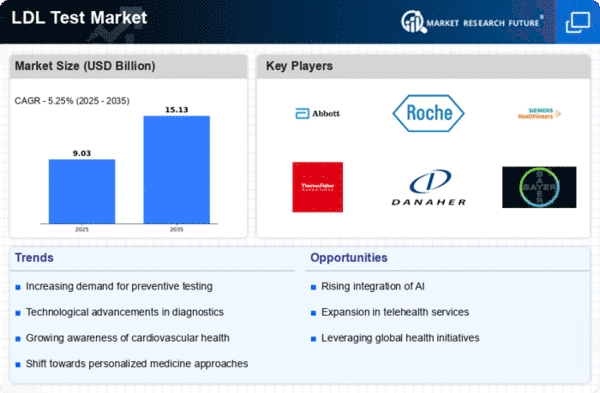
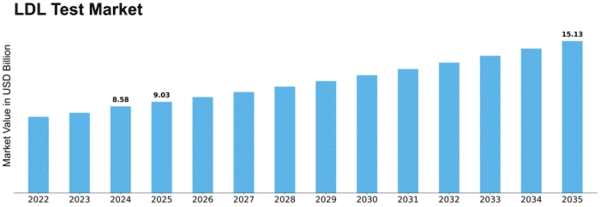
As per MRFR analysis, the LDL Test Market Size was estimated at 8.58 USD Billion in 2024. The LDL Test industry is projected to grow from 9.13 USD Billion in 2025 to 15.13 USD Billion by 2035, exhibiting a compound annual growth rate (CAGR) of 5.25 during the forecast period 2025 - 2035.

Key Market Trends & Highlights

The LDL Test Market is experiencing a dynamic shift driven by health awareness and technological innovations.

  • Rising health awareness is propelling demand for LDL testing across various demographics.
  • Technological advancements are enhancing the accuracy and efficiency of LDL testing methods.
  • The shift to home testing is gaining traction, particularly in the Asia-Pacific region, which is the fastest-growing market.
  • Increasing prevalence of cardiovascular diseases and regulatory support for cholesterol testing are key drivers of market growth.

Market Size & Forecast

2024 Market Size 8.58 (USD Billion)
2035 Market Size 15.13 (USD Billion)
CAGR (2025 - 2035) 5.25%
Largest Regional Market Share in 2024 North America

Major Players

Abbott Laboratories (US), Roche Diagnostics (CH), Siemens Healthineers (DE), Thermo Fisher Scientific (US), Danaher Corporation (US), Bayer AG (DE), PerkinElmer, Inc. (US), Quest Diagnostics (US), LabCorp (US)

Market Trends

The LDL Test Market is currently experiencing a notable evolution, driven by increasing awareness regarding cardiovascular health and the importance of cholesterol management. As healthcare professionals emphasize the need for regular lipid profile assessments, the demand for LDL testing is likely to rise. This trend is further supported by advancements in diagnostic technologies, which enhance the accuracy and efficiency of testing procedures. Moreover, the growing prevalence of lifestyle-related diseases appears to be a significant factor influencing the market dynamics, as individuals seek proactive measures to monitor their health status. In addition, the LDL Test Market is witnessing a shift towards home-based testing solutions, which may provide convenience and accessibility for patients. This trend is indicative of a broader movement towards personalized healthcare, where individuals take an active role in managing their health. Furthermore, the integration of digital health technologies, such as mobile applications and telemedicine, could facilitate better patient engagement and adherence to testing schedules. Overall, the LDL Test Market seems poised for growth, driven by a combination of technological advancements and changing consumer preferences.

Rising Health Awareness

There is a growing consciousness among the population regarding the significance of maintaining optimal cholesterol levels. This awareness is likely to drive individuals to seek regular LDL testing as part of their health management routines.

Technological Advancements

Innovations in diagnostic technologies are enhancing the precision and speed of LDL testing. These advancements may lead to increased adoption of testing services, as healthcare providers and patients alike benefit from improved testing capabilities.

Shift to Home Testing

The trend towards home-based testing solutions is gaining traction, offering patients greater convenience. This shift aligns with the broader movement towards personalized healthcare, allowing individuals to monitor their cholesterol levels more easily.

LDL Test Market Market Drivers

Market Growth Projections

The Global LDL Test Market Industry is projected to experience substantial growth over the coming years. With a market value of 9.02 USD Billion in 2024, it is anticipated to reach 19.1 USD Billion by 2035. This growth reflects a compound annual growth rate of 7.07% from 2025 to 2035. The increasing focus on cardiovascular health, advancements in testing technologies, and heightened awareness of preventive healthcare are key factors contributing to this upward trend. As the market evolves, stakeholders are likely to explore innovative solutions to meet the growing demand for LDL testing.

Regulatory Support and Guidelines

Regulatory bodies are playing a crucial role in shaping the Global LDL Test Market Industry through the establishment of guidelines and recommendations for cholesterol testing. Organizations such as the American Heart Association advocate for routine lipid screening, particularly for individuals at risk of cardiovascular diseases. This regulatory support fosters a conducive environment for market growth, as healthcare providers are encouraged to implement regular testing protocols. Consequently, the market is poised for expansion, with the increasing recognition of LDL testing as a vital component of cardiovascular risk assessment.

Aging Population and Lifestyle Changes

The aging population, coupled with changing lifestyle factors, is a significant driver of the Global LDL Test Market Industry. As individuals age, the risk of developing high cholesterol levels and related health issues increases. Additionally, lifestyle changes, such as poor dietary habits and sedentary behavior, contribute to rising LDL levels. This demographic shift necessitates regular monitoring of cholesterol levels, leading to increased demand for LDL testing services. The market's growth trajectory is expected to align with these trends, as healthcare systems adapt to the needs of an aging population.

Growing Awareness of Preventive Healthcare

There is a notable increase in public awareness regarding preventive healthcare, which significantly influences the Global LDL Test Market Industry. Individuals are becoming more proactive about their health, seeking regular screenings to monitor cholesterol levels. This shift towards preventive measures is supported by various health campaigns and educational initiatives. As a result, the market is expected to grow substantially, with projections indicating a rise to 19.1 USD Billion by 2035. The emphasis on early detection and management of dyslipidemia aligns with global health objectives, potentially reducing the burden of cardiovascular diseases.

Rising Prevalence of Cardiovascular Diseases

The increasing incidence of cardiovascular diseases globally drives the demand for LDL tests. As cardiovascular diseases remain a leading cause of mortality, healthcare systems are prioritizing preventive measures. The Global LDL Test Market Industry is witnessing a surge in testing as healthcare providers aim to identify at-risk populations early. For instance, in 2024, the market is projected to reach 9.02 USD Billion, reflecting the urgent need for effective cholesterol management. This trend is likely to continue, as the World Health Organization emphasizes the importance of monitoring lipid profiles to mitigate health risks associated with high LDL levels.

Technological Advancements in Testing Methods

Innovations in testing technologies are transforming the Global LDL Test Market Industry. Advanced diagnostic tools, such as point-of-care testing and home testing kits, are becoming increasingly accessible. These technologies enhance the accuracy and convenience of LDL testing, encouraging more individuals to participate in regular health assessments. The integration of digital health solutions, including mobile applications for tracking cholesterol levels, further supports this trend. As a result, the market is likely to experience a compound annual growth rate of 7.07% from 2025 to 2035, driven by the demand for user-friendly and efficient testing options.

Market Segment Insights

By Application: Clinical Testing (Largest) vs. Home Testing (Fastest-Growing)

In the LDL Test Market, clinical testing dominates the application segment, capturing a significant market share due to its established infrastructure within healthcare systems. This segment is preferred by healthcare professionals for accurate LDL testing for diagnosing and managing cardiovascular diseases. In contrast, home testing has emerged as a rapidly growing segment, appealing to health-conscious individuals seeking convenience and immediate results. With technological advancements, the availability of user-friendly home testing kits is likely driving up its adoption rates among consumers looking for proactive health management.

Testing Method: Clinical Testing (Dominant) vs. Home Testing (Emerging)

Clinical testing is characterized by the utilization of sophisticated laboratory equipment and trained professionals, ensuring high accuracy and reliability in LDL measurements. This segment stands out for its integration within healthcare facilities, making it the backbone of LDL testing. On the other hand, home testing represents a burgeoning market that empowers consumers to monitor their cholesterol levels independently. This segment is characterized by ease of use, portable devices, and immediate feedback, appealing particularly to individuals with emerging health consciousness. The growth of telehealth and digital health technologies further fosters the expansion of home testing, making it a pivotal segment in the evolving landscape of LDL testing.

By End Use: Hospitals (Largest) vs. Diagnostic Laboratories (Fastest-Growing)

In the LDL Test Market, the distribution of market share among end-use segments shows that hospitals hold the largest share. Their extensive resources and established patient base enable them to dominate the market significantly. Diagnostic laboratories are rapidly gaining ground, emerging as a vital player in the market due to their specialized focus on diagnostic tests and faster turnaround times for results. Home care settings and pharmaceutical companies also contribute to the market, but their shares are comparatively smaller and less influential. Growth trends in the LDL Test Market are fueled by the increasing prevalence of cardiovascular diseases, emphasizing the need for regular screening and monitoring. Technological advancements in testing methods, coupled with a growing preference for home care settings and diagnostic laboratories, support this market expansion. The rising awareness of LDL cholesterol's health impact propels demand, while regulatory support for accurate testing evolves, further driving growth across segments.

Hospitals (Dominant) vs. Diagnostic Laboratories (Emerging)

Hospitals remain the dominant force in the LDL Test Market, driven by their ability to integrate testing into comprehensive care pathways. They benefit from established relationships with patients and healthcare providers, offering a wide array of services including diagnostics, treatment, and follow-up care. On the other hand, diagnostic laboratories represent an emerging segment, characterized by their agility and specialization in testing services. They focus on efficiency and accuracy, often providing quicker results than traditional hospital labs, enabling them to gain market traction. Their growth is underpinned by an increasing trend towards personalized medicine and preventive healthcare, making them a critical player in advancing testing capabilities.

By Test Type: Direct LDL Test (Largest) vs. Calculated LDL Test (Fastest-Growing)

In the LDL Test Market, the Direct LDL Test holds the largest share, recognized for its straightforward approach and reliability in determining LDL cholesterol levels. On the other hand, the Calculated LDL Test is gaining traction due to its cost-effectiveness and the growing preference for non-invasive testing methods. Apolipoprotein B and Lipid Panel Tests hold smaller shares but contribute to the overall assessment of cardiovascular health.

Direct LDL Test (Dominant) vs. Calculated LDL Test (Emerging)

The Direct LDL Test is the dominant method in the market due to its high accuracy and direct measurement capabilities, making it a go-to choice for clinicians. In contrast, the Calculated LDL Test is emerging as a favorable alternative, especially among cost-conscious healthcare providers, as it utilizes standard lipid panel results, fostering its adoption in routine health checks. The Apolipoprotein B Test offers a more precise evaluation of cardiovascular risk, appealing to specialized markets, while the Lipid Panel Test remains integral for comprehensive lipid profiling. This diverse testing landscape allows healthcare professionals to tailor assessments according to individual patient needs.

By Technology: Enzymatic Assays (Largest) vs. Immunoassays (Fastest-Growing)

The LDL Test Market exhibits diverse technology applications, with Enzymatic Assays holding the largest market share due to their reliability and efficiency in cholesterol measurement. Immunoassays follow as a significant contributor to the market, capitalizing on their specificity and ability to detect various biomarkers. Chromatography and Mass Spectrometry, while crucial, occupy smaller segments as they serve specialized testing needs.

Technology: Enzymatic Assays (Dominant) vs. Immunoassays (Emerging)

Enzymatic Assays are recognized as the dominant technology in the LDL Test Market, primarily attributed to their high accuracy and lower costs, making them the preferred choice for routine testing. On the other hand, Immunoassays are emerging rapidly, driven by advancements in technology that enhance sensitivity and specificity. They are commonly used in clinical settings to measure lipid levels and have been gaining traction due to an increasing focus on cardiovascular health. Both technologies exhibit unique features that cater to varying clinical needs, thus playing integral roles in the overall landscape of LDL testing.

Get more detailed insights about LDL Test Market Research Report- Global Forecast Till 2035

Regional Insights

North America : Market Leader in Innovation

North America continues to lead the LDL test market, holding a significant share of 4.5 in 2024. The region's growth is driven by increasing awareness of cardiovascular diseases, advancements in diagnostic technologies, and supportive regulatory frameworks. The demand for accurate and timely LDL testing is further fueled by rising healthcare expenditures and a focus on preventive care. Regulatory bodies are promoting initiatives to enhance testing accuracy and accessibility, contributing to market expansion. The competitive landscape in North America is robust, featuring key players such as Abbott Laboratories, Roche Diagnostics, and Thermo Fisher Scientific. The U.S. is the primary market, benefiting from a well-established healthcare infrastructure and high adoption rates of advanced diagnostic tools. Companies are investing in R&D to innovate and improve testing methodologies, ensuring they remain at the forefront of the LDL testing market.

Europe : Emerging Market with Growth Potential

Europe's LDL test market is poised for growth, with a market size of 2.5 in 2024. The region is experiencing an increase in cardiovascular disease prevalence, driving demand for effective diagnostic solutions. Regulatory support, including initiatives to standardize testing procedures, is enhancing market dynamics. The focus on preventive healthcare and early diagnosis is further propelling the adoption of LDL testing across various healthcare settings, including hospitals and outpatient clinics. Leading countries in this region include Germany, France, and the UK, where major players like Siemens Healthineers and Bayer AG are actively competing. The competitive landscape is characterized by collaborations and partnerships aimed at improving testing accuracy and efficiency. As the market evolves, companies are focusing on integrating digital health solutions to streamline testing processes and enhance patient outcomes.

Asia-Pacific : Rapidly Growing Healthcare Sector

The Asia-Pacific region is witnessing significant growth in the LDL test market, with a market size of 1.8 in 2024. Factors such as increasing urbanization, rising disposable incomes, and a growing awareness of health issues are driving demand for LDL testing. Governments are implementing health initiatives aimed at reducing the burden of cardiovascular diseases, which is further catalyzing market growth. Regulatory frameworks are evolving to support the introduction of advanced diagnostic technologies in the region. Countries like China, India, and Japan are leading the market, with a competitive landscape featuring key players such as PerkinElmer and Quest Diagnostics. The presence of a large population and increasing healthcare investments are creating opportunities for market expansion. Companies are focusing on enhancing their distribution networks and local partnerships to improve accessibility and affordability of LDL testing solutions in this diverse region.

Middle East and Africa : Emerging Market with Challenges

The Middle East and Africa region is gradually developing its LDL test market, currently valued at 0.78 in 2024. The growth is driven by increasing awareness of cardiovascular health and the rising prevalence of related diseases. However, challenges such as limited healthcare infrastructure and varying regulatory standards across countries hinder rapid market expansion. Governments are beginning to recognize the importance of preventive healthcare, which is expected to drive future demand for LDL testing. Leading countries in this region include South Africa and the UAE, where there is a growing presence of key players like LabCorp and Danaher Corporation. The competitive landscape is evolving, with companies focusing on establishing partnerships to enhance their market presence. As healthcare systems improve, the potential for growth in LDL testing is significant, particularly in urban areas where access to healthcare is increasing.

Key Players and Competitive Insights

The LDL Test Market is currently characterized by a dynamic competitive landscape, driven by increasing awareness of cardiovascular health and the rising prevalence of dyslipidemia. Key players such as Abbott Laboratories (US), Roche Diagnostics (CH), and Siemens Healthineers (DE) are strategically positioned to leverage innovation and technological advancements. Abbott Laboratories (US) focuses on enhancing its diagnostic capabilities through continuous product development, while Roche Diagnostics (CH) emphasizes partnerships to expand its market reach. Siemens Healthineers (DE) is investing in digital transformation to streamline operations and improve patient outcomes. Collectively, these strategies contribute to a competitive environment that is increasingly focused on innovation and technological integration.In terms of business tactics, companies are localizing manufacturing and optimizing supply chains to enhance efficiency and reduce costs. The market structure appears moderately fragmented, with several key players exerting influence over various segments. This fragmentation allows for a diverse range of products and services, catering to different customer needs and preferences, while also fostering competition among established and emerging players.

In November Abbott Laboratories (US) announced the launch of a new LDL cholesterol test that utilizes advanced biomarker technology, potentially improving accuracy and speed in diagnostics. This strategic move is significant as it positions Abbott at the forefront of innovation in the LDL testing space, likely enhancing its market share and reinforcing its reputation for quality and reliability.

In October Roche Diagnostics (CH) entered into a strategic partnership with a leading telehealth provider to integrate LDL testing into remote patient monitoring systems. This collaboration is indicative of Roche's commitment to expanding access to its diagnostic solutions, particularly in underserved regions, thereby enhancing patient care and driving growth in the LDL Test Market.

In September Siemens Healthineers (DE) unveiled a new AI-driven analytics platform designed to optimize LDL test results interpretation. This initiative not only underscores Siemens' focus on digitalization but also reflects a broader trend towards integrating artificial intelligence in healthcare diagnostics, which could significantly improve clinical decision-making and patient outcomes.

As of December current competitive trends in the LDL Test Market are heavily influenced by digitalization, sustainability, and AI integration. Strategic alliances are increasingly shaping the landscape, enabling companies to pool resources and expertise to drive innovation. Looking ahead, competitive differentiation is likely to evolve from traditional price-based competition to a focus on technological advancements, innovative solutions, and supply chain reliability. This shift suggests that companies that prioritize R&D and strategic partnerships will be better positioned to thrive in an increasingly complex market.

Key Companies in the LDL Test Market include

Industry Developments

Future Outlook

LDL Test Market Future Outlook

The LDL Test Market is projected to grow at a 5.25% CAGR from 2024 to 2035, driven by increasing cardiovascular disease prevalence, technological advancements, and rising health awareness.

New opportunities lie in:

  • Development of portable LDL testing devices for home use.
  • Integration of AI-driven analytics for personalized health insights.
  • Expansion of telehealth services for remote LDL monitoring.

By 2035, the LDL Test Market is expected to achieve substantial growth, reflecting evolving healthcare demands.

Market Segmentation

LDL Test Market End Use Outlook

  • Hospitals
  • Diagnostic Laboratories
  • Home Care Settings
  • Pharmaceutical Companies

LDL Test Market Test Type Outlook

  • Direct LDL Test
  • Calculated LDL Test
  • Apolipoprotein B Test
  • Lipid Panel Test

LDL Test Market Technology Outlook

  • Enzymatic Assays
  • Immunoassays
  • Chromatography
  • Mass Spectrometry

LDL Test Market Application Outlook

  • Clinical Testing
  • Home Testing
  • Research Laboratories
  • Health Screening

Report Scope

MARKET SIZE 20248.58(USD Billion)
MARKET SIZE 20259.13(USD Billion)
MARKET SIZE 203515.13(USD Billion)
COMPOUND ANNUAL GROWTH RATE (CAGR)5.25% (2025 - 2035)
REPORT COVERAGERevenue Forecast, Competitive Landscape, Growth Factors, and Trends
BASE YEAR2024
Market Forecast Period2025 - 2035
Historical Data2019 - 2024
Market Forecast UnitsUSD Billion
Key Companies ProfiledAbbott Laboratories (US), Roche Diagnostics (CH), Siemens Healthineers (DE), Thermo Fisher Scientific (US), Danaher Corporation (US), Bayer AG (DE), PerkinElmer, Inc. (US), Quest Diagnostics (US), LabCorp (US)
Segments CoveredApplication, End Use, Test Type, Technology
Key Market OpportunitiesIntegration of advanced biomarkers enhances accuracy in the LDL Test Market.
Key Market DynamicsRising consumer awareness drives demand for LDL testing, influencing competitive dynamics and technological advancements in diagnostics.
Countries CoveredNorth America, Europe, APAC, South America, MEA

FAQs

What would be the LDL test market CAGR during the forecast period of 2022-2030?

LDL test market CAGR would be 6.44% during the forecast period.

Name the LDL test market players included in the report.

LDL test market players included in the report are Express Biotech International, Quest Diagnostics Incorporated, F. Hoffmann-La Roche Ltd, Reckon Diagnostics, Randox Laboratories Ltd, DiaSys Diagnostics India Private Limited, Sekisui Diagnostics, and others.

Which region would be the second largest in LDL test market?

Europe would be the second largest LDL test market.

Who are the end users included in the LDL test market report?

The end users mentioned in the LDL test market report are pharmaceutical and biotechnological companies, hospitals and clinics, and others.

What are the types mentioned in the LDL test market report?

The types mentioned in the LDL test market report are LDL-B, LDL-P, LDL-C, and others.

  1. SECTION I: EXECUTIVE SUMMARY AND KEY HIGHLIGHTS
    1. | 1.1 EXECUTIVE SUMMARY
  2. SECTION II: SCOPING, METHODOLOGY AND MARKET STRUCTURE
    1. | 2.1 MARKET INTRODUCTION
    2. | 2.2 RESEARCH METHODOLOGY
  3. SECTION III: QUALITATIVE ANALYSIS
    1. | 3.1 MARKET DYNAMICS
    2. | 3.2 MARKET FACTOR ANALYSIS
  4. SECTION IV: QUANTITATIVE ANALYSIS
    1. | 4.1 Healthcare, BY Application (USD Billion)
    2. | 4.2 Healthcare, BY End Use (USD Billion)
    3. | 4.3 Healthcare, BY Test Type (USD Billion)
    4. | 4.4 Healthcare, BY Technology (USD Billion)
    5. | 4.5 Healthcare, BY Region (USD Billion)
  5. SECTION V: COMPETITIVE ANALYSIS
    1. | 5.1 Competitive Landscape
    2. | 5.2 Company Profiles
    3. | 5.3 Appendix

LDL Test Market Segmentation

Market Segmentation Overview

  • Detailed segmentation data will be available in the full report
  • Comprehensive analysis by multiple parameters
  • Regional and country-level breakdowns
  • Market size forecasts by segment
Infographic

Free Sample Request

Kindly complete the form below to receive a free sample of this Report

Get Free Sample

Customer Strories

Compare Licence

×
Features License Type
Single User Multiuser License Enterprise User
Price $4,950 $5,950 $7,250
Maximum User Access Limit 1 User Upto 10 Users Unrestricted Access Throughout the Organization
Free Customization
Direct Access to Analyst
Deliverable Format
Platform Access
Discount on Next Purchase 10% 15% 15%
Printable Versions