×
Hero Background
English
Chinese
French
Japanese
Korean
German
Spanish

Lactose Intolerance Treatment Market Size

ID: MRFR/Pharma/2581-CR
133 Pages
Rahul Gotadki
March 2019

Lactose Intolerance Treatment Market Research Report Information By Type (Lactose Intolerance, Secondary Lactose Intolerance, Congenital Lactose Intolerance), By Treatment (Food Supplements, Enzyme Lactase Supplements, Probiotics), By Form (Powder, Liquid and Tablets), By End User (Homecare and Hospitals & Clinics) - Forecast till 2035

Share:
Download PDF ×

We do not share your information with anyone. However, we may send you emails based on your report interest from time to time. You may contact us at any time to opt-out.

Lactose Intolerance Treatment Market Infographic
Purchase Options

Lactose Intolerance Treatment Size

Lactose Intolerance Treatment Market Growth Projections and Opportunities

The global market for lactose intolerance treatment is expected to reach USD 26.12 billion during the forecast period from 2022-2030, with a CAGR of approximately 5.9%. Several factors collectively influence the dynamics and growth of the lactose intolerance treatment market. The main driver here is the high prevalence of lactose intolerance, a common digestive disorder characterized by the inability to digest lactose – milk sugar. Technological advancements significantly shape the landscape of lactose intolerance treatment. Constant innovation in lactase supplements, diagnosis tools, and improved production technologies for lactose-free foods make treatment more convenient and accessible. Moreover, advanced investigations carried out in the digestion health sector contribute to a better comprehension of mechanisms underlying lactase deficiency, leading to the refinement of targeted interventions. Economic factors such as healthcare spending and consumer purchasing power also affect market dynamics. This economy-based factor determines whether it would be feasible financially to absorb treatments for lactose intolerance within normal dietary practices. Additionally, geographical variations contribute to shaping this market since different regions face varied challenges in terms of dietary practices related to lactose intolerance. For instance, cultural dietary patterns and levels of awareness about lactase deficiency vary from one region to another, therefore influencing the type or mode of intervention required to address these needs. Despite all these factors, the competitive nature contributes to increased innovations in this sector as well as the expansion of markets in relation to addressing issues related to the lack of enzymes causing intolerant behavior towards the consumption of milk, among others. Furthermore, awareness drives development, although not as central as economic aspects have been too far-reaching. Initiatives have been made to avoid ignorance regarding who knows what. As knowledge of both symptoms and remedies continues to be absorbed by people, the majority will then seek appropriate medical approaches, which will eventually reflect upon their diets later on. In fact, education programs, including campaigns aimed at building confidence in safety and efficacy in dealing with lactase insufficiency, have provided room for trustworthiness in incorporating these interventions into the lives of lactose-intolerant people.

Lactose Intolerance Treatment Market Size Graph
Author
Rahul Gotadki
Assistant Manager

He holds an experience of about 7+ years in Market Research and Business Consulting, working under the spectrum of Life Sciences and Healthcare domains. Rahul conceptualizes and implements a scalable business strategy and provides strategic leadership to the clients. His expertise lies in market estimation, competitive intelligence, pipeline analysis, customer assessment, etc. In addition to the above, his other responsibility includes strategic tracking of high growth markets & advising clients on the potential areas of focus they could direct their business initiatives

Leave a Comment

FAQs

What is the valuation of the market?

lactose intolerance treatment market is expected to be valued at more than USD 26.12 billion by 2030.

What is the CAGR of the market?

The global market is expected to exhibit a strong 5.90% CAGR over the forecast period from 2023 to 2030.

What is the major driver for the market?

The growing prevalence of lactose intolerance is the major driver for the market.

Which is the leading regional market?

Europe held a dominant 42% share in the global lactose intolerance treatment market in 2018.

What are the key players in the market?

Leading players in the market include Abbott, Nestle, and Cargill Inc., among others.

Market Summary

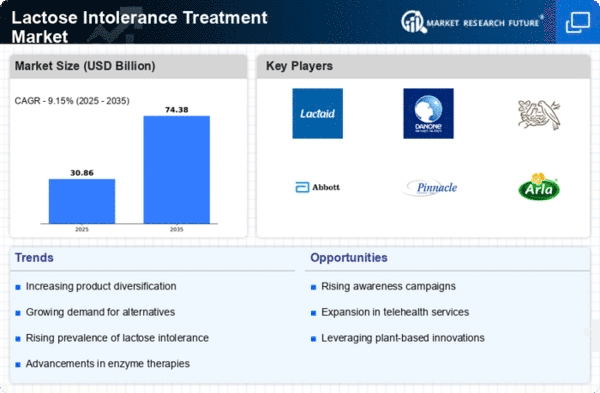
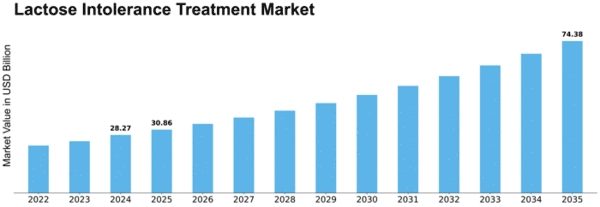
As per MRFR analysis, the Lactose Intolerance Treatment Market Size was estimated at 28.27 USD Billion in 2024. The Lactose Intolerance Treatment industry is projected to grow from 31.18 USD Billion in 2025 to 74.38 USD Billion by 2035, exhibiting a compound annual growth rate (CAGR) of 9.15 during the forecast period 2025 - 2035.

Key Market Trends & Highlights

The Lactose Intolerance Treatment Market is experiencing robust growth driven by rising consumer awareness and product innovation.

  • The demand for lactose-free products is on the rise, particularly in North America, which remains the largest market.
  • Advancements in enzyme supplementation are enhancing the effectiveness of lactose intolerance treatments, appealing to a broader consumer base.
  • Increased awareness and education regarding lactose intolerance are fostering a more health-conscious population, especially in the Asia-Pacific region.
  • The rising prevalence of lactose intolerance and innovations in lactose-free product development are key drivers propelling market growth.

Market Size & Forecast

2024 Market Size 28.27 (USD Billion)
2035 Market Size 74.38 (USD Billion)
CAGR (2025 - 2035) 9.15%
Largest Regional Market Share in 2024 North America

Major Players

<p>Lactaid (US), Danone (FR), Nestle (CH), Abbott Laboratories (US), Pioneer Foods (ZA), Arla Foods (DK), Lactose Free (US), Schreiber Foods (US), Fonterra (NZ)</p>

Market Trends

The Lactose Intolerance Treatment Market is currently experiencing a notable evolution, driven by a growing awareness of lactose intolerance among consumers. This condition, characterized by the inability to digest lactose, has led to an increased demand for various treatment options, including dietary modifications and enzyme supplements. As more individuals seek solutions to manage their symptoms, the market is witnessing a diversification of products aimed at alleviating discomfort associated with lactose consumption. Furthermore, the rise in lactose-free products in grocery stores reflects a broader trend towards healthier eating habits, which may contribute to the market's expansion. In addition to dietary changes, advancements in biotechnology are likely to play a pivotal role in shaping the Lactose Intolerance Treatment Market. Innovations in enzyme formulations and delivery methods could enhance the effectiveness of treatments, making them more appealing to consumers. Moreover, the increasing prevalence of lactose intolerance across different demographics suggests a sustained market potential. As awareness continues to grow, it appears that the Lactose Intolerance Treatment Market is poised for further development, with a focus on improving quality of life for those affected by this condition.

Rising Demand for Lactose-Free Products

The Lactose Intolerance Treatment Market is witnessing a surge in the availability of lactose-free products. This trend is largely driven by consumer preferences for healthier alternatives, as individuals increasingly seek options that do not trigger their symptoms. Manufacturers are responding by expanding their product lines to include lactose-free dairy items, which may enhance market growth.

Advancements in Enzyme Supplementation

Innovations in enzyme supplementation are emerging as a key trend within the Lactose Intolerance Treatment Market. Enhanced formulations and delivery systems are being developed to improve the efficacy of these supplements. This could lead to greater consumer satisfaction and adherence to treatment regimens, potentially expanding the market further.

Increased Awareness and Education

There is a growing emphasis on awareness and education regarding lactose intolerance. Health professionals and organizations are actively promoting understanding of the condition, which may encourage more individuals to seek treatment. This heightened awareness could drive demand for various treatment options, thereby influencing market dynamics.

Lactose Intolerance Treatment Market Market Drivers

Growing Health Consciousness

A surge in health consciousness among consumers significantly influences the Global Lactose Intolerance Treatment Market Industry. Individuals are increasingly prioritizing their dietary choices, leading to a demand for lactose-free products and treatments. This trend is particularly evident in developed regions, where consumers are more informed about dietary restrictions and their implications on health. As a result, the market is expected to experience a compound annual growth rate of 6.58% from 2025 to 2035, with projections indicating a market size of 34.8 USD Billion by 2035. This shift underscores the importance of lactose intolerance management in contemporary dietary practices.

Innovations in Lactose-Free Products

Innovations in lactose-free products are reshaping the Global Lactose Intolerance Treatment Market Industry. Manufacturers are increasingly developing a variety of lactose-free dairy products, such as milk, cheese, and yogurt, catering to the diverse preferences of lactose-intolerant consumers. These innovations not only enhance product availability but also improve taste and nutritional value, making lactose-free options more appealing. The introduction of fortified lactose-free products further supports the market's growth, as consumers seek alternatives that align with their health goals. This trend is likely to sustain the market's expansion in the coming years.

Rising Demand for Personalized Nutrition

The rising demand for personalized nutrition is influencing the Global Lactose Intolerance Treatment Market Industry. Consumers are increasingly seeking tailored dietary solutions that address their specific health needs, including lactose intolerance. This trend is prompting manufacturers to develop customized lactose-free products and treatments that cater to individual preferences and dietary restrictions. As personalized nutrition gains traction, the market is likely to see a surge in innovative offerings that align with consumer demands. This shift towards individualized dietary solutions may further enhance the market's growth trajectory in the coming years.

Rising Prevalence of Lactose Intolerance

The increasing prevalence of lactose intolerance globally drives the Global Lactose Intolerance Treatment Market Industry. Approximately 68% of the world's population experiences some form of lactose malabsorption, with higher rates observed in certain ethnic groups. This growing awareness of lactose intolerance leads to a heightened demand for treatment options, including lactase supplements and lactose-free products. As more individuals seek solutions to manage their symptoms, the market is projected to reach 17.3 USD Billion in 2024, reflecting a significant shift in consumer behavior towards lactose-free alternatives.

Increased Availability of Lactase Supplements

The increased availability of lactase supplements is a key driver in the Global Lactose Intolerance Treatment Market Industry. These supplements provide a convenient solution for individuals who wish to enjoy dairy products without experiencing discomfort. As awareness of lactose intolerance grows, more consumers are turning to lactase supplements as a proactive measure. Pharmacies and health food stores are expanding their offerings, making these products more accessible. This trend is anticipated to contribute to the market's growth, as consumers increasingly seek effective solutions to manage their lactose intolerance symptoms.

Market Segment Insights

By Treatment Type: Lactase Supplements (Largest) vs. Probiotics (Fastest-Growing)

<p>In the Lactose Intolerance Treatment Market, the segment is characterized by a diverse array of treatment types, including lactase supplements, probiotics, dietary modifications, and enzyme replacement therapy. Among these, lactase supplements hold the largest market share due to their straightforward efficacy and ease of use, appealing to a wide demographic of lactose-intolerant individuals. Probiotics, on the other hand, are rapidly gaining traction as a viable option for managing symptoms, thanks to ongoing research supporting their benefits in gut health and digestion.</p>

<p>Lactase Supplements (Dominant) vs. Probiotics (Emerging)</p>

<p>Lactase supplements are recognized as the dominant treatment option in the market, reflecting their established role in directly aiding lactose digestion. Many consumers prefer these supplements for their convenience and immediate effectiveness. Conversely, probiotics have emerged as an innovative alternative, touted for their holistic benefits in improving gut flora and overall digestive health. Their appeal lies in potentially offering long-term management of lactose intolerance symptoms through natural means. This segment is seeing increasing awareness and acceptance, driven by consumer interest in gut health and natural remedies, positioning probiotics as a promising and rapidly growing option.</p>

By Distribution Channel: Pharmacies (Largest) vs. Online Retail (Fastest-Growing)

<p>In the Lactose Intolerance Treatment Market, pharmacies dominate the distribution channel landscape due to their widespread availability and trust among consumers seeking lactose intolerance remedies. This segment accounts for a significant portion of market share, as pharmacies provide easy access to prescription and over-the-counter options. In contrast, online retail is rapidly gaining traction, appealing to a growing demographic of digitally-savvy consumers looking for convenience and discreet purchasing options. This shift in consumer behavior is shaping the distribution dynamics within the market. The growth trends in this segment are driven by an increase in the prevalence of lactose intolerance, prompting consumers to seek effective treatment solutions. The rise of e-commerce has made online retail the fastest-growing segment, as more individuals prefer to buy lactose intolerance products online. Additionally, health food stores are capturing a niche market by offering specialized lactose-free products, further diversifying the distribution landscape. As awareness of lactose intolerance continues to grow, so does the importance of these distribution channels in meeting consumer needs.</p>

<p>Pharmacies: Dominant vs. Online Retail: Emerging</p>

<p>Pharmacies have established themselves as the dominant distribution channel in the Lactose Intolerance Treatment Market due to their comprehensive inventory of lactose-free products and treatments. Their accessibility and the ability to consult with pharmacists enhance customer trust and satisfaction. On the other hand, online retail is emerging rapidly, fueled by the demand for convenience and privacy in purchasing lactose intolerance solutions. The online platform enables consumers to compare products easily and access a broader range of options, including niche lactose-free items that may not be available in physical stores. This evolution in purchasing behavior ensures that while pharmacies maintain their stronghold, online retail is set to disrupt the traditional landscape, offering personalized shopping experiences and subscription models to meet ongoing customer needs.</p>

By Patient Demographics: Adults (Largest) vs. Children (Fastest-Growing)

<p>In the Lactose Intolerance Treatment Market, the adult demographic holds the largest share, reflecting their chronic exposure to lactose intolerance and the subsequent demand for manageable treatment solutions. Adults predominantly seek lactose-free options due to lifestyle and dietary preferences, establishing a significant market presence. Conversely, the pediatric segment is currently the fastest-growing, driven by increasing awareness among parents regarding lactose intolerance in children and the rising availability of lactose-free products tailored for younger consumers.</p>

<p>Adults (Dominant) vs. Children (Emerging)</p>

<p>The adult segment in the Lactose Intolerance Treatment Market is characterized by a broad consumer base that spans various lifestyles, often leading to consistent demand for lactose-free products and enzyme supplements. Adults primarily seek convenient treatment options that align with their busy lives, leading to a robust market position. In contrast, the children's segment is emerging rapidly as awareness grows among parents about lactose intolerance as a childhood issue. This demographic is particularly influenced by pediatric nutritional trends, thus affecting the availability and presentation of lactose-free options tailored specifically for younger consumers, making it a critical area for growth.</p>

By Formulation Type: Tablets (Largest) vs. Powders (Fastest-Growing)

<p>In the Lactose Intolerance Treatment Market, the formulation type segment shows a diverse distribution, with tablets commanding the largest market share. Tablets are favored for their convenience and ease of use among consumers, making them the go-to option for managing lactose intolerance. Powders, while trailing in overall market share, are rapidly gaining traction due to their versatility and ability to be mixed with various foods and beverages, appealing to a broader audience seeking lactose-free solutions.</p>

<p>Tablets (Dominant) vs. Powders (Emerging)</p>

<p>Tablets dominate the Lactose Intolerance Treatment Market, appreciated for their portability and precise dosage, which cater to consumers looking for straightforward lactose management. They resonate well with individuals who prefer a no-fuss approach to treatment, ensuring consistent compliance with their dietary needs. On the other hand, powders are emerging as a significant competitor in this segment. Their flexibility allows users to incorporate them into daily foods and drinks easily, making lactose intolerance management more versatile. This adaptability, coupled with growing consumer awareness about lactose intolerance, is driving the rapid uptake of powdered formulations.</p>

Get more detailed insights about Lactose Intolerance Treatment Market Research Report - Global Forecast till 2035

Regional Insights

North America : Market Leader in Treatments

North America leads the Lactose Intolerance Treatment Market with a share of $12.0 million, driven by increasing awareness of lactose intolerance and a growing demand for lactose-free products. Regulatory support for health claims on lactose-free foods has further catalyzed market growth. The rise in lactose intolerance diagnoses among diverse populations is also a significant driver, pushing manufacturers to innovate and expand their product lines. The U.S. is the primary market, with key players like Lactaid, Abbott Laboratories, and Schreiber Foods dominating the landscape. The competitive environment is characterized by a mix of established brands and emerging companies focusing on lactose-free dairy alternatives. The presence of major food corporations ensures a steady supply of innovative products catering to lactose-intolerant consumers, solidifying North America's market position.

Key Players and Competitive Insights

The Lactose Intolerance Treatment Market is characterized by a dynamic competitive landscape, driven by increasing consumer awareness and demand for lactose-free products. Key players such as Lactaid (US), Danone (FR), and Abbott Laboratories (US) are strategically positioned to leverage innovation and expand their product offerings. Lactaid (US) focuses on enhancing its product line with new lactose-free dairy options, while Danone (FR) emphasizes sustainability in its sourcing and production processes. Abbott Laboratories (US) is investing in research and development to create advanced lactose intolerance solutions, indicating a collective shift towards innovation and consumer-centric strategies that shape the competitive environment.

In terms of business tactics, companies are increasingly localizing manufacturing to reduce costs and optimize supply chains. The market appears moderately fragmented, with several players vying for market share. However, the influence of key players is substantial, as they set trends and standards that smaller companies often follow. This competitive structure fosters an environment where innovation and operational efficiency are paramount for success.

In November 2025, Lactaid (US) launched a new line of lactose-free yogurt, which is expected to cater to the growing demand for convenient and healthy snack options. This strategic move not only diversifies their product portfolio but also positions Lactaid as a leader in the lactose-free segment, appealing to health-conscious consumers. The introduction of this product reflects a keen understanding of market trends and consumer preferences.

In October 2025, Danone (FR) announced a partnership with a local dairy cooperative to enhance its supply chain sustainability. This collaboration aims to source milk from farms that adhere to strict environmental standards, thereby reinforcing Danone's commitment to sustainability. Such strategic alliances are likely to enhance brand loyalty and consumer trust, which are critical in the competitive landscape.

In September 2025, Abbott Laboratories (US) unveiled a new digital platform designed to educate consumers about lactose intolerance and promote its lactose-free products. This initiative not only serves to inform potential customers but also positions Abbott as a thought leader in the market. By integrating technology into its marketing strategy, Abbott is likely to enhance customer engagement and drive sales.

As of December 2025, current trends in the Lactose Intolerance Treatment Market indicate a strong focus on digitalization, sustainability, and the integration of artificial intelligence in product development. Strategic alliances are increasingly shaping the competitive landscape, allowing companies to pool resources and expertise. Looking ahead, competitive differentiation is expected to evolve, with a shift from price-based competition to a focus on innovation, technology, and supply chain reliability. This transition suggests that companies that prioritize these aspects will likely gain a competitive edge in the market.

Key Companies in the Lactose Intolerance Treatment Market market include

Industry Developments

  • Q2 2024: Danone launches new dairy-free probiotic supplement for lactose intolerance Danone announced the launch of a new dairy-free probiotic supplement specifically formulated to aid individuals with lactose intolerance, expanding its health-focused product portfolio.
  • Q1 2024: Nestlé Health Science introduces expanded range of lactose-free nutritional products Nestlé Health Science unveiled an expanded line of lactose-free nutritional products targeting consumers with lactose intolerance, aiming to strengthen its position in the specialized nutrition market.
  • Q2 2024: Lactaid opens new manufacturing facility in Ohio to meet rising demand Lactaid, a leading brand in lactose-free dairy products, inaugurated a new manufacturing facility in Ohio to increase production capacity and address growing consumer demand for lactose intolerance solutions.
  • Q3 2024: Johnson & Johnson acquires biotech startup developing enzyme therapy for lactose intolerance Johnson & Johnson completed the acquisition of a biotechnology startup focused on developing novel enzyme therapies for lactose intolerance, aiming to enhance its gastrointestinal health portfolio.
  • Q2 2025: Abbott receives FDA approval for new lactose intolerance diagnostic kit Abbott announced that it has received FDA approval for its new diagnostic kit designed to rapidly detect lactose intolerance in clinical settings.
  • Q1 2025: Arla Foods partners with biotech firm to develop next-generation lactase supplements Arla Foods entered into a strategic partnership with a biotechnology company to co-develop advanced lactase enzyme supplements for improved lactose digestion.
  • Q2 2024: GSK launches chewable lactase tablets for children with lactose intolerance GlaxoSmithKline introduced a new line of chewable lactase tablets formulated for pediatric use, targeting children diagnosed with lactose intolerance.
  • Q3 2024: Chobani debuts plant-based yogurt line for lactose-intolerant consumers Chobani launched a new plant-based yogurt line specifically marketed to consumers with lactose intolerance, expanding its alternative dairy offerings.
  • Q1 2025: LactEase files for IPO to fund expansion of lactose intolerance treatment products LactEase, a company specializing in lactose intolerance treatment products, filed for an initial public offering to raise capital for product development and market expansion.
  • Q2 2025: DSM secures EU regulatory approval for novel lactase enzyme supplement DSM received regulatory approval from the European Union for its new lactase enzyme supplement, enabling commercial distribution across EU member states.

Future Outlook

Lactose Intolerance Treatment Market Future Outlook

<p>The Lactose Intolerance Treatment Market is projected to grow at a 9.15% CAGR from 2024 to 2035, driven by increasing consumer awareness and innovative product development.</p>

New opportunities lie in:

  • <p>Expansion of personalized lactose-free product lines</p>
  • <p>Development of mobile health applications for dietary management</p>
  • <p>Investment in educational campaigns targeting lactose intolerance awareness</p>

<p>By 2035, the market is expected to achieve substantial growth, reflecting evolving consumer needs and innovative solutions.</p>

Market Segmentation

Lactose Intolerance Treatment Market Treatment Type Outlook

  • Lactase Supplements
  • Probiotics
  • Dietary Modifications
  • Enzyme Replacement Therapy

Lactose Intolerance Treatment Market Formulation Type Outlook

  • Tablets
  • Powders
  • Liquids
  • Chewables

Lactose Intolerance Treatment Market Distribution Channel Outlook

  • Pharmacies
  • Online Retail
  • Supermarkets
  • Health Food Stores

Lactose Intolerance Treatment Market Patient Demographics Outlook

  • Children
  • Adults
  • Elderly
  • Pregnant Women

Report Scope

MARKET SIZE 202428.27(USD Billion)
MARKET SIZE 202531.18(USD Billion)
MARKET SIZE 203574.38(USD Billion)
COMPOUND ANNUAL GROWTH RATE (CAGR)9.15% (2024 - 2035)
REPORT COVERAGERevenue Forecast, Competitive Landscape, Growth Factors, and Trends
BASE YEAR2024
Market Forecast Period2025 - 2035
Historical Data2019 - 2024
Market Forecast UnitsUSD Billion
Key Companies ProfiledLactaid (US), Danone (FR), Nestle (CH), Abbott Laboratories (US), Pioneer Foods (ZA), Arla Foods (DK), Lactose Free (US), Schreiber Foods (US), Fonterra (NZ)
Segments CoveredTreatment Type, Distribution Channel, Patient Demographics, Formulation Type
Key Market OpportunitiesEmerging plant-based alternatives and personalized treatments drive growth in the Lactose Intolerance Treatment Market.
Key Market DynamicsRising consumer awareness drives demand for lactose-free products, influencing market dynamics and competitive strategies.
Countries CoveredNorth America, Europe, APAC, South America, MEA

FAQs

What is the valuation of the market?

lactose intolerance treatment market is expected to be valued at more than USD 26.12 billion by 2030.

What is the CAGR of the market?

The global market is expected to exhibit a strong 5.90% CAGR over the forecast period from 2023 to 2030.

What is the major driver for the market?

The growing prevalence of lactose intolerance is the major driver for the market.

Which is the leading regional market?

Europe held a dominant 42% share in the global lactose intolerance treatment market in 2018.

What are the key players in the market?

Leading players in the market include Abbott, Nestle, and Cargill Inc., among others.

  1. Executive Summary
  2. Market Introduction
    1. Introduction 14
    2. Assumptions & Limitations 14
      1. Limitations 14
    3. Assumptions 14
    4. Market Structure
  3. Research Methodology
    1. Research Process 15
    2. Data Mining 15
    3. Secondary Research 16
    4. Primary
    5. Research 17
    6. Forecasting Techniques 19
    7. Research
      1. Bottom-Up Approach
      2. Top-Down Approach 21
      3. Data Triangulation
      4. Validation 22
    8. Methodology for Market Size Estimation 20
  4. Market Dynamics
    1. Introduction 23
    2. Drivers 23
      1. Rising Cases of
      2. Increasing Awareness About Lactose
      3. Increased Prevalence
    3. Gastrointestinal Disorders 23
    4. Intolerance and Related Complications 24
    5. of Lactose Intolerance 24
    6. Restraints 25
      1. Side-Effects
    7. Associated with Supplements 25
    8. Opportunities 25
    9. Market Factor Analysis
    10. Value Chain Analysis 26
      1. Manufacturing 26
      2. Distribution
      3. Post-Sales Monitoring 26
    11. R&D 26
    12. & Sales 26
    13. Porter’s
      1. Threat of New Entrants 27
      2. Threat of Substitutes 28
      3. Intense Rivalry 28
    14. Five Forces Model 27
    15. Bargaining Power of Suppliers 27
    16. Bargaining Power of Buyers 28
    17. Investment Opportunities 28
  5. Lactose Intolerance Treatment Market,
    1. by Type
    2. Introduction 29
    3. Primary Lactose Intolerance
    4. Secondary Lactose Intolerance 31
    5. Congenital/Developmental
    6. Lactose Intolerance 32
  6. Lactose Intolerance Treatment Market, by
    1. Treatment
    2. Introduction 33
    3. Food Supplements 35
    4. Enzyme Lactase Supplements 35
    5. Probiotics 36
  7. Lactose
  8. Intolerance Treatment Market, by Form
    1. Introduction 37
    2. Powder 39
    3. Liquid 39
    4. Tablets & Capsules 40
    5. Global Lactose Intolerance Treatment Market by, End User
    6. Introduction
    7. Homecare 43
    8. Hospitals & Clinics 43
  9. Global Lactose Intolerance Treatment Market, by Region
    1. Introduction
    2. Americas 46
    3. Lactose Intolerance Treatment Market,
    4. by Type
  10. Lactose Intolerance Treatment Market, by Treatment
    1. Lactose
  11. Intolerance Treatment Market, by Form
    1. Lactose
  12. North America 49
  13. Intolerance Treatment Market, by Type
    1. Lactose Intolerance Treatment
  14. Market, by Treatment
  15. Lactose Intolerance Treatment Market, by Form
    1. US 51
  16. Lactose Intolerance Treatment Market, by Type
    1. Lactose
  17. Intolerance Treatment Market, by Treatment
    1. Lactose Intolerance Treatment
  18. Market, by Form
    1. Lactose Intolerance
  19. Canada 53
  20. Treatment Market, by Type
    1. Lactose Intolerance Treatment Market, by
    2. Treatment
  21. Lactose Intolerance Treatment Market, by Form
    1. Latin America 55
  22. Lactose Intolerance Treatment Market, by Type
    1. Lactose
  23. Intolerance Treatment Market, by Treatment
    1. Lactose Intolerance Treatment
  24. Market, by Form
    1. Europe 58
    2. Lactose Intolerance Treatment
  25. Market, by Type
  26. Lactose Intolerance Treatment Market, by Treatment
    1. Lactose
  27. Intolerance Treatment Market, by Form
    1. Lactose
  28. Western Europe 61
  29. Intolerance Treatment Market, by Type
    1. Lactose Intolerance Treatment
  30. Market, by Treatment
  31. Lactose Intolerance Treatment Market, by Form
    1. Germany 64
  32. Lactose Intolerance Treatment Market, by Type
    1. Lactose
  33. Intolerance Treatment Market, by Treatment
    1. Lactose Intolerance Treatment
  34. Market, by Form
    1. Lactose Intolerance
  35. France 66
  36. Treatment Market, by Type
    1. Lactose Intolerance Treatment Market, by
    2. Treatment
  37. Lactose Intolerance Treatment Market, by Form
    1. UK 68
  38. Lactose Intolerance Treatment Market, by Type
    1. Lactose
  39. Intolerance Treatment Market, by Treatment
    1. Lactose Intolerance Treatment
  40. Market, by Form
    1. Lactose Intolerance
  41. Italy 70
  42. Treatment Market, by Type
    1. Lactose Intolerance Treatment Market, by
    2. Treatment
  43. Lactose Intolerance Treatment Market, by Form
    1. Spain 72
  44. Lactose Intolerance Treatment Market, by Type
    1. Lactose
  45. Intolerance Treatment Market, by Treatment
    1. Lactose Intolerance Treatment
  46. Market, by Form
    1. Lactose
  47. Rest of Western Europe 74
  48. Intolerance Treatment Market, by Type
    1. Lactose Intolerance Treatment
  49. Market, by Treatment
  50. Lactose Intolerance Treatment Market, by Form
    1. Eastern Europe 76
  51. Lactose Intolerance Treatment Market, by Type
    1. Lactose
  52. Intolerance Treatment Market, by Treatment
    1. Lactose Intolerance Treatment
  53. Market, by Form
    1. Asia-Pacific 78
    2. Lactose Intolerance
  54. Treatment Market, by Type
    1. Lactose Intolerance Treatment Market, by
    2. Treatment
  55. Lactose Intolerance Treatment Market, by Form
    1. China 81
  56. Lactose Intolerance Treatment Market, by Type
    1. Lactose
  57. Intolerance Treatment Market, by Treatment
    1. Lactose Intolerance Treatment
  58. Market, by Form
    1. Lactose Intolerance
  59. Australia 83
  60. Treatment Market, by Type
    1. Lactose Intolerance Treatment Market, by
    2. Treatment
  61. Lactose Intolerance Treatment Market, by Form
    1. Japan 85
  62. Lactose Intolerance Treatment Market, by Type
    1. Lactose
  63. Intolerance Treatment Market, by Treatment
    1. Lactose Intolerance Treatment
  64. Market, by Form
    1. Lactose Intolerance
  65. India 87
  66. Treatment Market, by Type
    1. Lactose Intolerance Treatment Market, by
    2. Treatment
  67. Lactose Intolerance Treatment Market, by Form
    1. South Korea 89
  68. Lactose Intolerance Treatment Market, by Type
    1. Lactose
  69. Intolerance Treatment Market, by Treatment
    1. Lactose Intolerance Treatment
  70. Market, by Form
    1. Lactose
  71. Rest of the Asia-Pacific 91
  72. Intolerance Treatment Market, by Type
    1. Lactose Intolerance Treatment
  73. Market, by Treatment
  74. Lactose Intolerance Treatment Market, by Form
    1. Middle East & Africa 93
    2. Lactose Intolerance Treatment Market,
    3. by Type
  75. Lactose Intolerance Treatment Market, by Treatment
    1. Lactose
  76. Intolerance Treatment Market, by Form
    1. Lactose
  77. Middle East 96
  78. Intolerance Treatment Market, by Type
    1. Lactose Intolerance Treatment
  79. Market, by Treatment
  80. Lactose Intolerance Treatment Market, by Form
    1. Africa 98
  81. Lactose Intolerance Treatment Market, by Type
    1. Lactose
  82. Intolerance Treatment Market, by Treatment
    1. Lactose Intolerance Treatment
  83. Market, by Form
  84. Competitive Landscape
    1. Introduction
    2. Company Share Analysis 100
  85. Company Profiles
    1. Johnson & Johnson Services, Inc. 101
    2. Financial Overview 101
    3. Key Developments 102
    4. Key Strategies 102
    5. Overview 103
    6. Offered 104
    7. Analysis 104
    8. Company Overview 106
    9. Products/Services Offered 106
    10. SWOT Analysis 107
    11. Enzymes, Inc. 108
    12. Financial Overview 108
    13. Key Developments 108
    14. Key Strategies 109
    15. Company Overview 110
    16. Products/Services Offered 110
    17. SWOT Analysis 111
    18. Drug Company 112
    19. Financial Overview 112
    20. Key Developments 112
    21. Key Strategies 113
    22. Overview 114
    23. Offered 114
    24. Analysis 115
    25. Incorporated 116
    26. Financial Overview 116
    27. Key Developments 116
    28. Key Strategies 117
    29. Overview 118
    30. Offered 119
    31. Analysis 119
    32. Developments 122
    33. Strategies 122
  86. Company Overview 101
  87. Products/Services Offered 102
  88. SWOT Analysis 102
    1. Nestlé 103
      1. Company
      2. Financial Overview 103
      3. Products/Services
      4. Key Developments 104
      5. SWOT
      6. Key Strategies 105
    2. Abbott 106
      1. Financial Overview 106
      2. Key Developments 107
      3. Key Strategies 107
    3. Deerland
      1. Company Overview 108
      2. Products/Services Offered 108
      3. SWOT Analysis 109
    4. Ritter Pharmaceuticals 110
      1. Financial Overview 110
      2. Key Developments 110
      3. Key Strategies 111
    5. Guardian
      1. Company Overview 112
      2. Products/Services Offered 112
      3. SWOT Analysis 113
    6. Novozymes 114
      1. Company
      2. Financial Overview 114
      3. Products/Services
      4. Key Developments 115
      5. SWOT
      6. Key Strategies 115
    7. Cargill,
      1. Company Overview 116
      2. Products/Services Offered 116
      3. SWOT Analysis 117
    8. Arla Foods 118
      1. Company
      2. Financial Overview 118
      3. Products/Services
      4. Key Developments 119
      5. SWOT
      6. Key Strategies 120
    9. Dean Foods
      1. Company Overview 121
      2. Financial Overview
      3. Products/Services Offered 121
      4. Key
      5. SWOT Analysis 122
      6. Key
  89. Appendix
    1. References 123
    2. Related Reports 123
  90. List of Tables
  91. PRIMARY
    1. INTERVIEWS AND INFORMATION GATHERING PROCESS 18
  92. GLOBAL LACTOSE
    1. INTOLERANCE TREATMENT, BY TYPE 2023–2030 (USD Billion) 30
    2. TABLE
  93. GLOBAL LACTOSE INTOLERANCE TREATMENT MARKET FOR PRIMARY LACTOSE INTOLERANCE, BY
    1. REGION 2023 & 2030 (USD Billion) 31
  94. GLOBAL LACTOSE INTOLERANCE
  95. TREATMENT MARKET FOR SECONDARY LACTOSE INTOLERANCE, BY REGION 2023 & 2030 (USD
    1. Billion) 31
  96. GLOBAL LACTOSE INTOLERANCE TREATMENT MARKET FOR
    1. CONGENITAL/DEVELOPMENTAL LACTOSE INTOLERANCE, BY REGION 2023 & 2030 (USD Billion)
  97. GLOBAL LACTOSE INTOLERANCE TREATMENT MARKET, BY TREATMENT
  98. GLOBAL LACTOSE INTOLERANCE
  99. TREATMENT MARKET FOR FOOD SUPPLEMENT, BY REGION 2023 & 2030 (USD Billion) 35
    1. TABLE
  100. GLOBAL LACTOSE INTOLERANCE TREATMENT MARKET FOR ENZYME LACTASE SUPPLEMENTS, BY
    1. REGION 2023 & 2030 (USD Billion) 35
  101. GLOBAL LACTOSE INTOLERANCE
  102. TREATMENT MARKET FOR PROBIOTICS, BY REGION 2023 & 2030 (USD Billion) 36
    1. TABLE
  103. GLOBAL LACTOSE INTOLERANCE TREATMENT MARKET, BY FORM 2023–2030 (USD Billion)
  104. GLOBAL LACTOSE INTOLERANCE TREATMENT MARKET FOR POWDER,
    1. BY REGION 2023–2030 (USD Billion) 39
  105. GLOBAL LACTOSE
  106. INTOLERANCE TREATMENT MARKET FOR LIQUID, BY REGION 2023–2030 (USD Billion)
  107. GLOBAL LACTOSE INTOLERANCE TREATMENT MARKET FOR TABLETS/CAPSULES,
    1. BY REGION 2023–2030 (USD Billion) 40
  108. GLOBAL LACTOSE
  109. INTOLERANCE TREATMENT MARKET, BY END USER 2023–2030 (USD Billion) 42
    1. TABLE
  110. GLOBAL LACTOSE INTOLERANCE TREATMENT MARKET FOR HOME CARE, BY REGION 2023–2030
    1. (USD Billion) 43
  111. GLOBAL LACTOSE INTOLERANCE TREATMENT MARKET
    1. FOR HOSPITAL & CLINICS, BY REGION 2023–2030 (USD Billion) 43
    2. TABLE
  112. GLOBAL LACTOSE INTOLERANCE TREATMENT MARKET, BY REGION 2023–2030 (USD Billion)
  113. AMERICAS: LACTOSE INTOLERANCE TREATMENT MARKET, BY REGION
  114. AMERICAS: LACTOSE INTOLERANCE
  115. TREATMENT MARKET, BY TYPE 2023–2030 (USD Billion) 47
    1. TABLE 20
  116. AMERICAS: LACTOSE INTOLERANCE TREATMENT MARKET, BY TREATMENT 2023–2030 (USD
    1. Billion) 47
  117. AMERICAS: LACTOSE INTOLERANCE TREATMENT MARKET,
    1. BY FORM 2023–2030 (USD Billion) 48
  118. AMERICAS: LACTOSE
  119. INTOLERANCE TREATMENT MARKET, BY END USER 2023–2030 (USD Billion) 48
    1. TABLE
  120. NORTH AMERICA: LACTOSE INTOLERANCE TREATMENT MARKET, BY COUNTRY 2023–2030
    1. (USD Billion) 49
  121. NORTH AMERICA: LACTOSE INTOLERANCE TREATMENT
  122. MARKET, BY TYPE 2023–2030 (USD Billion) 49
  123. NORTH AMERICA:
  124. LACTOSE INTOLERANCE TREATMENT MARKET, BY TREATMENT 2023–2030 (USD Billion)
  125. NORTH AMERICA: LACTOSE INTOLERANCE TREATMENT MARKET, BY
    1. FORM 2023–2030 (USD Billion) 50
  126. NORTH AMERICA: LACTOSE
  127. INTOLERANCE TREATMENT MARKET, BY END USER 2023–2030 (USD Billion) 51
    1. TABLE
  128. US: LACTOSE INTOLERANCE TREATMENT MARKET, BY TYPE 2023–2030 (USD Billion)
  129. US: LACTOSE INTOLERANCE TREATMENT MARKET, BY TREATMENT
  130. US: LACTOSE INTOLERANCE
  131. TREATMENT MARKET, BY FORM 2023–2030 (USD Billion) 52
    1. TABLE 31
  132. US: LACTOSE INTOLERANCE TREATMENT MARKET, BY END USER 2023–2030 (USD Billion)
  133. CANADA: LACTOSE INTOLERANCE TREATMENT MARKET, BY TYPE
  134. CANADA: LACTOSE INTOLERANCE
  135. TREATMENT MARKET, BY TREATMENT 2023–2030 (USD Billion) 54
    1. TABLE
  136. CANADA: LACTOSE INTOLERANCE TREATMENT MARKET, BY FORM 2023–2030 (USD Billion)
  137. CANADA: LACTOSE INTOLERANCE TREATMENT MARKET, BY END USER
  138. LATIN AMERICA: LACTOSE INTOLERANCE
  139. TREATMENT MARKET, BY TYPE 2023–2030 (USD Billion) 55
    1. TABLE 37
  140. LATIN AMERICA: LACTOSE INTOLERANCE TREATMENT MARKET, BY TREATMENT 2023–2030
    1. (USD Billion) 56
  141. LATIN AMERICA: LACTOSE INTOLERANCE TREATMENT
  142. MARKET, BY FORM 2023–2030 (USD Billion) 56
  143. LATIN AMERICA:
  144. LACTOSE INTOLERANCE TREATMENT MARKET, BY END USER 2023–2030 (USD Billion)
  145. EUROPE: LACTOSE INTOLERANCE TREATMENT MARKET, BY REGION
  146. EUROPE: LACTOSE INTOLERANCE
  147. TREATMENT MARKET, BY TYPE 2023–2030 (USD Billion) 59
    1. TABLE 42
  148. EUROPE: LACTOSE INTOLERANCE TREATMENT MARKET, BY TREATMENT 2023–2030 (USD
    1. Billion) 59
  149. EUROPE: LACTOSE INTOLERANCE TREATMENT MARKET,
    1. BY FORM 2023–2030 (USD Billion) 60
  150. EUROPE: LACTOSE
  151. INTOLERANCE TREATMENT MARKET, BY END USER 2023–2030 (USD Billion) 60
    1. TABLE
  152. WESTERN EUROPE: LACTOSE INTOLERANCE TREATMENT MARKET, BY COUNTRY 2023–2030
    1. (USD Billion) 61
  153. WESTERN EUROPE: LACTOSE INTOLERANCE TREATMENT
  154. MARKET, BY TYPE 2023–2030 (USD Billion) 62
  155. WESTERN
  156. EUROPE: LACTOSE INTOLERANCE TREATMENT MARKET, BY TREATMENT 2023–2030 (USD
    1. Billion) 62
  157. WESTERN EUROPE: LACTOSE INTOLERANCE TREATMENT
  158. MARKET, BY FORM 2023–2030 (USD Billion) 63
  159. WESTERN
  160. EUROPE: LACTOSE INTOLERANCE TREATMENT MARKET, BY END USER 2023–2030 (USD Billion)
  161. GERMANY: LACTOSE INTOLERANCE TREATMENT MARKET, BY TYPE
  162. GERMANY: LACTOSE INTOLERANCE
  163. TREATMENT MARKET, BY TREATMENT 2023–2030 (USD Billion) 64
    1. TABLE
  164. GERMANY: LACTOSE INTOLERANCE TREATMENT MARKET, BY FORM 2023–2030 (USD Billion)
  165. GERMANY: LACTOSE INTOLERANCE TREATMENT MARKET, BY END
    1. USER 2023–2030 (USD Billion) 65
  166. FRANCE: LACTOSE INTOLERANCE
  167. TREATMENT MARKET, BY TYPE 2023–2030 (USD Billion) 66
    1. TABLE 55
  168. FRANCE: LACTOSE INTOLERANCE TREATMENT MARKET, BY TREATMENT 2023–2030 (USD
    1. Billion) 66
  169. FRANCE: LACTOSE INTOLERANCE TREATMENT MARKET,
    1. BY FORM 2023–2030 (USD Billion) 67
  170. FRANCE: LACTOSE
  171. INTOLERANCE TREATMENT MARKET, BY END USER 2023–2030 (USD Billion) 67
    1. TABLE
  172. UK: LACTOSE INTOLERANCE TREATMENT MARKET, BY TYPE 2023–2030 (USD Billion)
  173. UK: LACTOSE INTOLERANCE TREATMENT MARKET, BY TREATMENT
  174. UK: LACTOSE INTOLERANCE
  175. TREATMENT MARKET, BY FORM 2023–2030 (USD Billion) 69
    1. TABLE 61
  176. UK: LACTOSE INTOLERANCE TREATMENT MARKET, BY END USER 2023–2030 (USD Billion)
  177. ITALY: LACTOSE INTOLERANCE TREATMENT MARKET, BY TYPE 2023–2030
    1. (USD Billion) 70
  178. ITALY: LACTOSE INTOLERANCE TREATMENT MARKET,
    1. BY TREATMENT 2023–2030 (USD Billion) 70
  179. ITALY: LACTOSE
  180. INTOLERANCE TREATMENT MARKET, BY FORM 2023–2030 (USD Billion) 71
    1. TABLE
  181. ITALY: LACTOSE INTOLERANCE TREATMENT MARKET, BY END USER 2023–2030 (USD
    1. Billion) 71
  182. SPAIN: LACTOSE INTOLERANCE TREATMENT MARKET,
    1. BY TYPE 2023–2030 (USD Billion) 72
  183. SPAIN: LACTOSE INTOLERANCE
  184. TREATMENT MARKET, BY TREATMENT 2023–2030 (USD Billion) 72
    1. TABLE
  185. SPAIN: LACTOSE INTOLERANCE TREATMENT MARKET, BY FORM 2023–2030 (USD Billion)
  186. SPAIN: LACTOSE INTOLERANCE TREATMENT MARKET, BY END USER
  187. REST OF WESTERN EUROPE:
  188. LACTOSE INTOLERANCE TREATMENT MARKET, BY TYPE 2023–2030 (USD Billion) 74
    1. TABLE
  189. REST OF WESTERN EUROPE: LACTOSE INTOLERANCE TREATMENT MARKET, BY TREATMENT 2023–2030
    1. (USD Billion) 74
  190. REST OF WESTERN EUROPE: LACTOSE INTOLERANCE
  191. TREATMENT MARKET, BY FORM 2023–2030 (USD Billion) 75
    1. TABLE 73
  192. REST OF WESTERN EUROPE: LACTOSE INTOLERANCE TREATMENT MARKET, BY END USER 2023–2030
    1. (USD Billion) 75
  193. EASTERN EUROPE: LACTOSE INTOLERANCE TREATMENT
  194. MARKET, BY TYPE 2023–2030 (USD Billion) 76
  195. EASTERN
  196. EUROPE: LACTOSE INTOLERANCE TREATMENT MARKET, BY TREATMENT 2023–2030 (USD
    1. Billion) 76
  197. EASTERN EUROPE: LACTOSE INTOLERANCE TREATMENT
  198. MARKET, BY FORM 2023–2030 (USD Billion) 77
  199. EASTERN
  200. EUROPE: LACTOSE INTOLERANCE TREATMENT MARKET, BY END USER 2023–2030 (USD Billion)
  201. ASIA-PACIFIC: LACTOSE INTOLERANCE TREATMENT MARKET, BY
    1. COUNTRY 2023–2030 (USD Billion) 78
  202. ASIA-PACIFIC: LACTOSE
  203. INTOLERANCE TREATMENT MARKET, BY TYPE 2023–2030 (USD Billion) 79
    1. TABLE
  204. ASIA-PACIFIC: LACTOSE INTOLERANCE TREATMENT MARKET, BY TREATMENT 2023–2030
    1. (USD Billion) 79
  205. ASIA-PACIFIC: LACTOSE INTOLERANCE TREATMENT
  206. MARKET, BY FORM 2023–2030 (USD Billion) 80
  207. ASIA-PACIFIC:
  208. LACTOSE INTOLERANCE TREATMENT MARKET, BY END USER 2023–2030 (USD Billion)
  209. CHINA: LACTOSE INTOLERANCE TREATMENT MARKET, BY TYPE 2023–2030
    1. (USD Billion) 81
  210. CHINA: LACTOSE INTOLERANCE TREATMENT MARKET,
    1. BY TREATMENT 2023–2030 (USD Billion) 81
  211. CHINA: LACTOSE
  212. INTOLERANCE TREATMENT MARKET, BY FORM 2023–2030 (USD Billion) 82
    1. TABLE
  213. CHINA: LACTOSE INTOLERANCE TREATMENT MARKET, BY END USER 2023–2030 (USD
    1. Billion) 82
  214. AUSTRALIA: LACTOSE INTOLERANCE TREATMENT MARKET,
    1. BY TYPE 2023–2030 (USD Billion) 83
  215. AUSTRALIA: LACTOSE
  216. INTOLERANCE TREATMENT MARKET, BY TREATMENT 2023–2030 (USD Billion) 83
    1. TABLE
  217. AUSTRALIA: LACTOSE INTOLERANCE TREATMENT MARKET, BY FORM 2023–2030 (USD
    1. Billion) 84
  218. AUSTRALIA: LACTOSE INTOLERANCE TREATMENT MARKET,
    1. BY END USER 2023–2030 (USD Billion) 84
  219. JAPAN: LACTOSE
  220. INTOLERANCE TREATMENT MARKET, BY TYPE 2023–2030 (USD Billion) 85
    1. TABLE
  221. JAPAN: LACTOSE INTOLERANCE TREATMENT MARKET, BY TREATMENT 2023–2030 (USD
    1. Billion) 85
  222. JAPAN: LACTOSE INTOLERANCE TREATMENT MARKET,
    1. BY FORM 2023–2030 (USD Billion) 86
  223. JAPAN: LACTOSE INTOLERANCE
  224. TREATMENT MARKET, BY END USER 2023–2030 (USD Billion) 86
    1. TABLE
  225. INDIA: LACTOSE INTOLERANCE TREATMENT MARKET, BY TYPE 2023–2030 (USD Billion)
  226. INDIA: LACTOSE INTOLERANCE TREATMENT MARKET, BY TREATMENT
  227. INDIA: LACTOSE INTOLERANCE
  228. TREATMENT MARKET, BY FORM 2023–2030 (USD Billion) 88
    1. TABLE 98
  229. INDIA: LACTOSE INTOLERANCE TREATMENT MARKET, BY END USER 2023–2030 (USD Billion)
  230. SOUTH KOREA: LACTOSE INTOLERANCE TREATMENT MARKET, BY
    1. TYPE 2023–2030 (USD Billion) 89
  231. SOUTH KOREA: LACTOSE
  232. INTOLERANCE TREATMENT MARKET, BY TREATMENT 2023–2030 (USD Billion) 89
    1. TABLE
  233. SOUTH KOREA: LACTOSE INTOLERANCE TREATMENT MARKET, BY FORM 2023–2030 (USD
    1. Billion) 90
  234. SOUTH KOREA: LACTOSE INTOLERANCE TREATMENT MARKET,
    1. BY END USER 2023–2030 (USD Billion) 90
  235. REST OF THE
  236. ASIA-PACIFIC: LACTOSE INTOLERANCE TREATMENT MARKET, BY TYPE 2023–2030 (USD
    1. Billion) 91
  237. REST OF THE ASIA-PACIFIC: LACTOSE INTOLERANCE
  238. TREATMENT MARKET, BY TREATMENT 2023–2030 (USD Billion) 91
    1. TABLE
  239. REST OF THE ASIA-PACIFIC: LACTOSE INTOLERANCE TREATMENT MARKET, BY FORM 2023–2030
    1. (USD Billion) 92
  240. REST OF THE ASIA-PACIFIC: LACTOSE INTOLERANCE
  241. TREATMENT MARKET, BY END USER 2023–2030 (USD Billion) 92
    1. TABLE
  242. MIDDLE EAST & AFRICA: LACTOSE INTOLERANCE TREATMENT MARKET, BY REGION 2023–2030
    1. (USD Billion) 93
  243. MIDDLE EAST & AFRICA: LACTOSE INTOLERANCE
  244. TREATMENT MARKET, BY TYPE 2023–2030 (USD Billion) 94
    1. TABLE 109
  245. MIDDLE EAST & AFRICA: LACTOSE INTOLERANCE TREATMENT MARKET, BY TREATMENT 2023–2030
    1. (USD Billion) 94
  246. MIDDLE EAST & AFRICA: LACTOSE INTOLERANCE
  247. TREATMENT MARKET, BY FORM 2023–2030 (USD Billion) 95
    1. TABLE 111
  248. MIDDLE EAST & AFRICA: LACTOSE INTOLERANCE TREATMENT MARKET, BY END USER 2023–2030
    1. (USD Billion) 95
  249. MIDDLE EAST: LACTOSE INTOLERANCE TREATMENT
  250. MARKET, BY TYPE 2023–2030 (USD Billion) 96
  251. MIDDLE
  252. EAST: LACTOSE INTOLERANCE TREATMENT MARKET, BY TREATMENT 2023–2030 (USD Billion)
  253. MIDDLE EAST: LACTOSE INTOLERANCE TREATMENT MARKET, BY
    1. FORM 2023–2030 (USD Billion) 97
  254. MIDDLE EAST: LACTOSE
  255. INTOLERANCE TREATMENT MARKET, BY END USER 2023–2030 (USD Billion) 97
    1. TABLE
  256. AFRICA: LACTOSE INTOLERANCE TREATMENT MARKET, BY TYPE 2023–2030 (USD Billion)
  257. AFRICA: LACTOSE INTOLERANCE TREATMENT MARKET, BY TREATMENT
  258. AFRICA: LACTOSE INTOLERANCE
  259. TREATMENT MARKET, BY FORM 2023–2030 (USD Billion) 99
    1. TABLE 119
  260. AFRICA: LACTOSE INTOLERANCE TREATMENT MARKET, BY END USER 2023–2030 (USD Billion)
  261. List of Figures
    1. FIGURE
  262. MARKET SYNOPSIS 13
  263. GLOBAL LACTOSE INTOLERANCE TREATMENT
    1. MARKET: MARKET STRUCTURE 14
  264. PRIMARY RESPONDENT’S BREAKDOWN
  265. BOTTOM-UP AND TOP-DOWN APPROACH 20
    1. FIGURE
  266. MARKET DYNAMICS: ANALYSIS OF THE GLOBAL LACTOSE INTOLERANCE TREATMENT MARKET 23
    1. FIGURE
  267. VALUE CHAIN: GLOBAL LACTOSE INTOLERANCE TREATMENT MARKET 26
    1. FIGURE
  268. PORTER’S FIVE FORCES ANALYSIS: GLOBAL LACTOSE INTOLERANCE TREATMENT MARKET
  269. GLOBAL LACTOSE INTOLERANCE TREATMENT MARKET, BY TYPE 2023
    1. (%) 29
  270. GLOBAL LACTOSE INTOLERANCE TREATMENT MARKET, BY TYPE
  271. GLOBAL LACTOSE INTOLERANCE
  272. TREATMENT MARKET, BY TREATMENT 2023 (%) 33
  273. GLOBAL LACTOSE
  274. INTOLERANCE TREATMENT MARKET, BY TREATMENT 2023 & 2030 (USD Billion) 34
    1. FIGURE
  275. GLOBAL LACTOSE INTOLERANCE TREATMENT MARKET, BY FORM 2023 (%) 37
    1. FIGURE
  276. GLOBAL LACTOSE INTOLERANCE TREATMENT MARKET, BY FORM 2023–2030 (USD Billion)
  277. GLOBAL LACTOSE INTOLERANCE TREATMENT MARKET, BY END USER
  278. GLOBAL LACTOSE INTOLERANCE TREATMENT MARKET,
    1. BY END USER 2023–2030 (USD Billion) 42
  279. GLOBAL LACTOSE
  280. INTOLERANCE TREATMENT MARKET, BY REGION2023–2030 (USD Billion) 45
    1. FIGURE
  281. GLOBAL LACTOSE INTOLERANCE TREATMENT MARKET, BY REGION 2023 (%) 45
    1. FIGURE
  282. AMERICAS: LACTOSE INTOLERANCE TREATMENT MARKET, BY REGION 2023 (%) 46
    1. FIGURE
  283. NORTH AMERICA: LACTOSE INTOLERANCE TREATMENT MARKET, BY COUNTRY 2023 (%) 49
    1. FIGURE
  284. EUROPE: LACTOSE INTOLERANCE TREATMENT MARKET, BY REGION 2023 (%) 58
    1. FIGURE
  285. WESTERN EUROPE: LACTOSE INTOLERANCE TREATMENT MARKET, BY COUNTRY 2023 (%) 61
    1. FIGURE
  286. ASIA-PACIFIC: LACTOSE INTOLERANCE TREATMENT MARKET, BY COUNTRY 2023 (%) 78
    1. FIGURE
  287. MIDDLE EAST & AFRICA: LACTOSE INTOLERANCE TREATMENT MARKET, BY REGION 2023
    1. (%) 93
  288. GLOBAL LACTOSE INTOLERANCE TREATMENT MAJOR PLAYERS
    1. MARKET SHARE ANALYSIS, 2023 (%) 100

Lactose Intolerance Treatment Market Segmentation

Market Segmentation Overview

  • Detailed segmentation data will be available in the full report
  • Comprehensive analysis by multiple parameters
  • Regional and country-level breakdowns
  • Market size forecasts by segment
Infographic

Free Sample Request

Kindly complete the form below to receive a free sample of this Report

Get Free Sample

Customer Strories

Compare Licence

×
Features License Type
Single User Multiuser License Enterprise User
Price $4,950 $5,950 $7,250
Maximum User Access Limit 1 User Upto 10 Users Unrestricted Access Throughout the Organization
Free Customization
Direct Access to Analyst
Deliverable Format
Platform Access
Discount on Next Purchase 10% 15% 15%
Printable Versions