Request Free Sample ×

Kindly complete the form below to receive a free sample of this Report

* Please use a valid business email

Leading companies partner with us for data-driven Insights

clients tt-cursor
Hero Background
English
Chinese
French
Japanese
Korean
German
Spanish

Labyrinthitis Market Analysis

ID: MRFR/HC/3202-HCR
200 Pages
Vikita Thakur
April 2026

Global Labyrinthitis Market Research Report By Diagnosis Type (Clinical Diagnosis, Imaging Tests, Auditory Tests, Balance Tests), By Treatment Type (Medications, Surgery, Physical Therapy, Lifestyle Changes), By Distribution Channel (Hospitals, Specialty Clinics, Pharmacies, Online Platforms), By Patient Age Group (Pediatrics, Adults, Geriatrics) and By Regional (North America, Europe, South America, Asia Pacific, Middle East and Africa) -Forecast to 2035

Share:
Download PDF ×

We do not share your information with anyone. However, we may send you emails based on your report interest from time to time. You may contact us at any time to opt-out.

Labyrinthitis Market Infographic
Purchase Options

Market Analysis

In-depth Analysis of Labyrinthitis Market Industry Landscape

Labyrinthitis, a condition affecting the inner ear and leading to symptoms such as vertigo, nausea, and hearing loss, exhibits a distinctive set of market dynamics. The market for labyrinthitis-related products and treatments is influenced by a combination of factors ranging from prevalence and awareness to technological advancements and regulatory frameworks. Understanding these dynamics is crucial for stakeholders, including pharmaceutical companies, healthcare providers, and policymakers. The labrynthitis disease is the most important factor that is leading the market of the specific scope. In the course of increasing prevalence of this problem we observe more requests for proven up-to-date treatments, which encourages pharmaceutical corporations to invest their money in the development and research. The market permits and potential expansion in drug development and treatments, prompting advancement in the field. Moreover, expanding the understanding of healthcare professionals and common man empowers early diagnostics and the intervention, hence leads to develop the market in a positive way. Technological progressions as well have a profound implication on the market invasion. In the evolving healthcare market, diagnostic devices and treatments that promote diagnostic accuracy and efficiency occupy a key position. Imaging modalities, elaborated as magnetic resonance imaging and vestibular function examine, help specialists make specific diagnosis which arms them with the right decision. In addition, continual innovations in drug formulation like fixed-dose combinations and patient-focused treatments such as personalized therapies also add to the vibrancy of the market as they offer the desired outcome with minimal side effects. A challenging regulatory environment is another important variable that has impact on market dynamics in the labyrinthitis market. Stringent controls around the drugs and medical devices approval as well as telling process validate the safety and efficacy of the treatments. Regulatory bodies form a critical element in the market entering for new products, thus, they are of critical importance as they may shape the competitive landscape and impact the strategies companies adopt in their outcome to seek the market share. Additionally, readjustment mechanisms is another important factor which determines in what direction is the market moving, as they definition patients’ accessibility to treatments, weighs on health providers’ financial viability. Competing drug-makers occupy the place where the market of labyrinthitis is situated. While these approaches are lifesaving and curing of a disease, clinical trials also play a crucial role in drug development.

Patient demographics and socio-economic factors also contribute to the labyrinthitis market dynamics. The prevalence of labyrinthitis may vary across different regions and populations, influencing the demand for specific treatments in those areas. Economic factors, including healthcare expenditure and insurance coverage, impact patient access to treatments and, consequently, the market's overall growth potential. Understanding and adapting to these demographic and socio-economic factors are essential for market participants to navigate and succeed in diverse markets.


Author
Author Profile
Vikita Thakur
Senior Research Analyst

She holds an experience of about 5+ years in market research and business consulting projects for sectors such as life sciences, medical devices, and healthcare IT. She possesses a robust background in data analysis, market estimation, competitive intelligence, pipeline analysis market trend identification, and consumer behavior insights. Her expertise lies in technical Sales support, client interaction and project management, designing and implementing market research studies, conducting competitive analysis, and synthesizing complex data into actionable recommendations that drive business growth.

Leave a Comment

FAQs

What is the current valuation of the Labyrinthitis Market as of 2024?

<p>The Labyrinthitis Market was valued at 0.75 USD Billion in 2024.</p>

What is the projected market valuation for Labyrinthitis in 2035?

<p>The Labyrinthitis Market is projected to reach 1.208 USD Billion by 2035.</p>

What is the expected CAGR for the Labyrinthitis Market during the forecast period?

<p>The expected CAGR for the Labyrinthitis Market from 2025 to 2035 is 4.43%.</p>

Which companies are the key players in the Labyrinthitis Market?

<p>Key players in the Labyrinthitis Market include Bristol-Myers Squibb, Novartis, Roche, Merck & Co., GlaxoSmithKline, AstraZeneca, Sanofi, Johnson & Johnson, and Pfizer.</p>

What are the main segments of the Labyrinthitis Market?

<p>The main segments of the Labyrinthitis Market include Diagnosis Type, Treatment Type, Distribution Channel, and Patient Age Group.</p>

How much is the Clinical Diagnosis segment valued at in 2025?

<p>The Clinical Diagnosis segment is valued between 0.25 and 0.4 USD Billion in 2025.</p>

What is the projected value of the Medications segment by 2035?

<p>The Medications segment is expected to be valued between 0.3 and 0.5 USD Billion by 2035.</p>

What distribution channels are utilized in the Labyrinthitis Market?

<p>Distribution channels in the Labyrinthitis Market include Hospitals, Specialty Clinics, Pharmacies, and Online Platforms.</p>

What is the expected valuation for the Adult patient age group in 2025?

<p>The Adult patient age group is expected to be valued between 0.4 and 0.65 USD Billion in 2025.</p>

How does the Labyrinthitis Market's growth compare across different treatment types?

<p>The Treatment Type segment shows varying valuations, with Medications valued between 0.3 and 0.5 USD Billion, while Surgery is valued between 0.1 and 0.2 USD Billion.</p>

Market Summary

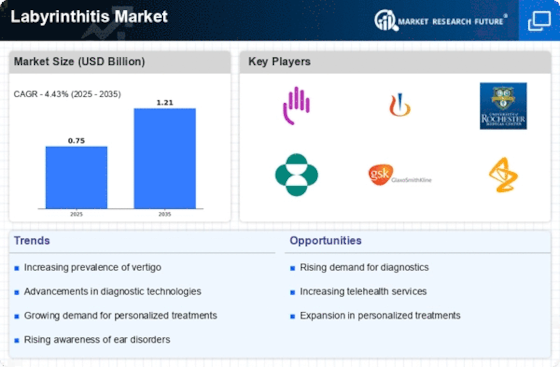
As per Market Research Future analysis, the Labyrinthitis Market Size was estimated at 0.75 USD Billion in 2024. The Labyrinthitis industry is projected to grow from USD 0.7832 Billion in 2025 to USD 1.208 Billion by 2035, exhibiting a compound annual growth rate (CAGR) of 4.43% during the forecast period 2025 - 2035

Key Market Trends & Highlights

The Labyrinthitis Market is experiencing notable growth driven by technological advancements and increasing patient awareness.

  • Technological advancements in diagnostics are enhancing the accuracy of labyrinthitis detection, particularly in North America. The rise in patient awareness regarding labyrinthitis symptoms is contributing to increased healthcare consultations in the Asia-Pacific region. The clinical diagnosis segment remains the largest, while imaging tests are emerging as the fastest-growing segment in the market. The increasing incidence of labyrinthitis and the rising geriatric population are key drivers propelling market expansion.

Market Size & Forecast

2024 Market Size 0.75 (USD Billion)
2035 Market Size 1.208 (USD Billion)
CAGR (2025 - 2035) 4.43%
Largest Regional Market Share in 2024 North America

Major Players

Bristol-Myers Squibb (US), Novartis (CH), Roche (CH), <a href="https://www.merckmanuals.com/professional/ear-nose-and-throat-disorders/inner-ear-disorders/purulent-labyrinthitis">Merck &amp; Co.</a> (US), GlaxoSmithKline (GB), AstraZeneca (GB), Sanofi (FR), Johnson &amp; Johnson (US), Pfizer (US)

Market Trends

The Labyrinthitis Market is currently experiencing a notable evolution, driven by a combination of factors including advancements in medical technology and an increasing awareness of ear-related disorders. As healthcare systems worldwide enhance their diagnostic capabilities, the identification of labyrinthitis has become more precise, leading to improved patient outcomes. This heightened awareness among healthcare professionals and patients alike is fostering a greater demand for effective treatment options. Furthermore, the integration of telemedicine into healthcare practices is facilitating access to specialized care, which may contribute to the growth of the Labyrinthitis Market. In addition, the ongoing research into the underlying causes and potential therapies for labyrinthitis is likely to shape the future landscape of this market. Pharmaceutical companies are exploring innovative drug formulations and treatment protocols, which could enhance therapeutic efficacy. Moreover, the collaboration between research institutions and healthcare providers appears to be strengthening, potentially leading to breakthroughs in understanding this condition. As the Labyrinthitis Market continues to evolve, stakeholders must remain vigilant to emerging trends and adapt their strategies accordingly to meet the changing needs of patients and healthcare systems.

Technological Advancements in Diagnostics

Recent innovations in diagnostic tools are enhancing the accuracy of labyrinthitis detection. Improved imaging techniques and auditory assessments are enabling healthcare providers to identify the condition more effectively, which may lead to timely interventions.

Rise in Patient Awareness

There is a growing awareness among the general population regarding ear health and related disorders. This trend is likely to increase the number of individuals seeking medical advice for labyrinthitis symptoms, thereby expanding the market.

Telemedicine Integration

The incorporation of telemedicine into healthcare services is transforming patient access to specialists. This trend may facilitate quicker consultations and follow-ups for labyrinthitis patients, potentially improving treatment adherence and outcomes.

Labyrinthitis Market Market Drivers

Rising Geriatric Population

The aging population is a significant driver of the Labyrinthitis Market. As individuals age, they become more susceptible to various health conditions, including labyrinthitis. Statistics indicate that the prevalence of vestibular disorders, including labyrinthitis, increases with age, with older adults being at a higher risk. This demographic shift is expected to lead to a higher incidence of labyrinthitis cases, thereby increasing the demand for medical interventions. Healthcare systems are likely to adapt to this trend by enhancing their services and treatment options for the elderly, further stimulating growth within the Labyrinthitis Market.

Growing Demand for Diagnostic Tools

The Labyrinthitis Market is witnessing a surge in demand for advanced diagnostic tools. Enhanced imaging technologies, such as MRI and CT scans, are becoming essential in accurately diagnosing labyrinthitis. The market for diagnostic equipment is projected to grow, with estimates suggesting a compound annual growth rate of around 6% over the next few years. This growth is driven by the need for precise diagnosis to differentiate labyrinthitis from other vestibular disorders. As healthcare facilities invest in state-of-the-art diagnostic tools, the Labyrinthitis Market is likely to benefit from increased accuracy and efficiency in patient care.

Advancements in Treatment Modalities

Innovations in treatment modalities are significantly influencing the Labyrinthitis Market. The development of new pharmacological therapies, including corticosteroids and antiviral medications, has improved patient outcomes. Recent studies indicate that early intervention with these treatments can reduce the duration and severity of symptoms, enhancing recovery rates. Furthermore, the introduction of minimally invasive surgical techniques for severe cases is reshaping treatment approaches. As these advancements become more widely adopted, they are expected to increase the overall market size, as healthcare providers seek to offer the most effective solutions to patients suffering from labyrinthitis.

Increasing Incidence of Labyrinthitis

The Labyrinthitis Market is experiencing growth due to the rising incidence of labyrinthitis cases. Factors such as viral infections, particularly those associated with respiratory illnesses, contribute to this increase. According to health statistics, labyrinthitis cases have shown a notable rise, with estimates suggesting that approximately 5 to 15% of individuals with viral infections may develop labyrinthitis. This trend indicates a growing patient population requiring medical attention, thereby driving demand for diagnostic and therapeutic solutions within the Labyrinthitis Market. As healthcare providers become more aware of the condition, the need for effective treatment options is likely to expand, further propelling market growth.

Increased Focus on Preventive Healthcare

The Labyrinthitis Market is benefiting from a growing emphasis on preventive healthcare measures. Public health initiatives aimed at educating individuals about the risks associated with viral infections and their potential to cause labyrinthitis are gaining traction. This focus on prevention is likely to lead to earlier diagnosis and treatment, reducing the overall burden of the disease. Additionally, healthcare providers are increasingly promoting vaccination against common viral infections, which may indirectly decrease the incidence of labyrinthitis. As awareness and preventive strategies improve, the Labyrinthitis Market is expected to see a positive impact on its growth trajectory.

Market Segment Insights

By Diagnosis Type: Clinical Diagnosis (Largest) vs. Imaging Tests (Fastest-Growing)

<p>In the Labyrinthitis Market, clinical diagnosis holds the largest share among the various diagnosis types. It relies primarily on the clinical history and symptom presentation of patients, allowing for a prompt identification of labyrinthitis. Imaging tests, while a crucial supplementary method in the diagnostic process, currently represent the fastest-growing segment. This evolution is largely due to advancements in imaging technology and increased awareness around the condition that promotes their use for a more accurate diagnosis. The growth trends for the diagnosis type segment indicate that as the prevalence of labyrinthitis rises, healthcare providers are more inclined to utilize a combination of clinical evaluations and comprehensive imaging tests. Emerging diagnostic methods, enhanced by technological innovations in MRI and CT scans, will likely continue to see significant growth as they yield better accuracy in diagnosing labyrinthitis, aligning with the rising demand for precise medical interventions.</p>

<p>Clinical Diagnosis (Dominant) vs. Balance Tests (Emerging)</p>

<p>Clinical diagnosis remains the dominant approach in the labyrinthitis market due to its direct reliance on the expertise of healthcare providers assessing symptoms and patient history. This method offers immediate insight, making it essential in efficient patient management. On the other hand, balance tests are considered an emerging diagnostic tool. They focus on evaluating a patient's balance abilities, which can be significantly affected by labyrinthitis. As awareness about the relevance of vestibular function grows, balance tests are gaining traction among clinicians, highlighting the importance of comprehensive evaluations for effective diagnosis and treatment plans.</p>

By Treatment Type: Medications (Largest) vs. Surgery (Fastest-Growing)

<p>In the Labyrinthitis Market, the treatment type segment exhibits a diverse array of approaches to manage the condition effectively. Medications dominate the market, accounting for a significant portion of treatment options, allowing patients to alleviate symptoms through pharmaceutical interventions. These include antihistamines, corticosteroids, and antibiotics, which collectively form the cornerstone of labyrinthitis management. In contrast, surgery, while currently a smaller segment, is emerging rapidly as a viable option for refractory cases, driving substantial interest and investment from healthcare providers.</p>

<p>Medications (Dominant) vs. Surgery (Emerging)</p>

<p>Medications serve as the dominant treatment type for patients suffering from labyrinthitis, primarily due to their accessibility and efficacy in symptom management. They are often prescribed as first-line interventions, offering relief from vertigo, nausea, and other symptoms associated with the condition. The surgery segment, on the other hand, is seeing increased scrutiny and innovation, particularly in cases where conservative treatments fail to provide lasting relief. Surgical options include procedures like labyrinthectomy or vestibular nerve section, which are considered for advanced cases. As surgical techniques improve, and patient outcomes become more favorable, this segment is expected to gain traction, possibly reshaping the overall treatment landscape for labyrinthitis.</p>

By Distribution Channel: Hospitals (Largest) vs. Online Platforms (Fastest-Growing)

<p>In the Labyrinthitis Market, Hospitals command the largest share of the distribution channels, attributed to their comprehensive facilities for diagnosis and treatment. Specialty Clinics and Pharmacies also hold significant portions, offering specialized care and medication, respectively. However, Online Platforms are increasingly making their mark, driven by the convenience of remote access to healthcare services and medication. This distribution reflects a diverse approach to patient care, balancing traditional and modern healthcare solutions.</p>

<p>Hospitals (Dominant) vs. Online Platforms (Emerging)</p>

<p>Hospitals remain the dominant distribution channel in the Labyrinthitis Market, given their essential role in providing acute and chronic care for patients suffering from this condition. Equipped with advanced diagnostic tools and a wide array of treatment options, they are the primary point of contact for labyrinthitis patients. In contrast, Online Platforms have emerged as a significant channel, particularly appealing to tech-savvy patients seeking quick answers and convenient access to resources. These platforms enable patients to consult with specialists and obtain medications without the need for physical visits, thereby catering to a growing preference for telehealth solutions in the market.</p>

By Patient Age Group: Adults (Largest) vs. Geriatrics (Fastest-Growing)

<p>The Labyrinthitis Market shows a diverse distribution among various patient age groups. The adult segment holds the largest share, primarily due to the higher prevalence of labyrinthitis in this demographic. This segment continues to benefit from increasing awareness and diagnosis rates among healthcare providers, solidifying its position as the dominant age group in this market. On the other hand, the geriatrics segment is rapidly gaining traction, fueled by an aging population that is more susceptible to hearing disorders, including labyrinthitis, thus driving a substantial share of market demand.</p>

<p>Adults (Dominant) vs. Geriatrics (Emerging)</p>

<p>In the Labyrinthitis Market, the adult segment is characterized by its significant share and established treatment pathways. This demographic is typically more aware and proactive about their health, leading to higher engagement with healthcare services. Conversely, the geriatric segment is emerging as a critical area of growth. With an increasing elderly population, there is a surge in cases of labyrinthitis, attributed to age-related factors such as diminished immunity and associated comorbidities. Healthcare providers are now focusing on innovative treatment solutions tailored for older adults, presenting opportunities for market expansion.</p>

Labyrinthitis Market Patient Age Group Insights

Labyrinthitis Market Patient Age Group Insights

The Global Labyrinthitis Market, particularly focusing on the Patient Age Group segment, is a diverse field with varying needs and treatments tailored to different age demographics. The overall market was valued at 0.75 Billion USD in 2024, showcasing significant demand driven by various health factors across age groups. Pediatrics plays a crucial role as early detection and intervention in younger patients can prevent long-term complications, outlining the importance of targeted therapies in this age group.

Adults constitute another significant portion of the market, often presenting with labyrinthitis due to infections or traumatic incidents, which drives the need for comprehensive therapeutic strategies and increased Research and Development efforts. Geriatrics represent a key demographic as well, often experiencing labyrinthitis in conjunction with other age-related health issues, making their treatment vital to enhance the quality of life in senior patients. The Global Labyrinthitis Market dynamics indicate steady growth, influenced by increasing awareness of ear-related ailments, advancements in medical technology, and the need for specialized treatment options tailored to each age group.

Get more detailed insights about Labyrinthitis Market Research Report-Forecast to 2035

Regional Insights

North America : Leading Innovation and Research

North America is the largest market for labyrinthitis treatments, accounting for approximately 45% of the global market share. The region's growth is driven by advanced healthcare infrastructure, high prevalence of ear infections, and increasing awareness of labyrinthitis. Regulatory support from agencies like the FDA facilitates rapid approval of new therapies, enhancing market dynamics. The demand for innovative treatment options is further fueled by rising healthcare expenditures and a growing aging population. The United States is the primary contributor to this market, with significant investments from key players such as Bristol-Myers Squibb, Merck & Co., and Johnson & Johnson. Canada also plays a vital role, with a focus on research and development in otolaryngology. The competitive landscape is characterized by collaborations between pharmaceutical companies and research institutions, aiming to develop effective therapies for labyrinthitis.

Europe : Emerging Regulatory Frameworks

Europe is the second-largest market for labyrinthitis treatments, holding approximately 30% of the global market share. The region benefits from a robust healthcare system and increasing investments in medical research. Regulatory bodies like the European Medicines Agency (EMA) are actively promoting innovative therapies, which is expected to drive market growth. The rising incidence of labyrinthitis, particularly among the elderly, is also contributing to the demand for effective treatments. Leading countries in this region include Germany, France, and the United Kingdom, where major pharmaceutical companies such as Novartis, Roche, and GlaxoSmithKline are based. The competitive landscape is marked by a focus on developing novel therapies and improving patient outcomes. Collaborations between industry and academia are fostering innovation, while government initiatives aim to streamline the approval process for new treatments.

Asia-Pacific : Rapidly Growing Healthcare Sector

Asia-Pacific is witnessing significant growth in the labyrinthitis market, accounting for approximately 20% of the global share. The region's expansion is driven by increasing healthcare investments, rising awareness of ear-related disorders, and a growing population. Countries like China and India are experiencing a surge in demand for healthcare services, which is expected to boost the market for labyrinthitis treatments. Additionally, supportive government policies and initiatives are enhancing access to healthcare. China is the largest market in this region, followed by Japan and India. The competitive landscape is evolving, with both local and international players striving to capture market share. Key companies are focusing on research and development to introduce innovative therapies. The presence of established pharmaceutical firms, along with emerging startups, is fostering a dynamic environment for growth in the labyrinthitis market.

Middle East and Africa : Untapped Market Opportunities

The Middle East and Africa region represents a smaller segment of the labyrinthitis market, holding approximately 5% of the global share. However, the region is characterized by untapped opportunities due to increasing healthcare investments and a rising prevalence of ear disorders. Governments are focusing on improving healthcare infrastructure and access to treatments, which is expected to drive market growth. The demand for effective labyrinthitis therapies is growing, particularly in urban areas with better healthcare facilities. Leading countries in this region include South Africa, UAE, and Saudi Arabia, where healthcare reforms are underway. The competitive landscape is gradually evolving, with both local and international pharmaceutical companies entering the market. Key players are focusing on establishing partnerships and collaborations to enhance their market presence and improve treatment options for labyrinthitis.

Key Players and Competitive Insights

The Global Labyrinthitis Market is characterized by a diverse range of competitors that actively influence its dynamics through innovative treatments and research initiatives. Labyrinthitis Market, an inner ear disorder primarily resulting from infections, is increasingly being targeted by pharmaceutical companies aiming to address the rising incidence of the condition. These companies not only focus on developing effective therapeutic agents but also work on enhancing their market reach through strategic partnerships and extensive distribution networks. Their commitment to research and development enables them to stay ahead in a competitive landscape where patient outcomes and the efficacy of treatment options are of utmost importance. As the demand for effective medications rises, companies are also focusing on the geographic expansion of their offerings to cater to both developed and developing markets, indicating the competitive nature of this sector.Merck and Co is a prominent player in the Global Labyrinthitis Market, distinguished by its robust portfolio of pharmaceutical products and commitment to research-driven solutions. The company has established a strong market presence due to its innovative approach to addressing various health conditions, including labyrinthitis. Merck and Co's strengths lie in its extensive research capabilities and its ability to integrate advanced technology into treatment formulations. Furthermore, the company's dedication to improving patient care by investing in clinical trials and collaborations with healthcare providers has equipped it with the necessary tools to enhance its offerings in the labyrinthitis arena. This strategic focus not only fosters confidence in its products but also consolidates Merck and Co.'s reputation as a trusted name in the treatment of inner ear disorders on a global scale.Pfizer Inc. has also made significant strides in the Global Labyrinthitis Market, particularly with its extensive portfolio of medications and strategic business initiatives. The company offers a variety of products aimed at the treatment and management of labyrinthitis symptoms, underpinned by its commitment to research and development. Pfizer Inc's market presence is bolstered by its strategic mergers and acquisitions, allowing it to expand its capabilities and enhance its market share substantially. Its strengths include a robust distribution network and partnerships with local healthcare systems to ensure the accessibility of its products. Moreover, Pfizer Inc.'s focus on developing novel therapies and patient-centric solutions showcases its dedication to addressing the needs within the labyrinthitis segment. The company continually evaluates market trends and invests in innovative strategies to remain competitive in the rapidly evolving landscape of healthcare on a global level.

Key Companies in the Labyrinthitis Market include

Industry Developments

Recent developments in the Global Labyrinthitis Market have demonstrated significant advancements in treatment options and the increasing importance of innovative therapies. Companies such as Merck and Co., Pfizer Inc., and Novartis International AG have been actively investing in Research and Development to enhance their product offerings. In August 2023, AbbVie Inc. announced the successful completion of its acquisition of a smaller biotech firm specializing in hearing disorders, reflecting a strategic move to strengthen its position in the labyrinthitis market.

Meanwhile, Roche Holding AG has reported a notable increase in market valuation due to the launch of a new therapeutic approach for labyrinthitis that has shown promising efficacy in clinical trials. Furthermore, Gilead Sciences has partnered with Thermo Fisher Scientific to advance laboratory diagnostics aimed at improving early detection of labyrinthitis. Over the past few years, the market has witnessed a 10% growth rate, largely driven by a rise in awareness and diagnostic capabilities within healthcare systems globally, with consistent increases reported each quarter as of 2022.

Johnson and Johnson and AstraZeneca continue to explore collaborative efforts aimed at addressing unmet medical needs in this segment, creating a more competitive landscape.


Future Outlook

Labyrinthitis Market Future Outlook

The Labyrinthitis Market is projected to grow at a 4.43% CAGR from 2025 to 2035, driven by advancements in diagnostic technologies and increasing awareness of ear disorders.

New opportunities lie in:

  • <p>Development of telehealth platforms for remote patient monitoring Investment in innovative drug delivery systems for labyrinthitis treatment Expansion of specialized clinics focusing on vestibular disorders</p>

By 2035, the Labyrinthitis Market is expected to achieve substantial growth, reflecting evolving healthcare needs.

Market Segmentation

Labyrinthitis Market Diagnosis Type Outlook

  • Clinical Diagnosis
  • Imaging Tests
  • Auditory Tests
  • Balance Tests

Labyrinthitis Market Treatment Type Outlook

  • Medications
  • Surgery
  • Physical Therapy
  • Lifestyle Changes

Labyrinthitis Market Patient Age Group Outlook

  • Pediatrics
  • Adults
  • Geriatrics

Labyrinthitis Market Distribution Channel Outlook

  • Hospitals
  • Specialty Clinics
  • Pharmacies
  • Online Platforms

Report Scope

MARKET SIZE 2024 0.75(USD Billion)
MARKET SIZE 2025 0.7832(USD Billion)
MARKET SIZE 2035 1.208(USD Billion)
COMPOUND ANNUAL GROWTH RATE (CAGR) 4.43% (2025 - 2035)
REPORT COVERAGE Revenue Forecast, Competitive Landscape, Growth Factors, and Trends
BASE YEAR 2024
Market Forecast Period 2025 - 2035
Historical Data 2019 - 2024
Market Forecast Units USD Billion
Key Companies Profiled Bristol-Myers Squibb (US), Novartis (CH), Roche (CH), Merck & Co. (US), GlaxoSmithKline (GB), AstraZeneca (GB), Sanofi (FR), Johnson & Johnson (US), Pfizer (US)
Segments Covered Diagnosis Type, Treatment Type, Distribution Channel, Patient Age Group, Regional
Key Market Opportunities Advancements in diagnostic technologies enhance early detection and treatment options in the Labyrinthitis Market.
Key Market Dynamics Rising prevalence of labyrinthitis drives demand for innovative treatment options and enhances competitive dynamics among healthcare providers.
Countries Covered North America, Europe, APAC, South America, MEA

FAQs

What is the current valuation of the Labyrinthitis Market as of 2024?

<p>The Labyrinthitis Market was valued at 0.75 USD Billion in 2024.</p>

What is the projected market valuation for Labyrinthitis in 2035?

<p>The Labyrinthitis Market is projected to reach 1.208 USD Billion by 2035.</p>

What is the expected CAGR for the Labyrinthitis Market during the forecast period?

<p>The expected CAGR for the Labyrinthitis Market from 2025 to 2035 is 4.43%.</p>

Which companies are the key players in the Labyrinthitis Market?

<p>Key players in the Labyrinthitis Market include Bristol-Myers Squibb, Novartis, Roche, Merck & Co., GlaxoSmithKline, AstraZeneca, Sanofi, Johnson & Johnson, and Pfizer.</p>

What are the main segments of the Labyrinthitis Market?

<p>The main segments of the Labyrinthitis Market include Diagnosis Type, Treatment Type, Distribution Channel, and Patient Age Group.</p>

How much is the Clinical Diagnosis segment valued at in 2025?

<p>The Clinical Diagnosis segment is valued between 0.25 and 0.4 USD Billion in 2025.</p>

What is the projected value of the Medications segment by 2035?

<p>The Medications segment is expected to be valued between 0.3 and 0.5 USD Billion by 2035.</p>

What distribution channels are utilized in the Labyrinthitis Market?

<p>Distribution channels in the Labyrinthitis Market include Hospitals, Specialty Clinics, Pharmacies, and Online Platforms.</p>

What is the expected valuation for the Adult patient age group in 2025?

<p>The Adult patient age group is expected to be valued between 0.4 and 0.65 USD Billion in 2025.</p>

How does the Labyrinthitis Market's growth compare across different treatment types?

<p>The Treatment Type segment shows varying valuations, with Medications valued between 0.3 and 0.5 USD Billion, while Surgery is valued between 0.1 and 0.2 USD Billion.</p>

  1. SECTION I: EXECUTIVE SUMMARY AND KEY HIGHLIGHTS
    1. | 1.1 EXECUTIVE SUMMARY
    2. | | 1.1.1 Market Overview
    3. | | 1.1.2 Key Findings
    4. | | 1.1.3 Market Segmentation
    5. | | 1.1.4 Competitive Landscape
    6. | | 1.1.5 Challenges and Opportunities
    7. | | 1.1.6 Future Outlook
  2. SECTION II: SCOPING, METHODOLOGY AND MARKET STRUCTURE
    1. | 2.1 MARKET INTRODUCTION
    2. | | 2.1.1 Definition
    3. | | 2.1.2 Scope of the study
    4. | | | 2.1.2.1 Research Objective
    5. | | | 2.1.2.2 Assumption
    6. | | | 2.1.2.3 Limitations
    7. | 2.2 RESEARCH METHODOLOGY
    8. | | 2.2.1 Overview
    9. | | 2.2.2 Data Mining
    10. | | 2.2.3 Secondary Research
    11. | | 2.2.4 Primary Research
    12. | | | 2.2.4.1 Primary Interviews and Information Gathering Process
    13. | | | 2.2.4.2 Breakdown of Primary Respondents
    14. | | 2.2.5 Forecasting Model
    15. | | 2.2.6 Market Size Estimation
    16. | | | 2.2.6.1 Bottom-Up Approach
    17. | | | 2.2.6.2 Top-Down Approach
    18. | | 2.2.7 Data Triangulation
    19. | | 2.2.8 Validation
  3. SECTION III: QUALITATIVE ANALYSIS
    1. | 3.1 MARKET DYNAMICS
    2. | | 3.1.1 Overview
    3. | | 3.1.2 Drivers
    4. | | 3.1.3 Restraints
    5. | | 3.1.4 Opportunities
    6. | 3.2 MARKET FACTOR ANALYSIS
    7. | | 3.2.1 Value chain Analysis
    8. | | 3.2.2 Porter's Five Forces Analysis
    9. | | | 3.2.2.1 Bargaining Power of Suppliers
    10. | | | 3.2.2.2 Bargaining Power of Buyers
    11. | | | 3.2.2.3 Threat of New Entrants
    12. | | | 3.2.2.4 Threat of Substitutes
    13. | | | 3.2.2.5 Intensity of Rivalry
    14. | | 3.2.3 COVID-19 Impact Analysis
    15. | | | 3.2.3.1 Market Impact Analysis
    16. | | | 3.2.3.2 Regional Impact
    17. | | | 3.2.3.3 Opportunity and Threat Analysis
  4. SECTION IV: QUANTITATIVE ANALYSIS
    1. | 4.1 Healthcare, BY Diagnosis Type (USD Billion)
    2. | | 4.1.1 Clinical Diagnosis
    3. | | 4.1.2 Imaging Tests
    4. | | 4.1.3 Auditory Tests
    5. | | 4.1.4 Balance Tests
    6. | 4.2 Healthcare, BY Treatment Type (USD Billion)
    7. | | 4.2.1 Medications
    8. | | 4.2.2 Surgery
    9. | | 4.2.3 Physical Therapy
    10. | | 4.2.4 Lifestyle Changes
    11. | 4.3 Healthcare, BY Distribution Channel (USD Billion)
    12. | | 4.3.1 Hospitals
    13. | | 4.3.2 Specialty Clinics
    14. | | 4.3.3 Pharmacies
    15. | | 4.3.4 Online Platforms
    16. | 4.4 Healthcare, BY Patient Age Group (USD Billion)
    17. | | 4.4.1 Pediatrics
    18. | | 4.4.2 Adults
    19. | | 4.4.3 Geriatrics
    20. | 4.5 Healthcare, BY Region (USD Billion)
    21. | | 4.5.1 North America
    22. | | | 4.5.1.1 US
    23. | | | 4.5.1.2 Canada
    24. | | 4.5.2 Europe
    25. | | | 4.5.2.1 Germany
    26. | | | 4.5.2.2 UK
    27. | | | 4.5.2.3 France
    28. | | | 4.5.2.4 Russia
    29. | | | 4.5.2.5 Italy
    30. | | | 4.5.2.6 Spain
    31. | | | 4.5.2.7 Rest of Europe
    32. | | 4.5.3 APAC
    33. | | | 4.5.3.1 China
    34. | | | 4.5.3.2 India
    35. | | | 4.5.3.3 Japan
    36. | | | 4.5.3.4 South Korea
    37. | | | 4.5.3.5 Malaysia
    38. | | | 4.5.3.6 Thailand
    39. | | | 4.5.3.7 Indonesia
    40. | | | 4.5.3.8 Rest of APAC
    41. | | 4.5.4 South America
    42. | | | 4.5.4.1 Brazil
    43. | | | 4.5.4.2 Mexico
    44. | | | 4.5.4.3 Argentina
    45. | | | 4.5.4.4 Rest of South America
    46. | | 4.5.5 MEA
    47. | | | 4.5.5.1 GCC Countries
    48. | | | 4.5.5.2 South Africa
    49. | | | 4.5.5.3 Rest of MEA
  5. SECTION V: COMPETITIVE ANALYSIS
    1. | 5.1 Competitive Landscape
    2. | | 5.1.1 Overview
    3. | | 5.1.2 Competitive Analysis
    4. | | 5.1.3 Market share Analysis
    5. | | 5.1.4 Major Growth Strategy in the Healthcare
    6. | | 5.1.5 Competitive Benchmarking
    7. | | 5.1.6 Leading Players in Terms of Number of Developments in the Healthcare
    8. | | 5.1.7 Key developments and growth strategies
    9. | | | 5.1.7.1 New Product Launch/Service Deployment
    10. | | | 5.1.7.2 Merger & Acquisitions
    11. | | | 5.1.7.3 Joint Ventures
    12. | | 5.1.8 Major Players Financial Matrix
    13. | | | 5.1.8.1 Sales and Operating Income
    14. | | | 5.1.8.2 Major Players R&D Expenditure. 2023
    15. | 5.2 Company Profiles
    16. | | 5.2.1 Bristol-Myers Squibb (US)
    17. | | | 5.2.1.1 Financial Overview
    18. | | | 5.2.1.2 Products Offered
    19. | | | 5.2.1.3 Key Developments
    20. | | | 5.2.1.4 SWOT Analysis
    21. | | | 5.2.1.5 Key Strategies
    22. | | 5.2.2 Novartis (CH)
    23. | | | 5.2.2.1 Financial Overview
    24. | | | 5.2.2.2 Products Offered
    25. | | | 5.2.2.3 Key Developments
    26. | | | 5.2.2.4 SWOT Analysis
    27. | | | 5.2.2.5 Key Strategies
    28. | | 5.2.3 Roche (CH)
    29. | | | 5.2.3.1 Financial Overview
    30. | | | 5.2.3.2 Products Offered
    31. | | | 5.2.3.3 Key Developments
    32. | | | 5.2.3.4 SWOT Analysis
    33. | | | 5.2.3.5 Key Strategies
    34. | | 5.2.4 Merck & Co. (US)
    35. | | | 5.2.4.1 Financial Overview
    36. | | | 5.2.4.2 Products Offered
    37. | | | 5.2.4.3 Key Developments
    38. | | | 5.2.4.4 SWOT Analysis
    39. | | | 5.2.4.5 Key Strategies
    40. | | 5.2.5 GlaxoSmithKline (GB)
    41. | | | 5.2.5.1 Financial Overview
    42. | | | 5.2.5.2 Products Offered
    43. | | | 5.2.5.3 Key Developments
    44. | | | 5.2.5.4 SWOT Analysis
    45. | | | 5.2.5.5 Key Strategies
    46. | | 5.2.6 AstraZeneca (GB)
    47. | | | 5.2.6.1 Financial Overview
    48. | | | 5.2.6.2 Products Offered
    49. | | | 5.2.6.3 Key Developments
    50. | | | 5.2.6.4 SWOT Analysis
    51. | | | 5.2.6.5 Key Strategies
    52. | | 5.2.7 Sanofi (FR)
    53. | | | 5.2.7.1 Financial Overview
    54. | | | 5.2.7.2 Products Offered
    55. | | | 5.2.7.3 Key Developments
    56. | | | 5.2.7.4 SWOT Analysis
    57. | | | 5.2.7.5 Key Strategies
    58. | | 5.2.8 Johnson & Johnson (US)
    59. | | | 5.2.8.1 Financial Overview
    60. | | | 5.2.8.2 Products Offered
    61. | | | 5.2.8.3 Key Developments
    62. | | | 5.2.8.4 SWOT Analysis
    63. | | | 5.2.8.5 Key Strategies
    64. | | 5.2.9 Pfizer (US)
    65. | | | 5.2.9.1 Financial Overview
    66. | | | 5.2.9.2 Products Offered
    67. | | | 5.2.9.3 Key Developments
    68. | | | 5.2.9.4 SWOT Analysis
    69. | | | 5.2.9.5 Key Strategies
    70. | 5.3 Appendix
    71. | | 5.3.1 References
    72. | | 5.3.2 Related Reports
  6. LIST OF FIGURES
    1. | 6.1 MARKET SYNOPSIS
    2. | 6.2 NORTH AMERICA MARKET ANALYSIS
    3. | 6.3 US MARKET ANALYSIS BY DIAGNOSIS TYPE
    4. | 6.4 US MARKET ANALYSIS BY TREATMENT TYPE
    5. | 6.5 US MARKET ANALYSIS BY DISTRIBUTION CHANNEL
    6. | 6.6 US MARKET ANALYSIS BY PATIENT AGE GROUP
    7. | 6.7 CANADA MARKET ANALYSIS BY DIAGNOSIS TYPE
    8. | 6.8 CANADA MARKET ANALYSIS BY TREATMENT TYPE
    9. | 6.9 CANADA MARKET ANALYSIS BY DISTRIBUTION CHANNEL
    10. | 6.10 CANADA MARKET ANALYSIS BY PATIENT AGE GROUP
    11. | 6.11 EUROPE MARKET ANALYSIS
    12. | 6.12 GERMANY MARKET ANALYSIS BY DIAGNOSIS TYPE
    13. | 6.13 GERMANY MARKET ANALYSIS BY TREATMENT TYPE
    14. | 6.14 GERMANY MARKET ANALYSIS BY DISTRIBUTION CHANNEL
    15. | 6.15 GERMANY MARKET ANALYSIS BY PATIENT AGE GROUP
    16. | 6.16 UK MARKET ANALYSIS BY DIAGNOSIS TYPE
    17. | 6.17 UK MARKET ANALYSIS BY TREATMENT TYPE
    18. | 6.18 UK MARKET ANALYSIS BY DISTRIBUTION CHANNEL
    19. | 6.19 UK MARKET ANALYSIS BY PATIENT AGE GROUP
    20. | 6.20 FRANCE MARKET ANALYSIS BY DIAGNOSIS TYPE
    21. | 6.21 FRANCE MARKET ANALYSIS BY TREATMENT TYPE
    22. | 6.22 FRANCE MARKET ANALYSIS BY DISTRIBUTION CHANNEL
    23. | 6.23 FRANCE MARKET ANALYSIS BY PATIENT AGE GROUP
    24. | 6.24 RUSSIA MARKET ANALYSIS BY DIAGNOSIS TYPE
    25. | 6.25 RUSSIA MARKET ANALYSIS BY TREATMENT TYPE
    26. | 6.26 RUSSIA MARKET ANALYSIS BY DISTRIBUTION CHANNEL
    27. | 6.27 RUSSIA MARKET ANALYSIS BY PATIENT AGE GROUP
    28. | 6.28 ITALY MARKET ANALYSIS BY DIAGNOSIS TYPE
    29. | 6.29 ITALY MARKET ANALYSIS BY TREATMENT TYPE
    30. | 6.30 ITALY MARKET ANALYSIS BY DISTRIBUTION CHANNEL
    31. | 6.31 ITALY MARKET ANALYSIS BY PATIENT AGE GROUP
    32. | 6.32 SPAIN MARKET ANALYSIS BY DIAGNOSIS TYPE
    33. | 6.33 SPAIN MARKET ANALYSIS BY TREATMENT TYPE
    34. | 6.34 SPAIN MARKET ANALYSIS BY DISTRIBUTION CHANNEL
    35. | 6.35 SPAIN MARKET ANALYSIS BY PATIENT AGE GROUP
    36. | 6.36 REST OF EUROPE MARKET ANALYSIS BY DIAGNOSIS TYPE
    37. | 6.37 REST OF EUROPE MARKET ANALYSIS BY TREATMENT TYPE
    38. | 6.38 REST OF EUROPE MARKET ANALYSIS BY DISTRIBUTION CHANNEL
    39. | 6.39 REST OF EUROPE MARKET ANALYSIS BY PATIENT AGE GROUP
    40. | 6.40 APAC MARKET ANALYSIS
    41. | 6.41 CHINA MARKET ANALYSIS BY DIAGNOSIS TYPE
    42. | 6.42 CHINA MARKET ANALYSIS BY TREATMENT TYPE
    43. | 6.43 CHINA MARKET ANALYSIS BY DISTRIBUTION CHANNEL
    44. | 6.44 CHINA MARKET ANALYSIS BY PATIENT AGE GROUP
    45. | 6.45 INDIA MARKET ANALYSIS BY DIAGNOSIS TYPE
    46. | 6.46 INDIA MARKET ANALYSIS BY TREATMENT TYPE
    47. | 6.47 INDIA MARKET ANALYSIS BY DISTRIBUTION CHANNEL
    48. | 6.48 INDIA MARKET ANALYSIS BY PATIENT AGE GROUP
    49. | 6.49 JAPAN MARKET ANALYSIS BY DIAGNOSIS TYPE
    50. | 6.50 JAPAN MARKET ANALYSIS BY TREATMENT TYPE
    51. | 6.51 JAPAN MARKET ANALYSIS BY DISTRIBUTION CHANNEL
    52. | 6.52 JAPAN MARKET ANALYSIS BY PATIENT AGE GROUP
    53. | 6.53 SOUTH KOREA MARKET ANALYSIS BY DIAGNOSIS TYPE
    54. | 6.54 SOUTH KOREA MARKET ANALYSIS BY TREATMENT TYPE
    55. | 6.55 SOUTH KOREA MARKET ANALYSIS BY DISTRIBUTION CHANNEL
    56. | 6.56 SOUTH KOREA MARKET ANALYSIS BY PATIENT AGE GROUP
    57. | 6.57 MALAYSIA MARKET ANALYSIS BY DIAGNOSIS TYPE
    58. | 6.58 MALAYSIA MARKET ANALYSIS BY TREATMENT TYPE
    59. | 6.59 MALAYSIA MARKET ANALYSIS BY DISTRIBUTION CHANNEL
    60. | 6.60 MALAYSIA MARKET ANALYSIS BY PATIENT AGE GROUP
    61. | 6.61 THAILAND MARKET ANALYSIS BY DIAGNOSIS TYPE
    62. | 6.62 THAILAND MARKET ANALYSIS BY TREATMENT TYPE
    63. | 6.63 THAILAND MARKET ANALYSIS BY DISTRIBUTION CHANNEL
    64. | 6.64 THAILAND MARKET ANALYSIS BY PATIENT AGE GROUP
    65. | 6.65 INDONESIA MARKET ANALYSIS BY DIAGNOSIS TYPE
    66. | 6.66 INDONESIA MARKET ANALYSIS BY TREATMENT TYPE
    67. | 6.67 INDONESIA MARKET ANALYSIS BY DISTRIBUTION CHANNEL
    68. | 6.68 INDONESIA MARKET ANALYSIS BY PATIENT AGE GROUP
    69. | 6.69 REST OF APAC MARKET ANALYSIS BY DIAGNOSIS TYPE
    70. | 6.70 REST OF APAC MARKET ANALYSIS BY TREATMENT TYPE
    71. | 6.71 REST OF APAC MARKET ANALYSIS BY DISTRIBUTION CHANNEL
    72. | 6.72 REST OF APAC MARKET ANALYSIS BY PATIENT AGE GROUP
    73. | 6.73 SOUTH AMERICA MARKET ANALYSIS
    74. | 6.74 BRAZIL MARKET ANALYSIS BY DIAGNOSIS TYPE
    75. | 6.75 BRAZIL MARKET ANALYSIS BY TREATMENT TYPE
    76. | 6.76 BRAZIL MARKET ANALYSIS BY DISTRIBUTION CHANNEL
    77. | 6.77 BRAZIL MARKET ANALYSIS BY PATIENT AGE GROUP
    78. | 6.78 MEXICO MARKET ANALYSIS BY DIAGNOSIS TYPE
    79. | 6.79 MEXICO MARKET ANALYSIS BY TREATMENT TYPE
    80. | 6.80 MEXICO MARKET ANALYSIS BY DISTRIBUTION CHANNEL
    81. | 6.81 MEXICO MARKET ANALYSIS BY PATIENT AGE GROUP
    82. | 6.82 ARGENTINA MARKET ANALYSIS BY DIAGNOSIS TYPE
    83. | 6.83 ARGENTINA MARKET ANALYSIS BY TREATMENT TYPE
    84. | 6.84 ARGENTINA MARKET ANALYSIS BY DISTRIBUTION CHANNEL
    85. | 6.85 ARGENTINA MARKET ANALYSIS BY PATIENT AGE GROUP
    86. | 6.86 REST OF SOUTH AMERICA MARKET ANALYSIS BY DIAGNOSIS TYPE
    87. | 6.87 REST OF SOUTH AMERICA MARKET ANALYSIS BY TREATMENT TYPE
    88. | 6.88 REST OF SOUTH AMERICA MARKET ANALYSIS BY DISTRIBUTION CHANNEL
    89. | 6.89 REST OF SOUTH AMERICA MARKET ANALYSIS BY PATIENT AGE GROUP
    90. | 6.90 MEA MARKET ANALYSIS
    91. | 6.91 GCC COUNTRIES MARKET ANALYSIS BY DIAGNOSIS TYPE
    92. | 6.92 GCC COUNTRIES MARKET ANALYSIS BY TREATMENT TYPE
    93. | 6.93 GCC COUNTRIES MARKET ANALYSIS BY DISTRIBUTION CHANNEL
    94. | 6.94 GCC COUNTRIES MARKET ANALYSIS BY PATIENT AGE GROUP
    95. | 6.95 SOUTH AFRICA MARKET ANALYSIS BY DIAGNOSIS TYPE
    96. | 6.96 SOUTH AFRICA MARKET ANALYSIS BY TREATMENT TYPE
    97. | 6.97 SOUTH AFRICA MARKET ANALYSIS BY DISTRIBUTION CHANNEL
    98. | 6.98 SOUTH AFRICA MARKET ANALYSIS BY PATIENT AGE GROUP
    99. | 6.99 REST OF MEA MARKET ANALYSIS BY DIAGNOSIS TYPE
    100. | 6.100 REST OF MEA MARKET ANALYSIS BY TREATMENT TYPE
    101. | 6.101 REST OF MEA MARKET ANALYSIS BY DISTRIBUTION CHANNEL
    102. | 6.102 REST OF MEA MARKET ANALYSIS BY PATIENT AGE GROUP
    103. | 6.103 KEY BUYING CRITERIA OF HEALTHCARE
    104. | 6.104 RESEARCH PROCESS OF MRFR
    105. | 6.105 DRO ANALYSIS OF HEALTHCARE
    106. | 6.106 DRIVERS IMPACT ANALYSIS: HEALTHCARE
    107. | 6.107 RESTRAINTS IMPACT ANALYSIS: HEALTHCARE
    108. | 6.108 SUPPLY / VALUE CHAIN: HEALTHCARE
    109. | 6.109 HEALTHCARE, BY DIAGNOSIS TYPE, 2024 (% SHARE)
    110. | 6.110 HEALTHCARE, BY DIAGNOSIS TYPE, 2024 TO 2035 (USD Billion)
    111. | 6.111 HEALTHCARE, BY TREATMENT TYPE, 2024 (% SHARE)
    112. | 6.112 HEALTHCARE, BY TREATMENT TYPE, 2024 TO 2035 (USD Billion)
    113. | 6.113 HEALTHCARE, BY DISTRIBUTION CHANNEL, 2024 (% SHARE)
    114. | 6.114 HEALTHCARE, BY DISTRIBUTION CHANNEL, 2024 TO 2035 (USD Billion)
    115. | 6.115 HEALTHCARE, BY PATIENT AGE GROUP, 2024 (% SHARE)
    116. | 6.116 HEALTHCARE, BY PATIENT AGE GROUP, 2024 TO 2035 (USD Billion)
    117. | 6.117 BENCHMARKING OF MAJOR COMPETITORS
  7. LIST OF TABLES
    1. | 7.1 LIST OF ASSUMPTIONS
    2. | | 7.1.1
    3. | 7.2 North America MARKET SIZE ESTIMATES; FORECAST
    4. | | 7.2.1 BY DIAGNOSIS TYPE, 2025-2035 (USD Billion)
    5. | | 7.2.2 BY TREATMENT TYPE, 2025-2035 (USD Billion)
    6. | | 7.2.3 BY DISTRIBUTION CHANNEL, 2025-2035 (USD Billion)
    7. | | 7.2.4 BY PATIENT AGE GROUP, 2025-2035 (USD Billion)
    8. | 7.3 US MARKET SIZE ESTIMATES; FORECAST
    9. | | 7.3.1 BY DIAGNOSIS TYPE, 2025-2035 (USD Billion)
    10. | | 7.3.2 BY TREATMENT TYPE, 2025-2035 (USD Billion)
    11. | | 7.3.3 BY DISTRIBUTION CHANNEL, 2025-2035 (USD Billion)
    12. | | 7.3.4 BY PATIENT AGE GROUP, 2025-2035 (USD Billion)
    13. | 7.4 Canada MARKET SIZE ESTIMATES; FORECAST
    14. | | 7.4.1 BY DIAGNOSIS TYPE, 2025-2035 (USD Billion)
    15. | | 7.4.2 BY TREATMENT TYPE, 2025-2035 (USD Billion)
    16. | | 7.4.3 BY DISTRIBUTION CHANNEL, 2025-2035 (USD Billion)
    17. | | 7.4.4 BY PATIENT AGE GROUP, 2025-2035 (USD Billion)
    18. | 7.5 Europe MARKET SIZE ESTIMATES; FORECAST
    19. | | 7.5.1 BY DIAGNOSIS TYPE, 2025-2035 (USD Billion)
    20. | | 7.5.2 BY TREATMENT TYPE, 2025-2035 (USD Billion)
    21. | | 7.5.3 BY DISTRIBUTION CHANNEL, 2025-2035 (USD Billion)
    22. | | 7.5.4 BY PATIENT AGE GROUP, 2025-2035 (USD Billion)
    23. | 7.6 Germany MARKET SIZE ESTIMATES; FORECAST
    24. | | 7.6.1 BY DIAGNOSIS TYPE, 2025-2035 (USD Billion)
    25. | | 7.6.2 BY TREATMENT TYPE, 2025-2035 (USD Billion)
    26. | | 7.6.3 BY DISTRIBUTION CHANNEL, 2025-2035 (USD Billion)
    27. | | 7.6.4 BY PATIENT AGE GROUP, 2025-2035 (USD Billion)
    28. | 7.7 UK MARKET SIZE ESTIMATES; FORECAST
    29. | | 7.7.1 BY DIAGNOSIS TYPE, 2025-2035 (USD Billion)
    30. | | 7.7.2 BY TREATMENT TYPE, 2025-2035 (USD Billion)
    31. | | 7.7.3 BY DISTRIBUTION CHANNEL, 2025-2035 (USD Billion)
    32. | | 7.7.4 BY PATIENT AGE GROUP, 2025-2035 (USD Billion)
    33. | 7.8 France MARKET SIZE ESTIMATES; FORECAST
    34. | | 7.8.1 BY DIAGNOSIS TYPE, 2025-2035 (USD Billion)
    35. | | 7.8.2 BY TREATMENT TYPE, 2025-2035 (USD Billion)
    36. | | 7.8.3 BY DISTRIBUTION CHANNEL, 2025-2035 (USD Billion)
    37. | | 7.8.4 BY PATIENT AGE GROUP, 2025-2035 (USD Billion)
    38. | 7.9 Russia MARKET SIZE ESTIMATES; FORECAST
    39. | | 7.9.1 BY DIAGNOSIS TYPE, 2025-2035 (USD Billion)
    40. | | 7.9.2 BY TREATMENT TYPE, 2025-2035 (USD Billion)
    41. | | 7.9.3 BY DISTRIBUTION CHANNEL, 2025-2035 (USD Billion)
    42. | | 7.9.4 BY PATIENT AGE GROUP, 2025-2035 (USD Billion)
    43. | 7.10 Italy MARKET SIZE ESTIMATES; FORECAST
    44. | | 7.10.1 BY DIAGNOSIS TYPE, 2025-2035 (USD Billion)
    45. | | 7.10.2 BY TREATMENT TYPE, 2025-2035 (USD Billion)
    46. | | 7.10.3 BY DISTRIBUTION CHANNEL, 2025-2035 (USD Billion)
    47. | | 7.10.4 BY PATIENT AGE GROUP, 2025-2035 (USD Billion)
    48. | 7.11 Spain MARKET SIZE ESTIMATES; FORECAST
    49. | | 7.11.1 BY DIAGNOSIS TYPE, 2025-2035 (USD Billion)
    50. | | 7.11.2 BY TREATMENT TYPE, 2025-2035 (USD Billion)
    51. | | 7.11.3 BY DISTRIBUTION CHANNEL, 2025-2035 (USD Billion)
    52. | | 7.11.4 BY PATIENT AGE GROUP, 2025-2035 (USD Billion)
    53. | 7.12 Rest of Europe MARKET SIZE ESTIMATES; FORECAST
    54. | | 7.12.1 BY DIAGNOSIS TYPE, 2025-2035 (USD Billion)
    55. | | 7.12.2 BY TREATMENT TYPE, 2025-2035 (USD Billion)
    56. | | 7.12.3 BY DISTRIBUTION CHANNEL, 2025-2035 (USD Billion)
    57. | | 7.12.4 BY PATIENT AGE GROUP, 2025-2035 (USD Billion)
    58. | 7.13 APAC MARKET SIZE ESTIMATES; FORECAST
    59. | | 7.13.1 BY DIAGNOSIS TYPE, 2025-2035 (USD Billion)
    60. | | 7.13.2 BY TREATMENT TYPE, 2025-2035 (USD Billion)
    61. | | 7.13.3 BY DISTRIBUTION CHANNEL, 2025-2035 (USD Billion)
    62. | | 7.13.4 BY PATIENT AGE GROUP, 2025-2035 (USD Billion)
    63. | 7.14 China MARKET SIZE ESTIMATES; FORECAST
    64. | | 7.14.1 BY DIAGNOSIS TYPE, 2025-2035 (USD Billion)
    65. | | 7.14.2 BY TREATMENT TYPE, 2025-2035 (USD Billion)
    66. | | 7.14.3 BY DISTRIBUTION CHANNEL, 2025-2035 (USD Billion)
    67. | | 7.14.4 BY PATIENT AGE GROUP, 2025-2035 (USD Billion)
    68. | 7.15 India MARKET SIZE ESTIMATES; FORECAST
    69. | | 7.15.1 BY DIAGNOSIS TYPE, 2025-2035 (USD Billion)
    70. | | 7.15.2 BY TREATMENT TYPE, 2025-2035 (USD Billion)
    71. | | 7.15.3 BY DISTRIBUTION CHANNEL, 2025-2035 (USD Billion)
    72. | | 7.15.4 BY PATIENT AGE GROUP, 2025-2035 (USD Billion)
    73. | 7.16 Japan MARKET SIZE ESTIMATES; FORECAST
    74. | | 7.16.1 BY DIAGNOSIS TYPE, 2025-2035 (USD Billion)
    75. | | 7.16.2 BY TREATMENT TYPE, 2025-2035 (USD Billion)
    76. | | 7.16.3 BY DISTRIBUTION CHANNEL, 2025-2035 (USD Billion)
    77. | | 7.16.4 BY PATIENT AGE GROUP, 2025-2035 (USD Billion)
    78. | 7.17 South Korea MARKET SIZE ESTIMATES; FORECAST
    79. | | 7.17.1 BY DIAGNOSIS TYPE, 2025-2035 (USD Billion)
    80. | | 7.17.2 BY TREATMENT TYPE, 2025-2035 (USD Billion)
    81. | | 7.17.3 BY DISTRIBUTION CHANNEL, 2025-2035 (USD Billion)
    82. | | 7.17.4 BY PATIENT AGE GROUP, 2025-2035 (USD Billion)
    83. | 7.18 Malaysia MARKET SIZE ESTIMATES; FORECAST
    84. | | 7.18.1 BY DIAGNOSIS TYPE, 2025-2035 (USD Billion)
    85. | | 7.18.2 BY TREATMENT TYPE, 2025-2035 (USD Billion)
    86. | | 7.18.3 BY DISTRIBUTION CHANNEL, 2025-2035 (USD Billion)
    87. | | 7.18.4 BY PATIENT AGE GROUP, 2025-2035 (USD Billion)
    88. | 7.19 Thailand MARKET SIZE ESTIMATES; FORECAST
    89. | | 7.19.1 BY DIAGNOSIS TYPE, 2025-2035 (USD Billion)
    90. | | 7.19.2 BY TREATMENT TYPE, 2025-2035 (USD Billion)
    91. | | 7.19.3 BY DISTRIBUTION CHANNEL, 2025-2035 (USD Billion)
    92. | | 7.19.4 BY PATIENT AGE GROUP, 2025-2035 (USD Billion)
    93. | 7.20 Indonesia MARKET SIZE ESTIMATES; FORECAST
    94. | | 7.20.1 BY DIAGNOSIS TYPE, 2025-2035 (USD Billion)
    95. | | 7.20.2 BY TREATMENT TYPE, 2025-2035 (USD Billion)
    96. | | 7.20.3 BY DISTRIBUTION CHANNEL, 2025-2035 (USD Billion)
    97. | | 7.20.4 BY PATIENT AGE GROUP, 2025-2035 (USD Billion)
    98. | 7.21 Rest of APAC MARKET SIZE ESTIMATES; FORECAST
    99. | | 7.21.1 BY DIAGNOSIS TYPE, 2025-2035 (USD Billion)
    100. | | 7.21.2 BY TREATMENT TYPE, 2025-2035 (USD Billion)
    101. | | 7.21.3 BY DISTRIBUTION CHANNEL, 2025-2035 (USD Billion)
    102. | | 7.21.4 BY PATIENT AGE GROUP, 2025-2035 (USD Billion)
    103. | 7.22 South America MARKET SIZE ESTIMATES; FORECAST
    104. | | 7.22.1 BY DIAGNOSIS TYPE, 2025-2035 (USD Billion)
    105. | | 7.22.2 BY TREATMENT TYPE, 2025-2035 (USD Billion)
    106. | | 7.22.3 BY DISTRIBUTION CHANNEL, 2025-2035 (USD Billion)
    107. | | 7.22.4 BY PATIENT AGE GROUP, 2025-2035 (USD Billion)
    108. | 7.23 Brazil MARKET SIZE ESTIMATES; FORECAST
    109. | | 7.23.1 BY DIAGNOSIS TYPE, 2025-2035 (USD Billion)
    110. | | 7.23.2 BY TREATMENT TYPE, 2025-2035 (USD Billion)
    111. | | 7.23.3 BY DISTRIBUTION CHANNEL, 2025-2035 (USD Billion)
    112. | | 7.23.4 BY PATIENT AGE GROUP, 2025-2035 (USD Billion)
    113. | 7.24 Mexico MARKET SIZE ESTIMATES; FORECAST
    114. | | 7.24.1 BY DIAGNOSIS TYPE, 2025-2035 (USD Billion)
    115. | | 7.24.2 BY TREATMENT TYPE, 2025-2035 (USD Billion)
    116. | | 7.24.3 BY DISTRIBUTION CHANNEL, 2025-2035 (USD Billion)
    117. | | 7.24.4 BY PATIENT AGE GROUP, 2025-2035 (USD Billion)
    118. | 7.25 Argentina MARKET SIZE ESTIMATES; FORECAST
    119. | | 7.25.1 BY DIAGNOSIS TYPE, 2025-2035 (USD Billion)
    120. | | 7.25.2 BY TREATMENT TYPE, 2025-2035 (USD Billion)
    121. | | 7.25.3 BY DISTRIBUTION CHANNEL, 2025-2035 (USD Billion)
    122. | | 7.25.4 BY PATIENT AGE GROUP, 2025-2035 (USD Billion)
    123. | 7.26 Rest of South America MARKET SIZE ESTIMATES; FORECAST
    124. | | 7.26.1 BY DIAGNOSIS TYPE, 2025-2035 (USD Billion)
    125. | | 7.26.2 BY TREATMENT TYPE, 2025-2035 (USD Billion)
    126. | | 7.26.3 BY DISTRIBUTION CHANNEL, 2025-2035 (USD Billion)
    127. | | 7.26.4 BY PATIENT AGE GROUP, 2025-2035 (USD Billion)
    128. | 7.27 MEA MARKET SIZE ESTIMATES; FORECAST
    129. | | 7.27.1 BY DIAGNOSIS TYPE, 2025-2035 (USD Billion)
    130. | | 7.27.2 BY TREATMENT TYPE, 2025-2035 (USD Billion)
    131. | | 7.27.3 BY DISTRIBUTION CHANNEL, 2025-2035 (USD Billion)
    132. | | 7.27.4 BY PATIENT AGE GROUP, 2025-2035 (USD Billion)
    133. | 7.28 GCC Countries MARKET SIZE ESTIMATES; FORECAST
    134. | | 7.28.1 BY DIAGNOSIS TYPE, 2025-2035 (USD Billion)
    135. | | 7.28.2 BY TREATMENT TYPE, 2025-2035 (USD Billion)
    136. | | 7.28.3 BY DISTRIBUTION CHANNEL, 2025-2035 (USD Billion)
    137. | | 7.28.4 BY PATIENT AGE GROUP, 2025-2035 (USD Billion)
    138. | 7.29 South Africa MARKET SIZE ESTIMATES; FORECAST
    139. | | 7.29.1 BY DIAGNOSIS TYPE, 2025-2035 (USD Billion)
    140. | | 7.29.2 BY TREATMENT TYPE, 2025-2035 (USD Billion)
    141. | | 7.29.3 BY DISTRIBUTION CHANNEL, 2025-2035 (USD Billion)
    142. | | 7.29.4 BY PATIENT AGE GROUP, 2025-2035 (USD Billion)
    143. | 7.30 Rest of MEA MARKET SIZE ESTIMATES; FORECAST
    144. | | 7.30.1 BY DIAGNOSIS TYPE, 2025-2035 (USD Billion)
    145. | | 7.30.2 BY TREATMENT TYPE, 2025-2035 (USD Billion)
    146. | | 7.30.3 BY DISTRIBUTION CHANNEL, 2025-2035 (USD Billion)
    147. | | 7.30.4 BY PATIENT AGE GROUP, 2025-2035 (USD Billion)
    148. | 7.31 PRODUCT LAUNCH/PRODUCT DEVELOPMENT/APPROVAL
    149. | | 7.31.1
    150. | 7.32 ACQUISITION/PARTNERSHIP
    151. | | 7.32.1

Healthcare Market Segmentation

Healthcare By Diagnosis Type (USD Billion, 2025-2035)

  • Clinical Diagnosis
  • Imaging Tests
  • Auditory Tests
  • Balance Tests

Healthcare By Treatment Type (USD Billion, 2025-2035)

  • Medications
  • Surgery
  • Physical Therapy
  • Lifestyle Changes

Healthcare By Distribution Channel (USD Billion, 2025-2035)

  • Hospitals
  • Specialty Clinics
  • Pharmacies
  • Online Platforms

Healthcare By Patient Age Group (USD Billion, 2025-2035)

  • Pediatrics
  • Adults
  • Geriatrics
Infographic

Free Sample Request

Kindly complete the form below to receive a free sample of this Report

Get Free Sample

Customer Strories

Compare Licence

×
Features License Type
Single User Multiuser License Enterprise User
Price $4,950 $5,950 $7,250
Maximum User Access Limit 1 User Upto 10 Users Unrestricted Access Throughout the Organization
Free Customization
Direct Access to Analyst
Deliverable Format
Platform Access
Discount on Next Purchase 10% 15% 15%
Printable Versions
%>