Japan Emergency Medical Device Services Market

ID: MRFR/MED/42213-HCR 200 Pages Rahul Gotadki Last Updated: September 24, 2026
Japan Emergency Medical Device Services Market Research Report: Size, Share, Trend Analysis By Emergency Medical Services End User Outlook (Hospitals Trauma Centers, Ambulatory Surgical Centers) and By Emergency Medical Services Application Outlook (Cardiac Care, Trauma Injuries, Respiratory Care) - Growth Outlook & Industry Forecast 2025 To 2035
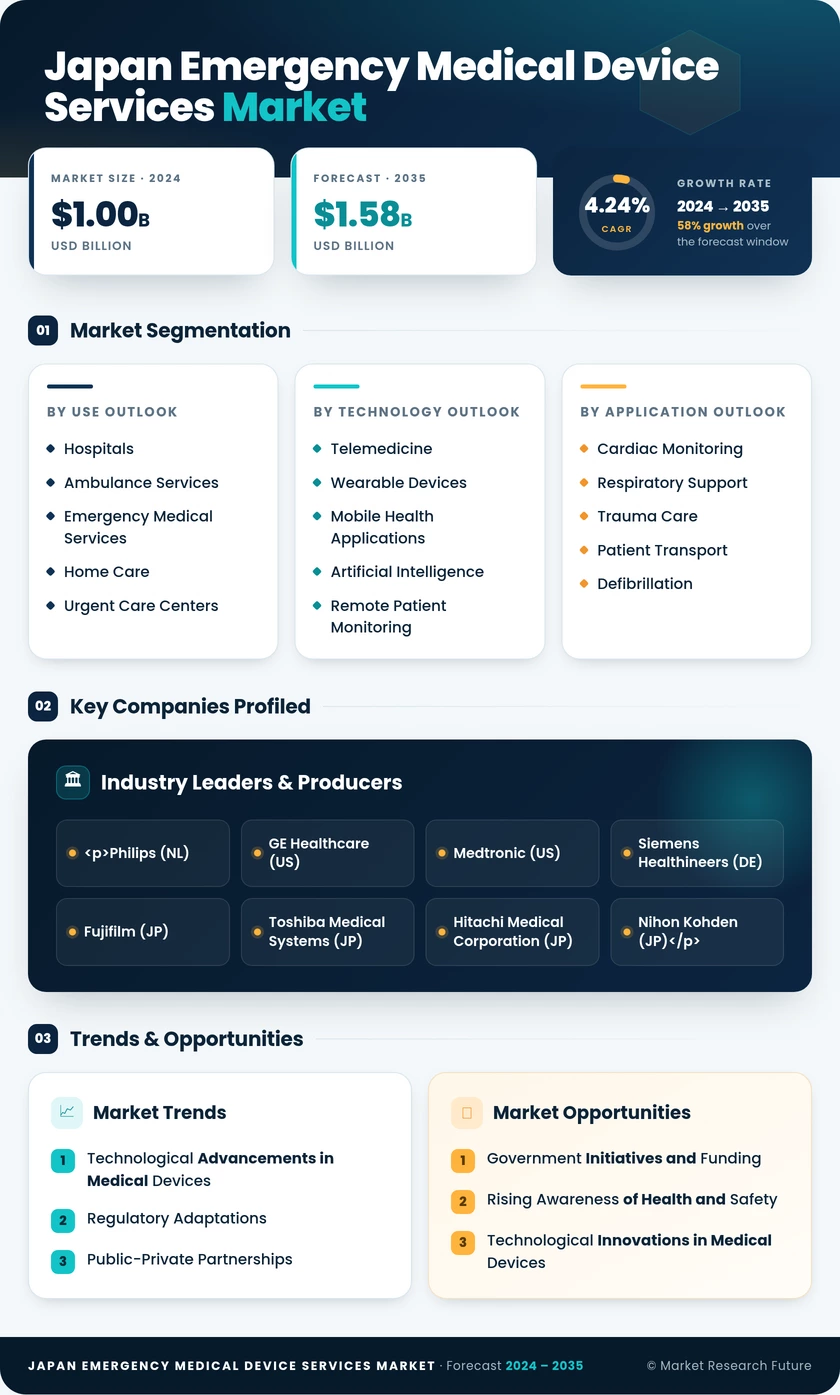
Japan Emergency Medical Device Services Market
Market Size
Forecast Period2025 - 2035
CAGR (2025 - 2035)4.24%
2024 Market Size$ 1 Billion
2025 Market Size$ 1.05 Billion
2035 Market Size$ 1.58 Billion
Key Players
Philips
GE Healthcare
Medtronic
Siemens Healthineers
Fujifilm
Toshiba Medical Systems
Opportunities
  • Government Initiatives and Funding
  • Rising Awareness of Health and Safety
  • Technological Innovations in Medical Devices
  1. SECTION I: EXECUTIVE SUMMARY AND KEY HIGHLIGHTS |
    1. 1.1 EXECUTIVE SUMMARY | |
      1. 1.1.1 Market Overview | |
      2. 1.1.2 Key Findings | |
      3. 1.1.3 Market Segmentation | |
      4. 1.1.4 Competitive Landscape | |
      5. 1.1.5 Challenges and Opportunities | |
      6. 1.1.6 Future Outlook 2
  2. SECTION II: SCOPING, METHODOLOGY AND MARKET STRUCTURE |
    1. 2.1 MARKET INTRODUCTION | |
      1. 2.1.1 Definition | |
      2. 2.1.2 Scope of the study | | |
        1. 2.1.2.1 Research Objective | | |
        2. 2.1.2.2 Assumption | | |
        3. 2.1.2.3 Limitations |
    2. 2.2 RESEARCH METHODOLOGY | |
      1. 2.2.1 Overview | |
      2. 2.2.2 Data Mining | |
      3. 2.2.3 Secondary Research | |
      4. 2.2.4 Primary Research | | |
        1. 2.2.4.1 Primary Interviews and Information Gathering Process | | |
        2. 2.2.4.2 Breakdown of Primary Respondents | |
      5. 2.2.5 Forecasting Model | |
      6. 2.2.6 Market Size Estimation | | |
        1. 2.2.6.1 Bottom-Up Approach | | |
        2. 2.2.6.2 Top-Down Approach | |
      7. 2.2.7 Data Triangulation | |
      8. 2.2.8 Validation 3
  3. SECTION III: QUALITATIVE ANALYSIS |
    1. 3.1 MARKET DYNAMICS | |
      1. 3.1.1 Overview | |
      2. 3.1.2 Drivers | |
      3. 3.1.3 Restraints | |
      4. 3.1.4 Opportunities |
    2. 3.2 MARKET FACTOR ANALYSIS | |
      1. 3.2.1 Value chain Analysis | |
      2. 3.2.2 Porter's Five Forces Analysis | | |
        1. 3.2.2.1 Bargaining Power of Suppliers | | |
        2. 3.2.2.2 Bargaining Power of Buyers | | |
        3. 3.2.2.3 Threat of New Entrants | | |
        4. 3.2.2.4 Threat of Substitutes | | |
        5. 3.2.2.5 Intensity of Rivalry | |
      3. 3.2.3 COVID-19 Impact Analysis | | |
        1. 3.2.3.1 Market Impact Analysis | | |
        2. 3.2.3.2 Regional Impact | | |
        3. 3.2.3.3 Opportunity and Threat Analysis 4
  4. SECTION IV: QUANTITATIVE ANALYSIS |
    1. 4.1 Healthcare, BY Application (USD Billion) | |
      1. 4.1.1 Cardiac Monitoring | |
      2. 4.1.2 Respiratory Support | |
      3. 4.1.3 Trauma Care | |
      4. 4.1.4 Patient Transport | |
      5. 4.1.5 Defibrillation |
    2. 4.2 Healthcare, BY End Use (USD Billion) | |
      1. 4.2.1 Hospitals | |
      2. 4.2.2 Ambulance Services | |
      3. 4.2.3 Emergency Medical Services | |
      4. 4.2.4 Home Care | |
      5. 4.2.5 Urgent Care Centers |
    3. 4.3 Healthcare, BY Device Type (USD Billion) | |
      1. 4.3.1 Automated External Defibrillators | |
      2. 4.3.2 Ventilators | |
      3. 4.3.3 Patient Monitors | |
      4. 4.3.4 Infusion Pumps | |
      5. 4.3.5 Emergency Resuscitation Equipment |
    4. 4.4 Healthcare, BY Technology (USD Billion) | |
      1. 4.4.1 Telemedicine | |
      2. 4.4.2 Wearable Devices | |
      3. 4.4.3 Mobile Health Applications | |
      4. 4.4.4 Artificial Intelligence | |
      5. 4.4.5 Remote Patient Monitoring |
    5. 4.5 Healthcare, BY Regulatory Compliance (USD Billion) | |
      1. 4.5.1 ISO Standards | |
      2. 4.5.2 Medical Device Regulations | |
      3. 4.5.3 Quality Management Systems | |
      4. 4.5.4 Safety Standards | |
      5. 4.5.5 Clinical Guidelines 5
  5. SECTION V: COMPETITIVE ANALYSIS |
    1. 5.1 Competitive Landscape | |
      1. 5.1.1 Overview | |
      2. 5.1.2 Competitive Analysis | |
      3. 5.1.3 Market share Analysis | |
      4. 5.1.4 Major Growth Strategy in the Healthcare | |
      5. 5.1.5 Competitive Benchmarking | |
      6. 5.1.6 Leading Players in Terms of Number of Developments in the Healthcare | |
      7. 5.1.7 Key developments and growth strategies | | |
        1. 5.1.7.1 New Product Launch/Service Deployment | | |
        2. 5.1.7.2 Merger & Acquisitions | | |
        3. 5.1.7.3 Joint Ventures | |
      8. 5.1.8 Major Players Financial Matrix | | |
        1. 5.1.8.1 Sales and Operating Income | | |
        2. 5.1.8.2 Major Players R&D Expenditure. 2023 |
    2. 5.2 Company Profiles | |
      1. 5.2.1 Philips (NL) | | |
        1. 5.2.1.1 Financial Overview | | |
        2. 5.2.1.2 Products Offered | | |
        3. 5.2.1.3 Key Developments | | |
        4. 5.2.1.4 SWOT Analysis | | |
        5. 5.2.1.5 Key Strategies | |
      2. 5.2.2 GE Healthcare (US) | | |
        1. 5.2.2.1 Financial Overview | | |
        2. 5.2.2.2 Products Offered | | |
        3. 5.2.2.3 Key Developments | | |
        4. 5.2.2.4 SWOT Analysis | | |
        5. 5.2.2.5 Key Strategies | |
      3. 5.2.3 Medtronic (US) | | |
        1. 5.2.3.1 Financial Overview | | |
        2. 5.2.3.2 Products Offered | | |
        3. 5.2.3.3 Key Developments | | |
        4. 5.2.3.4 SWOT Analysis | | |
        5. 5.2.3.5 Key Strategies | |
      4. 5.2.4 Siemens Healthineers (DE) | | |
        1. 5.2.4.1 Financial Overview | | |
        2. 5.2.4.2 Products Offered | | |
        3. 5.2.4.3 Key Developments | | |
        4. 5.2.4.4 SWOT Analysis | | |
        5. 5.2.4.5 Key Strategies | |
      5. 5.2.5 Fujifilm (JP) | | |
        1. 5.2.5.1 Financial Overview | | |
        2. 5.2.5.2 Products Offered | | |
        3. 5.2.5.3 Key Developments | | |
        4. 5.2.5.4 SWOT Analysis | | |
        5. 5.2.5.5 Key Strategies | |
      6. 5.2.6 Toshiba Medical Systems (JP) | | |
        1. 5.2.6.1 Financial Overview | | |
        2. 5.2.6.2 Products Offered | | |
        3. 5.2.6.3 Key Developments | | |
        4. 5.2.6.4 SWOT Analysis | | |
        5. 5.2.6.5 Key Strategies | |
      7. 5.2.7 Hitachi Medical Corporation (JP) | | |
        1. 5.2.7.1 Financial Overview | | |
        2. 5.2.7.2 Products Offered | | |
        3. 5.2.7.3 Key Developments | | |
        4. 5.2.7.4 SWOT Analysis | | |
        5. 5.2.7.5 Key Strategies | |
      8. 5.2.8 Nihon Kohden (JP) | | |
        1. 5.2.8.1 Financial Overview | | |
        2. 5.2.8.2 Products Offered | | |
        3. 5.2.8.3 Key Developments | | |
        4. 5.2.8.4 SWOT Analysis | | |
        5. 5.2.8.5 Key Strategies |
    3. 5.3 Appendix | |
      1. 5.3.1 References | |
      2. 5.3.2 Related Reports 6 LIST OF FIGURES |
    4. 6.1 MARKET SYNOPSIS |
    5. 6.2 JAPAN MARKET ANALYSIS BY APPLICATION |
    6. 6.3 JAPAN MARKET ANALYSIS BY END USE |
    7. 6.4 JAPAN MARKET ANALYSIS BY DEVICE TYPE |
    8. 6.5 JAPAN MARKET ANALYSIS BY TECHNOLOGY |
    9. 6.6 JAPAN MARKET ANALYSIS BY REGULATORY COMPLIANCE |
    10. 6.7 KEY BUYING CRITERIA OF HEALTHCARE |
    11. 6.8 RESEARCH PROCESS OF MRFR |
    12. 6.9 DRO ANALYSIS OF HEALTHCARE |
    13. 6.10 DRIVERS IMPACT ANALYSIS: HEALTHCARE |
    14. 6.11 RESTRAINTS IMPACT ANALYSIS: HEALTHCARE |
    15. 6.12 SUPPLY / VALUE CHAIN: HEALTHCARE |
    16. 6.13 HEALTHCARE, BY APPLICATION, 2024 (% SHARE) |
    17. 6.14 HEALTHCARE, BY APPLICATION, 2024 TO 2035 (USD Billion) |
    18. 6.15 HEALTHCARE, BY END USE, 2024 (% SHARE) |
    19. 6.16 HEALTHCARE, BY END USE, 2024 TO 2035 (USD Billion) |
    20. 6.17 HEALTHCARE, BY DEVICE TYPE, 2024 (% SHARE) |
    21. 6.18 HEALTHCARE, BY DEVICE TYPE, 2024 TO 2035 (USD Billion) |
    22. 6.19 HEALTHCARE, BY TECHNOLOGY, 2024 (% SHARE) |
    23. 6.20 HEALTHCARE, BY TECHNOLOGY, 2024 TO 2035 (USD Billion) |
    24. 6.21 HEALTHCARE, BY REGULATORY COMPLIANCE, 2024 (% SHARE) |
    25. 6.22 HEALTHCARE, BY REGULATORY COMPLIANCE, 2024 TO 2035 (USD Billion) |
    26. 6.23 BENCHMARKING OF MAJOR COMPETITORS 7 LIST OF TABLES |
    27. 7.1 LIST OF ASSUMPTIONS | |
      1. 7.1.1 |
    28. 7.2 Japan MARKET SIZE ESTIMATES; FORECAST | |
      1. 7.2.1 BY APPLICATION, 2026-2035 (USD Billion) | |
      2. 7.2.2 BY END USE, 2026-2035 (USD Billion) | |
      3. 7.2.3 BY DEVICE TYPE, 2026-2035 (USD Billion) | |
      4. 7.2.4 BY TECHNOLOGY, 2026-2035 (USD Billion) | |
      5. 7.2.5 BY REGULATORY COMPLIANCE, 2026-2035 (USD Billion) |
    29. 7.3 PRODUCT LAUNCH/PRODUCT DEVELOPMENT/APPROVAL | |
      1. 7.3.1 |
    30. 7.4 ACQUISITION/PARTNERSHIP | |

Japan Emergency Medical Device Services Market Segmentation

Japan Emergency Medical Device Services Market By Application (USD Billion, 2026-2035)

  • Cardiac Monitoring
  • Respiratory Support
  • Trauma Care
  • Patient Transport
  • Defibrillation

Japan Emergency Medical Device Services Market By End Use (USD Billion, 2026-2035)

  • Hospitals
  • Ambulance Services
  • Emergency Medical Services
  • Home Care
  • Urgent Care Centers

Japan Emergency Medical Device Services Market By Device Type (USD Billion, 2026-2035)

  • Automated External Defibrillators
  • Ventilators
  • Patient Monitors
  • Infusion Pumps
  • Emergency Resuscitation Equipment

Japan Emergency Medical Device Services Market By Japan Emergency Medical Device Services Market (USD Billion, 2026-2035)

  • Telemedicine
  • Wearable Devices
  • Mobile Health Applications
  • Artificial Intelligence
  • Remote Patient Monitoring

Japan Emergency Medical Device Services Market By Regulatory Compliance (USD Billion, 2026-2035)

  • ISO Standards
  • Japan Emergency Medical Device Services Market Regulations
  • Quality Management Systems
  • Safety Standards
  • Clinical Guidelines
Download PDF ×

We do not share your information with anyone. However, we may send you emails based on your report interest from time to time. You may contact us at any time to opt-out.