×
Hero Background
English
Chinese
French
Japanese
Korean
German
Spanish

Isophthalic Acid Market Analysis

ID: MRFR/CnM/11105-HCR
111 Pages
Anshula Mandaokar
October 2025

Isophthalic Acid Market Research Report Information By Application (PET Resin Production, UPR Production, Thermo-Resistant Coating, Thermosetting Fiber, Copolyester Polymer, and Others), By End Use (Plastics, Coating, Fibers, Packaging, Lubricants, and Others) And By Region (North America, Europe, Asia-Pacific, And Rest Of The World) –Market Forecast Till 2035.

Share:
Download PDF ×

We do not share your information with anyone. However, we may send you emails based on your report interest from time to time. You may contact us at any time to opt-out.

Isophthalic Acid Market Infographic
Purchase Options

Market Analysis

In-depth Analysis of Isophthalic Acid Market Industry Landscape

The organic market for isophthalic acid, a crucial chemical compound used in tars, paints, and filaments, is affected by many factors. Isophthalic Acid market growth is driven by end-use industries including auto, development, and hardware. As these industries expand internationally, demand for high-performance materials like Isophthalic Acid rises, driving market growth.

The development industry uses isophthalic acid to make erosion-resistant coatings and solid tars, which drives the market. Isophthalic Acid demand rises as urbanization and infrastructure projects flood, especially in emerging economies. The compound's versatility in strengthening and executing materials makes it crucial to development.

Isophthalic Acid's market also benefits from the auto industry. The compound assembles lightweight, high-strength materials, including vehicle part composites. To improve eco-friendliness and meet natural standards, the vehicle industry is moving toward lightweight materials.

In any case, market elements present obstacles. Isophthalic Acid production costs might vary with raw ingredient pricing, notably for petrochemical feedstocks. This uncertainty in input costs can test producers' revenues and evaluation systems. Ecological concerns and administrative changes related to drug mixture production and use may also challenge the Isophthalic Acid market.

Topographically, Asia-Pacific is a key Isophthalic Acid market player. Isophthalic Acid is popular due to rapid manufacturing and assembling growth. China's growing development and auto sectors make it a key market supporter. Structured businesses and mechanical advances drive market interest in North America and Europe.

Isophthalic Acid market competition is fierce due to a few key players. Companies are successfully pursuing consolidations, acquisitions, and partnerships to strengthen their market positions and product portfolios. Innovative work is also underway to find creative applications and improve Isophthalic Acid's presentation to meet industry standards.

Author
Anshula Mandaokar
Team Lead - Research

Anshula Mandaokar holds an academic degree in Chemical Engineering and has been contributing to the field for more than 5 years. She has expertise in Market Research and Business Consulting and serves as a Team Lead for a reputed Market Research firm under the Chemicals and Materials domain spectrum. She has worked on multiple projects, generating explicit results in a quick turnaround time. Her understanding of data interpretation justifies her role as a leader.

Leave a Comment

FAQs

What is the projected market valuation of the Isophthalic Acid Market by 2035?

The Isophthalic Acid Market is projected to reach a valuation of 4.951 USD Billion by 2035.

What was the market valuation of the Isophthalic Acid Market in 2024?

In 2024, the Isophthalic Acid Market was valued at 3.148 USD Billion.

What is the expected CAGR for the Isophthalic Acid Market during the forecast period 2025 - 2035?

The expected CAGR for the Isophthalic Acid Market during the forecast period 2025 - 2035 is 4.2%.

Which companies are considered key players in the Isophthalic Acid Market?

Key players in the Isophthalic Acid Market include BASF SE, Eastman Chemical Company, and Mitsubishi Gas Chemical Company, among others.

What are the primary applications of Isophthalic Acid in the market?

Primary applications of Isophthalic Acid include PET Resin Production, UPR Production, and Thermo-Resistant Coating.

How much revenue is generated from PET Resin Production in the Isophthalic Acid Market?

PET Resin Production generated revenue of 1.2 USD Billion in 2024, with projections reaching 1.9 USD Billion by 2035.

Market Summary

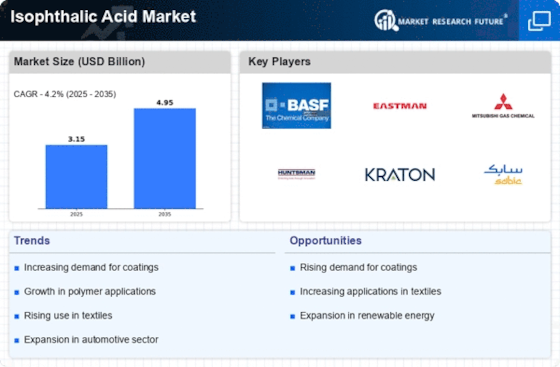
As per MRFR analysis, the Isophthalic Acid Market Size was estimated at 3.148 USD Billion in 2024. The Isophthalic Acid industry is projected to grow from 3.28 in 2025 to 4.951 by 2035, exhibiting a compound annual growth rate (CAGR) of 4.2 during the forecast period 2025 - 2035.

Key Market Trends & Highlights

The Isophthalic Acid Market is poised for growth driven by sustainability and technological advancements.

  • North America remains the largest market for isophthalic acid, primarily due to its robust demand in various applications.
  • Asia-Pacific is emerging as the fastest-growing region, fueled by rapid industrialization and increasing production capacities.
  • The PET resin production segment dominates the market, while the UPR production segment is witnessing the fastest growth.
  • Key market drivers include rising demand in coatings and adhesives, alongside the expansion in polyester production.

Market Size & Forecast

2024 Market Size 3.148 (USD Billion)
2035 Market Size 4.951 (USD Billion)
CAGR (2025 - 2035) 4.2%
Largest Regional Market Share in 2024 North America

Major Players

<p>BASF SE (DE), Eastman Chemical Company (US), Mitsubishi Gas Chemical Company, Inc. (JP), Huntsman Corporation (US), Kraton Corporation (US), SABIC (SA), LG Chem (KR), DIC Corporation (JP), Alfa Aesar (US)</p>

Market Trends

The Isophthalic Acid Market is currently experiencing a dynamic phase characterized by evolving demand patterns and innovative applications. This compound, primarily utilized in the production of polyesters and resins, is witnessing heightened interest from various sectors, including automotive, construction, and textiles. The increasing focus on sustainability and eco-friendly materials is driving manufacturers to explore isophthalic acid as a viable alternative to traditional chemicals. Furthermore, advancements in production technologies are likely to enhance efficiency and reduce costs, thereby making isophthalic acid more accessible to a broader range of industries. In addition, the Isophthalic Acid Market appears to be influenced by global economic trends and regulatory frameworks aimed at reducing environmental impact. As industries strive to comply with stringent regulations, the demand for high-performance materials that offer durability and resistance to degradation is expected to rise. This shift may lead to increased investments in research and development, fostering innovation in product formulations. Overall, the Isophthalic Acid Market is poised for growth, driven by a combination of technological advancements and changing consumer preferences, suggesting a promising outlook for stakeholders in the coming years.

Sustainability Initiatives

The Isophthalic Acid Market is increasingly shaped by sustainability initiatives, as industries seek to minimize their environmental footprint. This trend is prompting manufacturers to develop eco-friendly alternatives and enhance the recyclability of products containing isophthalic acid.

Technological Advancements

Technological advancements in production processes are likely to play a crucial role in the Isophthalic Acid Market. Innovations aimed at improving efficiency and reducing costs may lead to a more competitive landscape, enabling wider adoption across various applications.

Regulatory Compliance

Regulatory compliance is becoming a significant driver in the Isophthalic Acid Market. As governments implement stricter environmental regulations, companies are compelled to adopt materials that meet these standards, potentially increasing the demand for isophthalic acid in compliant formulations.

Isophthalic Acid Market Market Drivers

Expansion in Polyester Production

The Isophthalic Acid Market is significantly influenced by the expansion of polyester production, particularly in the textile and packaging sectors. Polyester, which is derived from isophthalic acid, is widely used due to its excellent strength, durability, and resistance to wrinkling. The textile industry, which has been growing steadily, is expected to witness a surge in polyester demand, potentially increasing the consumption of isophthalic acid. Recent estimates suggest that the polyester market could reach a valuation of over USD 100 billion by 2026, indicating a substantial opportunity for isophthalic acid producers. This expansion not only highlights the importance of isophthalic acid in polyester synthesis but also underscores its critical role in meeting the evolving needs of various industries.

Growth in Automotive Applications

The Isophthalic Acid Market is poised for growth due to the increasing utilization of isophthalic acid in automotive applications. As manufacturers strive to produce lightweight and fuel-efficient vehicles, the demand for advanced materials that can withstand high temperatures and provide structural integrity is rising. Isophthalic acid is integral in the production of high-performance resins and composites used in automotive components. The automotive sector is projected to grow at a CAGR of around 4% in the coming years, which could lead to a corresponding increase in isophthalic acid consumption. This trend suggests that the isophthalic acid market will benefit from the automotive industry's shift towards innovative materials that enhance vehicle performance and sustainability.

Rising Demand in Coatings and Adhesives

The Isophthalic Acid Market is experiencing a notable increase in demand from the coatings and adhesives sector. This growth is primarily driven by the need for high-performance materials that offer durability and resistance to environmental factors. The coatings industry, which utilizes isophthalic acid for its superior properties, is projected to expand at a compound annual growth rate (CAGR) of approximately 5% over the next few years. This trend indicates a robust market potential for isophthalic acid, as manufacturers seek to enhance product performance and longevity. Furthermore, the increasing focus on aesthetic appeal in construction and automotive applications further propels the demand for isophthalic acid-based coatings, thereby solidifying its position in the market.

Emerging Markets and Economic Development

The Isophthalic Acid Market is likely to benefit from the economic development in emerging markets, where industrialization and urbanization are accelerating. Countries in Asia and Latin America are witnessing a surge in construction and manufacturing activities, leading to increased demand for isophthalic acid in various applications, including coatings, adhesives, and plastics. The construction sector, in particular, is expected to grow significantly, with investments in infrastructure projects driving the need for high-quality materials. This trend indicates a potential increase in isophthalic acid consumption, as manufacturers in these regions seek to meet the rising demand for durable and efficient products. The economic growth in these markets presents a promising opportunity for stakeholders in the isophthalic acid industry.

Innovations in Chemical Manufacturing Processes

The Isophthalic Acid Market is experiencing a transformation due to innovations in chemical manufacturing processes. Advances in production techniques, such as more efficient catalytic processes and the use of renewable feedstocks, are enhancing the sustainability and cost-effectiveness of isophthalic acid production. These innovations not only reduce the environmental impact of manufacturing but also improve the overall quality of the end product. As companies increasingly prioritize sustainability, the adoption of these advanced manufacturing processes is likely to drive growth in the isophthalic acid market. Furthermore, the potential for reduced production costs may lead to increased competitiveness, allowing manufacturers to expand their market share and meet the evolving demands of various industries.


Market Segment Insights

By Application: PET Resin Production (Largest) vs. UPR Production (Fastest-Growing)

<p>In the Isophthalic Acid Market, the application segment is characterized by a diverse range of usages, with PET Resin Production leading in market share due to its extensive application in the bottle and packaging sectors. Following closely is UPR Production, driven by its utility in various industrial applications and composite materials. Other applications, including thermo-resistant coatings and thermosetting fibers, contribute to the market dynamics but have a smaller share of the overall landscape.</p>

<p>UPR Production (Fastest-Growing) vs. Thermosetting Fiber (Emerging)</p>

<p>The UPR (Unsaturated Polyester Resin) Production segment is experiencing rapid growth, fueled by the increasing demand for composite materials in construction and automotive industries. Its versatility, combined with the rising trend toward lightweight materials, positions it as the fastest-growing application within the Isophthalic Acid Market. In contrast, Thermosetting Fiber serves as an emerging application, characterized by its heat resistance and strength, making it suitable for high-performance applications. As industries continue to innovate, both UPR Production and Thermosetting Fibers are likely to expand their influence in the market.</p>

By End-Use: Plastics (Largest) vs. Coating (Fastest-Growing)

<p>In the Isophthalic Acid Market, Plastics segment dominates the overall market share, reflecting its essential role in manufacturing various plastic materials such as PET. This segment's stability and resilience in demand contribute significantly to its leading position. Conversely, the Coating segment is marked by rapid growth due to increasing applications in diverse industries, including automotive and aerospace, where protective and decorative coatings are invaluable.</p>

<p>Plastics (Dominant) vs. Coating (Emerging)</p>

<p>The Plastics segment of the Isophthalic Acid Market is characterized by its extensive use in producing high-performance plastics, particularly in the manufacturing of consumer goods and industrial applications. This segment benefits from advancements in polymer technology and a consistent demand from sectors such as automotive and electronics. On the other hand, the Coating segment is emerging rapidly, driven by innovations in coating technologies and increasing awareness of durability and aesthetic appeal. As industries prioritize sustainability, the Coating segment's growth is also bolstered by the transition towards eco-friendly solutions.</p>

Get more detailed insights about Isophthalic Acid Market Research Report - Global Forecast by 2035

Regional Insights

North America : Innovation and Demand Surge

North America is witnessing significant growth in the isophthalic acid market, driven by increasing demand from the automotive and construction sectors. The region holds approximately 40% of the global market share, making it the largest market for isophthalic acid. Regulatory support for sustainable materials and innovations in production processes are further propelling this growth. The United States and Canada are the leading countries in this region, with major players like BASF SE and Eastman Chemical Company dominating the landscape. The competitive environment is characterized by continuous innovation and strategic partnerships among key players, ensuring a robust supply chain and meeting the rising demand for high-performance materials.

Europe : Sustainability and Innovation Focus

Europe is emerging as a significant player in the isophthalic acid market, driven by stringent environmental regulations and a strong focus on sustainability. The region accounts for approximately 30% of the global market share, making it the second-largest market. The European Union's commitment to reducing carbon emissions and promoting eco-friendly materials is a key driver for market growth. Germany, France, and the UK are the leading countries in this market, with companies like BASF SE and DIC Corporation leading the charge. The competitive landscape is marked by innovation in production techniques and a shift towards bio-based isophthalic acid, positioning Europe as a hub for sustainable chemical solutions.

Asia-Pacific : Emerging Markets and Growth Potential

Asia-Pacific is rapidly becoming a powerhouse in the isophthalic acid market, driven by increasing industrialization and urbanization. The region holds about 25% of the global market share, with countries like China and India leading the charge. The demand for isophthalic acid is fueled by its applications in coatings, plastics, and textiles, supported by favorable government policies promoting manufacturing. China is the largest market in this region, with significant contributions from local manufacturers and multinational corporations. The competitive landscape is evolving, with key players like Mitsubishi Gas Chemical Company and LG Chem investing in capacity expansion and technological advancements to meet the growing demand for isophthalic acid in various applications.

Middle East and Africa : Resource-Rich and Growing Demand

The Middle East and Africa region is witnessing a gradual increase in the isophthalic acid market, driven by growing industrial activities and infrastructure development. The region currently holds about 5% of the global market share. Countries like Saudi Arabia and South Africa are leading this growth, supported by investments in petrochemical industries and favorable government initiatives. Saudi Arabia is the primary market in this region, with key players like SABIC focusing on expanding their product offerings. The competitive landscape is characterized by a mix of local and international companies, all vying to capture the emerging demand for isophthalic acid in various sectors, including construction and automotive.

Key Players and Competitive Insights

Leading market players are investing heavily in research and development in order to expand their product lines, which will help the Isophthalic Acid Market grow even more. Market participants are also undertaking a variety of strategic activities to expand their footprint, with important market developments including new product launches, contractual agreements, mergers and acquisitions, higher investments, and collaboration with other organizations. To expand and survive in a more competitive and rising market climate, the Isophthalic Acid industry must offer cost-effective items.

Manufacturing locally to minimize operational costs is one of the key business tactics used by manufacturers in the Isophthalic Acid industry to benefit clients and increase the market sector. In recent years, the Isophthalic Acid industry has offered some of the most significant advantages to the environment.

Major players in the Isophthalic Acid Market, including LOTTE Chemical CORPORATION, The Chemical Company, Merck KGaA, Eastman Chemical Company, International Chemical Co. (ICC), Thermo Fisher Scientific Inc., Mitsubishi Gas Chemical Company, Inc., Formosa Chemicals & Fibre Corp., Beijing Yanshan Petrochemical Company Ltd. (BYPC), and Hefei TNJ Chemical Industry Co.,Ltd, and others, are attempting to increase market demand by investing in research and development operations.

Eastman Chemical Company is a specialty chemical company headquartered in Kingsport, Tennessee, USA. It was founded in 1920 and has a strong presence in a wide range of industries, including chemicals, materials, and additives. Eastman is known for its innovation in developing various chemicals and materials used in a diverse array of applications, such as plastics, fibers, coatings, adhesives, and more. The company is committed to sustainability and has initiatives to reduce its environmental footprint and develop more environmentally friendly products.

Eastman Chemical Company is a Fortune 500 company that operates globally, serving customers in over 100 countries. On August 4, 2023, Eastman Chemical Company announced a partnership with China Petrochemical Corporation (Sinopec) to build a new isophthalic acid (IPA) plant in China. The plant is expected to be operational in 2025 and will have a capacity of 1 million metric tons per year. This partnership will allow Eastman to expand its reach in the Chinese market and meet the growing demand for IPA in the region.

Lotte Chemical Corporation is a subsidiary of the Lotte Group, a large South Korean conglomerate with interests in various industries, including petrochemicals, manufacturing, food, retail, and more. Lotte Chemical is one of the key companies within the Lotte Group and is involved in the production of various chemicals and petrochemical products. Lotte Chemical is known for its diverse range of chemical products, including petrochemicals, polymers, and performance chemicals. The company produces a variety of chemicals used in industries such as plastics, textiles, packaging, and automotive. On July 25, 2023, Lotte Chemical Corporation announced the acquisition of Daicel Corporation's IPA business.

The acquisition includes Daicel's IPA plant in Japan and its sales and marketing network. This acquisition will make Lotte Chemical the world's largest producer of IPA and will give it a strong presence in the Japanese market.

Key Companies in the Isophthalic Acid Market market include

Industry Developments

July 2023: Indorama Ventures acquired the isophthalic acid business of Eastman Chemical for $1.2 billion. The acquisition includes Eastman's isophthalic acid plants in the United States and the United Kingdom, as well as its isophthalic acid technology.

January 2023: Eastman Chemical Company announced that it has acquired the isophthalic acid business of INVISTA for USD 1.6 billion. This acquisition will expand Eastman's portfolio of specialty products and strengthen its position in the isophthalic acid market.

December 2022: BASF SE announced that it has formed a joint venture with Sinopec Corp. to produce isophthalic acid in China. The joint venture, named BASF-Sinopec Isophthalic Acid Market Company (BSIAC), will have a production capacity of 500,000 metric tons per year and is expected to start operations in 2025.

In January 2023, Lotte Chemical plans to divest non-essential international operations in order to enhance its high-value specialty materials business. In a public disclosure on January 16, the company declared its intention to divest its complete 75.01 percent ownership in Lotte Chemical Pakistan Limited (LCPL), a subsidiary in Pakistan that produces purified terephthalic acid (PTA). The buyer, Lucky Core Industries, a chemical company based in Pakistan, will acquire the stake for a price approximately 13 times higher than the original acquisition cost.

Lotte Chemical intends to utilize the funds obtained from the sell-off to enhance its current petrochemical offerings, including PE, PP, and PET. Additionally, the company aims to develop its specialty chemical division and venture into the eco-friendly material industry. In the latter half of 2020, Lotte Chemical ceased the operation of its PTA line at the Ulsan plant in Korea and subsequently converted the facility to produce purified isophthalic acid (PIA). It has fully exited PTA manufacturing by divesting LCPL to a Pakistani business.

Future Outlook

Isophthalic Acid Market Future Outlook

<p>The Isophthalic Acid Market is projected to grow at a 4.2% CAGR from 2024 to 2035, driven by increasing demand in coatings, plastics, and resins.</p>

New opportunities lie in:

  • <p>Expansion into bio-based isophthalic acid production</p>
  • <p>Development of high-performance composites for automotive applications</p>
  • <p>Strategic partnerships with key players in the coatings industry</p>

<p>By 2035, the Isophthalic Acid Market is expected to achieve robust growth and enhanced market positioning.</p>

Market Segmentation

Isophthalic Acid Market End-Use Outlook

  • Plastics
  • Coating
  • Fibers
  • Packaging
  • Lubricants
  • Others

Isophthalic Acid Market Application Outlook

  • PET Resin Production
  • UPR Production
  • Thermo-Resistant Coating
  • Thermosetting Fiber
  • Copolyester Polymer
  • Others

Report Scope

MARKET SIZE 20243.148(USD Billion)
MARKET SIZE 20253.28(USD Billion)
MARKET SIZE 20354.951(USD Billion)
COMPOUND ANNUAL GROWTH RATE (CAGR)4.2% (2024 - 2035)
REPORT COVERAGERevenue Forecast, Competitive Landscape, Growth Factors, and Trends
BASE YEAR2024
Market Forecast Period2025 - 2035
Historical Data2019 - 2024
Market Forecast UnitsUSD Billion
Key Companies ProfiledMarket analysis in progress
Segments CoveredMarket segmentation analysis in progress
Key Market OpportunitiesGrowing demand for high-performance polymers drives innovation in the Isophthalic Acid Market.
Key Market DynamicsRising demand for high-performance polymers drives innovation and competition in the Isophthalic Acid market.
Countries CoveredNorth America, Europe, APAC, South America, MEA

FAQs

What is the projected market valuation of the Isophthalic Acid Market by 2035?

The Isophthalic Acid Market is projected to reach a valuation of 4.951 USD Billion by 2035.

What was the market valuation of the Isophthalic Acid Market in 2024?

In 2024, the Isophthalic Acid Market was valued at 3.148 USD Billion.

What is the expected CAGR for the Isophthalic Acid Market during the forecast period 2025 - 2035?

The expected CAGR for the Isophthalic Acid Market during the forecast period 2025 - 2035 is 4.2%.

Which companies are considered key players in the Isophthalic Acid Market?

Key players in the Isophthalic Acid Market include BASF SE, Eastman Chemical Company, and Mitsubishi Gas Chemical Company, among others.

What are the primary applications of Isophthalic Acid in the market?

Primary applications of Isophthalic Acid include PET Resin Production, UPR Production, and Thermo-Resistant Coating.

How much revenue is generated from PET Resin Production in the Isophthalic Acid Market?

PET Resin Production generated revenue of 1.2 USD Billion in 2024, with projections reaching 1.9 USD Billion by 2035.

  1. SECTION I: EXECUTIVE SUMMARY AND KEY HIGHLIGHTS
    1. EXECUTIVE SUMMARY
      1. Market Overview
      2. Key Findings
      3. Market Segmentation
      4. Competitive Landscape
      5. Challenges and Opportunities
      6. Future Outlook
  2. SECTION II: SCOPING, METHODOLOGY AND MARKET STRUCTURE
    1. MARKET INTRODUCTION
      1. Definition
      2. Scope of the study
    2. RESEARCH METHODOLOGY
      1. Overview
      2. Data Mining
      3. Secondary Research
      4. Primary Research
      5. Forecasting Model
      6. Market Size Estimation
      7. Data Triangulation
      8. Validation
  3. SECTION III: QUALITATIVE ANALYSIS
    1. MARKET DYNAMICS
      1. Overview
      2. Drivers
      3. Restraints
      4. Opportunities
    2. MARKET FACTOR ANALYSIS
      1. Value chain Analysis
      2. Porter's Five Forces Analysis
      3. COVID-19 Impact Analysis
  4. SECTION IV: QUANTITATIVE ANALYSIS
    1. Chemicals and Materials, BY Application (USD Billion)
      1. PET Resin Production
      2. UPR Production
      3. Thermo-Resistant Coating
      4. Thermosetting Fiber
      5. Copolyester Polymer
      6. Others
    2. Chemicals and Materials, BY End-Use (USD Billion)
      1. Plastics
      2. Coating
      3. Fibers
      4. Packaging
      5. Lubricants
      6. Others
    3. Chemicals and Materials, BY Region (USD Billion)
      1. North America
      2. Europe
      3. APAC
      4. South America
      5. MEA
  5. SECTION V: COMPETITIVE ANALYSIS
    1. Competitive Landscape
      1. Overview
      2. Competitive Analysis
      3. Market share Analysis
      4. Major Growth Strategy in the Chemicals and Materials
      5. Competitive Benchmarking
      6. Leading Players in Terms of Number of Developments in the Chemicals and Materials
      7. Key developments and growth strategies
      8. Major Players Financial Matrix
    2. Company Profiles
      1. BASF SE (DE)
      2. Eastman Chemical Company (US)
      3. Mitsubishi Gas Chemical Company, Inc. (JP)
      4. Huntsman Corporation (US)
      5. Kraton Corporation (US)
      6. SABIC (SA)
      7. LG Chem (KR)
      8. DIC Corporation (JP)
      9. Alfa Aesar (US)
    3. Appendix
      1. References
      2. Related Reports
  6. LIST OF FIGURES
    1. MARKET SYNOPSIS
    2. NORTH AMERICA MARKET ANALYSIS
    3. US MARKET ANALYSIS BY APPLICATION
    4. US MARKET ANALYSIS BY END-USE
    5. CANADA MARKET ANALYSIS BY APPLICATION
    6. CANADA MARKET ANALYSIS BY END-USE
    7. EUROPE MARKET ANALYSIS
    8. GERMANY MARKET ANALYSIS BY APPLICATION
    9. GERMANY MARKET ANALYSIS BY END-USE
    10. UK MARKET ANALYSIS BY APPLICATION
    11. UK MARKET ANALYSIS BY END-USE
    12. FRANCE MARKET ANALYSIS BY APPLICATION
    13. FRANCE MARKET ANALYSIS BY END-USE
    14. RUSSIA MARKET ANALYSIS BY APPLICATION
    15. RUSSIA MARKET ANALYSIS BY END-USE
    16. ITALY MARKET ANALYSIS BY APPLICATION
    17. ITALY MARKET ANALYSIS BY END-USE
    18. SPAIN MARKET ANALYSIS BY APPLICATION
    19. SPAIN MARKET ANALYSIS BY END-USE
    20. REST OF EUROPE MARKET ANALYSIS BY APPLICATION
    21. REST OF EUROPE MARKET ANALYSIS BY END-USE
    22. APAC MARKET ANALYSIS
    23. CHINA MARKET ANALYSIS BY APPLICATION
    24. CHINA MARKET ANALYSIS BY END-USE
    25. INDIA MARKET ANALYSIS BY APPLICATION
    26. INDIA MARKET ANALYSIS BY END-USE
    27. JAPAN MARKET ANALYSIS BY APPLICATION
    28. JAPAN MARKET ANALYSIS BY END-USE
    29. SOUTH KOREA MARKET ANALYSIS BY APPLICATION
    30. SOUTH KOREA MARKET ANALYSIS BY END-USE
    31. MALAYSIA MARKET ANALYSIS BY APPLICATION
    32. MALAYSIA MARKET ANALYSIS BY END-USE
    33. THAILAND MARKET ANALYSIS BY APPLICATION
    34. THAILAND MARKET ANALYSIS BY END-USE
    35. INDONESIA MARKET ANALYSIS BY APPLICATION
    36. INDONESIA MARKET ANALYSIS BY END-USE
    37. REST OF APAC MARKET ANALYSIS BY APPLICATION
    38. REST OF APAC MARKET ANALYSIS BY END-USE
    39. SOUTH AMERICA MARKET ANALYSIS
    40. BRAZIL MARKET ANALYSIS BY APPLICATION
    41. BRAZIL MARKET ANALYSIS BY END-USE
    42. MEXICO MARKET ANALYSIS BY APPLICATION
    43. MEXICO MARKET ANALYSIS BY END-USE
    44. ARGENTINA MARKET ANALYSIS BY APPLICATION
    45. ARGENTINA MARKET ANALYSIS BY END-USE
    46. REST OF SOUTH AMERICA MARKET ANALYSIS BY APPLICATION
    47. REST OF SOUTH AMERICA MARKET ANALYSIS BY END-USE
    48. MEA MARKET ANALYSIS
    49. GCC COUNTRIES MARKET ANALYSIS BY APPLICATION
    50. GCC COUNTRIES MARKET ANALYSIS BY END-USE
    51. SOUTH AFRICA MARKET ANALYSIS BY APPLICATION
    52. SOUTH AFRICA MARKET ANALYSIS BY END-USE
    53. REST OF MEA MARKET ANALYSIS BY APPLICATION
    54. REST OF MEA MARKET ANALYSIS BY END-USE
    55. KEY BUYING CRITERIA OF CHEMICALS AND MATERIALS
    56. RESEARCH PROCESS OF MRFR
    57. DRO ANALYSIS OF CHEMICALS AND MATERIALS
    58. DRIVERS IMPACT ANALYSIS: CHEMICALS AND MATERIALS
    59. RESTRAINTS IMPACT ANALYSIS: CHEMICALS AND MATERIALS
    60. SUPPLY / VALUE CHAIN: CHEMICALS AND MATERIALS
    61. CHEMICALS AND MATERIALS, BY APPLICATION, 2024 (% SHARE)
    62. CHEMICALS AND MATERIALS, BY APPLICATION, 2024 TO 2035 (USD Billion)
    63. CHEMICALS AND MATERIALS, BY END-USE, 2024 (% SHARE)
    64. CHEMICALS AND MATERIALS, BY END-USE, 2024 TO 2035 (USD Billion)
    65. BENCHMARKING OF MAJOR COMPETITORS
  7. LIST OF TABLES
    1. LIST OF ASSUMPTIONS
    2. North America MARKET SIZE ESTIMATES; FORECAST
      1. BY APPLICATION, 2025-2035 (USD Billion)
      2. BY END-USE, 2025-2035 (USD Billion)
    3. US MARKET SIZE ESTIMATES; FORECAST
      1. BY APPLICATION, 2025-2035 (USD Billion)
      2. BY END-USE, 2025-2035 (USD Billion)
    4. Canada MARKET SIZE ESTIMATES; FORECAST
      1. BY APPLICATION, 2025-2035 (USD Billion)
      2. BY END-USE, 2025-2035 (USD Billion)
    5. Europe MARKET SIZE ESTIMATES; FORECAST
      1. BY APPLICATION, 2025-2035 (USD Billion)
      2. BY END-USE, 2025-2035 (USD Billion)
    6. Germany MARKET SIZE ESTIMATES; FORECAST
      1. BY APPLICATION, 2025-2035 (USD Billion)
      2. BY END-USE, 2025-2035 (USD Billion)
    7. UK MARKET SIZE ESTIMATES; FORECAST
      1. BY APPLICATION, 2025-2035 (USD Billion)
      2. BY END-USE, 2025-2035 (USD Billion)
    8. France MARKET SIZE ESTIMATES; FORECAST
      1. BY APPLICATION, 2025-2035 (USD Billion)
      2. BY END-USE, 2025-2035 (USD Billion)
    9. Russia MARKET SIZE ESTIMATES; FORECAST
      1. BY APPLICATION, 2025-2035 (USD Billion)
      2. BY END-USE, 2025-2035 (USD Billion)
    10. Italy MARKET SIZE ESTIMATES; FORECAST
      1. BY APPLICATION, 2025-2035 (USD Billion)
      2. BY END-USE, 2025-2035 (USD Billion)
    11. Spain MARKET SIZE ESTIMATES; FORECAST
      1. BY APPLICATION, 2025-2035 (USD Billion)
      2. BY END-USE, 2025-2035 (USD Billion)
    12. Rest of Europe MARKET SIZE ESTIMATES; FORECAST
      1. BY APPLICATION, 2025-2035 (USD Billion)
      2. BY END-USE, 2025-2035 (USD Billion)
    13. APAC MARKET SIZE ESTIMATES; FORECAST
      1. BY APPLICATION, 2025-2035 (USD Billion)
      2. BY END-USE, 2025-2035 (USD Billion)
    14. China MARKET SIZE ESTIMATES; FORECAST
      1. BY APPLICATION, 2025-2035 (USD Billion)
      2. BY END-USE, 2025-2035 (USD Billion)
    15. India MARKET SIZE ESTIMATES; FORECAST
      1. BY APPLICATION, 2025-2035 (USD Billion)
      2. BY END-USE, 2025-2035 (USD Billion)
    16. Japan MARKET SIZE ESTIMATES; FORECAST
      1. BY APPLICATION, 2025-2035 (USD Billion)
      2. BY END-USE, 2025-2035 (USD Billion)
    17. South Korea MARKET SIZE ESTIMATES; FORECAST
      1. BY APPLICATION, 2025-2035 (USD Billion)
      2. BY END-USE, 2025-2035 (USD Billion)
    18. Malaysia MARKET SIZE ESTIMATES; FORECAST
      1. BY APPLICATION, 2025-2035 (USD Billion)
      2. BY END-USE, 2025-2035 (USD Billion)
    19. Thailand MARKET SIZE ESTIMATES; FORECAST
      1. BY APPLICATION, 2025-2035 (USD Billion)
      2. BY END-USE, 2025-2035 (USD Billion)
    20. Indonesia MARKET SIZE ESTIMATES; FORECAST
      1. BY APPLICATION, 2025-2035 (USD Billion)
      2. BY END-USE, 2025-2035 (USD Billion)
    21. Rest of APAC MARKET SIZE ESTIMATES; FORECAST
      1. BY APPLICATION, 2025-2035 (USD Billion)
      2. BY END-USE, 2025-2035 (USD Billion)
    22. South America MARKET SIZE ESTIMATES; FORECAST
      1. BY APPLICATION, 2025-2035 (USD Billion)
      2. BY END-USE, 2025-2035 (USD Billion)
    23. Brazil MARKET SIZE ESTIMATES; FORECAST
      1. BY APPLICATION, 2025-2035 (USD Billion)
      2. BY END-USE, 2025-2035 (USD Billion)
    24. Mexico MARKET SIZE ESTIMATES; FORECAST
      1. BY APPLICATION, 2025-2035 (USD Billion)
      2. BY END-USE, 2025-2035 (USD Billion)
    25. Argentina MARKET SIZE ESTIMATES; FORECAST
      1. BY APPLICATION, 2025-2035 (USD Billion)
      2. BY END-USE, 2025-2035 (USD Billion)
    26. Rest of South America MARKET SIZE ESTIMATES; FORECAST
      1. BY APPLICATION, 2025-2035 (USD Billion)
      2. BY END-USE, 2025-2035 (USD Billion)
    27. MEA MARKET SIZE ESTIMATES; FORECAST
      1. BY APPLICATION, 2025-2035 (USD Billion)
      2. BY END-USE, 2025-2035 (USD Billion)
    28. GCC Countries MARKET SIZE ESTIMATES; FORECAST
      1. BY APPLICATION, 2025-2035 (USD Billion)
      2. BY END-USE, 2025-2035 (USD Billion)
    29. South Africa MARKET SIZE ESTIMATES; FORECAST
      1. BY APPLICATION, 2025-2035 (USD Billion)
      2. BY END-USE, 2025-2035 (USD Billion)
    30. Rest of MEA MARKET SIZE ESTIMATES; FORECAST
      1. BY APPLICATION, 2025-2035 (USD Billion)
      2. BY END-USE, 2025-2035 (USD Billion)
    31. PRODUCT LAUNCH/PRODUCT DEVELOPMENT/APPROVAL
    32. ACQUISITION/PARTNERSHIP


Isophthalic Acid Market Segmentation

Isophthalic Acid Application Outlook (USD Billion, 2018-2032)

  • PET Resin Production
  • UPR Production
  • Thermo-Resistant Coating
  • Thermosetting Fiber
  • Copolyester Polymer
  • Others

Isophthalic Acid End Use Outlook (USD Billion, 2018-2032)

  • Plastics
  • Coating
  • Fibers
  • Packaging
  • Lubricants
  • Others

Isophthalic Acid Regional Outlook (USD Billion, 2018-2032)

  • North America Outlook (USD Billion, 2018-2032)

    • North America Isophthalic Acid by Application
      • PET Resin Production
      • UPR Production
      • Thermo-Resistant Coating
      • Thermosetting Fiber
      • Copolyester Polymer
      • Others
    • North America Isophthalic Acid by End Use
      • Plastics
      • Coating
      • Fibers
      • Packaging
      • Lubricants
      • Others
    • US Outlook (USD Billion, 2018-2032)

    • US Isophthalic Acid by Application
      • PET Resin Production
      • UPR Production
      • Thermo-Resistant Coating
      • Thermosetting Fiber
      • Copolyester Polymer
      • Others
    • US Isophthalic Acid by End Use
      • Plastics
      • Coating
      • Fibers
      • Packaging
      • Lubricants
      • Others
    • CANADA Outlook (USD Billion, 2018-2032)

    • CANADA Isophthalic Acid by Application
      • PET Resin Production
      • UPR Production
      • Thermo-Resistant Coating
      • Thermosetting Fiber
      • Copolyester Polymer
      • Others
    • CANADA Isophthalic Acid by End Use
      • Plastics
      • Coating
      • Fibers
      • Packaging
      • Lubricants
      • Others
  • Europe Outlook (USD Billion, 2018-2032)

    • Europe Isophthalic Acid by Application
      • PET Resin Production
      • UPR Production
      • Thermo-Resistant Coating
      • Thermosetting Fiber
      • Copolyester Polymer
      • Others
    • Europe Isophthalic Acid by End Use
      • Plastics
      • Coating
      • Fibers
      • Packaging
      • Lubricants
      • Others
    • Germany Outlook (USD Billion, 2018-2032)

    • Germany Isophthalic Acid by Application
      • PET Resin Production
      • UPR Production
      • Thermo-Resistant Coating
      • Thermosetting Fiber
      • Copolyester Polymer
      • Others
    • Germany Isophthalic Acid by End Use
      • Plastics
      • Coating
      • Fibers
      • Packaging
      • Lubricants
      • Others
    • France Outlook (USD Billion, 2018-2032)

    • France Isophthalic Acid by Application
      • PET Resin Production
      • UPR Production
      • Thermo-Resistant Coating
      • Thermosetting Fiber
      • Copolyester Polymer
      • Others
    • France Isophthalic Acid by End Use
      • Plastics
      • Coating
      • Fibers
      • Packaging
      • Lubricants
      • Others
    • UK Outlook (USD Billion, 2018-2032)

    • UK Isophthalic Acid by Application
      • PET Resin Production
      • UPR Production
      • Thermo-Resistant Coating
      • Thermosetting Fiber
      • Copolyester Polymer
      • Others
    • UK Isophthalic Acid by End Use
      • Plastics
      • Coating
      • Fibers
      • Packaging
      • Lubricants
      • Others
    • ITALY Outlook (USD Billion, 2018-2032)

    • ITALY Isophthalic Acid by Application
      • PET Resin Production
      • UPR Production
      • Thermo-Resistant Coating
      • Thermosetting Fiber
      • Copolyester Polymer
      • Others
    • ITALY Isophthalic Acid by End Use
      • Plastics
      • Coating
      • Fibers
      • Packaging
      • Lubricants
      • Others
    • SPAIN Outlook (USD Billion, 2018-2032)

    • Spain Isophthalic Acid by Application
      • PET Resin Production
      • UPR Production
      • Thermo-Resistant Coating
      • Thermosetting Fiber
      • Copolyester Polymer
      • Others
    • Spain Isophthalic Acid by End Use
      • Plastics
      • Coating
      • Fibers
      • Packaging
      • Lubricants
      • Others
    • Rest Of Europe Outlook (USD Billion, 2018-2032)

    • Rest Of Europe Isophthalic Acid by Application
      • PET Resin Production
      • UPR Production
      • Thermo-Resistant Coating
      • Thermosetting Fiber
      • Copolyester Polymer
      • Others
    • REST OF EUROPE Isophthalic Acid by End Use
      • Plastics
      • Coating
      • Fibers
      • Packaging
      • Lubricants
      • Others
  • Asia-Pacific Outlook (USD Billion, 2018-2032)

    • Asia-Pacific Isophthalic Acid by Application
      • PET Resin Production
      • UPR Production
      • Thermo-Resistant Coating
      • Thermosetting Fiber
      • Copolyester Polymer
      • Others
    • Asia-Pacific Isophthalic Acid by End Use
      • Plastics
      • Coating
      • Fibers
      • Packaging
      • Lubricants
      • Others
    • China Outlook (USD Billion, 2018-2032)

    • China Isophthalic Acid by Application
      • PET Resin Production
      • UPR Production
      • Thermo-Resistant Coating
      • Thermosetting Fiber
      • Copolyester Polymer
      • Others
    • China Isophthalic Acid by End Use
      • Plastics
      • Coating
      • Fibers
      • Packaging
      • Lubricants
      • Others
    • Japan Outlook (USD Billion, 2018-2032)

    • Japan Isophthalic Acid by Application
      • PET Resin Production
      • UPR Production
      • Thermo-Resistant Coating
      • Thermosetting Fiber
      • Copolyester Polymer
      • Others
    • Japan Isophthalic Acid by End Use
      • Plastics
      • Coating
      • Fibers
      • Packaging
      • Lubricants
      • Others
    • India Outlook (USD Billion, 2018-2032)

    • India Isophthalic Acid by Application
      • PET Resin Production
      • UPR Production
      • Thermo-Resistant Coating
      • Thermosetting Fiber
      • Copolyester Polymer
      • Others
    • India Isophthalic Acid by End Use
      • Plastics
      • Coating
      • Fibers
      • Packaging
      • Lubricants
      • Others
    • Australia Outlook (USD Billion, 2018-2032)

    • Australia Isophthalic Acid by Application
      • PET Resin Production
      • UPR Production
      • Thermo-Resistant Coating
      • Thermosetting Fiber
      • Copolyester Polymer
      • Others
    • Australia Isophthalic Acid by End Use
      • Plastics
      • Coating
      • Fibers
      • Packaging
      • Lubricants
      • Others
    • Rest of Asia-Pacific Outlook (USD Billion, 2018-2032)

    • Rest of Asia-Pacific Isophthalic Acid by Application
      • PET Resin Production
      • UPR Production
      • Thermo-Resistant Coating
      • Thermosetting Fiber
      • Copolyester Polymer
      • Others
    • Rest of Asia-Pacific Isophthalic Acid by End Use
      • Plastics
      • Coating
      • Fibers
      • Packaging
      • Lubricants
      • Others
  • Rest of the World Outlook (USD Billion, 2018-2032)

    • Rest of the World Isophthalic Acid by Application
      • PET Resin Production
      • UPR Production
      • Thermo-Resistant Coating
      • Thermosetting Fiber
      • Copolyester Polymer
      • Others
    • Rest of the World Isophthalic Acid by End Use
      • Plastics
      • Coating
      • Fibers
      • Packaging
      • Lubricants
      • Others
    • Middle East Outlook (USD Billion, 2018-2032)

    • Middle East Isophthalic Acid by Application
      • PET Resin Production
      • UPR Production
      • Thermo-Resistant Coating
      • Thermosetting Fiber
      • Copolyester Polymer
      • Others
    • Middle East Isophthalic Acid by End Use
      • Plastics
      • Coating
      • Fibers
      • Packaging
      • Lubricants
      • Others
    • Africa Outlook (USD Billion, 2018-2032)

    • Africa Isophthalic Acid by Application
      • PET Resin Production
      • UPR Production
      • Thermo-Resistant Coating
      • Thermosetting Fiber
      • Copolyester Polymer
      • Others
    • Africa Isophthalic Acid by End Use
      • Plastics
      • Coating
      • Fibers
      • Packaging
      • Lubricants
      • Others
    • Latin America Outlook (USD Billion, 2018-2032)

    • Latin America Isophthalic Acid by Application
      • PET Resin Production
      • UPR Production
      • Thermo-Resistant Coating
      • Thermosetting Fiber
      • Copolyester Polymer
      • Others
    • Latin America Isophthalic Acid by End Use
      • Plastics
      • Coating
      • Fibers
      • Packaging
      • Lubricants
      • Others
Infographic

Free Sample Request

Kindly complete the form below to receive a free sample of this Report

Get Free Sample

Customer Strories

Compare Licence

×
Features License Type
Single User Multiuser License Enterprise User
Price $4,950 $5,950 $7,250
Maximum User Access Limit 1 User Upto 10 Users Unrestricted Access Throughout the Organization
Free Customization
Direct Access to Analyst
Deliverable Format
Platform Access
Discount on Next Purchase 10% 15% 15%
Printable Versions