Request Free Sample ×

Kindly complete the form below to receive a free sample of this Report

* Please use a valid business email

Leading companies partner with us for data-driven Insights

clients tt-cursor
Hero Background
English
Chinese
French
Japanese
Korean
German
Spanish

Iron Steel Market Share

ID: MRFR/CnM/10437-HCR
128 Pages
Chitranshi Jaiswal
March 2026

Iron Steel Market Research Report Information By Type (Iron, Steel), By Production Technology (Basic Oxygen Furnace, Electrical Arc Furnace, Open Hearth, Others), By End-use Industry (Building & Construction, Automotive & Transportation, Heavy Industry, Consumer Goods, Others) And By Region (North America, Europe, Asia-Pacific, And Rest Of The World) –Market Forecast Till 2035

Share:
Download PDF ×

We do not share your information with anyone. However, we may send you emails based on your report interest from time to time. You may contact us at any time to opt-out.

Iron Steel Market Infographic
Purchase Options

Market Share

Iron Steel Market Share Analysis

In the iron and steel market, positioning strategies play a crucial role in determining the market share of companies. These strategies are designed to help companies differentiate themselves from competitors and capture a larger portion of the market. One common positioning strategy used in the iron and steel market is product differentiation. Companies strive to develop unique products or variations of existing products that meet the specific needs and preferences of customers. By offering a product that stands out from the competition, companies can attract customers and gain market share.

Another important positioning strategy in the iron and steel market is cost leadership. Companies that can produce iron and steel products at a lower cost than their competitors can gain a competitive advantage by offering lower prices to customers. This can help them attract price-sensitive customers and increase their market share. Cost leadership strategies often involve investing in efficient production processes, sourcing materials at lower prices, and minimizing overhead costs.

In addition to product differentiation and cost leadership, companies in the iron and steel market also focus on building strong brand identities. A strong brand can help companies establish a positive reputation in the market and differentiate themselves from competitors. This can be particularly important in industries where products are perceived as commodities. By investing in branding and marketing efforts, companies can increase customer loyalty and command higher prices for their products, ultimately leading to a larger market share.

Furthermore, companies in the iron and steel market often target specific customer segments as part of their positioning strategies. By understanding the unique needs and preferences of different customer segments, companies can tailor their products and marketing efforts to better appeal to these groups. For example, some companies may focus on serving niche markets such as construction, automotive, or infrastructure, while others may target broader segments such as industrial or commercial customers. By aligning their offerings with the needs of specific customer segments, companies can increase their market share and competitiveness.

Another key aspect of market share positioning in the iron and steel market is geographical expansion. Companies often seek to expand into new geographic markets to access new customers and opportunities for growth. This may involve expanding production facilities, establishing distribution networks, or entering into partnerships with local businesses. By expanding into new markets, companies can diversify their customer base and reduce their dependence on any single market, thereby increasing their overall market share.

Furthermore, strategic alliances and partnerships can also play a significant role in market share positioning in the iron and steel market. By forming alliances with other companies, companies can access new resources, technologies, and markets that they may not have been able to access on their own. Strategic alliances can also help companies reduce costs, improve efficiency, and enhance their competitive position in the market. Whether through joint ventures, strategic partnerships, or supplier relationships, collaborating with other companies can be an effective way for iron and steel companies to strengthen their market position and increase their market share.


Author
Author Profile
Chitranshi Jaiswal
Team Lead - Research

Chitranshi is a Team Leader in the Chemicals & Materials (CnM) and Energy & Power (EnP) domains, with 6+ years of experience in market research. She leads and mentors teams to deliver cross-domain projects that equip clients with actionable insights and growth strategies. She is skilled in market estimation, forecasting, competitive benchmarking, and both primary & secondary research, enabling her to turn complex data into decision-ready insights. An engineer and MBA professional, she combines technical expertise with strategic acumen to solve dynamic market challenges. Chitranshi has successfully managed projects that support market entry, investment planning, and competitive positioning, while building strong client relationships. Certified in Advanced Excel & Power BI she leverages data-driven approaches to ensure accuracy, clarity, and impactful outcomes.

Leave a Comment

FAQs

What is the current valuation of The Global Iron Steel as of 2024?

<p>The overall market valuation was 1675.26 USD Billion in 2024.</p>

What is the projected market valuation for The Global Iron Steel in 2035?

<p>The projected valuation for 2035 is 2634.63 USD Billion.</p>

What is the expected CAGR for The Global Iron Steel during the forecast period 2025 - 2035?

<p>The expected CAGR for The Global Iron Steel during the forecast period 2025 - 2035 is 4.2%.</p>

Which companies are considered key players in The Global Iron Steel?

<p>Key players in the market include ArcelorMittal, China Baowu Steel Group, Nippon Steel Corporation, and others.</p>

What are the projected revenue ranges for Iron and Steel segments in the market?

<p>The revenue range for Iron is projected between 500.0 and 800.0 USD Billion, while Steel is between 1175.26 and 1834.63 USD Billion.</p>

How does the Basic Oxygen Furnace technology compare to other production technologies in terms of market value?

<p>The Basic Oxygen Furnace technology is projected to generate between 670.0 and 1050.0 USD Billion, indicating its prominence.</p>

What is the expected market value for the Automotive & Transportation segment by 2035?

The Automotive &amp; Transportation segment is expected to reach a market value between 300.0 and 500.0 USD Billion by 2035.

What is the market value range for the Heavy Industry segment in The Global Iron Steel?

The Heavy Industry segment is projected to have a market value between 450.0 and 700.0 USD Billion.

What are the anticipated revenue figures for the Consumer Goods segment in 2035?

The Consumer Goods segment is expected to generate revenue between 325.26 and 550.0 USD Billion by 2035.

How does the market valuation for the Others category in Production Technology compare to other technologies?

The Others category in Production Technology is projected to generate between 205.26 and 384.63 USD Billion, reflecting its niche role.

Market Summary

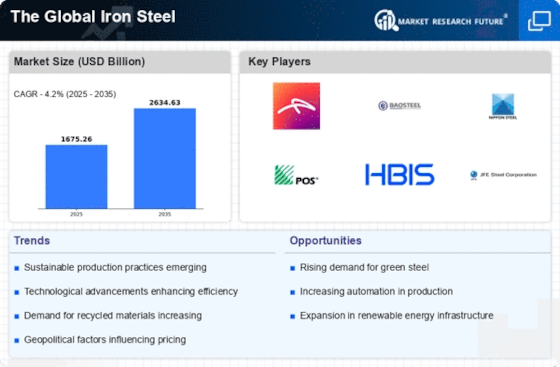
As per Market Research Future analysis, The Global Iron Steel Market Size was estimated at 1675.26 USD Billion in 2024. The iron steel industry is projected to grow from 1745.65 USD Billion in 2025 to 2634.63 USD Billion by 2035, exhibiting a compound annual growth rate (CAGR) of 4.2% during the forecast period 2025 - 2035

Key Market Trends & Highlights

The Global Iron Steel Market is poised for growth driven by sustainability and technological advancements.

  • North America remains the largest market for iron and steel, reflecting robust infrastructure development.
  • Asia-Pacific is the fastest-growing region, propelled by increasing demand in the automotive and energy sectors.
  • Steel continues to dominate the market, while iron is emerging as the fastest-growing segment due to rising applications.
  • Technological innovations and infrastructure development are key drivers, influencing market dynamics across regions.

Market Size & Forecast

2024 Market Size 1675.26 (USD Billion)
2035 Market Size 2634.63 (USD Billion)
CAGR (2025 - 2035) 4.2%
Largest Regional Market Share in 2024 Asia Pacific

Major Players

ArcelorMittal (LU), China Baowu Steel Group (CN), Nippon Steel Corporation (JP), POSCO (KR), HBIS Group (CN), JFE Steel Corporation (JP), Tata Steel Limited (IN), Thyssenkrupp AG (DE), United States Steel Corporation (US)

Market Trends

The Global Iron Steel Market is currently experiencing a dynamic phase characterized by evolving demand patterns and technological advancements. The industry appears to be adapting to a variety of factors, including environmental regulations and shifts in consumer preferences. As sustainability becomes increasingly prioritized, manufacturers are exploring innovative methods to reduce carbon emissions and enhance energy efficiency. This transition not only aligns with global climate goals but also reflects a growing awareness among stakeholders regarding the importance of responsible production practices. Moreover, the market seems to be influenced by geopolitical factors and trade policies, which may affect supply chains and pricing strategies. The ongoing development of infrastructure projects across various regions indicates a potential increase in demand for steel products. Additionally, the rise of electric vehicles and renewable energy technologies could further drive the need for specialized steel applications. Overall, The Global Iron Steel Market is poised for transformation, with opportunities for growth and adaptation in response to both challenges and advancements in the industry.

Sustainability Initiatives

The focus on sustainability within The Global Iron Steel Market is intensifying. Companies are increasingly investing in green technologies and processes to minimize their environmental footprint. This trend reflects a broader commitment to sustainable practices, which may enhance brand reputation and meet regulatory requirements.

Technological Advancements

Innovations in production techniques are reshaping The Global Iron Steel Market. Automation and digitalization are becoming more prevalent, leading to improved efficiency and reduced operational costs. These advancements could potentially revolutionize traditional manufacturing processes, allowing for greater flexibility and responsiveness.

Geopolitical Influences

The Global Iron Steel Market is also subject to the impacts of geopolitical dynamics. Trade agreements and tariffs can significantly affect supply chains and pricing structures. As nations navigate these complexities, market participants may need to adapt their strategies to remain competitive.

Iron Steel Market Market Drivers

Energy Sector Demand

The energy sector, particularly renewable energy, is emerging as a significant driver for the iron steel market. The construction of wind turbines, solar panels, and other renewable energy infrastructures requires substantial amounts of steel. It is estimated that the renewable energy sector could account for around 10% of global steel demand by 2025. This shift towards sustainable energy solutions is likely to bolster The Global Iron Steel Industry, as companies adapt to meet the needs of this evolving landscape. Moreover, the transition from fossil fuels to renewable sources may lead to increased investments in energy infrastructure, further enhancing steel consumption in the sector.

Global Trade Dynamics

The dynamics of The Global Iron Steel Market in various ways. Tariffs, trade agreements, and geopolitical tensions can significantly impact steel prices and availability. For instance, fluctuations in trade policies may lead to increased costs for imported steel, thereby affecting domestic markets. The Global Iron Steel Industry must navigate these complexities, as changes in trade dynamics can create both challenges and opportunities. Countries that adapt to these shifts may find new markets for their steel products, while others may face increased competition. This evolving landscape necessitates strategic planning and adaptability among industry players.

Technological Innovations

Technological advancements in steel production and processing are likely to reshape the iron steel market. Innovations such as electric arc furnaces and advanced metallurgy techniques are enhancing production efficiency and reducing environmental impact. These developments may lead to a more sustainable production process, which is increasingly demanded by consumers and regulators alike. The Global Iron Steel Industry is expected to benefit from these innovations, as they allow for the production of higher-quality steel at lower costs. Furthermore, the integration of automation and digital technologies in manufacturing processes could streamline operations, potentially increasing output and profitability for steel producers.

Automotive Industry Growth

The automotive sector is experiencing a resurgence, which significantly influences the iron steel market. As vehicle production ramps up, the demand for high-strength steel is likely to increase, driven by the need for lightweight materials that enhance fuel efficiency. In recent years, the automotive industry has accounted for nearly 12% of global steel consumption, a figure that may rise as electric vehicles gain traction. The Global Iron Steel Industry stands to gain from this trend, as manufacturers seek to innovate and produce vehicles that meet stringent environmental regulations. Additionally, the shift towards electric vehicles may necessitate new steel formulations, further driving research and development within the sector.

Infrastructure Development

The ongoing expansion of infrastructure projects worldwide appears to be a primary driver for the iron steel market. Governments are investing heavily in transportation networks, bridges, and urban development, which necessitates substantial quantities of steel. For instance, the construction sector is projected to consume approximately 50% of the total steel production, indicating a robust demand. This trend is likely to continue as nations prioritize infrastructure to stimulate economic growth. The Global Iron Steel Industry is thus poised to benefit from these investments, as the need for durable materials remains paramount. Furthermore, the rise in urbanization is expected to further amplify the demand for steel, as cities expand and require more robust infrastructure to support growing populations.

Market Segment Insights

By Type: Steel (Largest) vs. Iron (Fastest-Growing)

In The Global Iron Steel Market, the distribution of market share between Steel and Iron is significant, with Steel representing a dominant position. This dominance arises from its widespread application across construction, automotive, and industrial sectors, where strength, durability, and versatility are paramount. Iron, while lesser in overall market share, has been experiencing a surge in its usage, particularly in specialized applications like cast iron products, leading to its increasing relevance in emerging markets.

Steel (Dominant) vs. Iron (Emerging)

Steel holds a prominent position as the dominant segment in The Global Iron Steel Market due to its unmatched characteristics such as high tensile strength and malleability, making it ideal for a variety of structural applications. Conversely, Iron, particularly in the form of cast iron, is emerging as a significant alternative, especially in niche markets like machinery and automotive components where its unique properties can be fully leveraged. The growing emphasis on sustainability and recyclability is also aiding Iron's expansion in the market. As innovation continues to drive the development of new alloys and treatments, both segments are poised to adapt and thrive in tandem.

By Production Technology: Basic Oxygen Furnace (Largest) vs. Electrical Arc Furnace (Fastest-Growing)

In The Global Iron Steel Market, the production technology segment is predominantly led by the Basic Oxygen Furnace (BOF), which holds the largest share of the market due to its efficiency and cost-effectiveness in converting <a href="https://www.marketresearchfuture.com/reports/iron-ore-market-8004" target="_blank" title="iron ore">iron ore</a> into steel. The BOF technology benefits from economies of scale and is utilized extensively by large steel manufacturers, resulting in significant production volumes. In contrast, the Electrical Arc Furnace (EAF) technology, while currently smaller in overall market share, is gaining traction rapidly, attracting interest due to its lower carbon footprint and flexibility in using scrap steel as a primary input. The growth trends in this segment are heavily influenced by global initiatives towards sustainability and reducing carbon emissions. EAF, being the fastest-growing segment, is experiencing increased adoption as steel manufacturers pivot towards more environmentally friendly production methods. As regulations tighten around emissions, companies investing in EAF technology are likely to see substantial growth, driven by the flexibility and economic advantages it presents. The industry shift towards recycled steel applications also provides an additional growth avenue for EAF, fostering increased innovation in production processes.

Basic Oxygen Furnace (Dominant) vs. Electrical Arc Furnace (Emerging)

The Basic Oxygen Furnace (BOF) remains the dominant production technology in The Global Iron Steel Market, primarily due to its established operational processes and high production capabilities. This technology operates by blowing oxygen through molten iron, resulting in faster steel production with lower operational costs. Its efficiency in large scale operations has made it the preferred choice for many large steel producers. However, the Electrical Arc Furnace (EAF) represents an emerging technology, gaining ground through its ability to offer more sustainable production pathways. By primarily utilizing scrap steel as a feedstock, EAF aligns well with the market trend towards recycling. As environmental concerns rise, EAF's technologies are being rapidly adopted, setting the stage for a transformative shift in production methods across the industry.

By End-use Industry: Building & Construction (Largest) vs. Automotive & Transportation (Fastest-Growing)

The Global Iron Steel Market is significantly shaped by various end-use industries, with Building & Construction commanding the largest market share due to its extensive utilization in structural frameworks, rebar, and architectural components. This sector's dominance is largely attributed to the ongoing urbanization and infrastructure developments around the globe. Following closely is the Automotive & Transportation sector, driven by the increasing demand for lightweight and durable materials to enhance fuel efficiency and performance. As these industries evolve, they are bolstering the iron and steel consumption rate, navigating the market dynamics favorably.

Building & Construction (Dominant) vs. Automotive & Transportation (Emerging)

The Building & Construction sector remains dominant within The Global Iron Steel Market, characterized by its robust demand for steel in various applications such as beams, columns, and reinforcements. This segment is highly influenced by government initiatives to improve infrastructure and housing. In contrast, the Automotive & Transportation sector represents an emerging area in iron and steel use, focusing on innovation in automotive design and technology. As automotive manufacturers increasingly adopt advanced high-strength steel for vehicle production, this segment is expected to experience rapid growth driven by sustainability trends and enhanced performance requirements. Together, these sectors shape the strategic pathways for iron and steel production and technological advancements.

Get more detailed insights about Iron Steel Market Research Report—Global Forecast till 2035

Regional Insights

By region, the study provides the market insights into North America, Europe, Asia-Pacific and Rest of the World. The Asia-Pacific Iron Steel Market dominated this market in 2022 (45.80%). Over the projected period, it is anticipated that increasing investment in infrastructure development projects will increase demand for iron and steel in the area. China started constructing a 237.78 km railway line from Liuzhou to Wuzhou, Guangxi, China, in October 2021. The estimated completion date for this $4,793 million project is 2025.

Moreover, China’s Iron Steel Market held the largest market share, and the Indian Iron Steel Market was the fastest growing market in the Asia-Pacific region.

Further, the major countries studied in the market report are The U.S., Canada, German, France, the UK, Italy, Spain, China, Japan, India, Australia, South Korea, and Brazil.

Figure 2: IRON STEEL MARKET SHARE BY REGION 2022 (USD Billion)

Europe Iron Steel Market accounts for the second-largest market share. The apparent consumption of steel in the European Union rose by 40.5% in Q2 2021, the European Steel Association reports, following a 10.6% decline in Q2 2020. By the end of 2022, the consumption of steel is anticipated to rise by 4.7%. The region's demand for iron and steel is anticipated to be fueled by a number of government investments in infrastructure development initiatives. Further, the German Iron Steel Market held the largest market share, and the UK Iron Steel Market was the fastest growing market in the European region

North America Iron Steel Market accounts for the third-largest market share. The iron and steel market in North America is mostly driven by the building industry. Infrastructure development in the area is continuous and includes the construction of public infrastructure, commercial buildings, residential projects, and bridges. The demand for iron and steel products in North America is influenced by factors like population increase, urbanisation, and the need to update ageing infrastructure. Further, the U.S. Iron Steel Market held the largest market share, and the Canada Iron Steel Market was the fastest growing market in the North America region.

Key Players and Competitive Insights

Leading market players are investing heavily in research and development in order to expand their product lines, which will help the Iron Steel Market, grow even more. Market participants are also undertaking a variety of strategic activities to expand their global footprint, with important market developments including new product launches, contractual agreements, mergers and acquisitions, higher investments, and collaboration with other organizations. To expand and survive in a more competitive and rising market climate, Iron Steel industry must offer cost-effective items.
Manufacturing locally to minimize operational costs is one of the key business tactics used by manufacturers in the global Iron Steel industry to benefit clients and increase the market sector. In recent years, the Iron Steel industry has offered some of the most significant advantages to medicine. Major players in the Iron Steel Market, including ArcelorMittal; China BaoWu Steel Group Corporation Limited; Nippon Steel Corporation; HBIS Group; Jiangsu Shagang Group; POSCO HOLDINGS INC.; Tata Steel; JFE Steel Corporation; Shougang Group; Nucor Corporation; JSW; SAIL; NLMK; Techint Group; U.S.
Steel Corporation, and others, are attempting to increase market demand by investing in research and development operations.
A steel manufacturing business with integrated operations is ArcelorMittal SA (ArcelorMittal). A variety of completed and semi-finished steel products are produced and sold by this company. The company offers flat steel, such as sheet and plate, as well as long steel, such as bars, rods, and structural shapes. Along with mining products such iron ore lump, fines, concentrate, and sinter feed, it also manufactures pipes and tubes for use in coking, pulverised coal injection (PCI), and thermal coal. across addition, ArcelorMittal operates coal and iron ore mines across the Americas, Europe, Asia, and Africa.
It primarily sells steel goods to clients in the automotive, appliance, engineering, construction, and machinery sectors in local markets and through a centralised marketing organisation. The headquarters of ArcelorMittal are in Luxembourg.
Steel is produced by China Baowu Steel Group Corp Ltd (China Baowu). It runs enterprises in steel manufacturing, intelligent services, resources and the environment, industrial parks, and industrial finance. The business produces stainless steel, carbon steel, and special steel. Magnesium, aluminium, and titanium light metal materials are developed by China's Baowu new material industry. It provides services such trading, logistics, supply chain finance, asset management, smart operational maintenance, capital operation and industrial investment, equity investment, industrial funds, supply chain finance, and wealth management. Service industries for the business include aerospace, maritime engineering, energy, and transportation.
Shanghai, China serves as the home base for China Baowu.

Key Companies in the Iron Steel Market include

Industry Developments

In April 2022 The World Steel Association has named Tata Steel Limited and Tata Steel Europe as the 2022 Steel Sustainability Champions. This distinguished award recognises Tata Steel's efforts to keep up its position as a top-tier steel company wholly dedicated to the sustainability ideals.

In April 2022 High-tensile steel sheets with cold-forming capabilities have been introduced by JFE Steel and Thyssenkrupp Steel Europe for use in automotive frames for lighter body frames and greater crash safety performance.

In November 2021 The global alliance to reduce emissions and pollutants by limiting the manufacturing of crude steel is announced by China Baowu Steel Group Corp. Ltd. As a result, pollution decreased by 0.7% from the same period last year in the first 10 months of 2021.

Future Outlook

Iron Steel Market Future Outlook

The Global Iron Steel Market is projected to grow at a 4.2% CAGR from 2025 to 2035, driven by infrastructure development, technological advancements, and increasing demand for sustainable practices.

New opportunities lie in:

  • Investment in advanced steel recycling technologies
  • Development of high-strength, lightweight steel alloys
  • Expansion into emerging markets with infrastructure needs

By 2035, the market is expected to achieve robust growth, positioning itself as a leader in sustainable steel production.

Market Segmentation

Iron Steel Market Type Outlook

  • Iron
  • Steel

Iron Steel Market End-use Industry Outlook

  • Building & Construction
  • Automotive & Transportation
  • Heavy Industry
  • Consumer Goods
  • Others

Iron Steel Market Production Technology Outlook

  • Basic Oxygen Furnace
  • Electrical Arc Furnace
  • Open Hearth
  • Others

Report Scope

MARKET SIZE 2024 1675.26(USD Billion)
MARKET SIZE 2025 1745.65(USD Billion)
MARKET SIZE 2035 2634.63(USD Billion)
COMPOUND ANNUAL GROWTH RATE (CAGR) 4.2% (2025 - 2035)
REPORT COVERAGE Revenue Forecast, Competitive Landscape, Growth Factors, and Trends
BASE YEAR 2024
Market Forecast Period 2025 - 2035
Historical Data 2019 - 2024
Market Forecast Units USD Billion
Key Companies Profiled ArcelorMittal (LU), China Baowu Steel Group (CN), Nippon Steel Corporation (JP), POSCO (KR), HBIS Group (CN), JFE Steel Corporation (JP), Tata Steel Limited (IN), Thyssenkrupp AG (DE), United States Steel Corporation (US)
Segments Covered Type, Production Technology, End-use Industry, Region
Key Market Opportunities Adoption of sustainable production methods enhances competitiveness in The Global Iron Steel.
Key Market Dynamics Technological advancements and sustainability initiatives reshape competitive dynamics in the iron and steel market.
Countries Covered North America, Europe, APAC, South America, MEA

FAQs

What is the current valuation of The Global Iron Steel as of 2024?

<p>The overall market valuation was 1675.26 USD Billion in 2024.</p>

What is the projected market valuation for The Global Iron Steel in 2035?

<p>The projected valuation for 2035 is 2634.63 USD Billion.</p>

What is the expected CAGR for The Global Iron Steel during the forecast period 2025 - 2035?

<p>The expected CAGR for The Global Iron Steel during the forecast period 2025 - 2035 is 4.2%.</p>

Which companies are considered key players in The Global Iron Steel?

<p>Key players in the market include ArcelorMittal, China Baowu Steel Group, Nippon Steel Corporation, and others.</p>

What are the projected revenue ranges for Iron and Steel segments in the market?

<p>The revenue range for Iron is projected between 500.0 and 800.0 USD Billion, while Steel is between 1175.26 and 1834.63 USD Billion.</p>

How does the Basic Oxygen Furnace technology compare to other production technologies in terms of market value?

<p>The Basic Oxygen Furnace technology is projected to generate between 670.0 and 1050.0 USD Billion, indicating its prominence.</p>

What is the expected market value for the Automotive & Transportation segment by 2035?

The Automotive &amp; Transportation segment is expected to reach a market value between 300.0 and 500.0 USD Billion by 2035.

What is the market value range for the Heavy Industry segment in The Global Iron Steel?

The Heavy Industry segment is projected to have a market value between 450.0 and 700.0 USD Billion.

What are the anticipated revenue figures for the Consumer Goods segment in 2035?

The Consumer Goods segment is expected to generate revenue between 325.26 and 550.0 USD Billion by 2035.

How does the market valuation for the Others category in Production Technology compare to other technologies?

The Others category in Production Technology is projected to generate between 205.26 and 384.63 USD Billion, reflecting its niche role.

  1. SECTION I: EXECUTIVE SUMMARY AND KEY HIGHLIGHTS
    1. | 1.1 EXECUTIVE SUMMARY
    2. | | 1.1.1 Market Overview
    3. | | 1.1.2 Key Findings
    4. | | 1.1.3 Market Segmentation
    5. | | 1.1.4 Competitive Landscape
    6. | | 1.1.5 Challenges and Opportunities
    7. | | 1.1.6 Future Outlook
  2. SECTION II: SCOPING, METHODOLOGY AND MARKET STRUCTURE
    1. | 2.1 MARKET INTRODUCTION
    2. | | 2.1.1 Definition
    3. | | 2.1.2 Scope of the study
    4. | | | 2.1.2.1 Research Objective
    5. | | | 2.1.2.2 Assumption
    6. | | | 2.1.2.3 Limitations
    7. | 2.2 RESEARCH METHODOLOGY
    8. | | 2.2.1 Overview
    9. | | 2.2.2 Data Mining
    10. | | 2.2.3 Secondary Research
    11. | | 2.2.4 Primary Research
    12. | | | 2.2.4.1 Primary Interviews and Information Gathering Process
    13. | | | 2.2.4.2 Breakdown of Primary Respondents
    14. | | 2.2.5 Forecasting Model
    15. | | 2.2.6 Market Size Estimation
    16. | | | 2.2.6.1 Bottom-Up Approach
    17. | | | 2.2.6.2 Top-Down Approach
    18. | | 2.2.7 Data Triangulation
    19. | | 2.2.8 Validation
  3. SECTION III: QUALITATIVE ANALYSIS
    1. | 3.1 MARKET DYNAMICS
    2. | | 3.1.1 Overview
    3. | | 3.1.2 Drivers
    4. | | 3.1.3 Restraints
    5. | | 3.1.4 Opportunities
    6. | 3.2 MARKET FACTOR ANALYSIS
    7. | | 3.2.1 Value chain Analysis
    8. | | 3.2.2 Porter's Five Forces Analysis
    9. | | | 3.2.2.1 Bargaining Power of Suppliers
    10. | | | 3.2.2.2 Bargaining Power of Buyers
    11. | | | 3.2.2.3 Threat of New Entrants
    12. | | | 3.2.2.4 Threat of Substitutes
    13. | | | 3.2.2.5 Intensity of Rivalry
    14. | | 3.2.3 COVID-19 Impact Analysis
    15. | | | 3.2.3.1 Market Impact Analysis
    16. | | | 3.2.3.2 Regional Impact
    17. | | | 3.2.3.3 Opportunity and Threat Analysis
  4. SECTION IV: QUANTITATIVE ANALYSIS
    1. | 4.1 Chemicals and Materials, BY Type (USD Billion)
    2. | | 4.1.1 Iron
    3. | | 4.1.2 Steel
    4. | 4.2 Chemicals and Materials, BY Production Technology (USD Billion)
    5. | | 4.2.1 Basic Oxygen Furnace
    6. | | 4.2.2 Electrical Arc Furnace
    7. | | 4.2.3 Open Hearth
    8. | | 4.2.4 Others
    9. | 4.3 Chemicals and Materials, BY End-use Industry (USD Billion)
    10. | | 4.3.1 Building & Construction
    11. | | 4.3.2 Automotive & Transportation
    12. | | 4.3.3 Heavy Industry
    13. | | 4.3.4 Consumer Goods
    14. | | 4.3.5 Others
    15. | 4.4 Chemicals and Materials, BY Region (USD Billion)
    16. | | 4.4.1 North America
    17. | | | 4.4.1.1 US
    18. | | | 4.4.1.2 Canada
    19. | | 4.4.2 Europe
    20. | | | 4.4.2.1 Germany
    21. | | | 4.4.2.2 UK
    22. | | | 4.4.2.3 France
    23. | | | 4.4.2.4 Russia
    24. | | | 4.4.2.5 Italy
    25. | | | 4.4.2.6 Spain
    26. | | | 4.4.2.7 Rest of Europe
    27. | | 4.4.3 APAC
    28. | | | 4.4.3.1 China
    29. | | | 4.4.3.2 India
    30. | | | 4.4.3.3 Japan
    31. | | | 4.4.3.4 South Korea
    32. | | | 4.4.3.5 Malaysia
    33. | | | 4.4.3.6 Thailand
    34. | | | 4.4.3.7 Indonesia
    35. | | | 4.4.3.8 Rest of APAC
    36. | | 4.4.4 South America
    37. | | | 4.4.4.1 Brazil
    38. | | | 4.4.4.2 Mexico
    39. | | | 4.4.4.3 Argentina
    40. | | | 4.4.4.4 Rest of South America
    41. | | 4.4.5 MEA
    42. | | | 4.4.5.1 GCC Countries
    43. | | | 4.4.5.2 South Africa
    44. | | | 4.4.5.3 Rest of MEA
  5. SECTION V: COMPETITIVE ANALYSIS
    1. | 5.1 Competitive Landscape
    2. | | 5.1.1 Overview
    3. | | 5.1.2 Competitive Analysis
    4. | | 5.1.3 Market share Analysis
    5. | | 5.1.4 Major Growth Strategy in the Chemicals and Materials
    6. | | 5.1.5 Competitive Benchmarking
    7. | | 5.1.6 Leading Players in Terms of Number of Developments in the Chemicals and Materials
    8. | | 5.1.7 Key developments and growth strategies
    9. | | | 5.1.7.1 New Product Launch/Service Deployment
    10. | | | 5.1.7.2 Merger & Acquisitions
    11. | | | 5.1.7.3 Joint Ventures
    12. | | 5.1.8 Major Players Financial Matrix
    13. | | | 5.1.8.1 Sales and Operating Income
    14. | | | 5.1.8.2 Major Players R&D Expenditure. 2023
    15. | 5.2 Company Profiles
    16. | | 5.2.1 ArcelorMittal (LU)
    17. | | | 5.2.1.1 Financial Overview
    18. | | | 5.2.1.2 Products Offered
    19. | | | 5.2.1.3 Key Developments
    20. | | | 5.2.1.4 SWOT Analysis
    21. | | | 5.2.1.5 Key Strategies
    22. | | 5.2.2 China Baowu Steel Group (CN)
    23. | | | 5.2.2.1 Financial Overview
    24. | | | 5.2.2.2 Products Offered
    25. | | | 5.2.2.3 Key Developments
    26. | | | 5.2.2.4 SWOT Analysis
    27. | | | 5.2.2.5 Key Strategies
    28. | | 5.2.3 Nippon Steel Corporation (JP)
    29. | | | 5.2.3.1 Financial Overview
    30. | | | 5.2.3.2 Products Offered
    31. | | | 5.2.3.3 Key Developments
    32. | | | 5.2.3.4 SWOT Analysis
    33. | | | 5.2.3.5 Key Strategies
    34. | | 5.2.4 POSCO (KR)
    35. | | | 5.2.4.1 Financial Overview
    36. | | | 5.2.4.2 Products Offered
    37. | | | 5.2.4.3 Key Developments
    38. | | | 5.2.4.4 SWOT Analysis
    39. | | | 5.2.4.5 Key Strategies
    40. | | 5.2.5 HBIS Group (CN)
    41. | | | 5.2.5.1 Financial Overview
    42. | | | 5.2.5.2 Products Offered
    43. | | | 5.2.5.3 Key Developments
    44. | | | 5.2.5.4 SWOT Analysis
    45. | | | 5.2.5.5 Key Strategies
    46. | | 5.2.6 JFE Steel Corporation (JP)
    47. | | | 5.2.6.1 Financial Overview
    48. | | | 5.2.6.2 Products Offered
    49. | | | 5.2.6.3 Key Developments
    50. | | | 5.2.6.4 SWOT Analysis
    51. | | | 5.2.6.5 Key Strategies
    52. | | 5.2.7 Tata Steel Limited (IN)
    53. | | | 5.2.7.1 Financial Overview
    54. | | | 5.2.7.2 Products Offered
    55. | | | 5.2.7.3 Key Developments
    56. | | | 5.2.7.4 SWOT Analysis
    57. | | | 5.2.7.5 Key Strategies
    58. | | 5.2.8 Thyssenkrupp AG (DE)
    59. | | | 5.2.8.1 Financial Overview
    60. | | | 5.2.8.2 Products Offered
    61. | | | 5.2.8.3 Key Developments
    62. | | | 5.2.8.4 SWOT Analysis
    63. | | | 5.2.8.5 Key Strategies
    64. | | 5.2.9 United States Steel Corporation (US)
    65. | | | 5.2.9.1 Financial Overview
    66. | | | 5.2.9.2 Products Offered
    67. | | | 5.2.9.3 Key Developments
    68. | | | 5.2.9.4 SWOT Analysis
    69. | | | 5.2.9.5 Key Strategies
    70. | 5.3 Appendix
    71. | | 5.3.1 References
    72. | | 5.3.2 Related Reports
  6. LIST OF FIGURES
    1. | 6.1 MARKET SYNOPSIS
    2. | 6.2 NORTH AMERICA MARKET ANALYSIS
    3. | 6.3 US MARKET ANALYSIS BY TYPE
    4. | 6.4 US MARKET ANALYSIS BY PRODUCTION TECHNOLOGY
    5. | 6.5 US MARKET ANALYSIS BY END-USE INDUSTRY
    6. | 6.6 CANADA MARKET ANALYSIS BY TYPE
    7. | 6.7 CANADA MARKET ANALYSIS BY PRODUCTION TECHNOLOGY
    8. | 6.8 CANADA MARKET ANALYSIS BY END-USE INDUSTRY
    9. | 6.9 EUROPE MARKET ANALYSIS
    10. | 6.10 GERMANY MARKET ANALYSIS BY TYPE
    11. | 6.11 GERMANY MARKET ANALYSIS BY PRODUCTION TECHNOLOGY
    12. | 6.12 GERMANY MARKET ANALYSIS BY END-USE INDUSTRY
    13. | 6.13 UK MARKET ANALYSIS BY TYPE
    14. | 6.14 UK MARKET ANALYSIS BY PRODUCTION TECHNOLOGY
    15. | 6.15 UK MARKET ANALYSIS BY END-USE INDUSTRY
    16. | 6.16 FRANCE MARKET ANALYSIS BY TYPE
    17. | 6.17 FRANCE MARKET ANALYSIS BY PRODUCTION TECHNOLOGY
    18. | 6.18 FRANCE MARKET ANALYSIS BY END-USE INDUSTRY
    19. | 6.19 RUSSIA MARKET ANALYSIS BY TYPE
    20. | 6.20 RUSSIA MARKET ANALYSIS BY PRODUCTION TECHNOLOGY
    21. | 6.21 RUSSIA MARKET ANALYSIS BY END-USE INDUSTRY
    22. | 6.22 ITALY MARKET ANALYSIS BY TYPE
    23. | 6.23 ITALY MARKET ANALYSIS BY PRODUCTION TECHNOLOGY
    24. | 6.24 ITALY MARKET ANALYSIS BY END-USE INDUSTRY
    25. | 6.25 SPAIN MARKET ANALYSIS BY TYPE
    26. | 6.26 SPAIN MARKET ANALYSIS BY PRODUCTION TECHNOLOGY
    27. | 6.27 SPAIN MARKET ANALYSIS BY END-USE INDUSTRY
    28. | 6.28 REST OF EUROPE MARKET ANALYSIS BY TYPE
    29. | 6.29 REST OF EUROPE MARKET ANALYSIS BY PRODUCTION TECHNOLOGY
    30. | 6.30 REST OF EUROPE MARKET ANALYSIS BY END-USE INDUSTRY
    31. | 6.31 APAC MARKET ANALYSIS
    32. | 6.32 CHINA MARKET ANALYSIS BY TYPE
    33. | 6.33 CHINA MARKET ANALYSIS BY PRODUCTION TECHNOLOGY
    34. | 6.34 CHINA MARKET ANALYSIS BY END-USE INDUSTRY
    35. | 6.35 INDIA MARKET ANALYSIS BY TYPE
    36. | 6.36 INDIA MARKET ANALYSIS BY PRODUCTION TECHNOLOGY
    37. | 6.37 INDIA MARKET ANALYSIS BY END-USE INDUSTRY
    38. | 6.38 JAPAN MARKET ANALYSIS BY TYPE
    39. | 6.39 JAPAN MARKET ANALYSIS BY PRODUCTION TECHNOLOGY
    40. | 6.40 JAPAN MARKET ANALYSIS BY END-USE INDUSTRY
    41. | 6.41 SOUTH KOREA MARKET ANALYSIS BY TYPE
    42. | 6.42 SOUTH KOREA MARKET ANALYSIS BY PRODUCTION TECHNOLOGY
    43. | 6.43 SOUTH KOREA MARKET ANALYSIS BY END-USE INDUSTRY
    44. | 6.44 MALAYSIA MARKET ANALYSIS BY TYPE
    45. | 6.45 MALAYSIA MARKET ANALYSIS BY PRODUCTION TECHNOLOGY
    46. | 6.46 MALAYSIA MARKET ANALYSIS BY END-USE INDUSTRY
    47. | 6.47 THAILAND MARKET ANALYSIS BY TYPE
    48. | 6.48 THAILAND MARKET ANALYSIS BY PRODUCTION TECHNOLOGY
    49. | 6.49 THAILAND MARKET ANALYSIS BY END-USE INDUSTRY
    50. | 6.50 INDONESIA MARKET ANALYSIS BY TYPE
    51. | 6.51 INDONESIA MARKET ANALYSIS BY PRODUCTION TECHNOLOGY
    52. | 6.52 INDONESIA MARKET ANALYSIS BY END-USE INDUSTRY
    53. | 6.53 REST OF APAC MARKET ANALYSIS BY TYPE
    54. | 6.54 REST OF APAC MARKET ANALYSIS BY PRODUCTION TECHNOLOGY
    55. | 6.55 REST OF APAC MARKET ANALYSIS BY END-USE INDUSTRY
    56. | 6.56 SOUTH AMERICA MARKET ANALYSIS
    57. | 6.57 BRAZIL MARKET ANALYSIS BY TYPE
    58. | 6.58 BRAZIL MARKET ANALYSIS BY PRODUCTION TECHNOLOGY
    59. | 6.59 BRAZIL MARKET ANALYSIS BY END-USE INDUSTRY
    60. | 6.60 MEXICO MARKET ANALYSIS BY TYPE
    61. | 6.61 MEXICO MARKET ANALYSIS BY PRODUCTION TECHNOLOGY
    62. | 6.62 MEXICO MARKET ANALYSIS BY END-USE INDUSTRY
    63. | 6.63 ARGENTINA MARKET ANALYSIS BY TYPE
    64. | 6.64 ARGENTINA MARKET ANALYSIS BY PRODUCTION TECHNOLOGY
    65. | 6.65 ARGENTINA MARKET ANALYSIS BY END-USE INDUSTRY
    66. | 6.66 REST OF SOUTH AMERICA MARKET ANALYSIS BY TYPE
    67. | 6.67 REST OF SOUTH AMERICA MARKET ANALYSIS BY PRODUCTION TECHNOLOGY
    68. | 6.68 REST OF SOUTH AMERICA MARKET ANALYSIS BY END-USE INDUSTRY
    69. | 6.69 MEA MARKET ANALYSIS
    70. | 6.70 GCC COUNTRIES MARKET ANALYSIS BY TYPE
    71. | 6.71 GCC COUNTRIES MARKET ANALYSIS BY PRODUCTION TECHNOLOGY
    72. | 6.72 GCC COUNTRIES MARKET ANALYSIS BY END-USE INDUSTRY
    73. | 6.73 SOUTH AFRICA MARKET ANALYSIS BY TYPE
    74. | 6.74 SOUTH AFRICA MARKET ANALYSIS BY PRODUCTION TECHNOLOGY
    75. | 6.75 SOUTH AFRICA MARKET ANALYSIS BY END-USE INDUSTRY
    76. | 6.76 REST OF MEA MARKET ANALYSIS BY TYPE
    77. | 6.77 REST OF MEA MARKET ANALYSIS BY PRODUCTION TECHNOLOGY
    78. | 6.78 REST OF MEA MARKET ANALYSIS BY END-USE INDUSTRY
    79. | 6.79 KEY BUYING CRITERIA OF CHEMICALS AND MATERIALS
    80. | 6.80 RESEARCH PROCESS OF MRFR
    81. | 6.81 DRO ANALYSIS OF CHEMICALS AND MATERIALS
    82. | 6.82 DRIVERS IMPACT ANALYSIS: CHEMICALS AND MATERIALS
    83. | 6.83 RESTRAINTS IMPACT ANALYSIS: CHEMICALS AND MATERIALS
    84. | 6.84 SUPPLY / VALUE CHAIN: CHEMICALS AND MATERIALS
    85. | 6.85 CHEMICALS AND MATERIALS, BY TYPE, 2024 (% SHARE)
    86. | 6.86 CHEMICALS AND MATERIALS, BY TYPE, 2024 TO 2035 (USD Billion)
    87. | 6.87 CHEMICALS AND MATERIALS, BY PRODUCTION TECHNOLOGY, 2024 (% SHARE)
    88. | 6.88 CHEMICALS AND MATERIALS, BY PRODUCTION TECHNOLOGY, 2024 TO 2035 (USD Billion)
    89. | 6.89 CHEMICALS AND MATERIALS, BY END-USE INDUSTRY, 2024 (% SHARE)
    90. | 6.90 CHEMICALS AND MATERIALS, BY END-USE INDUSTRY, 2024 TO 2035 (USD Billion)
    91. | 6.91 BENCHMARKING OF MAJOR COMPETITORS
  7. LIST OF TABLES
    1. | 7.1 LIST OF ASSUMPTIONS
    2. | | 7.1.1
    3. | 7.2 North America MARKET SIZE ESTIMATES; FORECAST
    4. | | 7.2.1 BY TYPE, 2025-2035 (USD Billion)
    5. | | 7.2.2 BY PRODUCTION TECHNOLOGY, 2025-2035 (USD Billion)
    6. | | 7.2.3 BY END-USE INDUSTRY, 2025-2035 (USD Billion)
    7. | 7.3 US MARKET SIZE ESTIMATES; FORECAST
    8. | | 7.3.1 BY TYPE, 2025-2035 (USD Billion)
    9. | | 7.3.2 BY PRODUCTION TECHNOLOGY, 2025-2035 (USD Billion)
    10. | | 7.3.3 BY END-USE INDUSTRY, 2025-2035 (USD Billion)
    11. | 7.4 Canada MARKET SIZE ESTIMATES; FORECAST
    12. | | 7.4.1 BY TYPE, 2025-2035 (USD Billion)
    13. | | 7.4.2 BY PRODUCTION TECHNOLOGY, 2025-2035 (USD Billion)
    14. | | 7.4.3 BY END-USE INDUSTRY, 2025-2035 (USD Billion)
    15. | 7.5 Europe MARKET SIZE ESTIMATES; FORECAST
    16. | | 7.5.1 BY TYPE, 2025-2035 (USD Billion)
    17. | | 7.5.2 BY PRODUCTION TECHNOLOGY, 2025-2035 (USD Billion)
    18. | | 7.5.3 BY END-USE INDUSTRY, 2025-2035 (USD Billion)
    19. | 7.6 Germany MARKET SIZE ESTIMATES; FORECAST
    20. | | 7.6.1 BY TYPE, 2025-2035 (USD Billion)
    21. | | 7.6.2 BY PRODUCTION TECHNOLOGY, 2025-2035 (USD Billion)
    22. | | 7.6.3 BY END-USE INDUSTRY, 2025-2035 (USD Billion)
    23. | 7.7 UK MARKET SIZE ESTIMATES; FORECAST
    24. | | 7.7.1 BY TYPE, 2025-2035 (USD Billion)
    25. | | 7.7.2 BY PRODUCTION TECHNOLOGY, 2025-2035 (USD Billion)
    26. | | 7.7.3 BY END-USE INDUSTRY, 2025-2035 (USD Billion)
    27. | 7.8 France MARKET SIZE ESTIMATES; FORECAST
    28. | | 7.8.1 BY TYPE, 2025-2035 (USD Billion)
    29. | | 7.8.2 BY PRODUCTION TECHNOLOGY, 2025-2035 (USD Billion)
    30. | | 7.8.3 BY END-USE INDUSTRY, 2025-2035 (USD Billion)
    31. | 7.9 Russia MARKET SIZE ESTIMATES; FORECAST
    32. | | 7.9.1 BY TYPE, 2025-2035 (USD Billion)
    33. | | 7.9.2 BY PRODUCTION TECHNOLOGY, 2025-2035 (USD Billion)
    34. | | 7.9.3 BY END-USE INDUSTRY, 2025-2035 (USD Billion)
    35. | 7.10 Italy MARKET SIZE ESTIMATES; FORECAST
    36. | | 7.10.1 BY TYPE, 2025-2035 (USD Billion)
    37. | | 7.10.2 BY PRODUCTION TECHNOLOGY, 2025-2035 (USD Billion)
    38. | | 7.10.3 BY END-USE INDUSTRY, 2025-2035 (USD Billion)
    39. | 7.11 Spain MARKET SIZE ESTIMATES; FORECAST
    40. | | 7.11.1 BY TYPE, 2025-2035 (USD Billion)
    41. | | 7.11.2 BY PRODUCTION TECHNOLOGY, 2025-2035 (USD Billion)
    42. | | 7.11.3 BY END-USE INDUSTRY, 2025-2035 (USD Billion)
    43. | 7.12 Rest of Europe MARKET SIZE ESTIMATES; FORECAST
    44. | | 7.12.1 BY TYPE, 2025-2035 (USD Billion)
    45. | | 7.12.2 BY PRODUCTION TECHNOLOGY, 2025-2035 (USD Billion)
    46. | | 7.12.3 BY END-USE INDUSTRY, 2025-2035 (USD Billion)
    47. | 7.13 APAC MARKET SIZE ESTIMATES; FORECAST
    48. | | 7.13.1 BY TYPE, 2025-2035 (USD Billion)
    49. | | 7.13.2 BY PRODUCTION TECHNOLOGY, 2025-2035 (USD Billion)
    50. | | 7.13.3 BY END-USE INDUSTRY, 2025-2035 (USD Billion)
    51. | 7.14 China MARKET SIZE ESTIMATES; FORECAST
    52. | | 7.14.1 BY TYPE, 2025-2035 (USD Billion)
    53. | | 7.14.2 BY PRODUCTION TECHNOLOGY, 2025-2035 (USD Billion)
    54. | | 7.14.3 BY END-USE INDUSTRY, 2025-2035 (USD Billion)
    55. | 7.15 India MARKET SIZE ESTIMATES; FORECAST
    56. | | 7.15.1 BY TYPE, 2025-2035 (USD Billion)
    57. | | 7.15.2 BY PRODUCTION TECHNOLOGY, 2025-2035 (USD Billion)
    58. | | 7.15.3 BY END-USE INDUSTRY, 2025-2035 (USD Billion)
    59. | 7.16 Japan MARKET SIZE ESTIMATES; FORECAST
    60. | | 7.16.1 BY TYPE, 2025-2035 (USD Billion)
    61. | | 7.16.2 BY PRODUCTION TECHNOLOGY, 2025-2035 (USD Billion)
    62. | | 7.16.3 BY END-USE INDUSTRY, 2025-2035 (USD Billion)
    63. | 7.17 South Korea MARKET SIZE ESTIMATES; FORECAST
    64. | | 7.17.1 BY TYPE, 2025-2035 (USD Billion)
    65. | | 7.17.2 BY PRODUCTION TECHNOLOGY, 2025-2035 (USD Billion)
    66. | | 7.17.3 BY END-USE INDUSTRY, 2025-2035 (USD Billion)
    67. | 7.18 Malaysia MARKET SIZE ESTIMATES; FORECAST
    68. | | 7.18.1 BY TYPE, 2025-2035 (USD Billion)
    69. | | 7.18.2 BY PRODUCTION TECHNOLOGY, 2025-2035 (USD Billion)
    70. | | 7.18.3 BY END-USE INDUSTRY, 2025-2035 (USD Billion)
    71. | 7.19 Thailand MARKET SIZE ESTIMATES; FORECAST
    72. | | 7.19.1 BY TYPE, 2025-2035 (USD Billion)
    73. | | 7.19.2 BY PRODUCTION TECHNOLOGY, 2025-2035 (USD Billion)
    74. | | 7.19.3 BY END-USE INDUSTRY, 2025-2035 (USD Billion)
    75. | 7.20 Indonesia MARKET SIZE ESTIMATES; FORECAST
    76. | | 7.20.1 BY TYPE, 2025-2035 (USD Billion)
    77. | | 7.20.2 BY PRODUCTION TECHNOLOGY, 2025-2035 (USD Billion)
    78. | | 7.20.3 BY END-USE INDUSTRY, 2025-2035 (USD Billion)
    79. | 7.21 Rest of APAC MARKET SIZE ESTIMATES; FORECAST
    80. | | 7.21.1 BY TYPE, 2025-2035 (USD Billion)
    81. | | 7.21.2 BY PRODUCTION TECHNOLOGY, 2025-2035 (USD Billion)
    82. | | 7.21.3 BY END-USE INDUSTRY, 2025-2035 (USD Billion)
    83. | 7.22 South America MARKET SIZE ESTIMATES; FORECAST
    84. | | 7.22.1 BY TYPE, 2025-2035 (USD Billion)
    85. | | 7.22.2 BY PRODUCTION TECHNOLOGY, 2025-2035 (USD Billion)
    86. | | 7.22.3 BY END-USE INDUSTRY, 2025-2035 (USD Billion)
    87. | 7.23 Brazil MARKET SIZE ESTIMATES; FORECAST
    88. | | 7.23.1 BY TYPE, 2025-2035 (USD Billion)
    89. | | 7.23.2 BY PRODUCTION TECHNOLOGY, 2025-2035 (USD Billion)
    90. | | 7.23.3 BY END-USE INDUSTRY, 2025-2035 (USD Billion)
    91. | 7.24 Mexico MARKET SIZE ESTIMATES; FORECAST
    92. | | 7.24.1 BY TYPE, 2025-2035 (USD Billion)
    93. | | 7.24.2 BY PRODUCTION TECHNOLOGY, 2025-2035 (USD Billion)
    94. | | 7.24.3 BY END-USE INDUSTRY, 2025-2035 (USD Billion)
    95. | 7.25 Argentina MARKET SIZE ESTIMATES; FORECAST
    96. | | 7.25.1 BY TYPE, 2025-2035 (USD Billion)
    97. | | 7.25.2 BY PRODUCTION TECHNOLOGY, 2025-2035 (USD Billion)
    98. | | 7.25.3 BY END-USE INDUSTRY, 2025-2035 (USD Billion)
    99. | 7.26 Rest of South America MARKET SIZE ESTIMATES; FORECAST
    100. | | 7.26.1 BY TYPE, 2025-2035 (USD Billion)
    101. | | 7.26.2 BY PRODUCTION TECHNOLOGY, 2025-2035 (USD Billion)
    102. | | 7.26.3 BY END-USE INDUSTRY, 2025-2035 (USD Billion)
    103. | 7.27 MEA MARKET SIZE ESTIMATES; FORECAST
    104. | | 7.27.1 BY TYPE, 2025-2035 (USD Billion)
    105. | | 7.27.2 BY PRODUCTION TECHNOLOGY, 2025-2035 (USD Billion)
    106. | | 7.27.3 BY END-USE INDUSTRY, 2025-2035 (USD Billion)
    107. | 7.28 GCC Countries MARKET SIZE ESTIMATES; FORECAST
    108. | | 7.28.1 BY TYPE, 2025-2035 (USD Billion)
    109. | | 7.28.2 BY PRODUCTION TECHNOLOGY, 2025-2035 (USD Billion)
    110. | | 7.28.3 BY END-USE INDUSTRY, 2025-2035 (USD Billion)
    111. | 7.29 South Africa MARKET SIZE ESTIMATES; FORECAST
    112. | | 7.29.1 BY TYPE, 2025-2035 (USD Billion)
    113. | | 7.29.2 BY PRODUCTION TECHNOLOGY, 2025-2035 (USD Billion)
    114. | | 7.29.3 BY END-USE INDUSTRY, 2025-2035 (USD Billion)
    115. | 7.30 Rest of MEA MARKET SIZE ESTIMATES; FORECAST
    116. | | 7.30.1 BY TYPE, 2025-2035 (USD Billion)
    117. | | 7.30.2 BY PRODUCTION TECHNOLOGY, 2025-2035 (USD Billion)
    118. | | 7.30.3 BY END-USE INDUSTRY, 2025-2035 (USD Billion)
    119. | 7.31 PRODUCT LAUNCH/PRODUCT DEVELOPMENT/APPROVAL
    120. | | 7.31.1
    121. | 7.32 ACQUISITION/PARTNERSHIP
    122. | | 7.32.1

Chemicals and Materials Market Segmentation

Chemicals and Materials By Type (USD Billion, 2025-2035)

  • Iron
  • Steel

Chemicals and Materials By Production Technology (USD Billion, 2025-2035)

  • Basic Oxygen Furnace
  • Electrical Arc Furnace
  • Open Hearth
  • Others

Chemicals and Materials By End-use Industry (USD Billion, 2025-2035)

  • Building & Construction
  • Automotive & Transportation
  • Heavy Industry
  • Consumer Goods
  • Others
Infographic

Free Sample Request

Kindly complete the form below to receive a free sample of this Report

Get Free Sample

Customer Strories

Compare Licence

×
Features License Type
Single User Multiuser License Enterprise User
Price $4,950 $5,950 $7,250
Maximum User Access Limit 1 User Upto 10 Users Unrestricted Access Throughout the Organization
Free Customization
Direct Access to Analyst
Deliverable Format
Platform Access
Discount on Next Purchase 10% 15% 15%
Printable Versions