
×
Hero Background
English
Chinese
French
Japanese
Korean
German
Spanish

IoT Data Management Market Share

ID: MRFR/ICT/5817-HCR
100 Pages
Aarti Dhapte
October 2025

IoT Data Management Market Research Report Information By Category (Solution and Services), By Organization Size (Large Enterprises and Small & Medium Enterprises) And By Region (North America, Europe, Asia-Pacific, And Rest Of The World) –Market Forecast Till 2035.

Share:
Download PDF ×

We do not share your information with anyone. However, we may send you emails based on your report interest from time to time. You may contact us at any time to opt-out.

IoT Data Management Market Infographic
Purchase Options

Market Share

IoT Data Management Market Share Analysis

The IoT data management market is a quickly developing scene where organizations utilize different techniques to catch market share. One predominant methodology is separation, wherein organizations look to recognize their IoT data management arrangements from contenders through remarkable highlights, high level data examination abilities, and custom fitted data management conventions. By offering particular data management functionalities for explicit IoT applications like shrewd urban communities, modern computerization, or medical services checking, organizations can cut out a specialty inside the market and draw in clients searching for customized IoT data management arrangements. This separation procedure permits organizations to catch market share by speaking to explicit client fragments and situating themselves as pioneers in giving industry-explicit IoT data management arrangements.

Cost administration is one more critical situating system in the IoT data management market. A few organizations focus on offering their answers at a serious price tag contrasted with contenders, planning to draw in cost-cognizant associations and gain an upper hand. By giving reasonable yet vigorous IoT data management arrangements, organizations can catch market share by speaking to an expansive client base, including little and medium-sized organizations that focus on cost-viability. This methodology empowers organizations to situate themselves as practical suppliers of IoT data management arrangements and gain an upper hand in cost delicate market fragments.

Development and mechanical headway assume an essential part in the situating systems of organizations in the IoT data management market. Organizations that put resources into state of the art innovations, for example, edge figuring, constant data handling, blockchain coordination, and computer based intelligence driven experiences, can separate their contributions by giving adaptable, secure, and high level IoT data management arrangements. By situating themselves as innovation pioneers, these organizations can catch market share by drawing in associations looking for cutting edge IoT data management stages. This technique permits organizations to separate themselves from contenders and gain an upper hand through nonstop mechanical development.

Besides, client driven situating techniques are common in the IoT data management market. Organizations that focus on outstanding client care, consistent joining with IoT gadgets and sensors, and adjustable data management choices can make a dependable client base and separate themselves from contenders exclusively centered around specialized highlights. By profoundly understanding client needs and offering instinctive, client driven IoT data management stages, these organizations can catch market share by giving a predominant client experience and building long haul client connections. This client driven approach can prompt expanded client maintenance and backing, at last converting into a bigger market share through certain references and fulfilled clients.


Author
Aarti Dhapte
Team Lead - Research

She holds an experience of about 6+ years in Market Research and Business Consulting, working under the spectrum of Information Communication Technology, Telecommunications and Semiconductor domains. Aarti conceptualizes and implements a scalable business strategy and provides strategic leadership to the clients. Her expertise lies in market estimation, competitive intelligence, pipeline analysis, customer assessment, etc.

Leave a Comment

FAQs

What is the current valuation of the IoT Data Management Market as of 2025?

The IoT Data Management Market is valued at 40.11 USD Billion in 2024.

What is the projected market size for the IoT Data Management Market by 2035?

The market is projected to reach 204.71 USD Billion by 2035.

What is the expected CAGR for the IoT Data Management Market during the forecast period 2025 - 2035?

The expected CAGR for the IoT Data Management Market is 15.97% from 2025 to 2035.

Which companies are considered key players in the IoT Data Management Market?

Key players include Microsoft, IBM, Amazon, Google, Oracle, SAP, Cisco, Siemens, GE, and Huawei.

How do the solutions and services segments compare in terms of market valuation?

In 2024, the solutions segment was valued at 20.06 USD Billion, while the services segment was valued at 20.05 USD Billion.

What is the market valuation for large enterprises in the IoT Data Management Market?

The market valuation for large enterprises was 30.0 USD Billion in 2024.

Market Summary

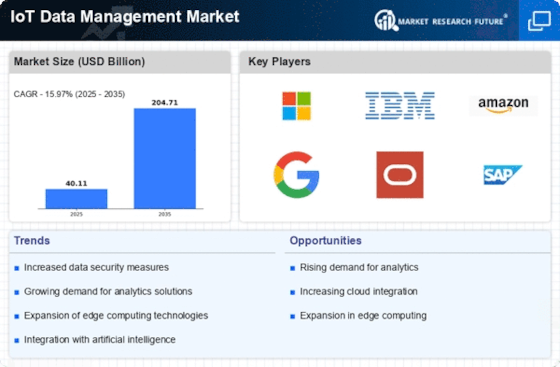
As per MRFR analysis, the IoT Data Management Market Size was estimated at 40.11 USD Billion in 2024. The IoT Data Management industry is projected to grow from 46.52 USD Billion in 2025 to 204.71 USD Billion by 2035, exhibiting a compound annual growth rate (CAGR) of 15.97 during the forecast period 2025 - 2035.

Key Market Trends & Highlights

The IoT Data Management Market is poised for substantial growth driven by technological advancements and evolving consumer demands.

  • North America remains the largest market for IoT data management, characterized by robust investments in data security and analytics.
  • Asia-Pacific is emerging as the fastest-growing region, fueled by rapid digital transformation and increasing IoT adoption.
  • Solutions segment dominates the market, while services are witnessing the fastest growth due to rising demand for managed services.
  • Key market drivers include the rising demand for real-time analytics and the expansion of IoT ecosystems, which are shaping the future landscape.

Market Size & Forecast

2024 Market Size 40.11 (USD Billion)
2035 Market Size 204.71 (USD Billion)
CAGR (2025 - 2035) 15.97%
Largest Regional Market Share in 2024 North America

Major Players

<p>Microsoft (US), IBM (US), Amazon (US), Google (US), Oracle (US), SAP (DE), Cisco (US), Siemens (DE), GE (US), Huawei (CN)</p>

Market Trends

The IoT Data Management Market is currently experiencing a transformative phase, driven by the increasing proliferation of connected devices and the subsequent surge in data generation. Organizations are recognizing the necessity of effective data management strategies to harness the potential of IoT technologies. This market appears to be characterized by a growing emphasis on data security, privacy, and compliance, as stakeholders seek to mitigate risks associated with data breaches and regulatory challenges. Furthermore, the integration of advanced analytics and artificial intelligence into data management solutions is likely to enhance decision-making processes, enabling businesses to derive actionable insights from vast datasets. In addition, the IoT Data Management Market seems to be evolving towards more decentralized architectures, which may facilitate improved data accessibility and interoperability among various devices and platforms. This shift could potentially empower organizations to optimize their operations and enhance customer experiences. As the landscape continues to develop, collaboration among technology providers, enterprises, and regulatory bodies will be crucial in shaping the future of data management in the IoT ecosystem. The ongoing advancements in cloud computing and edge computing technologies are also expected to play a pivotal role in this evolution, providing scalable and efficient solutions for data storage and processing.

Enhanced Data Security Measures

The focus on data security within the IoT Data Management Market is intensifying. Organizations are increasingly prioritizing robust security protocols to protect sensitive information from unauthorized access and cyber threats. This trend indicates a shift towards implementing advanced encryption techniques and multi-factor authentication, which may bolster overall data integrity.

Integration of AI and Machine Learning

The incorporation of artificial intelligence and machine learning technologies into data management solutions is becoming more prevalent. This trend suggests that organizations are leveraging these advanced tools to automate data processing, improve predictive analytics, and enhance operational efficiency, thereby enabling more informed decision-making.

Decentralized Data Architectures

There is a noticeable movement towards decentralized data architectures within the IoT Data Management Market. This trend implies that organizations are exploring distributed systems that allow for greater data accessibility and interoperability, potentially leading to improved collaboration and innovation across various sectors.

IoT Data Management Market Market Drivers

Expansion of IoT Ecosystems

The IoT Data Management Market is witnessing an expansion of IoT ecosystems, which is a critical driver of growth. As more devices become interconnected, the volume of data generated is escalating exponentially. This proliferation of devices, ranging from smart home appliances to industrial sensors, necessitates robust data management solutions to handle the influx of information. Industry reports indicate that the number of connected devices is expected to reach over 75 billion by 2025, further emphasizing the need for effective data management strategies. Consequently, organizations are investing in scalable IoT data management platforms that can accommodate this growth while ensuring data integrity and accessibility. The expansion of IoT ecosystems not only enhances operational capabilities but also opens new avenues for innovation and service delivery.

Emergence of Edge Computing Solutions

The IoT Data Management Market is experiencing a transformative shift with the emergence of edge computing solutions. Edge computing allows data processing to occur closer to the source of data generation, reducing latency and bandwidth usage. This paradigm shift is particularly beneficial for applications requiring real-time data processing, such as autonomous vehicles and industrial automation. Market Research Future indicate that the edge computing market is poised for substantial growth, driven by the increasing need for efficient data management in IoT environments. By deploying edge computing solutions, organizations can enhance their IoT data management strategies, ensuring faster response times and improved operational efficiency. This trend highlights the critical role of edge computing in shaping the future of IoT data management.

Rising Demand for Real-Time Analytics

The IoT Data Management Market is experiencing a notable surge in demand for real-time analytics. Organizations are increasingly recognizing the value of immediate insights derived from vast data streams generated by IoT devices. This trend is driven by the need for timely decision-making across various sectors, including manufacturing, healthcare, and smart cities. According to recent estimates, the market for real-time analytics is projected to grow at a compound annual growth rate of over 30% in the coming years. As businesses strive to enhance operational efficiency and customer experiences, the integration of real-time analytics into IoT data management strategies becomes paramount. This shift not only facilitates proactive responses to emerging trends but also fosters a competitive edge in an increasingly data-driven landscape.

Increased Focus on Data Privacy Regulations

The IoT Data Management Market is significantly influenced by the increasing focus on data privacy regulations. As governments and regulatory bodies implement stricter data protection laws, organizations are compelled to adopt comprehensive data management practices. Compliance with regulations such as the General Data Protection Regulation (GDPR) and the California Consumer Privacy Act (CCPA) is becoming essential for businesses operating in the IoT space. This regulatory landscape drives the demand for advanced data management solutions that ensure data security and privacy. Market analysts suggest that companies investing in compliance-focused IoT data management systems are likely to gain a competitive advantage, as they can build trust with consumers and mitigate the risks associated with data breaches. The emphasis on data privacy is reshaping the strategies organizations employ in managing IoT-generated data.

Advancements in Cloud Computing Technologies

The IoT Data Management Market is being propelled by advancements in cloud computing technologies. The shift towards cloud-based solutions allows organizations to efficiently store, process, and analyze vast amounts of data generated by IoT devices. Cloud platforms offer scalability, flexibility, and cost-effectiveness, making them an attractive option for businesses looking to optimize their IoT data management strategies. Recent studies indicate that the cloud computing market is expected to grow significantly, with a substantial portion of this growth attributed to IoT applications. As organizations increasingly leverage cloud technologies, they can enhance their data management capabilities, enabling real-time analytics and improved decision-making processes. This trend underscores the importance of integrating cloud solutions into IoT data management frameworks to harness the full potential of IoT data.

Market Segment Insights

By Category: Solutions (Largest) vs. Services (Fastest-Growing)

<p>In the IoT Data Management Market, the Solutions segment holds the largest share, reflecting businesses' preference for comprehensive and integrated offerings that simplify data management. This segment encompasses a wide range of tools and applications that provide organizations with the capability to seamlessly collect, store, and analyze massive volumes of data generated from interconnected devices. Meanwhile, the Services segment is gaining traction as it complements solutions, providing essential support for implementation, troubleshooting, and ongoing maintenance.</p>

<p>Category: Solutions (Dominant) vs. Services (Emerging)</p>

<p>The Solutions segment is recognized for its dominant position in the market, offering robust and versatile products that cater to diverse needs in IoT data management. This includes capabilities for data integration, security, and analytics, all of which are critical for businesses striving to leverage IoT effectively. In contrast, the Services segment, while emerging, is swiftly becoming vital as organizations seek expert assistance to optimize their IoT ecosystems. This segment encompasses consultancy, training, and support services, which allow companies to maximize the value of their solutions, adapt to new technologies, and respond to the evolving landscape of IoT.</p>

By Organization Size: Large Enterprises (Largest) vs. Small & Medium Enterprises (Fastest-Growing)

<p>The IoT Data Management Market shows a clear distribution of market share between the two primary organization sizes. Large Enterprises dominate this segment due to their extensive resources and the ability to invest in sophisticated IoT data management solutions. They leverage vast amounts of data generated from numerous IoT devices, which strengthens their operational efficiency and decision-making capabilities. On the other hand, Small & Medium Enterprises are increasingly adopting IoT data solutions, although they currently hold a smaller market share. This trend signals a transition in market dynamics as SMEs begin to harness IoT capabilities in innovative ways.</p>

<p>Organization Size: Large Enterprises (Dominant) vs. Small & Medium Enterprises (Emerging)</p>

<p>Large Enterprises exhibit a dominant presence in the IoT Data Management Market, characterized by their extensive human and technological resources. They are equipped to deploy advanced data analytics and management tools, enabling them to gain actionable insights from large volumes of IoT data. This segment primarily focuses on scalability, security, and complex integrations across various operational facets. Conversely, Small & Medium Enterprises represent an emerging segment that is rapidly gaining traction. These organizations are increasingly recognizing the potential of IoT data management to optimize processes, enhance customer experiences, and drive innovation. With a focus on cost-effective solutions, they are adopting cloud-based services that allow them to leverage IoT without heavy investment in infrastructure.</p>

Get more detailed insights about IoT Data Management Market Research Report - Global Forecast till 2035

Regional Insights

North America : Innovation and Leadership Hub

North America is the largest market for IoT data management, holding approximately 45% of the global share. The region's growth is driven by rapid technological advancements, increasing adoption of IoT devices, and supportive regulatory frameworks. The demand for data analytics and cloud solutions is surging, fueled by industries such as healthcare, manufacturing, and smart cities, which are increasingly reliant on data-driven decision-making. The United States leads the market, with significant contributions from Canada and Mexico. Major players like Microsoft, IBM, and Amazon are headquartered here, fostering a competitive landscape that encourages innovation. The presence of advanced infrastructure and a skilled workforce further enhances the region's attractiveness for IoT data management solutions. Companies are investing heavily in R&D to stay ahead in this dynamic market.

Europe : Regulatory Framework and Growth

Europe is the second-largest market for IoT data management, accounting for around 30% of the global share. The region's growth is propelled by stringent data protection regulations, such as GDPR, which drive demand for secure data management solutions. Additionally, the European Union's commitment to digital transformation and sustainability initiatives fosters a conducive environment for IoT adoption across various sectors, including automotive and energy. Leading countries in this region include Germany, the UK, and France, where companies are increasingly investing in IoT technologies. The competitive landscape features key players like SAP and Siemens, who are leveraging their expertise to offer innovative solutions. The focus on interoperability and data security is shaping the market, as organizations seek to comply with regulations while maximizing the benefits of IoT data management.

Asia-Pacific : Rapid Growth and Adoption

Asia-Pacific is witnessing rapid growth in the IoT data management market, holding approximately 20% of the global share. The region's expansion is driven by increasing urbanization, a growing number of connected devices, and government initiatives promoting smart city projects. Countries like China and India are at the forefront, with significant investments in IoT infrastructure and technology, which are expected to boost market demand further. China is the largest market in the region, followed by India and Japan. The competitive landscape is characterized by a mix of local and international players, including Huawei and Cisco, who are actively developing IoT solutions tailored to regional needs. The focus on enhancing connectivity and data analytics capabilities is crucial for businesses aiming to leverage IoT data management effectively, making the region a hotbed for innovation and growth.

Middle East and Africa : Emerging Market Potential

The Middle East and Africa (MEA) region is an emerging market for IoT data management, accounting for about 5% of the global share. The growth is driven by increasing investments in digital transformation and smart technologies, particularly in sectors like oil and gas, healthcare, and logistics. Governments are also implementing initiatives to enhance connectivity and infrastructure, which are essential for IoT adoption and data management solutions. Leading countries in this region include the UAE and South Africa, where there is a growing interest in IoT applications. The competitive landscape is evolving, with both local startups and international companies exploring opportunities. Key players are focusing on developing tailored solutions that address regional challenges, making the MEA market ripe for growth in IoT data management.

Key Players and Competitive Insights

The IoT Data Management Market is currently characterized by a dynamic competitive landscape, driven by rapid technological advancements and increasing demand for data-driven decision-making across various sectors. Major players such as Microsoft (US), IBM (US), and Amazon (US) are at the forefront, leveraging their extensive cloud infrastructures and analytics capabilities to enhance their market positioning. Microsoft (US) focuses on integrating AI and machine learning into its IoT solutions, while IBM (US) emphasizes its hybrid cloud strategy to facilitate seamless data management. Amazon (US), with its robust AWS platform, continues to innovate in edge computing, which is crucial for real-time data processing. Collectively, these strategies not only enhance operational efficiencies but also foster a competitive environment that prioritizes innovation and customer-centric solutions.

In terms of business tactics, companies are increasingly localizing their operations to better serve regional markets and optimize supply chains. The IoT Data Management Market appears moderately fragmented, with a mix of established players and emerging startups. This structure allows for diverse offerings and competitive pricing, although the influence of key players like Google (US) and Oracle (US) remains substantial. Their ability to integrate advanced analytics and cloud services into IoT solutions positions them as formidable competitors, shaping the market's trajectory.

In August 2025, Google (US) announced a strategic partnership with a leading telecommunications provider to enhance its IoT data management capabilities. This collaboration aims to improve connectivity and data processing speeds for IoT devices, which is critical for industries such as manufacturing and logistics. The strategic importance of this partnership lies in its potential to expand Google’s market reach and enhance its service offerings, thereby solidifying its competitive edge in the IoT landscape.

Similarly, in September 2025, IBM (US) unveiled a new suite of IoT data management tools designed to streamline data integration and analytics for enterprises. This launch reflects IBM's commitment to addressing the complexities of data management in IoT environments. By providing advanced analytics capabilities, IBM positions itself as a leader in helping organizations derive actionable insights from their IoT data, which is increasingly vital for operational success.

In October 2025, Amazon (US) expanded its IoT services portfolio by introducing a new edge computing solution that allows businesses to process data closer to the source. This move is particularly significant as it addresses the growing need for real-time data processing in various applications, from smart cities to industrial automation. By enhancing its edge computing capabilities, Amazon not only strengthens its competitive position but also aligns with the broader trend of digital transformation across industries.

As of October 2025, the competitive trends in the IoT Data Management Market are increasingly defined by digitalization, sustainability, and the integration of artificial intelligence. Strategic alliances are becoming more prevalent, as companies recognize the need to collaborate to enhance their technological capabilities and market reach. Looking ahead, competitive differentiation is likely to evolve from traditional price-based competition to a focus on innovation, technological advancements, and supply chain reliability. This shift underscores the importance of agility and responsiveness in meeting the ever-changing demands of the IoT landscape.

Key Companies in the IoT Data Management Market market include

Industry Developments

December 2022: An Internet of Things solutions supplier, Aeris, signed an agreement with Ericsson in order to obtain the Connected Vehicle Cloud business and IoT Accelerator of Ericsson. Both companies together will offer software for IoT connection for several enterprises in 190 countries and more than 100 million IoT devices globally.

February 2018: Xively from LogMeIn was acquired by Google for USD 50 million, providing Google Cloud with an established IoT platform to add to its product portfolio as it expects to utilize this as a springboard in the growing IoT market.

August 2019: A pioneer in hybrid data management, data integration technology, and cloud data warehouse, Actian announced the launch of a novel Actian ZenTM integrated database for both the IoT and mobiles.

Future Outlook

IoT Data Management Market Future Outlook

<p>The IoT Data Management Market is projected to grow at a 15.97% CAGR from 2024 to 2035, driven by increased data generation, cloud adoption, and advanced analytics.</p>

New opportunities lie in:

  • <p>Development of AI-driven data analytics platforms</p>
  • <p>Integration of edge computing for real-time data processing</p>
  • <p>Expansion of IoT security solutions for data protection</p>

<p>By 2035, the market is expected to be robust, driven by innovation and strategic investments.</p>

Market Segmentation

IoT Data Management Market Category Outlook

  • Solutions
  • Services

IoT Data Management Market Organization Size Outlook

  • Large Enterprises
  • Small & Medium Enterprises

Report Scope

MARKET SIZE 202440.11(USD Billion)
MARKET SIZE 202546.52(USD Billion)
MARKET SIZE 2035204.71(USD Billion)
COMPOUND ANNUAL GROWTH RATE (CAGR)15.97% (2024 - 2035)
REPORT COVERAGERevenue Forecast, Competitive Landscape, Growth Factors, and Trends
BASE YEAR2024
Market Forecast Period2025 - 2035
Historical Data2019 - 2024
Market Forecast UnitsUSD Billion
Key Companies ProfiledMarket analysis in progress
Segments CoveredMarket segmentation analysis in progress
Key Market OpportunitiesIntegration of advanced analytics and artificial intelligence in the IoT Data Management Market enhances data-driven decision-making.
Key Market DynamicsRising demand for real-time analytics drives innovation in IoT data management solutions and competitive market dynamics.
Countries CoveredNorth America, Europe, APAC, South America, MEA

FAQs

What is the current valuation of the IoT Data Management Market as of 2025?

The IoT Data Management Market is valued at 40.11 USD Billion in 2024.

What is the projected market size for the IoT Data Management Market by 2035?

The market is projected to reach 204.71 USD Billion by 2035.

What is the expected CAGR for the IoT Data Management Market during the forecast period 2025 - 2035?

The expected CAGR for the IoT Data Management Market is 15.97% from 2025 to 2035.

Which companies are considered key players in the IoT Data Management Market?

Key players include Microsoft, IBM, Amazon, Google, Oracle, SAP, Cisco, Siemens, GE, and Huawei.

How do the solutions and services segments compare in terms of market valuation?

In 2024, the solutions segment was valued at 20.06 USD Billion, while the services segment was valued at 20.05 USD Billion.

What is the market valuation for large enterprises in the IoT Data Management Market?

The market valuation for large enterprises was 30.0 USD Billion in 2024.

  1. SECTION I: EXECUTIVE SUMMARY AND KEY HIGHLIGHTS
    1. EXECUTIVE SUMMARY
      1. Market Overview
      2. Key Findings
      3. Market Segmentation
      4. Competitive Landscape
      5. Challenges and Opportunities
      6. Future Outlook
  2. SECTION II: SCOPING, METHODOLOGY AND MARKET STRUCTURE
    1. MARKET INTRODUCTION
      1. Definition
      2. Scope of the study
    2. RESEARCH METHODOLOGY
      1. Overview
      2. Data Mining
      3. Secondary Research
      4. Primary Research
      5. Forecasting Model
      6. Market Size Estimation
      7. Data Triangulation
      8. Validation
  3. SECTION III: QUALITATIVE ANALYSIS
    1. MARKET DYNAMICS
      1. Overview
      2. Drivers
      3. Restraints
      4. Opportunities
    2. MARKET FACTOR ANALYSIS
      1. Value chain Analysis
      2. Porter's Five Forces Analysis
      3. COVID-19 Impact Analysis
  4. SECTION IV: QUANTITATIVE ANALYSIS
    1. Information and Communications Technology, BY Category (USD Billion)
      1. Solutions
      2. Services
    2. Information and Communications Technology, BY Organization Size (USD Billion)
      1. Large Enterprises
      2. Small & Medium Enterprises
    3. Information and Communications Technology, BY Region (USD Billion)
      1. North America
      2. Europe
      3. APAC
      4. South America
      5. MEA
  5. SECTION V: COMPETITIVE ANALYSIS
    1. Competitive Landscape
      1. Overview
      2. Competitive Analysis
      3. Market share Analysis
      4. Major Growth Strategy in the Information and Communications Technology
      5. Competitive Benchmarking
      6. Leading Players in Terms of Number of Developments in the Information and Communications Technology
      7. Key developments and growth strategies
      8. Major Players Financial Matrix
    2. Company Profiles
      1. Microsoft (US)
      2. IBM (US)
      3. Amazon (US)
      4. Google (US)
      5. Oracle (US)
      6. SAP (DE)
      7. Cisco (US)
      8. Siemens (DE)
      9. GE (US)
      10. Huawei (CN)
    3. Appendix
      1. References
      2. Related Reports
  6. LIST OF FIGURES
    1. MARKET SYNOPSIS
    2. NORTH AMERICA MARKET ANALYSIS
    3. US MARKET ANALYSIS BY CATEGORY
    4. US MARKET ANALYSIS BY ORGANIZATION SIZE
    5. CANADA MARKET ANALYSIS BY CATEGORY
    6. CANADA MARKET ANALYSIS BY ORGANIZATION SIZE
    7. EUROPE MARKET ANALYSIS
    8. GERMANY MARKET ANALYSIS BY CATEGORY
    9. GERMANY MARKET ANALYSIS BY ORGANIZATION SIZE
    10. UK MARKET ANALYSIS BY CATEGORY
    11. UK MARKET ANALYSIS BY ORGANIZATION SIZE
    12. FRANCE MARKET ANALYSIS BY CATEGORY
    13. FRANCE MARKET ANALYSIS BY ORGANIZATION SIZE
    14. RUSSIA MARKET ANALYSIS BY CATEGORY
    15. RUSSIA MARKET ANALYSIS BY ORGANIZATION SIZE
    16. ITALY MARKET ANALYSIS BY CATEGORY
    17. ITALY MARKET ANALYSIS BY ORGANIZATION SIZE
    18. SPAIN MARKET ANALYSIS BY CATEGORY
    19. SPAIN MARKET ANALYSIS BY ORGANIZATION SIZE
    20. REST OF EUROPE MARKET ANALYSIS BY CATEGORY
    21. REST OF EUROPE MARKET ANALYSIS BY ORGANIZATION SIZE
    22. APAC MARKET ANALYSIS
    23. CHINA MARKET ANALYSIS BY CATEGORY
    24. CHINA MARKET ANALYSIS BY ORGANIZATION SIZE
    25. INDIA MARKET ANALYSIS BY CATEGORY
    26. INDIA MARKET ANALYSIS BY ORGANIZATION SIZE
    27. JAPAN MARKET ANALYSIS BY CATEGORY
    28. JAPAN MARKET ANALYSIS BY ORGANIZATION SIZE
    29. SOUTH KOREA MARKET ANALYSIS BY CATEGORY
    30. SOUTH KOREA MARKET ANALYSIS BY ORGANIZATION SIZE
    31. MALAYSIA MARKET ANALYSIS BY CATEGORY
    32. MALAYSIA MARKET ANALYSIS BY ORGANIZATION SIZE
    33. THAILAND MARKET ANALYSIS BY CATEGORY
    34. THAILAND MARKET ANALYSIS BY ORGANIZATION SIZE
    35. INDONESIA MARKET ANALYSIS BY CATEGORY
    36. INDONESIA MARKET ANALYSIS BY ORGANIZATION SIZE
    37. REST OF APAC MARKET ANALYSIS BY CATEGORY
    38. REST OF APAC MARKET ANALYSIS BY ORGANIZATION SIZE
    39. SOUTH AMERICA MARKET ANALYSIS
    40. BRAZIL MARKET ANALYSIS BY CATEGORY
    41. BRAZIL MARKET ANALYSIS BY ORGANIZATION SIZE
    42. MEXICO MARKET ANALYSIS BY CATEGORY
    43. MEXICO MARKET ANALYSIS BY ORGANIZATION SIZE
    44. ARGENTINA MARKET ANALYSIS BY CATEGORY
    45. ARGENTINA MARKET ANALYSIS BY ORGANIZATION SIZE
    46. REST OF SOUTH AMERICA MARKET ANALYSIS BY CATEGORY
    47. REST OF SOUTH AMERICA MARKET ANALYSIS BY ORGANIZATION SIZE
    48. MEA MARKET ANALYSIS
    49. GCC COUNTRIES MARKET ANALYSIS BY CATEGORY
    50. GCC COUNTRIES MARKET ANALYSIS BY ORGANIZATION SIZE
    51. SOUTH AFRICA MARKET ANALYSIS BY CATEGORY
    52. SOUTH AFRICA MARKET ANALYSIS BY ORGANIZATION SIZE
    53. REST OF MEA MARKET ANALYSIS BY CATEGORY
    54. REST OF MEA MARKET ANALYSIS BY ORGANIZATION SIZE
    55. KEY BUYING CRITERIA OF INFORMATION AND COMMUNICATIONS TECHNOLOGY
    56. RESEARCH PROCESS OF MRFR
    57. DRO ANALYSIS OF INFORMATION AND COMMUNICATIONS TECHNOLOGY
    58. DRIVERS IMPACT ANALYSIS: INFORMATION AND COMMUNICATIONS TECHNOLOGY
    59. RESTRAINTS IMPACT ANALYSIS: INFORMATION AND COMMUNICATIONS TECHNOLOGY
    60. SUPPLY / VALUE CHAIN: INFORMATION AND COMMUNICATIONS TECHNOLOGY
    61. INFORMATION AND COMMUNICATIONS TECHNOLOGY, BY CATEGORY, 2024 (% SHARE)
    62. INFORMATION AND COMMUNICATIONS TECHNOLOGY, BY CATEGORY, 2024 TO 2035 (USD Billion)
    63. INFORMATION AND COMMUNICATIONS TECHNOLOGY, BY ORGANIZATION SIZE, 2024 (% SHARE)
    64. INFORMATION AND COMMUNICATIONS TECHNOLOGY, BY ORGANIZATION SIZE, 2024 TO 2035 (USD Billion)
    65. BENCHMARKING OF MAJOR COMPETITORS
  7. LIST OF TABLES
    1. LIST OF ASSUMPTIONS
    2. North America MARKET SIZE ESTIMATES; FORECAST
      1. BY CATEGORY, 2025-2035 (USD Billion)
      2. BY ORGANIZATION SIZE, 2025-2035 (USD Billion)
    3. US MARKET SIZE ESTIMATES; FORECAST
      1. BY CATEGORY, 2025-2035 (USD Billion)
      2. BY ORGANIZATION SIZE, 2025-2035 (USD Billion)
    4. Canada MARKET SIZE ESTIMATES; FORECAST
      1. BY CATEGORY, 2025-2035 (USD Billion)
      2. BY ORGANIZATION SIZE, 2025-2035 (USD Billion)
    5. Europe MARKET SIZE ESTIMATES; FORECAST
      1. BY CATEGORY, 2025-2035 (USD Billion)
      2. BY ORGANIZATION SIZE, 2025-2035 (USD Billion)
    6. Germany MARKET SIZE ESTIMATES; FORECAST
      1. BY CATEGORY, 2025-2035 (USD Billion)
      2. BY ORGANIZATION SIZE, 2025-2035 (USD Billion)
    7. UK MARKET SIZE ESTIMATES; FORECAST
      1. BY CATEGORY, 2025-2035 (USD Billion)
      2. BY ORGANIZATION SIZE, 2025-2035 (USD Billion)
    8. France MARKET SIZE ESTIMATES; FORECAST
      1. BY CATEGORY, 2025-2035 (USD Billion)
      2. BY ORGANIZATION SIZE, 2025-2035 (USD Billion)
    9. Russia MARKET SIZE ESTIMATES; FORECAST
      1. BY CATEGORY, 2025-2035 (USD Billion)
      2. BY ORGANIZATION SIZE, 2025-2035 (USD Billion)
    10. Italy MARKET SIZE ESTIMATES; FORECAST
      1. BY CATEGORY, 2025-2035 (USD Billion)
      2. BY ORGANIZATION SIZE, 2025-2035 (USD Billion)
    11. Spain MARKET SIZE ESTIMATES; FORECAST
      1. BY CATEGORY, 2025-2035 (USD Billion)
      2. BY ORGANIZATION SIZE, 2025-2035 (USD Billion)
    12. Rest of Europe MARKET SIZE ESTIMATES; FORECAST
      1. BY CATEGORY, 2025-2035 (USD Billion)
      2. BY ORGANIZATION SIZE, 2025-2035 (USD Billion)
    13. APAC MARKET SIZE ESTIMATES; FORECAST
      1. BY CATEGORY, 2025-2035 (USD Billion)
      2. BY ORGANIZATION SIZE, 2025-2035 (USD Billion)
    14. China MARKET SIZE ESTIMATES; FORECAST
      1. BY CATEGORY, 2025-2035 (USD Billion)
      2. BY ORGANIZATION SIZE, 2025-2035 (USD Billion)
    15. India MARKET SIZE ESTIMATES; FORECAST
      1. BY CATEGORY, 2025-2035 (USD Billion)
      2. BY ORGANIZATION SIZE, 2025-2035 (USD Billion)
    16. Japan MARKET SIZE ESTIMATES; FORECAST
      1. BY CATEGORY, 2025-2035 (USD Billion)
      2. BY ORGANIZATION SIZE, 2025-2035 (USD Billion)
    17. South Korea MARKET SIZE ESTIMATES; FORECAST
      1. BY CATEGORY, 2025-2035 (USD Billion)
      2. BY ORGANIZATION SIZE, 2025-2035 (USD Billion)
    18. Malaysia MARKET SIZE ESTIMATES; FORECAST
      1. BY CATEGORY, 2025-2035 (USD Billion)
      2. BY ORGANIZATION SIZE, 2025-2035 (USD Billion)
    19. Thailand MARKET SIZE ESTIMATES; FORECAST
      1. BY CATEGORY, 2025-2035 (USD Billion)
      2. BY ORGANIZATION SIZE, 2025-2035 (USD Billion)
    20. Indonesia MARKET SIZE ESTIMATES; FORECAST
      1. BY CATEGORY, 2025-2035 (USD Billion)
      2. BY ORGANIZATION SIZE, 2025-2035 (USD Billion)
    21. Rest of APAC MARKET SIZE ESTIMATES; FORECAST
      1. BY CATEGORY, 2025-2035 (USD Billion)
      2. BY ORGANIZATION SIZE, 2025-2035 (USD Billion)
    22. South America MARKET SIZE ESTIMATES; FORECAST
      1. BY CATEGORY, 2025-2035 (USD Billion)
      2. BY ORGANIZATION SIZE, 2025-2035 (USD Billion)
    23. Brazil MARKET SIZE ESTIMATES; FORECAST
      1. BY CATEGORY, 2025-2035 (USD Billion)
      2. BY ORGANIZATION SIZE, 2025-2035 (USD Billion)
    24. Mexico MARKET SIZE ESTIMATES; FORECAST
      1. BY CATEGORY, 2025-2035 (USD Billion)
      2. BY ORGANIZATION SIZE, 2025-2035 (USD Billion)
    25. Argentina MARKET SIZE ESTIMATES; FORECAST
      1. BY CATEGORY, 2025-2035 (USD Billion)
      2. BY ORGANIZATION SIZE, 2025-2035 (USD Billion)
    26. Rest of South America MARKET SIZE ESTIMATES; FORECAST
      1. BY CATEGORY, 2025-2035 (USD Billion)
      2. BY ORGANIZATION SIZE, 2025-2035 (USD Billion)
    27. MEA MARKET SIZE ESTIMATES; FORECAST
      1. BY CATEGORY, 2025-2035 (USD Billion)
      2. BY ORGANIZATION SIZE, 2025-2035 (USD Billion)
    28. GCC Countries MARKET SIZE ESTIMATES; FORECAST
      1. BY CATEGORY, 2025-2035 (USD Billion)
      2. BY ORGANIZATION SIZE, 2025-2035 (USD Billion)
    29. South Africa MARKET SIZE ESTIMATES; FORECAST
      1. BY CATEGORY, 2025-2035 (USD Billion)
      2. BY ORGANIZATION SIZE, 2025-2035 (USD Billion)
    30. Rest of MEA MARKET SIZE ESTIMATES; FORECAST
      1. BY CATEGORY, 2025-2035 (USD Billion)
      2. BY ORGANIZATION SIZE, 2025-2035 (USD Billion)
    31. PRODUCT LAUNCH/PRODUCT DEVELOPMENT/APPROVAL
    32. ACQUISITION/PARTNERSHIP

IoT Data Management Market Segmentation

IoT Data Management Category Outlook (USD Billion, 2018-2032)

  • Solution
  • Services

IoT Data Management Organization Size Outlook (USD Billion, 2018-2032)

  • Large Enterprises
  • Small & Medium Enterprises

IoT Data Management Regional Outlook (USD Billion, 2018-2032)

  • North America Outlook (USD Billion, 2018-2032)
    • North America IoT Data Management by Category
      • Solution
      • Services
    • North America IoT Data Management by Organization Size
      • Large Enterprises
      • Small & Medium Enterprises
    • US Outlook (USD Billion, 2018-2032)
    • US IoT Data Management by Category
      • Solution
      • Services
    • US IoT Data Management by Organization Size
      • Large Enterprises
      • Small & Medium Enterprises
    • CANADA Outlook (USD Billion, 2018-2032)
    • CANADA IoT Data Management by Category
      • Solution
      • Services
    • CANADA IoT Data Management by Organization Size
      • Large Enterprises
      • Small & Medium Enterprises
    • Europe Outlook (USD Billion, 2018-2032)
      • Europe IoT Data Management by Category
        • Solution
        • Services
      • Europe IoT Data Management by Organization Size
        • Large Enterprises
        • Small & Medium Enterprises
      • Germany Outlook (USD Billion, 2018-2032)
      • Germany IoT Data Management by Category
        • Solution
        • Services
      • Germany IoT Data Management by Organization Size
        • Large Enterprises
        • Small & Medium Enterprises
      • France Outlook (USD Billion, 2018-2032)
      • France IoT Data Management by Category
        • Solution
        • Services
      • France IoT Data Management by Organization Size
        • Large Enterprises
        • Small & Medium Enterprises
      • UK Outlook (USD Billion, 2018-2032)
      • UK IoT Data Management by Category
        • Solution
        • Services
      • UK IoT Data Management by Organization Size
        • Large Enterprises
        • Small & Medium Enterprises
      • ITALY Outlook (USD Billion, 2018-2032)
      • ITALY IoT Data Management by Category
        • Solution
        • Services
      • ITALY IoT Data Management by Organization Size
        • Large Enterprises
        • Small & Medium Enterprises
      • SPAIN Outlook (USD Billion, 2018-2032)
      • Spain IoT Data Management by Category
        • Solution
        • Services
      • Spain IoT Data Management by Organization Size
        • Large Enterprises
        • Small & Medium Enterprises
      • Rest Of Europe Outlook (USD Billion, 2018-2032)
      • Rest Of Europe IoT Data Management by Category
        • Solution
        • Services
      • REST OF EUROPE IoT Data Management by Organization Size
        • Large Enterprises
        • Small & Medium Enterprises
      • Asia-Pacific Outlook (USD Billion, 2018-2032)
        • Asia-Pacific IoT Data Management by Category
          • Solution
          • Services
        • Asia-Pacific IoT Data Management by Organization Size
          • Large Enterprises
          • Small & Medium Enterprises
        • China Outlook (USD Billion, 2018-2032)
        • China IoT Data Management by Category
          • Solution
          • Services
        • China IoT Data Management by Organization Size
          • Large Enterprises
          • Small & Medium Enterprises
        • Japan Outlook (USD Billion, 2018-2032)
        • Japan IoT Data Management by Category
          • Solution
          • Services
        • Japan IoT Data Management by Organization Size
          • Large Enterprises
          • Small & Medium Enterprises
        • India Outlook (USD Billion, 2018-2032)
        • India IoT Data Management by Category
          • Solution
          • Services
        • India IoT Data Management by Organization Size
          • Large Enterprises
          • Small & Medium Enterprises
        • Australia Outlook (USD Billion, 2018-2032)
        • Australia IoT Data Management by Category
          • Solution
          • Services
        • Australia IoT Data Management by Organization Size
          • Large Enterprises
          • Small & Medium Enterprises
        • Rest of Asia-Pacific Outlook (USD Billion, 2018-2032)
        • Rest of Asia-Pacific IoT Data Management by Category
          • Solution
          • Services
        • Rest of Asia-Pacific IoT Data Management by Organization Size
          • Large Enterprises
          • Small & Medium Enterprises
        • Rest of the World Outlook (USD Billion, 2018-2032)
          • Rest of the World IoT Data Management by Category
            • Solution
            • Services
          • Rest of the World IoT Data Management by Organization Size
            • Large Enterprises
            • Small & Medium Enterprises
          • Middle East Outlook (USD Billion, 2018-2032)
          • Middle East IoT Data Management by Category
            • Solution
            • Services
          • Middle East IoT Data Management by Organization Size
            • Large Enterprises
            • Small & Medium Enterprises
          • Africa Outlook (USD Billion, 2018-2032)
          • Africa IoT Data Management by Category
            • Solution
            • Services
          • Africa IoT Data Management by Organization Size
            • Large Enterprises
            • Small & Medium Enterprises
          • Latin America Outlook (USD Billion, 2018-2032)
          • Latin America IoT Data Management by Category
            • Solution
            • Services
          • Latin America IoT Data Management by Organization Size
            • Large Enterprises
            • Small & Medium Enterprises
Infographic

Free Sample Request

Kindly complete the form below to receive a free sample of this Report

Get Free Sample

Customer Strories

Compare Licence

×
Features License Type
Single User Multiuser License Enterprise User
Price $4,950 $5,950 $7,250
Maximum User Access Limit 1 User Upto 10 Users Unrestricted Access Throughout the Organization
Free Customization
Direct Access to Analyst
Deliverable Format
Platform Access
Discount on Next Purchase 10% 15% 15%
Printable Versions