Insect Feed Market

ID: MRFR/FnB/39486-HCR
128 Pages
Snehal Singh
Last Updated: June 11, 2026
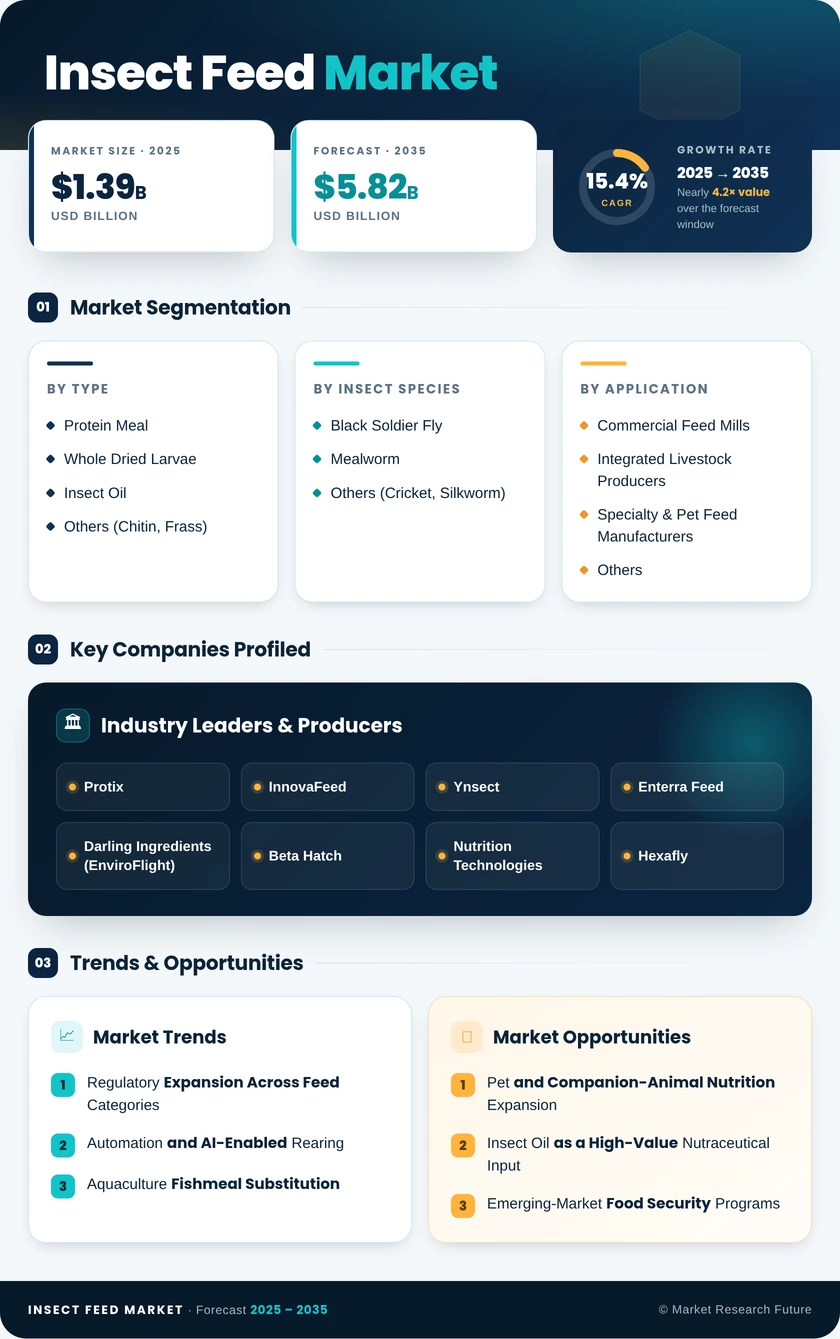
Insect Feed Market Size, Share, Industry Trend & Analysis Research Report By Animal Type (Aquaculture, Poultry, Swine, Others), By Insect Species (Black Soldier Fly, Mealworm, Others), By Product Form (Protein Meal, Whole Dried Larvae, Insect Oil, Others), By End User (Commercial Feed Mills, Integrated Livestock Producers, Specialty & Pet Feed Manufacturers, Others), By Region (North America, Europe, Asia-Pacific, South America, Middle East & Africa) - Forecast to 2035
Download PDF ×

We do not share your information with anyone. However, we may send you emails based on your report interest from time to time. You may contact us at any time to opt-out.

  1. 1 Market Overview |
    1. 1.1 Study Assumptions & Market Definition |
    2. 1.2 Scope of the Study |
    3. 1.3 Research Methodology
  2. 2 Market Summary & Key Takeaways
  3. 3 Market Dynamics |
    1. 3.1 Market Drivers Analysis | |
      1. 3.1.1 Regulatory Expansion for Insect-Based Animal Nutrition | |
      2. 3.1.2 Automated Production and AI-Driven Rearing Systems | |
      3. 3.1.3 Aquaculture Fishmeal Substitution Mandates | |
      4. 3.1.4 Circular-Economy Waste-Stream Utilization | |
      5. 3.1.5 ESG-Driven Demand for Sustainable Insect Protein Feed | |
      6. 3.1.6 Insect Frass as Fertilizer Co-Revenue Generation | |
      7. 3.1.7 Vertical Farming Integration Cost Reduction |
    2. 3.2 Market Restraints Analysis | |
      1. 3.2.1 High Initial CAPEX for Commercial-Scale Facilities | |
      2. 3.2.2 Consumer and Farmer Perception Barriers | |
      3. 3.2.3 Fragmented Regulatory Standards Across Jurisdictions | |
      4. 3.2.4 Feedstock Supply-Chain Inconsistency | |
      5. 3.2.5 Limited Species Diversity in Commercial Production |
    3. 3.3 Market Opportunity Analysis | |
      1. 3.3.1 Pet and Companion-Animal Nutrition Expansion | |
      2. 3.3.2 Insect Oil as a High-Value Nutraceutical Input | |
      3. 3.3.3 Emerging-Market Food Security Programs | |
      4. 3.3.4 Carbon-Credit and ESG Monetization | |
      5. 3.3.5 Data-Driven Precision Rearing Platforms |
    4. 3.4 Industry Value Chain Analysis |
    5. 3.5 Porter's Five Forces Analysis
  4. 4 Global Insect Feed Market Size & Forecast (2021–2035) |
    1. 4.1 Historical Market Size (2021–2025) |
    2. 4.2 Current & Forecast Market Size (2026–2035) |
    3. 4.3 Market Size by Revenue (USD Billion) |
    4. 4.4 Year-over-Year Growth Analysis
  5. 5 Segmentation Analysis |
    1. 5.1 By Animal Type | |
      1. 5.1.1 Aquaculture | |
      2. 5.1.2 Poultry | |
      3. 5.1.3 Swine | |
      4. 5.1.4 Others (Pet, Ruminant) |
    2. 5.2 By Insect Species | |
      1. 5.2.1 Black Soldier Fly | |
      2. 5.2.2 Mealworm | |
      3. 5.2.3 Others (Cricket, Silkworm) |
    3. 5.3 By Product Form | |
      1. 5.3.1 Protein Meal | |
      2. 5.3.2 Whole Dried Larvae | |
      3. 5.3.3 Insect Oil | |
      4. 5.3.4 Others (Chitin, Frass) |
    4. 5.4 By End User | |
      1. 5.4.1 Commercial Feed Mills | |
      2. 5.4.2 Integrated Livestock Producers | |
      3. 5.4.3 Specialty & Pet Feed Manufacturers | |
      4. 5.4.4 Others (Research Institutions, Smallholders)
  6. 6 Regional Analysis |
    1. 6.1 North America | |
      1. 6.1.1 United States | |
      2. 6.1.2 Canada | |
      3. 6.1.3 Mexico |
    2. 6.2 Europe | |
      1. 6.2.1 Germany | |
      2. 6.2.2 United Kingdom | |
      3. 6.2.3 France | |
      4. 6.2.4 Italy | |
      5. 6.2.5 Spain | |
      6. 6.2.6 Nordic Countries | |
      7. 6.2.7 Russia | |
      8. 6.2.8 Rest of Europe |
    3. 6.3 Asia-Pacific | |
      1. 6.3.1 China | |
      2. 6.3.2 India | |
      3. 6.3.3 Japan | |
      4. 6.3.4 South Korea | |
      5. 6.3.5 ASEAN | |
      6. 6.3.6 Rest of Asia-Pacific |
    4. 6.4 South America | |
      1. 6.4.1 Brazil | |
      2. 6.4.2 Argentina | |
      3. 6.4.3 Rest of South America |
    5. 6.5 Middle East & Africa | |
      1. 6.5.1 Saudi Arabia | |
      2. 6.5.2 UAE | |
      3. 6.5.3 South Africa | |
      4. 6.5.4 Egypt | |
      5. 6.5.5 Rest of MEA
  7. 7 Competitive Landscape |
    1. 7.1 Market Share Analysis (2025) |
    2. 7.2 Competitive Benchmarking Matrix |
    3. 7.3 Company Profiles | |
      1. 7.3.1 Protix | |
      2. 7.3.2 InnovaFeed | |
      3. 7.3.3 Ynsect | |
      4. 7.3.4 Enterra Feed | |
      5. 7.3.5 Darling Ingredients (EnviroFlight) | |
      6. 7.3.6 Beta Hatch | |
      7. 7.3.7 Nutrition Technologies | |
      8. 7.3.8 Hexafly | |
      9. 7.3.9 BioflyTech | |
      10. 7.3.10 Nasekomo
  8. 8 Future Outlook & Strategic Recommendations (2026–2035) |
    1. 8.1 AI-Optimized Production and Autonomous Rearing |
    2. 8.2 Platform Economics and Feed-as-a-Service Models |
    3. 8.3 ESG Reporting and Supply-Chain Transparency |
    4. 8.4 Integration with Cellular Agriculture and Hybrid Proteins
  9. 9 Recent Developments & News
  10. 10 Frequently Asked Questions (FAQs)
  11. 11 Report Scope & Methodology |
    1. 11.1 Study Period & Base Year |
    2. 11.2 Data Sources & Citations |
    3. 11.3 Abbreviations
  12. 12 LIST OF TABLES |
  13. TABLE 1 Global Insect Feed Market Size & Forecast, by Revenue (USD Billion), 2021–2035 |
  14. TABLE 2 Global Insect Feed Market – Year-over-Year Growth Analysis, 2021–2035 |
  15. TABLE 3 Global Insect Feed Market – Driver Impact Analysis |
  16. TABLE 4 Global Insect Feed Market – Restraint Impact Analysis |
  17. TABLE 5 Global Insect Feed Market Size, by Animal Type, 2021–2035 (USD Billion) |
  18. TABLE 6 Global Insect Feed Market Size, by Insect Species, 2021–2035 (USD Billion) |
  19. TABLE 7 Global Insect Feed Market Size, by Product Form, 2021–2035 (USD Billion) |
  20. TABLE 8 Global Insect Feed Market Size, by End User, 2021–2035 (USD Billion) |
  21. TABLE 9 Global Insect Feed Market Size, by Region, 2021–2035 (USD Billion) |
  22. TABLE 10 North America Insect Feed Market Size, by Country, 2021–2035 (USD Billion) |
  23. TABLE 11 Europe Insect Feed Market Size, by Country, 2021–2035 (USD Billion) |
  24. TABLE 12 Asia-Pacific Insect Feed Market Size, by Country, 2021–2035 (USD Billion) |
  25. TABLE 13 South America Insect Feed Market Size, by Country, 2021–2035 (USD Billion) |
  26. TABLE 14 Middle East & Africa Insect Feed Market Size, by Country, 2021–2035 (USD Billion) |
  27. TABLE 15 Regional Summary – Key Metrics and Investment Themes |
  28. TABLE 16 Competitive Benchmarking Matrix – Global Insect Feed Market, 2025 |
  29. TABLE 17 Recent Developments & Strategic Announcements, 2023–2025 |
  30. TABLE 18 Report Scope & Methodology Summary |
  31. TABLE 19 Detailed Sources and Citations |
  32. TABLE 20 North America Insect Feed Market Size, by Animal Type, 2021–2035 (USD Billion) |
  33. TABLE 21 North America Insect Feed Market Size, by Insect Species, 2021–2035 (USD Billion) |
  34. TABLE 22 North America Insect Feed Market Size, by Product Form, 2021–2035 (USD Billion) |
  35. TABLE 23 North America Insect Feed Market Size, by End User, 2021–2035 (USD Billion) |
  36. TABLE 24 Europe Insect Feed Market Size, by Animal Type, 2021–2035 (USD Billion) |
  37. TABLE 25 Europe Insect Feed Market Size, by Insect Species, 2021–2035 (USD Billion) |
  38. TABLE 26 Europe Insect Feed Market Size, by Product Form, 2021–2035 (USD Billion) |
  39. TABLE 27 Europe Insect Feed Market Size, by End User, 2021–2035 (USD Billion) |
  40. TABLE 28 Asia-Pacific Insect Feed Market Size, by Animal Type, 2021–2035 (USD Billion) |
  41. TABLE 29 Asia-Pacific Insect Feed Market Size, by Insect Species, 2021–2035 (USD Billion) |
  42. TABLE 30 Asia-Pacific Insect Feed Market Size, by Product Form, 2021–2035 (USD Billion) |
  43. TABLE 31 Asia-Pacific Insect Feed Market Size, by End User, 2021–2035 (USD Billion) |
  44. TABLE 32 South America Insect Feed Market Size, by Animal Type, 2021–2035 (USD Billion) |
  45. TABLE 33 South America Insect Feed Market Size, by Insect Species, 2021–2035 (USD Billion) |
  46. TABLE 34 South America Insect Feed Market Size, by Product Form, 2021–2035 (USD Billion) |
  47. TABLE 35 South America Insect Feed Market Size, by End User, 2021–2035 (USD Billion) |
  48. TABLE 36 Middle East & Africa Insect Feed Market Size, by Animal Type, 2021–2035 (USD Billion) |
  49. TABLE 37 Middle East & Africa Insect Feed Market Size, by Insect Species, 2021–2035 (USD Billion) |
  50. TABLE 38 Middle East & Africa Insect Feed Market Size, by Product Form, 2021–2035 (USD Billion) |
  51. TABLE 39 Middle East & Africa Insect Feed Market Size, by End User, 2021–2035 (USD Billion)
  52. 13 LIST OF FIGURES |
  53. FIGURE 1 Global Insect Feed Market Dynamics (Drivers, Restraints, Opportunities) |
  54. FIGURE 2 Insect Feed Industry Value Chain Analysis |
  55. FIGURE 3 Porter's Five Forces Analysis — Insect Feed Market |
  56. FIGURE 4 Global Insect Feed Market Size Trend (USD Billion), 2021–2035 |
  57. FIGURE 5 Insect Feed Market Share, by Animal Type (%), 2025 |
  58. FIGURE 6 Insect Feed Market Share, by Insect Species (%), 2025 |
  59. FIGURE 7 Insect Feed Market Share, by Product Form (%), 2025 |
  60. FIGURE 8 Insect Feed Market Share, by End User (%), 2025 |
  61. FIGURE 9 Insect Feed Market Share, by Region (%), 2025 |
  62. FIGURE 10 North America Insect Feed Market – Country Share (%), 2025 |
  63. FIGURE 11 Europe Insect Feed Market – Country Share (%), 2025 |
  64. FIGURE 12 Asia-Pacific Insect Feed Market – Country Share (%), 2025 |
  65. FIGURE 13 South America Insect Feed Market – Country Share (%), 2025 |
  66. FIGURE 14 Middle East & Africa Insect Feed Market – Country Share (%), 2025 |
  67. FIGURE 15 Competitive Landscape — Market Concentration & Share Distribution, 2025 |
  68. FIGURE 16 Competitive Positioning Map — Key Players, 2025

Segmentation Quick Reference

DimensionSub-SegmentsDominant SegmentFastest Growing Segment
By Animal TypeAquaculture, Poultry, Swine, OthersAquaculturePoultry
By Insect SpeciesBlack Soldier Fly, Mealworm, OthersBlack Soldier FlyMealworm
By Product FormProtein Meal, Whole Dried Larvae, Insect Oil, OthersProtein MealInsect Oil
By End UserCommercial Feed Mills, Integrated Livestock Producers, Specialty & Pet Feed Manufacturers, OthersCommercial Feed MillsIntegrated Livestock Producers
By RegionNorth America, Europe, Asia-Pacific, South America, Middle East & AfricaNorth AmericaMiddle East & Africa


Market Segmentation Overview

By Animal Type

Sub-SegmentKey Trend
AquacultureFishmeal replacement at 15–50% inclusion; driven by cost and sustainability mandates
PoultryFastest uptake following EU and U.S. regulatory approvals for broiler/layer diets
SwinePilot-phase integration in starter and grower rations; amino-acid complementarity
Others (Pet, Ruminant)Hypoallergenic pet nutrition driving premium product development


Aquaculture's dominance reflects a decade of inclusion trials validating insect protein performance, while poultry's rapid CAGR stems from recent regulatory breakthroughs that have opened high-volume commercial feed channels.

By Insect Species

Sub-SegmentKey Trend
Black Soldier FlyIndustry-standard species due to rapid lifecycle, waste-conversion efficiency, and scalability
MealwormPremium positioning in pet food and specialty aquaculture; advanced genetics research
Others (Cricket, Silkworm)Regional niche production in Southeast Asia; limited but growing commercial interest


Black soldier fly larvae remain the cornerstone of commercial insect rearing globally, while mealworm diversification into companion-animal and nutraceutical channels is opening higher-margin market segments.

By Product Form

Sub-SegmentKey Trend
Protein MealStandard commodity format; compatible with existing feed mill blending infrastructure
Whole Dried LarvaePopular in small-scale poultry, reptile, and aquarium feed segments
Insect OilFastest-growing form; lauric acid content valued in aquafeed and functional lipid applications
Others (Chitin, Frass)Chitin extraction for biomaterials; insect frass as organic fertilizer


Protein meal's dominance reflects its seamless compatibility with commercial feed mill operations, while insect oil's growth trajectory signals an emerging high-value co-product that enhances facility-level economics.

By End User

Sub-SegmentKey Trend
Commercial Feed MillsPrimary distribution channel; volume-driven procurement and formulation capabilities
Integrated Livestock ProducersFastest-growing user type; vertically integrating insect protein sourcing for margin capture
Specialty & Pet Feed ManufacturersPremium pricing power; growing consumer demand for sustainable, hypoallergenic pet diets
OthersResearch institutions and smallholders exploring pilot-scale applications


Commercial feed mills anchor the current distribution structure, but vertical integration by large livestock producers is reshaping procurement dynamics as the insect feed industry scales.