
Request Free Sample ×

Kindly complete the form below to receive a free sample of this Report

* Please use a valid business email

Leading companies partner with us for data-driven Insights

clients tt-cursor
Hero Background
English
Chinese
French
Japanese
Korean
German
Spanish

Industrial Starches Market Analysis

ID: MRFR/FnB/1528-HCR
200 Pages
Snehal Singh
April 2026

Industrial Starch Market Size, Share, Industry Trend & Analysis Research Report By Application (Food Beverage, Pharmaceutical, Textile, Paper, Biodegradable Plastics), By Source (Corn, Potato, Wheat, Tapioca, Cassava), By Type (Native Starch, Modified Starch, Organic Starch, Pre-gelatinized Starch), By End Use (Food Industry, Non-Food Industry, Animal Feed, Adhesives) and By Regional (North America, Europe, South America, Asia Pacific, Middle East and Africa)-Forecast to 2035

Share:
Download PDF ×

We do not share your information with anyone. However, we may send you emails based on your report interest from time to time. You may contact us at any time to opt-out.

Industrial Starches Market Infographic
Purchase Options

Market Analysis

In-depth Analysis of Industrial Starch Market Industry Landscape

The dynamics of the industrial starch market are influenced by different factors, including changes in consumer preferences, technological progress, legislative policies enacted by government authorities around the world, and competitiveness within this sector. Starch –a carbohydrate obtained from corn, wheat, and potatoes, among other sources – finds applications in a wide range of industries, including food and beverages, pharmaceuticals, paper& textile, and adhesives. One of the main reasons why the industrial starch market is expected to grow rapidly is the increasing consumption of processed and convenience foods. For instance, starch provides texture, viscosity, and stability in food products such as baked goods, snacks, sauces, soups, etc. In addition to that, the changing consumer lifestyles along with growing urbanization have resulted in the rise in demand for convenient or ready-to-eat foods, thereby necessitating increased consumer preference for processed foods plus snacks containing starch-based ingredients. Furthermore, the consumer shift towards clean labels and natural ingredients has influenced the dynamics of the industrial starch market. It goes without saying that people are currently seeking easy-to-understand consumable items that do not include any chemicals. Produced out of naturally occurring feedstocks, this kind of substance is considered a clean substitute. Technological advancements have significantly driven innovation and growth within the industrial starch market. Enhanced processing systems like enzymatic conversion, extrusion, or fermentation enhance functionalities, stability, and performance parameters required by manufacturers when developing these types of compounds. Moreover, biotechnology innovations coupled with genetic engineering have allowed the development of specialty starches that have properties like heat, shear, and acid resistance, hence making them applicable to many manufacturing processes. The dynamics of the industrial starch market are also influenced by regulatory frameworks, whereby industry practices and consumer perceptions are affected by regulations on food safety, labeling, and quality standards, among others. For starch producers to comply with legal requirements and gain consumers' confidence in their products, they must adhere to regulations relating to allergen labeling, product safety, and nutritional claims. The industrial starch market is very competitive, and many players try as much as possible through differentiation of products, branding, and marketing strategies to increase their share of the market. Key players in this market come from major contingent global companies manufacturing this product down to smaller specialized ingredient suppliers. A consumer's decision-making about purchasing is hugely influenced by brand reputation, product quality, and price competitiveness. Additionally, strategic partnerships with food and beverage manufacturers, retailers, or distributors are essential for increasing brand visibility and expanding the markets.


Author
Author Profile
Snehal Singh
Manager - Research

High acumen in analyzing complex macro & micro markets with more than 6 years of work experience in the field of market research. By implementing her analytical skills in forecasting and estimation into market research reports, she has expertise in Packaging, Construction, and Equipment domains. She handles a team size of 20-25 resources and ensures smooth running of the projects, associated marketing activities, and client servicing.

Leave a Comment

FAQs

What is the current valuation of the Industrial Starch Market as of 2024?

<p>The Industrial Starch Market was valued at 82.4 USD Billion in 2024.</p>

What is the projected market size for the Industrial Starch Market by 2035?

The market is projected to reach 145.75 USD Billion by 2035.

What is the expected CAGR for the Industrial Starch Market during the forecast period 2025 - 2035?

The expected CAGR for the Industrial Starch Market during 2025 - 2035 is 5.32%.

Which application segment holds the largest market share in the Industrial Starch Market?

The Food and Beverage segment is anticipated to dominate, with a valuation range of 30.0 to 55.0 USD Billion.

How does the performance of the Pharmaceutical segment compare to other segments?

The Pharmaceutical segment is valued between 15.0 and 25.0 USD Billion, indicating a moderate share compared to others.

What are the leading sources of industrial starch in terms of market valuation?

Corn is the leading source, with a valuation range of 32.0 to 56.0 USD Billion.

Which type of starch is expected to see the highest growth in the market?

Modified Starch is projected to grow significantly, with a valuation range of 30.0 to 50.0 USD Billion.

What is the market valuation for the Non-Food Industry segment?

The Non-Food Industry segment is expected to be valued between 25.0 and 45.0 USD Billion.

Who are the key players in the Industrial Starch Market?

Key players include Cargill, Archer Daniels Midland, Tate &amp; Lyle, and Ingredion, among others.

What is the expected growth trend for the Biodegradable Plastics segment?

The Biodegradable Plastics segment is projected to grow, with a valuation range of 15.4 to 20.75 USD Billion.

Market Summary

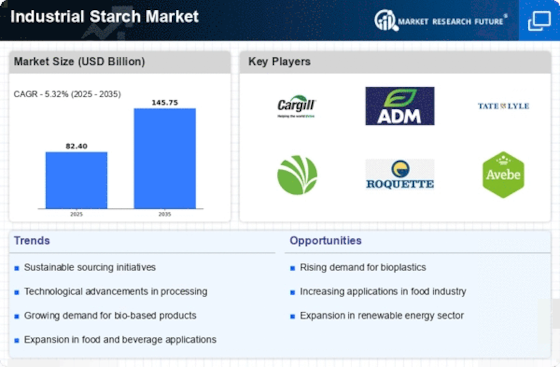
As per Market Research Future analysis, the Industrial Starch Market Size was estimated at 82.4 USD Billion in 2024. The Industrial Starch industry is projected to grow from 86.78 USD Billion in 2025 to 145.75 USD Billion by 2035, exhibiting a compound annual growth rate (CAGR) of 5.32% during the forecast period 2025 - 2035

Key Market Trends & Highlights

The Industrial Starch Market is experiencing a dynamic shift towards sustainability and innovation.

  • North America remains the largest market for industrial starch, driven by robust demand in the food and beverage sector.
  • Asia-Pacific is emerging as the fastest-growing region, propelled by increasing investments in biodegradable plastics.
  • The food and beverage segment continues to dominate, while the biodegradable plastics segment is witnessing rapid growth.
  • Rising demand in the food and beverage sector and expansion in bioplastics production are key drivers of market growth.

Market Size & Forecast

2024 Market Size 82.4 (USD Billion)
2035 Market Size 145.75 (USD Billion)
CAGR (2025 - 2035) 5.32%
Largest Regional Market Share in 2024 Asia Pacific

Major Players

Cargill (US), Archer Daniels Midland (US), Tate & Lyle (GB), Ingredion (US), Roquette Freres (FR), Avebe (NL), MGP Ingredients (US), KMC (DK), Emsland Group (DE)

Market Trends

The Industrial Starch Market is currently experiencing a dynamic evolution, driven by various factors that influence its growth trajectory. The increasing demand for biodegradable materials and sustainable products has prompted manufacturers to explore starch-based alternatives. This shift aligns with global trends towards environmental sustainability, as industries seek to reduce their carbon footprint. Additionally, the food and beverage sector continues to be a significant consumer of industrial starch, utilizing it for thickening, stabilizing, and texturizing applications. As consumer preferences evolve, the market adapts to incorporate innovative starch solutions that cater to health-conscious and quality-driven consumers. Moreover, advancements in technology are reshaping production processes within the Industrial Starch Market. Enhanced processing techniques and the development of modified starches are enabling manufacturers to meet diverse application requirements across various industries, including pharmaceuticals, textiles, and paper. This technological progress not only improves efficiency but also expands the functional properties of starch, making it a versatile ingredient. As the market progresses, it appears poised for further growth, with potential opportunities arising from emerging applications and the continuous pursuit of sustainable practices.

Sustainability Focus

The Industrial Starch Market is increasingly influenced by a focus on sustainability. Manufacturers are exploring eco-friendly alternatives to traditional materials, leading to a rise in demand for biodegradable starch products. This trend reflects a broader societal shift towards environmentally responsible practices.

Technological Advancements

Technological innovations are playing a crucial role in the evolution of the Industrial Starch Market. Enhanced processing methods and the introduction of modified starches are enabling producers to meet diverse application needs, thereby expanding the market's potential.

Health-Conscious Consumer Trends

The growing awareness of health and wellness among consumers is impacting the Industrial Starch Market. There is a noticeable shift towards starches that offer functional benefits, such as improved digestibility and nutritional value, catering to the demands of health-oriented consumers.

Industrial Starches Market Market Drivers

Expansion in Bioplastics Production

The Industrial Starch Market is poised for growth due to the expansion in bioplastics production. Starch-based bioplastics are gaining traction as sustainable alternatives to conventional plastics, driven by increasing environmental concerns. In 2025, the bioplastics segment is projected to grow at a compound annual growth rate of 15%, indicating a robust shift towards eco-friendly materials. This growth is supported by government initiatives promoting biodegradable materials, which further enhances the appeal of starch-based products. As industries seek to reduce their carbon footprint, the Industrial Starch Market is likely to benefit from this transition, positioning starch as a key ingredient in the development of sustainable packaging solutions.

Growth in Pharmaceutical Applications

The Industrial Starch Market is experiencing growth in pharmaceutical applications, where starches are utilized as excipients in drug formulations. Starches serve as binders, disintegrants, and fillers, playing a crucial role in the efficacy of medications. In 2025, the pharmaceutical sector is anticipated to account for approximately 10% of the total starch consumption, driven by the increasing demand for oral solid dosage forms. This trend suggests a growing recognition of the importance of starches in enhancing drug delivery systems. As the pharmaceutical industry evolves, the Industrial Starch Market is likely to expand its offerings to meet the specific needs of this sector, ensuring compliance with stringent regulatory standards.

Increased Use in Personal Care Products

The Industrial Starch Market is witnessing an increased use of starches in personal care products. Starches are valued for their thickening, binding, and absorbent properties, making them essential ingredients in cosmetics and toiletries. In 2025, the personal care segment is projected to grow at a rate of 8%, reflecting the rising consumer demand for natural and sustainable ingredients. This trend aligns with the broader movement towards clean beauty, where consumers seek products free from harmful chemicals. As manufacturers respond to these preferences, the Industrial Starch Market is likely to see a diversification of starch applications, enhancing its relevance in the personal care sector.

Rising Demand in Food and Beverage Sector

The Industrial Starch Market experiences a notable surge in demand from the food and beverage sector. Starches serve as thickeners, stabilizers, and texturizers, enhancing the quality of various products. In 2025, the food industry accounts for approximately 60% of the total starch consumption, driven by the increasing preference for convenience foods and ready-to-eat meals. This trend indicates a shift towards processed foods, which require industrial starches for improved shelf life and texture. Additionally, the growing trend of clean label products compels manufacturers to seek natural starches, further propelling the market. As consumer preferences evolve, the Industrial Starch Market is likely to adapt, ensuring that starches meet the demands of modern food formulations.

Technological Innovations in Starch Processing

Technological innovations in starch processing are transforming the Industrial Starch Market. Advances in enzymatic processes and modifications allow for the production of high-quality starches with tailored functionalities. In 2025, the market for modified starches is expected to reach a valuation of over 10 billion dollars, reflecting the increasing demand for specialized applications across various industries. These innovations enable manufacturers to create starches that meet specific requirements, such as improved solubility and enhanced stability under varying conditions. As industries continue to seek efficiency and quality, the Industrial Starch Market is likely to witness a shift towards more sophisticated processing techniques, enhancing the overall value proposition of starch products.

Market Segment Insights

By Application: Food and Beverage (Largest) vs. Biodegradable Plastics (Fastest-Growing)

In the Industrial Starch Market, the 'Food and Beverage' segment holds a significant share due to its widespread usage as a thickener, stabilizer, and texturizer in various food products. This segment dominates the market landscape, reflecting the growing consumer demand for processed foods and convenience items. Alongside, 'Pharmaceutical' and 'Textile' applications are also garnering attention, but they account for a smaller market share compared to food-related applications. On the other hand, the 'Biodegradable Plastics' segment is witnessing rapid growth fueled by increasing environmental concerns and a shift towards sustainable products. The demand for eco-friendly solutions in packaging and various industries is surging, making this segment the fastest-growing within the market. Other segments like 'Paper' and 'Pharmaceutical' also contribute to the overall growth, albeit at a slower rate, as they adapt to emerging market needs and regulations.

Food and Beverage (Dominant) vs. Biodegradable Plastics (Emerging)

The 'Food and Beverage' segment is characterized by its extensive use of industrial starch as a versatile ingredient that enhances texture, moisture retention, and shelf-life in a variety of food products. Its dominance is supported by the persistent demand for convenience food and processed items. Conversely, 'Biodegradable Plastics' represents an emerging segment driven by innovations in sustainable materials. As consumers increasingly seek eco-friendly options, this segment becomes integral in addressing packaging waste and environmental impact. The development of starch-based biodegradable plastics showcases a promising trend where industrial starch not only satisfies traditional needs but also adapts to the ecological demands of modern society.

By Source: Corn (Largest) vs. Potato (Fastest-Growing)

In the Industrial Starch Market, corn holds the largest share as a source of starch due to its abundant availability and versatility. It is extensively used in food, beverage, and industrial applications, leading to its dominance. On the other hand, potato starch is quickly gaining traction, primarily due to its strong functional properties and clean label appeal, making it the fastest-growing source segment among industrial starches. Market growth for starch sources is driven by innovations in food processing and an increasing demand for natural ingredients. Corn remains the backbone of the market due to its established infrastructure and production capabilities. However, consumer preferences are shifting towards potato and other starch sources, indicating a changing landscape in the industrial starch market that favors diversity and specialization in starch applications.

Corn (Dominant) vs. Potato (Emerging)

<a href="https://www.marketresearchfuture.com/reports/corn-starch-market-7485" target="_blank">corn starch</a>, as the dominant source in the Industrial Starch Market, is favored for its high yield and cost-effectiveness, making it an essential ingredient in various industries, including food, paper, and textiles. Its versatility allows it to be utilized in a myriad of applications, from thickening agents in food to bio-based plastics. In contrast, potato starch, while emerging, is recognized for its superior functional properties such as high viscosity, clarity, and freeze-thaw stability. Its clean label format appeals to health-conscious consumers and food formulators alike, thus driving demand. As the market progresses, the competition between corn and potato starch will likely intensify, reflecting changing consumer trends and advancing applications.

By Type: Native Starch (Largest) vs. Modified Starch (Fastest-Growing)

In the Industrial Starch Market, the segment distribution shows Native Starch holding the largest market share due to its widespread application in food and industrial sectors. Modified Starch, known for its enhanced functionalities, is witnessing rapid growth, driven by increasing demand for convenience foods and processed items. The growth of Modified Starch is attributed to its versatility and acceptance across various industries, including pharmaceuticals and textiles. With changing consumer preferences and the rise of health-conscious products, both Native and Modified Starch segments are expected to see sustained growth, but Modified Starch is on track to emerge as the fastest-growing due to innovations and product development.

Native Starch (Dominant) vs. Organic Starch (Emerging)

Native Starch is the dominant player in the Industrial Starch Market, prized for its natural properties and usage in a variety of applications ranging from food products to biodegradable materials. Its ability to gel and provide texture makes it a preferred choice among manufacturers. On the other hand, Organic Starch is gaining momentum as an emerging segment, driven by consumer trends favoring natural and organic products. As the market shifts towards clean labels and sustainable ingredients, Organic Starch is positioned well for growth. This segment is becoming increasingly attractive to health-conscious consumers and industries looking to align with sustainability goals, thus offering significant potential in the coming years.

By End Use: Food Industry (Largest) vs. Non-Food Industry (Fastest-Growing)

In the Industrial Starch Market, the food industry represents the largest segment, driven by the demand for processed foods and convenience products. With the rising consumer preference for gluten-free and health-oriented products, starch serves as a key ingredient for thickening, stabilizing, and providing texture. Meanwhile, the non-food industry, which includes applications like textiles and paper, is witnessing rapid growth due to its versatility and the increasing use of sustainable materials in various manufacturing processes. Growth trends in the Industrial Starch Market indicate that the non-food industry is positioned as the fastest-growing segment. Factors contributing to this growth include innovations in biodegradable packaging, the push for sustainable products, and increased use in industrial applications such as adhesives and construction materials. As environmental concerns continue to rise, the transition towards eco-friendly alternatives is likely to accelerate, positioning the non-food sector as a significant player in the market's future.

Food Industry (Dominant) vs. Adhesives (Emerging)

The food industry stands as the dominant segment in the Industrial Starch Market due to its extensive use in food processing, where it enhances product quality and stability. Starches from various sources, such as corn, wheat, and potatoes, cater to diverse culinary needs, making it an essential ingredient in sauces, soups, snacks, and <a href="https://www.marketresearchfuture.com/reports/bakery-products-market-1985" target="_blank">bakery products</a>. Conversely, the adhesives segment is emerging as a vital component in various industries, utilizing starches for their bonding properties. The growth of eco-friendly adhesives, driven by sustainability trends, positions starch-based adhesives favorably in markets including packaging and construction. This emerging segment is expected to gain momentum as manufacturers focus on creating environmentally conscious products that meet regulatory standards.

Get more detailed insights about Industrial Starch Market Research Report - Forecast till 2035

Regional Insights

The Industrial Starch Market demonstrates significant regional diversity, with North America and Asia Pacific holding substantial market values. In 2024, North America is expected to be valued at 20.0 USD billion, driven by strong demand in food, pharmaceuticals, and adhesives.

The region is projected to grow to 27.5 USD billion by 2035, reflecting its majority holding within the market. Europe follows closely, with a valuation of 18.0 USD billion in 2024 and growing to 24.0 USD billion by 2035, showcasing robust adoption in the automotive and paper industries.

Asia Pacific, dominating with a value of 25.0 USD billion in 2024 and expected to reach 36.0 USD billion by 2035, signifies the region's rapid industrial growth and increasing consumption of starch in various applications.

South America and the Middle East and Africa are also part of the landscape but show smaller market values, with South America expected to rise from 5.0 USD Billion in 2024 to 6.5 USD Billion by 2035, while the Middle East and Africa are anticipated to grow from 6.95 USD Billion to 8.5 USD Billion in the same period, indicating emerging opportunities in these regions.

Overall, the Industrial Starch Market reveals intricate dynamics spurred by regional consumption patterns and industrial applications that drive growth across different areas.

Key Players and Competitive Insights

The Industrial Starch Market has become increasingly competitive due to the rising demand for starch-based products across various industries such as food and beverage, pharmaceuticals, textiles, paper, and biofuels. As the market evolves, companies are focusing on innovation, product diversification, and strategic partnerships to capture a larger market share.The driving forces behind this competitive landscape include advancements in technology, growing consumer preferences for natural and plant-based ingredients, and stringent regulations regarding food safety and quality.Furthermore, globalization has allowed several key players to expand their operations, leading to heightened competition and a more integrated market structure.Companies are also engaging in mergers and acquisitions to enhance their product offerings and widen their geographical reach, which is pivotal in this thriving industry segment.

Roquette Frères holds a prominent position in the Industrial Starch Market, distinguished by its extensive portfolio of high-quality starch products. The company benefits from a solid reputation for its commitment to innovation and sustainability, allowing it to respond effectively to the changing demands of the market.With a robust supply chain and an established global presence, Roquette Freres is well-equipped to cater to diverse industries, including food and pharmaceuticals.The company's strengths lie in its research and development capabilities, which enable it to develop customized solutions that meet specific customer needs. This focus on customer-centric offerings has bolstered Roquette Freres’ standing in the market, making it a reliable partner for clients seeking advanced starch solutions.

Saarstärke GmbH is also a key player in the Industrial Starch Market, known for its innovative approach in producing native and modified starch products tailored for various applications.The company places a strong emphasis on quality control and sustainability, ensuring that its offerings meet industry standards while catering to the growing demand for environmentally friendly solutions.Saarstärke GmbH has a formidable market presence bolstered by strategic partnerships and collaborations, allowing it to enhance its distribution channels globally.Key products offered by the company include specialty starches used in different sectors, which have been well-received due to their performance and reliability.Strengths such as a dedicated research team and expertise in technological advancement further position Saarstärke GmbH favorably within the industry landscape. Additionally, the company remains open to strategic mergers and acquisitions, thereby continuously evolving its product range and expanding its footprint in the global market.

Key Companies in the Industrial Starches Market include

Industry Developments

There have been big changes in the Industrial Starch Market lately, with more emphasis on innovation and sustainability. Cargill and Ingredion are two companies that are working on more environmentally friendly ways to make their products. They want to lower their carbon footprints and attract customers who care about the environment.

In 2023, it was reported that Archer Daniels Midland was looking into buying companies in the same area to improve its industrial starch business. Roquette Frères and Tate & Lyle have also said they will build more factories to keep up with rising global demand.

The market for industrial starch has grown a lot because it is being used more and more in things like food, textiles, and drugs. By 2025, the market is expected to be worth almost USD 100 billion. Consumer trends and technological advances have led to a noticeable rise in the value of companies that make starch.

Also, in late 2023, Emsland Group released a new line of specialty starches that were meant to improve the performance of their products. This shows that the market is competitive and there is a strong desire for new ideas. This changing environment shows how flexible and responsive the Industrial Starch Market is to the needs of consumers and the environment.

Future Outlook

Industrial Starches Market Future Outlook

The Industrial Starch Market is projected to grow at a 5.32% CAGR from 2025 to 2035, driven by increasing demand in food, pharmaceuticals, and biodegradable materials.

New opportunities lie in:

  • Expansion into bioplastics production using industrial starch
  • Development of customized starch solutions for the pharmaceutical sector
  • Investment in advanced processing technologies to enhance product quality

By 2035, the market is expected to solidify its position as a key player in various industries.

Market Segmentation

Industrial Starches Market Type Outlook

  • Native Starch
  • Modified Starch
  • Organic Starch
  • Pre-gelatinized Starch

Industrial Starches Market Source Outlook

  • Corn
  • Potato
  • Wheat
  • Tapioca
  • Cassava

Industrial Starches Market End Use Outlook

  • Food Industry
  • Non-Food Industry
  • Animal Feed
  • Adhesives

Industrial Starches Market Application Outlook

  • Food and Beverage
  • Pharmaceutical
  • Textile
  • Paper
  • Biodegradable Plastics

Report Scope

MARKET SIZE 2024 82.4(USD Billion)
MARKET SIZE 2025 86.78(USD Billion)
MARKET SIZE 2035 145.75(USD Billion)
COMPOUND ANNUAL GROWTH RATE (CAGR) 5.32% (2025 - 2035)
REPORT COVERAGE Revenue Forecast, Competitive Landscape, Growth Factors, and Trends
BASE YEAR 2024
Market Forecast Period 2025 - 2035
Historical Data 2019 - 2024
Market Forecast Units USD Billion
Key Companies Profiled Cargill (US), Archer Daniels Midland (US), Tate & Lyle (GB), Ingredion (US), Roquette Freres (FR), Avebe (NL), MGP Ingredients (US), KMC (DK), Emsland Group (DE)
Segments Covered Application, Source, Type, End Use, Regional
Key Market Opportunities Growing demand for biodegradable materials drives innovation in the Industrial Starch Market.
Key Market Dynamics Rising demand for biodegradable materials drives innovation and competition in the industrial starch market.
Countries Covered North America, Europe, APAC, South America, MEA

FAQs

What is the current valuation of the Industrial Starch Market as of 2024?

<p>The Industrial Starch Market was valued at 82.4 USD Billion in 2024.</p>

What is the projected market size for the Industrial Starch Market by 2035?

The market is projected to reach 145.75 USD Billion by 2035.

What is the expected CAGR for the Industrial Starch Market during the forecast period 2025 - 2035?

The expected CAGR for the Industrial Starch Market during 2025 - 2035 is 5.32%.

Which application segment holds the largest market share in the Industrial Starch Market?

The Food and Beverage segment is anticipated to dominate, with a valuation range of 30.0 to 55.0 USD Billion.

How does the performance of the Pharmaceutical segment compare to other segments?

The Pharmaceutical segment is valued between 15.0 and 25.0 USD Billion, indicating a moderate share compared to others.

What are the leading sources of industrial starch in terms of market valuation?

Corn is the leading source, with a valuation range of 32.0 to 56.0 USD Billion.

Which type of starch is expected to see the highest growth in the market?

Modified Starch is projected to grow significantly, with a valuation range of 30.0 to 50.0 USD Billion.

What is the market valuation for the Non-Food Industry segment?

The Non-Food Industry segment is expected to be valued between 25.0 and 45.0 USD Billion.

Who are the key players in the Industrial Starch Market?

Key players include Cargill, Archer Daniels Midland, Tate &amp; Lyle, and Ingredion, among others.

What is the expected growth trend for the Biodegradable Plastics segment?

The Biodegradable Plastics segment is projected to grow, with a valuation range of 15.4 to 20.75 USD Billion.

  1. SECTION I: EXECUTIVE SUMMARY AND KEY HIGHLIGHTS
    1. | 1.1 EXECUTIVE SUMMARY
    2. | | 1.1.1 Market Overview
    3. | | 1.1.2 Key Findings
    4. | | 1.1.3 Market Segmentation
    5. | | 1.1.4 Competitive Landscape
    6. | | 1.1.5 Challenges and Opportunities
    7. | | 1.1.6 Future Outlook
  2. SECTION II: SCOPING, METHODOLOGY AND MARKET STRUCTURE
    1. | 2.1 MARKET INTRODUCTION
    2. | | 2.1.1 Definition
    3. | | 2.1.2 Scope of the study
    4. | | | 2.1.2.1 Research Objective
    5. | | | 2.1.2.2 Assumption
    6. | | | 2.1.2.3 Limitations
    7. | 2.2 RESEARCH METHODOLOGY
    8. | | 2.2.1 Overview
    9. | | 2.2.2 Data Mining
    10. | | 2.2.3 Secondary Research
    11. | | 2.2.4 Primary Research
    12. | | | 2.2.4.1 Primary Interviews and Information Gathering Process
    13. | | | 2.2.4.2 Breakdown of Primary Respondents
    14. | | 2.2.5 Forecasting Model
    15. | | 2.2.6 Market Size Estimation
    16. | | | 2.2.6.1 Bottom-Up Approach
    17. | | | 2.2.6.2 Top-Down Approach
    18. | | 2.2.7 Data Triangulation
    19. | | 2.2.8 Validation
  3. SECTION III: QUALITATIVE ANALYSIS
    1. | 3.1 MARKET DYNAMICS
    2. | | 3.1.1 Overview
    3. | | 3.1.2 Drivers
    4. | | 3.1.3 Restraints
    5. | | 3.1.4 Opportunities
    6. | 3.2 MARKET FACTOR ANALYSIS
    7. | | 3.2.1 Value chain Analysis
    8. | | 3.2.2 Porter's Five Forces Analysis
    9. | | | 3.2.2.1 Bargaining Power of Suppliers
    10. | | | 3.2.2.2 Bargaining Power of Buyers
    11. | | | 3.2.2.3 Threat of New Entrants
    12. | | | 3.2.2.4 Threat of Substitutes
    13. | | | 3.2.2.5 Intensity of Rivalry
    14. | | 3.2.3 COVID-19 Impact Analysis
    15. | | | 3.2.3.1 Market Impact Analysis
    16. | | | 3.2.3.2 Regional Impact
    17. | | | 3.2.3.3 Opportunity and Threat Analysis
  4. SECTION IV: QUANTITATIVE ANALYSIS
    1. | 4.1 Food, Beverages & Nutrition, BY Application (USD Billion)
    2. | | 4.1.1 Food and Beverage
    3. | | 4.1.2 Pharmaceutical
    4. | | 4.1.3 Textile
    5. | | 4.1.4 Paper
    6. | | 4.1.5 Biodegradable Plastics
    7. | 4.2 Food, Beverages & Nutrition, BY Source (USD Billion)
    8. | | 4.2.1 Corn
    9. | | 4.2.2 Potato
    10. | | 4.2.3 Wheat
    11. | | 4.2.4 Tapioca
    12. | | 4.2.5 Cassava
    13. | 4.3 Food, Beverages & Nutrition, BY Type (USD Billion)
    14. | | 4.3.1 Native Starch
    15. | | 4.3.2 Modified Starch
    16. | | 4.3.3 Organic Starch
    17. | | 4.3.4 Pre-gelatinized Starch
    18. | 4.4 Food, Beverages & Nutrition, BY End Use (USD Billion)
    19. | | 4.4.1 Food Industry
    20. | | 4.4.2 Non-Food Industry
    21. | | 4.4.3 Animal Feed
    22. | | 4.4.4 Adhesives
    23. | 4.5 Food, Beverages & Nutrition, BY Region (USD Billion)
    24. | | 4.5.1 North America
    25. | | | 4.5.1.1 US
    26. | | | 4.5.1.2 Canada
    27. | | 4.5.2 Europe
    28. | | | 4.5.2.1 Germany
    29. | | | 4.5.2.2 UK
    30. | | | 4.5.2.3 France
    31. | | | 4.5.2.4 Russia
    32. | | | 4.5.2.5 Italy
    33. | | | 4.5.2.6 Spain
    34. | | | 4.5.2.7 Rest of Europe
    35. | | 4.5.3 APAC
    36. | | | 4.5.3.1 China
    37. | | | 4.5.3.2 India
    38. | | | 4.5.3.3 Japan
    39. | | | 4.5.3.4 South Korea
    40. | | | 4.5.3.5 Malaysia
    41. | | | 4.5.3.6 Thailand
    42. | | | 4.5.3.7 Indonesia
    43. | | | 4.5.3.8 Rest of APAC
    44. | | 4.5.4 South America
    45. | | | 4.5.4.1 Brazil
    46. | | | 4.5.4.2 Mexico
    47. | | | 4.5.4.3 Argentina
    48. | | | 4.5.4.4 Rest of South America
    49. | | 4.5.5 MEA
    50. | | | 4.5.5.1 GCC Countries
    51. | | | 4.5.5.2 South Africa
    52. | | | 4.5.5.3 Rest of MEA
  5. SECTION V: COMPETITIVE ANALYSIS
    1. | 5.1 Competitive Landscape
    2. | | 5.1.1 Overview
    3. | | 5.1.2 Competitive Analysis
    4. | | 5.1.3 Market share Analysis
    5. | | 5.1.4 Major Growth Strategy in the Food, Beverages & Nutrition
    6. | | 5.1.5 Competitive Benchmarking
    7. | | 5.1.6 Leading Players in Terms of Number of Developments in the Food, Beverages & Nutrition
    8. | | 5.1.7 Key developments and growth strategies
    9. | | | 5.1.7.1 New Product Launch/Service Deployment
    10. | | | 5.1.7.2 Merger & Acquisitions
    11. | | | 5.1.7.3 Joint Ventures
    12. | | 5.1.8 Major Players Financial Matrix
    13. | | | 5.1.8.1 Sales and Operating Income
    14. | | | 5.1.8.2 Major Players R&D Expenditure. 2023
    15. | 5.2 Company Profiles
    16. | | 5.2.1 Cargill (US)
    17. | | | 5.2.1.1 Financial Overview
    18. | | | 5.2.1.2 Products Offered
    19. | | | 5.2.1.3 Key Developments
    20. | | | 5.2.1.4 SWOT Analysis
    21. | | | 5.2.1.5 Key Strategies
    22. | | 5.2.2 Archer Daniels Midland (US)
    23. | | | 5.2.2.1 Financial Overview
    24. | | | 5.2.2.2 Products Offered
    25. | | | 5.2.2.3 Key Developments
    26. | | | 5.2.2.4 SWOT Analysis
    27. | | | 5.2.2.5 Key Strategies
    28. | | 5.2.3 Tate & Lyle (GB)
    29. | | | 5.2.3.1 Financial Overview
    30. | | | 5.2.3.2 Products Offered
    31. | | | 5.2.3.3 Key Developments
    32. | | | 5.2.3.4 SWOT Analysis
    33. | | | 5.2.3.5 Key Strategies
    34. | | 5.2.4 Ingredion (US)
    35. | | | 5.2.4.1 Financial Overview
    36. | | | 5.2.4.2 Products Offered
    37. | | | 5.2.4.3 Key Developments
    38. | | | 5.2.4.4 SWOT Analysis
    39. | | | 5.2.4.5 Key Strategies
    40. | | 5.2.5 Roquette Freres (FR)
    41. | | | 5.2.5.1 Financial Overview
    42. | | | 5.2.5.2 Products Offered
    43. | | | 5.2.5.3 Key Developments
    44. | | | 5.2.5.4 SWOT Analysis
    45. | | | 5.2.5.5 Key Strategies
    46. | | 5.2.6 Avebe (NL)
    47. | | | 5.2.6.1 Financial Overview
    48. | | | 5.2.6.2 Products Offered
    49. | | | 5.2.6.3 Key Developments
    50. | | | 5.2.6.4 SWOT Analysis
    51. | | | 5.2.6.5 Key Strategies
    52. | | 5.2.7 MGP Ingredients (US)
    53. | | | 5.2.7.1 Financial Overview
    54. | | | 5.2.7.2 Products Offered
    55. | | | 5.2.7.3 Key Developments
    56. | | | 5.2.7.4 SWOT Analysis
    57. | | | 5.2.7.5 Key Strategies
    58. | | 5.2.8 KMC (DK)
    59. | | | 5.2.8.1 Financial Overview
    60. | | | 5.2.8.2 Products Offered
    61. | | | 5.2.8.3 Key Developments
    62. | | | 5.2.8.4 SWOT Analysis
    63. | | | 5.2.8.5 Key Strategies
    64. | | 5.2.9 Emsland Group (DE)
    65. | | | 5.2.9.1 Financial Overview
    66. | | | 5.2.9.2 Products Offered
    67. | | | 5.2.9.3 Key Developments
    68. | | | 5.2.9.4 SWOT Analysis
    69. | | | 5.2.9.5 Key Strategies
    70. | 5.3 Appendix
    71. | | 5.3.1 References
    72. | | 5.3.2 Related Reports
  6. LIST OF FIGURES
    1. | 6.1 MARKET SYNOPSIS
    2. | 6.2 NORTH AMERICA MARKET ANALYSIS
    3. | 6.3 US MARKET ANALYSIS BY APPLICATION
    4. | 6.4 US MARKET ANALYSIS BY SOURCE
    5. | 6.5 US MARKET ANALYSIS BY TYPE
    6. | 6.6 US MARKET ANALYSIS BY END USE
    7. | 6.7 CANADA MARKET ANALYSIS BY APPLICATION
    8. | 6.8 CANADA MARKET ANALYSIS BY SOURCE
    9. | 6.9 CANADA MARKET ANALYSIS BY TYPE
    10. | 6.10 CANADA MARKET ANALYSIS BY END USE
    11. | 6.11 EUROPE MARKET ANALYSIS
    12. | 6.12 GERMANY MARKET ANALYSIS BY APPLICATION
    13. | 6.13 GERMANY MARKET ANALYSIS BY SOURCE
    14. | 6.14 GERMANY MARKET ANALYSIS BY TYPE
    15. | 6.15 GERMANY MARKET ANALYSIS BY END USE
    16. | 6.16 UK MARKET ANALYSIS BY APPLICATION
    17. | 6.17 UK MARKET ANALYSIS BY SOURCE
    18. | 6.18 UK MARKET ANALYSIS BY TYPE
    19. | 6.19 UK MARKET ANALYSIS BY END USE
    20. | 6.20 FRANCE MARKET ANALYSIS BY APPLICATION
    21. | 6.21 FRANCE MARKET ANALYSIS BY SOURCE
    22. | 6.22 FRANCE MARKET ANALYSIS BY TYPE
    23. | 6.23 FRANCE MARKET ANALYSIS BY END USE
    24. | 6.24 RUSSIA MARKET ANALYSIS BY APPLICATION
    25. | 6.25 RUSSIA MARKET ANALYSIS BY SOURCE
    26. | 6.26 RUSSIA MARKET ANALYSIS BY TYPE
    27. | 6.27 RUSSIA MARKET ANALYSIS BY END USE
    28. | 6.28 ITALY MARKET ANALYSIS BY APPLICATION
    29. | 6.29 ITALY MARKET ANALYSIS BY SOURCE
    30. | 6.30 ITALY MARKET ANALYSIS BY TYPE
    31. | 6.31 ITALY MARKET ANALYSIS BY END USE
    32. | 6.32 SPAIN MARKET ANALYSIS BY APPLICATION
    33. | 6.33 SPAIN MARKET ANALYSIS BY SOURCE
    34. | 6.34 SPAIN MARKET ANALYSIS BY TYPE
    35. | 6.35 SPAIN MARKET ANALYSIS BY END USE
    36. | 6.36 REST OF EUROPE MARKET ANALYSIS BY APPLICATION
    37. | 6.37 REST OF EUROPE MARKET ANALYSIS BY SOURCE
    38. | 6.38 REST OF EUROPE MARKET ANALYSIS BY TYPE
    39. | 6.39 REST OF EUROPE MARKET ANALYSIS BY END USE
    40. | 6.40 APAC MARKET ANALYSIS
    41. | 6.41 CHINA MARKET ANALYSIS BY APPLICATION
    42. | 6.42 CHINA MARKET ANALYSIS BY SOURCE
    43. | 6.43 CHINA MARKET ANALYSIS BY TYPE
    44. | 6.44 CHINA MARKET ANALYSIS BY END USE
    45. | 6.45 INDIA MARKET ANALYSIS BY APPLICATION
    46. | 6.46 INDIA MARKET ANALYSIS BY SOURCE
    47. | 6.47 INDIA MARKET ANALYSIS BY TYPE
    48. | 6.48 INDIA MARKET ANALYSIS BY END USE
    49. | 6.49 JAPAN MARKET ANALYSIS BY APPLICATION
    50. | 6.50 JAPAN MARKET ANALYSIS BY SOURCE
    51. | 6.51 JAPAN MARKET ANALYSIS BY TYPE
    52. | 6.52 JAPAN MARKET ANALYSIS BY END USE
    53. | 6.53 SOUTH KOREA MARKET ANALYSIS BY APPLICATION
    54. | 6.54 SOUTH KOREA MARKET ANALYSIS BY SOURCE
    55. | 6.55 SOUTH KOREA MARKET ANALYSIS BY TYPE
    56. | 6.56 SOUTH KOREA MARKET ANALYSIS BY END USE
    57. | 6.57 MALAYSIA MARKET ANALYSIS BY APPLICATION
    58. | 6.58 MALAYSIA MARKET ANALYSIS BY SOURCE
    59. | 6.59 MALAYSIA MARKET ANALYSIS BY TYPE
    60. | 6.60 MALAYSIA MARKET ANALYSIS BY END USE
    61. | 6.61 THAILAND MARKET ANALYSIS BY APPLICATION
    62. | 6.62 THAILAND MARKET ANALYSIS BY SOURCE
    63. | 6.63 THAILAND MARKET ANALYSIS BY TYPE
    64. | 6.64 THAILAND MARKET ANALYSIS BY END USE
    65. | 6.65 INDONESIA MARKET ANALYSIS BY APPLICATION
    66. | 6.66 INDONESIA MARKET ANALYSIS BY SOURCE
    67. | 6.67 INDONESIA MARKET ANALYSIS BY TYPE
    68. | 6.68 INDONESIA MARKET ANALYSIS BY END USE
    69. | 6.69 REST OF APAC MARKET ANALYSIS BY APPLICATION
    70. | 6.70 REST OF APAC MARKET ANALYSIS BY SOURCE
    71. | 6.71 REST OF APAC MARKET ANALYSIS BY TYPE
    72. | 6.72 REST OF APAC MARKET ANALYSIS BY END USE
    73. | 6.73 SOUTH AMERICA MARKET ANALYSIS
    74. | 6.74 BRAZIL MARKET ANALYSIS BY APPLICATION
    75. | 6.75 BRAZIL MARKET ANALYSIS BY SOURCE
    76. | 6.76 BRAZIL MARKET ANALYSIS BY TYPE
    77. | 6.77 BRAZIL MARKET ANALYSIS BY END USE
    78. | 6.78 MEXICO MARKET ANALYSIS BY APPLICATION
    79. | 6.79 MEXICO MARKET ANALYSIS BY SOURCE
    80. | 6.80 MEXICO MARKET ANALYSIS BY TYPE
    81. | 6.81 MEXICO MARKET ANALYSIS BY END USE
    82. | 6.82 ARGENTINA MARKET ANALYSIS BY APPLICATION
    83. | 6.83 ARGENTINA MARKET ANALYSIS BY SOURCE
    84. | 6.84 ARGENTINA MARKET ANALYSIS BY TYPE
    85. | 6.85 ARGENTINA MARKET ANALYSIS BY END USE
    86. | 6.86 REST OF SOUTH AMERICA MARKET ANALYSIS BY APPLICATION
    87. | 6.87 REST OF SOUTH AMERICA MARKET ANALYSIS BY SOURCE
    88. | 6.88 REST OF SOUTH AMERICA MARKET ANALYSIS BY TYPE
    89. | 6.89 REST OF SOUTH AMERICA MARKET ANALYSIS BY END USE
    90. | 6.90 MEA MARKET ANALYSIS
    91. | 6.91 GCC COUNTRIES MARKET ANALYSIS BY APPLICATION
    92. | 6.92 GCC COUNTRIES MARKET ANALYSIS BY SOURCE
    93. | 6.93 GCC COUNTRIES MARKET ANALYSIS BY TYPE
    94. | 6.94 GCC COUNTRIES MARKET ANALYSIS BY END USE
    95. | 6.95 SOUTH AFRICA MARKET ANALYSIS BY APPLICATION
    96. | 6.96 SOUTH AFRICA MARKET ANALYSIS BY SOURCE
    97. | 6.97 SOUTH AFRICA MARKET ANALYSIS BY TYPE
    98. | 6.98 SOUTH AFRICA MARKET ANALYSIS BY END USE
    99. | 6.99 REST OF MEA MARKET ANALYSIS BY APPLICATION
    100. | 6.100 REST OF MEA MARKET ANALYSIS BY SOURCE
    101. | 6.101 REST OF MEA MARKET ANALYSIS BY TYPE
    102. | 6.102 REST OF MEA MARKET ANALYSIS BY END USE
    103. | 6.103 KEY BUYING CRITERIA OF FOOD, BEVERAGES & NUTRITION
    104. | 6.104 RESEARCH PROCESS OF MRFR
    105. | 6.105 DRO ANALYSIS OF FOOD, BEVERAGES & NUTRITION
    106. | 6.106 DRIVERS IMPACT ANALYSIS: FOOD, BEVERAGES & NUTRITION
    107. | 6.107 RESTRAINTS IMPACT ANALYSIS: FOOD, BEVERAGES & NUTRITION
    108. | 6.108 SUPPLY / VALUE CHAIN: FOOD, BEVERAGES & NUTRITION
    109. | 6.109 FOOD, BEVERAGES & NUTRITION, BY APPLICATION, 2024 (% SHARE)
    110. | 6.110 FOOD, BEVERAGES & NUTRITION, BY APPLICATION, 2024 TO 2035 (USD Billion)
    111. | 6.111 FOOD, BEVERAGES & NUTRITION, BY SOURCE, 2024 (% SHARE)
    112. | 6.112 FOOD, BEVERAGES & NUTRITION, BY SOURCE, 2024 TO 2035 (USD Billion)
    113. | 6.113 FOOD, BEVERAGES & NUTRITION, BY TYPE, 2024 (% SHARE)
    114. | 6.114 FOOD, BEVERAGES & NUTRITION, BY TYPE, 2024 TO 2035 (USD Billion)
    115. | 6.115 FOOD, BEVERAGES & NUTRITION, BY END USE, 2024 (% SHARE)
    116. | 6.116 FOOD, BEVERAGES & NUTRITION, BY END USE, 2024 TO 2035 (USD Billion)
    117. | 6.117 BENCHMARKING OF MAJOR COMPETITORS
  7. LIST OF TABLES
    1. | 7.1 LIST OF ASSUMPTIONS
    2. | | 7.1.1
    3. | 7.2 North America MARKET SIZE ESTIMATES; FORECAST
    4. | | 7.2.1 BY APPLICATION, 2025-2035 (USD Billion)
    5. | | 7.2.2 BY SOURCE, 2025-2035 (USD Billion)
    6. | | 7.2.3 BY TYPE, 2025-2035 (USD Billion)
    7. | | 7.2.4 BY END USE, 2025-2035 (USD Billion)
    8. | 7.3 US MARKET SIZE ESTIMATES; FORECAST
    9. | | 7.3.1 BY APPLICATION, 2025-2035 (USD Billion)
    10. | | 7.3.2 BY SOURCE, 2025-2035 (USD Billion)
    11. | | 7.3.3 BY TYPE, 2025-2035 (USD Billion)
    12. | | 7.3.4 BY END USE, 2025-2035 (USD Billion)
    13. | 7.4 Canada MARKET SIZE ESTIMATES; FORECAST
    14. | | 7.4.1 BY APPLICATION, 2025-2035 (USD Billion)
    15. | | 7.4.2 BY SOURCE, 2025-2035 (USD Billion)
    16. | | 7.4.3 BY TYPE, 2025-2035 (USD Billion)
    17. | | 7.4.4 BY END USE, 2025-2035 (USD Billion)
    18. | 7.5 Europe MARKET SIZE ESTIMATES; FORECAST
    19. | | 7.5.1 BY APPLICATION, 2025-2035 (USD Billion)
    20. | | 7.5.2 BY SOURCE, 2025-2035 (USD Billion)
    21. | | 7.5.3 BY TYPE, 2025-2035 (USD Billion)
    22. | | 7.5.4 BY END USE, 2025-2035 (USD Billion)
    23. | 7.6 Germany MARKET SIZE ESTIMATES; FORECAST
    24. | | 7.6.1 BY APPLICATION, 2025-2035 (USD Billion)
    25. | | 7.6.2 BY SOURCE, 2025-2035 (USD Billion)
    26. | | 7.6.3 BY TYPE, 2025-2035 (USD Billion)
    27. | | 7.6.4 BY END USE, 2025-2035 (USD Billion)
    28. | 7.7 UK MARKET SIZE ESTIMATES; FORECAST
    29. | | 7.7.1 BY APPLICATION, 2025-2035 (USD Billion)
    30. | | 7.7.2 BY SOURCE, 2025-2035 (USD Billion)
    31. | | 7.7.3 BY TYPE, 2025-2035 (USD Billion)
    32. | | 7.7.4 BY END USE, 2025-2035 (USD Billion)
    33. | 7.8 France MARKET SIZE ESTIMATES; FORECAST
    34. | | 7.8.1 BY APPLICATION, 2025-2035 (USD Billion)
    35. | | 7.8.2 BY SOURCE, 2025-2035 (USD Billion)
    36. | | 7.8.3 BY TYPE, 2025-2035 (USD Billion)
    37. | | 7.8.4 BY END USE, 2025-2035 (USD Billion)
    38. | 7.9 Russia MARKET SIZE ESTIMATES; FORECAST
    39. | | 7.9.1 BY APPLICATION, 2025-2035 (USD Billion)
    40. | | 7.9.2 BY SOURCE, 2025-2035 (USD Billion)
    41. | | 7.9.3 BY TYPE, 2025-2035 (USD Billion)
    42. | | 7.9.4 BY END USE, 2025-2035 (USD Billion)
    43. | 7.10 Italy MARKET SIZE ESTIMATES; FORECAST
    44. | | 7.10.1 BY APPLICATION, 2025-2035 (USD Billion)
    45. | | 7.10.2 BY SOURCE, 2025-2035 (USD Billion)
    46. | | 7.10.3 BY TYPE, 2025-2035 (USD Billion)
    47. | | 7.10.4 BY END USE, 2025-2035 (USD Billion)
    48. | 7.11 Spain MARKET SIZE ESTIMATES; FORECAST
    49. | | 7.11.1 BY APPLICATION, 2025-2035 (USD Billion)
    50. | | 7.11.2 BY SOURCE, 2025-2035 (USD Billion)
    51. | | 7.11.3 BY TYPE, 2025-2035 (USD Billion)
    52. | | 7.11.4 BY END USE, 2025-2035 (USD Billion)
    53. | 7.12 Rest of Europe MARKET SIZE ESTIMATES; FORECAST
    54. | | 7.12.1 BY APPLICATION, 2025-2035 (USD Billion)
    55. | | 7.12.2 BY SOURCE, 2025-2035 (USD Billion)
    56. | | 7.12.3 BY TYPE, 2025-2035 (USD Billion)
    57. | | 7.12.4 BY END USE, 2025-2035 (USD Billion)
    58. | 7.13 APAC MARKET SIZE ESTIMATES; FORECAST
    59. | | 7.13.1 BY APPLICATION, 2025-2035 (USD Billion)
    60. | | 7.13.2 BY SOURCE, 2025-2035 (USD Billion)
    61. | | 7.13.3 BY TYPE, 2025-2035 (USD Billion)
    62. | | 7.13.4 BY END USE, 2025-2035 (USD Billion)
    63. | 7.14 China MARKET SIZE ESTIMATES; FORECAST
    64. | | 7.14.1 BY APPLICATION, 2025-2035 (USD Billion)
    65. | | 7.14.2 BY SOURCE, 2025-2035 (USD Billion)
    66. | | 7.14.3 BY TYPE, 2025-2035 (USD Billion)
    67. | | 7.14.4 BY END USE, 2025-2035 (USD Billion)
    68. | 7.15 India MARKET SIZE ESTIMATES; FORECAST
    69. | | 7.15.1 BY APPLICATION, 2025-2035 (USD Billion)
    70. | | 7.15.2 BY SOURCE, 2025-2035 (USD Billion)
    71. | | 7.15.3 BY TYPE, 2025-2035 (USD Billion)
    72. | | 7.15.4 BY END USE, 2025-2035 (USD Billion)
    73. | 7.16 Japan MARKET SIZE ESTIMATES; FORECAST
    74. | | 7.16.1 BY APPLICATION, 2025-2035 (USD Billion)
    75. | | 7.16.2 BY SOURCE, 2025-2035 (USD Billion)
    76. | | 7.16.3 BY TYPE, 2025-2035 (USD Billion)
    77. | | 7.16.4 BY END USE, 2025-2035 (USD Billion)
    78. | 7.17 South Korea MARKET SIZE ESTIMATES; FORECAST
    79. | | 7.17.1 BY APPLICATION, 2025-2035 (USD Billion)
    80. | | 7.17.2 BY SOURCE, 2025-2035 (USD Billion)
    81. | | 7.17.3 BY TYPE, 2025-2035 (USD Billion)
    82. | | 7.17.4 BY END USE, 2025-2035 (USD Billion)
    83. | 7.18 Malaysia MARKET SIZE ESTIMATES; FORECAST
    84. | | 7.18.1 BY APPLICATION, 2025-2035 (USD Billion)
    85. | | 7.18.2 BY SOURCE, 2025-2035 (USD Billion)
    86. | | 7.18.3 BY TYPE, 2025-2035 (USD Billion)
    87. | | 7.18.4 BY END USE, 2025-2035 (USD Billion)
    88. | 7.19 Thailand MARKET SIZE ESTIMATES; FORECAST
    89. | | 7.19.1 BY APPLICATION, 2025-2035 (USD Billion)
    90. | | 7.19.2 BY SOURCE, 2025-2035 (USD Billion)
    91. | | 7.19.3 BY TYPE, 2025-2035 (USD Billion)
    92. | | 7.19.4 BY END USE, 2025-2035 (USD Billion)
    93. | 7.20 Indonesia MARKET SIZE ESTIMATES; FORECAST
    94. | | 7.20.1 BY APPLICATION, 2025-2035 (USD Billion)
    95. | | 7.20.2 BY SOURCE, 2025-2035 (USD Billion)
    96. | | 7.20.3 BY TYPE, 2025-2035 (USD Billion)
    97. | | 7.20.4 BY END USE, 2025-2035 (USD Billion)
    98. | 7.21 Rest of APAC MARKET SIZE ESTIMATES; FORECAST
    99. | | 7.21.1 BY APPLICATION, 2025-2035 (USD Billion)
    100. | | 7.21.2 BY SOURCE, 2025-2035 (USD Billion)
    101. | | 7.21.3 BY TYPE, 2025-2035 (USD Billion)
    102. | | 7.21.4 BY END USE, 2025-2035 (USD Billion)
    103. | 7.22 South America MARKET SIZE ESTIMATES; FORECAST
    104. | | 7.22.1 BY APPLICATION, 2025-2035 (USD Billion)
    105. | | 7.22.2 BY SOURCE, 2025-2035 (USD Billion)
    106. | | 7.22.3 BY TYPE, 2025-2035 (USD Billion)
    107. | | 7.22.4 BY END USE, 2025-2035 (USD Billion)
    108. | 7.23 Brazil MARKET SIZE ESTIMATES; FORECAST
    109. | | 7.23.1 BY APPLICATION, 2025-2035 (USD Billion)
    110. | | 7.23.2 BY SOURCE, 2025-2035 (USD Billion)
    111. | | 7.23.3 BY TYPE, 2025-2035 (USD Billion)
    112. | | 7.23.4 BY END USE, 2025-2035 (USD Billion)
    113. | 7.24 Mexico MARKET SIZE ESTIMATES; FORECAST
    114. | | 7.24.1 BY APPLICATION, 2025-2035 (USD Billion)
    115. | | 7.24.2 BY SOURCE, 2025-2035 (USD Billion)
    116. | | 7.24.3 BY TYPE, 2025-2035 (USD Billion)
    117. | | 7.24.4 BY END USE, 2025-2035 (USD Billion)
    118. | 7.25 Argentina MARKET SIZE ESTIMATES; FORECAST
    119. | | 7.25.1 BY APPLICATION, 2025-2035 (USD Billion)
    120. | | 7.25.2 BY SOURCE, 2025-2035 (USD Billion)
    121. | | 7.25.3 BY TYPE, 2025-2035 (USD Billion)
    122. | | 7.25.4 BY END USE, 2025-2035 (USD Billion)
    123. | 7.26 Rest of South America MARKET SIZE ESTIMATES; FORECAST
    124. | | 7.26.1 BY APPLICATION, 2025-2035 (USD Billion)
    125. | | 7.26.2 BY SOURCE, 2025-2035 (USD Billion)
    126. | | 7.26.3 BY TYPE, 2025-2035 (USD Billion)
    127. | | 7.26.4 BY END USE, 2025-2035 (USD Billion)
    128. | 7.27 MEA MARKET SIZE ESTIMATES; FORECAST
    129. | | 7.27.1 BY APPLICATION, 2025-2035 (USD Billion)
    130. | | 7.27.2 BY SOURCE, 2025-2035 (USD Billion)
    131. | | 7.27.3 BY TYPE, 2025-2035 (USD Billion)
    132. | | 7.27.4 BY END USE, 2025-2035 (USD Billion)
    133. | 7.28 GCC Countries MARKET SIZE ESTIMATES; FORECAST
    134. | | 7.28.1 BY APPLICATION, 2025-2035 (USD Billion)
    135. | | 7.28.2 BY SOURCE, 2025-2035 (USD Billion)
    136. | | 7.28.3 BY TYPE, 2025-2035 (USD Billion)
    137. | | 7.28.4 BY END USE, 2025-2035 (USD Billion)
    138. | 7.29 South Africa MARKET SIZE ESTIMATES; FORECAST
    139. | | 7.29.1 BY APPLICATION, 2025-2035 (USD Billion)
    140. | | 7.29.2 BY SOURCE, 2025-2035 (USD Billion)
    141. | | 7.29.3 BY TYPE, 2025-2035 (USD Billion)
    142. | | 7.29.4 BY END USE, 2025-2035 (USD Billion)
    143. | 7.30 Rest of MEA MARKET SIZE ESTIMATES; FORECAST
    144. | | 7.30.1 BY APPLICATION, 2025-2035 (USD Billion)
    145. | | 7.30.2 BY SOURCE, 2025-2035 (USD Billion)
    146. | | 7.30.3 BY TYPE, 2025-2035 (USD Billion)
    147. | | 7.30.4 BY END USE, 2025-2035 (USD Billion)
    148. | 7.31 PRODUCT LAUNCH/PRODUCT DEVELOPMENT/APPROVAL
    149. | | 7.31.1
    150. | 7.32 ACQUISITION/PARTNERSHIP
    151. | | 7.32.1

Food, Beverages & Nutrition Market Segmentation

Food, Beverages & Nutrition By Application (USD Billion, 2025-2035)

  • Food and Beverage
  • Pharmaceutical
  • Textile
  • Paper
  • Biodegradable Plastics

Food, Beverages & Nutrition By Source (USD Billion, 2025-2035)

  • Corn
  • Potato
  • Wheat
  • Tapioca
  • Cassava

Food, Beverages & Nutrition By Type (USD Billion, 2025-2035)

  • Native Starch
  • Modified Starch
  • Organic Starch
  • Pre-gelatinized Starch

Food, Beverages & Nutrition By End Use (USD Billion, 2025-2035)

  • Food Industry
  • Non-Food Industry
  • Animal Feed
  • Adhesives
Infographic

Free Sample Request

Kindly complete the form below to receive a free sample of this Report

Get Free Sample

Customer Strories

Compare Licence

×
Features License Type
Single User Multiuser License Enterprise User
Price $4,950 $5,950 $7,250
Maximum User Access Limit 1 User Upto 10 Users Unrestricted Access Throughout the Organization
Free Customization
Direct Access to Analyst
Deliverable Format
Platform Access
Discount on Next Purchase 10% 15% 15%
Printable Versions