×
Request Free Sample ×

Kindly complete the form below to receive a free sample of this Report

* Please use a valid business email

Leading companies partner with us for data-driven Insights

clients tt-cursor
Hero Background
English
Chinese
French
Japanese
Korean
German
Spanish

India Solar Pump Market Size

ID: MRFR/EnP/14640-HCR
128 Pages
Garvit Vyas
October 2025

India Solar Pump Market Research Report Information By Product (Surface Suction, Submersible, and Floating), By End-users (Agriculture, Water Management, and Others), By Operation (AC Pump and DC Pump) –Market Forecast Till 2035

Share:
Download PDF ×

We do not share your information with anyone. However, we may send you emails based on your report interest from time to time. You may contact us at any time to opt-out.

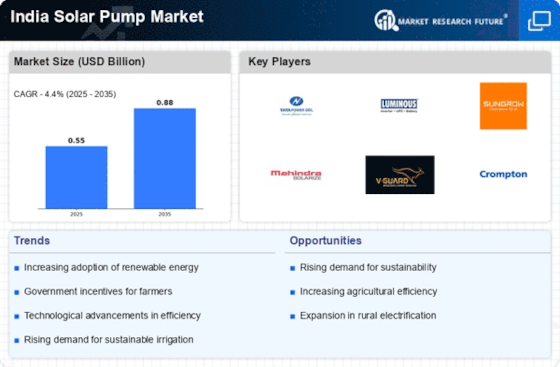
India Solar Pump Market Infographic
Purchase Options

India Solar Pump Size

India Solar Pump Market Growth Projections and Opportunities

The India Solar Pump Market is currently witnessing significant trends that underscore the nation's commitment to sustainable and clean energy solutions. One prominent trend is the increasing adoption of solar pumps for agricultural irrigation. Farmers across India are recognizing the benefits of solar-powered irrigation systems, which offer a reliable and cost-effective alternative to traditional diesel or electric pumps. This trend aligns with the government's initiatives to promote solar energy in agriculture, providing farmers with access to clean and efficient irrigation solutions while reducing dependency on conventional energy sources.

Off-grid solar pumps are gaining traction as a notable trend in the India Solar Pump Market. These systems operate independently of the electricity grid, making them particularly well-suited for remote or rural areas where grid connectivity is limited. Off-grid solar pumps empower communities to harness solar energy for water pumping, addressing water scarcity challenges and promoting sustainable agriculture practices. This trend contributes to decentralized energy solutions and supports the electrification of remote regions.

The rise of innovative financing models is shaping the India Solar Pump Market. Recognizing the capital-intensive nature of solar pump installations, financial mechanisms such as pay-as-you-go models, leasing arrangements, and subsidy programs are becoming prevalent. These financial innovations aim to make solar pumps more accessible to farmers by alleviating the upfront cost burden. Government incentives and subsidies further incentivize the adoption of solar pumps, fostering a conducive environment for market growth.

Smart and connected solar pump solutions are emerging as a technological trend in the India Solar Pump Market. The integration of Internet of Things (IoT) devices, sensors, and data analytics enhances the performance and efficiency of solar pumps. Smart pumps enable remote monitoring, real-time data collection, and predictive maintenance, optimizing the overall system operation. This technological trend aligns with India's broader push towards digitalization and smart solutions in various sectors.

Government initiatives and policy support play a pivotal role in shaping trends within the India Solar Pump Market. The Pradhan Mantri Kisan Urja Suraksha evam Utthaan Mahabhiyan (PM-KUSUM) scheme, launched by the government, aims to promote solar pumps and solarization of agricultural feeders. Such policy measures, along with financial incentives, subsidies, and awareness programs, create an enabling environment for the widespread adoption of solar pumps across the country.

The integration of solar pump systems with energy storage solutions is becoming increasingly relevant in the India Solar Pump Market. Battery storage addresses the intermittent nature of solar power, enabling farmers to store excess energy generated during sunny days for use during periods of low sunlight. This trend enhances the reliability of solar pump systems, ensuring continuous water supply for agricultural activities, even in the absence of direct sunlight.

Entrepreneurial and community-driven solar pump initiatives are gaining prominence in the India Solar Pump Market. Non-governmental organizations (NGOs), local communities, and private enterprises are actively participating in deploying solar pump solutions, particularly in underserved regions. This trend reflects a bottom-up approach to addressing energy and water challenges, empowering communities and fostering sustainable development.

Technological advancements in solar pump design and manufacturing are influencing the market trends. Innovations in pump efficiency, durability, and ease of maintenance contribute to the overall performance of solar pump systems. This trend promotes the development of high-quality and reliable solar pumps, addressing the specific needs of Indian farmers and enhancing the overall competitiveness of the market.

Climate change resilience and water resource management are emerging as critical considerations influencing trends in the India Solar Pump Market. Solar pumps play a vital role in adapting to changing climate conditions by providing farmers with a sustainable and energy-efficient solution for irrigation. This trend aligns with the broader goal of achieving water security and promoting climate-resilient agricultural practices.

The India Solar Pump Market is characterized by dynamic trends that reflect the nation's commitment to leveraging solar energy for sustainable agricultural practices. The adoption of solar pumps for irrigation, the rise of off-grid solutions, innovative financing models, smart and connected technologies, government initiatives, energy storage integration, community-driven initiatives, technological advancements, and a focus on climate resilience collectively define the evolving landscape of the India Solar Pump Market. These trends position solar pumps as a key contributor to India's transition towards clean and decentralized energy solutions in the agricultural sector.
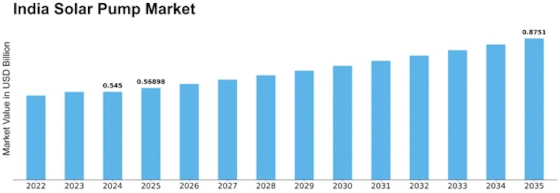
India Solar Pump Market Size Graph
Author
Garvit Vyas
Analyst

Explore the profile of Garvit Vyas, one of our esteemed authors at Market Research Future, and access their expert research contributions in the field of market research and industry analysis

Leave a Comment

FAQs

What is the current valuation of the India solar pump market?

<p>The India solar pump market was valued at 432.0 USD Million in 2024.</p>

What is the projected market size for the India solar pump market by 2035?

<p>The market is expected to reach a valuation of 933.12 USD Million by 2035.</p>

What is the expected CAGR for the India solar pump market during the forecast period?

<p>The expected CAGR for the India solar pump market from 2025 to 2035 is 7.25%.</p>

Which applications dominate the India solar pump market?

<p>The agriculture segment leads the market, with a valuation range from 150.0 to 320.0 USD Million.</p>

What are the key technologies used in the India solar pump market?

<p>Photovoltaic systems dominate, with a valuation range of 216.0 to 486.0 USD Million.</p>

What types of pumps are prevalent in the India solar pump market?

<p>Submersible pumps are significant, with a valuation range of 86.4 to 186.0 USD Million.</p>

Market Summary

As per analysis, the India Solar Pump Market is projected to grow from USD 432.0 Million in 2024 to USD 933.12 Million by 2035, exhibiting a compound annual growth rate (CAGR) of 7.25% during the forecast period (2025 - 2035).

Key Market Trends & Highlights

The India solar pump market is poised for substantial growth driven by technological advancements and government support.

  • The irrigation segment remains the largest contributor to the solar pump market, reflecting a strong demand for efficient water management solutions.
  • Hybrid systems are emerging as the fastest-growing segment, indicating a shift towards versatile energy solutions in agriculture.
  • Sustainability awareness is increasingly influencing consumer choices, leading to a greater adoption of solar pumps across various sectors.
  • Government initiatives and rising energy costs are key drivers propelling the market forward, alongside financial support for solar technology.

Market Size & Forecast

2024 Market Size 432.0 (USD Million)
2035 Market Size 933.12 (USD Million)
CAGR (2025 - 2035) 7.25%

Major Players

<p>Tata Power (IN), Luminous Power Technologies (IN), Sukam Power Systems (IN), Mahindra Solar (IN), Solarify (IN), Karma Energy (IN), Vikram Solar (IN), Adani Green Energy (IN), Rays Power Infra (IN)</p>

Market Trends

The India Solar Pump Market is currently experiencing a notable transformation, driven by a combination of government initiatives and increasing awareness of sustainable agricultural practices. The Indian government has implemented various schemes aimed at promoting solar energy utilization in agriculture, which has led to a rise in the adoption of solar pumps among farmers. This shift not only addresses the challenges of water scarcity but also reduces dependency on conventional energy sources, thereby enhancing the overall efficiency of irrigation systems. Furthermore, the growing emphasis on renewable energy aligns with India's broader goals of reducing carbon emissions and promoting sustainable development. In addition to government support, the market is witnessing a surge in technological advancements. Innovations in solar pump design and efficiency are making these systems more accessible and user-friendly for farmers. The integration of smart technologies, such as remote monitoring and automated controls, is likely to enhance the operational efficiency of solar pumps. As awareness of the benefits of solar energy continues to spread, it appears that the india solar pump market is poised for substantial growth in the coming years, potentially transforming the agricultural landscape across the country.

Government Initiatives

The indian government has launched several programs to promote the adoption of solar pumps in agriculture. These initiatives aim to provide financial assistance and subsidies to farmers, making solar technology more affordable. Such support is likely to encourage widespread usage, particularly in regions facing water scarcity.

Technological Advancements

Recent innovations in solar pump technology are enhancing efficiency and usability. Developments in solar panel efficiency and battery storage solutions are making these systems more reliable. This trend suggests that farmers may increasingly opt for solar pumps as a viable alternative to traditional irrigation methods.

Sustainability Awareness

There is a growing awareness among farmers regarding the environmental benefits of solar energy. As sustainability becomes a priority, more farmers are likely to consider solar pumps as a means to reduce their carbon footprint. This shift in mindset could significantly impact the adoption rates of solar technology in agriculture.

India Solar Pump Market Market Drivers

Rising Energy Costs

The rising costs of conventional energy sources, such as diesel and electricity, are prompting farmers to seek alternative solutions for irrigation. The india solar pump market is positioned to benefit from this trend, as solar pumps provide a cost-effective and sustainable alternative. With the increasing price volatility of fossil fuels, many farmers are turning to solar energy to mitigate their operational costs. Reports indicate that solar pumps can significantly reduce energy expenses, allowing farmers to allocate resources more efficiently. This economic incentive is likely to drive further adoption of solar pumps across various agricultural regions in India.

Government Initiatives

The Indian government has been actively promoting the adoption of solar pumps through various initiatives and schemes. Programs such as the Pradhan Mantri Kisan Urja Suraksha evam Utthaan Mahabhiyan (PM-KUSUM) aim to provide financial assistance to farmers for installing solar pumps. This initiative is expected to enhance the adoption rate of solar pumps in the agriculture sector, which is crucial for irrigation. As of January 2026, the government has allocated substantial funds to support this transition, indicating a strong commitment to the india solar pump market. The increasing number of beneficiaries under these schemes suggests a growing recognition of the benefits of solar energy in rural areas.

Sustainability Awareness

There is a growing awareness of sustainability and environmental conservation among Indian farmers, which is driving the demand for solar pumps. The india solar pump market benefits from this shift in mindset, as farmers increasingly recognize the importance of reducing their carbon footprint and reliance on fossil fuels. Solar pumps offer a clean and renewable energy source for irrigation, aligning with the global push towards sustainable agricultural practices. This trend is further supported by educational campaigns and workshops organized by various NGOs and government bodies, which aim to inform farmers about the long-term benefits of solar energy. Consequently, this heightened awareness is likely to contribute to the growth of the market.

Technological Advancements

The india solar pump market is witnessing rapid technological advancements that enhance the efficiency and affordability of solar pumps. Innovations in photovoltaic technology, such as the development of more efficient solar panels and energy storage systems, are making solar pumps more accessible to farmers. For instance, the introduction of smart solar pumps equipped with IoT technology allows for better monitoring and management of water resources. These advancements not only improve the performance of solar pumps but also reduce operational costs, making them a viable option for irrigation. As a result, the market is likely to expand as more farmers adopt these advanced solutions.

Government Subsidies and Financial Support

The availability of government subsidies and financial support mechanisms is a crucial driver for the india solar pump market. Various state and central government schemes provide financial assistance to farmers for the installation of solar pumps, making them more affordable. For instance, the subsidy rates can cover a significant portion of the installation costs, thereby encouraging farmers to invest in solar technology. As of January 2026, the government continues to enhance these financial support systems, which are instrumental in promoting the adoption of solar pumps. This financial backing not only alleviates the initial investment burden but also fosters a favorable environment for the growth of the solar pump market.

Market Segment Insights

By Application: Irrigation (Largest) vs. Agriculture (Fastest-Growing)

<p>In the India solar pump market, the application segment is characterized by a diverse distribution among various end-use categories. Irrigation remains the largest segment, reflecting the essential role of agriculture in India, particularly in rural areas where solar pumps enhance water accessibility. Agriculture, while significant, is closely followed by drinking water supply and industrial applications, highlighting the growing recognition of solar technology across different sectors.</p>

<p>Irrigation: Dominant vs. Agriculture: Emerging</p>

<p>Irrigation stands out as the dominant application in the solar pump market, driven by India's agricultural dependency. Solar irrigation systems provide a sustainable solution, reducing costs and ensuring water availability in farming regions. In contrast, agriculture is emerging rapidly as a key application, with an increasing number of farmers adopting solar pumps to boost productivity and save on energy expenses. The convergence of government incentives and technological advancements further fuels this growth, as solar pumps become a vital resource in achieving agricultural sustainability and efficiency.</p>

By Technology: Photovoltaic (Largest) vs. Hybrid Systems (Fastest-Growing)

<p>In the India solar pump market, the technology segment is primarily dominated by photovoltaic systems, holding a substantial market share due to their widespread acceptance and efficiency. Solar thermal systems follow closely in terms of adoption, catering to specific agricultural needs. Hybrid systems are gaining traction, offering an integrated approach that combines the benefits of both photovoltaic and solar thermal technology, reflecting a shift towards more versatile and efficient solutions.</p>

<p>Technology: Photovoltaic (Dominant) vs. Off-Grid Systems (Emerging)</p>

<p>Photovoltaic solar pumps have established themselves as the dominant technology in the India solar pump market, favored for their reliability and low maintenance costs. They provide a sustainable solution to irrigation challenges faced by farmers in remote areas. On the other hand, off-grid systems are emerging as a viable alternative, particularly catering to rural regions with limited access to electricity. These systems offer energy independence and efficiency, making them increasingly popular among smallholder farmers. As the market evolves, the integration of advanced technologies in off-grid systems is expected to enhance their appeal, positioning them as key players in the future of agricultural irrigation.</p>

By Pump Type: Submersible Pumps (Largest) vs. Surface Pumps (Fastest-Growing)

<p>In the Indian solar pump market, submersible pumps hold the largest share, reflecting their established reputation for efficiency in groundwater extraction. Surface pumps, while smaller in share compared to submersible pumps, are rapidly gaining traction due to their ease of installation and maintenance. This shift indicates a diversifying preference among consumers seeking adaptable solutions based on specific agricultural and domestic needs. The growth trends reveal that surface pumps are the fastest-growing segment, propelled by increasing awareness of solar pump technology among farmers and rural communities. Factors such as government support and declining solar technology costs enable wider adoption. Additionally, evolving irrigation practices and the need for efficient water management systems further drive the demand for these pumps, highlighting the sector's dynamic nature.</p>

<p>Submersible Pumps (Dominant) vs. Surface Pumps (Emerging)</p>

<p>Submersible pumps are increasingly recognized as the dominant choice in the Indian solar pump market due to their efficiency in deep-water extraction and energy conservation benefits. These pumps are specially designed to operate underwater, allowing for optimal performance in various agricultural scenarios, especially where groundwater is the primary source. In contrast, surface pumps are emerging as a flexible and practical option for farmers with limited access to deep boreholes. Their ease of installation and capability to draw water from shallow sources make them appealing in regions with varying topographies. This diversified market reflects the needs of different agricultural practices, where submersible pumps remain a preference for established irrigation, and surface pumps cater to new users transitioning to solar technology.</p>

By Power Rating: One to Five Horsepower (Largest) vs. Below One Horsepower (Fastest-Growing)

<p>In the India solar pump market, the power rating segment is pivotal, with the One to Five Horsepower category claiming the largest share, driven by its versatility in various agricultural applications. Meanwhile, the Below One Horsepower segment is emerging as the fastest-growing, appealing to small-scale farmers and enterprises seeking cost-effective solutions. This distribution reflects the diverse needs of the Indian market, where efficiency and affordability are paramount for adoption. The growth trends in this segment indicate a strong demand shift towards Solar Pumps below one horsepower, primarily attributed to rising energy costs, increased awareness of sustainable farming practices, and government incentives promoting renewable energy sources. The One to Five Horsepower range remains integral due to its compatibility with medium-scale irrigation systems, sustaining its dominance while fostering innovation to meet evolving consumer needs.</p>

<p>One to Five Horsepower (Dominant) vs. Below One Horsepower (Emerging)</p>

<p>The One to Five Horsepower segment stands as the dominant force in the India solar pump market, largely catering to medium-sized agricultural operations that require reliable and efficient irrigation solutions. This category is recognized for its robust performance and capability to handle diverse water lifting needs, thus making it a preferred choice among farmers. On the other hand, the Below One Horsepower segment is rapidly gaining traction as an emerging alternative for smaller farmers and garden owners, emphasizing affordability and energy efficiency. This segment's appeal lies in its compact design and lower initial investment, making solar automation accessible for a broader audience. Both segments reflect the rapid evolution of the market towards tailored solutions that fit various operational scales.</p>

By End User: Farmers (Largest) vs. Government Institutions (Fastest-Growing)

<p>In the India solar pump market, the end-user segment is dominated by farmers, who play a crucial role in adopting solar technology for irrigation and agricultural purposes. This segment holds a significant share of the market, driven by the increasing need for sustainable and cost-effective solutions for water sourcing in agriculture. Government institutions also represent a considerable portion of the market, aimed at promoting solar pumps for rural development and sustainable agriculture.</p>

<p>Farmers (Dominant) vs. Government Institutions (Emerging)</p>

<p>Farmers are the dominant end users in the India solar pump market, benefiting from reduced electricity costs and reliable water supply for their crops. Their adoption is significantly driven by government incentives and the urgent need to combat water scarcity in agriculture. On the other hand, government institutions are emerging as valuable players, implementing programs and subsidies to encourage the use of solar pumps and enhance rural irrigation systems. This dual focus not only addresses the immediate needs of farmers but also supports overall agricultural sustainability.</p>

Get more detailed insights about India Solar Pump Market Research Report – Forecast till 2035

Regional Insights

North America : Innovation and Sustainability Focus

The North American solar pump market is driven by increasing demand for sustainable agricultural practices and government incentives promoting renewable energy. The U.S. holds the largest market share at approximately 60%, followed by Canada at 25%. Regulatory support, such as tax credits and grants, is catalyzing growth, making solar pumps an attractive option for farmers seeking cost-effective irrigation solutions. Leading countries in this region include the United States and Canada, with a competitive landscape featuring key players like SunPower and First Solar. The presence of established companies and innovative startups is fostering a dynamic market environment. As awareness of solar technology benefits grows, the adoption of solar pumps is expected to accelerate, enhancing agricultural productivity and sustainability.

Europe : Regulatory Support and Growth

The European solar pump market is characterized by strong regulatory frameworks and a commitment to renewable energy. Germany and France are the largest markets, holding approximately 35% and 30% market shares, respectively. The European Union's Green Deal and various national policies are driving demand for solar pumps, as they align with sustainability goals and reduce reliance on fossil fuels. Key players in this region include companies like Grundfos and KSB, which are leading the charge in innovative solar pump technologies. The competitive landscape is marked by a mix of established firms and emerging startups, all focused on enhancing efficiency and reducing costs. As the market matures, collaboration between public and private sectors is expected to further boost growth and adoption of solar pumps across Europe.

Asia-Pacific : Rapid Growth and Adoption

The Asia-Pacific region is witnessing rapid growth in the solar pump market, driven by increasing agricultural demands and government initiatives promoting renewable energy. India is the largest market, accounting for approximately 70% of the regional share, followed by China at 20%. The Indian government's subsidy schemes and initiatives like the Pradhan Mantri Kisan Urja Suraksha evam Utthaan Mahabhiyan are significant catalysts for market expansion. In this region, India and China are the leading countries, with major players such as Tata Power and Mahindra Solar dominating the landscape. The competitive environment is characterized by a mix of local and international companies, all striving to innovate and provide cost-effective solutions. As awareness of solar technology benefits grows, the adoption of solar pumps is expected to increase significantly, enhancing agricultural productivity and sustainability.

Middle East and Africa : Emerging Market Potential

The Middle East and Africa region is emerging as a potential market for solar pumps, driven by the need for sustainable irrigation solutions in arid climates. Countries like South Africa and Kenya are leading the market, holding approximately 40% and 30% shares, respectively. Government initiatives aimed at promoting renewable energy and improving agricultural efficiency are key drivers of growth in this sector. In this region, South Africa and Kenya are at the forefront, with key players such as Solarify and Jain Irrigation Systems Ltd. actively participating in the market. The competitive landscape is evolving, with both local and international companies seeking to capitalize on the growing demand for solar pumps. As investment in renewable energy increases, the adoption of solar pumps is expected to rise, contributing to improved agricultural practices and water management.

Key Players and Competitive Insights

The solar pump market in India is currently characterized by a dynamic competitive landscape, driven by increasing demand for sustainable agricultural practices and government initiatives promoting renewable energy. Key players such as Tata Power (IN), Adani Green Energy (IN), and Vikram Solar (IN) are strategically positioning themselves through innovation and regional expansion. Tata Power (IN) focuses on enhancing its product offerings by integrating advanced technology into its solar pumps, while Adani Green Energy (IN) emphasizes large-scale project development to capture market share. Vikram Solar (IN) is also investing in research and development to improve efficiency and reduce costs, collectively shaping a competitive environment that prioritizes technological advancement and sustainability.

In terms of business tactics, companies are increasingly localizing manufacturing to reduce costs and optimize supply chains. The market appears moderately fragmented, with several players vying for dominance. This fragmentation allows for diverse strategies, as companies leverage their unique strengths to carve out niches. The collective influence of these key players fosters a competitive structure that encourages innovation and responsiveness to market demands.

In December 2025, Tata Power (IN) announced a partnership with local agricultural cooperatives to provide solar pumps at subsidized rates, aiming to enhance accessibility for farmers. This strategic move not only strengthens Tata Power's market presence but also aligns with government initiatives to promote renewable energy in rural areas. By collaborating with cooperatives, Tata Power (IN) is likely to enhance its brand loyalty and customer base.

In November 2025, Adani Green Energy (IN) launched a new line of solar pumps designed specifically for smallholder farmers, incorporating smart technology for better water management. This initiative reflects a growing trend towards precision agriculture, where technology plays a crucial role in optimizing resource use. The introduction of these pumps could potentially position Adani Green Energy (IN) as a leader in the niche market of smart agricultural solutions.

In October 2025, Vikram Solar (IN) expanded its manufacturing capabilities by investing $10 million in a new facility dedicated to solar pump production. This expansion is indicative of the company's commitment to meeting rising demand and enhancing production efficiency. By increasing its manufacturing capacity, Vikram Solar (IN) is likely to improve its competitive edge and respond more effectively to market fluctuations.

As of January 2026, the competitive trends in the solar pump market are increasingly defined by digitalization, sustainability, and the integration of AI technologies. Strategic alliances among companies are shaping the landscape, fostering innovation and collaboration. The shift from price-based competition to a focus on technological differentiation and supply chain reliability is becoming evident. Companies that prioritize innovation and sustainable practices are likely to thrive in this evolving market, suggesting a future where competitive advantage hinges on the ability to adapt and innovate.

Key Companies in the India Solar Pump Market include

Industry Developments

In 2022:Solar pumps are becoming pivotal for the Indian government to fulfill its mission of increasing farmers' incomes. Rajasthan is one of the few states that has taken the initiative to popularize solar pumps on a large scale in rural areas, and the budget announcement is likely to provide further impetus.

Future Outlook

India Solar Pump Market Future Outlook

The India solar pump market is projected to grow at a 7.25% CAGR from 2025 to 2035, driven by increasing agricultural demand, government incentives, and technological advancements.

New opportunities lie in:

  • Development of integrated solar irrigation systems for enhanced efficiency.
  • Expansion into rural electrification projects to boost market penetration.
  • Partnerships with agricultural cooperatives for bulk procurement and distribution.

By 2035, the market is expected to solidify its position as a leader in sustainable agricultural solutions.

Market Segmentation

India Solar Pump Market End User Outlook

  • Farmers
  • Government Institutions
  • Private Enterprises
  • Non-Governmental Organizations

India Solar Pump Market Pump Type Outlook

  • Submersible Pumps
  • Surface Pumps
  • Centrifugal Pumps
  • Positive Displacement Pumps
  • Diaphragm Pumps

India Solar Pump Market Technology Outlook

  • Photovoltaic
  • Solar Thermal
  • Hybrid Systems
  • Off-Grid Systems
  • Grid-Tied Systems

India Solar Pump Market Application Outlook

  • Agriculture
  • Drinking Water Supply
  • Industrial
  • Irrigation
  • Livestock

India Solar Pump Market Power Rating Outlook

  • Below One Horsepower
  • One to Five Horsepower
  • Five to Ten Horsepower
  • Above Ten Horsepower

Report Scope

MARKET SIZE 2024432.0(USD Million)
MARKET SIZE 2025466.56(USD Million)
MARKET SIZE 2035933.12(USD Million)
COMPOUND ANNUAL GROWTH RATE (CAGR)7.25% (2024 - 2035)
REPORT COVERAGERevenue Forecast, Competitive Landscape, Growth Factors, and Trends
BASE YEAR2024
Market Forecast Period2025 - 2035
Historical Data2019 - 2024
Market Forecast UnitsUSD Million
Key Companies ProfiledTata Power (IN), Luminous Power Technologies (IN), Sukam Power Systems (IN), Mahindra Solar (IN), Solarify (IN), Karma Energy (IN), Vikram Solar (IN), Adani Green Energy (IN), Rays Power Infra (IN)
Segments CoveredApplication, Technology, Pump Type, Power Rating, End User
Key Market OpportunitiesGrowing demand for sustainable irrigation solutions drives innovation in the india solar pump market.
Key Market DynamicsRising demand for sustainable irrigation solutions drives innovation and competition in India's solar pump market.
Countries CoveredIndia

FAQs

What is the current valuation of the India solar pump market?

<p>The India solar pump market was valued at 432.0 USD Million in 2024.</p>

What is the projected market size for the India solar pump market by 2035?

<p>The market is expected to reach a valuation of 933.12 USD Million by 2035.</p>

What is the expected CAGR for the India solar pump market during the forecast period?

<p>The expected CAGR for the India solar pump market from 2025 to 2035 is 7.25%.</p>

Which applications dominate the India solar pump market?

<p>The agriculture segment leads the market, with a valuation range from 150.0 to 320.0 USD Million.</p>

What are the key technologies used in the India solar pump market?

<p>Photovoltaic systems dominate, with a valuation range of 216.0 to 486.0 USD Million.</p>

What types of pumps are prevalent in the India solar pump market?

<p>Submersible pumps are significant, with a valuation range of 86.4 to 186.0 USD Million.</p>

  1. SECTION I: EXECUTIVE SUMMARY AND KEY HIGHLIGHTS
    1. EXECUTIVE SUMMARY
      1. Market Overview
      2. Key Findings
      3. Market Segmentation
      4. Competitive Landscape
      5. Challenges and Opportunities
      6. Future Outlook 2
  2. SECTION II: SCOPING, METHODOLOGY AND MARKET STRUCTURE
    1. MARKET INTRODUCTION
      1. Definition
      2. Scope of the study
    2. RESEARCH METHODOLOGY
      1. Overview
      2. Data Mining
      3. Secondary Research
      4. Primary Research
      5. Forecasting Model
      6. Market Size Estimation
      7. Data Triangulation
      8. Validation 3
  3. SECTION III: QUALITATIVE ANALYSIS
    1. MARKET DYNAMICS
      1. Overview
      2. Drivers
      3. Restraints
      4. Opportunities
    2. MARKET FACTOR ANALYSIS
      1. Value chain Analysis
      2. Porter's Five Forces Analysis
      3. COVID-19 Impact Analysis
  4. SECTION IV: QUANTITATIVE ANALYSIS
    1. Energy & Power, BY Product (USD Billion)
      1. Surface Suction
      2. Submersible
      3. Floating
    2. Energy & Power, BY End-users (USD Billion)
      1. Agriculture
      2. Water Management
      3. Others
    3. Energy & Power, BY Operation (USD Billion)
      1. AC Pump
      2. DC Pump
    4. Energy & Power, BY Region (USD Billion)
      1. North America
      2. Europe
      3. APAC
      4. South America
      5. MEA
  5. SECTION V: COMPETITIVE ANALYSIS
    1. Competitive Landscape
      1. Overview
      2. Competitive Analysis
      3. Market share Analysis
      4. Major Growth Strategy in the Energy & Power
      5. Competitive Benchmarking
      6. Leading Players in Terms of Number of Developments in the Energy & Power
      7. Key developments and growth strategies
      8. Major Players Financial Matrix
    2. Company Profiles
      1. Tata Power (IN)
      2. Luminous Power Technologies (IN)
      3. Sungrow Power Supply Co. Ltd. (CN)
      4. Mahindra Solar (IN)
      5. V-Guard Industries Ltd. (IN)
      6. Crompton Greaves Consumer Electricals Ltd. (IN)
      7. Solarify (IN)
      8. Jain Irrigation Systems Ltd. (IN)
      9. KSB Limited (IN)
    3. Appendix
      1. References
      2. Related Reports 6 LIST OF FIGURES
    4. MARKET SYNOPSIS
    5. NORTH AMERICA MARKET ANALYSIS
    6. US MARKET ANALYSIS BY PRODUCT
    7. US MARKET ANALYSIS BY END-USERS
    8. US MARKET ANALYSIS BY OPERATION
    9. CANADA MARKET ANALYSIS BY PRODUCT
    10. CANADA MARKET ANALYSIS BY END-USERS
    11. CANADA MARKET ANALYSIS BY OPERATION
    12. EUROPE MARKET ANALYSIS
    13. GERMANY MARKET ANALYSIS BY PRODUCT
    14. GERMANY MARKET ANALYSIS BY END-USERS
    15. GERMANY MARKET ANALYSIS BY OPERATION
    16. UK MARKET ANALYSIS BY PRODUCT
    17. UK MARKET ANALYSIS BY END-USERS
    18. UK MARKET ANALYSIS BY OPERATION
    19. FRANCE MARKET ANALYSIS BY PRODUCT
    20. FRANCE MARKET ANALYSIS BY END-USERS
    21. FRANCE MARKET ANALYSIS BY OPERATION
    22. RUSSIA MARKET ANALYSIS BY PRODUCT
    23. RUSSIA MARKET ANALYSIS BY END-USERS
    24. RUSSIA MARKET ANALYSIS BY OPERATION
    25. ITALY MARKET ANALYSIS BY PRODUCT
    26. ITALY MARKET ANALYSIS BY END-USERS
    27. ITALY MARKET ANALYSIS BY OPERATION
    28. SPAIN MARKET ANALYSIS BY PRODUCT
    29. SPAIN MARKET ANALYSIS BY END-USERS
    30. SPAIN MARKET ANALYSIS BY OPERATION
    31. REST OF EUROPE MARKET ANALYSIS BY PRODUCT
    32. REST OF EUROPE MARKET ANALYSIS BY END-USERS
    33. REST OF EUROPE MARKET ANALYSIS BY OPERATION
    34. APAC MARKET ANALYSIS
    35. CHINA MARKET ANALYSIS BY PRODUCT
    36. CHINA MARKET ANALYSIS BY END-USERS
    37. CHINA MARKET ANALYSIS BY OPERATION
    38. INDIA MARKET ANALYSIS BY PRODUCT
    39. INDIA MARKET ANALYSIS BY END-USERS
    40. INDIA MARKET ANALYSIS BY OPERATION
    41. JAPAN MARKET ANALYSIS BY PRODUCT
    42. JAPAN MARKET ANALYSIS BY END-USERS
    43. JAPAN MARKET ANALYSIS BY OPERATION
    44. SOUTH KOREA MARKET ANALYSIS BY PRODUCT
    45. SOUTH KOREA MARKET ANALYSIS BY END-USERS
    46. SOUTH KOREA MARKET ANALYSIS BY OPERATION
    47. MALAYSIA MARKET ANALYSIS BY PRODUCT
    48. MALAYSIA MARKET ANALYSIS BY END-USERS
    49. MALAYSIA MARKET ANALYSIS BY OPERATION
    50. THAILAND MARKET ANALYSIS BY PRODUCT
    51. THAILAND MARKET ANALYSIS BY END-USERS
    52. THAILAND MARKET ANALYSIS BY OPERATION
    53. INDONESIA MARKET ANALYSIS BY PRODUCT
    54. INDONESIA MARKET ANALYSIS BY END-USERS
    55. INDONESIA MARKET ANALYSIS BY OPERATION
    56. REST OF APAC MARKET ANALYSIS BY PRODUCT
    57. REST OF APAC MARKET ANALYSIS BY END-USERS
    58. REST OF APAC MARKET ANALYSIS BY OPERATION
    59. SOUTH AMERICA MARKET ANALYSIS
    60. BRAZIL MARKET ANALYSIS BY PRODUCT
    61. BRAZIL MARKET ANALYSIS BY END-USERS
    62. BRAZIL MARKET ANALYSIS BY OPERATION
    63. MEXICO MARKET ANALYSIS BY PRODUCT
    64. MEXICO MARKET ANALYSIS BY END-USERS
    65. MEXICO MARKET ANALYSIS BY OPERATION
    66. ARGENTINA MARKET ANALYSIS BY PRODUCT
    67. ARGENTINA MARKET ANALYSIS BY END-USERS
    68. ARGENTINA MARKET ANALYSIS BY OPERATION
    69. REST OF SOUTH AMERICA MARKET ANALYSIS BY PRODUCT
    70. REST OF SOUTH AMERICA MARKET ANALYSIS BY END-USERS
    71. REST OF SOUTH AMERICA MARKET ANALYSIS BY OPERATION
    72. MEA MARKET ANALYSIS
    73. GCC COUNTRIES MARKET ANALYSIS BY PRODUCT
    74. GCC COUNTRIES MARKET ANALYSIS BY END-USERS
    75. GCC COUNTRIES MARKET ANALYSIS BY OPERATION
    76. SOUTH AFRICA MARKET ANALYSIS BY PRODUCT
    77. SOUTH AFRICA MARKET ANALYSIS BY END-USERS
    78. SOUTH AFRICA MARKET ANALYSIS BY OPERATION
    79. REST OF MEA MARKET ANALYSIS BY PRODUCT
    80. REST OF MEA MARKET ANALYSIS BY END-USERS
    81. REST OF MEA MARKET ANALYSIS BY OPERATION
    82. KEY BUYING CRITERIA OF ENERGY & POWER
    83. RESEARCH PROCESS OF MRFR
    84. DRO ANALYSIS OF ENERGY & POWER
    85. DRIVERS IMPACT ANALYSIS: ENERGY & POWER
    86. RESTRAINTS IMPACT ANALYSIS: ENERGY & POWER
    87. SUPPLY / VALUE CHAIN: ENERGY & POWER
    88. ENERGY & POWER, BY PRODUCT, 2024 (% SHARE)
    89. ENERGY & POWER, BY PRODUCT, 2024 TO 2035 (USD Billion)
    90. ENERGY & POWER, BY END-USERS, 2024 (% SHARE)
    91. ENERGY & POWER, BY END-USERS, 2024 TO 2035 (USD Billion)
    92. ENERGY & POWER, BY OPERATION, 2024 (% SHARE)
    93. ENERGY & POWER, BY OPERATION, 2024 TO 2035 (USD Billion)
    94. BENCHMARKING OF MAJOR COMPETITORS 7 LIST OF TABLES
    95. LIST OF ASSUMPTIONS
    96. North America MARKET SIZE ESTIMATES; FORECAST
      1. BY PRODUCT, 2025-2035 (USD Billion)
      2. BY END-USERS, 2025-2035 (USD Billion)
      3. BY OPERATION, 2025-2035 (USD Billion)
    97. US MARKET SIZE ESTIMATES; FORECAST
      1. BY PRODUCT, 2025-2035 (USD Billion)
      2. BY END-USERS, 2025-2035 (USD Billion)
      3. BY OPERATION, 2025-2035 (USD Billion)
    98. Canada MARKET SIZE ESTIMATES; FORECAST
      1. BY PRODUCT, 2025-2035 (USD Billion)
      2. BY END-USERS, 2025-2035 (USD Billion)
      3. BY OPERATION, 2025-2035 (USD Billion)
    99. Europe MARKET SIZE ESTIMATES; FORECAST
      1. BY PRODUCT, 2025-2035 (USD Billion)
      2. BY END-USERS, 2025-2035 (USD Billion)
      3. BY OPERATION, 2025-2035 (USD Billion)
    100. Germany MARKET SIZE ESTIMATES; FORECAST
      1. BY PRODUCT, 2025-2035 (USD Billion)
      2. BY END-USERS, 2025-2035 (USD Billion)
      3. BY OPERATION, 2025-2035 (USD Billion)
    101. UK MARKET SIZE ESTIMATES; FORECAST
      1. BY PRODUCT, 2025-2035 (USD Billion)
      2. BY END-USERS, 2025-2035 (USD Billion)
      3. BY OPERATION, 2025-2035 (USD Billion)
    102. France MARKET SIZE ESTIMATES; FORECAST
      1. BY PRODUCT, 2025-2035 (USD Billion)
      2. BY END-USERS, 2025-2035 (USD Billion)
      3. BY OPERATION, 2025-2035 (USD Billion)
    103. Russia MARKET SIZE ESTIMATES; FORECAST
      1. BY PRODUCT, 2025-2035 (USD Billion)
      2. BY END-USERS, 2025-2035 (USD Billion)
      3. BY OPERATION, 2025-2035 (USD Billion)
    104. Italy MARKET SIZE ESTIMATES; FORECAST
      1. BY PRODUCT, 2025-2035 (USD Billion)
      2. BY END-USERS, 2025-2035 (USD Billion)
      3. BY OPERATION, 2025-2035 (USD Billion)
    105. Spain MARKET SIZE ESTIMATES; FORECAST
      1. BY PRODUCT, 2025-2035 (USD Billion)
      2. BY END-USERS, 2025-2035 (USD Billion)
      3. BY OPERATION, 2025-2035 (USD Billion)
    106. Rest of Europe MARKET SIZE ESTIMATES; FORECAST
      1. BY PRODUCT, 2025-2035 (USD Billion)
      2. BY END-USERS, 2025-2035 (USD Billion)
      3. BY OPERATION, 2025-2035 (USD Billion)
    107. APAC MARKET SIZE ESTIMATES; FORECAST
      1. BY PRODUCT, 2025-2035 (USD Billion)
      2. BY END-USERS, 2025-2035 (USD Billion)
      3. BY OPERATION, 2025-2035 (USD Billion)
    108. China MARKET SIZE ESTIMATES; FORECAST
      1. BY PRODUCT, 2025-2035 (USD Billion)
      2. BY END-USERS, 2025-2035 (USD Billion)
      3. BY OPERATION, 2025-2035 (USD Billion)
    109. India MARKET SIZE ESTIMATES; FORECAST
      1. BY PRODUCT, 2025-2035 (USD Billion)
      2. BY END-USERS, 2025-2035 (USD Billion)
      3. BY OPERATION, 2025-2035 (USD Billion)
    110. Japan MARKET SIZE ESTIMATES; FORECAST
      1. BY PRODUCT, 2025-2035 (USD Billion)
      2. BY END-USERS, 2025-2035 (USD Billion)
      3. BY OPERATION, 2025-2035 (USD Billion)
    111. South Korea MARKET SIZE ESTIMATES; FORECAST
      1. BY PRODUCT, 2025-2035 (USD Billion)
      2. BY END-USERS, 2025-2035 (USD Billion)
      3. BY OPERATION, 2025-2035 (USD Billion)
    112. Malaysia MARKET SIZE ESTIMATES; FORECAST
      1. BY PRODUCT, 2025-2035 (USD Billion)
      2. BY END-USERS, 2025-2035 (USD Billion)
      3. BY OPERATION, 2025-2035 (USD Billion)
    113. Thailand MARKET SIZE ESTIMATES; FORECAST
      1. BY PRODUCT, 2025-2035 (USD Billion)
      2. BY END-USERS, 2025-2035 (USD Billion)
      3. BY OPERATION, 2025-2035 (USD Billion)
    114. Indonesia MARKET SIZE ESTIMATES; FORECAST
      1. BY PRODUCT, 2025-2035 (USD Billion)
      2. BY END-USERS, 2025-2035 (USD Billion)
      3. BY OPERATION, 2025-2035 (USD Billion)
    115. Rest of APAC MARKET SIZE ESTIMATES; FORECAST
      1. BY PRODUCT, 2025-2035 (USD Billion)
      2. BY END-USERS, 2025-2035 (USD Billion)
      3. BY OPERATION, 2025-2035 (USD Billion)
    116. South America MARKET SIZE ESTIMATES; FORECAST
      1. BY PRODUCT, 2025-2035 (USD Billion)
      2. BY END-USERS, 2025-2035 (USD Billion)
      3. BY OPERATION, 2025-2035 (USD Billion)
    117. Brazil MARKET SIZE ESTIMATES; FORECAST
      1. BY PRODUCT, 2025-2035 (USD Billion)
      2. BY END-USERS, 2025-2035 (USD Billion)
      3. BY OPERATION, 2025-2035 (USD Billion)
    118. Mexico MARKET SIZE ESTIMATES; FORECAST
      1. BY PRODUCT, 2025-2035 (USD Billion)
      2. BY END-USERS, 2025-2035 (USD Billion)
      3. BY OPERATION, 2025-2035 (USD Billion)
    119. Argentina MARKET SIZE ESTIMATES; FORECAST
      1. BY PRODUCT, 2025-2035 (USD Billion)
      2. BY END-USERS, 2025-2035 (USD Billion)
      3. BY OPERATION, 2025-2035 (USD Billion)
    120. Rest of South America MARKET SIZE ESTIMATES; FORECAST
      1. BY PRODUCT, 2025-2035 (USD Billion)
      2. BY END-USERS, 2025-2035 (USD Billion)
      3. BY OPERATION, 2025-2035 (USD Billion)
    121. MEA MARKET SIZE ESTIMATES; FORECAST
      1. BY PRODUCT, 2025-2035 (USD Billion)
      2. BY END-USERS, 2025-2035 (USD Billion)
      3. BY OPERATION, 2025-2035 (USD Billion)
    122. GCC Countries MARKET SIZE ESTIMATES; FORECAST
      1. BY PRODUCT, 2025-2035 (USD Billion)
      2. BY END-USERS, 2025-2035 (USD Billion)
      3. BY OPERATION, 2025-2035 (USD Billion)
    123. South Africa MARKET SIZE ESTIMATES; FORECAST
      1. BY PRODUCT, 2025-2035 (USD Billion)
      2. BY END-USERS, 2025-2035 (USD Billion)
      3. BY OPERATION, 2025-2035 (USD Billion)
    124. Rest of MEA MARKET SIZE ESTIMATES; FORECAST
      1. BY PRODUCT, 2025-2035 (USD Billion)
      2. BY END-USERS, 2025-2035 (USD Billion)
      3. BY OPERATION, 2025-2035 (USD Billion)
    125. PRODUCT LAUNCH/PRODUCT DEVELOPMENT/APPROVAL
    126. ACQUISITION/PARTNERSHIP

India Solar Pump Market Segmentation

Market Segmentation Overview

  • Detailed segmentation data will be available in the full report
  • Comprehensive analysis by multiple parameters
  • Regional and country-level breakdowns
  • Market size forecasts by segment
Infographic

Free Sample Request

Kindly complete the form below to receive a free sample of this Report

Get Free Sample

Customer Strories

Compare Licence

×
Features License Type
Single User Multiuser License Enterprise User
Price $4,950 $5,950 $7,250
Maximum User Access Limit 1 User Upto 10 Users Unrestricted Access Throughout the Organization
Free Customization
Direct Access to Analyst
Deliverable Format
Platform Access
Discount on Next Purchase 10% 15% 15%
Printable Versions