Request Free Sample ×

Kindly complete the form below to receive a free sample of this Report

* Please use a valid business email

Leading companies partner with us for data-driven Insights

clients tt-cursor
Hero Background
English
Chinese
French
Japanese
Korean
German
Spanish

India Electric Vehicle Market Trends

ID: MRFR/AT/11147-HCR
128 Pages
Triveni Bhoyar
April 2026

India Electric Vehicle Market Size, Share & Growth Analysis Report By Platform (Two Wheeler, Three Wheeler, and Four Wheeler), By Vehicle Type (Passenger Cars and Commercial Vehicles), By Propulsion Type (Battery Electric Vehicle (BEV) and Hybrid Electric Vehicle (HEV) - Industry Outlook & Forecast to 2035

Share:
Download PDF ×

We do not share your information with anyone. However, we may send you emails based on your report interest from time to time. You may contact us at any time to opt-out.

India Electric Vehicle Market Infographic
Purchase Options

Market Trends

Key Emerging Trends in the India Electric Vehicle Market

The market trends for electric vehicles (EVs) in India have been experiencing a notable surge in recent years, propelled by a combination of factors that reflect a growing interest in sustainable and eco-friendly transportation solutions. One of the primary driving forces behind this trend is the Indian government's strong push towards electric mobility. To curb air pollution and reduce dependence on fossil fuels, various incentives, subsidies, and policy initiatives have been introduced to encourage the adoption of electric vehicles across the country.

In response to these government initiatives, there has been a significant uptick in the production and sales of electric vehicles in India. Automakers, both domestic and international, are increasingly investing in the development of electric models to cater to the evolving preferences of the Indian consumer. This has led to a diversification of the electric vehicle market, with a range of options available from compact electric cars to electric two-wheelers, and even electric three-wheelers gaining popularity in urban areas.

The affordability factor has played a crucial role in driving the market trends for electric vehicles in India. With the implementation of various subsidies and incentives, the upfront cost of electric vehicles has become more competitive, making them an attractive option for a broader segment of the population. Additionally, the lower operating and maintenance costs of electric vehicles make them financially appealing over the long term, further contributing to their growing popularity.

Infrastructure development is another key aspect influencing the market trends for electric vehicles in India. Recognizing the importance of a robust charging infrastructure, efforts are underway to establish charging stations across the country. Public and private collaborations are driving this initiative, and with the increasing availability of charging points, the concerns regarding "range anxiety" are gradually diminishing, making electric vehicles a more viable choice for Indian consumers.

The rise of electric two-wheelers is a significant trend within the Indian electric vehicle market. Given the prevalence of two-wheelers as a primary mode of transportation in the country, the shift towards electric scooters and motorcycles is gaining momentum. Several domestic manufacturers and startups are focusing on developing affordable and practical electric two-wheelers, targeting a vast consumer base in both urban and rural areas.

Government fleets and public transport systems are also actively transitioning to electric vehicles in India. Municipalities and government agencies are incorporating electric buses into their fleets, aiming to reduce carbon emissions and promote sustainable urban mobility. This shift is not only contributing to a cleaner environment but is also serving as a catalyst for private operators to explore electric alternatives for their commercial fleets.

Challenges such as limited awareness and concerns about charging infrastructure persist, but the market trends indicate a positive trajectory for electric vehicles in India. The increasing awareness of environmental issues, coupled with a proactive approach from the government and industry players, has set the stage for the widespread adoption of electric vehicles across the country.

The market trends for electric vehicles in India depict a landscape of growth and transformation. The confluence of government support, affordability, infrastructure development, and a diverse range of electric vehicle offerings has created a conducive environment for the electric mobility sector to thrive. As the industry continues to evolve and address existing challenges, electric vehicles are poised to play a pivotal role in shaping the future of transportation in India, contributing to a more sustainable and greener mobility ecosystem.


Author
Author Profile
Triveni Bhoyar
Senior Research Analyst

Triveni Bhoyar has over 5 years of experience in the market research industry, specializing in the Automotive and Aerospace & Defense sectors. She has contributed to 200+ reports, including numerous custom projects for leading global companies, delivering solutions to complex business challenges. Renowned for her ability to generate valuable insights, Triveni excels in addressing unique market dynamics with precision and depth. Her expertise spans market sizing, competitive intelligence, and trend analysis, enabling clients to craft data-driven growth strategies. With strong analytical rigor and a client-centric approach, she plays a pivotal role in driving impactful, strategic decision-making.

Leave a Comment

FAQs

What is the current valuation of the India Electric Vehicle Market?

<p>The India Electric Vehicle Market was valued at 11.11 USD Billion in 2024.</p>

What is the projected market valuation for the India Electric Vehicle Market by 2035?

<p>The market is projected to reach 2065.27 USD Billion by 2035.</p>

What is the expected CAGR for the India Electric Vehicle Market during the forecast period 2025 - 2035?

<p>The expected CAGR for the market during this period is 60.8%.</p>

Which companies are the key players in the India Electric Vehicle Market?

<p>Key players include Tata Motors, Mahindra Electric Mobility, Hero Electric, Ather Energy, Ola Electric, BYD India, MG Motor India, Nissan India, and Renault India.</p>

What are the main segments of the India Electric Vehicle Market?

<p>The main segments include Two Wheelers, Three Wheelers, Four Wheelers, Passenger Cars, Commercial Vehicles, Battery Electric Vehicles, and Hybrid Electric Vehicles.</p>

What was the valuation of the Two Wheeler segment in 2024?

<p>The Two Wheeler segment was valued at 3.33 USD Billion in 2024.</p>

How much is the Four Wheeler segment projected to be worth by 2035?

<p>The Four Wheeler segment is projected to be valued at 1065.27 USD Billion by 2035.</p>

What is the valuation of the Battery Electric Vehicle segment in 2024?

<p>The Battery Electric Vehicle segment was valued at 6.67 USD Billion in 2024.</p>

What is the projected valuation for the Commercial Vehicles segment by 2035?

<p>The Commercial Vehicles segment is projected to reach 826.11 USD Billion by 2035.</p>

How does the India Electric Vehicle Market compare to other segments in terms of growth?

<p>The India Electric Vehicle Market appears to be experiencing rapid growth, particularly in the Battery Electric Vehicle segment, which indicates strong future potential.</p>

Market Summary

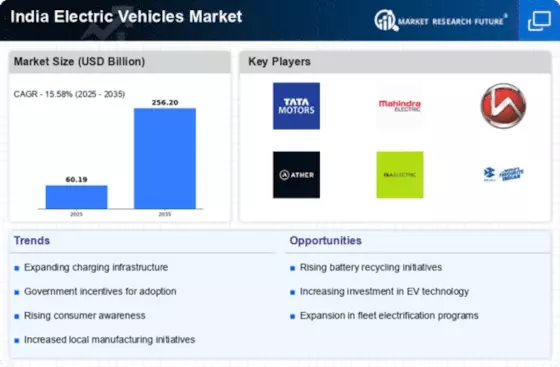
As per analysis, the India Electric Vehicles Market is projected to grow from USD 61.08 Billion in 2025 to USD 256.2 Billion by 2035, exhibiting a compound annual growth rate (CAGR) of 15.58% during the forecast period (2025 - 2035).

Key Market Trends & Highlights

The India Electric Vehicles Market is poised for substantial growth driven by technological advancements and supportive government policies.

  • Battery Electric Vehicles represent the largest segment in the market, indicating a strong consumer preference for fully electric options. Plug-in Hybrid Electric Vehicles are the fastest-growing segment, reflecting a shift towards versatile and eco-friendly transportation solutions. Public Charging Stations dominate the infrastructure landscape, ensuring accessibility for electric vehicle users across urban areas. Government initiatives and rising fuel prices are key drivers propelling the adoption of electric vehicles in India.

Market Size & Forecast

2024 Market Size 52.08 (USD Billion)
2035 Market Size 256.2 (USD Billion)
CAGR (2025 - 2035) 15.58%

Major Players

Tata Motors (IN), Mahindra Electric Mobility (IN), Hero Electric (IN), Ather Energy (IN), Ola Electric (IN), Bajaj Auto (IN), TVS Motor Company (IN), Revolt Motors (IN), BYD India (IN), Nissan India (IN)

Market Trends

The India Electric Vehicles Market is currently experiencing a transformative phase, driven by a confluence of government initiatives, technological advancements, and shifting consumer preferences. The Indian government has implemented various policies aimed at promoting electric mobility, including incentives for manufacturers and consumers alike. This strategic push is not only aimed at reducing carbon emissions but also at enhancing energy security and reducing dependence on fossil fuels.

As a result, the market is witnessing a surge in the production and adoption of electric vehicles across various segments, including two-wheelers, three-wheelers, and passenger cars. Moreover, the growing awareness of environmental issues among consumers is fostering a favorable environment for electric vehicles.

The increasing availability of charging infrastructure, coupled with advancements in battery technology, appears to be addressing some of the key barriers to adoption. Additionally, the rise of domestic manufacturers and collaborations with international players may further bolster the market's growth trajectory. Overall, the India Electric Vehicles Market seems poised for substantial expansion, reflecting a broader commitment to sustainable transportation solutions in the country.

Government Incentives and Policies

The Indian government has introduced a range of incentives to stimulate the adoption of electric vehicles. These include subsidies for consumers, tax exemptions, and support for manufacturers. Such measures are designed to lower the cost of electric vehicles, making them more accessible to the general public. Furthermore, policies aimed at enhancing charging infrastructure are being prioritized, which is crucial for alleviating range anxiety among potential buyers.

Technological Advancements in Battery Technology

Innovations in battery technology are playing a pivotal role in the India Electric Vehicles Market. Enhanced battery efficiency and reduced charging times are making electric vehicles more appealing to consumers. Research and development efforts are focused on improving energy density and lifespan, which could lead to longer-range vehicles. This technological progress is likely to drive consumer confidence and increase market penetration.

Growing Consumer Awareness and Demand

There is a noticeable shift in consumer attitudes towards electric vehicles in India. Increasing awareness of environmental issues and the benefits of electric mobility is driving demand. Consumers are becoming more informed about the advantages of electric vehicles, such as lower operating costs and reduced emissions. This growing consciousness is expected to further accelerate the transition towards electric mobility in the coming years.

India Electric Vehicle Market Market Drivers

Government Initiatives and Support

The India Electric Vehicles Market is significantly influenced by government initiatives aimed at promoting electric mobility. The Faster Adoption and Manufacturing of Hybrid and Electric Vehicles (FAME) scheme has allocated substantial funds to incentivize electric vehicle (EV) adoption. As of January 2026, the government has set a target of achieving 30 percent electric vehicle penetration by 2030, which indicates a robust commitment to reducing carbon emissions and enhancing energy security. Additionally, various state governments are implementing their own policies, such as tax exemptions and subsidies, to further stimulate the market. This supportive regulatory environment is likely to attract investments and encourage manufacturers to expand their EV offerings, thereby accelerating the growth of the India Electric Vehicles Market.

Investment in Research and Development

Investment in research and development (R&D) is a crucial driver for the India Electric Vehicles Market. As manufacturers strive to enhance the performance and affordability of electric vehicles, significant resources are being allocated to R&D initiatives. In January 2026, several Indian automotive companies are collaborating with technology firms to innovate in areas such as battery technology, vehicle design, and smart mobility solutions. This focus on R&D is likely to lead to breakthroughs that could improve the efficiency and appeal of electric vehicles. Moreover, government support for R&D initiatives, including grants and tax incentives, is expected to foster innovation within the industry. This commitment to advancing technology is poised to strengthen the competitive landscape of the India Electric Vehicles Market.

Rising Fuel Prices and Economic Factors

The India Electric Vehicles Market is experiencing a shift in consumer behavior due to rising fuel prices. As petrol and diesel prices continue to escalate, the cost of ownership for traditional internal combustion engine vehicles becomes less attractive. In January 2026, the average price of petrol in India has reached approximately INR 100 per liter, prompting consumers to consider electric vehicles as a more economical alternative. Additionally, the total cost of ownership for electric vehicles is projected to decrease as battery prices decline and technology improves. This economic pressure is likely to drive more consumers towards electric vehicles, thereby contributing to the growth of the India Electric Vehicles Market.

Environmental Concerns and Sustainability

The growing awareness of environmental issues is a significant driver for the India Electric Vehicles Market. As climate change becomes an increasingly pressing concern, consumers and businesses alike are seeking sustainable transportation solutions. The Indian government has committed to reducing greenhouse gas emissions, and electric vehicles are seen as a viable solution to achieve these targets. In January 2026, public sentiment is shifting towards eco-friendly alternatives, with many consumers actively seeking to reduce their carbon footprint. This trend is likely to encourage the adoption of electric vehicles, as they offer a cleaner and more sustainable mode of transportation. The emphasis on sustainability is expected to further propel the growth of the India Electric Vehicles Market.

Technological Innovations in Charging Infrastructure

The development of charging infrastructure is a critical driver for the India Electric Vehicles Market. As of January 2026, the country has witnessed a surge in the establishment of public and private charging stations, with over 1,000 fast-charging stations operational across major cities. This expansion is essential for alleviating range anxiety among potential EV buyers. Furthermore, advancements in charging technology, such as ultra-fast chargers and wireless charging solutions, are likely to enhance the convenience of EV ownership. The government is also collaborating with private players to create a seamless charging network, which could potentially lead to increased consumer confidence in electric vehicles. This growing infrastructure is expected to play a pivotal role in the widespread adoption of electric vehicles in India.

Market Segment Insights

By Platform: Two Wheeler (Largest) vs. Four Wheeler (Fastest-Growing)

<p>The India Electric Vehicle Market showcases a distinct platform distribution with the Two Wheeler segment holding a significant share. As urban mobility continues to evolve, two-wheelers have become the preferred choice among consumers due to their affordability and convenience. Following this, the Three Wheeler category captures a notable portion of the market, primarily driven by their utility in last-mile deliveries and transport services. The Four Wheeler segment, being relatively smaller, is gaining traction as consumer preferences shift towards personal electric cars for sustainability.</p>

<p>Two Wheeler (Dominant) vs. Four Wheeler (Emerging)</p>

<p>The Two Wheeler segment dominates the India Electric Vehicle Market, offering a range of electric scooters and bikes that are accessible to the middle class. With increasing fuel prices and government incentives for electric mobility, consumers are more inclined to switch from traditional motorcycles to electric models. In contrast, the Four Wheeler segment, while emerging, is seeing rapid growth fueled by innovations in technology and increased consumer awareness. Brands are investing heavily in electric cars, making them more appealing with advanced features and sustainability options, thus encouraging a shift in consumer purchasing behavior.</p>

By Vehicle Type: Passenger Cars (Largest) vs. Commercial Vehicles (Fastest-Growing)

<p>In the India Electric Vehicle Market, passenger cars dominate the vehicle type segment, capturing a majority of the market share due to increasing consumer preference for electric mobility solutions. This segment benefits from a robust charging infrastructure and government incentives that encourage the adoption of electric passenger vehicles. In contrast, commercial vehicles are emerging as a significant player, growing rapidly as businesses seek sustainable transportation options and cost savings through electric vehicle investments.</p>

<p>Passenger Cars (Dominant) vs. Commercial Vehicles (Emerging)</p>

<p>Passenger cars hold a prominent position in the India Electric Vehicle Market, characterized by a growing demand driven by urbanization and an increasing focus on environmental sustainability. This segment is bolstered by a range of options from various manufacturers, catering to diverse consumer preferences. On the other hand, commercial vehicles are experiencing accelerated growth, particularly in urban logistics and public transportation. Businesses are leveraging electric commercial vehicles to reduce operational costs, improve efficiency, and meet stringent emission norms. The shift towards electrification in this segment is supported by advancements in battery technology, enhancing range and performance.</p>

By Propulsion Type: Battery Electric Vehicle (BEV) (Largest) vs. Hybrid Electric Vehicle (HEV) (Fastest-Growing)

<p>In the India Electric Vehicle Market, Battery Electric Vehicles (BEV) hold the largest share among propulsion types, largely driven by a growing preference for fully electric models that promote sustainability and innovation. BEVs are increasingly being adopted by consumers due to their zero-emission features and decreasing battery costs. In contrast, Hybrid Electric Vehicles (HEV) are emerging rapidly, capturing the interest of consumers seeking a balance between electric and conventional driving experiences, thereby marking their presence as a fast-growing alternative.</p>

<p>Propulsion Type: BEV (Dominant) vs. HEV (Emerging)</p>

<p>Battery Electric Vehicles (BEV) are characterized by their reliance solely on electric power, resulting in zero tailpipe emissions and a growing infrastructure of charging stations across India. This segment is driven by an increasing commitment from both consumers and government policies towards sustainability. On the other hand, Hybrid Electric Vehicles (HEV) combine conventional internal combustion engines with electric propulsion, offering greater fuel efficiency and reduced costs for consumers reluctant to transition fully to electric. As the Indian government continues to push for cleaner vehicles through subsidies and infrastructural developments, both segments are poised for substantial growth, yet BEV remains the dominant force in shaping the future of India’s automotive landscape.</p>

By End User: Individual Consumers (Largest) vs. Ride-Sharing Services (Fastest-Growing)

In the India Electric Vehicles Market, the end user segment is characterized by a diverse distribution of users ranging from individual consumers to commercial fleets, government agencies, and ride-sharing services. Individual consumers represent the largest share, driven by a growing preference for eco-friendly transportation options and significant government incentives. Ride-sharing services, on the other hand, are rapidly gaining traction, reflecting a shift in urban mobility solutions as more consumers opt for shared mobility over private vehicle ownership. Growth trends in this segment are propelled by rising environmental awareness and increased urbanization in India. Government initiatives supporting electric vehicle adoption, such as subsidies and charging infrastructure development, further bolster this transition. As urban areas become saturated and the demand for efficient transport solutions grows, ride-sharing services are positioned to expand more rapidly than traditional vehicle ownership models, attracting both investors and consumers alike.

Individual Consumers (Dominant) vs. Commercial Fleets (Emerging)

The end user segment in the India Electric Vehicles Market showcases individual consumers as the dominant force, primarily due to their inclination towards sustainability and cost-effective solutions for personal transportation. This group is characterized by a varied demographic, including tech-savvy millennials and environmentally conscious families. In contrast, commercial fleets represent an emerging segment, increasingly investing in electric vehicles to enhance operational efficiency and reduce long-term costs. Fleets focusing on logistics, delivery, and public transport are particularly keen on transitioning to electric models, driven by both economic advantages and regulatory compliance. As technology improves and battery costs decrease, the commercial fleet segment is expected to witness significant growth, further diversifying the overall electric vehicle landscape in India.

Get more detailed insights about India Electric Vehicle Market Research Report – Forecast 2035

Regional Insights

North America : Innovation Hub for EVs

North America is a pivotal region for the electric vehicle (EV) market, driven by technological advancements and strong consumer demand. The U.S. holds the largest market share at approximately 60%, followed by Canada at around 20%. Regulatory incentives, such as tax credits and emissions standards, are significant catalysts for growth, encouraging manufacturers to invest in EV technology and infrastructure. The competitive landscape features major players like Tesla, Ford, and General Motors, alongside emerging startups. The presence of established automotive giants and innovative tech companies fosters a dynamic environment for EV development. With a focus on sustainability, North America is poised to continue its leadership in The India Electric Vehicle Industry.

Europe : Sustainable Mobility Leader

Europe is at the forefront of the electric vehicle market, driven by stringent environmental regulations and a strong push for sustainable mobility. The region's largest market, Germany, accounts for approximately 30% of the total EV sales, followed closely by France at around 20%. The European Union's Green Deal and various national incentives are key drivers, promoting the adoption of electric vehicles across member states. Leading countries like Germany, France, and the Netherlands are home to major manufacturers such as Volkswagen, Renault, and BMW. The competitive landscape is characterized by a mix of traditional automakers and new entrants focusing on innovative EV solutions. With ambitious targets for carbon neutrality, Europe is set to enhance its position as a global leader in the electric vehicle sector.

Asia-Pacific : Emerging Powerhouse in EVs

The Asia-Pacific region is rapidly emerging as a powerhouse in the electric vehicle market, primarily driven by increasing urbanization and government initiatives. China is the largest market, holding approximately 50% of the global EV share, while India is the second largest, contributing around 10%. Government policies, such as subsidies and infrastructure development, are crucial in fostering demand for electric vehicles in this region. Countries like China, Japan, and India are leading the charge, with key players including BYD, Nissan, and Tata Motors. The competitive landscape is vibrant, with both established manufacturers and startups innovating in EV technology. As the region continues to invest in sustainable transportation, the Asia-Pacific market is expected to witness significant growth in the coming years.

Middle East and Africa : Resource-Rich Frontier for EVs

The Middle East and Africa region is gradually recognizing the potential of the electric vehicle market, driven by increasing awareness of environmental issues and government initiatives. South Africa is the largest market in the region, holding about 5% of the total EV market share, while countries like Kenya and the UAE are also making strides in EV adoption. Regulatory frameworks and incentives are beginning to emerge, supporting the transition to electric mobility. Key players in the region include local manufacturers and international brands looking to expand their footprint. The competitive landscape is still developing, with a focus on infrastructure improvements and public awareness campaigns. As the region invests in renewable energy and sustainable practices, the electric vehicle market is poised for growth in the coming years.

Key Players and Competitive Insights

The Electric Vehicles Market in India is currently characterized by a dynamic competitive landscape, driven by a confluence of technological advancements, regulatory support, and shifting consumer preferences towards sustainable mobility solutions. Major players such as Tata Motors (India), Mahindra Electric Mobility (India), and Ola Electric (India) are at the forefront, each adopting distinct strategies to enhance their market positioning. Tata Motors (India) emphasizes innovation through its extensive R&D investments, focusing on developing advanced battery technologies and expanding its electric vehicle (EV) portfolio. Meanwhile, Mahindra Electric Mobility (India) is strategically enhancing its manufacturing capabilities, aiming to localize production to reduce costs and improve supply chain efficiency. Ola Electric (India) is leveraging digital transformation, utilizing data analytics to optimize customer experiences and streamline operations, thereby shaping a competitive environment that prioritizes technological integration and consumer engagement.
The business tactics employed by these companies reflect a moderately fragmented market structure, where localized manufacturing and supply chain optimization are pivotal. The collective influence of these key players fosters a competitive atmosphere that encourages innovation and collaboration, as companies seek to differentiate themselves in a rapidly evolving landscape. This fragmentation allows for niche players to emerge, further intensifying competition and driving advancements in EV technology.
In December 2025, Tata Motors (India) announced a strategic partnership with a leading battery manufacturer to co-develop next-generation battery systems. This collaboration is poised to enhance Tata's EV offerings, potentially reducing production costs and improving vehicle range, thereby reinforcing its competitive edge in the market. Such strategic alliances are indicative of a broader trend where companies are increasingly recognizing the importance of collaboration in achieving technological advancements and operational efficiencies.
In November 2025, Mahindra Electric Mobility (India) unveiled its ambitious plan to establish a network of EV charging stations across major urban centers. This initiative not only addresses the critical infrastructure gap but also positions Mahindra as a proactive player in promoting EV adoption. By investing in charging infrastructure, Mahindra is likely to enhance customer confidence and drive sales, reflecting a strategic move towards creating a comprehensive ecosystem for electric mobility.
In October 2025, Ola Electric (India) launched a new AI-driven platform aimed at optimizing fleet management for electric taxis. This innovative approach not only enhances operational efficiency but also aligns with the growing trend of integrating AI technologies into transportation solutions. By focusing on smart mobility solutions, Ola Electric is likely to attract a broader customer base, further solidifying its market presence.
As of January 2026, the competitive trends in the Electric Vehicles Market are increasingly defined by digitalization, sustainability, and the integration of AI technologies. Strategic alliances among key players are shaping the current landscape, fostering innovation and collaboration. The shift from price-based competition to a focus on technological differentiation and supply chain reliability is becoming evident. Companies that prioritize innovation and sustainability are likely to emerge as leaders in this evolving market, as consumer preferences continue to gravitate towards environmentally friendly and technologically advanced mobility solutions.

Key Companies in the India Electric Vehicle Market include

Industry Developments

  • Q1 2024: Tesla in talks with Indian government to set up manufacturing plant Tesla initiated discussions with the Indian government regarding the establishment of a manufacturing facility for electric vehicles in India, marking a potential major entry into the Indian EV market.
  • Q1 2024: Hyundai Motor India launches Creta EV Hyundai Motor India officially launched the Creta EV, its first mass-market electric SUV for the Indian market, expanding its EV portfolio in the country.
  • Q2 2024: BYD launches Sealion 7 and eMax7 electric vehicles in India Chinese automaker BYD introduced two new electric vehicle models, Sealion 7 and eMax7, to the Indian market, strengthening its product lineup.
  • Q2 2024: JSW Group acquires majority stake in MG Motor India JSW Group completed the acquisition of a majority stake in MG Motor India, aiming to accelerate the company's electric vehicle strategy and local manufacturing.
  • Q2 2024: Mahindra & Mahindra launches XUV400 EV in India Mahindra & Mahindra launched the XUV400 EV, expanding its electric SUV offerings and targeting the growing demand for electric passenger vehicles.
  • Q2 2024: Tata Motors opens new EV manufacturing facility in Tamil Nadu Tata Motors inaugurated a new electric vehicle manufacturing plant in Tamil Nadu, enhancing its production capacity to meet rising EV demand.
  • Q2 2024: Government launches PM E-DRIVE scheme with Rs. 2,000 crore allocation for EV charging stations The Indian government announced the PM E-DRIVE scheme, allocating Rs. 2,000 crore to expand public EV charging infrastructure nationwide.
  • Q3 2024: Olectra Greentech wins contract to supply 500 electric buses to Delhi Transport Corporation Olectra Greentech secured a contract to deliver 500 electric buses to the Delhi Transport Corporation, supporting the city's public transport electrification.
  • Q3 2024: Ather Energy raises $108 million in Series E funding round Ather Energy, an Indian electric two-wheeler manufacturer, raised $108 million in a Series E funding round to expand production and R&D.
  • Q4 2024: PMI Electro Mobility opens new electric bus manufacturing facility in Haryana PMI Electro Mobility inaugurated a new manufacturing plant in Haryana dedicated to electric buses, aiming to meet growing demand from urban transport authorities.
  • Q1 2025: BMW India launches iX1 electric SUV BMW India launched the iX1 electric SUV, expanding its luxury EV portfolio in the Indian market.
  • Q2 2025: Electric car sales jump 53% in first half of 2025 Sales of electric cars in India surged 53% year-on-year to 74,653 units in the first six months of 2025, driven by new launches and increased consumer adoption.

Future Outlook

India Electric Vehicle Market Future Outlook

The India Electric Vehicles Market is poised for growth at 15.58% CAGR from 2025 to 2035, driven by government incentives, technological advancements, and increasing consumer demand.

New opportunities lie in:

  • <p>Development of battery swapping infrastructure for urban areas. Expansion of electric vehicle charging networks in rural regions. Partnerships with tech firms for smart vehicle integration solutions.</p>

By 2035, the market is expected to be robust, reflecting substantial advancements and widespread adoption.

Market Segmentation

India Electric Vehicle Market End User Outlook

  • Individual Consumers
  • Commercial Fleets
  • Government Agencies
  • Ride-Sharing Services

India Electric Vehicle Market Vehicle Type Outlook

  • Battery Electric Vehicle
  • Plug-in Hybrid Electric Vehicle
  • Hybrid Electric Vehicle
  • Fuel Cell Electric Vehicle

India Electric Vehicle Market Battery Technology Outlook

  • Lithium-ion Battery
  • Solid State Battery
  • Nickel Metal Hydride Battery
  • Lead Acid Battery

India Electric Vehicle Market Charging Infrastructure Outlook

  • Public Charging Stations
  • Home Charging Solutions
  • Workplace Charging
  • Fast Charging Networks

Report Scope

MARKET SIZE 2024 52.08(USD Billion)
MARKET SIZE 2025 61.08(USD Billion)
MARKET SIZE 2035 256.2(USD Billion)
COMPOUND ANNUAL GROWTH RATE (CAGR) 15.58% (2024 - 2035)
REPORT COVERAGE Revenue Forecast, Competitive Landscape, Growth Factors, and Trends
BASE YEAR 2024
Market Forecast Period 2025 - 2035
Historical Data 2019 - 2024
Market Forecast Units USD Billion
Key Companies Profiled Tata Motors (IN), Mahindra Electric Mobility (IN), Hero Electric (IN), Ather Energy (IN), Ola Electric (IN), Bajaj Auto (IN), TVS Motor Company (IN), Revolt Motors (IN), BYD India (IN), Nissan India (IN)
Segments Covered Vehicle Type, Charging Infrastructure, Battery Technology, End User
Key Market Opportunities Growing demand for sustainable transportation solutions drives innovation in the India Electric Vehicles Market.
Key Market Dynamics Rising government incentives and infrastructure development are accelerating the adoption of electric vehicles in India.
Countries Covered India

FAQs

What is the current valuation of the India Electric Vehicle Market?

<p>The India Electric Vehicle Market was valued at 11.11 USD Billion in 2024.</p>

What is the projected market valuation for the India Electric Vehicle Market by 2035?

<p>The market is projected to reach 2065.27 USD Billion by 2035.</p>

What is the expected CAGR for the India Electric Vehicle Market during the forecast period 2025 - 2035?

<p>The expected CAGR for the market during this period is 60.8%.</p>

Which companies are the key players in the India Electric Vehicle Market?

<p>Key players include Tata Motors, Mahindra Electric Mobility, Hero Electric, Ather Energy, Ola Electric, BYD India, MG Motor India, Nissan India, and Renault India.</p>

What are the main segments of the India Electric Vehicle Market?

<p>The main segments include Two Wheelers, Three Wheelers, Four Wheelers, Passenger Cars, Commercial Vehicles, Battery Electric Vehicles, and Hybrid Electric Vehicles.</p>

What was the valuation of the Two Wheeler segment in 2024?

<p>The Two Wheeler segment was valued at 3.33 USD Billion in 2024.</p>

How much is the Four Wheeler segment projected to be worth by 2035?

<p>The Four Wheeler segment is projected to be valued at 1065.27 USD Billion by 2035.</p>

What is the valuation of the Battery Electric Vehicle segment in 2024?

<p>The Battery Electric Vehicle segment was valued at 6.67 USD Billion in 2024.</p>

What is the projected valuation for the Commercial Vehicles segment by 2035?

<p>The Commercial Vehicles segment is projected to reach 826.11 USD Billion by 2035.</p>

How does the India Electric Vehicle Market compare to other segments in terms of growth?

<p>The India Electric Vehicle Market appears to be experiencing rapid growth, particularly in the Battery Electric Vehicle segment, which indicates strong future potential.</p>

  1. SECTION I: EXECUTIVE SUMMARY AND KEY HIGHLIGHTS
    1. | 1.1 EXECUTIVE SUMMARY
    2. | | 1.1.1 Market Overview
    3. | | 1.1.2 Key Findings
    4. | | 1.1.3 Market Segmentation
    5. | | 1.1.4 Competitive Landscape
    6. | | 1.1.5 Challenges and Opportunities
    7. | | 1.1.6 Future Outlook
  2. SECTION II: SCOPING, METHODOLOGY AND MARKET STRUCTURE
    1. | 2.1 MARKET INTRODUCTION
    2. | | 2.1.1 Definition
    3. | | 2.1.2 Scope of the study
    4. | | | 2.1.2.1 Research Objective
    5. | | | 2.1.2.2 Assumption
    6. | | | 2.1.2.3 Limitations
    7. | 2.2 RESEARCH METHODOLOGY
    8. | | 2.2.1 Overview
    9. | | 2.2.2 Data Mining
    10. | | 2.2.3 Secondary Research
    11. | | 2.2.4 Primary Research
    12. | | | 2.2.4.1 Primary Interviews and Information Gathering Process
    13. | | | 2.2.4.2 Breakdown of Primary Respondents
    14. | | 2.2.5 Forecasting Model
    15. | | 2.2.6 Market Size Estimation
    16. | | | 2.2.6.1 Bottom-Up Approach
    17. | | | 2.2.6.2 Top-Down Approach
    18. | | 2.2.7 Data Triangulation
    19. | | 2.2.8 Validation
  3. SECTION III: QUALITATIVE ANALYSIS
    1. | 3.1 MARKET DYNAMICS
    2. | | 3.1.1 Overview
    3. | | 3.1.2 Drivers
    4. | | 3.1.3 Restraints
    5. | | 3.1.4 Opportunities
    6. | 3.2 MARKET FACTOR ANALYSIS
    7. | | 3.2.1 Value chain Analysis
    8. | | 3.2.2 Porter's Five Forces Analysis
    9. | | | 3.2.2.1 Bargaining Power of Suppliers
    10. | | | 3.2.2.2 Bargaining Power of Buyers
    11. | | | 3.2.2.3 Threat of New Entrants
    12. | | | 3.2.2.4 Threat of Substitutes
    13. | | | 3.2.2.5 Intensity of Rivalry
    14. | | 3.2.3 COVID-19 Impact Analysis
    15. | | | 3.2.3.1 Market Impact Analysis
    16. | | | 3.2.3.2 Regional Impact
    17. | | | 3.2.3.3 Opportunity and Threat Analysis
  4. SECTION IV: QUANTITATIVE ANALYSIS
    1. | 4.1 Automobile, BY Platform (USD Billion)
    2. | | 4.1.1 Two Wheeler
    3. | | 4.1.2 Three Wheeler
    4. | | 4.1.3 Four Wheeler
    5. | 4.2 Automobile, BY Vehicle Type (USD Billion)
    6. | | 4.2.1 Passenger Cars
    7. | | 4.2.2 Commercial Vehicles
    8. | 4.3 Automobile, BY Propulsion Type (USD Billion)
    9. | | 4.3.1 Battery Electric Vehicle (BEV)
    10. | | 4.3.2 Hybrid Electric Vehicle (HEV)
    11. | 4.4 Automobile, BY Region (USD Billion)
    12. | | 4.4.1 North America
    13. | | | 4.4.1.1 US
    14. | | | 4.4.1.2 Canada
    15. | | 4.4.2 Europe
    16. | | | 4.4.2.1 Germany
    17. | | | 4.4.2.2 UK
    18. | | | 4.4.2.3 France
    19. | | | 4.4.2.4 Russia
    20. | | | 4.4.2.5 Italy
    21. | | | 4.4.2.6 Spain
    22. | | | 4.4.2.7 Rest of Europe
    23. | | 4.4.3 APAC
    24. | | | 4.4.3.1 China
    25. | | | 4.4.3.2 India
    26. | | | 4.4.3.3 Japan
    27. | | | 4.4.3.4 South Korea
    28. | | | 4.4.3.5 Malaysia
    29. | | | 4.4.3.6 Thailand
    30. | | | 4.4.3.7 Indonesia
    31. | | | 4.4.3.8 Rest of APAC
    32. | | 4.4.4 South America
    33. | | | 4.4.4.1 Brazil
    34. | | | 4.4.4.2 Mexico
    35. | | | 4.4.4.3 Argentina
    36. | | | 4.4.4.4 Rest of South America
    37. | | 4.4.5 MEA
    38. | | | 4.4.5.1 GCC Countries
    39. | | | 4.4.5.2 South Africa
    40. | | | 4.4.5.3 Rest of MEA
  5. SECTION V: COMPETITIVE ANALYSIS
    1. | 5.1 Competitive Landscape
    2. | | 5.1.1 Overview
    3. | | 5.1.2 Competitive Analysis
    4. | | 5.1.3 Market share Analysis
    5. | | 5.1.4 Major Growth Strategy in the Automobile
    6. | | 5.1.5 Competitive Benchmarking
    7. | | 5.1.6 Leading Players in Terms of Number of Developments in the Automobile
    8. | | 5.1.7 Key developments and growth strategies
    9. | | | 5.1.7.1 New Product Launch/Service Deployment
    10. | | | 5.1.7.2 Merger & Acquisitions
    11. | | | 5.1.7.3 Joint Ventures
    12. | | 5.1.8 Major Players Financial Matrix
    13. | | | 5.1.8.1 Sales and Operating Income
    14. | | | 5.1.8.2 Major Players R&D Expenditure. 2023
    15. | 5.2 Company Profiles
    16. | | 5.2.1 Tata Motors (IN)
    17. | | | 5.2.1.1 Financial Overview
    18. | | | 5.2.1.2 Products Offered
    19. | | | 5.2.1.3 Key Developments
    20. | | | 5.2.1.4 SWOT Analysis
    21. | | | 5.2.1.5 Key Strategies
    22. | | 5.2.2 Mahindra Electric Mobility (IN)
    23. | | | 5.2.2.1 Financial Overview
    24. | | | 5.2.2.2 Products Offered
    25. | | | 5.2.2.3 Key Developments
    26. | | | 5.2.2.4 SWOT Analysis
    27. | | | 5.2.2.5 Key Strategies
    28. | | 5.2.3 Hero Electric (IN)
    29. | | | 5.2.3.1 Financial Overview
    30. | | | 5.2.3.2 Products Offered
    31. | | | 5.2.3.3 Key Developments
    32. | | | 5.2.3.4 SWOT Analysis
    33. | | | 5.2.3.5 Key Strategies
    34. | | 5.2.4 Ather Energy (IN)
    35. | | | 5.2.4.1 Financial Overview
    36. | | | 5.2.4.2 Products Offered
    37. | | | 5.2.4.3 Key Developments
    38. | | | 5.2.4.4 SWOT Analysis
    39. | | | 5.2.4.5 Key Strategies
    40. | | 5.2.5 Ola Electric (IN)
    41. | | | 5.2.5.1 Financial Overview
    42. | | | 5.2.5.2 Products Offered
    43. | | | 5.2.5.3 Key Developments
    44. | | | 5.2.5.4 SWOT Analysis
    45. | | | 5.2.5.5 Key Strategies
    46. | | 5.2.6 BYD India (CN)
    47. | | | 5.2.6.1 Financial Overview
    48. | | | 5.2.6.2 Products Offered
    49. | | | 5.2.6.3 Key Developments
    50. | | | 5.2.6.4 SWOT Analysis
    51. | | | 5.2.6.5 Key Strategies
    52. | | 5.2.7 MG Motor India (GB)
    53. | | | 5.2.7.1 Financial Overview
    54. | | | 5.2.7.2 Products Offered
    55. | | | 5.2.7.3 Key Developments
    56. | | | 5.2.7.4 SWOT Analysis
    57. | | | 5.2.7.5 Key Strategies
    58. | | 5.2.8 Nissan India (JP)
    59. | | | 5.2.8.1 Financial Overview
    60. | | | 5.2.8.2 Products Offered
    61. | | | 5.2.8.3 Key Developments
    62. | | | 5.2.8.4 SWOT Analysis
    63. | | | 5.2.8.5 Key Strategies
    64. | | 5.2.9 Renault India (FR)
    65. | | | 5.2.9.1 Financial Overview
    66. | | | 5.2.9.2 Products Offered
    67. | | | 5.2.9.3 Key Developments
    68. | | | 5.2.9.4 SWOT Analysis
    69. | | | 5.2.9.5 Key Strategies
    70. | 5.3 Appendix
    71. | | 5.3.1 References
    72. | | 5.3.2 Related Reports
  6. LIST OF FIGURES
    1. | 6.1 MARKET SYNOPSIS
    2. | 6.2 NORTH AMERICA MARKET ANALYSIS
    3. | 6.3 US MARKET ANALYSIS BY PLATFORM
    4. | 6.4 US MARKET ANALYSIS BY VEHICLE TYPE
    5. | 6.5 US MARKET ANALYSIS BY PROPULSION TYPE
    6. | 6.6 CANADA MARKET ANALYSIS BY PLATFORM
    7. | 6.7 CANADA MARKET ANALYSIS BY VEHICLE TYPE
    8. | 6.8 CANADA MARKET ANALYSIS BY PROPULSION TYPE
    9. | 6.9 EUROPE MARKET ANALYSIS
    10. | 6.10 GERMANY MARKET ANALYSIS BY PLATFORM
    11. | 6.11 GERMANY MARKET ANALYSIS BY VEHICLE TYPE
    12. | 6.12 GERMANY MARKET ANALYSIS BY PROPULSION TYPE
    13. | 6.13 UK MARKET ANALYSIS BY PLATFORM
    14. | 6.14 UK MARKET ANALYSIS BY VEHICLE TYPE
    15. | 6.15 UK MARKET ANALYSIS BY PROPULSION TYPE
    16. | 6.16 FRANCE MARKET ANALYSIS BY PLATFORM
    17. | 6.17 FRANCE MARKET ANALYSIS BY VEHICLE TYPE
    18. | 6.18 FRANCE MARKET ANALYSIS BY PROPULSION TYPE
    19. | 6.19 RUSSIA MARKET ANALYSIS BY PLATFORM
    20. | 6.20 RUSSIA MARKET ANALYSIS BY VEHICLE TYPE
    21. | 6.21 RUSSIA MARKET ANALYSIS BY PROPULSION TYPE
    22. | 6.22 ITALY MARKET ANALYSIS BY PLATFORM
    23. | 6.23 ITALY MARKET ANALYSIS BY VEHICLE TYPE
    24. | 6.24 ITALY MARKET ANALYSIS BY PROPULSION TYPE
    25. | 6.25 SPAIN MARKET ANALYSIS BY PLATFORM
    26. | 6.26 SPAIN MARKET ANALYSIS BY VEHICLE TYPE
    27. | 6.27 SPAIN MARKET ANALYSIS BY PROPULSION TYPE
    28. | 6.28 REST OF EUROPE MARKET ANALYSIS BY PLATFORM
    29. | 6.29 REST OF EUROPE MARKET ANALYSIS BY VEHICLE TYPE
    30. | 6.30 REST OF EUROPE MARKET ANALYSIS BY PROPULSION TYPE
    31. | 6.31 APAC MARKET ANALYSIS
    32. | 6.32 CHINA MARKET ANALYSIS BY PLATFORM
    33. | 6.33 CHINA MARKET ANALYSIS BY VEHICLE TYPE
    34. | 6.34 CHINA MARKET ANALYSIS BY PROPULSION TYPE
    35. | 6.35 INDIA MARKET ANALYSIS BY PLATFORM
    36. | 6.36 INDIA MARKET ANALYSIS BY VEHICLE TYPE
    37. | 6.37 INDIA MARKET ANALYSIS BY PROPULSION TYPE
    38. | 6.38 JAPAN MARKET ANALYSIS BY PLATFORM
    39. | 6.39 JAPAN MARKET ANALYSIS BY VEHICLE TYPE
    40. | 6.40 JAPAN MARKET ANALYSIS BY PROPULSION TYPE
    41. | 6.41 SOUTH KOREA MARKET ANALYSIS BY PLATFORM
    42. | 6.42 SOUTH KOREA MARKET ANALYSIS BY VEHICLE TYPE
    43. | 6.43 SOUTH KOREA MARKET ANALYSIS BY PROPULSION TYPE
    44. | 6.44 MALAYSIA MARKET ANALYSIS BY PLATFORM
    45. | 6.45 MALAYSIA MARKET ANALYSIS BY VEHICLE TYPE
    46. | 6.46 MALAYSIA MARKET ANALYSIS BY PROPULSION TYPE
    47. | 6.47 THAILAND MARKET ANALYSIS BY PLATFORM
    48. | 6.48 THAILAND MARKET ANALYSIS BY VEHICLE TYPE
    49. | 6.49 THAILAND MARKET ANALYSIS BY PROPULSION TYPE
    50. | 6.50 INDONESIA MARKET ANALYSIS BY PLATFORM
    51. | 6.51 INDONESIA MARKET ANALYSIS BY VEHICLE TYPE
    52. | 6.52 INDONESIA MARKET ANALYSIS BY PROPULSION TYPE
    53. | 6.53 REST OF APAC MARKET ANALYSIS BY PLATFORM
    54. | 6.54 REST OF APAC MARKET ANALYSIS BY VEHICLE TYPE
    55. | 6.55 REST OF APAC MARKET ANALYSIS BY PROPULSION TYPE
    56. | 6.56 SOUTH AMERICA MARKET ANALYSIS
    57. | 6.57 BRAZIL MARKET ANALYSIS BY PLATFORM
    58. | 6.58 BRAZIL MARKET ANALYSIS BY VEHICLE TYPE
    59. | 6.59 BRAZIL MARKET ANALYSIS BY PROPULSION TYPE
    60. | 6.60 MEXICO MARKET ANALYSIS BY PLATFORM
    61. | 6.61 MEXICO MARKET ANALYSIS BY VEHICLE TYPE
    62. | 6.62 MEXICO MARKET ANALYSIS BY PROPULSION TYPE
    63. | 6.63 ARGENTINA MARKET ANALYSIS BY PLATFORM
    64. | 6.64 ARGENTINA MARKET ANALYSIS BY VEHICLE TYPE
    65. | 6.65 ARGENTINA MARKET ANALYSIS BY PROPULSION TYPE
    66. | 6.66 REST OF SOUTH AMERICA MARKET ANALYSIS BY PLATFORM
    67. | 6.67 REST OF SOUTH AMERICA MARKET ANALYSIS BY VEHICLE TYPE
    68. | 6.68 REST OF SOUTH AMERICA MARKET ANALYSIS BY PROPULSION TYPE
    69. | 6.69 MEA MARKET ANALYSIS
    70. | 6.70 GCC COUNTRIES MARKET ANALYSIS BY PLATFORM
    71. | 6.71 GCC COUNTRIES MARKET ANALYSIS BY VEHICLE TYPE
    72. | 6.72 GCC COUNTRIES MARKET ANALYSIS BY PROPULSION TYPE
    73. | 6.73 SOUTH AFRICA MARKET ANALYSIS BY PLATFORM
    74. | 6.74 SOUTH AFRICA MARKET ANALYSIS BY VEHICLE TYPE
    75. | 6.75 SOUTH AFRICA MARKET ANALYSIS BY PROPULSION TYPE
    76. | 6.76 REST OF MEA MARKET ANALYSIS BY PLATFORM
    77. | 6.77 REST OF MEA MARKET ANALYSIS BY VEHICLE TYPE
    78. | 6.78 REST OF MEA MARKET ANALYSIS BY PROPULSION TYPE
    79. | 6.79 KEY BUYING CRITERIA OF AUTOMOBILE
    80. | 6.80 RESEARCH PROCESS OF MRFR
    81. | 6.81 DRO ANALYSIS OF AUTOMOBILE
    82. | 6.82 DRIVERS IMPACT ANALYSIS: AUTOMOBILE
    83. | 6.83 RESTRAINTS IMPACT ANALYSIS: AUTOMOBILE
    84. | 6.84 SUPPLY / VALUE CHAIN: AUTOMOBILE
    85. | 6.85 AUTOMOBILE, BY PLATFORM, 2024 (% SHARE)
    86. | 6.86 AUTOMOBILE, BY PLATFORM, 2024 TO 2035 (USD Billion)
    87. | 6.87 AUTOMOBILE, BY VEHICLE TYPE, 2024 (% SHARE)
    88. | 6.88 AUTOMOBILE, BY VEHICLE TYPE, 2024 TO 2035 (USD Billion)
    89. | 6.89 AUTOMOBILE, BY PROPULSION TYPE, 2024 (% SHARE)
    90. | 6.90 AUTOMOBILE, BY PROPULSION TYPE, 2024 TO 2035 (USD Billion)
    91. | 6.91 BENCHMARKING OF MAJOR COMPETITORS
  7. LIST OF TABLES
    1. | 7.1 LIST OF ASSUMPTIONS
    2. | | 7.1.1
    3. | 7.2 North America MARKET SIZE ESTIMATES; FORECAST
    4. | | 7.2.1 BY PLATFORM, 2025-2035 (USD Billion)
    5. | | 7.2.2 BY VEHICLE TYPE, 2025-2035 (USD Billion)
    6. | | 7.2.3 BY PROPULSION TYPE, 2025-2035 (USD Billion)
    7. | 7.3 US MARKET SIZE ESTIMATES; FORECAST
    8. | | 7.3.1 BY PLATFORM, 2025-2035 (USD Billion)
    9. | | 7.3.2 BY VEHICLE TYPE, 2025-2035 (USD Billion)
    10. | | 7.3.3 BY PROPULSION TYPE, 2025-2035 (USD Billion)
    11. | 7.4 Canada MARKET SIZE ESTIMATES; FORECAST
    12. | | 7.4.1 BY PLATFORM, 2025-2035 (USD Billion)
    13. | | 7.4.2 BY VEHICLE TYPE, 2025-2035 (USD Billion)
    14. | | 7.4.3 BY PROPULSION TYPE, 2025-2035 (USD Billion)
    15. | 7.5 Europe MARKET SIZE ESTIMATES; FORECAST
    16. | | 7.5.1 BY PLATFORM, 2025-2035 (USD Billion)
    17. | | 7.5.2 BY VEHICLE TYPE, 2025-2035 (USD Billion)
    18. | | 7.5.3 BY PROPULSION TYPE, 2025-2035 (USD Billion)
    19. | 7.6 Germany MARKET SIZE ESTIMATES; FORECAST
    20. | | 7.6.1 BY PLATFORM, 2025-2035 (USD Billion)
    21. | | 7.6.2 BY VEHICLE TYPE, 2025-2035 (USD Billion)
    22. | | 7.6.3 BY PROPULSION TYPE, 2025-2035 (USD Billion)
    23. | 7.7 UK MARKET SIZE ESTIMATES; FORECAST
    24. | | 7.7.1 BY PLATFORM, 2025-2035 (USD Billion)
    25. | | 7.7.2 BY VEHICLE TYPE, 2025-2035 (USD Billion)
    26. | | 7.7.3 BY PROPULSION TYPE, 2025-2035 (USD Billion)
    27. | 7.8 France MARKET SIZE ESTIMATES; FORECAST
    28. | | 7.8.1 BY PLATFORM, 2025-2035 (USD Billion)
    29. | | 7.8.2 BY VEHICLE TYPE, 2025-2035 (USD Billion)
    30. | | 7.8.3 BY PROPULSION TYPE, 2025-2035 (USD Billion)
    31. | 7.9 Russia MARKET SIZE ESTIMATES; FORECAST
    32. | | 7.9.1 BY PLATFORM, 2025-2035 (USD Billion)
    33. | | 7.9.2 BY VEHICLE TYPE, 2025-2035 (USD Billion)
    34. | | 7.9.3 BY PROPULSION TYPE, 2025-2035 (USD Billion)
    35. | 7.10 Italy MARKET SIZE ESTIMATES; FORECAST
    36. | | 7.10.1 BY PLATFORM, 2025-2035 (USD Billion)
    37. | | 7.10.2 BY VEHICLE TYPE, 2025-2035 (USD Billion)
    38. | | 7.10.3 BY PROPULSION TYPE, 2025-2035 (USD Billion)
    39. | 7.11 Spain MARKET SIZE ESTIMATES; FORECAST
    40. | | 7.11.1 BY PLATFORM, 2025-2035 (USD Billion)
    41. | | 7.11.2 BY VEHICLE TYPE, 2025-2035 (USD Billion)
    42. | | 7.11.3 BY PROPULSION TYPE, 2025-2035 (USD Billion)
    43. | 7.12 Rest of Europe MARKET SIZE ESTIMATES; FORECAST
    44. | | 7.12.1 BY PLATFORM, 2025-2035 (USD Billion)
    45. | | 7.12.2 BY VEHICLE TYPE, 2025-2035 (USD Billion)
    46. | | 7.12.3 BY PROPULSION TYPE, 2025-2035 (USD Billion)
    47. | 7.13 APAC MARKET SIZE ESTIMATES; FORECAST
    48. | | 7.13.1 BY PLATFORM, 2025-2035 (USD Billion)
    49. | | 7.13.2 BY VEHICLE TYPE, 2025-2035 (USD Billion)
    50. | | 7.13.3 BY PROPULSION TYPE, 2025-2035 (USD Billion)
    51. | 7.14 China MARKET SIZE ESTIMATES; FORECAST
    52. | | 7.14.1 BY PLATFORM, 2025-2035 (USD Billion)
    53. | | 7.14.2 BY VEHICLE TYPE, 2025-2035 (USD Billion)
    54. | | 7.14.3 BY PROPULSION TYPE, 2025-2035 (USD Billion)
    55. | 7.15 India MARKET SIZE ESTIMATES; FORECAST
    56. | | 7.15.1 BY PLATFORM, 2025-2035 (USD Billion)
    57. | | 7.15.2 BY VEHICLE TYPE, 2025-2035 (USD Billion)
    58. | | 7.15.3 BY PROPULSION TYPE, 2025-2035 (USD Billion)
    59. | 7.16 Japan MARKET SIZE ESTIMATES; FORECAST
    60. | | 7.16.1 BY PLATFORM, 2025-2035 (USD Billion)
    61. | | 7.16.2 BY VEHICLE TYPE, 2025-2035 (USD Billion)
    62. | | 7.16.3 BY PROPULSION TYPE, 2025-2035 (USD Billion)
    63. | 7.17 South Korea MARKET SIZE ESTIMATES; FORECAST
    64. | | 7.17.1 BY PLATFORM, 2025-2035 (USD Billion)
    65. | | 7.17.2 BY VEHICLE TYPE, 2025-2035 (USD Billion)
    66. | | 7.17.3 BY PROPULSION TYPE, 2025-2035 (USD Billion)
    67. | 7.18 Malaysia MARKET SIZE ESTIMATES; FORECAST
    68. | | 7.18.1 BY PLATFORM, 2025-2035 (USD Billion)
    69. | | 7.18.2 BY VEHICLE TYPE, 2025-2035 (USD Billion)
    70. | | 7.18.3 BY PROPULSION TYPE, 2025-2035 (USD Billion)
    71. | 7.19 Thailand MARKET SIZE ESTIMATES; FORECAST
    72. | | 7.19.1 BY PLATFORM, 2025-2035 (USD Billion)
    73. | | 7.19.2 BY VEHICLE TYPE, 2025-2035 (USD Billion)
    74. | | 7.19.3 BY PROPULSION TYPE, 2025-2035 (USD Billion)
    75. | 7.20 Indonesia MARKET SIZE ESTIMATES; FORECAST
    76. | | 7.20.1 BY PLATFORM, 2025-2035 (USD Billion)
    77. | | 7.20.2 BY VEHICLE TYPE, 2025-2035 (USD Billion)
    78. | | 7.20.3 BY PROPULSION TYPE, 2025-2035 (USD Billion)
    79. | 7.21 Rest of APAC MARKET SIZE ESTIMATES; FORECAST
    80. | | 7.21.1 BY PLATFORM, 2025-2035 (USD Billion)
    81. | | 7.21.2 BY VEHICLE TYPE, 2025-2035 (USD Billion)
    82. | | 7.21.3 BY PROPULSION TYPE, 2025-2035 (USD Billion)
    83. | 7.22 South America MARKET SIZE ESTIMATES; FORECAST
    84. | | 7.22.1 BY PLATFORM, 2025-2035 (USD Billion)
    85. | | 7.22.2 BY VEHICLE TYPE, 2025-2035 (USD Billion)
    86. | | 7.22.3 BY PROPULSION TYPE, 2025-2035 (USD Billion)
    87. | 7.23 Brazil MARKET SIZE ESTIMATES; FORECAST
    88. | | 7.23.1 BY PLATFORM, 2025-2035 (USD Billion)
    89. | | 7.23.2 BY VEHICLE TYPE, 2025-2035 (USD Billion)
    90. | | 7.23.3 BY PROPULSION TYPE, 2025-2035 (USD Billion)
    91. | 7.24 Mexico MARKET SIZE ESTIMATES; FORECAST
    92. | | 7.24.1 BY PLATFORM, 2025-2035 (USD Billion)
    93. | | 7.24.2 BY VEHICLE TYPE, 2025-2035 (USD Billion)
    94. | | 7.24.3 BY PROPULSION TYPE, 2025-2035 (USD Billion)
    95. | 7.25 Argentina MARKET SIZE ESTIMATES; FORECAST
    96. | | 7.25.1 BY PLATFORM, 2025-2035 (USD Billion)
    97. | | 7.25.2 BY VEHICLE TYPE, 2025-2035 (USD Billion)
    98. | | 7.25.3 BY PROPULSION TYPE, 2025-2035 (USD Billion)
    99. | 7.26 Rest of South America MARKET SIZE ESTIMATES; FORECAST
    100. | | 7.26.1 BY PLATFORM, 2025-2035 (USD Billion)
    101. | | 7.26.2 BY VEHICLE TYPE, 2025-2035 (USD Billion)
    102. | | 7.26.3 BY PROPULSION TYPE, 2025-2035 (USD Billion)
    103. | 7.27 MEA MARKET SIZE ESTIMATES; FORECAST
    104. | | 7.27.1 BY PLATFORM, 2025-2035 (USD Billion)
    105. | | 7.27.2 BY VEHICLE TYPE, 2025-2035 (USD Billion)
    106. | | 7.27.3 BY PROPULSION TYPE, 2025-2035 (USD Billion)
    107. | 7.28 GCC Countries MARKET SIZE ESTIMATES; FORECAST
    108. | | 7.28.1 BY PLATFORM, 2025-2035 (USD Billion)
    109. | | 7.28.2 BY VEHICLE TYPE, 2025-2035 (USD Billion)
    110. | | 7.28.3 BY PROPULSION TYPE, 2025-2035 (USD Billion)
    111. | 7.29 South Africa MARKET SIZE ESTIMATES; FORECAST
    112. | | 7.29.1 BY PLATFORM, 2025-2035 (USD Billion)
    113. | | 7.29.2 BY VEHICLE TYPE, 2025-2035 (USD Billion)
    114. | | 7.29.3 BY PROPULSION TYPE, 2025-2035 (USD Billion)
    115. | 7.30 Rest of MEA MARKET SIZE ESTIMATES; FORECAST
    116. | | 7.30.1 BY PLATFORM, 2025-2035 (USD Billion)
    117. | | 7.30.2 BY VEHICLE TYPE, 2025-2035 (USD Billion)
    118. | | 7.30.3 BY PROPULSION TYPE, 2025-2035 (USD Billion)
    119. | 7.31 PRODUCT LAUNCH/PRODUCT DEVELOPMENT/APPROVAL
    120. | | 7.31.1
    121. | 7.32 ACQUISITION/PARTNERSHIP
    122. | | 7.32.1

Automobile Market Segmentation

Automobile By Platform (USD Billion, 2025-2035)

  • Two Wheeler
  • Three Wheeler
  • Four Wheeler

Automobile By Vehicle Type (USD Billion, 2025-2035)

  • Passenger Cars
  • Commercial Vehicles

Automobile By Propulsion Type (USD Billion, 2025-2035)

  • Battery Electric Vehicle (BEV)
  • Hybrid Electric Vehicle (HEV)
Infographic

Free Sample Request

Kindly complete the form below to receive a free sample of this Report

Get Free Sample

Customer Strories

Compare Licence

×
Features License Type
Single User Multiuser License Enterprise User
Price $4,950 $5,950 $7,250
Maximum User Access Limit 1 User Upto 10 Users Unrestricted Access Throughout the Organization
Free Customization
Direct Access to Analyst
Deliverable Format
Platform Access
Discount on Next Purchase 10% 15% 15%
Printable Versions
%>