
×
Request Free Sample ×

Kindly complete the form below to receive a free sample of this Report

* Please use a valid business email

Leading companies partner with us for data-driven Insights

clients tt-cursor
Hero Background
English
Chinese
French
Japanese
Korean
German
Spanish

In-Game Advertising Market Share

ID: MRFR/ICT/10191-HCR
128 Pages
Ankit Gupta
February 2026

In-Game Advertising Market Research Report Information By Type (Static Ads, Dynamic Ads, and Advergaming), By Device Type (PC/Laptop and Smartphone/Tablet), and By Region (North America, Europe, Asia-Pacific, and Rest of The World) – Market Forecast Till 2035

Share:
Download PDF ×

We do not share your information with anyone. However, we may send you emails based on your report interest from time to time. You may contact us at any time to opt-out.

In-Game Advertising Market Infographic
Purchase Options

Market Share

In-Game Advertising Market Share Analysis

In the ever-evolving landscape of the In-Game Advertising market, businesses employ various strategic approaches to establish and strengthen their market share positioning. Differentiation is a fundamental strategy, where companies aim to set themselves apart by offering unique and immersive advertising experiences within games. This could involve the integration of branded content, interactive ad formats, or personalized in-game campaigns. By providing innovative and engaging advertising solutions, companies can attract both gamers and advertisers, positioning themselves as leaders in this dynamic market.

Collaboration is a key driver in the In-Game Advertising market. Companies often form partnerships with game developers, publishers, and advertisers to create seamless and integrated advertising solutions. Collaborative efforts can lead to the development of native ad placements, branded in-game assets, or sponsored in-game events. Successful collaborations not only enhance the gaming experience for players but also offer effective promotional opportunities for brands. By leveraging the strengths of various stakeholders, companies can broaden their market reach and solidify their position within the In-Game Advertising sector. Player engagement is paramount in market share positioning within the In-Game Advertising market.

Advertisers and developers prioritize creating ads that align with the gaming environment and capture the attention of players without disrupting their experience. Advertisements that seamlessly blend into the gaming content, offering rewards or enhancing gameplay, tend to be more positively received. Companies that prioritize player engagement not only gain the favor of gamers but also establish a reputation for delivering effective and non-intrusive in-game advertising solutions. Innovation is at the core of strategies employed by successful companies in the In-Game Advertising market.

This involves staying ahead of technological advancements, such as augmented reality (AR) or virtual reality (VR) integrations, dynamic ad placements, and programmatic advertising within games. Adapting to new gaming platforms and emerging technologies ensures that companies remain relevant and can offer advertisers novel ways to connect with their target audience. Innovators in the In-Game Advertising space often attract a diverse range of advertisers and secure a prominent market share.


Author
Ankit Gupta
Team Lead - Research

Ankit Gupta is a seasoned market intelligence and strategic research professional with over six plus years of experience in the ICT and Semiconductor industries. With academic roots in Telecom, Marketing, and Electronics, he blends technical insight with business strategy. Ankit has led 200+ projects, including work for Fortune 500 clients like Microsoft and Rio Tinto, covering market sizing, tech forecasting, and go-to-market strategies. Known for bridging engineering and enterprise decision-making, his insights support growth, innovation, and investment planning across diverse technology markets.

Leave a Comment

FAQs

What is the current valuation of the In-Game Advertising Market as of 2024?

<p>The In-Game Advertising Market was valued at 9.209 USD Billion in 2024.</p>

What is the projected market size for the In-Game Advertising Market by 2035?

<p>The market is projected to reach 33.0 USD Billion by 2035.</p>

What is the expected CAGR for the In-Game Advertising Market during the forecast period 2025 - 2035?

<p>The expected CAGR for the In-Game Advertising Market during 2025 - 2035 is 12.3%.</p>

Which segments are included in the In-Game Advertising Market?

<p>The market includes segments such as Static Ads, Dynamic Ads, and Advergaming.</p>

What were the valuations for Static Ads, Dynamic Ads, and Advergaming in 2024?

<p>In 2024, Static Ads were valued at 2.5 USD Billion, Dynamic Ads at 3.0 USD Billion, and Advergaming at 3.709 USD Billion.</p>

How do device types impact the In-Game Advertising Market?

<p>Device types such as PC/Laptop and Smartphone/Tablet significantly influence the market, with valuations of 3.0 USD Billion and 6.209 USD Billion in 2024, respectively.</p>

Who are the key players in the In-Game Advertising Market?

Key players include Unity Technologies, AdColony, InMobi, IronSource, Chartboost, Vungle, Playwire, Digital Turbine, and Aarki.

What is the projected growth for Dynamic Ads in the In-Game Advertising Market?

Dynamic Ads are projected to grow from 3.0 USD Billion in 2024 to 12.0 USD Billion by 2035.

What role do key players like Unity Technologies play in the market?

Unity Technologies and other key players are likely to drive innovation and growth within the In-Game Advertising Market.

How does the market's growth potential compare across different segments?

The growth potential appears robust across segments, with Advergaming projected to increase from 3.709 USD Billion in 2024 to 12.0 USD Billion by 2035.

Market Summary

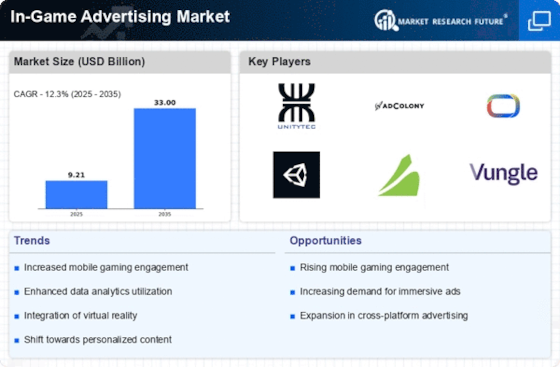
As per Market Research Future analysis, the In-Game Advertising Market Size was estimated at 9.209 USD Billion in 2024. The In-Game Advertising industry is projected to grow from 10.34 USD Billion in 2025 to 33.0 USD Billion by 2035, exhibiting a compound annual growth rate (CAGR) of 12.3% during the forecast period 2025 - 2035

Key Market Trends & Highlights

The In-Game Advertising Market is experiencing dynamic growth driven by technological advancements and evolving consumer preferences.

  • The integration of augmented reality in gaming is becoming increasingly prevalent, enhancing user engagement. User-generated content is reshaping advertising strategies, allowing for more personalized experiences. Cross-platform advertising is gaining traction, particularly between PC/laptop and smartphone/tablet segments. The rising popularity of mobile gaming and advancements in technology are key drivers propelling market expansion.

Market Size & Forecast

2024 Market Size 9.209 (USD Billion)
2035 Market Size 33.0 (USD Billion)
CAGR (2025 - 2035) 12.3%
Largest Regional Market Share in 2024 North America

Major Players

<a href="https://unity.com/">Unity Technologies</a> (US), AdColony (US), InMobi (IN), IronSource (IL), <a href="https://cas.ai/">Chartboost</a> (US), Vungle (US), Playwire (US), Digital Turbine (US), Aarki (US)

Market Trends

The In-Game Advertising Market is currently experiencing a transformative phase, characterized by the integration of immersive advertising strategies within gaming environments. This evolution appears to be driven by the increasing convergence of technology and entertainment, where brands seek to engage consumers in more interactive and meaningful ways. As gaming continues to gain popularity across diverse demographics, advertisers are recognizing the potential of in-game placements to reach audiences in a less intrusive manner. This trend suggests a shift from traditional advertising methods to more innovative approaches that resonate with players, enhancing their overall experience while promoting brand visibility. Moreover, the In-Game Advertising Market seems to be influenced by advancements in data analytics and artificial intelligence, which allow for more targeted and personalized advertising efforts. Advertisers are likely to leverage these technologies to analyze player behavior and preferences, tailoring their messages accordingly. This could lead to a more effective advertising ecosystem, where brands not only capture attention but also foster deeper connections with consumers. As the market evolves, it may also witness the emergence of new formats and platforms, further expanding the possibilities for in-game advertising and its impact on consumer engagement. This in-game advertising market report provides a comprehensive analysis of market size, trends, segmentation, and regional outlook through 2035. The in game advertising market is undergoing rapid transformation as immersive advertising strategies become increasingly integrated into gaming environments.

Increased Integration of Augmented Reality

The In-Game Advertising Market is witnessing a rise in the use of augmented reality (AR) technologies. This trend indicates that brands are exploring ways to create immersive experiences that blend digital content with the real world. By utilizing AR, advertisers can enhance player engagement and create memorable interactions that resonate beyond the gaming environment.

Shift Towards User-Generated Content

There appears to be a growing trend towards incorporating user-generated content within the In-Game Advertising Market. This approach allows players to contribute their own creations, which can be integrated into advertising campaigns. Such a strategy not only fosters community involvement but also enhances authenticity, as players are more likely to engage with content that reflects their own creativity.

Focus on Cross-Platform Advertising

The In-Game Advertising Market is increasingly emphasizing cross-platform strategies. This trend suggests that advertisers are recognizing the importance of reaching players across various devices and gaming platforms. By adopting a unified approach, brands can ensure consistent messaging and maximize their reach, ultimately enhancing the effectiveness of their advertising efforts.

In-Game Advertising Market Market Drivers

Advancements in Technology

Technological advancements play a crucial role in shaping the In-Game Advertising Market. The rise of artificial intelligence and machine learning enables advertisers to create more personalized and engaging ad experiences within games. These technologies facilitate real-time data analysis, allowing for dynamic ad placements that adapt to player behavior. Moreover, the development of high-quality graphics and immersive environments enhances the visual appeal of in-game ads, making them more attractive to players. As technology continues to evolve, the potential for interactive and immersive advertising experiences increases, thereby attracting more advertisers to the In-Game Advertising Market. This trend suggests a future where ads are seamlessly integrated into gameplay, enhancing both player experience and advertising effectiveness.

Rising Popularity of Mobile Gaming

The In-Game Advertising Market is experiencing a notable surge in mobile gaming popularity. As of October 2025, mobile games account for approximately 50% of the total gaming market, indicating a shift in consumer preferences towards portable gaming experiences. This trend is likely to drive advertisers to invest more in-game ads, as mobile platforms offer unique opportunities for targeted advertising. The ability to reach a diverse audience through mobile games enhances the effectiveness of advertising campaigns. Furthermore, the integration of advanced analytics in mobile gaming allows advertisers to track user engagement and optimize their strategies accordingly. As mobile gaming continues to grow, the In-Game Advertising Market is poised to benefit significantly from increased ad placements and innovative advertising formats.

Increased Focus on Data-Driven Marketing

The In-Game Advertising Market is experiencing an increased focus on data-driven marketing strategies. Advertisers are leveraging data analytics to gainsights into player behavior and preferences, allowing for more targeted advertising efforts. This approach enhances the effectiveness of ad campaigns, as brands can tailor their messages to specific demographics. As of October 2025, data-driven marketing is estimated to improve ad performance by up to 40%, making it a critical component of advertising strategies within the gaming sector. The ability to track user engagement and conversion rates in real-time empowers advertisers to make informed decisions and optimize their campaigns. Consequently, the In-Game Advertising Market is likely to see a rise in demand for data analytics tools and services that support these marketing efforts.

Growing Demand for Interactive Advertising

The In-Game Advertising Market is witnessing a growing demand for interactive advertising formats. Players increasingly prefer ads that engage them rather than traditional static advertisements. This shift is evident in the rise of advergames and branded content, where players can interact with products in a virtual environment. According to recent data, interactive ads can lead to a 30% increase in brand recall compared to traditional ads. This trend indicates that advertisers are recognizing the value of creating memorable experiences that resonate with players. As the demand for interactive content continues to rise, the In-Game Advertising Market is likely to see an influx of innovative advertising solutions that prioritize user engagement and interactivity.

Expansion of Esports and Competitive Gaming

The expansion of esports and competitive gaming is significantly influencing the In-Game Advertising Market. As of October 2025, the esports industry has grown to a multi-billion dollar market, attracting millions of viewers and participants worldwide. This growth presents a unique opportunity for advertisers to reach a highly engaged audience. Brands are increasingly sponsoring esports events and integrating their products into competitive gaming environments. The visibility and reach of in-game ads during esports tournaments can lead to substantial brand exposure. Furthermore, the rise of streaming platforms has created additional avenues for advertisers to engage with audiences in real-time. This trend suggests that the In-Game Advertising Market will continue to evolve alongside the esports phenomenon, offering new and innovative advertising opportunities.

Market Segment Insights

By Type: Static Ads (Largest) vs. Dynamic Ads (Fastest-Growing)

The In-Game Advertising Market showcases a diversified landscape with Static Ads holding the largest share. This segment benefits from its simplicity and ease of integration within game environments, appealing to developers and brands alike. Dynamic Ads, while currently smaller in market share, are rapidly gaining traction thanks to their ability to adapt and personalize based on player behavior, leading to increased engagement and effectiveness.

Static Ads (Dominant) vs. Dynamic Ads (Emerging)

Static Ads remain the dominant force in the In-Game Advertising Market, characterized by their fixed presence within the game environments, often seen in the form of billboards or sponsorships. Their advantage lies in brand recognition and seamless integration with the gameplay experience. In contrast, Dynamic Ads represent an emerging market trend, leveraging technology to deliver personalized advertising content that changes based on real-time analytics and player interactions. This flexibility allows for higher engagement rates, thereby making Dynamic Ads increasingly appealing to advertisers looking for innovative ways to connect with game players.

By Device Type: PC/Laptop (Largest) vs. Smartphone/Tablet (Fastest-Growing)

In the In-Game Advertising Market, PC/Laptop devices maintain a dominant market share due to their extensive use in gaming and a preference for high-quality graphics and larger screen sizes. These devices are favored by gamers who seek immersive experiences, thereby attracting significant advertising spend from brands targeting this audience. On the other hand, <a href="https://www.marketresearchfuture.com/reports/online-smartphone-and-tablet-games-market-23523">Smartphone/Tablet devices</a> have emerged as a rapidly growing segment, fueled by the increasing penetration of mobile gaming and the convenience of in-app advertising. This growth is indicative of a broader trend towards mobile engagement in gaming.

Device Type: PC/Laptop (Dominant) vs. Smartphone/Tablet (Emerging)

The PC/Laptop segment in-game advertising is characterized by established usage patterns and a stable audience familiar with traditional gaming formats. This segment benefits from larger screen real estate and sufficient processing power, making it attractive for advertisers aiming for high-impact visuals. In contrast, the Smartphone/Tablet segment is being shaped by a surge in <a href="https://www.marketresearchfuture.com/reports/mobile-gaming-market-6313">mobile gaming</a> popularity, catering to a younger demographic that prefers gaming on-the-go. Advertisers are increasingly recognizing this shift, developing strategies tailored for mobile platforms to capture the attention of emerging audiences, thus indicating a diversification of ad placements from traditionally dominant formats.

Get more detailed insights about In-Game Advertising Market Research Report - Global Forecast till 2035

Regional Insights

North America : Digital Advertising Leader

North America is the largest market for in-game advertising, holding approximately 45% of the global share. The region's growth is driven by high smartphone penetration, increasing gaming audiences, and innovative advertising technologies. Regulatory support for digital advertising and data privacy laws are also shaping the landscape, fostering a competitive environment for advertisers and developers alike. The United States is the leading country in this sector, with major players like Unity Technologies, AdColony, and Vungle driving innovation. The competitive landscape is characterized by a mix of established companies and emerging startups, all vying for market share. The presence of advanced technology and a robust gaming culture further enhances the region's attractiveness for in-game advertising.

Europe : Emerging Market Dynamics

Europe is witnessing significant growth in the in-game advertising market, accounting for around 30% of the global share. The region benefits from a diverse gaming population and increasing investments in mobile gaming. Regulatory frameworks, such as GDPR, are influencing advertising strategies, ensuring user privacy while promoting innovative ad formats that enhance user experience. Leading countries include the United Kingdom, Germany, and France, where companies like IronSource and Chartboost are making substantial impacts. The competitive landscape is vibrant, with both local and international players competing for market share. The region's focus on user engagement and data-driven advertising strategies positions it as a key player in the global market.

Asia-Pacific : Rapid Growth and Innovation

Asia-Pacific is rapidly emerging as a powerhouse in the in-game advertising market, holding approximately 20% of the global share. The region's growth is fueled by a massive gaming population, increasing smartphone usage, and a shift towards mobile gaming. Regulatory developments are also encouraging the adoption of in-game advertising, creating a favorable environment for advertisers and developers alike. Countries like China, Japan, and India are leading the charge, with key players such as InMobi and Aarki making significant strides. The competitive landscape is marked by a mix of local and international companies, all striving to capture the growing audience. The region's unique gaming culture and innovative advertising formats are driving the evolution of in-game advertising strategies.

Middle East and Africa : Untapped Market Potential

The Middle East and Africa region is an emerging market for in-game advertising, currently holding about 5% of the global share. The growth is driven by increasing internet penetration, a young population, and rising smartphone adoption. Regulatory frameworks are gradually evolving to support digital advertising, creating new opportunities for advertisers to engage with consumers in innovative ways. Countries like South Africa and the UAE are at the forefront of this growth, with local and international players entering the market. The competitive landscape is still developing, but the presence of key players is beginning to shape the industry. As the gaming culture expands, the region is poised for significant growth in in-game advertising.

Key Players and Competitive Insights

The In-Game Advertising Market is currently characterized by a dynamic competitive landscape, driven by rapid technological advancements and evolving consumer preferences. Key players such as Unity Technologies (US), AdColony (US), and InMobi (IN) are at the forefront, each adopting distinct strategies to enhance their market positioning. Unity Technologies (US) focuses on integrating immersive advertising experiences within its gaming platform, leveraging its extensive developer network to create tailored ad solutions. Meanwhile, AdColony (US) emphasizes video advertising, particularly in mobile gaming, aiming to deliver high engagement through innovative formats. InMobi (IN) is strategically expanding its global footprint, particularly in emerging markets, by offering localized advertising solutions that resonate with diverse audiences. Collectively, these strategies contribute to a competitive environment that is increasingly centered around user engagement and technological integration. The business tactics employed by these companies reflect a moderately fragmented market structure, where collaboration and strategic partnerships play a crucial role. For instance, companies are increasingly localizing their advertising content to cater to regional preferences, thereby optimizing their supply chains and enhancing user experience. This localized approach not only improves ad relevance but also fosters stronger connections with gamers, ultimately driving higher conversion rates. The collective influence of these key players shapes a competitive landscape that is both diverse and rapidly evolving, with each company striving to carve out its niche. In August 2025, Unity Technologies (US) announced a partnership with a leading mobile game developer to integrate augmented reality (AR) advertising into their flagship titles. This strategic move is significant as it positions Unity at the cutting edge of immersive advertising, potentially attracting a new segment of advertisers looking to leverage AR technology. By enhancing user engagement through interactive ad experiences, Unity aims to solidify its market leadership and drive revenue growth in a competitive sector. In September 2025, AdColony (US) launched a new suite of programmatic advertising tools designed to optimize ad placements in real-time. This initiative is particularly noteworthy as it reflects AdColony's commitment to harnessing data analytics for improved targeting and efficiency. By enabling advertisers to make data-driven decisions, AdColony enhances its value proposition, likely increasing its market share in the mobile advertising space. In July 2025, InMobi (IN) expanded its operations into Latin America, establishing partnerships with local advertisers to deliver culturally relevant ad content. This expansion is strategically important as it allows InMobi to tap into a rapidly growing market, diversifying its revenue streams and enhancing its competitive edge. By focusing on localized content, InMobi positions itself as a leader in delivering tailored advertising solutions that resonate with regional audiences. As of October 2025, the In-Game Advertising Market is witnessing trends that emphasize digitalization, sustainability, and the integration of artificial intelligence. Companies are increasingly forming strategic alliances to enhance their technological capabilities and expand their market reach. This shift indicates a move away from traditional price-based competition towards a landscape where innovation, technology, and supply chain reliability are paramount. Looking ahead, competitive differentiation will likely hinge on the ability to deliver unique, engaging advertising experiences that resonate with gamers, thereby fostering brand loyalty and driving long-term growth.

Key Companies in the In-Game Advertising Market include

Industry Developments

  • Q2 2024: Activision Blizzard Media launches new in-game advertising platform for mobile titles Activision Blizzard Media announced the launch of a new in-game advertising platform designed to deliver non-disruptive, immersive ad experiences within its mobile games, including Candy Crush Saga. The platform aims to help brands reach diverse gaming audiences through seamless ad integration.

Future Outlook

In-Game Advertising Market Future Outlook

The In-Game Advertising Market is projected to grow at a 12.3% CAGR from 2025 to 2035, driven by technological advancements, increased gaming engagement, and evolving advertising strategies.

New opportunities lie in:

  • <p>Integration of augmented reality ads in mobile games Development of targeted ad algorithms using player data Partnerships with game developers for exclusive ad placements</p>

By 2035, the market is expected to be robust, reflecting substantial growth and innovation.

Market Segmentation

In-Game Advertising Market Type Outlook

  • Static Ads
  • Dynamic Ads
  • Advergaming

In-Game Advertising Market Device Type Outlook

  • PC/Laptop
  • Smartphone/Tablet

Report Scope

MARKET SIZE 2024 9.209 (USD Billion)
MARKET SIZE 2025 10.34 (USD Billion)
MARKET SIZE 2035 33.0 (USD Billion)
COMPOUND ANNUAL GROWTH RATE (CAGR) 12.3% (2025 - 2035)
REPORT COVERAGE Revenue Forecast, Competitive Landscape, Growth Factors, and Trends
BASE YEAR 2024
Market Forecast Period 2025 - 2035
Historical Data 2019 - 2024
Market Forecast Units USD Billion
Key Companies Profiled Unity Technologies (US), AdColony (US), InMobi (IN), IronSource (IL), Chartboost (US), Vungle (US), Playwire (US), Digital Turbine (US), Aarki (US)
Segments Covered Type, Device Type, Region
Key Market Opportunities Integration of augmented reality enhances engagement in the In-Game Advertising Market.
Key Market Dynamics Rising consumer engagement in gaming drives demand for innovative in-game advertising strategies and technologies.
Countries Covered North America, Europe, APAC, South America, MEA

FAQs

What is the current valuation of the In-Game Advertising Market as of 2024?

<p>The In-Game Advertising Market was valued at 9.209 USD Billion in 2024.</p>

What is the projected market size for the In-Game Advertising Market by 2035?

<p>The market is projected to reach 33.0 USD Billion by 2035.</p>

What is the expected CAGR for the In-Game Advertising Market during the forecast period 2025 - 2035?

<p>The expected CAGR for the In-Game Advertising Market during 2025 - 2035 is 12.3%.</p>

Which segments are included in the In-Game Advertising Market?

<p>The market includes segments such as Static Ads, Dynamic Ads, and Advergaming.</p>

What were the valuations for Static Ads, Dynamic Ads, and Advergaming in 2024?

<p>In 2024, Static Ads were valued at 2.5 USD Billion, Dynamic Ads at 3.0 USD Billion, and Advergaming at 3.709 USD Billion.</p>

How do device types impact the In-Game Advertising Market?

<p>Device types such as PC/Laptop and Smartphone/Tablet significantly influence the market, with valuations of 3.0 USD Billion and 6.209 USD Billion in 2024, respectively.</p>

Who are the key players in the In-Game Advertising Market?

Key players include Unity Technologies, AdColony, InMobi, IronSource, Chartboost, Vungle, Playwire, Digital Turbine, and Aarki.

What is the projected growth for Dynamic Ads in the In-Game Advertising Market?

Dynamic Ads are projected to grow from 3.0 USD Billion in 2024 to 12.0 USD Billion by 2035.

What role do key players like Unity Technologies play in the market?

Unity Technologies and other key players are likely to drive innovation and growth within the In-Game Advertising Market.

How does the market's growth potential compare across different segments?

The growth potential appears robust across segments, with Advergaming projected to increase from 3.709 USD Billion in 2024 to 12.0 USD Billion by 2035.

  1. SECTION I: EXECUTIVE SUMMARY AND KEY HIGHLIGHTS
    1. | 1.1 EXECUTIVE SUMMARY
    2. | | 1.1.1 Market Overview
    3. | | 1.1.2 Key Findings
    4. | | 1.1.3 Market Segmentation
    5. | | 1.1.4 Competitive Landscape
    6. | | 1.1.5 Challenges and Opportunities
    7. | | 1.1.6 Future Outlook
  2. SECTION II: SCOPING, METHODOLOGY AND MARKET STRUCTURE
    1. | 2.1 MARKET INTRODUCTION
    2. | | 2.1.1 Definition
    3. | | 2.1.2 Scope of the study
    4. | | | 2.1.2.1 Research Objective
    5. | | | 2.1.2.2 Assumption
    6. | | | 2.1.2.3 Limitations
    7. | 2.2 RESEARCH METHODOLOGY
    8. | | 2.2.1 Overview
    9. | | 2.2.2 Data Mining
    10. | | 2.2.3 Secondary Research
    11. | | 2.2.4 Primary Research
    12. | | | 2.2.4.1 Primary Interviews and Information Gathering Process
    13. | | | 2.2.4.2 Breakdown of Primary Respondents
    14. | | 2.2.5 Forecasting Model
    15. | | 2.2.6 Market Size Estimation
    16. | | | 2.2.6.1 Bottom-Up Approach
    17. | | | 2.2.6.2 Top-Down Approach
    18. | | 2.2.7 Data Triangulation
    19. | | 2.2.8 Validation
  3. SECTION III: QUALITATIVE ANALYSIS
    1. | 3.1 MARKET DYNAMICS
    2. | | 3.1.1 Overview
    3. | | 3.1.2 Drivers
    4. | | 3.1.3 Restraints
    5. | | 3.1.4 Opportunities
    6. | 3.2 MARKET FACTOR ANALYSIS
    7. | | 3.2.1 Value chain Analysis
    8. | | 3.2.2 Porter's Five Forces Analysis
    9. | | | 3.2.2.1 Bargaining Power of Suppliers
    10. | | | 3.2.2.2 Bargaining Power of Buyers
    11. | | | 3.2.2.3 Threat of New Entrants
    12. | | | 3.2.2.4 Threat of Substitutes
    13. | | | 3.2.2.5 Intensity of Rivalry
    14. | | 3.2.3 COVID-19 Impact Analysis
    15. | | | 3.2.3.1 Market Impact Analysis
    16. | | | 3.2.3.2 Regional Impact
    17. | | | 3.2.3.3 Opportunity and Threat Analysis
  4. SECTION IV: QUANTITATIVE ANALYSIS
    1. | 4.1 Information and Communications Technology, BY Type (USD Billion)
    2. | | 4.1.1 Static Ads
    3. | | 4.1.2 Dynamic Ads
    4. | | 4.1.3 Advergaming
    5. | 4.2 Information and Communications Technology, BY Device Type (USD Billion)
    6. | | 4.2.1 PC/Laptop
    7. | | 4.2.2 Smartphone/Tablet
    8. | 4.3 Information and Communications Technology, BY Region (USD Billion)
    9. | | 4.3.1 North America
    10. | | | 4.3.1.1 US
    11. | | | 4.3.1.2 Canada
    12. | | 4.3.2 Europe
    13. | | | 4.3.2.1 Germany
    14. | | | 4.3.2.2 UK
    15. | | | 4.3.2.3 France
    16. | | | 4.3.2.4 Russia
    17. | | | 4.3.2.5 Italy
    18. | | | 4.3.2.6 Spain
    19. | | | 4.3.2.7 Rest of Europe
    20. | | 4.3.3 APAC
    21. | | | 4.3.3.1 China
    22. | | | 4.3.3.2 India
    23. | | | 4.3.3.3 Japan
    24. | | | 4.3.3.4 South Korea
    25. | | | 4.3.3.5 Malaysia
    26. | | | 4.3.3.6 Thailand
    27. | | | 4.3.3.7 Indonesia
    28. | | | 4.3.3.8 Rest of APAC
    29. | | 4.3.4 South America
    30. | | | 4.3.4.1 Brazil
    31. | | | 4.3.4.2 Mexico
    32. | | | 4.3.4.3 Argentina
    33. | | | 4.3.4.4 Rest of South America
    34. | | 4.3.5 MEA
    35. | | | 4.3.5.1 GCC Countries
    36. | | | 4.3.5.2 South Africa
    37. | | | 4.3.5.3 Rest of MEA
  5. SECTION V: COMPETITIVE ANALYSIS
    1. | 5.1 Competitive Landscape
    2. | | 5.1.1 Overview
    3. | | 5.1.2 Competitive Analysis
    4. | | 5.1.3 Market share Analysis
    5. | | 5.1.4 Major Growth Strategy in the Information and Communications Technology
    6. | | 5.1.5 Competitive Benchmarking
    7. | | 5.1.6 Leading Players in Terms of Number of Developments in the Information and Communications Technology
    8. | | 5.1.7 Key developments and growth strategies
    9. | | | 5.1.7.1 New Product Launch/Service Deployment
    10. | | | 5.1.7.2 Merger & Acquisitions
    11. | | | 5.1.7.3 Joint Ventures
    12. | | 5.1.8 Major Players Financial Matrix
    13. | | | 5.1.8.1 Sales and Operating Income
    14. | | | 5.1.8.2 Major Players R&D Expenditure. 2023
    15. | 5.2 Company Profiles
    16. | | 5.2.1 Unity Technologies (US)
    17. | | | 5.2.1.1 Financial Overview
    18. | | | 5.2.1.2 Products Offered
    19. | | | 5.2.1.3 Key Developments
    20. | | | 5.2.1.4 SWOT Analysis
    21. | | | 5.2.1.5 Key Strategies
    22. | | 5.2.2 AdColony (US)
    23. | | | 5.2.2.1 Financial Overview
    24. | | | 5.2.2.2 Products Offered
    25. | | | 5.2.2.3 Key Developments
    26. | | | 5.2.2.4 SWOT Analysis
    27. | | | 5.2.2.5 Key Strategies
    28. | | 5.2.3 InMobi (IN)
    29. | | | 5.2.3.1 Financial Overview
    30. | | | 5.2.3.2 Products Offered
    31. | | | 5.2.3.3 Key Developments
    32. | | | 5.2.3.4 SWOT Analysis
    33. | | | 5.2.3.5 Key Strategies
    34. | | 5.2.4 IronSource (IL)
    35. | | | 5.2.4.1 Financial Overview
    36. | | | 5.2.4.2 Products Offered
    37. | | | 5.2.4.3 Key Developments
    38. | | | 5.2.4.4 SWOT Analysis
    39. | | | 5.2.4.5 Key Strategies
    40. | | 5.2.5 Chartboost (US)
    41. | | | 5.2.5.1 Financial Overview
    42. | | | 5.2.5.2 Products Offered
    43. | | | 5.2.5.3 Key Developments
    44. | | | 5.2.5.4 SWOT Analysis
    45. | | | 5.2.5.5 Key Strategies
    46. | | 5.2.6 Vungle (US)
    47. | | | 5.2.6.1 Financial Overview
    48. | | | 5.2.6.2 Products Offered
    49. | | | 5.2.6.3 Key Developments
    50. | | | 5.2.6.4 SWOT Analysis
    51. | | | 5.2.6.5 Key Strategies
    52. | | 5.2.7 Playwire (US)
    53. | | | 5.2.7.1 Financial Overview
    54. | | | 5.2.7.2 Products Offered
    55. | | | 5.2.7.3 Key Developments
    56. | | | 5.2.7.4 SWOT Analysis
    57. | | | 5.2.7.5 Key Strategies
    58. | | 5.2.8 Digital Turbine (US)
    59. | | | 5.2.8.1 Financial Overview
    60. | | | 5.2.8.2 Products Offered
    61. | | | 5.2.8.3 Key Developments
    62. | | | 5.2.8.4 SWOT Analysis
    63. | | | 5.2.8.5 Key Strategies
    64. | | 5.2.9 Aarki (US)
    65. | | | 5.2.9.1 Financial Overview
    66. | | | 5.2.9.2 Products Offered
    67. | | | 5.2.9.3 Key Developments
    68. | | | 5.2.9.4 SWOT Analysis
    69. | | | 5.2.9.5 Key Strategies
    70. | 5.3 Appendix
    71. | | 5.3.1 References
    72. | | 5.3.2 Related Reports
  6. LIST OF FIGURES
    1. | 6.1 MARKET SYNOPSIS
    2. | 6.2 NORTH AMERICA MARKET ANALYSIS
    3. | 6.3 US MARKET ANALYSIS BY TYPE
    4. | 6.4 US MARKET ANALYSIS BY DEVICE TYPE
    5. | 6.5 CANADA MARKET ANALYSIS BY TYPE
    6. | 6.6 CANADA MARKET ANALYSIS BY DEVICE TYPE
    7. | 6.7 EUROPE MARKET ANALYSIS
    8. | 6.8 GERMANY MARKET ANALYSIS BY TYPE
    9. | 6.9 GERMANY MARKET ANALYSIS BY DEVICE TYPE
    10. | 6.10 UK MARKET ANALYSIS BY TYPE
    11. | 6.11 UK MARKET ANALYSIS BY DEVICE TYPE
    12. | 6.12 FRANCE MARKET ANALYSIS BY TYPE
    13. | 6.13 FRANCE MARKET ANALYSIS BY DEVICE TYPE
    14. | 6.14 RUSSIA MARKET ANALYSIS BY TYPE
    15. | 6.15 RUSSIA MARKET ANALYSIS BY DEVICE TYPE
    16. | 6.16 ITALY MARKET ANALYSIS BY TYPE
    17. | 6.17 ITALY MARKET ANALYSIS BY DEVICE TYPE
    18. | 6.18 SPAIN MARKET ANALYSIS BY TYPE
    19. | 6.19 SPAIN MARKET ANALYSIS BY DEVICE TYPE
    20. | 6.20 REST OF EUROPE MARKET ANALYSIS BY TYPE
    21. | 6.21 REST OF EUROPE MARKET ANALYSIS BY DEVICE TYPE
    22. | 6.22 APAC MARKET ANALYSIS
    23. | 6.23 CHINA MARKET ANALYSIS BY TYPE
    24. | 6.24 CHINA MARKET ANALYSIS BY DEVICE TYPE
    25. | 6.25 INDIA MARKET ANALYSIS BY TYPE
    26. | 6.26 INDIA MARKET ANALYSIS BY DEVICE TYPE
    27. | 6.27 JAPAN MARKET ANALYSIS BY TYPE
    28. | 6.28 JAPAN MARKET ANALYSIS BY DEVICE TYPE
    29. | 6.29 SOUTH KOREA MARKET ANALYSIS BY TYPE
    30. | 6.30 SOUTH KOREA MARKET ANALYSIS BY DEVICE TYPE
    31. | 6.31 MALAYSIA MARKET ANALYSIS BY TYPE
    32. | 6.32 MALAYSIA MARKET ANALYSIS BY DEVICE TYPE
    33. | 6.33 THAILAND MARKET ANALYSIS BY TYPE
    34. | 6.34 THAILAND MARKET ANALYSIS BY DEVICE TYPE
    35. | 6.35 INDONESIA MARKET ANALYSIS BY TYPE
    36. | 6.36 INDONESIA MARKET ANALYSIS BY DEVICE TYPE
    37. | 6.37 REST OF APAC MARKET ANALYSIS BY TYPE
    38. | 6.38 REST OF APAC MARKET ANALYSIS BY DEVICE TYPE
    39. | 6.39 SOUTH AMERICA MARKET ANALYSIS
    40. | 6.40 BRAZIL MARKET ANALYSIS BY TYPE
    41. | 6.41 BRAZIL MARKET ANALYSIS BY DEVICE TYPE
    42. | 6.42 MEXICO MARKET ANALYSIS BY TYPE
    43. | 6.43 MEXICO MARKET ANALYSIS BY DEVICE TYPE
    44. | 6.44 ARGENTINA MARKET ANALYSIS BY TYPE
    45. | 6.45 ARGENTINA MARKET ANALYSIS BY DEVICE TYPE
    46. | 6.46 REST OF SOUTH AMERICA MARKET ANALYSIS BY TYPE
    47. | 6.47 REST OF SOUTH AMERICA MARKET ANALYSIS BY DEVICE TYPE
    48. | 6.48 MEA MARKET ANALYSIS
    49. | 6.49 GCC COUNTRIES MARKET ANALYSIS BY TYPE
    50. | 6.50 GCC COUNTRIES MARKET ANALYSIS BY DEVICE TYPE
    51. | 6.51 SOUTH AFRICA MARKET ANALYSIS BY TYPE
    52. | 6.52 SOUTH AFRICA MARKET ANALYSIS BY DEVICE TYPE
    53. | 6.53 REST OF MEA MARKET ANALYSIS BY TYPE
    54. | 6.54 REST OF MEA MARKET ANALYSIS BY DEVICE TYPE
    55. | 6.55 KEY BUYING CRITERIA OF INFORMATION AND COMMUNICATIONS TECHNOLOGY
    56. | 6.56 RESEARCH PROCESS OF MRFR
    57. | 6.57 DRO ANALYSIS OF INFORMATION AND COMMUNICATIONS TECHNOLOGY
    58. | 6.58 DRIVERS IMPACT ANALYSIS: INFORMATION AND COMMUNICATIONS TECHNOLOGY
    59. | 6.59 RESTRAINTS IMPACT ANALYSIS: INFORMATION AND COMMUNICATIONS TECHNOLOGY
    60. | 6.60 SUPPLY / VALUE CHAIN: INFORMATION AND COMMUNICATIONS TECHNOLOGY
    61. | 6.61 INFORMATION AND COMMUNICATIONS TECHNOLOGY, BY TYPE, 2024 (% SHARE)
    62. | 6.62 INFORMATION AND COMMUNICATIONS TECHNOLOGY, BY TYPE, 2024 TO 2035 (USD Billion)
    63. | 6.63 INFORMATION AND COMMUNICATIONS TECHNOLOGY, BY DEVICE TYPE, 2024 (% SHARE)
    64. | 6.64 INFORMATION AND COMMUNICATIONS TECHNOLOGY, BY DEVICE TYPE, 2024 TO 2035 (USD Billion)
    65. | 6.65 BENCHMARKING OF MAJOR COMPETITORS
  7. LIST OF TABLES
    1. | 7.1 LIST OF ASSUMPTIONS
    2. | | 7.1.1
    3. | 7.2 North America MARKET SIZE ESTIMATES; FORECAST
    4. | | 7.2.1 BY TYPE, 2025-2035 (USD Billion)
    5. | | 7.2.2 BY DEVICE TYPE, 2025-2035 (USD Billion)
    6. | 7.3 US MARKET SIZE ESTIMATES; FORECAST
    7. | | 7.3.1 BY TYPE, 2025-2035 (USD Billion)
    8. | | 7.3.2 BY DEVICE TYPE, 2025-2035 (USD Billion)
    9. | 7.4 Canada MARKET SIZE ESTIMATES; FORECAST
    10. | | 7.4.1 BY TYPE, 2025-2035 (USD Billion)
    11. | | 7.4.2 BY DEVICE TYPE, 2025-2035 (USD Billion)
    12. | 7.5 Europe MARKET SIZE ESTIMATES; FORECAST
    13. | | 7.5.1 BY TYPE, 2025-2035 (USD Billion)
    14. | | 7.5.2 BY DEVICE TYPE, 2025-2035 (USD Billion)
    15. | 7.6 Germany MARKET SIZE ESTIMATES; FORECAST
    16. | | 7.6.1 BY TYPE, 2025-2035 (USD Billion)
    17. | | 7.6.2 BY DEVICE TYPE, 2025-2035 (USD Billion)
    18. | 7.7 UK MARKET SIZE ESTIMATES; FORECAST
    19. | | 7.7.1 BY TYPE, 2025-2035 (USD Billion)
    20. | | 7.7.2 BY DEVICE TYPE, 2025-2035 (USD Billion)
    21. | 7.8 France MARKET SIZE ESTIMATES; FORECAST
    22. | | 7.8.1 BY TYPE, 2025-2035 (USD Billion)
    23. | | 7.8.2 BY DEVICE TYPE, 2025-2035 (USD Billion)
    24. | 7.9 Russia MARKET SIZE ESTIMATES; FORECAST
    25. | | 7.9.1 BY TYPE, 2025-2035 (USD Billion)
    26. | | 7.9.2 BY DEVICE TYPE, 2025-2035 (USD Billion)
    27. | 7.10 Italy MARKET SIZE ESTIMATES; FORECAST
    28. | | 7.10.1 BY TYPE, 2025-2035 (USD Billion)
    29. | | 7.10.2 BY DEVICE TYPE, 2025-2035 (USD Billion)
    30. | 7.11 Spain MARKET SIZE ESTIMATES; FORECAST
    31. | | 7.11.1 BY TYPE, 2025-2035 (USD Billion)
    32. | | 7.11.2 BY DEVICE TYPE, 2025-2035 (USD Billion)
    33. | 7.12 Rest of Europe MARKET SIZE ESTIMATES; FORECAST
    34. | | 7.12.1 BY TYPE, 2025-2035 (USD Billion)
    35. | | 7.12.2 BY DEVICE TYPE, 2025-2035 (USD Billion)
    36. | 7.13 APAC MARKET SIZE ESTIMATES; FORECAST
    37. | | 7.13.1 BY TYPE, 2025-2035 (USD Billion)
    38. | | 7.13.2 BY DEVICE TYPE, 2025-2035 (USD Billion)
    39. | 7.14 China MARKET SIZE ESTIMATES; FORECAST
    40. | | 7.14.1 BY TYPE, 2025-2035 (USD Billion)
    41. | | 7.14.2 BY DEVICE TYPE, 2025-2035 (USD Billion)
    42. | 7.15 India MARKET SIZE ESTIMATES; FORECAST
    43. | | 7.15.1 BY TYPE, 2025-2035 (USD Billion)
    44. | | 7.15.2 BY DEVICE TYPE, 2025-2035 (USD Billion)
    45. | 7.16 Japan MARKET SIZE ESTIMATES; FORECAST
    46. | | 7.16.1 BY TYPE, 2025-2035 (USD Billion)
    47. | | 7.16.2 BY DEVICE TYPE, 2025-2035 (USD Billion)
    48. | 7.17 South Korea MARKET SIZE ESTIMATES; FORECAST
    49. | | 7.17.1 BY TYPE, 2025-2035 (USD Billion)
    50. | | 7.17.2 BY DEVICE TYPE, 2025-2035 (USD Billion)
    51. | 7.18 Malaysia MARKET SIZE ESTIMATES; FORECAST
    52. | | 7.18.1 BY TYPE, 2025-2035 (USD Billion)
    53. | | 7.18.2 BY DEVICE TYPE, 2025-2035 (USD Billion)
    54. | 7.19 Thailand MARKET SIZE ESTIMATES; FORECAST
    55. | | 7.19.1 BY TYPE, 2025-2035 (USD Billion)
    56. | | 7.19.2 BY DEVICE TYPE, 2025-2035 (USD Billion)
    57. | 7.20 Indonesia MARKET SIZE ESTIMATES; FORECAST
    58. | | 7.20.1 BY TYPE, 2025-2035 (USD Billion)
    59. | | 7.20.2 BY DEVICE TYPE, 2025-2035 (USD Billion)
    60. | 7.21 Rest of APAC MARKET SIZE ESTIMATES; FORECAST
    61. | | 7.21.1 BY TYPE, 2025-2035 (USD Billion)
    62. | | 7.21.2 BY DEVICE TYPE, 2025-2035 (USD Billion)
    63. | 7.22 South America MARKET SIZE ESTIMATES; FORECAST
    64. | | 7.22.1 BY TYPE, 2025-2035 (USD Billion)
    65. | | 7.22.2 BY DEVICE TYPE, 2025-2035 (USD Billion)
    66. | 7.23 Brazil MARKET SIZE ESTIMATES; FORECAST
    67. | | 7.23.1 BY TYPE, 2025-2035 (USD Billion)
    68. | | 7.23.2 BY DEVICE TYPE, 2025-2035 (USD Billion)
    69. | 7.24 Mexico MARKET SIZE ESTIMATES; FORECAST
    70. | | 7.24.1 BY TYPE, 2025-2035 (USD Billion)
    71. | | 7.24.2 BY DEVICE TYPE, 2025-2035 (USD Billion)
    72. | 7.25 Argentina MARKET SIZE ESTIMATES; FORECAST
    73. | | 7.25.1 BY TYPE, 2025-2035 (USD Billion)
    74. | | 7.25.2 BY DEVICE TYPE, 2025-2035 (USD Billion)
    75. | 7.26 Rest of South America MARKET SIZE ESTIMATES; FORECAST
    76. | | 7.26.1 BY TYPE, 2025-2035 (USD Billion)
    77. | | 7.26.2 BY DEVICE TYPE, 2025-2035 (USD Billion)
    78. | 7.27 MEA MARKET SIZE ESTIMATES; FORECAST
    79. | | 7.27.1 BY TYPE, 2025-2035 (USD Billion)
    80. | | 7.27.2 BY DEVICE TYPE, 2025-2035 (USD Billion)
    81. | 7.28 GCC Countries MARKET SIZE ESTIMATES; FORECAST
    82. | | 7.28.1 BY TYPE, 2025-2035 (USD Billion)
    83. | | 7.28.2 BY DEVICE TYPE, 2025-2035 (USD Billion)
    84. | 7.29 South Africa MARKET SIZE ESTIMATES; FORECAST
    85. | | 7.29.1 BY TYPE, 2025-2035 (USD Billion)
    86. | | 7.29.2 BY DEVICE TYPE, 2025-2035 (USD Billion)
    87. | 7.30 Rest of MEA MARKET SIZE ESTIMATES; FORECAST
    88. | | 7.30.1 BY TYPE, 2025-2035 (USD Billion)
    89. | | 7.30.2 BY DEVICE TYPE, 2025-2035 (USD Billion)
    90. | 7.31 PRODUCT LAUNCH/PRODUCT DEVELOPMENT/APPROVAL
    91. | | 7.31.1
    92. | 7.32 ACQUISITION/PARTNERSHIP
    93. | | 7.32.1

Information and Communications Technology Market Segmentation

Information and Communications Technology By Type (USD Billion, 2025-2035)

  • Static Ads
  • Dynamic Ads
  • Advergaming

Information and Communications Technology By Device Type (USD Billion, 2025-2035)

  • PC/Laptop
  • Smartphone/Tablet
Infographic

Free Sample Request

Kindly complete the form below to receive a free sample of this Report

Get Free Sample

Customer Strories

Compare Licence

×
Features License Type
Single User Multiuser License Enterprise User
Price $4,950 $5,950 $7,250
Maximum User Access Limit 1 User Upto 10 Users Unrestricted Access Throughout the Organization
Free Customization
Direct Access to Analyst
Deliverable Format
Platform Access
Discount on Next Purchase 10% 15% 15%
Printable Versions