×
Request Free Sample ×

Kindly complete the form below to receive a free sample of this Report

* Please use a valid business email

Leading companies partner with us for data-driven Insights

clients tt-cursor
Hero Background
English
Chinese
French
Japanese
Korean
German
Spanish

Identity and Access Management Market Size

ID: MRFR/ICT/1966-CR
200 Pages
Shubham Munde
July 2025

Identity and Access Management Market Size, Share and Trends Analysis Research Report By Deployment Type (On-Premises, Cloud-Based, Hybrid), By Solution Type (Single Sign-On, Multi-Factor Authentication, Access Governance, Directory Services), By End-user (BFSI, Healthcare, Government, IT and Telecom, Retail), By Organization Size (Small Enterprises, Medium Enterprises, Large Enterprises), and By Regional (North America, Europe, South America, Asia Pacific, Middle East and Africa) - Forecast to 2035

Share:
Download PDF ×

We do not share your information with anyone. However, we may send you emails based on your report interest from time to time. You may contact us at any time to opt-out.

Identity Access Management Market Infographic
Purchase Options

Identity Access Management Size

Identity Access Management Market Growth Projections and Opportunities

Many factors affect the Identity and Access Management (IAM) business. Network safety concerns at a period of wild data breaches and digital threats are a key cause. Strong IAM systems are in demand as companies realize they must protect their sensitive data. Distributed computers and mobile phones increase this need, while traditional safety methods fail despite mechanical advances.

Administrative consistency is crucial to IAM market management. Information assurance standards and recommendations from states and industry groups are forcing organizations to follow strict IAM norms. Compliance with GDPR, HIPAA, and other regulations drives the IAM industry. Thus, enterprises want integrated IAM solutions that boost security and comply with the complicated information protection and insurance regulations.

Remote labor is becoming more common, complicating IAM requirements. Consistent, secure access control is essential for a crucial workforce operating remotely. Adaptable IAM setups that don't compromise security stand out, solving modern workplace issues.

IAM market growth is driven by digital threat refinement. To stay ahead, IAM should evolve as cybercriminals create new methods. This has led IAM frameworks to combine human and AI brainpower to better detect and mitigate risks. IAM development is characterized by the constant arms race between digital attackers and safety attempts.

The IAM landscape depends on market union and critical organizations. As demand for comprehensive IAM solutions rises, companies seek providers with a full spectrum of services. Due to consolidations and acquisitions, IAM players now have specific solutions to complement their contributions. Critical partnerships between IAM sellers and other innovation providers lead to stronger and more coordinated security measures.

Cost concerns continue to affect the IAM market. While robust identity and access management is widely acknowledged, organizations need also alter their budgets. The market offers financial solutions for small businesses and innovative, high-impact solutions for large companies. The IAM market's ability to handle various financial constraints ensures that groups may access customized arrangements.

Identity Access Management Market Size Graph
Author
Shubham Munde
Research Analyst Level II

With a technical background in information technology & semiconductors, Shubham has 4.5+ years of experience in market research and analytics with the tasks of data mining, analysis, and project execution. He is the POC for our clients, for their consulting projects running under the ICT/Semiconductor domain. Shubham holds a Bachelor’s in Information and Technology and a Master of Business Administration (MBA). Shubham has executed over 150 research projects for our clients under the brand name Market Research Future in the last 2 years. His core skill is building the research respondent relation for gathering the primary information from industry and market estimation for niche markets. He is having expertise in conducting secondary & primary research, market estimations, market projections, competitive analysis, analysing current market trends and market dynamics, deep-dive analysis on market scenarios, consumer behaviour, technological impact analysis, consulting, analytics, etc. He has worked on fortune 500 companies' syndicate and consulting projects along with several government projects. He has worked on the projects of top tech brands such as IBM, Google, Microsoft, AWS, Meta, Oracle, Cisco Systems, Samsung, Accenture, VMware, Schneider Electric, Dell, HP, Ericsson, and so many others. He has worked on Metaverse, Web 3.0, Zero-Trust security, cyber-security, blockchain, quantum computing, robotics, 5G technology, High-Performance computing, data centers, AI, automation, IT equipment, sensors, semiconductors, consumer electronics and so many tech domain projects.

Leave a Comment

FAQs

What was the market size of the Identity and Access Management Market in 2024?

The Identity and Access Management Market was valued at 17.08 USD Billion in 2024.

What is the projected market growth rate from 2025 to 2035?

The market is expected to grow at a Compound Annual Growth Rate (CAGR) of 8.04% during the period from 2025 to 2035.

Which region is anticipated to have the highest market value in 2035?

North America is projected to have the highest market value, estimated at 17.0 USD Billion in 2035.

What was the market size of the Cloud-Based segment in 2024?

The Cloud-Based segment of the Identity and Access Management Market was valued at 7.5 USD Billion in 2024.

Who are the major players in the Identity and Access Management Market?

Key players in the market include Broadcom, ForgeRock, SailPoint Technologies, Oracle, and Microsoft.

What is the expected market value for the Hybrid segment by 2035?

The Hybrid segment is projected to reach a value of 7.5 USD Billion by 2035.

How is the Identity and Access Management Market segmented by deployment type?

The market is segmented into On-Premises, Cloud-Based, and Hybrid deployment types.

What was the market size of Europe in 2024?

Europe held a market size of 4.8 USD Billion in 2024.

Which segment is expected to witness the most significant growth between 2025 and 2035?

The Cloud-Based segment is anticipated to witness significant growth, reaching 17.5 USD Billion by 2035.

What challenges might impact the Identity and Access Management Market?

Challenges may include rapid technological changes and evolving cybersecurity threats in the market.

Market Summary

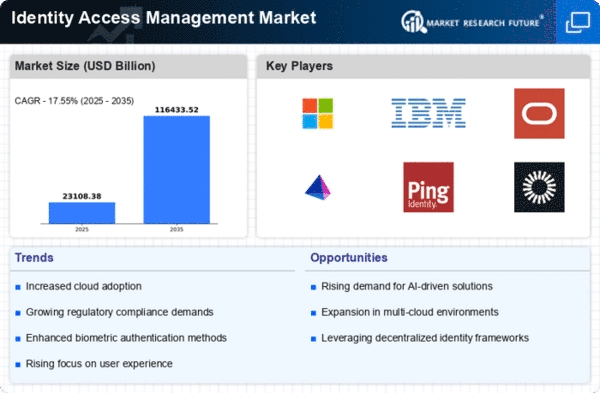
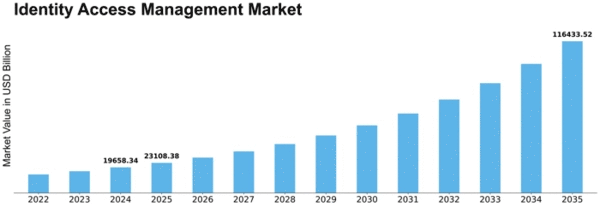
As per MRFR analysis, the Identity Access Management Market Size was estimated at 19658.34 USD Billion in 2024. The Identity Access Management industry is projected to grow from 23108.77 USD Billion in 2025 to 116433.52 USD Billion by 2035, exhibiting a compound annual growth rate (CAGR) of 17.55 during the forecast period 2025 - 2035.

Key Market Trends & Highlights

The Identity Access Management Market is experiencing robust growth driven by technological advancements and evolving security needs.

  • North America remains the largest market for Identity Access Management solutions, reflecting a strong demand for security and compliance.
  • The Asia-Pacific region is emerging as the fastest-growing market, fueled by increasing digital transformation initiatives.
  • Single Sign-On continues to dominate as the largest segment, while Multi-Factor Authentication is rapidly gaining traction as the fastest-growing segment.
  • Rising cybersecurity threats and regulatory compliance requirements are key drivers propelling the market forward.

Market Size & Forecast

2024 Market Size 19658.34 (USD Billion)
2035 Market Size 116433.52 (USD Billion)
CAGR (2025 - 2035) 17.55%
Largest Regional Market Share in 2024 North America

Major Players

Microsoft (US), IBM (US), Oracle (US), SailPoint (US), Ping Identity (US), Okta (US), CyberArk (IL), ForgeRock (US), Duo Security (US)

Market Trends

The Identity Access Management Market is currently experiencing a transformative phase, driven by the increasing need for robust security measures and regulatory compliance across various sectors. Organizations are recognizing the necessity of safeguarding sensitive information, which has led to a surge in the adoption of advanced identity management solutions. This market is characterized by a diverse range of offerings, including single sign-on, multi-factor authentication, and identity governance, all aimed at enhancing user experience while ensuring security. As digital transformation accelerates, the demand for seamless integration of identity management systems with existing IT infrastructure is becoming more pronounced. Moreover, the rise of remote work and cloud-based applications has further propelled the need for effective identity access solutions. Companies are now prioritizing the implementation of comprehensive identity management strategies to mitigate risks associated with unauthorized access and data breaches. This evolving landscape suggests that the Identity Access Management Market will continue to expand, with innovations in artificial intelligence and machine learning likely to play a pivotal role in shaping future developments. Organizations that adapt to these changes may find themselves better positioned to navigate the complexities of identity management in an increasingly digital world.

Increased Focus on Compliance and Regulations

Organizations are placing greater emphasis on adhering to compliance standards and regulations, which is driving the demand for identity access management solutions. This trend reflects a broader recognition of the importance of protecting sensitive data and maintaining customer trust.

Integration of Artificial Intelligence

The incorporation of artificial intelligence into identity access management systems is becoming more prevalent. AI technologies enhance security measures by enabling predictive analytics and automating threat detection, thereby improving overall system efficiency.

Shift Towards Cloud-Based Solutions

There is a noticeable shift towards cloud-based identity access management solutions as organizations seek flexibility and scalability. This trend allows businesses to manage identities more effectively while reducing the burden of on-premises infrastructure.

Identity Access Management Market Market Drivers

Market Growth Projections

The Global Identity and Access Management Market Industry is poised for substantial growth, with projections indicating a market size of 17.1 USD Billion in 2024 and an anticipated increase to 40 USD Billion by 2035. This growth trajectory reflects a compound annual growth rate (CAGR) of 8.04% from 2025 to 2035. The increasing adoption of IAM solutions across various sectors, driven by factors such as cybersecurity threats, regulatory compliance, and technological advancements, underscores the market's potential. As organizations continue to prioritize identity and access management, the industry is expected to evolve significantly, presenting opportunities for innovation and investment.

Rising Cybersecurity Threats

The increasing frequency and sophistication of cyber threats is a primary driver for the Global Identity and Access Management Market Industry. Organizations are compelled to adopt robust IAM solutions to protect sensitive data and ensure compliance with regulations. For instance, the rise in data breaches has led to a heightened focus on identity verification and access controls. In 2024, the market is projected to reach 17.1 USD Billion, reflecting the urgent need for enhanced security measures. This trend is expected to continue as organizations prioritize safeguarding their digital assets, thereby fueling growth in the IAM sector.

Adoption of Cloud-Based Solutions

The shift towards cloud computing is reshaping the Global Identity and Access Management Market Industry. Organizations are increasingly adopting cloud-based IAM solutions due to their scalability, flexibility, and cost-effectiveness. These solutions enable businesses to manage user identities and access rights more efficiently, particularly in remote work environments. The growing demand for cloud services is expected to drive the IAM market, with a projected CAGR of 8.04% from 2025 to 2035. As companies migrate to the cloud, the need for robust IAM solutions becomes paramount, further propelling market growth.

Regulatory Compliance Requirements

Stringent regulatory frameworks across various sectors are significantly influencing the Global Identity and Access Management Market Industry. Compliance with regulations such as GDPR and HIPAA necessitates organizations to implement effective IAM solutions to manage user identities and access rights. Failure to comply can result in severe penalties, prompting businesses to invest in IAM technologies. As a result, the market is anticipated to grow substantially, with projections indicating a rise to 40 USD Billion by 2035. This regulatory landscape creates a compelling case for organizations to enhance their IAM capabilities, ensuring they meet compliance standards while protecting sensitive information.

Integration of Artificial Intelligence

The integration of artificial intelligence into IAM solutions is emerging as a transformative driver within the Global Identity and Access Management Market Industry. AI technologies enhance identity verification processes, enabling organizations to detect anomalies and potential security threats in real-time. This capability is particularly vital in an era where cyber threats are increasingly sophisticated. As businesses recognize the value of AI-driven IAM solutions, the market is likely to experience significant growth. The combination of AI and IAM not only improves security but also streamlines user access management, making it a critical focus for organizations moving forward.

Growing Demand for User-Centric Experiences

The Global Identity and Access Management Market Industry is witnessing a shift towards user-centric IAM solutions. Organizations are increasingly prioritizing seamless user experiences while maintaining security protocols. This trend is driven by the need to enhance customer satisfaction and engagement in a competitive landscape. As businesses strive to provide intuitive access management solutions, the demand for IAM technologies that balance security and user experience is on the rise. This focus on user-centric design is likely to contribute to the overall growth of the IAM market, as organizations seek to create secure yet accessible environments for their users.

Market Segment Insights

By Application: Single Sign-On (Largest) vs. Multi-Factor Authentication (Fastest-Growing)

In the Identity Access Management Market, Single Sign-On (SSO) currently holds the largest market share due to its ability to enhance user experience by allowing individuals to access multiple applications with a single set of credentials. Following closely is Multi-Factor Authentication (MFA), which is gaining traction as organizations prioritize security in access management, especially in light of increasing cyber threats. Identity Governance, Access Management, and Privileged Access Management are also essential components but command smaller portions of the overall market share. MFA is particularly becoming vital as data breaches rise, prompting companies to adopt robust security measures.

Access Management: Single Sign-On (Dominant) vs. Multi-Factor Authentication (Emerging)

Single Sign-On (SSO) solutions dominate the Identity Access Management Market due to their convenience and efficiency, allowing seamless access to various applications with one login. This is appealing for both enterprises and users, driving widespread adoption. In comparison, Multi-Factor Authentication (MFA) is emerging rapidly as organizations seek enhanced security protocols that require multiple verification methods, addressing vulnerabilities in traditional passwords. The shift towards cloud services and remote work has accelerated the need for both SSO and MFA, making them complementary components in securing access and improving user satisfaction without compromising security.

By Deployment Type: Cloud-Based (Largest) vs. On-Premises (Fastest-Growing)

In the Identity Access Management (IAM) market, the cloud-based deployment model currently dominates the landscape, providing flexibility and scalability that many organizations seek in modern security solutions. On-premises solutions, while still relevant, hold a smaller market share but are experiencing a resurgence as companies reinforce their in-house data security systems. Hybrid deployment is also gaining traction, providing businesses with the ability to leverage both cloud and on-premises systems for enhanced security and compliance.

Cloud-Based (Dominant) vs. On-Premises (Emerging)

As the dominant deployment model in the Identity Access Management market, cloud-based solutions offer unparalleled advantages, including ease of access and integration with other cloud services. Organizations are increasingly adopting them due to their cost-effectiveness and rapid deployment capabilities. On-premises solutions, while traditionally seen as more secure due to direct control over data, are becoming an emerging preference for firms prioritizing stringent compliance and security measures. The flexibility of hybrid solutions is also appealing, particularly for those who wish to customize their IAM implementations according to their unique business needs.

By End User: BFSI (Largest) vs. Healthcare (Fastest-Growing)

The Identity Access Management (IAM) market is significantly influenced by its end users, with the Banking, Financial Services, and Insurance (BFSI) sector leading the market due to the critical need for stringent security protocols and regulatory compliance. This sector's robust demand for identity verification and access control solutions underscores its significant market share, driving sustained investment in IAM technologies. Conversely, the healthcare sector is rapidly expanding its share in the IAM market, propelled by an increasing reliance on digital solutions for patient data management and stringent regulatory requirements surrounding data privacy, showcasing a shift towards integrated IAM solutions.

BFSI: Dominant vs. Healthcare: Emerging

The BFSI sector stands as the dominant player in the Identity Access Management market, characterized by high-security demands and the necessity for regulatory compliance, which requires sophisticated IAM solutions to protect sensitive financial data and maintain customer trust. In contrast, the healthcare sector, while emerging, is quickly gaining ground as it faces unique challenges in managing patient information and ensuring compliance with regulations such as HIPAA. The increasing adoption of digital health solutions and telemedicine compels healthcare providers to invest in IAM systems that facilitate secure access to critical information while maintaining patient confidentiality.

By Organization Size: Small Enterprises (Largest) vs. Large Enterprises (Fastest-Growing)

In the Identity Access Management Market, the distribution of market share among organization sizes reveals that small enterprises hold the largest proportion, capitalizing on cost-effective solutions that cater to their operational needs. Conversely, large enterprises, while smaller in share, represent a rapidly growing segment as they invest heavily in comprehensive IAM solutions to address complex security requirements in their expansive environments. Growth trends in this segment indicate that small enterprises continue to upgrade their IAM capabilities as they scale, seeking solutions that balance affordability with functionality. On the other hand, the large enterprises segment is witnessing significant growth driven by increasing regulatory compliance demands and the need for advanced security measures, positioning them to better protect sensitive data from evolving threats.

Small Enterprises: Dominant vs. Large Enterprises: Emerging

Small enterprises in the Identity Access Management Market are characterized by their growing adoption of scalable and budget-friendly IAM solutions, enabling them to protect sensitive data efficiently without overspending. They typically seek user-friendly solutions that offer essential features like single sign-on and multi-factor authentication. Conversely, large enterprises are emerging as powerful players in the market as they undergo digital transformation and pursue initiatives to enhance security frameworks. With complex IT infrastructures and a larger attack surface, these organizations prioritize advanced IAM technologies that support extensive access controls and real-time monitoring capabilities, highlighting their need for tailored solutions that can handle demanding security challenges.

By Component: Software (Largest) vs. Services (Fastest-Growing)

In the Identity Access Management (IAM) Market, the component segment is primarily composed of Software, Services, and Solutions. Among these, Software holds the largest market share due to its critical role in enforcing access policies and ensuring data security across various platforms. Services, on the other hand, while holding a smaller share, encompass essential support and strategic consulting that organizations increasingly require, reflecting a diversification of demand in IAM implementations. The growth trends in the IAM component segment indicate a shift towards integrated solutions, with Software leading the charge as organizations prioritize automation and real-time monitoring. Services are experiencing rapid growth propelled by the rising complexities of cybersecurity threats and regulatory compliance needs, driving organizations to seek expert guidance and support for effective IAM strategies.

Services: Support (Dominant) vs. Solutions (Emerging)

In the IAM market, the comparison between Support Services, regarded as Dominant, and Solutions, identified as Emerging, reveals diverse strategic focuses. Support Services are vital, encompassing installation, maintenance, and ongoing assistance, which facilitate uninterrupted operational continuity and enhance user adoption rates. As organizations strive for refined user experiences and security protocols, the demand for these services intensifies. Conversely, emerging Solutions are innovative offerings designed to address specific challenges such as identity governance and privileged access management. These solutions are gaining traction, reflecting a trend towards tailored offerings that meet varied organizational needs in an ever-evolving digital landscape.

Get more detailed insights about Identity and Access Management Market Research Report - Global Forecast 2035

Regional Insights

The Identity and Access Management Market experienced substantial growth. North America held a majority share, valued at 7.2 USD Billion in 2024, and is projected to grow to 17.0 USD Billion by 2035. This region was significant due to its advanced technological infrastructure and increasing regulatory compliance requirements, which drive the demand for robust identity and access management solutions.

Europe followed with a valuation of 4.8 USD Billion in 2024, increasing to 10.5 USD Billion by 2035, as organizations strived to enhance their cybersecurity frameworks in response to stringent data protection laws.In South America, the market stood at 1.2 USD Billion in 2024 and is expected to reach 3.0 USD Billion by 2035, indicating a growing recognition of the need for enhanced security measures in digital identity management. The Asia Pacific region, valued at 3.6 USD Billion in 2024, reflected increasing investments in digital transformation initiatives, projected to grow to 7.0 USD Billion by 2035.

Lastly, the Middle East and Africa, while valued at 0.28 USD Billion in 2024, is anticipated to experience significant growth to 2.5 USD Billion by 2035, driven by the rising demand for cloud-based solutions and heightened awareness about cybersecurity threats.Overall, the Identity and Access Management Market segmentation highlighted regional disparities, with North America dominating, and all regions expected to benefit from digital transformation efforts.

Key Players and Competitive Insights

The Identity Access Management Market is currently characterized by a dynamic competitive landscape, driven by the increasing need for robust security measures and regulatory compliance across various sectors. Major players such as Microsoft (US), IBM (US), and Okta (US) are strategically positioning themselves through innovation and partnerships. Microsoft (US) focuses on integrating AI capabilities into its identity solutions, enhancing user experience and security. IBM (US) emphasizes its hybrid cloud offerings, which allow for seamless identity management across diverse environments. Okta (US) continues to expand its ecosystem through strategic partnerships, thereby enhancing its service offerings and market reach. Collectively, these strategies contribute to a competitive environment that is increasingly focused on technological advancement and customer-centric solutions.Key business tactics within the Identity Access Management Market include localized service offerings and supply chain optimization, which are essential for meeting the diverse needs of global clients. The market structure appears moderately fragmented, with a mix of established players and emerging startups. This fragmentation allows for a variety of solutions tailored to specific industry requirements, while the influence of key players like Microsoft (US) and IBM (US) helps to set industry standards and drive innovation.

In November Microsoft (US) announced the launch of its new AI-driven identity verification tool, which aims to streamline user authentication processes while enhancing security measures. This strategic move is significant as it not only reinforces Microsoft's commitment to innovation but also positions the company as a leader in the integration of AI within identity management solutions. The tool is expected to attract a wide range of clients seeking to bolster their security frameworks in an increasingly digital world.

In October IBM (US) unveiled its latest cloud-based identity management platform, designed to facilitate secure access across hybrid environments. This development is crucial as it addresses the growing demand for flexible and secure identity solutions, particularly among enterprises transitioning to cloud infrastructures. By enhancing its cloud capabilities, IBM (US) is likely to strengthen its competitive position and appeal to organizations looking for comprehensive identity management solutions.

In September Okta (US) expanded its partnership with a leading cybersecurity firm to enhance its identity protection services. This collaboration is indicative of a broader trend towards strategic alliances in the market, as companies seek to combine their strengths to offer more robust solutions. Such partnerships not only enhance service offerings but also enable companies to leverage each other's expertise, thereby fostering innovation and improving customer satisfaction.

As of December current competitive trends in the Identity Access Management Market include a pronounced focus on digitalization, AI integration, and sustainability. The shift towards strategic alliances is reshaping the landscape, as companies recognize the value of collaboration in driving innovation. Looking ahead, competitive differentiation is likely to evolve from traditional price-based competition to a focus on technological innovation, reliability, and the ability to provide tailored solutions that meet the unique needs of clients.

Key Companies in the Identity Access Management Market include

Industry Developments

By including support for passwordless authentication, identity federation across hybrid environments, and increased mainframe access restrictions for companies, Broadcom improved its Identity and Access Management (IAM) capabilities in 2024.After being purchased by Thoma Bravo, ForgeRock formally joined with Ping identification in August 2023 to create a unified IAM powerhouse that specializes in worker and customer identification solutions.

In April 2025, SailPoint Technologies released a significant upgrade to its Identity Security Cloud that included machine identity governance, AI-driven identity security, and more extensive data access restrictions. Additionally, it obtained GovRAMP authorization in June 2025 and grew its Success Acceleration Partner and managed service provider (MSP) programs.

With the release of Identity Security Platform V23.4 in early 2024, CyberArk further solidified its position as a pioneer in privileged access management by integrating cloud workload identity support and Zero Trust architecture.In December 2023, Okta introduced new lifecycle automation tools to streamline access provisioning for hybrid workforces and purchased Israeli company Spera to improve its identity governance capabilities.

Future Outlook

Identity Access Management Market Future Outlook

The Identity Access Management Market is projected to grow at a 17.55% CAGR from 2025 to 2035, driven by increasing cybersecurity threats, regulatory compliance, and digital transformation initiatives.

New opportunities lie in:

  • Integration of AI-driven identity verification solutions
  • Expansion of cloud-based IAM services for SMEs
  • Development of biometric authentication technologies for enhanced security

By 2035, the market is expected to be robust, reflecting substantial growth and innovation.

Market Segmentation

Identity Access Management Market End User Outlook

  • BFSI
  • Healthcare
  • Government
  • Retail
  • IT and Telecom

Identity Access Management Market Component Outlook

  • Solutions
  • Services
  • Software

Identity Access Management Market Application Outlook

  • Single Sign-On
  • Multi-Factor Authentication
  • Identity Governance
  • Access Management
  • Privileged Access Management

Identity Access Management Market Deployment Type Outlook

  • Cloud-Based
  • On-Premises
  • Hybrid

Identity Access Management Market Organization Size Outlook

  • Small Enterprises
  • Medium Enterprises
  • Large Enterprises

Report Scope

MARKET SIZE 202419658.34(USD Billion)
MARKET SIZE 202523108.77(USD Billion)
MARKET SIZE 2035116433.52(USD Billion)
COMPOUND ANNUAL GROWTH RATE (CAGR)17.55% (2025 - 2035)
REPORT COVERAGERevenue Forecast, Competitive Landscape, Growth Factors, and Trends
BASE YEAR2024
Market Forecast Period2025 - 2035
Historical Data2019 - 2024
Market Forecast UnitsUSD Billion
Key Companies ProfiledMicrosoft (US), IBM (US), Oracle (US), SailPoint (US), Ping Identity (US), Okta (US), CyberArk (IL), ForgeRock (US), Duo Security (US)
Segments CoveredApplication, Deployment Type, End User, Organization Size, Component
Key Market OpportunitiesIntegration of artificial intelligence enhances security and user experience in the Identity Access Management Market.
Key Market DynamicsRising regulatory compliance requirements drive demand for advanced Identity Access Management solutions across various sectors.
Countries CoveredNorth America, Europe, APAC, South America, MEA

FAQs

What was the market size of the Identity and Access Management Market in 2024?

The Identity and Access Management Market was valued at 17.08 USD Billion in 2024.

What is the projected market growth rate from 2025 to 2035?

The market is expected to grow at a Compound Annual Growth Rate (CAGR) of 8.04% during the period from 2025 to 2035.

Which region is anticipated to have the highest market value in 2035?

North America is projected to have the highest market value, estimated at 17.0 USD Billion in 2035.

What was the market size of the Cloud-Based segment in 2024?

The Cloud-Based segment of the Identity and Access Management Market was valued at 7.5 USD Billion in 2024.

Who are the major players in the Identity and Access Management Market?

Key players in the market include Broadcom, ForgeRock, SailPoint Technologies, Oracle, and Microsoft.

What is the expected market value for the Hybrid segment by 2035?

The Hybrid segment is projected to reach a value of 7.5 USD Billion by 2035.

How is the Identity and Access Management Market segmented by deployment type?

The market is segmented into On-Premises, Cloud-Based, and Hybrid deployment types.

What was the market size of Europe in 2024?

Europe held a market size of 4.8 USD Billion in 2024.

Which segment is expected to witness the most significant growth between 2025 and 2035?

The Cloud-Based segment is anticipated to witness significant growth, reaching 17.5 USD Billion by 2035.

What challenges might impact the Identity and Access Management Market?

Challenges may include rapid technological changes and evolving cybersecurity threats in the market.

  1. SECTION I: EXECUTIVE SUMMARY AND KEY HIGHLIGHTS
    1. | 1.1 EXECUTIVE SUMMARY
    2. | 1.1.1 Market Overview
    3. | 1.1.2 Key Findings
    4. | 1.1.3 Market Segmentation
    5. | 1.1.4 Competitive Landscape
    6. | 1.1.5 Challenges and Opportunities
    7. | 1.1.6 Future Outlook
  2. SECTION II: SCOPING, METHODOLOGY AND MARKET STRUCTURE
    1. | 2.1 MARKET INTRODUCTION
    2. | 2.1.1 Definition
    3. | 2.1.2 Scope of the study
    4. |-- 2.1.2.1 Research Objective
    5. |-- 2.1.2.2 Assumption
    6. |-- 2.1.2.3 Limitations
    7. | 2.2 RESEARCH METHODOLOGY
    8. | 2.2.1 Overview
    9. | 2.2.2 Data Mining
    10. | 2.2.3 Secondary Research
    11. | 2.2.4 Primary Research
    12. |-- 2.2.4.1 Primary Interviews and Information Gathering Process
    13. |-- 2.2.4.2 Breakdown of Primary Respondents
    14. | 2.2.5 Forecasting Model
    15. | 2.2.6 Market Size Estimation
    16. |-- 2.2.6.1 Bottom-Up Approach
    17. |-- 2.2.6.2 Top-Down Approach
    18. | 2.2.7 Data Triangulation
    19. | 2.2.8 Validation
  3. SECTION III: QUALITATIVE ANALYSIS
    1. | 3.1 MARKET DYNAMICS
    2. | 3.1.1 Overview
    3. | 3.1.2 Drivers
    4. | 3.1.3 Restraints
    5. | 3.1.4 Opportunities
    6. | 3.2 MARKET FACTOR ANALYSIS
    7. | 3.2.1 Value chain Analysis
    8. | 3.2.2 Porter's Five Forces Analysis
    9. |-- 3.2.2.1 Bargaining Power of Suppliers
    10. |-- 3.2.2.2 Bargaining Power of Buyers
    11. |-- 3.2.2.3 Threat of New Entrants
    12. |-- 3.2.2.4 Threat of Substitutes
    13. |-- 3.2.2.5 Intensity of Rivalry
    14. | 3.2.3 COVID-19 Impact Analysis
    15. |-- 3.2.3.1 Market Impact Analysis
    16. |-- 3.2.3.2 Regional Impact
    17. |-- 3.2.3.3 Opportunity and Threat Analysis
  4. SECTION IV: QUANTITATIVE ANALYSIS
    1. | 4.1 Information and Communications Technology, BY Application (USD Billion)
    2. | 4.1.1 Single Sign-On
    3. | 4.1.2 Multi-Factor Authentication
    4. | 4.1.3 Identity Governance
    5. | 4.1.4 Access Management
    6. | 4.1.5 Privileged Access Management
    7. | 4.2 Information and Communications Technology, BY Deployment Type (USD Billion)
    8. | 4.2.1 Cloud-Based
    9. | 4.2.2 On-Premises
    10. | 4.2.3 Hybrid
    11. | 4.3 Information and Communications Technology, BY End User (USD Billion)
    12. | 4.3.1 BFSI
    13. | 4.3.2 Healthcare
    14. | 4.3.3 Government
    15. | 4.3.4 Retail
    16. | 4.3.5 IT and Telecom
    17. | 4.4 Information and Communications Technology, BY Organization Size (USD Billion)
    18. | 4.4.1 Small Enterprises
    19. | 4.4.2 Medium Enterprises
    20. | 4.4.3 Large Enterprises
    21. | 4.5 Information and Communications Technology, BY Component (USD Billion)
    22. | 4.5.1 Solutions
    23. | 4.5.2 Services
    24. | 4.5.3 Software
    25. | 4.6 Information and Communications Technology, BY Region (USD Billion)
    26. | 4.6.1 North America
    27. |-- 4.6.1.1 US
    28. |-- 4.6.1.2 Canada
    29. | 4.6.2 Europe
    30. |-- 4.6.2.1 Germany
    31. |-- 4.6.2.2 UK
    32. |-- 4.6.2.3 France
    33. |-- 4.6.2.4 Russia
    34. |-- 4.6.2.5 Italy
    35. |-- 4.6.2.6 Spain
    36. |-- 4.6.2.7 Rest of Europe
    37. | 4.6.3 APAC
    38. |-- 4.6.3.1 China
    39. |-- 4.6.3.2 India
    40. |-- 4.6.3.3 Japan
    41. |-- 4.6.3.4 South Korea
    42. |-- 4.6.3.5 Malaysia
    43. |-- 4.6.3.6 Thailand
    44. |-- 4.6.3.7 Indonesia
    45. |-- 4.6.3.8 Rest of APAC
    46. | 4.6.4 South America
    47. |-- 4.6.4.1 Brazil
    48. |-- 4.6.4.2 Mexico
    49. |-- 4.6.4.3 Argentina
    50. |-- 4.6.4.4 Rest of South America
    51. | 4.6.5 MEA
    52. |-- 4.6.5.1 GCC Countries
    53. |-- 4.6.5.2 South Africa
    54. |-- 4.6.5.3 Rest of MEA
  5. SECTION V: COMPETITIVE ANALYSIS
    1. | 5.1 Competitive Landscape
    2. | 5.1.1 Overview
    3. | 5.1.2 Competitive Analysis
    4. | 5.1.3 Market share Analysis
    5. | 5.1.4 Major Growth Strategy in the Information and Communications Technology
    6. | 5.1.5 Competitive Benchmarking
    7. | 5.1.6 Leading Players in Terms of Number of Developments in the Information and Communications Technology
    8. | 5.1.7 Key developments and growth strategies
    9. |-- 5.1.7.1 New Product Launch/Service Deployment
    10. |-- 5.1.7.2 Merger & Acquisitions
    11. |-- 5.1.7.3 Joint Ventures
    12. | 5.1.8 Major Players Financial Matrix
    13. |-- 5.1.8.1 Sales and Operating Income
    14. |-- 5.1.8.2 Major Players R&D Expenditure. 2023
    15. | 5.2 Company Profiles
    16. | 5.2.1 Microsoft (US)
    17. |-- 5.2.1.1 Financial Overview
    18. |-- 5.2.1.2 Products Offered
    19. |-- 5.2.1.3 Key Developments
    20. |-- 5.2.1.4 SWOT Analysis
    21. |-- 5.2.1.5 Key Strategies
    22. | 5.2.2 IBM (US)
    23. |-- 5.2.2.1 Financial Overview
    24. |-- 5.2.2.2 Products Offered
    25. |-- 5.2.2.3 Key Developments
    26. |-- 5.2.2.4 SWOT Analysis
    27. |-- 5.2.2.5 Key Strategies
    28. | 5.2.3 Oracle (US)
    29. |-- 5.2.3.1 Financial Overview
    30. |-- 5.2.3.2 Products Offered
    31. |-- 5.2.3.3 Key Developments
    32. |-- 5.2.3.4 SWOT Analysis
    33. |-- 5.2.3.5 Key Strategies
    34. | 5.2.4 SailPoint (US)
    35. |-- 5.2.4.1 Financial Overview
    36. |-- 5.2.4.2 Products Offered
    37. |-- 5.2.4.3 Key Developments
    38. |-- 5.2.4.4 SWOT Analysis
    39. |-- 5.2.4.5 Key Strategies
    40. | 5.2.5 Ping Identity (US)
    41. |-- 5.2.5.1 Financial Overview
    42. |-- 5.2.5.2 Products Offered
    43. |-- 5.2.5.3 Key Developments
    44. |-- 5.2.5.4 SWOT Analysis
    45. |-- 5.2.5.5 Key Strategies
    46. | 5.2.6 Okta (US)
    47. |-- 5.2.6.1 Financial Overview
    48. |-- 5.2.6.2 Products Offered
    49. |-- 5.2.6.3 Key Developments
    50. |-- 5.2.6.4 SWOT Analysis
    51. |-- 5.2.6.5 Key Strategies
    52. | 5.2.7 CyberArk (IL)
    53. |-- 5.2.7.1 Financial Overview
    54. |-- 5.2.7.2 Products Offered
    55. |-- 5.2.7.3 Key Developments
    56. |-- 5.2.7.4 SWOT Analysis
    57. |-- 5.2.7.5 Key Strategies
    58. | 5.2.8 ForgeRock (US)
    59. |-- 5.2.8.1 Financial Overview
    60. |-- 5.2.8.2 Products Offered
    61. |-- 5.2.8.3 Key Developments
    62. |-- 5.2.8.4 SWOT Analysis
    63. |-- 5.2.8.5 Key Strategies
    64. | 5.2.9 Duo Security (US)
    65. |-- 5.2.9.1 Financial Overview
    66. |-- 5.2.9.2 Products Offered
    67. |-- 5.2.9.3 Key Developments
    68. |-- 5.2.9.4 SWOT Analysis
    69. |-- 5.2.9.5 Key Strategies
    70. | 5.3 Appendix
    71. | 5.3.1 References
    72. | 5.3.2 Related Reports

Information and Communications Technology Market Segmentation

Information and Communications Technology By Application (USD Billion, 2025-2035)

  • Single Sign-On
  • Multi-Factor Authentication
  • Identity Governance
  • Access Management
  • Privileged Access Management

Information and Communications Technology By Deployment Type (USD Billion, 2025-2035)

  • Cloud-Based
  • On-Premises
  • Hybrid

Information and Communications Technology By End User (USD Billion, 2025-2035)

  • BFSI
  • Healthcare
  • Government
  • Retail
  • IT and Telecom

Information and Communications Technology By Organization Size (USD Billion, 2025-2035)

  • Small Enterprises
  • Medium Enterprises
  • Large Enterprises

Information and Communications Technology By Component (USD Billion, 2025-2035)

  • Solutions
  • Services
  • Software
Infographic

Free Sample Request

Kindly complete the form below to receive a free sample of this Report

Get Free Sample

Customer Strories

Compare Licence

×
Features License Type
Single User Multiuser License Enterprise User
Price $4,950 $5,950 $7,250
Maximum User Access Limit 1 User Upto 10 Users Unrestricted Access Throughout the Organization
Free Customization
Direct Access to Analyst
Deliverable Format
Platform Access
Discount on Next Purchase 10% 15% 15%
Printable Versions