Request Free Sample ×

Kindly complete the form below to receive a free sample of this Report

* Please use a valid business email

Leading companies partner with us for data-driven Insights

clients tt-cursor
Hero Background
English
Chinese
French
Japanese
Korean
German
Spanish

Hybrid Fabric Market Share

ID: MRFR/CnM/6172-HCR
140 Pages
Chitranshi Jaiswal
March 2026

Hybrid Fabric Market Research Report Information by Combination (Carbon-Aramid, Aramid-Glass, Carbon-Glass, Carbon-UHMWPE), Form (Composite, Non-Composite), End-Use Industry (Automotive, Aerospace & Defense, Wind Energy, Consumer Goods) and Region - Forecast to 2035

Share:
Download PDF ×

We do not share your information with anyone. However, we may send you emails based on your report interest from time to time. You may contact us at any time to opt-out.

Hybrid Fabric Market Infographic
Purchase Options

Market Share

Hybrid Fabric Market Share Analysis

Market share positioning strategies in the Hybrid Fabric Market involve various approaches aimed at capturing a significant portion of the market and establishing a competitive edge. One strategy is differentiation, where companies focus on creating unique hybrid fabric products that stand out from competitors. This could involve incorporating innovative technologies, such as advanced materials or manufacturing processes, to enhance product performance or features. By offering something distinct, companies can attract customers who are looking for specific benefits not available from other products in the market.

The Hybrid Fabrics are mainly manufactured by using different combinations of carbon, aramid, glass and other high-strength fibers in the form of layers. These fabrics are primarily differentiated from the other fibers and fabrics on the basis of the special technical functions that require specific performance properties such as high strength and durability, excellent resistance to heat, flame and chemical agents.

Another key strategy is pricing. Companies may choose to position themselves as cost leaders by offering hybrid fabric products at lower prices compared to competitors. This approach can help capture price-sensitive customers and gain market share by appealing to budget-conscious consumers. Alternatively, companies may opt for a premium pricing strategy, positioning their products as high-end or luxury options with superior quality or design. By targeting niche markets willing to pay a premium for perceived value, companies can carve out a profitable segment of the market.

Distribution channels also play a crucial role in market share positioning. Companies may focus on expanding their reach by partnering with distributors or retailers to ensure widespread availability of their hybrid fabric products. This strategy helps increase accessibility and convenience for customers, making it easier for them to purchase the products. Additionally, companies may invest in online platforms and e-commerce channels to tap into the growing trend of online shopping and reach customers beyond traditional brick-and-mortar stores.

Marketing and branding are essential components of market share positioning strategies. Companies need to effectively communicate the value proposition of their hybrid fabric products to target customers. This involves developing strong branding strategies that resonate with the target audience and differentiate the products from competitors. Marketing efforts may include advertising campaigns, social media engagement, and influencer partnerships to raise awareness and generate interest in the products.

Furthermore, companies can leverage partnerships and collaborations to strengthen their market position. This could involve collaborating with other industry players, such as textile manufacturers or fashion designers, to create co-branded hybrid fabric products or collections. By leveraging the expertise and reputation of partners, companies can enhance their credibility and appeal to a wider audience. Strategic alliances can also facilitate access to new markets or distribution channels, driving growth and increasing market share.

Innovation is another key driver of market share positioning in the hybrid fabric market. Companies must continually invest in research and development to stay ahead of competitors and meet evolving customer demands. This could involve developing new materials, improving production processes, or introducing novel product features that address emerging trends or customer preferences. By innovating continuously, companies can maintain their relevance in the market and attract customers seeking cutting-edge solutions.

Overall, market share positioning in the hybrid fabric market requires a multifaceted approach that encompasses product differentiation, pricing strategies, distribution channels, marketing and branding efforts, partnerships, and innovation. By strategically implementing these strategies, companies can strengthen their competitive position, capture market share, and achieve long-term success in the dynamic and rapidly evolving hybrid fabric industry.


Author
Author Profile
Chitranshi Jaiswal
Team Lead - Research

Chitranshi is a Team Leader in the Chemicals & Materials (CnM) and Energy & Power (EnP) domains, with 6+ years of experience in market research. She leads and mentors teams to deliver cross-domain projects that equip clients with actionable insights and growth strategies. She is skilled in market estimation, forecasting, competitive benchmarking, and both primary & secondary research, enabling her to turn complex data into decision-ready insights. An engineer and MBA professional, she combines technical expertise with strategic acumen to solve dynamic market challenges. Chitranshi has successfully managed projects that support market entry, investment planning, and competitive positioning, while building strong client relationships. Certified in Advanced Excel & Power BI she leverages data-driven approaches to ensure accuracy, clarity, and impactful outcomes.

Leave a Comment

FAQs

What is the projected market valuation of the Hybrid Fabric Market by 2035?

<p>The projected market valuation of the Hybrid Fabric Market is 36.05 USD Million by 2035.</p>

What was the overall market valuation of the Hybrid Fabric Market in 2024?

<p>The overall market valuation of the Hybrid Fabric Market was 5.8 USD Million in 2024.</p>

What is the expected CAGR for the Hybrid Fabric Market during the forecast period 2025 - 2035?

<p>The expected CAGR for the Hybrid Fabric Market during the forecast period 2025 - 2035 is 18.08%.</p>

Which companies are considered key players in the Hybrid Fabric Market?

<p>Key players in the Hybrid Fabric Market include Toray Industries, BASF SE, DuPont de Nemours, Inc., and others.</p>

What are the main applications of hybrid fabrics in the market?

<p>Main applications of hybrid fabrics include Automotive, Aerospace, Industrial, Consumer Goods, and Medical.</p>

How do hybrid fabrics perform in the textiles segment?

In the textiles segment, hybrid fabrics are valued at 9.0 USD Million, indicating strong market performance.

What functionalities are offered by hybrid fabrics?

Hybrid fabrics offer functionalities such as water resistance, fire resistance, UV protection, breathability, and durability.

What is the valuation of hybrid fibers in the material type segment?

The valuation of hybrid fibers in the material type segment is 9.35 USD Million.

How does the manufacturing process impact the hybrid fabric market?

The manufacturing process, including weaving and knitting, contributes significantly to the market, with weaving valued at 9.5 USD Million.

What trends are emerging in the hybrid fabric market by end use?

By end use, sportswear is projected to reach a valuation of 8.5 USD Million, reflecting growing consumer interest.

Market Summary

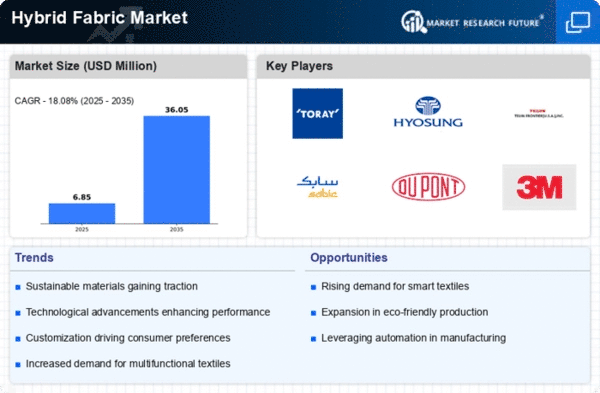
As per MRFR analysis, the Hybrid Fabric Market Size was estimated at 5.8 USD Million in 2024. The Hybrid Fabric industry is projected to grow from 6.84 in 2025 to 36.05 by 2035, exhibiting a compound annual growth rate (CAGR) of 18.08% during the forecast period 2025 - 2035.

Key Market Trends & Highlights

The Hybrid Fabric Market is poised for substantial growth driven by sustainability and technological advancements.

  • North America remains the largest market for hybrid fabrics, driven by robust demand in the automotive sector.
  • Asia-Pacific is emerging as the fastest-growing region, fueled by increasing investments in aerospace applications.
  • The clothing segment continues to dominate, while the protective gear segment is witnessing rapid growth due to heightened safety regulations.
  • Key market drivers include sustainability initiatives and rising demand in fashion and apparel, which are shaping industry dynamics.

Market Size & Forecast

2024 Market Size 5.8 (USD Million)
2035 Market Size 36.05 (USD Million)
CAGR (2025 - 2035) 18.08%
Largest Regional Market Share in 2024 North America

Major Players

Toray Industries (JP), Hyosung Corporation (KR), Teijin Limited (JP), SABIC (SA), DuPont (US), 3M (US), BASF (DE), Milliken & Company (US), W. L. Gore & Associates (US)

Market Trends

The Hybrid Fabric Market is currently experiencing a dynamic evolution, driven by a confluence of technological advancements and shifting consumer preferences. This sector encompasses a diverse range of materials that combine the properties of different fibers, resulting in fabrics that offer enhanced performance, durability, and aesthetic appeal. As sustainability becomes increasingly paramount, manufacturers are exploring eco-friendly options, integrating recycled materials, and adopting innovative production techniques. This trend not only caters to environmentally conscious consumers but also aligns with global initiatives aimed at reducing waste and promoting responsible consumption. Moreover, the Hybrid Fabric Market is witnessing a surge in demand across various applications, including automotive, aerospace, and fashion industries. The versatility of hybrid fabrics allows for their use in specialized products that require specific characteristics, such as lightweight yet strong materials for vehicle interiors or breathable fabrics for activewear. As the market continues to expand, collaboration between textile manufacturers and technology firms is likely to foster further innovation, leading to the development of smart fabrics that can respond to environmental stimuli. Overall, the Hybrid Fabric Market appears poised for substantial growth, driven by a blend of creativity, sustainability, and technological integration.

Sustainability Initiatives

The Hybrid Fabric Market is increasingly influenced by sustainability initiatives, as consumers demand eco-friendly products. Manufacturers are focusing on incorporating recycled materials and reducing waste in production processes. This shift not only meets consumer expectations but also aligns with global environmental goals.

Technological Advancements

Technological advancements are reshaping the Hybrid Fabric Market, enabling the creation of innovative materials with enhanced properties. Developments in fiber technology and production techniques allow for the production of fabrics that are lighter, stronger, and more versatile, catering to diverse applications.

Customization and Personalization

Customization and personalization trends are gaining traction within the Hybrid Fabric Market. Consumers are seeking unique products tailored to their preferences, prompting manufacturers to offer bespoke solutions. This trend enhances consumer engagement and fosters brand loyalty.

Hybrid Fabric Market Market Drivers

Market Growth Projections

The Global Hybrid Fabric Market Industry is poised for substantial growth, with projections indicating a market value of 844.8 USD Million by 2035. This anticipated growth reflects the increasing adoption of hybrid fabrics across various sectors, driven by their unique properties and versatility. The market is expected to expand at a compound annual growth rate of 19.15% from 2025 to 2035, highlighting the potential for innovation and diversification within the industry. Such growth projections underscore the importance of hybrid fabrics in meeting the evolving needs of consumers and industries alike.

Growing Fashion Industry Trends

The Global Hybrid Fabric Market Industry is significantly influenced by evolving trends within the fashion industry. As designers increasingly prioritize functionality alongside aesthetics, hybrid fabrics are becoming a staple in contemporary fashion. The ability to combine different fibers allows for the creation of unique textures and styles that appeal to modern consumers. This trend is evident in the rising popularity of athleisure and performance wear, which often utilize hybrid fabrics for their comfort and durability. As the fashion industry continues to embrace innovation, the demand for hybrid fabrics is likely to escalate, contributing to the overall market growth.

Rising Demand for Sustainable Textiles

The Global Hybrid Fabric Market Industry experiences a notable surge in demand for sustainable textiles, driven by increasing consumer awareness regarding environmental issues. As consumers become more conscious of their purchasing decisions, manufacturers are compelled to innovate and produce eco-friendly hybrid fabrics. This trend is reflected in the projected market value of 123.0 USD Million in 2024, as brands seek to align with sustainability goals. The integration of recycled materials and organic fibers into hybrid fabrics not only enhances their appeal but also contributes to a reduction in carbon footprint, thereby fostering a more sustainable textile industry.

Expanding Applications Across Industries

The versatility of hybrid fabrics is a key driver of growth within the Global Hybrid Fabric Market Industry. These fabrics find applications across various sectors, including automotive, aerospace, and healthcare, due to their unique properties such as durability, lightweight, and resistance to environmental factors. For instance, hybrid fabrics are increasingly utilized in the automotive industry for interior components, enhancing both aesthetics and functionality. This broad applicability suggests a robust market potential, with a projected compound annual growth rate of 19.15% from 2025 to 2035, indicating a sustained interest from diverse industries.

Technological Advancements in Fabric Production

Technological advancements play a pivotal role in the evolution of the Global Hybrid Fabric Market Industry. Innovations in weaving techniques and fiber technology enable the production of high-performance hybrid fabrics that cater to diverse applications, from fashion to industrial uses. The introduction of smart textiles, which incorporate sensors and electronics, exemplifies this trend. As these technologies become more accessible, manufacturers are likely to enhance product offerings, thereby attracting a broader consumer base. This technological evolution is expected to contribute to the market's growth trajectory, with projections indicating a significant increase in market value by 2035.

Increased Investment in Research and Development

Investment in research and development is crucial for the advancement of the Global Hybrid Fabric Market Industry. Companies are allocating substantial resources to explore new materials and production methods that enhance the performance and sustainability of hybrid fabrics. This focus on innovation not only drives product differentiation but also fosters competitive advantage in a rapidly evolving market. As a result, the industry is likely to witness a proliferation of novel hybrid fabric solutions that meet the changing demands of consumers and industries alike. Such investments are expected to yield significant returns, further propelling market growth.

Market Segment Insights

By Application: Automotive (Largest) vs. Aerospace (Fastest-Growing)

The Hybrid Fabric Market exhibits a diverse application landscape, with the automotive sector capturing the largest market share. Automakers are increasingly adopting hybrid fabrics due to their lightweight nature and enhanced performance characteristics, which are crucial for improving fuel efficiency and sustainability. In contrast, the aerospace sector is witnessing rapid growth as manufacturers explore new materials that can withstand high stress and varying temperatures while maintaining low weight, making it a fast-growing segment in this market.

Automotive: Dominant vs. Aerospace: Emerging

The automotive industry stands as the dominant player in the Hybrid Fabric Market, utilizing these advanced materials to enhance vehicle performance and reduce emissions. Hybrid fabrics are primarily integrated into vehicle interiors and structural components, contributing to safety and comfort. In contrast, the aerospace sector is emerging swiftly, driven by the push for innovative materials that can reduce aircraft weight while offering superior strength and durability. This trend is accelerating as aerospace manufacturers seek to meet stringent efficiency regulations and pursue sustainability initiatives. Both segments are positioned well within the market, catering to the evolving demands for performance, safety, and environmental responsibility.

By End Use: Textiles (Largest) vs. Sportswear (Fastest-Growing)

<p>In the Hybrid Fabric Market, the 'End Use' segment is characterized by a diverse array of applications, with textiles leading the way. Textiles account for the largest share of the market, driven by their adaptability and demand across various sectors. Following textiles, protective clothing and composite applications also contribute significantly, while emerging segments like <a href="https://www.marketresearchfuture.com/reports/sportswear-market-16113" target="_blank" title="sportswear">sportswear</a> are quickly gaining traction due to their innovative features and performance benefits. Home furnishings, while important, remain a smaller niche within this expansive market. The push for sustainability and enhanced performance fuels the growth of hybrid fabrics across segments. Sportswear is experiencing the fastest growth, as awareness of health and fitness rises. Innovations in fabric technology, combined with the demand for breathable, durable, and lightweight materials, further propel the expansion of hybrid fabrics across these end-use applications, solidifying their importance in various markets.</p>

<p>Textiles (Dominant) vs. Sportswear (Emerging)</p>

<p>Textiles remain the dominant segment in the Hybrid Fabric Market, underpinned by their versatility in applications ranging from fashion to industrial uses. This segment encompasses a wide range of materials that are increasingly being engineered to improve functionality, comfort, and sustainability. On the other hand, sportswear is emerging as a significant force, driven by shifts in consumer lifestyle towards more active living. This segment prioritizes performance characteristics such as moisture-wicking, stretchability, and durability, positioning itself as a key player in the market. Sportswear brands are continuously innovating, incorporating hybrid fabrics to enhance athletic performance and appeal to the environmentally-conscious consumer, creating a dynamic landscape within the hybrid fabric space.</p>

By Material Type: Natural Fiber (Largest) vs. Synthetic Fiber (Fastest-Growing)

In the Hybrid Fabric Market, the distribution of market share among material types reveals that Natural Fiber holds the largest segment. Its appeal is driven by increasing consumer preference for sustainable and eco-friendly products, which is carving a substantial share of the market. Conversely, Synthetic Fiber is emerging rapidly, gaining traction owing to advancements in technology that enhance performance and durability, thus appealing to a broader audience in the textile industry.

Natural Fiber (Dominant) vs. Synthetic Fiber (Emerging)

Natural Fiber, with its biodegradable nature and superior comfort qualities, has established itself as a dominant force within the Hybrid Fabric Market. It typically offers strength, breathability, and a natural aesthetic, making it particularly attractive in active wear and home textiles. On the other hand, Synthetic Fiber represents an emerging segment characterized by innovative developments in material technology that lead to lighter, stronger, and more versatile fabrics. Its rapid acceptance is bolstered by its potential for cost-effectiveness, making it ideal for mass production and varied applications.

By Manufacturing Process: Weaving (Largest) vs. Knitting (Fastest-Growing)

<p>The Hybrid Fabric Market exhibits a varied distribution among its main manufacturing processes. Weaving is the largest segment, capturing a significant portion of the market due to its established techniques and versatile applications. In contrast, knitting, while smaller in market share, is growing rapidly, driven by innovative designs and increasing demand for stretchable fabrics. Other processes such as non-woven, coating, and laminating also contribute to the market, but to a lesser extent, indicating the unique preferences within hybrid fabrics.</p>

<p>Weaving (Dominant) vs. Knitting (Emerging)</p>

<p>Weaving is characterized by its ability to create densely woven fabrics that offer durability and structure, making it a dominant choice in the Hybrid Fabric Market. Its extensive application ranges from apparel to industrial uses, ensuring a stable demand. On the other hand, knitting is emerging rapidly, favored for its flexibility and comfort. With advancements in technology, knitted fabrics are becoming more prominent for fashion and sportswear, appealing to a younger audience looking for performance and style. This dynamic presents a balancing act, where weaving's strength competes with knitting's versatility in the evolving hybrid fabric landscape.</p>

By Functionality: Water Resistance (Largest) vs. Fire Resistance (Fastest-Growing)

<p>In the Hybrid Fabric Market, water resistance stands out as the largest segment, accounting for the majority of the market share. This functionality is critical for various applications ranging from outdoor gear to sportswear, where protection against the elements is paramount. Following closely, fire resistance is emerging as the fastest-growing segment, driven by increasing safety regulations and demand in industries such as construction and automotive. Together, these functionalities highlight the diverse needs of consumers and industries relying on hybrid fabrics. The growth trends within the functionality segment are largely influenced by advancements in material technology and sustainability goals. Brands are continuously innovating to enhance the performance of both water and fire-resistant fabrics, resulting in more durable and versatile products. The rising awareness of safety standards in various sectors reinforces the demand for fire-resistant hybrid fabrics, making it a rapidly expanding niche. Simultaneously, innovations in water resistance technology cater to a growing consumer interest in high-performance outdoor products, fostering an optimistic outlook for continued growth in these areas.</p>

<p>Water Resistance (Dominant) vs. Durability (Emerging)</p>

<p>Water resistance is characterized by its ability to repel moisture, making it vital for products designed for wet conditions. This functionality is predominant in the hybrid fabric market, significantly influenced by consumer demand for outdoor apparel and gear that withstands rainy weather. On the other hand, durability is emerging as a pivotal segment due to rising consumer expectations for long-lasting products. Enhanced durability ensures that fabrics maintain their performance over time, appealing to both consumers and brands focused on sustainability. The interconnection between water resistance and durability strengthens their market positions, as durable fabrics that also offer water resistance are increasingly sought after for both performance and longevity in consumer goods.</p>

Get more detailed insights about Hybrid Fabric Market Size, Share, Trends, Growth and Forecast to 2035

Regional Insights

North America : Market Leader in Hybrid Fabrics

North America is poised to maintain its leadership in the hybrid fabric market, holding a significant share of 2.9 billion. The region's growth is driven by increasing demand in automotive and aerospace sectors, alongside stringent regulations promoting sustainable materials. Innovations in manufacturing processes and a focus on lightweight materials further enhance market potential. The competitive landscape is robust, with key players like DuPont, 3M, and Milliken & Company leading the charge. The U.S. remains the largest market, supported by advanced R&D capabilities and a strong manufacturing base. The presence of major corporations fosters a dynamic environment for hybrid fabric innovations, ensuring continued growth in this sector.

Europe : Emerging Market with Growth Potential

Europe's hybrid fabric market is valued at 1.5 billion, driven by increasing applications in the automotive and construction industries. Regulatory frameworks emphasizing sustainability and eco-friendly materials are significant growth catalysts. The region is witnessing a shift towards innovative hybrid solutions, aligning with EU directives on material efficiency and waste reduction. Leading countries include Germany, France, and the UK, where companies like BASF and Teijin Limited are making substantial investments. The competitive landscape is characterized by a mix of established players and emerging startups, fostering innovation. The European market is expected to grow as demand for high-performance materials rises, supported by favorable regulations.

Asia-Pacific : Rapid Growth and Innovation Hub

The Asia-Pacific region, with a market size of 1.7 billion, is experiencing rapid growth in the hybrid fabric sector. This surge is fueled by increasing industrialization, urbanization, and a growing automotive market. Countries like China and India are leading the charge, supported by government initiatives promoting advanced manufacturing and sustainable practices. Regulatory support for innovation in materials is also a key driver. China stands out as a major player, with significant investments from companies like Hyosung Corporation and Toray Industries. The competitive landscape is evolving, with both local and international firms vying for market share. As demand for high-performance fabrics rises, the region is set to become a global hub for hybrid fabric innovation, attracting investments and fostering technological advancements.

Middle East and Africa : Emerging Market with Untapped Potential

The Middle East and Africa region, valued at 0.7 billion, presents untapped potential in the hybrid fabric market. The growth is driven by increasing demand in sectors such as construction and automotive, alongside a rising focus on sustainable materials. Regulatory frameworks are gradually evolving to support innovation and environmental standards, creating a conducive environment for market growth. Countries like South Africa and the UAE are emerging as key players, with local manufacturers beginning to explore hybrid fabric applications. The competitive landscape is still developing, with opportunities for both local and international companies to establish a foothold. As the region invests in infrastructure and industrial capabilities, the hybrid fabric market is expected to expand significantly in the coming years.

Key Players and Competitive Insights

The Hybrid Fabric Market is currently characterized by a dynamic competitive landscape, driven by innovation, sustainability, and technological advancements. Key players such as Toray Industries (Japan), Hyosung Corporation (South Korea), and DuPont (US) are at the forefront, each adopting distinct strategies to enhance their market positioning. Toray Industries (Japan) emphasizes innovation in high-performance materials, focusing on developing fabrics that offer superior durability and functionality. Meanwhile, Hyosung Corporation (South Korea) is leveraging its expertise in synthetic fibers to expand its product offerings, particularly in eco-friendly fabrics, which aligns with the growing consumer demand for sustainable solutions. DuPont (US) is actively pursuing strategic partnerships to enhance its research capabilities and accelerate product development, thereby reinforcing its competitive edge in the market.The business tactics employed by these companies reflect a concerted effort to optimize supply chains and localize manufacturing processes. The Hybrid Fabric Market appears to be moderately fragmented, with a mix of established players and emerging companies vying for market share. The collective influence of these key players shapes the competitive structure, as they engage in strategic collaborations and technological advancements to meet evolving consumer preferences.

In November Toray Industries (Japan) announced a partnership with a leading automotive manufacturer to develop lightweight hybrid fabrics aimed at enhancing fuel efficiency in vehicles. This strategic move underscores Toray's commitment to innovation and positions the company as a key player in the automotive sector, where lightweight materials are increasingly sought after to meet regulatory standards and consumer expectations.

In October Hyosung Corporation (South Korea) launched a new line of recycled hybrid fabrics, which are designed to reduce environmental impact while maintaining high performance. This initiative not only caters to the rising demand for sustainable products but also reinforces Hyosung's reputation as a leader in eco-friendly textile solutions, potentially attracting environmentally conscious consumers and brands.

In September DuPont (US) unveiled a cutting-edge hybrid fabric technology that integrates smart textiles with moisture-wicking properties. This innovation is expected to revolutionize the activewear segment, providing consumers with enhanced comfort and performance. By investing in smart textile technology, DuPont is likely to differentiate itself in a competitive market, appealing to tech-savvy consumers seeking advanced functionality in their apparel.

As of December the Hybrid Fabric Market is witnessing trends that emphasize digitalization, sustainability, and the integration of artificial intelligence in product development. Strategic alliances among key players are shaping the current landscape, fostering innovation and enhancing supply chain reliability. The competitive differentiation is likely to evolve from traditional price-based competition to a focus on technological advancements and sustainable practices, as companies strive to meet the demands of a more environmentally conscious consumer base.

Key Companies in the Hybrid Fabric Market include

Industry Developments

Future Outlook

Hybrid Fabric Market Future Outlook

The Hybrid Fabric Market is projected to grow at an 18.08% CAGR from 2025 to 2035, driven by technological advancements, increasing demand for sustainable materials, and diverse applications across industries.

New opportunities lie in:

  • Development of smart textiles integrating IoT technology for enhanced functionality.
  • Expansion into emerging markets with tailored hybrid fabric solutions.
  • Partnerships with automotive manufacturers for lightweight, durable fabric applications.

By 2035, the Hybrid Fabric Market is expected to achieve substantial growth, reflecting evolving consumer preferences and technological innovations.

Market Segmentation

Hybrid Fabric Market End Use Outlook

  • Clothing
  • Upholstery
  • Protective Gear
  • Sports Equipment
  • Home Textiles

Hybrid Fabric Market Application Outlook

  • Automotive
  • Aerospace
  • Industrial
  • Consumer Goods
  • Medical

Hybrid Fabric Market Functionality Outlook

  • Water Resistance
  • Fire Resistance
  • UV Protection
  • Breathability

Hybrid Fabric Market Material Type Outlook

  • Natural Fiber
  • Synthetic Fiber
  • Blended Fiber
  • Recycled Fiber

Hybrid Fabric Market Weaving Technique Outlook

  • Woven
  • Knitted
  • Non-Woven
  • Braided

Report Scope

MARKET SIZE 2024 5.8(USD Million)
MARKET SIZE 2025 6.84(USD Million)
MARKET SIZE 2035 36.05(USD Million)
COMPOUND ANNUAL GROWTH RATE (CAGR) 18.08% (2025 - 2035)
REPORT COVERAGE Revenue Forecast, Competitive Landscape, Growth Factors, and Trends
BASE YEAR 2024
Market Forecast Period 2025 - 2035
Historical Data 2019 - 2024
Market Forecast Units USD Million
Key Companies Profiled Toray Industries (JP), Hyosung Corporation (KR), Teijin Limited (JP), SABIC (SA), DuPont (US), 3M (US), BASF (DE), Milliken & Company (US), W. L. Gore & Associates (US)
Segments Covered Application, End Use, Material Type, Weaving Technique, Functionality
Key Market Opportunities Integration of sustainable materials and advanced technologies drives growth in the Hybrid Fabric Market.
Key Market Dynamics Rising demand for sustainable materials drives innovation and competition in the hybrid fabric market.
Countries Covered North America, Europe, APAC, South America, MEA

FAQs

What is the projected market valuation of the Hybrid Fabric Market by 2035?

<p>The projected market valuation of the Hybrid Fabric Market is 36.05 USD Million by 2035.</p>

What was the overall market valuation of the Hybrid Fabric Market in 2024?

<p>The overall market valuation of the Hybrid Fabric Market was 5.8 USD Million in 2024.</p>

What is the expected CAGR for the Hybrid Fabric Market during the forecast period 2025 - 2035?

<p>The expected CAGR for the Hybrid Fabric Market during the forecast period 2025 - 2035 is 18.08%.</p>

Which companies are considered key players in the Hybrid Fabric Market?

<p>Key players in the Hybrid Fabric Market include Toray Industries, BASF SE, DuPont de Nemours, Inc., and others.</p>

What are the main applications of hybrid fabrics in the market?

<p>Main applications of hybrid fabrics include Automotive, Aerospace, Industrial, Consumer Goods, and Medical.</p>

How do hybrid fabrics perform in the textiles segment?

In the textiles segment, hybrid fabrics are valued at 9.0 USD Million, indicating strong market performance.

What functionalities are offered by hybrid fabrics?

Hybrid fabrics offer functionalities such as water resistance, fire resistance, UV protection, breathability, and durability.

What is the valuation of hybrid fibers in the material type segment?

The valuation of hybrid fibers in the material type segment is 9.35 USD Million.

How does the manufacturing process impact the hybrid fabric market?

The manufacturing process, including weaving and knitting, contributes significantly to the market, with weaving valued at 9.5 USD Million.

What trends are emerging in the hybrid fabric market by end use?

By end use, sportswear is projected to reach a valuation of 8.5 USD Million, reflecting growing consumer interest.

  1. SECTION I: EXECUTIVE SUMMARY AND KEY HIGHLIGHTS
    1. | 1.1 EXECUTIVE SUMMARY
    2. | | 1.1.1 Market Overview
    3. | | 1.1.2 Key Findings
    4. | | 1.1.3 Market Segmentation
    5. | | 1.1.4 Competitive Landscape
    6. | | 1.1.5 Challenges and Opportunities
    7. | | 1.1.6 Future Outlook
  2. SECTION II: SCOPING, METHODOLOGY AND MARKET STRUCTURE
    1. | 2.1 MARKET INTRODUCTION
    2. | | 2.1.1 Definition
    3. | | 2.1.2 Scope of the study
    4. | | | 2.1.2.1 Research Objective
    5. | | | 2.1.2.2 Assumption
    6. | | | 2.1.2.3 Limitations
    7. | 2.2 RESEARCH METHODOLOGY
    8. | | 2.2.1 Overview
    9. | | 2.2.2 Data Mining
    10. | | 2.2.3 Secondary Research
    11. | | 2.2.4 Primary Research
    12. | | | 2.2.4.1 Primary Interviews and Information Gathering Process
    13. | | | 2.2.4.2 Breakdown of Primary Respondents
    14. | | 2.2.5 Forecasting Model
    15. | | 2.2.6 Market Size Estimation
    16. | | | 2.2.6.1 Bottom-Up Approach
    17. | | | 2.2.6.2 Top-Down Approach
    18. | | 2.2.7 Data Triangulation
    19. | | 2.2.8 Validation
  3. SECTION III: QUALITATIVE ANALYSIS
    1. | 3.1 MARKET DYNAMICS
    2. | | 3.1.1 Overview
    3. | | 3.1.2 Drivers
    4. | | 3.1.3 Restraints
    5. | | 3.1.4 Opportunities
    6. | 3.2 MARKET FACTOR ANALYSIS
    7. | | 3.2.1 Value chain Analysis
    8. | | 3.2.2 Porter's Five Forces Analysis
    9. | | | 3.2.2.1 Bargaining Power of Suppliers
    10. | | | 3.2.2.2 Bargaining Power of Buyers
    11. | | | 3.2.2.3 Threat of New Entrants
    12. | | | 3.2.2.4 Threat of Substitutes
    13. | | | 3.2.2.5 Intensity of Rivalry
    14. | | 3.2.3 COVID-19 Impact Analysis
    15. | | | 3.2.3.1 Market Impact Analysis
    16. | | | 3.2.3.2 Regional Impact
    17. | | | 3.2.3.3 Opportunity and Threat Analysis
  4. SECTION IV: QUANTITATIVE ANALYSIS
    1. | 4.1 Chemicals and Materials, BY Application (USD Million)
    2. | | 4.1.1 Automotive
    3. | | 4.1.2 Aerospace
    4. | | 4.1.3 Industrial
    5. | | 4.1.4 Consumer Goods
    6. | | 4.1.5 Medical
    7. | 4.2 Chemicals and Materials, BY End Use (USD Million)
    8. | | 4.2.1 Textiles
    9. | | 4.2.2 Composites
    10. | | 4.2.3 Protective Clothing
    11. | | 4.2.4 Home Furnishings
    12. | | 4.2.5 Sportswear
    13. | 4.3 Chemicals and Materials, BY Material Type (USD Million)
    14. | | 4.3.1 Natural Fiber
    15. | | 4.3.2 Synthetic Fiber
    16. | | 4.3.3 Blended Fiber
    17. | | 4.3.4 Recycled Fiber
    18. | | 4.3.5 Hybrid Fiber
    19. | 4.4 Chemicals and Materials, BY Manufacturing Process (USD Million)
    20. | | 4.4.1 Weaving
    21. | | 4.4.2 Knitting
    22. | | 4.4.3 Non-woven
    23. | | 4.4.4 Coating
    24. | | 4.4.5 Laminating
    25. | 4.5 Chemicals and Materials, BY Functionality (USD Million)
    26. | | 4.5.1 Water Resistance
    27. | | 4.5.2 Fire Resistance
    28. | | 4.5.3 UV Protection
    29. | | 4.5.4 Breathability
    30. | | 4.5.5 Durability
    31. | 4.6 Chemicals and Materials, BY Region (USD Million)
    32. | | 4.6.1 North America
    33. | | | 4.6.1.1 US
    34. | | | 4.6.1.2 Canada
    35. | | 4.6.2 Europe
    36. | | | 4.6.2.1 Germany
    37. | | | 4.6.2.2 UK
    38. | | | 4.6.2.3 France
    39. | | | 4.6.2.4 Russia
    40. | | | 4.6.2.5 Italy
    41. | | | 4.6.2.6 Spain
    42. | | | 4.6.2.7 Rest of Europe
    43. | | 4.6.3 APAC
    44. | | | 4.6.3.1 China
    45. | | | 4.6.3.2 India
    46. | | | 4.6.3.3 Japan
    47. | | | 4.6.3.4 South Korea
    48. | | | 4.6.3.5 Malaysia
    49. | | | 4.6.3.6 Thailand
    50. | | | 4.6.3.7 Indonesia
    51. | | | 4.6.3.8 Rest of APAC
    52. | | 4.6.4 South America
    53. | | | 4.6.4.1 Brazil
    54. | | | 4.6.4.2 Mexico
    55. | | | 4.6.4.3 Argentina
    56. | | | 4.6.4.4 Rest of South America
    57. | | 4.6.5 MEA
    58. | | | 4.6.5.1 GCC Countries
    59. | | | 4.6.5.2 South Africa
    60. | | | 4.6.5.3 Rest of MEA
  5. SECTION V: COMPETITIVE ANALYSIS
    1. | 5.1 Competitive Landscape
    2. | | 5.1.1 Overview
    3. | | 5.1.2 Competitive Analysis
    4. | | 5.1.3 Market share Analysis
    5. | | 5.1.4 Major Growth Strategy in the Chemicals and Materials
    6. | | 5.1.5 Competitive Benchmarking
    7. | | 5.1.6 Leading Players in Terms of Number of Developments in the Chemicals and Materials
    8. | | 5.1.7 Key developments and growth strategies
    9. | | | 5.1.7.1 New Product Launch/Service Deployment
    10. | | | 5.1.7.2 Merger & Acquisitions
    11. | | | 5.1.7.3 Joint Ventures
    12. | | 5.1.8 Major Players Financial Matrix
    13. | | | 5.1.8.1 Sales and Operating Income
    14. | | | 5.1.8.2 Major Players R&D Expenditure. 2023
    15. | 5.2 Company Profiles
    16. | | 5.2.1 Toray Industries (JP)
    17. | | | 5.2.1.1 Financial Overview
    18. | | | 5.2.1.2 Products Offered
    19. | | | 5.2.1.3 Key Developments
    20. | | | 5.2.1.4 SWOT Analysis
    21. | | | 5.2.1.5 Key Strategies
    22. | | 5.2.2 BASF SE (DE)
    23. | | | 5.2.2.1 Financial Overview
    24. | | | 5.2.2.2 Products Offered
    25. | | | 5.2.2.3 Key Developments
    26. | | | 5.2.2.4 SWOT Analysis
    27. | | | 5.2.2.5 Key Strategies
    28. | | 5.2.3 DuPont de Nemours, Inc. (US)
    29. | | | 5.2.3.1 Financial Overview
    30. | | | 5.2.3.2 Products Offered
    31. | | | 5.2.3.3 Key Developments
    32. | | | 5.2.3.4 SWOT Analysis
    33. | | | 5.2.3.5 Key Strategies
    34. | | 5.2.4 Teijin Limited (JP)
    35. | | | 5.2.4.1 Financial Overview
    36. | | | 5.2.4.2 Products Offered
    37. | | | 5.2.4.3 Key Developments
    38. | | | 5.2.4.4 SWOT Analysis
    39. | | | 5.2.4.5 Key Strategies
    40. | | 5.2.5 3M Company (US)
    41. | | | 5.2.5.1 Financial Overview
    42. | | | 5.2.5.2 Products Offered
    43. | | | 5.2.5.3 Key Developments
    44. | | | 5.2.5.4 SWOT Analysis
    45. | | | 5.2.5.5 Key Strategies
    46. | | 5.2.6 Honeywell International Inc. (US)
    47. | | | 5.2.6.1 Financial Overview
    48. | | | 5.2.6.2 Products Offered
    49. | | | 5.2.6.3 Key Developments
    50. | | | 5.2.6.4 SWOT Analysis
    51. | | | 5.2.6.5 Key Strategies
    52. | | 5.2.7 SABIC (SA)
    53. | | | 5.2.7.1 Financial Overview
    54. | | | 5.2.7.2 Products Offered
    55. | | | 5.2.7.3 Key Developments
    56. | | | 5.2.7.4 SWOT Analysis
    57. | | | 5.2.7.5 Key Strategies
    58. | | 5.2.8 Solvay S.A. (BE)
    59. | | | 5.2.8.1 Financial Overview
    60. | | | 5.2.8.2 Products Offered
    61. | | | 5.2.8.3 Key Developments
    62. | | | 5.2.8.4 SWOT Analysis
    63. | | | 5.2.8.5 Key Strategies
    64. | | 5.2.9 Hyosung Corporation (KR)
    65. | | | 5.2.9.1 Financial Overview
    66. | | | 5.2.9.2 Products Offered
    67. | | | 5.2.9.3 Key Developments
    68. | | | 5.2.9.4 SWOT Analysis
    69. | | | 5.2.9.5 Key Strategies
    70. | 5.3 Appendix
    71. | | 5.3.1 References
    72. | | 5.3.2 Related Reports
  6. LIST OF FIGURES
    1. | 6.1 MARKET SYNOPSIS
    2. | 6.2 NORTH AMERICA MARKET ANALYSIS
    3. | 6.3 US MARKET ANALYSIS BY APPLICATION
    4. | 6.4 US MARKET ANALYSIS BY END USE
    5. | 6.5 US MARKET ANALYSIS BY MATERIAL TYPE
    6. | 6.6 US MARKET ANALYSIS BY MANUFACTURING PROCESS
    7. | 6.7 US MARKET ANALYSIS BY FUNCTIONALITY
    8. | 6.8 CANADA MARKET ANALYSIS BY APPLICATION
    9. | 6.9 CANADA MARKET ANALYSIS BY END USE
    10. | 6.10 CANADA MARKET ANALYSIS BY MATERIAL TYPE
    11. | 6.11 CANADA MARKET ANALYSIS BY MANUFACTURING PROCESS
    12. | 6.12 CANADA MARKET ANALYSIS BY FUNCTIONALITY
    13. | 6.13 EUROPE MARKET ANALYSIS
    14. | 6.14 GERMANY MARKET ANALYSIS BY APPLICATION
    15. | 6.15 GERMANY MARKET ANALYSIS BY END USE
    16. | 6.16 GERMANY MARKET ANALYSIS BY MATERIAL TYPE
    17. | 6.17 GERMANY MARKET ANALYSIS BY MANUFACTURING PROCESS
    18. | 6.18 GERMANY MARKET ANALYSIS BY FUNCTIONALITY
    19. | 6.19 UK MARKET ANALYSIS BY APPLICATION
    20. | 6.20 UK MARKET ANALYSIS BY END USE
    21. | 6.21 UK MARKET ANALYSIS BY MATERIAL TYPE
    22. | 6.22 UK MARKET ANALYSIS BY MANUFACTURING PROCESS
    23. | 6.23 UK MARKET ANALYSIS BY FUNCTIONALITY
    24. | 6.24 FRANCE MARKET ANALYSIS BY APPLICATION
    25. | 6.25 FRANCE MARKET ANALYSIS BY END USE
    26. | 6.26 FRANCE MARKET ANALYSIS BY MATERIAL TYPE
    27. | 6.27 FRANCE MARKET ANALYSIS BY MANUFACTURING PROCESS
    28. | 6.28 FRANCE MARKET ANALYSIS BY FUNCTIONALITY
    29. | 6.29 RUSSIA MARKET ANALYSIS BY APPLICATION
    30. | 6.30 RUSSIA MARKET ANALYSIS BY END USE
    31. | 6.31 RUSSIA MARKET ANALYSIS BY MATERIAL TYPE
    32. | 6.32 RUSSIA MARKET ANALYSIS BY MANUFACTURING PROCESS
    33. | 6.33 RUSSIA MARKET ANALYSIS BY FUNCTIONALITY
    34. | 6.34 ITALY MARKET ANALYSIS BY APPLICATION
    35. | 6.35 ITALY MARKET ANALYSIS BY END USE
    36. | 6.36 ITALY MARKET ANALYSIS BY MATERIAL TYPE
    37. | 6.37 ITALY MARKET ANALYSIS BY MANUFACTURING PROCESS
    38. | 6.38 ITALY MARKET ANALYSIS BY FUNCTIONALITY
    39. | 6.39 SPAIN MARKET ANALYSIS BY APPLICATION
    40. | 6.40 SPAIN MARKET ANALYSIS BY END USE
    41. | 6.41 SPAIN MARKET ANALYSIS BY MATERIAL TYPE
    42. | 6.42 SPAIN MARKET ANALYSIS BY MANUFACTURING PROCESS
    43. | 6.43 SPAIN MARKET ANALYSIS BY FUNCTIONALITY
    44. | 6.44 REST OF EUROPE MARKET ANALYSIS BY APPLICATION
    45. | 6.45 REST OF EUROPE MARKET ANALYSIS BY END USE
    46. | 6.46 REST OF EUROPE MARKET ANALYSIS BY MATERIAL TYPE
    47. | 6.47 REST OF EUROPE MARKET ANALYSIS BY MANUFACTURING PROCESS
    48. | 6.48 REST OF EUROPE MARKET ANALYSIS BY FUNCTIONALITY
    49. | 6.49 APAC MARKET ANALYSIS
    50. | 6.50 CHINA MARKET ANALYSIS BY APPLICATION
    51. | 6.51 CHINA MARKET ANALYSIS BY END USE
    52. | 6.52 CHINA MARKET ANALYSIS BY MATERIAL TYPE
    53. | 6.53 CHINA MARKET ANALYSIS BY MANUFACTURING PROCESS
    54. | 6.54 CHINA MARKET ANALYSIS BY FUNCTIONALITY
    55. | 6.55 INDIA MARKET ANALYSIS BY APPLICATION
    56. | 6.56 INDIA MARKET ANALYSIS BY END USE
    57. | 6.57 INDIA MARKET ANALYSIS BY MATERIAL TYPE
    58. | 6.58 INDIA MARKET ANALYSIS BY MANUFACTURING PROCESS
    59. | 6.59 INDIA MARKET ANALYSIS BY FUNCTIONALITY
    60. | 6.60 JAPAN MARKET ANALYSIS BY APPLICATION
    61. | 6.61 JAPAN MARKET ANALYSIS BY END USE
    62. | 6.62 JAPAN MARKET ANALYSIS BY MATERIAL TYPE
    63. | 6.63 JAPAN MARKET ANALYSIS BY MANUFACTURING PROCESS
    64. | 6.64 JAPAN MARKET ANALYSIS BY FUNCTIONALITY
    65. | 6.65 SOUTH KOREA MARKET ANALYSIS BY APPLICATION
    66. | 6.66 SOUTH KOREA MARKET ANALYSIS BY END USE
    67. | 6.67 SOUTH KOREA MARKET ANALYSIS BY MATERIAL TYPE
    68. | 6.68 SOUTH KOREA MARKET ANALYSIS BY MANUFACTURING PROCESS
    69. | 6.69 SOUTH KOREA MARKET ANALYSIS BY FUNCTIONALITY
    70. | 6.70 MALAYSIA MARKET ANALYSIS BY APPLICATION
    71. | 6.71 MALAYSIA MARKET ANALYSIS BY END USE
    72. | 6.72 MALAYSIA MARKET ANALYSIS BY MATERIAL TYPE
    73. | 6.73 MALAYSIA MARKET ANALYSIS BY MANUFACTURING PROCESS
    74. | 6.74 MALAYSIA MARKET ANALYSIS BY FUNCTIONALITY
    75. | 6.75 THAILAND MARKET ANALYSIS BY APPLICATION
    76. | 6.76 THAILAND MARKET ANALYSIS BY END USE
    77. | 6.77 THAILAND MARKET ANALYSIS BY MATERIAL TYPE
    78. | 6.78 THAILAND MARKET ANALYSIS BY MANUFACTURING PROCESS
    79. | 6.79 THAILAND MARKET ANALYSIS BY FUNCTIONALITY
    80. | 6.80 INDONESIA MARKET ANALYSIS BY APPLICATION
    81. | 6.81 INDONESIA MARKET ANALYSIS BY END USE
    82. | 6.82 INDONESIA MARKET ANALYSIS BY MATERIAL TYPE
    83. | 6.83 INDONESIA MARKET ANALYSIS BY MANUFACTURING PROCESS
    84. | 6.84 INDONESIA MARKET ANALYSIS BY FUNCTIONALITY
    85. | 6.85 REST OF APAC MARKET ANALYSIS BY APPLICATION
    86. | 6.86 REST OF APAC MARKET ANALYSIS BY END USE
    87. | 6.87 REST OF APAC MARKET ANALYSIS BY MATERIAL TYPE
    88. | 6.88 REST OF APAC MARKET ANALYSIS BY MANUFACTURING PROCESS
    89. | 6.89 REST OF APAC MARKET ANALYSIS BY FUNCTIONALITY
    90. | 6.90 SOUTH AMERICA MARKET ANALYSIS
    91. | 6.91 BRAZIL MARKET ANALYSIS BY APPLICATION
    92. | 6.92 BRAZIL MARKET ANALYSIS BY END USE
    93. | 6.93 BRAZIL MARKET ANALYSIS BY MATERIAL TYPE
    94. | 6.94 BRAZIL MARKET ANALYSIS BY MANUFACTURING PROCESS
    95. | 6.95 BRAZIL MARKET ANALYSIS BY FUNCTIONALITY
    96. | 6.96 MEXICO MARKET ANALYSIS BY APPLICATION
    97. | 6.97 MEXICO MARKET ANALYSIS BY END USE
    98. | 6.98 MEXICO MARKET ANALYSIS BY MATERIAL TYPE
    99. | 6.99 MEXICO MARKET ANALYSIS BY MANUFACTURING PROCESS
    100. | 6.100 MEXICO MARKET ANALYSIS BY FUNCTIONALITY
    101. | 6.101 ARGENTINA MARKET ANALYSIS BY APPLICATION
    102. | 6.102 ARGENTINA MARKET ANALYSIS BY END USE
    103. | 6.103 ARGENTINA MARKET ANALYSIS BY MATERIAL TYPE
    104. | 6.104 ARGENTINA MARKET ANALYSIS BY MANUFACTURING PROCESS
    105. | 6.105 ARGENTINA MARKET ANALYSIS BY FUNCTIONALITY
    106. | 6.106 REST OF SOUTH AMERICA MARKET ANALYSIS BY APPLICATION
    107. | 6.107 REST OF SOUTH AMERICA MARKET ANALYSIS BY END USE
    108. | 6.108 REST OF SOUTH AMERICA MARKET ANALYSIS BY MATERIAL TYPE
    109. | 6.109 REST OF SOUTH AMERICA MARKET ANALYSIS BY MANUFACTURING PROCESS
    110. | 6.110 REST OF SOUTH AMERICA MARKET ANALYSIS BY FUNCTIONALITY
    111. | 6.111 MEA MARKET ANALYSIS
    112. | 6.112 GCC COUNTRIES MARKET ANALYSIS BY APPLICATION
    113. | 6.113 GCC COUNTRIES MARKET ANALYSIS BY END USE
    114. | 6.114 GCC COUNTRIES MARKET ANALYSIS BY MATERIAL TYPE
    115. | 6.115 GCC COUNTRIES MARKET ANALYSIS BY MANUFACTURING PROCESS
    116. | 6.116 GCC COUNTRIES MARKET ANALYSIS BY FUNCTIONALITY
    117. | 6.117 SOUTH AFRICA MARKET ANALYSIS BY APPLICATION
    118. | 6.118 SOUTH AFRICA MARKET ANALYSIS BY END USE
    119. | 6.119 SOUTH AFRICA MARKET ANALYSIS BY MATERIAL TYPE
    120. | 6.120 SOUTH AFRICA MARKET ANALYSIS BY MANUFACTURING PROCESS
    121. | 6.121 SOUTH AFRICA MARKET ANALYSIS BY FUNCTIONALITY
    122. | 6.122 REST OF MEA MARKET ANALYSIS BY APPLICATION
    123. | 6.123 REST OF MEA MARKET ANALYSIS BY END USE
    124. | 6.124 REST OF MEA MARKET ANALYSIS BY MATERIAL TYPE
    125. | 6.125 REST OF MEA MARKET ANALYSIS BY MANUFACTURING PROCESS
    126. | 6.126 REST OF MEA MARKET ANALYSIS BY FUNCTIONALITY
    127. | 6.127 KEY BUYING CRITERIA OF CHEMICALS AND MATERIALS
    128. | 6.128 RESEARCH PROCESS OF MRFR
    129. | 6.129 DRO ANALYSIS OF CHEMICALS AND MATERIALS
    130. | 6.130 DRIVERS IMPACT ANALYSIS: CHEMICALS AND MATERIALS
    131. | 6.131 RESTRAINTS IMPACT ANALYSIS: CHEMICALS AND MATERIALS
    132. | 6.132 SUPPLY / VALUE CHAIN: CHEMICALS AND MATERIALS
    133. | 6.133 CHEMICALS AND MATERIALS, BY APPLICATION, 2024 (% SHARE)
    134. | 6.134 CHEMICALS AND MATERIALS, BY APPLICATION, 2024 TO 2035 (USD Million)
    135. | 6.135 CHEMICALS AND MATERIALS, BY END USE, 2024 (% SHARE)
    136. | 6.136 CHEMICALS AND MATERIALS, BY END USE, 2024 TO 2035 (USD Million)
    137. | 6.137 CHEMICALS AND MATERIALS, BY MATERIAL TYPE, 2024 (% SHARE)
    138. | 6.138 CHEMICALS AND MATERIALS, BY MATERIAL TYPE, 2024 TO 2035 (USD Million)
    139. | 6.139 CHEMICALS AND MATERIALS, BY MANUFACTURING PROCESS, 2024 (% SHARE)
    140. | 6.140 CHEMICALS AND MATERIALS, BY MANUFACTURING PROCESS, 2024 TO 2035 (USD Million)
    141. | 6.141 CHEMICALS AND MATERIALS, BY FUNCTIONALITY, 2024 (% SHARE)
    142. | 6.142 CHEMICALS AND MATERIALS, BY FUNCTIONALITY, 2024 TO 2035 (USD Million)
    143. | 6.143 BENCHMARKING OF MAJOR COMPETITORS
  7. LIST OF TABLES
    1. | 7.1 LIST OF ASSUMPTIONS
    2. | | 7.1.1
    3. | 7.2 North America MARKET SIZE ESTIMATES; FORECAST
    4. | | 7.2.1 BY APPLICATION, 2025-2035 (USD Million)
    5. | | 7.2.2 BY END USE, 2025-2035 (USD Million)
    6. | | 7.2.3 BY MATERIAL TYPE, 2025-2035 (USD Million)
    7. | | 7.2.4 BY MANUFACTURING PROCESS, 2025-2035 (USD Million)
    8. | | 7.2.5 BY FUNCTIONALITY, 2025-2035 (USD Million)
    9. | 7.3 US MARKET SIZE ESTIMATES; FORECAST
    10. | | 7.3.1 BY APPLICATION, 2025-2035 (USD Million)
    11. | | 7.3.2 BY END USE, 2025-2035 (USD Million)
    12. | | 7.3.3 BY MATERIAL TYPE, 2025-2035 (USD Million)
    13. | | 7.3.4 BY MANUFACTURING PROCESS, 2025-2035 (USD Million)
    14. | | 7.3.5 BY FUNCTIONALITY, 2025-2035 (USD Million)
    15. | 7.4 Canada MARKET SIZE ESTIMATES; FORECAST
    16. | | 7.4.1 BY APPLICATION, 2025-2035 (USD Million)
    17. | | 7.4.2 BY END USE, 2025-2035 (USD Million)
    18. | | 7.4.3 BY MATERIAL TYPE, 2025-2035 (USD Million)
    19. | | 7.4.4 BY MANUFACTURING PROCESS, 2025-2035 (USD Million)
    20. | | 7.4.5 BY FUNCTIONALITY, 2025-2035 (USD Million)
    21. | 7.5 Europe MARKET SIZE ESTIMATES; FORECAST
    22. | | 7.5.1 BY APPLICATION, 2025-2035 (USD Million)
    23. | | 7.5.2 BY END USE, 2025-2035 (USD Million)
    24. | | 7.5.3 BY MATERIAL TYPE, 2025-2035 (USD Million)
    25. | | 7.5.4 BY MANUFACTURING PROCESS, 2025-2035 (USD Million)
    26. | | 7.5.5 BY FUNCTIONALITY, 2025-2035 (USD Million)
    27. | 7.6 Germany MARKET SIZE ESTIMATES; FORECAST
    28. | | 7.6.1 BY APPLICATION, 2025-2035 (USD Million)
    29. | | 7.6.2 BY END USE, 2025-2035 (USD Million)
    30. | | 7.6.3 BY MATERIAL TYPE, 2025-2035 (USD Million)
    31. | | 7.6.4 BY MANUFACTURING PROCESS, 2025-2035 (USD Million)
    32. | | 7.6.5 BY FUNCTIONALITY, 2025-2035 (USD Million)
    33. | 7.7 UK MARKET SIZE ESTIMATES; FORECAST
    34. | | 7.7.1 BY APPLICATION, 2025-2035 (USD Million)
    35. | | 7.7.2 BY END USE, 2025-2035 (USD Million)
    36. | | 7.7.3 BY MATERIAL TYPE, 2025-2035 (USD Million)
    37. | | 7.7.4 BY MANUFACTURING PROCESS, 2025-2035 (USD Million)
    38. | | 7.7.5 BY FUNCTIONALITY, 2025-2035 (USD Million)
    39. | 7.8 France MARKET SIZE ESTIMATES; FORECAST
    40. | | 7.8.1 BY APPLICATION, 2025-2035 (USD Million)
    41. | | 7.8.2 BY END USE, 2025-2035 (USD Million)
    42. | | 7.8.3 BY MATERIAL TYPE, 2025-2035 (USD Million)
    43. | | 7.8.4 BY MANUFACTURING PROCESS, 2025-2035 (USD Million)
    44. | | 7.8.5 BY FUNCTIONALITY, 2025-2035 (USD Million)
    45. | 7.9 Russia MARKET SIZE ESTIMATES; FORECAST
    46. | | 7.9.1 BY APPLICATION, 2025-2035 (USD Million)
    47. | | 7.9.2 BY END USE, 2025-2035 (USD Million)
    48. | | 7.9.3 BY MATERIAL TYPE, 2025-2035 (USD Million)
    49. | | 7.9.4 BY MANUFACTURING PROCESS, 2025-2035 (USD Million)
    50. | | 7.9.5 BY FUNCTIONALITY, 2025-2035 (USD Million)
    51. | 7.10 Italy MARKET SIZE ESTIMATES; FORECAST
    52. | | 7.10.1 BY APPLICATION, 2025-2035 (USD Million)
    53. | | 7.10.2 BY END USE, 2025-2035 (USD Million)
    54. | | 7.10.3 BY MATERIAL TYPE, 2025-2035 (USD Million)
    55. | | 7.10.4 BY MANUFACTURING PROCESS, 2025-2035 (USD Million)
    56. | | 7.10.5 BY FUNCTIONALITY, 2025-2035 (USD Million)
    57. | 7.11 Spain MARKET SIZE ESTIMATES; FORECAST
    58. | | 7.11.1 BY APPLICATION, 2025-2035 (USD Million)
    59. | | 7.11.2 BY END USE, 2025-2035 (USD Million)
    60. | | 7.11.3 BY MATERIAL TYPE, 2025-2035 (USD Million)
    61. | | 7.11.4 BY MANUFACTURING PROCESS, 2025-2035 (USD Million)
    62. | | 7.11.5 BY FUNCTIONALITY, 2025-2035 (USD Million)
    63. | 7.12 Rest of Europe MARKET SIZE ESTIMATES; FORECAST
    64. | | 7.12.1 BY APPLICATION, 2025-2035 (USD Million)
    65. | | 7.12.2 BY END USE, 2025-2035 (USD Million)
    66. | | 7.12.3 BY MATERIAL TYPE, 2025-2035 (USD Million)
    67. | | 7.12.4 BY MANUFACTURING PROCESS, 2025-2035 (USD Million)
    68. | | 7.12.5 BY FUNCTIONALITY, 2025-2035 (USD Million)
    69. | 7.13 APAC MARKET SIZE ESTIMATES; FORECAST
    70. | | 7.13.1 BY APPLICATION, 2025-2035 (USD Million)
    71. | | 7.13.2 BY END USE, 2025-2035 (USD Million)
    72. | | 7.13.3 BY MATERIAL TYPE, 2025-2035 (USD Million)
    73. | | 7.13.4 BY MANUFACTURING PROCESS, 2025-2035 (USD Million)
    74. | | 7.13.5 BY FUNCTIONALITY, 2025-2035 (USD Million)
    75. | 7.14 China MARKET SIZE ESTIMATES; FORECAST
    76. | | 7.14.1 BY APPLICATION, 2025-2035 (USD Million)
    77. | | 7.14.2 BY END USE, 2025-2035 (USD Million)
    78. | | 7.14.3 BY MATERIAL TYPE, 2025-2035 (USD Million)
    79. | | 7.14.4 BY MANUFACTURING PROCESS, 2025-2035 (USD Million)
    80. | | 7.14.5 BY FUNCTIONALITY, 2025-2035 (USD Million)
    81. | 7.15 India MARKET SIZE ESTIMATES; FORECAST
    82. | | 7.15.1 BY APPLICATION, 2025-2035 (USD Million)
    83. | | 7.15.2 BY END USE, 2025-2035 (USD Million)
    84. | | 7.15.3 BY MATERIAL TYPE, 2025-2035 (USD Million)
    85. | | 7.15.4 BY MANUFACTURING PROCESS, 2025-2035 (USD Million)
    86. | | 7.15.5 BY FUNCTIONALITY, 2025-2035 (USD Million)
    87. | 7.16 Japan MARKET SIZE ESTIMATES; FORECAST
    88. | | 7.16.1 BY APPLICATION, 2025-2035 (USD Million)
    89. | | 7.16.2 BY END USE, 2025-2035 (USD Million)
    90. | | 7.16.3 BY MATERIAL TYPE, 2025-2035 (USD Million)
    91. | | 7.16.4 BY MANUFACTURING PROCESS, 2025-2035 (USD Million)
    92. | | 7.16.5 BY FUNCTIONALITY, 2025-2035 (USD Million)
    93. | 7.17 South Korea MARKET SIZE ESTIMATES; FORECAST
    94. | | 7.17.1 BY APPLICATION, 2025-2035 (USD Million)
    95. | | 7.17.2 BY END USE, 2025-2035 (USD Million)
    96. | | 7.17.3 BY MATERIAL TYPE, 2025-2035 (USD Million)
    97. | | 7.17.4 BY MANUFACTURING PROCESS, 2025-2035 (USD Million)
    98. | | 7.17.5 BY FUNCTIONALITY, 2025-2035 (USD Million)
    99. | 7.18 Malaysia MARKET SIZE ESTIMATES; FORECAST
    100. | | 7.18.1 BY APPLICATION, 2025-2035 (USD Million)
    101. | | 7.18.2 BY END USE, 2025-2035 (USD Million)
    102. | | 7.18.3 BY MATERIAL TYPE, 2025-2035 (USD Million)
    103. | | 7.18.4 BY MANUFACTURING PROCESS, 2025-2035 (USD Million)
    104. | | 7.18.5 BY FUNCTIONALITY, 2025-2035 (USD Million)
    105. | 7.19 Thailand MARKET SIZE ESTIMATES; FORECAST
    106. | | 7.19.1 BY APPLICATION, 2025-2035 (USD Million)
    107. | | 7.19.2 BY END USE, 2025-2035 (USD Million)
    108. | | 7.19.3 BY MATERIAL TYPE, 2025-2035 (USD Million)
    109. | | 7.19.4 BY MANUFACTURING PROCESS, 2025-2035 (USD Million)
    110. | | 7.19.5 BY FUNCTIONALITY, 2025-2035 (USD Million)
    111. | 7.20 Indonesia MARKET SIZE ESTIMATES; FORECAST
    112. | | 7.20.1 BY APPLICATION, 2025-2035 (USD Million)
    113. | | 7.20.2 BY END USE, 2025-2035 (USD Million)
    114. | | 7.20.3 BY MATERIAL TYPE, 2025-2035 (USD Million)
    115. | | 7.20.4 BY MANUFACTURING PROCESS, 2025-2035 (USD Million)
    116. | | 7.20.5 BY FUNCTIONALITY, 2025-2035 (USD Million)
    117. | 7.21 Rest of APAC MARKET SIZE ESTIMATES; FORECAST
    118. | | 7.21.1 BY APPLICATION, 2025-2035 (USD Million)
    119. | | 7.21.2 BY END USE, 2025-2035 (USD Million)
    120. | | 7.21.3 BY MATERIAL TYPE, 2025-2035 (USD Million)
    121. | | 7.21.4 BY MANUFACTURING PROCESS, 2025-2035 (USD Million)
    122. | | 7.21.5 BY FUNCTIONALITY, 2025-2035 (USD Million)
    123. | 7.22 South America MARKET SIZE ESTIMATES; FORECAST
    124. | | 7.22.1 BY APPLICATION, 2025-2035 (USD Million)
    125. | | 7.22.2 BY END USE, 2025-2035 (USD Million)
    126. | | 7.22.3 BY MATERIAL TYPE, 2025-2035 (USD Million)
    127. | | 7.22.4 BY MANUFACTURING PROCESS, 2025-2035 (USD Million)
    128. | | 7.22.5 BY FUNCTIONALITY, 2025-2035 (USD Million)
    129. | 7.23 Brazil MARKET SIZE ESTIMATES; FORECAST
    130. | | 7.23.1 BY APPLICATION, 2025-2035 (USD Million)
    131. | | 7.23.2 BY END USE, 2025-2035 (USD Million)
    132. | | 7.23.3 BY MATERIAL TYPE, 2025-2035 (USD Million)
    133. | | 7.23.4 BY MANUFACTURING PROCESS, 2025-2035 (USD Million)
    134. | | 7.23.5 BY FUNCTIONALITY, 2025-2035 (USD Million)
    135. | 7.24 Mexico MARKET SIZE ESTIMATES; FORECAST
    136. | | 7.24.1 BY APPLICATION, 2025-2035 (USD Million)
    137. | | 7.24.2 BY END USE, 2025-2035 (USD Million)
    138. | | 7.24.3 BY MATERIAL TYPE, 2025-2035 (USD Million)
    139. | | 7.24.4 BY MANUFACTURING PROCESS, 2025-2035 (USD Million)
    140. | | 7.24.5 BY FUNCTIONALITY, 2025-2035 (USD Million)
    141. | 7.25 Argentina MARKET SIZE ESTIMATES; FORECAST
    142. | | 7.25.1 BY APPLICATION, 2025-2035 (USD Million)
    143. | | 7.25.2 BY END USE, 2025-2035 (USD Million)
    144. | | 7.25.3 BY MATERIAL TYPE, 2025-2035 (USD Million)
    145. | | 7.25.4 BY MANUFACTURING PROCESS, 2025-2035 (USD Million)
    146. | | 7.25.5 BY FUNCTIONALITY, 2025-2035 (USD Million)
    147. | 7.26 Rest of South America MARKET SIZE ESTIMATES; FORECAST
    148. | | 7.26.1 BY APPLICATION, 2025-2035 (USD Million)
    149. | | 7.26.2 BY END USE, 2025-2035 (USD Million)
    150. | | 7.26.3 BY MATERIAL TYPE, 2025-2035 (USD Million)
    151. | | 7.26.4 BY MANUFACTURING PROCESS, 2025-2035 (USD Million)
    152. | | 7.26.5 BY FUNCTIONALITY, 2025-2035 (USD Million)
    153. | 7.27 MEA MARKET SIZE ESTIMATES; FORECAST
    154. | | 7.27.1 BY APPLICATION, 2025-2035 (USD Million)
    155. | | 7.27.2 BY END USE, 2025-2035 (USD Million)
    156. | | 7.27.3 BY MATERIAL TYPE, 2025-2035 (USD Million)
    157. | | 7.27.4 BY MANUFACTURING PROCESS, 2025-2035 (USD Million)
    158. | | 7.27.5 BY FUNCTIONALITY, 2025-2035 (USD Million)
    159. | 7.28 GCC Countries MARKET SIZE ESTIMATES; FORECAST
    160. | | 7.28.1 BY APPLICATION, 2025-2035 (USD Million)
    161. | | 7.28.2 BY END USE, 2025-2035 (USD Million)
    162. | | 7.28.3 BY MATERIAL TYPE, 2025-2035 (USD Million)
    163. | | 7.28.4 BY MANUFACTURING PROCESS, 2025-2035 (USD Million)
    164. | | 7.28.5 BY FUNCTIONALITY, 2025-2035 (USD Million)
    165. | 7.29 South Africa MARKET SIZE ESTIMATES; FORECAST
    166. | | 7.29.1 BY APPLICATION, 2025-2035 (USD Million)
    167. | | 7.29.2 BY END USE, 2025-2035 (USD Million)
    168. | | 7.29.3 BY MATERIAL TYPE, 2025-2035 (USD Million)
    169. | | 7.29.4 BY MANUFACTURING PROCESS, 2025-2035 (USD Million)
    170. | | 7.29.5 BY FUNCTIONALITY, 2025-2035 (USD Million)
    171. | 7.30 Rest of MEA MARKET SIZE ESTIMATES; FORECAST
    172. | | 7.30.1 BY APPLICATION, 2025-2035 (USD Million)
    173. | | 7.30.2 BY END USE, 2025-2035 (USD Million)
    174. | | 7.30.3 BY MATERIAL TYPE, 2025-2035 (USD Million)
    175. | | 7.30.4 BY MANUFACTURING PROCESS, 2025-2035 (USD Million)
    176. | | 7.30.5 BY FUNCTIONALITY, 2025-2035 (USD Million)
    177. | 7.31 PRODUCT LAUNCH/PRODUCT DEVELOPMENT/APPROVAL
    178. | | 7.31.1
    179. | 7.32 ACQUISITION/PARTNERSHIP
    180. | | 7.32.1

Chemicals and Materials Market Segmentation

Chemicals and Materials By Application (USD Million, 2025-2035)

  • Automotive
  • Aerospace
  • Industrial
  • Consumer Goods
  • Medical

Chemicals and Materials By End Use (USD Million, 2025-2035)

  • Textiles
  • Composites
  • Protective Clothing
  • Home Furnishings
  • Sportswear

Chemicals and Materials By Material Type (USD Million, 2025-2035)

  • Natural Fiber
  • Synthetic Fiber
  • Blended Fiber
  • Recycled Fiber
  • Hybrid Fiber

Chemicals and Materials By Manufacturing Process (USD Million, 2025-2035)

  • Weaving
  • Knitting
  • Non-woven
  • Coating
  • Laminating

Chemicals and Materials By Functionality (USD Million, 2025-2035)

  • Water Resistance
  • Fire Resistance
  • UV Protection
  • Breathability
  • Durability
Infographic

Free Sample Request

Kindly complete the form below to receive a free sample of this Report

Get Free Sample

Customer Strories

Compare Licence

×
Features License Type
Single User Multiuser License Enterprise User
Price $4,950 $5,950 $7,250
Maximum User Access Limit 1 User Upto 10 Users Unrestricted Access Throughout the Organization
Free Customization
Direct Access to Analyst
Deliverable Format
Platform Access
Discount on Next Purchase 10% 15% 15%
Printable Versions