Segmentation Quick Reference
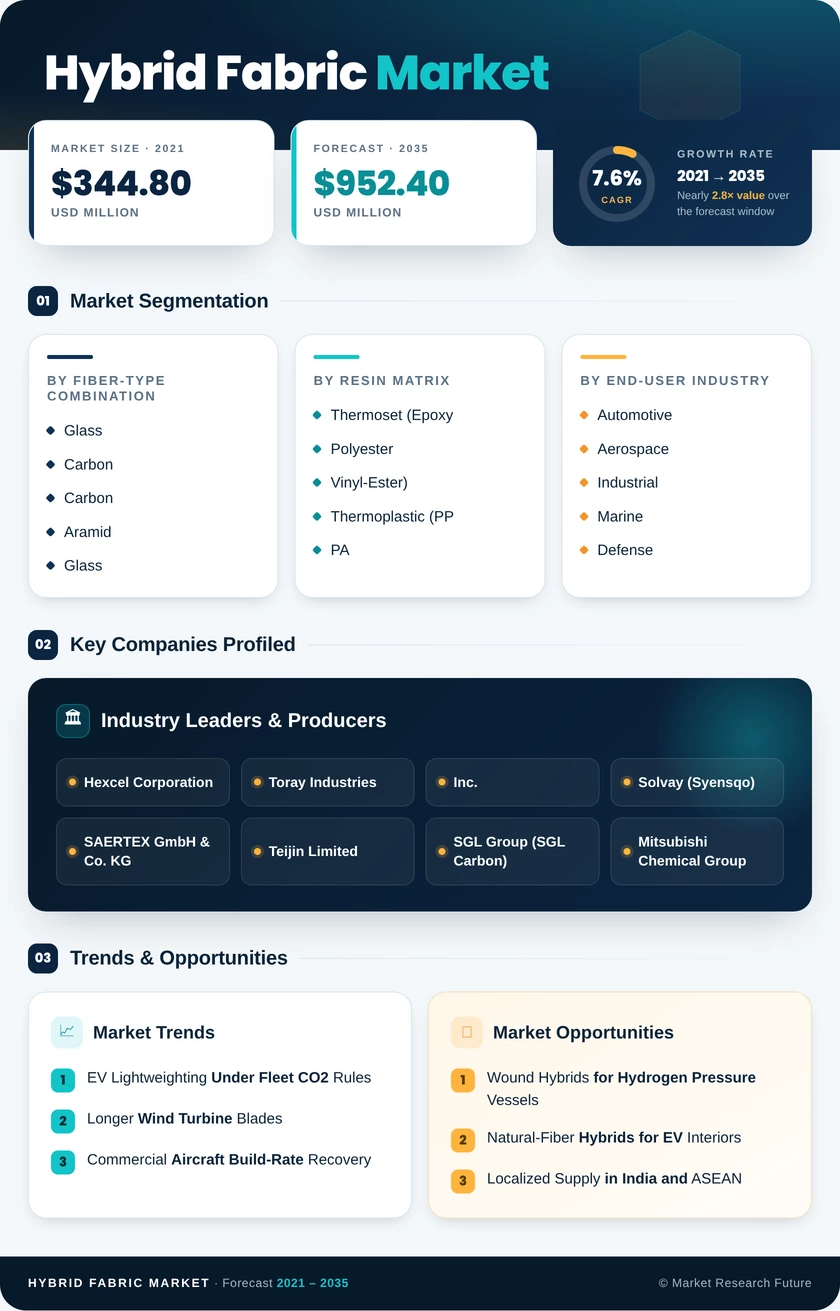
| Dimension | Sub-Segments | Dominant Segment | Fastest Growing Segment |
|---|
| By Fiber-Type Combination | Glass and Carbon; Carbon and Aramid; Glass and Aramid; Other Fiber Types (Natural (Flax) and Carbon, etc.) | Glass and Carbon (40.5% share) | Other Fiber Types (Natural (Flax) and Carbon, etc.) (9.1% CAGR) |
| By Resin Matrix | Thermoset (Epoxy, Polyester, Vinyl-Ester); Thermoplastic (PP, PA, PEEK, PEKK) | Thermoset (Epoxy, Polyester, Vinyl-Ester) (65.8% share) | Thermoplastic (PP, PA, PEEK, PEKK) (8.4% CAGR) |
| By End-User Industry | Automotive and Aerospace; Industrial; Marine and Defense; Sports Equipment; Other End-user Industries (Construction and Infrastructure, etc.) | Automotive and Aerospace (40.6% share) | Sports Equipment (9.5% CAGR) |
| By Manufacturing Technology | Prepreg and Autoclave; Vacuum Infusion/RTM; Braiding and Filament Winding | Prepreg and Autoclave (52.0% share) | Braiding and Filament Winding (9.3% CAGR) |
| By Region | North America; Europe; Asia-Pacific; South America; Middle East & Africa | Asia-Pacific (44.6%) | Asia-Pacific (44.6%) |
Market Segmentation Overview
| Sub-Segment | Key Trend |
|---|
| Glass and Carbon | Graded-stiffness spar caps and cost-optimized automotive panels |
| Carbon and Aramid | Ballistic armor and rotorcraft parts needing impact absorption |
| Glass and Aramid | Mid-cost impact protection for marine and industrial guards |
| Other Fiber Types (Natural (Flax) and Carbon, etc.) | Bio-based content targets in EV interiors and sports goods |
Glass and Carbon lead this dimension because it captures most of carbon's stiffness at a fraction of the cost, matching the economics of wind spar caps and vehicle structures. Other Fiber Types (Natural (Flax) and Carbon, etc.) grow fastest, since flax adds vibration damping and lowers embodied carbon that automakers must now report. Carbon and Aramid stay a premium niche tied to defense and rotorcraft specifications.
| Sub-Segment | Key Trend |
|---|
| Thermoset (Epoxy, Polyester, Vinyl-Ester) | Entrenched aerospace and wind qualifications favor epoxy |
| Thermoplastic (PP, PA, PEEK, PEKK) | Minute-scale press cycles and remeltable scrap |
Thermoset (Epoxy, Polyester, Vinyl-Ester) dominates because epoxy carries decades of flight and blade certification data that buyers will not easily abandon. Thermoplastic (PP, PA, PEEK, PEKK) grows fastest as battery enclosure and high-rate automotive programs value short press cycles and recyclable trim. Tooling cost remains the main brake on thermoplastic conversion.
| Sub-Segment | Key Trend |
|---|
| Automotive and Aerospace | EV range extension and narrow-body production ramps |
| Industrial | Pressure vessels, robot arms, and tooling plates |
| Marine and Defense | Hull laminates, armor panels, and naval craft |
| Sports Equipment | Carbon plates in footwear and tuned-flex bicycle parts |
| Other End-user Industries (Construction and Infrastructure, etc.) | Bridge decks and structural strengthening wraps |
Automotive and Aerospace leads because weight savings convert directly into vehicle range and aircraft fuel burn, justifying hybrid fabric premiums. Sports Equipment grows fastest as footwear rules limiting plates push brands to optimize plate composition. Industrial users form a large value pool anchored by pressure vessels and automation equipment.
| Sub-Segment | Key Trend |
|---|
| Prepreg and Autoclave | Certification-driven aerospace processing with sub-1% porosity |
| Vacuum Infusion/RTM | Lower-capital processing for large wind and automotive parts |
| Braiding and Filament Winding | Automated multi-fiber placement for tanks and shafts |
Prepreg and Autoclave leads because aerospace certification depends on its porosity and fiber-volume control. Braiding and Filament Winding grow fastest, as automated heads place different fibers in one pass for hydrogen tanks and torque shafts. Vacuum Infusion/RTM serves large wind and automotive parts where autoclave capital cannot be justified.


 Noah Malgeri
Co-Founder

 Peter Groot koerkamp
Account and Business Manager

 Younghwan Choi
Senior Retail Manager

 Mark Irwin
Management Consultant

 Akif Moroglu
Strategy & Business Development Director

 Guilherme Gomes Martins
Product Management Director

 Joseph Aguayo
Sales Operations & Pricing Manager

 La Terria Dodd
Program Support Specialist

 Rob Kooiker
Group Product Manager HVAC & Fire Protection GMA