

×
Hero Background
English
Chinese
French
Japanese
Korean
German
Spanish

Human Centered AI Market Trends

ID: MRFR/ICT/10704-HCR
215 Pages
Ankit Gupta
October 2025

Human-Centered AI Market Research Report Information By Function (Assistance and Support, Safety and Security, Decision-Making & Support, Workflow Automation, Collaboration and Others), Application (Medical Diagnostic, Chatbots and Virtual Assistants, Personalized Learning, Fraud Detection & Risk Assessment, Quality Control, and Human Resources) End User, (Healthcare, Automobile, Education, Retail & E-commerce, Transportation & Logistics, Manufacturing), By Regions - Forecast Till 2035

Share:
Download PDF ×

We do not share your information with anyone. However, we may send you emails based on your report interest from time to time. You may contact us at any time to opt-out.

Human Centered AI Market Infographic
Purchase Options

Market Trends

Key Emerging Trends in the Human Centered AI Market

The Human-Centered AI market is witnessing significant trends as the integration of artificial intelligence (AI) technologies becomes more prevalent in various aspects of our daily lives. One key trend is the emphasis on ethical AI and responsible AI development. As AI systems play an increasingly influential role in decision-making processes, there is a growing recognition of the need to prioritize ethical considerations. This trend is reflected in the development of guidelines, standards, and frameworks that focus on fairness, transparency, and accountability in AI systems, ensuring that they align with human values and adhere to ethical principles.

Moreover, there is a noticeable shift towards the development of AI systems that prioritize user experience and human well-being. Human-centered AI places the user at the forefront of design, aiming to create systems that are intuitive, empathetic, and user-friendly. This trend is particularly relevant in applications such as virtual assistants, customer service chatbots, and AI-driven interfaces, where the focus is on enhancing the interaction between humans and AI. As AI systems become more integrated into daily activities, ensuring a positive user experience is essential for widespread acceptance and adoption.

The Human-Centered AI market is experiencing a surge in explainable AI (XAI) solutions. As AI models become more complex, there is a growing demand for transparency in their decision-making processes. XAI aims to make AI systems more understandable and interpretable by humans, providing insights into how decisions are reached. This trend is crucial in building trust and confidence in AI applications, especially in critical domains such as healthcare, finance, and autonomous vehicles, where the ability to explain AI decisions is paramount.

The integration of AI in healthcare is a noteworthy trend within the Human-Centered AI market. AI applications in healthcare focus on improving patient outcomes, optimizing diagnostics, and personalizing treatment plans. From AI-powered diagnostic tools to predictive analytics for disease prevention, human-centered AI in healthcare aims to enhance the overall quality of care and streamline healthcare processes. This trend is driven by the potential to leverage AI to address complex medical challenges and improve the efficiency of healthcare delivery.

In addition, the Human-Centered AI market is witnessing the rise of AI-powered personalization in various industries. From content recommendations on streaming platforms to personalized shopping experiences, AI is being used to tailor services to individual preferences. This trend not only enhances user satisfaction but also contributes to more targeted and effective marketing strategies. AI-driven personalization relies on sophisticated algorithms that analyze user behavior and preferences, providing a more personalized and engaging experience across diverse applications.

The trend of democratizing AI is gaining momentum, aiming to make AI technology accessible to a broader audience. This involves developing user-friendly interfaces, low-code AI platforms, and tools that allow individuals without extensive technical expertise to harness the power of AI. Democratizing AI aligns with the vision of empowering diverse users, including business professionals, researchers, and domain experts, to leverage AI for problem-solving and decision-making, contributing to a more inclusive and participatory AI landscape.

Collaboration between humans and AI, often referred to as augmented intelligence, is a significant trend in the Human-Centered AI market. Augmented intelligence involves combining the strengths of AI systems with human capabilities to achieve more effective outcomes. This collaborative approach recognizes that AI is a tool to augment human decision-making, providing valuable insights and assistance. The trend towards augmented intelligence is evident in applications such as data analysis, research, and decision support systems, where human expertise is enhanced by AI capabilities.

Furthermore, there is a growing focus on continuous learning and adaptability in AI systems. Human-centered AI recognizes the importance of adapting to evolving circumstances and learning from real-world experiences. This trend involves the development of AI models that can continuously improve their performance, adapt to changing user preferences, and learn from feedback. Continuous learning in AI is crucial for ensuring that systems remain relevant and effective in dynamic environments.

Author
Ankit Gupta
Senior Research Analyst

Ankit Gupta is an analyst in market research industry in ICT and SEMI industry. With post-graduation in "Telecom and Marketing Management" and graduation in "Electronics and Telecommunication" vertical he is well versed with recent development in ICT industry as a whole. Having worked on more than 150+ reports including consultation for fortune 500 companies such as Microsoft and Rio Tinto in identifying solutions with respect to business problems his opinions are inclined towards mixture of technical and managerial aspects.

Leave a Comment

FAQs

What is the current valuation of the Human-Centered AI Market in 2025?

The Human-Centered AI Market is valued at 11.28 USD Billion in 2024.

What is the projected market size for the Human-Centered AI Market by 2035?

The market is projected to reach 88.69 USD Billion by 2035.

What is the expected CAGR for the Human-Centered AI Market during the forecast period?

The expected CAGR for the Human-Centered AI Market from 2025 to 2035 is 20.62%.

Which companies are considered key players in the Human-Centered AI Market?

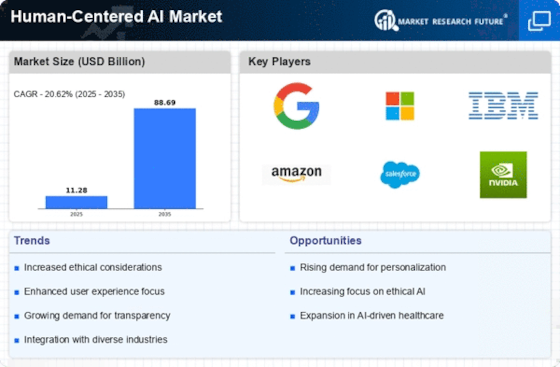
Key players include Google, Microsoft, IBM, Amazon, Salesforce, NVIDIA, OpenAI, Meta, and SAP.

Market Summary

As per MRFR analysis, the Human-Centered AI Market Size was estimated at 11.28 USD Billion in 2024. The Human-Centered AI industry is projected to grow from 13.6 in 2025 to 88.69 by 2035, exhibiting a compound annual growth rate (CAGR) of 20.62 during the forecast period 2025 - 2035.

Key Market Trends & Highlights

The Human-Centered AI Market is experiencing a transformative shift towards ethical practices and user-centric designs.

  • The market is increasingly prioritizing ethical AI development to address societal concerns.
  • Interdisciplinary collaboration is becoming essential for advancing AI technologies in North America and Asia-Pacific.
  • User-centric design is driving innovation in assistance and support applications, which remain the largest segment.
  • The growing demand for personalization and advancements in natural language processing are key drivers of market expansion.

Market Size & Forecast

2024 Market Size 11.28 (USD Billion)
2035 Market Size 88.69 (USD Billion)
CAGR (2025 - 2035) 20.62%
Largest Regional Market Share in 2024 Healthcare

Major Players

<p>Google (US), Microsoft (US), IBM (US), Amazon (US), Salesforce (US), NVIDIA (US), OpenAI (US), Meta (US), SAP (DE)</p>

Market Trends

The Human-Centered AI Market is currently experiencing a transformative phase, characterized by a growing emphasis on ethical considerations and user-centric design. Organizations are increasingly recognizing the necessity of integrating human values into artificial intelligence systems. This shift appears to stem from a broader societal demand for transparency, accountability, and inclusivity in technology. As a result, companies are investing in research and development to create AI solutions that prioritize user experience and societal impact. This trend suggests a potential redefinition of success in the tech industry, moving beyond mere efficiency to encompass the well-being of users and communities. Moreover, the Human-Centered AI Market is witnessing a surge in collaboration between technologists and social scientists. This interdisciplinary approach seems to enhance the understanding of human behavior and needs, leading to more effective AI applications. By fostering partnerships across diverse fields, organizations may develop solutions that are not only innovative but also resonate with users on a deeper level. This collaborative spirit indicates a promising future for AI technologies that are designed with empathy and understanding at their core, potentially reshaping the landscape of artificial intelligence in the years to come.

Ethical AI Development

There is a noticeable trend towards the ethical development of AI technologies. Companies are increasingly prioritizing ethical guidelines to ensure that their AI systems are fair, transparent, and accountable. This focus on ethics is likely to influence the design and deployment of AI solutions, fostering trust among users.

Interdisciplinary Collaboration

The Human-Centered AI Market is seeing a rise in interdisciplinary collaboration. By bringing together experts from various fields, organizations can better understand human needs and behaviors. This collaboration may lead to more effective and user-friendly AI applications, enhancing overall user experience.

User-Centric Design

A significant trend in the Human-Centered AI Market is the emphasis on user-centric design principles. Companies are increasingly focusing on creating AI systems that prioritize user experience, ensuring that technology is accessible and beneficial to a diverse range of users. This approach may redefine how AI solutions are developed and implemented.

Human Centered AI Market Market Drivers

Focus on Ethical AI Practices

The Human-Centered AI Market is witnessing a growing emphasis on ethical AI practices. As concerns regarding bias and transparency in AI systems rise, organizations are prioritizing the development of ethical frameworks to guide AI deployment. This focus on ethics is not merely a regulatory response; it reflects a broader societal demand for responsible AI usage. Companies that adopt ethical AI practices are likely to gain consumer trust and enhance their brand reputation. Market data indicates that 65% of consumers are more likely to engage with brands that demonstrate a commitment to ethical AI. Thus, the integration of ethical considerations into AI development is becoming a fundamental driver in the Human-Centered AI Market.

Increased Demand for Personalization

The Human-Centered AI Market experiences a notable surge in demand for personalized solutions. As consumers increasingly seek tailored experiences, businesses are compelled to adopt AI technologies that prioritize user preferences and behaviors. This trend is reflected in market data, indicating that 70% of consumers express a preference for personalized interactions. Companies leveraging human-centered AI can enhance customer satisfaction and loyalty, ultimately driving revenue growth. Furthermore, the integration of AI in various sectors, such as retail and healthcare, allows for the creation of customized products and services, thereby fostering a more engaging user experience. This shift towards personalization not only meets consumer expectations but also positions organizations competitively within the Human-Centered AI Market.

Advancements in Natural Language Processing

Natural Language Processing (NLP) has emerged as a pivotal driver within the Human-Centered AI Market. Recent advancements in NLP technologies enable machines to understand and respond to human language with unprecedented accuracy. This capability enhances user interactions across various platforms, including chatbots and virtual assistants. Market data suggests that the NLP segment is projected to grow at a compound annual growth rate of 20% over the next five years. As organizations increasingly adopt NLP solutions, they can provide more intuitive and effective communication channels for users. This evolution not only improves user satisfaction but also streamlines operations, making NLP a critical component of the Human-Centered AI Market.

Growing Investment in AI Research and Development

Investment in research and development (R&D) within the Human-Centered AI Market is on the rise, driven by the increasing recognition of AI's transformative potential. Organizations are allocating substantial resources to explore innovative applications of AI that prioritize user experience and ethical considerations. Market data indicates that global investment in AI R&D is expected to reach 100 billion dollars by 2026, reflecting a robust commitment to advancing human-centered technologies. This influx of funding not only accelerates technological advancements but also encourages the development of solutions that align with user needs. As a result, the growing investment landscape is poised to significantly influence the trajectory of the Human-Centered AI Market.

Interdisciplinary Collaboration in AI Development

Interdisciplinary collaboration is increasingly recognized as a vital driver within the Human-Centered AI Market. By bringing together experts from diverse fields such as psychology, design, and computer science, organizations can create more effective and user-friendly AI solutions. This collaborative approach fosters innovation and ensures that AI technologies are developed with a comprehensive understanding of human needs and behaviors. Market data suggests that companies engaging in interdisciplinary teams are 30% more likely to produce successful AI products. As the demand for human-centered solutions grows, the importance of interdisciplinary collaboration in AI development becomes ever more pronounced within the Human-Centered AI Market.

Market Segment Insights

By Function: Assistance and Support (Largest) vs. Safety and Security (Fastest-Growing)

<p>In the Human-Centered AI Market, the segment of Assistance and Support holds a prominent position, dominating the market share compared to other function segments. It is primarily utilized in areas such as customer service, chatbots, and virtual personal assistants, thereby facilitating seamless interactions between users and technology. Meanwhile, Safety and Security is steadily gaining traction, driven by the increasing demand for enhanced cybersecurity measures and risk management solutions in AI applications. The growth trajectory of both Assistance and Support and Safety and Security segments reflects the evolving landscape of human-centered AI. The post-pandemic world has accelerated the adoption of AI solutions, with organizations prioritizing efficiency and safety. The demand for automated assistance to optimize user experiences and the rising importance of safety measures underscore the significance of these segments. With continuous innovation, these functions are set to reshape industries and create value for end-users, making them critical to the market's future development.</p>

<p>Assistance and Support (Dominant) vs. Safety and Security (Emerging)</p>

<p>Assistance and Support stands as a dominant function in the Human-Centered AI Market, known for its applications in enhancing user experience through intuitive interactions. This segment leverages advanced natural language processing and machine learning to provide personalized services, making it invaluable across various industries, such as retail, healthcare, and finance. On the other hand, Safety and Security is an emerging segment that is quickly becoming essential as organizations grapple with cybersecurity threats. With the rise in data breaches and privacy concerns, this segment focuses on implementing AI-driven security solutions that not only protect sensitive information but also ensure compliance with regulations. Both segments are vital for the sustained growth and evolution of the Human-Centered AI market, bridging the gaps between user engagement and safety.</p>

By Application: Medical Diagnostic (Largest) vs. Chatbots and Virtual Assistants (Fastest-Growing)

<p>In the Human-Centered AI market, the application segment is characterized by diverse categories, including Medical Diagnostic, Chatbots and Virtual Assistants, Personalized Learning, Fraud Detection & Risk Assessment, Quality Control, Human Resources, and Others. Among these, Medical Diagnostic stands out as the largest segment, largely driven by advancements in AI technology facilitating accurate disease detection and patient management. Chatbots and Virtual Assistants are emerging rapidly, capturing a significant share of consumer interaction sectors with their ability to enhance communication and streamline processes across industries.</p>

<p>Medical Diagnostic (Dominant) vs. Chatbots and Virtual Assistants (Emerging)</p>

<p>The Medical Diagnostic segment thrives on the implementation of AI in healthcare, where technologies are increasingly employed to analyze medical data, suggest treatment options, and improve patient outcomes. This segment benefits from a growing emphasis on personalized medicine and efficiency in diagnosis. Conversely, Chatbots and Virtual Assistants are quickly becoming a preferred solution for customer service and engagement, providing businesses with cost-effective, 24/7 communication tools. As these technologies evolve, they are being integrated with machine learning algorithms to deliver increasingly sophisticated interactions, making them a vital component in enhancing user experiences across various sectors.</p>

By End User: Healthcare (Largest) vs. Retail & E-commerce (Fastest-Growing)

<p>In the Human-Centered AI Market, the end-user segment showcases diverse applications across various industries. Healthcare emerges as the largest segment, driven by the growing demand for personalized patient care and efficient healthcare solutions. Following closely, Retail & E-commerce has also gained substantial traction, fueled by the need for enhanced customer experiences and operational efficiencies through AI technologies. The distribution among other sectors such as Automobile, Education, Transportation & Logistics, and Manufacturing further illustrates the expanding horizons attributed to AI advancements in these fields.</p>

<p>Healthcare (Dominant) vs. Retail & E-commerce (Emerging)</p>

<p>Healthcare has established itself as the dominant end-user segment in the Human-Centered AI Market, characterized by its significant investments in AI-driven solutions. This sector leverages AI for applications such as predictive analytics, virtual health assistants, and diagnostic tools, enhancing patient outcomes and operational efficiencies. Conversely, Retail & E-commerce represents an emerging segment with a rapid growth trajectory, driven by technological innovations and an increasing emphasis on customer-centric strategies. Retailers are keen to implement AI to personalize shopping experiences, manage inventories efficiently, and streamline supply chain processes. Both sectors are integral to the evolving landscape of the Human-Centered AI Market, with distinct yet complementary roles.</p>

Get more detailed insights about Human-Centered AI Market Research Report - Global Forecast till 2035

Regional Insights

North America : Innovation and Leadership Hub

North America is the largest market for Human-Centered AI, holding approximately 45% of the global share. The region's growth is driven by significant investments in AI research and development, coupled with a robust technology infrastructure. Regulatory support from government initiatives, such as the National AI Initiative Act, further catalyzes market expansion. The demand for AI solutions in sectors like healthcare, finance, and retail is surging, reflecting a strong trend towards automation and enhanced user experiences. The United States leads the North American market, with key players like Google, Microsoft, and IBM driving innovation. The competitive landscape is characterized by rapid advancements in AI technologies, with companies focusing on ethical AI and user-centric designs. Canada also plays a significant role, fostering a vibrant startup ecosystem that complements the established giants. This dynamic environment positions North America as a leader in shaping the future of Human-Centered AI.

Europe : Regulatory Framework and Growth

Europe is witnessing rapid growth in the Human-Centered AI market, holding approximately 30% of the global share. The region's expansion is fueled by stringent regulations aimed at ensuring ethical AI use, such as the EU's AI Act, which promotes transparency and accountability. Countries like Germany and France are at the forefront, driving demand for AI solutions across various sectors, including manufacturing and automotive. The emphasis on data privacy and user rights is shaping the market landscape, encouraging responsible AI development. Germany is the largest market in Europe, supported by a strong industrial base and a focus on innovation. France follows closely, with significant investments in AI research and development. The competitive landscape features a mix of established companies like SAP and emerging startups, fostering collaboration and innovation. The presence of leading tech firms and a supportive regulatory environment positions Europe as a key player in the global Human-Centered AI market.

Asia-Pacific : Rapid Adoption and Innovation

Asia-Pacific is rapidly emerging as a significant player in the Human-Centered AI market, accounting for approximately 20% of the global share. The region's growth is driven by increasing digitalization, government initiatives promoting AI adoption, and a burgeoning tech-savvy population. Countries like China and India are leading the charge, with substantial investments in AI research and development. The demand for AI solutions in sectors such as e-commerce, healthcare, and finance is on the rise, reflecting a shift towards more personalized user experiences. China is the largest market in the region, supported by government policies that prioritize AI development. India follows closely, with a vibrant startup ecosystem and a focus on AI applications in various industries. The competitive landscape is characterized by a mix of local and international players, including major tech firms and innovative startups. This dynamic environment positions Asia-Pacific as a key region for the future of Human-Centered AI.

Middle East and Africa : Emerging Opportunities in AI

The Middle East and Africa region is gradually emerging in the Human-Centered AI market, holding approximately 5% of the global share. The growth is driven by increasing investments in technology infrastructure and government initiatives aimed at fostering innovation. Countries like the UAE and South Africa are leading the way, with a focus on integrating AI into various sectors, including healthcare and finance. The demand for AI solutions is expected to rise as businesses seek to enhance operational efficiency and customer engagement. The UAE is the largest market in the region, supported by government-led initiatives such as the UAE AI Strategy 2031, which aims to position the country as a global leader in AI. South Africa follows, with a growing tech ecosystem and increasing interest in AI applications. The competitive landscape features a mix of local startups and international players, creating a vibrant environment for AI development. This region presents significant opportunities for growth in the Human-Centered AI market.

Key Players and Competitive Insights

Major players in the Human-Centered AI Market are making substantial investments in research and development to expand their product/service portfolios, contributing to the market's robust growth. These market leaders are implementing various strategic initiatives to expand their global presence. Key developments include new product/service launches, mergers and acquisitions, contractual agreements, increased investments, and collaborations with other organizations. Given the competitive and evolving market landscape, competitors in the identity theft protection services industry are focusing on cost-effective offerings to thrive and expand.

Some of the key players are focusing small and medium enterprise size by customizing offerings to reduce operational costs as a primary business strategy to benefit customers and expand market share. In recent years, the financial industry vertical has witnessed significant advancements in the human-centered AI industry. Key market players, including IBM Corporation, Microsoft Corporation, Google LLC, Amazon Inc., Apple Inc., OpenAI, NVIDIA Corporation, Salesforce Inc., Nuance Communications, Cognizant, Accenture, Affectiva, Sentient Technologies, BenevolentAI and Zebra Technologies and others, are driving innovation in human-centered AI, pushing the boundaries of computational capabilities.

Key Companies in the Human Centered AI Market market include

Industry Developments

June 2023 - PepsiCo, Inc. has announced a partnership with the Stanford Institute for Human-Centered Artificial Intelligence, a non-profit dedicated to leading and shaping the future of artificial intelligence. PepsiCo intends to be the worldwide corporate leader in industrialized AI applications and responsible AI as the first CPG firm to join Stanford HAI's Corporate Affiliate Program, gaining insights that promote research, education, policy, and practice throughout the industry.

Future Outlook

Human Centered AI Market Future Outlook

<p>The Human-Centered AI Market is projected to grow at a 20.62% CAGR from 2024 to 2035, driven by advancements in machine learning, user experience design, and increased demand for ethical AI solutions.</p>

New opportunities lie in:

  • <p>Development of personalized AI-driven customer service platforms.</p>
  • <p>Integration of AI in remote healthcare monitoring systems.</p>
  • <p>Creation of AI tools for enhancing workplace productivity and collaboration.</p>

<p>By 2035, the Human-Centered AI Market is expected to be a pivotal sector, driving innovation and economic growth.</p>

Market Segmentation

Human Centered AI Market End User Outlook

  • Healthcare
  • Automobile
  • Education
  • Retail & E-commerce
  • Transportation & Logistics
  • Manufacturing
  • Others

Human Centered AI Market Function Outlook

  • Assistance and Support
  • Safety and Security
  • Decision-Making & Support
  • Workflow Automation
  • Collaboration
  • Others

Human Centered AI Market Application Outlook

  • Medical Diagnostic
  • Chatbots and Virtual Assistants
  • Personalized Learning
  • Fraud Detection & Risk Assessment
  • Quality Control
  • Human Resources
  • Others

Report Scope

MARKET SIZE 202411.28(USD Billion)
MARKET SIZE 202513.6(USD Billion)
MARKET SIZE 203588.69(USD Billion)
COMPOUND ANNUAL GROWTH RATE (CAGR)20.62% (2024 - 2035)
REPORT COVERAGERevenue Forecast, Competitive Landscape, Growth Factors, and Trends
BASE YEAR2024
Market Forecast Period2025 - 2035
Historical Data2019 - 2024
Market Forecast UnitsUSD Billion
Key Companies ProfiledMarket analysis in progress
Segments CoveredMarket segmentation analysis in progress
Key Market OpportunitiesIntegration of ethical frameworks in Human-Centered AI design enhances user trust and market adoption.
Key Market DynamicsRising consumer demand for ethical AI solutions drives innovation and regulatory scrutiny in the Human-Centered AI Market.
Countries CoveredNorth America, Europe, APAC, South America, MEA

FAQs

What is the current valuation of the Human-Centered AI Market in 2025?

The Human-Centered AI Market is valued at 11.28 USD Billion in 2024.

What is the projected market size for the Human-Centered AI Market by 2035?

The market is projected to reach 88.69 USD Billion by 2035.

What is the expected CAGR for the Human-Centered AI Market during the forecast period?

The expected CAGR for the Human-Centered AI Market from 2025 to 2035 is 20.62%.

Which companies are considered key players in the Human-Centered AI Market?

Key players include Google, Microsoft, IBM, Amazon, Salesforce, NVIDIA, OpenAI, Meta, and SAP.

  1. EXECUTIVE SUMMARY
    1. Market Attractiveness
    2. Analysis
  2. Global Human-Centered AI Market, by Function
  3. Global Human-Centered AI Market, by Application
  4. Global Human-Centered
  5. AI Market, by End-user
  6. Global Human-Centered AI Market, by Region
  7. MARKET INTRODUCTION
    1. Definition
    2. Scope of the Study
    3. Market Structure
    4. Key Buying Criteria
    5. Macro Factor Indicator Analysis
  8. RESEARCH METHODOLOGY
    1. Research Process
    2. Primary Research
    3. Secondary Research
    4. Market Size Estimation
    5. Forecast Model
    6. List of Assumptions
  9. MARKET DYNAMICS
    1. Introduction
    2. Drivers
      1. Growing Demand
      2. Increasing Use of AI to Personalize Experiences for Users
      3. Driver Impact
      4. Restraint Impact Analysis
    3. for AI in Medical Diagnosis
    4. Analysis
    5. Restraints
    6. Personal Data Usage for AI Applications Raises Privacy Concerns
    7. Opportunities
      1. The
      2. Significant Growth
      3. Increasing Use of AI-powered Educational Platforms
    8. Emphasis on Ethical Considerations in AI Development is Growing Stronger.
    9. of Human-AI Collaboration
    10. Challenge
      1. Adaption of Cross-Cultural
    11. Behaviors can be Challenging
    12. Covid-19 Impact Analysis
      1. Impact on Healthcare Sector such as Virtual
      2. Significant Impact on Remote Customer Services
      3. Growing Emphasize on Remote
    13. Assistance and Telemedicine
    14. Work Facilities
    15. YOY growth 2020-202
  10. COVID-19 IMPACT ON SUPPLY CHAIN DELAYSMARKET FACTOR ANALYSIS
    1. Value Chain Analysis/Supply Chain Analysis
    2. Porter’s Five
      1. Bargaining Power of Buyers
      2. Threat of New Entrants
      3. Threat of Substitutes
      4. Intensity of Rivalry
    3. Forces Model
    4. Bargaining Power of Suppliers
  11. GLOBAL HUMAN-CENTERED AI MARKET, BY FUNCTION
    1. Introduction
    2. Assistance and Support
    3. Safety and Security
    4. Decision-Making
    5. & Support
    6. Workflow Automation
    7. Collaboration
    8. Others
  12. GLOBAL
  13. HUMAN-CENTERED AI MARKET, BY APPLICATION
    1. Introduction
    2. Medical Diagnostic
    3. Chatbots and Virtual Assistants
    4. Personalized Learning
    5. Fraud Detection
    6. & Risk Assessment
    7. Quality Control
    8. Human Resources
    9. Others
  14. GLOBAL
  15. HUMAN-CENTERED AI MARKET, BY END-USER
    1. Introduction
    2. Healthcare
    3. Automobile
    4. Education
    5. Retail & E-commerce
    6. Transportation & Logistics
    7. Manufacturing
    8. Others
  16. GLOBAL HUMAN-CENTERED
  17. AI MARKET SIZE ESTIMATION & FORECAST, BY REGION
    1. Introduction
    2. North America
      1. Market Estimates & Forecast, by Country,
  18. Market Estimates & Forecast, by Function, 2018-2032
  19. Market Estimates & Forecast, by Application,
  20. Market Estimates & Forecast, by End-user, 2018-2032
    1. & Forecast, by Application, 2018-2032
    2. Canada
  21. US
  22. Market Estimates & Forecast, by Function, 2018-2032
  23. Market Estimates
  24. Market Estimates & Forecast, by End-user,
  25. Market Estimates & Forecast, by Function, 2018-2032
  26. Market Estimates & Forecast, by Application,
  27. Market Estimates & Forecast, by End-user, 2018-2032
  28. Mexico
  29. Market Estimates & Forecast, by Function,
  30. Market Estimates & Forecast, by Application, 2018-2032
    1. Europe
  31. Market Estimates & Forecast, by End-user,
  32. Market Estimates & Forecast, by Country, 2018-2032
  33. Market Estimates & Forecast, by Function,
  34. Market Estimates & Forecast, by Application, 2018-2032
    1. UK
  35. Market Estimates & Forecast, by End-user,
  36. Market Estimates & Forecast, by Function, 2018-2032
  37. Market Estimates & Forecast, by Application,
  38. Market Estimates & Forecast, by End-user, 2018-2032
  39. Germany
  40. Market Estimates & Forecast, by Function,
  41. Market Estimates & Forecast, by Application, 2018-2032
    1. France
  42. Market Estimates & Forecast, by End-user,
  43. Market Estimates & Forecast, by Function, 2018-2032
  44. Market Estimates & Forecast, by Application,
  45. Market Estimates & Forecast, by End-user, 2018-2032
  46. Italy
  47. Market Estimates & Forecast, by Function,
  48. Market Estimates & Forecast, by Application, 2018-2032
    1. Spain
  49. Market Estimates & Forecast, by End-user,
  50. Market Estimates & Forecast, by Function, 2018-2032
  51. Market Estimates & Forecast, by Application,
  52. Market Estimates & Forecast, by End-user, 2018-2032
  53. Rest of Europe
  54. Market Estimates & Forecast, by Function,
  55. Market Estimates & Forecast, by Application, 2018-2032
    1. Asia-Pacific
  56. Market Estimates & Forecast, by End-user,
  57. Market Estimates & Forecast, by Country, 2018-2032
  58. Market Estimates & Forecast, by Function,
  59. Market Estimates & Forecast, by Application, 2018-2032
    1. China
  60. Market Estimates & Forecast, by End-user,
  61. Market Estimates & Forecast, by Function, 2018-2032
  62. Market Estimates & Forecast, by Application,
  63. Market Estimates & Forecast, by End-user, 2018-2032
  64. Japan
  65. Market Estimates & Forecast, by Function,
  66. Market Estimates & Forecast, by Application, 2018-2032
    1. India
  67. Market Estimates & Forecast, by End-user,
  68. Market Estimates & Forecast, by Function, 2018-2032
  69. Market Estimates & Forecast, by Application,
  70. Market Estimates & Forecast, by End-user, 2018-2032
  71. Australia
  72. Market Estimates & Forecast, by Function,
  73. Market Estimates & Forecast, by Application, 2018-2032
    1. Rest of Asia-Pacific
  74. Market Estimates & Forecast, by End-user,
  75. Market Estimates & Forecast, by Function, 2018-2032
  76. Market Estimates & Forecast, by Application,
  77. Market Estimates & Forecast, by End-user, 2018-2032
    1. Rest of the World
      1. Market Estimates & Forecast, by Function,
  78. Market Estimates & Forecast, by Application, 2018-2032
    1. Middle East
  79. Market Estimates & Forecast, by End-user,
  80. Market Estimates & Forecast, by Function, 2018-2032
  81. Market Estimates & Forecast, by Application,
  82. Market Estimates & Forecast, by End-user, 2018-2032
  83. Africa
  84. Market Estimates & Forecast, by Function,
  85. Market Estimates & Forecast, by Application, 2018-2032
    1. Latin America
  86. Market Estimates & Forecast, by End-user,
  87. Market Estimates & Forecast, by Function, 2018-2032
  88. Market Estimates & Forecast, by Application,
  89. Market Estimates & Forecast, by End-user, 2018-2032
  90. COMPETITIVE LANDSCAPE
    1. Introduction
    2. Key Developments & Growth Strategies
    3. Competitor Benchmarking
    4. Vendor Share Analysis,
      1. Key Developments
      2. SWOT Analysis
      3. Key Strategies
    5. COMPANY PROFILES
    6. IBM Corporation
    7. IBM Corporation
    8. Microsoft Corporation
    9. Google LLC
    10. Amazon Inc.
    11. Apple Inc.
    12. OpenAI
    13. NVIDIA Corporation
    14. Salesforce Inc.
    15. Nuance Communications
    16. Cognizant
    17. Accenture
    18. Affectiva
    19. Sentient Technologies
    20. BenevolentAI
    21. Zebra Technologies
    22. Company Overview
    23. Financial Overview
    24. Solution/Applications Offered
    25. LIST
  91. OF TABLES
    1. TABLE
  92. MARKET SYNOPSIS 19
    1. TABLE
  93. GLOBAL HUMAN-CENTERED AI MARKET, BY FUNCTION, 2018–2032 (USD MILLION) 52
  94. GLOBAL HUMAN-CENTERED
  95. AI MARKET, BY APPLICATION, 2018–2032 (USD MILLION) 55
  96. GLOBAL HUMAN-CENTERED AI MARKET, BY END-USER,
  97. GLOBAL HUMAN-CENTERED AI MARKET, BY REGION, 2018–2032
    1. (USD MILLION) 57
    2. TABLE
  98. NORTH AMERICA HUMAN-CENTERED AI MARKET, BY COUNTRY, 2018–2032 (USD MILLION)
    1. TABLE 7
  99. NORTH AMERICA HUMAN-CENTERED AI MARKET, BY FUNCTION, 2018–2032 (USD MILLION)
    1. TABLE 8
  100. NORTH AMERICA HUMAN-CENTERED AI MARKET, BY APPLICATION, 2018–2032 (USD MILLION)
    1. TABLE 9
  101. NORTH AMERICA HUMAN-CENTERED AI MARKET, BY END-USER, 2018–2032 (USD MILLION)
    1. TABLE 10
  102. US HUMAN-CENTERED AI MARKET, BY FUNCTION, 2018–2032 (USD MILLION) 66
  103. US HUMAN-CENTERED
  104. AI MARKET, BY APPLICATION, 2018–2032 (USD MILLION) 66
  105. US HUMAN-CENTERED AI MARKET, BY END-USER,
  106. CANADA HUMAN-CENTERED AI MARKET, BY FUNCTION, 2018–2032
    1. (USD MILLION) 68
    2. TABLE
  107. CANADA HUMAN-CENTERED AI MARKET, BY APPLICATION, 2018–2032 (USD MILLION)
    1. TABLE 15
  108. CANADA HUMAN-CENTERED AI MARKET, BY END-USER, 2018–2032 (USD MILLION) 68
  109. MEXICO HUMAN-CENTERED
  110. AI MARKET, BY FUNCTION, 2018–2032 (USD MILLION) 70
  111. MEXICO HUMAN-CENTERED AI MARKET, BY APPLICATION,
  112. MEXICO HUMAN-CENTERED AI MARKET, BY END-USER, 2018–2032
    1. (USD MILLION) 71
    2. TABLE
  113. EUROPE HUMAN-CENTERED AI MARKET, BY COUNTRY, 2018–2032 (USD MILLION) 71
  114. EUROPE HUMAN-CENTERED
  115. AI MARKET, BY FUNCTION, 2018–2032 (USD MILLION) 73
  116. EUROPE HUMAN-CENTERED AI MARKET, BY APPLICATION,
  117. EUROPE HUMAN-CENTERED AI MARKET, BY END-USER, 2018–2032
    1. (USD MILLION) 74
    2. TABLE
  118. UK HUMAN-CENTERED AI MARKET, BY FUNCTION, 2018–2032 (USD MILLION) 74
  119. UK HUMAN-CENTERED
  120. AI MARKET, BY APPLICATION, 2018–2032 (USD MILLION) 77
  121. UK HUMAN-CENTERED AI MARKET, BY END-USER,
  122. GERMANY HUMAN-CENTERED AI MARKET, BY FUNCTION, 2018–2032
    1. (USD MILLION) 79
    2. TABLE
  123. GERMANY HUMAN-CENTERED AI MARKET, BY APPLICATION, 2018–2032 (USD MILLION)
    1. TABLE 28
  124. GERMANY HUMAN-CENTERED AI MARKET, BY END-USER, 2018–2032 (USD MILLION) 80
  125. FRANCE HUMAN-CENTERED
  126. AI MARKET, BY FUNCTION, 2018–2032 (USD MILLION) 81
  127. FRANCE HUMAN-CENTERED AI MARKET, BY APPLICATION,
  128. FRANCE HUMAN-CENTERED AI MARKET, BY END-USER, 2018–2032
    1. (USD MILLION) 82
    2. TABLE
  129. SPAIN HUMAN-CENTERED AI MARKET, BY FUNCTION, 2018–2032 (USD MILLION) 82
  130. SPAIN HUMAN-CENTERED
  131. AI MARKET, BY APPLICATION, 2018–2032 (USD MILLION) 85
  132. SPAIN HUMAN-CENTERED AI MARKET, BY END-USER,
  133. ITALY HUMAN-CENTERED AI MARKET, BY FUNCTION, 2018–2032
    1. (USD MILLION) 85
    2. TABLE
  134. ITALY HUMAN-CENTERED AI MARKET, BY APPLICATION, 2018–2032 (USD MILLION)
    1. TABLE 37
  135. ITALY HUMAN-CENTERED AI MARKET, BY END-USER, 2018–2032 (USD MILLION) 87
  136. REST OF EUROPE
  137. HUMAN-CENTERED AI MARKET, BY FUNCTION, 2018–2032 (USD MILLION) 88
  138. REST OF EUROPE
  139. HUMAN-CENTERED AI MARKET, BY APPLICATION, 2018–2032 (USD MILLION) 88
  140. REST OF EUROPE
  141. HUMAN-CENTERED AI MARKET, BY END-USER, 2018–2032 (USD MILLION) 88
  142. ASIA-PACIFIC
  143. HUMAN-CENTERED AI MARKET, BY COUNTRY, 2018–2032 (USD MILLION) 90
  144. ASIA-PACIFIC
  145. HUMAN-CENTERED AI MARKET, BY FUNCTION, 2018–2032 (USD MILLION) 90
  146. ASIA-PACIFIC
  147. HUMAN-CENTERED AI MARKET, BY APPLICATION, 2018–2032 (USD MILLION) 91
  148. ASIA-PACIFIC
  149. HUMAN-CENTERED AI MARKET, BY END-USER, 2018–2032 (USD MILLION) 91
  150. CHINA HUMAN-CENTERED
  151. AI MARKET, BY FUNCTION, 2018–2032 (USD MILLION) 92
  152. CHINA HUMAN-CENTERED AI MARKET, BY APPLICATION,
  153. CHINA HUMAN-CENTERED AI MARKET, BY END-USER, 2018–2032
    1. (USD MILLION) 93
    2. TABLE
  154. JAPAN HUMAN-CENTERED AI MARKET, BY FUNCTION, 2018–2032 (USD MILLION) 93
  155. JAPAN HUMAN-CENTERED
  156. AI MARKET, BY APPLICATION, 2018–2032 (USD MILLION) 95
  157. JAPAN HUMAN-CENTERED AI MARKET, BY END-USER,
  158. INDIA HUMAN-CENTERED AI MARKET, BY FUNCTION, 2018–2032
    1. (USD MILLION) 96
    2. TABLE
  159. INDIA HUMAN-CENTERED AI MARKET, BY APPLICATION, 2018–2032 (USD MILLION)
    1. TABLE 53
  160. INDIA HUMAN-CENTERED AI MARKET, BY END-USER, 2018–2032 (USD MILLION) 99
  161. SOUTH KOREA
  162. HUMAN-CENTERED AI MARKET, BY FUNCTION, 2018–2032 (USD MILLION) 100
  163. SOUTH KOREA
  164. HUMAN-CENTERED AI MARKET, BY APPLICATION, 2018–2032 (USD MILLION) 101
  165. SOUTH KOREA
  166. HUMAN-CENTERED AI MARKET, BY END-USER, 2018–2032 (USD MILLION) 102
  167. REST OF ASIA-PACIFIC
  168. HUMAN-CENTERED AI MARKET, BY FUNCTION, 2018–2032 (USD MILLION) 102
  169. REST OF ASIA-PACIFIC
  170. HUMAN-CENTERED AI MARKET, BY APPLICATION, 2018–2032 (USD MILLION) 103
  171. REST OF ASIA-PACIFIC
  172. HUMAN-CENTERED AI MARKET, BY END-USER, 2018–2032 (USD MILLION) 104
  173. REST OF THE
  174. WORLD HUMAN-CENTERED AI MARKET, BY COUNTRY, 2018–2032 (USD MILLION) 104
  175. REST OF THE
  176. WORLD HUMAN-CENTERED AI MARKET, BY FUNCTION, 2018–2032 (USD MILLION) 104
  177. REST OF THE
  178. WORLD HUMAN-CENTERED AI MARKET, BY APPLICATION, 2018–2032 (USD MILLION) 105
  179. REST OF THE
  180. WORLD CAMERA MARKET, BY END-USER, 2018–2032 (USD MILLION) 106
  181. MIDDLE EAST HUMAN-CENTERED
  182. AI MARKET, BY FUNCTION, 2018–2032 (USD MILLION) 106
  183. MIDDLE EAST HUMAN-CENTERED AI MARKET, BY
    1. APPLICATION, 2018–2032 (USD MILLION) 106
  184. MIDDLE EAST HUMAN-CENTERED AI MARKET, BY
    1. END-USER, 2018–2032 (USD MILLION) 108
  185. AFRICA HUMAN-CENTERED AI MARKET, BY FUNCTION,
  186. AFRICA HUMAN-CENTERED AI MARKET, BY APPLICATION, 2018–2032
    1. (USD MILLION) 109
    2. TABLE
  187. AFRICA HUMAN-CENTERED AI MARKET, BY END-USER, 2018–2032 (USD MILLION) 109
  188. LATIN AMERICA
  189. HUMAN-CENTERED AI MARKET, BY FUNCTION, 2018–2032 (USD MILLION) 111
  190. LATIN AMERICA
  191. HUMAN-CENTERED AI MARKET, BY APPLICATION, 2018–2032 (USD MILLION) 111
  192. LATIN AMERICA
  193. HUMAN-CENTERED AI MARKET, BY END-USER, 2018–2032 (USD MILLION) 112
  194. BUSINESS EXPANSIONS/PRODUCT
    1. LAUNCHES 112
    2. TABLE
  195. PARTNERSHIPS/AGREEMENTS/CONTRACTS/COLLABORATIONS 113
  196. ACQUISITIONS/MERGERS 114
  197. IBM CORPORATION: PRODUCTS
    1. OFFERED 115
    2. TABLE
  198. IBM CORPORATION: KEY DEVELOPMENT 115
  199. MICROSOFT CORPORATION: PRODUCTS OFFERED 117
  200. MICROSOFT CORPORATION:
    1. KEY DEVELOPMENT 119
    2. TABLE
  201. GOOGLE LLC: PRODUCTS OFFERED 120
  202. GOOGLE LLC: KEY DEVELOPMENT 120
  203. AMAZON INC.: PRODUCTS
    1. OFFERED 122
    2. TABLE
  204. AMAZON INC.: KEY DEVELOPMENT 123
  205. APPLE INC.: PRODUCTS OFFERED 124
  206. APPLE INC.: KEY DEVELOPMENT
    1. TABLE 86
    2. OPENAI: PRODUCTS OFFERED 128
  207. OPENAI: KEY DEVELOPMENT 130
  208. NVIDIA CORPORATION: PRODUCTS OFFERED 135
  209. NVIDIA CORPORATION:
    1. KEY DEVELOPMENT 138
    2. TABLE
  210. SALESFORCE INC.. : PRODUCTS OFFERED 139
  211. SALESFORCE INC.. : KEY DEVELOPMENT 142
  212. NUANCE COMMUNICATIONS:
    1. PRODUCTS OFFERED 143
    2. TABLE
  213. NUANCE COMMUNICATIONS: KEY DEVELOPMENT 146
  214. COGNIZANT: PRODUCTS OFFERED 147
  215. COGNIZANT: KEY
    1. DEVELOPMENT 150
    2. TABLE
  216. ACCENTURE: PRODUCTS OFFERED 152
  217. ACCENTURE: KEY DEVELOPMENT 154
  218. AFFECTIVA: PRODUCTS
    1. OFFERED 156
    2. TABLE
  219. AFFECTIVA: KEY DEVELOPMENT 158
  220. SENTIENT TECHNOLOGIES: PRODUCTS OFFERED 159
  221. SENTIENT TECHNOLOGIES:
    1. KEY DEVELOPMENT 161
    2. TABLE
  222. BENEVOLENTAI: PRODUCTS OFFERED 163
  223. BENEVOLENTAI: KEY DEVELOPMENT 165
  224. ZEBRA TECHNOLOGIES:
    1. PRODUCTS OFFERED 166
    2. TABLE
  225. ZEBRA TECHNOLOGIES: KEY DEVELOPMENT 168
  226. LIST OF FIGURES
  227. MARKET ATTRACTIVENESS ANALYSIS: GLOBAL HUMAN-CENTERED
    1. AI MARKET 20
    2. FIGURE
  228. GLOBAL HUMAN-CENTERED AI MARKET: MARKET STRUCTURE 22
  229. BOTTOM-UP AND TOP-DOWN APPROACHES 27
  230. NORTH AMERICA:
  231. HUMAN-CENTERED AI MARKET SIZE (USD MILLION) & MARKET SHARE (%), BY COUNTRY (2022
    1. VS 2032) 30
    2. FIGURE
  232. EUROPE: HUMAN-CENTERED AI MARKET SIZE (USD MILLION) & MARKET SHARE (%), BY
    1. COUNTRY (2022 VS 2032) 30
  233. ASIA–PACIFIC: HUMAN-CENTERED AI MARKET SIZE (USD MILLION)
  234. & MARKET SHARE (%), BY COUNTRY (2022 VS 2032) 31
  235. GLOBAL HUMAN-CENTERED AI MARKET SIZE (USD
  236. MILLION) & MARKET SHARE (%), BY FUNCTION (2022 VS 2032) 32
  237. GLOBAL HUMAN-CENTERED
  238. AI MARKET SIZE (USD MILLION) & MARKET SHARE (%), BY APPLICATION (2022 VS 2032)
    1. FIGURE 9
  239. GLOBAL HUMAN-CENTERED AI MARKET SIZE (USD MILLION) & MARKET SHARE (%), BY END-USER
    1. (2022 VS 2032) 33
    2. FIGURE
  240. MARKET DYNAMIC ANALYSIS OF THE GLOBAL HUMAN-CENTERED AI MARKET 34
  241. DRIVER IMPACT ANALYSIS
    1. FIGURE 12
    2. RESTRAINT IMPACT ANALYSIS 35
  242. VALUE CHAIN: GLOBAL HUMAN-CENTERED AI MARKET 37
  243. PORTER''S FIVE
    1. FORCES ANALYSIS OF THE GLOBAL HUMAN-CENTERED AI MARKET 37
  244. GLOBAL HUMAN-CENTERED AI MARKET, BY FUNCTION,
    1. FIGURE
  245. GLOBAL HUMAN-CENTERED AI MARKET, BY FUNCTION, 2022 VS 2032 (USD MILLION) 45
  246. GLOBAL HUMAN-CENTERED
  247. AI MARKET, BY APPLICATION, 2022 (% SHARE) 48
  248. GLOBAL HUMAN-CENTERED AI MARKET, BY APPLICATION,
  249. GLOBAL HUMAN-CENTERED AI MARKET, BY END-USER, 2022 (% SHARE)
    1. FIGURE 20
  250. GLOBAL HUMAN-CENTERED AI MARKET, BY END-USER, 2022 VS 2032 (USD MILLION) 51
  251. GLOBAL HUMAN-CENTERED
  252. AI MARKET, BY REGION, 2022 (% SHARE) 54
  253. GLOBAL HUMAN-CENTERED AI MARKET, BY REGION, 2022
    1. VS 2032 (USD MILLION) 54
  254. NORTH AMERICA HUMAN-CENTERED AI MARKET, BY COUNTRY, 2022
    1. (% SHARE) 56
    2. FIGURE
  255. NORTH AMERICA HUMAN-CENTERED AI MARKET, BY COUNTRY, 2022 VS 2032 (USD MILLION)
    1. FIGURE 25
  256. NORTH AMERICA HUMAN-CENTERED AI MARKET, BY FUNCTION, 2022-2032 (USD MILLION) 56
  257. NORTH AMERICA
  258. HUMAN-CENTERED AI MARKET, BY APPLICATION, 2022-2032 (USD MILLION) 56
  259. NORTH AMERICA HUMAN-CENTERED
  260. AI MARKET, BY END-USER, 2022-2032 (USD MILLION) 56
  261. EUROPE HUMAN-CENTERED AI MARKET, BY COUNTRY,
    1. FIGURE
  262. EUROPE HUMAN-CENTERED AI MARKET, BY COUNTRY, 2022 VS 2032 (USD MILLION) 62
  263. EUROPE HUMAN-CENTERED
  264. AI MARKET, BY FUNCTION, 2022-2032 (USD MILLION) 62
  265. EUROPE HUMAN-CENTERED AI MARKET, BY APPLICATION,
  266. EUROPE HUMAN-CENTERED AI MARKET, BY END-USER, 2022-2032 (USD
    1. MILLION) 64
    2. FIGURE
  267. ASIA-PACIFIC HUMAN-CENTERED AI MARKET, BY COUNTRY, 2022 (% SHARE) 65
  268. ASIA-PACIFIC
  269. HUMAN-CENTERED AI MARKET, BY COUNTRY, 2022 VS 2032 (USD MILLION) 65
  270. ASIA-PACIFIC HUMAN-CENTERED
  271. AI MARKET, BY FUNCTION, 2022-2032 (USD MILLION) 65
  272. ASIA-PACIFIC HUMAN-CENTERED AI MARKET,
    1. BY APPLICATION, 2022-2032 (USD MILLION) 65
  273. ASIA-PACIFIC HUMAN-CENTERED AI MARKET,
    1. BY END-USER, 2022-2032 (USD MILLION) 76
  274. REST OF THE WORLD HUMAN-CENTERED AI MARKET, BY
    1. COUNTRY, 2022 (% SHARE) 77
  275. REST OF THE WORLD HUMAN-CENTERED AI MARKET, BY COUNTRY, 2022
    1. VS 2032 (USD MILLION) 78
  276. REST OF THE WORLD HUMAN-CENTERED AI MARKET, BY FUNCTION,
  277. REST OF THE WORLD HUMAN-CENTERED AI MARKET, BY APPLICATION,
  278. REST OF THE WORLD HUMAN-CENTERED AI MARKET, BY END-USER,
  279. GLOBAL HUMAN-CENTERED AI MARKET: COMPETITIVE BENCHMARKING
    1. FIGURE 44
    2. VENDOR SHARE ANALYSIS (2022) (%) 98
  280. IBM CORPORATION: FINANCIAL OVERVIEW SNAPSHOT 99
  281. IBM CORPORATION:
    1. SWOT ANALYSIS 100
    2. FIGURE
  282. MICROSOFT CORPORATION: FINANCIAL OVERVIEW SNAPSHOT 101
  283. MICROSOFT CORPORATION: SWOT ANALYSIS 101
  284. GOOGLE LLC:
    1. FINANCIAL OVERVIEW SNAPSHOT 101
  285. GOOGLE LLC: SWOT ANALYSIS 101
  286. AMAZON INC.: FINANCIAL OVERVIEW SNAPSHOT
    1. FIGURE
  287. AMAZON INC.: SWOT ANALYSIS 118
  288. APPLE INC.: FINANCIAL OVERVIEW SNAPSHOT 119
  289. APPLE INC.: SWOT ANALYSIS
    1. FIGURE
  290. OPENAI: FINANCIAL OVERVIEW SNAPSHOT 119
  291. OPENAI: SWOT ANALYSIS 122
  292. NVIDIA CORPORATION:
    1. FINANCIAL OVERVIEW SNAPSHOT 123
  293. NVIDIA CORPORATION: SWOT ANALYSIS 124
  294. SALESFORCE INC.. : FINANCIAL OVERVIEW SNAPSHOT
    1. FIGURE
  295. SALESFORCE INC.. : SWOT ANALYSIS 126
  296. NUANCE COMMUNICATIONS: FINANCIAL OVERVIEW SNAPSHOT
    1. FIGURE
  297. NUANCE COMMUNICATIONS: SWOT ANALYSIS 128
  298. COGNIZANT: FINANCIAL OVERVIEW SNAPSHOT
    1. FIGURE
  299. COGNIZANT: SWOT ANALYSIS 130
  300. ACCENTURE: FINANCIAL OVERVIEW SNAPSHOT 131
  301. ACCENTURE: SWOT ANALYSIS
    1. FIGURE
  302. AFFECTIVA: FINANCIAL OVERVIEW SNAPSHOT 135
  303. AFFECTIVA: SWOT ANALYSIS 136
  304. SENTIENT TECHNOLOGIES:
    1. FINANCIAL OVERVIEW SNAPSHOT 138
  305. SENTIENT TECHNOLOGIES: SWOT ANALYSIS 139
  306. BENEVOLENTAI: FINANCIAL
    1. OVERVIEW SNAPSHOT 140
    2. FIGURE
  307. BENEVOLENTAI: SWOT ANALYSIS 142
  308. ZEBRA TECHNOLOGIES: FINANCIAL OVERVIEW SNAPSHOT
    1. FIGURE
  309. ZEBRA TECHNOLOGIES: SWOT ANALYSIS 145
    1. NOTE:
    2. This table of content is tentative and subject to change as the research
    3. progresses.
    4. In section 14, only the top 10-15 companies will be profiled. Each company will
    5. be profiled based on the Market Overview, Financials, Application Portfolio, Business
    6. Strategies, and Recent Developments parameters.
    7.  The companies are selected based on two broad criteria¬–
    8. strength of Function portfolio and excellence in business strategies.
    9.  Key parameters considered
    10. for evaluating strength of the vendor’s Function portfolio are industry experience,
    11. Function capabilities/features, innovations/R&D investment, flexibility to customize
    12. the Function, ability to integrate with other systems, pre- and post-sale Applications,
    13. and customer ratings/feedback.
    14.  Key parameters considered for evaluating a vendor’s excellence
    15. in business strategy are its market share, global presence, customer base, partner
    16. ecosystem (Application alliances/resellers/distributors), acquisitions, and marketing
    17. strategies/investments.
    18.  The financial details of the company cannot be provided if the information
    19. is not available in the public domain and or from reliable sources.  

Human-Centered AI Market Segmentation

Market Segmentation Overview

  • Detailed segmentation data will be available in the full report
  • Comprehensive analysis by multiple parameters
  • Regional and country-level breakdowns
  • Market size forecasts by segment
Infographic

Free Sample Request

Kindly complete the form below to receive a free sample of this Report

Get Free Sample

Customer Strories

Compare Licence

×
Features License Type
Single User Multiuser License Enterprise User
Price $4,950 $5,950 $7,250
Maximum User Access Limit 1 User Upto 10 Users Unrestricted Access Throughout the Organization
Free Customization
Direct Access to Analyst
Deliverable Format
Platform Access
Discount on Next Purchase 10% 15% 15%
Printable Versions















