

Request Free Sample ×

Kindly complete the form below to receive a free sample of this Report

* Please use a valid business email

Leading companies partner with us for data-driven Insights

clients tt-cursor
Hero Background
English
Chinese
French
Japanese
Korean
German
Spanish

Human Centered AI Market Analysis

ID: MRFR/ICT/10704-HCR
215 Pages
Ankit Gupta
December 2024

Human-Centered AI Market Research Report Information By Function (Assistance and Support, Safety and Security, Decision-Making & Support, Workflow Automation, Collaboration and Others), Application (Medical Diagnostic, Chatbots and Virtual Assistants, Personalized Learning, Fraud Detection & Risk Assessment, Quality Control, and Human Resources) End User, (Healthcare, Automobile, Education, Retail & E-commerce, Transportation & Logistics, Manufacturing), By Regions - Forecast Till 2035

Share:
Download PDF ×

We do not share your information with anyone. However, we may send you emails based on your report interest from time to time. You may contact us at any time to opt-out.

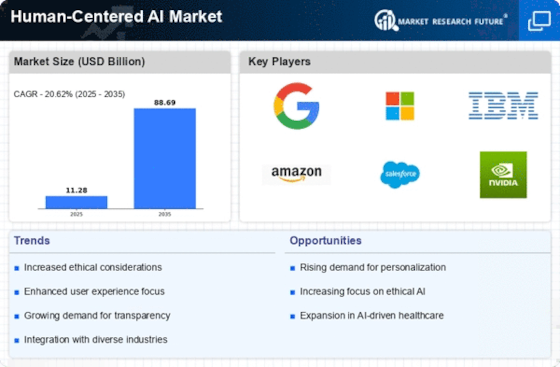
Human Centered AI Market Infographic
Purchase Options

Market Analysis

In-depth Analysis of Human Centered AI Market Industry Landscape

The Human-Centered AI market is influenced by a variety of factors that collectively shape its growth and impact on industries. One pivotal factor driving the adoption of Human-Centered AI is the increasing emphasis on creating AI systems that prioritize human needs, values, and ethical considerations. As organizations recognize the importance of aligning AI technologies with human-centric principles, the demand for solutions that enhance user experience, promote transparency, and address ethical concerns becomes a driving force in the market.

Technological advancements play a key role in shaping the dynamics of the Human-Centered AI market. As AI technologies evolve, innovations such as natural language processing, computer vision, and explainable AI contribute to creating more user-friendly and understandable AI systems. These advancements empower organizations to design AI applications that augment human capabilities, fostering collaboration and trust between humans and AI.

Regulatory considerations are critical factors influencing the adoption of Human-Centered AI. Governments and regulatory bodies are increasingly introducing guidelines and standards to ensure ethical AI practices, protect user privacy, and prevent biases in AI algorithms. Organizations adopting Human-Centered AI solutions need to navigate and comply with these evolving regulatory frameworks, shaping the development and deployment of human-centric AI technologies.

Market competition is another significant factor shaping the Human-Centered AI landscape. With diverse stakeholders, including technology developers, AI solution providers, and industry-specific applications, competition fosters innovation. Companies strive to differentiate themselves by offering AI solutions that prioritize user experience, address biases, and align with ethical guidelines. This competitive environment contributes to the continuous improvement and refinement of Human-Centered AI technologies.

Economic conditions and funding opportunities contribute to the trajectory of the Human-Centered AI market. As organizations recognize the potential of human-centric AI in improving productivity, enhancing decision-making, and delivering more personalized experiences, investments in research, development, and implementation of such solutions increase. Public and private funding initiatives play a crucial role in supporting projects that aim to integrate Human-Centered AI into various industries, enabling organizations to harness the benefits of AI while ensuring a human-centric approach.

Global trends in AI and technology, such as the rise of responsible AI practices and the integration of AI in diverse sectors, align with the principles of Human-Centered AI. The increasing awareness of ethical considerations, bias mitigation, and user-centric design resonates with the core tenets of Human-Centered AI. Organizations across industries are recognizing the importance of incorporating human values into AI development, shaping the market as a response to these global trends.

Ethical considerations and public perception also impact the Human-Centered AI market. As AI technologies become more prevalent in daily life, addressing concerns related to bias, privacy, and accountability becomes crucial. Ensuring transparency, fairness, and inclusivity in AI applications helps build trust among users and stakeholders. Organizations that prioritize ethical considerations in their Human-Centered AI solutions are likely to receive positive reception from the public and gain a competitive edge in the market.

Author
Author Profile
Ankit Gupta
Team Lead - Research

Ankit Gupta is a seasoned market intelligence and strategic research professional with over six plus years of experience in the ICT and Semiconductor industries. With academic roots in Telecom, Marketing, and Electronics, he blends technical insight with business strategy. Ankit has led 200+ projects, including work for Fortune 500 clients like Microsoft and Rio Tinto, covering market sizing, tech forecasting, and go-to-market strategies. Known for bridging engineering and enterprise decision-making, his insights support growth, innovation, and investment planning across diverse technology markets.

Leave a Comment

FAQs

What is the current valuation of the Human-Centered AI Market in 2025?

<p>The Human-Centered AI Market is valued at 11.28 USD Billion in 2024.</p>

What is the projected market size for the Human-Centered AI Market by 2035?

<p>The market is projected to reach 88.69 USD Billion by 2035.</p>

What is the expected CAGR for the Human-Centered AI Market during the forecast period?

<p>The expected CAGR for the Human-Centered AI Market from 2025 to 2035 is 20.62%.</p>

Which companies are considered key players in the Human-Centered AI Market?

<p>Key players include Google, Microsoft, IBM, Amazon, Salesforce, NVIDIA, OpenAI, Meta, and SAP.</p>

What segment of the Human-Centered AI Market is projected to have the highest growth?

The Assistance and Support segment is projected to grow from 2.5 USD Billion in 2024 to 20.0 USD Billion by 2035.

How does the Decision-Making & Support segment perform in the Human-Centered AI Market?

The Decision-Making &amp; Support segment is expected to grow from 2.0 USD Billion in 2024 to 15.0 USD Billion by 2035.

What applications are driving growth in the Human-Centered AI Market?

Applications such as Chatbots and Virtual Assistants are projected to grow from 2.0 USD Billion in 2024 to 16.0 USD Billion by 2035.

What is the expected performance of the Healthcare sector within the Human-Centered AI Market?

The Healthcare sector is anticipated to expand from 2.5 USD Billion in 2024 to 20.0 USD Billion by 2035.

How does the Fraud Detection & Risk Assessment application contribute to the market?

Fraud Detection &amp; Risk Assessment is expected to grow from 1.2 USD Billion in 2024 to 10.0 USD Billion by 2035.

What is the projected growth for the Collaboration segment in the Human-Centered AI Market?

The Collaboration segment is projected to increase from 2.0 USD Billion in 2024 to 14.0 USD Billion by 2035.

Market Summary

As per Market Research Future analysis, the Human-Centered AI Market Size was estimated at 11.28 USD Billion in 2024. The Human-Centered AI industry is projected to grow from USD 13.6 Billion in 2025 to USD 88.69 Billion by 2035, exhibiting a compound annual growth rate (CAGR) of 20.62% during the forecast period 2025 - 2035

Key Market Trends & Highlights

The Human-Centered AI Market is experiencing a transformative shift towards ethical practices and user-centric designs.

  • The market is increasingly prioritizing ethical AI development to address societal concerns. Interdisciplinary collaboration is becoming essential for advancing AI technologies in North America and Asia-Pacific. User-centric design is driving innovation in assistance and support applications, which remain the largest segment. The growing demand for personalization and advancements in natural language processing are key drivers of market expansion.

Market Size & Forecast

2024 Market Size 11.28 (USD Billion)
2035 Market Size 88.69 (USD Billion)
CAGR (2025 - 2035) 20.62%
Largest Regional Market Share in 2024 Healthcare

Major Players

Google (US), Microsoft (US), IBM (US), Amazon (US), Salesforce (US), NVIDIA (US), OpenAI (US), Meta (US), SAP (DE)

Market Trends

The Human-Centered AI Market is currently experiencing a transformative phase, characterized by a growing emphasis on ethical considerations and user-centric design. Organizations are increasingly recognizing the necessity of integrating human values into artificial intelligence systems. This shift appears to stem from a broader societal demand for transparency, accountability, and inclusivity in technology. As a result, companies are investing in research and development to create AI solutions that prioritize user experience and societal impact. This trend suggests a potential redefinition of success in the tech industry, moving beyond mere efficiency to encompass the well-being of users and communities. Moreover, the Human-Centered AI Market is witnessing a surge in collaboration between technologists and social scientists. This interdisciplinary approach seems to enhance the understanding of human behavior and needs, leading to more effective AI applications. By fostering partnerships across diverse fields, organizations may develop solutions that are not only innovative but also resonate with users on a deeper level. This collaborative spirit indicates a promising future for AI technologies that are designed with empathy and understanding at their core, potentially reshaping the landscape of artificial intelligence in the years to come.

Ethical AI Development

There is a noticeable trend towards the ethical development of AI technologies. Companies are increasingly prioritizing ethical guidelines to ensure that their AI systems are fair, transparent, and accountable. This focus on ethics is likely to influence the design and deployment of AI solutions, fostering trust among users.

Interdisciplinary Collaboration

The Human-Centered AI Market is seeing a rise in interdisciplinary collaboration. By bringing together experts from various fields, organizations can better understand human needs and behaviors. This collaboration may lead to more effective and user-friendly AI applications, enhancing overall user experience.

User-Centric Design

A significant trend in the Human-Centered AI Market is the emphasis on user-centric design principles. Companies are increasingly focusing on creating AI systems that prioritize user experience, ensuring that technology is accessible and beneficial to a diverse range of users. This approach may redefine how AI solutions are developed and implemented.

Human Centered AI Market Market Drivers

Focus on Ethical AI Practices

The Human-Centered AI Market is witnessing a growing emphasis on ethical AI practices. As concerns regarding bias and transparency in AI systems rise, organizations are prioritizing the development of ethical frameworks to guide AI deployment. This focus on ethics is not merely a regulatory response; it reflects a broader societal demand for responsible AI usage. Companies that adopt ethical AI practices are likely to gain consumer trust and enhance their brand reputation. Market data indicates that 65% of consumers are more likely to engage with brands that demonstrate a commitment to ethical AI. Thus, the integration of ethical considerations into AI development is becoming a fundamental driver in the Human-Centered AI Market.

Increased Demand for Personalization

The Human-Centered AI Market experiences a notable surge in demand for personalized solutions. As consumers increasingly seek tailored experiences, businesses are compelled to adopt AI technologies that prioritize user preferences and behaviors. This trend is reflected in market data, indicating that 70% of consumers express a preference for personalized interactions. Companies leveraging human-centered AI can enhance customer satisfaction and loyalty, ultimately driving revenue growth. Furthermore, the integration of AI in various sectors, such as retail and healthcare, allows for the creation of customized products and services, thereby fostering a more engaging user experience. This shift towards personalization not only meets consumer expectations but also positions organizations competitively within the Human-Centered AI Market.

Advancements in Natural Language Processing

Natural Language Processing (NLP) has emerged as a pivotal driver within the Human-Centered AI Market. Recent advancements in NLP technologies enable machines to understand and respond to human language with unprecedented accuracy. This capability enhances user interactions across various platforms, including chatbots and virtual assistants. Market data suggests that the NLP segment is projected to grow at a compound annual growth rate of 20% over the next five years. As organizations increasingly adopt NLP solutions, they can provide more intuitive and effective communication channels for users. This evolution not only improves user satisfaction but also streamlines operations, making NLP a critical component of the Human-Centered AI Market.

Growing Investment in AI Research and Development

Investment in research and development (R&D) within the Human-Centered AI Market is on the rise, driven by the increasing recognition of AI's transformative potential. Organizations are allocating substantial resources to explore innovative applications of AI that prioritize user experience and ethical considerations. Market data indicates that global investment in AI R&D is expected to reach 100 billion dollars by 2026, reflecting a robust commitment to advancing human-centered technologies. This influx of funding not only accelerates technological advancements but also encourages the development of solutions that align with user needs. As a result, the growing investment landscape is poised to significantly influence the trajectory of the Human-Centered AI Market.

Interdisciplinary Collaboration in AI Development

Interdisciplinary collaboration is increasingly recognized as a vital driver within the Human-Centered AI Market. By bringing together experts from diverse fields such as psychology, design, and computer science, organizations can create more effective and user-friendly AI solutions. This collaborative approach fosters innovation and ensures that AI technologies are developed with a comprehensive understanding of human needs and behaviors. Market data suggests that companies engaging in interdisciplinary teams are 30% more likely to produce successful AI products. As the demand for human-centered solutions grows, the importance of interdisciplinary collaboration in AI development becomes ever more pronounced within the Human-Centered AI Market.

Market Segment Insights

By Function: Assistance and Support (Largest) vs. Safety and Security (Fastest-Growing)

In the Human-Centered AI Market, the segment of Assistance and Support holds a prominent position, dominating the market share compared to other function segments. It is primarily utilized in areas such as <a title="customer service" href="https://www.marketresearchfuture.com/reports/customer-service-market-42123" target="_blank" rel="noopener">customer service</a>, chatbots, and virtual personal assistants, thereby facilitating seamless interactions between users and technology. Meanwhile, Safety and Security is steadily gaining traction, driven by the increasing demand for enhanced cybersecurity measures and risk management solutions in AI applications. The growth trajectory of both Assistance and Support and Safety and Security segments reflects the evolving landscape of human-centered AI. The post-pandemic world has accelerated the adoption of AI solutions, with organizations prioritizing efficiency and safety. The demand for automated assistance to optimize user experiences and the rising importance of safety measures underscore the significance of these segments. With continuous innovation, these functions are set to reshape industries and create value for end-users, making them critical to the market's future development.

Assistance and Support (Dominant) vs. Safety and Security (Emerging)

Assistance and Support stands as a dominant function in the Human-Centered AI Market, known for its applications in enhancing user experience through intuitive interactions. This segment leverages advanced natural language processing and machine learning to provide personalized services, making it invaluable across various industries, such as retail, healthcare, and finance. On the other hand, Safety and Security is an emerging segment that is quickly becoming essential as organizations grapple with cybersecurity threats. With the rise in data breaches and privacy concerns, this segment focuses on implementing AI-driven security solutions that not only protect sensitive information but also ensure compliance with regulations. Both segments are vital for the sustained growth and evolution of the Human-Centered AI market, bridging the gaps between user engagement and safety.

By Application: Medical Diagnostic (Largest) vs. Chatbots and Virtual Assistants (Fastest-Growing)

In the Human-Centered AI market, the application segment is characterized by diverse categories, including Medical Diagnostic, Chatbots and Virtual Assistants, Personalized Learning, Fraud Detection &amp; Risk Assessment, Quality Control, Human Resources, and Others. Among these, Medical Diagnostic stands out as the largest segment, largely driven by advancements in AI technology facilitating accurate disease detection and patient management. Chatbots and Virtual Assistants are emerging rapidly, capturing a significant share of consumer interaction sectors with their ability to enhance communication and streamline processes across industries.

Medical Diagnostic (Dominant) vs. Chatbots and Virtual Assistants (Emerging)

The Medical Diagnostic segment thrives on the implementation of AI in healthcare, where technologies are increasingly employed to analyze medical data, suggest treatment options, and improve patient outcomes. This segment benefits from a growing emphasis on personalized medicine and efficiency in diagnosis. Conversely, Chatbots and Virtual Assistants are quickly becoming a preferred solution for customer service and engagement, providing businesses with cost-effective, 24/7 communication tools. As these technologies evolve, they are being integrated with machine learning algorithms to deliver increasingly sophisticated interactions, making them a vital component in enhancing user experiences across various sectors.

By End User: Healthcare (Largest) vs. Retail & E-commerce (Fastest-Growing)

In the Human-Centered AI Market, the end-user segment showcases diverse applications across various industries. Healthcare emerges as the largest segment, driven by the growing demand for personalized patient care and efficient healthcare solutions. Following closely, Retail &amp; <a title="E-commerce" href="https://www.marketresearchfuture.com/reports/e-commerce-market-18845" target="_blank" rel="noopener">E-commerce</a> has also gained substantial traction, fueled by the need for enhanced customer experiences and operational efficiencies through AI technologies. The distribution among other sectors such as Automobile, Education, Transportation &amp; Logistics, and Manufacturing further illustrates the expanding horizons attributed to AI advancements in these fields.

Healthcare (Dominant) vs. Retail &amp; E-commerce (Emerging)

Healthcare has established itself as the dominant end-user segment in the Human-Centered AI Market, characterized by its significant investments in AI-driven solutions. This sector leverages AI for applications such as predictive analytics, virtual health assistants, and diagnostic tools, enhancing patient outcomes and operational efficiencies. Conversely, Retail &amp; E-commerce represents an emerging segment with a rapid growth trajectory, driven by technological innovations and an increasing emphasis on customer-centric strategies. Retailers are keen to implement AI to personalize shopping experiences, manage inventories efficiently, and streamline supply chain processes. Both sectors are integral to the evolving landscape of the Human-Centered AI Market, with distinct yet complementary roles.

Get more detailed insights about Human-Centered AI Market Research Report - Global Forecast till 2035

Regional Insights

North America : Innovation and Leadership Hub

North America is the largest market for Human-Centered AI, holding approximately 45% of the global share. The region's growth is driven by significant investments in AI research and development, coupled with a robust technology infrastructure. Regulatory support from government initiatives, such as the National AI Initiative Act, further catalyzes market expansion. The demand for AI solutions in sectors like healthcare, finance, and retail is surging, reflecting a strong trend towards automation and enhanced user experiences. The United States leads the North American market, with key players like Google, Microsoft, and IBM driving innovation. The competitive landscape is characterized by rapid advancements in AI technologies, with companies focusing on ethical AI and user-centric designs. Canada also plays a significant role, fostering a vibrant startup ecosystem that complements the established giants. This dynamic environment positions North America as a leader in shaping the future of Human-Centered AI.

Europe : Regulatory Framework and Growth

Europe is witnessing rapid growth in the Human-Centered AI market, holding approximately 30% of the global share. The region's expansion is fueled by stringent regulations aimed at ensuring ethical AI use, such as the EU's AI Act, which promotes transparency and accountability. Countries like Germany and France are at the forefront, driving demand for AI solutions across various sectors, including manufacturing and automotive. The emphasis on data privacy and user rights is shaping the market landscape, encouraging responsible AI development. Germany is the largest market in Europe, supported by a strong industrial base and a focus on innovation. France follows closely, with significant investments in AI research and development. The competitive landscape features a mix of established companies like SAP and emerging startups, fostering collaboration and innovation. The presence of leading tech firms and a supportive regulatory environment positions Europe as a key player in the global Human-Centered AI market.

Asia-Pacific : Rapid Adoption and Innovation

Asia-Pacific is rapidly emerging as a significant player in the Human-Centered AI market, accounting for approximately 20% of the global share. The region's growth is driven by increasing digitalization, government initiatives promoting AI adoption, and a burgeoning tech-savvy population. Countries like China and India are leading the charge, with substantial investments in AI research and development. The demand for AI solutions in sectors such as e-commerce, healthcare, and finance is on the rise, reflecting a shift towards more personalized user experiences. China is the largest market in the region, supported by government policies that prioritize AI development. India follows closely, with a vibrant startup ecosystem and a focus on AI applications in various industries. The competitive landscape is characterized by a mix of local and international players, including major tech firms and innovative startups. This dynamic environment positions Asia-Pacific as a key region for the future of Human-Centered AI.

Middle East and Africa : Emerging Opportunities in AI

The Middle East and Africa region is gradually emerging in the Human-Centered AI market, holding approximately 5% of the global share. The growth is driven by increasing investments in technology infrastructure and government initiatives aimed at fostering innovation. Countries like the UAE and South Africa are leading the way, with a focus on integrating AI into various sectors, including healthcare and finance. The demand for AI solutions is expected to rise as businesses seek to enhance operational efficiency and customer engagement. The UAE is the largest market in the region, supported by government-led initiatives such as the UAE AI Strategy 2031, which aims to position the country as a global leader in AI. South Africa follows, with a growing tech ecosystem and increasing interest in AI applications. The competitive landscape features a mix of local startups and international players, creating a vibrant environment for AI development. This region presents significant opportunities for growth in the Human-Centered AI market.

Key Players and Competitive Insights

Major players in the Human-Centered AI Market are making substantial investments in research and development to expand their product/service portfolios, contributing to the market's robust growth. These market leaders are implementing various strategic initiatives to expand their global presence. Key developments include new product/service launches, mergers and acquisitions, contractual agreements, increased investments, and collaborations with other organizations. Given the competitive and evolving market landscape, competitors in the identity theft protection services industry are focusing on cost-effective offerings to thrive and expand.
Some of the key players are focusing small and medium enterprise size by customizing offerings to reduce operational costs as a primary business strategy to benefit customers and expand market share. In recent years, the financial industry vertical has witnessed significant advancements in the human-centered AI industry. Key market players, including IBM Corporation, Microsoft Corporation, Google LLC, Amazon Inc., Apple Inc., OpenAI, NVIDIA Corporation, Salesforce Inc., Nuance Communications, Cognizant, Accenture, Affectiva, Sentient Technologies, BenevolentAI and Zebra Technologies and others, are driving innovation in human-centered AI, pushing the boundaries of computational capabilities.

Key Companies in the Human Centered AI Market include

Industry Developments

June 2023 - PepsiCo, Inc. has announced a partnership with the Stanford Institute for Human-Centered Artificial Intelligence, a non-profit dedicated to leading and shaping the future of artificial intelligence. PepsiCo intends to be the worldwide corporate leader in industrialized AI applications and responsible AI as the first CPG firm to join Stanford HAI's Corporate Affiliate Program, gaining insights that promote research, education, policy, and practice throughout the industry.

Future Outlook

Human Centered AI Market Future Outlook

The Human-Centered AI Market is projected to grow at a 20.62% CAGR from 2025 to 2035, driven by advancements in machine learning, user experience design, and increased demand for ethical AI solutions.

New opportunities lie in:

  • Development of personalized AI-driven customer service platforms.
  • Integration of AI in remote healthcare monitoring systems.
  • Creation of AI tools for enhancing workplace productivity and collaboration.

By 2035, the Human-Centered AI Market is expected to be a pivotal sector, driving innovation and economic growth.

Market Segmentation

Human Centered AI Market End User Outlook

  • Healthcare
  • Automobile
  • Education
  • Retail & E-commerce
  • Transportation & Logistics
  • Manufacturing
  • Others

Human Centered AI Market Function Outlook

  • Assistance and Support
  • Safety and Security
  • Decision-Making & Support
  • Workflow Automation
  • Collaboration
  • Others

Human Centered AI Market Application Outlook

  • Medical Diagnostic
  • Chatbots and Virtual Assistants
  • Personalized Learning
  • Fraud Detection & Risk Assessment
  • Quality Control
  • Human Resources
  • Others

Report Scope

MARKET SIZE 2024 11.28(USD Billion)
MARKET SIZE 2025 13.6(USD Billion)
MARKET SIZE 2035 88.69(USD Billion)
COMPOUND ANNUAL GROWTH RATE (CAGR) 20.62% (2025 - 2035)
REPORT COVERAGE Revenue Forecast, Competitive Landscape, Growth Factors, and Trends
BASE YEAR 2024
Market Forecast Period 2025 - 2035
Historical Data 2019 - 2024
Market Forecast Units USD Billion
Key Companies Profiled Google (US), Microsoft (US), IBM (US), Amazon (US), Salesforce (US), NVIDIA (US), OpenAI (US), Meta (US), SAP (DE)
Segments Covered Function, Regions - Forecast Till 2035
Key Market Opportunities Integration of ethical frameworks in Human-Centered AI design enhances user trust and market adoption.
Key Market Dynamics Rising consumer demand for ethical AI solutions drives innovation and regulatory scrutiny in the Human-Centered AI Market.
Countries Covered North America, Europe, APAC, South America, MEA

FAQs

What is the current valuation of the Human-Centered AI Market in 2025?

<p>The Human-Centered AI Market is valued at 11.28 USD Billion in 2024.</p>

What is the projected market size for the Human-Centered AI Market by 2035?

<p>The market is projected to reach 88.69 USD Billion by 2035.</p>

What is the expected CAGR for the Human-Centered AI Market during the forecast period?

<p>The expected CAGR for the Human-Centered AI Market from 2025 to 2035 is 20.62%.</p>

Which companies are considered key players in the Human-Centered AI Market?

<p>Key players include Google, Microsoft, IBM, Amazon, Salesforce, NVIDIA, OpenAI, Meta, and SAP.</p>

What segment of the Human-Centered AI Market is projected to have the highest growth?

The Assistance and Support segment is projected to grow from 2.5 USD Billion in 2024 to 20.0 USD Billion by 2035.

How does the Decision-Making & Support segment perform in the Human-Centered AI Market?

The Decision-Making &amp; Support segment is expected to grow from 2.0 USD Billion in 2024 to 15.0 USD Billion by 2035.

What applications are driving growth in the Human-Centered AI Market?

Applications such as Chatbots and Virtual Assistants are projected to grow from 2.0 USD Billion in 2024 to 16.0 USD Billion by 2035.

What is the expected performance of the Healthcare sector within the Human-Centered AI Market?

The Healthcare sector is anticipated to expand from 2.5 USD Billion in 2024 to 20.0 USD Billion by 2035.

How does the Fraud Detection & Risk Assessment application contribute to the market?

Fraud Detection &amp; Risk Assessment is expected to grow from 1.2 USD Billion in 2024 to 10.0 USD Billion by 2035.

What is the projected growth for the Collaboration segment in the Human-Centered AI Market?

The Collaboration segment is projected to increase from 2.0 USD Billion in 2024 to 14.0 USD Billion by 2035.

  1. SECTION I: EXECUTIVE SUMMARY AND KEY HIGHLIGHTS
    1. | 1.1 EXECUTIVE SUMMARY
    2. | | 1.1.1 Market Overview
    3. | | 1.1.2 Key Findings
    4. | | 1.1.3 Market Segmentation
    5. | | 1.1.4 Competitive Landscape
    6. | | 1.1.5 Challenges and Opportunities
    7. | | 1.1.6 Future Outlook
  2. SECTION II: SCOPING, METHODOLOGY AND MARKET STRUCTURE
    1. | 2.1 MARKET INTRODUCTION
    2. | | 2.1.1 Definition
    3. | | 2.1.2 Scope of the study
    4. | | | 2.1.2.1 Research Objective
    5. | | | 2.1.2.2 Assumption
    6. | | | 2.1.2.3 Limitations
    7. | 2.2 RESEARCH METHODOLOGY
    8. | | 2.2.1 Overview
    9. | | 2.2.2 Data Mining
    10. | | 2.2.3 Secondary Research
    11. | | 2.2.4 Primary Research
    12. | | | 2.2.4.1 Primary Interviews and Information Gathering Process
    13. | | | 2.2.4.2 Breakdown of Primary Respondents
    14. | | 2.2.5 Forecasting Model
    15. | | 2.2.6 Market Size Estimation
    16. | | | 2.2.6.1 Bottom-Up Approach
    17. | | | 2.2.6.2 Top-Down Approach
    18. | | 2.2.7 Data Triangulation
    19. | | 2.2.8 Validation
  3. SECTION III: QUALITATIVE ANALYSIS
    1. | 3.1 MARKET DYNAMICS
    2. | | 3.1.1 Overview
    3. | | 3.1.2 Drivers
    4. | | 3.1.3 Restraints
    5. | | 3.1.4 Opportunities
    6. | 3.2 MARKET FACTOR ANALYSIS
    7. | | 3.2.1 Value chain Analysis
    8. | | 3.2.2 Porter's Five Forces Analysis
    9. | | | 3.2.2.1 Bargaining Power of Suppliers
    10. | | | 3.2.2.2 Bargaining Power of Buyers
    11. | | | 3.2.2.3 Threat of New Entrants
    12. | | | 3.2.2.4 Threat of Substitutes
    13. | | | 3.2.2.5 Intensity of Rivalry
    14. | | 3.2.3 COVID-19 Impact Analysis
    15. | | | 3.2.3.1 Market Impact Analysis
    16. | | | 3.2.3.2 Regional Impact
    17. | | | 3.2.3.3 Opportunity and Threat Analysis
  4. SECTION IV: QUANTITATIVE ANALYSIS
    1. | 4.1 Information and Communications Technology, BY Function (USD Billion)
    2. | | 4.1.1 Assistance and Support
    3. | | 4.1.2 Safety and Security
    4. | | 4.1.3 Decision-Making & Support
    5. | | 4.1.4 Workflow Automation
    6. | | 4.1.5 Collaboration
    7. | | 4.1.6 Others
    8. | 4.2 Information and Communications Technology, BY Application (USD Billion)
    9. | | 4.2.1 Medical Diagnostic
    10. | | 4.2.2 Chatbots and Virtual Assistants
    11. | | 4.2.3 Personalized Learning
    12. | | 4.2.4 Fraud Detection & Risk Assessment
    13. | | 4.2.5 Quality Control
    14. | | 4.2.6 Human Resources
    15. | | 4.2.7 Others
    16. | 4.3 Information and Communications Technology, BY End User (USD Billion)
    17. | | 4.3.1 Healthcare
    18. | | 4.3.2 Automobile
    19. | | 4.3.3 Education
    20. | | 4.3.4 Retail & E-commerce
    21. | | 4.3.5 Transportation & Logistics
    22. | | 4.3.6 Manufacturing
    23. | | 4.3.7 Others
    24. | 4.4 Information and Communications Technology, BY Region (USD Billion)
    25. | | 4.4.1 North America
    26. | | | 4.4.1.1 US
    27. | | | 4.4.1.2 Canada
    28. | | 4.4.2 Europe
    29. | | | 4.4.2.1 Germany
    30. | | | 4.4.2.2 UK
    31. | | | 4.4.2.3 France
    32. | | | 4.4.2.4 Russia
    33. | | | 4.4.2.5 Italy
    34. | | | 4.4.2.6 Spain
    35. | | | 4.4.2.7 Rest of Europe
    36. | | 4.4.3 APAC
    37. | | | 4.4.3.1 China
    38. | | | 4.4.3.2 India
    39. | | | 4.4.3.3 Japan
    40. | | | 4.4.3.4 South Korea
    41. | | | 4.4.3.5 Malaysia
    42. | | | 4.4.3.6 Thailand
    43. | | | 4.4.3.7 Indonesia
    44. | | | 4.4.3.8 Rest of APAC
    45. | | 4.4.4 South America
    46. | | | 4.4.4.1 Brazil
    47. | | | 4.4.4.2 Mexico
    48. | | | 4.4.4.3 Argentina
    49. | | | 4.4.4.4 Rest of South America
    50. | | 4.4.5 MEA
    51. | | | 4.4.5.1 GCC Countries
    52. | | | 4.4.5.2 South Africa
    53. | | | 4.4.5.3 Rest of MEA
  5. SECTION V: COMPETITIVE ANALYSIS
    1. | 5.1 Competitive Landscape
    2. | | 5.1.1 Overview
    3. | | 5.1.2 Competitive Analysis
    4. | | 5.1.3 Market share Analysis
    5. | | 5.1.4 Major Growth Strategy in the Information and Communications Technology
    6. | | 5.1.5 Competitive Benchmarking
    7. | | 5.1.6 Leading Players in Terms of Number of Developments in the Information and Communications Technology
    8. | | 5.1.7 Key developments and growth strategies
    9. | | | 5.1.7.1 New Product Launch/Service Deployment
    10. | | | 5.1.7.2 Merger & Acquisitions
    11. | | | 5.1.7.3 Joint Ventures
    12. | | 5.1.8 Major Players Financial Matrix
    13. | | | 5.1.8.1 Sales and Operating Income
    14. | | | 5.1.8.2 Major Players R&D Expenditure. 2023
    15. | 5.2 Company Profiles
    16. | | 5.2.1 Google (US)
    17. | | | 5.2.1.1 Financial Overview
    18. | | | 5.2.1.2 Products Offered
    19. | | | 5.2.1.3 Key Developments
    20. | | | 5.2.1.4 SWOT Analysis
    21. | | | 5.2.1.5 Key Strategies
    22. | | 5.2.2 Microsoft (US)
    23. | | | 5.2.2.1 Financial Overview
    24. | | | 5.2.2.2 Products Offered
    25. | | | 5.2.2.3 Key Developments
    26. | | | 5.2.2.4 SWOT Analysis
    27. | | | 5.2.2.5 Key Strategies
    28. | | 5.2.3 IBM (US)
    29. | | | 5.2.3.1 Financial Overview
    30. | | | 5.2.3.2 Products Offered
    31. | | | 5.2.3.3 Key Developments
    32. | | | 5.2.3.4 SWOT Analysis
    33. | | | 5.2.3.5 Key Strategies
    34. | | 5.2.4 Amazon (US)
    35. | | | 5.2.4.1 Financial Overview
    36. | | | 5.2.4.2 Products Offered
    37. | | | 5.2.4.3 Key Developments
    38. | | | 5.2.4.4 SWOT Analysis
    39. | | | 5.2.4.5 Key Strategies
    40. | | 5.2.5 Salesforce (US)
    41. | | | 5.2.5.1 Financial Overview
    42. | | | 5.2.5.2 Products Offered
    43. | | | 5.2.5.3 Key Developments
    44. | | | 5.2.5.4 SWOT Analysis
    45. | | | 5.2.5.5 Key Strategies
    46. | | 5.2.6 NVIDIA (US)
    47. | | | 5.2.6.1 Financial Overview
    48. | | | 5.2.6.2 Products Offered
    49. | | | 5.2.6.3 Key Developments
    50. | | | 5.2.6.4 SWOT Analysis
    51. | | | 5.2.6.5 Key Strategies
    52. | | 5.2.7 OpenAI (US)
    53. | | | 5.2.7.1 Financial Overview
    54. | | | 5.2.7.2 Products Offered
    55. | | | 5.2.7.3 Key Developments
    56. | | | 5.2.7.4 SWOT Analysis
    57. | | | 5.2.7.5 Key Strategies
    58. | | 5.2.8 Meta (US)
    59. | | | 5.2.8.1 Financial Overview
    60. | | | 5.2.8.2 Products Offered
    61. | | | 5.2.8.3 Key Developments
    62. | | | 5.2.8.4 SWOT Analysis
    63. | | | 5.2.8.5 Key Strategies
    64. | | 5.2.9 SAP (DE)
    65. | | | 5.2.9.1 Financial Overview
    66. | | | 5.2.9.2 Products Offered
    67. | | | 5.2.9.3 Key Developments
    68. | | | 5.2.9.4 SWOT Analysis
    69. | | | 5.2.9.5 Key Strategies
    70. | 5.3 Appendix
    71. | | 5.3.1 References
    72. | | 5.3.2 Related Reports
  6. LIST OF FIGURES
    1. | 6.1 MARKET SYNOPSIS
    2. | 6.2 NORTH AMERICA MARKET ANALYSIS
    3. | 6.3 US MARKET ANALYSIS BY FUNCTION
    4. | 6.4 US MARKET ANALYSIS BY APPLICATION
    5. | 6.5 US MARKET ANALYSIS BY END USER
    6. | 6.6 CANADA MARKET ANALYSIS BY FUNCTION
    7. | 6.7 CANADA MARKET ANALYSIS BY APPLICATION
    8. | 6.8 CANADA MARKET ANALYSIS BY END USER
    9. | 6.9 EUROPE MARKET ANALYSIS
    10. | 6.10 GERMANY MARKET ANALYSIS BY FUNCTION
    11. | 6.11 GERMANY MARKET ANALYSIS BY APPLICATION
    12. | 6.12 GERMANY MARKET ANALYSIS BY END USER
    13. | 6.13 UK MARKET ANALYSIS BY FUNCTION
    14. | 6.14 UK MARKET ANALYSIS BY APPLICATION
    15. | 6.15 UK MARKET ANALYSIS BY END USER
    16. | 6.16 FRANCE MARKET ANALYSIS BY FUNCTION
    17. | 6.17 FRANCE MARKET ANALYSIS BY APPLICATION
    18. | 6.18 FRANCE MARKET ANALYSIS BY END USER
    19. | 6.19 RUSSIA MARKET ANALYSIS BY FUNCTION
    20. | 6.20 RUSSIA MARKET ANALYSIS BY APPLICATION
    21. | 6.21 RUSSIA MARKET ANALYSIS BY END USER
    22. | 6.22 ITALY MARKET ANALYSIS BY FUNCTION
    23. | 6.23 ITALY MARKET ANALYSIS BY APPLICATION
    24. | 6.24 ITALY MARKET ANALYSIS BY END USER
    25. | 6.25 SPAIN MARKET ANALYSIS BY FUNCTION
    26. | 6.26 SPAIN MARKET ANALYSIS BY APPLICATION
    27. | 6.27 SPAIN MARKET ANALYSIS BY END USER
    28. | 6.28 REST OF EUROPE MARKET ANALYSIS BY FUNCTION
    29. | 6.29 REST OF EUROPE MARKET ANALYSIS BY APPLICATION
    30. | 6.30 REST OF EUROPE MARKET ANALYSIS BY END USER
    31. | 6.31 APAC MARKET ANALYSIS
    32. | 6.32 CHINA MARKET ANALYSIS BY FUNCTION
    33. | 6.33 CHINA MARKET ANALYSIS BY APPLICATION
    34. | 6.34 CHINA MARKET ANALYSIS BY END USER
    35. | 6.35 INDIA MARKET ANALYSIS BY FUNCTION
    36. | 6.36 INDIA MARKET ANALYSIS BY APPLICATION
    37. | 6.37 INDIA MARKET ANALYSIS BY END USER
    38. | 6.38 JAPAN MARKET ANALYSIS BY FUNCTION
    39. | 6.39 JAPAN MARKET ANALYSIS BY APPLICATION
    40. | 6.40 JAPAN MARKET ANALYSIS BY END USER
    41. | 6.41 SOUTH KOREA MARKET ANALYSIS BY FUNCTION
    42. | 6.42 SOUTH KOREA MARKET ANALYSIS BY APPLICATION
    43. | 6.43 SOUTH KOREA MARKET ANALYSIS BY END USER
    44. | 6.44 MALAYSIA MARKET ANALYSIS BY FUNCTION
    45. | 6.45 MALAYSIA MARKET ANALYSIS BY APPLICATION
    46. | 6.46 MALAYSIA MARKET ANALYSIS BY END USER
    47. | 6.47 THAILAND MARKET ANALYSIS BY FUNCTION
    48. | 6.48 THAILAND MARKET ANALYSIS BY APPLICATION
    49. | 6.49 THAILAND MARKET ANALYSIS BY END USER
    50. | 6.50 INDONESIA MARKET ANALYSIS BY FUNCTION
    51. | 6.51 INDONESIA MARKET ANALYSIS BY APPLICATION
    52. | 6.52 INDONESIA MARKET ANALYSIS BY END USER
    53. | 6.53 REST OF APAC MARKET ANALYSIS BY FUNCTION
    54. | 6.54 REST OF APAC MARKET ANALYSIS BY APPLICATION
    55. | 6.55 REST OF APAC MARKET ANALYSIS BY END USER
    56. | 6.56 SOUTH AMERICA MARKET ANALYSIS
    57. | 6.57 BRAZIL MARKET ANALYSIS BY FUNCTION
    58. | 6.58 BRAZIL MARKET ANALYSIS BY APPLICATION
    59. | 6.59 BRAZIL MARKET ANALYSIS BY END USER
    60. | 6.60 MEXICO MARKET ANALYSIS BY FUNCTION
    61. | 6.61 MEXICO MARKET ANALYSIS BY APPLICATION
    62. | 6.62 MEXICO MARKET ANALYSIS BY END USER
    63. | 6.63 ARGENTINA MARKET ANALYSIS BY FUNCTION
    64. | 6.64 ARGENTINA MARKET ANALYSIS BY APPLICATION
    65. | 6.65 ARGENTINA MARKET ANALYSIS BY END USER
    66. | 6.66 REST OF SOUTH AMERICA MARKET ANALYSIS BY FUNCTION
    67. | 6.67 REST OF SOUTH AMERICA MARKET ANALYSIS BY APPLICATION
    68. | 6.68 REST OF SOUTH AMERICA MARKET ANALYSIS BY END USER
    69. | 6.69 MEA MARKET ANALYSIS
    70. | 6.70 GCC COUNTRIES MARKET ANALYSIS BY FUNCTION
    71. | 6.71 GCC COUNTRIES MARKET ANALYSIS BY APPLICATION
    72. | 6.72 GCC COUNTRIES MARKET ANALYSIS BY END USER
    73. | 6.73 SOUTH AFRICA MARKET ANALYSIS BY FUNCTION
    74. | 6.74 SOUTH AFRICA MARKET ANALYSIS BY APPLICATION
    75. | 6.75 SOUTH AFRICA MARKET ANALYSIS BY END USER
    76. | 6.76 REST OF MEA MARKET ANALYSIS BY FUNCTION
    77. | 6.77 REST OF MEA MARKET ANALYSIS BY APPLICATION
    78. | 6.78 REST OF MEA MARKET ANALYSIS BY END USER
    79. | 6.79 KEY BUYING CRITERIA OF INFORMATION AND COMMUNICATIONS TECHNOLOGY
    80. | 6.80 RESEARCH PROCESS OF MRFR
    81. | 6.81 DRO ANALYSIS OF INFORMATION AND COMMUNICATIONS TECHNOLOGY
    82. | 6.82 DRIVERS IMPACT ANALYSIS: INFORMATION AND COMMUNICATIONS TECHNOLOGY
    83. | 6.83 RESTRAINTS IMPACT ANALYSIS: INFORMATION AND COMMUNICATIONS TECHNOLOGY
    84. | 6.84 SUPPLY / VALUE CHAIN: INFORMATION AND COMMUNICATIONS TECHNOLOGY
    85. | 6.85 INFORMATION AND COMMUNICATIONS TECHNOLOGY, BY FUNCTION, 2024 (% SHARE)
    86. | 6.86 INFORMATION AND COMMUNICATIONS TECHNOLOGY, BY FUNCTION, 2024 TO 2035 (USD Billion)
    87. | 6.87 INFORMATION AND COMMUNICATIONS TECHNOLOGY, BY APPLICATION, 2024 (% SHARE)
    88. | 6.88 INFORMATION AND COMMUNICATIONS TECHNOLOGY, BY APPLICATION, 2024 TO 2035 (USD Billion)
    89. | 6.89 INFORMATION AND COMMUNICATIONS TECHNOLOGY, BY END USER, 2024 (% SHARE)
    90. | 6.90 INFORMATION AND COMMUNICATIONS TECHNOLOGY, BY END USER, 2024 TO 2035 (USD Billion)
    91. | 6.91 BENCHMARKING OF MAJOR COMPETITORS
  7. LIST OF TABLES
    1. | 7.1 LIST OF ASSUMPTIONS
    2. | | 7.1.1
    3. | 7.2 North America MARKET SIZE ESTIMATES; FORECAST
    4. | | 7.2.1 BY FUNCTION, 2025-2035 (USD Billion)
    5. | | 7.2.2 BY APPLICATION, 2025-2035 (USD Billion)
    6. | | 7.2.3 BY END USER, 2025-2035 (USD Billion)
    7. | 7.3 US MARKET SIZE ESTIMATES; FORECAST
    8. | | 7.3.1 BY FUNCTION, 2025-2035 (USD Billion)
    9. | | 7.3.2 BY APPLICATION, 2025-2035 (USD Billion)
    10. | | 7.3.3 BY END USER, 2025-2035 (USD Billion)
    11. | 7.4 Canada MARKET SIZE ESTIMATES; FORECAST
    12. | | 7.4.1 BY FUNCTION, 2025-2035 (USD Billion)
    13. | | 7.4.2 BY APPLICATION, 2025-2035 (USD Billion)
    14. | | 7.4.3 BY END USER, 2025-2035 (USD Billion)
    15. | 7.5 Europe MARKET SIZE ESTIMATES; FORECAST
    16. | | 7.5.1 BY FUNCTION, 2025-2035 (USD Billion)
    17. | | 7.5.2 BY APPLICATION, 2025-2035 (USD Billion)
    18. | | 7.5.3 BY END USER, 2025-2035 (USD Billion)
    19. | 7.6 Germany MARKET SIZE ESTIMATES; FORECAST
    20. | | 7.6.1 BY FUNCTION, 2025-2035 (USD Billion)
    21. | | 7.6.2 BY APPLICATION, 2025-2035 (USD Billion)
    22. | | 7.6.3 BY END USER, 2025-2035 (USD Billion)
    23. | 7.7 UK MARKET SIZE ESTIMATES; FORECAST
    24. | | 7.7.1 BY FUNCTION, 2025-2035 (USD Billion)
    25. | | 7.7.2 BY APPLICATION, 2025-2035 (USD Billion)
    26. | | 7.7.3 BY END USER, 2025-2035 (USD Billion)
    27. | 7.8 France MARKET SIZE ESTIMATES; FORECAST
    28. | | 7.8.1 BY FUNCTION, 2025-2035 (USD Billion)
    29. | | 7.8.2 BY APPLICATION, 2025-2035 (USD Billion)
    30. | | 7.8.3 BY END USER, 2025-2035 (USD Billion)
    31. | 7.9 Russia MARKET SIZE ESTIMATES; FORECAST
    32. | | 7.9.1 BY FUNCTION, 2025-2035 (USD Billion)
    33. | | 7.9.2 BY APPLICATION, 2025-2035 (USD Billion)
    34. | | 7.9.3 BY END USER, 2025-2035 (USD Billion)
    35. | 7.10 Italy MARKET SIZE ESTIMATES; FORECAST
    36. | | 7.10.1 BY FUNCTION, 2025-2035 (USD Billion)
    37. | | 7.10.2 BY APPLICATION, 2025-2035 (USD Billion)
    38. | | 7.10.3 BY END USER, 2025-2035 (USD Billion)
    39. | 7.11 Spain MARKET SIZE ESTIMATES; FORECAST
    40. | | 7.11.1 BY FUNCTION, 2025-2035 (USD Billion)
    41. | | 7.11.2 BY APPLICATION, 2025-2035 (USD Billion)
    42. | | 7.11.3 BY END USER, 2025-2035 (USD Billion)
    43. | 7.12 Rest of Europe MARKET SIZE ESTIMATES; FORECAST
    44. | | 7.12.1 BY FUNCTION, 2025-2035 (USD Billion)
    45. | | 7.12.2 BY APPLICATION, 2025-2035 (USD Billion)
    46. | | 7.12.3 BY END USER, 2025-2035 (USD Billion)
    47. | 7.13 APAC MARKET SIZE ESTIMATES; FORECAST
    48. | | 7.13.1 BY FUNCTION, 2025-2035 (USD Billion)
    49. | | 7.13.2 BY APPLICATION, 2025-2035 (USD Billion)
    50. | | 7.13.3 BY END USER, 2025-2035 (USD Billion)
    51. | 7.14 China MARKET SIZE ESTIMATES; FORECAST
    52. | | 7.14.1 BY FUNCTION, 2025-2035 (USD Billion)
    53. | | 7.14.2 BY APPLICATION, 2025-2035 (USD Billion)
    54. | | 7.14.3 BY END USER, 2025-2035 (USD Billion)
    55. | 7.15 India MARKET SIZE ESTIMATES; FORECAST
    56. | | 7.15.1 BY FUNCTION, 2025-2035 (USD Billion)
    57. | | 7.15.2 BY APPLICATION, 2025-2035 (USD Billion)
    58. | | 7.15.3 BY END USER, 2025-2035 (USD Billion)
    59. | 7.16 Japan MARKET SIZE ESTIMATES; FORECAST
    60. | | 7.16.1 BY FUNCTION, 2025-2035 (USD Billion)
    61. | | 7.16.2 BY APPLICATION, 2025-2035 (USD Billion)
    62. | | 7.16.3 BY END USER, 2025-2035 (USD Billion)
    63. | 7.17 South Korea MARKET SIZE ESTIMATES; FORECAST
    64. | | 7.17.1 BY FUNCTION, 2025-2035 (USD Billion)
    65. | | 7.17.2 BY APPLICATION, 2025-2035 (USD Billion)
    66. | | 7.17.3 BY END USER, 2025-2035 (USD Billion)
    67. | 7.18 Malaysia MARKET SIZE ESTIMATES; FORECAST
    68. | | 7.18.1 BY FUNCTION, 2025-2035 (USD Billion)
    69. | | 7.18.2 BY APPLICATION, 2025-2035 (USD Billion)
    70. | | 7.18.3 BY END USER, 2025-2035 (USD Billion)
    71. | 7.19 Thailand MARKET SIZE ESTIMATES; FORECAST
    72. | | 7.19.1 BY FUNCTION, 2025-2035 (USD Billion)
    73. | | 7.19.2 BY APPLICATION, 2025-2035 (USD Billion)
    74. | | 7.19.3 BY END USER, 2025-2035 (USD Billion)
    75. | 7.20 Indonesia MARKET SIZE ESTIMATES; FORECAST
    76. | | 7.20.1 BY FUNCTION, 2025-2035 (USD Billion)
    77. | | 7.20.2 BY APPLICATION, 2025-2035 (USD Billion)
    78. | | 7.20.3 BY END USER, 2025-2035 (USD Billion)
    79. | 7.21 Rest of APAC MARKET SIZE ESTIMATES; FORECAST
    80. | | 7.21.1 BY FUNCTION, 2025-2035 (USD Billion)
    81. | | 7.21.2 BY APPLICATION, 2025-2035 (USD Billion)
    82. | | 7.21.3 BY END USER, 2025-2035 (USD Billion)
    83. | 7.22 South America MARKET SIZE ESTIMATES; FORECAST
    84. | | 7.22.1 BY FUNCTION, 2025-2035 (USD Billion)
    85. | | 7.22.2 BY APPLICATION, 2025-2035 (USD Billion)
    86. | | 7.22.3 BY END USER, 2025-2035 (USD Billion)
    87. | 7.23 Brazil MARKET SIZE ESTIMATES; FORECAST
    88. | | 7.23.1 BY FUNCTION, 2025-2035 (USD Billion)
    89. | | 7.23.2 BY APPLICATION, 2025-2035 (USD Billion)
    90. | | 7.23.3 BY END USER, 2025-2035 (USD Billion)
    91. | 7.24 Mexico MARKET SIZE ESTIMATES; FORECAST
    92. | | 7.24.1 BY FUNCTION, 2025-2035 (USD Billion)
    93. | | 7.24.2 BY APPLICATION, 2025-2035 (USD Billion)
    94. | | 7.24.3 BY END USER, 2025-2035 (USD Billion)
    95. | 7.25 Argentina MARKET SIZE ESTIMATES; FORECAST
    96. | | 7.25.1 BY FUNCTION, 2025-2035 (USD Billion)
    97. | | 7.25.2 BY APPLICATION, 2025-2035 (USD Billion)
    98. | | 7.25.3 BY END USER, 2025-2035 (USD Billion)
    99. | 7.26 Rest of South America MARKET SIZE ESTIMATES; FORECAST
    100. | | 7.26.1 BY FUNCTION, 2025-2035 (USD Billion)
    101. | | 7.26.2 BY APPLICATION, 2025-2035 (USD Billion)
    102. | | 7.26.3 BY END USER, 2025-2035 (USD Billion)
    103. | 7.27 MEA MARKET SIZE ESTIMATES; FORECAST
    104. | | 7.27.1 BY FUNCTION, 2025-2035 (USD Billion)
    105. | | 7.27.2 BY APPLICATION, 2025-2035 (USD Billion)
    106. | | 7.27.3 BY END USER, 2025-2035 (USD Billion)
    107. | 7.28 GCC Countries MARKET SIZE ESTIMATES; FORECAST
    108. | | 7.28.1 BY FUNCTION, 2025-2035 (USD Billion)
    109. | | 7.28.2 BY APPLICATION, 2025-2035 (USD Billion)
    110. | | 7.28.3 BY END USER, 2025-2035 (USD Billion)
    111. | 7.29 South Africa MARKET SIZE ESTIMATES; FORECAST
    112. | | 7.29.1 BY FUNCTION, 2025-2035 (USD Billion)
    113. | | 7.29.2 BY APPLICATION, 2025-2035 (USD Billion)
    114. | | 7.29.3 BY END USER, 2025-2035 (USD Billion)
    115. | 7.30 Rest of MEA MARKET SIZE ESTIMATES; FORECAST
    116. | | 7.30.1 BY FUNCTION, 2025-2035 (USD Billion)
    117. | | 7.30.2 BY APPLICATION, 2025-2035 (USD Billion)
    118. | | 7.30.3 BY END USER, 2025-2035 (USD Billion)
    119. | 7.31 PRODUCT LAUNCH/PRODUCT DEVELOPMENT/APPROVAL
    120. | | 7.31.1
    121. | 7.32 ACQUISITION/PARTNERSHIP
    122. | | 7.32.1

Information and Communications Technology Market Segmentation

Information and Communications Technology By Function (USD Billion, 2025-2035)

  • Assistance and Support
  • Safety and Security
  • Decision-Making & Support
  • Workflow Automation
  • Collaboration
  • Others

Information and Communications Technology By Application (USD Billion, 2025-2035)

  • Medical Diagnostic
  • Chatbots and Virtual Assistants
  • Personalized Learning
  • Fraud Detection & Risk Assessment
  • Quality Control
  • Human Resources
  • Others

Information and Communications Technology By End User (USD Billion, 2025-2035)

  • Healthcare
  • Automobile
  • Education
  • Retail & E-commerce
  • Transportation & Logistics
  • Manufacturing
  • Others
Infographic

Free Sample Request

Kindly complete the form below to receive a free sample of this Report

Get Free Sample

Customer Strories

Compare Licence

×
Features License Type
Single User Multiuser License Enterprise User
Price $4,950 $5,950 $7,250
Maximum User Access Limit 1 User Upto 10 Users Unrestricted Access Throughout the Organization
Free Customization
Direct Access to Analyst
Deliverable Format
Platform Access
Discount on Next Purchase 10% 15% 15%
Printable Versions















