
Satellite Propulsion System Market Summary
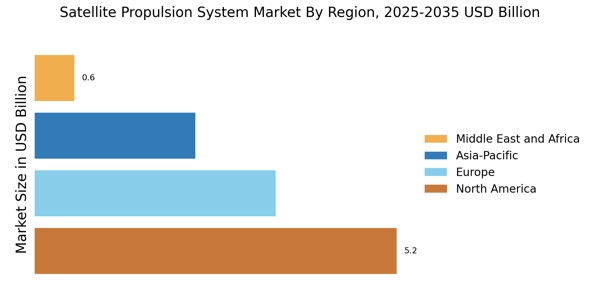
As per Market Research Future analysis, the Satellite Propulsion System Market Size was estimated at 11.5 USD Billion in 2024. The Satellite Propulsion System industry is projected to grow from 12.7 USD Billion in 2025 to 34.15 USD Billion by 2035, exhibiting a compound annual growth rate (CAGR) of 10.4% during the forecast period 2025 - 2035. North America holds the largest share of the Satellite Propulsion System Market at ~40% (~$13.7B of $34.15B by 2035), driven by government and private space investments and the presence of Aerojet Rocketdyne and SpaceX. The United States leads within North America at ~34% global share, supported by NASA programs, SpaceX Starlink constellations, and DoD funding for next-generation satellite propulsion R&D. Cold Gas Propulsion dominates at ~37.2% global share, driven by its established reliability and widespread use in attitude control and station-keeping for commercial and government-class spacecraft.
Key Market Trends & Highlights
The Satellite Propulsion System Market is poised for substantial growth driven by technological advancements and increasing demand for satellite services.
- The emergence of electric propulsion systems is reshaping the landscape of satellite propulsion technologies.
- North America remains the largest market, while the Asia-Pacific region is recognized as the fastest-growing area for satellite propulsion systems.
- Cold gas propulsion continues to dominate the market, whereas green liquid propulsion is rapidly gaining traction as a preferred choice.
- Advancements in propulsion technologies and increasing demand for satellite services are key drivers propelling market expansion.
Market Size & Forecast
| 2024 Market Size | 11.5 (USD Billion) |
| 2035 Market Size | 34.15 (USD Billion) |
| CAGR (2025 - 2035) | 10.4% |
Major Players
Aerojet Rocketdyne (US), Northrop Grumman (US), Airbus Defence and Space (GB), Boeing (US), Thales Alenia Space (FR), Rocket Lab (NZ), Mitsubishi Heavy Industries (JP), Sierra Nevada Corporation (US), Maxar Technologies (CA)