Request Free Sample ×

Kindly complete the form below to receive a free sample of this Report

* Please use a valid business email

Leading companies partner with us for data-driven Insights

clients tt-cursor
Hero Background
English
Chinese
French
Japanese
Korean
German
Spanish

Healthcare Electronic Data Interchange Market Trends

ID: MRFR/HC/5869-HCR
90 Pages
Vikita Thakur
April 2026

Healthcare Electronic Data Interchange (EDI) Market Research Report By Application (Claims Management, Payment Remittance, Order Processing, Eligibility Verification), By End Use (Healthcare Providers, Insurance Payers, Pharmaceutical Companies, Billing Services), By Deployment Type (On-Premises, Cloud-Based, Hybrid), By Transaction Type (Electronic Claims Submission, Electronic Remittance Advice, Patient Information Requests) and By Regional (North America, Europe, South America, Asia Pacific, Middle East and Africa) - Growth & Industry Forecast 2025 To 2035

Share:
Download PDF ×

We do not share your information with anyone. However, we may send you emails based on your report interest from time to time. You may contact us at any time to opt-out.

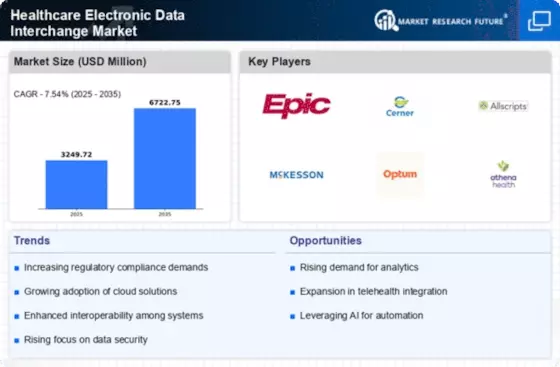
Healthcare Electronic Data Interchange Market Infographic
Purchase Options

Market Trends

Key Emerging Trends in the Healthcare Electronic Data Interchange Market

The Healthcare Electronic Data Interchange (EDI) market is encountering fast development, driven by the rising reception of advanced arrangements in the healthcare area. As healthcare suppliers and associations make progress toward effectiveness and precision in data exchange, EDI has arisen as a vital innovation. One of the essential market patterns is the accentuation on cost productivity. Healthcare EDI smoothes out regulatory cycles, diminishing the requirement for manual mediation in errands, for example, claims handling and charging. This, thus, prompts huge expense investment funds for healthcare elements, making EDI an appealing answer for different partners. The healthcare business is dependent upon various guidelines and consistence standards. Market patterns feature a rising mindfulness and accentuation on gathering these administrative prerequisites through EDI arrangements. Wholesalers in the healthcare EDI market are persistently refreshing their contributions to line up with the most recent healthcare standards and guidelines. Cloud-based healthcare EDI arrangements are gaining foothold because of their versatility, availability, and cost-adequacy. The market is seeing a shift from conventional on-premises answers for cloud-based models, permitting healthcare associations to oversee and trade data without the requirement for broad foundation speculations effectively. With the rise in digital dangers and the responsiveness of healthcare data, security highlights are vital in EDI arrangements. Market patterns demonstrate an uplifted spotlight on carrying out vigorous safety efforts to protect patient data during electronic data trade. Encryption, confirmation, and consistency with data security guidelines are indispensable parts of current healthcare EDI arrangements. The healthcare EDI market is seeing the coordination of cutting-edge innovations like artificial intelligence (AI) and machine learning (ML). These innovations improve the abilities of EDI arrangements via robotizing dull undertakings, predicting possible issues, and upgrading processes. The combination of AI and ML is ready to carry further proficiency and knowledge to healthcare data trade.


Author
Author Profile
Vikita Thakur
Senior Research Analyst

She holds an experience of about 5+ years in market research and business consulting projects for sectors such as life sciences, medical devices, and healthcare IT. She possesses a robust background in data analysis, market estimation, competitive intelligence, pipeline analysis market trend identification, and consumer behavior insights. Her expertise lies in technical Sales support, client interaction and project management, designing and implementing market research studies, conducting competitive analysis, and synthesizing complex data into actionable recommendations that drive business growth.

Leave a Comment

FAQs

What is the projected market valuation of the Healthcare Electronic Data Interchange Market by 2035?

<p>The projected market valuation for the Healthcare Electronic Data Interchange Market is 6722.75 USD Million by 2035.</p>

Which companies are considered key players in the Healthcare Electronic Data Interchange Market?

<p>Key players in the market include Epic Systems Corporation, Cerner Corporation, Allscripts Healthcare Solutions, McKesson Corporation, Optum, Athenahealth, Change Healthcare, NextGen Healthcare, and GE Healthcare.</p>

What was the market valuation of the Healthcare Electronic Data Interchange Market in 2024?

<p>The overall market valuation of the Healthcare Electronic Data Interchange Market was 3021.87 USD Million in 2024.</p>

What is the expected CAGR for the Healthcare Electronic Data Interchange Market during the forecast period 2025 - 2035?

<p>The expected CAGR for the Healthcare Electronic Data Interchange Market during the forecast period 2025 - 2035 is 7.54%.</p>

How does the Claims Management segment perform in terms of market valuation?

<p>The Claims Management segment is projected to grow from 600.0 USD Million to 1300.0 USD Million by 2035.</p>

What are the projected valuations for the Cloud-Based deployment type by 2035?

<p>The Cloud-Based deployment type is expected to reach a valuation of 3000.0 USD Million by 2035.</p>

What is the market size for Healthcare Providers in the Healthcare Electronic Data Interchange Market?

<p>The market size for Healthcare Providers is projected to grow from 1200.0 USD Million to 2700.0 USD Million by 2035.</p>

What is the expected growth for the Real-Time Processing transaction type?

<p>The Real-Time Processing transaction type is anticipated to grow from 821.87 USD Million to 1822.75 USD Million by 2035.</p>

Which standard is projected to have the highest market valuation by 2035?

<p>The HL7 standard is projected to have the highest market valuation, expected to reach 2000.0 USD Million by 2035.</p>

What is the expected growth trajectory for the Referral Management segment?

<p>The Referral Management segment is expected to grow from 421.87 USD Million to 1022.75 USD Million by 2035.</p>

Market Summary

As per MRFR analysis, the Healthcare Electronic Data Interchange Market Size was estimated at 3021.87 USD Million in 2024. The Healthcare Electronic Data Interchange industry is projected to grow from 3249.72 in 2025 to 6722.75 by 2035, exhibiting a compound annual growth rate (CAGR) of 7.54% during the forecast period 2025 - 2035.

Key Market Trends & Highlights

The Healthcare Electronic Data Interchange Market is experiencing robust growth driven by technological advancements and increasing demand for interoperability.

  • The market is witnessing an increased adoption of cloud-based solutions, particularly in North America, which remains the largest market.
  • There is a heightened focus on data security and compliance, especially in the Asia-Pacific region, which is the fastest-growing market.
  • Integration of advanced technologies is becoming prevalent, with Segment1 showing significant growth due to its innovative capabilities.
  • Rising demand for interoperability and regulatory compliance are major drivers propelling the market forward, enhancing operational efficiency.

Market Size & Forecast

2024 Market Size 3021.87 (USD Million)
2035 Market Size 6722.75 (USD Million)
CAGR (2025 - 2035) 7.54%
Largest Regional Market Share in 2024 North America

Major Players

<p>Epic Systems Corporation (US), Cerner Corporation (US), Allscripts Healthcare Solutions (US), McKesson Corporation (US), Optum (US), Athenahealth (US), Change Healthcare (US), NextGen Healthcare (US), GE Healthcare (US)</p>

Market Trends

The Healthcare Electronic Data Interchange Market is currently experiencing a transformative phase, driven by the increasing demand for efficient data management and interoperability among healthcare systems. As healthcare providers and payers seek to streamline operations, the adoption of electronic data interchange solutions appears to be gaining momentum. This shift is likely influenced by the need for improved patient care, reduced administrative costs, and enhanced regulatory compliance. Furthermore, the integration of advanced technologies such as artificial intelligence and machine learning into EDI systems may facilitate more sophisticated data analysis and decision-making processes, thereby enhancing overall operational efficiency. In addition, the growing emphasis on data security and privacy is shaping the landscape of the Healthcare Electronic Data Interchange Market. Stakeholders are increasingly aware of the potential risks associated with data breaches and are prioritizing solutions that ensure the protection of sensitive patient information. This trend suggests a heightened focus on compliance with regulations such as HIPAA, which may drive innovation in secure data exchange methods. Overall, the market appears poised for continued growth as organizations recognize the value of electronic data interchange in fostering collaboration and improving healthcare outcomes.

Increased Adoption of Cloud-Based Solutions

The trend towards cloud-based electronic data interchange solutions is becoming more pronounced. Organizations are recognizing the benefits of scalability, flexibility, and cost-effectiveness that cloud technologies offer. This shift may enable healthcare entities to access real-time data and enhance collaboration across various platforms.

Focus on Data Security and Compliance

As concerns regarding data breaches intensify, there is a growing emphasis on security measures within the Healthcare Electronic Data Interchange Market. Organizations are likely to invest in advanced encryption and authentication technologies to safeguard sensitive information, ensuring compliance with regulatory standards.

Integration of Advanced Technologies

The incorporation of advanced technologies such as artificial intelligence and machine learning into electronic data interchange systems is emerging as a key trend. These technologies may facilitate improved data analysis, predictive analytics, and automation, ultimately enhancing operational efficiency and decision-making capabilities.

Healthcare Electronic Data Interchange Market Market Drivers

Rising Demand for Interoperability

The increasing demand for interoperability among healthcare systems is a primary driver of the Healthcare Electronic Data Interchange Market. As healthcare providers strive to enhance patient care and streamline operations, the need for seamless data exchange becomes paramount. Interoperability facilitates the sharing of patient information across various platforms, which is essential for coordinated care. According to recent estimates, the interoperability market is projected to grow significantly, indicating a robust demand for electronic data interchange solutions. This trend is likely to propel the Healthcare Electronic Data Interchange Market forward, as organizations seek to implement systems that can communicate effectively with one another, thereby improving overall healthcare delivery.

Regulatory Compliance and Standards

Regulatory compliance is a critical driver influencing the Healthcare Electronic Data Interchange Market. Governments and regulatory bodies are increasingly mandating the adoption of standardized electronic data interchange protocols to ensure the secure and efficient exchange of health information. Compliance with regulations such as HIPAA in the United States necessitates the implementation of robust electronic data interchange systems. As healthcare organizations face penalties for non-compliance, the urgency to adopt these systems intensifies. The market for electronic data interchange solutions is expected to expand as healthcare providers invest in technologies that meet regulatory requirements, thereby enhancing the overall integrity and security of health data.

Increased Focus on Patient-Centric Care

The shift towards patient-centric care is driving the Healthcare Electronic Data Interchange Market. As healthcare providers prioritize patient engagement and satisfaction, the need for accurate and timely data exchange becomes increasingly important. Electronic data interchange solutions enable healthcare organizations to provide personalized care by ensuring that patient information is readily available across different care settings. This focus on patient-centricity is likely to enhance the demand for electronic data interchange systems, as providers seek to improve communication and collaboration among care teams. The trend towards value-based care models further emphasizes the necessity for efficient data exchange, positioning the Healthcare Electronic Data Interchange Market for continued growth.

Technological Advancements in Healthcare IT

Technological advancements in healthcare IT are significantly influencing the Healthcare Electronic Data Interchange Market. Innovations such as artificial intelligence, machine learning, and blockchain technology are enhancing the capabilities of electronic data interchange systems. These technologies improve data accuracy, security, and processing speed, making electronic data interchange solutions more attractive to healthcare organizations. As healthcare IT continues to evolve, the integration of these advanced technologies is expected to drive the adoption of electronic data interchange systems. The market is likely to witness an influx of new solutions that leverage these advancements, thereby fostering growth within the Healthcare Electronic Data Interchange Market.

Cost Efficiency and Operational Streamlining

Cost efficiency remains a significant driver for the Healthcare Electronic Data Interchange Market. By automating data exchange processes, healthcare organizations can reduce administrative costs and minimize errors associated with manual data entry. The implementation of electronic data interchange solutions can lead to substantial savings, as organizations can process claims and manage patient information more efficiently. Studies indicate that healthcare providers that adopt electronic data interchange can experience a reduction in operational costs by up to 30 percent. This financial incentive is likely to encourage more organizations to invest in electronic data interchange technologies, further propelling the growth of the Healthcare Electronic Data Interchange Market.

Market Segment Insights

By Application: Claims Management (Largest) vs. Payment Processing (Fastest-Growing)

<p>The Healthcare Electronic Data Interchange Market is characterized by a diverse range of applications, with Claims Management holding the largest market share. This segment is crucial for the efficient handling of healthcare claims between providers and payers, streamlining reimbursement processes and reducing administrative costs. Payment Processing follows closely, reflecting significant growth potential as healthcare organizations increasingly adopt electronic solutions for faster and more accurate transactions. Other segments like Clinical Data Exchange, Eligibility Verification, and Referral Management likewise contribute to the market, albeit with smaller shares. The growth trends within this segment indicate a robust demand for efficient, automated solutions that enhance operational efficiency and accuracy. Claims Management is benefiting from regulatory changes and a push towards value-based care, while Payment Processing is gaining traction due to rising patient volumes and the need for quicker payment cycles. Furthermore, advancements in technology and the increasing integration of blockchain and AI in healthcare are driving the expansion and evolution of these applications, promising enhanced security and operational capabilities.</p>

<p>Claims Management (Dominant) vs. Payment Processing (Emerging)</p>

<p>Claims Management has established itself as the dominant force in the Healthcare Electronic Data Interchange Market due to its central role in managing the flow of information between healthcare providers and insurers. Its focus on reducing denials and speeding up claims processing has made it essential for cost management in healthcare settings. On the other hand, Payment Processing is emerging as a vital component, fueled by the shift towards digital payments and the demand for seamless financial transactions in healthcare. This segment is rapidly adapting to innovations such as real-time payment systems and integrated billing solutions. As healthcare stakeholders prioritize patient experiences and operational efficiency, the dynamics between these two segments will continue to shape the overall landscape.</p>

By End Use: Healthcare Providers (Largest) vs. Pharmaceutical Companies (Fastest-Growing)

<p>The Healthcare Electronic Data Interchange (EDI) market is predominantly driven by Healthcare Providers, who command the largest share due to their need for efficient claims processing, appointment scheduling, and patient record management. These providers leverage EDI to streamline operations, enhance patient care, and ensure compliance with regulatory standards, which has secured their position as key players in this market segment. On the other hand, Pharmaceutical Companies are emerging as the fastest-growing segment, capitalizing on the increasing demand for electronic transaction solutions that facilitate drug approval processes and enhance communication with healthcare providers and payers.</p>

<p>Healthcare Providers: Dominant vs. Pharmaceutical Companies: Emerging</p>

<p>Healthcare Providers are at the forefront of the Healthcare Electronic Data Interchange market, characterized by their extensive use of electronic functionalities to optimize patient treatment processes and communication efficiencies. Their dominance stems from the rising complexity of healthcare services and the need for seamless information exchange to improve patient outcomes. In contrast, Pharmaceutical Companies are recognized as an emerging segment due to their increasing reliance on EDI to navigate regulatory landscapes and expedite drug delivery systems. The shift towards <a href="https://www.marketresearchfuture.com/reports/digital-healthcare-market-7636" target="_blank" title="digital healthcare">digital healthcare</a> solutions among these firms is driven by the necessity for accurate transaction handling and enhanced data sharing capabilities, making them pivotal in the evolution of healthcare EDI.</p>

By Deployment Type: Cloud-Based (Largest) vs. On-Premises (Fastest-Growing)

<p>In the Healthcare Electronic Data Interchange Market, the deployment type segment is primarily dominated by cloud-based solutions. This segment not only leads in market share but also acts as a cornerstone for facilitating seamless data exchange among healthcare providers. The on-premises deployment, while accounting for a smaller share, is witnessing significant growth as organizations seek control and customization in their data handling processes. The expansion of the cloud-based deployment can be attributed to the increasing reliance on remote access and the efficiency it brings to healthcare operations. Conversely, the rapid adoption of hybrid models that combine both cloud and on-premises solutions is reshaping the landscape, as organizations aim to leverage the benefits of both, leading to a robust growth trajectory for the segment as a whole.</p>

<p>Cloud-Based (Dominant) vs. On-Premises (Emerging)</p>

<p>Cloud-based deployment solutions are characterized by their flexibility, scalability, and lower infrastructure costs, making them the preferred choice for many healthcare organizations. This deployment type allows for seamless integration with various health information systems, enhancing overall operational efficiency. On the other hand, on-premises solutions are becoming an emerging choice for organizations that prioritize data security and compliance. These systems offer greater control over data management and local operations, appealing to healthcare providers dealing with sensitive patient information. As regulatory pressures increase, the preference for on-premises and hybrid models is likely to grow, alongside the continued dominance of cloud solutions.</p>

By Transaction Type: Direct Data Entry (Largest) vs. Real-Time Processing (Fastest-Growing)

<p>The Healthcare Electronic Data Interchange Market is characterized by a diverse range of transaction types, with Direct Data Entry commanding the largest share. This method has long been favored due to its simplicity and ease of implementation, enabling healthcare providers to input data directly into systems without much complexity. On the other hand, Batch Processing plays a significant role but is overshadowed by Direct Data Entry. The growth dynamics of Real-Time Processing, while currently smaller in market share, indicate a shifting preference towards methods that facilitate instant data exchange and improve operational efficiencies in healthcare settings. Recent trends show a robust growth trajectory for Real-Time Processing as healthcare organizations increasingly prioritize speed and accuracy in data transfers. The high demand for timely information exchange among providers, payers, and patients is driving investments in Real-Time Processing solutions. As technology continues to advance, the integration capabilities of Electronic Data Interchange systems are improving, leading to greater adoption of real-time solutions that embrace automation and enhance data accuracy, supporting a more patient-centered approach in healthcare delivery.</p>

<p>Direct Data Entry (Dominant) vs. Batch Processing (Emerging)</p>

<p>Direct Data Entry is established as the dominant method in the Healthcare Electronic Data Interchange Market, largely due to its intuitive nature and ease of use for healthcare practitioners. This approach minimizes errors associated with manual data entry and is well-supported by existing infrastructure in many healthcare settings. Conversely, Batch Processing is viewed as an emerging segment, suitable for handling large volumes of transactions efficiently, though it often lacks the immediacy that modern healthcare demands. As organizations look to streamline operations and improve efficiency, Batch Processing's role is evolving, compelling players in the market to innovate and integrate these methods into larger automated systems, ultimately enhancing the overall transaction landscape in healthcare.</p>

By Standards: HL7 (Largest) vs. NCPDP (Fastest-Growing)

<p>In the Healthcare Electronic Data Interchange Market, the segmentation by standards reveals a diverse landscape with HL7 holding the largest market share. HL7 is widely adopted due to its flexibility and comprehensive data exchange capabilities, enabling seamless communication between healthcare providers. On the other hand, NCPDP has emerged as a significant player expected to experience the fastest growth. Its standardization of data exchange particularly within pharmacy services is gaining traction amongst various stakeholders in the healthcare sector.</p>

<p>HL7 (Dominant) vs. NCPDP (Emerging)</p>

<p>HL7, as the dominant standard in healthcare EDI, is pivotal for ensuring interoperability among diverse healthcare systems. It facilitates the exchange of clinical and administrative data, making it indispensable for comprehensive patient care and timely data sharing. Conversely, NCPDP is fast gaining recognition for its role in enhancing pharmacy benefits and pharmacy claims processing. With the growing emphasis on streamlining pharmacy operations and improving patient outcomes, NCPDP's prominence in the market is set to rise, particularly as technological advancements enable faster and more efficient claims processing.</p>

Get more detailed insights about Healthcare Electronic Data Interchange (EDI) Market Research Report – Global Forecast till 2035

Regional Insights

North America : Market Leader in EDI Solutions

North America continues to lead the Healthcare Electronic Data Interchange (EDI) market, holding a significant share of 1510.94M in 2024. The region's growth is driven by increasing demand for efficient healthcare data management, regulatory support, and technological advancements. The adoption of EDI solutions is further propelled by the need for interoperability among healthcare systems, enhancing patient care and operational efficiency. The competitive landscape in North America is robust, featuring key players such as Epic Systems Corporation, Cerner Corporation, and McKesson Corporation. These companies are at the forefront of innovation, offering comprehensive EDI solutions that cater to various healthcare needs. The U.S. remains the leading country, supported by favorable regulations and a strong emphasis on digital health initiatives, ensuring continued market expansion.

Europe : Growing Adoption of EDI Technologies

Europe's Healthcare EDI market is witnessing significant growth, with a market size of 900.56M in 2024. The region is characterized by increasing regulatory support for digital health initiatives and a rising demand for streamlined healthcare processes. Countries are focusing on enhancing data exchange capabilities to improve patient outcomes and operational efficiencies, driven by the European Union's commitment to digital transformation in healthcare. Leading countries in this region include Germany, France, and the UK, where major players like Allscripts Healthcare Solutions and Change Healthcare are making substantial investments. The competitive landscape is evolving, with a focus on partnerships and collaborations to enhance service offerings. The European Medicines Agency emphasizes the importance of EDI in improving healthcare delivery, stating that "the integration of electronic data interchange is crucial for the future of healthcare in Europe."

Asia-Pacific : Emerging Market with High Potential

The Asia-Pacific region is emerging as a significant player in the Healthcare EDI market, with a market size of 500.94M in 2024. The growth is driven by increasing healthcare expenditures, rising awareness of digital health solutions, and government initiatives aimed at improving healthcare infrastructure. Countries in this region are rapidly adopting EDI technologies to enhance data management and patient care, reflecting a shift towards more efficient healthcare systems. Key countries such as China, India, and Japan are leading the charge, with a growing number of healthcare providers investing in EDI solutions. The competitive landscape is becoming more dynamic, with local and international players vying for market share. Companies like GE Healthcare and Optum are expanding their presence, contributing to the region's growth and innovation in healthcare data exchange solutions.

Middle East and Africa : Developing Market with Challenges

The Middle East and Africa (MEA) region is gradually developing its Healthcare EDI market, currently valued at 109.43M in 2024. The growth is hindered by infrastructural challenges and varying levels of regulatory support across countries. However, there is a growing recognition of the importance of EDI in enhancing healthcare delivery and operational efficiency, prompting governments to invest in digital health initiatives. Countries like South Africa and the UAE are leading the way in adopting EDI technologies, with increasing investments from both public and private sectors. The competitive landscape is still in its nascent stages, but companies are beginning to establish a foothold. The World Health Organization highlights the need for improved data exchange in healthcare, stating that "effective data interchange is essential for advancing healthcare systems in the region."

Key Players and Competitive Insights

The Healthcare Electronic Data Interchange Market is currently characterized by a dynamic competitive landscape, driven by the increasing demand for efficient data management and interoperability among healthcare systems. Key players such as Epic Systems Corporation (US), Cerner Corporation (US), and Change Healthcare (US) are at the forefront, each adopting distinct strategies to enhance their market positioning. Epic Systems Corporation (US) focuses on innovation through continuous software enhancements, while Cerner Corporation (US) emphasizes strategic partnerships to expand its service offerings. Change Healthcare (US) is actively pursuing digital transformation initiatives, which collectively shape a competitive environment that is increasingly reliant on technological advancements and collaborative efforts.

The market structure appears moderately fragmented, with several players vying for market share through various business tactics. Companies are localizing their operations and optimizing supply chains to enhance service delivery and reduce costs. This competitive structure allows for a diverse range of solutions, catering to the unique needs of healthcare providers and payers, thereby fostering a robust ecosystem of electronic data interchange solutions.

In January 2026, Epic Systems Corporation (US) announced a partnership with a leading telehealth provider to integrate their platforms, enhancing patient data exchange capabilities. This strategic move is likely to bolster Epic's position in the telehealth sector, enabling seamless data flow and improving patient outcomes. Such collaborations indicate a trend towards integrated healthcare solutions that prioritize patient-centric care.

In December 2025, Cerner Corporation (US) launched a new cloud-based platform aimed at streamlining data sharing among healthcare organizations. This initiative is significant as it aligns with the growing demand for cloud solutions, allowing for greater scalability and flexibility in data management. Cerner's focus on cloud technology may enhance its competitive edge by addressing the evolving needs of healthcare providers.

In November 2025, Change Healthcare (US) expanded its analytics capabilities by acquiring a data analytics firm, which is expected to enhance its offerings in predictive analytics and population health management. This acquisition underscores the importance of data-driven decision-making in healthcare, positioning Change Healthcare as a leader in leveraging analytics for improved patient care and operational efficiency.

As of February 2026, the competitive trends in the Healthcare Electronic Data Interchange Market are increasingly defined by digitalization, sustainability, and the integration of artificial intelligence (AI). Strategic alliances are becoming more prevalent, as companies recognize the value of collaboration in navigating complex regulatory environments and enhancing service delivery. Looking ahead, competitive differentiation is likely to evolve from traditional price-based competition to a focus on innovation, technology integration, and supply chain reliability, reflecting the industry's shift towards more sophisticated and efficient healthcare solutions.

Key Companies in the Healthcare Electronic Data Interchange Market include

Industry Developments

The Healthcare Electronic Data Interchange Market (EDI) Market has seen significant developments recently, particularly with companies like Change Healthcare and McKesson making waves. Change Healthcare continues to innovate in data interoperability solutions, while McKesson's advancements in cloud-based services have positioned it as a leader in the space. Recent acquisitions include athenahealth being acquired by private equity firms, aiming to enhance their product offerings in EDI services.

Similarly, GE Healthcare is enhancing its capabilities in healthcare analytics, which directly influences EDI by streamlining data sharing and reducing administrative burdens. Amidst this, the market is witnessing a surge in adoption due to the growing need for efficient healthcare delivery systems, with companies like Cerner and Epic Systems emphasizing scalable solutions. VerityStream and eClinicalWorks are also expanding their reach with integrated healthcare management platforms that facilitate seamless data interchange.

The overall market valuation is experiencing growth, largely driven by advancements in technology and regulatory pushes for better data exchange frameworks. These movements reflect a robust and evolving environment for players in the Global Healthcare EDI Market, underscoring the increasing importance of effective data interchange in healthcare.


Future Outlook

Healthcare Electronic Data Interchange Market Future Outlook

The Healthcare Electronic Data Interchange Market is projected to grow at a 7.54% CAGR from 2024 to 2035, driven by technological advancements, regulatory support, and increasing demand for interoperability.

New opportunities lie in:

  • Integration of AI-driven analytics for real-time data processing
  • Development of blockchain solutions for enhanced data security
  • Expansion of cloud-based EDI platforms for scalability and accessibility

By 2035, the market is expected to achieve robust growth, positioning itself as a cornerstone of healthcare efficiency.

Market Segmentation

Healthcare Electronic Data Interchange Market End Use Outlook

  • Healthcare Providers
  • Payers
  • Pharmaceutical Companies
  • Government Agencies

Healthcare Electronic Data Interchange Market Standards Outlook

  • X12
  • HL7
  • NCPDP
  • EDIFACT

Healthcare Electronic Data Interchange Market Application Outlook

  • Claims Management
  • Payment Processing
  • Clinical Data Exchange
  • Eligibility Verification
  • Referral Management

Healthcare Electronic Data Interchange Market Deployment Type Outlook

  • On-Premises
  • Cloud-Based
  • Hybrid

Healthcare Electronic Data Interchange Market Transaction Type Outlook

  • Direct Data Entry
  • Batch Processing
  • Real-Time Processing

Report Scope

MARKET SIZE 2024 3021.87(USD Million)
MARKET SIZE 2025 3249.72(USD Million)
MARKET SIZE 2035 6722.75(USD Million)
COMPOUND ANNUAL GROWTH RATE (CAGR) 7.54% (2024 - 2035)
REPORT COVERAGE Revenue Forecast, Competitive Landscape, Growth Factors, and Trends
BASE YEAR 2024
Market Forecast Period 2025 - 2035
Historical Data 2019 - 2024
Market Forecast Units USD Million
Key Companies Profiled Epic Systems Corporation (US), Cerner Corporation (US), Allscripts Healthcare Solutions (US), McKesson Corporation (US), Optum (US), Athenahealth (US), Change Healthcare (US), NextGen Healthcare (US), GE Healthcare (US)
Segments Covered Application, End Use, Deployment Type, Transaction Type, Standards
Key Market Opportunities Integration of artificial intelligence enhances efficiency in the Healthcare Electronic Data Interchange Market.
Key Market Dynamics Rising demand for seamless interoperability drives innovation in Healthcare Electronic Data Interchange solutions and regulatory compliance.
Countries Covered North America, Europe, APAC, South America, MEA

FAQs

What is the projected market valuation of the Healthcare Electronic Data Interchange Market by 2035?

<p>The projected market valuation for the Healthcare Electronic Data Interchange Market is 6722.75 USD Million by 2035.</p>

Which companies are considered key players in the Healthcare Electronic Data Interchange Market?

<p>Key players in the market include Epic Systems Corporation, Cerner Corporation, Allscripts Healthcare Solutions, McKesson Corporation, Optum, Athenahealth, Change Healthcare, NextGen Healthcare, and GE Healthcare.</p>

What was the market valuation of the Healthcare Electronic Data Interchange Market in 2024?

<p>The overall market valuation of the Healthcare Electronic Data Interchange Market was 3021.87 USD Million in 2024.</p>

What is the expected CAGR for the Healthcare Electronic Data Interchange Market during the forecast period 2025 - 2035?

<p>The expected CAGR for the Healthcare Electronic Data Interchange Market during the forecast period 2025 - 2035 is 7.54%.</p>

How does the Claims Management segment perform in terms of market valuation?

<p>The Claims Management segment is projected to grow from 600.0 USD Million to 1300.0 USD Million by 2035.</p>

What are the projected valuations for the Cloud-Based deployment type by 2035?

<p>The Cloud-Based deployment type is expected to reach a valuation of 3000.0 USD Million by 2035.</p>

What is the market size for Healthcare Providers in the Healthcare Electronic Data Interchange Market?

<p>The market size for Healthcare Providers is projected to grow from 1200.0 USD Million to 2700.0 USD Million by 2035.</p>

What is the expected growth for the Real-Time Processing transaction type?

<p>The Real-Time Processing transaction type is anticipated to grow from 821.87 USD Million to 1822.75 USD Million by 2035.</p>

Which standard is projected to have the highest market valuation by 2035?

<p>The HL7 standard is projected to have the highest market valuation, expected to reach 2000.0 USD Million by 2035.</p>

What is the expected growth trajectory for the Referral Management segment?

<p>The Referral Management segment is expected to grow from 421.87 USD Million to 1022.75 USD Million by 2035.</p>

  1. SECTION I: EXECUTIVE SUMMARY AND KEY HIGHLIGHTS
    1. | 1.1 EXECUTIVE SUMMARY
    2. | | 1.1.1 Market Overview
    3. | | 1.1.2 Key Findings
    4. | | 1.1.3 Market Segmentation
    5. | | 1.1.4 Competitive Landscape
    6. | | 1.1.5 Challenges and Opportunities
    7. | | 1.1.6 Future Outlook
  2. SECTION II: SCOPING, METHODOLOGY AND MARKET STRUCTURE
    1. | 2.1 MARKET INTRODUCTION
    2. | | 2.1.1 Definition
    3. | | 2.1.2 Scope of the study
    4. | | | 2.1.2.1 Research Objective
    5. | | | 2.1.2.2 Assumption
    6. | | | 2.1.2.3 Limitations
    7. | 2.2 RESEARCH METHODOLOGY
    8. | | 2.2.1 Overview
    9. | | 2.2.2 Data Mining
    10. | | 2.2.3 Secondary Research
    11. | | 2.2.4 Primary Research
    12. | | | 2.2.4.1 Primary Interviews and Information Gathering Process
    13. | | | 2.2.4.2 Breakdown of Primary Respondents
    14. | | 2.2.5 Forecasting Model
    15. | | 2.2.6 Market Size Estimation
    16. | | | 2.2.6.1 Bottom-Up Approach
    17. | | | 2.2.6.2 Top-Down Approach
    18. | | 2.2.7 Data Triangulation
    19. | | 2.2.8 Validation
  3. SECTION III: QUALITATIVE ANALYSIS
    1. | 3.1 MARKET DYNAMICS
    2. | | 3.1.1 Overview
    3. | | 3.1.2 Drivers
    4. | | 3.1.3 Restraints
    5. | | 3.1.4 Opportunities
    6. | 3.2 MARKET FACTOR ANALYSIS
    7. | | 3.2.1 Value chain Analysis
    8. | | 3.2.2 Porter's Five Forces Analysis
    9. | | | 3.2.2.1 Bargaining Power of Suppliers
    10. | | | 3.2.2.2 Bargaining Power of Buyers
    11. | | | 3.2.2.3 Threat of New Entrants
    12. | | | 3.2.2.4 Threat of Substitutes
    13. | | | 3.2.2.5 Intensity of Rivalry
    14. | | 3.2.3 COVID-19 Impact Analysis
    15. | | | 3.2.3.1 Market Impact Analysis
    16. | | | 3.2.3.2 Regional Impact
    17. | | | 3.2.3.3 Opportunity and Threat Analysis
  4. SECTION IV: QUANTITATIVE ANALYSIS
    1. | 4.1 Healthcare, BY Application (USD Million)
    2. | | 4.1.1 Claims Management
    3. | | 4.1.2 Payment Processing
    4. | | 4.1.3 Clinical Data Exchange
    5. | | 4.1.4 Eligibility Verification
    6. | | 4.1.5 Referral Management
    7. | 4.2 Healthcare, BY End Use (USD Million)
    8. | | 4.2.1 Healthcare Providers
    9. | | 4.2.2 Payers
    10. | | 4.2.3 Pharmaceutical Companies
    11. | | 4.2.4 Government Agencies
    12. | 4.3 Healthcare, BY Deployment Type (USD Million)
    13. | | 4.3.1 On-Premises
    14. | | 4.3.2 Cloud-Based
    15. | | 4.3.3 Hybrid
    16. | 4.4 Healthcare, BY Transaction Type (USD Million)
    17. | | 4.4.1 Direct Data Entry
    18. | | 4.4.2 Batch Processing
    19. | | 4.4.3 Real-Time Processing
    20. | 4.5 Healthcare, BY Standards (USD Million)
    21. | | 4.5.1 X12
    22. | | 4.5.2 HL7
    23. | | 4.5.3 NCPDP
    24. | | 4.5.4 EDIFACT
    25. | 4.6 Healthcare, BY Region (USD Million)
    26. | | 4.6.1 North America
    27. | | | 4.6.1.1 US
    28. | | | 4.6.1.2 Canada
    29. | | 4.6.2 Europe
    30. | | | 4.6.2.1 Germany
    31. | | | 4.6.2.2 UK
    32. | | | 4.6.2.3 France
    33. | | | 4.6.2.4 Russia
    34. | | | 4.6.2.5 Italy
    35. | | | 4.6.2.6 Spain
    36. | | | 4.6.2.7 Rest of Europe
    37. | | 4.6.3 APAC
    38. | | | 4.6.3.1 China
    39. | | | 4.6.3.2 India
    40. | | | 4.6.3.3 Japan
    41. | | | 4.6.3.4 South Korea
    42. | | | 4.6.3.5 Malaysia
    43. | | | 4.6.3.6 Thailand
    44. | | | 4.6.3.7 Indonesia
    45. | | | 4.6.3.8 Rest of APAC
    46. | | 4.6.4 South America
    47. | | | 4.6.4.1 Brazil
    48. | | | 4.6.4.2 Mexico
    49. | | | 4.6.4.3 Argentina
    50. | | | 4.6.4.4 Rest of South America
    51. | | 4.6.5 MEA
    52. | | | 4.6.5.1 GCC Countries
    53. | | | 4.6.5.2 South Africa
    54. | | | 4.6.5.3 Rest of MEA
  5. SECTION V: COMPETITIVE ANALYSIS
    1. | 5.1 Competitive Landscape
    2. | | 5.1.1 Overview
    3. | | 5.1.2 Competitive Analysis
    4. | | 5.1.3 Market share Analysis
    5. | | 5.1.4 Major Growth Strategy in the Healthcare
    6. | | 5.1.5 Competitive Benchmarking
    7. | | 5.1.6 Leading Players in Terms of Number of Developments in the Healthcare
    8. | | 5.1.7 Key developments and growth strategies
    9. | | | 5.1.7.1 New Product Launch/Service Deployment
    10. | | | 5.1.7.2 Merger & Acquisitions
    11. | | | 5.1.7.3 Joint Ventures
    12. | | 5.1.8 Major Players Financial Matrix
    13. | | | 5.1.8.1 Sales and Operating Income
    14. | | | 5.1.8.2 Major Players R&D Expenditure. 2023
    15. | 5.2 Company Profiles
    16. | | 5.2.1 Epic Systems Corporation (US)
    17. | | | 5.2.1.1 Financial Overview
    18. | | | 5.2.1.2 Products Offered
    19. | | | 5.2.1.3 Key Developments
    20. | | | 5.2.1.4 SWOT Analysis
    21. | | | 5.2.1.5 Key Strategies
    22. | | 5.2.2 Cerner Corporation (US)
    23. | | | 5.2.2.1 Financial Overview
    24. | | | 5.2.2.2 Products Offered
    25. | | | 5.2.2.3 Key Developments
    26. | | | 5.2.2.4 SWOT Analysis
    27. | | | 5.2.2.5 Key Strategies
    28. | | 5.2.3 Allscripts Healthcare Solutions (US)
    29. | | | 5.2.3.1 Financial Overview
    30. | | | 5.2.3.2 Products Offered
    31. | | | 5.2.3.3 Key Developments
    32. | | | 5.2.3.4 SWOT Analysis
    33. | | | 5.2.3.5 Key Strategies
    34. | | 5.2.4 McKesson Corporation (US)
    35. | | | 5.2.4.1 Financial Overview
    36. | | | 5.2.4.2 Products Offered
    37. | | | 5.2.4.3 Key Developments
    38. | | | 5.2.4.4 SWOT Analysis
    39. | | | 5.2.4.5 Key Strategies
    40. | | 5.2.5 Optum (US)
    41. | | | 5.2.5.1 Financial Overview
    42. | | | 5.2.5.2 Products Offered
    43. | | | 5.2.5.3 Key Developments
    44. | | | 5.2.5.4 SWOT Analysis
    45. | | | 5.2.5.5 Key Strategies
    46. | | 5.2.6 Athenahealth (US)
    47. | | | 5.2.6.1 Financial Overview
    48. | | | 5.2.6.2 Products Offered
    49. | | | 5.2.6.3 Key Developments
    50. | | | 5.2.6.4 SWOT Analysis
    51. | | | 5.2.6.5 Key Strategies
    52. | | 5.2.7 Change Healthcare (US)
    53. | | | 5.2.7.1 Financial Overview
    54. | | | 5.2.7.2 Products Offered
    55. | | | 5.2.7.3 Key Developments
    56. | | | 5.2.7.4 SWOT Analysis
    57. | | | 5.2.7.5 Key Strategies
    58. | | 5.2.8 NextGen Healthcare (US)
    59. | | | 5.2.8.1 Financial Overview
    60. | | | 5.2.8.2 Products Offered
    61. | | | 5.2.8.3 Key Developments
    62. | | | 5.2.8.4 SWOT Analysis
    63. | | | 5.2.8.5 Key Strategies
    64. | | 5.2.9 GE Healthcare (US)
    65. | | | 5.2.9.1 Financial Overview
    66. | | | 5.2.9.2 Products Offered
    67. | | | 5.2.9.3 Key Developments
    68. | | | 5.2.9.4 SWOT Analysis
    69. | | | 5.2.9.5 Key Strategies
    70. | 5.3 Appendix
    71. | | 5.3.1 References
    72. | | 5.3.2 Related Reports
  6. LIST OF FIGURES
    1. | 6.1 MARKET SYNOPSIS
    2. | 6.2 NORTH AMERICA MARKET ANALYSIS
    3. | 6.3 US MARKET ANALYSIS BY APPLICATION
    4. | 6.4 US MARKET ANALYSIS BY END USE
    5. | 6.5 US MARKET ANALYSIS BY DEPLOYMENT TYPE
    6. | 6.6 US MARKET ANALYSIS BY TRANSACTION TYPE
    7. | 6.7 US MARKET ANALYSIS BY STANDARDS
    8. | 6.8 CANADA MARKET ANALYSIS BY APPLICATION
    9. | 6.9 CANADA MARKET ANALYSIS BY END USE
    10. | 6.10 CANADA MARKET ANALYSIS BY DEPLOYMENT TYPE
    11. | 6.11 CANADA MARKET ANALYSIS BY TRANSACTION TYPE
    12. | 6.12 CANADA MARKET ANALYSIS BY STANDARDS
    13. | 6.13 EUROPE MARKET ANALYSIS
    14. | 6.14 GERMANY MARKET ANALYSIS BY APPLICATION
    15. | 6.15 GERMANY MARKET ANALYSIS BY END USE
    16. | 6.16 GERMANY MARKET ANALYSIS BY DEPLOYMENT TYPE
    17. | 6.17 GERMANY MARKET ANALYSIS BY TRANSACTION TYPE
    18. | 6.18 GERMANY MARKET ANALYSIS BY STANDARDS
    19. | 6.19 UK MARKET ANALYSIS BY APPLICATION
    20. | 6.20 UK MARKET ANALYSIS BY END USE
    21. | 6.21 UK MARKET ANALYSIS BY DEPLOYMENT TYPE
    22. | 6.22 UK MARKET ANALYSIS BY TRANSACTION TYPE
    23. | 6.23 UK MARKET ANALYSIS BY STANDARDS
    24. | 6.24 FRANCE MARKET ANALYSIS BY APPLICATION
    25. | 6.25 FRANCE MARKET ANALYSIS BY END USE
    26. | 6.26 FRANCE MARKET ANALYSIS BY DEPLOYMENT TYPE
    27. | 6.27 FRANCE MARKET ANALYSIS BY TRANSACTION TYPE
    28. | 6.28 FRANCE MARKET ANALYSIS BY STANDARDS
    29. | 6.29 RUSSIA MARKET ANALYSIS BY APPLICATION
    30. | 6.30 RUSSIA MARKET ANALYSIS BY END USE
    31. | 6.31 RUSSIA MARKET ANALYSIS BY DEPLOYMENT TYPE
    32. | 6.32 RUSSIA MARKET ANALYSIS BY TRANSACTION TYPE
    33. | 6.33 RUSSIA MARKET ANALYSIS BY STANDARDS
    34. | 6.34 ITALY MARKET ANALYSIS BY APPLICATION
    35. | 6.35 ITALY MARKET ANALYSIS BY END USE
    36. | 6.36 ITALY MARKET ANALYSIS BY DEPLOYMENT TYPE
    37. | 6.37 ITALY MARKET ANALYSIS BY TRANSACTION TYPE
    38. | 6.38 ITALY MARKET ANALYSIS BY STANDARDS
    39. | 6.39 SPAIN MARKET ANALYSIS BY APPLICATION
    40. | 6.40 SPAIN MARKET ANALYSIS BY END USE
    41. | 6.41 SPAIN MARKET ANALYSIS BY DEPLOYMENT TYPE
    42. | 6.42 SPAIN MARKET ANALYSIS BY TRANSACTION TYPE
    43. | 6.43 SPAIN MARKET ANALYSIS BY STANDARDS
    44. | 6.44 REST OF EUROPE MARKET ANALYSIS BY APPLICATION
    45. | 6.45 REST OF EUROPE MARKET ANALYSIS BY END USE
    46. | 6.46 REST OF EUROPE MARKET ANALYSIS BY DEPLOYMENT TYPE
    47. | 6.47 REST OF EUROPE MARKET ANALYSIS BY TRANSACTION TYPE
    48. | 6.48 REST OF EUROPE MARKET ANALYSIS BY STANDARDS
    49. | 6.49 APAC MARKET ANALYSIS
    50. | 6.50 CHINA MARKET ANALYSIS BY APPLICATION
    51. | 6.51 CHINA MARKET ANALYSIS BY END USE
    52. | 6.52 CHINA MARKET ANALYSIS BY DEPLOYMENT TYPE
    53. | 6.53 CHINA MARKET ANALYSIS BY TRANSACTION TYPE
    54. | 6.54 CHINA MARKET ANALYSIS BY STANDARDS
    55. | 6.55 INDIA MARKET ANALYSIS BY APPLICATION
    56. | 6.56 INDIA MARKET ANALYSIS BY END USE
    57. | 6.57 INDIA MARKET ANALYSIS BY DEPLOYMENT TYPE
    58. | 6.58 INDIA MARKET ANALYSIS BY TRANSACTION TYPE
    59. | 6.59 INDIA MARKET ANALYSIS BY STANDARDS
    60. | 6.60 JAPAN MARKET ANALYSIS BY APPLICATION
    61. | 6.61 JAPAN MARKET ANALYSIS BY END USE
    62. | 6.62 JAPAN MARKET ANALYSIS BY DEPLOYMENT TYPE
    63. | 6.63 JAPAN MARKET ANALYSIS BY TRANSACTION TYPE
    64. | 6.64 JAPAN MARKET ANALYSIS BY STANDARDS
    65. | 6.65 SOUTH KOREA MARKET ANALYSIS BY APPLICATION
    66. | 6.66 SOUTH KOREA MARKET ANALYSIS BY END USE
    67. | 6.67 SOUTH KOREA MARKET ANALYSIS BY DEPLOYMENT TYPE
    68. | 6.68 SOUTH KOREA MARKET ANALYSIS BY TRANSACTION TYPE
    69. | 6.69 SOUTH KOREA MARKET ANALYSIS BY STANDARDS
    70. | 6.70 MALAYSIA MARKET ANALYSIS BY APPLICATION
    71. | 6.71 MALAYSIA MARKET ANALYSIS BY END USE
    72. | 6.72 MALAYSIA MARKET ANALYSIS BY DEPLOYMENT TYPE
    73. | 6.73 MALAYSIA MARKET ANALYSIS BY TRANSACTION TYPE
    74. | 6.74 MALAYSIA MARKET ANALYSIS BY STANDARDS
    75. | 6.75 THAILAND MARKET ANALYSIS BY APPLICATION
    76. | 6.76 THAILAND MARKET ANALYSIS BY END USE
    77. | 6.77 THAILAND MARKET ANALYSIS BY DEPLOYMENT TYPE
    78. | 6.78 THAILAND MARKET ANALYSIS BY TRANSACTION TYPE
    79. | 6.79 THAILAND MARKET ANALYSIS BY STANDARDS
    80. | 6.80 INDONESIA MARKET ANALYSIS BY APPLICATION
    81. | 6.81 INDONESIA MARKET ANALYSIS BY END USE
    82. | 6.82 INDONESIA MARKET ANALYSIS BY DEPLOYMENT TYPE
    83. | 6.83 INDONESIA MARKET ANALYSIS BY TRANSACTION TYPE
    84. | 6.84 INDONESIA MARKET ANALYSIS BY STANDARDS
    85. | 6.85 REST OF APAC MARKET ANALYSIS BY APPLICATION
    86. | 6.86 REST OF APAC MARKET ANALYSIS BY END USE
    87. | 6.87 REST OF APAC MARKET ANALYSIS BY DEPLOYMENT TYPE
    88. | 6.88 REST OF APAC MARKET ANALYSIS BY TRANSACTION TYPE
    89. | 6.89 REST OF APAC MARKET ANALYSIS BY STANDARDS
    90. | 6.90 SOUTH AMERICA MARKET ANALYSIS
    91. | 6.91 BRAZIL MARKET ANALYSIS BY APPLICATION
    92. | 6.92 BRAZIL MARKET ANALYSIS BY END USE
    93. | 6.93 BRAZIL MARKET ANALYSIS BY DEPLOYMENT TYPE
    94. | 6.94 BRAZIL MARKET ANALYSIS BY TRANSACTION TYPE
    95. | 6.95 BRAZIL MARKET ANALYSIS BY STANDARDS
    96. | 6.96 MEXICO MARKET ANALYSIS BY APPLICATION
    97. | 6.97 MEXICO MARKET ANALYSIS BY END USE
    98. | 6.98 MEXICO MARKET ANALYSIS BY DEPLOYMENT TYPE
    99. | 6.99 MEXICO MARKET ANALYSIS BY TRANSACTION TYPE
    100. | 6.100 MEXICO MARKET ANALYSIS BY STANDARDS
    101. | 6.101 ARGENTINA MARKET ANALYSIS BY APPLICATION
    102. | 6.102 ARGENTINA MARKET ANALYSIS BY END USE
    103. | 6.103 ARGENTINA MARKET ANALYSIS BY DEPLOYMENT TYPE
    104. | 6.104 ARGENTINA MARKET ANALYSIS BY TRANSACTION TYPE
    105. | 6.105 ARGENTINA MARKET ANALYSIS BY STANDARDS
    106. | 6.106 REST OF SOUTH AMERICA MARKET ANALYSIS BY APPLICATION
    107. | 6.107 REST OF SOUTH AMERICA MARKET ANALYSIS BY END USE
    108. | 6.108 REST OF SOUTH AMERICA MARKET ANALYSIS BY DEPLOYMENT TYPE
    109. | 6.109 REST OF SOUTH AMERICA MARKET ANALYSIS BY TRANSACTION TYPE
    110. | 6.110 REST OF SOUTH AMERICA MARKET ANALYSIS BY STANDARDS
    111. | 6.111 MEA MARKET ANALYSIS
    112. | 6.112 GCC COUNTRIES MARKET ANALYSIS BY APPLICATION
    113. | 6.113 GCC COUNTRIES MARKET ANALYSIS BY END USE
    114. | 6.114 GCC COUNTRIES MARKET ANALYSIS BY DEPLOYMENT TYPE
    115. | 6.115 GCC COUNTRIES MARKET ANALYSIS BY TRANSACTION TYPE
    116. | 6.116 GCC COUNTRIES MARKET ANALYSIS BY STANDARDS
    117. | 6.117 SOUTH AFRICA MARKET ANALYSIS BY APPLICATION
    118. | 6.118 SOUTH AFRICA MARKET ANALYSIS BY END USE
    119. | 6.119 SOUTH AFRICA MARKET ANALYSIS BY DEPLOYMENT TYPE
    120. | 6.120 SOUTH AFRICA MARKET ANALYSIS BY TRANSACTION TYPE
    121. | 6.121 SOUTH AFRICA MARKET ANALYSIS BY STANDARDS
    122. | 6.122 REST OF MEA MARKET ANALYSIS BY APPLICATION
    123. | 6.123 REST OF MEA MARKET ANALYSIS BY END USE
    124. | 6.124 REST OF MEA MARKET ANALYSIS BY DEPLOYMENT TYPE
    125. | 6.125 REST OF MEA MARKET ANALYSIS BY TRANSACTION TYPE
    126. | 6.126 REST OF MEA MARKET ANALYSIS BY STANDARDS
    127. | 6.127 KEY BUYING CRITERIA OF HEALTHCARE
    128. | 6.128 RESEARCH PROCESS OF MRFR
    129. | 6.129 DRO ANALYSIS OF HEALTHCARE
    130. | 6.130 DRIVERS IMPACT ANALYSIS: HEALTHCARE
    131. | 6.131 RESTRAINTS IMPACT ANALYSIS: HEALTHCARE
    132. | 6.132 SUPPLY / VALUE CHAIN: HEALTHCARE
    133. | 6.133 HEALTHCARE, BY APPLICATION, 2024 (% SHARE)
    134. | 6.134 HEALTHCARE, BY APPLICATION, 2024 TO 2035 (USD Million)
    135. | 6.135 HEALTHCARE, BY END USE, 2024 (% SHARE)
    136. | 6.136 HEALTHCARE, BY END USE, 2024 TO 2035 (USD Million)
    137. | 6.137 HEALTHCARE, BY DEPLOYMENT TYPE, 2024 (% SHARE)
    138. | 6.138 HEALTHCARE, BY DEPLOYMENT TYPE, 2024 TO 2035 (USD Million)
    139. | 6.139 HEALTHCARE, BY TRANSACTION TYPE, 2024 (% SHARE)
    140. | 6.140 HEALTHCARE, BY TRANSACTION TYPE, 2024 TO 2035 (USD Million)
    141. | 6.141 HEALTHCARE, BY STANDARDS, 2024 (% SHARE)
    142. | 6.142 HEALTHCARE, BY STANDARDS, 2024 TO 2035 (USD Million)
    143. | 6.143 BENCHMARKING OF MAJOR COMPETITORS
  7. LIST OF TABLES
    1. | 7.1 LIST OF ASSUMPTIONS
    2. | | 7.1.1
    3. | 7.2 North America MARKET SIZE ESTIMATES; FORECAST
    4. | | 7.2.1 BY APPLICATION, 2026-2035 (USD Million)
    5. | | 7.2.2 BY END USE, 2026-2035 (USD Million)
    6. | | 7.2.3 BY DEPLOYMENT TYPE, 2026-2035 (USD Million)
    7. | | 7.2.4 BY TRANSACTION TYPE, 2026-2035 (USD Million)
    8. | | 7.2.5 BY STANDARDS, 2026-2035 (USD Million)
    9. | 7.3 US MARKET SIZE ESTIMATES; FORECAST
    10. | | 7.3.1 BY APPLICATION, 2026-2035 (USD Million)
    11. | | 7.3.2 BY END USE, 2026-2035 (USD Million)
    12. | | 7.3.3 BY DEPLOYMENT TYPE, 2026-2035 (USD Million)
    13. | | 7.3.4 BY TRANSACTION TYPE, 2026-2035 (USD Million)
    14. | | 7.3.5 BY STANDARDS, 2026-2035 (USD Million)
    15. | 7.4 Canada MARKET SIZE ESTIMATES; FORECAST
    16. | | 7.4.1 BY APPLICATION, 2026-2035 (USD Million)
    17. | | 7.4.2 BY END USE, 2026-2035 (USD Million)
    18. | | 7.4.3 BY DEPLOYMENT TYPE, 2026-2035 (USD Million)
    19. | | 7.4.4 BY TRANSACTION TYPE, 2026-2035 (USD Million)
    20. | | 7.4.5 BY STANDARDS, 2026-2035 (USD Million)
    21. | 7.5 Europe MARKET SIZE ESTIMATES; FORECAST
    22. | | 7.5.1 BY APPLICATION, 2026-2035 (USD Million)
    23. | | 7.5.2 BY END USE, 2026-2035 (USD Million)
    24. | | 7.5.3 BY DEPLOYMENT TYPE, 2026-2035 (USD Million)
    25. | | 7.5.4 BY TRANSACTION TYPE, 2026-2035 (USD Million)
    26. | | 7.5.5 BY STANDARDS, 2026-2035 (USD Million)
    27. | 7.6 Germany MARKET SIZE ESTIMATES; FORECAST
    28. | | 7.6.1 BY APPLICATION, 2026-2035 (USD Million)
    29. | | 7.6.2 BY END USE, 2026-2035 (USD Million)
    30. | | 7.6.3 BY DEPLOYMENT TYPE, 2026-2035 (USD Million)
    31. | | 7.6.4 BY TRANSACTION TYPE, 2026-2035 (USD Million)
    32. | | 7.6.5 BY STANDARDS, 2026-2035 (USD Million)
    33. | 7.7 UK MARKET SIZE ESTIMATES; FORECAST
    34. | | 7.7.1 BY APPLICATION, 2026-2035 (USD Million)
    35. | | 7.7.2 BY END USE, 2026-2035 (USD Million)
    36. | | 7.7.3 BY DEPLOYMENT TYPE, 2026-2035 (USD Million)
    37. | | 7.7.4 BY TRANSACTION TYPE, 2026-2035 (USD Million)
    38. | | 7.7.5 BY STANDARDS, 2026-2035 (USD Million)
    39. | 7.8 France MARKET SIZE ESTIMATES; FORECAST
    40. | | 7.8.1 BY APPLICATION, 2026-2035 (USD Million)
    41. | | 7.8.2 BY END USE, 2026-2035 (USD Million)
    42. | | 7.8.3 BY DEPLOYMENT TYPE, 2026-2035 (USD Million)
    43. | | 7.8.4 BY TRANSACTION TYPE, 2026-2035 (USD Million)
    44. | | 7.8.5 BY STANDARDS, 2026-2035 (USD Million)
    45. | 7.9 Russia MARKET SIZE ESTIMATES; FORECAST
    46. | | 7.9.1 BY APPLICATION, 2026-2035 (USD Million)
    47. | | 7.9.2 BY END USE, 2026-2035 (USD Million)
    48. | | 7.9.3 BY DEPLOYMENT TYPE, 2026-2035 (USD Million)
    49. | | 7.9.4 BY TRANSACTION TYPE, 2026-2035 (USD Million)
    50. | | 7.9.5 BY STANDARDS, 2026-2035 (USD Million)
    51. | 7.10 Italy MARKET SIZE ESTIMATES; FORECAST
    52. | | 7.10.1 BY APPLICATION, 2026-2035 (USD Million)
    53. | | 7.10.2 BY END USE, 2026-2035 (USD Million)
    54. | | 7.10.3 BY DEPLOYMENT TYPE, 2026-2035 (USD Million)
    55. | | 7.10.4 BY TRANSACTION TYPE, 2026-2035 (USD Million)
    56. | | 7.10.5 BY STANDARDS, 2026-2035 (USD Million)
    57. | 7.11 Spain MARKET SIZE ESTIMATES; FORECAST
    58. | | 7.11.1 BY APPLICATION, 2026-2035 (USD Million)
    59. | | 7.11.2 BY END USE, 2026-2035 (USD Million)
    60. | | 7.11.3 BY DEPLOYMENT TYPE, 2026-2035 (USD Million)
    61. | | 7.11.4 BY TRANSACTION TYPE, 2026-2035 (USD Million)
    62. | | 7.11.5 BY STANDARDS, 2026-2035 (USD Million)
    63. | 7.12 Rest of Europe MARKET SIZE ESTIMATES; FORECAST
    64. | | 7.12.1 BY APPLICATION, 2026-2035 (USD Million)
    65. | | 7.12.2 BY END USE, 2026-2035 (USD Million)
    66. | | 7.12.3 BY DEPLOYMENT TYPE, 2026-2035 (USD Million)
    67. | | 7.12.4 BY TRANSACTION TYPE, 2026-2035 (USD Million)
    68. | | 7.12.5 BY STANDARDS, 2026-2035 (USD Million)
    69. | 7.13 APAC MARKET SIZE ESTIMATES; FORECAST
    70. | | 7.13.1 BY APPLICATION, 2026-2035 (USD Million)
    71. | | 7.13.2 BY END USE, 2026-2035 (USD Million)
    72. | | 7.13.3 BY DEPLOYMENT TYPE, 2026-2035 (USD Million)
    73. | | 7.13.4 BY TRANSACTION TYPE, 2026-2035 (USD Million)
    74. | | 7.13.5 BY STANDARDS, 2026-2035 (USD Million)
    75. | 7.14 China MARKET SIZE ESTIMATES; FORECAST
    76. | | 7.14.1 BY APPLICATION, 2026-2035 (USD Million)
    77. | | 7.14.2 BY END USE, 2026-2035 (USD Million)
    78. | | 7.14.3 BY DEPLOYMENT TYPE, 2026-2035 (USD Million)
    79. | | 7.14.4 BY TRANSACTION TYPE, 2026-2035 (USD Million)
    80. | | 7.14.5 BY STANDARDS, 2026-2035 (USD Million)
    81. | 7.15 India MARKET SIZE ESTIMATES; FORECAST
    82. | | 7.15.1 BY APPLICATION, 2026-2035 (USD Million)
    83. | | 7.15.2 BY END USE, 2026-2035 (USD Million)
    84. | | 7.15.3 BY DEPLOYMENT TYPE, 2026-2035 (USD Million)
    85. | | 7.15.4 BY TRANSACTION TYPE, 2026-2035 (USD Million)
    86. | | 7.15.5 BY STANDARDS, 2026-2035 (USD Million)
    87. | 7.16 Japan MARKET SIZE ESTIMATES; FORECAST
    88. | | 7.16.1 BY APPLICATION, 2026-2035 (USD Million)
    89. | | 7.16.2 BY END USE, 2026-2035 (USD Million)
    90. | | 7.16.3 BY DEPLOYMENT TYPE, 2026-2035 (USD Million)
    91. | | 7.16.4 BY TRANSACTION TYPE, 2026-2035 (USD Million)
    92. | | 7.16.5 BY STANDARDS, 2026-2035 (USD Million)
    93. | 7.17 South Korea MARKET SIZE ESTIMATES; FORECAST
    94. | | 7.17.1 BY APPLICATION, 2026-2035 (USD Million)
    95. | | 7.17.2 BY END USE, 2026-2035 (USD Million)
    96. | | 7.17.3 BY DEPLOYMENT TYPE, 2026-2035 (USD Million)
    97. | | 7.17.4 BY TRANSACTION TYPE, 2026-2035 (USD Million)
    98. | | 7.17.5 BY STANDARDS, 2026-2035 (USD Million)
    99. | 7.18 Malaysia MARKET SIZE ESTIMATES; FORECAST
    100. | | 7.18.1 BY APPLICATION, 2026-2035 (USD Million)
    101. | | 7.18.2 BY END USE, 2026-2035 (USD Million)
    102. | | 7.18.3 BY DEPLOYMENT TYPE, 2026-2035 (USD Million)
    103. | | 7.18.4 BY TRANSACTION TYPE, 2026-2035 (USD Million)
    104. | | 7.18.5 BY STANDARDS, 2026-2035 (USD Million)
    105. | 7.19 Thailand MARKET SIZE ESTIMATES; FORECAST
    106. | | 7.19.1 BY APPLICATION, 2026-2035 (USD Million)
    107. | | 7.19.2 BY END USE, 2026-2035 (USD Million)
    108. | | 7.19.3 BY DEPLOYMENT TYPE, 2026-2035 (USD Million)
    109. | | 7.19.4 BY TRANSACTION TYPE, 2026-2035 (USD Million)
    110. | | 7.19.5 BY STANDARDS, 2026-2035 (USD Million)
    111. | 7.20 Indonesia MARKET SIZE ESTIMATES; FORECAST
    112. | | 7.20.1 BY APPLICATION, 2026-2035 (USD Million)
    113. | | 7.20.2 BY END USE, 2026-2035 (USD Million)
    114. | | 7.20.3 BY DEPLOYMENT TYPE, 2026-2035 (USD Million)
    115. | | 7.20.4 BY TRANSACTION TYPE, 2026-2035 (USD Million)
    116. | | 7.20.5 BY STANDARDS, 2026-2035 (USD Million)
    117. | 7.21 Rest of APAC MARKET SIZE ESTIMATES; FORECAST
    118. | | 7.21.1 BY APPLICATION, 2026-2035 (USD Million)
    119. | | 7.21.2 BY END USE, 2026-2035 (USD Million)
    120. | | 7.21.3 BY DEPLOYMENT TYPE, 2026-2035 (USD Million)
    121. | | 7.21.4 BY TRANSACTION TYPE, 2026-2035 (USD Million)
    122. | | 7.21.5 BY STANDARDS, 2026-2035 (USD Million)
    123. | 7.22 South America MARKET SIZE ESTIMATES; FORECAST
    124. | | 7.22.1 BY APPLICATION, 2026-2035 (USD Million)
    125. | | 7.22.2 BY END USE, 2026-2035 (USD Million)
    126. | | 7.22.3 BY DEPLOYMENT TYPE, 2026-2035 (USD Million)
    127. | | 7.22.4 BY TRANSACTION TYPE, 2026-2035 (USD Million)
    128. | | 7.22.5 BY STANDARDS, 2026-2035 (USD Million)
    129. | 7.23 Brazil MARKET SIZE ESTIMATES; FORECAST
    130. | | 7.23.1 BY APPLICATION, 2026-2035 (USD Million)
    131. | | 7.23.2 BY END USE, 2026-2035 (USD Million)
    132. | | 7.23.3 BY DEPLOYMENT TYPE, 2026-2035 (USD Million)
    133. | | 7.23.4 BY TRANSACTION TYPE, 2026-2035 (USD Million)
    134. | | 7.23.5 BY STANDARDS, 2026-2035 (USD Million)
    135. | 7.24 Mexico MARKET SIZE ESTIMATES; FORECAST
    136. | | 7.24.1 BY APPLICATION, 2026-2035 (USD Million)
    137. | | 7.24.2 BY END USE, 2026-2035 (USD Million)
    138. | | 7.24.3 BY DEPLOYMENT TYPE, 2026-2035 (USD Million)
    139. | | 7.24.4 BY TRANSACTION TYPE, 2026-2035 (USD Million)
    140. | | 7.24.5 BY STANDARDS, 2026-2035 (USD Million)
    141. | 7.25 Argentina MARKET SIZE ESTIMATES; FORECAST
    142. | | 7.25.1 BY APPLICATION, 2026-2035 (USD Million)
    143. | | 7.25.2 BY END USE, 2026-2035 (USD Million)
    144. | | 7.25.3 BY DEPLOYMENT TYPE, 2026-2035 (USD Million)
    145. | | 7.25.4 BY TRANSACTION TYPE, 2026-2035 (USD Million)
    146. | | 7.25.5 BY STANDARDS, 2026-2035 (USD Million)
    147. | 7.26 Rest of South America MARKET SIZE ESTIMATES; FORECAST
    148. | | 7.26.1 BY APPLICATION, 2026-2035 (USD Million)
    149. | | 7.26.2 BY END USE, 2026-2035 (USD Million)
    150. | | 7.26.3 BY DEPLOYMENT TYPE, 2026-2035 (USD Million)
    151. | | 7.26.4 BY TRANSACTION TYPE, 2026-2035 (USD Million)
    152. | | 7.26.5 BY STANDARDS, 2026-2035 (USD Million)
    153. | 7.27 MEA MARKET SIZE ESTIMATES; FORECAST
    154. | | 7.27.1 BY APPLICATION, 2026-2035 (USD Million)
    155. | | 7.27.2 BY END USE, 2026-2035 (USD Million)
    156. | | 7.27.3 BY DEPLOYMENT TYPE, 2026-2035 (USD Million)
    157. | | 7.27.4 BY TRANSACTION TYPE, 2026-2035 (USD Million)
    158. | | 7.27.5 BY STANDARDS, 2026-2035 (USD Million)
    159. | 7.28 GCC Countries MARKET SIZE ESTIMATES; FORECAST
    160. | | 7.28.1 BY APPLICATION, 2026-2035 (USD Million)
    161. | | 7.28.2 BY END USE, 2026-2035 (USD Million)
    162. | | 7.28.3 BY DEPLOYMENT TYPE, 2026-2035 (USD Million)
    163. | | 7.28.4 BY TRANSACTION TYPE, 2026-2035 (USD Million)
    164. | | 7.28.5 BY STANDARDS, 2026-2035 (USD Million)
    165. | 7.29 South Africa MARKET SIZE ESTIMATES; FORECAST
    166. | | 7.29.1 BY APPLICATION, 2026-2035 (USD Million)
    167. | | 7.29.2 BY END USE, 2026-2035 (USD Million)
    168. | | 7.29.3 BY DEPLOYMENT TYPE, 2026-2035 (USD Million)
    169. | | 7.29.4 BY TRANSACTION TYPE, 2026-2035 (USD Million)
    170. | | 7.29.5 BY STANDARDS, 2026-2035 (USD Million)
    171. | 7.30 Rest of MEA MARKET SIZE ESTIMATES; FORECAST
    172. | | 7.30.1 BY APPLICATION, 2026-2035 (USD Million)
    173. | | 7.30.2 BY END USE, 2026-2035 (USD Million)
    174. | | 7.30.3 BY DEPLOYMENT TYPE, 2026-2035 (USD Million)
    175. | | 7.30.4 BY TRANSACTION TYPE, 2026-2035 (USD Million)
    176. | | 7.30.5 BY STANDARDS, 2026-2035 (USD Million)
    177. | 7.31 PRODUCT LAUNCH/PRODUCT DEVELOPMENT/APPROVAL
    178. | | 7.31.1
    179. | 7.32 ACQUISITION/PARTNERSHIP
    180. | | 7.32.1

Healthcare Market Segmentation

Healthcare By Application (USD Million, 2022-2035)

  • Claims Management
  • Payment Processing
  • Clinical Data Exchange
  • Eligibility Verification
  • Referral Management

Healthcare By End Use (USD Million, 2022-2035)

  • Healthcare Providers
  • Payers
  • Pharmaceutical Companies
  • Government Agencies

Healthcare By Deployment Type (USD Million, 2022-2035)

  • On-Premises
  • Cloud-Based
  • Hybrid

Healthcare By Transaction Type (USD Million, 2022-2035)

  • Direct Data Entry
  • Batch Processing
  • Real-Time Processing

Healthcare By Standards (USD Million, 2022-2035)

  • X12
  • HL7
  • NCPDP
  • EDIFACT
Infographic

Free Sample Request

Kindly complete the form below to receive a free sample of this Report

Get Free Sample

Customer Strories

Compare Licence

×
Features License Type
Single User Multiuser License Enterprise User
Price $4,950 $5,950 $7,250
Maximum User Access Limit 1 User Upto 10 Users Unrestricted Access Throughout the Organization
Free Customization
Direct Access to Analyst
Deliverable Format
Platform Access
Discount on Next Purchase 10% 15% 15%
Printable Versions
%>