
×
Request Free Sample ×

Kindly complete the form below to receive a free sample of this Report

* Please use a valid business email

Leading companies partner with us for data-driven Insights

clients tt-cursor
Hero Background
English
Chinese
French
Japanese
Korean
German
Spanish

HD Maps Market Trends

ID: MRFR/ICT/7265-HCR
110 Pages
Aarti Dhapte
October 2025

HD Maps Market Size, Share and Trends Analysis Report By Component (Hardware {Camera, Global Positioning System, LIDAR, and Inertial Measurement Unit, others}, Software, Services {Mapping and Localization, Updates & Maintenance, Advertisement}), by deployment (On-Cloud and On-Premise), By End-User (Automotive, Defense & Aerospace, Internet Service Providers and others), by Region (North America, Europe, Asia-Pacific and Rest of the World {Middle East and Africa and South America}) - Forecast till 2035

Share:
Download PDF ×

We do not share your information with anyone. However, we may send you emails based on your report interest from time to time. You may contact us at any time to opt-out.

HD Maps Market Infographic
×
HD Maps Market Infographic Full View
Purchase Options

Market Trends

Key Emerging Trends in the HD Maps Market

Companies use various market share positioning methods to obtain prominence and a competitive edge in the fast growing HD Maps (High-Definition Maps) Market. Differentiating HD maps with unique features, new mapping methods, or industry-specific applications is key. This attracts autonomous car makers and smart city planners and gives the impression of higher accuracy and dependability, which is critical in a market where developing technologies require precision mapping.

In the HD Maps Market, product innovation drives market share. Companies may meet changing mapping needs by improving, integrating cutting-edge technology like LiDAR and sophisticated sensor fusion, and staying ahead of market trends. Companies may expand their consumer base and stay ahead in a fast-changing sector by supplying precise and adaptive HD maps for autonomous cars, smart infrastructure, and location-based services.

HD Maps market share standing depends on pricing tactics. To attract cost-conscious clients, several organizations price their services competitively following industry norms. A value-based pricing approach may emphasize HD maps' higher quality, real-time updates, or other features. In a market where companies want affordable, high-quality mapping solutions for their applications, pricing and perceived value must be balanced.

Strategic partnerships and collaborations help HD map companies acquire market share. Companies may expand and offer integrated solutions by partnering with autonomous vehicle manufacturers, technology suppliers, and urban planning authorities. These collaborations generally provide bespoke HD maps for diverse sectors, providing smooth integration into numerous applications and settings.

Market share positioning in the HD Maps Market requires effective marketing and branding. A strong brand identity and focused marketing initiatives may boost a company's exposure and reputation. A strong brand attracts new clients and builds confidence and credibility among current ones, sustaining development in a competitive sector where mapping data quality is important.

Customer service and support are crucial to HD map market share. HD maps provide accurate navigation and decision-making for autonomous cars and smart infrastructure, thus rapid and educated customer service is crucial. Quickly answering client questions, giving training, and providing continuing assistance build customer loyalty and favorable word-of-mouth recommendations.

Geographic expansion is a notable HD maps approach. Companies may enter new markets or improve their position in current ones as industries worldwide understand the necessity of high-precision mapping for autonomous navigation and smart city planning. In a market with varying sectors and mapping demands, adapting HD maps to match regional and industry objectives positions organizations for success.


Author
Aarti Dhapte
Team Lead - Research

She holds an experience of about 6+ years in Market Research and Business Consulting, working under the spectrum of Information Communication Technology, Telecommunications and Semiconductor domains. Aarti conceptualizes and implements a scalable business strategy and provides strategic leadership to the clients. Her expertise lies in market estimation, competitive intelligence, pipeline analysis, customer assessment, etc.

Leave a Comment

FAQs

What is the predicted value of the global high definition maps market?

The global high definition maps market is predicted to hold a substantial value during the forecast period.

At what CAGR is the global high definition maps market is likely to flourish?

The global high definition maps is estimated to flourish at a decent CAGR during the forecast period.

Which region is likely to dominate the global high definition market?

According to the study, North America is projected to dominate the market. On the other hand, the APAC region is estimated to be the fastest-growing market.

On what basis is the global high definition maps market segmented?

The global high definition maps market can be segmented on the basis of component, deployment, end—user, and region.

What are the renowned names of the global high definition maps market?

The most renowned names of the global high definition maps market are Here Technologies Inc. (The Netherlands), TomTom NV (The Netherlands), Google (US), Alibaba (China), NavInfo (China), The Sanborn Map Company (US), Mapmyindia (India), Deepmap, Inc. (US), Momenta (US), Navmii (UK), Mapbox (US), Civil Maps (US), RMSI (India), Genesys International Corporation Ltd (India) and Cyient Inc. (India).

Market Summary

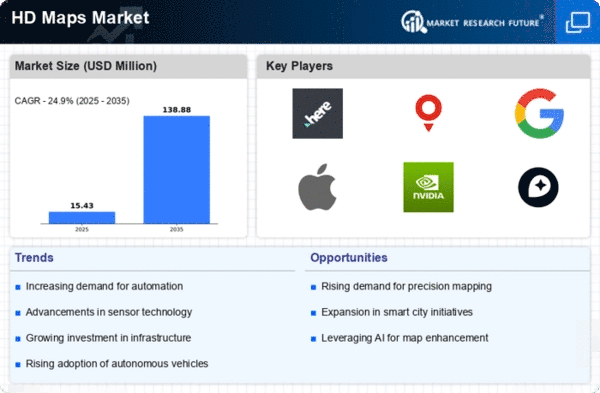
As per MRFR analysis, the HD Maps Market Size was estimated at 12.35 USD Million in 2024. The HD Maps industry is projected to grow from 15.03 in 2025 to 138.88 by 2035, exhibiting a compound annual growth rate (CAGR) of 24.9 during the forecast period 2025 - 2035.

Key Market Trends & Highlights

The HD Maps Market is poised for substantial growth driven by technological advancements and increasing integration with autonomous systems.

  • The market is witnessing a robust integration with autonomous vehicles, enhancing navigation and safety features.
  • Expansion into smart city applications is becoming a pivotal trend, facilitating improved urban mobility and infrastructure management.
  • Advancements in mapping technologies are enabling more precise and real-time data collection, which is crucial for various applications.
  • Rising demand for autonomous driving solutions and growth of smart city initiatives are key drivers propelling the market forward.

Market Size & Forecast

2024 Market Size 12.35 (USD Million)
2035 Market Size 138.88 (USD Million)
CAGR (2025 - 2035) 24.9%
Largest Regional Market Share in 2024 North America

Major Players

<p>HERE Technologies (NL), TomTom (NL), Google (US), Apple (US), NVIDIA (US), Mapbox (US), Waymo (US), Aurora (US), Continental (DE), Bosch (DE)</p>

Market Trends

The HD Maps Market is currently experiencing a transformative phase, driven by advancements in technology and the increasing demand for autonomous vehicles. As the automotive industry evolves, the necessity for precise and detailed mapping solutions becomes paramount. These high-definition maps provide critical information for navigation, obstacle detection, and route optimization, thereby enhancing the safety and efficiency of autonomous driving systems. Furthermore, the integration of artificial intelligence and machine learning into mapping processes is likely to improve the accuracy and reliability of these maps, making them indispensable for modern transportation systems. In addition to the automotive sector, the HD Maps Market is witnessing interest from various industries, including logistics, urban planning, and smart city initiatives. The ability to visualize and analyze geographic data in real-time offers significant advantages for decision-making and operational efficiency. As cities become more interconnected and reliant on technology, the demand for high-definition mapping solutions is expected to grow. This trend suggests a promising future for the HD Maps Market, as stakeholders recognize the value of accurate spatial data in enhancing urban infrastructure and mobility solutions.

Integration with Autonomous Vehicles

The HD Maps Market is increasingly aligned with the development of autonomous vehicles. These vehicles require highly accurate maps to navigate complex environments safely. The integration of HD maps into autonomous driving systems enhances their ability to interpret surroundings, leading to improved safety and efficiency.

Expansion into Smart City Applications

There is a growing trend of utilizing HD maps in smart city projects. These maps facilitate better urban planning and management by providing detailed geographic information. As cities aim to become more efficient and sustainable, the demand for HD mapping solutions in urban development is likely to rise.

Advancements in Mapping Technologies

Technological innovations are continuously shaping the HD Maps Market. The emergence of new mapping techniques, such as real-time data collection and enhanced imaging technologies, is expected to improve the quality and accessibility of HD maps. This evolution may lead to broader applications across various sectors.

HD Maps Market Market Drivers

Market Growth Projections

The Global HD Maps Market Industry is poised for substantial growth, with projections indicating a rise from 3.5 USD Billion in 2024 to 12 USD Billion by 2035. This growth trajectory suggests a compound annual growth rate (CAGR) of 11.85% from 2025 to 2035. Such figures highlight the increasing importance of HD maps in various applications, particularly in autonomous vehicles and smart transportation systems. The market's expansion is likely driven by technological advancements, regulatory support, and the growing demand for location-based services. As industries continue to recognize the value of accurate mapping, the Global HD Maps Market is expected to flourish in the coming years.

Advancements in Mapping Technologies

Technological innovations significantly influence the Global HD Maps Market Industry, as advancements in mapping technologies enhance the accuracy and reliability of HD maps. The integration of LiDAR, computer vision, and machine learning facilitates the creation of highly detailed maps that can adapt to changing environments. These innovations not only improve the quality of maps but also reduce the time and cost associated with map production. As a result, companies are increasingly investing in these technologies to maintain competitiveness. The ongoing evolution of mapping technologies is likely to propel the market forward, contributing to the projected growth from 3.5 USD Billion in 2024 to 12 USD Billion by 2035.

Rising Demand for Autonomous Vehicles

The Global HD Maps Market Industry experiences a surge in demand driven by the increasing adoption of autonomous vehicles. As manufacturers develop self-driving technology, the need for precise and detailed mapping becomes paramount. HD maps provide real-time data that enhances vehicle navigation and safety. In 2024, the market is projected to reach 3.5 USD Billion, reflecting the growing investment in autonomous driving solutions. By 2035, this figure is expected to escalate to 12 USD Billion, indicating a robust growth trajectory. The anticipated CAGR of 11.85% from 2025 to 2035 further underscores the industry's potential as it aligns with advancements in vehicle automation.

Government Initiatives and Regulations

Government initiatives and regulations play a crucial role in shaping the Global HD Maps Market Industry. Many countries are implementing policies that promote the development and deployment of HD mapping technologies, particularly in the context of smart city initiatives and transportation safety. For instance, regulatory bodies are establishing standards for HD maps to ensure interoperability among different systems. These initiatives not only foster innovation but also create a conducive environment for market growth. As governments recognize the importance of accurate mapping for autonomous vehicles and urban planning, the market is expected to benefit significantly, with a projected CAGR of 11.85% from 2025 to 2035.

Growing Demand for Location-Based Services

The Global HD Maps Market Industry is significantly influenced by the growing demand for location-based services across various sectors. Industries such as logistics, tourism, and real estate increasingly rely on accurate mapping for operational efficiency and customer engagement. HD maps provide the necessary precision for applications like route optimization, location tracking, and augmented reality experiences. As businesses recognize the value of location intelligence, investments in HD mapping technologies are likely to rise. This trend is expected to contribute to the market's expansion, with a projected CAGR of 11.85% from 2025 to 2035, reflecting the increasing integration of HD maps into diverse applications.

Increasing Investment in Smart Transportation

The Global HD Maps Market Industry is bolstered by the increasing investment in smart transportation systems. As cities worldwide strive to enhance mobility and reduce congestion, the integration of HD maps into transportation infrastructure becomes essential. Smart transportation systems leverage HD maps to optimize traffic flow, improve public transit, and enhance overall urban planning. This trend is evident in various global initiatives aimed at developing intelligent transportation networks. The market's growth is reflected in the projected increase from 3.5 USD Billion in 2024 to 12 USD Billion by 2035, indicating a strong commitment to investing in advanced mapping solutions that support smart city objectives.

Market Segment Insights

By Application: Autonomous Vehicles (Largest) vs. Advanced Driver Assistance Systems (Fastest-Growing)

<p>The HD Maps Market is characterized by significant variation among its application segments. The largest share is held by Autonomous Vehicles, which dominate the landscape due to their integral role in enabling safe and efficient navigation. In contrast, Advanced Driver Assistance Systems (ADAS) are rapidly gaining traction, reflecting a shift towards enhanced safety features and better driver support systems. Other segments like Logistics and Fleet Management, Urban Planning, and Smart City Infrastructure also contribute to the market, yet they lag behind in share numbers. Driving growth in the HD Maps Market is the increasing demand for automated transport solutions and smart infrastructure. Autonomous Vehicles continue to drive innovation, leveraging advanced mapping technologies to ensure precise navigation and obstacle detection. Meanwhile, ADAS benefits from advancements in sensor technologies and government regulations advocating for safer driving environments, positioning it as the fastest-growing application. As urban regions embrace smart city initiatives, applications in urban planning and infrastructure development are expected to grow in relevance, although they currently account for a smaller market share.</p>

<p>Autonomous Vehicles (Dominant) vs. Advanced Driver Assistance Systems (Emerging)</p>

<p>In the HD Maps Market, Autonomous Vehicles emerge as the dominant application, distinguishing themselves through their reliance on highly accurate and detailed mapping for navigation. These vehicles utilize HD maps to achieve real-time positioning, ensuring that they can navigate complex environments with precision. As a result, the demand for HD mapping solutions continues to grow, driven by advancements in AI and machine learning. On the other hand, Advanced Driver Assistance Systems represent an emerging area within the market. While still in the growth phase, ADAS solutions enhance vehicle safety by providing features like lane-keeping assistance and adaptive cruise control, which rely on HD maps to function effectively. As both segments evolve, their interdependence on accurate mapping technology will be key to the future of mobility.</p>

By End Use: Automotive (Largest) vs. Construction (Fastest-Growing)

<p>The HD Maps market is predominantly driven by the automotive sector, which comprises a significant share of the market. Automotive applications leverage high-definition maps for advanced driver assistance systems (ADAS) and autonomous vehicle navigation. This sector's growth is further supported by increased investments in electric vehicles and the demand for smarter transportation systems. On the other hand, construction is emerging as a fast-growing segment, with HD maps facilitating project planning, site management, and real-time monitoring through precise geospatial data.</p>

<p>Automotive: Largest vs. Construction: Fastest-Growing</p>

<p>The automotive sector is currently the largest end-use segment within the HD Maps market, characterized by its demand for precision and accuracy in navigation for self-driving and connected vehicles. This dominance is fueled by technological advancements and the increasing integration of HD maps in vehicle systems. In contrast, the construction sector is gaining momentum as a fast-growing area where HD maps are becoming essential for site planning and execution. Construction companies are increasingly utilizing these maps for improved efficiency, risk management, and enhancement of on-site safety. With infrastructure development on the rise, both segments show promising potential for continued growth, although they cater to different needs within the market.</p>

By Technology: LiDAR (Largest) vs. Computer Vision (Fastest-Growing)

<p>The HD Maps Market is witnessing a significant shift in technology adoption, with LiDAR leading the segment with the largest market share. This technology has been pivotal in providing high-resolution mapping solutions, crucial for various applications, particularly in autonomous vehicles and smart transportation systems. Computer Vision, meanwhile, is rapidly gaining ground, driven by advancements in machine learning algorithms and increased demand for real-time processing capabilities in mapping applications. Its ability to interpret and analyze visual data efficiently positions it as the fastest-growing technology in this segment. Growth trends in the HD Maps Market are profoundly influenced by the rising adoption of autonomous vehicles and progressive enhancements in mapping technologies. LiDAR remains the cornerstone, offering precise spatial data, while Computer Vision is emerging due to its versatility in different environments and cost-effectiveness. The integration of these technologies, alongside others like Radar and Sensor Fusion, is igniting innovation, aiming to improve mapping accuracy and operational efficiency across various sectors, thus shaping the landscape of HD maps for the foreseeable future.</p>

<p>Technology: LiDAR (Dominant) vs. Computer Vision (Emerging)</p>

<p>LiDAR technology currently dominates the HD Maps Market, thanks to its unparalleled ability to deliver high-resolution, three-dimensional mapping necessary for precise navigation in autonomous vehicles. Its reliability and accuracy have made it indispensable in sectors such as automotive and urban planning. On the other hand, Computer Vision is emerging as a game-changer with its capacity to process visual data swiftly and effectively. It combines real-time analytics with operational efficiency, making it suitable for a broader range of applications beyond traditional mapping. As the market increasingly gravitates towards integrating these technologies, their complementary characteristics will play a critical role in enhancing the functionality of HD maps, meeting the evolving needs of various industries.</p>

By Data Type: Static Data (Largest) vs. Dynamic Data (Fastest-Growing)

<p>In the HD Maps market, static data holds the largest share, primarily due to its foundational role in map creation and navigation systems. Static data includes the geographic information that does not change frequently, contributing to a stable user experience. On the other hand, dynamic data is gaining traction as it allows for real-time updates and adaptability, catering to the growing need for up-to-date and responsive navigation systems. The integration of both data types supports a more comprehensive mapping solution that meets the demands of various applications. The growth of the HD Maps market is significantly driven by the increasing adoption of autonomous vehicles and advanced driver-assistance systems (ADAS). Dynamic data is recognized as the fastest-growing segment due to its capability to provide timely information about traffic conditions, obstacles, and environmental changes. Furthermore, the demand for real-time data in navigation applications, coupled with advancements in mapping technology, fuels the overall growth of the HD Maps market in this data-centric landscape.</p>

<p>Static Data (Dominant) vs. Real-Time Data (Emerging)</p>

<p>Static data is a dominant force in the HD Maps market as it serves as the cornerstone for most mapping applications. This type includes comprehensive details about roads, landmarks, and other fixed geographic features essential for navigation and route planning. Its stability and reliability make it invaluable for foundational mapping services. On the other hand, real-time data is an emerging segment that is rapidly gaining importance as users increasingly demand instantaneous updates for better navigation. This data type includes live traffic conditions, weather updates, and dynamic routing information that enhance the overall user experience. While static data ensures a solid framework, real-time data adds an essential layer of responsiveness that modern users seek in an evolving digital environment.</p>

By Deployment Type: Cloud-Based (Largest) vs. Hybrid (Fastest-Growing)

<p>In the HD Maps Market, the deployment type segment is primarily divided between cloud-based, on-premises, and hybrid solutions. Cloud-based deployment currently holds the largest market share, as it offers advantages like scalability, cost efficiency, and ease of access. On-premises solutions, while stable, are gradually declining in preference due to higher maintenance costs and limited flexibility. Hybrid deployment is emerging as a viable alternative, providing a balance between cloud and on-premises solutions and catering to diverse customer needs.</p>

<p>Cloud-Based (Dominant) vs. Hybrid (Emerging)</p>

<p>Cloud-based deployment is characterized by its capacity to deliver HD maps via internet-based services, enabling real-time updates and data sharing across multiple platforms. This segment has become dominant due to the increasing demand for efficient and scalable solutions in navigation and autonomous vehicle applications. On the other hand, hybrid deployment, which combines the benefits of both cloud and on-premises systems, is emerging as a strong contender. It provides businesses with flexibility, allowing them to harness the security of on-premises infrastructure while still enjoying the advantages of cloud capabilities, making it an appealing option for companies that prioritize both control and adaptability.</p>

Get more detailed insights about HD Maps Market Research Report - Global Forecast till 2035

Regional Insights

North America : Market Leader in HD Maps

North America continues to lead the HD Maps market, holding a significant share of 5.0 in 2024. The region's growth is driven by rapid advancements in autonomous vehicle technology, increasing demand for precise navigation, and supportive regulatory frameworks. Government initiatives promoting smart city developments and infrastructure upgrades further catalyze market expansion. The integration of AI and machine learning in mapping technologies is also a key growth driver, enhancing accuracy and user experience. The competitive landscape in North America is robust, featuring major players like Google, Apple, and NVIDIA. These companies are investing heavily in R&D to innovate and improve their mapping solutions. The presence of tech giants and automotive leaders fosters a collaborative environment, driving advancements in HD mapping technologies. As the market evolves, partnerships and acquisitions are expected to shape the competitive dynamics, ensuring sustained growth in this region.

Europe : Emerging Hub for Innovation

Europe is emerging as a significant player in the HD Maps market, with a market size of 3.5. The region benefits from stringent regulations aimed at enhancing road safety and environmental sustainability, which drive demand for high-quality mapping solutions. The European Union's focus on digital transformation and smart mobility initiatives further supports market growth. Additionally, the increasing adoption of electric and autonomous vehicles is creating a surge in demand for accurate HD maps, positioning Europe as a key market player. Leading countries in this region include Germany, France, and the UK, where companies like HERE Technologies and TomTom are at the forefront of innovation. The competitive landscape is characterized by a mix of established firms and startups, fostering a dynamic environment for technological advancements. Collaborations between automotive manufacturers and mapping companies are becoming more common, enhancing the development of integrated mapping solutions. "The European market is poised for significant growth as we embrace digital transformation in transportation," European Commission report.

Asia-Pacific : Rapidly Growing Market Potential

The Asia-Pacific region is witnessing rapid growth in the HD Maps market, with a market size of 2.5. This growth is fueled by increasing urbanization, rising vehicle ownership, and advancements in technology. Countries like China and Japan are leading the charge, driven by government initiatives promoting smart transportation and autonomous vehicles. The demand for high-precision maps is also being propelled by the growing logistics and delivery sectors, which require accurate navigation solutions for efficiency. China stands out as a key player, with companies like Baidu and Alibaba investing heavily in HD mapping technologies. The competitive landscape is evolving, with both local and international players vying for market share. As the region continues to embrace digital transformation, partnerships between tech firms and automotive manufacturers are expected to enhance the development of innovative mapping solutions. The future of HD maps in Asia-Pacific looks promising, with significant investments anticipated in the coming years.

Middle East and Africa : Emerging Market with Potential

The Middle East and Africa region is gradually emerging in the HD Maps market, with a market size of 1.35. The growth is driven by increasing investments in smart city projects and infrastructure development. Governments are recognizing the importance of accurate mapping solutions for urban planning and transportation efficiency. Additionally, the rise in mobile technology adoption is creating new opportunities for HD map applications, particularly in logistics and transportation sectors. Countries like the UAE and South Africa are leading the way in adopting HD mapping technologies. The competitive landscape is still developing, with a mix of local startups and international players entering the market. As the region continues to invest in technology and infrastructure, the demand for HD maps is expected to grow, presenting significant opportunities for both established companies and new entrants. "Investments in smart infrastructure are crucial for the region's growth in HD mapping technologies," Middle East Development report.

Key Players and Competitive Insights

The HD Maps Market is currently characterized by a dynamic competitive landscape, driven by advancements in technology and increasing demand for high-precision mapping solutions. Key players such as HERE Technologies (NL), TomTom (NL), and Google (US) are at the forefront, each adopting distinct strategies to enhance their market positioning. HERE Technologies (NL) focuses on partnerships with automotive manufacturers to integrate its mapping solutions into autonomous vehicles, thereby solidifying its role in the burgeoning self-driving sector. Meanwhile, TomTom (NL) emphasizes innovation in real-time traffic data and navigation services, which enhances its competitive edge in urban mobility solutions. Google (US), leveraging its vast data resources, continues to refine its mapping algorithms, aiming to provide unparalleled accuracy and user experience, which collectively shapes a highly competitive environment.

The business tactics employed by these companies reflect a concerted effort to optimize operations and enhance service delivery. Localizing manufacturing and supply chain optimization are prevalent strategies, allowing companies to respond swiftly to regional demands. The market structure appears moderately fragmented, with several players vying for dominance, yet the collective influence of major companies like HERE Technologies (NL) and Google (US) suggests a trend towards consolidation, as they seek to leverage synergies and expand their technological capabilities.

In November 2025, HERE Technologies (NL) announced a strategic partnership with a leading automotive manufacturer to develop a next-generation HD mapping platform tailored for electric vehicles. This collaboration is poised to enhance the accuracy of navigation systems, thereby improving the overall driving experience and supporting the transition to sustainable transportation. The strategic importance of this partnership lies in its potential to position HERE as a key player in the electric vehicle ecosystem, aligning with global sustainability goals.

In October 2025, TomTom (NL) launched an innovative traffic management solution that utilizes AI to predict traffic patterns and optimize routing for urban areas. This initiative not only enhances the efficiency of urban mobility but also underscores TomTom's commitment to leveraging technology for smarter city solutions. The strategic significance of this development is evident in its potential to attract municipal contracts, thereby expanding TomTom's market reach and reinforcing its competitive stance.

In December 2025, Google (US) unveiled an upgraded version of its mapping service, incorporating advanced machine learning algorithms to improve real-time data accuracy. This enhancement is expected to significantly elevate user engagement and satisfaction, further entrenching Google’s dominance in the mapping sector. The strategic importance of this upgrade lies in its ability to differentiate Google from competitors, as it continues to innovate in a rapidly evolving market.

As of December 2025, the competitive trends in the HD Maps Market are increasingly defined by digitalization, sustainability, and AI integration. Strategic alliances are becoming pivotal, as companies recognize the need to collaborate to enhance technological capabilities and market reach. Looking ahead, competitive differentiation is likely to evolve from traditional price-based competition to a focus on innovation, technology, and supply chain reliability, as companies strive to meet the growing demands of a tech-savvy consumer base.

Key Companies in the HD Maps Market include

Industry Developments

  • Q2 2024: HERE Technologies launches HD Live Map for China to support autonomous vehicle development HERE Technologies announced the launch of its HD Live Map in China, expanding its high-definition mapping services to support the development and deployment of autonomous vehicles in the Chinese market.
  • Q2 2024: TomTom and Microsoft expand partnership to deliver HD maps for autonomous vehicles TomTom and Microsoft announced an expanded partnership to integrate TomTom’s HD maps with Microsoft’s Azure cloud platform, aiming to accelerate the development of autonomous driving solutions.
  • Q2 2024: NVIDIA and Baidu partner to enhance HD mapping for autonomous driving in China NVIDIA and Baidu announced a partnership to leverage NVIDIA’s DRIVE platform and Baidu’s Apollo ecosystem to improve the quality and coverage of HD maps for autonomous vehicles in China.
  • Q3 2024: Mobileye secures contract with major European automaker for HD mapping services Mobileye, an Intel company, announced it has secured a contract to provide its Road Experience Management (REM) HD mapping technology to a leading European automaker for use in next-generation driver assistance and autonomous systems.
  • Q3 2024: Waymo launches next-generation HD mapping platform for urban autonomous driving Waymo unveiled its latest HD mapping platform designed to improve localization and navigation for autonomous vehicles operating in complex urban environments.
  • Q3 2024: DeepMap raises $50 million Series C to scale HD mapping for autonomous vehicles DeepMap, a provider of high-definition mapping solutions for autonomous vehicles, announced it has raised $50 million in Series C funding to expand its engineering team and accelerate product development.
  • Q4 2024: Apple acquires HD mapping startup for undisclosed sum to bolster autonomous vehicle efforts Apple confirmed the acquisition of a Silicon Valley-based HD mapping startup, aiming to enhance its capabilities in autonomous vehicle navigation and localization.
  • Q4 2024: Bosch and NavInfo announce joint venture to develop HD maps for China’s autonomous vehicle market Bosch and NavInfo announced the formation of a joint venture focused on creating and maintaining high-definition maps tailored for autonomous vehicles in China.
  • Q1 2025: Toyota invests in HD mapping startup to accelerate autonomous driving development Toyota announced a strategic investment in a leading HD mapping startup, aiming to integrate advanced mapping technologies into its autonomous vehicle development program.
  • Q1 2025: HERE Technologies wins contract to supply HD maps for new European autonomous truck fleet HERE Technologies secured a contract to provide its HD mapping solutions for a newly launched autonomous truck fleet operating across major European logistics corridors.
  • Q2 2025: NVIDIA launches real-time HD mapping service for autonomous vehicles NVIDIA introduced a new real-time HD mapping service designed to provide up-to-date, centimeter-level accurate maps for autonomous vehicles, leveraging its AI and cloud infrastructure.
  • Q2 2025: DeepMap acquired by major automotive supplier to integrate HD mapping into ADAS platforms DeepMap was acquired by a leading global automotive supplier, with plans to integrate DeepMap’s HD mapping technology into advanced driver-assistance systems (ADAS) and autonomous vehicle platforms.

Future Outlook

HD Maps Market Future Outlook

<p>The HD Maps Market is projected to grow at a 24.9% CAGR from 2024 to 2035, driven by advancements in autonomous vehicles, increased demand for navigation solutions, and enhanced data analytics capabilities.</p>

New opportunities lie in:

  • <p>Development of subscription-based HD map services for automotive manufacturers.</p>
  • <p>Integration of real-time traffic data into HD mapping solutions.</p>
  • <p>Partnerships with tech firms for AI-driven map updates and enhancements.</p>

<p>By 2035, the HD Maps Market is expected to be a pivotal component of the autonomous vehicle ecosystem.</p>

Market Segmentation

HD Maps Market End Use Outlook

  • Automotive
  • Aerospace
  • Construction
  • Telecommunications
  • Public Safety

HD Maps Market Data Type Outlook

  • Static Data
  • Dynamic Data
  • Map Updates
  • 3D Mapping
  • Real-Time Data

HD Maps Market Technology Outlook

  • LiDAR
  • Computer Vision
  • Radar
  • GPS
  • Sensor Fusion

HD Maps Market Application Outlook

  • Autonomous Vehicles
  • Advanced Driver Assistance Systems
  • Logistics and Fleet Management
  • Urban Planning
  • Smart City Infrastructure

HD Maps Market Deployment Type Outlook

  • Cloud-Based
  • On-Premises
  • Hybrid

Report Scope

MARKET SIZE 202412.35(USD Million)
MARKET SIZE 202515.03(USD Million)
MARKET SIZE 2035138.88(USD Million)
COMPOUND ANNUAL GROWTH RATE (CAGR)24.9% (2024 - 2035)
REPORT COVERAGERevenue Forecast, Competitive Landscape, Growth Factors, and Trends
BASE YEAR2024
Market Forecast Period2025 - 2035
Historical Data2019 - 2024
Market Forecast UnitsUSD Million
Key Companies ProfiledHERE Technologies (NL), TomTom (NL), Google (US), Apple (US), NVIDIA (US), Mapbox (US), Waymo (US), Aurora (US), Continental (DE), Bosch (DE)
Segments CoveredApplication, End Use, Technology, Data Type, Deployment Type
Key Market OpportunitiesIntegration of artificial intelligence in HD Maps Market enhances navigation accuracy and user experience.
Key Market DynamicsRising demand for autonomous vehicles drives innovation and competition in the HD Maps market.
Countries CoveredNorth America, Europe, APAC, South America, MEA

FAQs

What is the predicted value of the global high definition maps market?

The global high definition maps market is predicted to hold a substantial value during the forecast period.

At what CAGR is the global high definition maps market is likely to flourish?

The global high definition maps is estimated to flourish at a decent CAGR during the forecast period.

Which region is likely to dominate the global high definition market?

According to the study, North America is projected to dominate the market. On the other hand, the APAC region is estimated to be the fastest-growing market.

On what basis is the global high definition maps market segmented?

The global high definition maps market can be segmented on the basis of component, deployment, end—user, and region.

What are the renowned names of the global high definition maps market?

The most renowned names of the global high definition maps market are Here Technologies Inc. (The Netherlands), TomTom NV (The Netherlands), Google (US), Alibaba (China), NavInfo (China), The Sanborn Map Company (US), Mapmyindia (India), Deepmap, Inc. (US), Momenta (US), Navmii (UK), Mapbox (US), Civil Maps (US), RMSI (India), Genesys International Corporation Ltd (India) and Cyient Inc. (India).

  1. Executive Summary
  2. Scope of the Report
    1. Market Definition
    2. Scope of the Study
      1. Research Objectives
      2. Assumptions & Limitations
    3. Markets Structure
  3. Market Research
    1. Methodology
    2. Research Process
    3. Secondary Research
    4. Primary
    5. Research
    6. Forecast Model
  4. Market Landscape
    1. Porter’s
      1. Threat of New Entrants
      2. Bargaining Power
      3. Threat of Substitutes
      4. Intensity of Rivalry
    2. Five Forces Analysis
    3. of Buyers
    4. Bargaining Power of Suppliers
    5. Value Chain/Supply Chain of the Global HD
    6. Maps Market
  5. Market Dynamics of the Global HD Maps Market
    1. Market
      1. Increasing Investment by Start-UPS in Development of HD Maps
      2. Growing Trend of Autonomous Cars
    2. Drivers
    3. Market Restraints
      1. Limited
    4. Standardization in HD Maps
    5. Market Opportunities
      1. Advancement
    6. in 5G Technology
    7. Market Challenges
      1. Legal & Privacy Issues
      2. High Cost of Technology
    8. Related HD Maps
  6. Market Trends
    1. Introduction
    2. Impact Analysis of Emerging Technologies
    3. Best Practices
    4. and Use Cases
  7. Global HD Maps Market, by Component
    1. Introduction
    2. Hardware
      1. Market Estimates & Forecast, 2020–2027
  8. Market Estimates & Forecast, by Region, 2020–2027
    1. & Forecast, by Region, 2020–2027
    2. (GPS)
  9. Camera
  10. Market Estimates & Forecast, 2020–2027
  11. Market Estimates
  12. Global Positioning System
  13. Market Estimates & Forecast, 2020–2027
  14. Market Estimates & Forecast, by Region, 2020–2027
    1. inertial measurement unit (IMU)
    2. Others
  15. LIDAR and
  16. Market Estimates & Forecast, 2020–2027
  17. Market Estimates & Forecast, by Region, 2020–2027
  18. Market Estimates & Forecast, 2020–2027
  19. Market Estimates & Forecast, by Region, 2020–2027
    1. Software
      1. Market Estimates & Forecast, 2020–2027
      2. Market Estimates
    2. & Forecast, by Region, 2020–2027
    3. Service
      1. Market Estimates
      2. Market Estimates & Forecast, by Region,
      3. Mapping and Localization
      4. Updates & Maintenance
      5. Advertisement
    4. & Forecast, 2020–2027
    5. & Forecast, 2020–2027
    6. Region, 2020–2027
    7. Estimates & Forecast, 2020–2027
    8. by Region, 2020–2027
    9. & Forecast, 2020–2027
    10. Region, 2020–2027
  20. Global HD Maps Market, by Deployment
    1. Introduction
    2. On-Cloud
      1. Market Estimates & Forecast, 2020–2027
  21. Market Estimates & Forecast, by Region, 2020–2027
    1. On-Premise
      1. Market Estimates & Forecast, 2020–2027
      2. Market Estimates
    2. & Forecast, by Region, 2020–2027
  22. Global HD Maps Market, by End-User
    1. Introduction
    2. Automotive
      1. Market Estimates & Forecast,
      2. Market Estimates & Forecast, by Region, 2020–2027
    3. Defense & Aerospace
      1. Market Estimates & Forecast, 2020–2027
      2. Market Estimates & Forecast, by Region, 2020–2027
    4. Internet
      1. Market Estimates & Forecast, 2020–2027
      2. Market Estimates & Forecast, by Region, 2020–2027
    5. Service Providers
    6. Others
      1. Market Estimates & Forecast, 2020–2027
      2. Market Estimates
    7. & Forecast, by Region, 2020–2027
  23. Global HD Maps Market, by Region
    1. Introduction
    2. North America
      1. Market Estimates & Forecast,
      2. Market Estimates & Forecast, by Component,
      3. Market Estimates & Forecast, by Deployment, 2020–2027
      4. Market Estimates & Forecast, by End-User, 2020–2027
    3. by Country, 2020–2027
    4. US
  24. Market Estimates & Forecast, by End-User, 2020–2027
  25. Canada
  26. Market Estimates & Forecast, by Component, 2020–2027
  27. Market Estimates & Forecast, by Deployment, 2020–2027
    1. Estimates & Forecast, by End-User, 2020–2027
  28. Market
  29. Mexico
  30. Market Estimates & Forecast, by Component, 2020–2027
    1. Estimates & Forecast, by Deployment, 2020–2027
    2. & Forecast, by End-User, 2020–2027
    3. Estimates & Forecast, by Country, 2020–2027
    4. & Forecast, by Component, 2020–2027
    5. Forecast, by Deployment, 2020–2027
    6. by End-User, 2020–2027
    7. & Forecast, by Component, 2020–2027
    8. Forecast, by Deployment, 2020–2027
    9. by End-User, 2020–2027
    10. Forecast, by Component, 2020–2027
    11. by Deployment, 2020–2027
    12. End-User, 2020–2027
    13. by Component, 2020–2027
    14. Deployment, 2020–2027
    15. by Component, 2020–2027
    16. Deployment, 2020–2027
    17. by Component, 2020–2027
    18. Deployment, 2020–2027
    19. Forecast, by Component, 2020–2027
    20. by Deployment, 2020–2027
    21. End-User, 2020–2027
    22. Forecast, by Country, 2020–2027
    23. by Component, 2020–2027
  31. Market
  32. Market Estimates
    1. Europe
      1. Market
      2. Market Estimates
      3. Market Estimates &
      4. Market Estimates & Forecast,
      5. Germany
      6. France
      7. UK
      8. Italy
      9. Spain
      10. Rest of Europe
    2. Asia-Pacific
      1. Market Estimates &
      2. Market Estimates & Forecast,
      3. Market Estimates & Forecast, by Deployment,
      4. Market Estimates & Forecast, by End-User, 2020–2027
      5. China
  33. Market Estimates & Forecast, by End-User, 2020–2027
  34. India
  35. Market Estimates & Forecast, by Component, 2020–2027
  36. Market Estimates & Forecast, by Deployment, 2020–2027
    1. Estimates & Forecast, by End-User, 2020–2027
  37. Market
  38. Japan
  39. Market Estimates & Forecast, by Component, 2020–2027
    1. Estimates & Forecast, by Deployment, 2020–2027
    2. & Forecast, by End-User, 2020–2027
  40. Market
  41. Market Estimates
  42. South Korea
  43. Market Estimates & Forecast, by Component, 2020–2027
    1. Estimates & Forecast, by Deployment, 2020–2027
    2. & Forecast, by End-User, 2020–2027
  44. Market
  45. Market Estimates
  46. Australia
  47. Market Estimates & Forecast, by Component, 2020–2027
    1. Estimates & Forecast, by Deployment, 2020–2027
    2. & Forecast, by End-User, 2020–2027
  48. Market
  49. Market Estimates
  50. Rest of Asia-Pacific
  51. Market Estimates & Forecast, by Component, 2020–2027
  52. Market Estimates & Forecast, by Deployment, 2020–2027
    1. Estimates & Forecast, by End-User, 2020–2027
  53. Market
    1. Rest of the World
      1. Market Estimates & Forecast, by Region, 2020–2027
  54. Market Estimates & Forecast, by Component, 2020–2027
    1. Estimates & Forecast, by Deployment, 2020–2027
    2. & Forecast, by End-User, 2020–2027
  55. Market
  56. Market Estimates
  57. Middle East and Africa
  58. Market Estimates & Forecast, by Component, 2020–2027
  59. Market Estimates & Forecast, by Deployment, 2020–2027
    1. Estimates & Forecast, by End-User, 2020–2027
  60. Market
  61. South America
  62. Market Estimates & Forecast, by Component, 2020–2027
  63. Market Estimates & Forecast, by Deployment, 2020–2027
    1. Estimates & Forecast, by End-User, 2020–2027
  64. Market
  65. Company Profiles
    1. Here Technologies
      1. Company Overview
      2. Product/Business
      3. Financial Updates
      4. Key Developments
      5. Key Strategies
    2. Segment Overview
    3. SWOT Analysis
    4. TomTom NV
      1. Company
      2. Product/Business Segment Overview
      3. Financial Updates
      4. Key Developments
      5. SWOT Analysis
      6. Key Strategies
    5. Overview
    6. Google
      1. Company Overview
      2. Product/Business Segment
      3. Financial Updates
      4. Key Developments
      5. Key Strategies
    7. Overview
    8. SWOT Analysis
    9. Alibaba
      1. Company Overview
      2. Product/Business Segment Overview
      3. Financial Updates
      4. SWOT Analysis
      5. Key Strategies
      6. Company Overview
      7. Product/Business Segment Overview
      8. Financial Updates
      9. Key Developments
      10. SWOT Analysis
      11. Key Strategies
    10. Key Developments
    11. NavInfo
    12. The Sanborn Map Company
      1. Company Overview
      2. Product/Business Segment Overview
      3. Financial Updates
      4. SWOT Analysis
      5. Key Strategies
      6. Company Overview
      7. Product/Business Segment Overview
      8. Financial Updates
      9. Key Developments
      10. SWOT Analysis
      11. Key Strategies
    13. Key Developments
    14. Mapmyindia
    15. Deepmap, Inc.
      1. Company Overview
      2. Product/Business Segment Overview
      3. Financial Updates
      4. SWOT Analysis
      5. Key Strategies
      6. Company Overview
      7. Product/Business Segment Overview
      8. Financial Updates
      9. Key Developments
      10. SWOT Analysis
      11. Key Strategies
    16. Key Developments
    17. Momenta
    18. Navmii
      1. Company Overview
      2. Financial Updates
      3. Key
      4. SWOT Analysis
      5. Key Strategies
    19. Product/Business Segment Overview
    20. Developments
    21. Mapbox
      1. Company Overview
      2. Product/Business Segment Overview
      3. Key Developments
      4. SWOT Analysis
    22. Financial Updates
    23. Key Strategies
    24. Civil Maps
      1. Company Overview
      2. Financial Updates
      3. Key
      4. SWOT Analysis
      5. Key Strategies
    25. Product/Business Segment Overview
    26. Developments
    27. RMSI
      1. Company Overview
      2. Product/Business Segment Overview
      3. Key Developments
      4. SWOT Analysis
    28. Financial Updates
    29. Key Strategies
    30. Genesys International Corporation Ltd
      1. Company
      2. Product/Business Segment Overview
      3. Financial Updates
      4. Key Developments
      5. SWOT Analysis
      6. Key Strategies
    31. Overview
    32. Cyient Inc.
      1. Company Overview
      2. Product/Business
      3. Financial Updates
      4. Key Developments
      5. SWOT Analysis
      6. Key Strategies
    33. Segment Overview
  66. Conclusion
  67. LIST OF TABLES
  68. Table1 Global HD Maps Market, by Country, 2020–2027
  69. Table2 North America: HD Maps Market, by Country, 2020–2027
    1. Table3
    2. Europe: HD Maps Market. by Country, 2020–2027
    3. Table4 Asia-Pacific: HD
    4. Maps Market by Country, 2020–2027
    5. Table5 North America: HD Maps Market,
    6. by Country
  70. Table6 North America: HD Maps Market, by Component
    1. Table7 North
  71. America: HD Maps Market, by Deployment
    1. Table8 North America: HD Maps Market,
    2. by End-User
  72. Table9 Europe: HD Maps Market, by Country
    1. Table10 Europe:
  73. HD Maps Market, by Component
  74. Table11 Europe: HD Maps Market, by Deployment
  75. Table12 Europe: HD Maps Market, by End-User
    1. Table13 Asia-Pacific: HD Maps
  76. Market, by Country
  77. Table14 Asia-Pacific: HD Maps Market, by Component
    1. Table15
  78. Asia-Pacific: HD Maps Market, by Deployment
    1. Table16 Asia-Pacific: HD Maps Market,
    2. by End-User
  79. Table17 Rest of the World: HD Maps Market, by Region
    1. Table18
  80. Rest of the World: HD Maps Market, by Component
    1. Table19 Rest of the World:
  81. HD Maps Market, by Deployment
    1. Table20 Rest of the World: HD Maps Market, by
    2. End-User
  82. LIST OF FIGURES
  83. Global HD Maps
    1. Market Segmentation
  84. Forecast Methodology
  85. Porter’s
    1. Five Forces Analysis of the Global HD Maps Market
  86. Value Chain of the
    1. Global HD Maps Market
  87. Share of the HD Maps Market in 2018, by country
    1. (in %)
  88. Global HD Maps Market, 2020–2027
  89. Global
  90. HD Maps Market Size, by Component, 2020–2027
  91. Share of the Global
  92. HD Maps Market, by Component, (in %)
  93. Global HD Maps Market size, by
    1. Deployment, 2020–2027
  94. Share of the Global HD Maps Market, by
    1. Deployment, (in %)
  95. Global HD Maps Market Size, by End-User, 2020–2027
  96. Share of the Global HD Maps Market, by End-User, (in %)

HD Maps Market Segmentation

Market Segmentation Overview

  • Detailed segmentation data will be available in the full report
  • Comprehensive analysis by multiple parameters
  • Regional and country-level breakdowns
  • Market size forecasts by segment
Infographic

Free Sample Request

Kindly complete the form below to receive a free sample of this Report

Get Free Sample

Customer Strories

Compare Licence

×
Features License Type
Single User Multiuser License Enterprise User
Price $4,950 $5,950 $7,250
Maximum User Access Limit 1 User Upto 10 Users Unrestricted Access Throughout the Organization
Free Customization
Direct Access to Analyst
Deliverable Format
Platform Access
Discount on Next Purchase 10% 15% 15%
Printable Versions