×
Hero Background
English
Chinese
French
Japanese
Korean
German
Spanish

Glyoxal Market Analysis

ID: MRFR/CnM/3333-HCR
139 Pages
Priya Nagrale
October 2025

Glyoxal Market by Application (Paper, Cross-Linking Polymer, Sulfur Scavenger, Wood Hardening and Others), by End Use (Oil & Gas, Paper Packaging, Leather, Textiles, Cosmetics, Furniture and Others) and by Region Forecast till 2035

Share:
Download PDF ×

We do not share your information with anyone. However, we may send you emails based on your report interest from time to time. You may contact us at any time to opt-out.

Glyoxal Market Infographic
Purchase Options

Market Analysis

In-depth Analysis of Glyoxal Market Industry Landscape

Many factors affect glyoxal demand, growth, and competition. Glyoxal is a versatile chemical molecule used in many goods. Glyoxal's use in textiles, resins, and other chemicals drives the market. It improves wrinkle resistance and colorfastness in textile finishing by crosslinking with proteins and fibers.

Glyoxal market dynamics are driven by the textile and garment sector. Glyoxal-based finishing chemicals are used due to textile functionality and sustainability concerns. As the textile industry prioritizes eco-friendly and high-performance solutions, glyoxal is becoming a popular fabric treatment. Glyoxal's robust and practical coatings meet textile industry needs.

Glyoxal market dynamics are heavily influenced by raw material prices and production costs. Glyoxal is created by oxidizing ethylene glycol, and raw material prices affect production costs. Manufacturers track these economic aspects to make educated decisions, adjust to cost fluctuations, and stay competitive in the glyoxal industry.

Environmental factors influence glyoxal market dynamics. Chemical industry operations and products are being scrutinized for environmental impact. This is prompting glycoxal makers to create eco-friendly formulas. Regulatory actions supporting eco-friendly chemicals and bio-based glyoxal help the sector move toward sustainability.

Technological advances drive glyoxal market dynamics. Research and development create new glyoxal formulations and applications, boosting its use in numerous industries. Technological innovation improves production methods, features, and customized solutions, giving producers tools to meet industry needs.

Industry leaders in the glyoxal market collaborate, merge, and acquire. Partnerships let organizations exchange expertise, harness strengths, and grow product offerings. These strategic actions boost innovation and glyoxal industry growth.

Consumer choices and market developments also influence glyoxal market dynamics. Textile and chemical processors want materials that balance performance, cost, and environmental responsibility. To meet these demands, manufacturers create glyoxal-based goods that are sustainable, useful, and eco-friendly.

Author
Priya Nagrale
Senior Research Analyst

With an experience of over five years in market research industry (Chemicals & Materials domain), I gather and analyze market data from diverse sources to produce results, which are then presented back to a client. Also, provide recommendations based on the findings. As a Senior Research Analyst, I perform quality checks (QC) for market estimations, QC for reports, and handle queries and work extensively on client customizations. Also, handle the responsibilities of client proposals, report planning, report finalization, and execution

Leave a Comment

FAQs

At what CAGR is the Glyoxal Market predicted to grow during the forecast period?

Glyoxal Market is predicted to grow at 5.20% CAGR through forecast period of 2025-2035.

What is the forecast period of Glyoxal Market research report?

The forecast period for Glyoxal Market research report is 2025-2035.

Which region will lead the global Glyoxal Market?

Glyoxal Market is dominated by APAC region.

What are the key factors driving the Glyoxal Market?

Rapid urbanization and growth of the middle-class population ensure in increasing the lifestyle standards of the urban population.

What are the key factors driving the Glyoxal Market?

BASF SE (Germany), Silver Fern Chemical Inc. (The U.S.), Eastman Chemical Company (The U.S.), The Dow Chemical Company (The U.S.), Huntsman Corporation (The U.S.), Formosa Plastics Corporation (Taiwan), Royal Dutch Shell plc (The Netherlands), Amzole India Private Limited (India), Hubei Hongyuan Pharmaceutical Technology Co., Ltd (China), Zhonglan Industry Co., Ltd (China)

Market Summary

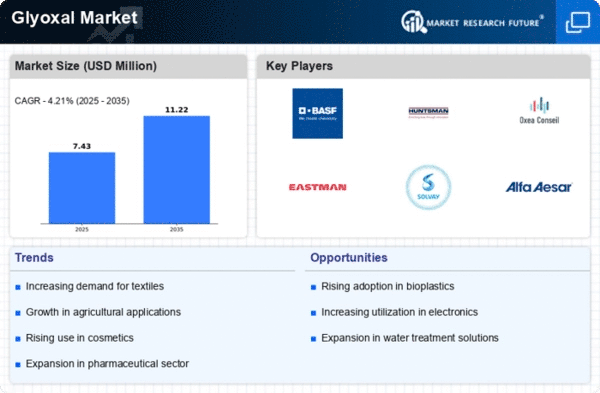
As per MRFR analysis, the Glyoxal Market Size was estimated at 7.13 USD Million in 2024. The Glyoxal industry is projected to grow from 7.43 in 2025 to 11.22 by 2035, exhibiting a compound annual growth rate (CAGR) of 4.21 during the forecast period 2025 - 2035.

Key Market Trends & Highlights

The Glyoxal Market is poised for growth driven by sustainability and diverse applications.

  • North America remains the largest market for glyoxal, primarily due to its extensive use in the textile industry.
  • Asia-Pacific is emerging as the fastest-growing region, fueled by increasing demand in pharmaceutical applications.
  • The textile segment continues to dominate the market, while the healthcare segment is witnessing rapid growth.
  • Key drivers include rising demand in the textile industry and increasing regulatory support for biodegradable chemicals.

Market Size & Forecast

2024 Market Size 7.13 (USD Million)
2035 Market Size 11.22 (USD Million)
CAGR (2025 - 2035) 4.21%
Largest Regional Market Share in 2024 Europe

Major Players

<p>BASF SE (DE), Huntsman Corporation (US), Oxea GmbH (DE), Eastman Chemical Company (US), Solvay S.A. (BE), Alfa Aesar (US), Merck KGaA (DE), Taminco (BE)</p>

Market Trends

The Glyoxal Market is currently experiencing a notable transformation, driven by various factors that influence its demand and supply dynamics. The increasing utilization of glyoxal in diverse applications, such as textiles, pharmaceuticals, and personal care products, appears to be a primary catalyst for market growth. Furthermore, the rising awareness regarding sustainable practices and eco-friendly alternatives is prompting manufacturers to explore innovative production methods. This shift towards sustainability may lead to the development of greener glyoxal production processes, which could enhance the market's appeal to environmentally conscious consumers. In addition, the Glyoxal Market seems to be benefiting from advancements in technology that facilitate more efficient production techniques. These innovations not only improve yield but also reduce waste, aligning with the global trend towards resource optimization. As industries continue to seek cost-effective solutions, the demand for high-quality glyoxal is likely to rise. Overall, the Glyoxal Market is poised for growth, with emerging trends indicating a shift towards sustainability and technological advancements that could reshape its landscape in the coming years.

Sustainability Initiatives

The Glyoxal Market is witnessing a growing emphasis on sustainability, as companies strive to adopt eco-friendly practices. This trend is characterized by the development of greener production methods and the use of renewable resources, which may appeal to environmentally conscious consumers.

Technological Advancements

Innovations in production technology are playing a crucial role in the Glyoxal Market. Enhanced manufacturing processes are likely to improve efficiency and reduce waste, thereby attracting industries seeking cost-effective and high-quality glyoxal solutions.

Diverse Application Growth

The expanding range of applications for glyoxal is contributing to market expansion. Its use in textiles, pharmaceuticals, and personal care products suggests a broadening scope that may drive demand across various sectors.

Glyoxal Market Market Drivers

Market Growth Projections

The Global Glyoxal Market Industry is projected to experience substantial growth in the coming years, with estimates indicating a market value of 1250 USD Million in 2024 and a potential increase to 2750 USD Million by 2035. This growth trajectory suggests a robust demand for glyoxal across various applications, driven by factors such as rising industrialization and increasing consumer awareness of sustainable products. The anticipated CAGR of 7.43% from 2025 to 2035 further underscores the market's potential, indicating a favorable environment for investment and development within the glyoxal sector.

Growth in Chemical Manufacturing

The Global Glyoxal Market Industry is significantly influenced by the growth in chemical manufacturing, where glyoxal serves as an essential intermediate in the production of various chemicals and pharmaceuticals. The increasing focus on specialty chemicals and the rising demand for agrochemicals contribute to this trend. As manufacturers seek to innovate and improve product formulations, glyoxal's versatility positions it as a key ingredient. The market is anticipated to grow at a CAGR of 7.43% from 2025 to 2035, reflecting the ongoing expansion of the chemical sector and its reliance on glyoxal as a crucial component.

Rising Demand in Textile Industry

The Global Glyoxal Market Industry experiences a notable surge in demand from the textile sector, where glyoxal is utilized as a finishing agent for cotton fabrics. This application enhances the durability and wrinkle resistance of textiles, making them more appealing to consumers. As the global textile market continues to expand, driven by increasing consumer preferences for high-quality fabrics, the glyoxal market is projected to reach 1250 USD Million in 2024. This growth is indicative of the broader trend towards sustainable and durable textile production, which is likely to further propel the Global Glyoxal Market Industry in the coming years.

Market Diversification and Innovation

The Global Glyoxal Market Industry is characterized by ongoing market diversification and innovation, as companies explore new applications for glyoxal across various sectors. This includes its use in the production of resins, adhesives, and coatings, which are essential in construction and automotive industries. The continuous exploration of glyoxal's potential applications is likely to drive market expansion, as manufacturers seek to leverage its unique properties. This innovative approach may lead to the development of new formulations and products, contributing to the overall growth of the glyoxal market. The industry's adaptability to emerging trends is a key driver of its future success.

Advancements in Healthcare Applications

The Global Glyoxal Market Industry benefits from advancements in healthcare applications, particularly in the development of glyoxal-based antiseptics and disinfectants. These products are gaining traction due to their effectiveness against a broad spectrum of pathogens. As healthcare facilities prioritize infection control and patient safety, the demand for glyoxal in medical applications is expected to rise. This trend aligns with the overall growth trajectory of the glyoxal market, which is projected to reach 2750 USD Million by 2035. The increasing emphasis on hygiene and safety in healthcare settings underscores the potential for glyoxal's applications in this sector.

Regulatory Support for Sustainable Chemicals

The Global Glyoxal Market Industry is positively impacted by regulatory support for sustainable chemicals, as governments worldwide implement policies promoting environmentally friendly practices. Glyoxal Market, being a biodegradable compound, aligns with these regulations, making it an attractive option for manufacturers seeking compliance. The push towards sustainability is likely to enhance the market's growth, as industries adopt greener alternatives. This regulatory environment fosters innovation and encourages the development of glyoxal-based products, further solidifying its position in the market. The anticipated growth of the glyoxal market reflects a broader shift towards sustainability in chemical production.

Market Segment Insights

By Application: Textile (Largest) vs. Pharmaceutical (Fastest-Growing)

<p>In the Glyoxal Market, the application segment is characterized by diverse yet interconnected domains. The textile industry secures the largest market share due to its extensive reliance on glyoxal for fabric finishing and dyeing processes. This sector capitalizes on glyoxal's effectiveness in enhancing fabric quality, leading to its prevalent use among manufacturers. Meanwhile, other applications like pharmaceuticals are rapidly rising, driven by increasing demand for glyoxal in drug production and formulations, reflecting a growing awareness of its benefits in the health sector. Growth trends in the Glyoxal Market emphasize the increasing adoption of glyoxal across various applications. The pharmaceutical sector is witnessing the fastest growth, spurred by innovations in drug development and the need for efficient formulation processes. Additionally, the textile application maintains stability as it continues to expand into sustainable practices, appealing to eco-conscious consumers while solidifying glyoxal's role in chemical formulations. The agriculture and cosmetics sectors are also gaining traction, driven by their specific requirements for quality and efficiency in product formulation and production.</p>

<p>Textile (Dominant) vs. Pharmaceutical (Emerging)</p>

<p>The textile and pharmaceutical applications of glyoxal represent two pivotal segments. The textile sector is dominant, utilizing glyoxal for its benefits in fabric enhancing properties, such as improving durability, and color retention, and reducing microbial growth. This application is supported by a long-standing integration of glyoxal in various textile processing methodologies. Conversely, the pharmaceutical sector is emerging, gradually harnessing glyoxal's potential in drug formulations and its utility as a key raw material in several pharmaceuticals. This upward trend is propelled by advancements in medical research and increased investments in pharmaceutical innovations, indicating a shift towards glyoxal's role as a versatile agent in enhancing drug efficacy and manufacturing processes.</p>

By End Use: Industrial (Largest) vs. Healthcare (Fastest-Growing)

<p>In the Glyoxal Market, the end-use segment distribution reveals that Industrial applications hold the largest market share, indicative of their predominant role in manufacturing processes. Commercial and Residential uses follow, indicating significant demand for glyoxal derivatives in various consumer products. The Research segment, while crucial, occupies a smaller share, primarily driven by specialized applications in laboratories and academic institutions. Healthcare showcases potential with increasing utilization in medical formulations and diagnostics, reflecting a shift towards more innovative applications in this sector. Growth trends for the Glyoxal Market are predominantly influenced by industrial demand. Innovations in glyoxal production and a rise in application in the healthcare sector signal robust growth opportunities. The push for sustainable and high-performance chemical solutions in industrial applications further bolsters this market segment. Coupled with ongoing research, advancements in glyoxal derivatives are likely to enhance market penetration in emerging sectors, particularly in healthcare, where demand for innovative solutions is accelerating.</p>

<p>Industrial (Dominant) vs. Healthcare (Emerging)</p>

<p>The Industrial segment of the Glyoxal Market is characterized by its extensive application in manufacturing processes, particularly in textiles, resins, and antifreeze agents. Dominating the market, it benefits from established supply chains and continuous innovations in industrial chemistry. The Greek oxidation process enhances production efficiency, supporting diverse industrial applications. Conversely, the Healthcare segment is emerging with rapid innovations in formulations for diagnostics and therapeutics. The growing trend toward biocompatibility and efficacy in medical solutions is driving glyoxal utilization in pharmaceuticals. As regulatory standards evolve, the Healthcare sector is likely to experience significant growth, fueled by the increasing need for better healthcare outcomes and personalized medicine, making it a critical area to watch in the glyoxal landscape.</p>

By Form: Liquid (Largest) vs. Solid (Fastest-Growing)

<p>In the Glyoxal Market, the distribution across different forms reveals that liquid glyoxal holds the largest share, making it the preferred choice among various applications like chemical synthesis and pharmaceuticals. Its established presence and versatility ensure a dominant market stance, allowing manufacturers to cater to diverse needs efficiently. Sweetening agent, preservatives, and anti-fungal agent applications further solidify liquid glyoxal’s position in the market. On the other hand, solid glyoxal is emerging as the fastest-growing segment within the market. This growth is driven by increasing demand in specialty chemicals and innovative manufacturing processes. As industries focus on enhancing production efficiency while minimizing environmental impact, solid glyoxal's unique properties offer significant advantages, positioning it favorably for future expansion within the market.</p>

<p>Liquid (Dominant) vs. Solid (Emerging)</p>

<p>Liquid glyoxal remains the dominant form in the Glyoxal Market due to its extensive use in various industrial applications, including production processes that require stability and reliability. Its fluid properties facilitate easy integration into existing frameworks in manufacturing, enhancing product quality and process efficiency. Conversely, solid glyoxal is positioned as an emerging player, appealing to sectors that prioritize innovative solutions. With increasing applications in biocides and antibacterial agents, solid glyoxal is attracting attention for its potential in niche markets. The growth of solid glyoxal is supported by advancements in production techniques and a shift towards sustainable solutions, making it a valuable alternative in the evolving landscape of glyoxal applications.</p>

By Production Method: Oxidation (Largest) vs. Hydrolysis (Fastest-Growing)

<p>The production method segment in the Glyoxal Market sees a noteworthy distribution among its major methods: oxidation, hydration, dehydrogenation, and hydrolysis. Oxidation method stands out as the largest contributor, dominating market share due to its well-established processes and extensive applications in various sectors. Other methods like hydration and hydrolysis also hold significant shares, with hydrolysis rapidly gaining traction as industries seek alternative production methods. Growth within the Glyoxal production methods is primarily driven by increasing demand for eco-friendly and efficient production techniques. As regulatory pressures mount and businesses aim for sustainability, hydrolysis is emerging as a preferred method among manufacturers, demonstrating considerable growth potential. Additionally, advancements in technology and increased research within oxidation processes continue to bolster their market presence.</p>

<p>Oxidation (Dominant) vs. Hydrolysis (Emerging)</p>

<p>Oxidation is a dominant production method in the Glyoxal Market, characterized by its efficiency and widely accepted application across diverse industries such as textiles, pharmaceuticals, and agriculture. This method benefits from established procedures that enhance product quality and consistency. On the other hand, Hydrolysis is considered an emerging production method, gaining momentum due to its environmentally friendly nature. As manufacturers increasingly prioritize sustainable approaches, hydrolysis presents a compelling alternative with fewer emissions and lower energy consumption. This dichotomy within the segment portrays a landscape where established practices vie against innovative, sustainable solutions aimed at capturing the evolving market demands.</p>

By Purity Level: High Purity (Largest) vs. Medium Purity (Fastest-Growing)

<p>In the Glyoxal Market, the purity level segments are characterized by distinct market share distributions. High Purity Glyoxal commands the largest share due to its vast applications in industries requiring chemical precision, such as pharmaceuticals and specialty chemicals. Medium Purity Glyoxal, while smaller in share, is gaining traction, particularly in applications that do not require the strict specifications of high purity but still demand reasonable quality. Low Purity Glyoxal maintains the smallest share, often utilized in less critical applications, limiting its growth potential.</p>

<p>Glyoxal: High Purity (Dominant) vs. Medium Purity (Emerging)</p>

<p>High Purity Glyoxal is predominantly used in applications that necessitate elevated chemical standards, thereby solidifying its position as the dominant segment in the market. This form is essential for producing various high-quality chemicals and is favored in sensitive industrial applications. On the other hand, Medium Purity Glyoxal is emerging as a valuable alternative, appealing to industries that balance cost-effectiveness with acceptable quality levels. Its versatile use in less sensitive applications is driving its popularity, positioning it for remarkable growth as industries seek affordable yet reliable chemical solutions.</p>

Get more detailed insights about Glyoxal Market Research Report- Forecast to 2035

Regional Insights

North America : Growing Demand and Innovation

The North American glyoxal market is poised for growth, driven by increasing demand in various applications such as textiles, pharmaceuticals, and agrochemicals. With a market size of $1.5 million, the region is witnessing a surge in innovation and product development. Regulatory support for sustainable chemical practices is also a catalyst for market expansion, as companies seek to align with environmental standards and consumer preferences. The United States leads the North American market, with key players like Huntsman Corporation and Eastman Chemical Company driving competition. The presence of established manufacturers and a robust supply chain further enhance market dynamics. As companies invest in R&D to develop advanced glyoxal products, the competitive landscape is expected to evolve, fostering growth and innovation in the sector.

Europe : Market Leader in Glyoxal Production

Europe holds the largest share of the glyoxal market, valued at $3.5 million, reflecting its strong industrial base and demand across various sectors. The region benefits from stringent regulations that promote the use of eco-friendly chemicals, driving manufacturers to innovate and comply with environmental standards. This regulatory landscape is a significant growth driver, encouraging investments in sustainable production methods. Germany and Belgium are key players in this market, with companies like BASF SE and Solvay S.A. leading the charge. The competitive landscape is characterized by a mix of established firms and emerging players, all vying for market share. The presence of advanced research institutions further supports innovation, ensuring that Europe remains at the forefront of glyoxal production and application development.

Asia-Pacific : Emerging Market with High Potential

The Asia-Pacific glyoxal market is rapidly expanding, with a market size of $2.0 million, driven by increasing industrialization and demand in textiles and pharmaceuticals. Countries like China and India are experiencing significant growth, supported by rising consumer demand and government initiatives to boost manufacturing. The region's regulatory environment is gradually evolving, promoting the use of safer and more sustainable chemicals, which is expected to further enhance market growth. China stands out as a leading country in the Asia-Pacific region, with major players like Oxea GmbH and Merck KGaA establishing a strong presence. The competitive landscape is becoming increasingly dynamic, with both local and international companies investing in production capabilities. As the market matures, innovation and strategic partnerships will play a crucial role in shaping the future of the glyoxal market in this region.

Middle East and Africa : Niche Market with Growth Opportunities

The Middle East and Africa glyoxal market is relatively small, with a market size of $0.13 million, but it presents unique growth opportunities. The region is witnessing a gradual increase in demand for glyoxal in various applications, including textiles and personal care products. As industrial activities expand, there is potential for regulatory frameworks to evolve, promoting the use of glyoxal in a more sustainable manner. Countries like South Africa and the UAE are beginning to explore the benefits of glyoxal, with local manufacturers showing interest in its applications. The competitive landscape is still developing, with few key players currently operating. However, as awareness of glyoxal's benefits grows, the market is expected to attract new entrants and investments, paving the way for future growth.

Key Players and Competitive Insights

The Glyoxal Market is currently characterized by a competitive landscape that is both dynamic and multifaceted. Key growth drivers include the increasing demand for glyoxal in various applications such as textiles, pharmaceuticals, and agrochemicals. Major players like BASF SE (DE), Huntsman Corporation (US), and Eastman Chemical Company (US) are strategically positioned to leverage their extensive product portfolios and technological capabilities. BASF SE (DE) focuses on innovation and sustainability, aiming to enhance its production processes while reducing environmental impact. Huntsman Corporation (US) emphasizes regional expansion and strategic partnerships to bolster its market presence, while Eastman Chemical Company (US) is investing in digital transformation to optimize its operations and supply chain efficiency. Collectively, these strategies shape a competitive environment that is increasingly focused on sustainability and technological advancement.

In terms of business tactics, companies are localizing manufacturing to better serve regional markets and optimize supply chains. The Glyoxal Market appears to be moderately fragmented, with several key players exerting influence over pricing and product availability. This competitive structure allows for a diverse range of offerings, although the presence of dominant players like BASF SE (DE) and Huntsman Corporation (US) suggests a potential for consolidation in the future.

In November 2025, BASF SE (DE) announced a significant investment in a new production facility aimed at increasing its glyoxal output by 30%. This strategic move is expected to enhance the company's capacity to meet rising global demand while reinforcing its commitment to sustainable practices. The investment not only positions BASF as a leader in production efficiency but also aligns with broader industry trends towards environmentally friendly manufacturing processes.

In October 2025, Huntsman Corporation (US) entered into a strategic partnership with a leading textile manufacturer to develop innovative glyoxal-based products. This collaboration is likely to enhance Huntsman's product offerings in the textile sector, tapping into the growing demand for sustainable and high-performance materials. The partnership underscores the importance of innovation in maintaining competitive advantage and responding to evolving market needs.

In September 2025, Eastman Chemical Company (US) launched a new digital platform designed to streamline its glyoxal supply chain. This initiative aims to improve operational efficiency and customer engagement, reflecting a broader trend towards digitalization in the chemical industry. By leveraging technology, Eastman is positioning itself to respond more effectively to market fluctuations and customer demands, thereby enhancing its competitive edge.

As of December 2025, current trends in the Glyoxal Market indicate a strong emphasis on digitalization, sustainability, and the integration of advanced technologies such as AI. Strategic alliances are increasingly shaping the competitive landscape, allowing companies to pool resources and expertise to drive innovation. Looking ahead, it is anticipated that competitive differentiation will evolve, with a shift from price-based competition to a focus on innovation, technology, and supply chain reliability. This transition may redefine market dynamics, compelling companies to adapt and innovate continuously to maintain their competitive positions.

Key Companies in the Glyoxal Market market include

Industry Developments

    • BASF SE (Germany) used a variety of organic and inorganic growth tactics to increase its market position. This main player used mergers and acquisitions as one of its key growth strategies to build and expand its regional presence to meet the growing demand for glyoxal from emerging and developed nations alike.
    • In January 2022, Cantabio Pharmaceuticals, Inc. also received an adequate amount of grant from the Michael J. Fox Foundation for the project research on Parkinson's Research. Cantabio's in-house drug development program is focusing on reducing biochemical stress, such as protein aggregation, oxidative, and glyoxal stress, which are the root causes of various aging-related illnesses.

Intended Audience

    • Global Glyoxal Market Manufacturers
    • Traders and Distributors of Global Glyoxal Market
    • Research and Development Institutes
    • Potential Investors
    • Raw Material Suppliers
    • Nationalized Laboratory

Future Outlook

Glyoxal Market Future Outlook

<p>The Glyoxal Market is projected to grow at a 4.21% CAGR from 2024 to 2035, driven by increasing demand in textiles, pharmaceuticals, and agrochemicals.</p>

New opportunities lie in:

  • <p>Expansion into biodegradable glyoxal derivatives for eco-friendly applications.</p>
  • <p>Development of glyoxal-based antimicrobial agents for healthcare products.</p>
  • <p>Investment in advanced production technologies to enhance efficiency and reduce costs.</p>

<p>By 2035, the Glyoxal Market is expected to achieve robust growth, positioning itself as a key player in various industries.</p>

Market Segmentation

Glyoxal Market Form Outlook

  • Liquid
  • Solid
  • Gas

Glyoxal Market End Use Outlook

  • Industrial
  • Commercial
  • Residential
  • Research
  • Healthcare

Glyoxal Market Application Outlook

  • Textile
  • Chemical
  • Pharmaceutical
  • Agriculture
  • Cosmetics

Glyoxal Market Purity Level Outlook

  • Low Purity
  • Medium Purity
  • High Purity

Glyoxal Market Production Method Outlook

  • Oxidation
  • Hydration
  • Dehydrogenation
  • Hydrolysis

Report Scope

MARKET SIZE 20247.13(USD Million)
MARKET SIZE 20257.43(USD Million)
MARKET SIZE 203511.22(USD Million)
COMPOUND ANNUAL GROWTH RATE (CAGR)4.21% (2024 - 2035)
REPORT COVERAGERevenue Forecast, Competitive Landscape, Growth Factors, and Trends
BASE YEAR2024
Market Forecast Period2025 - 2035
Historical Data2019 - 2024
Market Forecast UnitsUSD Million
Key Companies ProfiledBASF SE (DE), Huntsman Corporation (US), Oxea GmbH (DE), Eastman Chemical Company (US), Solvay S.A. (BE), Alfa Aesar (US), Merck KGaA (DE), Taminco (BE)
Segments CoveredApplication, End Use, Form, Production Method, Purity Level
Key Market OpportunitiesGrowing demand for eco-friendly glyoxal applications in textiles and pharmaceuticals presents significant opportunities.
Key Market DynamicsRising demand for eco-friendly products drives innovation and competition in the Glyoxal Market.
Countries CoveredNorth America, Europe, APAC, South America, MEA

FAQs

At what CAGR is the Glyoxal Market predicted to grow during the forecast period?

Glyoxal Market is predicted to grow at 5.20% CAGR through forecast period of 2025-2035.

What is the forecast period of Glyoxal Market research report?

The forecast period for Glyoxal Market research report is 2025-2035.

Which region will lead the global Glyoxal Market?

Glyoxal Market is dominated by APAC region.

What are the key factors driving the Glyoxal Market?

Rapid urbanization and growth of the middle-class population ensure in increasing the lifestyle standards of the urban population.

What are the key factors driving the Glyoxal Market?

BASF SE (Germany), Silver Fern Chemical Inc. (The U.S.), Eastman Chemical Company (The U.S.), The Dow Chemical Company (The U.S.), Huntsman Corporation (The U.S.), Formosa Plastics Corporation (Taiwan), Royal Dutch Shell plc (The Netherlands), Amzole India Private Limited (India), Hubei Hongyuan Pharmaceutical Technology Co., Ltd (China), Zhonglan Industry Co., Ltd (China)

  1. Executive Summary
    1. Scope of the Report
    2. Market Definition
      1. Research Objectives
    3. Scope of the Study
    4. Assumptions & Limitations
    5. Markets Structure
  2. Market Research Methodology
    1. Research
    2. Process
    3. Secondary Research
    4. Primary
    5. Research
    6. Forecast Model
  3. Market
    1. Landscape
    2. Five Forces Analysis
      1. Bargaining power of buyers
      2. Threat of substitutes
      3. Segment
    3. Threat of New Entrants
    4. rivalry
    5. Value Chain/Supply Chain of Global Glyoxal Market
  4. Industry Overview of Global Glyoxal Market
    1. Introduction
    2. Growth Drivers
    3. Impact analysis
    4. Market Challenges
    5. Market Trends
    6. Introduction
    7. Growth Trends
    8. Impact analysis
  5. Global
    1. Glyoxal Market by End Use Industry
    2. Introduction
      1. Market Estimates & Forecast, 2020-2027
      2. Market
    3. Paper
    4. Estimates & Forecast by Region, 2020-2027
    5. Cross
      1. Market Estimates & Forecast, 2020-2027
      2. Market Estimates & Forecast, 2020-2027
      3. Market Estimates & Forecast, 2020-2027
      4. Market Estimates & Forecast, 2020-2027
      5. Market Estimates
    6. linking polymer
    7. Market Estimates & Forecast by Region, 2020-2027
    8. Sulfur scavenger
    9. Market Estimates & Forecast by Region, 2020-2027
    10. Wood hardening
    11. Market Estimates & Forecast by Region, 2020-2027
    12. Others
    13. & Forecast by Region, 2020-2027
  6. Global Glyoxal Market by end
    1. use industry
    2. Introduction
    3. Oil
      1. Market Estimates & Forecast, 2020-2027
      2. Market
    4. & Gas
    5. Estimates & Forecast by Region, 2020-2027
    6. Paper packaging
      1. Market Estimates & Forecast, 2020-2027
      2. Market Estimates &
    7. Forecast by Region, 2020-2027
    8. Leather
      1. Market
      2. Market Estimates & Forecast by
    9. Estimates & Forecast, 2020-2027
    10. Region, 2020-2027
    11. Textiles
      1. Market Estimates
      2. Market Estimates & Forecast by Region,
    12. & Forecast, 2020-2027
    13. Cosmetics
      1. Market Estimates
      2. Market Estimates & Forecast by Region,
    14. & Forecast, 2020-2027
    15. Furniture
      1. Market Estimates
      2. Market Estimates & Forecast by Region,
    16. & Forecast, 2020-2027
    17. Others
      1. Market Estimates
      2. Market Estimates & Forecast by Region,
    18. & Forecast, 2020-2027
  7. Global Glyoxal Market by Region
    1. Introduction
    2. North America
      1. Market Estimates
      2. Market Estimates & Forecast by Application,
      3. Market Estimates & Forecast by End Use Industry, 2020-2027
      4. US
      5. Mexico
    3. & Forecast, 2020-2027
    4. Market Estimates & Forecast by End Use Industry, 2020-2027
    5. Canada
    6. Market Estimates & Forecast by Application, 2020-2027
    7. & Forecast by End Use Industry, 2020-2027
    8. & Forecast by Application, 2020-2027
    9. by End Use Industry, 2020-2027
    10. Europe
      1. Market
      2. Market Estimates & Forecast by
      3. Market Estimates & Forecast by End Use Industry,
      4. Germany
      5. France
      6. UK
    11. Estimates & Forecast, 2020-2027
    12. Application, 2020-2027
    13. Forecast, 2020-2027
    14. Italy
    15. Market Estimates & Forecast by Application, 2020-2027
    16. & Forecast by End Use Industry, 2020-2027
    17. & Forecast by Application, 2020-2027
    18. by End Use Industry, 2020-2027
    19. Asia Pacific
      1. Market Estimates & Forecast
      2. Market Estimates & Forecast by End Use
      3. China
      4. India
      5. Rest
    20. Market Estimates & Forecast, 2020-2027
    21. by Application, 2020-2027
    22. Industry, 2020-2027
    23. & Forecast, 2020-2027
    24. Market Estimates & Forecast by End Use Industry, 2020-2027
    25. Japan
    26. Market Estimates & Forecast by Application, 2020-2027
    27. & Forecast by End Use Industry, 2020-2027
    28. of Asia Pacific
    29. Market Estimates & Forecast by Application, 2020-2027
    30. & Forecast by End Use Industry, 2020-2027
    31. Middle
      1. Market Estimates & Forecast, 2020-2027
      2. Market Estimates & Forecast by Application, 2020-2027
      3. Market
      4. Saudi Arabia
      5. Qatar
      6. North Africa
      7. GCC
      8. Rest of Middle East & Africa
    32. East & Africa
    33. Estimates & Forecast by End Use Industry, 2020-2027
    34. & Forecast by Application, 2020-2027
    35. by End Use Industry, 2020-2027
    36. Forecast, 2020-2027
    37. Market Estimates & Forecast by End Use Industry, 2020-2027
    38. & Forecast by Application, 2020-2027
    39. by End Use Industry, 2020-2027
    40. & Forecast by Application, 2020-2027
    41. by End Use Industry, 2020-2027
    42. Latin America
      1. Market Estimates & Forecast
      2. Market Estimates & Forecast by End Use
      3. Brazil
      4. Argentina
      5. Rest of
    43. Market Estimates & Forecast, 2020-2027
    44. by Application, 2020-2027
    45. Industry, 2020-2027
    46. Forecast, 2020-2027
    47. Market Estimates & Forecast by End Use Industry, 2020-2027
    48. Latin America
    49. Market Estimates & Forecast by Application, 2020-2027
    50. & Forecast by End Use Industry, 2020-2027
  8. Company Landscape
    1. Company Profiles
    2. BASF SE
      1. Company
      2. Product/Business Segment Overview
      3. Key Developments
      4. Company Overview
      5. Product/Business Segment Overview
      6. Key Developments
      7. Company Overview
      8. Product/Business Segment Overview
      9. Key Developments
      10. Company
      11. Product/Business Segment Overview
      12. Key Developments
      13. Company
      14. Product/Business Segment Overview
      15. Key Developments
      16. Company
      17. Product/Business Segment Overview
      18. Key Developments
      19. Company Overview
      20. Product/Business Segment Overview
      21. Key Developments
      22. Company Overview
      23. Product/Business Segment Overview
      24. Key Developments
      25. Product/Business Segment Overview
      26. Financial Updates
      27. Key Developments
    3. Overview
    4. Financial Updates
    5. Silver Fern Chemical Inc.
    6. Financial Updates
    7. Eastman Chemical Company
    8. Financial Updates
    9. The Dow Chemical Company
    10. Overview
    11. Financial Updates
    12. Huntsman Corporation
    13. Overview
    14. Financial Updates
    15. Formosa Plastics Corporation
    16. Overview
    17. Financial Updates
    18. Royal Dutch Shell plc.
    19. Financial Updates
    20. Amzole India Private Limited
    21. Financial Updates
    22. Hubei Hongyuan Pharmaceutical Technology Co., Ltd
    23. Company Overview
    24. Zhonglan Industry Co., Ltd
      1. Company
      2. Product/Business Segment Overview
      3. Key Developments
    25. Overview
    26. Financial Updates
    27. Conclusion
    28. List of Tables:
  9. World
    1. Population by Major Regions (2020-2027)
  10. Global
    1. Glyoxal Market: By Region, 2020-2027
  11. North
    1. America Glyoxal Market: By Country, 2020-2027
  12. Europe
    1. Glyoxal Market: By Country, 2020-2027
  13. Asia-Pacific
    1. Glyoxal Market: By Country, 2020-2027
  14. Middle
    1. East & Africa Glyoxal Market: By Country, 2020-2027
    2. Table 7
    3. Latin America Glyoxal Market: By Country, 2020-2027
    4. Table 8
    5. Global Glyoxal by Application Market: By Regions, 2020-2027
    6. Table
  15. North America Glyoxal by Application Market: By Country,
    1. Table10 Europe Glyoxal by Application Market:
    2. By Country, 2020-2027
    3. Table11 Asia-Pacific Glyoxal
    4. by Application Market: By Country, 2020-2027
    5. Table12 Middle
    6. East & Africa Glyoxal by Application Market: By Country, 2020-2027
    7. Table13 Latin America Glyoxal by Application Market: By Country,
    8. Table14 Global Glyoxal by End Use Industry
    9. Market: By Regions, 2020-2027
    10. Table15 North America
    11. Glyoxal by End Use Industry Market: By Country, 2020-2027
    12. Table16
    13. Europe Glyoxal by End Use Industry Market: By Country, 2020-2027
    14. Table17 Asia-Pacific Glyoxal by End Use Industry Market: By
    15. Country, 2020-2027
    16. Table18 Middle East & Africa
    17. Glyoxal by End Use Industry Market: By Country, 2020-2027
    18. Table19
    19. Latin America Glyoxal by End Use Industry Market: By Country, 2020-2027
    20. Table20 Global Application Market: By Region, 2020-2027
  16. Table21 North America Glyoxal Market, By Country
    1. Table22
  17. North America Glyoxal Market, By Application
    1. Table23 North
  18. America Glyoxal Market, By End Use Industry
    1. Table24 Europe:
  19. Glyoxal Market, By Country
    1. Table25 Europe: Glyoxal
  20. Market, By Application
    1. Table26 Europe: Glyoxal Market, By
    2. End Use Industry
    3. Table27 Asia-Pacific: Glyoxal Market, By
    4. Country
  21. Table28 Asia-Pacific: Glyoxal Market, By Application
  22. Table29 Asia-Pacific: Glyoxal Market, By End Use Industry
  23. Table30 Middle East & Africa: Glyoxal Market, By Country
    1. Table31 Middle East & Africa Glyoxal Market, By
    2. Application
    3. Table32 Middle East & Africa Glyoxal Market,
    4. By End Use Industry
    5. Table33 Latin America: Glyoxal
  24. Market, By Country
    1. Table34 Latin America Glyoxal Market,
    2. By Application
  25. Table35 Latin America Glyoxal Market, By End
    1. Use Industry
    2. List Of Figures:
  26. Global
    1. Glyoxal market segmentation
  27. Forecast Methodology
    1. FIGURE
  28. Five Forces Analysis of Global Glyoxal Market
  29. Value
    1. Chain of Global Glyoxal Market
  30. Share of Global Glyoxal Market
    1. in 2020, by country (in %)
  31. Global Glyoxal Market, 2020-2027,
  32. Sub segments of Application
  33. Global Glyoxal
    1. Market size by Application, 2020
  34. Share of Global Glyoxal Market
    1. by Application, 2020-2027
  35. Global Glyoxal Market size by End
    1. Use Industry, 2020
  36. Share of Global Glyoxal Market by End Use
    1. Industry, 2020-2027

Glyoxal Market Segmentation

Market Segmentation Overview

  • Detailed segmentation data will be available in the full report
  • Comprehensive analysis by multiple parameters
  • Regional and country-level breakdowns
  • Market size forecasts by segment
Infographic

Free Sample Request

Kindly complete the form below to receive a free sample of this Report

Get Free Sample

Customer Strories

Compare Licence

×
Features License Type
Single User Multiuser License Enterprise User
Price $4,950 $5,950 $7,250
Maximum User Access Limit 1 User Upto 10 Users Unrestricted Access Throughout the Organization
Free Customization
Direct Access to Analyst
Deliverable Format
Platform Access
Discount on Next Purchase 10% 15% 15%
Printable Versions