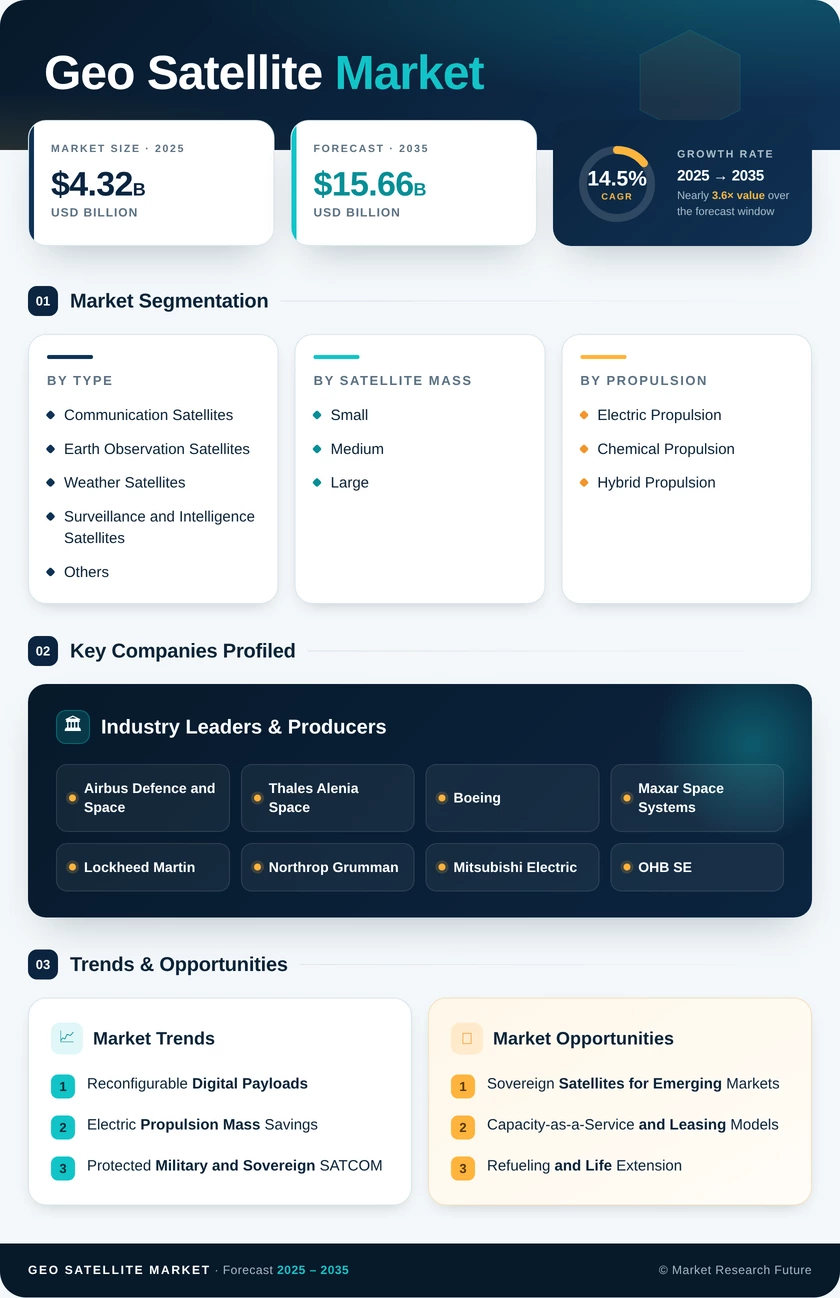
Segmentation Quick Reference
| Dimension | Sub-Segments | Dominant Segment | Fastest Growing Segment |
|---|
| By Satellite Type | Communication Satellites, Earth Observation Satellites, Weather Satellites, Surveillance and Intelligence Satellites, Others | Communication Satellites (57.6% share) | Earth Observation Satellites (16.5% CAGR) |
| By Satellite Mass | Small, Medium, Large | Large (49.2% share) | Medium (18.5% CAGR) |
| By Propulsion | Electric Propulsion, Chemical Propulsion, Hybrid Propulsion | Electric Propulsion (63.9% share) | Electric Propulsion (63.9% share) |
| By End User | Commercial, Government and Civil, Military | Commercial (55.4% share) | Military (16.2% CAGR) |
| By Region | North America, Europe, Asia-Pacific, South America, Middle East & Africa | North America (39.2% share) | Asia-Pacific (17.1% CAGR) |
Market Segmentation Overview
| Sub-Segment | Key Trend |
|---|
| Communication Satellites | Shift to reconfigurable digital payloads |
| Earth Observation Satellites | Continuous regional sensing for defense and climate |
| Weather Satellites | Multi-decade agency replacement programs |
| Surveillance and Intelligence Satellites | Persistent monitoring with protected links |
| Others | Navigation augmentation and technology demonstrations |
Communication Satellites lead with a 57.6% share because transponder leases and broadcast contracts lock in revenue for a decade or more. Earth Observation Satellites grow fastest at a 16.5% CAGR, since a fixed geostationary view supports hourly sensing that low-orbit revisits cannot provide. Weather Satellites add stable volume tied to agency procurement cycles.
| Sub-Segment | Key Trend |
|---|
| Small | Maneuverable government missions |
| Medium | Leased platforms with faster delivery |
| Large | High-capacity commercial anchor satellites |
Large platforms hold a 49.2% share because launch and insurance costs fall per transponder as bus size rises. Medium satellites grow fastest at an 18.5% CAGR, as operators trade some capacity for shorter build schedules and lease financing. Small platforms remain limited by power and antenna size at geostationary altitude.
| Sub-Segment | Key Trend |
|---|
| Electric Propulsion | Default for new commercial stationkeeping |
| Chemical Propulsion | Retained for rapid orbit raising |
| Hybrid Propulsion | Time-sensitive government programs |
Electric Propulsion leads on both share and growth at 63.9% of 2025 revenue, because thruster mass savings translate directly into extra payload. Chemical Propulsion stays relevant for defense satellites that cannot wait months to reach station. Hybrid Propulsion fills the gap where speed and efficiency both matter.
| Sub-Segment | Key Trend |
|---|
| Commercial | Broadcast, backhaul, and mobility capacity |
| Government and Civil | Meteorology and public connectivity |
| Military | Anti-jam, maneuverable protected SATCOM |
Commercial operators lead with a 55.4% share, buying capacity for broadcast, enterprise, maritime, and aviation networks. Military buyers grow fastest at a 16.2% CAGR as protected tactical waveforms move onto smaller maneuverable satellites. Government and Civil demand provides a steady baseline through weather and science missions.


 Noah Malgeri
Co-Founder

 Peter Groot koerkamp
Account and Business Manager

 Younghwan Choi
Senior Retail Manager

 Mark Irwin
Management Consultant

 Akif Moroglu
Strategy & Business Development Director

 Guilherme Gomes Martins
Product Management Director

 Joseph Aguayo
Sales Operations & Pricing Manager

 La Terria Dodd
Program Support Specialist

 Rob Kooiker
Group Product Manager HVAC & Fire Protection GMA